Quality Audit
What is an Quality Audit ?
 A systematic and independent examination to
determine whether quality activities and related
results comply with the planned arrangements, and
whether these arrangements are implemented
effectively and are suitable to achieve objective.
 A systematic, independent and documented process.
 To obtain audit evidence and evaluating it objectively
to determine the extent to which audit criteria are
fulfilled.
Why to perform quality audit?
 To check:-
1. Desired qualities and specifications of end product.
2. Whether equipments are working properly or not.
3. Whether specified quality procedures are being
followed or not.
4. The quality system element are adequate with
regards to specified requirements.
5. Regulation requirements are being met.
Course objectives
 What is an audit?
 How to prepare for and plan an audit
 How to conduct an audit
 How to report on an audit
 Course closing
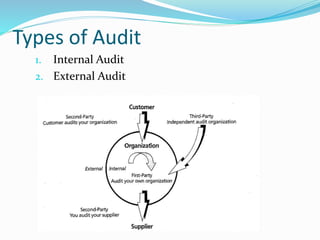
Types of Audit
1. Internal Audit
2. External Audit
Objective of Quality Audit
 Quality audits are meant to be assured about:-
1. Product’s safety and use.
2. Required quality is attended or not.
3. Specified standards by various industries and
Government Agencies are being followed.
4. Specifications are adhered to.
5. Adequate procedures are implemented and
followed.
6. Data system provides accurate and adequate
information at all stages.
7. Identification of deficiencies and corrective
action taken on it.
8. Improvement opportunities.
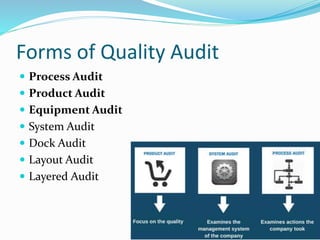
Forms of Quality Audit
 Process Audit
 Product Audit
 Equipment Audit
 System Audit
 Dock Audit
 Layout Audit
 Layered Audit
Process Audit
 A verification that processes are working within
established limit.
 It is an audit of the process (manufacturing) to ensure
accuracy in the manufacturing of product at first
attempt.
 It check conformance to defined requirements such as
time, accuracy, temperature, pressure .
 Examine the resources (equipment, material, people)
 To check the adequacy and effectiveness of process
 Improvement in the manufacturing process.
Product Audit
 It is an assurance of the quality of product to evaluate
its qualification for use and to conform the
specifications.
 It is a complete inspection of product.
 Due to this inspection, we can aim at improving the
quality, improving profitability and enhancing
customer satisfaction.
 It benefits both supplier and customer.
System Audit
Equipment Audit
 This audit is carried out to ensure that all the
machines and facilities are used in the production
process.
 It also ensures the capability of the machines to
produce the desired quality of product and all are kept
properly maintained in working condition.
Elements of Quality Audit
 Audit Purpose:-
Audit directed to product, process or equipment.
 Audit Team:-
1. The audit may be performed by a single person or by
a team depending upon the scope, extent and
complexity of investigation.
2. Internal audit is done by a single person while the
external audit is done by a group by a same
organisation or by different organisations.
 Audit Frequency:-
1. Audit may be done weekly, monthly, yearly or
unannounced.
2. Third party audits are performed for the best results.
 Audit Reporting:-
The result of audit may be provided as a raw data or with
the comparison with the indicative quality index or after
complete analysis with a corrective action plan.
 Audit Corrective Action:-
1. Audit is done to identify the possibilities of quality
improvement.
2. Results of audit must be analysed seriously and corrective
action should be done whenever is necessary.
Audit Report
 Audit report include:-
a. Purpose and scope of audit.
b. Activities audited.
c. Details of audit plan.
d. Standards, checks lists and documents used.
e. Audit observations, conclusions and
recommendations.
f. Improvement opportunities identified.
g. Follow up recommendations.
h. Improvement suggestions.
i. Distribution list for audit report.
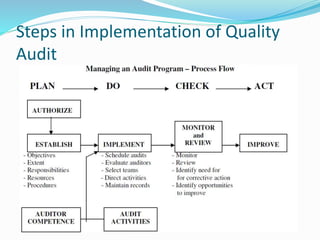
Steps in Implementation of Quality
Audit

Quality audit

  • 1.
  • 2.
    What is anQuality Audit ?  A systematic and independent examination to determine whether quality activities and related results comply with the planned arrangements, and whether these arrangements are implemented effectively and are suitable to achieve objective.  A systematic, independent and documented process.  To obtain audit evidence and evaluating it objectively to determine the extent to which audit criteria are fulfilled.
  • 3.
    Why to performquality audit?  To check:- 1. Desired qualities and specifications of end product. 2. Whether equipments are working properly or not. 3. Whether specified quality procedures are being followed or not. 4. The quality system element are adequate with regards to specified requirements. 5. Regulation requirements are being met.
  • 4.
    Course objectives  Whatis an audit?  How to prepare for and plan an audit  How to conduct an audit  How to report on an audit  Course closing
  • 5.
    Types of Audit 1.Internal Audit 2. External Audit
  • 6.
    Objective of QualityAudit  Quality audits are meant to be assured about:- 1. Product’s safety and use. 2. Required quality is attended or not. 3. Specified standards by various industries and Government Agencies are being followed. 4. Specifications are adhered to. 5. Adequate procedures are implemented and followed. 6. Data system provides accurate and adequate information at all stages. 7. Identification of deficiencies and corrective action taken on it. 8. Improvement opportunities.
  • 7.
    Forms of QualityAudit  Process Audit  Product Audit  Equipment Audit  System Audit  Dock Audit  Layout Audit  Layered Audit
  • 8.
    Process Audit  Averification that processes are working within established limit.  It is an audit of the process (manufacturing) to ensure accuracy in the manufacturing of product at first attempt.  It check conformance to defined requirements such as time, accuracy, temperature, pressure .  Examine the resources (equipment, material, people)  To check the adequacy and effectiveness of process  Improvement in the manufacturing process.
  • 9.
    Product Audit  Itis an assurance of the quality of product to evaluate its qualification for use and to conform the specifications.  It is a complete inspection of product.  Due to this inspection, we can aim at improving the quality, improving profitability and enhancing customer satisfaction.  It benefits both supplier and customer.
  • 10.
  • 11.
    Equipment Audit  Thisaudit is carried out to ensure that all the machines and facilities are used in the production process.  It also ensures the capability of the machines to produce the desired quality of product and all are kept properly maintained in working condition.
  • 12.
    Elements of QualityAudit  Audit Purpose:- Audit directed to product, process or equipment.  Audit Team:- 1. The audit may be performed by a single person or by a team depending upon the scope, extent and complexity of investigation. 2. Internal audit is done by a single person while the external audit is done by a group by a same organisation or by different organisations.
  • 13.
     Audit Frequency:- 1.Audit may be done weekly, monthly, yearly or unannounced. 2. Third party audits are performed for the best results.  Audit Reporting:- The result of audit may be provided as a raw data or with the comparison with the indicative quality index or after complete analysis with a corrective action plan.  Audit Corrective Action:- 1. Audit is done to identify the possibilities of quality improvement. 2. Results of audit must be analysed seriously and corrective action should be done whenever is necessary.
  • 14.
    Audit Report  Auditreport include:- a. Purpose and scope of audit. b. Activities audited. c. Details of audit plan. d. Standards, checks lists and documents used. e. Audit observations, conclusions and recommendations. f. Improvement opportunities identified. g. Follow up recommendations. h. Improvement suggestions. i. Distribution list for audit report.
  • 15.
    Steps in Implementationof Quality Audit