How  to  Perform  a  Successful
Quality  Audit
Presented  by:
Kyle  Rose
President  
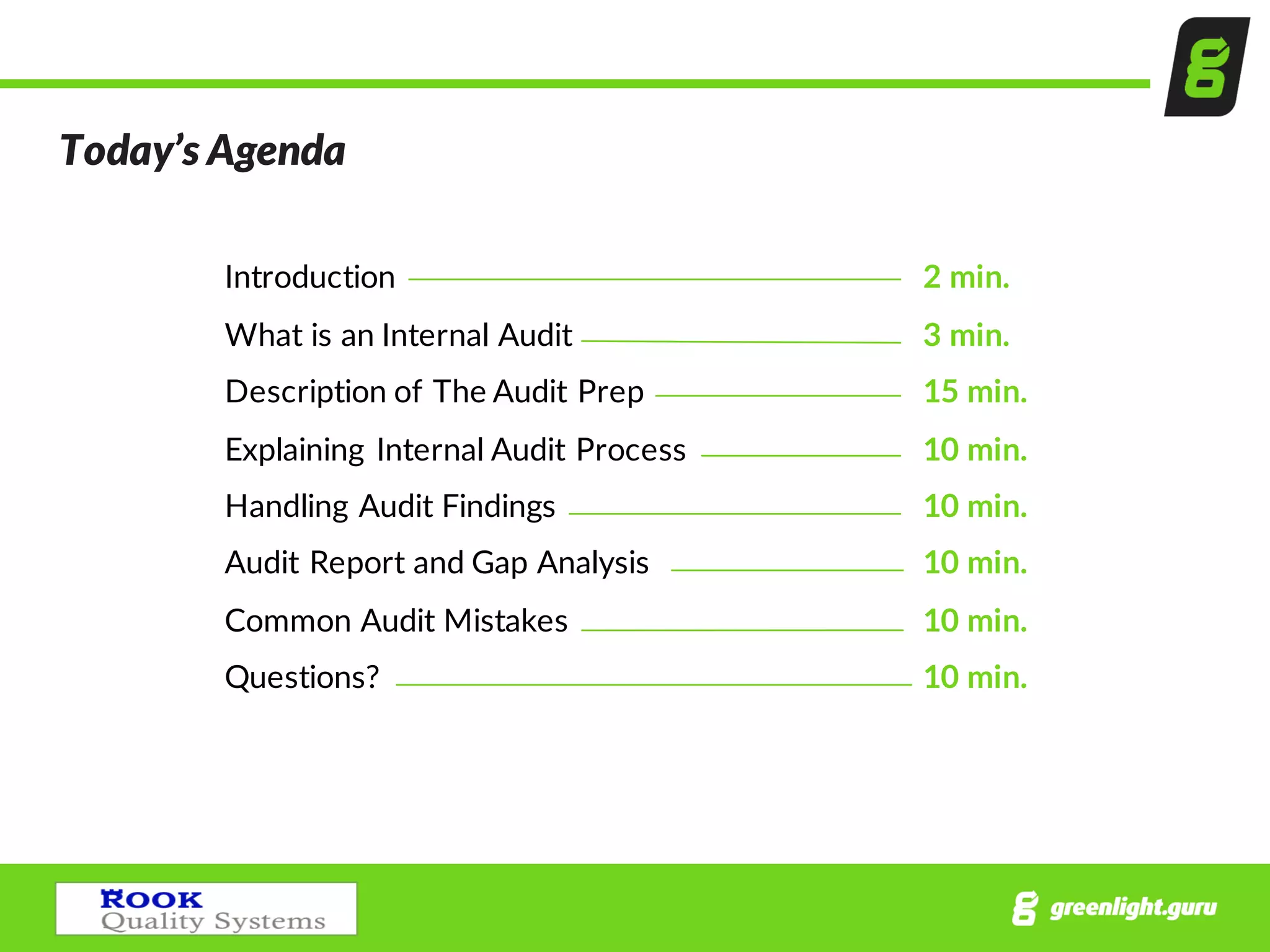
Today’s  Agenda
Introduction 2  min.
What  is  an  Internal  Audit   3  min.
Description  of  The  Audit  Prep 15  min.
Explaining  Internal  Audit  Process     10 min.
Handling  Audit  Findings   10  min.
Audit  Report  and  Gap  Analysis 10  min.
Common  Audit  Mistakes 10  min.
Questions? 10  min.
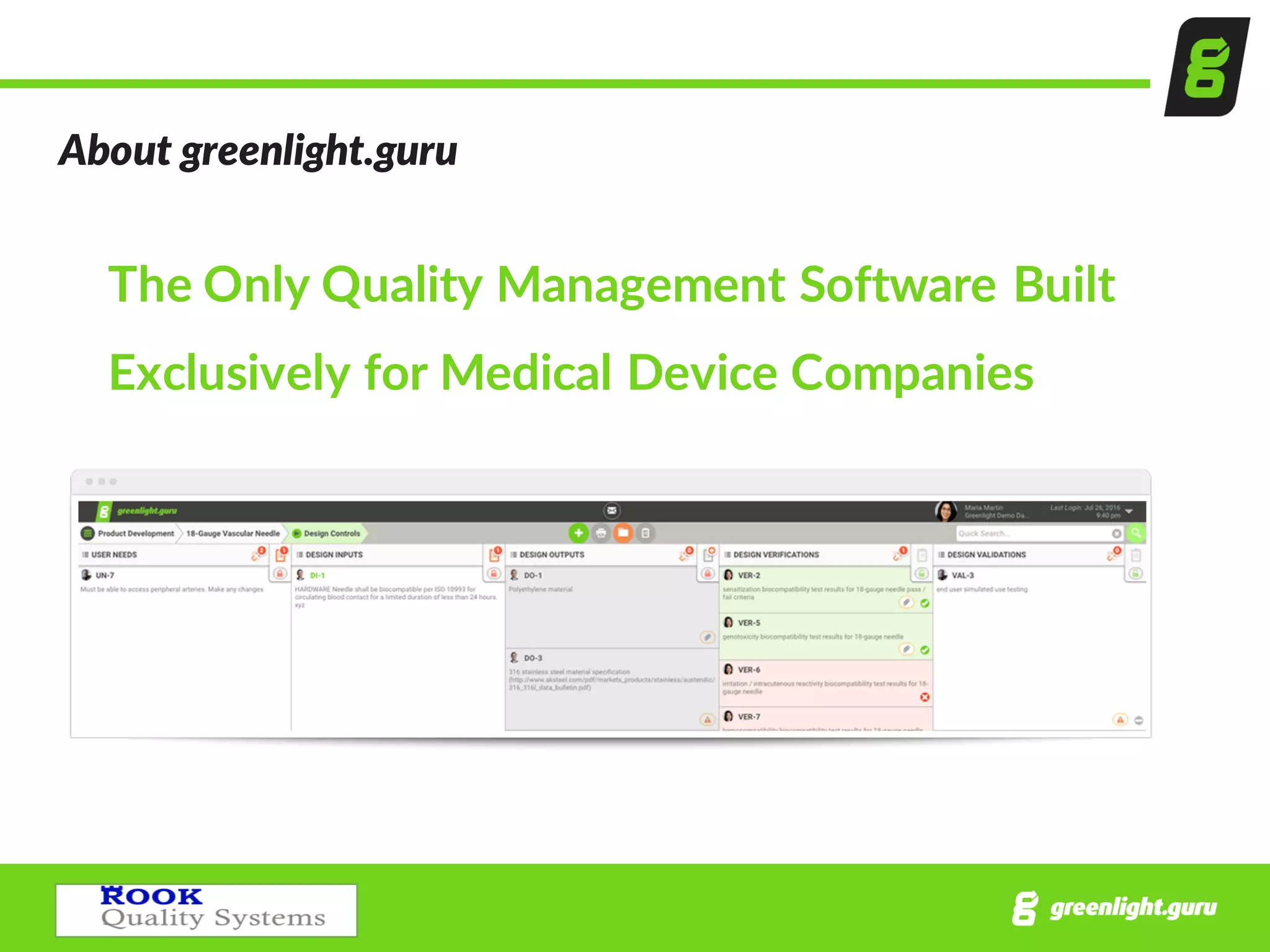
About  greenlight.guru
The  Only  Quality  Management  Software  Built  
Exclusively  for  Medical  Device  Companies
About  the  Presenter
Kyle  Rose  (CQA)  is  the  President  of  
Rook  Quality  Systems,  a  consulting  
firm  dedicated  on  helping  startup  to  
mid-­‐sized  medical  device  companies  
develop  and  maintain  effective  and  
efficient  quality  systems.  
Rook	
  Quality	
  Systems	
  provides	
  specialized	
  and	
  custom	
  
consulting	
  services	
  for	
  all	
  classes	
  of	
  medical	
  devices,	
  
medical	
  software,	
  and combination devices.	
  We	
  work	
  
with	
  you	
  to	
  outline	
  your	
  quality	
  and	
  business	
  goals	
  to	
  
develop	
  innovative	
  and	
  efficient	
  practices	
  that	
  improve	
  
compliance	
  and	
  quality.
The	
  development	
  of	
  a	
  new	
  medical	
  device	
  or	
  software	
  is	
  
regulated	
  by	
  the	
  FDA	
  or	
  an	
  International	
  Regulatory	
  
Body.	
  This	
  process	
  is	
  the	
  foundation	
  for	
  the	
  success	
  of	
  
your	
  device	
  and	
  company.	
  Rook	
  Consultants	
  help	
  focus	
  
your	
  expertise	
  during	
  the	
  development	
  phase	
  of	
  your	
  
device	
  for	
  market	
  and	
  patient	
  success	
  while	
  capturing	
  the	
  
required	
  documentation	
  for	
  device	
  approval.
After	
  market	
  approval	
  of	
  your	
  device,	
  the	
  Quality	
  System	
  
becomes	
  an	
  even	
  larger	
  component	
  of	
  your	
  
company.	
  Rook	
  consultants	
  have	
  designed	
  dozens	
  of	
  
custom	
  quality	
  systems	
  for	
  all	
  sizes	
  of	
  companies	
  and	
  will	
  
assist	
  in	
  the	
  creation	
  of	
  the	
  perfect	
  Quality	
  System	
  for	
  
your	
  device	
  and	
  regulations.
What  is  an  Internal  Audit?
?
What  is  an  Internal  Audit?
• Definitions  from  the  Standards
FDA  QSR  Sec.  820.22  Quality  Audit
Each  manufacturer  shall  establish  procedures  for  quality  audits  and  conduct  such  
audits  to  assure  that  the  quality  system  is  in  compliance  with  the  established  quality  
system  requirements  and  to  determine  the  effectiveness  of  the  quality  system.  Quality  
audits  shall  be  conducted  by  individuals  who  do  not  have  direct  responsibility   for  the  
matters  being  audited.  Corrective  action(s),  including  a  re-­‐audit  of  deficient  matters,  
shall  be  taken  when  necessary.  A  report  of  the  results  of  each  quality  audit,  and  re-­‐
audit(s)  where  taken,  shall  be  made  and  such  reports  shall  be  reviewed   by  management  
having  responsibility  for  the  matters  audited.  The  dates  and  results  of  quality  audits  
and  re-­‐audits  shall  be  documented.
What  is  an  Internal  Audit?
• Definitions  from  the  Standards
ISO  13485:2016  Section  8.2.4  Internal  audit
The  organization  shall  conduct  internal  audits  at  planned  intervals  to  determine  
whether  the  quality  management  system:
a) conforms  to  planned  and  documented  arrangements,  requirements  of  this  
International  Standard,  quality    management    system    requirements    established    
by    the    organization,    and    applicable  regulatory  requirements;
b) is  effectively  implemented  and  maintained.
What  is  an  Internal  Audit?
• Definitions  from  the  Standards
ISO  13485:2016  Section  8.2.4  Internal  audit  (Continued)
• The  organization  shall  document  a  procedure  to  describe  the  responsibilities   and  
requirements  for  planning  and  conducting  audits  and  recording  and  reporting  audit  
results.
• An  audit  program  shall  be  planned,  taking  into  consideration  the  status  and  importance  
of  the  processes  and  area  to  be  audited,  as  well  as  the  results  of  previous  audits.  The  
audit  criteria,  scope,  interval  and  methods  shall  be  defined  and  recorded  The  selection  
of  auditors  and  conduct  of  audits  shall  ensure  objectivity  and  impartiality  of  the  audit  
process.  Auditors  shall  not  audit  their  own  work.
What  is  an  Internal  Audit?
• Definitions  from  the  Standards
ISO  13485:2016  Section  8.2.4  Internal  audit  (Continued)
• Records  of  the  audits  and  their  results,  including  identification  of  the  processes  and  
areas  audited  and  the  conclusions,  shall  be  maintained.
• The  management  responsible  for  the  area  being  audited  shall  ensure  that  any  
necessary  corrections  and  corrective  actions  are  taken  without  undue  delay  to  
eliminate  detected  nonconformities  and  their  causes.  Follow-­‐up  activities  shall  include  
the  verification  of  the  actions  taken  and  the  reporting  of  verification  results.
Reasons  for  Internal  Audits
• Provides  outline  to  monitor  procedure  and  product  at  
planned  intervals  within  the  company.
• Helps  the  organization’s  capability  to  address  product  
safety  and  effectiveness.
• Ensures  compliance  to  internal  procedures  and  applied  
regulatory  requirements.
Preparation  for  a  Successful  Internal  Audit  Program
Establishing  Procedures  for  Internal  Audits
• Create  Dedicated  Quality  System  Procedures  for  Audits
• Outline  Scope  and  Applied  Regulations/Standards
• Outline  Roles  for  Employees  involved  in  Audit  Process
• Describe  Audit  Procedure
• Audit  Forms
• Best  Practices
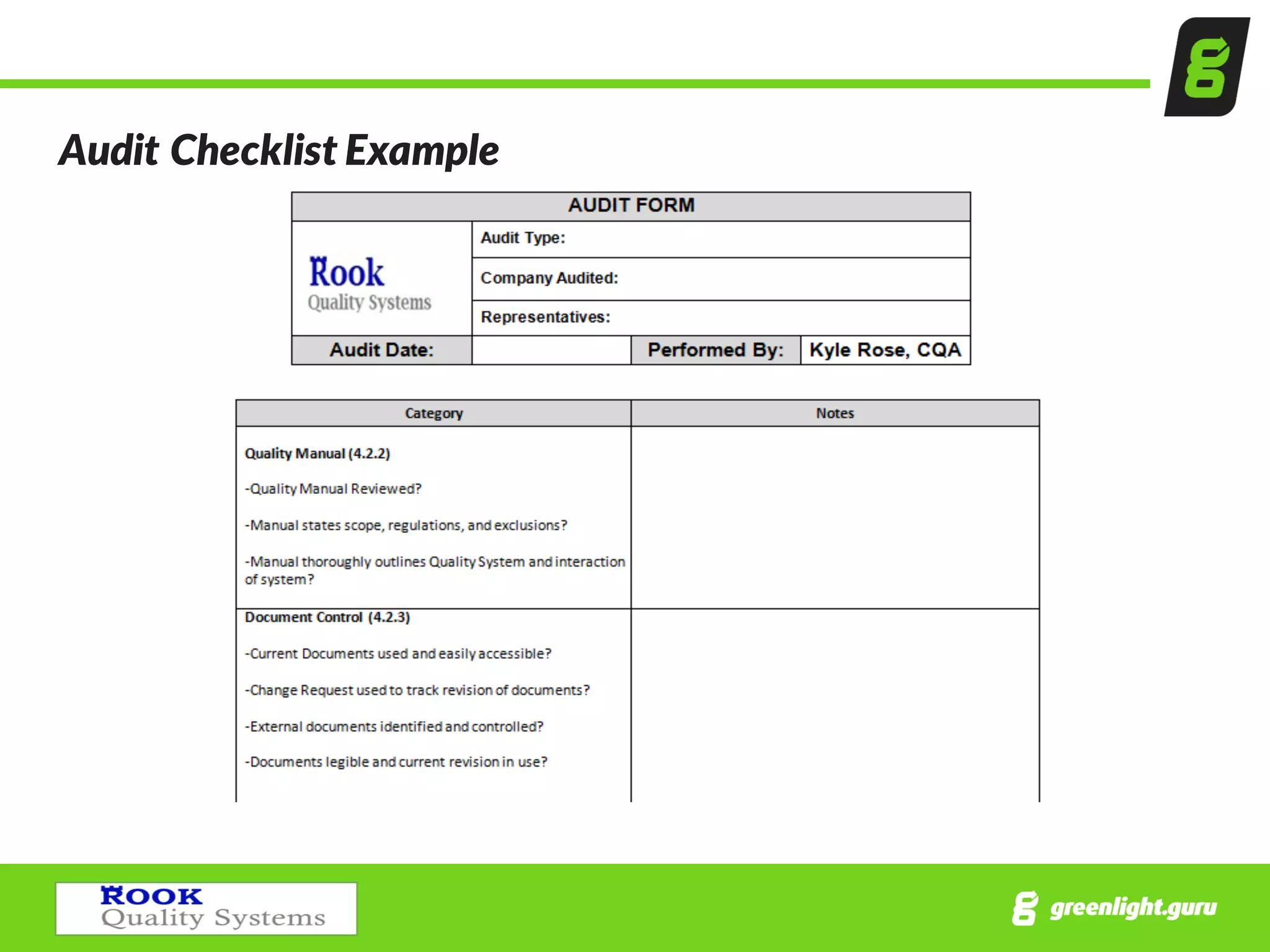
• Create  an  Audit  Checklist
• Outline  Each  Section  of  the  Quality  System
• Provide  Space  to  Document  Audit  Findings  
Audit  Checklist  Example  
Additional  Forms
• Audit  Forms  for  Expanded  Scope
• Create  forms  specific  to  additional  regulations  for  products  under  CE  Mark  or  Health  
Canada  Regulations.  This  allows  for  the  separation  of  products  that  may  be  sold  in  
different  markets.
• Audit  Report  Form
• Develop  Forms  for  the  Audit  Report  outline  to  ensure  all  sections  are  covered  in  the  
report.    
• Include  a  cover  letter  for  the  audit  report.
Additional  Forms
Audit  Plan
• Planning  your  audit  schedule  is  also  part  of  the  FDA  and  ISO  Requirements
• Larger  Companies  – Internal  Audit  must  be  split  between  separate  days  or  months  
• Ensures  all  sections  are  properly  audited
• This  should  be  clearly  defined  in  the  Audit  Plan
• Smaller  and  startup  companies  – Plan  will  not  be  as  detailed  but  is  still  required
• Plan  can  be  detailed  in  the  Management  Review  Minutes  if  a  dedicated  form  is  not  
required
• Ensure  the  plan  meets  your  requirements  and  scope
• Any  changes  to  the  plan  should  be  approved
Explaining  the  Internal  Audit  Process
Conducting  the  Audit  
• Audit  Logistics  
• Announcement  of  Audit  by  Lead  Auditor
• Identifying  the  Audit  Team  and  Location
• Determining  the  Audit  Dates  and  Location
• Provide  a  designated  area  for  the  audit  to  take  place,  meeting  room,  or  office
• Initial  Document  Review
• Reviewing  procedures  for  each  section  
• Document  effective  date  and  revision  of  procedures  reviewed
• Ensure  documents  are  compliant  with  standards  and  scope
• Provide  supporting  documentation  as  requested    
Conducting  the  Audit  
• Record  Review
Many  sections  of  the  audit  will  require  review  of  actual  records  conducted  within  
the  quality  system.  This  includes:
• QC  Test  Records
• Labelling  and  Packaging  verification
• Traceability  Review
• Sterilization  Logs  
• Records  of  Customer  Feedback/Complaints
• Document  Control  and  Storage
Conducting  the  Audit  
• Validation  /  Design  Control    /  Risk  Management  
Records  for  Validation,  Design  Control,  and  Risk  Management  should  be  
reviewed  during  the  audit  as  well.  
• Internal  Audits  are  based  on  sampling
• Not  all  records  or  reports  can,  or  will,  be  reviewed  during  the  audit
• Special  Audits  can  be  conducted  to  focus  more  directly  on  Validations,  Design  Control,  
and  Risk  Management
• During  the  audit,  document  specific  reports  and  files  that  were  reviewed
Handling  Audit  Findings  
Identifying  Audit  Findings  
• Observation  definition
A	
  problem	
  of	
  minor	
  nature	
  that	
  does	
  not	
  directly	
  affect	
  the	
  system,	
  product,	
  or	
  
process;	
  a	
  suggestion	
  for	
  improvement	
  that	
  does	
  not	
  require	
  the	
  creation	
  of	
  a	
  CAPA
• Non-­‐conformance  definition
An	
  identified	
  problem	
  where	
  a	
  product,	
  process,	
  or	
  document	
  does	
  not	
  meet	
  expected	
  
or	
  pre-­‐determined	
  requirements.
Handling  Audit  Findings  
• Audit  Findings  Notification
• When  identified,  the  Audit  finding  should  be  communicated  immediately  to  the  
responsible  department  or  employee.
• Level  Determination
• More  records  /  documentation  will  be  requested  when  an  Audit  finding  is  identified
• Additional  records  help  to  determine  extent  of  non-­‐conformities  
• Severity  of  the  finding  does  not  have  to  be  determined  immediately,  but  is  
required  in  the  audit  report
• Multiple  findings  of  a  similar  nature  can  be  grouped  into  one  CAPA  record.
Addressing  Audit  Findings  
• Risk  Based  Actions  for  Findings
• The  severity  determination  – tied  to  the  Risk  associated  with  finding  
• NCRs  with  high  risk  to  patient  safety  should  be  corrected  ASAP
• CAPA  record  should  be  assigned  and  due  dates  identified  in  the  report
• We  encourage  companies  to  separate  CAPAs  into  defined  levels  that  identify  timeframes  
for  completion  based  on  risk  associated  with  finding.
• Verification  of  Correction  
• Specialized  audits  – conducted  to  verify  the  CAPA  associated  with  any  audit  findings
• Focus  only  on  the  area  affected  by  the  NCR  
• Used  to  verify  effectiveness  of  the  CAPA  after  a  defined  timeline  for  
implementation
Conduct  During  Audit  Findings  
• Professionalism  During  Audit  Process
• All  parties  involved  should  participate  in  a  professional  manner  and  remember  that  the  
overall  goal  of  the  audit  is  to  ensure  patient  safety  and  company  compliance.  
• Treat  the  internal  audit  like  an  external  regulatory  audit  from  the  FDA  or  Registrar  to  
provide  additional  practice  for  your  company.  
Audit  Report  
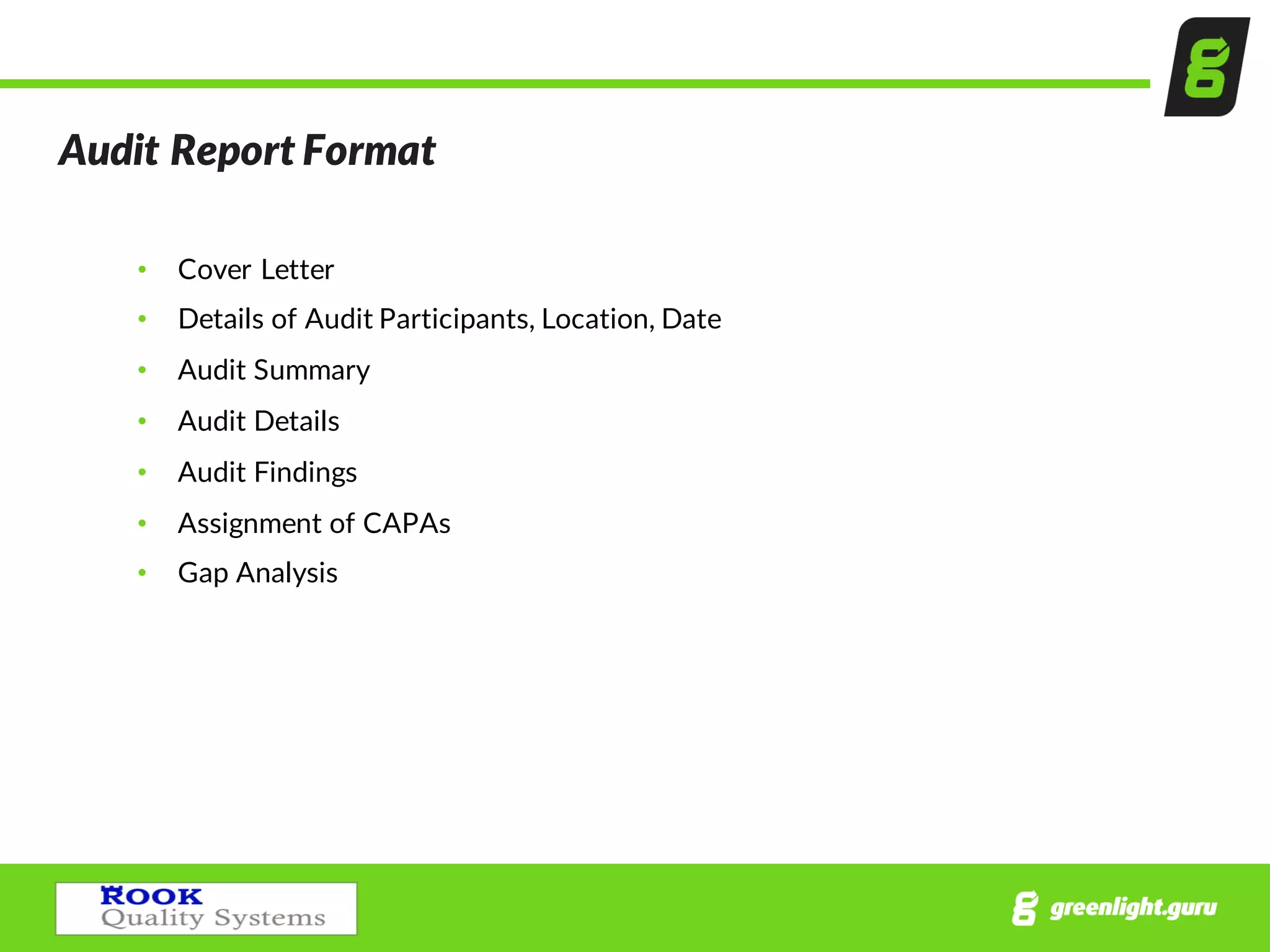
Audit  Report  Format
• Cover  Letter
• Details  of  Audit  Participants,  Location,  Date
• Audit  Summary  
• Audit  Details
• Audit  Findings
• Assignment  of  CAPAs
• Gap  Analysis
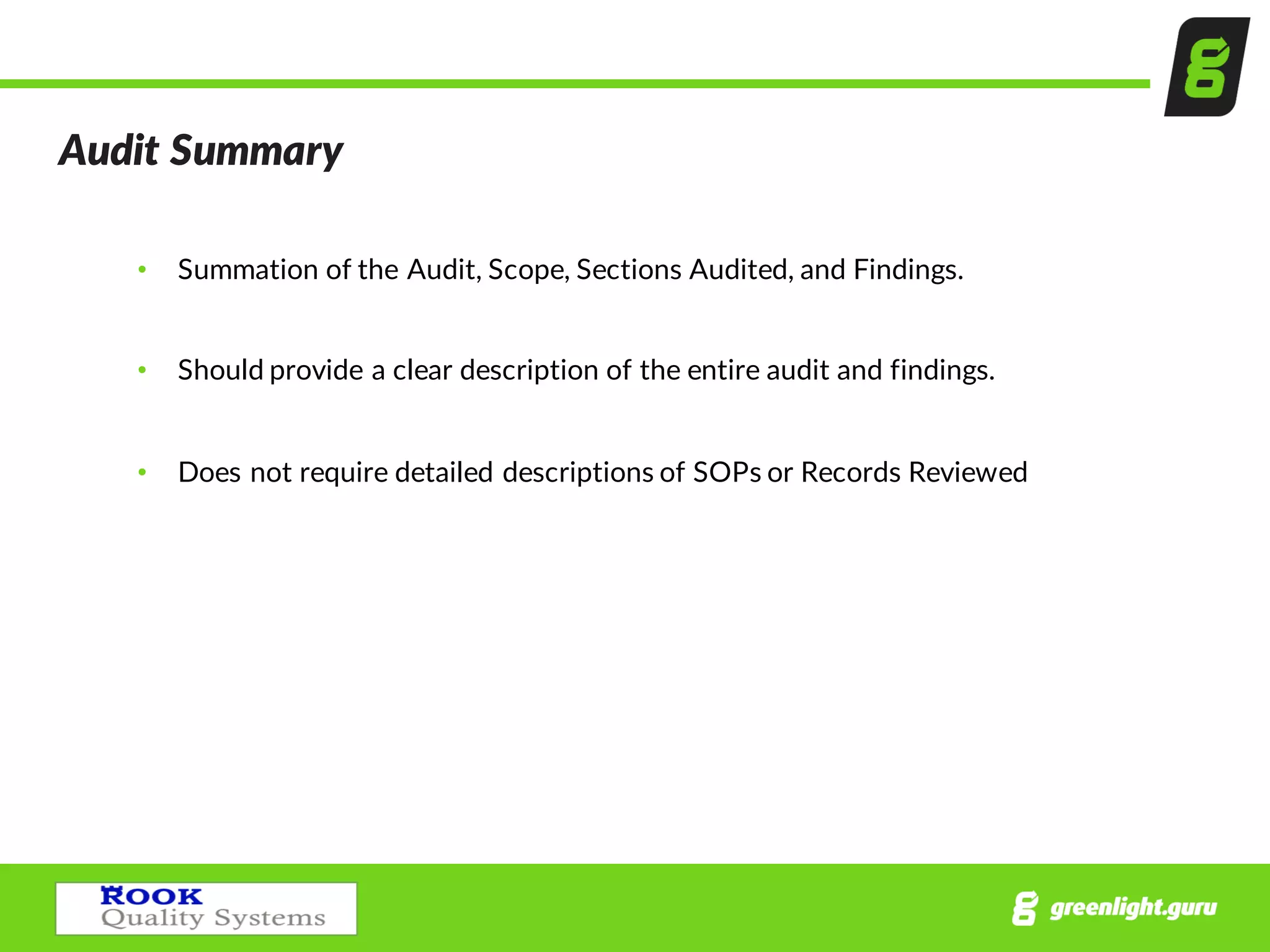
Audit  Summary
• Summation  of  the  Audit,  Scope,  Sections  Audited,  and  Findings.
• Should  provide  a  clear  description  of  the  entire  audit  and  findings.  
• Does  not  require  detailed  descriptions  of  SOPs  or  Records  Reviewed
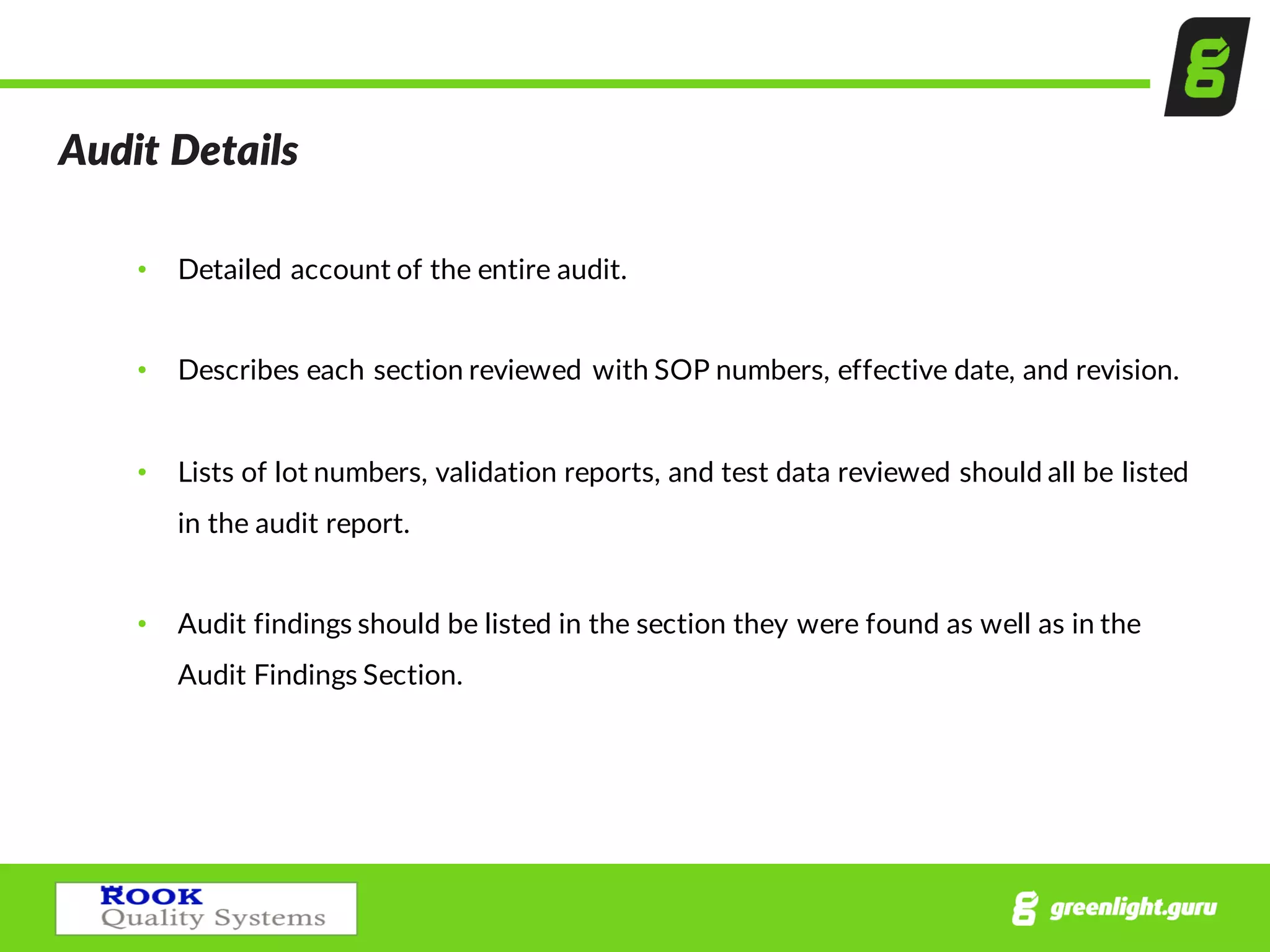
Audit  Details
• Detailed  account  of  the  entire  audit.
• Describes  each  section  reviewed  with  SOP  numbers,  effective  date,  and  revision.  
• Lists  of  lot  numbers,  validation  reports,  and  test  data  reviewed  should  all  be  listed  
in  the  audit  report.
• Audit  findings  should  be  listed  in  the  section  they  were  found  as  well  as  in  the  
Audit  Findings  Section.
Audit  Findings  and  CAPA  Assignment  
• Detailed  description  of  each  finding.
• Determination  by  the  Lead  Auditor  of  the  level  of  Finding,  Non-­‐Conformity  (High,  
Medium,  Low)  or  Observation.
• Assignment  of  the  department  head  or  employee  responsible  for  the  CAPA.
• Timeline  for  CAPA  completion  and  verification
Gap  Analysis
• Often  when  a  major  change  to  the  QMS  is  being  conducted  a  Gap  Analysis  is  
required  to  determine  all  of  the  gaps  and  prioritize  them.  
• This  can  be  conducted  for  changes  to  standard  (ISO  13485:2016),  scope  expansion  to  a  
foreign  market,  or  revisiting   older  records  that  were  not  completed  properly.  
• Design  Control  and  Risk  Management  for  DHF  /  TF  is  a  major  source  of  Gap  
Analysis  questions.  
• Once  the  Gaps  have  been  identified,  they  should  be  documented  in  the  Audit  
Report  and  a  timeline  for  completion  should  be  created.  
• This  timeline  should  be  based  on  a  Risk  Analysis  of  the  Gaps  with  the  higher  risk  Gaps  
addressed  first.    
Internal  Audit  Common  Mistakes  
Contacting  Rook  Quality  for  your  Audit  Needs
www.rookqualitysystems.com
info@rookqualitysystems.com
@RookQuality
Questions?
To  Get  Your  Free  QMS  Audit  Checklist,  Go  To:
http://www.greenlight.guru/quality-­‐audit-­‐offer

How to Perform a Successful Internal Quality Audit

  • 1.
    How  to  Perform a  Successful Quality  Audit Presented  by: Kyle  Rose President  
  • 2.
    Today’s  Agenda Introduction 2 min. What  is  an  Internal  Audit   3  min. Description  of  The  Audit  Prep 15  min. Explaining  Internal  Audit  Process     10 min. Handling  Audit  Findings   10  min. Audit  Report  and  Gap  Analysis 10  min. Common  Audit  Mistakes 10  min. Questions? 10  min.
  • 3.
    About  greenlight.guru The  Only Quality  Management  Software  Built   Exclusively  for  Medical  Device  Companies
  • 4.
    About  the  Presenter Kyle Rose  (CQA)  is  the  President  of   Rook  Quality  Systems,  a  consulting   firm  dedicated  on  helping  startup  to   mid-­‐sized  medical  device  companies   develop  and  maintain  effective  and   efficient  quality  systems.   Rook  Quality  Systems  provides  specialized  and  custom   consulting  services  for  all  classes  of  medical  devices,   medical  software,  and combination devices.  We  work   with  you  to  outline  your  quality  and  business  goals  to   develop  innovative  and  efficient  practices  that  improve   compliance  and  quality. The  development  of  a  new  medical  device  or  software  is   regulated  by  the  FDA  or  an  International  Regulatory   Body.  This  process  is  the  foundation  for  the  success  of   your  device  and  company.  Rook  Consultants  help  focus   your  expertise  during  the  development  phase  of  your   device  for  market  and  patient  success  while  capturing  the   required  documentation  for  device  approval. After  market  approval  of  your  device,  the  Quality  System   becomes  an  even  larger  component  of  your   company.  Rook  consultants  have  designed  dozens  of   custom  quality  systems  for  all  sizes  of  companies  and  will   assist  in  the  creation  of  the  perfect  Quality  System  for   your  device  and  regulations.
  • 5.
    What  is  an Internal  Audit? ?
  • 6.
    What  is  an Internal  Audit? • Definitions  from  the  Standards FDA  QSR  Sec.  820.22  Quality  Audit Each  manufacturer  shall  establish  procedures  for  quality  audits  and  conduct  such   audits  to  assure  that  the  quality  system  is  in  compliance  with  the  established  quality   system  requirements  and  to  determine  the  effectiveness  of  the  quality  system.  Quality   audits  shall  be  conducted  by  individuals  who  do  not  have  direct  responsibility   for  the   matters  being  audited.  Corrective  action(s),  including  a  re-­‐audit  of  deficient  matters,   shall  be  taken  when  necessary.  A  report  of  the  results  of  each  quality  audit,  and  re-­‐ audit(s)  where  taken,  shall  be  made  and  such  reports  shall  be  reviewed   by  management   having  responsibility  for  the  matters  audited.  The  dates  and  results  of  quality  audits   and  re-­‐audits  shall  be  documented.
  • 7.
    What  is  an Internal  Audit? • Definitions  from  the  Standards ISO  13485:2016  Section  8.2.4  Internal  audit The  organization  shall  conduct  internal  audits  at  planned  intervals  to  determine   whether  the  quality  management  system: a) conforms  to  planned  and  documented  arrangements,  requirements  of  this   International  Standard,  quality    management    system    requirements    established     by    the    organization,    and    applicable  regulatory  requirements; b) is  effectively  implemented  and  maintained.
  • 8.
    What  is  an Internal  Audit? • Definitions  from  the  Standards ISO  13485:2016  Section  8.2.4  Internal  audit  (Continued) • The  organization  shall  document  a  procedure  to  describe  the  responsibilities   and   requirements  for  planning  and  conducting  audits  and  recording  and  reporting  audit   results. • An  audit  program  shall  be  planned,  taking  into  consideration  the  status  and  importance   of  the  processes  and  area  to  be  audited,  as  well  as  the  results  of  previous  audits.  The   audit  criteria,  scope,  interval  and  methods  shall  be  defined  and  recorded  The  selection   of  auditors  and  conduct  of  audits  shall  ensure  objectivity  and  impartiality  of  the  audit   process.  Auditors  shall  not  audit  their  own  work.
  • 9.
    What  is  an Internal  Audit? • Definitions  from  the  Standards ISO  13485:2016  Section  8.2.4  Internal  audit  (Continued) • Records  of  the  audits  and  their  results,  including  identification  of  the  processes  and   areas  audited  and  the  conclusions,  shall  be  maintained. • The  management  responsible  for  the  area  being  audited  shall  ensure  that  any   necessary  corrections  and  corrective  actions  are  taken  without  undue  delay  to   eliminate  detected  nonconformities  and  their  causes.  Follow-­‐up  activities  shall  include   the  verification  of  the  actions  taken  and  the  reporting  of  verification  results.
  • 10.
    Reasons  for  Internal Audits • Provides  outline  to  monitor  procedure  and  product  at   planned  intervals  within  the  company. • Helps  the  organization’s  capability  to  address  product   safety  and  effectiveness. • Ensures  compliance  to  internal  procedures  and  applied   regulatory  requirements.
  • 11.
    Preparation  for  a Successful  Internal  Audit  Program
  • 12.
    Establishing  Procedures  for Internal  Audits • Create  Dedicated  Quality  System  Procedures  for  Audits • Outline  Scope  and  Applied  Regulations/Standards • Outline  Roles  for  Employees  involved  in  Audit  Process • Describe  Audit  Procedure • Audit  Forms • Best  Practices • Create  an  Audit  Checklist • Outline  Each  Section  of  the  Quality  System • Provide  Space  to  Document  Audit  Findings  
  • 13.
  • 14.
    Additional  Forms • Audit Forms  for  Expanded  Scope • Create  forms  specific  to  additional  regulations  for  products  under  CE  Mark  or  Health   Canada  Regulations.  This  allows  for  the  separation  of  products  that  may  be  sold  in   different  markets. • Audit  Report  Form • Develop  Forms  for  the  Audit  Report  outline  to  ensure  all  sections  are  covered  in  the   report.     • Include  a  cover  letter  for  the  audit  report.
  • 15.
    Additional  Forms Audit  Plan •Planning  your  audit  schedule  is  also  part  of  the  FDA  and  ISO  Requirements • Larger  Companies  – Internal  Audit  must  be  split  between  separate  days  or  months   • Ensures  all  sections  are  properly  audited • This  should  be  clearly  defined  in  the  Audit  Plan • Smaller  and  startup  companies  – Plan  will  not  be  as  detailed  but  is  still  required • Plan  can  be  detailed  in  the  Management  Review  Minutes  if  a  dedicated  form  is  not   required • Ensure  the  plan  meets  your  requirements  and  scope • Any  changes  to  the  plan  should  be  approved
  • 16.
    Explaining  the  Internal Audit  Process
  • 17.
    Conducting  the  Audit  • Audit  Logistics   • Announcement  of  Audit  by  Lead  Auditor • Identifying  the  Audit  Team  and  Location • Determining  the  Audit  Dates  and  Location • Provide  a  designated  area  for  the  audit  to  take  place,  meeting  room,  or  office • Initial  Document  Review • Reviewing  procedures  for  each  section   • Document  effective  date  and  revision  of  procedures  reviewed • Ensure  documents  are  compliant  with  standards  and  scope • Provide  supporting  documentation  as  requested    
  • 18.
    Conducting  the  Audit  • Record  Review Many  sections  of  the  audit  will  require  review  of  actual  records  conducted  within   the  quality  system.  This  includes: • QC  Test  Records • Labelling  and  Packaging  verification • Traceability  Review • Sterilization  Logs   • Records  of  Customer  Feedback/Complaints • Document  Control  and  Storage
  • 19.
    Conducting  the  Audit  • Validation  /  Design  Control    /  Risk  Management   Records  for  Validation,  Design  Control,  and  Risk  Management  should  be   reviewed  during  the  audit  as  well.   • Internal  Audits  are  based  on  sampling • Not  all  records  or  reports  can,  or  will,  be  reviewed  during  the  audit • Special  Audits  can  be  conducted  to  focus  more  directly  on  Validations,  Design  Control,   and  Risk  Management • During  the  audit,  document  specific  reports  and  files  that  were  reviewed
  • 20.
  • 21.
    Identifying  Audit  Findings  • Observation  definition A  problem  of  minor  nature  that  does  not  directly  affect  the  system,  product,  or   process;  a  suggestion  for  improvement  that  does  not  require  the  creation  of  a  CAPA • Non-­‐conformance  definition An  identified  problem  where  a  product,  process,  or  document  does  not  meet  expected   or  pre-­‐determined  requirements.
  • 22.
    Handling  Audit  Findings  • Audit  Findings  Notification • When  identified,  the  Audit  finding  should  be  communicated  immediately  to  the   responsible  department  or  employee. • Level  Determination • More  records  /  documentation  will  be  requested  when  an  Audit  finding  is  identified • Additional  records  help  to  determine  extent  of  non-­‐conformities   • Severity  of  the  finding  does  not  have  to  be  determined  immediately,  but  is   required  in  the  audit  report • Multiple  findings  of  a  similar  nature  can  be  grouped  into  one  CAPA  record.
  • 23.
    Addressing  Audit  Findings  • Risk  Based  Actions  for  Findings • The  severity  determination  – tied  to  the  Risk  associated  with  finding   • NCRs  with  high  risk  to  patient  safety  should  be  corrected  ASAP • CAPA  record  should  be  assigned  and  due  dates  identified  in  the  report • We  encourage  companies  to  separate  CAPAs  into  defined  levels  that  identify  timeframes   for  completion  based  on  risk  associated  with  finding. • Verification  of  Correction   • Specialized  audits  – conducted  to  verify  the  CAPA  associated  with  any  audit  findings • Focus  only  on  the  area  affected  by  the  NCR   • Used  to  verify  effectiveness  of  the  CAPA  after  a  defined  timeline  for   implementation
  • 24.
    Conduct  During  Audit Findings   • Professionalism  During  Audit  Process • All  parties  involved  should  participate  in  a  professional  manner  and  remember  that  the   overall  goal  of  the  audit  is  to  ensure  patient  safety  and  company  compliance.   • Treat  the  internal  audit  like  an  external  regulatory  audit  from  the  FDA  or  Registrar  to   provide  additional  practice  for  your  company.  
  • 25.
  • 26.
    Audit  Report  Format •Cover  Letter • Details  of  Audit  Participants,  Location,  Date • Audit  Summary   • Audit  Details • Audit  Findings • Assignment  of  CAPAs • Gap  Analysis
  • 27.
    Audit  Summary • Summation of  the  Audit,  Scope,  Sections  Audited,  and  Findings. • Should  provide  a  clear  description  of  the  entire  audit  and  findings.   • Does  not  require  detailed  descriptions  of  SOPs  or  Records  Reviewed
  • 28.
    Audit  Details • Detailed account  of  the  entire  audit. • Describes  each  section  reviewed  with  SOP  numbers,  effective  date,  and  revision.   • Lists  of  lot  numbers,  validation  reports,  and  test  data  reviewed  should  all  be  listed   in  the  audit  report. • Audit  findings  should  be  listed  in  the  section  they  were  found  as  well  as  in  the   Audit  Findings  Section.
  • 29.
    Audit  Findings  and CAPA  Assignment   • Detailed  description  of  each  finding. • Determination  by  the  Lead  Auditor  of  the  level  of  Finding,  Non-­‐Conformity  (High,   Medium,  Low)  or  Observation. • Assignment  of  the  department  head  or  employee  responsible  for  the  CAPA. • Timeline  for  CAPA  completion  and  verification
  • 30.
    Gap  Analysis • Often when  a  major  change  to  the  QMS  is  being  conducted  a  Gap  Analysis  is   required  to  determine  all  of  the  gaps  and  prioritize  them.   • This  can  be  conducted  for  changes  to  standard  (ISO  13485:2016),  scope  expansion  to  a   foreign  market,  or  revisiting   older  records  that  were  not  completed  properly.   • Design  Control  and  Risk  Management  for  DHF  /  TF  is  a  major  source  of  Gap   Analysis  questions.   • Once  the  Gaps  have  been  identified,  they  should  be  documented  in  the  Audit   Report  and  a  timeline  for  completion  should  be  created.   • This  timeline  should  be  based  on  a  Risk  Analysis  of  the  Gaps  with  the  higher  risk  Gaps   addressed  first.    
  • 31.
  • 32.
    Contacting  Rook  Quality for  your  Audit  Needs www.rookqualitysystems.com info@rookqualitysystems.com @RookQuality
  • 33.
    Questions? To  Get  Your Free  QMS  Audit  Checklist,  Go  To: http://www.greenlight.guru/quality-­‐audit-­‐offer