CASE STUDY TEACHING & DEVELOPMENT  By: Shashi Tiwari 28/02/12
CONTENTS What is a Case? Case Characteristics Our approach as a Reader Types of Case situations Discussing the Case Guidelines to Develop a Case Steps in Case Writing Teaching Note Case Discussion & Presentation 28/02/12
WHAT IS A CASE? Cases are the verbal representations of reality that put the reader in the role of a participant in the situation. A business case imitates or simulates a real situation. Any problem may be developed as case. 28/02/12
CASE CHARACTERISTICS A significant business issue or issues Sufficient information on which to base conclusion  No stated conclusion BUT, many cases have these complicating characteristics: Information that includes “noise” Unstated information that must be inferred from the information that is stated A non linear structure in which related evidence is scattered throughout the text and is often disguised and left to inference 28/02/12
OUR APPROACH AS A READER Construct conclusions from the information in the text Filter out irrelevant or low value portion of the text Furnish missing information through inferences Associate evidence from different parts of the case and integrate it into a conclusion Active reading – Think as you read 28/02/12
TYPES OF CASE SITUATIONS Problems Decisions Evaluations Rules 28/02/12
HOW TO ANALYZE A CASE? A case is a text that refuses to explain itself.  Understanding the situation. To analyze a case, an individual needs ways of identifying and understanding important aspects of a situation and what they mean in relation to the overall situation The major dilemma that confronts everyone who reads a case is they don’t know what to look for in a case.  In an active approach to solving a case, thinking and reading must go hand in hand 28/02/12
CONTD………. Active reading is interrogative & purposeful. Questions give a purpose for reading, they direct and focus study on important aspects of a study Active reading is iterative, meaning an individual needs to make multiple passes through a case. With each iteration, the purpose of reading changes. An individual looks for new information or looking at old information in a new way. Three concepts contribute to active reading: a goal, a point of view and a hypothesis.  28/02/12
CONTD……. Goal: Understanding the situation with the information in the case, come to a conclusion, show why your conclusion is reasonable, and discuss about other possible solutions that might have existed. Point of view: Adopt the point of view of the protagonist. Hypothesis: Cases don’t allow any just any hypothesis. The available evidence in the case sets the rational limit on the range of hypothesis. 28/02/12
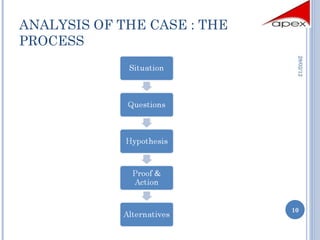
ANALYSIS OF THE CASE : THE PROCESS 28/02/12
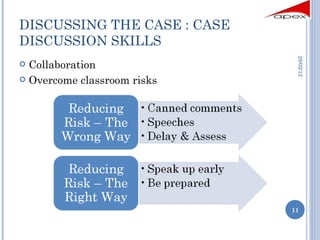
DISCUSSING THE CASE : CASE DISCUSSION SKILLS Collaboration Overcome classroom risks 28/02/12
CONTD…….. Read actively Recognize the social factor Remember how to laugh Listening is participating Reflect on what you learn Be patient with yourself 28/02/12
What is the focus? Or the Case Objectives Identify the organization Parts of a case : Introduction, Body & Conclusion Teaching notes GUIDELINES TO DEVELOP A CASE 28/02/12
WHAT IS THE FOCUS? / CASE OBJECTIVES What theories & concepts are you going to reach through the case? Is there is a hook (theme), an overriding issue that pulls all the parts together? This can be a managerial issue or a decision that requires attention The hook must be linked to the concept that are we are teaching. Identify the target audience 28/02/12
IDENTIFY THE ORGANIZATION Has the organization faced the issue that you propose to write? Identify the major protagonist Will the organization provide data? Will the organization provide permission for publication? Identify the sources of information 28/02/12
INTRODUCTION Set the general issue Highlight a concise but interesting picture of the main issues in the case Bring out the context and the purpose of the case Introduce the principle protagonist Highlight objectives 28/02/12
BODY Tell the total story – the start, background of the company, background of the business environment Maintain a chronological order Detail the specific issues faced by the company Bring out the different sides of the organization by quoting information from the interviews The problems are generally not easy to resolve and have competing alternatives 28/02/12
CONCLUSION Do not state the conclusion Leave questions for the readers 28/02/12
STEPS IN CASE WRITING 28/02/12
STEP 1 : PLANNING Identify the purpose of case writing task  1. what are the learning outcomes for the case? a. what students are expected to know? b. what they are expected to be able to do, value or feel at the completion of an  instructional task? Eventually the learning outcome helps us to  determine the content of the case in terms of  concepts, rules and principles needed 28/02/12
CONTD… How is the case used in terms of the instructional sequence? 1. May be presented at the beginning of the  instruction to elicit students’ attention 2. May also act as an anchor that supports the  learning of the content or skills of the subject 3. Students may be asked to read and analyze  the cases before coming to class 4. Employ a role play activity to involve students in the problem solving process 5. May be used to assess students’ learning 28/02/12
CONTD…… Identifying the learners 1. Search the common ground that you and your  readers share 2. Awareness of the level of entry skills of the students is helpful in determining what learning issues should be pursued Deciding what information should be put in the case 1. Determine the authenticity of the case 2. Determine the source of information 28/02/12
STEP 2: ORGANIZING In this part you tackle the problem of how to present case materials. Typically, cases are  presented in a narrative format. Structuring in a narrative form 1. What does a narrative consist of?  It is a story of an event. It includes WHAT happened, WHO was involved, WHY it happened and HOW it happened. Therefore in a narrative style, the following are impotant: 28/02/12
CONTD…. Details of a specific setting A list of actors with names and descriptions of personalities A progressive disclosure of actions The problems or issues that evolve the case How is narrative organized? 1. Chronologically 2. Order of importance 3. Start with and end, and tell the story through a series of flashbacks 28/02/12
STEP 3 : DRAFTING What is the central idea of the case? How should the central idea of the case should be supported? For example : If I am talking about positioning of a product, I should provide information about by current strategies of positing a product. 28/02/12
STEP 4 : REVISING This involves re – reading, evaluating, and making changes to improve the written case. Considering  The following questions may help: Will the case produce the intended learning outcome? Are the problems or issues presented in the case related to learning outcomes? Does the case appear to be realistic? Are all the elements of narrative style used in the case? Are the events organized in a logical order? 28/02/12
PREPARING A TEACHING NOTE A teaching note, usually, but not necessarily,  produced by the author of the case, is a document designed to give other potential instructors valuable insights into the case and the learning  which can be derived from the case. Components of a teaching note: Summary of the case Teaching objectives & Target Audience Teaching approach 7 strategy Analysis Additional reading or references Feedback 28/02/12
CASE DISCUSSION 28/02/12

Case study development & teaching

  • 1.
    CASE STUDY TEACHING& DEVELOPMENT By: Shashi Tiwari 28/02/12
  • 2.
    CONTENTS What isa Case? Case Characteristics Our approach as a Reader Types of Case situations Discussing the Case Guidelines to Develop a Case Steps in Case Writing Teaching Note Case Discussion & Presentation 28/02/12
  • 3.
    WHAT IS ACASE? Cases are the verbal representations of reality that put the reader in the role of a participant in the situation. A business case imitates or simulates a real situation. Any problem may be developed as case. 28/02/12
  • 4.
    CASE CHARACTERISTICS Asignificant business issue or issues Sufficient information on which to base conclusion No stated conclusion BUT, many cases have these complicating characteristics: Information that includes “noise” Unstated information that must be inferred from the information that is stated A non linear structure in which related evidence is scattered throughout the text and is often disguised and left to inference 28/02/12
  • 5.
    OUR APPROACH ASA READER Construct conclusions from the information in the text Filter out irrelevant or low value portion of the text Furnish missing information through inferences Associate evidence from different parts of the case and integrate it into a conclusion Active reading – Think as you read 28/02/12
  • 6.
    TYPES OF CASESITUATIONS Problems Decisions Evaluations Rules 28/02/12
  • 7.
    HOW TO ANALYZEA CASE? A case is a text that refuses to explain itself. Understanding the situation. To analyze a case, an individual needs ways of identifying and understanding important aspects of a situation and what they mean in relation to the overall situation The major dilemma that confronts everyone who reads a case is they don’t know what to look for in a case. In an active approach to solving a case, thinking and reading must go hand in hand 28/02/12
  • 8.
    CONTD………. Active readingis interrogative & purposeful. Questions give a purpose for reading, they direct and focus study on important aspects of a study Active reading is iterative, meaning an individual needs to make multiple passes through a case. With each iteration, the purpose of reading changes. An individual looks for new information or looking at old information in a new way. Three concepts contribute to active reading: a goal, a point of view and a hypothesis. 28/02/12
  • 9.
    CONTD……. Goal: Understandingthe situation with the information in the case, come to a conclusion, show why your conclusion is reasonable, and discuss about other possible solutions that might have existed. Point of view: Adopt the point of view of the protagonist. Hypothesis: Cases don’t allow any just any hypothesis. The available evidence in the case sets the rational limit on the range of hypothesis. 28/02/12
  • 10.
    ANALYSIS OF THECASE : THE PROCESS 28/02/12
  • 11.
    DISCUSSING THE CASE: CASE DISCUSSION SKILLS Collaboration Overcome classroom risks 28/02/12
  • 12.
    CONTD…….. Read activelyRecognize the social factor Remember how to laugh Listening is participating Reflect on what you learn Be patient with yourself 28/02/12
  • 13.
    What is thefocus? Or the Case Objectives Identify the organization Parts of a case : Introduction, Body & Conclusion Teaching notes GUIDELINES TO DEVELOP A CASE 28/02/12
  • 14.
    WHAT IS THEFOCUS? / CASE OBJECTIVES What theories & concepts are you going to reach through the case? Is there is a hook (theme), an overriding issue that pulls all the parts together? This can be a managerial issue or a decision that requires attention The hook must be linked to the concept that are we are teaching. Identify the target audience 28/02/12
  • 15.
    IDENTIFY THE ORGANIZATIONHas the organization faced the issue that you propose to write? Identify the major protagonist Will the organization provide data? Will the organization provide permission for publication? Identify the sources of information 28/02/12
  • 16.
    INTRODUCTION Set thegeneral issue Highlight a concise but interesting picture of the main issues in the case Bring out the context and the purpose of the case Introduce the principle protagonist Highlight objectives 28/02/12
  • 17.
    BODY Tell thetotal story – the start, background of the company, background of the business environment Maintain a chronological order Detail the specific issues faced by the company Bring out the different sides of the organization by quoting information from the interviews The problems are generally not easy to resolve and have competing alternatives 28/02/12
  • 18.
    CONCLUSION Do notstate the conclusion Leave questions for the readers 28/02/12
  • 19.
    STEPS IN CASEWRITING 28/02/12
  • 20.
    STEP 1 :PLANNING Identify the purpose of case writing task 1. what are the learning outcomes for the case? a. what students are expected to know? b. what they are expected to be able to do, value or feel at the completion of an instructional task? Eventually the learning outcome helps us to determine the content of the case in terms of concepts, rules and principles needed 28/02/12
  • 21.
    CONTD… How isthe case used in terms of the instructional sequence? 1. May be presented at the beginning of the instruction to elicit students’ attention 2. May also act as an anchor that supports the learning of the content or skills of the subject 3. Students may be asked to read and analyze the cases before coming to class 4. Employ a role play activity to involve students in the problem solving process 5. May be used to assess students’ learning 28/02/12
  • 22.
    CONTD…… Identifying thelearners 1. Search the common ground that you and your readers share 2. Awareness of the level of entry skills of the students is helpful in determining what learning issues should be pursued Deciding what information should be put in the case 1. Determine the authenticity of the case 2. Determine the source of information 28/02/12
  • 23.
    STEP 2: ORGANIZINGIn this part you tackle the problem of how to present case materials. Typically, cases are presented in a narrative format. Structuring in a narrative form 1. What does a narrative consist of? It is a story of an event. It includes WHAT happened, WHO was involved, WHY it happened and HOW it happened. Therefore in a narrative style, the following are impotant: 28/02/12
  • 24.
    CONTD…. Details ofa specific setting A list of actors with names and descriptions of personalities A progressive disclosure of actions The problems or issues that evolve the case How is narrative organized? 1. Chronologically 2. Order of importance 3. Start with and end, and tell the story through a series of flashbacks 28/02/12
  • 25.
    STEP 3 :DRAFTING What is the central idea of the case? How should the central idea of the case should be supported? For example : If I am talking about positioning of a product, I should provide information about by current strategies of positing a product. 28/02/12
  • 26.
    STEP 4 :REVISING This involves re – reading, evaluating, and making changes to improve the written case. Considering The following questions may help: Will the case produce the intended learning outcome? Are the problems or issues presented in the case related to learning outcomes? Does the case appear to be realistic? Are all the elements of narrative style used in the case? Are the events organized in a logical order? 28/02/12
  • 27.
    PREPARING A TEACHINGNOTE A teaching note, usually, but not necessarily, produced by the author of the case, is a document designed to give other potential instructors valuable insights into the case and the learning which can be derived from the case. Components of a teaching note: Summary of the case Teaching objectives & Target Audience Teaching approach 7 strategy Analysis Additional reading or references Feedback 28/02/12
  • 28.