Quadratic Functions
Learning Targets
• Give an example of real life situations
using quadratic functions.
• Differentiate quadratic functions from
linear functions.
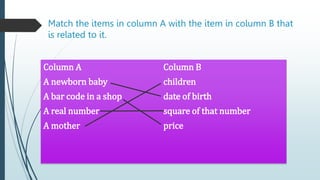
Match the items in column A with the item in column B that
is related to it.
Column A Column B
A newborn baby children
A bar code in a shop date of birth
A real number square of that number
A mother price
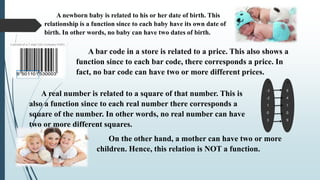
A newborn baby is related to his or her date of birth. This
relationship is a function since to each baby have its own date of
birth. In other words, no baby can have two dates of birth.
-3
-2
1
0
3
9
4
1
0
9
x x2
A bar code in a store is related to a price. This also shows a
function since to each bar code, there corresponds a price. In
fact, no bar code can have two or more different prices.
A real number is related to a square of that number. This is
also a function since to each real number there corresponds a
square of the number. In other words, no real number can have
two or more different squares.
On the other hand, a mother can have two or more
children. Hence, this relation is NOT a function.
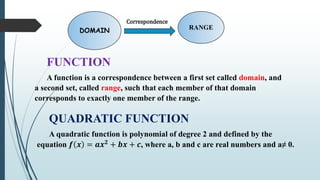
DOMAIN RANGE
Correspondence
FUNCTION
A function is a correspondence between a first set called domain, and
a second set, called range, such that each member of that domain
corresponds to exactly one member of the range.
QUADRATIC FUNCTION
A quadratic function is polynomial of degree 2 and defined by the
equation 𝒇 𝒙 = 𝒂𝒙𝟐 + 𝒃𝒙 + 𝒄, where a, b and c are real numbers and a≠ 0.
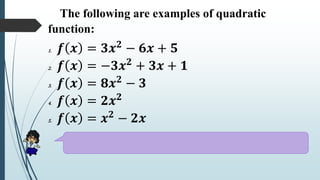
The following are examples of quadratic
function:
1. 𝒇 𝒙 = 𝟑𝒙𝟐
− 𝟔𝒙 + 𝟓
2. 𝒇 𝒙 = −𝟑𝒙𝟐
+ 𝟑𝒙 + 𝟏
3. 𝒇 𝒙 = 𝟖𝒙𝟐
− 𝟑
4. 𝒇 𝒙 = 𝟐𝒙𝟐
5. 𝒇 𝒙 = 𝒙𝟐
− 𝟐𝒙
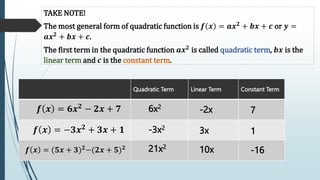
Quadratic Term Linear Term Constant Term
TAKE NOTE!
The most general form of quadratic function is 𝒇 𝒙 = 𝒂𝒙𝟐
+ 𝒃𝒙 + 𝒄 or 𝒚 =
𝒂𝒙𝟐 + 𝒃𝒙 + 𝒄.
The first term in the quadratic function 𝒂𝒙𝟐 is called quadratic term, 𝒃𝒙 is the
linear term and 𝒄 is the constant term.
𝒇 𝒙 = −𝟑𝒙𝟐 + 𝟑𝒙 + 𝟏
6x2
𝒇 𝒙 = 𝟔𝒙𝟐 − 𝟐𝒙 + 𝟕
𝒇 𝒙 = (𝟓𝒙 + 𝟑)𝟐−(𝟐𝒙 + 𝟓)𝟐
-3x2
21x2
-2x
3x
10x
7
1
-16
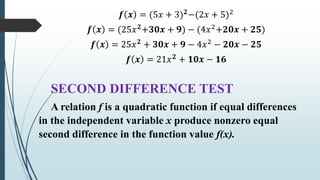
𝒇 𝒙 = (5𝑥 + 3)𝟐
−(2𝑥 + 5)2
𝒇 𝒙 = (25𝑥𝟐+𝟑𝟎𝒙 + 𝟗) − (4𝑥2+𝟐𝟎𝒙 + 𝟐𝟓)
𝒇 𝒙 = 25𝑥𝟐
+ 𝟑𝟎𝒙 + 𝟗 − 4𝑥2
− 𝟐𝟎𝒙 − 𝟐𝟓
𝒇 𝒙 = 21𝑥𝟐 + 𝟏𝟎𝒙 − 𝟏𝟔
SECOND DIFFERENCE TEST
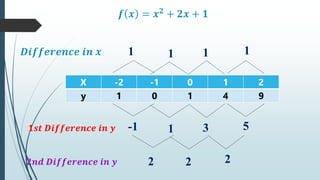
A relation f is a quadratic function if equal differences
in the independent variable x produce nonzero equal
second difference in the function value f(x).
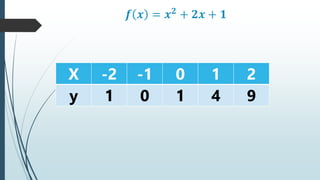
𝒇 𝒙 = 𝒙𝟐
+ 𝟐𝒙 + 𝟏
X -2 -1 0 1 2
y 1 0 1 4 9
𝒇 𝒙 = 𝒙𝟐
+ 𝟐𝒙 + 𝟏
X -2 -1 0 1 2
y 1 0 1 4 9
1
1
1
1
𝑫𝒊𝒇𝒇𝒆𝒓𝒆𝒏𝒄𝒆 𝒊𝒏 𝒙
𝟏𝒔𝒕 𝑫𝒊𝒇𝒇𝒆𝒓𝒆𝒏𝒄𝒆 𝒊𝒏 𝒚 5
3
1
-1
𝟐𝒏𝒅 𝑫𝒊𝒇𝒇𝒆𝒓𝒆𝒏𝒄𝒆 𝒊𝒏 𝒚 2
2
2
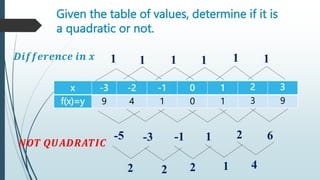
Given the table of values, determine if it is
a quadratic or not.
x -3 -2 -1 0 1 2 3
f(x)=y 9 4 1 0 1 3 9
1
1
1
1
𝑫𝒊𝒇𝒇𝒆𝒓𝒆𝒏𝒄𝒆 𝒊𝒏 𝒙 1 1
6
1
-1
-5 -3 2
4
1
2
2
2
𝑵𝑶𝑻 𝑸𝑼𝑨𝑫𝑹𝑨𝑻𝑰𝑪
Concept Review page 49
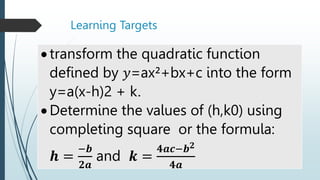
Learning Targets
 transform the quadratic function
defined by 𝑦=ax²+bx+c into the form
y=a(x-h)2 + k.
 Determine the values of (h,k0) using
completing square or the formula:
𝒉 =
−𝒃
𝟐𝒂
and 𝒌 =
𝟒𝒂𝒄−𝒃𝟐
𝟒𝒂
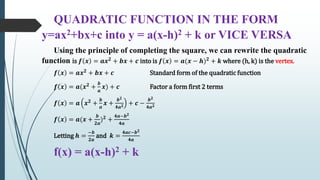
QUADRATIC FUNCTION IN THE FORM
y=ax2+bx+c into y = a(x-h)2 + k or VICE VERSA
Using the principle of completing the square, we can rewrite the quadratic
function is 𝒇 𝒙 = 𝒂𝒙𝟐 + 𝒃𝒙 + 𝒄 into is 𝒇 𝒙 = 𝒂(𝒙 − 𝒉)𝟐 + 𝒌 where (h, k) is the vertex.
𝒇 𝒙 = 𝒂𝒙𝟐 + 𝒃𝒙 + 𝒄 Standard form of the quadratic function
𝒇 𝒙 = 𝒂(𝒙𝟐 +
𝒃
𝒂
𝒙) + 𝒄 Factor a form first 2 terms
𝒇 𝒙 = 𝒂 𝒙𝟐
+
𝒃
𝒂
𝒙 +
𝒃𝟐
𝟒𝒂𝟐 + 𝒄 −
𝒃𝟐
𝟒𝒂𝟐
𝒇 𝒙 = 𝒂(𝒙 +
𝒃
𝟐𝒂
)𝟐 +
𝟒𝒂−𝒃𝟐
𝟒𝒂
Letting 𝒉 =
−𝒃
𝟐𝒂
and 𝒌 =
𝟒𝒂𝒄−𝒃𝟐
𝟒𝒂
f(x) = a(x-h)2 + k
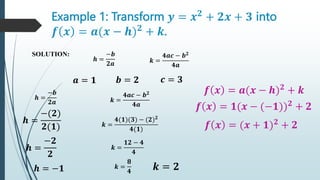
Example 1: Transform 𝒚 = 𝒙𝟐
+ 𝟐𝒙 + 𝟑 into
𝒇 𝒙 = 𝒂(𝒙 − 𝒉)𝟐
+ 𝒌.
SOLUTION:
𝒂 = 𝟏
𝒌 =
𝟒𝒂𝒄 − 𝒃𝟐
𝟒𝒂
𝒉 =
−𝒃
𝟐𝒂
𝒃 = 𝟐 𝒄 = 𝟑
𝒉 =
−𝒃
𝟐𝒂
𝒉 =
−(𝟐)
𝟐(𝟏)
𝒉 =
−𝟐
𝟐
𝒉 = −𝟏
𝒌 =
𝟒𝒂𝒄 − 𝒃𝟐
𝟒𝒂
𝒌 =
𝟏𝟐 − 𝟒
𝟒
𝒌 =
𝟒(𝟏)(𝟑) − (𝟐)𝟐
𝟒(𝟏)
𝒌 =
𝟖
𝟒 𝒌 = 𝟐
𝒇 𝒙 = 𝒂(𝒙 − 𝒉)𝟐
+ 𝒌
𝒇 𝒙 = 𝟏(𝒙 − (−𝟏))𝟐
+ 𝟐
𝒇 𝒙 = (𝒙 + 𝟏)𝟐
+ 𝟐
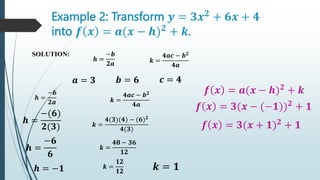
Example 2: Transform 𝒚 = 𝟑𝒙𝟐
+ 𝟔𝒙 + 𝟒
into 𝒇 𝒙 = 𝒂(𝒙 − 𝒉)𝟐
+ 𝒌.
SOLUTION:
𝒂 = 𝟑
𝒌 =
𝟒𝒂𝒄 − 𝒃𝟐
𝟒𝒂
𝒉 =
−𝒃
𝟐𝒂
𝒃 = 𝟔 𝒄 = 𝟒
𝒉 =
−𝒃
𝟐𝒂
𝒉 =
−(𝟔)
𝟐(𝟑)
𝒉 =
−𝟔
𝟔
𝒉 = −𝟏
𝒌 =
𝟒𝒂𝒄 − 𝒃𝟐
𝟒𝒂
𝒌 =
𝟒𝟖 − 𝟑𝟔
𝟏𝟐
𝒌 =
𝟒(𝟑)(𝟒) − (𝟔)𝟐
𝟒(𝟑)
𝒌 =
𝟏𝟐
𝟏𝟐 𝒌 = 𝟏
𝒇 𝒙 = 𝒂(𝒙 − 𝒉)𝟐
+ 𝒌
𝒇 𝒙 = 𝟑(𝒙 − (−𝟏))𝟐
+ 𝟏
𝒇 𝒙 = 𝟑(𝒙 + 𝟏)𝟐
+ 𝟏
𝒉 =
−𝒃
𝟐𝒂
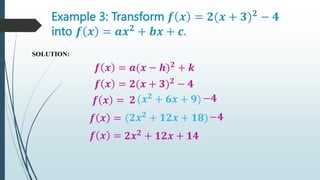
Example 3: Transform 𝒇 𝒙 = 𝟐(𝒙 + 𝟑)𝟐
− 𝟒
into 𝒇 𝒙 = 𝒂𝒙𝟐
+ 𝒃𝒙 + 𝒄.
SOLUTION:
𝒇 𝒙 = 𝒂(𝒙 − 𝒉)𝟐
+ 𝒌
𝒇 𝒙 = 𝟐(𝒙 + 𝟑)𝟐
− 𝟒
𝒇 𝒙 = 𝟐(𝒙𝟐
+ 𝟔𝒙 + 𝟗)
−𝟒
𝒇 𝒙 = (𝟐𝒙𝟐
+ 𝟏𝟐𝒙 + 𝟏𝟖)
𝒇 𝒙 = 𝟐𝒙𝟐
+ 𝟏𝟐𝒙 + 𝟏𝟒
−𝟒
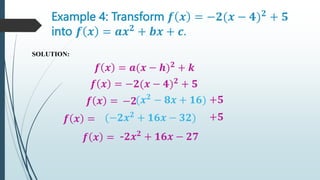
Example 4: Transform 𝒇 𝒙 = −𝟐(𝒙 − 𝟒)𝟐
+ 𝟓
into 𝒇 𝒙 = 𝒂𝒙𝟐
+ 𝒃𝒙 + 𝒄.
SOLUTION:
𝒇 𝒙 = 𝒂(𝒙 − 𝒉)𝟐
+ 𝒌
𝒇 𝒙 = −𝟐(𝒙 − 𝟒)𝟐
+ 𝟓
𝒇 𝒙 = −𝟐(𝒙𝟐
− 𝟖𝒙 + 𝟏𝟔)
+𝟓
𝒇 𝒙 = (−𝟐𝒙𝟐
+ 𝟏𝟔𝒙 − 𝟑𝟐)
𝒇 𝒙 = -𝟐𝒙𝟐
+ 𝟏𝟔𝒙 − 𝟐𝟕
+𝟓
Concept Review Page 53
1-5 only
GRAPHS OF QUADRATIC FUNCTION
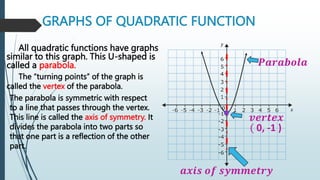
All quadratic functions have graphs
similar to this graph. This U-shaped is
called a parabola. 𝑷𝒂𝒓𝒂𝒃𝒐𝒍𝒂
𝒗𝒆𝒓𝒕𝒆𝒙
( 0, -1 )
The “turning points” of the graph is
called the vertex of the parabola.
The parabola is symmetric with respect
to a line that passes through the vertex.
This line is called the axis of symmetry. It
divides the parabola into two parts so
that one part is a reflection of the other
part.
𝒂𝒙𝒊𝒔 𝒐𝒇 𝒔𝒚𝒎𝒎𝒆𝒕𝒓𝒚
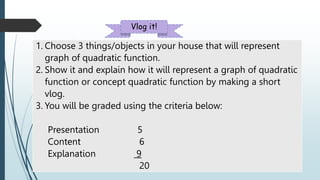
Vlog it!
1. Choose 3 things/objects in your house that will represent
graph of quadratic function.
2. Show it and explain how it will represent a graph of quadratic
function or concept quadratic function by making a short
vlog.
3. You will be graded using the criteria below:
Presentation 5
Content 6
Explanation 9
20

Quadratic Functions.pptx

  • 1.
    Quadratic Functions Learning Targets •Give an example of real life situations using quadratic functions. • Differentiate quadratic functions from linear functions.
  • 2.
    Match the itemsin column A with the item in column B that is related to it. Column A Column B A newborn baby children A bar code in a shop date of birth A real number square of that number A mother price
  • 3.
    A newborn babyis related to his or her date of birth. This relationship is a function since to each baby have its own date of birth. In other words, no baby can have two dates of birth. -3 -2 1 0 3 9 4 1 0 9 x x2 A bar code in a store is related to a price. This also shows a function since to each bar code, there corresponds a price. In fact, no bar code can have two or more different prices. A real number is related to a square of that number. This is also a function since to each real number there corresponds a square of the number. In other words, no real number can have two or more different squares. On the other hand, a mother can have two or more children. Hence, this relation is NOT a function.
  • 4.
    DOMAIN RANGE Correspondence FUNCTION A functionis a correspondence between a first set called domain, and a second set, called range, such that each member of that domain corresponds to exactly one member of the range. QUADRATIC FUNCTION A quadratic function is polynomial of degree 2 and defined by the equation 𝒇 𝒙 = 𝒂𝒙𝟐 + 𝒃𝒙 + 𝒄, where a, b and c are real numbers and a≠ 0.
  • 5.
    The following areexamples of quadratic function: 1. 𝒇 𝒙 = 𝟑𝒙𝟐 − 𝟔𝒙 + 𝟓 2. 𝒇 𝒙 = −𝟑𝒙𝟐 + 𝟑𝒙 + 𝟏 3. 𝒇 𝒙 = 𝟖𝒙𝟐 − 𝟑 4. 𝒇 𝒙 = 𝟐𝒙𝟐 5. 𝒇 𝒙 = 𝒙𝟐 − 𝟐𝒙
  • 6.
    Quadratic Term LinearTerm Constant Term TAKE NOTE! The most general form of quadratic function is 𝒇 𝒙 = 𝒂𝒙𝟐 + 𝒃𝒙 + 𝒄 or 𝒚 = 𝒂𝒙𝟐 + 𝒃𝒙 + 𝒄. The first term in the quadratic function 𝒂𝒙𝟐 is called quadratic term, 𝒃𝒙 is the linear term and 𝒄 is the constant term. 𝒇 𝒙 = −𝟑𝒙𝟐 + 𝟑𝒙 + 𝟏 6x2 𝒇 𝒙 = 𝟔𝒙𝟐 − 𝟐𝒙 + 𝟕 𝒇 𝒙 = (𝟓𝒙 + 𝟑)𝟐−(𝟐𝒙 + 𝟓)𝟐 -3x2 21x2 -2x 3x 10x 7 1 -16
  • 7.
    𝒇 𝒙 =(5𝑥 + 3)𝟐 −(2𝑥 + 5)2 𝒇 𝒙 = (25𝑥𝟐+𝟑𝟎𝒙 + 𝟗) − (4𝑥2+𝟐𝟎𝒙 + 𝟐𝟓) 𝒇 𝒙 = 25𝑥𝟐 + 𝟑𝟎𝒙 + 𝟗 − 4𝑥2 − 𝟐𝟎𝒙 − 𝟐𝟓 𝒇 𝒙 = 21𝑥𝟐 + 𝟏𝟎𝒙 − 𝟏𝟔 SECOND DIFFERENCE TEST A relation f is a quadratic function if equal differences in the independent variable x produce nonzero equal second difference in the function value f(x).
  • 8.
    𝒇 𝒙 =𝒙𝟐 + 𝟐𝒙 + 𝟏 X -2 -1 0 1 2 y 1 0 1 4 9
  • 9.
    𝒇 𝒙 =𝒙𝟐 + 𝟐𝒙 + 𝟏 X -2 -1 0 1 2 y 1 0 1 4 9 1 1 1 1 𝑫𝒊𝒇𝒇𝒆𝒓𝒆𝒏𝒄𝒆 𝒊𝒏 𝒙 𝟏𝒔𝒕 𝑫𝒊𝒇𝒇𝒆𝒓𝒆𝒏𝒄𝒆 𝒊𝒏 𝒚 5 3 1 -1 𝟐𝒏𝒅 𝑫𝒊𝒇𝒇𝒆𝒓𝒆𝒏𝒄𝒆 𝒊𝒏 𝒚 2 2 2
  • 10.
    Given the tableof values, determine if it is a quadratic or not. x -3 -2 -1 0 1 2 3 f(x)=y 9 4 1 0 1 3 9 1 1 1 1 𝑫𝒊𝒇𝒇𝒆𝒓𝒆𝒏𝒄𝒆 𝒊𝒏 𝒙 1 1 6 1 -1 -5 -3 2 4 1 2 2 2 𝑵𝑶𝑻 𝑸𝑼𝑨𝑫𝑹𝑨𝑻𝑰𝑪
  • 11.
  • 13.
    Learning Targets  transformthe quadratic function defined by 𝑦=ax²+bx+c into the form y=a(x-h)2 + k.  Determine the values of (h,k0) using completing square or the formula: 𝒉 = −𝒃 𝟐𝒂 and 𝒌 = 𝟒𝒂𝒄−𝒃𝟐 𝟒𝒂
  • 14.
    QUADRATIC FUNCTION INTHE FORM y=ax2+bx+c into y = a(x-h)2 + k or VICE VERSA Using the principle of completing the square, we can rewrite the quadratic function is 𝒇 𝒙 = 𝒂𝒙𝟐 + 𝒃𝒙 + 𝒄 into is 𝒇 𝒙 = 𝒂(𝒙 − 𝒉)𝟐 + 𝒌 where (h, k) is the vertex. 𝒇 𝒙 = 𝒂𝒙𝟐 + 𝒃𝒙 + 𝒄 Standard form of the quadratic function 𝒇 𝒙 = 𝒂(𝒙𝟐 + 𝒃 𝒂 𝒙) + 𝒄 Factor a form first 2 terms 𝒇 𝒙 = 𝒂 𝒙𝟐 + 𝒃 𝒂 𝒙 + 𝒃𝟐 𝟒𝒂𝟐 + 𝒄 − 𝒃𝟐 𝟒𝒂𝟐 𝒇 𝒙 = 𝒂(𝒙 + 𝒃 𝟐𝒂 )𝟐 + 𝟒𝒂−𝒃𝟐 𝟒𝒂 Letting 𝒉 = −𝒃 𝟐𝒂 and 𝒌 = 𝟒𝒂𝒄−𝒃𝟐 𝟒𝒂 f(x) = a(x-h)2 + k
  • 15.
    Example 1: Transform𝒚 = 𝒙𝟐 + 𝟐𝒙 + 𝟑 into 𝒇 𝒙 = 𝒂(𝒙 − 𝒉)𝟐 + 𝒌. SOLUTION: 𝒂 = 𝟏 𝒌 = 𝟒𝒂𝒄 − 𝒃𝟐 𝟒𝒂 𝒉 = −𝒃 𝟐𝒂 𝒃 = 𝟐 𝒄 = 𝟑 𝒉 = −𝒃 𝟐𝒂 𝒉 = −(𝟐) 𝟐(𝟏) 𝒉 = −𝟐 𝟐 𝒉 = −𝟏 𝒌 = 𝟒𝒂𝒄 − 𝒃𝟐 𝟒𝒂 𝒌 = 𝟏𝟐 − 𝟒 𝟒 𝒌 = 𝟒(𝟏)(𝟑) − (𝟐)𝟐 𝟒(𝟏) 𝒌 = 𝟖 𝟒 𝒌 = 𝟐 𝒇 𝒙 = 𝒂(𝒙 − 𝒉)𝟐 + 𝒌 𝒇 𝒙 = 𝟏(𝒙 − (−𝟏))𝟐 + 𝟐 𝒇 𝒙 = (𝒙 + 𝟏)𝟐 + 𝟐
  • 16.
    Example 2: Transform𝒚 = 𝟑𝒙𝟐 + 𝟔𝒙 + 𝟒 into 𝒇 𝒙 = 𝒂(𝒙 − 𝒉)𝟐 + 𝒌. SOLUTION: 𝒂 = 𝟑 𝒌 = 𝟒𝒂𝒄 − 𝒃𝟐 𝟒𝒂 𝒉 = −𝒃 𝟐𝒂 𝒃 = 𝟔 𝒄 = 𝟒 𝒉 = −𝒃 𝟐𝒂 𝒉 = −(𝟔) 𝟐(𝟑) 𝒉 = −𝟔 𝟔 𝒉 = −𝟏 𝒌 = 𝟒𝒂𝒄 − 𝒃𝟐 𝟒𝒂 𝒌 = 𝟒𝟖 − 𝟑𝟔 𝟏𝟐 𝒌 = 𝟒(𝟑)(𝟒) − (𝟔)𝟐 𝟒(𝟑) 𝒌 = 𝟏𝟐 𝟏𝟐 𝒌 = 𝟏 𝒇 𝒙 = 𝒂(𝒙 − 𝒉)𝟐 + 𝒌 𝒇 𝒙 = 𝟑(𝒙 − (−𝟏))𝟐 + 𝟏 𝒇 𝒙 = 𝟑(𝒙 + 𝟏)𝟐 + 𝟏 𝒉 = −𝒃 𝟐𝒂
  • 17.
    Example 3: Transform𝒇 𝒙 = 𝟐(𝒙 + 𝟑)𝟐 − 𝟒 into 𝒇 𝒙 = 𝒂𝒙𝟐 + 𝒃𝒙 + 𝒄. SOLUTION: 𝒇 𝒙 = 𝒂(𝒙 − 𝒉)𝟐 + 𝒌 𝒇 𝒙 = 𝟐(𝒙 + 𝟑)𝟐 − 𝟒 𝒇 𝒙 = 𝟐(𝒙𝟐 + 𝟔𝒙 + 𝟗) −𝟒 𝒇 𝒙 = (𝟐𝒙𝟐 + 𝟏𝟐𝒙 + 𝟏𝟖) 𝒇 𝒙 = 𝟐𝒙𝟐 + 𝟏𝟐𝒙 + 𝟏𝟒 −𝟒
  • 18.
    Example 4: Transform𝒇 𝒙 = −𝟐(𝒙 − 𝟒)𝟐 + 𝟓 into 𝒇 𝒙 = 𝒂𝒙𝟐 + 𝒃𝒙 + 𝒄. SOLUTION: 𝒇 𝒙 = 𝒂(𝒙 − 𝒉)𝟐 + 𝒌 𝒇 𝒙 = −𝟐(𝒙 − 𝟒)𝟐 + 𝟓 𝒇 𝒙 = −𝟐(𝒙𝟐 − 𝟖𝒙 + 𝟏𝟔) +𝟓 𝒇 𝒙 = (−𝟐𝒙𝟐 + 𝟏𝟔𝒙 − 𝟑𝟐) 𝒇 𝒙 = -𝟐𝒙𝟐 + 𝟏𝟔𝒙 − 𝟐𝟕 +𝟓
  • 19.
  • 20.
    GRAPHS OF QUADRATICFUNCTION All quadratic functions have graphs similar to this graph. This U-shaped is called a parabola. 𝑷𝒂𝒓𝒂𝒃𝒐𝒍𝒂 𝒗𝒆𝒓𝒕𝒆𝒙 ( 0, -1 ) The “turning points” of the graph is called the vertex of the parabola. The parabola is symmetric with respect to a line that passes through the vertex. This line is called the axis of symmetry. It divides the parabola into two parts so that one part is a reflection of the other part. 𝒂𝒙𝒊𝒔 𝒐𝒇 𝒔𝒚𝒎𝒎𝒆𝒕𝒓𝒚
  • 21.
    Vlog it! 1. Choose3 things/objects in your house that will represent graph of quadratic function. 2. Show it and explain how it will represent a graph of quadratic function or concept quadratic function by making a short vlog. 3. You will be graded using the criteria below: Presentation 5 Content 6 Explanation 9 20