3 Quadratic Functions 1
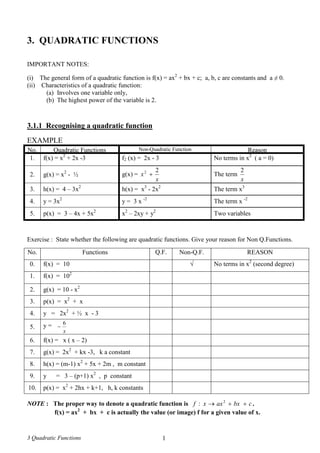
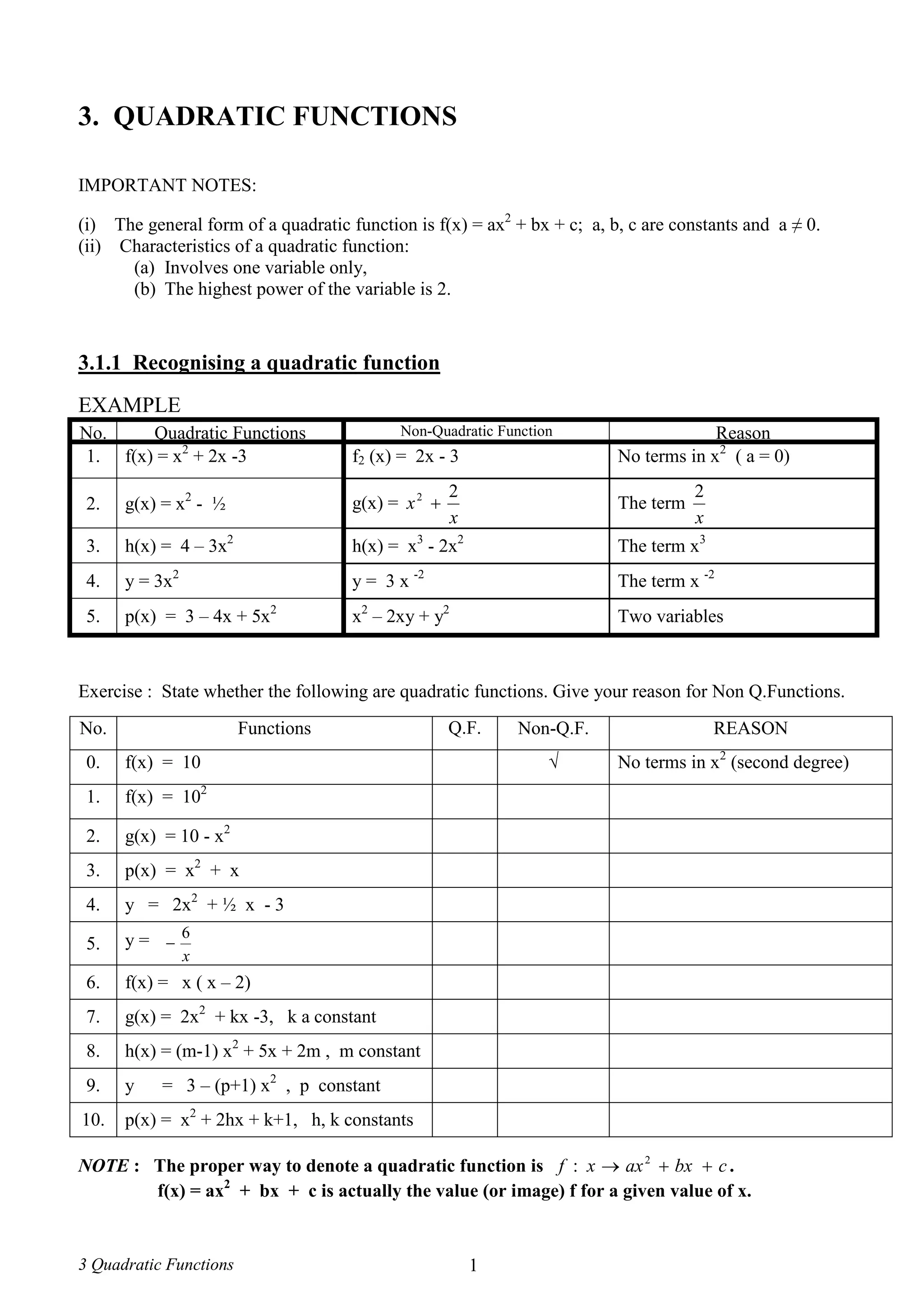
3. QUADRATIC FUNCTIONS
IMPORTANT NOTES:
(i) The general form of a quadratic function is f(x) = ax2
+ bx + c; a, b, c are constants and a ≠ 0.
(ii) Characteristics of a quadratic function:
(a) Involves one variable only,
(b) The highest power of the variable is 2.
3.1.1 Recognising a quadratic function
EXAMPLE
No. Quadratic Functions Non-Quadratic Function Reason
1. f(x) = x2
+ 2x -3 f2 (x) = 2x - 3 No terms in x2
( a = 0)
2. g(x) = x2
- ½ g(x) =
x
x
22
 The term
x
2
3. h(x) = 4 – 3x2
h(x) = x3
- 2x2
The term x3
4. y = 3x2
y = 3 x -2
The term x -2
5. p(x) = 3 – 4x + 5x2
x2
– 2xy + y2
Two variables
Exercise : State whether the following are quadratic functions. Give your reason for Non Q.Functions.
No. Functions Q.F. Non-Q.F. REASON
0. f(x) = 10 √ No terms in x2
(second degree)
1. f(x) = 102
2. g(x) = 10 - x2
3. p(x) = x2
+ x
4. y = 2x2
+ ½ x - 3
5. y =
x
6

6. f(x) = x ( x – 2)
7. g(x) = 2x2
+ kx -3, k a constant
8. h(x) = (m-1) x2
+ 5x + 2m , m constant
9. y = 3 – (p+1) x2
, p constant
10. p(x) = x2
+ 2hx + k+1, h, k constants
NOTE : The proper way to denote a quadratic function is cbxaxxf  2
: .
f(x) = ax2
+ bx + c is actually the value (or image) f for a given value of x.
3 Quadratic Functions 2
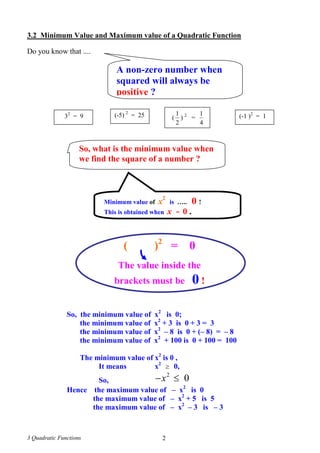
3.2 Minimum Value and Maximum value of a Quadratic Function
Do you know that ....
A non-zero number when
squared will always be
positive ?
32
= 9 (-5) 2
= 25 (-1 )2
= 1(
2
1
) 2
=
4
1
So, what is the minimum value when
we find the square of a number ?
Minimum value of x2
is ….. 0 !
This is obtained when x = 0 .
( )2
= 0
The value inside the
brackets must be 0 !
So, the minimum value of x2
is 0;
the minimum value of x2
+ 3 is 0 + 3 = 3
the minimum value of x2
– 8 is 0 + (– 8) = – 8
the minimum value of x2
+ 100 is 0 + 100 = 100
The minimum value of x2
is 0 ,
It means x2
 0,
So,
2
0x 
Hence the maximum value of – x2
is 0
the maximum value of – x2
+ 5 is 5
the maximum value of – x2
– 3 is – 3
3 Quadratic Functions 3
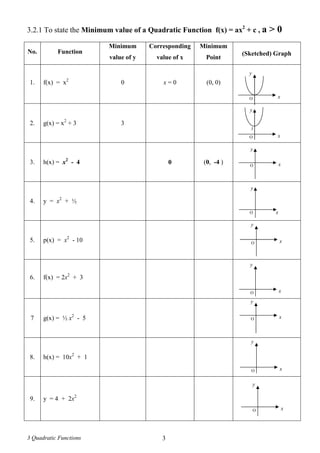
3.2.1 To state the Minimum value of a Quadratic Function f(x) = ax2
+ c , a > 0
No. Function
Minimum
value of y
Corresponding
value of x
Minimum
Point
(Sketched) Graph
1. f(x) = x2
0 x = 0 (0, 0)
2. g(x) = x2
+ 3 3
3. h(x) = x2
- 4 0 (0, -4 )
4. y = x2
+ ½
5. p(x) = x2
- 10
6. f(x) = 2x2
+ 3
7 g(x) = ½ x2
- 5
8. h(x) = 10x2
+ 1
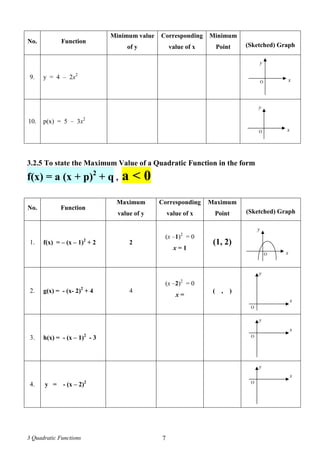
9. y = 4 + 2x2
xO
y
xO
y
3
xO
y
O
y
x
xO
y
xO
y
xO
y
xO
y
xO
y
3 Quadratic Functions 4
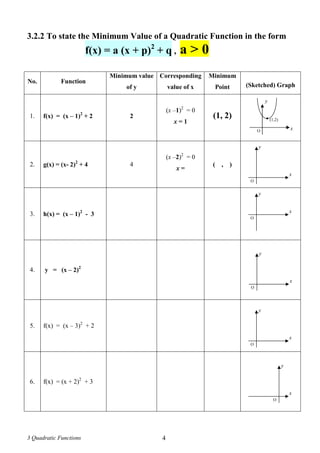
3.2.2 To state the Minimum Value of a Quadratic Function in the form
f(x) = a (x + p)2
+ q , a > 0
No. Function
Minimum value
of y
Corresponding
value of x
Minimum
Point (Sketched) Graph
1. f(x) = (x – 1)2
+ 2 2
(x –1)2
= 0
x = 1
(1, 2)
2. g(x) = (x- 2)2
+ 4 4
(x –2)2
= 0
x =
( , )
3. h(x) = (x – 1)2
- 3
4. y = (x – 2)2
5. f(x) = (x – 3)2
+ 2
6. f(x) = (x + 2)2
+ 3
x
O
y
x
O
y
x
O
y
O
x
y
x
O
y
xO
y
(1,2)●
x
3 Quadratic Functions 5
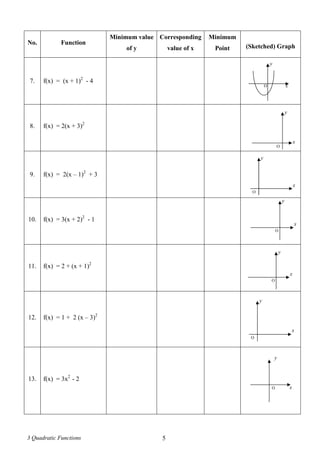
No. Function
Minimum value
of y
Corresponding
value of x
Minimum
Point (Sketched) Graph
7. f(x) = (x + 1)2
- 4
8. f(x) = 2(x + 3)2
9. f(x) = 2(x – 1)2
+ 3
10. f(x) = 3(x + 2)2
- 1
11. f(x) = 2 + (x + 1)2
12. f(x) = 1 + 2 (x – 3)2
13. f(x) = 3x2
- 2
O
y
x
x
O
y
O
x
y
x
O
y
O
x
y
xO
y
O
y
x
3 Quadratic Functions 6
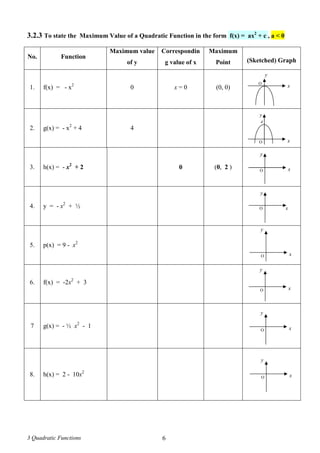
3.2.3 To state the Maximum Value of a Quadratic Function in the form f(x) = ax2
+ c , a < 0
No. Function
Maximum value
of y
Correspondin
g value of x
Maximum
Point (Sketched) Graph
1. f(x) = - x2
0 x = 0 (0, 0)
2. g(x) = - x2
+ 4 4
3. h(x) = - x2
+ 2 0 (0, 2 )
4. y = - x2
+ ½
5. p(x) = 9 - x2
6. f(x) = -2x2
+ 3
7 g(x) = - ½ x2
- 1
8. h(x) = 2 - 10x2
xO
y
xO
y
4
xO
y
y
O x
xO
y
xO
y
xO
y
xO
y
3 Quadratic Functions 7
No. Function
Minimum value
of y
Corresponding
value of x
Minimum
Point (Sketched) Graph
9. y = 4 – 2x2
10. p(x) = 5 – 3x2
3.2.5 To state the Maximum Value of a Quadratic Function in the form
f(x) = a (x + p)2
+ q , a < 0
No. Function
Maximum
value of y
Corresponding
value of x
Maximum
Point (Sketched) Graph
1. f(x) = – (x – 1)2
+ 2 2
(x –1)2
= 0
x = 1
(1, 2)
2. g(x) = - (x- 2)2
+ 4 4
(x –2)2
= 0
x =
( , )
3. h(x) = - (x – 1)2
- 3
4. y = - (x – 2)2
xO
y
xO
y
x
O
y
x
O
y
x
O
y
xO
y
3 Quadratic Functions 8
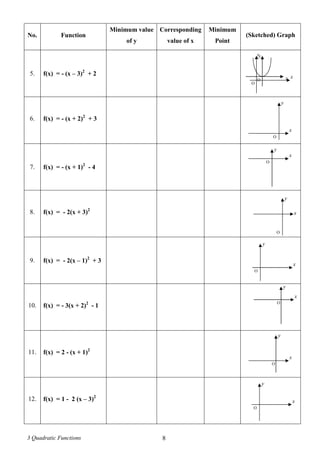
No. Function
Minimum value
of y
Corresponding
value of x
Minimum
Point
(Sketched) Graph
5. f(x) = - (x – 3)2
+ 2
6. f(x) = - (x + 2)2
+ 3
7. f(x) = - (x + 1)2
- 4
8. f(x) = - 2(x + 3)2
9. f(x) = - 2(x – 1)2
+ 3
10. f(x) = - 3(x + 2)2
- 1
11. f(x) = 2 - (x + 1)2
12. f(x) = 1 - 2 (x – 3)2
O
x
y
x
O
y
x
O
y
O
y
x
x
O
y
O
x
y
x
O
y
O
x
y
xO
y
3 Quadratic Functions 9
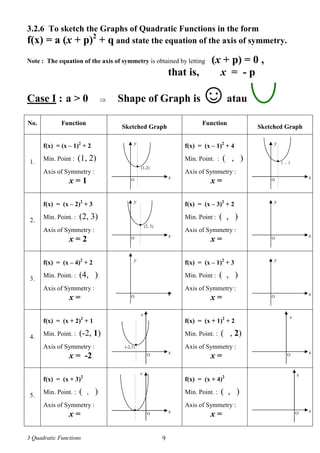
3.2.6 To sketch the Graphs of Quadratic Functions in the form
f(x) = a (x + p)2
+ q and state the equation of the axis of symmetry.
Note : The equation of the axis of symmetry is obtained by letting (x + p) = 0 ,
that is, x = - p
Case I : a > 0  Shape of Graph is☺atau
No. Function
Sketched Graph
Function
Sketched Graph
1.
f(x) = (x – 1)2
+ 2
Min. Point : (1, 2)
Axis of Symmetry :
x = 1
f(x) = (x – 1)2
+ 4
Min. Point. : ( , )
Axis of Symmetry :
x =
2.
f(x) = (x – 2)2
+ 3
Min. Point. : (2, 3)
Axis of Symmetry :
x = 2
f(x) = (x – 3)2
+ 2
Min. Point : ( , )
Axis of Symmetry :
x =
3.
f(x) = (x – 4)2
+ 2
Min. Point. : (4, )
Axis of Symmetry :
x =
f(x) = (x – 1)2
+ 3
Min. Point : ( , )
Axis of Symmetry :
x =
4.
f(x) = (x + 2)2
+ 1
Min. Point. : (-2, 1)
Axis of Symmetry :
x = -2
f(x) = (x + 1)2
+ 2
Min. Point. : ( , 2)
Axis of Symmetry :
x =
5.
f(x) = (x + 3)2
Min. Point. : ( , )
Axis of Symmetry :
x =
f(x) = (x + 4)2
Min. Point. : ( , )
Axis of Symmetry :
x =
xO
y
(1,2)●
xO
y
( , )●
y
xO
y
(2, 3)●
xO
y
xO
y
xO
y
xO
(-2,1)
●
xO
xO
● xO
y
y
y
3 Quadratic Functions 10
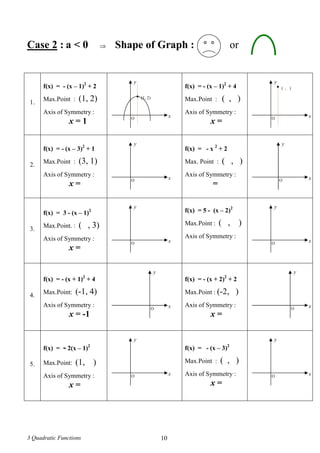
Case 2 : a < 0  Shape of Graph : or
1.
f(x) = - (x – 1)2
+ 2
Max.Point : (1, 2)
Axis of Symmetry :
x = 1
f(x) = - (x – 1)2
+ 4
Max.Point : ( , )
Axis of Symmetry :
x =
2.
f(x) = - (x – 3)2
+ 1
Max.Point : (3, 1)
Axis of Symmetry :
x =
f(x) = - x 2
+ 2
Max. Point : ( , )
Axis of Symmetry :
=
3.
f(x) = 3 - (x – 1)2
Max.Point. : ( , 3)
Axis of Symmetry :
x =
f(x) = 5 - (x – 2)2
Max.Point : ( , )
Axis of Symmetry :
4.
f(x) = - (x + 1)2
+ 4
Max.Point: (-1, 4)
Axis of Symmetry :
x = -1
f(x) = - (x + 2)2
+ 2
Max.Point : (-2, )
Axis of Symmetry :
x =
5.
f(x) = - 2(x – 1)2
Max.Point: (1, )
Axis of Symmetry :
x =
f(x) = - (x – 3)2
Max.Point : ( , )
Axis of Symmetry :
x =
xO
y
(1, 2)●
xO
y
( , )●
xO
y
xO
y
xO
y
xO
y
xO
y
xO
y
xO
y
xO
y
3 Quadratic Functions 11
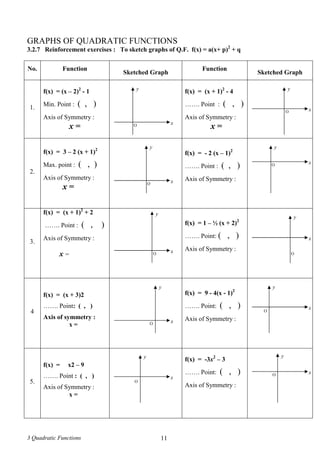
GRAPHS OF QUADRATIC FUNCTIONS
3.2.7 Reinforcement exercises : To sketch graphs of Q.F. f(x) = a(x+ p)2
+ q
No. Function
Sketched Graph
Function
Sketched Graph
1.
f(x) = (x – 2)2
- 1
Min. Point : ( , )
Axis of Symmetry :
x =
f(x) = (x + 1)2
- 4
……. Point : ( , )
Axis of Symmetry :
x =
2.
f(x) = 3 – 2 (x + 1)2
Max. point : ( , )
Axis of Symmetry :
x =
f(x) = - 2 (x – 1)2
……. Point : ( , )
Axis of Symmetry :
3.
f(x) = (x + 1)2
+ 2
……. Point : ( , )
Axis of Symmetry :
x =
f(x) = 1 – ½ (x + 2)2
……. Point: ( , )
Axis of Symmetry :
4
f(x) = (x + 3)2
……. Point: ( , )
Axis of symmetry :
x =
f(x) = 9 - 4(x - 1)2
……. Point: ( , )
Axis of Symmetry :
5.
f(x) = x2 – 9
……. Point : ( , )
Axis of Symmetry :
x =
f(x) = -3x2
– 3
……. Point: ( , )
Axis of Symmetry :
xO
y
xO
y
xO
y
xO
y
xO
y
x
O
y
xO
y
x
O
y
x
O
y
xO
y
3 Quadratic Functions 12
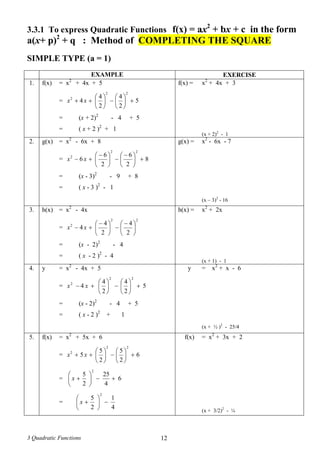
3.3.1 To express Quadratic Functions f(x) = ax2
+ bx + c in the form
a(x+ p)2
+ q : Method of COMPLETING THE SQUARE
SIMPLE TYPE (a = 1)
EXAMPLE EXERCISE
1. f(x) = x2
+ 4x + 5
= 5
2
4
2
4
4
22
2












 xx
= (x + 2)2
- 4 + 5
= ( x + 2 )2
+ 1
f(x) = x2
+ 4x + 3
(x + 2)2
- 1
2. g(x) = x2
- 6x + 8
= 8
2
6
2
6
6
22
2





 





 
 xx
= (x - 3)2
- 9 + 8
= ( x - 3 )2
- 1
g(x) = x2
- 6x - 7
(x – 3)2
- 16
3. h(x) = x2
- 4x
=
22
2
2
4
2
4
4 




 





 
 xx
= (x - 2)2
- 4
= ( x - 2 )2
- 4
h(x) = x2
+ 2x
(x + 1) - 1
4. y = x2
- 4x + 5
= 5
2
4
2
4
4
22
2












 xx
= (x - 2)2
- 4 + 5
= ( x - 2 )2
+ 1
y = x2
+ x - 6
(x + ½ )2
- 25/4
5. f(x) = x2
+ 5x + 6
= 6
2
5
2
5
5
22
2












 xx
= 6
4
25
2
5
2






x
=
4
1
2
5
2






x
f(x) = x2
+ 3x + 2
(x + 3/2)2
- ¼
3 Quadratic Functions 13
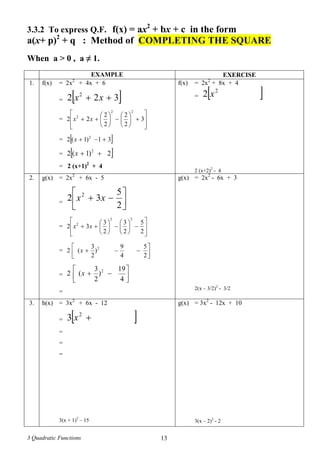
3.3.2 To express Q.F. f(x) = ax2
+ bx + c in the form
a(x+ p)2
+ q : Method of COMPLETING THE SQUARE
When a > 0 , a ≠ 1.
EXAMPLE EXERCISE
1. f(x) = 2x2
+ 4x + 6
=  322 2
 xx
=




















 3
2
2
2
2
22
22
2
xx
=  31)1(2 2
x
=  2)1(2 2
x
= 2 (x+1)2
+ 4
f(x) = 2x2
+ 8x + 4
=  2
2 x
2 (x+2)2
- 4
2. g(x) = 2x2
+ 6x - 5
= 




2
5
32 2
xx
=





















2
5
2
3
2
3
32
22
2
xx
= 




2
5
4
9
)
2
3
(2 2
x
= 






4
19
)
2
3
(2 2
x
=
g(x) = 2x2
- 6x + 3
2(x – 3/2)2
- 3/2
3. h(x) = 3x2
+ 6x - 12
=  2
3 x
=
=
=
3(x + 1)2
– 15
g(x) = 3x2
- 12x + 10
3(x – 2)2
- 2
3 Quadratic Functions 14
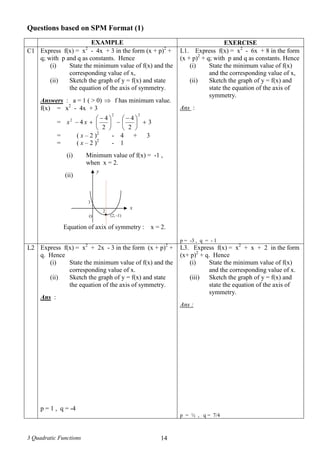
Questions based on SPM Format (1)
EXAMPLE EXERCISE
Express f(x) = x2
- 4x + 3 in the form (x + p)2
+
q; with p and q as constants. Hence
(i) State the minimum value of f(x) and the
corresponding value of x,
(ii) Sketch the graph of y = f(x) and state
the equation of the axis of symmetry.
Answers : a = 1 ( > 0)  f has minimum value.
C1
f(x) = x2
- 4x + 3
= 3
2
4
2
4
4
22
2





 





 
 xx
= ( x – 2 )2
- 4 + 3
= ( x – 2 )2
- 1
(i) Minimum value of f(x) = -1 ,
when x = 2.
(ii)
Equation of axix of symmetry : x = 2.
L1. Express f(x) = x2
- 6x + 8 in the form
(x + p)2
+ q; with p and q as constants. Hence
(i) State the minimum value of f(x)
and the corresponding value of x,
(ii) Sketch the graph of y = f(x) and
state the equation of the axis of
symmetry.
Ans :
p = -3 , q = - 1
L2 Express f(x) = x2
+ 2x - 3 in the form (x + p)2
+
q. Hence
(i) State the minimum value of f(x) and the
corresponding value of x.
(ii) Sketch the graph of y = f(x) and state
the equation of the axis of symmetry.
Ans :
p = 1 , q = -4
L3. Express f(x) = x2
+ x + 2 in the form
(x+ p)2
+ q. Hence
(i) State the minimum value of f(x)
and the corresponding value of x.
(iii) Sketch the graph of y = f(x) and
state the equation of the axis of
symmetry.
Ans :
p = ½ , q = 7/4
x
O
y
(2, -1)●
3
2
3 Quadratic Functions 15
Questions based on SPM Format (II)
EXAMPLE EXERCISE
Express f(x) = - x2
+ 6x + 7 in the form
k - (x + p)2
, k and p are constants. Hence
(i) State the maximum value of f(x) and
state the coressponding value of x,
(ii) Sketch the graph of y = f(x) and state
the equation of the axis of symmetry.
Ans: a = -1 ( < 0)  f has maximum value
C2
f(x) = - x2
+ 6x + 7
=  762
 xx
=













 





 
 7
2
6
3
6
6(
22
2
xx
=  79)3( 2
 x
= - [ (x - 3)2
- 16 ]
= 16 - (x -3)2
(i) Maximum f(x) = 16, when x =
3.
(ii)
Axis of symmetry is : x = 3.
L4. Express f(x) = - x2
- 8x + 9 in the form
- (x + p)2
+ q. Hence
(i) State the maximum value of f(x)
and state the coressponding value
of x,
(ii) Sketch the graph of y = f(x) and
state the equation of the axis of
symmetry.
Ans:
p = 4 , q = 25
L5 Express f(x) = - x2
+ 4x + 1 in the form - (x +
p)2
. Hence
(i) State the maximum value of f(x) and
state the coressponding value of x,
(ii) Sketch the graph of y = f(x) and state
the equation of the axis of symmetry.
Jawapan :
(sila gunakan kertas sendiri) 5 – (x – 2)2
L6. Express f(x) = 4 – 3x - x2
in the form
q - (x + p)2
Hence
(i) State the maximum value of f(x)
and state the coressponding value
of x,
(ii) Sketch the graph of y = f(x) and
state the equation of the axis of
symmetry.
Jawapan :
25/4 - (x + 3/2)2
xO
y
(3, 16)
●
7
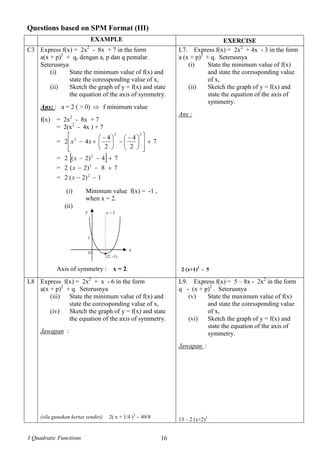
3
x = 3
3 Quadratic Functions 16
Questions based on SPM Format (III)
EXAMPLE EXERCISE
Express f(x) = 2x2
- 8x + 7 in the form
a(x + p)2
+ q, dengan a, p dan q pemalar.
Seterusnya
(i) State the minimum value of f(x) and
state the coressponding value of x,
(ii) Sketch the graph of y = f(x) and state
the equation of the axis of symmetry.
Ans: : a = 2 ( > 0)  f minimum value
C3
f(x) = 2x2
- 8x + 7
= 2(x2
- 4x ) + 7
= 7
2
4
2
4
42
22
2














 





 
 xx
=   74)2(2 2
x
= 78)2(2 2
x
= 1)2(2 2
x
(i) Minimum value f(x) = -1 ,
when x = 2.
(ii)
Axis of symmetry : x = 2.
L7. Express f(x) = 2x2
+ 4x - 3 in the form
a (x + p)2
+ q. Seterusnya
(i) State the minimum value of f(x)
and state the coressponding value
of x,
(ii) Sketch the graph of y = f(x) and
state the equation of the axis of
symmetry.
Ans :
2 (x+1)2
- 5
L8 Express f(x) = 2x2
+ x - 6 in the form
a(x + p)2
+ q. Seterusnya
(iii) State the minimum value of f(x) and
state the coressponding value of x,
(iv) Sketch the graph of y = f(x) and state
the equation of the axis of symmetry.
Jawapan :
(sila gunakan kertas sendiri) 2( x + 1/4 )2
- 49/8
L9. Express f(x) = 5 – 8x - 2x2
in the form
q - (x + p)2
. Seterusnya
(v) State the maximum value of f(x)
and state the coressponding value
of x,
(vi) Sketch the graph of y = f(x) and
state the equation of the axis of
symmetry.
Jawapan :
13 – 2 (x+2)2
xO
y
(2, -1)
●
7
x = 2
3 Quadratic Functions 17
3.4 Quadratic Inequalities
(Students must be able to solve simple linear inequlities first)
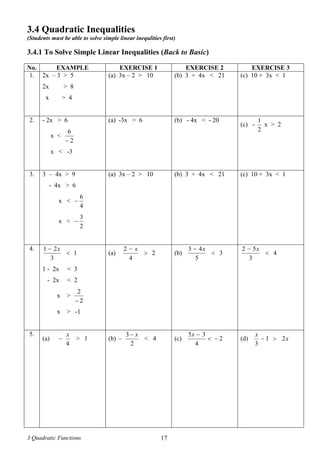
3.4.1 To Solve Simple Linear Inequalities (Back to Basic)
No. EXAMPLE EXERCISE 1 EXERCISE 2 EXERCISE 3
1. 2x – 3 > 5
2x > 8
x > 4
(a) 3x – 2 > 10 (b) 3 + 4x < 21 (c) 10 + 3x < 1
2. - 2x > 6
x <
2
6

x < -3
(a) -3x > 6 (b) - 4x < - 20
(c) -
2
1
x > 2
3. 3 – 4x > 9
- 4x > 6
x <
4
6

x <
2
3

(a) 3x – 2 > 10 (b) 3 + 4x < 21 (c) 10 + 3x < 1
4.
1
3
21

 x
1 - 2x < 3
- 2x < 2
x >
2
2

x > -1
(a) 2
4
2

 x
(b) 3
5
43

 x
4
3
52

 x
5.
(a)
4
x
 > 1 (b)
2
3 x
 < 4 (c) 2
4
35

x
(d) x
x
21
3

3 Quadratic Functions 18
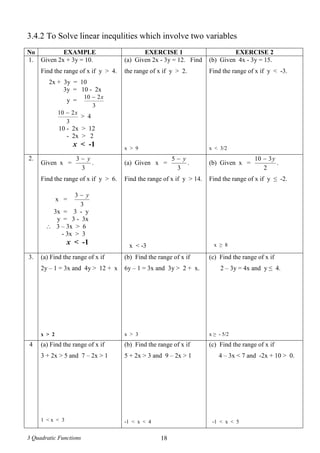
3.4.2 To Solve linear inequlities which involve two variables
No EXAMPLE EXERCISE 1 EXERCISE 2
1. Given 2x + 3y = 10.
Find the range of x if y > 4.
2x + 3y = 10
3y = 10 - 2x
y =
3
210 x
3
210 x
> 4
10 - 2x > 12
- 2x > 2
x < -1
(a) Given 2x - 3y = 12. Find
the range of x if y > 2.
x > 9
(b) Given 4x - 3y = 15.
Find the range of x if y < -3.
x < 3/2
2.
Given x =
3
3 y
.
Find the range of x if y > 6.
x =
3
3 y
3x = 3 - y
y = 3 - 3x
 3 – 3x > 6
- 3x > 3
x < -1
(a) Given x =
3
5 y
.
Find the range of x if y > 14.
x < -3
(b) Given x =
2
310 y
.
Find the range of x if y ≤ -2.
x ≥ 8
3. (a) Find the range of x if
2y – 1 = 3x and 4y > 12 + x
x > 2
(b) Find the range of x if
6y – 1 = 3x and 3y > 2 + x.
x > 3
(c) Find the range of x if
2 – 3y = 4x and y ≤ 4.
x ≥ - 5/2
4 (a) Find the range of x if
3 + 2x > 5 and 7 – 2x > 1
1 < x < 3
(b) Find the range of x if
5 + 2x > 3 and 9 – 2x > 1
-1 < x < 4
(c) Find the range of x if
4 – 3x < 7 and -2x + 10 > 0.
-1 < x < 5
3 Quadratic Functions 19
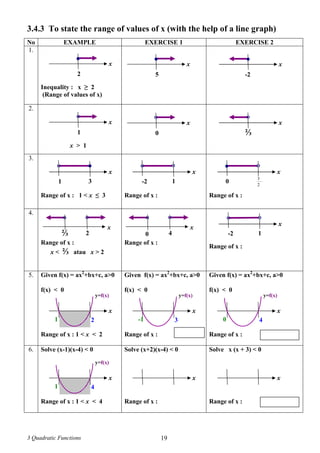
3.4.3 To state the range of values of x (with the help of a line graph)
No EXAMPLE EXERCISE 1 EXERCISE 2
1.
Inequality : x ≥ 2
(Range of values of x)
2.
x > 1
3.
Range of x : 1 < x ≤ 3 Range of x : Range of x :
4.
Range of x :
x < ⅔ atau x > 2
Range of x :
Range of x :
5. Given f(x) = ax2
+bx+c, a>0
f(x) < 0
Range of x : 1 < x < 2
Given f(x) = ax2
+bx+c, a>0
f(x) < 0
Range of x :
Given f(x) = ax2
+bx+c, a>0
f(x) < 0
Range of x :
6. Solve (x-1)(x-4) < 0
Range of x : 1 < x < 4
Solve (x+2)(x-4) < 0
Range of x :
Solve x (x + 3) < 0
Range of x :
x
2
• x
5
• x
-2
•
x
1
O
x
0
O
x
⅔
O
x
2
O
⅔
O
x
-2 1
O O
x
4
O
0
O
x
1
O
3
• x
-2
O
1
O
x
0
O
2
3
•
x
1 2
y=f(x)
x
-1 3
y=f(x)
x
0 4
y=f(x)
x
1 4
y=f(x)
x x
3 Quadratic Functions 20
3.4.5 Solving Quadratic Inequalities [ by sketching the graph of y = f(x) ]
Guide
STEP 1 : Make sure the inequality has been rearranged into the form f(x) < 0 or f(x) > 0
( Right-Hand Side MUST be 0 ! )
STEP 2 : Factorise f(x). [Here we consider only f(x) which can be factorised]
It is easier to factorise if a is made positive.
Hence
STEP 3 : Sketch the graph of y = f(x) and shade the region which satisfy the inequality.
STEP 4 : State the range of values of x based on the graph.
EXAMPLE EXERCISE
C1 Solve x2
– 4x < -3
x2
– 4x + 3 < 0 [ In the form f(x) < 0 ]
(x - 1) (x – 3) < 0 [ faktorise ]
Consider f(x) = (x - 1) (x – 3)
f(x) = 0  x = 1 atau x = 3
From the graph above, the range of x which
satisfies the inequality f(x) < 0 ialah
1 < x < 3 .
L1. Solve x2
– 5x + 6 < 0
2 < x < 3
Example 1
x2
– 4x > 5 changed to
x2
– 4x – 5 > 0
Example 2
x(2x – 1) < 6
2x2
– x < 6
2x2
–x – 6 < 0
Example
– x2
+ 3x + 4 > 0 can be transformed into
x2
– 3x – 4 < 0
(x+1) (x – 4) < 0
x
1 3
y=f(x)
3 Quadratic Functions 21
EXAMPLE EXERCISE
L2 Solve x (x+ 4) < 12
x (x+ 4) < 12
x2
+ 4x - 12 < 0 [ in the form f(x) = 0 ]
( ) ( ) < 0 [ faktorise ]
Consider f(x) =
f(x) = 0  x = or x =
From the graph above, the range of x which
satisfies the inequality f(x) < 0 ialah
L3. Finf the range of values of x which satisfies
x2
+ 2x < 0.
-2 < x < 0
C2 Solve the inequality x2
+ x - 6 ≥ 0
x2
+ x - 6 ≥ 0
(x + 3) ( x – 2) ≥ 0
Consider f(x) = 0. Then x = -3 , x = 2
Range of x is : x ≤ -3 atau x ≥ 2
L4. Solve the inequality x2
+ 3x - 10 ≥ 0.
x ≤ -5 , x ≥ 2
L5 Solve the inequality 2x2
+ x > 6.
x < -2 , x > 3/2
L6. Solve the inequality x(4 – x) ≥ 0.
0 ≤ x ≤ 4
x
x
-3 2
y=f(x)
3 Quadratic Functions 22
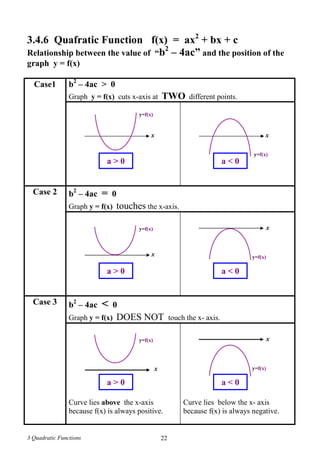
3.4.6 Quafratic Function f(x) = ax2
+ bx + c
Relationship between the value of “b2
– 4ac” and the position of the
graph y = f(x)
b2
– 4ac > 0
Graph y = f(x) cuts x-axis at TWO different points.
Case1
b2
– 4ac = 0
Graph y = f(x) touches the x-axis.
Case 2
b2
– 4ac < 0
Graph y = f(x) DOES NOT touch the x- axis.
Case 3
Curve lies above the x-axis
because f(x) is always positive.
Curve lies below the x- axis
because f(x) is always negative.
x
a > 0
y=f(x)
x
a < 0
y=f(x)
x
a > 0
y=f(x) x
a < 0
y=f(x)
x
a > 0
y=f(x) x
a < 0
y=f(x)
3 Quadratic Functions 23
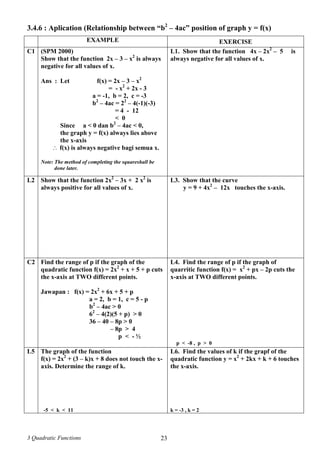
3.4.6 : Aplication (Relationship between “b2
– 4ac” position of graph y = f(x)
EXAMPLE EXERCISE
C1 (SPM 2000)
Show that the function 2x – 3 – x2
is always
negative for all values of x.
Ans : Let f(x) = 2x – 3 – x2
= - x2
+ 2x - 3
a = -1, b = 2, c = -3
b2
– 4ac = 22
– 4(-1)(-3)
= 4 - 12
< 0
Since a < 0 dan b2
– 4ac < 0,
the graph y = f(x) always lies above
the x-axis
 f(x) is always negative bagi semua x.
Note: The method of completing the squareshall be
done later.
L1. Show that the function 4x – 2x2
– 5 is
always negative for all values of x.
L2 Show that the function 2x2
– 3x + 2 x2
is
always positive for all values of x.
L3. Show that the curve
y = 9 + 4x2
– 12x touches the x-axis.
C2 Find the range of p if the graph of the
quadratic function f(x) = 2x2
+ x + 5 + p cuts
the x-axis at TWO different points.
Jawapan : f(x) = 2x2
+ 6x + 5 + p
a = 2, b = 1, c = 5 - p
b2
– 4ac > 0
62
– 4(2)(5 + p) > 0
36 – 40 – 8p > 0
– 8p > 4
p < - ½
L4. Find the range of p if the graph of
quarritic function f(x) = x2
+ px – 2p cuts the
x-axis at TWO different points.
p < -8 , p > 0
L5 The graph of the function
f(x) = 2x2
+ (3 – k)x + 8 does not touch the x-
axis. Determine the range of k.
-5 < k < 11
L6. Find the values of k if the grapf of the
quadratic function y = x2
+ 2kx + k + 6 touches
the x-axis.
k = -3 , k = 2
3 Quadratic Functions 24
QUESTIONS BASED ON SPM FORMAT
EXAMPLE EXERCISE
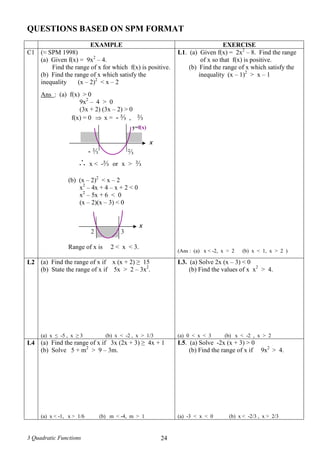
C1 (≈ SPM 1998)
(a) Given f(x) = 9x2
– 4.
Find the range of x for which f(x) is positive.
(b) Find the range of x which satisfy the
inequality (x – 2)2
< x – 2
Ans : (a) f(x) > 0
9x2
– 4 > 0
(3x + 2) (3x – 2) > 0
f(x) = 0  x = - ⅔ , ⅔
 x < -⅔ or x > ⅔
(b) (x – 2)2
< x – 2
x2
– 4x + 4 – x + 2 < 0
x2
– 5x + 6 < 0
(x – 2)(x – 3) < 0
Range of x is 2 < x < 3.
L1. (a) Given f(x) = 2x2
– 8. Find the range
of x so that f(x) is positive.
(b) Find the range of x which satisfy the
inequality (x – 1)2
> x – 1
(Ans : (a) x < -2, x > 2 (b) x < 1, x > 2 )
L2 (a) Find the range of x if x (x + 2) ≥ 15
(b) State the range of x if 5x > 2 – 3x2
.
(a) x ≤ -5 , x ≥ 3 (b) x < -2 , x > 1/3
L3. (a) Solve 2x (x – 3) < 0
(b) Find the values of x x2
> 4.
(a) 0 < x < 3 (b) x < -2 , x > 2
L4 (a) Find the range of x if 3x (2x + 3) ≥ 4x + 1
(b) Solve 5 + m2
> 9 – 3m.
(a) x < -1, x > 1/6 (b) m < -4, m > 1
L5. (a) Solve -2x (x + 3) > 0
(b) Find the range of x if 9x2
> 4.
(a) -3 < x < 0 (b) x < -2/3 , x > 2/3
x
- ⅔ ⅔
y=f(x)
x
2 3
3 Quadratic Functions 25
EXAMPLE /EXERCISE EXERCISE
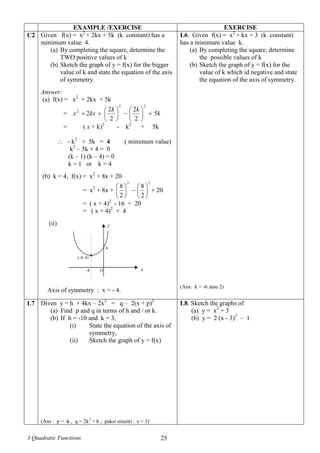
C2 Given f(x) = x2
+ 2kx + 5k (k constant) has a
minimum value 4.
(a) By completing the square, determine the
TWO positive values of k
(b) Sketch the graph of y = f(x) for the bigger
value of k and state the equation of the axis
of symmetry.
Answer:
(a) f(x) = x2
+ 2kx + 5k
= k
kk
kxx 5
2
2
2
2
2
22
2













= ( x + k)2
- k2
+ 5k
 - k2
+ 5k = 4 ( minimum value)
k2
– 5k + 4 = 0
(k – 1) (k – 4) = 0
k = 1 or k = 4
(b) k = 4, f(x) = x2
+ 8x + 20
= x2
+ 8x +
22
2
8
2
8












+ 20
= ( x + 4)2
- 16 + 20
= ( x + 4)2
+ 4
(ii)
Axis of symmetry : x = - 4.
L6. Given f(x) = x2
+ kx + 3 (k constant)
has a minimum value k.
(a) By completing the square, determine
the possible values of k
(b) Sketch the graph of y = f(x) for the
value of k which id negative and state
the equation of the axis of symmetry.
(Ans: k = -6 atau 2)
L7 Diven y = h + 4kx – 2x2
= q – 2(x + p)2
(a) Find p and q in terms of h and / or k.
(b) If h = -10 and k = 3,
(i) State the equation of the axis of
symmetry,
(ii) Sketch the graph of y = f(x)
(Ans : p = -k , q = 2k2
+ h ; paksi simetri : x = 3)
L8. Sketch the graphs of
(a) y = x2
+ 3
(b) y = 2 (x - 3)2
– 1
y
xO
(-4, 4)
●
4
-4
3 Quadratic Functions 26
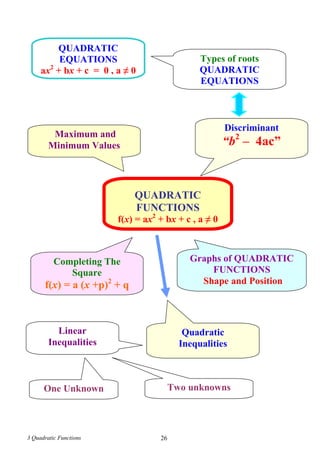
QUADRATIC
FUNCTIONS
f(x) = ax2
+ bx + c , a ≠ 0
Maximum and
Minimum Values
Quadratic
Inequalities
QUADRATIC
EQUATIONS
ax2
+ bx + c = 0 , a ≠ 0
Linear
Inequalities
Completing The
Square
f(x) = a (x +p)2
+ q
Graphs of QUADRATIC
FUNCTIONS
Shape and Position
Types of roots
QUADRATIC
EQUATIONS
Discriminant
“b2
– 4ac”
One Unknown Two unknowns

Modul 3 quadratic function

  • 1.
    3 Quadratic Functions1 3. QUADRATIC FUNCTIONS IMPORTANT NOTES: (i) The general form of a quadratic function is f(x) = ax2 + bx + c; a, b, c are constants and a ≠ 0. (ii) Characteristics of a quadratic function: (a) Involves one variable only, (b) The highest power of the variable is 2. 3.1.1 Recognising a quadratic function EXAMPLE No. Quadratic Functions Non-Quadratic Function Reason 1. f(x) = x2 + 2x -3 f2 (x) = 2x - 3 No terms in x2 ( a = 0) 2. g(x) = x2 - ½ g(x) = x x 22  The term x 2 3. h(x) = 4 – 3x2 h(x) = x3 - 2x2 The term x3 4. y = 3x2 y = 3 x -2 The term x -2 5. p(x) = 3 – 4x + 5x2 x2 – 2xy + y2 Two variables Exercise : State whether the following are quadratic functions. Give your reason for Non Q.Functions. No. Functions Q.F. Non-Q.F. REASON 0. f(x) = 10 √ No terms in x2 (second degree) 1. f(x) = 102 2. g(x) = 10 - x2 3. p(x) = x2 + x 4. y = 2x2 + ½ x - 3 5. y = x 6  6. f(x) = x ( x – 2) 7. g(x) = 2x2 + kx -3, k a constant 8. h(x) = (m-1) x2 + 5x + 2m , m constant 9. y = 3 – (p+1) x2 , p constant 10. p(x) = x2 + 2hx + k+1, h, k constants NOTE : The proper way to denote a quadratic function is cbxaxxf  2 : . f(x) = ax2 + bx + c is actually the value (or image) f for a given value of x.
  • 2.
    3 Quadratic Functions2 3.2 Minimum Value and Maximum value of a Quadratic Function Do you know that .... A non-zero number when squared will always be positive ? 32 = 9 (-5) 2 = 25 (-1 )2 = 1( 2 1 ) 2 = 4 1 So, what is the minimum value when we find the square of a number ? Minimum value of x2 is ….. 0 ! This is obtained when x = 0 . ( )2 = 0 The value inside the brackets must be 0 ! So, the minimum value of x2 is 0; the minimum value of x2 + 3 is 0 + 3 = 3 the minimum value of x2 – 8 is 0 + (– 8) = – 8 the minimum value of x2 + 100 is 0 + 100 = 100 The minimum value of x2 is 0 , It means x2  0, So, 2 0x  Hence the maximum value of – x2 is 0 the maximum value of – x2 + 5 is 5 the maximum value of – x2 – 3 is – 3
  • 3.
    3 Quadratic Functions3 3.2.1 To state the Minimum value of a Quadratic Function f(x) = ax2 + c , a > 0 No. Function Minimum value of y Corresponding value of x Minimum Point (Sketched) Graph 1. f(x) = x2 0 x = 0 (0, 0) 2. g(x) = x2 + 3 3 3. h(x) = x2 - 4 0 (0, -4 ) 4. y = x2 + ½ 5. p(x) = x2 - 10 6. f(x) = 2x2 + 3 7 g(x) = ½ x2 - 5 8. h(x) = 10x2 + 1 9. y = 4 + 2x2 xO y xO y 3 xO y O y x xO y xO y xO y xO y xO y
  • 4.
    3 Quadratic Functions4 3.2.2 To state the Minimum Value of a Quadratic Function in the form f(x) = a (x + p)2 + q , a > 0 No. Function Minimum value of y Corresponding value of x Minimum Point (Sketched) Graph 1. f(x) = (x – 1)2 + 2 2 (x –1)2 = 0 x = 1 (1, 2) 2. g(x) = (x- 2)2 + 4 4 (x –2)2 = 0 x = ( , ) 3. h(x) = (x – 1)2 - 3 4. y = (x – 2)2 5. f(x) = (x – 3)2 + 2 6. f(x) = (x + 2)2 + 3 x O y x O y x O y O x y x O y xO y (1,2)● x
  • 5.
    3 Quadratic Functions5 No. Function Minimum value of y Corresponding value of x Minimum Point (Sketched) Graph 7. f(x) = (x + 1)2 - 4 8. f(x) = 2(x + 3)2 9. f(x) = 2(x – 1)2 + 3 10. f(x) = 3(x + 2)2 - 1 11. f(x) = 2 + (x + 1)2 12. f(x) = 1 + 2 (x – 3)2 13. f(x) = 3x2 - 2 O y x x O y O x y x O y O x y xO y O y x
  • 6.
    3 Quadratic Functions6 3.2.3 To state the Maximum Value of a Quadratic Function in the form f(x) = ax2 + c , a < 0 No. Function Maximum value of y Correspondin g value of x Maximum Point (Sketched) Graph 1. f(x) = - x2 0 x = 0 (0, 0) 2. g(x) = - x2 + 4 4 3. h(x) = - x2 + 2 0 (0, 2 ) 4. y = - x2 + ½ 5. p(x) = 9 - x2 6. f(x) = -2x2 + 3 7 g(x) = - ½ x2 - 1 8. h(x) = 2 - 10x2 xO y xO y 4 xO y y O x xO y xO y xO y xO y
  • 7.
    3 Quadratic Functions7 No. Function Minimum value of y Corresponding value of x Minimum Point (Sketched) Graph 9. y = 4 – 2x2 10. p(x) = 5 – 3x2 3.2.5 To state the Maximum Value of a Quadratic Function in the form f(x) = a (x + p)2 + q , a < 0 No. Function Maximum value of y Corresponding value of x Maximum Point (Sketched) Graph 1. f(x) = – (x – 1)2 + 2 2 (x –1)2 = 0 x = 1 (1, 2) 2. g(x) = - (x- 2)2 + 4 4 (x –2)2 = 0 x = ( , ) 3. h(x) = - (x – 1)2 - 3 4. y = - (x – 2)2 xO y xO y x O y x O y x O y xO y
  • 8.
    3 Quadratic Functions8 No. Function Minimum value of y Corresponding value of x Minimum Point (Sketched) Graph 5. f(x) = - (x – 3)2 + 2 6. f(x) = - (x + 2)2 + 3 7. f(x) = - (x + 1)2 - 4 8. f(x) = - 2(x + 3)2 9. f(x) = - 2(x – 1)2 + 3 10. f(x) = - 3(x + 2)2 - 1 11. f(x) = 2 - (x + 1)2 12. f(x) = 1 - 2 (x – 3)2 O x y x O y x O y O y x x O y O x y x O y O x y xO y
  • 9.
    3 Quadratic Functions9 3.2.6 To sketch the Graphs of Quadratic Functions in the form f(x) = a (x + p)2 + q and state the equation of the axis of symmetry. Note : The equation of the axis of symmetry is obtained by letting (x + p) = 0 , that is, x = - p Case I : a > 0  Shape of Graph is☺atau No. Function Sketched Graph Function Sketched Graph 1. f(x) = (x – 1)2 + 2 Min. Point : (1, 2) Axis of Symmetry : x = 1 f(x) = (x – 1)2 + 4 Min. Point. : ( , ) Axis of Symmetry : x = 2. f(x) = (x – 2)2 + 3 Min. Point. : (2, 3) Axis of Symmetry : x = 2 f(x) = (x – 3)2 + 2 Min. Point : ( , ) Axis of Symmetry : x = 3. f(x) = (x – 4)2 + 2 Min. Point. : (4, ) Axis of Symmetry : x = f(x) = (x – 1)2 + 3 Min. Point : ( , ) Axis of Symmetry : x = 4. f(x) = (x + 2)2 + 1 Min. Point. : (-2, 1) Axis of Symmetry : x = -2 f(x) = (x + 1)2 + 2 Min. Point. : ( , 2) Axis of Symmetry : x = 5. f(x) = (x + 3)2 Min. Point. : ( , ) Axis of Symmetry : x = f(x) = (x + 4)2 Min. Point. : ( , ) Axis of Symmetry : x = xO y (1,2)● xO y ( , )● y xO y (2, 3)● xO y xO y xO y xO (-2,1) ● xO xO ● xO y y y
  • 10.
    3 Quadratic Functions10 Case 2 : a < 0  Shape of Graph : or 1. f(x) = - (x – 1)2 + 2 Max.Point : (1, 2) Axis of Symmetry : x = 1 f(x) = - (x – 1)2 + 4 Max.Point : ( , ) Axis of Symmetry : x = 2. f(x) = - (x – 3)2 + 1 Max.Point : (3, 1) Axis of Symmetry : x = f(x) = - x 2 + 2 Max. Point : ( , ) Axis of Symmetry : = 3. f(x) = 3 - (x – 1)2 Max.Point. : ( , 3) Axis of Symmetry : x = f(x) = 5 - (x – 2)2 Max.Point : ( , ) Axis of Symmetry : 4. f(x) = - (x + 1)2 + 4 Max.Point: (-1, 4) Axis of Symmetry : x = -1 f(x) = - (x + 2)2 + 2 Max.Point : (-2, ) Axis of Symmetry : x = 5. f(x) = - 2(x – 1)2 Max.Point: (1, ) Axis of Symmetry : x = f(x) = - (x – 3)2 Max.Point : ( , ) Axis of Symmetry : x = xO y (1, 2)● xO y ( , )● xO y xO y xO y xO y xO y xO y xO y xO y
  • 11.
    3 Quadratic Functions11 GRAPHS OF QUADRATIC FUNCTIONS 3.2.7 Reinforcement exercises : To sketch graphs of Q.F. f(x) = a(x+ p)2 + q No. Function Sketched Graph Function Sketched Graph 1. f(x) = (x – 2)2 - 1 Min. Point : ( , ) Axis of Symmetry : x = f(x) = (x + 1)2 - 4 ……. Point : ( , ) Axis of Symmetry : x = 2. f(x) = 3 – 2 (x + 1)2 Max. point : ( , ) Axis of Symmetry : x = f(x) = - 2 (x – 1)2 ……. Point : ( , ) Axis of Symmetry : 3. f(x) = (x + 1)2 + 2 ……. Point : ( , ) Axis of Symmetry : x = f(x) = 1 – ½ (x + 2)2 ……. Point: ( , ) Axis of Symmetry : 4 f(x) = (x + 3)2 ……. Point: ( , ) Axis of symmetry : x = f(x) = 9 - 4(x - 1)2 ……. Point: ( , ) Axis of Symmetry : 5. f(x) = x2 – 9 ……. Point : ( , ) Axis of Symmetry : x = f(x) = -3x2 – 3 ……. Point: ( , ) Axis of Symmetry : xO y xO y xO y xO y xO y x O y xO y x O y x O y xO y
  • 12.
    3 Quadratic Functions12 3.3.1 To express Quadratic Functions f(x) = ax2 + bx + c in the form a(x+ p)2 + q : Method of COMPLETING THE SQUARE SIMPLE TYPE (a = 1) EXAMPLE EXERCISE 1. f(x) = x2 + 4x + 5 = 5 2 4 2 4 4 22 2              xx = (x + 2)2 - 4 + 5 = ( x + 2 )2 + 1 f(x) = x2 + 4x + 3 (x + 2)2 - 1 2. g(x) = x2 - 6x + 8 = 8 2 6 2 6 6 22 2                xx = (x - 3)2 - 9 + 8 = ( x - 3 )2 - 1 g(x) = x2 - 6x - 7 (x – 3)2 - 16 3. h(x) = x2 - 4x = 22 2 2 4 2 4 4                xx = (x - 2)2 - 4 = ( x - 2 )2 - 4 h(x) = x2 + 2x (x + 1) - 1 4. y = x2 - 4x + 5 = 5 2 4 2 4 4 22 2              xx = (x - 2)2 - 4 + 5 = ( x - 2 )2 + 1 y = x2 + x - 6 (x + ½ )2 - 25/4 5. f(x) = x2 + 5x + 6 = 6 2 5 2 5 5 22 2              xx = 6 4 25 2 5 2       x = 4 1 2 5 2       x f(x) = x2 + 3x + 2 (x + 3/2)2 - ¼
  • 13.
    3 Quadratic Functions13 3.3.2 To express Q.F. f(x) = ax2 + bx + c in the form a(x+ p)2 + q : Method of COMPLETING THE SQUARE When a > 0 , a ≠ 1. EXAMPLE EXERCISE 1. f(x) = 2x2 + 4x + 6 =  322 2  xx =                      3 2 2 2 2 22 22 2 xx =  31)1(2 2 x =  2)1(2 2 x = 2 (x+1)2 + 4 f(x) = 2x2 + 8x + 4 =  2 2 x 2 (x+2)2 - 4 2. g(x) = 2x2 + 6x - 5 =      2 5 32 2 xx =                      2 5 2 3 2 3 32 22 2 xx =      2 5 4 9 ) 2 3 (2 2 x =        4 19 ) 2 3 (2 2 x = g(x) = 2x2 - 6x + 3 2(x – 3/2)2 - 3/2 3. h(x) = 3x2 + 6x - 12 =  2 3 x = = = 3(x + 1)2 – 15 g(x) = 3x2 - 12x + 10 3(x – 2)2 - 2
  • 14.
    3 Quadratic Functions14 Questions based on SPM Format (1) EXAMPLE EXERCISE Express f(x) = x2 - 4x + 3 in the form (x + p)2 + q; with p and q as constants. Hence (i) State the minimum value of f(x) and the corresponding value of x, (ii) Sketch the graph of y = f(x) and state the equation of the axis of symmetry. Answers : a = 1 ( > 0)  f has minimum value. C1 f(x) = x2 - 4x + 3 = 3 2 4 2 4 4 22 2                xx = ( x – 2 )2 - 4 + 3 = ( x – 2 )2 - 1 (i) Minimum value of f(x) = -1 , when x = 2. (ii) Equation of axix of symmetry : x = 2. L1. Express f(x) = x2 - 6x + 8 in the form (x + p)2 + q; with p and q as constants. Hence (i) State the minimum value of f(x) and the corresponding value of x, (ii) Sketch the graph of y = f(x) and state the equation of the axis of symmetry. Ans : p = -3 , q = - 1 L2 Express f(x) = x2 + 2x - 3 in the form (x + p)2 + q. Hence (i) State the minimum value of f(x) and the corresponding value of x. (ii) Sketch the graph of y = f(x) and state the equation of the axis of symmetry. Ans : p = 1 , q = -4 L3. Express f(x) = x2 + x + 2 in the form (x+ p)2 + q. Hence (i) State the minimum value of f(x) and the corresponding value of x. (iii) Sketch the graph of y = f(x) and state the equation of the axis of symmetry. Ans : p = ½ , q = 7/4 x O y (2, -1)● 3 2
  • 15.
    3 Quadratic Functions15 Questions based on SPM Format (II) EXAMPLE EXERCISE Express f(x) = - x2 + 6x + 7 in the form k - (x + p)2 , k and p are constants. Hence (i) State the maximum value of f(x) and state the coressponding value of x, (ii) Sketch the graph of y = f(x) and state the equation of the axis of symmetry. Ans: a = -1 ( < 0)  f has maximum value C2 f(x) = - x2 + 6x + 7 =  762  xx =                        7 2 6 3 6 6( 22 2 xx =  79)3( 2  x = - [ (x - 3)2 - 16 ] = 16 - (x -3)2 (i) Maximum f(x) = 16, when x = 3. (ii) Axis of symmetry is : x = 3. L4. Express f(x) = - x2 - 8x + 9 in the form - (x + p)2 + q. Hence (i) State the maximum value of f(x) and state the coressponding value of x, (ii) Sketch the graph of y = f(x) and state the equation of the axis of symmetry. Ans: p = 4 , q = 25 L5 Express f(x) = - x2 + 4x + 1 in the form - (x + p)2 . Hence (i) State the maximum value of f(x) and state the coressponding value of x, (ii) Sketch the graph of y = f(x) and state the equation of the axis of symmetry. Jawapan : (sila gunakan kertas sendiri) 5 – (x – 2)2 L6. Express f(x) = 4 – 3x - x2 in the form q - (x + p)2 Hence (i) State the maximum value of f(x) and state the coressponding value of x, (ii) Sketch the graph of y = f(x) and state the equation of the axis of symmetry. Jawapan : 25/4 - (x + 3/2)2 xO y (3, 16) ● 7 3 x = 3
  • 16.
    3 Quadratic Functions16 Questions based on SPM Format (III) EXAMPLE EXERCISE Express f(x) = 2x2 - 8x + 7 in the form a(x + p)2 + q, dengan a, p dan q pemalar. Seterusnya (i) State the minimum value of f(x) and state the coressponding value of x, (ii) Sketch the graph of y = f(x) and state the equation of the axis of symmetry. Ans: : a = 2 ( > 0)  f minimum value C3 f(x) = 2x2 - 8x + 7 = 2(x2 - 4x ) + 7 = 7 2 4 2 4 42 22 2                         xx =   74)2(2 2 x = 78)2(2 2 x = 1)2(2 2 x (i) Minimum value f(x) = -1 , when x = 2. (ii) Axis of symmetry : x = 2. L7. Express f(x) = 2x2 + 4x - 3 in the form a (x + p)2 + q. Seterusnya (i) State the minimum value of f(x) and state the coressponding value of x, (ii) Sketch the graph of y = f(x) and state the equation of the axis of symmetry. Ans : 2 (x+1)2 - 5 L8 Express f(x) = 2x2 + x - 6 in the form a(x + p)2 + q. Seterusnya (iii) State the minimum value of f(x) and state the coressponding value of x, (iv) Sketch the graph of y = f(x) and state the equation of the axis of symmetry. Jawapan : (sila gunakan kertas sendiri) 2( x + 1/4 )2 - 49/8 L9. Express f(x) = 5 – 8x - 2x2 in the form q - (x + p)2 . Seterusnya (v) State the maximum value of f(x) and state the coressponding value of x, (vi) Sketch the graph of y = f(x) and state the equation of the axis of symmetry. Jawapan : 13 – 2 (x+2)2 xO y (2, -1) ● 7 x = 2
  • 17.
    3 Quadratic Functions17 3.4 Quadratic Inequalities (Students must be able to solve simple linear inequlities first) 3.4.1 To Solve Simple Linear Inequalities (Back to Basic) No. EXAMPLE EXERCISE 1 EXERCISE 2 EXERCISE 3 1. 2x – 3 > 5 2x > 8 x > 4 (a) 3x – 2 > 10 (b) 3 + 4x < 21 (c) 10 + 3x < 1 2. - 2x > 6 x < 2 6  x < -3 (a) -3x > 6 (b) - 4x < - 20 (c) - 2 1 x > 2 3. 3 – 4x > 9 - 4x > 6 x < 4 6  x < 2 3  (a) 3x – 2 > 10 (b) 3 + 4x < 21 (c) 10 + 3x < 1 4. 1 3 21   x 1 - 2x < 3 - 2x < 2 x > 2 2  x > -1 (a) 2 4 2   x (b) 3 5 43   x 4 3 52   x 5. (a) 4 x  > 1 (b) 2 3 x  < 4 (c) 2 4 35  x (d) x x 21 3 
  • 18.
    3 Quadratic Functions18 3.4.2 To Solve linear inequlities which involve two variables No EXAMPLE EXERCISE 1 EXERCISE 2 1. Given 2x + 3y = 10. Find the range of x if y > 4. 2x + 3y = 10 3y = 10 - 2x y = 3 210 x 3 210 x > 4 10 - 2x > 12 - 2x > 2 x < -1 (a) Given 2x - 3y = 12. Find the range of x if y > 2. x > 9 (b) Given 4x - 3y = 15. Find the range of x if y < -3. x < 3/2 2. Given x = 3 3 y . Find the range of x if y > 6. x = 3 3 y 3x = 3 - y y = 3 - 3x  3 – 3x > 6 - 3x > 3 x < -1 (a) Given x = 3 5 y . Find the range of x if y > 14. x < -3 (b) Given x = 2 310 y . Find the range of x if y ≤ -2. x ≥ 8 3. (a) Find the range of x if 2y – 1 = 3x and 4y > 12 + x x > 2 (b) Find the range of x if 6y – 1 = 3x and 3y > 2 + x. x > 3 (c) Find the range of x if 2 – 3y = 4x and y ≤ 4. x ≥ - 5/2 4 (a) Find the range of x if 3 + 2x > 5 and 7 – 2x > 1 1 < x < 3 (b) Find the range of x if 5 + 2x > 3 and 9 – 2x > 1 -1 < x < 4 (c) Find the range of x if 4 – 3x < 7 and -2x + 10 > 0. -1 < x < 5
  • 19.
    3 Quadratic Functions19 3.4.3 To state the range of values of x (with the help of a line graph) No EXAMPLE EXERCISE 1 EXERCISE 2 1. Inequality : x ≥ 2 (Range of values of x) 2. x > 1 3. Range of x : 1 < x ≤ 3 Range of x : Range of x : 4. Range of x : x < ⅔ atau x > 2 Range of x : Range of x : 5. Given f(x) = ax2 +bx+c, a>0 f(x) < 0 Range of x : 1 < x < 2 Given f(x) = ax2 +bx+c, a>0 f(x) < 0 Range of x : Given f(x) = ax2 +bx+c, a>0 f(x) < 0 Range of x : 6. Solve (x-1)(x-4) < 0 Range of x : 1 < x < 4 Solve (x+2)(x-4) < 0 Range of x : Solve x (x + 3) < 0 Range of x : x 2 • x 5 • x -2 • x 1 O x 0 O x ⅔ O x 2 O ⅔ O x -2 1 O O x 4 O 0 O x 1 O 3 • x -2 O 1 O x 0 O 2 3 • x 1 2 y=f(x) x -1 3 y=f(x) x 0 4 y=f(x) x 1 4 y=f(x) x x
  • 20.
    3 Quadratic Functions20 3.4.5 Solving Quadratic Inequalities [ by sketching the graph of y = f(x) ] Guide STEP 1 : Make sure the inequality has been rearranged into the form f(x) < 0 or f(x) > 0 ( Right-Hand Side MUST be 0 ! ) STEP 2 : Factorise f(x). [Here we consider only f(x) which can be factorised] It is easier to factorise if a is made positive. Hence STEP 3 : Sketch the graph of y = f(x) and shade the region which satisfy the inequality. STEP 4 : State the range of values of x based on the graph. EXAMPLE EXERCISE C1 Solve x2 – 4x < -3 x2 – 4x + 3 < 0 [ In the form f(x) < 0 ] (x - 1) (x – 3) < 0 [ faktorise ] Consider f(x) = (x - 1) (x – 3) f(x) = 0  x = 1 atau x = 3 From the graph above, the range of x which satisfies the inequality f(x) < 0 ialah 1 < x < 3 . L1. Solve x2 – 5x + 6 < 0 2 < x < 3 Example 1 x2 – 4x > 5 changed to x2 – 4x – 5 > 0 Example 2 x(2x – 1) < 6 2x2 – x < 6 2x2 –x – 6 < 0 Example – x2 + 3x + 4 > 0 can be transformed into x2 – 3x – 4 < 0 (x+1) (x – 4) < 0 x 1 3 y=f(x)
  • 21.
    3 Quadratic Functions21 EXAMPLE EXERCISE L2 Solve x (x+ 4) < 12 x (x+ 4) < 12 x2 + 4x - 12 < 0 [ in the form f(x) = 0 ] ( ) ( ) < 0 [ faktorise ] Consider f(x) = f(x) = 0  x = or x = From the graph above, the range of x which satisfies the inequality f(x) < 0 ialah L3. Finf the range of values of x which satisfies x2 + 2x < 0. -2 < x < 0 C2 Solve the inequality x2 + x - 6 ≥ 0 x2 + x - 6 ≥ 0 (x + 3) ( x – 2) ≥ 0 Consider f(x) = 0. Then x = -3 , x = 2 Range of x is : x ≤ -3 atau x ≥ 2 L4. Solve the inequality x2 + 3x - 10 ≥ 0. x ≤ -5 , x ≥ 2 L5 Solve the inequality 2x2 + x > 6. x < -2 , x > 3/2 L6. Solve the inequality x(4 – x) ≥ 0. 0 ≤ x ≤ 4 x x -3 2 y=f(x)
  • 22.
    3 Quadratic Functions22 3.4.6 Quafratic Function f(x) = ax2 + bx + c Relationship between the value of “b2 – 4ac” and the position of the graph y = f(x) b2 – 4ac > 0 Graph y = f(x) cuts x-axis at TWO different points. Case1 b2 – 4ac = 0 Graph y = f(x) touches the x-axis. Case 2 b2 – 4ac < 0 Graph y = f(x) DOES NOT touch the x- axis. Case 3 Curve lies above the x-axis because f(x) is always positive. Curve lies below the x- axis because f(x) is always negative. x a > 0 y=f(x) x a < 0 y=f(x) x a > 0 y=f(x) x a < 0 y=f(x) x a > 0 y=f(x) x a < 0 y=f(x)
  • 23.
    3 Quadratic Functions23 3.4.6 : Aplication (Relationship between “b2 – 4ac” position of graph y = f(x) EXAMPLE EXERCISE C1 (SPM 2000) Show that the function 2x – 3 – x2 is always negative for all values of x. Ans : Let f(x) = 2x – 3 – x2 = - x2 + 2x - 3 a = -1, b = 2, c = -3 b2 – 4ac = 22 – 4(-1)(-3) = 4 - 12 < 0 Since a < 0 dan b2 – 4ac < 0, the graph y = f(x) always lies above the x-axis  f(x) is always negative bagi semua x. Note: The method of completing the squareshall be done later. L1. Show that the function 4x – 2x2 – 5 is always negative for all values of x. L2 Show that the function 2x2 – 3x + 2 x2 is always positive for all values of x. L3. Show that the curve y = 9 + 4x2 – 12x touches the x-axis. C2 Find the range of p if the graph of the quadratic function f(x) = 2x2 + x + 5 + p cuts the x-axis at TWO different points. Jawapan : f(x) = 2x2 + 6x + 5 + p a = 2, b = 1, c = 5 - p b2 – 4ac > 0 62 – 4(2)(5 + p) > 0 36 – 40 – 8p > 0 – 8p > 4 p < - ½ L4. Find the range of p if the graph of quarritic function f(x) = x2 + px – 2p cuts the x-axis at TWO different points. p < -8 , p > 0 L5 The graph of the function f(x) = 2x2 + (3 – k)x + 8 does not touch the x- axis. Determine the range of k. -5 < k < 11 L6. Find the values of k if the grapf of the quadratic function y = x2 + 2kx + k + 6 touches the x-axis. k = -3 , k = 2
  • 24.
    3 Quadratic Functions24 QUESTIONS BASED ON SPM FORMAT EXAMPLE EXERCISE C1 (≈ SPM 1998) (a) Given f(x) = 9x2 – 4. Find the range of x for which f(x) is positive. (b) Find the range of x which satisfy the inequality (x – 2)2 < x – 2 Ans : (a) f(x) > 0 9x2 – 4 > 0 (3x + 2) (3x – 2) > 0 f(x) = 0  x = - ⅔ , ⅔  x < -⅔ or x > ⅔ (b) (x – 2)2 < x – 2 x2 – 4x + 4 – x + 2 < 0 x2 – 5x + 6 < 0 (x – 2)(x – 3) < 0 Range of x is 2 < x < 3. L1. (a) Given f(x) = 2x2 – 8. Find the range of x so that f(x) is positive. (b) Find the range of x which satisfy the inequality (x – 1)2 > x – 1 (Ans : (a) x < -2, x > 2 (b) x < 1, x > 2 ) L2 (a) Find the range of x if x (x + 2) ≥ 15 (b) State the range of x if 5x > 2 – 3x2 . (a) x ≤ -5 , x ≥ 3 (b) x < -2 , x > 1/3 L3. (a) Solve 2x (x – 3) < 0 (b) Find the values of x x2 > 4. (a) 0 < x < 3 (b) x < -2 , x > 2 L4 (a) Find the range of x if 3x (2x + 3) ≥ 4x + 1 (b) Solve 5 + m2 > 9 – 3m. (a) x < -1, x > 1/6 (b) m < -4, m > 1 L5. (a) Solve -2x (x + 3) > 0 (b) Find the range of x if 9x2 > 4. (a) -3 < x < 0 (b) x < -2/3 , x > 2/3 x - ⅔ ⅔ y=f(x) x 2 3
  • 25.
    3 Quadratic Functions25 EXAMPLE /EXERCISE EXERCISE C2 Given f(x) = x2 + 2kx + 5k (k constant) has a minimum value 4. (a) By completing the square, determine the TWO positive values of k (b) Sketch the graph of y = f(x) for the bigger value of k and state the equation of the axis of symmetry. Answer: (a) f(x) = x2 + 2kx + 5k = k kk kxx 5 2 2 2 2 2 22 2              = ( x + k)2 - k2 + 5k  - k2 + 5k = 4 ( minimum value) k2 – 5k + 4 = 0 (k – 1) (k – 4) = 0 k = 1 or k = 4 (b) k = 4, f(x) = x2 + 8x + 20 = x2 + 8x + 22 2 8 2 8             + 20 = ( x + 4)2 - 16 + 20 = ( x + 4)2 + 4 (ii) Axis of symmetry : x = - 4. L6. Given f(x) = x2 + kx + 3 (k constant) has a minimum value k. (a) By completing the square, determine the possible values of k (b) Sketch the graph of y = f(x) for the value of k which id negative and state the equation of the axis of symmetry. (Ans: k = -6 atau 2) L7 Diven y = h + 4kx – 2x2 = q – 2(x + p)2 (a) Find p and q in terms of h and / or k. (b) If h = -10 and k = 3, (i) State the equation of the axis of symmetry, (ii) Sketch the graph of y = f(x) (Ans : p = -k , q = 2k2 + h ; paksi simetri : x = 3) L8. Sketch the graphs of (a) y = x2 + 3 (b) y = 2 (x - 3)2 – 1 y xO (-4, 4) ● 4 -4
  • 26.
    3 Quadratic Functions26 QUADRATIC FUNCTIONS f(x) = ax2 + bx + c , a ≠ 0 Maximum and Minimum Values Quadratic Inequalities QUADRATIC EQUATIONS ax2 + bx + c = 0 , a ≠ 0 Linear Inequalities Completing The Square f(x) = a (x +p)2 + q Graphs of QUADRATIC FUNCTIONS Shape and Position Types of roots QUADRATIC EQUATIONS Discriminant “b2 – 4ac” One Unknown Two unknowns