Behavior of the
Graph of a
Quadratic Function
Let us differentiate the following:
Quadratic
Function
Quadratic
Equation
Quadratic
Expression
𝒂𝒙𝟐 + 𝒃𝒙 + 𝒄
𝒂𝒙𝟐
+ 𝒃𝒙 + 𝒄 = 𝟎
𝒇 𝒙 = 𝒂𝒙𝟐 + 𝒃𝒙 + 𝒄
or
𝒚 = 𝒂𝒙𝟐 + 𝒃𝒙+c
Clearly we can see that
𝒇 𝒙 = 𝒚
𝒐𝒓
𝒚 = 𝒇(𝒙)
A quadratic function has two variables the x and the y
x – is the independent variable
y – is the dependent variable or we can say that the
value of y depends on the value of x
The values of x are called the domain of the quadratic
function while the values of y are called the range of
the quadratic function
ax2 + bx + c = 0
Recall:
Quadratic term
Linear term
Constant term
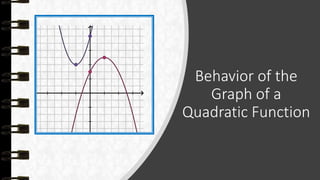
The Graph of a
Quadratic
Function is called
a PARABOLA
•vertex: The point at which a parabola changes direction,
corresponding to the minimum or maximum value of the
quadratic function.
•axis of symmetry: A vertical line drawn through the vertex of a
parabola around which the parabola is symmetric.
•zeros: In a given function, the values of x at which y=0, also called
roots. It is where the graph of the function intersects the x-axis
•point of origin: the intersection of the x-axis and y-
axis
•line of symmetry: it is a line drawn intersecting the vertex and is
parallel to the y-axis
Key Terms
•x –intercept is where the graph of the function intersects the x-axis
•y –intercept is where the graph of the function intersects the y-axis
Let us observe the graph of the Quadratic Function of the
form 𝒚 = 𝒂𝒙𝟐
1) 𝑦 = 𝑥2
2) 𝑦 = 2𝑥2
3) 𝑦 =
1
2
𝑥2
4) 𝑦 =
1
3
𝑥2
5) 𝑦 = −𝑥2
6) 𝑦 = −2𝑥2
Analyze the graphs.
a. What happens to the graph as the value of a becomes larger?
b. What happens when 0 < 𝑎 < 1?
c. What happens when 𝑎 < 0? 𝑎 > 0?
d. Summarize your observations.
Let us observe the graph of the Quadratic Function of the
form 𝒚 = 𝒂𝒙𝟐
1) 𝑦 = 𝑥2
2) 𝑦 = 2𝑥2
3) 𝑦 =
1
2
𝑥2
4) 𝑦 =
1
3
𝑥2
5) 𝑦 = −𝑥2
6) 𝑦 = −2𝑥2
Opens upward
Opens upward, opening becomes wider the previous
Opens upward, opening becomes narrower
Opens upward, opening becomes wider
Opens downward,
Opens downward, opening becomes narrower
When a is positive it opens upward, as the value of a increases its opening becomes
narrower.
When a is negative it opens downward, as the value of a decreases its opening
becomes narrower
Let us observe the graph of the Quadratic Function of
the form 𝒚 = 𝒂(𝒙 − 𝒉)𝟐
+ k
1) 𝑦 = 𝑥2
2) 𝑦 = (𝑥 + 1)2
3) 𝑦 = (𝑥 + 1)2
+ 1
4) 𝑦 = 2(𝑥 + 2)2
+ 2
5) 𝑦 = (𝑥 − 1)2
f) 𝑦 = (𝑥 − 1)2
-1
f) 𝑦 = 2(𝑥 − 2)2
-2
f) 𝑦 = −2(𝑥 − 2)2
- 2
Analyze the graphs
a. What have you noticed about the graphs of the quadratic function of
the form𝑦 = 𝑎(𝑥 − ℎ)2 + 𝑘?
b. How would you compare the graph of 𝑦 = 𝑎(𝑥 − ℎ)2
+ 𝑘 and that
of 𝑦 = 𝑎𝑥2
c. Discuss your ideas and observations.
d. What Conclusions can you give based on your observations?
𝒚 = 𝒂(𝒙 − 𝒉)𝟐
+ 𝐤
a indicates a
reflection across
the x-axis and/or
a vertical stretch
or compression
h indicates a
horizontal
translation
k indicates a
vertical translation
Write a REFLECTION about your experiences and what
you have learned in our Mathematics Class.
Special Task
Mylane S. Epino
Master Teacher I

Demo-Behaviour-of-the-Graph-of-a-Quadratic-Function.pptx

  • 1.
    Behavior of the Graphof a Quadratic Function
  • 2.
    Let us differentiatethe following: Quadratic Function Quadratic Equation Quadratic Expression 𝒂𝒙𝟐 + 𝒃𝒙 + 𝒄 𝒂𝒙𝟐 + 𝒃𝒙 + 𝒄 = 𝟎 𝒇 𝒙 = 𝒂𝒙𝟐 + 𝒃𝒙 + 𝒄 or 𝒚 = 𝒂𝒙𝟐 + 𝒃𝒙+c Clearly we can see that 𝒇 𝒙 = 𝒚 𝒐𝒓 𝒚 = 𝒇(𝒙)
  • 3.
    A quadratic functionhas two variables the x and the y x – is the independent variable y – is the dependent variable or we can say that the value of y depends on the value of x The values of x are called the domain of the quadratic function while the values of y are called the range of the quadratic function
  • 4.
    ax2 + bx+ c = 0 Recall: Quadratic term Linear term Constant term
  • 5.
    The Graph ofa Quadratic Function is called a PARABOLA
  • 6.
    •vertex: The pointat which a parabola changes direction, corresponding to the minimum or maximum value of the quadratic function. •axis of symmetry: A vertical line drawn through the vertex of a parabola around which the parabola is symmetric. •zeros: In a given function, the values of x at which y=0, also called roots. It is where the graph of the function intersects the x-axis •point of origin: the intersection of the x-axis and y- axis •line of symmetry: it is a line drawn intersecting the vertex and is parallel to the y-axis Key Terms •x –intercept is where the graph of the function intersects the x-axis •y –intercept is where the graph of the function intersects the y-axis
  • 7.
    Let us observethe graph of the Quadratic Function of the form 𝒚 = 𝒂𝒙𝟐 1) 𝑦 = 𝑥2 2) 𝑦 = 2𝑥2 3) 𝑦 = 1 2 𝑥2 4) 𝑦 = 1 3 𝑥2 5) 𝑦 = −𝑥2 6) 𝑦 = −2𝑥2
  • 8.
    Analyze the graphs. a.What happens to the graph as the value of a becomes larger? b. What happens when 0 < 𝑎 < 1? c. What happens when 𝑎 < 0? 𝑎 > 0? d. Summarize your observations.
  • 9.
    Let us observethe graph of the Quadratic Function of the form 𝒚 = 𝒂𝒙𝟐 1) 𝑦 = 𝑥2 2) 𝑦 = 2𝑥2 3) 𝑦 = 1 2 𝑥2 4) 𝑦 = 1 3 𝑥2 5) 𝑦 = −𝑥2 6) 𝑦 = −2𝑥2 Opens upward Opens upward, opening becomes wider the previous Opens upward, opening becomes narrower Opens upward, opening becomes wider Opens downward, Opens downward, opening becomes narrower When a is positive it opens upward, as the value of a increases its opening becomes narrower. When a is negative it opens downward, as the value of a decreases its opening becomes narrower
  • 11.
    Let us observethe graph of the Quadratic Function of the form 𝒚 = 𝒂(𝒙 − 𝒉)𝟐 + k 1) 𝑦 = 𝑥2 2) 𝑦 = (𝑥 + 1)2 3) 𝑦 = (𝑥 + 1)2 + 1 4) 𝑦 = 2(𝑥 + 2)2 + 2 5) 𝑦 = (𝑥 − 1)2 f) 𝑦 = (𝑥 − 1)2 -1 f) 𝑦 = 2(𝑥 − 2)2 -2 f) 𝑦 = −2(𝑥 − 2)2 - 2
  • 12.
    Analyze the graphs a.What have you noticed about the graphs of the quadratic function of the form𝑦 = 𝑎(𝑥 − ℎ)2 + 𝑘? b. How would you compare the graph of 𝑦 = 𝑎(𝑥 − ℎ)2 + 𝑘 and that of 𝑦 = 𝑎𝑥2 c. Discuss your ideas and observations. d. What Conclusions can you give based on your observations?
  • 13.
    𝒚 = 𝒂(𝒙− 𝒉)𝟐 + 𝐤 a indicates a reflection across the x-axis and/or a vertical stretch or compression h indicates a horizontal translation k indicates a vertical translation
  • 14.
    Write a REFLECTIONabout your experiences and what you have learned in our Mathematics Class. Special Task
  • 15.