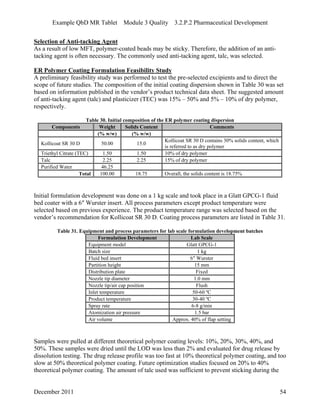
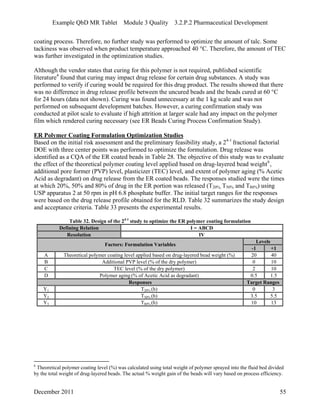
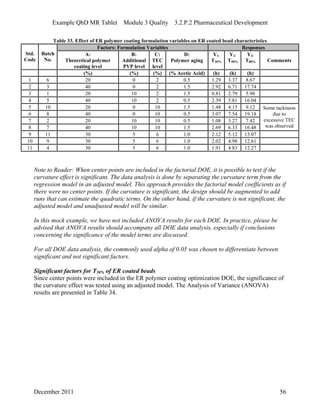
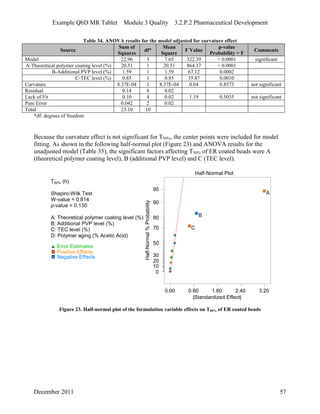
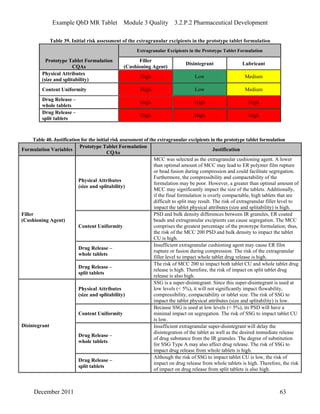
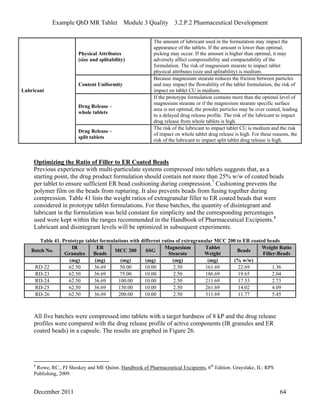
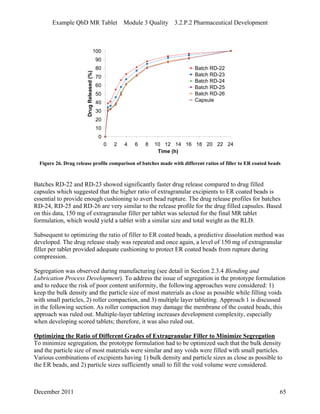
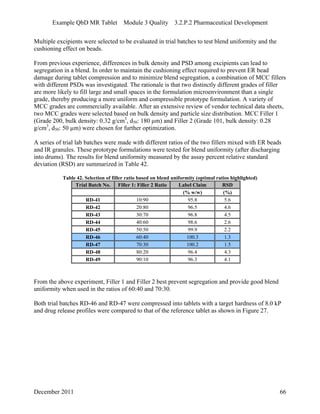
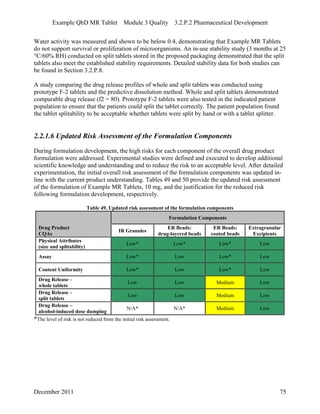
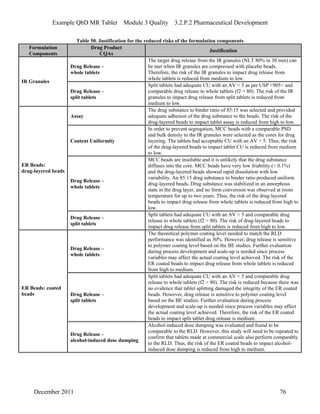
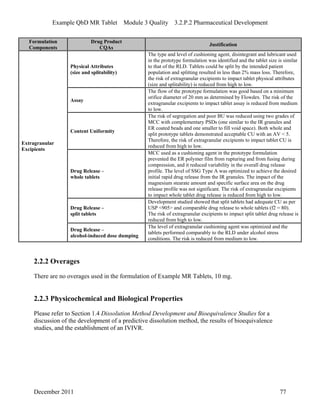
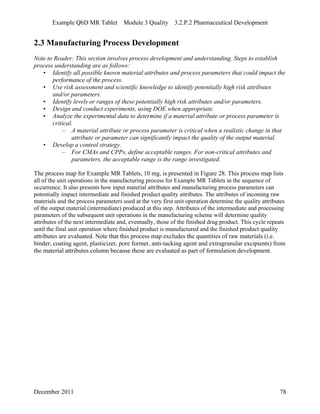
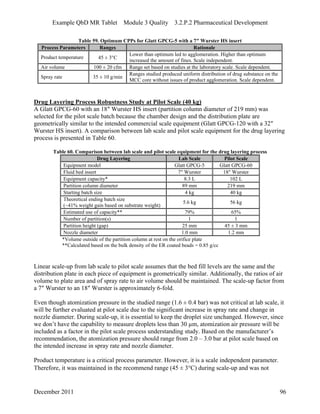
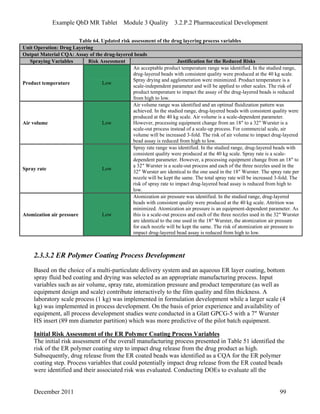
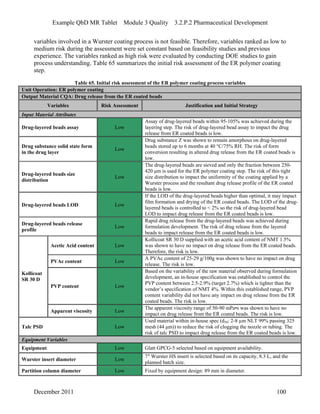
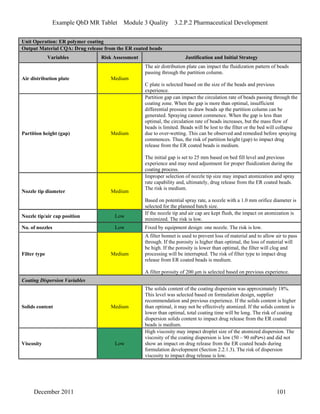
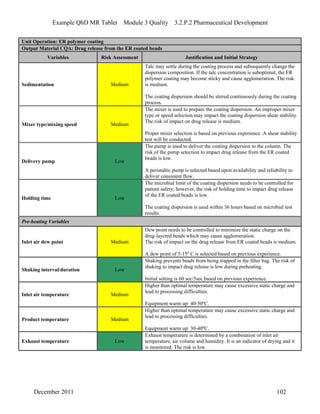
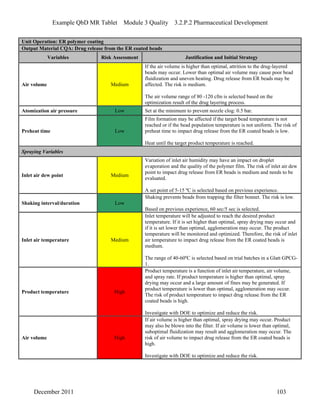
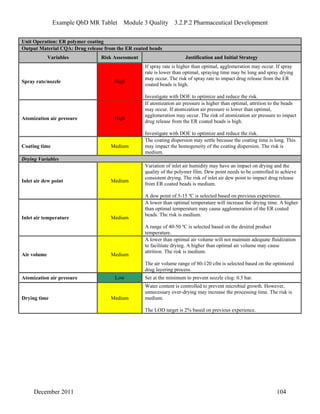
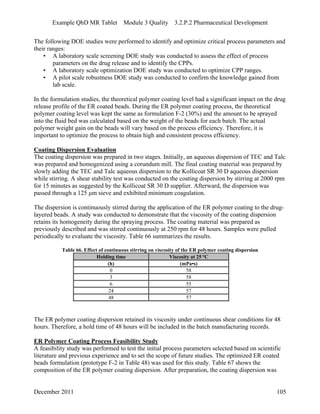
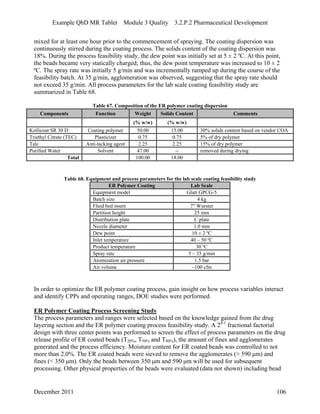
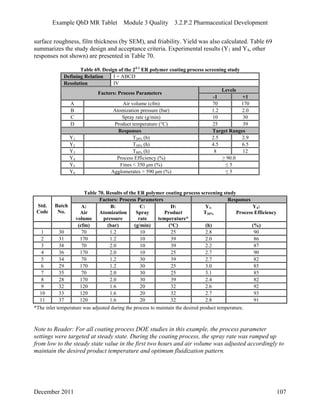
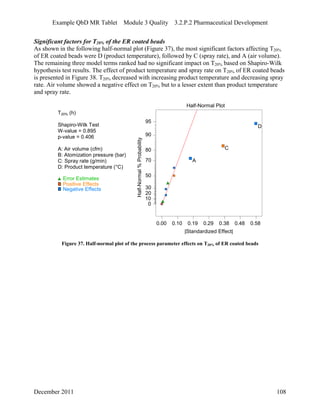
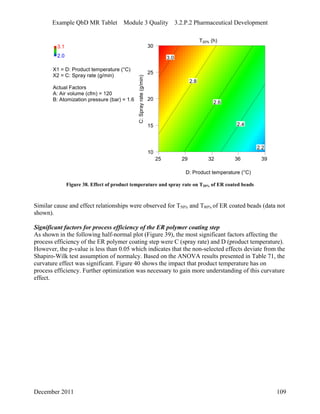
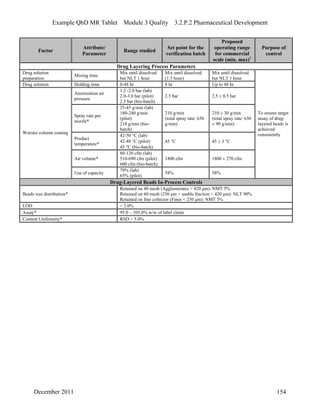
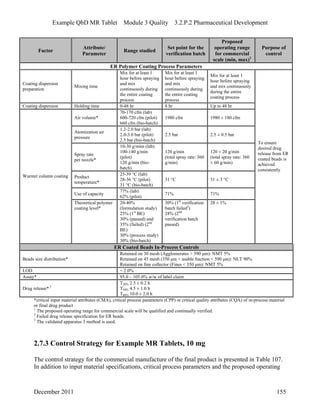
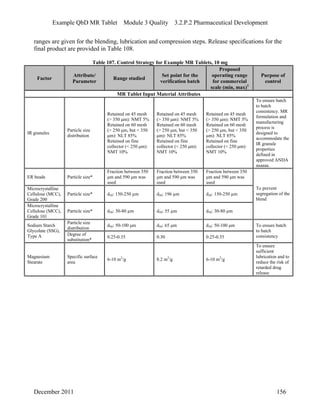
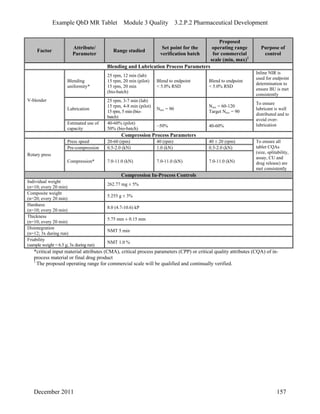
Example QbD MR Tablet Module 3 Quality 3.2.P.2 Pharmaceutical Development
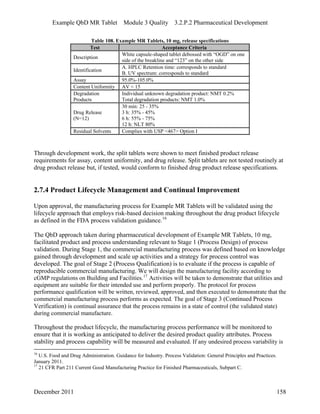
Quality by Design for ANDAs:
An Example for
Modified Release Dosage Forms
Introduction to the Example
This is an example pharmaceutical development report illustrating how ANDA applicants can
move toward implementation of Quality by Design (QbD).
The purpose of the example is to illustrate the types of pharmaceutical development studies
ANDA applicants may use as they implement QbD in their development process and to promote
discussion on how OGD would use this information in review.
Although we have tried to make the example as realistic as possible, the development of a real
product may differ from this example. The example is for illustrative purposes and, depending on
applicants’ experience and knowledge, the degree of experimentation for a particular product
may vary. The impact of experience and knowledge should be thoroughly explained in the
submission. The risk assessment process is one avenue for this explanation. At many places in
this example alternative pharmaceutical development approaches would also be appropriate.
Notes to the reader are included in italics throughout the text. Questions and comments may be
sent to GenericDrugs@fda.hhs.gov
December 2011 1
Example QbD MR Tablet Module 3 Quality 3.2.P.2 Pharmaceutical Development
Pharmaceutical Development Report
Example QbD for MR Generic Drugs
Table of Contents
1.1 Executive Summary................................................................................................................ 4
1.2 Analysis of the Reference Listed Drug Product................................................................... 7
1.2.1 Clinical.................................................................................................................................7
1.2.2 Pharmacokinetics ...............................................................................................................7
1.2.3 Drug Release .......................................................................................................................8
1.2.4 Physicochemical Characterization....................................................................................9
1.2.5 Composition ......................................................................................................................10
1.3 Quality Target Product Profile for the ANDA Product.................................................... 11
1.4 Dissolution Method Development and Bioequivalence Studies........................................ 17
1.4.1 Development of a Predictive Dissolution Method..........................................................18
1.4.3 Pivotal Bioequivalence Study ..........................................................................................26
2.1 Components of Drug Product.............................................................................................. 28
2.1.1 Drug Substance.................................................................................................................28
2.1.1.1 Physical Properties.......................................................................................................28
2.1.1.2 Chemical Properties.....................................................................................................30
2.1.1.3 Biological Properties....................................................................................................30
2.1.1.4 Risk Assessment of Drug Substance Attributes ..........................................................31
2.1.2 Excipients ..........................................................................................................................33
2.1.2.1 Excipients in the IR Granules .....................................................................................33
2.1.2.2 Excipients in the ER Coated Beads.............................................................................35
2.1.2.3 Excipients in Example MR Tablets, 10 mg.................................................................36
2.2 Drug Product......................................................................................................................... 38
2.2.1 Formulation Development...............................................................................................38
2.2.1.1 Initial Risk Assessment of the Formulation Components..........................................39
2.2.1.2 IR Granule Formulation Development.......................................................................42
2.2.1.3 ER Bead Formulation Development ...........................................................................43
2.2.1.4 Prototype Tablet Formulation Development...............................................................62
2.2.1.5 Prototype Tablet Formulations and Trial BE Studies................................................71
2.2.1.6 Updated Risk Assessment of the Formulation Components ......................................75
2.2.2 Overages............................................................................................................................77
2.2.3 Physicochemical and Biological Properties....................................................................77
2.3 Manufacturing Process Development ................................................................................. 78
2.3.1 Initial Risk Assessment of the Drug Product Manufacturing Process........................80
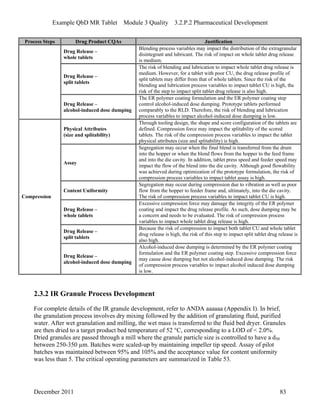
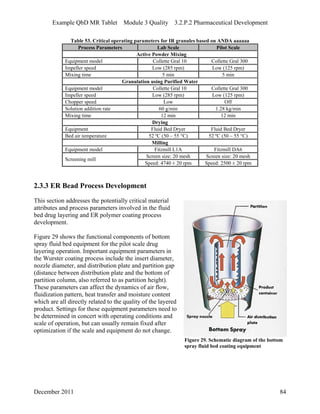
2.3.2 IR Granule Process Development...................................................................................83
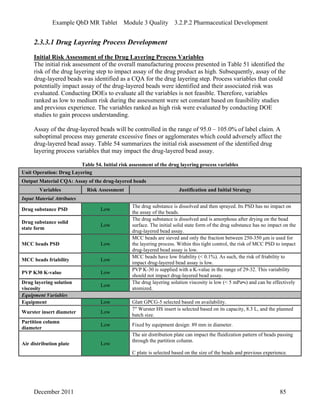
2.3.3 ER Bead Process Development........................................................................................84
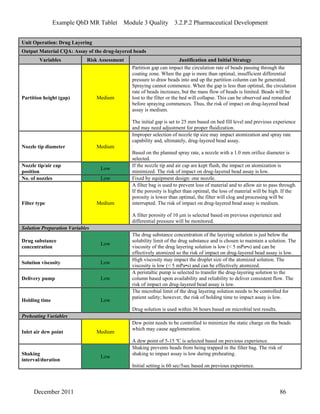
2.3.3.1 Drug Layering Process Development..........................................................................85
2.3.3.2 ER Polymer Coating Process Development ................................................................99
2.3.4 Blending and Lubrication Process Development.........................................................120
2.3.5 Tablet Compression Process Development ..................................................................126
December 2011 2
Example QbD MR Tablet Module 3 Quality 3.2.P.2 Pharmaceutical Development
2.3.6 Exhibit Batch ..................................................................................................................139
2.3.7 Scale-up to Commercial Scale.......................................................................................141
2.3.7.1 Scale-up of IR Granulation .......................................................................................141
2.3.7.2 Scale-up of ER Beads Drug Layering and Polymer Coating...................................142
2.3.7.3 Scale-up of Blending and Compression....................................................................147
2.3.8 Updated Risk Assessment of the Drug Product Manufacturing Process..................148
2.4 Container Closure System.................................................................................................. 150
2.5 Microbiological Attributes................................................................................................. 150
2.6 Compatibility....................................................................................................................... 151
2.7 Control Strategy.................................................................................................................. 151
2.7.1 Control Strategy for IR Granules.................................................................................151
2.7.2 Control Strategy for ER Coated Beads ........................................................................153
2.7.3 Control Strategy for Example MR Tablets, 10 mg .....................................................155
2.7.4 Product Lifecycle Management and Continual Improvement...................................158
A.1 Appendix I .......................................................................................................................... 160
List of Abbreviations ................................................................................................................ 161
December 2011 3
Example QbD MR Tablet Module 3 Quality 3.2.P.2 Pharmaceutical Development
1.1 Executive Summary
The following pharmaceutical development report summarizes the development of Example
Modified Release (MR) Tablets, 10 mg, a generic version of the reference listed drug (RLD),
Brand MR Tablets, 10 mg, indicated for therapeutic relief. We used a Quality by Design (QbD)
approach to develop a tablet formulation and manufacturing process that ensures the quality,
safety and efficacy of Example MR Tablets.
Initially, the quality target product profile (QTPP) was defined based on the properties of the
drug substance, characterization of the RLD product, and consideration of the RLD label and
intended patient population. Example MR Tablets were designed to achieve all of the attributes
in the QTPP. However, our investigation during pharmaceutical development focused on those
critical quality attributes (CQAs) that could be impacted by a realistic change to the drug product
formulation or manufacturing process. For Example MR Tablets, these attributes included
physical attributes (size and splitability), assay, content uniformity and drug release.
Example MR Tablets contain drug substance Z, a chemically stable BCS Class I compound. To
match the RLD, Example MR Tablets were designed to have immediate release (IR) granules
and extended release (ER) coated beads with extragranular cushioning agents and other
excipients all compressed into scored tablets. ANDA aaaaaa documents the approved
formulation and manufacturing process for the IR granules. Kollicoat SR 30 D was selected as
the release rate controlling polymer and the formulation was optimized using design of
experiments (DOE). Two grades of microcrystalline cellulose (MCC) were used in an optimized
ratio to prevent segregation of the IR granules and ER coated beads. The appropriate levels of
disintegrant (sodium starch glycolate) and lubricant (magnesium stearate) were also identified to
produce a robust formulation.
A predictive dissolution method was a key element of our development program. We developed
the method (USP apparatus 3 at 10 dpm in 250 mL of pH 6.8 phosphate buffer) by performing an
extensive evaluation of dissolution conditions using our initial prototype formulation (F-1) that
failed in our first pilot bioequivalence (BE) study. A subsequent BE study confirmed the
theoretical polymer coating level needed to match the RLD performance. We utilized
pharmacokinetic data collected from the BE studies to establish an in vitro-in vivo relationship
(IVIVR). The predictive dissolution method will be used for quality control of the final drug
product.
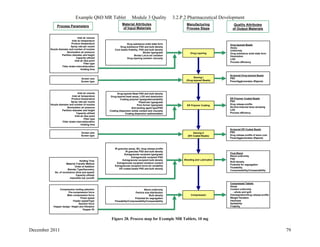
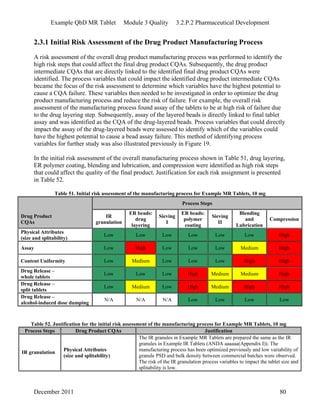
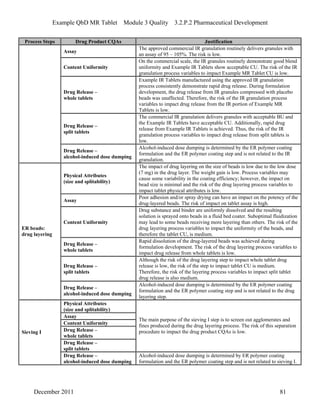
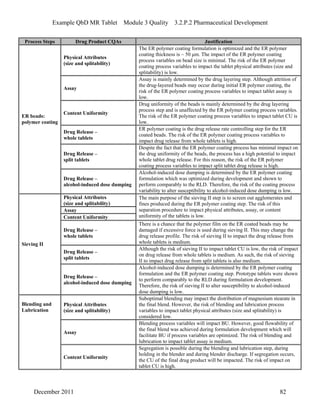
Risk assessment was used throughout development to identify potentially high risk formulation
and process variables and to determine which studies were necessary to increase our knowledge.
Each risk assessment was then updated to capture the reduced the level of risk based on our
improved product and process understanding.
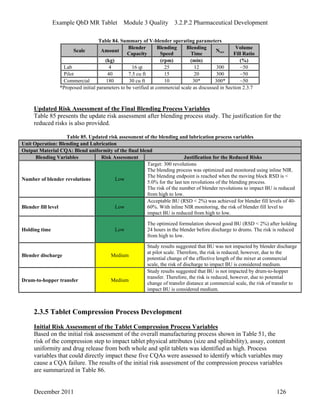
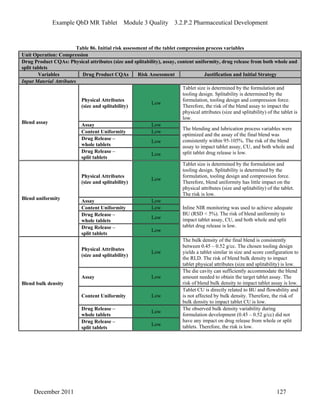
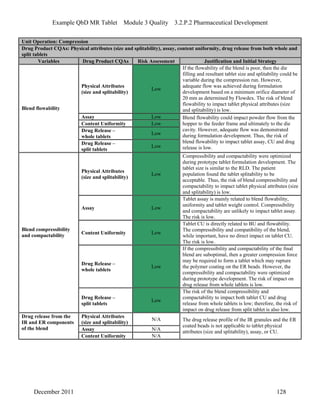
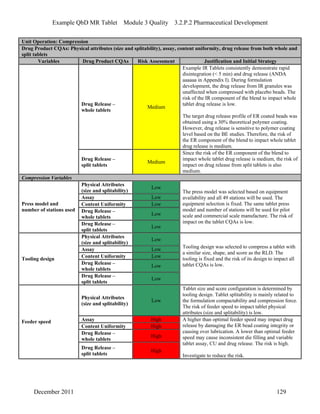
As the IR granulation process has been previously established, this development report focuses
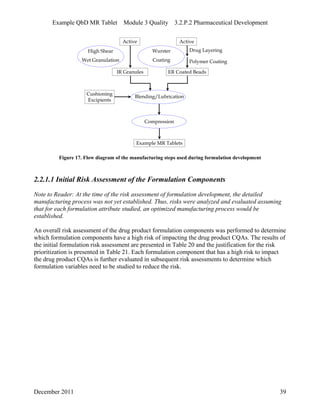
on four key steps for ER bead and final tablet process development: 1) drug layering, 2) ER
polymer coating, 3) blending and lubrication, and 4) compression. We selected a bottom spray
fluid bed process for both drug layering and polymer coating of the ER beads. We utilized
diffusive mixing for the final blend before compressing the blend into scored tablets. For each
December 2011 4
Example QbD MR Tablet Module 3 Quality 3.2.P.2 Pharmaceutical Development
unit operation, we conducted a risk assessment and then utilized DOE to investigate the
identified high risk variables to determine the critical material attributes (CMAs) and critical
process parameters (CPPs). An inline NIR method was validated and implemented to monitor
blend uniformity and to reduce the risk associated with the blending step. Our process
optimization facilitated the creation of a design space at the pilot scale. A pivotal BE study
conducted with the exhibit batch manufactured at pilot scale demonstrated equivalence between
our product and the RLD.
Our first verification batch at commercial scale failed dissolution testing. Subsequent
investigation showed that film coat thickness increased on the beads manufactured at commercial
scale versus beads manufactured at pilot scale due to a difference in process efficiency. A second
verification batch was manufactured by decreasing the theoretical polymer coating level from
30% to 28 % to account for improved processing efficiency at commercial scale. The
formulation change resulted in drug product that met our predefined CQA targets.
We propose a control strategy that includes the input material attributes and process parameters
identified as potentially high risk variables during the initial risk assessment. Our control strategy
also includes in-process and finished product specifications. The process will be monitored
during the lifecycle of the product and additional knowledge gained will be utilized to make
adjustments to the control strategy as appropriate.
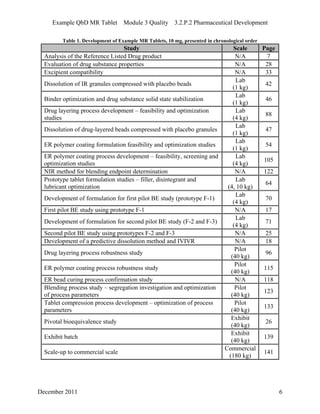
The development time line for Example MR is presented in Table 1.
December 2011 5
Example QbD MR Tablet Module 3 Quality 3.2.P.2 Pharmaceutical Development
Table 1. Development of Example MR Tablets, 10 mg, presented in chronological order
Study Scale Page
Analysis of the Reference Listed Drug product N/A 7
Evaluation of drug substance properties N/A 28
Excipient compatibility N/A 33
Dissolution of IR granules compressed with placebo beads
Lab
(1 kg)
42
Binder optimization and drug substance solid state stabilization
Lab
(1 kg)
46
Drug layering process development – feasibility and optimization
studies
Lab
(4 kg)
88
Dissolution of drug-layered beads compressed with placebo granules
Lab
(1 kg)
47
ER polymer coating formulation feasibility and optimization studies
Lab
(1 kg)
54
ER polymer coating process development – feasibility, screening and
optimization studies
Lab
(4 kg)
105
NIR method for blending endpoint determination N/A 122
Prototype tablet formulation studies – filler, disintegrant and
lubricant optimization
Lab
(4, 10 kg)
64
Development of formulation for first pilot BE study (prototype F-1)
Lab
(4 kg)
70
First pilot BE study using prototype F-1 N/A 17
Development of formulation for second pilot BE study (F-2 and F-3)
Lab
(4 kg)
71
Second pilot BE study using prototypes F-2 and F-3 N/A 25
Development of a predictive dissolution method and IVIVR N/A 18
Drug layering process robustness study
Pilot
(40 kg)
96
ER polymer coating process robustness study
Pilot
(40 kg)
115
ER bead curing process confirmation study N/A 118
Blending process study – segregation investigation and optimization
of process parameters
Pilot
(40 kg)
123
Tablet compression process development – optimization of process
parameters
Pilot
(40 kg)
133
Pivotal bioequivalence study
Exhibit
(40 kg)
26
Exhibit batch
Exhibit
(40 kg)
139
Scale-up to commercial scale
Commercial
(180 kg)
141
December 2011 6
Example QbD MR Tablet Module 3 Quality 3.2.P.2 Pharmaceutical Development
1.2 Analysis of the Reference Listed Drug Product
1.2.1 Clinical
The reference listed drug (RLD) is Brand MR Tablets, 10 mg, and is a modified release (MR)
formulation composed of both an immediate release (IR) and an extended release (ER)
component. The RLD was approved in the United States in 2009 in NDA aaaaaa and is indicated
for therapeutic relief. Tablets contain the active ingredient Z that acts through the CNS; however,
its mechanism of action remains unknown. Brand MR Tablets, 10 mg, were developed based
upon the corresponding IR formulation, Brand IR Tablets, 3 mg, approved in 2005 in NDA
bbbbbb. The ANDA approval for Example IR Tablets (ANDA aaaaaa) was in 2010.
Brand MR Tablets are designed for once-a-day dosing to provide both immediate onset of
therapeutic relief similar to the IR product as well as maintenance of the therapeutic effect. The
label-recommended dosing is 10 mg once daily in adults; however, this dose may be titrated to a
maximum daily dose of 20 mg. The tablet is scored to allow for 5 mg dosing, particularly for
elderly patients or patients with hepatic insufficiency who do not clear the drug as rapidly as
normal. The label warns of the potential risk of dose dumping that may occur with the co-
ingestion of alcohol.
1.2.2 Pharmacokinetics
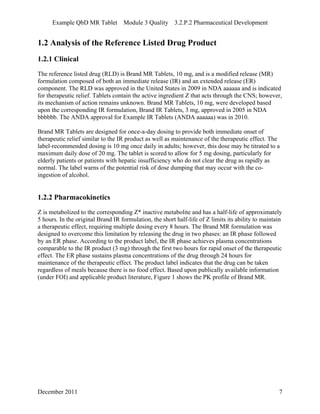
Z is metabolized to the corresponding Z* inactive metabolite and has a half-life of approximately
5 hours. In the original Brand IR formulation, the short half-life of Z limits its ability to maintain
a therapeutic effect, requiring multiple dosing every 8 hours. The Brand MR formulation was
designed to overcome this limitation by releasing the drug in two phases: an IR phase followed
by an ER phase. According to the product label, the IR phase achieves plasma concentrations
comparable to the IR product (3 mg) through the first two hours for rapid onset of the therapeutic
effect. The ER phase sustains plasma concentrations of the drug through 24 hours for
maintenance of the therapeutic effect. The product label indicates that the drug can be taken
regardless of meals because there is no food effect. Based upon publically available information
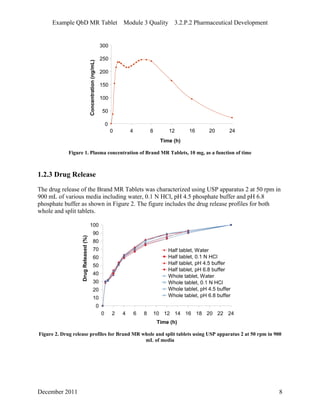
(under FOI) and applicable product literature, Figure 1 shows the PK profile of Brand MR.
December 2011 7
Example QbD MR Tablet Module 3 Quality 3.2.P.2 Pharmaceutical Development
0
50
100
150
200
250
300
0 4 8 12 16 20 24
Time (h)
Concentration(ng/mL)
Figure 1. Plasma concentration of Brand MR Tablets, 10 mg, as a function of time
1.2.3 Drug Release
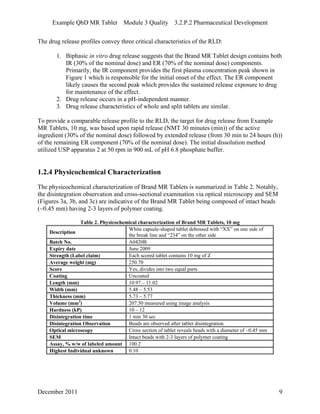
The drug release of the Brand MR Tablets was characterized using USP apparatus 2 at 50 rpm in
900 mL of various media including water, 0.1 N HCl, pH 4.5 phosphate buffer and pH 6.8
phosphate buffer as shown in Figure 2. The figure includes the drug release profiles for both
whole and split tablets.
0
10
20
30
40
50
60
70
80
90
100
0 2 4 6 8 10 12 14 16 18 20 22 24
Time (h)
DrugReleased(%)
Half tablet, Water
Half tablet, 0.1 N HCl
Half tablet, pH 4.5 buffer
Half tablet, pH 6.8 buffer
Whole tablet, Water
Whole tablet, 0.1 N HCl
Whole tablet, pH 4.5 buffer
Whole tablet, pH 6.8 buffer
Figure 2. Drug release profiles for Brand MR whole and split tablets using USP apparatus 2 at 50 rpm in 900
mL of media
December 2011 8
Example QbD MR Tablet Module 3 Quality 3.2.P.2 Pharmaceutical Development
The drug release profiles convey three critical characteristics of the RLD:
1. Biphasic in vitro drug release suggests that the Brand MR Tablet design contains both
IR (30% of the nominal dose) and ER (70% of the nominal dose) components.
Primarily, the IR component provides the first plasma concentration peak shown in
Figure 1 which is responsible for the initial onset of the effect. The ER component
likely causes the second peak which provides the sustained release exposure to drug
for maintenance of the effect.
2. Drug release occurs in a pH-independent manner.
3. Drug release characteristics of whole and split tablets are similar.
To provide a comparable release profile to the RLD, the target for drug release from Example
MR Tablets, 10 mg, was based upon rapid release (NMT 30 minutes (min)) of the active
ingredient (30% of the nominal dose) followed by extended release (from 30 min to 24 hours (h))
of the remaining ER component (70% of the nominal dose). The initial dissolution method
utilized USP apparatus 2 at 50 rpm in 900 mL of pH 6.8 phosphate buffer.
1.2.4 Physicochemical Characterization
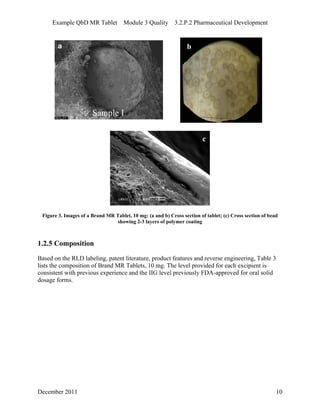
The physicochemical characterization of Brand MR Tablets is summarized in Table 2. Notably,
the disintegration observation and cross-sectional examination via optical microscopy and SEM
(Figures 3a, 3b, and 3c) are indicative of the Brand MR Tablet being composed of intact beads
(~0.45 mm) having 2-3 layers of polymer coating.
Table 2. Physicochemical characterization of Brand MR Tablets, 10 mg
Description
White capsule-shaped tablet debossed with “XX” on one side of
the break line and “234” on the other side
Batch No. A0420B
Expiry date June 2009
Strength (Label claim) Each scored tablet contains 10 mg of Z
Average weight (mg) 250.70
Score Yes, divides into two equal parts
Coating Uncoated
Length (mm) 10.97 – 11.02
Width (mm) 5.48 – 5.53
Thickness (mm) 5.73 – 5.77
Volume (mm3
) 207.50 measured using image analysis
Hardness (kP) 10 – 12
Disintegration time 1 min 30 sec
Disintegration Observation Beads are observed after tablet disintegration
Optical microscopy Cross section of tablet reveals beads with a diameter of ~0.45 mm
SEM Intact beads with 2-3 layers of polymer coating
Assay, % w/w of labeled amount 100.2
Highest Individual unknown 0.10
December 2011 9
Example QbD MR Tablet Module 3 Quality 3.2.P.2 Pharmaceutical Development
b
c
Figure 3. Images of a Brand MR Tablet, 10 mg: (a and b) Cross section of tablet; (c) Cross section of bead
showing 2-3 layers of polymer coating
1.2.5 Composition
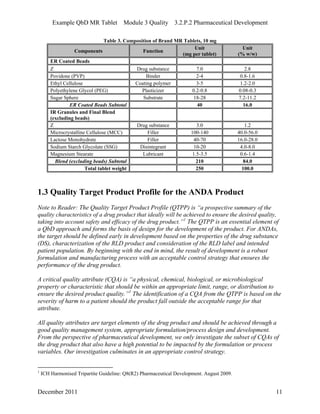
Based on the RLD labeling, patent literature, product features and reverse engineering, Table 3
lists the composition of Brand MR Tablets, 10 mg. The level provided for each excipient is
consistent with previous experience and the IIG level previously FDA-approved for oral solid
dosage forms.
December 2011 10
Example QbD MR Tablet Module 3 Quality 3.2.P.2 Pharmaceutical Development
Table 3. Composition of Brand MR Tablets, 10 mg
Components Function
Unit
(mg per tablet)
Unit
(% w/w)
ER Coated Beads
Z Drug substance 7.0 2.8
Povidone (PVP) Binder 2-4 0.8-1.6
Ethyl Cellulose Coating polymer 3-5 1.2-2.0
Polyethylene Glycol (PEG) Plasticizer 0.2-0.8 0.08-0.3
Sugar Sphere Substrate 18-28 7.2-11.2
ER Coated Beads Subtotal 40 16.0
IR Granules and Final Blend
(excluding beads)
Z Drug substance 3.0 1.2
Microcrystalline Cellulose (MCC) Filler 100-140 40.0-56.0
Lactose Monohydrate Filler 40-70 16.0-28.0
Sodium Starch Glycolate (SSG) Disintegrant 10-20 4.0-8.0
Magnesium Stearate Lubricant 1.5-3.5 0.6-1.4
Blend (excluding beads) Subtotal 210 84.0
Total tablet weight 250 100.0
1.3 Quality Target Product Profile for the ANDA Product
Note to Reader: The Quality Target Product Profile (QTPP) is “a prospective summary of the
quality characteristics of a drug product that ideally will be achieved to ensure the desired quality,
taking into account safety and efficacy of the drug product.”1
The QTPP is an essential element of
a QbD approach and forms the basis of design for the development of the product. For ANDAs,
the target should be defined early in development based on the properties of the drug substance
(DS), characterization of the RLD product and consideration of the RLD label and intended
patient population. By beginning with the end in mind, the result of development is a robust
formulation and manufacturing process with an acceptable control strategy that ensures the
performance of the drug product.
A critical quality attribute (CQA) is “a physical, chemical, biological, or microbiological
property or characteristic that should be within an appropriate limit, range, or distribution to
ensure the desired product quality.”1
The identification of a CQA from the QTPP is based on the
severity of harm to a patient should the product fall outside the acceptable range for that
attribute.
All quality attributes are target elements of the drug product and should be achieved through a
good quality management system, appropriate formulation/process design and development.
From the perspective of pharmaceutical development, we only investigate the subset of CQAs of
the drug product that also have a high potential to be impacted by the formulation or process
variables. Our investigation culminates in an appropriate control strategy.
1
ICH Harmonised Tripartite Guideline: Q8(R2) Pharmaceutical Development. August 2009.
December 2011 11
Example QbD MR Tablet Module 3 Quality 3.2.P.2 Pharmaceutical Development
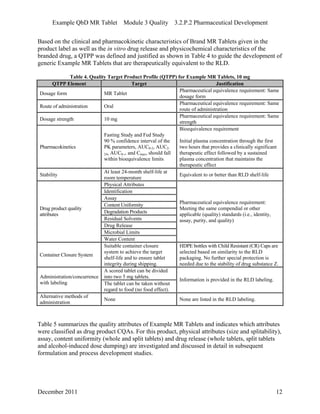
Based on the clinical and pharmacokinetic characteristics of Brand MR Tablets given in the
product label as well as the in vitro drug release and physicochemical characteristics of the
branded drug, a QTPP was defined and justified as shown in Table 4 to guide the development of
generic Example MR Tablets that are therapeutically equivalent to the RLD.
Table 4. Quality Target Product Profile (QTPP) for Example MR Tablets, 10 mg
QTPP Element Target Justification
Dosage form MR Tablet
Pharmaceutical equivalence requirement: Same
dosage form
Route of administration Oral
Pharmaceutical equivalence requirement: Same
route of administration
Dosage strength 10 mg
Pharmaceutical equivalence requirement: Same
strength
Pharmacokinetics
Fasting Study and Fed Study
90 % confidence interval of the
PK parameters, AUC0-2, AUC2-
24, AUC0-∞ and Cmax, should fall
within bioequivalence limits
Bioequivalence requirement
Initial plasma concentration through the first
two hours that provides a clinically significant
therapeutic effect followed by a sustained
plasma concentration that maintains the
therapeutic effect
Stability
At least 24-month shelf-life at
room temperature
Equivalent to or better than RLD shelf-life
Physical Attributes
Identification
Assay
Content Uniformity
Degradation Products
Residual Solvents
Drug Release
Microbial Limits
Drug product quality
attributes
Water Content
Pharmaceutical equivalence requirement:
Meeting the same compendial or other
applicable (quality) standards (i.e., identity,
assay, purity, and quality)
Container Closure System
Suitable container closure
system to achieve the target
shelf-life and to ensure tablet
integrity during shipping.
HDPE bottles with Child Resistant (CR) Caps are
selected based on similarity to the RLD
packaging. No further special protection is
needed due to the stability of drug substance Z.
A scored tablet can be divided
into two 5 mg tablets.Administration/concurrence
with labeling The tablet can be taken without
regard to food (no food effect).
Information is provided in the RLD labeling.
Alternative methods of
administration
None None are listed in the RLD labeling.
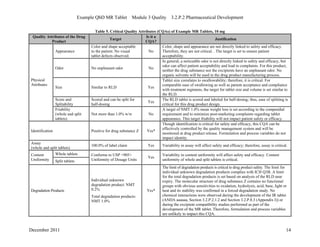
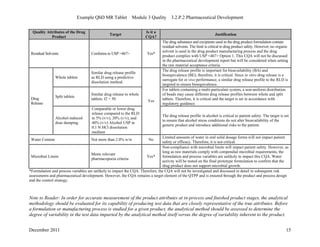
Table 5 summarizes the quality attributes of Example MR Tablets and indicates which attributes
were classified as drug product CQAs. For this product, physical attributes (size and splitability),
assay, content uniformity (whole and split tablets) and drug release (whole tablets, split tablets
and alcohol-induced dose dumping) are investigated and discussed in detail in subsequent
formulation and process development studies.
December 2011 12
Example QbD MR Tablet Module 3 Quality 3.2.P.2 Pharmaceutical Development
December 2011 13
On the other hand, CQAs including identity, degradation products and microbial limits which are
unlikely to be impacted by formulation and process variables will not be discussed in detail in
the pharmaceutical development report. However, these CQAs are still target elements of the
QTPP and are ensured through the product and process design and the control strategy
Example QbD MR Tablet Module 3 Quality 3.2.P.2 Pharmaceutical Development
Table 5. Critical Quality Attributes (CQAs) of Example MR Tablets, 10 mg
Quality Attributes of the Drug
Product
Target
Is it a
CQA?
Justification
Appearance
Color and shape acceptable
to the patient. No visual
tablet defects observed.
No
Color, shape and appearance are not directly linked to safety and efficacy.
Therefore, they are not critical. . The target is set to ensure patient
acceptability.
Odor No unpleasant odor No
In general, a noticeable odor is not directly linked to safety and efficacy, but
odor can affect patient acceptability and lead to complaints. For this product,
neither the drug substance nor the excipients have an unpleasant odor. No
organic solvents will be used in the drug product manufacturing process.
Size Similar to RLD Yes
Tablet size correlates to swallowability; therefore, it is critical. For
comparable ease of swallowing as well as patient acceptance and compliance
with treatment regimens, the target for tablet size and volume is set similar to
the RLD.
Score and
Splitability
Scored and can be split for
half-dosing
Yes
The RLD tablet is scored and labeled for half-dosing; thus, ease of splitting is
critical for this drug product design.
Physical
Attributes
Friability
(whole and split
tablets)
Not more than 1.0% w/w No
A target of NMT 1.0% mean weight loss is set according to the compendial
requirement and to minimize post-marketing complaints regarding tablet
appearance. This target friability will not impact patient safety or efficacy.
Identification Positive for drug substance Z Yes*
Though identification is critical for safety and efficacy, this CQA can be
effectively controlled by the quality management system and will be
monitored at drug product release. Formulation and process variables do not
impact identity.
Assay
(whole and split tablets)
100.0% of label claim Yes Variability in assay will affect safety and efficacy; therefore, assay is critical.
Whole tabletsContent
Uniformity Split tablets
Conforms to USP <905>
Uniformity of Dosage Units
Yes
Variability in content uniformity will affect safety and efficacy. Content
uniformity of whole and split tablets is critical.
Degradation Products
Individual unknown
degradation product: NMT
0.2%
Total degradation products:
NMT 1.0%
Yes*
The limit of degradation products is critical to drug product safety. The limit for
individual unknown degradation products complies with ICH Q3B. A limit
for the total degradation products is set based on analysis of the RLD near
expiry. The molecular structure of drug substance Z contains no functional
groups with obvious sensitivities to oxidation, hydrolysis, acid, base, light or
heat and its stability was confirmed in a forced degradation study. No
chemical interactions were observed during the development of the IR tablet
(ANDA aaaaaa, Section 3.2.P.2.1.2 and Section 3.2.P.8.3 (Appendix I)) or
during the excipient compatibility studies performed as part of the
development of the MR tablet. Therefore, formulation and process variables
are unlikely to impact this CQA.
December 2011 14
Example QbD MR Tablet Module 3 Quality 3.2.P.2 Pharmaceutical Development
Quality Attributes of the Drug
Product
Target
Is it a
CQA?
Justification
Residual Solvents Conforms to USP <467> Yes*
The drug substance and excipients used in the drug product formulation contain
residual solvents. The limit is critical to drug product safety. However, no organic
solvent is used in the drug product manufacturing process and the drug
product complies with USP <467> Option 1. This CQA will not be discussed
in the pharmaceutical development report but will be considered when setting
the raw material acceptance criteria.
Whole tablets
Similar drug release profile
as RLD using a predictive
dissolution method.
The drug release profile is important for bioavailability (BA) and
bioequivalence (BE); therefore, it is critical. Since in vitro drug release is a
surrogate for in vivo performance, a similar drug release profile to the RLD is
targeted to ensure bioequivalence.
Split tablets
Similar drug release to whole
tablets: f2 > 50
For tablets containing a multi-particulate system, a non-uniform distribution
of beads may cause different drug release profiles between whole and split
tablets. Therefore, it is critical and the target is set in accordance with
regulatory guidance.
Drug
Release
Alcohol-induced
dose dumping
Comparable or lower drug
release compared to the RLD
in 5% (v/v), 20% (v/v), and
40% (v/v) Alcohol USP in
0.1 N HCl dissolution
medium
Yes
The drug release profile in alcohol is critical to patient safety. The target is set
to ensure that alcohol stress conditions do not alter bioavailability of the
generic product and introduce additional risks to the patient.
Water Content Not more than 2.0% w/w No
Limited amounts of water in oral solid dosage forms will not impact patient
safety or efficacy. Therefore, it is not critical.
Microbial Limits
Meets relevant
pharmacopoeia criteria
Yes*
Non-compliance with microbial limits will impact patient safety. However, as
long as raw materials comply with compendial microbial requirements, the
formulation and process variables are unlikely to impact this CQA. Water
activity will be tested on the final prototype formulation to confirm that the
drug product does not support microbial growth.
*Formulation and process variables are unlikely to impact the CQA. Therefore, the CQA will not be investigated and discussed in detail in subsequent risk
assessments and pharmaceutical development. However, the CQA remains a target element of the QTPP and is ensured through the product and process design
and the control strategy.
Note to Reader: In order for accurate measurement of the product attributes at in-process and finished product stages, the analytical
methodology should be evaluated for its capability of producing test data that are closely representative of the true attributes. Before
a formulation or manufacturing process is studied for a given product, the analytical method should be assessed to determine the
degree of variability in the test data imparted by the analytical method itself versus the degree of variability inherent to the product.
December 2011 15
Example QbD MR Tablet Module 3 Quality 3.2.P.2 Pharmaceutical Development
December 2011 16
One such approach to conduct measurement system analysis is to use ANOVA-based statistical methods designed for this purpose.
This allows quantitative discernment between different sources of variability including, but not limited to, the instrument, the operator
and the sample. Analysis of the measurement system and assurance of its capability to produce representative data are even more
important when changes in the values of the product attributes are studied as responses to controlled changes in the formulation and
the process parameters in a design of experiments (DOE).
Example QbD MR Tablet Module 3 Quality 3.2.P.2 Pharmaceutical Development
1.4 Dissolution Method Development and Bioequivalence Studies
It was important to understand the relationship between in vitro drug release and in vivo
performance in order to 1) evaluate the impact of formulation and process variable changes on drug
product quality during development; 2) predict the performance of the commercial batches based on
the BE data from the exhibit batch manufactured at the pilot scale, and 3) facilitate the evaluation of
post-approval changes. Therefore, we decided to develop a predictive dissolution method and
establish an in vitro-in vivo relationship (IVIVR) between in vitro drug release and in vivo
performance of the drug product. A predictive dissolution method should be able to predict in vivo
performance of the drug product reasonably well and also discriminate between the formulations
that perform differently.
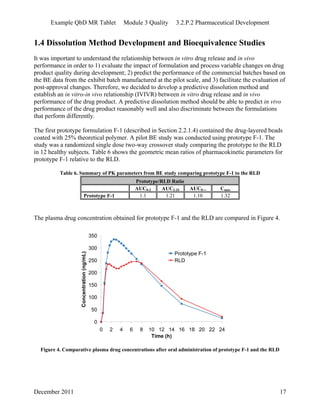
The first prototype formulation F-1 (described in Section 2.2.1.4) contained the drug-layered beads
coated with 25% theoretical polymer. A pilot BE study was conducted using prototype F-1. The
study was a randomized single dose two-way crossover study comparing the prototype to the RLD
in 12 healthy subjects. Table 6 shows the geometric mean ratios of pharmacokinetic parameters for
prototype F-1 relative to the RLD.
Table 6. Summary of PK parameters from BE study comparing prototype F-1 to the RLD
Prototype/RLD Ratio
AUC0-2 AUC2-24 AUC0-∞ Cmax
Prototype F-1 1.1 1.21 1.10 1.32
The plasma drug concentration obtained for prototype F-1 and the RLD are compared in Figure 4.
0
50
100
150
200
250
300
350
0 2 4 6 8 10 12 14 16 18 20 22 24
Time (h)
Concentration(ng/mL)
Prototype F-1
RLD
Figure 4. Comparative plasma drug concentrations after oral administration of prototype F-1 and the RLD
December 2011 17
Example QbD MR Tablet Module 3 Quality 3.2.P.2 Pharmaceutical Development
The RLD provided a biphasic profile representing the IR and ER portions of the formulation which
was not observed for prototype F-1. The data suggested the need to slow the release rate from the
ER coated beads in the prototype formulation in order to achieve bioequivalence to the RLD.
Therefore, prototype F-1 was used to develop a predictive dissolution method.
1.4.1 Development of a Predictive Dissolution Method
The effects of dissolution medium pH, stirring speed or number of dips per minute (dpm) as
applicable, and dissolution medium volume were systemically evaluated to develop the predictive
dissolution method. The effect of ionic strength of the dissolution medium was considered but not
evaluated because a predictive method could be developed using a standard USP buffer.
USP Apparatus 2 (Paddle)
An initial attempt at developing the discriminating dissolution method that would be predictive of in
vivo performance was made using USP apparatus 2 because the RLD was extensively characterized
as shown in Figure 2 using this apparatus early in the formulation development.
Effect of dissolution medium pH
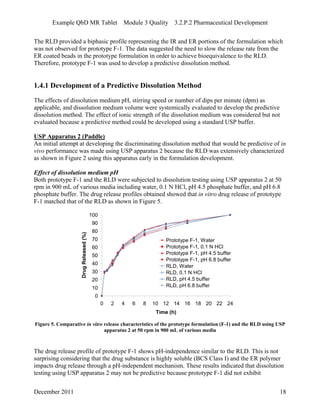
Both prototype F-1 and the RLD were subjected to dissolution testing using USP apparatus 2 at 50
rpm in 900 mL of various media including water, 0.1 N HCl, pH 4.5 phosphate buffer, and pH 6.8
phosphate buffer. The drug release profiles obtained showed that in vitro drug release of prototype
F-1 matched that of the RLD as shown in Figure 5.
0
10
20
30
40
50
60
70
80
90
100
0 2 4 6 8 10 12 14 16 18 20 22 24
Time (h)
DrugReleased(%)
Prototype F-1, Water
Prototype F-1, 0.1 N HCl
Prototype F-1, pH 4.5 buffer
Prototype F-1, pH 6.8 buffer
RLD, Water
RLD, 0.1 N HCl
RLD, pH 4.5 buffer
RLD, pH 6.8 buffer
Figure 5. Comparative in vitro release characteristics of the prototype formulation (F-1) and the RLD using USP
apparatus 2 at 50 rpm in 900 mL of various media
The drug release profile of prototype F-1 shows pH-independence similar to the RLD. This is not
surprising considering that the drug substance is highly soluble (BCS Class I) and the ER polymer
impacts drug release through a pH-independent mechanism. These results indicated that dissolution
testing using USP apparatus 2 may not be predictive because prototype F-1 did not exhibit
December 2011 18
Example QbD MR Tablet Module 3 Quality 3.2.P.2 Pharmaceutical Development
bioequivalence to the RLD when dosed in healthy human volunteers despite giving almost identical
drug release profiles under various pH conditions. Therefore, the effect of pH was not studied
further during the development of a predictive dissolution method. The pH 6.8 phosphate buffer
was selected as the dissolution medium since this medium is often used for modified release drug
products.
Effect of dissolution medium volume
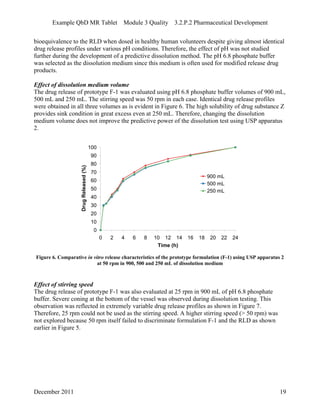
The drug release of prototype F-1 was evaluated using pH 6.8 phosphate buffer volumes of 900 mL,
500 mL and 250 mL. The stirring speed was 50 rpm in each case. Identical drug release profiles
were obtained in all three volumes as is evident in Figure 6. The high solubility of drug substance Z
provides sink condition in great excess even at 250 mL. Therefore, changing the dissolution
medium volume does not improve the predictive power of the dissolution test using USP apparatus
2.
0
10
20
30
40
50
60
70
80
90
100
0 2 4 6 8 10 12 14 16 18 20 22 24
Time (h)
DrugReleased(%)
900 mL
500 mL
250 mL
Figure 6. Comparative in vitro release characteristics of the prototype formulation (F-1) using USP apparatus 2
at 50 rpm in 900, 500 and 250 mL of dissolution medium
Effect of stirring speed
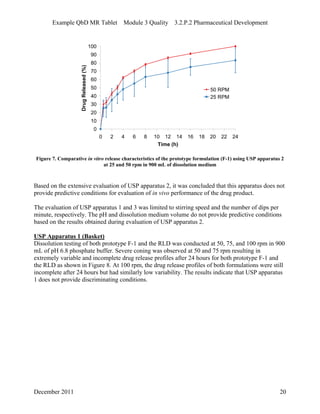
The drug release of prototype F-1 was also evaluated at 25 rpm in 900 mL of pH 6.8 phosphate
buffer. Severe coning at the bottom of the vessel was observed during dissolution testing. This
observation was reflected in extremely variable drug release profiles as shown in Figure 7.
Therefore, 25 rpm could not be used as the stirring speed. A higher stirring speed (> 50 rpm) was
not explored because 50 rpm itself failed to discriminate formulation F-1 and the RLD as shown
earlier in Figure 5.
December 2011 19
Example QbD MR Tablet Module 3 Quality 3.2.P.2 Pharmaceutical Development
0
10
20
30
40
50
60
70
80
90
100
0 2 4 6 8 10 12 14 16 18 20 22 24
Time (h)
DrugReleased(%)
50 RPM
25 RPM
Figure 7. Comparative in vitro release characteristics of the prototype formulation (F-1) using USP apparatus 2
at 25 and 50 rpm in 900 mL of dissolution medium
Based on the extensive evaluation of USP apparatus 2, it was concluded that this apparatus does not
provide predictive conditions for evaluation of in vivo performance of the drug product.
The evaluation of USP apparatus 1 and 3 was limited to stirring speed and the number of dips per
minute, respectively. The pH and dissolution medium volume do not provide predictive conditions
based on the results obtained during evaluation of USP apparatus 2.
USP Apparatus 1 (Basket)
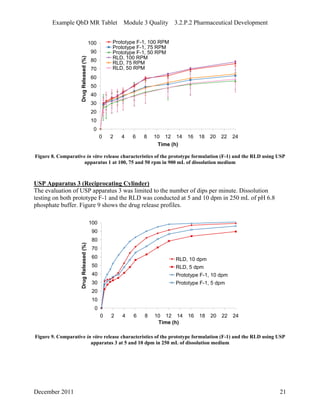
Dissolution testing of both prototype F-1 and the RLD was conducted at 50, 75, and 100 rpm in 900
mL of pH 6.8 phosphate buffer. Severe coning was observed at 50 and 75 rpm resulting in
extremely variable and incomplete drug release profiles after 24 hours for both prototype F-1 and
the RLD as shown in Figure 8. At 100 rpm, the drug release profiles of both formulations were still
incomplete after 24 hours but had similarly low variability. The results indicate that USP apparatus
1 does not provide discriminating conditions.
December 2011 20
Example QbD MR Tablet Module 3 Quality 3.2.P.2 Pharmaceutical Development
0
10
20
30
40
50
60
70
80
90
100
0 2 4 6 8 10 12 14 16 18 20 22 24
Time (h)
DrugReleased(%)
Prototype F-1, 100 RPM
Prototype F-1, 75 RPM
Prototype F-1, 50 RPM
RLD, 100 RPM
RLD, 75 RPM
RLD, 50 RPM
Figure 8. Comparative in vitro release characteristics of the prototype formulation (F-1) and the RLD using USP
apparatus 1 at 100, 75 and 50 rpm in 900 mL of dissolution medium
USP Apparatus 3 (Reciprocating Cylinder)
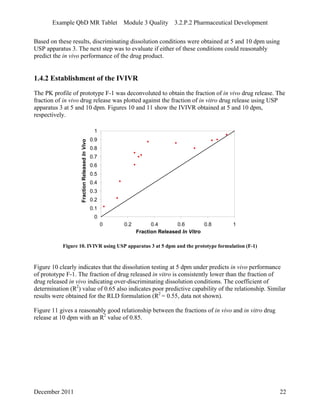
The evaluation of USP apparatus 3 was limited to the number of dips per minute. Dissolution
testing on both prototype F-1 and the RLD was conducted at 5 and 10 dpm in 250 mL of pH 6.8
phosphate buffer. Figure 9 shows the drug release profiles.
0
10
20
30
40
50
60
70
80
90
100
0 2 4 6 8 10 12 14 16 18 20 22 24
Time (h)
DrugReleased(%)
RLD, 10 dpm
RLD, 5 dpm
Prototype F-1, 10 dpm
Prototype F-1, 5 dpm
Figure 9. Comparative in vitro release characteristics of the prototype formulation (F-1) and the RLD using USP
apparatus 3 at 5 and 10 dpm in 250 mL of dissolution medium
December 2011 21
Example QbD MR Tablet Module 3 Quality 3.2.P.2 Pharmaceutical Development
Based on these results, discriminating dissolution conditions were obtained at 5 and 10 dpm using
USP apparatus 3. The next step was to evaluate if either of these conditions could reasonably
predict the in vivo performance of the drug product.
1.4.2 Establishment of the IVIVR
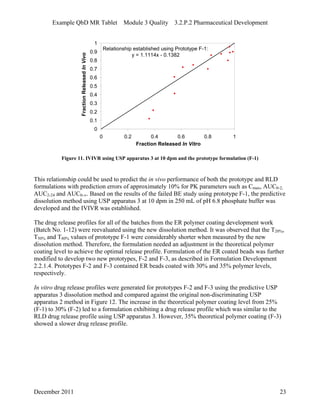
The PK profile of prototype F-1 was deconvoluted to obtain the fraction of in vivo drug release. The
fraction of in vivo drug release was plotted against the fraction of in vitro drug release using USP
apparatus 3 at 5 and 10 dpm. Figures 10 and 11 show the IVIVR obtained at 5 and 10 dpm,
respectively.
0
0.1
0.2
0.3
0.4
0.5
0.6
0.7
0.8
0.9
1
0 0.2 0.4 0.6 0.8 1
Fraction Released In Vitro
FractionReleasedInVivo
Figure 10. IVIVR using USP apparatus 3 at 5 dpm and the prototype formulation (F-1)
Figure 10 clearly indicates that the dissolution testing at 5 dpm under predicts in vivo performance
of prototype F-1. The fraction of drug released in vitro is consistently lower than the fraction of
drug released in vivo indicating over-discriminating dissolution conditions. The coefficient of
determination (R2
) value of 0.65 also indicates poor predictive capability of the relationship. Similar
results were obtained for the RLD formulation (R2
= 0.55, data not shown).
Figure 11 gives a reasonably good relationship between the fractions of in vivo and in vitro drug
release at 10 dpm with an R2
value of 0.85.
December 2011 22
Example QbD MR Tablet Module 3 Quality 3.2.P.2 Pharmaceutical Development
Relationship established using Prototype F-1:
y = 1.1114x - 0.1382
0
0.1
0.2
0.3
0.4
0.5
0.6
0.7
0.8
0.9
1
0 0.2 0.4 0.6 0.8 1
Fraction Released In Vitro
FractionReleasedInVivo
Figure 11. IVIVR using USP apparatus 3 at 10 dpm and the prototype formulation (F-1)
This relationship could be used to predict the in vivo performance of both the prototype and RLD
formulations with prediction errors of approximately 10% for PK parameters such as Cmax, AUC0-2,
AUC2-24 and AUC0-∞. Based on the results of the failed BE study using prototype F-1, the predictive
dissolution method using USP apparatus 3 at 10 dpm in 250 mL of pH 6.8 phosphate buffer was
developed and the IVIVR was established.
The drug release profiles for all of the batches from the ER polymer coating development work
(Batch No. 1-12) were reevaluated using the new dissolution method. It was observed that the T20%,
T50% and T80% values of prototype F-1 were considerably shorter when measured by the new
dissolution method. Therefore, the formulation needed an adjustment in the theoretical polymer
coating level to achieve the optimal release profile. Formulation of the ER coated beads was further
modified to develop two new prototypes, F-2 and F-3, as described in Formulation Development
2.2.1.4. Prototypes F-2 and F-3 contained ER beads coated with 30% and 35% polymer levels,
respectively.
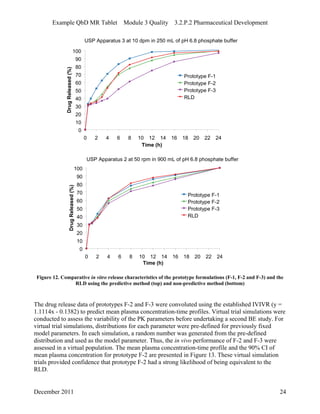
In vitro drug release profiles were generated for prototypes F-2 and F-3 using the predictive USP
apparatus 3 dissolution method and compared against the original non-discriminating USP
apparatus 2 method in Figure 12. The increase in the theoretical polymer coating level from 25%
(F-1) to 30% (F-2) led to a formulation exhibiting a drug release profile which was similar to the
RLD drug release profile using USP apparatus 3. However, 35% theoretical polymer coating (F-3)
showed a slower drug release profile.
December 2011 23
Example QbD MR Tablet Module 3 Quality 3.2.P.2 Pharmaceutical Development
0
10
20
30
40
50
60
70
80
90
100
0 2 4 6 8 10 12 14 16 18 20 22 24
Time (h)
DrugReleased(%)
Prototype F-1
Prototype F-2
Prototype F-3
RLD
0
10
20
30
40
50
60
70
80
90
100
0 2 4 6 8 10 12 14 16 18 20 22 24
Time (h)
DrugReleased(%)
Prototype F-1
Prototype F-2
Prototype F-3
RLD
USP Apparatus 3 at 10 dpm in 250 mL of pH 6.8 phosphate buffer
USP Apparatus 2 at 50 rpm in 900 mL of pH 6.8 phosphate buffer
Figure 12. Comparative in vitro release characteristics of the prototype formulations (F-1, F-2 and F-3) and the
RLD using the predictive method (top) and non-predictive method (bottom)
The drug release data of prototypes F-2 and F-3 were convoluted using the established IVIVR (y =
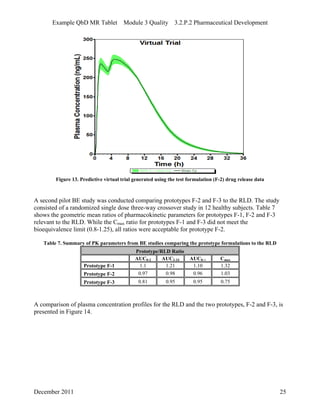
1.1114x - 0.1382) to predict mean plasma concentration-time profiles. Virtual trial simulations were
conducted to assess the variability of the PK parameters before undertaking a second BE study. For
virtual trial simulations, distributions for each parameter were pre-defined for previously fixed
model parameters. In each simulation, a random number was generated from the pre-defined
distribution and used as the model parameter. Thus, the in vivo performance of F-2 and F-3 were
assessed in a virtual population. The mean plasma concentration-time profile and the 90% CI of
mean plasma concentration for prototype F-2 are presented in Figure 13. These virtual simulation
trials provided confidence that prototype F-2 had a strong likelihood of being equivalent to the
RLD.
December 2011 24
Example QbD MR Tablet Module 3 Quality 3.2.P.2 Pharmaceutical Development
Figure 13. Predictive virtual trial generated using the test formulation (F-2) drug release data
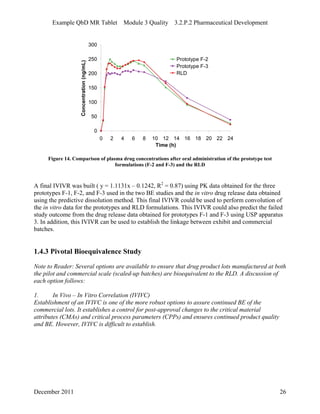
A second pilot BE study was conducted comparing prototypes F-2 and F-3 to the RLD. The study
consisted of a randomized single dose three-way crossover study in 12 healthy subjects. Table 7
shows the geometric mean ratios of pharmacokinetic parameters for prototypes F-1, F-2 and F-3
relevant to the RLD. While the Cmax ratio for prototypes F-1 and F-3 did not meet the
bioequivalence limit (0.8-1.25), all ratios were acceptable for prototype F-2.
Table 7. Summary of PK parameters from BE studies comparing the prototype formulations to the RLD
Prototype/RLD Ratio
AUC0-2 AUC2-24 AUC0-∞ Cmax
Prototype F-1 1.1 1.21 1.10 1.32
Prototype F-2 0.97 0.98 0.96 1.03
Prototype F-3 0.81 0.95 0.95 0.75
A comparison of plasma concentration profiles for the RLD and the two prototypes, F-2 and F-3, is
presented in Figure 14.
December 2011 25
Example QbD MR Tablet Module 3 Quality 3.2.P.2 Pharmaceutical Development
0
50
100
150
200
250
300
0 2 4 6 8 10 12 14 16 18 20 22 24
Time (h)
Concentration(ng/mL)
Prototype F-2
Prototype F-3
RLD
Figure 14. Comparison of plasma drug concentrations after oral administration of the prototype test
formulations (F-2 and F-3) and the RLD
A final IVIVR was built ( y = 1.1131x – 0.1242, R2
= 0.87) using PK data obtained for the three
prototypes F-1, F-2, and F-3 used in the two BE studies and the in vitro drug release data obtained
using the predictive dissolution method. This final IVIVR could be used to perform convolution of
the in vitro data for the prototypes and RLD formulations. This IVIVR could also predict the failed
study outcome from the drug release data obtained for prototypes F-1 and F-3 using USP apparatus
3. In addition, this IVIVR can be used to establish the linkage between exhibit and commercial
batches.
1.4.3 Pivotal Bioequivalence Study
Note to Reader: Several options are available to ensure that drug product lots manufactured at both
the pilot and commercial scale (scaled-up batches) are bioequivalent to the RLD. A discussion of
each option follows:
1. In Vivo – In Vitro Correlation (IVIVC)
Establishment of an IVIVC is one of the more robust options to assure continued BE of the
commercial lots. It establishes a control for post-approval changes to the critical material
attributes (CMAs) and critical process parameters (CPPs) and ensures continued product quality
and BE. However, IVIVC is difficult to establish.
December 2011 26
Example QbD MR Tablet Module 3 Quality 3.2.P.2 Pharmaceutical Development
2. Predictive in vitro method (In Vivo – In Vitro Relationship (IVIVR))
A product designed and developed using QbD principles should lead to the establishment of a
predictive in vitro dissolution method. Establishing an IVIVR, although less robust than an IVIVC,
may be sufficient to assure product quality when combined with product and process
understanding. Such an in vitro method will also be useful in assessing post-approval changes.
3. Bioequivalence study of commercial scale batches
It is well recognized that an ER product developed at pivotal batch scale may not always scale-up
to commercial scale and yield a drug product that is BE to the RLD. Both fed and fasting
bioequivalence studies may be necessary to assure that the commercial batches are BE to the RLD.
It is also expected that the risk assessment of a product developed on QbD principles will identify
all the CMAs and CPPs and include adequate controls; one of these controls will be a
discriminating in vitro method. While the bioequivalence study of commercial batches will assure
BE of the drug product, a discriminating in vitro method will assure product quality through its life-
cycle (post-approval changes).
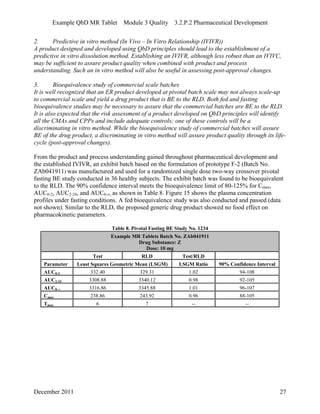
From the product and process understanding gained throughout pharmaceutical development and
the established IVIVR, an exhibit batch based on the formulation of prototype F-2 (Batch No.
ZAb041911) was manufactured and used for a randomized single dose two-way crossover pivotal
fasting BE study conducted in 36 healthy subjects. The exhibit batch was found to be bioequivalent
to the RLD. The 90% confidence interval meets the bioequivalence limit of 80-125% for Cmax,
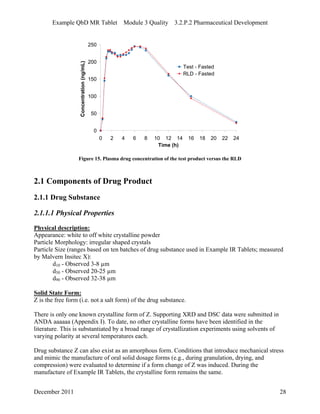
AUC0-2, AUC2-24, and AUC0-∞, as shown in Table 8. Figure 15 shows the plasma concentration
profiles under fasting conditions. A fed bioequivalence study was also conducted and passed (data
not shown). Similar to the RLD, the proposed generic drug product showed no food effect on
pharmacokinetic parameters.
Table 8. Pivotal Fasting BE Study No. 1234
Example MR Tablets Batch No. ZAb041911
Drug Substance: Z
Dose: 10 mg
Test RLD Test/RLD
Parameter Least Squares Geometric Mean (LSGM) LSGM Ratio 90% Confidence Interval
AUC0-2 332.40 329.31 1.02 94-108
AUC2-24 3308.88 3340.12 0.98 92-105
AUC0-∞ 3316.86 3345.88 1.01 96-107
Cmax 238.86 243.92 0.96 88-105
Tmax 6 7 -- --
December 2011 27
Example QbD MR Tablet Module 3 Quality 3.2.P.2 Pharmaceutical Development
0
50
100
150
200
250
0 2 4 6 8 10 12 14 16 18 20 22 24
Time (h)
Concentration(ng/mL)
Test - Fasted
RLD - Fasted
Figure 15. Plasma drug concentration of the test product versus the RLD
2.1 Components of Drug Product
2.1.1 Drug Substance
2.1.1.1 Physical Properties
Physical description:
Appearance: white to off white crystalline powder
Particle Morphology: irregular shaped crystals
Particle Size (ranges based on ten batches of drug substance used in Example IR Tablets; measured
by Malvern Insitec X):
d10 - Observed 3-8 µm
d50 - Observed 20-25 µm
d90 - Observed 32-38 µm
Solid State Form:
Z is the free form (i.e. not a salt form) of the drug substance.
There is only one known crystalline form of Z. Supporting XRD and DSC data were submitted in
ANDA aaaaaa (Appendix I). To date, no other crystalline forms have been identified in the
literature. This is substantiated by a broad range of crystallization experiments using solvents of
varying polarity at several temperatures each.
Drug substance Z can also exist as an amorphous form. Conditions that introduce mechanical stress
and mimic the manufacture of oral solid dosage forms (e.g., during granulation, drying, and
compression) were evaluated to determine if a form change of Z was induced. During the
manufacture of Example IR Tablets, the crystalline form remains the same.
December 2011 28
Example QbD MR Tablet Module 3 Quality 3.2.P.2 Pharmaceutical Development
The physical stability of both the crystalline and amorphous form of Z under stress conditions is
discussed further in 2.1.1.2 Chemical Properties.
Melting point: 246-251 °C
Aqueous solubility as a function of pH:
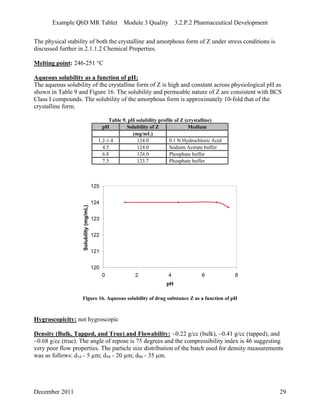
The aqueous solubility of the crystalline form of Z is high and constant across physiological pH as
shown in Table 9 and Figure 16. The solubility and permeable nature of Z are consistent with BCS
Class I compounds. The solubility of the amorphous form is approximately 10-fold that of the
crystalline form.
Table 9. pH solubility profile of Z (crystalline)
pH Solubility of Z Medium
(mg/mL)
1.2-1.4 124.0 0.1 N Hydrochloric Acid
4.5 124.0 Sodium Acetate buffer
6.8 124.0 Phosphate buffer
7.5 123.7 Phosphate buffer
120
121
122
123
124
125
0 2 4 6 8
pH
Solubility(mg/mL)
Figure 16. Aqueous solubility of drug substance Z as a function of pH
Hygroscopicity: not hygroscopic
Density (Bulk, Tapped, and True) and Flowability: ~0.22 g/cc (bulk), ~0.41 g/cc (tapped), and
~0.68 g/cc (true). The angle of repose is 75 degrees and the compressibility index is 46 suggesting
very poor flow properties. The particle size distribution of the batch used for density measurements
was as follows: d10 - 5 µm; d50 - 20 µm; d90 - 35 µm.
December 2011 29
Example QbD MR Tablet Module 3 Quality 3.2.P.2 Pharmaceutical Development
2.1.1.2 Chemical Properties
pKa: 7.0
Chemical stability in solid state (crystalline & amorphous) and in solution:
Stress testing of drug substance Z was conducted to gain insight into the intrinsic stability of the
molecule, to identify any likely degradation products, and to facilitate the development of a
stability-indicating analytical method. A more comprehensive overview of the forced degradation
studies of Z is located in ANDA aaaaaa, Section 3.2.S.4.3 (Appendix I). Table 10 summarizes the
results of the stress testing.
Table 10. Stability of drug substance Z under stress conditions
Stress Conditions Assay Impurities Solid State Form
(% w/w) (% w/w)
Untreated 99.6 ND Crystalline
In Solution
1% solution (Purified Water, RT, 14 days) 99.3 ND N/A
Acid (0.1% solution, 1.0 N HCl, RT, 14 days) 99.5 ND N/A
Base (0.1% solution, 1.0 N NaOH, RT, 14 days) 99.2 ND N/A
Peroxide (0.1% solution, 3% H2O2, RT, 7 days) 99.1 ND N/A
Crystalline Material
Humidity and heat (open container, 90% RH, 40 °C, 7 days) 99.6 ND Crystalline
Dry heat (105 °C, 96 hrs) 99.5 ND Crystalline
Photostability according to ICH Q1B Option 1 99.6 ND Crystalline
Amorphous Material
Humidity and heat (open container, 90% RH, 25 °C, 7 days) 99.5 ND Amorphous
Humidity and heat (open container, 90% RH, 40 °C, 7 days) 99.5 ND Crystallization observed
Humidity and heat (open container, 90% RH, 60 °C, 7 days) 99.3 ND Crystallization observed
Photostability according to ICH Q1B Option 1 99.6 ND Amorphous
Dry heat (105 °C, 96 hrs) 99.4 ND Amorphous
Overall, Z is chemically stable and insensitive to light, oxidation, and heat. A 1% solution was
stable at room temperature for two weeks. The amorphous form of Z crystallizes under combined
conditions of high humidity and temperature greater than 40 ºC. No degradation products were
identified. These results concur with information provided by the DMF holder.
2.1.1.3 Biological Properties
Partition Coefficient: log P 0.5 (25 °C, pH 6.8)
Biopharmaceutics Classification: BCS Class I (See ANDA aaaaaa, 3.2.P.2.1 (Appendix I))
December 2011 30
Example QbD MR Tablet Module 3 Quality 3.2.P.2 Pharmaceutical Development
2.1.1.4 Risk Assessment of Drug Substance Attributes
A risk assessment of the drug substance attributes was performed to evaluate the impact that each
attribute could have on the drug product CQAs. The outcome of the assessment and the
accompanying justification is provided as a summary in the pharmaceutical development report.
The relative risk that each drug substance attribute presents was ranked as high, medium, or low.
Those attributes that could have a high impact on the drug product CQAs warranted further
investigation whereas those attributes that had low impact on the drug product CQAs required no
further investigation. The same relative risk ranking system was used throughout the pharmaceutical
development and is summarized in Table 11. For each risk assessment performed, the rationale for
the risk assessment tool selection and the details of the risk identification, analysis, and evaluation
are available to the FDA Reviewer upon request.
Table 11. Overview of relative risk ranking system
Low Broadly acceptable risk. No further investigation is needed.
Medium Risk is accepted. Further investigation may be needed in order to reduce the risk.
High Risk is unacceptable. Further investigation is needed to reduce the risk.
Note to Reader: According to ICH Q9 Quality Risk Management, it is important to note that “it is
neither always appropriate nor always necessary to use a formal risk management process (using
recognized tools and/or internal procedures e.g. standard operating procedures). The use of
informal risk management processes (using empirical tools and/or internal procedures) can also be
considered acceptable. Appropriate use of quality risk management can facilitate but does not
obviate industry’s obligation to comply with regulatory requirements and does not replace
appropriate communications between industry and regulators.”
The two primary principles that should be considered when implementing quality risk management:
• The evaluation of the risk to quality should be based on scientific knowledge and ultimately
link to the protection of the patient; and
• The level of effort, formality and documentation of the quality risk management process
should be commensurate with the level of risk.
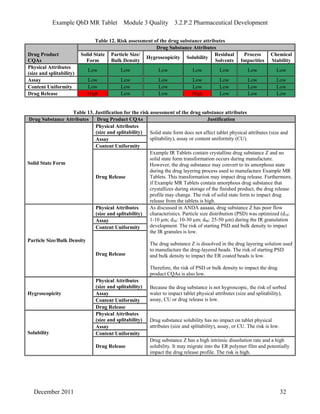
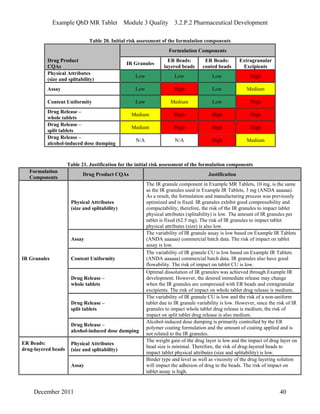
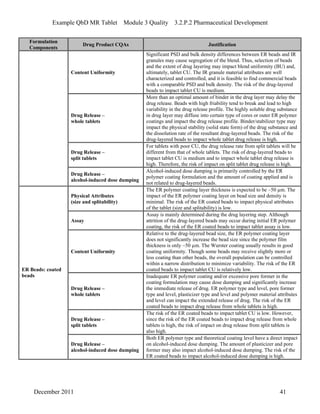
Risk assessment of the drug substance attributes on the drug product CQAs is presented in Table 12
and Table 13 provides the justification for the level of risk that was assigned to each attribute. Both
solid state form and solubility were identified as high risks and need to be further investigated.
December 2011 31
Example QbD MR Tablet Module 3 Quality 3.2.P.2 Pharmaceutical Development
Table 12. Risk assessment of the drug substance attributes
Drug Substance Attributes
Drug Product
CQAs
Solid State
Form
Particle Size/
Bulk Density
Hygroscopicity Solubility
Residual
Solvents
Process
Impurities
Chemical
Stability
Physical Attributes
(size and splitability)
Low Low Low Low Low Low Low
Assay Low Low Low Low Low Low Low
Content Uniformity Low Low Low Low Low Low Low
Drug Release High Low Low High Low Low Low
Table 13. Justification for the risk assessment of the drug substance attributes
Drug Substance Attributes Drug Product CQAs Justification
Physical Attributes
(size and splitability)
Assay
Content Uniformity
Solid state form does not affect tablet physical attributes (size and
splitability), assay or content uniformity (CU).
Solid State Form
Drug Release
Example IR Tablets contain crystalline drug substance Z and no
solid state form transformation occurs during manufacture.
However, the drug substance may convert to its amorphous state
during the drug layering process used to manufacture Example MR
Tablets. This transformation may impact drug release. Furthermore,
if Example MR Tablets contain amorphous drug substance that
crystallizes during storage of the finished product, the drug release
profile may change. The risk of solid state form to impact drug
release from the tablets is high.
Physical Attributes
(size and splitability)
Assay
Content Uniformity
Particle Size/Bulk Density
Drug Release
As discussed in ANDA aaaaaa, drug substance Z has poor flow
characteristics. Particle size distribution (PSD) was optimized (d10:
1-10 µm; d50: 10-30 µm; d90: 25-50 µm) during the IR granulation
development. The risk of starting PSD and bulk density to impact
the IR granules is low.
The drug substance Z is dissolved in the drug layering solution used
to manufacture the drug-layered beads. The risk of starting PSD
and bulk density to impact the ER coated beads is low.
Therefore, the risk of PSD or bulk density to impact the drug
product CQAs is also low.
Physical Attributes
(size and splitability)
Assay
Content Uniformity
Hygroscopicity
Drug Release
Because the drug substance is not hygroscopic, the risk of sorbed
water to impact tablet physical attributes (size and splitability),
assay, CU or drug release is low.
Physical Attributes
(size and splitability)
Assay
Content Uniformity
Drug substance solubility has no impact on tablet physical
attributes (size and splitability), assay, or CU. The risk is low.
Solubility
Drug Release
Drug substance Z has a high intrinsic dissolution rate and a high
solubility. It may migrate into the ER polymer film and potentially
impact the drug release profile. The risk is high.
December 2011 32
Example QbD MR Tablet Module 3 Quality 3.2.P.2 Pharmaceutical Development
Drug Substance Attributes Drug Product CQAs Justification
Physical Attributes
(size and splitability)
Assay
Content Uniformity
Residual Solvents
Drug Release
The residual solvents in the drug substance are well below the ICH
Q3C levels (based on ten commercial batches). As such, the risk of
drug substance residual solvents to impact the drug product CQAs
is low.
Physical Attributes
(size and splitability)
Assay
Content Uniformity
Process Impurities
Drug Release
The drug substance supplied by the vendor is consistently pure with
total impurities < 0.05% (based on ten commercial batches). The
risk of process impurities in drug substance Z to impact the drug
product CQAs is low.
Physical Attributes
(size and splitability)
Assay
Content Uniformity
Chemical Stability
Drug Release
Both crystalline and amorphous forms of the drug substance are
stable both in the solid state and in solution. The risk of the drug
substance chemical stability to impact the drug product CQAs is
low.
2.1.2 Excipients
The choice of excipients for the formulation of Example MR Tablets, 10 mg, was based on the
intent to combine the IR granules used in Example IR Tablets, 3 mg, (ANDA aaaaaa) with ER
coated beads to provide a drug product with an extended release profile of Z.
2.1.2.1 Excipients in the IR Granules
Excipients used in the IR portion of the formulation for Example MR Tablets are the same as the
excipients used in the formulation for Z granules in ANDA aaaaaa (Appendix I). The drug
substance Z was demonstrated to be compatible with MCC, lactose, PVP, sodium starch glycolate
(SSG), and magnesium stearate. Table 14 lists the excipients used in the IR portion of Example MR
Tablets.
Table 14. Composition of the IR portion of Example MR Tablets, 10 mg
Components Function
Compendial
Reference
mg per tablet % w/w
IR Granules
Z Drug substance In-house 3.00 4.8
Microcrystalline Cellulose (MCC), Grade 200 Filler NF 32.62 52.2
Lactose Monohydrate Filler NF 21.88 35.0
Povidone (PVP), K30 Binder USP 2.50 4.0
Sodium Starch Glycolate (SSG), Type A Disintegrant NF 2.50 4.0
Purified Water Solvent USP --
IR Granules Subtotal 62.50 100.0
December 2011 33
Example QbD MR Tablet Module 3 Quality 3.2.P.2 Pharmaceutical Development
No additional formulation work for the IR granules was performed during development of Example
MR Tablets. The excipient compatibility studies performed in ANDA aaaaaa have been reproduced
below for ease of review.
The excipient compatibility was assessed through HPLC analysis of binary mixtures of excipient
and drug substance Z at a 1:1 ratio in the solid state except for the lubricants where the ratio was
1:10. Samples were stored at 25 °C/60 % RH and 40 °C/75 % RH in both open and closed
containers for 1 month. Common excipients functioning as fillers, disintegrants, and lubricants were
evaluated in the excipient compatibility study. Table 15 summarizes the results for the samples
stored at the most aggressive condition (40 °C/75 % RH, open container).
Table 15. Excipient compatibility (Binary Mixtures)
Binary Mixture
Condition: 40 °C/75 % RH, open container, 1 month
Assay
(% w/w)
Degradants
(% w/w)
Lactose Monohydrate/DS (1:1) 99.6 ND
Microcrystalline Cellulose (MCC), Grade 200/DS (1:1) 99.2 ND
Dibasic calcium phosphate/DS (1:1) 100.2 ND
Mannitol/DS (1:1) 99.8 ND
Povidone (PVP), K30/DS (1:1) 99.6 ND
HPMC 2910 6 cP/DS (1:1) 100.4 ND
HPC-EF/DS (1:1) 100.1 ND
Pregelatinized Starch/DS (1:1) 99.1 ND
Croscarmellose Sodium/DS (1:1) 100.5 ND
Crospovidone/DS (1:1) 99.2 ND
Sodium starch glycolate (SSG), Type A/DS (1:1) 99.1 ND
Talc/DS (1:10) 99.7 ND
Magnesium Stearate/DS (1:10) 100.1 ND
No loss of assay was observed in any of the binary mixtures at 40 °C/75% RH in open containers.
In addition, no degradants were observed indicating that the excipients investigated were
compatible with the drug substance in the respective binary mixtures.
An additional study was conducted to investigate the potential for drug degradation due to
interaction between several excipients and the drug. In this experiment, several different mixtures of
drug and excipients were prepared. The first mixture consisted of drug and all excipients in the ratio
representative of the proposed finished product formulation. In subsequent sets, one excipient was
removed at a time. These mixtures were stored at 25 °C/60 % RH and 40 °C/75 % RH in both open
and closed containers for 1 month. The results of the study are presented in Table 16.
December 2011 34
Example QbD MR Tablet Module 3 Quality 3.2.P.2 Pharmaceutical Development
Table 16. Excipient compatibility (Interaction Study)
Mixture
Condition: 40 °C/75 % RH, open container, 1 month
Assay
(% w/w)
Degradants
(% w/w)
All excipients 99.8 ND
All excipients except Lactose Monohydrate 99.6 ND
All excipients except Microcrystalline Cellulose (MCC), Grade 200 100.3 ND
All excipients except Povidone (PVP), K30 100.2 ND
All excipients except Sodium Starch Glycolate (SSG), Type A 100.8 ND
All excipients except Talc 99.9 ND
All excipients except Magnesium Stearate 100.5 ND
The results indicate that there are no interactions between the excipients and the drug substance that
can cause drug degradation.
2.1.2.2 Excipients in the ER Coated Beads
The ER coated beads consist of a substrate for drug layering, binder, ER polymer, plasticizer and an
anti-tacking agent as listed in Table 17.
Table 17. Composition of the ER portion of Example MR Tablets, 10 mg
Components Function
Compendial
Reference
mg per tablet % w/w Comments
ER Beads
Z Drug substance In-house 7.00 18.6
Microcrystalline Cellulose
(MCC) Beads
Substrate NF 19.98 53.0
Povidone (PVP), K30 Binder USP 1.24 3.3
Purified Water Solvent USP -- --
Evaporates during
processing
Drug-layered Beads Subtotal 28.22 74.9
Kollicoat SR 30 D* Coating polymer NF 7.90 20.9
28% theoretical polymer
coating based on drug-
layered bead weight
Triethyl Citrate (TEC) Plasticizer NF 0.40 1.1 5% of dry polymer
Talc Anti-tacking agent USP 1.19 3.2 15% of dry polymer
Purified Water Solvent USP -- --
Evaporates during
processing
ER Polymer Coating Subtotal 9.49 25.2
ER Coated Beads Subtotal 37.71 ≈ 100.0
*Kollicoat SR 30 D contains 27% Polyvinyl Acetate (PVAc), 2.7% Povidone (PVP) and 0.3% Sodium Lauryl Sulfate
(SLS) as per vendor’s product technical data sheet.
Povidone (PVP) K30 was selected as the binder because it was used as such in the IR tablets
described in ANDA aaaaaa. Likewise, as microcrystalline cellulose (MCC) was used as the filler in
the IR tablet, MCC beads were chosen as the substrate for drug layering. The compatibility of PVP
and MCC with crystalline drug substance Z was demonstrated during the formulation of the IR
December 2011 35
Example QbD MR Tablet Module 3 Quality 3.2.P.2 Pharmaceutical Development
tablet. However, further testing was conducted to demonstrate the compatibility of these excipients
with the amorphous form of drug substance Z resulting from the drug layering process.
Drug substance Z and PVP were dissolved in water at the target drug concentrations. The MCC
beads were crushed using a mortar and pestle and added to the drug/PVP solution to form a
suspension. An aliquot of this suspension was allowed to air dry. Drug substance (control) and the
dried residue from the drug substance/PVP/MCC suspension were exposed to 40 °C/75% RH for 4
weeks. Drug substance stability was monitored using HPLC for the drug substance and impurities.
The drug substance assay and impurities were unchanged (compared to the drug substance control)
throughout the test period, indicating that the drug substance was chemically compatible with PVP
and MCC under the conditions that approximate those encountered during processing. The XRPD
scans confirmed the amorphous nature of the drug substance in the dried residue throughout the
duration of the compatibility study. This observation was also verified in binder optimization
studies conducted during formulation development as described in Section 2.2.1.3 Binder
Optimization and Drug Substance Solid State Stabilization.
As discussed in Section 2.2.1.3 Selection of Coating Polymer, Kollicoat SR 30 D was selected as
the ER polymer based on favorable physico-mechanical properties that can withstand downstream
compression conditions. Triethyl citrate (TEC) and talc were chosen as the plasticizer and anti-
tacking agent, respectively. For the compatibility study, 1% drug substance Z was spiked into a
prototype coating dispersion containing 82.8% Kollicoat 30 SR D, 4% TEC and 12.2% Talc. An
aliquot of the spiked coating dispersion was allowed to air dry. Drug substance Z (control) and the
spiked dispersion were exposed to 60 °C/75% RH for 1, 7 and 14 days and to 40 °C/75% RH for 1,
2 and 4 weeks. Drug substance stability was monitored using HPLC for drug substance Z and
impurities.
Drug substance assay and impurities were unchanged (compared to the drug substance control)
throughout the test period. This demonstrated that the prototype coating dispersion was chemically
compatible with drug substance Z under conditions which mimicked those expected during the ER
polymer coating and curing (if needed) processes.
2.1.2.3 Excipients in Example MR Tablets, 10 mg
It was important to choose a formulation that would maintain bead structural integrity during
compression while exhibiting consistent, optimal drug release. Premature crushing or damage to the
beads would alter the drug release profile leading to an inconsistent pharmacokinetic profile of the
extended release portion of the drug product. The components in the final formulation of the
Example MR Tablets are listed in Table 18. Because the compatibility of the excipients used in the
extragranular matrix was already demonstrated during the IR tablet development, no additional
compatibility study was conducted.
December 2011 36
Example QbD MR Tablet Module 3 Quality 3.2.P.2 Pharmaceutical Development
Table 18. Composition of Example MR Tablets, 10 mg
Components Function
Compendial
Reference
mg per tablet % w/w
IR granules Drug substance-IR portion In-house 62.50 23.8
ER coated beads Drug substance-ER portion In-house 37.71 14.4
Microcrystalline Cellulose (MCC), Grade 200 Filler NF 97.50 37.1
Microcrystalline Cellulose (MCC), Grade 101 Filler NF 52.50 20.0
Sodium Starch Glycolate (SSG), Type A Disintegrant NF 10.47 4.0
Magnesium Stearate Lubricant NF 2.09 0.8
Total tablet weight 262.77 ≈ 100.0
Table 19 compares the excipients used in the generic product to those used in the innovator product.
Table 19. Comparison of excipients used in the generic and brand drug product
Excipient Function
Example MR Tablets, 10 mg
(Generic)
Brand MR Tablets, 10 mg
(Brand)
Z Drug substance  
Microcrystalline Cellulose (MCC) Filler  
Lactose Monohydrate Filler  
Povidone (PVP) Binder  
Sodium Starch Glycolate (SSG) Disintegrant  
Magnesium Stearate Lubricant  
Microcrystalline Cellulose (MCC) Beads Substrate  
Sugar Spheres Substrate  
Kollicoat SR 30 D* Coating polymer  
Ethyl Cellulose Coating polymer  
Triethyl Citrate (TEC) Plasticizer  
Polyethylene Glycol (PEG) Plasticizer  
Talc Anti-tacking agent  
*Kollicoat SR 30 D contains 27% PVAc, 2.7% PVP and 0.3% SLS as per vendor’s product technical data sheet.
Key:  Present;  Absent
December 2011 37
Example QbD MR Tablet Module 3 Quality 3.2.P.2 Pharmaceutical Development
2.2 Drug Product
2.2.1 Formulation Development
Note to Reader: This section discusses formulation design and understanding. Steps to basic
product understanding are as follows:
• Identify all possible drug substance attributes as well as excipient attributes and levels that
could impact the performance of the product.
• Use risk assessment and scientific knowledge to identify potentially high risk drug substance
attributes as well as excipient attributes and levels.
• Identify levels or ranges of these high risk formulation variables.
• Design and conduct experiments, using DOE when appropriate.
• Analyze the experimental data to determine if a formulation variable is critical.
– An input material attribute is critical when a realistic change in that material
attribute can significantly impact the quality of the output material.
• Develop a control strategy.
– For critical material attributes (CMAs), define acceptable ranges. For non-critical
material attributes, the acceptable range is the range investigated.
The proposed generic formulation for Brand MR Tablets, 10 mg, was developed for once-a-day
dosing. Based upon the clinical, pharmacokinetic and physicochemical characterization of the RLD
product (see details in Section 1.2), the initial formulation strategy was defined and justified as
follows:
• Design a tablet formulation that provides biphasic release of drug with initial rapid release
followed by sustained release.
• Exclude non-disintegrating ER matrix tablets due to the rapid disintegration of the RLD
tablet and the immediate drug release from the beads.
• Exclude ER polymer coating on a compressed tablet core or osmotic pump due to: 1) the
scored configuration of the RLD; and 2) RLD whole and split tablets showing similar drug
release profiles.
• Formulate a multi-particulate delivery system comprised of IR granules, ER coated beads,
and extragranular excipients all compressed into scored tablets. Such a system is similar to
the RLD and minimizes any food effect or variability in GI transit among individuals.
• Obtain similar alcohol-induced dose dumping profile as RLD tablet because the RLD label
warns that dose dumping due to alcohol co-ingestion is possible. Select a suitable ER
polymer coating system to reduce the potential risk.
Figure 17 shows a flow diagram of the manufacturing steps used during formulation development
studies to manufacture the multi-particulate deliver system comprised of IR granules, ER coated
beads, and extragranular excipients all compressed into scored tablets. .
December 2011 38
Example QbD MR Tablet Module 3 Quality 3.2.P.2 Pharmaceutical Development
Active
Blending/Lubrication
Drug Layering
Polymer Coating
IR Granules
Example MR Tablets
Cushioning
Excipients
Compression
High Shear
Wet Granulation
Active
Wurster
Coating
ER Coated Beads
Figure 17. Flow diagram of the manufacturing steps used during formulation development
2.2.1.1 Initial Risk Assessment of the Formulation Components
Note to Reader: At the time of the risk assessment of formulation development, the detailed
manufacturing process was not yet established. Thus, risks were analyzed and evaluated assuming
that for each formulation attribute studied, an optimized manufacturing process would be
established.
An overall risk assessment of the drug product formulation components was performed to determine
which formulation components have a high risk of impacting the drug product CQAs. The results of
the initial formulation risk assessment are presented in Table 20 and the justification for the risk
prioritization is presented in Table 21. Each formulation component that has a high risk to impact
the drug product CQAs is further evaluated in subsequent risk assessments to determine which
formulation variables need to be studied to reduce the risk.
December 2011 39
Example QbD MR Tablet Module 3 Quality 3.2.P.2 Pharmaceutical Development
Table 20. Initial risk assessment of the formulation components
Formulation Components
Drug Product
CQAs
IR Granules
ER Beads:
layered beads
ER Beads:
coated beads
Extragranular
Excipients
Physical Attributes
(size and splitability)
Low Low Low High
Assay Low High Low Medium
Content Uniformity Low Medium Low High
Drug Release –
whole tablets
Medium High High High
Drug Release –
split tablets
Medium High High High
Drug Release –
alcohol-induced dose dumping
N/A N/A High Medium
Table 21. Justification for the initial risk assessment of the formulation components
Formulation
Components
Drug Product CQAs Justification
Physical Attributes
(size and splitability)
The IR granule component in Example MR Tablets, 10 mg, is the same
as the IR granules used in Example IR Tablets, 3 mg (ANDA aaaaaa).
As a result, the formulation and manufacturing process was previously
optimized and is fixed. IR granules exhibit good compressibility and
compactability; therefore, the risk of the IR granules to impact tablet
physical attributes (splitability) is low. The amount of IR granules per
tablet is fixed (62.5 mg). The risk of IR granules to impact tablet
physical attributes (size) is also low.
Assay
The variability of IR granule assay is low based on Example IR Tablets
(ANDA aaaaaa) commercial batch data. The risk of impact on tablet
assay is low.
Content Uniformity
The variability of IR granule CU is low based on Example IR Tablets
(ANDA aaaaaa) commercial batch data. IR granules also have good
flowability. The risk of impact on tablet CU is low.
Drug Release –
whole tablets
Optimal dissolution of IR granules was achieved through Example IR
development. However, the desired immediate release may change
when the IR granules are compressed with ER beads and extragranular
excipients. The risk of impact on whole tablet drug release is medium.
Drug Release –
split tablets
The variability of IR granule CU is low and the risk of a non-uniform
tablet due to IR granule variability is low. However, since the risk of IR
granules to impact whole tablet drug release is medium, the risk of
impact on split tablet drug release is also medium.
IR Granules
Drug Release –
alcohol-induced dose dumping
Alcohol-induced dose dumping is primarily controlled by the ER
polymer coating formulation and the amount of coating applied and is
not related to the IR granules.
Physical Attributes
(size and splitability)
The weight gain of the drug layer is low and the impact of drug layer on
bead size is minimal. Therefore, the risk of drug-layered beads to
impact tablet physical attributes (size and splitability) is low.
ER Beads:
drug-layered beads
Assay
Binder type and level as well as viscosity of the drug layering solution
will impact the adhesion of drug to the beads. The risk of impact on
tablet assay is high.
December 2011 40
Example QbD MR Tablet Module 3 Quality 3.2.P.2 Pharmaceutical Development
Formulation
Drug Product CQAs Justification
Components
Content Uniformity
Significant PSD and bulk density differences between ER beads and IR
granules may cause segregation of the blend. Thus, selection of beads
and the extent of drug layering may impact blend uniformity (BU) and,
ultimately, tablet CU. The IR granule material attributes are well
characterized and controlled, and it is feasible to find commercial beads
with a comparable PSD and bulk density. The risk of the drug-layered
beads to impact tablet CU is medium.
Drug Release –
whole tablets
More than an optimal amount of binder in the drug layer may delay the
drug release. Beads with high friability tend to break and lead to high
variability in the drug release profile. The highly soluble drug substance
in drug layer may diffuse into certain type of cores or outer ER polymer
coatings and impact the drug release profile. Binder/stabilizer type may
impact the physical stability (solid state form) of the drug substance and
the dissolution rate of the resultant drug-layered beads. The risk of the
drug-layered beads to impact whole tablet drug release is high.
Drug Release –
split tablets
For tablets with poor CU, the drug release rate from split tablets will be
different from that of whole tablets. The risk of drug-layered beads to
impact tablet CU is medium and to impact whole tablet drug release is
high. Therefore, the risk of impact on split tablet drug release is high.
Drug Release –
alcohol-induced dose dumping
Alcohol-induced dose dumping is primarily controlled by the ER
polymer coating formulation and the amount of coating applied and is
not related to drug-layered beads.
Physical Attributes
(size and splitability)
The ER polymer coating layer thickness is expected to be ~50 µm. The
impact of the ER polymer coating layer on bead size and density is
minimal. The risk of the ER coated beads to impact physical attributes
of the tablet (size and splitability) is low.
Assay
Assay is mainly determined during the drug layering step. Although
attrition of the drug-layered beads may occur during initial ER polymer
coating, the risk of the ER coated beads to impact tablet assay is low.
Content Uniformity
Relative to the drug-layered bead size, the ER polymer coating layer
does not significantly increase the bead size since the polymer film
thickness is only ~50 µm. The Wurster coating usually results in good
coating uniformity. Though some beads may receive slightly more or
less coating than other beads, the overall population can be controlled
within a narrow distribution to minimize variability. The risk of the ER
coated beads to impact tablet CU is relatively low.
Drug Release –
whole tablets
Inadequate ER polymer coating and/or excessive pore former in the
coating formulation may cause dose dumping and significantly increase
the immediate release of drug. ER polymer type and level, pore former
type and level, plasticizer type and level and polymer material attributes
and level can impact the extended release of drug. The risk of the ER
coated beads to impact drug release from whole tablets is high.
Drug Release –
split tablets
The risk of the ER coated beads to impact tablet CU is low. However,
since the risk of the ER coated beads to impact drug release from whole
tablets is high, the risk of impact on drug release from split tablets is
also high.
ER Beads: coated
beads
Drug Release –
alcohol-induced dose dumping
Both ER polymer type and theoretical coating level have a direct impact
on alcohol-induced dose dumping. The amount of plasticizer and pore
former may also impact alcohol-induced dose dumping. The risk of the
ER coated beads to impact alcohol-induced dose dumping is high.
December 2011 41
Example QbD MR Tablet Module 3 Quality 3.2.P.2 Pharmaceutical Development
Formulation
Drug Product CQAs Justification
Components
Physical Attributes
(size and splitability)
The amount of extragranular excipients used in the formulation has a
significant impact on the tablet size, compressibility and compactability
which impact tablet splitability. The risk of extragranular excipients to
impact tablet physical attributes (size and splitability) is high.
Assay
Flowability of the final blend may impact die filling during tablet
compression. However, extragranular excipients with good flow
properties can be selected. The risk of extragranular excipients to
impact tablet assay is medium
Content Uniformity
Both the type and level of extragranular excipients can impact BU. The
risk of impact on tablet CU is high.
Drug Release –
whole tablets
The type and level of extragranular disintegrant and lubricant will
impact the disintegration of the whole tablet. As a result, it can change
the rapid release of the IR portion of the tablet. The type and amount of
extragranular cushioning agent will impact the integrity of the ER
polymer film during compression. Therefore, it can change the extended
release profile of the tablet. The risk of extragranular excipients to
impact whole tablet drug release is high.
Drug Release –
split tablets
Because the risk of extragranular excipients to impact both CU and drug
release from whole tablets is high, the risk of impact on drug release
from split tablets is also high.
Extragranular
Excipients
Drug Release –
alcohol-induced dose dumping
Insufficient extragranular cushioning agent may cause micro level
structural changes in the ER film. It is possible to observe an altered
alcohol-induced dumping profile due to the alcohol stress condition
even though there is no noticeable drug release change under normal
dissolution conditions. The risk is medium.
2.2.1.2 IR Granule Formulation Development
The IR portion was adopted from the granulation process for the production of Example IR Tablets
approved in ANDA aaaaaa, Section 3.2.P.2.2.1 (Appendix I). No additional formulation or process
development for the IR granules was conducted. The components of the IR granules are listed in
Table 14. The manufacturing process involves granulating Z with lactose, MCC, PVP and SSG by
high shear mixing with water. The granules are then dried and milled. The mean IR granular size is
controlled within the range of 250-350 µm by the existing manufacturing process. In addition to the
mean granule size, the control strategy also defines the target granule size distribution.
Dissolution of IR Granules Compressed with Placebo Beads
Several small batches were prepared and dissolution studies were performed to determine if the
expected dissolution (NLT 80% in 30 min) is met when IR granules are compressed with placebo
ER coated beads under increasing compression force. Figure 18 shows the results. Based upon these
studies, it was concluded that the formulation of IR granules used in the manufacture of Example IR
Tablets could be incorporated into the MR tablet formulation without any further formulation
adjustment.
December 2011 42
Example QbD MR Tablet Module 3 Quality 3.2.P.2 Pharmaceutical Development
0
10
20
30
40
50
60
70
80
90
100
0 5 10 15 20 25 30 35 40 45
Time (min)
DrugReleased(%)
R3S0042 - 5 kN
R3S0043 - 15 kN
R3S0044 - 25 kN
Uncompressed
Figure 18. Dissolution profiles of IR granules compressed with placebo ER beads
2.2.1.3 ER Bead Formulation Development
Drug-Layered Beads
A drug layering approach was selected over extrusion-spheronization because drug-layered beads
typically have smoother surfaces and a narrower particle size distribution. These attributes are
important for the subsequent ER bead coating and tablet compression steps. The drug substance was
dissolved in purified water and sprayed onto the selected beads using a bottom-spray fluid bed
(Wurster) coating process to produce the drug-layered beads. The drug substance had a low intrinsic
binding property so the addition of a binder to the aqueous coating was considered necessary to
maintain the physical integrity of the drug-layered bead during subsequent processing.
Initial Risk Assessment of the Drug Layer Formulation Variables
The initial risk assessment of the formulation components shown in Table 20 identified assay and
drug release from whole tablets to be at high risk of failure due to the variability of the drug-layered
beads quality attributes. Subsequently, assay and drug release from the layered beads were
identified as the CQAs of the drug layer. The formulation variables that could directly impact assay
and drug release from the beads were assessed to identify which of the variables could have the
highest potential to cause an assay or drug release failure of the beads. This method of identifying
formulation and/or process variables for further study is illustrated in Figure 19 and is applied in all
risk assessments of formulation components and process steps.
December 2011 43
Example QbD MR Tablet Module 3 Quality 3.2.P.2 Pharmaceutical Development
Formulation
and/or Process
Variables
Drug Product
Intermediate
CQAs
Drug Product
CQAs
Figure 19. Schematic of method used to identify formulation and process variables for further study
The initial risk assessment of the drug layer formulation variables is shown in Table 22 and the
justification for the initial risk assessment is presented in Table 23.
Table 22. Initial risk assessment of the drug layer formulation variables
Drug Layer Formulation Variables
Drug-layered beads
CQAs
Bead selection
(type/size)
DS
particle size
Binder
type/grade
Binder
lot-to-lot
variability
DS/Binder
ratio
Viscosity of drug
layering solution
Assay Low Low High Medium High Medium
Drug Release Medium Low Medium Low High Low
Table 23. Justification for the initial risk assessment of the drug layer formulation variables
Formulation
Variables
Drug-layered beads
CQAs
Justification
Assay
The beads are the substrate for drug layering but have no impact on assay because
assay only depends on the amount of drug layered onto the beads. Thus, the risk of
bead size and type to impact drug-layered bead assay is low.
Bead selection
(type/size)
Drug Release
Beads with high friability tend to break and lead to high variability in the drug
release profile. In addition, the highly soluble drug substance may diffuse into
certain type of cores which may affect the drug release profile of the beads. The
risk of bead selection to impact drug release from the drug-layered beads is
medium.
Assay
Within the specified particle size distribution, the drug substance is readily
dissolved in water and then sprayed onto beads. Since the drug substance is used in
solution, particle size has no impact on the assay of the beads. Therefore, the risk
of drug substance particle size to impact assay is low.DS particle size
Drug Release
After the drug substance is dissolved, the starting drug substance particle size is
irrelevant to drug release. Therefore, the risk of impact on drug release from the
layered beads is low.
Assay
Binder type and grade selection will impact the adhesion of the drug substance to
the beads. The risk of binder type and grade to impact drug-layered bead assay is
high.
Binder type/grade
Drug Release
Binder type and grade may impact the solid state physical stability of the drug
substance and, therefore, the dissolution rate of the drug substance in the drug
layer. However, the solubility and intrinsic dissolution rate of the drug substance is
high. The risk of impact on drug release from the layered beads is medium.
December 2011 44
Example QbD MR Tablet Module 3 Quality 3.2.P.2 Pharmaceutical Development
Formulation Drug-layered beads
Justification
Variables CQAs
Assay
Binder lot-to-lot variability may impact the adhesion of the drug substance to the
beads. However, binder lot-to-lot variability can be controlled through tighter
internal specifications. The risk of binder variability to impact drug-layered bead
assay is medium.
Binder lot-to-lot
variability
Drug Release
Once the drug layer formulation is optimized, the impact of binder lot-to-lot
variability on drug layer dissolution is low for a highly soluble drug substance. The
risk of impact on drug release from the layered beads is low.
Assay
The drug substance to binder ratio will impact the adhesion of the drug substance
to the beads. The risk of the ratio to impact drug-layered bead assay is high.
DS/Binder ratio
Drug Release
The ratio of drug substance to binder may impact the physical stability of the
amorphous form in the drug-layered beads and excessive binder may retard the
release of drug substance from the drug layer. The risk of impact on drug release
from the layered beads is high.
Assay
A highly viscous drug layering solution can not be effectively atomized and the
assay of the drug-layered beads may be adversely affected. Since the viscosity of
the drug layering solution is kept low (< 5 mPa•s), the risk of the solution viscosity
to impact drug-layered bead assay is medium.
Viscosity of drug
layering solution
Drug Release
The drug release from the drug layer is mainly controlled by the binder type and
grade as well as the drug substance to binder ratio. The risk of the drug layering
solution viscosity to impact drug release from the layered beads is low.
Selection of Beads
The diameter of the final ER coated beads was proposed to be ~450 μm. This size was selected to
be similar to the size of the IR granules to minimize segregation. In addition, beads less than 1 mm
in size show a less significant food effect.2
A bead size of 250-350 μm was selected for drug layering. Initially, MCC, sugar, calcium carbonate
and other commercially available beads with a mean diameter of 250-350 μm were considered for
evaluation. Beads made from calcium carbonate were eliminated due to the higher bulk density and
the increased potential for segregation in the final blend. Sugar spheres tend to have greater attrition
and agglomeration during the production process. On the other hand, MCC beads are insoluble in
most organic solvents and in water, offering the advantage of aqueous-based drug layering. The low
friability of MCC beads combined with the high solubility of Z, the drug substance, facilitates an
efficient drug layering process. In addition, MCC beads do not normally require a seal coat to
smooth out the irregular crystalline surface that is normally associated with other commercial beads.
The extreme hardness of the MCC beads make them the best choice for ER polymer coating and
downstream manufacturing processes including tableting. Therefore, MCC beads of 250-350 μm
were selected for this drug product.
Commercially available MCC beads are provided with  85% of the beads meeting the particle size
distribution (PSD) criterion of 250-350 μm. Furthermore, batch-to-batch or vendor-to-vendor PSD
variability for commercial MCC beads was not found to be significant. The narrow PSD and
sphericity enable a Wurster coating process to provide drug product with consistent content
2
“Physiological Pharmaceutics – Biological Barriers to Drug Absorption”, C.G. Wilson and N. Washington. Ellis
Horwood Ltd, John Wiley & sons, chapter 5, pp 73.
December 2011 45
Example QbD MR Tablet Module 3 Quality 3.2.P.2 Pharmaceutical Development
uniformity and drug release profile. Physical parameters for commercially available MCC beads
with a 250-350 μm PSD are listed below:
• PSD: 250-350 µm with  85% of beads meeting criterion
• Loss on Drying (LOD): ≤ 7.0%
• Bulk density: ~ 0.80  5% g/cc
• Sphericity degree: 0.90  0.05
• Friability: < 0.1%
• Swelling index: ≤ 2 mL/g
Prior to drug layering, the MCC beads received from the vendor are sieved and only the fraction
that falls within the desired PSD of 250-350 µm is used for processing.
Binder Optimization and Drug Substance Solid State Stabilization
A lab scale formulation development study was performed on a 1 kg batch. Aqueous solution of
drug substance and binder was coated onto beads and the effect of each binder on drug substance
physical stability and drug release profile was investigated.
Binders are selected based on their spreading coefficients. For a binder to be effective, it is vital that
it is able to form a film on the particle surface. If binders are added in a higher than optimal
concentration, films can form viscous gels on the bead’s surface, thereby retarding the dissolution
properties of the drug.
PVP was selected because it was used as the binder in IR granules and is known to be compatible
with both MCC and drug substance Z. In addition, PVP was shown to provide good adhesion of the
drug layer to MCC beads and the layer displays satisfactory uniformity, porosity and LOD values.
The solution of drug substance and binder in water has to be neither too viscous nor too tacky to
ensure successful drug layering. The following studies were performed to optimize the drug
substance to binder ratio and to assess its effect on drug substance physical stability and drug
layering efficiency. Results are summarized in Table 24.
Table 24. Drug substance to binder ratio optimization studies for drug layering
Experiment DS:Binder Ratio Release in 15 min HPLC Assay LOD Amount of crystalline DS*
(%) (% w/w) (%) (%)
No binder 100:0 89 99.9 0.1 80
With PVP K30 95:5 89 99.8 0.2 20
With PVP K30 90:10 96 99.7 0.2 ND
With PVP K30 85:15 97 99.6 0.3 ND
With PVP K30 80:20 92 99.4 0.2 ND
With PVP K30 75:25 85 99.5 0.2 ND
*Amorphous-crystalline ratio as determined by XRPD after 6 months storage at 40 °C/75% RH.
The output characteristics measured include rate of release, assay (HPLC), LOD and solid state
characterization (Table 24). Each drug substance to binder ratio investigated gave a clear solution of
low viscosity and resulted in drug-layered beads that met the predefined release and assay targets of
not less than 85% in 15 minutes and 95.0 – 105.0%, respectively. At ratios of 90:10, 85:15 and
December 2011 46
Example QbD MR Tablet Module 3 Quality 3.2.P.2 Pharmaceutical Development
80:20, the release at 15 minutes increased due to the absence of crystalline material. However, even
though the drug was also amorphous at a ratio of 75:25, release was retarded due to the presence of
too much binder. A ratio of 85:15 was selected.
Stress testing of the drug-layered beads at 40°C/75% RH was performed to probe the physical
stability of amorphous material formed during the drug layering process. The normalized XRPD
data presented in Figure 20 confirms the absence of crystalline drug substance for the 85:15 drug
substance to binder formulation. Additionally, DSC showed the absence of an endothermic
transition at the melting point of Z, suggesting that the drug substance is amorphous. This
contrasted with the baseline formulation without binder which exhibited a sharp drug melt
associated with crystalline drug. Without binder, transformation of the amorphous drug substance to
the crystalline form occurred following storage for 6 hours at 40 °C/75% RH. With an 85:15 drug
substance to binder ratio, no transformation was observed for the lab batch (6 months at 40 °C/75%
RH). Physical stability of the amorphous form was subsequently confirmed on drug-layered beads
stored up to two years at 25 °C/60% RH (data not shown).
Figure 20. XRPD Analysis: (A) Drug substance crystals; (B) Binder; and (C) Amorphous drug substance with an
85:15 DS:Binder ratio
Dissolution of Drug Layered Beads Compressed with Placebo Granules
Several small batches of drug-layered beads formulated with an 85:15 drug substance to binder ratio
were prepared and compressed with placebo granules under increasing compression force. The
dissolution studies showed that the expected rapid dissolution (NLT 85% in 15 min) was met and
there was no significant retarding effect due to binder addition.
Final Formulation of the Drug-Layered Beads
Based on these studies, the final formulation for drug-layered beads was selected for the pilot scale
batch as shown in Table 25.
December 2011 47
Example QbD MR Tablet Module 3 Quality 3.2.P.2 Pharmaceutical Development
Table 25. Composition of the drug-layered beads
Components Function mg per tablet Comments
ER Beads
Z Drug substance 7.00 DS: Binder ratio = 85:15
Povidone (PVP), K30 Binder 1.24
Microcrystalline Cellulose (MCC) Substrate 19.98
Purified Water --
Drug-Layered Beads Subtotal 28.22
Updated Risk Assessment of the Drug Layer Formulation Variables
These formulation development studies for drug-layered beads addressed the identified high risks.
Table 26 shows the updated risk assessment and Table 27 provides the justification for the risk
reduction.
Table 26. Updated risk assessment of the drug layer formulation variables
Drug Layer Formulation Variables
Drug-layered beads
CQAs
Bead selection
(type/size)
DS
particle size
Binder
type/grade
Binder
lot-to-lot
variability
DS/Binder
ratio
Viscosity of drug
layering solution
Assay Low* Low* Low Low Low Low
Drug Release Low Low* Low Low* Low Low*
*The level of risk is not reduced from the initial risk assessment.
Table 27. Justification for the reduced risks of the drug layer formulation variables
Formulation
Variables
Drug-layered beads
CQAs
Justification
Bead selection
(type/size)
Drug Release
MCC beads with a size of 250-350 µm were selected. MCC beads show low
friability (< 0.1%) and tend not to break. The MCC beads are insoluble in water. The
drug substance did not diffuse into this kind of bead. The risk of the selected MCC
beads to impact drug release from the layered beads is reduced from medium to low.
Assay
PVP K30 was selected as a binder based on previous experience. No other type or
grade of binder was evaluated. PVP K30 provided good adhesion of the drug layer
to MCC beads. The risk of binder type and grade to impact drug-layered bead assay
is reduced from high to low.
Binder
type/grade
Drug Release
PVP K30 used at 15% in the layering solution kept the drug substance amorphous in
the drug layer for up to 2 years at room temperature based on stability results. The
drug-layered beads demonstrated rapid release when compressed with placebo
granules. Therefore, the risk of binder type and grade to impact drug release from
the layered beads is reduced from medium to low.
Binder lot-to-lot
variability
Assay
Binder lot-to-lot variability is controlled through in-house specifications. In the
range studied, no impact on assay of the drug-layered beads was observed.
Therefore, the risk of impact on drug-layered bead assay is reduced from medium to
low.
December 2011 48
Example QbD MR Tablet Module 3 Quality 3.2.P.2 Pharmaceutical Development
Formulation Drug-layered beads
Justification
Variables CQAs
Assay
At a ratio of 85:15, the drug substance can be uniformly applied onto the MCC
beads without adhesion issues. The risk of the drug substance to binder ratio to
impact drug-layered bead assay is reduced from high to low.
DS/Binder ratio
Drug Release
Using a drug substance to binder ratio of 90:10, 85:15 or 80:20 stabilized the
amorphous form in the drug-layered beads. A drug substance to binder ratio of 85:15
was selected and the beads showed rapid dissolution when compressed with placebo
IR granules. The risk of the ratio to impact drug release from the layered beads is
reduced from high to low.
Viscosity of drug
layering solution
Assay
The viscosity of the drug layering solution is very low (< 5 mPa•s) and the drug
layering solution can be effectively atomized. Therefore, the risk of solution
viscosity to impact assay is reduced from medium to low.
ER Coated Beads
Figure 21 illustrates the design of the ER coated beads which possess an inert core loaded with 7.0
mg of Z per unit dose. The beads are further coated with a rate controlling polymer to mimic the
RLD release profile. The ER beads, IR granules and extragranular excipients will be compressed
into scored tablets.
MCC Bead
Drug Layer
Rate Controlling Polymer
Figure 21. Structural representation of ER beads
Initial Risk Assessment of the ER Polymer Coating Formulation Variables
Multi-particulate ER portion performance depends on the choice of excipients such as the coating
polymer, plasticizer and anti-tacking agent. Initial selection of polyvinyl acetate (PVAc) as the
coating polymer, TEC as the plasticizer, and talc as the anti-tacking agent in the formulation was
based on process requirements, a literature survey and previous experience. In the initial risk
assessment of the ER polymer coating formulation variables shown in Table 28, ER excipient type,
level and material attributes were evaluated in order to identify formulation variables with high risk.
Justification for the risk ranking is presented in Table 29. All the formulation variables identified as
high risk were further studied to reduce the level of risk to an acceptable level.
December 2011 49
Example QbD MR Tablet Module 3 Quality 3.2.P.2 Pharmaceutical Development
Table 28. Initial risk assessment of the ER polymer coating formulation variables*
ER Polymer Coating Formulation Variables
ER coated beads
CQAs
Theoretical
polymer
coating level**
Polymer
aging
Polymer
lot-to-lot
variability
Additional
pore former
level
Plasticizer
level
Anti-
tacking
agent level
Viscosity
of coating
dispersion
Drug release High High Medium High High Medium Medium
Drug release – alcohol-
induced dose dumping
High High Medium High High Low Medium
*The type of ER polymer, pore former, plasticizer and anti-tacking agent was selected based on process requirements, a
literature survey and previous experience.
**The percentage of theoretical polymer coating is calculated using total weight of polymer sprayed into the fluid bed
divided by the total weight of drug-layered beads.
Table 29. Justification for the initial risk assessment of the ER polymer coating formulation variables
Formulation
Variables
ER coated beads
CQAs
Justification
Drug release
If the theoretical polymer coating level is suboptimal, the ER coated
beads will not have the desired extended drug release profile. The risk of
the polymer coating level to impact drug release from the ER coated
beads is high.
Theoretical
polymer coating
level
Drug release –
alcohol-induced dose dumping
Although PVAc is insoluble in water, it is soluble in alcohol and dose
dumping may occur. The risk of theoretical polymer coating level to
impact alcohol-induced dose dumping is high.
Drug release
Polymer aging Drug release –
alcohol-induced dose dumping
Polymer aging or degradation may alter the polymer properties and affect
drug release from the ER coated beads. The drug release profile under
both normal and alcohol stress conditions could be impacted. The risk is
high.
Drug release
Polymer lot-to-lot
variability Drug release –
alcohol-induced dose dumping
Lot-to-lot variability could affect the drug release profile under both
normal and alcohol stress conditions. However, the polymer will be
sourced from a single supplier and, if necessary, controlled by tighter
internal specifications beyond those of the vendor. Therefore, the risk of
polymer variability to impact drug release is medium.
Drug release
Additional pore
former level Drug release –
alcohol-induced dose dumping
A pore former in the film will dissolve upon contact with aqueous
medium and form diffusion channels for the release of the drug
substance. Additional pore former may need to be included in the
formulation to optimize drug release from the ER coated beads. The
concentration of PVP may impact drug release under both normal and
alcohol stress conditions. The risk is high.
Drug release
Plasticizers play an important role in controlling film quality and
permeability and, therefore, the drug release profile. The risk of TEC
concentration to impact drug release from the ER coated beads is high.Plasticizer level
Drug release –
alcohol-induced dose dumping
TEC is more soluble in alcohol than in water. Thus, the concentration of
TEC may affect alcohol-induced dose dumping. The risk is high.
Drug release
An anti-tacking agent is used to minimize stickiness during coating. It has
a tendency to change the drug release profile because it increases the
hydrophobicity of the film. The risk of impact on drug release is medium.
Anti-tacking
agent level
Drug release –
alcohol-induced dose dumping
Talc concentration will not alter susceptibility to alcohol-induced dose
dumping because talc is not soluble in water or alcohol. The risk is low.
December 2011 50
Example QbD MR Tablet Module 3 Quality 3.2.P.2 Pharmaceutical Development
Formulation ER coated beads
Justification
Variables CQAs
Drug release
Viscosity of
coating
dispersion
Drug release –
alcohol-induced dose dumping
If the coating dispersion is highly viscous, then the dispersion cannot be
effectively atomized and the quality of the ER polymer film may be
adversely affected. This could affect drug release under both normal and
alcohol stress conditions. Since the viscosity of an aqueous-based latex
coating dispersion can be kept low (< 100 mPa•s), the risk of the
dispersion viscosity to impact drug release from the ER coated beads is
medium.
Selection of Coating Polymer
An aqueous coating process was selected in this application as it is environmentally friendly, less
toxic, and economically advantageous. Commercially available sustained release coating polymers
of cellulosic and acrylic monomers as well as other newly developed vinyl acetate-based materials
were evaluated for pH independent and sustained release drug delivery.
Common polymers used in aqueous dispersions include ethyl cellulose (Aquacoat ECD), Eudragit
(RS 30D, RL 30D, NE 30D) and PVAc (Kollicoat SR 30 D). Important parameters to be further
evaluated during polymer coating selection include 1) mechanical strength properties and 2) film
formation temperature.
The coating polymer should be able to generate reliable films that achieve reproducible drug release
characteristics. The polymer should also impart mechanical properties that allow beads to be
compressed without compromising the drug release profile. In addition, high elasticity of the film
prevents the initiation and propagation of cracks during subsequent processing and reduces the
potential for dose dumping. For these reasons, the percent elongation of the film needs
characterization under dry and wet conditions. A journal article published by N. Langly and Y. Lan
described a study conducted on the polymers represented in Figure 22. Highest elongations were
observed in both dry and wet states for Eudragit RS 30D, Eudragit RL 30D, and Kollicoat SR 30
D.3
Therefore, these polymers were considered for further development.
3
N. Langly and Y. Lan. How to make oral dosage coatings count. PFQ, June 2009, (http://www.pharmaquality.com).
December 2011 51
Example QbD MR Tablet Module 3 Quality 3.2.P.2 Pharmaceutical Development
0
50
100
150
200
250
300
350
400
Elongation(%)
Aquacoat Surelease Eudragit
RS 30 D
Eudragit
RL 30 D
Kollicoat
Dry State
Wet State
SR 30 D
Figure 22. Elongation (%) of polymer film (Kollicoat SR 30 D film with 10% TEC, other polymer films with 20% TEC)3
A fundamental property of any polymer is its glass transition temperature (Tg). In evaluating
various polymers, a useful parameter to consider is the minimum film-forming temperature (MFT).
The MFT is positively correlated to Tg and the usual correlation reported in literature is between 0.9
- 1.1. The MFT of a given coating polymer determines the process temperature above which a
continuous polymer film is formed. Previous formulation experience suggests that during
manufacturing, the process temperature needs to be set at least 10 °C above the MFT to achieve
good film quality. The process temperature can also be manipulated by choosing an appropriate
plasticizer to lower the Tg and hence the MFT.
Eudragit NE 30 D and Kollicoat SR 30 D have MFTs below room temperature, while ethyl
cellulose (Aquacoat and Surelease) and other methacrylate polymers (Eudragit RS 30 D and RL 30
D) have MFTs above room temperature. As noted previously, the manufacturing process involves
compression of the ER coated beads so it is critical that the coating is sufficiently flexible to
withstand the compression force. The high elongation percentage at break coupled with the low
MFT of Kollicoat SR 30 D substantiated its use in the ER polymer coating process. In addition, the
literature reported that films using Kollicoat SR 30 D may not need to undergo a curing process
which is an additional processing advantage.4
Therefore, Kollicoat SR 30 D was pursued as the
coating polymer during development.
Kollicoat SR 30 D is commercially available as a 30% w/w aqueous dispersion of polyvinyl acetate
(PVAc, 27%) stabilized with polyvinylpyrrolidine (PVP, Povidone, 2.7%) and sodium lauryl sulfate
(SLS, 0.3%). Only one grade of the polymer dispersion is available. Polyvinyl acetate is water
insoluble and forms the barrier while PVP acts as a pore former. As PVAc does not possess ionic
functional groups, drug release is not affected by pH.
4
Dashevsky, et al. Physicochemical and release properties of beads coated with Kollicoat SR 30 D, a new aqueous
polyvinyl acetate dispersion for extended release. International Journal of Pharmaceutics, 2005, 290: 15-23.
December 2011 52
Example QbD MR Tablet Module 3 Quality 3.2.P.2 Pharmaceutical Development
Based on vendor recommendation, the starting level of Kollicoat SR 30 D needed to achieve the
desired film thickness was 20% theoretical polymer coating relative to the drug-layered bead
weight. To understand the impact of additional pore former on the drug release profile, additional
PVP was added to the aqueous dispersion of the commercial polymer to adjust the membrane to
pore former ratio during the optimization studies (see ER Polymer Coating Optimization Studies).
The extent of polymer aging and its impact on coating performance was also considered during
optimization. Acetic acid is a degradation product of Kollicoat SR 30 D and may be present at
different levels depending on the age of the polymer. Three commercial lots of Kollicoat SR 30 D
aqueous dispersion, each with a different amount of acetic acid present as a degradant, were
evaluated.
Another important property of a polymer is its molecular weight distribution. Kollicoat SR 30 D is a
synthetic polymer and was sourced from one manufacturer that tightly controls the mean molecular
weight distribution in the range of 420-480 KDa. Thus, the impact of molecular weight variability
on drug release from the ER coated beads was not investigated further.
The impact of Kollicoat SR 30 D aqueous dispersion lot-to-lot variability (PVAc content ranging
from 25 – 29 g/100g and apparent viscosity ranging from 50 – 90 mPa•s in) on drug release from
the ER coated beads was studied subsequent to formulation optimization.
Selection of Plasticizer
Plasticizers are used in polymeric coating dispersions to optimize properties of the film such as
permeability, hydrophobicity, adhesiveness, flexibility and brittleness. Three commonly used
plasticizer types are polyethylene glycols (PEGs), fixed oils (e.g.: Castor oil, Oleic acid) and
organic esters (e.g.: Triacetin, Tributyl citrate). Plasticizers are known to affect the Tg of the
polymer. Some plasticizers such as glycerin or PEG 400 are water soluble while others are not.
The reported MFT for Kollicoat SR 30 D is 18 °C on the product technical data sheet. This
temperature is close to room temperature and the polymer can become brittle during handling,
processing and even storage. It is possible to reduce the MFT with the addition of a plasticizer.
Several plasticizers such as PEG 400, tributyl citrate (TBC), propylene glycol (PG) and triethyl
citrate (TEC) were evaluated.
Polyethylene glycol 400 and PG are more soluble than TBC and TEC and will increase pore
formation when mixed with the polymer. Thus, release from an ER polymer coating formulated
with PEG 400 or PG would be faster than release from an ER polymer coating formulated with
TBC or TEC. In addition, pH-dependent release has been reported from PEG 400, PG and TBC.5
Finally, distribution behavior using TEC is not affected by the mixing time or the degree of
agitation due to adequate water solubility. Therefore, TEC was selected for the coating process.
5
Okarter, et al. The Effects of Plasticizers on the Release of Metoprolol Tartrate from Granules Coated with
Polymethacrylate Films. Drug Development and Industrial Pharmacy 2000; 26(3): 323-329.
December 2011 53
Example QbD MR Tablet Module 3 Quality 3.2.P.2 Pharmaceutical Development
Selection of Anti-tacking Agent
As a result of low MFT, polymer-coated beads may be sticky. Therefore, the addition of an anti-
tacking agent is often necessary. The commonly used anti-tacking agent, talc, was selected.
ER Polymer Coating Formulation Feasibility Study
A preliminary feasibility study was performed to test the pre-selected excipients and to direct the
scope of future studies. The composition of the initial coating dispersion shown in Table 30 was set
based on information published in the vendor’s product technical data sheet. The suggested amount
of anti-tacking agent (talc) and plasticizer (TEC) was 15% – 50% and 5% – 10% of dry polymer,
respectively.
Table 30. Initial composition of the ER polymer coating dispersion
Components Weight Solids Content Comments
(% w/w) (% w/w)
Kollicoat SR 30 D 50.00 15.0
Kollicoat SR 30 D contains 30% solids content, which
is referred to as dry polymer
Triethyl Citrate (TEC) 1.50 1.50 10% of dry polymer
Talc 2.25 2.25 15% of dry polymer
Purified Water 46.25
Total 100.00 18.75 Overall, the solids content is 18.75%
Initial formulation development was done on a 1 kg scale and took place in a Glatt GPCG-1 fluid
bed coater with a 6″ Wurster insert. All process parameters except product temperature were
selected based on previous experience. The product temperature range was selected based on the
vendor’s recommendation for Kollicoat SR 30 D. Coating process parameters are listed in Table 31.
Table 31. Equipment and process parameters for lab scale formulation development batches
Formulation Development Lab Scale
Equipment model Glatt GPCG-1
Batch size 1 kg
Fluid bed insert 6″ Wurster
Partition height 15 mm
Distribution plate Fixed
Nozzle tip diameter 1.0 mm
Nozzle tip/air cap position Flush
Inlet temperature 50-60 ºC
Product temperature 30-40 ºC
Spray rate 6-8 g/min
Atomization air pressure 1.5 bar
Air volume Approx. 40% of flap setting
Samples were pulled at different theoretical polymer coating levels: 10%, 20%, 30%, 40%, and
50%. These samples were dried until the LOD was less than 2% and evaluated for drug release by
dissolution testing. The drug release profile was too fast at 10% theoretical polymer coating, and too
slow at 50% theoretical polymer coating. Future optimization studies focused on 20% to 40%
theoretical polymer coating. The amount of talc used was sufficient to prevent sticking during the
December 2011 54
Example QbD MR Tablet Module 3 Quality 3.2.P.2 Pharmaceutical Development
coating process. Therefore, no further study was performed to optimize the amount of talc. Some
tackiness was observed when product temperature approached 40 °C. Therefore, the amount of TEC
was further investigated in the optimization studies.
Although the vendor states that curing for this polymer is not required, published scientific
literature4
found that curing may impact drug release for certain drug substances. A study was
performed to verify if curing would be required for this drug product. The results showed that there
was no difference in drug release profile between the uncured beads and the beads cured at 60 °C
for 24 hours (data not shown). Curing was found unnecessary at the 1 kg scale and was not
performed on subsequent development batches. However, a curing confirmation study was
conducted at pilot scale to evaluate if high attrition at larger scale had any impact on the polymer
film which rendered curing necessary (see ER Beads Curing Process Confirmation Study).
ER Polymer Coating Formulation Optimization Studies
Based on the initial risk assessment and the preliminary feasibility study, a 24-1
fractional factorial
DOE with three center points was performed to optimize the formulation. Drug release was
identified as a CQA of the ER coated beads in Table 28. The objective of this study was to evaluate
the effect of the theoretical polymer coating level applied based on drug-layered bead weight6
,
additional pore former (PVP) level, plasticizer (TEC) level, and extent of polymer aging (% Acetic
Acid as degradant) on drug release from the ER coated beads. The responses studied were the times
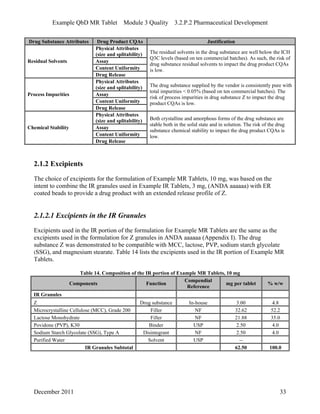
at which 20%, 50% and 80% of drug in the ER portion was released (T20%, T50% and T80%) using
USP apparatus 2 at 50 rpm in pH 6.8 phosphate buffer. The initial target ranges for the responses
were based on the drug release profile obtained for the RLD. Table 32 summarizes the study design
and acceptance criteria. Table 33 presents the experimental results.
Table 32. Design of the 24-1
study to optimize the ER polymer coating formulation
Defining Relation I = ABCD
Resolution IV
Levels
Factors: Formulation Variables
-1 +1
A Theoretical polymer coating level applied based on drug-layered bead weight (%) 20 40
B Additional PVP level (% of the dry polymer) 0 10
C TEC level (% of the dry polymer) 2 10
D Polymer aging (% of Acetic Acid as degradant) 0.5 1.5
Responses Target Ranges
Y1 T20% (h) 0 3
Y2 T50% (h) 3.5 5.5
Y3 T80% (h) 10 13
6
Theoretical polymer coating level (%) was calculated using total weight of polymer sprayed into the fluid bed divided
by the total weight of drug-layered beads. The actual % weight gain of the beads will vary based on process efficiency.
December 2011 55
Example QbD MR Tablet Module 3 Quality 3.2.P.2 Pharmaceutical Development
Table 33. Effect of ER polymer coating formulation variables on ER coated bead characteristics
Factors: Formulation Variables Responses
Std.
Code
Batch
No.
A:
Theoretical polymer
coating level
B:
Additional
PVP level
C:
TEC
level
D:
Polymer aging
Y1:
T20%
Y2:
T50%
Y3:
T80% Comments
(%) (%) (%) (% Acetic Acid) (h) (h) (h)
1 6 20 0 2 0.5 1.29 3.37 8.67
2 3 40 0 2 1.5 2.92 6.71 17.74
3 1 20 10 2 1.5 0.81 2.79 5.98
4 5 40 10 2 0.5 2.39 5.81 16.04
5 10 20 0 10 1.5 1.48 4.15 9.12
6 8 40 0 10 0.5 3.07 7.54 19.18
7 2 20 10 10 0.5 1.08 3.27 7.42
8 7 40 10 10 1.5 2.69 6.33 16.48
Some tackiness
due to
excessive TEC
was observed
9 11 30 5 6 1.0 2.12 5.12 13.07
10 9 30 5 6 1.0 2.02 4.98 12.61
11 4 30 5 6 1.0 1.91 4.83 12.27
Note to Reader: When center points are included in the factorial DOE, it is possible to test if the
curvature effect is significant. The data analysis is done by separating the curvature term from the
regression model in an adjusted model. This approach provides the factorial model coefficients as if
there were no center points. If the curvature is significant, the design should be augmented to add
runs that can estimate the quadratic terms. On the other hand, if the curvature is not significant, the
adjusted model and unadjusted model will be similar.
In this mock example, we have not included ANOVA results for each DOE. In practice, please be
advised that ANOVA results should accompany all DOE data analysis, especially if conclusions
concerning the significance of the model terms are discussed.
For all DOE data analysis, the commonly used alpha of 0.05 was chosen to differentiate between
significant and not significant factors.
Significant factors for T50% of ER coated beads
Since center points were included in the ER polymer coating optimization DOE, the significance of
the curvature effect was tested using an adjusted model. The Analysis of Variance (ANOVA)
results are presented in Table 34.
December 2011 56
Example QbD MR Tablet Module 3 Quality 3.2.P.2 Pharmaceutical Development
Table 34. ANOVA results for the model adjusted for curvature effect
Source
Sum of
Squares
df*
Mean
Square
F Value
p-value
Probability > F
Comments
Model 22.96 3 7.65 322.39 < 0.0001 significant
A-Theoretical polymer coating level (%) 20.51 1 20.51 864.17 < 0.0001
B-Additional PVP level (%) 1.59 1 1.59 67.12 0.0002
C-TEC level (%) 0.85 1 0.85 35.87 0.0010
Curvature 8.37E-04 1 8.37E-04 0.04 0.8573 not significant
Residual 0.14 6 0.02
Lack of Fit 0.10 4 0.02 1.19 0.5035 not significant
Pure Error 0.042 2 0.02
Total 23.10 10
*df: degrees of freedom
Because the curvature effect is not significant for T50%, the center points were included for model
fitting. As shown in the following half-normal plot (Figure 23) and ANOVA results for the
unadjusted model (Table 35), the significant factors affecting T50% of ER coated beads were A
(theoretical polymer coating level), B (additional PVP level) and C (TEC level).
Half-Normal Plot
Half-Normal%Probability
|Standardized Effect|
0.00 0.80 1.60 2.40 3.20
0
10
20
30
50
70
80
90
95
A
B
C
T50% (h)
Shapiro-Wilk Test
W-value = 0.814
p-value = 0.130
A: Theoretical polymer coating level (%)
B: Additional PVP level (%)
C: TEC level (%)
D: Polymer aging (% Acetic Acid)
Error Estimates
Positive Effects
Negative Effects
Figure 23. Half-normal plot of the formulation variable effects on T50% of ER coated beads
December 2011 57
Example QbD MR Tablet Module 3 Quality 3.2.P.2 Pharmaceutical Development
Table 35. ANOVA results for the unadjusted model
Source
Sum of
Squares
df*
Mean
Square
F Value
p-value
Probability > F
Comments
Model 22.96 3 7.65 373.92 < 0.0001 significant
A-Theoretical polymer coating level (%) 20.51 1 20.51 1002.31 < 0.0001
B-Additional PVP level (%) 1.59 1 1.59 77.85 < 0.0001
C-TEC level (%) 0.85 1 0.85 41.61 0.0004
Residual 0.14 7 0.02
Lack of Fit 0.10 5 0.02 0.96 0.5807 not significant
Pure Error 0.042 2 0.02
Total 23.10 10
*df: degrees of freedom
Factor A (theoretical polymer coating level) was the dominating factor affecting the drug release,
followed by B (additional PVP level) and C (TEC level). The remaining four model terms had no
significant impact because they came from the normally distributed population as pure error based
on Shapiro-Wilk hypothesis test results.
The effect of additional pore former on ER T50% is presented in Figure 24. The T50% decreased with
increasing amounts of pore former (i.e. the more pore former added, the faster the drug release). In
addition, the initial part of the drug release profile differed significantly from the target drug release
profile of the RLD. Therefore, the commercial product of Kollicoat SR 30 D was used in the
formulation as is with no additional pore former.
0 2 4 6 8 10
B: Additional PVP level (%)
T50%(h)
3.0
4.0
5.0
6.0
7.0T50% (h)
X1 = B: Additional PVP level (%)
Actual Factors
A: Theoretical polymer coating level (%) = 30
C: TEC level (%) = 6
D: Polymer aging (% Acetic Acid) = 1.0
Design Points
Figure 24. Main effect of additional pore former (% PVP) on T50% of ER coated beads
The effect of theoretical polymer coating level and TEC level (with 0 % additional PVP) on T50% of
ER coated beads is presented in Figure 25. The T50% increased (i.e. slower drug release) as
theoretical polymer coating level and TEC level increased.
December 2011 58
Example QbD MR Tablet Module 3 Quality 3.2.P.2 Pharmaceutical Development
Some agglomeration due to film tackiness was observed for batches with 10% TEC as plasticizer.
Therefore, the amount of TEC was reduced to 5 % for the final formulation.
T50% (h)
7.5
2.8
X1 = A: Theoretical polymer coating level (%)
X2 = C: TEC level (%)
Actual Factors
B: Additional PVP level (%) = 0
D: Polymer aging (% Acetic Acid) = 1
10
20 25 30 35 40
2
4
6
8
A: Theoretical polymer coating level (%)
C:TEClevel(%)
7.0
4.0
6.05.0
Figure 25. Effect of theoretical polymer coating level and TEC level on T50% of ER coated beads
Similar cause and effect relationships were observed for T20% and T80% of ER coated beads (data not
shown). There were no interaction terms or curvature effects for any of the factors on the responses
studied. Therefore, further optimization was not necessary.
The DOE studies showed that the formulation with 25% theoretical polymer coating, 5% TEC and
15% Talc (both of the dry polymer) had optimal performance characteristics when compared to the
drug release characteristics of the RLD using USP apparatus 2 at 50 rpm in 900 mL of pH 6.8
phosphate buffer. The viscosity of the coating dispersion caused no concerns during atomization.
The amount of acetic acid present as a degradant in the commercial polymer had no impact on the
ER coated bead drug release when present in the range of 0.5 – 1.5%. The drug release profile of
the coated beads was not affected under accelerated storage conditions (6 months at 40 °C/75% RH,
data not shown).
The commercial product of Kollicoat SR 30 D aqueous dispersion lot-to-lot variability (PVAc
content ranging from 25 – 29 g/100g and apparent viscosity ranging from 50 – 90 mPa•s) was
studied and no impact on the drug release profile of ER coated beads was observed.
Formulation of the ER Coated Beads
Based on these studies, the formulation of the ER coated beads was selected for the pilot scale batch
as shown in Table 36.
December 2011 59
Example QbD MR Tablet Module 3 Quality 3.2.P.2 Pharmaceutical Development
Table 36. Composition of the ER coated beads
Components Function mg per tablet Comments
ER Beads
Z Drug substance 7.00
Microcrystalline Cellulose (MCC) Beads Substrate 19.98
Povidone (PVP), K30 Binder 1.24
Purified Water Solvent --
Drug-layered Beads Subtotal 28.22
Kollicoat SR 30 D* Coating polymer 7.06
25% theoretical polymer coating based on
drug-layered bead weight
Triethyl Citrate (TEC) Plasticizer 0.35 5% of the dry polymer
Talc Anti-tacking agent 1.06 15% of the dry polymer
Purified Water Solvent --
ER Polymer Coating Subtotal 8.47
ER Coated Beads Subtotal 36.69 14.0%
*Kollicoat SR 30 D contains 27% PVAc, 2.7% PVP and 0.3% SLS as per product technical data sheet.
Effect of Compression on Drug Release from ER Coated Beads
Since it is desirable that the drug release from ER coated beads remain unaltered after compression
into tablets, a compression study was conducted on ER coated beads from the DOE study in the
previous section (Batch No. 1 with 2% TEC and 15% Talc) with placebo IR granules. The
relationship between drug release and compression force was investigated. Significantly faster drug
release from ER coated beads was observed and it indicated the existence of damaged beads.
Therefore, cushioning from the IR granules alone was not sufficient. One way to eliminate the
damage is to add additional cushioning agents. MCC was selected initially as the cushioning agent
based on its use as such in the scientific literature.7
The formulation of the final blend is discussed
in Section 2.2.1.4.
Alcohol-induced Dose Dumping Study
An in vitro alcohol-induced dose dumping study was conducted using 0.1 N HCl with 5%, 20% and
40% (v/v) of Alcohol USP. Data was collected every 15 minutes for a total of two hours. The ER
coated beads performed similarly to the RLD tablets under each condition (data included in Module
5). The study also investigated if Kollicoat SR 30 D aging or lot-to-lot variability impacted alcohol-
induced dose dumping and concluded that, for this formulation, these variables played an
insignificant role in susceptibility to alcohol-induced dose dumping.
Updated Risk Assessment of the ER Polymer Coating Formulation Variables
These formulation development studies addressed the identified high risks. The updated risk
assessment is presented in Table 37 followed by the justification for the reduced risks in Table 38.
7
Mount, DL. and Schwartz, JB. Formulation and Compaction of Nonfracturing Deformable Coated Beads. Drug
Development and Industrial Pharmacy, 1996, 22(7): 609-621.
December 2011 60
Example QbD MR Tablet Module 3 Quality 3.2.P.2 Pharmaceutical Development
Table 37. Updated risk assessment of the ER polymer coating formulation variables
ER Polymer Coating Formulation Variables
ER coated beads
CQAs
Theoretical
polymer
coating level**
Polymer
aging
Polymer
lot to lot
variability
Additional
pore former
level
Plasticizer
level
Anti-
tacking
agent level
Viscosity of
coating
dispersion
Drug release Medium Low Low N/A Low Low Low
Drug release – alcohol-
induced dose dumping
Medium Low Low N/A Low Low* Low
*The level of risk is not reduced from the initial risk assessment.
**The percentage of theoretical polymer coating is calculated using total weight of polymer sprayed into the fluid bed
divided by the total weight of drug-layered beads.
Table 38. Justification for the reduced risks of the ER polymer coating formulation variables
Formulation
Variables
ER coated beads
CQAs
Justification
Drug release
The theoretical polymer coating level (based on drug-layered bead
weight) was identified as 25% because this coating level resulted in
comparable drug release to the RLD using USP apparatus 2. A trial BE
study will be conducted to verify that the dissolution method is
predictive. Therefore, the risk of theoretical polymer coating level to
impact drug release from the ER coated beads is reduced from high to
medium.
Theoretical
polymer coating
level
Drug release –
alcohol-induced dose dumping
The alcohol-induced dose dumping study showed that the ER coated
beads and RLD tablets had comparable in vitro drug release profiles.
However, drug release is sensitive to polymer coating level. If the
theoretical polymer coating level is adjusted based on the results of the
trial BE study, then alcohol-induced dose dumping may be impacted.
The risk is reduced from high to medium.
Drug release
Polymer aging Drug release –
alcohol-induced dose dumping
Polymer aging was studied and found to have no impact on in vitro drug
release. The risk of polymer aging to impact drug release from ER
coated beads is reduced from high to low.
Drug release
Polymer lot-to-lot
variability Drug release –
alcohol-induced dose dumping
Polymer lot-to-lot variability did not show any significant impact on
drug release from ER coated beads within the range investigated. The
risk is reduced from high to low.
Drug release
Additional pore
former level Drug release –
alcohol-induced dose dumping
The concentration of pore former is no longer considered a risk to drug
release from ER coated beads because optimal release was achieved
without adding additional pore former to the formulation.
Drug release
Plasticizer concentration was optimized at 5% of the dry polymer. This
level resulted in adequate film quality. The risk of plasticizer
concentration to impact drug release from the ER coated beads is
reduced from high to low.
Plasticizer level
Drug release –
alcohol-induced dose dumping
In vitro drug release studies demonstrated comparable alcohol-induced
dose dumping to the RLD. The risk is reduced from high to low.
Anti-tacking
agent level
Drug release
Talc is used to minimize stickiness during coating. Its concentration was
adequate at 15% of the dry polymer. The risk of anti-tacking agent
concentration to impact drug release from the ER coated beads is
reduced from medium to low.
December 2011 61
Example QbD MR Tablet Module 3 Quality 3.2.P.2 Pharmaceutical Development
Formulation ER coated beads
Justification
Variables CQAs
Drug releaseViscosity of
coating
dispersion
Drug release –
alcohol-induced dose dumping
The viscosity of the selected coating dispersion can be effectively
atomized. The risk of dispersion viscosity to impact drug release from
ER coated beads under both normal and alcohol stress conditions is
reduced from medium to low.
2.2.1.4 Prototype Tablet Formulation Development
The objectives of the prototype tablet formulation development were to 1) prevent segregation of
the blend, and 2) ensure an adequate cushioning effect to maintain ER bead integrity during tablet
compression. A validated NIR spectroscopic method was used to determine the blending endpoint
in the development studies (see Section 2.3.4 for details). Studies to optimize the filler and
disintegrant levels in the prototype formulation used a 4 kg batch size. To optimize the lubricant,
the batch size was increased to 10 kg for the compression unit operation.
Initial Risk Assessment of the Extragranular Excipients in the Prototype Tablet Formulation
The IR granules and ER coated beads are both components of the prototype tablet formulation that
have been previously optimized, and the associated risk of these components on drug product CQAs
has been reduced to acceptable levels. In addition to the IR granules and the ER coated beads, the
prototype formulation was designed to contain cushioning agent, disintegrant and lubricant.
As discussed previously, MCC was selected as a cushioning agent based on scientific literature.7
After consideration of the PSD and bulk density of both the IR granules and ER coated beads, MCC
grade 200 was chosen as a starting point. The choice of disintegrant was made with respect to its
effect on disintegration and dissolution. Crospovidone and SSG were initially evaluated as potential
disintegrants in the formulation and preliminary studies showed that both excipients performed
similarly in promoting tablet disintegration. Therefore, SSG was selected for further development
because it was used in approved ANDA aaaaaa for Example IR Tablets and demonstrated good
compatibility with drug substance Z. Magnesium stearate was selected as the lubricant based on its
use in the RLD and its compatibility with drug substance Z.
To identify formulation variables for further study, an initial risk assessment of the extragranular
excipients was conducted. Differences in particle size and other physiochemical characteristics such
as bulk density, morphology between the IR granules, ER coated beads and extragranular excipients
may cause blend uniformity and tablet content uniformity failure due to segregation during
downstream processing after blending. All the excipients used in the prototype formulation were
evaluated in order to identify formulation variables with high risk as shown in Table 39. In Table
40, the justification for the risk prioritization is provided.
December 2011 62
Example QbD MR Tablet Module 3 Quality 3.2.P.2 Pharmaceutical Development
Table 39. Initial risk assessment of the extragranular excipients in the prototype tablet formulation
Extragranular Excipients in the Prototype Tablet Formulation
Prototype Tablet Formulation
CQAs
Filler
(Cushioning Agent)
Disintegrant Lubricant
Physical Attributes
(size and splitability)
High Low Medium
Content Uniformity High Low Medium
Drug Release –
whole tablets
High High High
Drug Release –
split tablets
High High High
Table 40. Justification for the initial risk assessment of the extragranular excipients in the prototype tablet formulation
Formulation Variables
Prototype Tablet Formulation
CQAs
Justification
Physical Attributes
(size and splitability)
MCC was selected as the extragranular cushioning agent. A lower
than optimal amount of MCC may lead to ER polymer film rupture
or bead fusion during compression and could facilitate segregation.
Furthermore, the compressibility and compactability of the
formulation may be poor. However, a greater than optimal amount of
MCC may significantly impact the size of the tablets. Additionally,
if the final formulation is overly compactable, high tablets that are
difficult to split may result. The risk of extragranular filler level to
impact the tablet physical attributes (size and splitability) is high.
Content Uniformity
PSD and bulk density differences between IR granules, ER coated
beads and extragranular excipients can cause segregation. The MCC
comprises the greatest percentage of the prototype formulation; thus,
the risk of the MCC 200 PSD and bulk density to impact the tablet
CU is high.
Drug Release –
whole tablets
Insufficient extragranular cushioning agent may cause ER film
rupture or fusion during compression. The risk of the extragranular
filler level to impact whole tablet drug release is high.
Filler
(Cushioning Agent)
Drug Release –
split tablets
The risk of MCC 200 to impact both tablet CU and whole tablet drug
release is high. Therefore, the risk of impact on split tablet drug
release is also high.
Physical Attributes
(size and splitability)
SSG is a super-disintegrant. Since this super-disintegrant is used at
low levels (< 5%), it will not significantly impact flowability,
compressibility, compactability or tablet size. The risk of SSG to
impact the tablet physical attributes (size and splitability) is low.
Content Uniformity
Because SSG is used at low levels (< 5%), its PSD will have a
minimal impact on segregation. The risk of SSG to impact tablet CU
is low.
Drug Release –
whole tablets
Insufficient extragranular super-disintegrant will delay the
disintegration of the tablet as well as the desired immediate release
of drug substance from the IR granules. The degree of substitution
for SSG Type A may also affect drug release. The risk of SSG to
impact drug release from whole tablets is high.
Disintegrant
Drug Release –
split tablets
Although the risk of SSG to impact tablet CU is low, the risk of
impact on drug release from whole tablets is high. Therefore, the risk
of impact on drug release from split tablets is also high.
December 2011 63
Example QbD MR Tablet Module 3 Quality 3.2.P.2 Pharmaceutical Development
Physical Attributes
(size and splitability)
The amount of lubricant used in the formulation may impact the
appearance of the tablets. If the amount is lower than optimal,
picking may occur. If the amount is higher than optimal, it may
adversely affect compressibility and compactability of the
formulation. The risk of magnesium stearate to impact tablet
physical attributes (size and splitability) is medium.
Content Uniformity
Because magnesium stearate reduces the friction between particles
and may impact the flowability of the tablet formulation, the risk of
impact on tablet CU is medium.
Drug Release –
whole tablets
If the prototype formulation contains more than the optimal level of
magnesium stearate or if the magnesium stearate specific surface
area is not optimal, the powder particles may be over coated, leading
to a delayed drug release profile. The risk of the lubricant to impact
drug release from whole tablets is high.
Lubricant
Drug Release –
split tablets
The risk of the lubricant to impact tablet CU is medium and the risk
of impact on whole tablet drug release is high. For these reasons, the
risk of the lubricant to impact split tablet drug release is high.
Optimizing the Ratio of Filler to ER Coated Beads
Previous experience with multi-particulate systems compressed into tablets suggests that, as a
starting point, the drug product formulation should contain not more than 25% w/w of coated beads
per tablet to ensure sufficient ER bead cushioning during compression.7
Cushioning prevents the
polymer film on the beads from rupturing. It also prevents beads from fusing together during
compression. Table 41 lists the weight ratios of extragranular filler to ER coated beads that were
considered in prototype tablet formulations. For these batches, the quantity of disintegrant and
lubricant in the formulation was held constant for simplicity and the corresponding percentages
used were kept within the ranges recommended in the Handbook of Pharmaceutical Excipients.8
Lubricant and disintegrant levels will be optimized in subsequent experiments.
Table 41. Prototype tablet formulations with different ratios of extragranular MCC 200 to ER coated beads
Batch No.
IR
Granules
ER
Beads
MCC 200 SSG
Magnesium
Stearate
Tablet
Weight
Beads
Weight Ratio
Filler:Beads
(mg) (mg) (mg) (mg) (mg) (mg) (% w/w)
RD-22 62.50 36.69 50.00 10.00 2.50 161.69 22.69 1.36
RD-23 62.50 36.69 75.00 10.00 2.50 186.69 19.65 2.04
RD-24 62.50 36.69 100.00 10.00 2.50 211.69 17.33 2.73
RD-25 62.50 36.69 150.00 10.00 2.50 261.69 14.02 4.09
RD-26 62.50 36.69 200.00 10.00 2.50 311.69 11.77 5.45
All five batches were compressed into tablets with a target hardness of 8 kP and the drug release
profiles were compared with the drug release profile of active components (IR granules and ER
coated beads) in a capsule. The results are graphed in Figure 26.
8
Rowe, RC., PJ Sheskey and ME Quinn. Handbook of Pharmaceutical Excipients, 6th
Edition. Grayslake, IL: RPS
Publishing, 2009.
December 2011 64
Example QbD MR Tablet Module 3 Quality 3.2.P.2 Pharmaceutical Development
0
10
20
30
40
50
60
70
80
90
100
0 2 4 6 8 10 12 14 16 18 20 22 24
Time (h)
DrugReleased(%)
Batch RD-22
Batch RD-23
Batch RD-24
Batch RD-25
Batch RD-26
Capsule
Figure 26. Drug release profile comparison of batches made with different ratios of filler to ER coated beads
Batches RD-22 and RD-23 showed significantly faster drug release compared to drug filled
capsules which suggested that the higher ratio of extragranular excipients to ER coated beads is
essential to provide enough cushioning to avert bead rupture. The drug release profiles for batches
RD-24, RD-25 and RD-26 are very similar to the release profile for the drug filled capsules. Based
on this data, 150 mg of extragranular filler per tablet was selected for the final MR tablet
formulation, which would yield a tablet with a similar size and total weight as the RLD.
Subsequent to optimizing the ratio of filler to ER coated beads, a predictive dissolution method was
developed. The drug release study was repeated and once again, a level of 150 mg of extragranular
filler per tablet provided adequate cushioning to protect ER coated beads from rupture during
compression.
Segregation was observed during manufacturing (see detail in Section 2.3.4 Blending and
Lubrication Process Development). To address the issue of segregation in the prototype formulation
and to reduce the risk of poor content uniformity, the following approaches were considered: 1)
keep the bulk density and the particle size of most materials as close as possible while filling voids
with small particles, 2) roller compaction, and 3) multiple layer tableting. Approach 1 is discussed
in the following section. As roller compaction may damage the membrane of the coated beads, this
approach was ruled out. Multiple-layer tableting increases development complexity, especially
when developing scored tablets; therefore, it was also ruled out.
Optimizing the Ratio of Different Grades of Extragranular Filler to Minimize Segregation
To minimize segregation, the prototype formulation had to be optimized such that the bulk density
and the particle size of most materials were similar and any voids were filled with small particles.
Various combinations of excipients having 1) bulk density and particle sizes as close as possible to
the ER beads, and 2) particle sizes sufficiently small to fill the void volume were considered.
December 2011 65
Example QbD MR Tablet Module 3 Quality 3.2.P.2 Pharmaceutical Development
Multiple excipients were selected to be evaluated in trial batches to test blend uniformity and the
cushioning effect on beads.
From previous experience, differences in bulk density and PSD among excipients can lead to
segregation in a blend. In order to maintain the cushioning effect required to prevent ER bead
damage during tablet compression and to minimize blend segregation, a combination of MCC fillers
with different PSDs was investigated. The rationale is that two distinctly different grades of filler
are more likely to fill large and small spaces in the formulation microenvironment than a single
grade, thereby producing a more uniform and compressible prototype formulation. A variety of
MCC grades are commercially available. After an extensive review of vendor technical data sheets,
two MCC grades were selected based on bulk density and particle size distribution. MCC Filler 1
(Grade 200, bulk density: 0.32 g/cm3
, d50: 180 µm) and Filler 2 (Grade 101, bulk density: 0.28
g/cm3
, d50: 50 µm) were chosen for further optimization.
A series of trial lab batches were made with different ratios of the two fillers mixed with ER beads
and IR granules. These prototype formulations were tested for blend uniformity (after discharging
into drums). The results for blend uniformity measured by the assay percent relative standard
deviation (RSD) are summarized in Table 42.
Table 42. Selection of filler ratio based on blend uniformity (optimal ratios highlighted)
Trial Batch No. Filler 1: Filler 2 Ratio Label Claim RSD
(% w/w) (%)
RD-41 10:90 95.8 5.6
RD-42 20:80 96.5 4.6
RD-43 30:70 96.8 4.5
RD-44 40:60 98.6 2.6
RD-45 50:50 99.9 2.2
RD-46 60:40 100.3 1.3
RD-47 70:30 100.2 1.5
RD-48 80:20 96.4 4.3
RD-49 90:10 96.3 4.1
From the above experiment, Filler 1 and Filler 2 best prevent segregation and provide good blend
uniformity when used in the ratios of 60:40 and 70:30.
Both trial batches RD-46 and RD-47 were compressed into tablets with a target hardness of 8.0 kP
and drug release profiles were compared to that of the reference tablet as shown in Figure 27.
December 2011 66
Example QbD MR Tablet Module 3 Quality 3.2.P.2 Pharmaceutical Development
0
10
20
30
40
50
60
70
80
90
100
0 2 4 6 8 10 12 14 16 18 20 22 24
Time (h)
DrugReleased(%)
Batch RD-46
Batch RD-47
RLD
Figure 27. Drug release profiles of trial batches RD-46 and RD-47 and RLD tablets
Compressed tablets from both trial batches RD-46 and RD-47 showed comparable drug release
profiles, indicting that Filler 1 and Filler 2 used in a ratio of 60:40 to 70:30 can prevent ER
membrane rupture. A Filler 1 to Filler 2 ratio of 65:35 was selected for the final formulation.
Optimizing the Level of Disintegrant
The quantity of SSG Type A was varied (2 – 5%) within the range recommended in the Handbook
of Pharmaceutical Excipients to evaluate its influence on product performance.8
Compressed tablets
containing both IR granules, ER coated beads, MCC 200, MCC 101 and magnesium stearate were
used. The results are provided in Table 43.
Table 43. Optimization of the sodium starch glycolate level
Batch No. RD-56 RD-57 RD-58 RD-59 RLD
SSG (%) 2 3 4 5 Unknown
Disintegration 6 min 2.5 min 1.5 min 1.5 min 1.5 min
Drug Release % Drug dissolved in 900 mL of pH 6.8 phosphate buffer using USP Apparatus 2 at 50 rpm
10 min 5 12 11 11 11
20 min 10 12 14 13 16
30 min 18 32 33 33 33
The dissolution profiles of the formulations containing 3 – 5% SSG were comparable to the RLD
sample. Thus, 4% SSG was selected in the final formulation. A subsequent study using 4% SSG
Type A in the formulation demonstrated that the degree of substitution investigated (0.25 – 0.35)
had no impact on disintegration or drug release of the tablets.
Optimizing the Level of Lubricant
The goal of this study was to find the minimum level of magnesium stearate needed to provide
adequate lubrication for tableting. The range of lubricant studied (0.2 – 1.2%) was within the range
December 2011 67
Example QbD MR Tablet Module 3 Quality 3.2.P.2 Pharmaceutical Development
recommended in the Handbook of Pharmaceutical Excipients.8
Four batches (10 kg each) of
prototype formulation were manufactured with the following quantities of lubricant: 0.2%, 0.4%,
0.8%, and 1.2%. The lubrication was carried out in a 1 cu ft V-blender at 15 rpm. The sensitivity of
the responses to the number of revolutions (Nrev) was also investigated. Samples (500 g) were
withdrawn at 60, 90, and 120 revolutions. These samples were compressed at 8 kN. The responses
measured were:
• Tablet appearance
• Tablet tooling appearance
• Hardness
• Friability
• Ejection force
• Disintegration
• Drug Release
The study results are summarized in Table 44.
Table 44. Effect of lubricant and lubrication parameters on tablet properties
Batch No. RD-60 RLD
Lubricant (%) 0.2 -
Nrev 60 90 120 -
Tablet appearance Unclear score, uneven tablet surface and striations on the side -
Tablet tooling appearance Visible indication of sticking on punches and binding in the die -
Ejection force (N) 650 500 450
The remaining responses were not evaluated based on the results of tablet and tooling appearance.
Batch No. RD-61 RLD
Lubricant (%) 0.4 -
Nrev 60 90 120 -
Tablet appearance Slightly rough surfaces but no visible picking/sticking -
Tablet tooling appearance Slight hazing of the punch surfaces but no evidence of binding in the die -
Ejection force (N) 350 325 275 -
Hardness (kP) 10 9.5 9.5 -
Friability (%) 0.1 0.12 0.1 -
Disintegration time (min) 1.5 1.5 2 -
Drug release % Drug dissolved in 900 mL of pH 6.8 phosphate buffer using USP Apparatus 2 at 50 rpm
0.25 h 11 9 10 11
0.5 h 34 32 31 33
3 h 41 43 42 42
6 h 67 64 66 65
12 h 86 89 86 87
December 2011 68
Example QbD MR Tablet Module 3 Quality 3.2.P.2 Pharmaceutical Development
Batch No. RD-62 RLD
Lubricant (%) 0.8 -
Nrev 60 90 120 -
Tablet appearance Shiny appearance with smooth surface -
Tablet tooling appearance Shiny appearance with no evidence of picking and sticking -
Ejection force (N) 150 100 125 -
Hardness (kP) 8.9 8.4 8.6 -
Friability (%) 0.08 0.07 0.07 -
Disintegration time (min) 2 1.5 2.5 -
Drug release % Drug dissolved in 900 mL of pH 6.8 phosphate buffer using USP Apparatus 2 at 50 rpm
0.25 h 11 10 11 11
0.5 h 31 33 32 33
3 h 38 39 40 42
6 h 66 67 65 65
12 h 90 86 88 87
Batch No. RD-63 RLD
Lubricant (%) 1.2 -
Nrev 60 90 120 -
Tablet appearance Shiny appearance with smooth surface -
Tablet tooling appearance Shiny appearance with no evidence of picking and sticking -
Ejection force (N) 130 115 100 -
Hardness (kP) 8.0 8.2 8.3 -
Friability (%) 0.11 0.09 0.06 -
Disintegration time (min) 2.5 2 2 -
Drug release % Drug dissolved in 900 mL of pH 6.8 phosphate buffer using USP Apparatus 2 at 50 rpm
0.25 h 13 10 12 11
0.5 h 32 33 31 33
3 h 39 40 44 42
6 h 68 65 66 65
12 h 87 87 89 87
The results indicated that 0.2% and 0.4% magnesium stearate provide sub-optimal lubrication based
on the appearance of the tablets. The 0.8% and 1.2% lubricant levels gave the desired drug release
profile without significant compression-related issues such as tablet picking and sticking. In
addition, none of the responses studied were sensitive to the number of revolutions. Based on these
results, 0.8% magnesium stearate was used in the final formulation and 60-120 revolutions results
in adequate lubrication.
Furthermore, the impact of magnesium stearate specific surface area on the responses listed above
was studied using a level of 0.8% magnesium stearate in the formulation. Within the range
investigated (6-10 m2
/g), the impact on the responses was not significant (data not shown).
The tablets compressed during Batch No. RD-62 (150 mg of cushioning agent, 4% SSG, and 0.8%
magnesium stearate) were split either with a tablet splitter or by hand and were then evaluated for
weight loss. For both splitting methods, the split tablets had a loss of mass less than 1.5% indicating
that either method could be used. Regardless of splitting method, whole and hand-split tablets
December 2011 69
Example QbD MR Tablet Module 3 Quality 3.2.P.2 Pharmaceutical Development
performed similarly and met the drug product specifications for friability, assay and drug release
(similarity factor (f2) > 80). Both whole and split tablets demonstrated content uniformity (AV< 5).
Updated Risk Assessment of the Extragranular Excipients in the Prototype Tablet Formulation
The prototype formulation development studies addressed the identified risks. The updated risk
assessment is presented in Table 45 followed by the justification for the reduced risks in Table 46.
Table 45. Updated risk assessment of the extragranular excipients in the prototype tablet formulation
Extragranular Excipients in the Prototype Tablet Formulation
Prototype Tablet Formulation
CQAs
Filler Disintegrant Lubricant
Physical Attributes
(size and splitability)
Low Low* Low
Content Uniformity Low Low* Low
Drug Release –
whole tablets
Low Low Low
Drug Release –
split tablets
Low Low Low
*The level of risk is not reduced from the initial risk assessment.
Table 46. Justification for the reduced risks of the extragranular excipients in the prototype tablet formulation
Formulation Variables
Prototype Tablet Formulation
CQAs
Justification
Physical Attributes
(size and splitability)
The level of filler required to cushion the ER coated beads was
optimized to control the size of the tablet. The tablet size is similar to
the RLD. The formulation demonstrated good compressibility and
compactability. Therefore, the risk of extragranular filler level to impact
physical attributes (size and splitability) is reduced from high to low.
Content Uniformity
MCC 200 (d50: 150 -250 µm) and MCC 101 (d50: 30-80 µm) are fixed in
the ratio 65:35 to prevent segregation. The flow of the prototype
formulation was adequate based on a minimum orifice diameter of 20
mm as determined by Flowdex. Tablets demonstrated acceptable CU
per USP <905>. The risk of extragranular filler level and grade to
impact tablet CU is reduced from high to low.
Drug Release –
whole tablets
The level and grades of MCC were optimized to prevent segregation
and to protect the ER coated beads from damage during compression.
Therefore, the risk of MCC to impact drug release from whole tablets is
reduced from high to low.
Filler
(Cushioning Agent)
Drug Release –
split tablets
Both whole and split tablets demonstrated CU as per USP <905>. The
drug release from whole and split tablets was comparable. The risk of
extragranular filler to impact drug release from split tablets is reduced
from high to low.
December 2011 70
Example QbD MR Tablet Module 3 Quality 3.2.P.2 Pharmaceutical Development
Drug Release –
whole tablets
The level of SSG Type A was optimized to achieve the desired drug
release profile. The degree of substitution showed no effect on release.
Thus, the risk of disintegrant to impact drug release from whole tablets
is reduced from high to low.
Disintegrant
Drug Release –
split tablets
The drug release from whole and split tablets was comparable. The risk
of impact on drug release from split tablets is reduced from high to low.
Physical Attributes
(size and splitability)
The level of magnesium stearate used in the prototype formulation
(0.8%) did not cause any tablet appearance issues during compression.
Thus, the risk of lubricant to impact tablet physical attributes (size and
splitability) is reduced from medium to low.
Content Uniformity
Tablets compressed with the selected level of magnesium stearate
achieved acceptable tablet CU as per USP <905>. The risk of lubricant
to impact tablet CU is reduced from medium to low.
Drug Release –
whole tablets
The impact of the magnesium stearate level and specific surface area on
the drug release profile is not significant. The risk of impact on whole
tablet drug release is reduced from high to low.
Lubricant
Drug Release –
split tablets
Both whole and split prototype tablets demonstrated good CU. The drug
release from whole and split tablets was comparable. Thus, the risk of
lubricant to impact drug release from split tablets is reduced from high
to low.
2.2.1.5 Prototype Tablet Formulations and Trial BE Studies
The conclusions from the formulation development work supported the manufacture of a 4 kg lab
scale batch of ER coated beads. The beads were blended with IR granules and extragranular
excipients, and the blend was compressed into tablets for further evaluation. The formulation of
prototype F-1, Lot No. ZAp030110, is summarized in Table 47.
December 2011 71
Example QbD MR Tablet Module 3 Quality 3.2.P.2 Pharmaceutical Development
Table 47. Formulation of prototype F-1
Components Function
Compendial
Reference
mg per tablet Comments
IR Granules
Z Drug substance In-house 3.00
Microcrystalline Cellulose (MCC), Grade 200 Filler NF 32.62
Lactose Monohydrate Filler NF 21.88
Povidone (PVP), K30 Binder USP 2.50
Sodium Starch Glycolate (SSG), Type A Disintegrant NF 2.50
Purified Water Solvent USP --
IR Granules Subtotal 62.50
ER Beads
Z Drug substance In-house 7.00
Microcrystalline Cellulose (MCC) Beads Substrate NF 19.98
Povidone (PVP), K30 Binder USP 1.24
Purified Water Solvent USP --
Drug-layered Beads Subtotal 28.22
Kollicoat SR 30 D* Coating polymer NF 7.06
25% theoretical
polymer coating based
on drug-layered bead
weight
Triethyl Citrate (TEC) Plasticizer NF 0.35 5% of the dry polymer
Talc Anti-tacking agent USP 1.06
15% of the dry
polymer
Purified Water Solvent USP --
ER Polymer Coating Subtotal 8.47
ER Coated Beads Subtotal 36.69
Extragranular Excipients
Microcrystalline Cellulose (MCC), Grade 200 Filler NF 97.50
Microcrystalline Cellulose (MCC), Grade 101 Filler NF 52.50
Sodium Starch Glycolate (SSG), Type A Disintegrant NF 10.47
Magnesium Stearate Lubricant NF 2.09
Total tablet weight 261.75
*Kollicoat SR 30 D contains 90% PVAc, 9% PVP and 1% SLS calculated on a solids basis.
The drug release profiles of prototype F-1 were obtained using USP apparatus 2 at 50 rpm in
various media and the data showed that the in vitro drug release of this formulation matched the
RLD profile (see Section 1.4.1 Figure 5). The drug release of the prototype showed pH-
independence. In addition, in vitro alcohol-induced dose dumping studies were conducted in 5%,
20% and 40% v/v Alcohol USP in 0.1 N HCl medium. The drug release profile for the prototype
did not indicate any increased alcohol-induced dose dumping potential for whole or split tablets as
both the RLD and prototype performed comparably under each condition (data included in Section
5.3).
December 2011 72
Example QbD MR Tablet Module 3 Quality 3.2.P.2 Pharmaceutical Development
A pilot BE study was conducted using prototype F-1. The RLD provided a biphasic profile
representing the IR and ER portions which was not observed for prototype F-1 (see Section 1.4.1
Figure 4). The data suggested the need to slow the release rate from the ER beads in the prototype
formulation.
The BE study results also suggested that the in vitro dissolution method was not predictive of the in
vivo performance of the prototype formulation. Although multimedia dissolution testing using USP
apparatus 2 provided similar drug release profiles for the RLD and prototype F-1, the prototype
released drug at a much faster rate in vivo.
Based on the results of the failed BE study, a more predictive dissolution method using USP
apparatus 3 at 10 dpm in 250 mL of pH 6.8 phosphate buffer was developed and an IVIVR was
established (see sections 1.4.1 and 1.4.2). The dissolution test on the first prototype formulation (F-
1) was rerun using the new predictive dissolution method. It was evident that the in vitro drug
release rate was much faster when measured by the new dissolution method (see Section 1.4.1
Figure 9).
Therefore, the formulation needed an adjustment in the theoretical polymer coating level to achieve
the optimal release profile. The formulation of the ER coated beads was further modified to develop
two new prototypes F-2 and F-3 as shown in Table 48.
December 2011 73
Example QbD MR Tablet Module 3 Quality 3.2.P.2 Pharmaceutical Development
Table 48. Formulation of prototypes F-2 and F-3
mg per tablet
Components Function
Compendial
Reference F-2 F-3
Comments
IR Granules
Z Drug substance In-house 3.00 3.00
Microcrystalline Cellulose (MCC), Grade 200 Filler NF 32.62 32.62
Lactose Monohydrate Filler NF 21.88 21.88
Povidone (PVP), K30 Binder USP 2.50 2.50
Sodium Starch Glycolate (SSG), Type A Disintegrant NF 2.50 2.50
Purified Water Solvent USP -- --
IR Granules Subtotal 62.50 62.50
ER Beads
Z Drug substance In-house 7.00 7.00
Microcrystalline Cellulose (MCC) Beads Bead NF 19.98 19.98
Povidone (PVP), K30 Binder USP 1.24 1.24
Purified Water Solvent USP -- --
Drug-layered Beads Subtotal 28.22 28.22
Kollicoat SR 30 D* Coating polymer NF 8.47 9.88
30% (F-2) and 35%
(F-3) theoretical
polymer coating
based on drug-
layered bead weight
Triethyl Citrate (TEC) Plasticizer NF 0.42 0.49 5% of dry polymer
Talc Anti-tacking agent USP 1.27 1.48 15% of dry polymer
Purified Water Solvent USP -- --
ER Polymer Coating Subtotal 10.16 11.85
ER Coated Beads Subtotal 38.38 40.07
Extragranular Excipients
Microcrystalline Cellulose (MCC), Grade 200 Filler NF 97.50 97.50
Microcrystalline Cellulose (MCC), Grade 101 Filler NF 52.50 52.50
Sodium Starch Glycolate (SSG), Type A Disintegrant NF 10.47 10.47
Magnesium Stearate Lubricant NF 2.09 2.09
Total tablet weight 263.44 265.13
*Kollicoat SR 30 D contains 90% PVAc, 9% PVP and 1% SLS calculated on a solids basis.
In vitro drug release profiles were generated for prototypes F-2 and F-3 using the predictive
dissolution method (see Section 1.4.2 Figure 12). The increase in the theoretical polymer coating
level from 25% (F-1) to 30% (F-2) led to a formulation exhibiting a drug release profile which was
similar to the RLD drug release profile. However, a 35% theoretical polymer coating (F-3) showed
a slower drug release profile.
A second pilot BE study was conducted comparing prototypes F-2 and F-3 to the RLD (see Section
1.4.2 Table 7 and Figure 14). Only prototype F-2 exhibited bioequivalence to the RLD. Based on
the results, prototype F-2 with 30% theoretical polymer coating was selected and used in the
subsequent development. Table 48 lists the composition of prototype F-2.
Accelerated stability data (6 months at 40 °C/75% RH) for prototype F-2 confirmed that the
selected drug product formulation is stable and meets all quality attributes defined in the QTPP.
December 2011 74
Example QbD MR Tablet Module 3 Quality 3.2.P.2 Pharmaceutical Development
Water activity was measured and shown to be below 0.4, demonstrating that Example MR Tablets
do not support survival or proliferation of microorganisms. An in-use stability study (3 months at 25
°C/60% RH) conducted on split tablets stored in the proposed packaging demonstrated that the split
tablets also meet the established stability requirements. Detailed stability data for both studies can
be found in Section 3.2.P.8.
A study comparing the drug release profiles of whole and split tablets was conducted using
prototype F-2 tablets and the predictive dissolution method. Whole and split tablets demonstrated
comparable drug release (f2 = 80). Prototype F-2 tablets were also tested in the indicated patient
population to ensure that the patients could split the tablet correctly. The patient population found
the tablet splitability to be acceptable whether tablets were split by hand or with a tablet splitter.
2.2.1.6 Updated Risk Assessment of the Formulation Components
During formulation development, the high risks for each component of the overall drug product
formulation were addressed. Experimental studies were defined and executed to develop additional
scientific knowledge and understanding and to reduce the risk to an acceptable level. After detailed
experimentation, the initial overall risk assessment of the formulation components was updated in-
line with the current product understanding. Tables 49 and 50 provide the updated risk assessment
of the formulation of Example MR Tablets, 10 mg, and the justification for the reduced risk
following formulation development, respectively.
Table 49. Updated risk assessment of the formulation components
Formulation Components
Drug Product
CQAs
IR Granules
ER Beads:
drug-layered beads
ER Beads:
coated beads
Extragranular
Excipients
Physical Attributes
(size and splitability)
Low* Low* Low* Low
Assay Low* Low Low* Low
Content Uniformity Low* Low Low* Low
Drug Release –
whole tablets
Low Low Medium Low
Drug Release –
split tablets
Low Low Medium Low
Drug Release –
alcohol-induced dose dumping
N/A* N/A* Medium Low
*The level of risk is not reduced from the initial risk assessment.
December 2011 75
Example QbD MR Tablet Module 3 Quality 3.2.P.2 Pharmaceutical Development
Table 50. Justification for the reduced risks of the formulation components
Formulation
Components
Drug Product
CQAs
Justification
Drug Release –
whole tablets
The target drug release from the IR granules (NLT 80% in 30 min) can
be met when IR granules are compressed with placebo beads.
Therefore, the risk of the IR granules to impact drug release from
whole tablets is reduced from medium to low.
IR Granules
Drug Release –
split tablets
Split tablets had adequate CU with an AV < 5 as per USP <905> and
comparable drug release to whole tablets (f2 = 80). The risk of the IR
granules to impact drug release from split tablets is reduced from
medium to low.
Assay
The drug substance to binder ratio of 85:15 was selected and provided
adequate adhesion of the drug substance to the beads. The risk of the
drug-layered beads to impact tablet assay is reduced from high to low.
Content Uniformity
In order to prevent segregation, MCC beads with a comparable PSD
and bulk density to the IR granules were selected as the cores for drug
layering. The tablets had acceptable CU with an AV < 5. Thus, the risk
of the drug-layered beads to impact tablet CU is reduced from medium
to low.
Drug Release –
whole tablets
MCC beads are insoluble and it is unlikely that the drug substance
diffuses into the core. MCC beads have very low friability (< 0.1%)
and the drug-layered beads showed rapid dissolution with low
variability. An 85:15 drug substance to binder ratio produced uniform
drug-layered beads. Drug substance was stabilized in an amorphous
state in the drug layer, and no form conversion was observed at room
temperature for up to two years. Thus, the risk of the drug-layered
beads to impact drug release from whole tablets is reduced from high to
low.
ER Beads:
drug-layered beads
Drug Release –
split tablets
Split tablets had adequate CU with an AV < 5 and comparable drug
release to whole tablets (f2 = 80). The risk of drug-layered beads to
impact drug release from split tablets is reduced from high to low.
Drug Release –
whole tablets
The theoretical polymer coating level needed to match the RLD
performance was identified as 30%. However, drug release is sensitive
to polymer coating level based on the BE studies. Further evaluation
during process development and scale-up is needed since process
variables may affect the actual coating level achieved. The risk of the
ER coated beads to impact drug release from whole tablets is reduced
from high to medium.
Drug Release –
split tablets
Split tablets had adequate CU with an AV < 5 and comparable drug
release to whole tablets (f2 = 80). The risk is reduced because there was
no evidence that tablet splitting damaged the integrity of the ER coated
beads. However, drug release is sensitive to polymer coating level
based on the BE studies. Further evaluation during process
development and scale-up is needed since process variables may affect
the actual coating level achieved. Therefore, the risk of the ER coated
beads to impact split tablet drug release is medium.
ER Beads: coated
beads
Drug Release –
alcohol-induced dose dumping
Alcohol-induced dose dumping was evaluated and found to be
comparable to the RLD. However, this study will need to be repeated to
confirm that tablets made at commercial scale also perform comparably
to the RLD. Thus, the risk of the ER coated beads to impact alcohol-
induced dose dumping is reduced from high to medium.
December 2011 76
Example QbD MR Tablet Module 3 Quality 3.2.P.2 Pharmaceutical Development
Formulation Drug Product
Justification
Components CQAs
Physical Attributes
(size and splitability)
The type and level of cushioning agent, disintegrant and lubricant used
in the prototype formulation was identified and the tablet size is similar
to that of the RLD. Tablets could be split by the intended patient
population and splitting resulted in less than 2% mass loss. Therefore,
the risk of extragranular excipients to impact tablet physical attributes
(size and splitability) is reduced from high to low.
Assay
The flow of the prototype formulation was good based on a minimum
orifice diameter of 20 mm as determined by Flowdex. The risk of the
extragranular excipients to impact tablet assay is reduced from medium
to low.
Content Uniformity
The risk of segregation and poor BU was reduced using two grades of
MCC with complementary PSDs (one similar to the IR granules and
ER coated beads and one smaller to fill void space). Both whole and
split prototype tablets demonstrated acceptable CU with an AV < 5.
Therefore, the risk of extragranular excipients to impact tablet CU is
reduced from high to low.
Drug Release –
whole tablets
MCC used as a cushioning agent in the prototype formulation
prevented the ER polymer film from rupturing and from fusing during
compression, and it reduced variability in the overall drug release
profile. The level of SSG Type A was optimized to achieve the desired
initial rapid drug release from the IR granules. The impact of the
magnesium stearate amount and specific surface area on the drug
release profile was not significant. The risk of extragranular excipients
to impact whole tablet drug release is reduced from high to low.
Drug Release –
split tablets
Development studied showed that split tablets had adequate CU as per
USP <905> and comparable drug release to whole tablets (f2 = 80).
The risk of extragranular excipients to impact split tablet drug release is
reduced from high to low.
Extragranular
Excipients
Drug Release –
alcohol-induced dose dumping
The level of extragranular cushioning agent was optimized and the
tablets performed comparably to the RLD under alcohol stress
conditions. The risk is reduced from medium to low.
2.2.2 Overages
There are no overages used in the formulation of Example MR Tablets, 10 mg.
2.2.3 Physicochemical and Biological Properties
Please refer to Section 1.4 Dissolution Method Development and Bioequivalence Studies for a
discussion of the development of a predictive dissolution method, the results of bioequivalence
studies, and the establishment of an IVIVR.
December 2011 77
Example QbD MR Tablet Module 3 Quality 3.2.P.2 Pharmaceutical Development
December 2011 78
2.3 Manufacturing Process Development
Note to Reader: This section involves process development and understanding. Steps to establish
process understanding are as follows:
• Identify all possible known material attributes and process parameters that could impact the
performance of the process.
• Use risk assessment and scientific knowledge to identify potentially high risk attributes
and/or parameters.
• Identify levels or ranges of these potentially high risk attributes and/or parameters.
• Design and conduct experiments, using DOE when appropriate.
• Analyze the experimental data to determine if a material attribute or process parameter is
critical.
– A material attribute or process parameter is critical when a realistic change in that
attribute or parameter can significantly impact the quality of the output material.
• Develop a control strategy.
– For CMAs and CPPs, define acceptable ranges. For non-critical attributes and
parameters, the acceptable range is the range investigated.
The process map for Example MR Tablets, 10 mg, is presented in Figure 28. This process map lists
all of the unit operations in the manufacturing process for Example MR Tablets in the sequence of
occurrence. It also presents how input material attributes and manufacturing process parameters can
potentially impact intermediate and finished product quality attributes. The attributes of incoming raw
materials and the process parameters used at the very first unit operation determine the quality attributes
of the output material (intermediate) produced at this step. Attributes of the intermediate and processing
parameters of the subsequent unit operations in the manufacturing scheme will determine quality
attributes of the next intermediate and, eventually, those of the finished drug product. This cycle repeats
until the final unit operation where finished product is manufactured and the finished product quality
attributes are evaluated. Note that this process map excludes the quantities of raw materials (i.e.
binder, coating agent, plasticizer, pore former, anti-tacking agent and extragranular excipients) from
the material attributes column because these are evaluated as part of formulation development.
Example QbD MR Tablet Module 3 Quality 3.2.P.2 Pharmaceutical Development
December 2011 79
Drug substance solid state form
Drug substance PSD and bulk density
Core beads friability, PSD and bulk density
Binder type/grade
Binder Lot-to-lot variation
Drug layering solution viscosity
Inlet air volume
Inlet air temperature
Product temperature
Spray rate per nozzle
Nozzle diameter and number of nozzles
Atomization air pressure
Partition diameter and height
Capacity utilized
Inlet air dew point
Filter type
Filter shake interval/duration
Holding time
Screen size
Screen type
Inlet air volume
Inlet air temperature
Product temperature
Spray rate per nozzle
Nozzle diameter and number of nozzles
Atomization air pressure
Partition diameter and height
Capacity utilized
Inlet air dew point
Filter type
Filter shake interval/duration
Holding time
Screen size
Screen type
Holding Time
Material Transfer Method
Order of Addition
Blender Type/Geometry
No. of revolutions (time and speed)
Capacity utilized
Intensifier bar (on/off)
Compression tooling selection
Pre-compression force
Main compression force
Press speed
Feeder speed/Type
Ejection force
Hopper design: Height and Vibration
Hopper fill
Compressed Tablets
Assay
Content uniformity
- whole and split
Disintegration/Drug release profile
Weight Variation
Hardness
Splitability
Friability
Drug-layered Beads
Assay
Uniformity
Drug substance solid state form
Dissolution
LOD
Process efficiency
ER Polymer Coated Beads
PSD
Drug release profile
Alcohol-induced dose dumping
LOD
Process efficiency
Screened ER Coated Beads
PSD
Drug release profile of sieve cuts
Fines/Agglomerates (Rejects)
Final Blend
Blend uniformity
PSD
Bulk density
Potential for segregation
Flowability
Compressibility/Compactability
Screened Drug-layered Beads
PSD
Fines/Agglomerates (Rejects)
Drug-layered Bead PSD and bulk density
Drug-layered bead assay, LOD and dissolution
Coating polymer type/grade/variability
Plasticizer type/grade
Pore former type/grade
Anti-tacking agent type/PSD
Coating dispersion solids content and viscosity
Coating dispersion sedimentation
IR granules assay, BU, drug release profile
IR granules PSD and bulk density
Extragranular excipient type/grade
Extragranular excipient PSD
Extragranular excipient bulk density
Extragranular excipient moisture content
Extragranular excipient lot-to-lot variability
ER coated beads PSD and bulk density
Blend uniformity
Particle size distribution
Bulk density
Potential for segregation
Flowability/Compressibility/Compactability
ER Polymer Coating
Sieving II
(ER Coated Beads)
Blending and Lubrication
Compression
Drug Layering
Sieving I
(Drug-layered Beads)
Manufacturing
Process Steps
Quality Attributes
of Output Materials
Material Attributes
of Input Materials
Process Parameters
Figure 28. Process map for Example MR Tablets, 10 mg
Example QbD MR Tablet Module 3 Quality 3.2.P.2 Pharmaceutical Development
2.3.1 Initial Risk Assessment of the Drug Product Manufacturing Process
A risk assessment of the overall drug product manufacturing process was performed to identify the
high risk steps that could affect the final drug product CQAs. Subsequently, the drug product
intermediate CQAs that are directly linked to the identified final drug product CQAs were
identified. The process variables that could impact the identified drug product intermediate CQAs
became the focus of the risk assessment to determine which variables have the highest potential to
cause a CQA failure. These variables then needed to be investigated in order to optimize the drug
product manufacturing process and reduce the risk of failure. For example, the overall risk
assessment of the manufacturing process found assay of the tablets to be at high risk of failure due
to the drug layering step. Subsequently, assay of the layered beads is directly linked to final tablet
assay and was identified as the CQA of the drug-layered beads. Process variables that could directly
impact the assay of the drug-layered beads were assessed to identify which of the variables could
have the highest potential to cause a bead assay failure. This method of identifying process
variables for further study was also illustrated previously in Figure 19.
In the initial risk assessment of the overall manufacturing process shown in Table 51, drug layering,
ER polymer coating, blending and lubrication, and compression were identified as high risk steps
that could affect the quality of the final product. Justification for each risk assignment is presented
in Table 52.
Table 51. Initial risk assessment of the manufacturing process for Example MR Tablets, 10 mg
Process Steps
Drug Product
CQAs
IR
granulation
ER beads:
drug
layering
Sieving
I
ER beads:
polymer
coating
Sieving
II
Blending
and
Lubrication
Compression
Physical Attributes
(size and splitability)
Low Low Low Low Low Low High
Assay Low High Low Low Low Medium High
Content Uniformity Low Medium Low Low Low High High
Drug Release –
whole tablets
Low Low Low High Medium Medium High
Drug Release –
split tablets
Low Medium Low High Medium High High
Drug Release –
alcohol-induced dose dumping
N/A N/A N/A Low Low Low Low
Table 52. Justification for the initial risk assessment of the manufacturing process for Example MR Tablets, 10 mg
Process Steps Drug Product CQAs Justification
IR granulation Physical Attributes
(size and splitability)
The IR granules in Example MR Tablets are prepared the same as the IR
granules in Example IR Tablets (ANDA aaaaaa(Appendix I)). The
manufacturing process has been optimized previously and low variability of
granule PSD and bulk density between commercial batches were observed.
The risk of the IR granulation process variables to impact the tablet size and
splitability is low.
December 2011 80
Example QbD MR Tablet Module 3 Quality 3.2.P.2 Pharmaceutical Development
Process Steps Drug Product CQAs Justification
Assay
The approved commercial IR granulation routinely delivers granules with
an assay of 95 – 105%. The risk is low.
Content Uniformity
On the commercial scale, the IR granules routinely demonstrate good blend
uniformity and Example IR Tablets show acceptable CU. The risk of the IR
granulation process variables to impact Example MR Tablet CU is low.
Drug Release –
whole tablets
Example IR Tablets manufactured using the approved IR granulation
process consistently demonstrate rapid drug release. During formulation
development, the drug release from IR granules compressed with placebo
beads was unaffected. Therefore, the risk of the IR granulation process
variables to impact drug release from the IR portion of Example MR
Tablets is low.
Drug Release –
split tablets
The commercial IR granulation delivers granules with acceptable BU and
the Example IR Tablets have acceptable CU. Additionally, rapid drug
release from Example IR Tablets is achieved. Thus, the risk of the IR
granulation process variables to impact drug release from split tablets is
low.
Drug Release –
alcohol-induced dose dumping
Alcohol-induced dose dumping is determined by the ER polymer coating
formulation and the ER polymer coating step and is not related to the IR
granulation.
Physical Attributes
(size and splitability)
The impact of drug layering on the size of beads is low due to the low dose
(7 mg) in the drug layer. The weight gain is low. Process variables may
cause some variability in the coating efficiency; however, the impact on
bead size is minimal and the risk of the drug layering process variables to
impact tablet physical attributes is low.
Assay
Poor adhesion and/or spray drying can have an impact on the potency of the
drug-layered beads. The risk of impact on tablet assay is high.
Content Uniformity
Drug substance and binder are uniformly dissolved and the resulting
solution is sprayed onto beads in a fluid bed coater. Suboptimal fluidization
may lead to some beads receiving more layering than others. The risk of the
drug layering process variables to impact the uniformity of the beads, and
therefore the tablet CU, is medium.
Drug Release –
whole tablets
Rapid dissolution of the drug-layered beads was achieved during
formulation development. The risk of the drug layering process variables to
impact drug release from whole tablets is low.
Drug Release –
split tablets
Although the risk of the drug layering step to impact whole tablet drug
release is low, the risk of the step to impact tablet CU is medium.
Therefore, the risk of the layering process variables to impact split tablet
drug release is also medium.
ER beads:
drug layering
Drug Release –
alcohol-induced dose dumping
Alcohol-induced dose dumping is determined by the ER polymer coating
formulation and the ER polymer coating step and is not related to the drug
layering step.
Physical Attributes
(size and splitability)
Assay
Content Uniformity
Drug Release –
whole tablets
Drug Release –
split tablets
The main purpose of the sieving I step is to screen out agglomerates and
fines produced during the drug layering process. The risk of this separation
procedure to impact the drug product CQAs is low.Sieving I
Drug Release –
alcohol-induced dose dumping
Alcohol-induced dose dumping is determined by ER polymer coating
formulation and the ER polymer coating step and is not related to sieving I.
December 2011 81
Example QbD MR Tablet Module 3 Quality 3.2.P.2 Pharmaceutical Development
Process Steps Drug Product CQAs Justification
Physical Attributes
(size and splitability)
The ER polymer coating formulation is optimized and the ER polymer
coating thickness is ~ 50 μm. The impact of the ER polymer coating
process variables on bead size is minimal. The risk of the ER polymer
coating process variables to impact the tablet physical attributes (size and
splitability) is low.
Assay
Assay is mainly determined by the drug layering step. Although attrition of
the drug-layered beads may occur during initial ER polymer coating, the
risk of the ER polymer coating process variables to impact tablet assay is
low.
Content Uniformity
Drug uniformity of the beads is mainly determined by the drug layering
process step and is unaffected by the ER polymer coating process variables.
The risk of the ER polymer coating process variables to impact tablet CU is
low.
Drug Release –
whole tablets
ER polymer coating is the drug release rate controlling step for the ER
coated beads. The risk of the ER polymer coating process variables to
impact drug release from whole tablets is high.
Drug Release –
split tablets
Despite the fact that the ER polymer coating process has minimal impact on
the drug uniformity of the beads, the process has a high potential to impact
whole tablet drug release. For this reason, the risk of the ER polymer
coating process variables to impact split tablet drug release is high.
ER beads:
polymer coating
Drug Release –
alcohol-induced dose dumping
Alcohol-induced dose dumping is determined by the ER polymer coating
formulation which was optimized during development and shown to
perform comparably to the RLD. Therefore, the risk of the coating process
variability to alter susceptibility to alcohol-induced dose dumping is low.
Physical Attributes
(size and splitability)
Assay
Content Uniformity
The main purpose of the sieving II step is to screen out agglomerates and
fines produced during the ER polymer coating step. The risk of this
separation procedure to impact physical attributes, assay, or content
uniformity of the tablets is low.
Drug Release –
whole tablets
There is a chance that the polymer film on the ER coated beads may be
damaged if excessive force is used during sieving II. This may change the
drug release profile. The risk of sieving II to impact the drug release from
whole tablets is medium.
Drug Release –
split tablets
Although the risk of sieving II to impact tablet CU is low, the risk of impact
on drug release from whole tablets is medium. As such, the risk of sieving
II to impact drug release from split tablets is also medium.
Sieving II
Drug Release –
alcohol-induced dose dumping
Alcohol-induced dose dumping is determined by the ER polymer coating
formulation and the ER polymer coating step. Prototype tablets were shown
to perform comparably to the RLD during formulation development.
Therefore, the risk of sieving II to alter susceptibility to alcohol-induced
dose dumping is low.
Physical Attributes
(size and splitability)
Suboptimal blending may impact the distribution of magnesium stearate in
the final blend. However, the risk of blending and lubrication process
variables to impact tablet physical attributes (size and splitability) is
considered low.
Assay
Blending process variables will impact BU. However, good flowability of
the final blend was achieved during formulation development which will
facilitate BU if process variables are optimized. The risk of blending and
lubrication to impact tablet assay is medium.
Blending and
Lubrication
Content Uniformity
Segregation is possible during the blending and lubrication step, during
holding in the blender and during blender discharge. If segregation occurs,
the CU of the final drug product will be impacted. The risk of impact on
tablet CU is high.
December 2011 82
Example QbD MR Tablet Module 3 Quality 3.2.P.2 Pharmaceutical Development
Process Steps Drug Product CQAs Justification
Drug Release –
whole tablets
Blending process variables may impact the distribution of the extragranular
disintegrant and lubricant. The risk of impact on whole tablet drug release
is medium.
Drug Release –
split tablets
The risk of blending and lubrication to impact whole tablet drug release is
medium. However, for a tablet with poor CU, the drug release profile of
split tablets may differ from that of whole tablets. Since the risk of the
blending and lubrication process variables to impact tablet CU is high, the
risk of the step to impact split tablet drug release is also high.
Drug Release –
alcohol-induced dose dumping
The ER polymer coating formulation and the ER polymer coating step
control alcohol-induced dose dumping. Prototype tablets performed
comparably to the RLD. Therefore, the risk of blending and lubrication
process variables to impact alcohol-induced dose dumping is low.
Physical Attributes
(size and splitability)
Through tooling design, the shape and score configuration of the tablets are
defined. Compression force may impact the splitability of the scored
tablets. The risk of the compression process variables to impact the tablet
physical attributes (size and splitability) is high.
Assay
Segregation may occur when the final blend is transferred from the drum
into the hopper or when the blend flows from the hopper to the feed frame
and into the die cavity. In addition, tablet press speed and feeder speed may
impact the flow of the blend into the die cavity. Although good flowability
was achieved during optimization of the prototype formulation, the risk of
compression process variables to impact tablet assay is high.
Content Uniformity
Segregation may occur during compression due to vibration as well as poor
flow from the hopper to feeder frame and, ultimately, into the die cavity.
The risk of compression process variables to impact tablet CU is high.
Drug Release –
whole tablets
Excessive compression force may damage the integrity of the ER polymer
coating and impact the drug release profile. As such, dose dumping may be
a concern and needs to be evaluated. The risk of compression process
variables to impact whole tablet drug release is high.
Drug Release –
split tablets
Because the risk of compression to impact both tablet CU and whole tablet
drug release is high, the risk of this step to impact split tablet drug release is
also high.
Compression
Drug Release –
alcohol-induced dose dumping
Alcohol-induced dose dumping is determined by the ER polymer coating
formulation and the ER polymer coating step. Excessive compression force
may cause dose dumping but not alcohol-induced dose dumping. The risk
of compression process variables to impact alcohol induced dose dumping
is low.
2.3.2 IR Granule Process Development
For complete details of the IR granule development, refer to ANDA aaaaaa (Appendix I). In brief,
the granulation process involves dry mixing followed by the addition of granulating fluid, purified
water. After wet granulation and milling, the wet mass is transferred to the fluid bed dryer. Granules
are then dried to a target product bed temperature of 52 °C, corresponding to a LOD of < 2.0%.
Dried granules are passed through a mill where the granule particle size is controlled to have a d50
between 250-350 µm. Batches were scaled-up by maintaining impeller tip speed. Assay of pilot
batches was maintained between 95% and 105% and the acceptance value for content uniformity
was less than 5. The critical operating parameters are summarized in Table 53.
December 2011 83
Example QbD MR Tablet Module 3 Quality 3.2.P.2 Pharmaceutical Development
Table 53. Critical operating parameters for IR granules based on ANDA aaaaaa
Process Parameters Lab Scale Pilot Scale
Active Powder Mixing
Equipment model Collette Gral 10 Collette Gral 300
Impeller speed Low (285 rpm) Low (125 rpm)
Mixing time 5 min 5 min
Granulation using Purified Water
Equipment model Collette Gral 10 Collette Gral 300
Impeller speed Low (285 rpm) Low (125 rpm)
Chopper speed Low Off
Solution addition rate 60 g/min 1.28 kg/min
Mixing time 12 min 12 min
Drying
Equipment Fluid Bed Dryer Fluid Bed Dryer
Bed air temperature 52 ºC (50 – 55 °C) 52 ºC (50 – 55 °C)
Milling
Equipment model Fitzmill L1A Fitzmill DA6
Screen size: 20 mesh Screen size: 20 mesh
Screening mill
Speed: 4740 ± 20 rpm Speed: 2500 ± 20 rpm
2.3.3 ER Bead Process Development
This section addresses the potentially critical material
attributes and process parameters involved in the fluid
bed drug layering and ER polymer coating process
development.
Figure 29 shows the functional components of bottom
spray fluid bed equipment for the pilot scale drug
layering operation. Important equipment parameters in
the Wurster coating process include the insert diameter,
nozzle diameter, and distribution plate and partition gap
(distance between distribution plate and the bottom of
partition column, also referred to as partition height).
These parameters can affect the dynamics of air flow,
fluidization pattern, heat transfer and moisture content
which are all directly related to the quality of the layered
product. Settings for these equipment parameters need to
be determined in concert with operating conditions and
scale of operation, but can usually remain fixed after
optimization if the scale and equipment do not change.
Figure 29. Schematic diagram of the bottom
spray fluid bed coating equipment
December 2011 84
Example QbD MR Tablet Module 3 Quality 3.2.P.2 Pharmaceutical Development
2.3.3.1 Drug Layering Process Development
Initial Risk Assessment of the Drug Layering Process Variables
The initial risk assessment of the overall manufacturing process presented in Table 51 identified the
risk of the drug layering step to impact assay of the drug product as high. Subsequently, assay of the
drug-layered beads was identified as a CQA for the drug layering step. Process variables that could
potentially impact assay of the drug-layered beads were identified and their associated risk was
evaluated. Conducting DOEs to evaluate all the variables is not feasible. Therefore, variables
ranked as low to medium risk during the assessment were set constant based on feasibility studies
and previous experience. The variables ranked as high risk were evaluated by conducting DOE
studies to gain process understanding.
Assay of the drug-layered beads will be controlled in the range of 95.0 – 105.0% of label claim. A
suboptimal process may generate excessive fines or agglomerates which could adversely affect the
drug-layered bead assay. Table 54 summarizes the initial risk assessment of the identified drug
layering process variables that may impact the drug-layered bead assay.
Table 54. Initial risk assessment of the drug layering process variables
Unit Operation: Drug Layering
Output Material CQA: Assay of the drug-layered beads
Variables Risk Assessment Justification and Initial Strategy
Input Material Attributes
Drug substance PSD Low
The drug substance is dissolved and then sprayed. Its PSD has no impact on
the assay of the beads.
Drug substance solid
state form
Low
The drug substance is dissolved and is amorphous after drying on the bead
surface. The initial solid state form of the drug substance has no impact on the
drug-layered bead assay.
MCC beads PSD Low
MCC beads are sieved and only the fraction between 250-350 μm is used for
the layering process. Within this tight control, the risk of MCC PSD to impact
drug-layered bead assay is low.
MCC beads friability Low
MCC beads have low friability (< 0.1%). As such, the risk of friability to
impact drug-layered bead assay is low.
PVP K30 K-value Low
PVP K-30 is supplied with a K-value in the range of 29-32. This variability
should not impact drug-layered bead assay.
Drug layering solution
viscosity
Low
The drug layering solution viscosity is low (< 5 mPa•s) and can be effectively
atomized.
Equipment Variables
Equipment Low Glatt GPCG-5 selected based on availability.
Wurster insert diameter Low
7″ Wurster HS insert is selected based on its capacity, 8.3 L, and the planned
batch size.
Partition column
diameter
Low Fixed by equipment design: 89 mm in diameter.
Air distribution plate Low
The air distribution plate can impact the fluidization pattern of beads passing
through the partition column.
C plate is selected based on the size of the beads and previous experience.
December 2011 85
Example QbD MR Tablet Module 3 Quality 3.2.P.2 Pharmaceutical Development
Unit Operation: Drug Layering
Output Material CQA: Assay of the drug-layered beads
Variables Risk Assessment Justification and Initial Strategy
Partition height (gap) Medium
Partition gap can impact the circulation rate of beads passing through the
coating zone. When the gap is more than optimal, insufficient differential
pressure to draw beads into and up the partition column can be generated.
Spraying cannot commence. When the gap is less than optimal, the circulation
rate of beads increases, but the mass flow of beads is limited. Beads will be
lost to the filter or the bed will collapse. This can be observed and remedied
before spraying commences. Thus, the risk of impact on drug-layered bead
assay is medium.
The initial gap is set to 25 mm based on bed fill level and previous experience
and may need adjustment for proper fluidization.
Nozzle tip diameter Medium
Improper selection of nozzle tip size may impact atomization and spray rate
capability and, ultimately, drug-layered bead assay.
Based on the planned spray rate, a nozzle with a 1.0 mm orifice diameter is
selected.
Nozzle tip/air cap
position
Low
If the nozzle tip and air cap are kept flush, the impact on atomization is
minimized. The risk of impact on drug-layered bead assay is low.
No. of nozzles Low Fixed by equipment design: one nozzle.
Filter type Medium
A filter bag is used to prevent loss of material and to allow air to pass through.
If the porosity is higher than optimal, the loss of material will be high. If the
porosity is lower than optimal, the filter will clog and processing will be
interrupted. The risk of impact on drug-layered bead assay is medium.
A filter porosity of 10 μm is selected based on previous experience and
differential pressure will be monitored.
Solution Preparation Variables
Drug substance
concentration
Low
The drug substance concentration of the layering solution is just below the
solubility limit of the drug substance and is chosen to maintain a solution. The
viscosity of the drug layering solution is low (< 5 mPa•s) and can be
effectively atomized so the risk of impact on drug-layered bead assay is low.
Solution viscosity Low
High viscosity may impact the droplet size of the atomized solution. The
viscosity is low (< 5 mPa•s) and can be effectively atomized.
Delivery pump Low
A peristaltic pump is selected to transfer the drug-layering solution to the
column based upon availability and reliability to deliver consistent flow. The
risk of impact on drug-layered bead assay is low.
Holding time Low
The microbial limit of the drug layering solution needs to be controlled for
patient safety; however, the risk of holding time to impact assay is low.
Drug solution is used within 36 hours based on microbial test results.
Preheating Variables
Inlet air dew point Medium
Dew point needs to be controlled to minimize the static charge on the beads
which may cause agglomeration.
A dew point of 5-15 ºC is selected based on previous experience.
Shaking
interval/duration
Low
Shaking prevents beads from being trapped in the filter bag. The risk of
shaking to impact assay is low during preheating.
Initial setting is 60 sec/5sec based on previous experience.
December 2011 86
Example QbD MR Tablet Module 3 Quality 3.2.P.2 Pharmaceutical Development
Unit Operation: Drug Layering
Output Material CQA: Assay of the drug-layered beads
Variables Risk Assessment Justification and Initial Strategy
Inlet air temperature Medium
Higher than optimal temperature may lead to excessive static charge and
processing difficulties.
Equipment warm up: 50-60 ºC.
Product temperature Medium
Higher than optimal temperature may lead to excessive static charge and
processing difficulties.
Equipment warm up: 40-50 ºC.
Air volume Medium
Higher than optimal air volume may trap MCC beads in the filter bag. If these
beads are shaken loose once spraying starts, it may result in variable drug-
layered bead assay. Lower than optimal air volume may cause suboptimal bead
fluidization and uneven heating. Drug-layered bead assay may be affected.
The air volume range of 70 – 110 cfm was selected based on visual
observation and previous experience.
Atomization air pressure Low Set at the minimum to prevent nozzle clog: 0.5 bar.
Preheat time Low
Assay may be affected if the target bead temperature is not reached or if the
bead population temperature is not uniform.
Heat until target product temperature is reached.
Spraying Variables
Inlet air dew point Medium
Dew point affects droplet evaporation. If it is not controlled, the drying may be
variable and assay may be impacted.
A set point of 5-15 ºC is selected based on previous experience.
Shaking
interval/duration
Low
Shaking prevents beads from being trapped in the filter bag. An appropriate
interval is necessary to avoid high differential pressure and processing
interruptions.
Initial setting is 60 sec/5sec based on previous experience.
Inlet air temperature Medium
Inlet temperature will be adjusted to reach the desired product temperature. If it
is set higher than optimal, spray drying may occur and if it is set lower than
optimal, agglomeration may occur.
The range of 50-70 ºC is selected based on trial batches in a Glatt GPCG-1.
Product temperature High
Product temperature is a function of inlet air temperature, air volume, and
spray rate. If product temperature is higher than optimal, spray drying may
occur resulting in a large amount of fines. If product temperature is lower than
optimal, agglomeration may occur.
Investigate with DOE to optimize and reduce risk.
Air volume High
If air volume is higher than optimal, spray drying may occur. Product may also
be blown into the filter. If air volume is lower than optimal, suboptimal
fluidization may result and agglomeration may occur.
Investigate with DOE to optimize and reduce risk.
Spray rate per nozzle High
If spray rate is higher than optimal, agglomeration may occur. If spray rate is
lower than optimal, spraying time may be long and spray drying may occur.
Investigate with DOE to optimize and reduce risk.
December 2011 87
Example QbD MR Tablet Module 3 Quality 3.2.P.2 Pharmaceutical Development
Unit Operation: Drug Layering
Output Material CQA: Assay of the drug-layered beads
Variables Risk Assessment Justification and Initial Strategy
Atomization air pressure High
If atomization air pressure is higher than optimal, attrition of the beads may
occur. If atomization air pressure is lower than optimal, agglomeration may
occur.
Investigate with DOE to optimize and reduce risk.
Drying Variables
Inlet air dew point Medium
Dew point needs to be controlled to achieve consistent drying.
A dew point of 5-15 ºC is selected based on previous experience.
Inlet air temperature Medium
A lower than optimal temperature will increase the drying time. A higher than
optimal temperature may speed up surface drying but will increase the product
temperature before diffusion-limited water has evaporated, resulting in a false
endpoint determination.
Range of 50-60 ºC was selected based on desired product temperature.
Inlet air volume Medium
A lower than optimal air volume will not maintain adequate fluidization to
facilitate drying. A higher than optimal air volume may cause attrition of the
drug layer which may impact assay.
The air volume range of 70 – 110 cfm was selected based on visual
observation and previous experience.
Exhaust temperature Low
Exhaust temperature cannot be controlled directly but is an indicator of the
drying endpoint and will be monitored.
Atomization air pressure Low Minimum setting to prevent nozzle clog: 0.5 bar.
Drying time Medium
Water content is controlled to prevent microbial growth. However,
unnecessary over-drying may cause attrition of the drug layer and statically
charge the beads
The LOD target is 2% based on previous experience.
Drug Layering Process Feasibility Study
A feasibility study was performed to test the initial parameters selected based on scientific literature
and previous experience and to set the scope for future studies. The optimized formulation for the
drug-layered beads shown in Table 25 was used for this study. Drug substance and binder were
dissolved in purified water. The solids content of the drug layering solution is 12.4% as calculated
in Table 55. During the process feasibility study, the dew point was initially set at 5 ± 2 ºC. At this
temperature, the beads became statically charged; thus, the dew point was increased to 10 ± 2 ºC.
The spray rate was initially 15 g/min and was incrementally ramped up during the course of the
feasibility batch. At 50 g/min, agglomeration was observed, suggesting that the spray rate should
not exceed the upper limit of 50 g/min. All the process parameters used in the feasibility study are
summarized in Table 56.
December 2011 88
Example QbD MR Tablet Module 3 Quality 3.2.P.2 Pharmaceutical Development
Table 55. Composition of the drug layering solution
Components Function Concentration Solids Content Comments
(mg/g of solution) (% w/w)
Z Drug substance 105.2 10.5
Povidone (PVP), K30 Binder 18.6 1.9
Purified Water Solvent 876.3 removed during drying process
Total ~1000 12.4
Table 56. Equipment and process parameters for the lab scale layering feasibility batch
Drug Layering Lab Scale
Equipment model Glatt GPCG-5
Batch size 4 kg
Fluid bed insert 7″ Wurster
Partition height 25 mm
Distribution plate C plate
Nozzle tip diameter 1.0 mm
Dew point 10 ± 2 ºC
Inlet temperature 50 – 60 ºC
Product temperature 45ºC
Spray rate 15 – 50 g/min
Atomization air pressure 1.5 bar
Air volume ~100 cfm
In order to optimize the drug layering process, gain insight on how process variables interact and
identify potential boundary limits for acceptable operating ranges at full scale operation, a DOE was
performed. All parameters were targeted at steady state.
Drug Layering Optimization Studies at Lab Scale (4 kg)
The rate of aqueous vehicle evaporation plays a critical role during the drug layering process. An
overly wet environment can lead to bead agglomeration whereas an overly dry environment can
impact adherence of the drug to the MCC beads and lead to spray drying (fine particles). Input
variables such as air volume, spray rate, atomization pressure9
and product temperature (as well as
equipment design and scale) contribute interactively to the equilibrium between deposition on MCC
beads and coating solution evaporation. These potential high risk process variables identified from
initial risk assessment were investigated. All other process parameters were set the same as in the
feasibility study (Table 56).
All of the formulation development for drug-layered beads was performed in a Glatt GPCG-1 using
a 1 kg batch size. However, the drug layering process development batches were 4 kg in size and
were manufactured using a Glatt GPCG-5 equipped with a 7″ Wurster HS insert because this
equipment is more predictive of the pilot batch equipment. A 24-1
fractional factorial DOE study
9
Atomization air pressure is generally recognized as an easily adjustable variable for a given application depending on
a company’s level of prior experience using a Wurster column coating process. However, this variable may pose a
serious impact on the coating process and, therefore, on product performance. Atomization air pressure in this example
is studied with the assumption that prior knowledge about such a coating process either does not exist or is very
minimal or not applicable.
December 2011 89
Example QbD MR Tablet Module 3 Quality 3.2.P.2 Pharmaceutical Development
with three center points was performed. Table 57 summarizes the study design and acceptance
criteria for the responses. Upon completion of spraying the drug solution, the product was dried
until the bed temperature reached 55 °C. Moisture content of the drug-layered beads was controlled
to be less than 2.0% for each batch (actual LOD ranging from 0.5 – 1.2%). The responses studied
were fine particles (< 250 μm), agglomerates (> 420 μm), and assay of drug-layered beads. Other
physical properties of the drug-layered beads that were evaluated (data not shown) include bead
surface roughness, film thickness (by SEM) and bead size distribution (by sieve analysis). Table 58
presents the experimental results.
4-1
Table 57. Design of the 2 drug layering optimization study
Defining Relation I = ABCD
Resolution IV
Factors: Process Parameters
Levels
-1 +1
A Air volume (cfm) 80 120
B Spray rate (g/min) 25 45
C Atomization pressure (bar) 1.2 2.0
D Product temperature (°C) 42 50
Responses Target Ranges
Y1 Fines < 250 μm (%) ≤ 5
Y2 Agglomerates > 420 μm (%) ≤ 5
Y3 Assay (HPLC method) (% w/w) 95.0 105.0
Table 58. Results of the drug layering optimization study (Glatt GPCG-5, 4 kg batch size)
Std.
Code
Batch
No.
Factors: Process Parameters Responses
A:
Air
volume
B:
Spray
rate
C:
Atomization
pressure
D:
Product
temperature*
Y1:
Fines
< 250 μm
Y2:
Agglomerates
> 420 μm
Y3:
HPLC
Assay
(cfm) (g/min) (bar) (C) (%) (%) (% w/w)
1 22 80 25 1.2 42 0.4 8.0 99.7
2 18 120 25 1.2 50 6.3 0.5 94.5
3 19 80 45 1.2 50 2.8 3.9 97.9
4 15 120 45 1.2 42 0.8 6.4 99.4
5 17 80 25 2.0 50 3.5 1.9 97.5
6 16 120 25 2.0 42 0.9 3.4 99.4
7 21 80 45 2.0 42 0.5 11.0 99.6
8 13 120 45 2.0 50 5.5 0.8 96.0
9 12 100 35 1.6 46 2.2 4.1 98.4
10 20 100 35 1.6 46 1.8 3.8 98.7
11 14 100 35 1.6 46 2.5 4.4 98.2
*Inlet temperature was adjusted during the process to maintain the desired product temperature.
Note to Reader: For all drug layering process DOE studies in this example, the process parameter
settings were targeted at steady state. During the drug layering process, the spray rate was ramped
up from the low to the steady state value in the first two hours and the air volume was adjusted
accordingly to maintain the desired product temperature and optimum fluidization pattern.
December 2011 90
Example QbD MR Tablet Module 3 Quality 3.2.P.2 Pharmaceutical Development
Significant factors for fines (< 250μm) generated during the drug layering step
As shown in the following half-normal plot (Figure 30), the significant factors affecting fines (<
250 μm) of drug-layered beads were D (product temperature) and A (air volume). These two
process variables also showed strong interaction (AD). The remaining four model terms had no
significant impact on fines (< 250 μm) based on Shapiro-Wilk hypothesis test results. As shown in
the contour plot (Figure 31), % fines (< 250 μm) of the drug-layered beads increased with
increasing product temperature and air volume. Air volume showed a more pronounced impact on
% fines when coating at high product temperature.
%Fines (< 250 μm)
Shapiro-Wilk test
W-value = 0.827
p-value = 0.161
A: Air volume (cfm)
B: Spray rate (g/min)
C: Atomization pressure (bar)
D: Product temperature (°C)
Half-Normal Plot
Half-Normal%Probability
|Standardized Effect|
0.00 0.97 1.94 2.91 3.88
0
10
20
30
50
70
80
90
95
A
D
AD
Error Estimates
Positive Effects
Negative Effects
Figure 30. Half-normal plot of the process parameter effects on fines (< 250 μm) generated during the drug layering step
December 2011 91
Example QbD MR Tablet Module 3 Quality 3.2.P.2 Pharmaceutical Development
6.3
0.4
X1 = D: Product temperature (°C)
X2 = A: Air volume (cfm)
Actual Factors
B: Spray rate (g/min) = 35
C: Atomization pressure (bar) = 1.6
42 44 46 48 50
80
90
100
110
120
% Fines (< 250 μm)
D: Product temperature (°C)
5.0
A:Airvolume(cfm)
4.0
2.0 3.0
1.0
Figure 31. Effect of product temperature and air volume on fines (< 250 μm) generated during the drug layering step
Significant factors for agglomerates (> 420 μm) generated during the drug layering step
As shown in the following half-normal plot (Figure 32), the significant factors affecting
agglomerates (> 420 μm) of drug-layered beads were D (product temperature), A (air volume), and
B (spray rate). The remaining four model terms had no significant impact on agglomerates (> 420
μm) based on Shapiro-Wilk hypothesis test results. The effect of product temperature and air
volume on agglomerates (> 420 μm) of drug-layered beads is presented in Figure 33. The percent of
agglomerates decreased with increasing product temperature and air volume.
December 2011 92
Example QbD MR Tablet Module 3 Quality 3.2.P.2 Pharmaceutical Development
% agglomerates (> 420 μm)
Shapiro-Wilk test
W-value = 0.831
p-value = 0.170
A: Air volume (cfm)
B: Spray rate (g/min)
C: Atomization pressure (bar)
D: Product temperature (°C)
Half-Normal Plot
Half-Normal%Probability
|Standardized Effect|
0.00 0.90 1.81 2.71 3.62 4.52 5.43
0
10
20
30
50
70
80
90
95
A
B
D
Error Estimates
Positive Effects
Negative Effects
Figure 32. Half-normal plot of the process parameter effects on agglomerates (> 420 μm) generated during the drug layering step
11.0
0.5
X1 = D: Product temperature (°C)
X2 = A: Air volume (cfm)
Actual Factors
B: Spray rate (g/min) = 35
C: Atomization pressure (bar) = 1.6
120
42 44 46 48 50
80
90
100
110
% agglomerates (> 420 μm)
D: Product temperature (°C)
A:Airvolume(cfm)
2.0
4.0
6.0
8.0
Figure 33. Effect of product temperature and air volume on agglomerates (> 420 μm) generated during the drug layering step
December 2011 93
Example QbD MR Tablet Module 3 Quality 3.2.P.2 Pharmaceutical Development
Significant factors for assay of the drug-layered beads
As shown in the following half-normal plot (Figure 34), the significant factors affecting the assay of
drug-layered beads were D (product temperature) and A (air volume). These two process variables
showed a significant interaction (AD). The remaining four model terms had no significant impact
on assay based on Shapiro-Wilk hypothesis test results. The effect of product temperature and air
volume on assay is presented in Figure 35. Assay decreased with increasing product temperature
and air volume.
Half-Normal Plot
Half-Normal%Probability
|Standardized Effect|
0.00 0.44 0.87 1.31 1.74 2.18 2.61 3.05
0
10
20
30
50
70
80
90
95
A
D
AD
Assay (%)
Shapiro-Wilk test
W-value = 0.911
p-value = 0.488
A: Air volume (cfm)
B: Spray rate (g/min)
C: Atomization pressure (bar)
D: Product temperature (°C)
Error Estimates
Positive Effects
Negative Effects
Figure 34. Half-normal plot of the process parameter effects on assay of drug-layered beads
December 2011 94
Example QbD MR Tablet Module 3 Quality 3.2.P.2 Pharmaceutical Development
99.7
94.5
X1 = D: Product temperature (°C)
X2 = A: Air volume (cfm)
Actual Factors
B: Spray rate (g/min) = 35
C: Atomization pressure (bar) = 1.6
42 44 46 48 50
80
90
100
110
120
Assay (%)
D: Product temperature (°C)
A:Airvolume(cfm)
96.0
97.0
98.0
99.0
Figure 35. Effect of product temperature and air volume on assay of drug-layered beads
This process optimization study showed that at the 4 kg scale:
• Product temperature, air volume and spray rate were identified as CPPs for drug layering.
Change of atomization air pressure within the study range (1.2 – 2.0 bar) had no significant
impact on the three responses studied.
• Higher product temperature and higher air volume generally resulted in higher levels of
fines. These two process variables also showed a significant interaction.
• Conversely, there was slightly greater agglomeration at lower product temperature and air
volume. Spray rate also impacted agglomeration, but to a lesser extent within the study
range (25 – 45 g/min).
• Higher product temperature and higher air volume generally resulted in lower assay of drug-
layered beads.
To achieve the target assay level and to avoid excessive fines and particle agglomeration, the ranges
for these three CPPs were proposed as shown in Table 59. Atomization pressure was found not
critical within the range studied at this scale. Therefore, the studied range of 1.6 ± 0.4 bar was
recommended for this scale. These critical factors will be further confirmed during scale-up.
December 2011 95
Example QbD MR Tablet Module 3 Quality 3.2.P.2 Pharmaceutical Development
Table 59. Optimum CPPs for Glatt GPCG-5 with a 7″ Wurster HS insert
Process Parameters Ranges Rationale
Product temperature 45 ± 3C
Lower than optimum led to agglomeration. Higher than optimum
increased the amount of fines. Scale independent.
Air volume 100 ± 20 cfm Range set based on studies at the laboratory scale. Scale dependent.
Spray rate 35 ± 10 g/min
Ranges studied produced uniform distribution of drug substance on the
MCC core without issues of product agglomeration. Scale dependent.
Drug Layering Process Robustness Study at Pilot Scale (40 kg)
A Glatt GPCG-60 with an 18″ Wurster HS insert (partition column diameter of 219 mm) was
selected for the pilot scale batch because the chamber design and the distribution plate are
geometrically similar to the intended commercial scale equipment (Glatt GPCG-120 with a 32″
Wurster HS insert). A comparison between lab scale and pilot scale equipment for the drug layering
process is presented in Table 60.
Table 60. Comparison between lab scale and pilot scale equipment for the drug layering process
Drug Layering Lab Scale Pilot Scale
Equipment model Glatt GPCG-5 Glatt GPCG-60
Fluid bed insert 7″ Wurster 18″ Wurster
Equipment capacity* 8.3 L 102 L
Partition column diameter 89 mm 219 mm
Starting batch size 4 kg 40 kg
Theoretical ending batch size
(~41% weight gain based on substrate weight)
5.6 kg 56 kg
Estimated use of capacity** 79% 65%
Number of partition(s) 1 1
Partition height (gap) 25 mm 45 ± 3 mm
Nozzle diameter 1.0 mm 1.2 mm
*Volume outside of the partition column at rest on the orifice plate
**Calculated based on the bulk density of the ER coated beads = 0.85 g/cc
Linear scale-up from lab scale to pilot scale assumes that the bed fill levels are the same and the
distribution plate in each piece of equipment is geometrically similar. Additionally, the ratios of air
volume to plate area and of spray rate to air volume should be maintained. The scale-up factor from
a 7″ Wurster to an 18″ Wurster is approximately 6-fold.
Even though atomization pressure in the studied range (1.6 ± 0.4 bar) was not critical at lab scale, it
will be further evaluated at pilot scale due to the significant increase in spray rate and change in
nozzle diameter. During scale-up, it is essential to keep the droplet size unchanged. However, since
we don’t have the capability to measure droplets less than 30 µm, atomization air pressure will be
included as a factor in the pilot scale process understanding study. Based on the manufacturer’s
recommendation, the atomization pressure should range from 2.0 – 3.0 bar at pilot scale based on
the intended increase in spray rate and nozzle diameter.
Product temperature is a critical process parameter. However, it is a scale independent parameter.
Therefore, it was maintained in the recommend range (45 ± 3C) during scale-up and was not
December 2011 96
Example QbD MR Tablet Module 3 Quality 3.2.P.2 Pharmaceutical Development
purposely varied for further investigation. The risk of extended processing at this temperature to
drug product stability is low based on the results of the drug substance forced degradation studies.
A 23-1
factorial DOE study with one center point was performed on the pilot batch scale (40 kg) to
confirm process knowledge gained from the lab scale (4 kg). The study design and acceptance
criteria for the responses are presented in Table 61 and experimental results are reported in Table
62.
Table 61. Design of the 23-1
drug layering confirmation study
Defining Relation I = ABC
Resolution III
Levels
Factors: Process Parameters
-1 +1
A Air volume (cfm) 510 690
B Spray rate (g/min) 180 240
C Atomization pressure (bar) 2.0 3.0
Responses Target Ranges
Y1 Fines < 250 μm (%) ≤ 5
Y2 Agglomerates > 420 μm (%) ≤ 5
Y3 Assay (HPLC method) (% w/w) 95.0 105.0
Y4 LOD (%) ≤ 2
Y5 Process Efficiency (%) ≥ 90
Table 62. Results of the drug layering process confirmation study (Glatt GPCG-60, 40 kg batch size)
Factors: Process Parameters Responses
A:
Air
volume
B:
Spray
rate
C:
Atomization
pressure
Y1:
Fines
(< 250 µm)
Y2:
Agglomerates
(> 420 µm)
Y3:
Assay
HPLC
Y4:
LOD
Y5:
Process
Efficiency10
Std.
Code
Batch
No.
(cfm) (g/min) (bar) (%) (%) (% w/w) (%) (%)
1 26 510 180 3.0 2.4 1.5 98.1 0.6 98
2 25 690 180 2.0 2.0 2.2 98.4 0.5 96
3 24 510 240 2.0 2.5 2.9 98.2 0.6 94
4 27 690 240 3.0 1.8 1.8 98.9 0.5 96
5 23 600 210 2.5 2.4 1.6 99.5 0.5 95
The data in Table 62 indicate that the various processing conditions employed for drug layering
provided satisfactory drug-layered beads at the 40 kg scale. DOE statistical analysis also
demonstrated that the impact of all factors (in the range studied) on the responses was not
significant (α = 0.05) since all the factor effects lie on the pure error line. See the half-normal plot
of the process parameter effects on agglomerates (d50 > 420 µm) in Figure 36 as a representative
example. Similar plots were obtained for all other responses studied (figures not shown). The study
confirmed that when the CPPs are set within the optimized range, drug-layered beads that meet the
10
Process Efficiency was defined as the ratio of the actual final weight of coated beads (Wf) to the theoretical final
weight of coated beads (Wt) expressed as a percentage. Weight was corrected for moisture content.
  100% 
t
f
W
W
EfficiencyocessPr
December 2011 97
Example QbD MR Tablet Module 3 Quality 3.2.P.2 Pharmaceutical Development
predefined targets are produced. Based on the results of the confirmation study, a 40 kg scale design
space for the drug layering unit operation was defined as shown in Table 63. The drug-layered
beads were sieved to remove the agglomerates (> 420 μm) and fines (< 250 μm). Only the beads
between 250 μm and 420 μm were used for subsequent processing.
Note to Reader: The design space for the drug layering unit operation is for the 40 kg scale only
and the use of linear scale-up principles needs to be further verified at commercial scale (180 kg).
Agglomerates (> 420 μm)
Shapiro-Wilk test
W-value = 1.000
p-value = 1.000
A: Air volume (cfm)
B: Spray rate (g/min)
C: Atomization pressure (bar)
Half-Normal Plot
Half-Normal%Probability
|Standardized Effect|
0.0 0.1 0.2 0.3 0.4 0.5 0.6 0.7 0.8 0.9
0
10
20
30
50
70
80
90
95
Positive Effects
Negative Effects
ure 36. Half-normal plot of the process parameter effects on agglomerates (> 420µm) generated during the drug layering stepFig
Table 63. Design space at 40 kg scale for the drug layering unit operation
(Glatt GPCG-60 with an 18″ Wurster HS insert)
Process Parameters Ranges
Product temperature 45 ± 3 C
Atomization pressure 2.5 ± 0.5 bar
Air volume 600 ± 90 cfm
Spray rate 210 ± 30 g/min
Updated Risk Assessment of the Drug Layering Process Variables
Table 64 presents the risk reduction for the drug layering process as a result of the development
work. Only the spraying process variables that were initially identified as high risk to the assay of
drug-layered beads are shown.
December 2011 98
Example QbD MR Tablet Module 3 Quality 3.2.P.2 Pharmaceutical Development
Table 64. Updated risk assessment of the drug layering process variables
Unit Operation: Drug Layering
Output Material CQA: Assay of the drug-layered beads
Spraying Variables Risk Assessment Justification for the Reduced Risks
Product temperature Low
An acceptable product temperature range was identified. In the studied range,
drug-layered beads with consistent quality were produced at the 40 kg scale.
Spray drying and agglomeration were minimized. Product temperature is a
scale-independent parameter and will be applied to other scales. The risk of
product temperature to impact the assay of the drug-layered beads is reduced
from high to low.
Air volume Low
Air volume range was identified and an optimal fluidization pattern was
achieved. In the studied range, drug-layered beads with consistent quality were
produced at the 40 kg scale. Air volume is a scale-dependent parameter.
However, processing equipment change from an 18″ to a 32″ Wurster is a
scale-out process instead of a scale-up process. For commercial scale, air
volume will be increased 3-fold. The risk of air volume to impact drug-layered
bead assay is reduced from high to low.
Spray rate Low
Spray rate range was identified. In the studied range, drug-layered beads with
consistent quality were produced at the 40 kg scale. Spray rate is a scale-
dependent parameter. However, a processing equipment change from an 18″ to
a 32″ Wurster is a scale-out process and each of the three nozzles used in the
32″ Wurster are identical to the one used in the 18″ Wurster. The spray rate per
nozzle will be kept the same. The total spray rate will be increased 3-fold. The
risk of spray rate to impact drug-layered bead assay is reduced from high to
low.
Atomization air pressure Low
Atomization air pressure was identified. In the studied range, drug-layered
beads with consistent quality were produced at the 40 kg scale. Attrition was
minimized. Atomization air pressure is an equipment-dependent parameter. As
this is a scale-out process and each of the three nozzles used in the 32″ Wurster
are identical to the one used in the 18″ Wurster, the atomization air pressure
for each nozzle will be kept the same. The risk of atomization air pressure to
impact drug-layered bead assay is reduced from high to low.
2.3.3.2 ER Polymer Coating Process Development
Based on the choice of a multi-particulate delivery system and an aqueous ER layer coating, bottom
spray fluid bed coating and drying was selected as an appropriate manufacturing process. Input
variables such as air volume, spray rate, atomization pressure and product temperature (as well as
equipment design and scale) contribute interactively to the film quality and film thickness. A
laboratory scale process (1 kg) was implemented in formulation development while a larger scale (4
kg) was implemented in process development. On the basis of prior experience and availability of
equipment, all process development studies were conducted in a Glatt GPCG-5 with a 7″ Wurster
HS insert (89 mm diameter partition) which was more predictive of the pilot batch equipment.
Initial Risk Assessment of the ER Polymer Coating Process Variables
The initial risk assessment of the overall manufacturing process presented in Table 51 identified the
risk of the ER polymer coating step to impact drug release from the drug product as high.
Subsequently, drug release from the ER coated beads was identified as a CQA for the ER polymer
coating step. Process variables that could potentially impact drug release from the ER coated beads
were identified and their associated risk was evaluated. Conducting DOEs to evaluate all the
December 2011 99
Example QbD MR Tablet Module 3 Quality 3.2.P.2 Pharmaceutical Development
variables involved in a Wurster coating process is not feasible. Therefore, variables ranked as low to
medium risk during the assessment were set constant based on feasibility studies and previous
experience. The variables ranked as high risk were evaluated by conducting DOE studies to gain
process understanding. Table 65 summarizes the initial risk assessment of the ER polymer coating
step.
Table 65. Initial risk assessment of the ER polymer coating process variables
Unit Operation: ER polymer coating
Output Material CQA: Drug release from the ER coated beads
Variables Risk Assessment Justification and Initial Strategy
Input Material Attributes
Drug-layered beads assay Low
Assay of drug-layered beads within 95-105% was achieved during the
layering step. The risk of drug-layered bead assay to impact the drug
release from ER coated beads is low.
Drug substance solid state form
in the drug layer
Low
Drug substance Z was shown to remain amorphous on drug-layered
beads stored up to 6 months at 40 °C/75% RH. The risk of form
conversion resulting in altered drug release from the ER coated beads is
low.
Drug-layered beads size
distribution
Low
The drug-layered beads are sieved and only the fraction between 250-
420 μm is used for the ER polymer coating step. The risk of this tight
size distribution to impact the uniformity of the coating applied by a
Wurster process and the resultant drug release profile of the ER coated
beads is low.
Drug-layered beads LOD Low
If the LOD of the drug-layered beads higher than optimal, it may impact
film formation and drying of the ER coated beads. The LOD of the drug-
layered beads is controlled to < 2% so the risk of drug-layered bead
LOD to impact drug release from the ER coated beads is low.
Drug-layered beads release
profile
Low
Rapid drug release from the drug-layered beads was achieved during
formulation development. The risk of drug release from the layered
beads to impact release from the ER coated beads is low.
Acetic Acid content Low
Kollicoat SR 30 D supplied with an acetic acid content of NMT 1.5%
was shown to have no impact on drug release from the ER coated beads.
Therefore, the risk is low.
PVAc content Low
A PVAc content of 25-29 g/100g was shown to have no impact on drug
release. The risk is low.
PVP content Low
Based on the variability of the raw material observed during formulation
development, an in-house specification was established to control the
PVP content between 2.5-2.9% (target 2.7%) which is tighter than the
vendor’s specification of NMT 4%. Within this established range, PVP
content variability did not have any impact on drug release from the ER
coated beads. The risk is low.
Kollicoat
SR 30 D
Apparent viscosity Low
The apparent viscosity range of 50-90 mPa•s was shown to have no
impact on drug release from the ER coated beads. The risk is low.
Talc PSD Low
Used material within in-house spec (d50: 2-8 µm NLT 99% passing 325
mesh (44 μm)) to reduce the risk of clogging the nozzle or tubing. The
risk of talc PSD to impact drug release from the ER coated beads is low.
Equipment Variables
Equipment Low Glatt GPCG-5 selected based on equipment availability.
Wurster insert diameter Low
7″ Wurster HS insert is selected based on its capacity, 8.3 L, and the
planned batch size.
Partition column diameter Low Fixed by equipment design: 89 mm in diameter.
December 2011 100
Example QbD MR Tablet Module 3 Quality 3.2.P.2 Pharmaceutical Development
Unit Operation: ER polymer coating
Output Material CQA: Drug release from the ER coated beads
Variables Risk Assessment Justification and Initial Strategy
Air distribution plate Medium
The air distribution plate can impact the fluidization pattern of beads
passing through the partition column.
C plate is selected based on the size of the beads and previous
experience.
Partition height (gap) Medium
Partition gap can impact the circulation rate of beads passing through the
coating zone. When the gap is more than optimal, insufficient
differential pressure to draw beads up the partition column can be
generated. Spraying cannot commence. When the gap is less than
optimal, the circulation rate of beads increases, but the mass flow of
beads is limited. Beads will be lost to the filter or the bed will collapse
due to over-wetting. This can be observed and remedied before spraying
commences. Thus, the risk of partition height (gap) to impact drug
release from the ER coated beads is medium.
The initial gap is set to 25 mm based on bed fill level and previous
experience and may need adjustment for proper fluidization during the
coating process.
Nozzle tip diameter Medium
Improper selection of nozzle tip size may impact atomization and spray
rate capability and, ultimately, drug release from the ER coated beads.
The risk is medium.
Based on potential spray rate, a nozzle with a 1.0 mm orifice diameter is
selected for the planned batch size.
Nozzle tip/air cap position Low
If the nozzle tip and air cap are kept flush, the impact on atomization is
minimized. The risk is low.
No. of nozzles Low Fixed by equipment design: one nozzle. The risk is low.
Filter type Medium
A filter bonnet is used to prevent loss of material and to allow air to pass
through. If the porosity is higher than optimal, the loss of material will
be high. If the porosity is lower than optimal, the filter will clog and
processing will be interrupted. The risk of filter type to impact drug
release from ER coated beads is medium.
A filter porosity of 200 μm is selected based on previous experience.
Coating Dispersion Variables
Solids content Medium
The solids content of the coating dispersion was approximately 18%.
This level was selected based on formulation design, supplier
recommendation and previous experience. If the solids content is higher
than optimal, it may not be effectively atomized. If the solids content is
lower than optimal, total coating time will be long. The risk of coating
dispersion solids content to impact drug release from the ER coated
beads is medium.
Viscosity Low
High viscosity may impact droplet size of the atomized dispersion. The
viscosity of the coating dispersion is low (50 – 90 mPa•s) and did not
show an impact on drug release from the ER coated beads during
formulation development (Section 2.2.1.3). The risk of dispersion
viscosity to impact drug release is low.
December 2011 101
Example QbD MR Tablet Module 3 Quality 3.2.P.2 Pharmaceutical Development
Unit Operation: ER polymer coating
Output Material CQA: Drug release from the ER coated beads
Variables Risk Assessment Justification and Initial Strategy
Sedimentation Medium
Talc may settle during the coating process and subsequently change the
dispersion composition. If the talc concentration is suboptimal, the ER
polymer coating may become sticky and cause agglomeration. The risk
is medium.
The coating dispersion should be stirred continuously during the coating
process.
Mixer type/mixing speed Medium
The mixer is used to prepare the coating dispersion. An improper mixer
type or speed selection may impact the coating dispersion shear stability.
The risk of impact on drug release is medium.
Proper mixer selection is based on previous experience. A shear stability
test will be conducted.
Delivery pump Low
The pump is used to deliver the coating dispersion to the column. The
risk of the pump selection to impact drug release from the ER coated
beads is low.
A peristaltic pump is selected based upon availability and reliability to
deliver consistent flow.
Holding time Low
The microbial limit of the coating dispersion needs to be controlled for
patient safety; however, the risk of holding time to impact drug release
of the ER coated beads is low.
The coating dispersion is used within 36 hours based on microbial test
results.
Pre-heating Variables
Inlet air dew point Medium
Dew point needs to be controlled to minimize the static charge on the
drug-layered beads which may cause agglomeration.
The risk of impact on the drug release from ER coated beads is medium.
A dew point of 5-15º C is selected based on previous experience.
Shaking interval/duration Low
Shaking prevents beads from being trapped in the filter bag. The risk of
shaking to impact drug release is low during preheating.
Initial setting is 60 sec/5sec based on previous experience.
Inlet air temperature Medium
Higher than optimal temperature may cause excessive static charge and
lead to processing difficulties.
Equipment warm up: 40-50ºC.
Product temperature Medium
Higher than optimal temperature may cause excessive static charge and
lead to processing difficulties.
Equipment warm up: 30-40ºC.
Exhaust temperature Low
Exhaust temperature is determined by a combination of inlet air
temperature, air volume and humidity. It is an indicator of drying and it
is monitored. The risk is low.
December 2011 102
Example QbD MR Tablet Module 3 Quality 3.2.P.2 Pharmaceutical Development
Unit Operation: ER polymer coating
Output Material CQA: Drug release from the ER coated beads
Variables Risk Assessment Justification and Initial Strategy
Air volume Medium
If the air volume is higher than optimal, attrition to the drug-layered
beads may occur. Lower than optimal air volume may cause poor bead
fluidization and uneven heating. Drug release from ER beads may be
affected. The risk is medium.
The air volume range of 80 -120 cfm is selected based on the
optimization result of the drug layering process.
Atomization air pressure Low Set at the minimum to prevent nozzle clog: 0.5 bar.
Preheat time Low
Film formation may be affected if the target bead temperature is not
reached or if the bead population temperature is not uniform. The risk of
preheat time to impact drug release from the ER coated beads is low.
Heat until the target product temperature is reached.
Spraying Variables
Inlet air dew point Medium
Variation of inlet air humidity may have an impact on droplet
evaporation and the quality of the polymer film. The risk of inlet air dew
point to impact drug release from ER beads is medium and needs to be
evaluated.
A set point of 5-15 ºC is selected based on previous experience.
Shaking interval/duration Low
Shaking prevents beads from trapping the filter bonnet. The risk is low.
Based on previous experience, 60 sec/5 sec is selected.
Inlet air temperature Medium
Inlet temperature will be adjusted to reach the desired product
temperature. If it is set higher than optimal, spray drying may occur and
if it is set lower than optimal, agglomeration may occur. The product
temperature will be monitored and optimized. Therefore, the risk of inlet
air temperature to impact drug release from the ER coated beads is
medium.
The range of 40-60ºC is selected based on trial batches in a Glatt GPCG-
1.
Product temperature High
Product temperature is a function of inlet air temperature, air volume,
and spray rate. If product temperature is higher than optimal, spray
drying may occur and a large amount of fines may be generated. If
product temperature is lower than optimal, agglomeration may occur.
The risk of product temperature to impact drug release from the ER
coated beads is high.
Investigate with DOE to optimize and reduce the risk.
Air volume High
If air volume is higher than optimal, spray drying may occur. Product
may also be blown into the filter. If air volume is lower than optimal,
suboptimal fluidization may result and agglomeration may occur. The
risk of air volume to impact drug release from the ER coated beads is
high.
Investigate with DOE to optimize and reduce the risk.
December 2011 103
Example QbD MR Tablet Module 3 Quality 3.2.P.2 Pharmaceutical Development
Unit Operation: ER polymer coating
Output Material CQA: Drug release from the ER coated beads
Variables Risk Assessment Justification and Initial Strategy
Spray rate/nozzle High
If spray rate is higher than optimal, agglomeration may occur. If spray
rate is lower than optimal, spraying time may be long and spray drying
may occur. The risk of spray rate to impact drug release from the ER
coated beads is high.
Investigate with DOE to optimize and reduce the risk.
Atomization air pressure High
If atomization air pressure is higher than optimal, attrition to the beads
may occur. If atomization air pressure is lower than optimal,
agglomeration may occur. The risk of atomization air pressure to impact
drug release from the ER coated beads is high.
Investigate with DOE to optimize and reduce the risk.
Coating time Medium
The coating dispersion may settle because the coating time is long. This
may impact the homogeneity of the coating dispersion. The risk is
medium.
Drying Variables
Inlet air dew point Medium
Variation of inlet air humidity may have an impact on drying and the
quality of the polymer film. Dew point needs to be controlled to achieve
consistent drying. The risk of inlet air dew point to impact drug release
from ER coated beads is medium.
A dew point of 5-15 ºC is selected based on previous experience.
Inlet air temperature Medium
A lower than optimal temperature will increase the drying time. A higher
than optimal temperature may cause agglomeration of the ER coated
beads. The risk is medium.
A range of 40-50 ºC is selected based on the desired product
temperature.
Air volume Medium
A lower than optimal air volume will not maintain adequate fluidization
to facilitate drying. A higher than optimal air volume may cause
attrition. The risk is medium.
The air volume range of 80-120 cfm is selected based on the optimized
drug layering process.
Atomization air pressure Low Set at the minimum to prevent nozzle clog: 0.5 bar.
Drying time Medium
Water content is controlled to prevent microbial growth. However,
unnecessary over-drying may increase the processing time. The risk is
medium.
The LOD target is 2% based on previous experience.
December 2011 104
Example QbD MR Tablet Module 3 Quality 3.2.P.2 Pharmaceutical Development
The following DOE studies were performed to identify and optimize critical process parameters and
their ranges:
• A laboratory scale screening DOE study was conducted to assess the effect of process
parameters on the drug release and to identify the CPPs.
• A laboratory scale optimization DOE study was conducted to optimize CPP ranges.
• A pilot scale robustness DOE study was conducted to confirm the knowledge gained from
lab scale.
In the formulation studies, the theoretical polymer coating level had a significant impact on the drug
release profile of the ER coated beads. During the ER polymer coating process, the theoretical
polymer coating level was kept the same as formulation F-2 (30%) and the amount to be sprayed
into the fluid bed was calculated based on the weight of the beads for each batch. The actual
polymer weight gain on the beads will vary based on the process efficiency. Therefore, it is
important to optimize the process to obtain high and consistent process efficiency.
Coating Dispersion Evaluation
The coating dispersion was prepared in two stages. Initially, an aqueous dispersion of TEC and Talc
was prepared and homogenized using a corundum mill. The final coating material was prepared by
slowly adding the TEC and Talc aqueous dispersion to the Kollicoat SR 30 D aqueous dispersion
while stirring. A shear stability test was conducted on the coating dispersion by stirring at 2000 rpm
for 15 minutes as suggested by the Kollicoat SR 30 D supplier. Afterward, the dispersion was
passed through a 125 μm sieve and exhibited minimum coagulation.
The dispersion is continuously stirred during the application of the ER polymer coating to the drug-
layered beads. A study was conducted to demonstrate that the viscosity of the coating dispersion
retains its homogeneity during the spraying process. The coating material was prepared as
previously described and was stirred continuously at 250 rpm for 48 hours. Samples were pulled
periodically to evaluate the viscosity. Table 66 summarizes the results.
Table 66. Effect of continuous stirring on viscosity of the ER polymer coating dispersion
Holding time Viscosity at 25 °C
(h) (mPa•s)
0 58
3 58
6 55
24 57
48 57
The ER polymer coating dispersion retained its viscosity under continuous shear conditions for 48
hours. Therefore, a hold time of 48 hours will be included in the batch manufacturing records.
ER Polymer Coating Process Feasibility Study
A feasibility study was performed to test the initial process parameters selected based on scientific
literature and previous experience and to set the scope of future studies. The optimized ER coated
beads formulation (prototype F-2 in Table 48) was used for this study. Table 67 shows the
composition of the ER polymer coating dispersion. After preparation, the coating dispersion was
December 2011 105
Example QbD MR Tablet Module 3 Quality 3.2.P.2 Pharmaceutical Development
mixed for at least one hour prior to the commencement of spraying. The coating dispersion was
continuously stirred during the coating process. The solids content of the coating dispersion was
18%. During the process feasibility study, the dew point was initially set at 5 ± 2 ºC. At this point,
the beads became very statically charged; thus, the dew point temperature was increased to 10 ± 2
ºC. The spray rate was initially 5 g/min and was incrementally ramped up during the course of the
feasibility batch. At 35 g/min, agglomeration was observed, suggesting that the spray rate should
not exceed 35 g/min. All process parameters for the lab scale coating feasibility study are
summarized in Table 68.
Table 67. Composition of the ER polymer coating dispersion
Components Function Weight Solids Content Comments
(% w/w) (% w/w)
Kollicoat SR 30 D Coating polymer 50.00 15.00 30% solids content based on vendor COA
Triethyl Citrate (TEC) Plasticizer 0.75 0.75 5% of dry polymer
Talc Anti-tacking agent 2.25 2.25 15% of dry polymer
Purified Water Solvent 47.00 -- removed during drying
Total 100.00 18.00
Table 68. Equipment and process parameters for the lab scale coating feasibility study
ER Polymer Coating Lab Scale
Equipment model Glatt GPCG-5
Batch size 4 kg
Fluid bed insert 7″ Wurster
Partition height 25 mm
Distribution plate C plate
Nozzle diameter 1.0 mm
Dew point 10 ± 2 ºC
Inlet temperature 40 – 50 ºC
Product temperature 30 ºC
Spray rate 5 – 35 g/min
Atomization air pressure 1.5 bar
Air volume ~100 cfm
In order to optimize the ER polymer coating process, gain insight on how process variables interact
and identify CPPs and operating ranges, DOE studies were performed.
ER Polymer Coating Process Screening Study
The process parameters and ranges were selected based on the knowledge gained from the drug
layering section and the ER polymer coating process feasibility study. A 24-1
fractional factorial
design with three center points was performed to screen the effect of process parameters on the drug
release profile of ER coated beads (T20%, T50% and T80%), the amount of fines and agglomerates
generated and the process efficiency. Moisture content for ER coated beads was controlled to not
more than 2.0%. The ER coated beads were sieved to remove the agglomerates (> 590 μm) and
fines (< 350 μm). Only the beads between 350 μm and 590 μm will be used for subsequent
processing. Other physical properties of the beads were evaluated (data not shown) including bead
December 2011 106
Example QbD MR Tablet Module 3 Quality 3.2.P.2 Pharmaceutical Development
surface roughness, film thickness (by SEM), and friability. Yield was also calculated. Table 69
summarizes the study design and acceptance criteria. Experimental results (Y1 and Y4, other
responses not shown) are presented in Table 70.
Table 69. Design of the 24-1
ER polymer coating process screening study
Defining Relation I = ABCD
Resolution IV
Levels
Factors: Process Parameters
-1 +1
A Air volume (cfm) 70 170
B Atomization pressure (bar) 1.2 2.0
C Spray rate (g/min) 10 30
D Product temperature (°C) 25 39
Responses Target Ranges
Y1 T20% (h) 2.5 2.9
Y2 T50% (h) 4.5 6.5
Y3 T80% (h) 8 12
Y4 Process Efficiency (%) ≥ 90.0
Y5 Fines < 350 μm (%) ≤ 5
Y6 Agglomerates > 590 μm (%) ≤ 5
Table 70. Results of the ER polymer coating process screening study
Factors: Process Parameters Responses
Std.
Code
Batch
No.
A:
Air
volume
B:
Atomization
pressure
C:
Spray
rate
D:
Product
temperature*
Y1:
T20%
Y4:
Process Efficiency
(cfm) (bar) (g/min) (°C) (h) (%)
1 30 70 1.2 10 25 2.8 90
2 31 170 1.2 10 39 2.0 86
3 38 70 2.0 10 39 2.2 87
4 36 170 2.0 10 25 2.7 90
5 34 70 1.2 30 39 2.7 82
6 29 170 1.2 30 25 3.0 85
7 35 70 2.0 30 25 3.1 85
8 28 170 2.0 30 39 2.4 82
9 32 120 1.6 20 32 2.6 92
10 33 120 1.6 20 32 2.7 93
11 37 120 1.6 20 32 2.8 91
*The inlet temperature was adjusted during the process to maintain the desired product temperature.
Note to Reader: For all coating process DOE studies in this example, the process parameter
settings were targeted at steady state. During the coating process, the spray rate was ramped up
from low to the steady state value in the first two hours and air volume was adjusted accordingly to
maintain the desired product temperature and optimum fluidization pattern.
December 2011 107
Example QbD MR Tablet Module 3 Quality 3.2.P.2 Pharmaceutical Development
Significant factors for T20% of the ER coated beads
As shown in the following half-normal plot (Figure 37), the most significant factors affecting T20%
of ER coated beads were D (product temperature), followed by C (spray rate), and A (air volume).
The remaining three model terms ranked had no significant impact on T20% based on Shapiro-Wilk
hypothesis test results. The effect of product temperature and spray rate on T20% of ER coated beads
is presented in Figure 38. T20% decreased with increasing product temperature and decreasing spray
rate. Air volume showed a negative effect on T20% but to a lesser extent than product temperature
and spray rate.
T20% (h)
Shapiro-Wilk Test
W-value = 0.895
p-value = 0.406
A: Air volume (cfm)
B: Atomization pressure (bar)
C: Spray rate (g/min)
D: Product temperature (°C)
Half-Normal Plot
Half-Normal%Probability
|Standardized Effect|
0.00 0.10 0.19 0.29 0.38 0.48 0.58
0
10
20
30
50
70
80
90
95
A
C
D
Error Estimates
Positive Effects
Negative Effects
Figure 37. Half-normal plot of the process parameter effects on T20% of ER coated beads
December 2011 108
Example QbD MR Tablet Module 3 Quality 3.2.P.2 Pharmaceutical Development
3.1
2.0
X1 = D: Product temperature (°C)
X2 = C: Spray rate (g/min)
Actual Factors
A: Air volume (cfm) = 120
B: Atomization pressure (bar) = 1.6
30
25 29 32 36 39
10
15
20
25
T20% (h)
D: Product temperature (°C)
C:Sprayrate(g/min)
3.0
2.8
2.6
2.4
2.2
Figure 38. Effect of product temperature and spray rate on T20% of ER coated beads
Similar cause and effect relationships were observed for T50% and T80% of ER coated beads (data not
shown).
Significant factors for process efficiency of the ER polymer coating step
As shown in the following half-normal plot (Figure 39), the most significant factors affecting the
process efficiency of the ER polymer coating step were C (spray rate) and D (product temperature).
However, the p-value is less than 0.05 which indicates that the non-selected effects deviate from the
Shapiro-Wilk test assumption of normalcy. Based on the ANOVA results presented in Table 71, the
curvature effect was significant. Figure 40 shows the impact that product temperature has on
process efficiency. Further optimization was necessary to gain more understanding of this curvature
effect.
December 2011 109
Example QbD MR Tablet Module 3 Quality 3.2.P.2 Pharmaceutical Development
Process Efficiency (%)
Shapiro-Wilk test
W-value = 0.684
p-value = 0.006
A: Air volume (cfm)
B: Atomization pressure (bar)
C: Spray rate (g/min)
D: Product temperature (°C)
Half-Normal Plot
Half-Normal%Probability
|Standardized Effect|
0.00 1.19 2.37 3.56 4.75
0
10
20
30
50
70
80
90
95
C
D
Error Estimates
Positive Effects
Negative Effects
Figure 39. Half-normal plot of the process parameter effects on efficiency of the ER polymer coating process
Table 71. ANOVA results for the ER polymer coating process efficiency
Source
Sum of
Squares
df*
Mean
Square
F Value
p-value
Probability > F
Comments
Model 66.25 2 33.13 88.33 < 0.0001 Significant
C-Spray rate (g/min) 45.13 1 45.13 120.33 < 0.0001
D-Product temp (°C) 21.13 1 21.13 56.33 0.0001
Curvature 81.85 1 81.85 218.27 < 0.0001 Significant
Residual 2.62 7 0.37
Lack of Fit 0.62 5 0.12 0.125 0.9723 not significant
Pure Error 2 2 1
Total 150.73 10
*df: degree of freedom
December 2011 110
Example QbD MR Tablet Module 3 Quality 3.2.P.2 Pharmaceutical Development
Process efficiency (%)
X1 = D: Product temperature (°C)
Actual Factors
A: Air volume (cfm) = 120
B: Atomization pressure (bar) = 1.6
C: Spray rate (g/min) = 20
25 29 32 36 39
D: Product temperature (°C)
ProcessEfficiency(%)
82
84
86
88
90
92
94
Design Center Points
Figure 40. Main effect of product temperature on efficiency of the ER polymer coating process
Results from the screening DOE study demonstrated that product temperature, spray rate and air
volume are the CPPs for the ER polymer coating process. Within the range studied, the impact of a
change in atomization air pressure on the responses measured was not significant (α = 0.05).
Although the risk of atomization air pressure to impact the drug release profile of the ER coated
beads was considered high during the initial assessment, atomization air pressure was not found to
be a critical process parameter at lab scale.
ER Polymer Coating Process Optimization Study at Lab Scale (4 kg)
An optimization study was performed to optimize the three CPPs (product temperature, spray rate
and air volume) identified in the previous screening and feasibility studies. The same equipment
(Glatt GPCG-5 with a 7″ Wurster insert) was used as in the process screening study. Since the
impact of atomization air pressure was not significant (α = 0.05) in the screening study, it was kept
constant at 1.6 bar for the optimization study.
In a full factorial design for three factors at three levels including six center point replicates, the
total number of experiments needed would be 33. Though a full factorial design offers maximum
resolution, a Central Composite Face-centered (CCF) design was chosen to reduce the number of
runs and allow a quadratic model fit while evaluating three levels for each factor. The design had
one center point, no replicates, α = 1.0 and 15 runs total. Table 72 shows the study design and
acceptance criteria. The measured responses were the drug release profiles (T20%, T50% and T80%),
the amount of fines and agglomerates generated and process efficiency. Table 73 summarizes
experimental results (Y1 and Y4, other responses not shown).
December 2011 111
Example QbD MR Tablet Module 3 Quality 3.2.P.2 Pharmaceutical Development
Table 72. Design of the CCF study to optimize the ER polymer coating process
Levels
Factors: Process Parameters
-1 0 +1
A Air volume (cfm) 80 110 140
B Product temperature (°C) 28 32 36
C Spray rate (g/min) 10 20 30
Responses Target Ranges
Y1 T20% (h) 2.5 2.7 2.9
Y2 T50% (h) 4.5 5.5 6.5
Y3 T80% (h) 8 10 12
Y4 Process Efficiency (%) ≥ 90
Y5 Fines < 350 μm (%) ≤ 5
Y6 Agglomerates > 590 μm (%) ≤ 5
Table 73. Results of the ER polymer coating process optimization study
Factors: Process Parameters Responses
Std.
Code
Batch
No.
A:
Air volume
B:
Product
temperature
C:
Spray rate
Y1:
T20%
Y4:
Process
Efficiency
(cfm) (°C) (g/min) (h) (%)
1 51 80 28 10 2.8 94
2 40 140 28 10 2.6 95
3 53 80 36 10 2.5 93
4 48 140 36 10 2.4 93
5 42 80 28 30 3.1 90
6 44 140 28 30 3.0 90
7 41 80 36 30 2.7 88
8 50 140 36 30 2.6 88
9 47 80 32 20 2.7 93
10 45 140 32 20 2.6 93
11 46 110 28 20 2.7 92
12 43 110 36 20 2.5 91
13 49 110 32 10 2.6 96
14 52 110 32 30 2.7 91
15 39 110 32 20 2.6 93
Based on the sum of squares of sequential models (i.e. linear, 2 factor interaction, quadratic and
cubic), the highest order polynomial model was selected where the additional terms were significant
and the model was not aliased. The model terms were further reduced based on the significance
level (α = 0.05) using the backward model selection method.
Significant factors for T20% of the ER coated beads
Based on ANOVA results, the significant factors affecting T20% of ER coated beads were B
(product temperature), C (spray rate), and A (air volume). The effect of product temperature and
spray rate on T20% of ER coated beads is presented in Figure 41. The T20% decreased with increasing
product temperature but increased with increasing spray rate. Air volume showed a negative effect
December 2011 112
Example QbD MR Tablet Module 3 Quality 3.2.P.2 Pharmaceutical Development
on T20%, but to a lesser extent than product temperature. Similar cause and effect relationships were
observed for T50% and T80% of ER coated beads (data not shown).
2.4
X1 = B: Product temperature (°C)
X2 = C: Spray rate (g/min)
Actual Factor
A: Air volume (cfm) = 110
28 30 32 34 36
10
15
20
25
30
T20% (h)
B: Product temperature (°C)
C:Sprayrate(g/min)
2.9
2.8
2.7
2.6
2.5
3.1
Figure 41. Effect of product temperature and spray rate on T20% of ER coated beads
Significant factors for the process efficiency of the ER polymer coating step
Based on ANOVA results, the significant factors affecting the process efficiency of the ER polymer
coating step were B (product temperature) and C (spray rate). The curvature effect identified in the
screening DOE was well modeled by the square term of product temperature as illustrated in Figure
42.
December 2011 113
Example QbD MR Tablet Module 3 Quality 3.2.P.2 Pharmaceutical Development
96
88
30
28 30 32 34 36
10
15
20
25
Process Efficiency (%)
B: Product temperature (°C)
C:Sprayrate(g/min)
91
95
X1 = B: Product temperature (°C)
X2 = C: Spray rate (g/min)
Actual Factor
A: Air volume (cfm) = 110
93
89
Figure 42. Effect of product temperature and spray rate on efficiency of the ER polymer coating process
Based on the results from the screening and optimization DOE studies, product temperature, spray
rate and air volume were identified as CPPs. The design space (green zone in Figure 43) was
determined from the common region of successful operating ranges for multiple CQAs for the ER
polymer coating unit operation at the 4 kg scale using the Glatt GPCG-5 equipped with a 7″
Wurster insert. In this case, the overlap region is comprised of the ranges for T20% and process
efficiency.11
The acceptable ranges for these three CPPs were proposed as shown in Table 74. Note
that in this table, the acceptable range of one process parameter is dependent on the value of the
other. This approach allows the maximum range of operation to achieve the desired quality
attributes. Atomization pressure was found not critical within the range studied. Therefore, the
studied range of 1.2 – 2.0 bar was recommended for this scale. The relevance of the proposed 4 kg
scale design space for this unit operation will be verified when scaling up to pilot scale and, ultimately,
to commercial scale.
11
This is for concept demonstration only. All identified CQAs should be studied and included for a real drug product.
December 2011 114
Example QbD MR Tablet Module 3 Quality 3.2.P.2 Pharmaceutical Development
Figure 43. Overlay plots of the ER polymer coating unit operation at 4 kg scale
(Glatt GPCG-5 with a 7″ Wurster HS insert)
Note to Reader: At this scale, the edge of failure for process parameters was determined because
the CQAs cannot be met beyond a certain range. However, determining the edge of failure or
demonstrating failure modes are not essential parts of establishing a design space.
Table 74. Acceptable ranges for the ER polymer coating process parameters at 4 kg scale
(Glatt GPCG-5 with a 7″ Wurster HS insert)
Process Parameters Ranges Rationale
Product temperature 31 ± 3 C
Lower than optimum led to agglomeration. Higher than optimum
increased the amount of fines. Scale-independent parameter.
Air volume 110 ± 30 cfm
Range set based on studies on the laboratory scale. Scale-dependent
parameter
Spray rate 20 ± 10 g/min
Ranges studied produced acceptable ER bead with desired release
profile. Scale-dependent parameter.
ER Polymer Coating Process Robustness Study at Pilot Scale (40 kg)
To minimize the scale-up risk from lab scale (4 kg) to commercial scale (180 kg), a robustness
study was performed to evaluate the CPPs at pilot scale (40 kg). A Glatt GPCG-60 with an 18″
Wurster HS insert (partition column diameter of 219 mm) was selected for the pilot scale batch
because the chamber design and the distribution plate are geometrically similar to the intended
commercial scale equipment (Glatt GPCG-120 with a 32″ Wurster HS insert). A comparison
between lab scale and pilot scale equipment for the ER polymer coating process is presented in
Table 75.
December 2011 115
Example QbD MR Tablet Module 3 Quality 3.2.P.2 Pharmaceutical Development
Table 75. Comparison between lab scale and pilot scale equipment for the ER polymer coating process
ER Polymer Coating Lab Scale Pilot Scale
Equipment model Glatt GPCG-5 Glatt GPCG-60
Fluid bed insert 7″ Wurster 18″ Wurster
Equipment capacity* 8.3 L 102 L
Partition column diameter 89 mm 219 mm
Starting batch size 4 kg 40 kg
Theoretical ending batch size
(~36% weight gain based on drug-layered bead weight)
5.4 kg 54 kg
Estimated use of capacity** 77% 62%
Number of partition(s) 1 1
Partition height (gap) 25 mm 45 ± 3 mm
Nozzle diameter 1.0 mm 1.2 mm
*Volume outside of the partition column at rest on the orifice plate
**Calculated based on the bulk density of the ER coated beads = 0.85 g/cc
Linear scale-up from lab scale to pilot scale assumes that the bed fill levels are the same and the
distribution plate in each piece of equipment is geometrically similar. Additionally, ratios of air
volume to plate area and spray rate to air volume should be maintained. The scale-up factor from a
7″ Wurster to an 18″ Wurster is approximately 6-fold based on vendor recommendation.
Even though atomization pressure was not critical within the studied range (1.2-2.0 bar) at lab scale,
it will be further evaluated at pilot scale due to the significant increase in spray rate and change in
nozzle diameter. During scale-up, it is essential that the atomization air pressure selected is capable
of efficiently atomizing the coating dispersion at increased spray rate and nozzle diameter. An
excessively high atomization air pressure generates smaller droplets which have a greater surface
area. Thus, these smaller droplets evaporate faster while in the air making them susceptible to spray
drying. On the contrary, when the atomization pressure is suboptimal, the nozzle can not develop a
full spray pattern and may result in larger droplets which can potentially cause agglomeration.
Based on the intended spray rate and air volume for pilot scale, the manufacturer recommended an
atomization pressure range of 2.0 – 3.0 bar. By a visual check, the coating dispersion spray pattern
was acceptable in this range.
Although product temperature is a CPP, it is a scale independent parameter; therefore, product
temperature will be tightly controlled to 31 ± 3 C based on the lab scale optimization and will be
monitored during scale-up. The study design and acceptance criteria at pilot scale are given in Table
76. To reduce the number of runs, a 23-1
fractional factorial DOE with one center point was
performed instead of a full factorial design. The experimental runs and results (Y1 and Y4, other
responses not shown) are summarized in Table 77.
December 2011 116
Example QbD MR Tablet Module 3 Quality 3.2.P.2 Pharmaceutical Development
Table 76. Design of the 23-1
ER polymer coating process robustness study
Defining Relation I = ABC
Resolution III
Levels
Factors: Process Parameters
-1 +1
A Air volume (cfm) 600 720
B Atomization pressure (bar) 2.0 3.0
C Spray rate (g/min) 100 140
Responses Target Ranges
Y1 T20% (h) 2.5 2.9
Y2 T50% (h) 4.5 6.5
Y3 T80% (h) 8 12
Y4 Process Efficiency (%) ≥ 90%
Y5 Fines < 350 μm (%) ≤ 5
Y6 Agglomerates > 590 μm (%) ≤ 5
Table 77. Results of the ER polymer coating process robustness study
Factors: Process Parameters Responses
Std.
Code
Batch
No.
A:
Air volume
B:
Atomization
pressure
C:
Spray rate
Y1:
T20%
Y4:
Process
Efficiency
(cfm) (bar) (g/min) (h) (%)
1 57 600 2.0 140 2.8 94
2 55 720 2.0 100 2.6 93
3 59 600 3.0 100 2.7 95
4 58 720 3.0 140 2.9 92
5 56 660 2.5 120 2.7 94
The data in Table 77 indicate that the various processing conditions investigated for the ER polymer
coating step provided satisfactory ER coated beads at the 40 kg scale. DOE statistical analysis also
demonstrated that the impact of all factors (in the range studied) on the responses studied was not
significant (α = 0.05) since all the factor effects lie on the pure error line. See the half-normal plot
of the process parameter effects on T20% in Figure 44 as a representative example. Similar plots
were obtained for all other responses studied (figures not shown). Based on the results of the
confirmation study, a 40 kg scale design space for the ER polymer coating unit operation was
defined as shown in Table 78. Operation within the design space resulted in a product meeting all
predefined CQAs. Again, because air volume and spray rate are scale dependent variables, the 40 kg
scale design space needs to be verified at commercial scale (180 kg). Atomization air pressure is an
equipment-dependent parameter. However, scaling the coating unit operation from an 18″ Wurster
to a 32″ Wurster is a scale-out instead of a scale-up. The three nozzles used in the 32″ Wurster are
identical to the one used in the 18″ Wurster. The atomization air pressure is kept the same per
nozzle.
December 2011 117
Example QbD MR Tablet Module 3 Quality 3.2.P.2 Pharmaceutical Development
T20% (h)
Shapiro-Wilk Test
W-value = 1.000
p-value = 1.000
A: Air volume (cfm)
B: Atomization pressure (bar)
C: Spray rate (g/min)
Half-Normal Plot
Half-Normal%Probability
|Standardized Effect|
0.00 0.05 0.10 0.15 0.20
0
10
20
30
50
70
80
90
95
Positive Effects
Negative Effects
Figure 44. Half-normal plot of the process parameter effects on T20% of ER coated beads
Note to Reader: At this scale, the edge of failure for process parameters was not defined because all
relevant quality attributes were met in the studied ranges.
Table 78. Design space at 40 kg scale for the ER polymer coating unit operation
(Glatt GPCG-60 with an 18″ Wurster HS insert)
Process Parameters Ranges
Product temperature 31 ± 3 C
Atomization pressure 2.5 ± 0.5 bar
Air volume 660 ± 60 cfm
Spray rate 120 ± 20 g/min
ER Beads Curing Process Confirmation Study
Because of the low MFT (8 °C) for Kollicoat SR 30 D with 5% TEC as plasticizer, the vendor
claims that a thermal after-treatment (curing) of coated beads is not required. Drug release profiles
of coated and uncoated beads showed no curing effect in the formulation feasibility study conducted
in Glatt GPCG-1. This study was conducted to investigate if curing is required for beads coated in
large scale equipment due to high attrition. The beads manufactured in the pilot scale confirmation
study (Batch No. 55) were cured in a laboratory oven at 60 °C for 12 and 24 hours. Figure 45
compares the obtained drug release profiles with that of the uncured beads. The percent of drug
released from the ER coated beads is calculated based on the nominal dose of 7 mg. The study
confirmed that curing has little impact on the drug release from ER coated beads.
December 2011 118
Example QbD MR Tablet Module 3 Quality 3.2.P.2 Pharmaceutical Development
0
10
20
30
40
50
60
70
80
90
100
0 2 4 6 8 10 12 14 16 18 20 22 24
Time (h)
DrugReleased(%)
Uncured
12 h / 60 °C
24 h / 60 °C
Figure 45. Effect of curing on the drug release profiles of ER coated beads
Updated Risk Assessment of the ER Polymer Coating Process Variables
Table 79 presents the risk reduction for the drug layering process as a result of the development
work.
Table 79. Updated risk assessment of the ER polymer coating process variables
Unit Operation: ER polymer coating
Output Material CQA: Drug release from the ER coated beads
Spraying Variables Risk Assessment Justification for the Reduced Risks
Product temperature Low
Product temperature range was identified. In the studied range, ER coated
beads with consistent quality were produced at the 40 kg scale. Spray drying
and agglomeration were minimized. Product temperature is a scale-
independent parameter and will be applied to other scales. The risk of product
temperature to impact drug release from the ER coated beads is reduced from
high to low.
Air volume Medium
Air volume range was identified. In the studied range, ER coated beads with
consistent quality were produced at the 40 kg scale. An optimal fluidization
pattern was achieved. Air volume is a scale-dependent parameter. However,
processing equipment change from an 18″ to a 32″ Wurster is a scale-out
process instead of a scale-up process. For commercial scale, air volume will
be increased 3-fold. Further adjustment may be necessary. The risk of air
volume to impact drug release from the ER coated beads is reduced from high
to medium.
Spray rate Medium
Spray rate range was identified. In the studied range, ER coated beads with
consistent quality were produced at the 40 kg scale. Spray rate is a scale-
dependent parameter. However, a processing equipment change from an 18″
to a 32″ Wurster is a scale-out process and each of the three nozzles used in
the 32″ Wurster are identical to the one used in the 18″ Wurster. The spray
rate per nozzle will be kept the same. The total spray rate will be increased 3-
fold. Further adjustment may be necessary. The risk of spray rate to impact
drug release from the ER coated beads is reduced from high to medium.
December 2011 119
Example QbD MR Tablet Module 3 Quality 3.2.P.2 Pharmaceutical Development
Unit Operation: ER polymer coating
Output Material CQA: Drug release from the ER coated beads
Spraying Variables Risk Assessment Justification for the Reduced Risks
Atomization air pressure Low
Atomization air pressure was identified. In the studied range, ER coated
beads with consistent quality were produced at the 40 kg scale. Neither
attrition nor agglomeration was an issue within the identified range.
Atomization air pressure is an equipment-dependent parameter. As this is a
scale-out process and each of the three nozzles used in the 32″ Wurster are
identical to the one used in the 18″ Wurster, the atomization air pressure for
each nozzle will be kept the same. The risk of atomization air pressure to
impact drug release from the ER coated beads is reduced from high to low.
2.3.4 Blending and Lubrication Process Development
Initial Risk Assessment of the Blending and Lubrication Process Variables
The initial risk assessment of the overall manufacturing process presented in Table 51 identified
blending and lubrication as high risk steps that could impact tablet CU and drug release from split
tablets. Subsequently, blend uniformity of the final blend was identified as a CQA for the blending
and lubrication step. Process variables that could directly impact blend uniformity were assessed to
identify which variables may cause poor blend uniformity. The results of the initial risk assessment
of the blending and lubrication process variables are summarized in Table 80.
Table 80. Initial risk assessment of blending and lubrication process variables on blend uniformity
Unit Operation: Blending and Lubrication
Output Material CQA: Blend uniformity of the final blend
Variables Risk Assessment Justification and Initial Strategy
Input Material Attributes
IR granules assay Low
The approved commercial IR granulation process (ANDA aaaaaa)
routinely produces granules with an assay of 95 – 105%. The risk of
the IR granule assay to impact blend uniformity is low.
IR granules content uniformity Low
At commercial scale, the IR granules routinely demonstrate good
blend uniformity (RSD < 5%) and Example IR Tablets show
acceptable CU as per USP <905>. The risk of the IR granule CU to
impact blend uniformity is low.
IR granules size distribution Medium
The granule size distribution is fixed by ANDA aaaaaa:
Retained on 45 mesh (> 350 μm): NMT 5%
Retained on 60 mesh (> 250 μm, but < 350 μm): NLT 85%
Retained on fine collector (< 250 μm): NMT 10%
Due to the differences in size distribution, density, shape and aspect
ratio between IR granules and ER beads, segregation is possible. The
risk is medium.
ER coated beads assay Low
The drug layering process was optimized to minimize spray drying
and agglomeration. Assay of the drug-layered beads within 95 –
105% was achieved and the ER polymer coating step did not cause
attrition to the drug layer. The risk of ER coated beads assay to
impact blend uniformity is low.
December 2011 120
Example QbD MR Tablet Module 3 Quality 3.2.P.2 Pharmaceutical Development
Unit Operation: Blending and Lubrication
Output Material CQA: Blend uniformity of the final blend
Variables Risk Assessment Justification and Initial Strategy
ER coated beads size
distribution
Medium
Fixed: 350 – 590 μm.
Due to the differences in size distribution, density, shape and aspect
ratio between IR granules and ER beads, segregation is possible. The
risk is medium.
MCC Grade 200 and
MCC Grade 101 PSD
Low
The total amount of MCC was optimized and the formulation
demonstrated good compressibility. Two grades of MCC were used
to prevent segregation. The ratio between MCC 200 (d50: 150 -250
µm) and MCC 101 (d50: 30-80 µm) was optimized and fixed at
65:35. A uniform tablet was achieved with the optimized
formulation. The risk of cushioning agent PSD to impact blend
uniformity is low.
Sodium starch glycolate,
Type A (SSG) PSD
Low
Due to the low level of SSG used in the final formulation, the risk of
its PSD to impact blend uniformity is low.
Magnesium stearate specific
surface area
Low
The impact of magnesium stearate specific surface area on blend
uniformity and tablet quality attributes was studied during
formulation development. Within the range studied (6-10 m2
/g), the
impact of magnesium stearate specific surface area on all the
response variables was not significant.
Blending Variables
Blender type Medium Fixed: V-blender
Order of addition Medium
The risk of the order of addition to impact blend uniformity is
medium.
To reduce the potential for damage to the coating on the ER beads
during loading into the V-blender, a “sandwich” approach will be
used, i.e. the cushioning agent MCC will be added first followed by
ER coated beads and SSG. Then, IR granules will be added last.
After the blending endpoint is determined by inline NIR, magnesium
stearate will be added.
Rotation speed (rpm) Medium
The risk of rotation speed to impact blend uniformity is medium. The
rpm is fixed by equipment constraint:
lab scale (16 qt, 25 rpm)
pilot scale (7.5 cu ft, 15 rpm)
commercial scale (30 cu ft, 10 rpm)
Intensifier bar (on/off) Medium
The intensifier bar is kept off to prevent damage to the ER coated
beads. The risk of not using the intensifier bar to impact BU is
medium.
Number of blender revolutions High
Under- or over-blending may occur if the number of revolutions is
not optimized. Investigate to reduce the risk.
Blender fill level High
Under-blending may occur due to a suboptimal blender fill level.
Investigate to reduce the risk.
Holding time High
Segregation may occur during holding. The risk of impact on BU is
high. Investigate to reduce the risk.
Blender discharge High
Segregation may occur during discharge. The risk of impact on BU is
high. Investigate to reduce the risk.
Drum-to-Hopper transfer High
Segregation may occur during transfer. The risk of impact on BU is
high. Investigate to reduce the risk.
Environment temperature Low Fixed: 25 ºC ± 5%. The risk is low.
Environment RH Low Fixed: 40% – 60%. The risk is low.
December 2011 121
Example QbD MR Tablet Module 3 Quality 3.2.P.2 Pharmaceutical Development
Unit Operation: Blending and Lubrication
Output Material CQA: Blend uniformity of the final blend
Variables Risk Assessment Justification and Initial Strategy
Lubrication Variables
Number of blender revolutions Low
Investigated during formulation development. A proven acceptable
range for Nrev (60 – 120) was established based on drug release
profile and tablet appearance. The risk of the number of blender
revolutions during lubrication to impact BU is low.
The target setting is 90 revolutions.
Effect of Number of Revolutions on Blend Uniformity
Note to Reader: NIR method validation is beyond the scope of the pharmaceutical development
report and the details are not discussed in this example. The validation report should be included in
Section 3.2.P.5.3 Validation of Analytical Procedures.
Inline NIR provides a real time response and eliminates the challenges and errors associated with
thief sampling blends. An inline validated NIR spectrophotometric method with specificity for drug
substance Z was used to determine the blending endpoint for development work. During validation,
blend uniformity data collected at various time points by the NIR method was compared to that
obtained by traditional thief sampling followed by offline HPLC analysis and was found to be
comparable. Based on these findings, NIR is capable of accurately assessing the real-time
homogeneity of the blend and can be used to control the endpoint of the blending process.
During blending, one spectrum was acquired non-invasively through the sight glass of the V-
blender for each revolution as the V-blender was in the inverted position. To assess the
homogeneity of the blend, RSD was calculated for each moving block of ten consecutive spectra
and plotted as a function of time. The blend was considered uniform once the RSD was below 5%
for ten consecutive measurements.
Figure 46 shows the NIR measurements for a lab scale and pilot scale (Lot # XXX-10-058) batch.
Blend uniformity was achieved in 12 minutes at the lab scale (16 qt V-blender, 25 rpm, 300
revolutions) and 20 minutes at the pilot scale (7.5 cu ft V-blender, 15 rpm, 300 revolutions). No
demixing was observed at either scale when the V-blender was operated well beyond the blending
endpoint. Figure 46 clearly supports that while blending time and blender speed are not scalable, the
number of revolutions is scalable. For further drug product batches, 300 revolutions (25 minutes)
are proposed to achieve blend uniformity and RSD values that are within the acceptable range.
December 2011 122
Example QbD MR Tablet Module 3 Quality 3.2.P.2 Pharmaceutical Development
5
7
9
11
13
BlendUniformity(%RSD)
15
Figure 46. Blend uniformity of prototype F-2 determined by a validated inline NIR method at both lab (25 rpm)
and pilot (15 rpm) scale.12
3
0 5 10 15 20 25
Time (min)
30 35 40 45
The final blend was sampled for blend uniformity in the blender 24 hours post blending and again in
the drum after discharge. The data in Table 81 were obtained.
Table 81. Blend uniformity of the final blend for Example MR Tablets, 10 mg
Batch No: XXX- 10-058
Final blend
(in blender, 24 hrs after mixing)
Final blend
(in drum after discharge)Sample point
(% w/w of label claim) (% w/w of label claim)
1 105.8 93.1
2 95.7 99.2
3 102.5 92.4
4 108.4 96.8
5 97.5 98.3
6 99.3 91.6
7 96.1 106.5
8 94.8 109.5
9 104.8 104.7
10 91.1 90.4
Mean 99.6 98.3
RSD 5.6 6.8
Minimum 91.1 90.4
Maximum 108.4 109.5
12
Figure modified from Pharmaceutical Development Case Study: “ACE Tablets”, Prepared by CMC-IM Working
Group, March 13, 2008, Version 2.0.
December 2011 123
Example QbD MR Tablet Module 3 Quality 3.2.P.2 Pharmaceutical Development
The results in Table 81 suggest that blend segregation occurred in the blender during the 24 hour
holding period. Furthermore, the data suggest that the extent of segregation was exacerbated during
discharge to the drum. The blend was also tested using a segregation tester13
and the data showed
significant variability in average particle size, thus corroborating the earlier findings.
To address the issue of segregation in the final blend and to reduce the risk of poor content
uniformity, MCC 101 (bulk density: 0.28 g/cm3
, d50: 50 µm) was combined with MCC 200 (bulk
density: 0.32 g/cm3
, d50: 180 µm) to fill the void volume between ER beads and IR granules. The
ratio between MCC 200 and MCC 101 was optimized at 65:35 (see Table 42 in Section 2.2.1.4 for
optimization data).
Confirmatory Study of the Effect of Number of Revolutions on Blend Uniformity
Upon optimizing the ratio of extragranular fillers in the final blend, a second 40 kg trial batch
(XXX-10-110) was manufactured in a 7.5 cu ft V-blender at 15 rpm and monitored using an NIR
probe. Blend uniformity was achieved after 20 minutes (300 revolutions) of blending. Samples were
taken from the blender 24 hours after mixing and from the drum after discharge. Table 82 shows the
blend uniformity results of these samples.
Table 82. Blend uniformity of the optimized final blend for Example MR Tablets, 10 mg
Batch No: XXX-10-110
Final blend
(in blender, 24 hrs after mixing)
Final blend
(in drum after discharge)Sample point
(% w/w of label claim) (% w/w of label claim)
1 101.3 100.4
2 100.2 101.9
3 102.5 98.7
4 101.8 99.5
5 99.4 99.2
6 99.3 100.3
7 101.5 101.5
8 101.2 102.7
9 101.5 102.3
10 98.9 99.7
Mean 100.8 100.6
RSD 1.2 1.4
Minimum 98.9 98.7
Maximum 102.5 102.7
Unlike in the first segregation study, the optimized final blend with MCC Grade 200 and MCC
Grade 101 in the ratio of 65:35 had acceptable blend uniformity (RSD < 2%) both in the blender (24
hours post blending) and after discharging into the drum.
13
An automated fluidization segregation tester was used where particle-size measurements were carried out with a
laser-diffraction sensor system equipped with a dry-powder feeder system.
December 2011 124
Example QbD MR Tablet Module 3 Quality 3.2.P.2 Pharmaceutical Development
Effect of Blender Fill Level on Blend Uniformity
A study was performed to evaluate the impact of blender fill level (40% to 60%) on blend
uniformity. Each blend was mixed in a 7.5 cu ft (212.4 L) V-blender at 15 rpm and monitored using
an NIR probe. Blend uniformity was achieved after 20 minutes (300 revolutions) of blending for all
three fill levels, 40%, 50% and 60%.
Effect of Transfer Method on Blend Uniformity
In addition, a study was conducted to look at the effect of drum-to-hopper transfer method on blend
uniformity in the compression machine hopper. The blends were transferred to the hopper by
charging from a higher location (with respect to the hopper) or by manual scooping, respectively.
As shown in Table 83, blend uniformity data for the blend transferred by using either of these two
methods met the acceptance criteria. Since manual scooping is time consuming, the method of
charging from a higher location was selected for future processing.
Table 83. Blend uniformity of the final blend after it is transferred to the hopper
Batch No: XXX-10-111
Drum-to-Hopper:
dropping from a higher location
Drum-to-Hopper:
scooping manuallySample point
(% w/w of label claim) (% w/w of label claim)
1 96.5 98.5
2 98.5 98.9
3 104.3 96.3
4 102.5 100.5
5 96.6 99.7
6 96.9 98.7
7 97.6 96.5
8 100.5 102.3
9 102.5 104.2
10 98.1 98.9
Mean 99.4 99.5
RSD 2.9 2.4
Minimum 96.5 96.3
Maximum 104.3 104.2
Summary of Proposed V-blender Operating Parameters
Table 84 lists the V-blender operating parameters optimized for laboratory and pilot scale blending.
The operating parameters proposed for commercial scale are based on 300 revolutions and will need
to be verified. NIR monitoring will be used to determine the end point of blending.
December 2011 125
Example QbD MR Tablet Module 3 Quality 3.2.P.2 Pharmaceutical Development
Table 84. Summary of V-blender operating parameters
Scale Amount
Blender
Capacity
Blending
Speed
Blending
Time
Nrev
Volume
Fill Ratio
(kg) (rpm) (min) (%)
Lab 4 16 qt 25 12 300 ~50
Pilot 40 7.5 cu ft 15 20 300 ~50
Commercial 180 30 cu ft 10 30* 300* ~50
*Proposed initial parameters to be verified at commercial scale as discussed in Section 2.3.7
Updated Risk Assessment of the Final Blending Process Variables
Table 85 presents the update risk assessment after blending process study. The justification for the
reduced risks is also provided.
Table 85. Updated risk assessment of the blending and lubrication process variables
Unit Operation: Blending and Lubrication
Output Material CQA: Blend uniformity of the final blend
Blending Variables Risk Assessment Justification for the Reduced Risks
Number of blender revolutions Low
Target: 300 revolutions
The blending process was optimized and monitored using inline NIR.
The blending endpoint is reached when the moving block RSD is <
5.0% for the last ten revolutions of the blending process.
The risk of the number of blender revolutions to impact BU is reduced
from high to low.
Blender fill level Low
Acceptable BU (RSD < 2%) was achieved for blender fill levels of 40-
60%. With inline NIR monitoring, the risk of blender fill level to
impact BU is reduced from high to low.
Holding time Low
The optimized formulation showed good BU (RSD < 2%) after holding
24 hours in the blender before discharge to drums. The risk is reduced
from high to low.
Blender discharge Medium
Study results suggested that BU was not impacted by blender discharge
at pilot scale. Therefore, the risk is reduced; however, due to the
potential change of the effective length of the mixer at commercial
scale, the risk of discharge to impact BU is considered medium.
Drum-to-hopper transfer Medium
Study results suggested that BU is not impacted by drum-to-hopper
transfer. Therefore, the risk is reduced, however, due to potential
change of transfer distance at commercial scale, the risk of transfer to
impact BU is considered medium.
2.3.5 Tablet Compression Process Development
Initial Risk Assessment of the Tablet Compression Process Variables
Based on the initial risk assessment of the overall manufacturing process shown in Table 51, the
risk of the compression step to impact tablet physical attributes (size and splitability), assay, content
uniformity and drug release from both whole and split tablets was identified as high. Process
variables that could directly impact these five CQAs were assessed to identify which variables may
cause a CQA failure. The results of the initial risk assessment of the compression process variables
are summarized in Table 86.
December 2011 126
Example QbD MR Tablet Module 3 Quality 3.2.P.2 Pharmaceutical Development
Table 86. Initial risk assessment of the tablet compression process variables
Unit Operation: Compression
Drug Product CQAs: Physical attributes (size and splitability), assay, content uniformity, drug release from both whole and
split tablets
Variables Drug Product CQAs Risk Assessment Justification and Initial Strategy
Input Material Attributes
Physical Attributes
(size and splitability)
Low
Tablet size is determined by the formulation and
tooling design. Splitability is determined by the
formulation, tooling design and compression force.
Therefore, the risk of the blend assay to impact the
physical attributes (size and splitability) of the tablet is
low.
Assay Low
Content Uniformity Low
Drug Release –
whole tablets
Low
Blend assay
Drug Release –
split tablets
Low
The blending and lubrication process variables were
optimized and the assay of the final blend was
consistently within 95-105%. The risk of the blend
assay to impact tablet assay, CU, and both whole and
split tablet drug release is low.
Physical Attributes
(size and splitability)
Low
Tablet size is determined by the formulation and
tooling design. Splitability is determined by the
formulation, tooling design and compression force.
Therefore, blend uniformity has little impact on the
physical attributes (size and splitability) of the tablet.
The risk is low.
Assay Low
Content Uniformity Low
Drug Release –
whole tablets
Low
Blend uniformity
Drug Release –
split tablets
Low
Inline NIR monitoring was used to achieve adequate
BU (RSD < 5%). The risk of blend uniformity to
impact tablet assay, CU, and both whole and split
tablet drug release is low.
Physical Attributes
(size and splitability)
Low
The bulk density of the final blend is consistently
between 0.45 – 0.52 g/cc. The chosen tooling design
yields a tablet similar in size and score configuration to
the RLD. The risk of blend bulk density to impact
tablet physical attributes (size and splitability) is low.
Assay Low
The die cavity can sufficiently accommodate the blend
amount needed to obtain the target tablet assay. The
risk of blend bulk density to impact tablet assay is low.
Content Uniformity Low
Tablet CU is directly related to BU and flowability and
is not affected by bulk density. Therefore, the risk of
bulk density to impact tablet CU is low.
Drug Release –
whole tablets
Low
Blend bulk density
Drug Release –
split tablets
Low
The observed bulk density variability during
formulation development (0.45 – 0.52 g/cc) did not
have any impact on drug release from whole or split
tablets. Therefore, the risk is low.
December 2011 127
Example QbD MR Tablet Module 3 Quality 3.2.P.2 Pharmaceutical Development
Unit Operation: Compression
Drug Product CQAs: Physical attributes (size and splitability), assay, content uniformity, drug release from both whole and
split tablets
Variables Drug Product CQAs Risk Assessment Justification and Initial Strategy
Physical Attributes
(size and splitability)
Low
If the flowability of the blend is poor, then the die
filling and resultant tablet size and splitability could be
variable during the compression run. However,
adequate flow was achieved during formulation
development based on a minimum orifice diameter of
20 mm as determined by Flowdex. The risk of blend
flowability to impact tablet physical attributes (size
and splitability) is low.
Assay Low
Content Uniformity Low
Drug Release –
whole tablets
Low
Blend flowability
Drug Release –
split tablets
Low
Blend flowability could impact powder flow from the
hopper to the feeder frame and ultimately to the die
cavity. However, adequate flow was demonstrated
during formulation development. Thus, the risk of
blend flowability to impact tablet assay, CU and drug
release is low.
Physical Attributes
(size and splitability)
Low
Compressibility and compactability were optimized
during prototype tablet formulation development. The
tablet size is similar to the RLD. The patient
population found the tablet splitability to be
acceptable. Thus, the risk of blend compressibility and
compactability to impact tablet physical attributes (size
and splitability) is low.
Assay Low
Tablet assay is mainly related to blend flowability,
uniformity and tablet weight control. Compressibility
and compactability are unlikely to impact tablet assay.
The risk is low.
Content Uniformity Low
Tablet CU is directly related to BU and flowability.
The compressibility and compatibility of the blend,
while important, have no direct impact on tablet CU.
The risk is low.
Drug Release –
whole tablets
Low
If the compressibility and compactability of the final
blend are suboptimal, then a greater compression force
may be required to form a tablet which may rupture
the polymer coating on the ER beads. However, the
compressibility and compactability were optimized
during prototype development. The risk of impact on
drug release from whole tablets is low.
Blend compressibility
and compactability
Drug Release –
split tablets
Low
The risk of the blend compressibility and
compactability to impact both tablet CU and drug
release from whole tablets is low; therefore, the risk of
impact on drug release from split tablet is also low.
Physical Attributes
(size and splitability)
N/A
Assay N/A
Drug release from the
IR and ER components
of the blend
Content Uniformity N/A
The drug release profile of the IR granules and the ER
coated beads is not applicable to tablet physical
attributes (size and splitability), assay, or CU.
December 2011 128
Example QbD MR Tablet Module 3 Quality 3.2.P.2 Pharmaceutical Development
Unit Operation: Compression
Drug Product CQAs: Physical attributes (size and splitability), assay, content uniformity, drug release from both whole and
split tablets
Variables Drug Product CQAs Risk Assessment Justification and Initial Strategy
Drug Release –
whole tablets
Medium
Example IR Tablets consistently demonstrate rapid
disintegration (< 5 min) and drug release (ANDA
aaaaaa in Appendix I). During formulation
development, the drug release from IR granules was
unaffected when compressed with placebo beads. The
risk of the IR component of the blend to impact whole
tablet drug release is low.
The target drug release profile of ER coated beads was
obtained using a 30% theoretical polymer coating.
However, drug release is sensitive to polymer coating
level based on the BE studies. Therefore, the risk of
the ER component of the blend to impact whole tablet
drug release is medium.
Drug Release –
split tablets
Medium
Since the risk of the ER component of the blend to
impact whole tablet drug release is medium, the risk of
impact on drug release from split tablets is also
medium.
Compression Variables
Physical Attributes
(size and splitability)
Low
Assay Low
Content Uniformity Low
Drug Release –
whole tablets
Low
Press model and
number of stations used
Drug Release –
split tablets
Low
The press model was selected based on equipment
availability and all 49 stations will be used. The
equipment selection is fixed. The same tablet press
model and number of stations will be used for pilot
scale and commercial scale manufacture. The risk of
impact on the tablet CQAs is low.
Physical Attributes
(size and splitability)
Low
Assay Low
Content Uniformity Low
Drug Release –
whole tablets
Low
Tooling design
Drug Release –
split tablets
Low
Tooling design was selected to compress a tablet with
a similar size, shape, and score as the RLD. The
tooling is fixed and the risk of its design to impact all
tablet CQAs is low.
Physical Attributes
(size and splitability)
Low
Tablet size and score configuration is determined by
tooling design. Tablet splitability is mainly related to
the formulation compactability and compression force.
The risk of feeder speed to impact tablet physical
attributes (size and splitability) is low.
Assay High
Content Uniformity High
Drug Release –
whole tablets
High
Feeder speed
Drug Release –
split tablets
High
A higher than optimal feeder speed may impact drug
release by damaging the ER bead coating integrity or
causing over lubrication. A lower than optimal feeder
speed may cause inconsistent die filling and variable
tablet assay, CU and drug release. The risk is high.
Investigate to reduce the risk.
December 2011 129
Example QbD MR Tablet Module 3 Quality 3.2.P.2 Pharmaceutical Development
Unit Operation: Compression
Drug Product CQAs: Physical attributes (size and splitability), assay, content uniformity, drug release from both whole and
split tablets
Variables Drug Product CQAs Risk Assessment Justification and Initial Strategy
Physical Attributes
(size and splitability)
Low
Tablet size and score configuration is determined by
tooling design. Tablet splitability is mainly related to
the formulation compactability and compression force.
The risk of feeder fill depth to impact tablet physical
attributes (size and splitability) is low.
Assay High
Content Uniformity High
Drug Release –
whole tablets
High
Feeder fill depth
Drug Release –
split tablets
High
A greater than optimal feeder fill depth may result in
excessive powder that could jam the feeder. This
would cause processing interruptions and variable
tablet CU. A less than optimal feeder fill depth will not
deliver enough powder for consistent die filling. This
may cause variable tablet assay, CU and drug release.
The risk is high.
Investigate to reduce the risk.
Physical Attributes
(size and splitability)
High
A greater than optimal pre-compression force will
increase tablet hardness and may subsequently impact
tablet splitability. A lower than optimal pre-
compression force may trap air in the tablets, leading
to capping. The risk of pre-compression force to
impact tablet physical attributes (size and splitability)
is high.
Investigate to reduce the risk.
Assay Low
Content Uniformity Low
Tablet assay and CU are dominated by blend
flowability and uniformity. The pre-compression force
is unrelated to tablet assay and CU; therefore, the risk
of pre-compression force to impact tablet assay and
CU is low.
Drug Release –
whole tablets
High
A greater than optimal pre-compression force may
cause lamination and affect drug release from whole
tablets. A lower than optimal pre-compression force
may trap air in the tablets, leading to capping. The risk
of pre-compression force to impact drug release from
whole tablet is high.
Investigate to reduce the risk.
Pre-compression force
Drug Release –
split tablets
High
The risk of pre-compression force to impact tablet CU
is low. However, the risk of impact on drug release
from whole tablets is high. Therefore, the risk of
impact on drug release from split tablets is also high.
Investigate to reduce the risk.
Compression force Physical Attributes
(size and splitability)
High
A greater than optimal compression force will increase
tablet hardness and may subsequently impact tablet
splitability. A lower than optimal compression force
may result in tablets that are friable. The risk of
compression force to impact tablet physical attributes
(size and splitability) is high.
Investigate to reduce the risk.
December 2011 130
Example QbD MR Tablet Module 3 Quality 3.2.P.2 Pharmaceutical Development
Unit Operation: Compression
Drug Product CQAs: Physical attributes (size and splitability), assay, content uniformity, drug release from both whole and
split tablets
Variables Drug Product CQAs Risk Assessment Justification and Initial Strategy
Assay Low
Content Uniformity Low
Tablet assay and CU are dominated by blend
flowability and uniformity. The pre-compression force
is unrelated to tablet assay and CU; therefore, the risk
of pre-compression force to impact tablet assay and
CU is low.
Drug Release –
whole tablets
High
A greater than optimal compression force may damage
the ER bead coating and affect drug release from
whole tablets. A lower than optimal compression force
may result in tablets that are friable. The risk of
compression force to impact drug release from whole
tablets is high.
Investigate to reduce the risk.
Drug Release –
split tablets
High
The risk of compression force to impact tablet CU is
low. However, the risk of impact on drug release from
whole tablets is high. Therefore, the risk of
compression force to impact drug release from split
tablets is also high.
Investigate to reduce the risk.
Physical Attributes
(size and splitability)
Low
Assay Low
Content Uniformity Low
Drug Release –
whole tablets
Low
Ejection force
Drug Release –
split tablets
Low
The level of lubricant was optimized during
formulation development and tablets had acceptable
appearance. In addition, ejection force will be
monitored during tablet compression. The risk of
ejection force to impact all tablets CQAs is low.
Physical Attributes
(size and splitability)
Medium
Tablet size and score configuration is determined by
tooling design. The risk of press speed to impact
physical attributes (size) is low. Tablet splitability is
mainly related to the formulation compactability and
compression force. However, if a change in press
speed leads to a change in dwell time, then the tablet
hardness and splitability may be affected. The risk of
press speed to impact tablet physical attributes
(splitability) is medium.
Assay High
Content Uniformity High
Drug Release –
whole tablets
High
Press speed
Drug Release –
split tablets
High
A faster than optimal press speed may cause
inconsistent die filling and affect tablet assay, CU, and
hardness. Subsequently, it may impact release from
whole and split tablets. To improve manufacturing
efficiency, the press speed will be set as fast as
practically possible without adversely impacting tablet
quality. The risk of press speed to impact tablet assay,
CU and drug release is high.
Investigate to reduce the risk.
December 2011 131
Example QbD MR Tablet Module 3 Quality 3.2.P.2 Pharmaceutical Development
Unit Operation: Compression
Drug Product CQAs: Physical attributes (size and splitability), assay, content uniformity, drug release from both whole and
split tablets
Variables Drug Product CQAs Risk Assessment Justification and Initial Strategy
Physical Attributes
(size and splitability)
Low
Tablet size and score configuration is determined by
tooling design. Tablet splitability is mainly related to
the formulation compactability and compression force.
The risk of hopper design and vibration to impact
tablet physical attributes (size and splitability) is low.
Assay Medium
Content Uniformity Medium
Drug Release –
whole tablets
Medium
Hopper design and
vibration
Drug Release –
split tablets
Medium
The flow of the blend and the potential for segregation
may be impacted by the tablet press vibrations and the
hopper angle design. Therefore, hopper design may
impact tablet assay, CU, and drug release. The risk is
medium.
Physical Attributes
(size and splitability)
Low
Tablet size and score configuration is determined by
the tooling design. Tablet splitability is mainly related
to the formulation compactability and compression
force. The risk of hopper fill level to impact tablet
physical attributes (size and splitability) is low.
Assay Medium
Content Uniformity Medium
Drug Release –
whole tablets
Medium
Hopper fill level
Drug Release –
split tablets
Medium
If the hopper fill level is suboptimal, the mass effect on
flow could be insufficient to supply a consistent
amount of blend to the feeder frame, thus impacting
tablet assay, CU, and drug release. Ideally, the hopper
fill level should be maintained at a constant level
during the compression step. The risk of hopper fill
level to impact these tablet CQAs is medium.
It will be monitored during the compression step.
Physical Attributes
(size and splitability)
Medium
Assay Medium
Content Uniformity Medium
Drug Release –
whole tablets
Medium
Drop height of finished
tablets
Drug Release –
split tablets
Medium
A higher than optimal finished tablet drop height may
affect tablet appearance. If the tablets chip, crack,
cleave or break, then all tablet CQAs could be
affected. The risk of the drop height on finished tablet
CQAs is medium.
Physical Attributes
(size and splitability)
Low
Assay Low
Content Uniformity Low
Drug Release –
whole tablets
Low
Environment
temperature
Drug Release –
split tablets
Low
Routine environment temperature set point in the
cGMP manufacturing facility is 25 ºC ± 5%. It will be
monitored during tablet compression. The risk of
environment temperature to impact tablet CQAs is
low.
December 2011 132
Example QbD MR Tablet Module 3 Quality 3.2.P.2 Pharmaceutical Development
Unit Operation: Compression
Drug Product CQAs: Physical attributes (size and splitability), assay, content uniformity, drug release from both whole and
split tablets
Variables Drug Product CQAs Risk Assessment Justification and Initial Strategy
Physical Attributes
(size and splitability)
Low
Assay Low
Content Uniformity Low
Drug Release –
whole tablets
Low
Environment RH
Drug Release –
split tablets
Low
Routine environment RH set point in the cGMP
manufacturing facility is 40%-60%. It will be
monitored during the compression step. The risk of
environment RH to impact tablet CQAs is low.
A series of experiments were undertaken to investigate the relationship between the input material
attributes and process parameters related to compression and the output drug product quality
attributes. Three lots of the optimized final blend (RD 64-66, 40 kg each) were manufactured at the
pilot scale using a 7.5 cu ft blender for the compression studies. The observed bulk density for these
three batches ranged from 0.45 g/cc to 0.52 g/cc.
Effect of Feeder Speed and Feeder Fill Depth
A screening study to investigate the impact of the compression process parameters on the tablet
quality attributes was conducted. The study confirmed that feeder speed (8-20 rpm) and feeder fill
(low to full) have no impact on quality over the ranges investigated.
Effect of Pre-compression Force, Compression Force and Press Speed
Pre-compression force, compression force and press speed (which is related to dwell time) can
affect numerous quality attributes including hardness, friability, uniformity of weight,
disintegration, and drug release. Therefore, a 23
full factorial DOE with one center point was
performed to understand the effects of these parameters on these quality attributes. Table 87
presents the study design and acceptance criteria for the responses.
December 2011 133
Example QbD MR Tablet Module 3 Quality 3.2.P.2 Pharmaceutical Development
Table 87. Design of the 23
study to optimize tablet compression
Defining Relation
Resolution
N/A (No aliased term in full factorial DOE)
Input Material
Blend Batch No. RD-64, Pilot Scale, 40 kg
Magnesium Stearate: 0.8% lubricated at 90 revolutions
Tablet target weight: 263.44 mg
Levels
Factors: Process Parameters
-1 +1
A Pre-compression force (kN) 0.5 2.0
B Compression force (kN) 7 11
C Press speed (rpm) 20 60
Responses Target Ranges
Y1 Hardness 4 11
Y2 Friability NMT 1.0 %
Y3 Weight Variability
Individual: Target ± 5%
Composite: Target ± 3%
Y4 Disintegration Time NMT 5 min
Y5 Drug Release
0.5 h: 25 – 35%
3 h: 35% – 45%
6 h: 55% – 75%
12 h: NLT 80%
Y6 Assay 95 – 105%
Y7 Content Uniformity AV < 15
Note to Reader: For demonstration purposes, hardness is the only response presented for data
analysis.
The tablets were sampled after the press was run at the steady state of the specified DOE run
conditions for at least five minutes. The half-normal plot presented in Figure 47 shows that only the
main compression force had a significant impact on tablet hardness (α = 0.05). Pre-compression
force and press speed did not affect tablet hardness within the range studied. There was no
interaction between these three parameters. The main effects plot in Figure 48 illustrates that an
increase in main compression force resulted in an increase in tablet hardness. The compression
force was specified at 7.0-11.0 kN, corresponding to the hardness range of 4.7-10.6 kP.
December 2011 134
Example QbD MR Tablet Module 3 Quality 3.2.P.2 Pharmaceutical Development
Hardness (kP)
Shapiro-Wilk Test
W-value = 0.973
p-value = 0.913
A: Pre-compression force (kN)
B: Main compression force (kN)
C: Press speed (rpm)
Half-Normal Plot
Half-Normal%Probability
|Standardized Effect|
0.00 1.30 2.60 3.90 5.20
0
10
20
30
50
70
80
90
95
B
Positive Effects
Negative Effects
Figure 47. Half-normal plot of the process parameter effects on tablet hardness
Hardness (kP)
X1 = B: Main compression force (kN)
Actual Factors
A: Pre-compression force (kN) = 1.25
C: Press speed (rpm) = 40
7 8 9 10 11
B: Main compression force (kN)
Hardness(kP)
4.0
5.0
6.0
7.0
8.0
9.0
10.0
11.0
Design Points
Figure 48. Main effect of the main compression force on tablet hardness
Bead integrity was examined using SEM on tablets compressed at 11 kN. Tablets shown in Figure
49 had a hardness of 10.6 kP. These images corroborate the drug release data as there was not any
evidence of bead fracture in the tablets compressed at the highest compression force. Additionally,
the drug release profile of the pre-compressed beads matched that of compressed tablets (f2 = 79).
December 2011 135
Example QbD MR Tablet Module 3 Quality 3.2.P.2 Pharmaceutical Development
a b
Figure 49. SEM images demonstrating bead integrity: (a) Cross section of a tablet compressed at 11 kP; (b) ER
beads recovered from dissolution medium after 5 min
Within the range studied, pre-compression force, main compression force, and press speed did not
show a significant impact on responses Y2-Y7 (α = 0.05, data not shown). The pre-compression
force, which is generally overridden by the compression force, was specified at 0.5-2.0 kN. Based
upon the target individual tablet weight range of 263.44 mg (± 5 %), the press speed range was
specified at 20-60 rpm.
Evaluation of Potential Segregation and Weight Variation during Compression at Pilot Scale
The compression process must provide the desired dose in each tablet by avoiding segregation of
the uniform blend. Segregation during compression may occur due to longer run times and
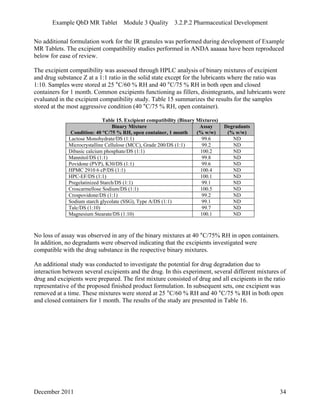
vibrations of the hopper and the press. Blend uniformity was demonstrated as described in Section
2.3.4. The potential for segregation of the blend during compression was investigated during
compression of a 40 kg pilot scale batch (RD-65) by measuring content uniformity of tablets taken
from ten approximately evenly spaced time points throughout the entire batch. The results of these
studies are summarized in Figure 50 and demonstrate that content uniformity was well controlled.
This data showed no evidence of segregation during compression as no trend for tablet strength was
observed throughout the entire compression run.
December 2011 136
Example QbD MR Tablet Module 3 Quality 3.2.P.2 Pharmaceutical Development
90
100
110
1 2 3 4 5 6 7 8 9 10
Sampling Time Points
%LabelClaim
Average Claim
Maximum Individual Claim
Minimum Individual Claim
Figure 50. Content uniformity of the tablets at ten evenly space sampling time points during compression
A sample size of 20 tablets was pulled at each of the ten sampling time points. Weight variability
was evaluated by weighing a composite sample of tablets (n = 20) as well as individual tablets (n =
10) collected at each time point. The results shown in Figure 51 demonstrate that weight variability
was well controlled for the individual tablets within ± 5% of the target weight. The average tablet
weight for a sample size of 20 tablets was controlled within ± 3% of the target weight. No trend for
tablet weight was observed throughout the entire compression run.
237.15
250.325
263.5
276.675
289.85
1 2 3 4 5 6 7 8 9 10 11
TabletWeight(mg)
Target ± 3% for average tablet weight
Average weight
Minimum individual tablet weight
Maximum individual tablet weight
Sampling Time Points
Target ± 5% for individual tablet weight
Figure 51. Weight variation of the tablets at ten evenly spaced sampling time points during compression
December 2011 137
Example QbD MR Tablet Module 3 Quality 3.2.P.2 Pharmaceutical Development
Performance of Split Tablets
To evaluate the performance of split tablets at both ends of the target hardness range, a 40 kg pilot
scale blend batch (RD-66) was compressed with the pre-compression force and press speed set to
1.25 kN and 40 rpm, respectively. The first half of the batch used a main compression force set
point of 7 kN and the second half of the batch used a main compression force set point of 11 kN.
Table 88 presents the responses measured for both whole and split tablets.
Table 88. Evaluation of tablet quality attributes for both whole and split tablets
(1.25 kN pre-compression force and 40 rpm press speed)
Weight Loss Drug Release
Compression
Force
Hardness
Hand
Tablet
Splitter
Friability Assay CU
Disintegration
Time 0.5 h 3 h 6 h 12 h
(kN) (kP) (%) (%) (AV) (min) (%) (%) (%) (%)
7 4.7-5.1 N/A N/A 0.09 97.3 4.2 1.25 31 38 60 84
Whole
11 9.6-10.6 N/A N/A 0.1 98.5 4.7 1.75 33 41 63 81
7 N/A 1.1 1.2 0.1 98.4 6.2 1.0 32 42 59 82Split
(n=12) 11 N/A 1.0 0.9 0.2 97.6 5.9 1.25 31 39 64 85
The results of the investigation indicated that split tablets had well below 3% weight loss whether
the tablets were split by hand or with a tablet splitter. Friability was not affected by tablet splitting
as tablets with lower hardness (4.7 kP) still had acceptable friability results. Split tablets also met
predefined targets for assay, content uniformity, disintegration and drug release. Drug release
profiles for whole and split tablets were comparable at both the low end (f2 = 84) and high end (f2 =
83) of the target hardness range. The drug release profiles of the pre-compressed beads versus the
compressed split tablet portions were also comparable (f2 = 81). In summary, the split tablets
demonstrated equivalent performance to the whole tablets, suggesting that Example MR Tablets are
designed effectively for half dosing.
Summary of Compression In-Process Controls
Based on the results of the studies undertaken to understand the process variables affecting
compression, Table 89 lists the proposed in-process controls for the compression step.
Table 89. Proposed in-process controls for the compression step
Test Frequency Limits
Individual tablet weight
(n = 10)
20 min 263.44 mg ± 5%
Composite tablet weight
(n = 20)
20 min 5.269 g ± 3%
Hardness
(n = 10)
20 min
Target: 8.0 kP
Range: 4.7-10.6 kP
Thickness
(n = 10)
20 min
Target: 5.75 mm
Range: 5.60-5.90 mm
Disintegration*
(n = 12)
3x during run NMT 5 min
Friability*
(sample weight = 6.5 g)
3x during run NMT 1.0%
*Tested at the beginning, middle and end of the run.
December 2011 138
Example QbD MR Tablet Module 3 Quality 3.2.P.2 Pharmaceutical Development
Updated Risk Assessment of the Tablet Compression Process Variables
Risks identified during initial assessment of the compression process were reduced through
development studies. The updated risk assessment is presented in Table 90.
Table 90. Updated risk assessment of the tablet compression process variables
Unit Operation: Compression
Drug Product CQAs: Physical attributes (size and splitability), assay, content uniformity, drug release from both whole and
split tablets
Compression Variables Drug Product CQAs Risk Assessment Justification for the Reduced Risks
Assay Low
Content Uniformity Low
Drug Release –
whole tablets
LowFeeder speed
Drug Release –
split tablets
Low
In the range studied, the feeder speed had no impact on
tablet assay, CU, or drug release. The same tablet press
model will be used for pilot scale and commercial
scale manufacture. Thus, the risk of feeder speed to
impact tablet assay, CU and drug release is reduced
from high to low.
Assay Low
Content Uniformity Low
Drug Release –
whole tablets
LowFeeder fill depth
Drug Release –
split tablets
Low
In the range studied, the feeder fill depth had no
impact on tablet assay, CU, or drug release. Thus, the
risk of impact on tablet assay, CU and drug release is
reduced from high to low.
Physical Attributes
(size and splitability)
Low
Drug Release –
whole tablets
Low
Pre-compression force
Drug Release –
split tablets
Low
The pre-compression force settings that were
investigated did not result in tablet lamination or
capping. No effect on tablet physical attributes (size
and splitability), or drug release from whole or split
tablets was observed. Thus, the risk of pre-
compression force to impact the tablet physical
attributes (size and splitability) and drug release is
reduced from high to low.
Physical Attributes
(size and splitability)
Low
Drug Release –
whole tablets
LowCompression force
Drug Release –
split tablets
Low
The compression force is correlated to tablet hardness.
However, in the range of force studied, there was no
impact on the tablet physical attributes (size and
splitability) or drug release from whole or split tablets.
Thus, the risk of impact on these CQAs is reduced
from high to low.
Assay Low
Content Uniformity Low
Drug Release –
whole tablets
LowPress speed
Drug Release –
split tablets
Low
The range of press speeds investigated had no impact
on tablet assay, CU, or drug release. Thus, the risk of
press speed to impact these tablet CQAs is reduced
from high to low.
2.3.6 Exhibit Batch
Based on the product and process understanding gained throughout development and the established
IVIVR, an exhibit batch (Batch No. ZAb041911) at pilot scale (40 kg) was manufactured. The in-
process and release performance characteristics of the drug product were evaluated and are
summarized in Table 91 and Table 92, respectively. Split tablets met the finished product release
December 2011 139
Example QbD MR Tablet Module 3 Quality 3.2.P.2 Pharmaceutical Development
requirements for assay, content uniformity, and drug release. Whole and split tablets met the
similarity factor (f2) criteria for drug release.
The exhibit batch was used for a pivotal BE study which demonstrated bioequivalence to the RLD
(see Section 1.4.3). In addition, an in vitro alcohol-induced dose dumping study was conducted
using 0.1 N HCl with 5%, 20% and 40% (v/v) of Alcohol USP. For each condition, 12 units were
tested and data was collected every 15 minutes for a total of two hours. Based on an analysis of the
means, range and RSD, both whole and split tablets performed comparably to the RLD under each
condition (data included in module 5.3).
Table 91. In-process testing results for the exhibit batch (Batch No. ZAb041911)
Test In-process Control
Range Observed for
Entire Batch
Individual tablet weight
(n = 10)
Target: 263.44 mg ± 5%
Range: 250.27 – 276.61 mg
259.32 – 266.21 mg
Composite tablet weight
(n = 20)
Target: 5.269 g ± 3%
Range: 5.006 – 5.532 g
5.157 – 5.386 g
Hardness
(n = 10)
Target: 8.0 kP
Range: 4.7 – 10.6 kP
7.5 – 9.3 kP
Thickness
(n = 10)
Target: 5.75 mm ± 0.15 mm
Range: 5.60 – 5.90 mm
5.67 – 5.81 mm
Disintegration
(n = 12)
NMT 5 min 1.0 – 1.75 min
Friability
(sample weight = 6.5 g)
NMT 1.0 % 0.09 – 0.1%
Table 92. Release testing results for the exhibit batch (Batch No. ZAb041911)
Results
Test Acceptance Criteria
Whole Tablets Split Tablets
Description
White capsule-shaped tablet debossed with
“OGD” on one side of the breakline and “123”
on the other side
White capsule-shaped tablet
debossed with “OGD” on one side
of the breakline and “123” on the
other side
N/A
Identification
A. HPLC Retention time: corresponds to
standard
B. UV spectrum: corresponds to standard
Corresponds to standard N/A
Assay 95.0% – 105.0% 99.6% 99.3%
Content
Uniformity
AV < 15 4.2 6.1
Degradation
Products
Individual unknown degradation product:
NMT 0.2%
Total degradation products: NMT 1.0%
Individual unknown degradation
product: 0.06%
Total degradation products: 0.3%
N/A
30 min: 32%
3 h: 41%
6 h: 65%
12 h: 83%
30 min: 34%
3 h: 39%
6 h: 68%
12 h: 86%
Drug Release
(N = 12)
30 min: 25 – 35%
3 h: 35% – 45%
6 h: 55% – 75%
12 h: NLT 80%
f2 = 83
Residual
Solvents
Complies with USP <467> Option 1 Complies with USP <467> Option I N/A
December 2011 140
Example QbD MR Tablet Module 3 Quality 3.2.P.2 Pharmaceutical Development
2.3.7 Scale-up to Commercial Scale
Note to Reader: Currently, scale-up information is limited at the time of submission. The applicant
should discuss product specific scale-up principles including their planned approach to the scale-
up process. OGD will evaluate the applicant’s plan to determine its adequacy. However, if a
substantial amendment needs to be submitted due to the inadequacy of the scale-up plan, it may
significantly extend the review process. It is the firm’s discretion to submit scale-up data such as
actual process verification information at the time of submission for a complex drug product which
has a high risk of scale-up failure; however, in some cases it may be requested by OGD.
2.3.7.1 Scale-up of IR Granulation
Scale-up using a high shear granulator Collete Gral was performed previously for the IR granule
formulation in ANDA aaaaaa, Section 2.3 (Appendix I). Table 93 summarizes the scaled
granulation process utilizing the same equipment design and operating principles.
Table 93. Scale-up and acceptable operating ranges for the IR granulation
Lab Scale Pilot Scale Commercial Scale
Batch load 2.0 kg 40.0 kg 180 kg
Active Powder Mixing
Equipment model Collette Gral 10 Collette Gral 300 Collette Gral 1200
Impeller speed Low (285 rpm) Low (125 rpm) Low (75 rpm)
Mixing time 5 min 5 min 5 min
Granulation using Purified Water
Equipment model Collette Gral 10 Collette Gral 300 Collette Gral 1200
Impeller speed Low (285 rpm) Low (125 rpm) Low (75 rpm)
Chopper speed Low Off Off
Solution addition rate 60 g/min 1.3 kg/min 10.0 kg/min
Mixing time 12 min 12 min 12 min
Drying
Equipment Fluid Bed Dryer Fluid Bed Dryer Fluid Bed Dryer
Bed air temperature 52ºC (50 – 55 °C) 52ºC (50 – 55 °C) 52ºC (50 – 55 °C)
Milling
Equipment Fitzmill L1A Fitzmill DA6 Fitzmill DA6
Screen size: 20 mesh Screen size: 20 mesh Screen size: 20 mesh
Screening mill
Speed: 4740 ± 20 rpm Speed: 2500 ± 20 rpm Speed: 2500 ± 20 rpm
December 2011 141
Example QbD MR Tablet Module 3 Quality 3.2.P.2 Pharmaceutical Development
2.3.7.2 Scale-up of ER Beads Drug Layering and Polymer Coating
Scale-up Principles for Bottom Spray Fluid Bed Coating
Process variables most likely to impact the quality of coated beads were optimized at the pilot batch
scale. A batch at commercial scale was used to confirm the critical process parameter ranges and
consistent product performance for the drug layering and ER polymer coating unit operations. The
commercial batch was processed in a Glatt GPCG -120 with a 32″ Wurster HS insert. The 32″ insert
has three partition columns and spray nozzles. Figure 52 illustrates the key operational features of
this equipment, specifically the three partition columns and spray nozzles. Each of these three
configurations has the same geometry and dimensions as the single-spray unit (18″ Wurster HS
insert with a partition column diameter of 219 mm) used for pilot scale processing.
Figure 52. Glatt GPCG-120 with a 32″ Wurster insert used at commercial scale
Linear scale-up of drug layering using a fluid bed process is possible by utilizing properly designed
distribution plates and chambers and by maintaining the ratios of air volume to distribution plate
area and spray rate to air volume. Assuming that bed fill levels are the same and that the chamber
design and the distribution plate in each piece of equipment is geometrically similar, fluid bed
scaling from a coater with an 18″ insert to one with a 32″ insert is straightforward. The number of
nozzles, air volume, and total spray rate at the 32″ insert scale are all a direct multiple of the
parameters optimized in a single nozzle unit at the 18″ insert scale. The spray rate and atomization
air pressure per nozzle are maintained the same as those optimized at the pilot scale. The linear air
flow rate in the equipment is kept constant as the process is scaled up. The air volume is scaled up
by a factor of three based upon the distribution plate area.
During scale-up, product temperature and relative humidity of the inlet air (dew point) are scale-
independent variables and kept the same as the values optimized in the pilot scale process
development study. Table 94 compares the fluid bed equipment used at pilot and commercial scale.
December 2011 142
Example QbD MR Tablet Module 3 Quality 3.2.P.2 Pharmaceutical Development
Table 94. Fluid bed equipment for pilot and commercial scale
Lab Scale Pilot Scale
Verification Batch at
Commercial Scale
Equipment model Glatt GPCG - 5 Glatt GPCG - 60 Glatt GPCG - 120
Fluid bed insert 7″ Wurster 18″ Wurster 32″ Wurster
Equipment working capacity* 8.3 L 102 L 405 L
Partition column diameter 89 mm 219 mm 219 mm
Number of partition columns 1 1 3
Nozzle diameter 1.0 1.2 mm 1.2 mm
Number of spray nozzles 1 1 3
*Volume outside of the partition column at rest on the orifice plate
Scale-up of the Drug Layering Process
A verification batch at commercial scale was manufactured using the target settings listed in Table
95 based on linear scale-up of the pilot scale process robustness study. The spray rate and
atomization air pressure were maintained at the pilot scale settings per nozzle. Partition height was
set at 40 ± 10 mm on the basis of prior experience to maintain optimal fluidization.
Table 95. Equipment and process parameters for pilot and commercial scale drug layering
Pilot Scale
Verification Batches
at Commercial Scale
Equipment model Glatt GPCG - 60 Glatt GPCG - 120
Starting weight of substrate 40 kg 140 kg
Theoretical ending weight of batch
(~ 41% weight gain based on coating substrate weight)
56 kg 198 kg
Estimated use of capacity* 65% 58%
Partition height 45 ± 3 mm 45 ± 3 mm
Product temperature (°C) 45 ± 3 C 45 ± 3 C
Dew point (°C) 10 ± 2 C 10 ± 2 C
Air volume (cfm) 600 ± 90 cfm 1800 ± 270 cfm
Spray rate per nozzle (g/min) 210 ± 30 g/min 210 ± 30 g/min
Total spray rate (g/min) 210 ± 30 g/min 630 ± 90 g/min
Atomization air pressure per nozzle (bar) 2.5 ± 0.5 bar 2.5 ± 0.5 bar
*Calculated based on bulk density of drug-layered beads = 0.85 g/cc
Note: All coating process parameter settings were target values at steady state.
Table 96 presents the data collected for the quality attributes of the drug-layered beads. The drug-
layered beads manufactured at commercial scale were carried forward for further processing.
Table 96. Quality attributes of drug-layered beads manufactured at commercial scale
PSD
LOD Fines
< 250 µm
Agglomerates
> 420 µm
250 µm < usable fraction < 420 µm
Assay Process Efficiency
(%) (%) (%) (%) (%) (%)
0.8 0.8 0.2 98.8 99.9 99.6
December 2011 143
Example QbD MR Tablet Module 3 Quality 3.2.P.2 Pharmaceutical Development
Scale-up of the ER Polymer Coating Process
Similar to drug layering, scale-up of the ER polymer coating process was also a linear scale-up from
an 18″ to a 32″ Wurster HS insert. A verification batch at commercial scale was manufactured using
the equipment and process parameters optimized during the pilot scale process robustness study.
The target settings are detailed in Table 97. Drug-layered beads from the previous unit operation
were loaded into the fluid bed coater after testing was completed for performance characteristics
such as particle size distribution and LOD.
Table 97. Equipment and process parameters for pilot and commercial scale ER polymer coating
Pilot Scale
Verification Batches
at Commercial Scale
Equipment model Glatt GPCG - 60 Glatt GPCG - 120
Starting weight of drug-layered beads 40 kg 180 kg
Theoretical ending weight of batch
(~ 36% weight gain based on drug-layered bead weight)
54 kg 245 kg
Estimated use of capacity* 62% 71%
Partition height 45 ± 3 mm 50 ± 3 mm
Product temperature (°C) 31 ± 3 31 ± 3
Dew point (°C) 10 ± 2 ºC 10 ± 2 ºC
Air volume (cfm) 660 ± 60 1980 ± 180
Spray rate per nozzle (g/min) 120 ± 20 120 ± 20
Total spray rate (g/min) 120 ± 20 360 ± 60
Atomization air pressure per nozzle (bar) 2.5 ± 0.5 2.5 ± 0.5
*Calculated based on the bulk density of the ER coated beads = 0.85 g/cc
Note: All coating process parameter settings were target values at steady state.
Based on previous experience with Wurster coating, it is possible for process efficiency to differ
between pilot and commercial scale. The actual polymer coating level applied to the beads will vary
based on the process efficiency. During the verification batch, samples were pulled at different
theoretical polymer coating levels of 26%, 27%, 28%, 29%, 30%, 31% and 32% to determine the
optimum theoretical polymer coating level that would result in the desired drug release profile.
These samples were dried until the LOD was less than 2% and evaluated for drug release by
dissolution testing.
Table 98 presents the data collected for the quality attributes of the ER coated beads.
Table 98. Quality attributes of the ER coated beads manufactured at commercial scale (Batch No. COM001)
PSD
LOD Fines
< 350 µm
Agglomerates
> 590 µm
350 µm < usable fraction < 590 µm
Assay Process Efficiency
(%) (%) (%) (%) (%) (%)
0.9 0.7 0.1 99.2 98.9 99.0
The first commercial verification batch (Batch No. COM001) of ER coated beads with a theoretical
polymer coating level between 30-32% exhibited slower release when compared to the pivotal bio-
batch (Lot No. ZAb041911) manufactured at pilot scale and failed the predefined drug release
December 2011 144
Example QbD MR Tablet Module 3 Quality 3.2.P.2 Pharmaceutical Development
specification (data not shown). The ER coated beads with 26% theoretical polymer coating showed
faster drug release when compared to the pivotal bio-batch. However, there was no significant
difference between beads with 27-29% theoretical polymer coating and the pivotal bio-batch.
The ER coated beads were further examined using SEM and no obvious difference in film quality
was observed. In order to understand whether the drug release failure was due to a film coat
thickness change, the usable ER beads (350-590 μm) were further sieved to minimize the effect of
bead size on film thickness measurement. The fraction between sieve No. 40 and 35 (420-500 μm)
was collected from both the verification batch (Lot No. COM001) and the pivotal bio-batch.
Samples were sent to an outside testing laboratory for film thickness testing by Terahertz Pulse
Imaging (TPI)14
and the data presented in Figure 53 was obtained.
0
10
20
30
40
50
60
Pilot COM001
FilmCoatThickness(µm)
Figure 53. Film coat thickness of beads with 30% theoretical polymer coating from pilot (red) and commercial
(blue) batches
Drug-layered beads with 30% theoretical polymer coating showed an increase in total film thickness
from 41 ± 2 µm at pilot scale to 46 ± 3 µm at commercial scale. The T50% increased from 5.6 hours
to 6.6 hours and failed to meet the pre-defined CQA acceptance criteria. This could potentially be
attributed to the fact that in the commercial scale equipment, 71% of capacity was utilized
compared to 62% use of capacity at pilot scale. When the bed fill level was low at pilot scale, the
partition height was also set low, which may limit the mass flow of beads into the partition column.
Therefore, coating material may be lost to the partition column wall, resulting in overall lower
process efficiency at pilot scale.
In order to achieve similar drug release and bioequivalence results as those obtained at the pilot
scale, the theoretical polymer coating level was reduced from 30% to 28% based on the drug release
14
Taday P.F., et al. Nondestructive analysis of tablet coating thickness using terahertz pulsed imaging, J. Pharm. Sci.
2005; 94 (1); 177-183.
December 2011 145
Example QbD MR Tablet Module 3 Quality 3.2.P.2 Pharmaceutical Development
results of samples with different coating levels (26-32%) pulled during the first verification batch.
Using the same process parameters, a second verification batch (Batch No. COM002) at
commercial scale was manufactured with a 28% theoretical polymer coating. Table 99 summarizes
LOD, PSD, assay and process efficiency results.
Table 99. Quality attributes of the ER coated beads manufactured at commercial scale (Batch No. COM002)
PSD
LOD Fines
< 350 µm
Agglomerates
> 590 µm
350 µm < usable fraction < 590 µm
Assay Process Efficiency
(%) (%) (%) (%) (%) (%)
0.8 0.7 0.2 99.1 98.6 99.0
Similar to the evaluation of the first verification batch (Batch No. COM001), a non-destructive TPI
method performed at an outside testing lab was used to measure polymer coating thickness of the
second verification batch (Batch No. COM002). Results indicated that a difference in film thickness
between the pivotal bio-batch and the second verification batch was not statistically significant (α =
0.05). Similarity in drug release characteristics for the ER coated beads was also tested and
confirmed using the established discriminatory dissolution method (data not shown).
ER coated beads (Batch No. COM002) were subsequently blended with extragranular excipients
and compressed into tablets. The final drug product exhibited a drug release profile equivalent to
tablets from the pilot scale bio-batch and the RLD as shown in Figure 54.
0
10
20
30
40
50
60
70
80
90
100
0 2 4 6 8 10 12 14 16 18 20 22 24
Time (h)
DrugReleased(%)
Verification Batch No. COM002
Bio-Batch No. ZAb041911
RLD
Figure 54. Drug release profiles of the 2nd verification batch (COM002) and the bio-batch (ZAb041911)
Although the formulation for Example MR Tablets was modified to reduce the theoretical polymer
coating level by 2%, no additional bioequivalence studies were necessary. The comparable in vitro
drug release between the second commercial batch and the bio-batch demonstrated in Figure 54 and
the established IVIVR ensure the desired performance of the drug product in vivo.
December 2011 146
Example QbD MR Tablet Module 3 Quality 3.2.P.2 Pharmaceutical Development
2.3.7.3 Scale-up of Blending and Compression
The equipment employed in the critical unit operations to manufacture the trial, pilot and
commercial batches have the same principle of operation as outlined in Table 100. However, the
equipment capacity varies based on the intended size of the commercial batches. In order to avoid
scale-up issues, the same type of equipment was used.
Table 100. Scale-up of MR Tablet blending, lubrication and compression
Unit
Operation
Lab
Scale
Pilot
Scale
Commercial
Scale
Operating
Principle
Constant Parameter
Blending
V (tumble)
blender
(16 qt)
V (tumble)
blender
(7.5 cu ft)
V (tumble)
blender
(30 cu ft)
Diffusion
Mixing
Nrev = 300
Use inline NIR for endpoint
determination
Lubrication
V (tumble)
blender
(16 qt)
V (tumble)
blender
(7.5 cu ft)
V (tumble)
blender
(30 cu ft)
Diffusion
Mixing
Nrev = 90
Compression
10-station
Rotary Tablet
Press with ‘B’
type tooling
49-station
Rotary Tablet
Press with ‘B’
type tooling
49-station
Rotary Tablet
Press with ‘B’
type tooling
Compression
Individual Weight: 263.44 mg ± 5%
Hardness: 8.0 kP (4.7 – 10.6 kP)
Thickness: 5.75 mm ± 0.15 mm
Scale-up of the Blending Process
The inline NIR method developed and validated at pilot scale was verified at commercial scale and
will be used for blending endpoint determination of all commercial batches. The target endpoint for
blending will remain at 300 revolutions of the blender; however, the actual endpoint is based on
inline NIR measurements. To assess the homogeneity of the blend, a moving block RSD was
calculated for each moving block of ten consecutive spectra and plotted as a function of time. The
blend was considered uniform once the RSD was below 5% for ten consecutive measurements.
Table 101 summarizes the blending process parameters and endpoints for the different scales.
Table 101. Scale-up of blending process parameters for diffusion mixing in a V-blender
Scale
(V-blender size)
Blender rotation speed Target Nrev Target mixing time Blend Uniformity by NIR
(rpm) (min) (% RSD)
Lab Scale
(16 qt)
25 300 12 1.19
Pilot Scale
(7.5 cu ft)
15 300 20 1.02
Commercial Scale
(30 cu ft)
10 300 30 1.20
Scale-up of the Tableting Process
The tablet compression machine is equipped with a modern compression force feedback control that
adjusts the fill depth to ensure target tablet weight and, consequently, content uniformity. Based on
compression force feedback, the fill cam below the die table adjusts the lower punch to the
December 2011 147
Example QbD MR Tablet Module 3 Quality 3.2.P.2 Pharmaceutical Development
appropriate height to control fill depth (and ultimately tablet weight). Detailed parameters that
affect the tableting process were already explored and discussed in Section 2.3.5. Commercial
batches of drug product produced comparable results as those presented in Section 2.3.5 because the
same model of rotary tablet press was used and tablets were compressed at the same speed.
Therefore, dwell time remains unchanged during scale-up.
2.3.8 Updated Risk Assessment of the Drug Product Manufacturing Process
During process development, high risks for each unit operation were addressed. Experimental
studies were defined and executed in order to establish additional scientific knowledge and
understanding, to allow appropriate controls to be developed and implemented, and to reduce the
risk to an acceptable level. After detailed experimentation, the initial manufacturing process risk
assessment was updated in-line with the current process understanding. Table 102 presents how the
application of the control strategy to the manufacturing process has reduced the identified risks.
Table 103 provides the justification for the reduced risk following process development.
Table 102. Updated risk assessment of the manufacturing process for Example MR Tablets, 10 mg
Process Steps
Drug Product
CQAs
IR
granulation
ER beads:
drug
layering
Sieving
I
ER beads:
polymer
coating
Sieving
II
Blending
and
Lubrication
Compression
Physical Attributes
(size and splitability)
Low* Low* Low* Low* Low* Low* Low
Assay Low* Low Low* Low* Low* Low Low
Content Uniformity Low* Low Low* Low* Low* Low Low
Drug Release –
Whole tablets
Low* Low* Low* Medium Low Low Low
Drug Release –
split tablets
Low* Low Low* Medium Low Low Low
Drug Release –
alcohol-induced dose dumping
N/A* N/A* N/A* Low* Low* Low* Low*
*The level of risk was not reduced from the initial risk assessment.
Table 103. Justification for the reduced risks of the manufacturing process for Example MR Tablets, 10 mg
Process Steps Drug Product CQAs Justification
Assay
The drug layering process was optimized to minimize spray drying and
agglomeration. Fines and agglomerates generated during the verification batch were
both below 1%. Drug-layered beads had an assay within the target range of 95.0 –
105.0%. Within the range studied, the risk of drug layering process variables to
impact tablet assay is reduced from high to low.
ER beads:
drug layering
Content Uniformity
Optimal fluidization and uniform spray was achieved using process parameters
within the range studied. The drug-layered beads had acceptable uniformity. Thus,
the risk of drug layering process variables to impact tablet CU is reduced from
medium to low.
December 2011 148
Example QbD MR Tablet Module 3 Quality 3.2.P.2 Pharmaceutical Development
Process Steps Drug Product CQAs Justification
Drug Release –
split tablets
Split tablets had adequate CU with an AV < 7 and the drug release profile between
whole and split tablets met the similarity factor (f2 > 80) criteria. The risk of the drug
layering process variables to impact drug release from split tablet is reduced from
medium to low.
Drug Release –
whole tablets
The ER polymer coating process was optimized to minimize spray drying and
agglomeration. Fines and agglomerates were both below 1% in the verification
batches. Within the range studied, the risk of ER polymer coating process variables
to impact drug release from whole tablets is reduced at pilot scale. However, some
variability in process efficiency and ER polymer coating layer thickness was
observed during scale-up from pilot to commercial scale. The theoretical polymer
coating level was decreased from 30% to 28% to achieve the target drug release
profile. The impact of ER polymer coating process variability on drug release from
whole tablets needs to be further monitored during validation and routine
commercial manufacturing to gain additional knowledge and to facilitate continual
improvement. Therefore, the risk for drug release from whole tablets is considered
acceptable but at a medium level.
ER beads:
polymer coating
Drug Release –
split tablets
Split tablets had adequate CU with an AV < 7 and comparable drug release to whole
tablets (f2 > 80). The risk is reduced but because drug release is sensitive to polymer
coating level based on the BE studies, further evaluation during process validation
and routine commercial manufacturing is needed to gain additional knowledge.
Therefore, the risk of ER polymer coating process variables to impact split tablet
drug release is medium.
Drug Release –
whole tablets
The risk of damaging the coated beads is reduced with the instructions “do not use
force during sieving” included in the batch record. The risk of sieving II to impact
drug release from whole tablets is reduced from medium to low.
Sieving II
Drug Release –
split tablets
Split tablets had adequate CU with an AV < 7. The risk of sieving II to impact drug
release from whole tablet is reduced from medium to low. As such, the risk of this
step to impact drug release from split tablets is also reduced from medium to low.
Assay
The blending process was optimized and the risk of segregation was reduced during
prototype formulation optimization by using two MCC grades. The risk of the
blending and lubrication process variables to impact tablet assay is reduced from
medium to low.
Content Uniformity
Inline NIR was utilized to ensure blend uniformity and no segregation was observed
after discharge from the blender. In addition, tablet CU met the requirements set
forth in USP <905>. The risk of the blending and lubrication process variables to
impact tablet CU is reduced from high to low.
Drug Release –
whole tablets
The blending process was optimized and blend uniformity was achieved by utilizing
inline NIR for endpoint determination. The lubrication process was also optimized.
Whole tablets demonstrated acceptable CU with an AV < 5, exhibited rapid
disintegration, and met the target drug release profile. The fact that the tablets
showed rapid disintegration and had no appearance defects during the entire
compression run provides evidence that the disintegrant and lubricant were
adequately distributed in the final blend. Therefore, the risk of the blending and
lubrication process variables to impact drug release from whole tablet is reduced
from medium to low.
Blending and
Lubrication
Drug Release –
split tablets
Both whole and split tablets complied with USP <905> and demonstrated acceptable
CU. Similar drug release profiles between whole and split tablets were obtained (f2 >
80). The risk is reduced from high to low.
Compression Physical Attributes
(size and splitability)
The shape and score configuration of the tablets were defined and compression
process parameters were optimized. The tablet has a similar size as the RLD tablet.
Tablets were easily split by the target patient population. Thus, the risk of the
compression process variables to impact tablet physical attributes (size and
splitability) is reduced from high to low.
December 2011 149
Example QbD MR Tablet Module 3 Quality 3.2.P.2 Pharmaceutical Development
Process Steps Drug Product CQAs Justification
Assay
Feeder speed, feeder fill depth and press speed were investigated and acceptable
tablet assay (95 – 105%) was achieved within the studied ranges. The risk of the
compression process variables to impact tablet assay is reduced from high to low.
Content Uniformity
Tablets were sampled at ten evenly spaced time intervals during compression of a
batch and CU testing at each time point was performed. The data revealed no
evidence of segregation in the hopper. The risk of impact on tablet CU is reduced
from high to low.
Drug Release –
whole tablets
The compression process was optimized. Bead integrity was confirmed after tablet
compression at the highest force studied. The drug release from whole tablets was
not significantly impacted by the compression force within the studied range.
Therefore, the risk of the compression process variables to impact drug release from
whole tablets is reduced from high to low.
Drug Release –
split tablets
The split tablet portions demonstrated adequate CU and comparable drug release to
the whole tablets. Thus, the risk of the compression process variables to impact drug
release from split tablets is reduced from high to low.
2.4 Container Closure System
To be consistent with the RLD, the drug product Example MR Tablets, 10 mg, is intended to be
labeled for storage at 25 °C (77 °F) with excursions permitted to 15-30 °C (59 – 86 °F). The
innovator has chosen round white opaque HDPE bottles with an induction seal liner and child
resistant (CR) closure. Example MR Tablets, 10 mg, will be similarly packed and the bottle pack
details are summarized in Table 104.
Table 104. Proposed commercial packaging for Example MR Tablets, 10 mg
Count HDPE Bottle Closure
30 Tablets 40 cc 33 mm white CR cap with pulp liner
90 Tablets 60 cc 38 mm white CR cap with pulp liner
Information on conformance to USP <661> and USP <671>, food safety certification, and stability
data available to date can be found in the relevant sections of Module 3. The selected commercial
packaging provides adequate protection from light, heat, oxygen, and moisture and is suitable for its
intended use.
2.5 Microbiological Attributes
An accelerated stability study of prototype F-2 demonstrated that the drug product has low water
activity and is not capable of supporting microbial growth. Routine microbiological testing of
Example MR Tablets is unnecessary due to the low water activity of the product, controls on
incoming raw materials, and controls on in-process water content.
December 2011 150
Example QbD MR Tablet Module 3 Quality 3.2.P.2 Pharmaceutical Development
2.6 Compatibility
This section is not applicable because the drug product is a solid oral dosage form and there are no
reconstitution diluents.
2.7 Control Strategy
Note to Reader: The control strategy is “a planned set of controls, derived from current product
and process understanding, that assures process performance and product quality. The controls can
include parameters and attributes related to drug substance and drug product materials and
components, facility and equipment operating conditions, in-process controls, finished product
specifications, and the associated methods and frequency of monitoring and control.”15
The control strategy for Example MR Tablets is built upon the outcome of extensive product and
process understanding studies. These studies investigated the material attributes and process
parameters that were deemed high risk to the CQAs of the drug product during the initial risk
assessment. In some cases, variables considered medium risk were also investigated. Through these
systematic studies, the CMAs and CPPs were identified and the acceptable operating ranges were
established. For the drug layering and the ER polymer coating unit operations, a design space was
established at both lab and pilot scale. All variables ranked as high risk in the initial risk
assessment are included in the control strategy because the conclusion of the experiments was
dependant on the range studied and the complex multivariate relationship between variables. Thus,
the control strategy is an integrated overview of how quality is assured based on current process
and product knowledge. The control strategy may be further refined based on additional experience
gained during the commercial lifecycle of the product. However, any post-approval changes should
be reported to the agency in accordance with CFR 314.70 and should follow steps as outlined by
guidances used for scale-up and post-approval changes.
2.7.1 Control Strategy for IR Granules
The control strategy for the commercial manufacture of IR granules was first submitted in ANDA
aaaaaa (Appendix I). Table 105 summarizes the proven acceptable ranges for each critical material
attribute and process parameter involved in the granulation unit operation for the IR portion of the
MR tablets.
15
ICH Harmonised Tripartite Guideline: Q10 Pharmaceutical Quality Systems. June 2008.
December 2011 151
Example QbD MR Tablet Module 3 Quality 3.2.P.2 Pharmaceutical Development
Table 105. Control Strategy for IR granules
Factor
Attribute/
Parameter
Range
studied
Set point for
the verification
batch
Validated
operating range
for commercial
scale (min,
max)
Purpose of
control
IR Granules Input Material Attributes
Z Particle size distribution
d10: 1- 10 µm
d50: 10-30 µm
d90: 25-50 µm
d10: 5 µm
d50: 20 µm
d90: 35 µm
d10: 1- 10 µm
d50: 10-30 µm
d90: 25-50 µm
Microcrystalline
Cellulose (MCC),
Grade 200
Particle size distribution d50: 150-250 µm d50: 196 µm d50: 150 -250 µm
Lactose Monohydrate Particle size distribution d50: 50-100 µm d50: 65 µm d50: 50-100 µm
To reduce
granulation
process variability
Povidone (PVP), K30 K-value
Used material
within in-house
spec
(K-value: 29-32)
30 29-32
To ensure
consistent binding
functionality
Particle size distribution d50: 50-100 μm d50: 65 μm d50: 50-100 μmSodium Starch
Glycolate (SSG),
Type A Degree of substitution* 0.25-0.35 0.30 0.25-0.35
To ensure batch to
batch consistency
Powder Mixing and Granulation Process Variables (Validated Process)
Impeller speed Low and High Low Low
Chopper speed On and Off Off Off
Powder mixing time 2-10 min 5 min 2-10 min
Granulation mixing time 10-20 min 12 min 10-20 min
Solution addition rate 5-20 kg/min 10 kg/min 5-20 kg/min
Granulation fluid
quantity*
32-42% w/w 36.5% w/w 35-38% w/w
To ensure IR
granule CQAs
(PSD and bulk
density) are met
consistently
Drying Process Variables and In-Process Controls (Validated Process)
Drying 50-55 °C 52 °C 50-55 °C
Water content NMT 2.0% NMT 2.0% NMT 2.0%
To ensure low
water activity in
order to prevent
microbial growth
Milling and Blending Process Variables and In-process controls (Validated Process)
Milling Speed 4740 rpm 2500 rpm 2500 ± 20 rpm
Mill screen size 20 20 20
To ensure IR
granule PSD is met
consistently
Blend Uniformity,
(% RSD)*
95.0-105.0%
NMT 3.0%
95.0-105.0%
NMT 3.0%
To ensure tablet
CU is met
consistently
IR Granules In-Process Controls
Granule size distribution*
Retained on 45 mesh (coarse granules > 350 μm): NMT 5%
Retained on 60 mesh (> 250 μm, but < 350 μm): NLT 85%
Retained on fine collector (< 250 μm): NMT 10%
LOD < 2.0%
Dissolution* NLT 80% in 30 min in 0.1 HCl
Assay* 95.0 – 105.0% w/w of label claim
*critical input material attributes (CMA), critical process parameters (CPP) or critical quality attributes (CQA) of in-
process material or final drug product
December 2011 152
Example QbD MR Tablet Module 3 Quality 3.2.P.2 Pharmaceutical Development
2.7.2 Control Strategy for ER Coated Beads
Since extensive DOE studies were carried out during the formulation and process development of
the ER coated beads, a pilot scale (40 kg) design space for critical parameters has been established.
Table 106 summarizes the proposed ranges for the commercial manufacture of ER coated beads.
Because dissolution apparatus 3 has been used to establish an IVIVR, this method was selected and
validated for quality control of the ER coated beads and the release assay of the final drug product.
Note that the process parameters presented in the control strategy are the target values achieved at
steady state.
Table 106. Control Strategy for ER beads
Factor
Attribute/
Parameter
Range studied
Set point for the
verification batch
Proposed
operating range
for commercial
scale (min, max)1
Purpose of
control
ER Coated Beads Input Material Attributes
Z
Particle size
distribution
d10: 1- 10 µm
d50: 10-30 µm
d90: 25-50 µm
d10: 5 µm
d50: 20 µm
d90: 35 µm
d10: 1- 10 µm
d50: 10-30 µm
d90: 25-50 µm
To ensure batch
to batch
consistency
(same as
Example IR
Tablets)
Microcrystalline
Cellulose (MCC) beads
Bead size
distribution*
Fraction between
250-350 µm was
used
Fraction between
250-350 µm was
used
Fraction between
250-350 µm was
used
To prevent
segregation and
to reduce
coating process
variability
Povidone (PVP), K30 K-value
Used material
within in-house spec
(K: 29-32)
30 29-32
To ensure
consistent
binding
functionality
Acetic acid content 0.5-1.5% 1.4% NMT 1.5%
Poly vinyl acetate
content
Used material within
in-house spec (25-29
g/100g)
27 g/100g 25-29 g/100g
Povidone* content
Used material within
in-house spec (2.5-
2.9%) + 0-2.7%
additional
2.7% (as is)
0% additional
2.5-2.9% (as is)
0% additional
Kollicoat SR 30 D
Apparent viscosity 50-90 mPa•s 88 mPa•s 50-90 mPa•s
To ensure
desired drug
release from ER
coated beads is
achieved
consistently
Talc Particle size
Used material
within in-house spec
d50: 2-8 µm
NLT 99% passing
325 mesh (44 μm)
Used as-is
d50: 4.7 µm
99.9% passing 325
mesh (44 μm)
d50: 2-8 µm
NLT 99% passing
325 mesh (44 μm)
To ensure batch
to batch
consistency and
to reduce nozzle
and tubing
clogging
December 2011 153
Example QbD MR Tablet Module 3 Quality 3.2.P.2 Pharmaceutical Development
Factor
Attribute/
Parameter
Range studied
Set point for the
verification batch
Proposed
operating range
for commercial
scale (min, max)1
Purpose of
control
Drug Layering Process Parameters
Drug solution
preparation
Mixing time
Mix until dissolved
but NLT 1 hour
Mix until dissolved
(1.5 hour)
Mix until dissolved
but NLT 1 hour
Drug solution Holding time 0-48 hr 8 hr Up to 48 hr
Atomization air
pressure
1.2 -2.0 bar (lab)
2.0-3.0 bar (pilot)
2.5 bar (bio-batch)
2.5 bar 2.5 ± 0.5 bar
Spray rate per
nozzle*
25-45 g/min (lab)
180-240 g/min
(pilot)
210 g/min (bio-
batch)
210 g/min
(total spray rate: 630
g/min)
210 ± 30 g/min
(total spray rate: 630
± 90 g/min)
Product
temperature*
42-50 °C (lab)
42-48 C (pilot)
45 C (bio-batch)
45 C 45 ± 3 C
Air volume*
80-120 cfm (lab)
510-690 cfm (pilot)
600 cfm (bio-batch)
1800 cfm 1800 ± 270 cfm
Wurster column coating
Use of capacity
79% (lab)
65% (pilot)
58% 58%
To ensure target
assay of drug-
layered beads is
achieved
consistently
Drug-Layered Beads In-Process Controls
Beads size distribution*
Retained on 40 mesh (Agglomerates > 420 μm): NMT 5%
Retained on 60 mesh (250 μm < usable fraction < 420 μm): NLT 90%
Retained on fine collector (Fines < 250 μm): NMT 5%
LOD < 2.0%
Assay* 95.0 – 105.0% w/w of label claim
Content Uniformity* RSD < 5.0%
December 2011 154
Example QbD MR Tablet Module 3 Quality 3.2.P.2 Pharmaceutical Development
Factor
Attribute/
Parameter
Range studied
Set point for the
verification batch
Proposed
operating range
for commercial
scale (min, max)1
Purpose of
control
ER Polymer Coating Process Parameters
Coating dispersion
preparation
Mixing time
Mix for at least 1
hour before spraying
and mix
continuously during
the entire coating
process
Mix for at least 1
hour before spraying
and mix
continuously during
the entire coating
process
Mix for at least 1
hour before spraying
and mix continuously
during the entire
coating process
Coating dispersion Holding time 0-48 hr 8 hr Up to 48 hr
Air volume*
70-170 cfm (lab)
600-720 cfm (pilot)
660 cfm (bio-batch)
1980 cfm 1980 ± 180 cfm
Atomization air
pressure
1.2-2.0 bar (lab)
2.0-3.0 bar (pilot)
2.5 bar (bio-batch)
2.5 bar 2.5 ± 0.5 bar
Spray rate
per nozzle*
10-30 g/mim (lab)
100-140 g/min
(pilot)
120 g/min (bio-
batch)
120 g/min
(total spray rate: 360
g/min)
120 ± 20 g/min
(total spray rate: 360
± 60 g/min)
Product
temperature*
25-39 °C (lab)
28-36 °C (pilot)
31 °C (bio-batch)
31 °C 31 ± 3 °C
Use of capacity
77% (lab)
62% (pilot)
71% 71%
Wurster column coating
Theoretical polymer
coating level*
20-40%
(formulation study)
25% (1st
BE)
30% (passed) and
35% (failed) (2nd
BE)
30% (process study)
30% (bio-batch)
30% (1st
verification
batch failed2
)
28% (2nd
verification batch
passed)
28 ± 1%
To ensure
desired drug
release from ER
coated beads is
achieved
consistently
ER Coated Beads In-Process Controls
Beads size distribution*
Retained on 30 mesh (Agglomerates > 590 μm): NMT 5%
Retained on 45 mesh (350 μm < usable fraction < 590 μm): NLT 90%
Retained on fine collector (Fines < 350 μm): NMT 5%
LOD < 2.0%
Assay* 95.0 – 105.0% w/w of label claim
Drug release*,3
T20% 2.5 ± 0.2 h
T50% 4.5 ± 1.0 h
T80% 10.0 ± 2.0 h
*critical input material attributes (CMA), critical process parameters (CPP) or critical quality attributes (CQA) of in-process material
or final drug product
1
The proposed operating range for commercial scale will be qualified and continually verified.
2
Failed drug release specification for ER beads.
3
The validated apparatus 3 method is used.
2.7.3 Control Strategy for Example MR Tablets, 10 mg
The control strategy for the commercial manufacture of the final product is presented in Table 107.
In addition to input material specifications, critical process parameters and the proposed operating
December 2011 155
Example QbD MR Tablet Module 3 Quality 3.2.P.2 Pharmaceutical Development
ranges are given for the blending, lubrication and compression steps. Release specifications for the
final product are provided in Table 108.
Table 107. Control Strategy for Example MR Tablets, 10 mg
Factor
Attribute/
Parameter
Range studied
Set point for the
verification batch
Proposed
operating range
for commercial
scale (min, max)1
Purpose of
control
MR Tablet Input Material Attributes
IR granules
Particle size
distribution
Retained on 45 mesh
(> 350 μm): NMT 5%
Retained on 60 mesh
(> 250 μm, but < 350
μm): NLT 85%
Retained on fine
collector (< 250 μm):
NMT 10%
Retained on 45 mesh
(> 350 μm): NMT 5%
Retained on 60 mesh
(> 250 μm, but < 350
μm): NLT 85%
Retained on fine
collector (< 250 μm):
NMT 10%
Retained on 45 mesh
(> 350 μm): NMT 5%
Retained on 60 mesh
(> 250 μm, but < 350
μm): NLT 85%
Retained on fine
collector (< 250 μm):
NMT 10%
To ensure batch
to batch
consistency. MR
formulation and
manufacturing
process is
designed to
accommodate the
IR granule
properties
defined in
approved ANDA
aaaaaa.
ER beads Particle size*
Fraction between 350
μm and 590 μm was
used
Fraction between 350
μm and 590 μm was
used
Fraction between 350
μm and 590 μm was
used
Microcrystalline
Cellulose (MCC),
Grade 200
Particle size* d50: 150-250 µm d50: 196 µm d50: 150-250 µm
Microcrystalline
Cellulose (MCC),
Grade 101
Particle size* d50: 30-80 µm d50: 55 µm d50: 30-80 µm
To prevent
segregation of the
blend
Particle size
distribution
d50: 50-100 μm d50: 65 μm d50: 50-100 μmSodium Starch
Glycolate (SSG),
Type A Degree of
substitution*
0.25-0.35 0.30 0.25-0.35
To ensure batch
to batch
consistency
Magnesium
Stearate
Specific surface
area
6-10 m2
/g 8.2 m2
/g 6-10 m2
/g
To ensure
sufficient
lubrication and to
reduce the risk of
retarded drug
release
December 2011 156
Example QbD MR Tablet Module 3 Quality 3.2.P.2 Pharmaceutical Development
Factor
Attribute/
Parameter
Range studied
Set point for the
verification batch
Proposed
operating range
for commercial
scale (min, max)1
Purpose of
control
Blending and Lubrication Process Parameters
Blending
uniformity*
25 rpm, 12 min (lab)
15 rpm, 20 min (pilot)
15 rpm, 20 min
(bio-batch)
Blend to endpoint
< 5.0% RSD
Blend to endpoint
< 5.0% RSD
Inline NIR is
used for endpoint
determination to
ensure BU is met
consistently
Lubrication
25 rpm, 3-7 min (lab)
15 rpm, 4-8 min (pilot)
15 rpm, 5 min (bio-
batch)
Nrev = 90
Nrev = 60-120
Target Nrev = 90
V-blender
Estimated use of
capacity
40-60% (pilot)
50% (bio-batch)
~50% 40-60%
To ensure
lubricant is well
distributed and to
avoid over-
lubrication
Compression Process Parameters
Press speed 20-60 (rpm) 40 (rpm) 40 ± 20 (rpm)
Pre-compression 0.5-2.0 (kN) 1.0 (kN) 0.5-2.0 (kN)
Rotary press
Compression* 7.0-11.0 (kN) 7.0-11.0 (kN) 7.0-11.0 (kN)
To ensure all
tablet CQAs
(size, splitability,
assay, CU and
drug release) are
met consistently
Compression In-Process Controls
Individual weight
(n=10; every 20 min)
262.77 mg ± 5%
Composite weight
(n=20; every 20 min)
5.255 g ± 3%
Hardness
(n=10; every 20 min)
8.0 (4.7-10.6) kP
Thickness
(n=10; every 20 min)
5.75 mm ± 0.15 mm
Disintegration
(n=12; 3x during run)
NMT 5 min
Friability
(sample weight = 6.5 g; 3x during run)
NMT 1.0 %
*critical input material attributes (CMA), critical process parameters (CPP) or critical quality attributes (CQA) of in-
process material or final drug product
1
The proposed operating range for commercial scale will be qualified and continually verified.
December 2011 157
Example QbD MR Tablet Module 3 Quality 3.2.P.2 Pharmaceutical Development
Table 108. Example MR Tablets, 10 mg, release specifications
Test Acceptance Criteria
Description
White capsule-shaped tablet debossed with “OGD” on one
side of the breakline and “123” on the other side
Identification
A. HPLC Retention time: corresponds to standard
B. UV spectrum: corresponds to standard
Assay 95.0%-105.0%
Content Uniformity AV < 15
Degradation
Products
Individual unknown degradation product: NMT 0.2%
Total degradation products: NMT 1.0%
Drug Release
(N=12)
30 min: 25 - 35%
3 h: 35% - 45%
6 h: 55% - 75%
12 h: NLT 80%
Residual Solvents Complies with USP <467> Option I
Through development work, the split tablets were shown to meet finished product release
requirements for assay, content uniformity, and drug release. Split tablets are not tested routinely at
drug product release but, if tested, would conform to finished drug product release specifications.
2.7.4 Product Lifecycle Management and Continual Improvement
Upon approval, the manufacturing process for Example MR Tablets will be validated using the
lifecycle approach that employs risk-based decision making throughout the drug product lifecycle
as defined in the FDA process validation guidance.16
The QbD approach taken during pharmaceutical development of Example MR Tablets, 10 mg,
facilitated product and process understanding relevant to Stage 1 (Process Design) of process
validation. During Stage 1, the commercial manufacturing process was defined based on knowledge
gained through development and scale up activities and a strategy for process control was
developed. The goal of Stage 2 (Process Qualification) is to evaluate if the process is capable of
reproducible commercial manufacturing. We will design the manufacturing facility according to
cGMP regulations on Building and Facilities.17
Activities will be taken to demonstrate that utilities and
equipment are suitable for their intended use and perform properly. The protocol for process
performance qualification will be written, reviewed, approved, and then executed to demonstrate that the
commercial manufacturing process performs as expected. The goal of Stage 3 (Continued Process
Verification) is continual assurance that the process remains in a state of control (the validated state)
during commercial manufacture.
Throughout the product lifecycle, the manufacturing process performance will be monitored to
ensure that it is working as anticipated to deliver the desired product quality attributes. Process
stability and process capability will be measured and evaluated. If any undesired process variability is
16
U.S. Food and Drug Administration. Guidance for Industry. Process Validation: General Principles and Practices.
January 2011.
17
21 CFR Part 211 Current Good Manufacturing Practice for Finished Pharmaceuticals, Subpart C.
December 2011 158
Example QbD MR Tablet Module 3 Quality 3.2.P.2 Pharmaceutical Development
detected, appropriate actions will be taken to correct, anticipate, and prevent future problems so that the
process remains in control. The additional knowledge gained during routine manufacturing will be
utilized for adjustment of process parameters as part of the continual improvement of the drug
product. As a commitment, the regulatory agency will be notified in accordance with CFR 314.70
regarding each change in each condition beyond the variability already provided in this application.
December 2011 159
Example QbD MR Tablet Module 3 Quality 3.2.P.2 Pharmaceutical Development
A.1 Appendix I
Note to Reader: This is where the referenced sections of ANDA aaaaaa for Example IR Tablets, 3
mg, would reside. A reference to the specific section and page number of ANDA aaaaaa where the
information is located would be provided. Additionally, a concise summary of the information in
ANDA aaaaaa and its relevance to this ANDA is expected.
December 2011 160
Example QbD MR Tablet Module 3 Quality 3.2.P.2 Pharmaceutical Development
December 2011 161
List of Abbreviations
ANDA: Abbreviated New Drug Application
ANOVA: Analysis of Variance
AUC: Area Under the Curve
AV: Acceptance Value
BE: Bioequivalence
BU: Blend Uniformity
CCF: Central Composite Face-centered
CFR: Code of Federal Regulations
CMA: Critical Material Attribute
Cmax: Concentration Maximum
CPP: Critical Process Parameter
CQA: Critical Quality Attribute
CU: Content Uniformity
df: degrees of freedom
DOE: Design of Experiments
DS: Drug Substance
ER: Extended Release
f2: Similarity factor
HPC: Hydroxypropyl Cellulose
HPMC: Hydroxypropyl Methylcellulose
ICH: International Conference on Harmonization
IR: Immediate Release
IVIVC: In Vitro-In Vivo Correlation
IVIVR: In Vitro-In Vivo Relationship
LOD: Loss on Drying
MCC: Microcrystalline Cellulose
MFT: Minimum Film-forming Temperature
MR: Modified Release
NIR: Near-infrared
No.: Number
Nrev: Number of revolutions
PEG: Polyethylene Glycol
PG: Propylene Glycol
PSD: Particle Size Distribution
PVAc: Polyvinyl Acetate
PVP: Polyvinylpyrrolidone, Povidone
QTPP: Quality Target Product Profile
R2
: Coefficient of Determination
RLD: Reference Listed Drug
RSD: Relative Standard Deviation
RT: Room Temperature
SLS: Sodium Lauryl Sulfate
SSG: Sodium Starch Glycolate
TEC: Triethyl Citrate
Tmax: Time for achieving Maximum Plasma Concentration
TPI: Terahertz Pulse Imaging
XRPD: X-Ray Powder Diffraction

QbD MR Tablets - FDA Example

  • 1.
    Example QbD MRTablet Module 3 Quality 3.2.P.2 Pharmaceutical Development Quality by Design for ANDAs: An Example for Modified Release Dosage Forms Introduction to the Example This is an example pharmaceutical development report illustrating how ANDA applicants can move toward implementation of Quality by Design (QbD). The purpose of the example is to illustrate the types of pharmaceutical development studies ANDA applicants may use as they implement QbD in their development process and to promote discussion on how OGD would use this information in review. Although we have tried to make the example as realistic as possible, the development of a real product may differ from this example. The example is for illustrative purposes and, depending on applicants’ experience and knowledge, the degree of experimentation for a particular product may vary. The impact of experience and knowledge should be thoroughly explained in the submission. The risk assessment process is one avenue for this explanation. At many places in this example alternative pharmaceutical development approaches would also be appropriate. Notes to the reader are included in italics throughout the text. Questions and comments may be sent to GenericDrugs@fda.hhs.gov December 2011 1
  • 2.
    Example QbD MRTablet Module 3 Quality 3.2.P.2 Pharmaceutical Development Pharmaceutical Development Report Example QbD for MR Generic Drugs Table of Contents 1.1 Executive Summary................................................................................................................ 4 1.2 Analysis of the Reference Listed Drug Product................................................................... 7 1.2.1 Clinical.................................................................................................................................7 1.2.2 Pharmacokinetics ...............................................................................................................7 1.2.3 Drug Release .......................................................................................................................8 1.2.4 Physicochemical Characterization....................................................................................9 1.2.5 Composition ......................................................................................................................10 1.3 Quality Target Product Profile for the ANDA Product.................................................... 11 1.4 Dissolution Method Development and Bioequivalence Studies........................................ 17 1.4.1 Development of a Predictive Dissolution Method..........................................................18 1.4.3 Pivotal Bioequivalence Study ..........................................................................................26 2.1 Components of Drug Product.............................................................................................. 28 2.1.1 Drug Substance.................................................................................................................28 2.1.1.1 Physical Properties.......................................................................................................28 2.1.1.2 Chemical Properties.....................................................................................................30 2.1.1.3 Biological Properties....................................................................................................30 2.1.1.4 Risk Assessment of Drug Substance Attributes ..........................................................31 2.1.2 Excipients ..........................................................................................................................33 2.1.2.1 Excipients in the IR Granules .....................................................................................33 2.1.2.2 Excipients in the ER Coated Beads.............................................................................35 2.1.2.3 Excipients in Example MR Tablets, 10 mg.................................................................36 2.2 Drug Product......................................................................................................................... 38 2.2.1 Formulation Development...............................................................................................38 2.2.1.1 Initial Risk Assessment of the Formulation Components..........................................39 2.2.1.2 IR Granule Formulation Development.......................................................................42 2.2.1.3 ER Bead Formulation Development ...........................................................................43 2.2.1.4 Prototype Tablet Formulation Development...............................................................62 2.2.1.5 Prototype Tablet Formulations and Trial BE Studies................................................71 2.2.1.6 Updated Risk Assessment of the Formulation Components ......................................75 2.2.2 Overages............................................................................................................................77 2.2.3 Physicochemical and Biological Properties....................................................................77 2.3 Manufacturing Process Development ................................................................................. 78 2.3.1 Initial Risk Assessment of the Drug Product Manufacturing Process........................80 2.3.2 IR Granule Process Development...................................................................................83 2.3.3 ER Bead Process Development........................................................................................84 2.3.3.1 Drug Layering Process Development..........................................................................85 2.3.3.2 ER Polymer Coating Process Development ................................................................99 2.3.4 Blending and Lubrication Process Development.........................................................120 2.3.5 Tablet Compression Process Development ..................................................................126 December 2011 2
  • 3.
    Example QbD MRTablet Module 3 Quality 3.2.P.2 Pharmaceutical Development 2.3.6 Exhibit Batch ..................................................................................................................139 2.3.7 Scale-up to Commercial Scale.......................................................................................141 2.3.7.1 Scale-up of IR Granulation .......................................................................................141 2.3.7.2 Scale-up of ER Beads Drug Layering and Polymer Coating...................................142 2.3.7.3 Scale-up of Blending and Compression....................................................................147 2.3.8 Updated Risk Assessment of the Drug Product Manufacturing Process..................148 2.4 Container Closure System.................................................................................................. 150 2.5 Microbiological Attributes................................................................................................. 150 2.6 Compatibility....................................................................................................................... 151 2.7 Control Strategy.................................................................................................................. 151 2.7.1 Control Strategy for IR Granules.................................................................................151 2.7.2 Control Strategy for ER Coated Beads ........................................................................153 2.7.3 Control Strategy for Example MR Tablets, 10 mg .....................................................155 2.7.4 Product Lifecycle Management and Continual Improvement...................................158 A.1 Appendix I .......................................................................................................................... 160 List of Abbreviations ................................................................................................................ 161 December 2011 3
  • 4.
    Example QbD MRTablet Module 3 Quality 3.2.P.2 Pharmaceutical Development 1.1 Executive Summary The following pharmaceutical development report summarizes the development of Example Modified Release (MR) Tablets, 10 mg, a generic version of the reference listed drug (RLD), Brand MR Tablets, 10 mg, indicated for therapeutic relief. We used a Quality by Design (QbD) approach to develop a tablet formulation and manufacturing process that ensures the quality, safety and efficacy of Example MR Tablets. Initially, the quality target product profile (QTPP) was defined based on the properties of the drug substance, characterization of the RLD product, and consideration of the RLD label and intended patient population. Example MR Tablets were designed to achieve all of the attributes in the QTPP. However, our investigation during pharmaceutical development focused on those critical quality attributes (CQAs) that could be impacted by a realistic change to the drug product formulation or manufacturing process. For Example MR Tablets, these attributes included physical attributes (size and splitability), assay, content uniformity and drug release. Example MR Tablets contain drug substance Z, a chemically stable BCS Class I compound. To match the RLD, Example MR Tablets were designed to have immediate release (IR) granules and extended release (ER) coated beads with extragranular cushioning agents and other excipients all compressed into scored tablets. ANDA aaaaaa documents the approved formulation and manufacturing process for the IR granules. Kollicoat SR 30 D was selected as the release rate controlling polymer and the formulation was optimized using design of experiments (DOE). Two grades of microcrystalline cellulose (MCC) were used in an optimized ratio to prevent segregation of the IR granules and ER coated beads. The appropriate levels of disintegrant (sodium starch glycolate) and lubricant (magnesium stearate) were also identified to produce a robust formulation. A predictive dissolution method was a key element of our development program. We developed the method (USP apparatus 3 at 10 dpm in 250 mL of pH 6.8 phosphate buffer) by performing an extensive evaluation of dissolution conditions using our initial prototype formulation (F-1) that failed in our first pilot bioequivalence (BE) study. A subsequent BE study confirmed the theoretical polymer coating level needed to match the RLD performance. We utilized pharmacokinetic data collected from the BE studies to establish an in vitro-in vivo relationship (IVIVR). The predictive dissolution method will be used for quality control of the final drug product. Risk assessment was used throughout development to identify potentially high risk formulation and process variables and to determine which studies were necessary to increase our knowledge. Each risk assessment was then updated to capture the reduced the level of risk based on our improved product and process understanding. As the IR granulation process has been previously established, this development report focuses on four key steps for ER bead and final tablet process development: 1) drug layering, 2) ER polymer coating, 3) blending and lubrication, and 4) compression. We selected a bottom spray fluid bed process for both drug layering and polymer coating of the ER beads. We utilized diffusive mixing for the final blend before compressing the blend into scored tablets. For each December 2011 4
  • 5.
    Example QbD MRTablet Module 3 Quality 3.2.P.2 Pharmaceutical Development unit operation, we conducted a risk assessment and then utilized DOE to investigate the identified high risk variables to determine the critical material attributes (CMAs) and critical process parameters (CPPs). An inline NIR method was validated and implemented to monitor blend uniformity and to reduce the risk associated with the blending step. Our process optimization facilitated the creation of a design space at the pilot scale. A pivotal BE study conducted with the exhibit batch manufactured at pilot scale demonstrated equivalence between our product and the RLD. Our first verification batch at commercial scale failed dissolution testing. Subsequent investigation showed that film coat thickness increased on the beads manufactured at commercial scale versus beads manufactured at pilot scale due to a difference in process efficiency. A second verification batch was manufactured by decreasing the theoretical polymer coating level from 30% to 28 % to account for improved processing efficiency at commercial scale. The formulation change resulted in drug product that met our predefined CQA targets. We propose a control strategy that includes the input material attributes and process parameters identified as potentially high risk variables during the initial risk assessment. Our control strategy also includes in-process and finished product specifications. The process will be monitored during the lifecycle of the product and additional knowledge gained will be utilized to make adjustments to the control strategy as appropriate. The development time line for Example MR is presented in Table 1. December 2011 5
  • 6.
    Example QbD MRTablet Module 3 Quality 3.2.P.2 Pharmaceutical Development Table 1. Development of Example MR Tablets, 10 mg, presented in chronological order Study Scale Page Analysis of the Reference Listed Drug product N/A 7 Evaluation of drug substance properties N/A 28 Excipient compatibility N/A 33 Dissolution of IR granules compressed with placebo beads Lab (1 kg) 42 Binder optimization and drug substance solid state stabilization Lab (1 kg) 46 Drug layering process development – feasibility and optimization studies Lab (4 kg) 88 Dissolution of drug-layered beads compressed with placebo granules Lab (1 kg) 47 ER polymer coating formulation feasibility and optimization studies Lab (1 kg) 54 ER polymer coating process development – feasibility, screening and optimization studies Lab (4 kg) 105 NIR method for blending endpoint determination N/A 122 Prototype tablet formulation studies – filler, disintegrant and lubricant optimization Lab (4, 10 kg) 64 Development of formulation for first pilot BE study (prototype F-1) Lab (4 kg) 70 First pilot BE study using prototype F-1 N/A 17 Development of formulation for second pilot BE study (F-2 and F-3) Lab (4 kg) 71 Second pilot BE study using prototypes F-2 and F-3 N/A 25 Development of a predictive dissolution method and IVIVR N/A 18 Drug layering process robustness study Pilot (40 kg) 96 ER polymer coating process robustness study Pilot (40 kg) 115 ER bead curing process confirmation study N/A 118 Blending process study – segregation investigation and optimization of process parameters Pilot (40 kg) 123 Tablet compression process development – optimization of process parameters Pilot (40 kg) 133 Pivotal bioequivalence study Exhibit (40 kg) 26 Exhibit batch Exhibit (40 kg) 139 Scale-up to commercial scale Commercial (180 kg) 141 December 2011 6
  • 7.
    Example QbD MRTablet Module 3 Quality 3.2.P.2 Pharmaceutical Development 1.2 Analysis of the Reference Listed Drug Product 1.2.1 Clinical The reference listed drug (RLD) is Brand MR Tablets, 10 mg, and is a modified release (MR) formulation composed of both an immediate release (IR) and an extended release (ER) component. The RLD was approved in the United States in 2009 in NDA aaaaaa and is indicated for therapeutic relief. Tablets contain the active ingredient Z that acts through the CNS; however, its mechanism of action remains unknown. Brand MR Tablets, 10 mg, were developed based upon the corresponding IR formulation, Brand IR Tablets, 3 mg, approved in 2005 in NDA bbbbbb. The ANDA approval for Example IR Tablets (ANDA aaaaaa) was in 2010. Brand MR Tablets are designed for once-a-day dosing to provide both immediate onset of therapeutic relief similar to the IR product as well as maintenance of the therapeutic effect. The label-recommended dosing is 10 mg once daily in adults; however, this dose may be titrated to a maximum daily dose of 20 mg. The tablet is scored to allow for 5 mg dosing, particularly for elderly patients or patients with hepatic insufficiency who do not clear the drug as rapidly as normal. The label warns of the potential risk of dose dumping that may occur with the co- ingestion of alcohol. 1.2.2 Pharmacokinetics Z is metabolized to the corresponding Z* inactive metabolite and has a half-life of approximately 5 hours. In the original Brand IR formulation, the short half-life of Z limits its ability to maintain a therapeutic effect, requiring multiple dosing every 8 hours. The Brand MR formulation was designed to overcome this limitation by releasing the drug in two phases: an IR phase followed by an ER phase. According to the product label, the IR phase achieves plasma concentrations comparable to the IR product (3 mg) through the first two hours for rapid onset of the therapeutic effect. The ER phase sustains plasma concentrations of the drug through 24 hours for maintenance of the therapeutic effect. The product label indicates that the drug can be taken regardless of meals because there is no food effect. Based upon publically available information (under FOI) and applicable product literature, Figure 1 shows the PK profile of Brand MR. December 2011 7
  • 8.
    Example QbD MRTablet Module 3 Quality 3.2.P.2 Pharmaceutical Development 0 50 100 150 200 250 300 0 4 8 12 16 20 24 Time (h) Concentration(ng/mL) Figure 1. Plasma concentration of Brand MR Tablets, 10 mg, as a function of time 1.2.3 Drug Release The drug release of the Brand MR Tablets was characterized using USP apparatus 2 at 50 rpm in 900 mL of various media including water, 0.1 N HCl, pH 4.5 phosphate buffer and pH 6.8 phosphate buffer as shown in Figure 2. The figure includes the drug release profiles for both whole and split tablets. 0 10 20 30 40 50 60 70 80 90 100 0 2 4 6 8 10 12 14 16 18 20 22 24 Time (h) DrugReleased(%) Half tablet, Water Half tablet, 0.1 N HCl Half tablet, pH 4.5 buffer Half tablet, pH 6.8 buffer Whole tablet, Water Whole tablet, 0.1 N HCl Whole tablet, pH 4.5 buffer Whole tablet, pH 6.8 buffer Figure 2. Drug release profiles for Brand MR whole and split tablets using USP apparatus 2 at 50 rpm in 900 mL of media December 2011 8
  • 9.
    Example QbD MRTablet Module 3 Quality 3.2.P.2 Pharmaceutical Development The drug release profiles convey three critical characteristics of the RLD: 1. Biphasic in vitro drug release suggests that the Brand MR Tablet design contains both IR (30% of the nominal dose) and ER (70% of the nominal dose) components. Primarily, the IR component provides the first plasma concentration peak shown in Figure 1 which is responsible for the initial onset of the effect. The ER component likely causes the second peak which provides the sustained release exposure to drug for maintenance of the effect. 2. Drug release occurs in a pH-independent manner. 3. Drug release characteristics of whole and split tablets are similar. To provide a comparable release profile to the RLD, the target for drug release from Example MR Tablets, 10 mg, was based upon rapid release (NMT 30 minutes (min)) of the active ingredient (30% of the nominal dose) followed by extended release (from 30 min to 24 hours (h)) of the remaining ER component (70% of the nominal dose). The initial dissolution method utilized USP apparatus 2 at 50 rpm in 900 mL of pH 6.8 phosphate buffer. 1.2.4 Physicochemical Characterization The physicochemical characterization of Brand MR Tablets is summarized in Table 2. Notably, the disintegration observation and cross-sectional examination via optical microscopy and SEM (Figures 3a, 3b, and 3c) are indicative of the Brand MR Tablet being composed of intact beads (~0.45 mm) having 2-3 layers of polymer coating. Table 2. Physicochemical characterization of Brand MR Tablets, 10 mg Description White capsule-shaped tablet debossed with “XX” on one side of the break line and “234” on the other side Batch No. A0420B Expiry date June 2009 Strength (Label claim) Each scored tablet contains 10 mg of Z Average weight (mg) 250.70 Score Yes, divides into two equal parts Coating Uncoated Length (mm) 10.97 – 11.02 Width (mm) 5.48 – 5.53 Thickness (mm) 5.73 – 5.77 Volume (mm3 ) 207.50 measured using image analysis Hardness (kP) 10 – 12 Disintegration time 1 min 30 sec Disintegration Observation Beads are observed after tablet disintegration Optical microscopy Cross section of tablet reveals beads with a diameter of ~0.45 mm SEM Intact beads with 2-3 layers of polymer coating Assay, % w/w of labeled amount 100.2 Highest Individual unknown 0.10 December 2011 9
  • 10.
    Example QbD MRTablet Module 3 Quality 3.2.P.2 Pharmaceutical Development b c Figure 3. Images of a Brand MR Tablet, 10 mg: (a and b) Cross section of tablet; (c) Cross section of bead showing 2-3 layers of polymer coating 1.2.5 Composition Based on the RLD labeling, patent literature, product features and reverse engineering, Table 3 lists the composition of Brand MR Tablets, 10 mg. The level provided for each excipient is consistent with previous experience and the IIG level previously FDA-approved for oral solid dosage forms. December 2011 10
  • 11.
    Example QbD MRTablet Module 3 Quality 3.2.P.2 Pharmaceutical Development Table 3. Composition of Brand MR Tablets, 10 mg Components Function Unit (mg per tablet) Unit (% w/w) ER Coated Beads Z Drug substance 7.0 2.8 Povidone (PVP) Binder 2-4 0.8-1.6 Ethyl Cellulose Coating polymer 3-5 1.2-2.0 Polyethylene Glycol (PEG) Plasticizer 0.2-0.8 0.08-0.3 Sugar Sphere Substrate 18-28 7.2-11.2 ER Coated Beads Subtotal 40 16.0 IR Granules and Final Blend (excluding beads) Z Drug substance 3.0 1.2 Microcrystalline Cellulose (MCC) Filler 100-140 40.0-56.0 Lactose Monohydrate Filler 40-70 16.0-28.0 Sodium Starch Glycolate (SSG) Disintegrant 10-20 4.0-8.0 Magnesium Stearate Lubricant 1.5-3.5 0.6-1.4 Blend (excluding beads) Subtotal 210 84.0 Total tablet weight 250 100.0 1.3 Quality Target Product Profile for the ANDA Product Note to Reader: The Quality Target Product Profile (QTPP) is “a prospective summary of the quality characteristics of a drug product that ideally will be achieved to ensure the desired quality, taking into account safety and efficacy of the drug product.”1 The QTPP is an essential element of a QbD approach and forms the basis of design for the development of the product. For ANDAs, the target should be defined early in development based on the properties of the drug substance (DS), characterization of the RLD product and consideration of the RLD label and intended patient population. By beginning with the end in mind, the result of development is a robust formulation and manufacturing process with an acceptable control strategy that ensures the performance of the drug product. A critical quality attribute (CQA) is “a physical, chemical, biological, or microbiological property or characteristic that should be within an appropriate limit, range, or distribution to ensure the desired product quality.”1 The identification of a CQA from the QTPP is based on the severity of harm to a patient should the product fall outside the acceptable range for that attribute. All quality attributes are target elements of the drug product and should be achieved through a good quality management system, appropriate formulation/process design and development. From the perspective of pharmaceutical development, we only investigate the subset of CQAs of the drug product that also have a high potential to be impacted by the formulation or process variables. Our investigation culminates in an appropriate control strategy. 1 ICH Harmonised Tripartite Guideline: Q8(R2) Pharmaceutical Development. August 2009. December 2011 11
  • 12.
    Example QbD MRTablet Module 3 Quality 3.2.P.2 Pharmaceutical Development Based on the clinical and pharmacokinetic characteristics of Brand MR Tablets given in the product label as well as the in vitro drug release and physicochemical characteristics of the branded drug, a QTPP was defined and justified as shown in Table 4 to guide the development of generic Example MR Tablets that are therapeutically equivalent to the RLD. Table 4. Quality Target Product Profile (QTPP) for Example MR Tablets, 10 mg QTPP Element Target Justification Dosage form MR Tablet Pharmaceutical equivalence requirement: Same dosage form Route of administration Oral Pharmaceutical equivalence requirement: Same route of administration Dosage strength 10 mg Pharmaceutical equivalence requirement: Same strength Pharmacokinetics Fasting Study and Fed Study 90 % confidence interval of the PK parameters, AUC0-2, AUC2- 24, AUC0-∞ and Cmax, should fall within bioequivalence limits Bioequivalence requirement Initial plasma concentration through the first two hours that provides a clinically significant therapeutic effect followed by a sustained plasma concentration that maintains the therapeutic effect Stability At least 24-month shelf-life at room temperature Equivalent to or better than RLD shelf-life Physical Attributes Identification Assay Content Uniformity Degradation Products Residual Solvents Drug Release Microbial Limits Drug product quality attributes Water Content Pharmaceutical equivalence requirement: Meeting the same compendial or other applicable (quality) standards (i.e., identity, assay, purity, and quality) Container Closure System Suitable container closure system to achieve the target shelf-life and to ensure tablet integrity during shipping. HDPE bottles with Child Resistant (CR) Caps are selected based on similarity to the RLD packaging. No further special protection is needed due to the stability of drug substance Z. A scored tablet can be divided into two 5 mg tablets.Administration/concurrence with labeling The tablet can be taken without regard to food (no food effect). Information is provided in the RLD labeling. Alternative methods of administration None None are listed in the RLD labeling. Table 5 summarizes the quality attributes of Example MR Tablets and indicates which attributes were classified as drug product CQAs. For this product, physical attributes (size and splitability), assay, content uniformity (whole and split tablets) and drug release (whole tablets, split tablets and alcohol-induced dose dumping) are investigated and discussed in detail in subsequent formulation and process development studies. December 2011 12
  • 13.
    Example QbD MRTablet Module 3 Quality 3.2.P.2 Pharmaceutical Development December 2011 13 On the other hand, CQAs including identity, degradation products and microbial limits which are unlikely to be impacted by formulation and process variables will not be discussed in detail in the pharmaceutical development report. However, these CQAs are still target elements of the QTPP and are ensured through the product and process design and the control strategy
  • 14.
    Example QbD MRTablet Module 3 Quality 3.2.P.2 Pharmaceutical Development Table 5. Critical Quality Attributes (CQAs) of Example MR Tablets, 10 mg Quality Attributes of the Drug Product Target Is it a CQA? Justification Appearance Color and shape acceptable to the patient. No visual tablet defects observed. No Color, shape and appearance are not directly linked to safety and efficacy. Therefore, they are not critical. . The target is set to ensure patient acceptability. Odor No unpleasant odor No In general, a noticeable odor is not directly linked to safety and efficacy, but odor can affect patient acceptability and lead to complaints. For this product, neither the drug substance nor the excipients have an unpleasant odor. No organic solvents will be used in the drug product manufacturing process. Size Similar to RLD Yes Tablet size correlates to swallowability; therefore, it is critical. For comparable ease of swallowing as well as patient acceptance and compliance with treatment regimens, the target for tablet size and volume is set similar to the RLD. Score and Splitability Scored and can be split for half-dosing Yes The RLD tablet is scored and labeled for half-dosing; thus, ease of splitting is critical for this drug product design. Physical Attributes Friability (whole and split tablets) Not more than 1.0% w/w No A target of NMT 1.0% mean weight loss is set according to the compendial requirement and to minimize post-marketing complaints regarding tablet appearance. This target friability will not impact patient safety or efficacy. Identification Positive for drug substance Z Yes* Though identification is critical for safety and efficacy, this CQA can be effectively controlled by the quality management system and will be monitored at drug product release. Formulation and process variables do not impact identity. Assay (whole and split tablets) 100.0% of label claim Yes Variability in assay will affect safety and efficacy; therefore, assay is critical. Whole tabletsContent Uniformity Split tablets Conforms to USP <905> Uniformity of Dosage Units Yes Variability in content uniformity will affect safety and efficacy. Content uniformity of whole and split tablets is critical. Degradation Products Individual unknown degradation product: NMT 0.2% Total degradation products: NMT 1.0% Yes* The limit of degradation products is critical to drug product safety. The limit for individual unknown degradation products complies with ICH Q3B. A limit for the total degradation products is set based on analysis of the RLD near expiry. The molecular structure of drug substance Z contains no functional groups with obvious sensitivities to oxidation, hydrolysis, acid, base, light or heat and its stability was confirmed in a forced degradation study. No chemical interactions were observed during the development of the IR tablet (ANDA aaaaaa, Section 3.2.P.2.1.2 and Section 3.2.P.8.3 (Appendix I)) or during the excipient compatibility studies performed as part of the development of the MR tablet. Therefore, formulation and process variables are unlikely to impact this CQA. December 2011 14
  • 15.
    Example QbD MRTablet Module 3 Quality 3.2.P.2 Pharmaceutical Development Quality Attributes of the Drug Product Target Is it a CQA? Justification Residual Solvents Conforms to USP <467> Yes* The drug substance and excipients used in the drug product formulation contain residual solvents. The limit is critical to drug product safety. However, no organic solvent is used in the drug product manufacturing process and the drug product complies with USP <467> Option 1. This CQA will not be discussed in the pharmaceutical development report but will be considered when setting the raw material acceptance criteria. Whole tablets Similar drug release profile as RLD using a predictive dissolution method. The drug release profile is important for bioavailability (BA) and bioequivalence (BE); therefore, it is critical. Since in vitro drug release is a surrogate for in vivo performance, a similar drug release profile to the RLD is targeted to ensure bioequivalence. Split tablets Similar drug release to whole tablets: f2 > 50 For tablets containing a multi-particulate system, a non-uniform distribution of beads may cause different drug release profiles between whole and split tablets. Therefore, it is critical and the target is set in accordance with regulatory guidance. Drug Release Alcohol-induced dose dumping Comparable or lower drug release compared to the RLD in 5% (v/v), 20% (v/v), and 40% (v/v) Alcohol USP in 0.1 N HCl dissolution medium Yes The drug release profile in alcohol is critical to patient safety. The target is set to ensure that alcohol stress conditions do not alter bioavailability of the generic product and introduce additional risks to the patient. Water Content Not more than 2.0% w/w No Limited amounts of water in oral solid dosage forms will not impact patient safety or efficacy. Therefore, it is not critical. Microbial Limits Meets relevant pharmacopoeia criteria Yes* Non-compliance with microbial limits will impact patient safety. However, as long as raw materials comply with compendial microbial requirements, the formulation and process variables are unlikely to impact this CQA. Water activity will be tested on the final prototype formulation to confirm that the drug product does not support microbial growth. *Formulation and process variables are unlikely to impact the CQA. Therefore, the CQA will not be investigated and discussed in detail in subsequent risk assessments and pharmaceutical development. However, the CQA remains a target element of the QTPP and is ensured through the product and process design and the control strategy. Note to Reader: In order for accurate measurement of the product attributes at in-process and finished product stages, the analytical methodology should be evaluated for its capability of producing test data that are closely representative of the true attributes. Before a formulation or manufacturing process is studied for a given product, the analytical method should be assessed to determine the degree of variability in the test data imparted by the analytical method itself versus the degree of variability inherent to the product. December 2011 15
  • 16.
    Example QbD MRTablet Module 3 Quality 3.2.P.2 Pharmaceutical Development December 2011 16 One such approach to conduct measurement system analysis is to use ANOVA-based statistical methods designed for this purpose. This allows quantitative discernment between different sources of variability including, but not limited to, the instrument, the operator and the sample. Analysis of the measurement system and assurance of its capability to produce representative data are even more important when changes in the values of the product attributes are studied as responses to controlled changes in the formulation and the process parameters in a design of experiments (DOE).
  • 17.
    Example QbD MRTablet Module 3 Quality 3.2.P.2 Pharmaceutical Development 1.4 Dissolution Method Development and Bioequivalence Studies It was important to understand the relationship between in vitro drug release and in vivo performance in order to 1) evaluate the impact of formulation and process variable changes on drug product quality during development; 2) predict the performance of the commercial batches based on the BE data from the exhibit batch manufactured at the pilot scale, and 3) facilitate the evaluation of post-approval changes. Therefore, we decided to develop a predictive dissolution method and establish an in vitro-in vivo relationship (IVIVR) between in vitro drug release and in vivo performance of the drug product. A predictive dissolution method should be able to predict in vivo performance of the drug product reasonably well and also discriminate between the formulations that perform differently. The first prototype formulation F-1 (described in Section 2.2.1.4) contained the drug-layered beads coated with 25% theoretical polymer. A pilot BE study was conducted using prototype F-1. The study was a randomized single dose two-way crossover study comparing the prototype to the RLD in 12 healthy subjects. Table 6 shows the geometric mean ratios of pharmacokinetic parameters for prototype F-1 relative to the RLD. Table 6. Summary of PK parameters from BE study comparing prototype F-1 to the RLD Prototype/RLD Ratio AUC0-2 AUC2-24 AUC0-∞ Cmax Prototype F-1 1.1 1.21 1.10 1.32 The plasma drug concentration obtained for prototype F-1 and the RLD are compared in Figure 4. 0 50 100 150 200 250 300 350 0 2 4 6 8 10 12 14 16 18 20 22 24 Time (h) Concentration(ng/mL) Prototype F-1 RLD Figure 4. Comparative plasma drug concentrations after oral administration of prototype F-1 and the RLD December 2011 17
  • 18.
    Example QbD MRTablet Module 3 Quality 3.2.P.2 Pharmaceutical Development The RLD provided a biphasic profile representing the IR and ER portions of the formulation which was not observed for prototype F-1. The data suggested the need to slow the release rate from the ER coated beads in the prototype formulation in order to achieve bioequivalence to the RLD. Therefore, prototype F-1 was used to develop a predictive dissolution method. 1.4.1 Development of a Predictive Dissolution Method The effects of dissolution medium pH, stirring speed or number of dips per minute (dpm) as applicable, and dissolution medium volume were systemically evaluated to develop the predictive dissolution method. The effect of ionic strength of the dissolution medium was considered but not evaluated because a predictive method could be developed using a standard USP buffer. USP Apparatus 2 (Paddle) An initial attempt at developing the discriminating dissolution method that would be predictive of in vivo performance was made using USP apparatus 2 because the RLD was extensively characterized as shown in Figure 2 using this apparatus early in the formulation development. Effect of dissolution medium pH Both prototype F-1 and the RLD were subjected to dissolution testing using USP apparatus 2 at 50 rpm in 900 mL of various media including water, 0.1 N HCl, pH 4.5 phosphate buffer, and pH 6.8 phosphate buffer. The drug release profiles obtained showed that in vitro drug release of prototype F-1 matched that of the RLD as shown in Figure 5. 0 10 20 30 40 50 60 70 80 90 100 0 2 4 6 8 10 12 14 16 18 20 22 24 Time (h) DrugReleased(%) Prototype F-1, Water Prototype F-1, 0.1 N HCl Prototype F-1, pH 4.5 buffer Prototype F-1, pH 6.8 buffer RLD, Water RLD, 0.1 N HCl RLD, pH 4.5 buffer RLD, pH 6.8 buffer Figure 5. Comparative in vitro release characteristics of the prototype formulation (F-1) and the RLD using USP apparatus 2 at 50 rpm in 900 mL of various media The drug release profile of prototype F-1 shows pH-independence similar to the RLD. This is not surprising considering that the drug substance is highly soluble (BCS Class I) and the ER polymer impacts drug release through a pH-independent mechanism. These results indicated that dissolution testing using USP apparatus 2 may not be predictive because prototype F-1 did not exhibit December 2011 18
  • 19.
    Example QbD MRTablet Module 3 Quality 3.2.P.2 Pharmaceutical Development bioequivalence to the RLD when dosed in healthy human volunteers despite giving almost identical drug release profiles under various pH conditions. Therefore, the effect of pH was not studied further during the development of a predictive dissolution method. The pH 6.8 phosphate buffer was selected as the dissolution medium since this medium is often used for modified release drug products. Effect of dissolution medium volume The drug release of prototype F-1 was evaluated using pH 6.8 phosphate buffer volumes of 900 mL, 500 mL and 250 mL. The stirring speed was 50 rpm in each case. Identical drug release profiles were obtained in all three volumes as is evident in Figure 6. The high solubility of drug substance Z provides sink condition in great excess even at 250 mL. Therefore, changing the dissolution medium volume does not improve the predictive power of the dissolution test using USP apparatus 2. 0 10 20 30 40 50 60 70 80 90 100 0 2 4 6 8 10 12 14 16 18 20 22 24 Time (h) DrugReleased(%) 900 mL 500 mL 250 mL Figure 6. Comparative in vitro release characteristics of the prototype formulation (F-1) using USP apparatus 2 at 50 rpm in 900, 500 and 250 mL of dissolution medium Effect of stirring speed The drug release of prototype F-1 was also evaluated at 25 rpm in 900 mL of pH 6.8 phosphate buffer. Severe coning at the bottom of the vessel was observed during dissolution testing. This observation was reflected in extremely variable drug release profiles as shown in Figure 7. Therefore, 25 rpm could not be used as the stirring speed. A higher stirring speed (> 50 rpm) was not explored because 50 rpm itself failed to discriminate formulation F-1 and the RLD as shown earlier in Figure 5. December 2011 19
  • 20.
    Example QbD MRTablet Module 3 Quality 3.2.P.2 Pharmaceutical Development 0 10 20 30 40 50 60 70 80 90 100 0 2 4 6 8 10 12 14 16 18 20 22 24 Time (h) DrugReleased(%) 50 RPM 25 RPM Figure 7. Comparative in vitro release characteristics of the prototype formulation (F-1) using USP apparatus 2 at 25 and 50 rpm in 900 mL of dissolution medium Based on the extensive evaluation of USP apparatus 2, it was concluded that this apparatus does not provide predictive conditions for evaluation of in vivo performance of the drug product. The evaluation of USP apparatus 1 and 3 was limited to stirring speed and the number of dips per minute, respectively. The pH and dissolution medium volume do not provide predictive conditions based on the results obtained during evaluation of USP apparatus 2. USP Apparatus 1 (Basket) Dissolution testing of both prototype F-1 and the RLD was conducted at 50, 75, and 100 rpm in 900 mL of pH 6.8 phosphate buffer. Severe coning was observed at 50 and 75 rpm resulting in extremely variable and incomplete drug release profiles after 24 hours for both prototype F-1 and the RLD as shown in Figure 8. At 100 rpm, the drug release profiles of both formulations were still incomplete after 24 hours but had similarly low variability. The results indicate that USP apparatus 1 does not provide discriminating conditions. December 2011 20
  • 21.
    Example QbD MRTablet Module 3 Quality 3.2.P.2 Pharmaceutical Development 0 10 20 30 40 50 60 70 80 90 100 0 2 4 6 8 10 12 14 16 18 20 22 24 Time (h) DrugReleased(%) Prototype F-1, 100 RPM Prototype F-1, 75 RPM Prototype F-1, 50 RPM RLD, 100 RPM RLD, 75 RPM RLD, 50 RPM Figure 8. Comparative in vitro release characteristics of the prototype formulation (F-1) and the RLD using USP apparatus 1 at 100, 75 and 50 rpm in 900 mL of dissolution medium USP Apparatus 3 (Reciprocating Cylinder) The evaluation of USP apparatus 3 was limited to the number of dips per minute. Dissolution testing on both prototype F-1 and the RLD was conducted at 5 and 10 dpm in 250 mL of pH 6.8 phosphate buffer. Figure 9 shows the drug release profiles. 0 10 20 30 40 50 60 70 80 90 100 0 2 4 6 8 10 12 14 16 18 20 22 24 Time (h) DrugReleased(%) RLD, 10 dpm RLD, 5 dpm Prototype F-1, 10 dpm Prototype F-1, 5 dpm Figure 9. Comparative in vitro release characteristics of the prototype formulation (F-1) and the RLD using USP apparatus 3 at 5 and 10 dpm in 250 mL of dissolution medium December 2011 21
  • 22.
    Example QbD MRTablet Module 3 Quality 3.2.P.2 Pharmaceutical Development Based on these results, discriminating dissolution conditions were obtained at 5 and 10 dpm using USP apparatus 3. The next step was to evaluate if either of these conditions could reasonably predict the in vivo performance of the drug product. 1.4.2 Establishment of the IVIVR The PK profile of prototype F-1 was deconvoluted to obtain the fraction of in vivo drug release. The fraction of in vivo drug release was plotted against the fraction of in vitro drug release using USP apparatus 3 at 5 and 10 dpm. Figures 10 and 11 show the IVIVR obtained at 5 and 10 dpm, respectively. 0 0.1 0.2 0.3 0.4 0.5 0.6 0.7 0.8 0.9 1 0 0.2 0.4 0.6 0.8 1 Fraction Released In Vitro FractionReleasedInVivo Figure 10. IVIVR using USP apparatus 3 at 5 dpm and the prototype formulation (F-1) Figure 10 clearly indicates that the dissolution testing at 5 dpm under predicts in vivo performance of prototype F-1. The fraction of drug released in vitro is consistently lower than the fraction of drug released in vivo indicating over-discriminating dissolution conditions. The coefficient of determination (R2 ) value of 0.65 also indicates poor predictive capability of the relationship. Similar results were obtained for the RLD formulation (R2 = 0.55, data not shown). Figure 11 gives a reasonably good relationship between the fractions of in vivo and in vitro drug release at 10 dpm with an R2 value of 0.85. December 2011 22
  • 23.
    Example QbD MRTablet Module 3 Quality 3.2.P.2 Pharmaceutical Development Relationship established using Prototype F-1: y = 1.1114x - 0.1382 0 0.1 0.2 0.3 0.4 0.5 0.6 0.7 0.8 0.9 1 0 0.2 0.4 0.6 0.8 1 Fraction Released In Vitro FractionReleasedInVivo Figure 11. IVIVR using USP apparatus 3 at 10 dpm and the prototype formulation (F-1) This relationship could be used to predict the in vivo performance of both the prototype and RLD formulations with prediction errors of approximately 10% for PK parameters such as Cmax, AUC0-2, AUC2-24 and AUC0-∞. Based on the results of the failed BE study using prototype F-1, the predictive dissolution method using USP apparatus 3 at 10 dpm in 250 mL of pH 6.8 phosphate buffer was developed and the IVIVR was established. The drug release profiles for all of the batches from the ER polymer coating development work (Batch No. 1-12) were reevaluated using the new dissolution method. It was observed that the T20%, T50% and T80% values of prototype F-1 were considerably shorter when measured by the new dissolution method. Therefore, the formulation needed an adjustment in the theoretical polymer coating level to achieve the optimal release profile. Formulation of the ER coated beads was further modified to develop two new prototypes, F-2 and F-3, as described in Formulation Development 2.2.1.4. Prototypes F-2 and F-3 contained ER beads coated with 30% and 35% polymer levels, respectively. In vitro drug release profiles were generated for prototypes F-2 and F-3 using the predictive USP apparatus 3 dissolution method and compared against the original non-discriminating USP apparatus 2 method in Figure 12. The increase in the theoretical polymer coating level from 25% (F-1) to 30% (F-2) led to a formulation exhibiting a drug release profile which was similar to the RLD drug release profile using USP apparatus 3. However, 35% theoretical polymer coating (F-3) showed a slower drug release profile. December 2011 23
  • 24.
    Example QbD MRTablet Module 3 Quality 3.2.P.2 Pharmaceutical Development 0 10 20 30 40 50 60 70 80 90 100 0 2 4 6 8 10 12 14 16 18 20 22 24 Time (h) DrugReleased(%) Prototype F-1 Prototype F-2 Prototype F-3 RLD 0 10 20 30 40 50 60 70 80 90 100 0 2 4 6 8 10 12 14 16 18 20 22 24 Time (h) DrugReleased(%) Prototype F-1 Prototype F-2 Prototype F-3 RLD USP Apparatus 3 at 10 dpm in 250 mL of pH 6.8 phosphate buffer USP Apparatus 2 at 50 rpm in 900 mL of pH 6.8 phosphate buffer Figure 12. Comparative in vitro release characteristics of the prototype formulations (F-1, F-2 and F-3) and the RLD using the predictive method (top) and non-predictive method (bottom) The drug release data of prototypes F-2 and F-3 were convoluted using the established IVIVR (y = 1.1114x - 0.1382) to predict mean plasma concentration-time profiles. Virtual trial simulations were conducted to assess the variability of the PK parameters before undertaking a second BE study. For virtual trial simulations, distributions for each parameter were pre-defined for previously fixed model parameters. In each simulation, a random number was generated from the pre-defined distribution and used as the model parameter. Thus, the in vivo performance of F-2 and F-3 were assessed in a virtual population. The mean plasma concentration-time profile and the 90% CI of mean plasma concentration for prototype F-2 are presented in Figure 13. These virtual simulation trials provided confidence that prototype F-2 had a strong likelihood of being equivalent to the RLD. December 2011 24
  • 25.
    Example QbD MRTablet Module 3 Quality 3.2.P.2 Pharmaceutical Development Figure 13. Predictive virtual trial generated using the test formulation (F-2) drug release data A second pilot BE study was conducted comparing prototypes F-2 and F-3 to the RLD. The study consisted of a randomized single dose three-way crossover study in 12 healthy subjects. Table 7 shows the geometric mean ratios of pharmacokinetic parameters for prototypes F-1, F-2 and F-3 relevant to the RLD. While the Cmax ratio for prototypes F-1 and F-3 did not meet the bioequivalence limit (0.8-1.25), all ratios were acceptable for prototype F-2. Table 7. Summary of PK parameters from BE studies comparing the prototype formulations to the RLD Prototype/RLD Ratio AUC0-2 AUC2-24 AUC0-∞ Cmax Prototype F-1 1.1 1.21 1.10 1.32 Prototype F-2 0.97 0.98 0.96 1.03 Prototype F-3 0.81 0.95 0.95 0.75 A comparison of plasma concentration profiles for the RLD and the two prototypes, F-2 and F-3, is presented in Figure 14. December 2011 25
  • 26.
    Example QbD MRTablet Module 3 Quality 3.2.P.2 Pharmaceutical Development 0 50 100 150 200 250 300 0 2 4 6 8 10 12 14 16 18 20 22 24 Time (h) Concentration(ng/mL) Prototype F-2 Prototype F-3 RLD Figure 14. Comparison of plasma drug concentrations after oral administration of the prototype test formulations (F-2 and F-3) and the RLD A final IVIVR was built ( y = 1.1131x – 0.1242, R2 = 0.87) using PK data obtained for the three prototypes F-1, F-2, and F-3 used in the two BE studies and the in vitro drug release data obtained using the predictive dissolution method. This final IVIVR could be used to perform convolution of the in vitro data for the prototypes and RLD formulations. This IVIVR could also predict the failed study outcome from the drug release data obtained for prototypes F-1 and F-3 using USP apparatus 3. In addition, this IVIVR can be used to establish the linkage between exhibit and commercial batches. 1.4.3 Pivotal Bioequivalence Study Note to Reader: Several options are available to ensure that drug product lots manufactured at both the pilot and commercial scale (scaled-up batches) are bioequivalent to the RLD. A discussion of each option follows: 1. In Vivo – In Vitro Correlation (IVIVC) Establishment of an IVIVC is one of the more robust options to assure continued BE of the commercial lots. It establishes a control for post-approval changes to the critical material attributes (CMAs) and critical process parameters (CPPs) and ensures continued product quality and BE. However, IVIVC is difficult to establish. December 2011 26
  • 27.
    Example QbD MRTablet Module 3 Quality 3.2.P.2 Pharmaceutical Development 2. Predictive in vitro method (In Vivo – In Vitro Relationship (IVIVR)) A product designed and developed using QbD principles should lead to the establishment of a predictive in vitro dissolution method. Establishing an IVIVR, although less robust than an IVIVC, may be sufficient to assure product quality when combined with product and process understanding. Such an in vitro method will also be useful in assessing post-approval changes. 3. Bioequivalence study of commercial scale batches It is well recognized that an ER product developed at pivotal batch scale may not always scale-up to commercial scale and yield a drug product that is BE to the RLD. Both fed and fasting bioequivalence studies may be necessary to assure that the commercial batches are BE to the RLD. It is also expected that the risk assessment of a product developed on QbD principles will identify all the CMAs and CPPs and include adequate controls; one of these controls will be a discriminating in vitro method. While the bioequivalence study of commercial batches will assure BE of the drug product, a discriminating in vitro method will assure product quality through its life- cycle (post-approval changes). From the product and process understanding gained throughout pharmaceutical development and the established IVIVR, an exhibit batch based on the formulation of prototype F-2 (Batch No. ZAb041911) was manufactured and used for a randomized single dose two-way crossover pivotal fasting BE study conducted in 36 healthy subjects. The exhibit batch was found to be bioequivalent to the RLD. The 90% confidence interval meets the bioequivalence limit of 80-125% for Cmax, AUC0-2, AUC2-24, and AUC0-∞, as shown in Table 8. Figure 15 shows the plasma concentration profiles under fasting conditions. A fed bioequivalence study was also conducted and passed (data not shown). Similar to the RLD, the proposed generic drug product showed no food effect on pharmacokinetic parameters. Table 8. Pivotal Fasting BE Study No. 1234 Example MR Tablets Batch No. ZAb041911 Drug Substance: Z Dose: 10 mg Test RLD Test/RLD Parameter Least Squares Geometric Mean (LSGM) LSGM Ratio 90% Confidence Interval AUC0-2 332.40 329.31 1.02 94-108 AUC2-24 3308.88 3340.12 0.98 92-105 AUC0-∞ 3316.86 3345.88 1.01 96-107 Cmax 238.86 243.92 0.96 88-105 Tmax 6 7 -- -- December 2011 27
  • 28.
    Example QbD MRTablet Module 3 Quality 3.2.P.2 Pharmaceutical Development 0 50 100 150 200 250 0 2 4 6 8 10 12 14 16 18 20 22 24 Time (h) Concentration(ng/mL) Test - Fasted RLD - Fasted Figure 15. Plasma drug concentration of the test product versus the RLD 2.1 Components of Drug Product 2.1.1 Drug Substance 2.1.1.1 Physical Properties Physical description: Appearance: white to off white crystalline powder Particle Morphology: irregular shaped crystals Particle Size (ranges based on ten batches of drug substance used in Example IR Tablets; measured by Malvern Insitec X): d10 - Observed 3-8 µm d50 - Observed 20-25 µm d90 - Observed 32-38 µm Solid State Form: Z is the free form (i.e. not a salt form) of the drug substance. There is only one known crystalline form of Z. Supporting XRD and DSC data were submitted in ANDA aaaaaa (Appendix I). To date, no other crystalline forms have been identified in the literature. This is substantiated by a broad range of crystallization experiments using solvents of varying polarity at several temperatures each. Drug substance Z can also exist as an amorphous form. Conditions that introduce mechanical stress and mimic the manufacture of oral solid dosage forms (e.g., during granulation, drying, and compression) were evaluated to determine if a form change of Z was induced. During the manufacture of Example IR Tablets, the crystalline form remains the same. December 2011 28
  • 29.
    Example QbD MRTablet Module 3 Quality 3.2.P.2 Pharmaceutical Development The physical stability of both the crystalline and amorphous form of Z under stress conditions is discussed further in 2.1.1.2 Chemical Properties. Melting point: 246-251 °C Aqueous solubility as a function of pH: The aqueous solubility of the crystalline form of Z is high and constant across physiological pH as shown in Table 9 and Figure 16. The solubility and permeable nature of Z are consistent with BCS Class I compounds. The solubility of the amorphous form is approximately 10-fold that of the crystalline form. Table 9. pH solubility profile of Z (crystalline) pH Solubility of Z Medium (mg/mL) 1.2-1.4 124.0 0.1 N Hydrochloric Acid 4.5 124.0 Sodium Acetate buffer 6.8 124.0 Phosphate buffer 7.5 123.7 Phosphate buffer 120 121 122 123 124 125 0 2 4 6 8 pH Solubility(mg/mL) Figure 16. Aqueous solubility of drug substance Z as a function of pH Hygroscopicity: not hygroscopic Density (Bulk, Tapped, and True) and Flowability: ~0.22 g/cc (bulk), ~0.41 g/cc (tapped), and ~0.68 g/cc (true). The angle of repose is 75 degrees and the compressibility index is 46 suggesting very poor flow properties. The particle size distribution of the batch used for density measurements was as follows: d10 - 5 µm; d50 - 20 µm; d90 - 35 µm. December 2011 29
  • 30.
    Example QbD MRTablet Module 3 Quality 3.2.P.2 Pharmaceutical Development 2.1.1.2 Chemical Properties pKa: 7.0 Chemical stability in solid state (crystalline & amorphous) and in solution: Stress testing of drug substance Z was conducted to gain insight into the intrinsic stability of the molecule, to identify any likely degradation products, and to facilitate the development of a stability-indicating analytical method. A more comprehensive overview of the forced degradation studies of Z is located in ANDA aaaaaa, Section 3.2.S.4.3 (Appendix I). Table 10 summarizes the results of the stress testing. Table 10. Stability of drug substance Z under stress conditions Stress Conditions Assay Impurities Solid State Form (% w/w) (% w/w) Untreated 99.6 ND Crystalline In Solution 1% solution (Purified Water, RT, 14 days) 99.3 ND N/A Acid (0.1% solution, 1.0 N HCl, RT, 14 days) 99.5 ND N/A Base (0.1% solution, 1.0 N NaOH, RT, 14 days) 99.2 ND N/A Peroxide (0.1% solution, 3% H2O2, RT, 7 days) 99.1 ND N/A Crystalline Material Humidity and heat (open container, 90% RH, 40 °C, 7 days) 99.6 ND Crystalline Dry heat (105 °C, 96 hrs) 99.5 ND Crystalline Photostability according to ICH Q1B Option 1 99.6 ND Crystalline Amorphous Material Humidity and heat (open container, 90% RH, 25 °C, 7 days) 99.5 ND Amorphous Humidity and heat (open container, 90% RH, 40 °C, 7 days) 99.5 ND Crystallization observed Humidity and heat (open container, 90% RH, 60 °C, 7 days) 99.3 ND Crystallization observed Photostability according to ICH Q1B Option 1 99.6 ND Amorphous Dry heat (105 °C, 96 hrs) 99.4 ND Amorphous Overall, Z is chemically stable and insensitive to light, oxidation, and heat. A 1% solution was stable at room temperature for two weeks. The amorphous form of Z crystallizes under combined conditions of high humidity and temperature greater than 40 ºC. No degradation products were identified. These results concur with information provided by the DMF holder. 2.1.1.3 Biological Properties Partition Coefficient: log P 0.5 (25 °C, pH 6.8) Biopharmaceutics Classification: BCS Class I (See ANDA aaaaaa, 3.2.P.2.1 (Appendix I)) December 2011 30
  • 31.
    Example QbD MRTablet Module 3 Quality 3.2.P.2 Pharmaceutical Development 2.1.1.4 Risk Assessment of Drug Substance Attributes A risk assessment of the drug substance attributes was performed to evaluate the impact that each attribute could have on the drug product CQAs. The outcome of the assessment and the accompanying justification is provided as a summary in the pharmaceutical development report. The relative risk that each drug substance attribute presents was ranked as high, medium, or low. Those attributes that could have a high impact on the drug product CQAs warranted further investigation whereas those attributes that had low impact on the drug product CQAs required no further investigation. The same relative risk ranking system was used throughout the pharmaceutical development and is summarized in Table 11. For each risk assessment performed, the rationale for the risk assessment tool selection and the details of the risk identification, analysis, and evaluation are available to the FDA Reviewer upon request. Table 11. Overview of relative risk ranking system Low Broadly acceptable risk. No further investigation is needed. Medium Risk is accepted. Further investigation may be needed in order to reduce the risk. High Risk is unacceptable. Further investigation is needed to reduce the risk. Note to Reader: According to ICH Q9 Quality Risk Management, it is important to note that “it is neither always appropriate nor always necessary to use a formal risk management process (using recognized tools and/or internal procedures e.g. standard operating procedures). The use of informal risk management processes (using empirical tools and/or internal procedures) can also be considered acceptable. Appropriate use of quality risk management can facilitate but does not obviate industry’s obligation to comply with regulatory requirements and does not replace appropriate communications between industry and regulators.” The two primary principles that should be considered when implementing quality risk management: • The evaluation of the risk to quality should be based on scientific knowledge and ultimately link to the protection of the patient; and • The level of effort, formality and documentation of the quality risk management process should be commensurate with the level of risk. Risk assessment of the drug substance attributes on the drug product CQAs is presented in Table 12 and Table 13 provides the justification for the level of risk that was assigned to each attribute. Both solid state form and solubility were identified as high risks and need to be further investigated. December 2011 31
  • 32.
    Example QbD MRTablet Module 3 Quality 3.2.P.2 Pharmaceutical Development Table 12. Risk assessment of the drug substance attributes Drug Substance Attributes Drug Product CQAs Solid State Form Particle Size/ Bulk Density Hygroscopicity Solubility Residual Solvents Process Impurities Chemical Stability Physical Attributes (size and splitability) Low Low Low Low Low Low Low Assay Low Low Low Low Low Low Low Content Uniformity Low Low Low Low Low Low Low Drug Release High Low Low High Low Low Low Table 13. Justification for the risk assessment of the drug substance attributes Drug Substance Attributes Drug Product CQAs Justification Physical Attributes (size and splitability) Assay Content Uniformity Solid state form does not affect tablet physical attributes (size and splitability), assay or content uniformity (CU). Solid State Form Drug Release Example IR Tablets contain crystalline drug substance Z and no solid state form transformation occurs during manufacture. However, the drug substance may convert to its amorphous state during the drug layering process used to manufacture Example MR Tablets. This transformation may impact drug release. Furthermore, if Example MR Tablets contain amorphous drug substance that crystallizes during storage of the finished product, the drug release profile may change. The risk of solid state form to impact drug release from the tablets is high. Physical Attributes (size and splitability) Assay Content Uniformity Particle Size/Bulk Density Drug Release As discussed in ANDA aaaaaa, drug substance Z has poor flow characteristics. Particle size distribution (PSD) was optimized (d10: 1-10 µm; d50: 10-30 µm; d90: 25-50 µm) during the IR granulation development. The risk of starting PSD and bulk density to impact the IR granules is low. The drug substance Z is dissolved in the drug layering solution used to manufacture the drug-layered beads. The risk of starting PSD and bulk density to impact the ER coated beads is low. Therefore, the risk of PSD or bulk density to impact the drug product CQAs is also low. Physical Attributes (size and splitability) Assay Content Uniformity Hygroscopicity Drug Release Because the drug substance is not hygroscopic, the risk of sorbed water to impact tablet physical attributes (size and splitability), assay, CU or drug release is low. Physical Attributes (size and splitability) Assay Content Uniformity Drug substance solubility has no impact on tablet physical attributes (size and splitability), assay, or CU. The risk is low. Solubility Drug Release Drug substance Z has a high intrinsic dissolution rate and a high solubility. It may migrate into the ER polymer film and potentially impact the drug release profile. The risk is high. December 2011 32
  • 33.
    Example QbD MRTablet Module 3 Quality 3.2.P.2 Pharmaceutical Development Drug Substance Attributes Drug Product CQAs Justification Physical Attributes (size and splitability) Assay Content Uniformity Residual Solvents Drug Release The residual solvents in the drug substance are well below the ICH Q3C levels (based on ten commercial batches). As such, the risk of drug substance residual solvents to impact the drug product CQAs is low. Physical Attributes (size and splitability) Assay Content Uniformity Process Impurities Drug Release The drug substance supplied by the vendor is consistently pure with total impurities < 0.05% (based on ten commercial batches). The risk of process impurities in drug substance Z to impact the drug product CQAs is low. Physical Attributes (size and splitability) Assay Content Uniformity Chemical Stability Drug Release Both crystalline and amorphous forms of the drug substance are stable both in the solid state and in solution. The risk of the drug substance chemical stability to impact the drug product CQAs is low. 2.1.2 Excipients The choice of excipients for the formulation of Example MR Tablets, 10 mg, was based on the intent to combine the IR granules used in Example IR Tablets, 3 mg, (ANDA aaaaaa) with ER coated beads to provide a drug product with an extended release profile of Z. 2.1.2.1 Excipients in the IR Granules Excipients used in the IR portion of the formulation for Example MR Tablets are the same as the excipients used in the formulation for Z granules in ANDA aaaaaa (Appendix I). The drug substance Z was demonstrated to be compatible with MCC, lactose, PVP, sodium starch glycolate (SSG), and magnesium stearate. Table 14 lists the excipients used in the IR portion of Example MR Tablets. Table 14. Composition of the IR portion of Example MR Tablets, 10 mg Components Function Compendial Reference mg per tablet % w/w IR Granules Z Drug substance In-house 3.00 4.8 Microcrystalline Cellulose (MCC), Grade 200 Filler NF 32.62 52.2 Lactose Monohydrate Filler NF 21.88 35.0 Povidone (PVP), K30 Binder USP 2.50 4.0 Sodium Starch Glycolate (SSG), Type A Disintegrant NF 2.50 4.0 Purified Water Solvent USP -- IR Granules Subtotal 62.50 100.0 December 2011 33
  • 34.
    Example QbD MRTablet Module 3 Quality 3.2.P.2 Pharmaceutical Development No additional formulation work for the IR granules was performed during development of Example MR Tablets. The excipient compatibility studies performed in ANDA aaaaaa have been reproduced below for ease of review. The excipient compatibility was assessed through HPLC analysis of binary mixtures of excipient and drug substance Z at a 1:1 ratio in the solid state except for the lubricants where the ratio was 1:10. Samples were stored at 25 °C/60 % RH and 40 °C/75 % RH in both open and closed containers for 1 month. Common excipients functioning as fillers, disintegrants, and lubricants were evaluated in the excipient compatibility study. Table 15 summarizes the results for the samples stored at the most aggressive condition (40 °C/75 % RH, open container). Table 15. Excipient compatibility (Binary Mixtures) Binary Mixture Condition: 40 °C/75 % RH, open container, 1 month Assay (% w/w) Degradants (% w/w) Lactose Monohydrate/DS (1:1) 99.6 ND Microcrystalline Cellulose (MCC), Grade 200/DS (1:1) 99.2 ND Dibasic calcium phosphate/DS (1:1) 100.2 ND Mannitol/DS (1:1) 99.8 ND Povidone (PVP), K30/DS (1:1) 99.6 ND HPMC 2910 6 cP/DS (1:1) 100.4 ND HPC-EF/DS (1:1) 100.1 ND Pregelatinized Starch/DS (1:1) 99.1 ND Croscarmellose Sodium/DS (1:1) 100.5 ND Crospovidone/DS (1:1) 99.2 ND Sodium starch glycolate (SSG), Type A/DS (1:1) 99.1 ND Talc/DS (1:10) 99.7 ND Magnesium Stearate/DS (1:10) 100.1 ND No loss of assay was observed in any of the binary mixtures at 40 °C/75% RH in open containers. In addition, no degradants were observed indicating that the excipients investigated were compatible with the drug substance in the respective binary mixtures. An additional study was conducted to investigate the potential for drug degradation due to interaction between several excipients and the drug. In this experiment, several different mixtures of drug and excipients were prepared. The first mixture consisted of drug and all excipients in the ratio representative of the proposed finished product formulation. In subsequent sets, one excipient was removed at a time. These mixtures were stored at 25 °C/60 % RH and 40 °C/75 % RH in both open and closed containers for 1 month. The results of the study are presented in Table 16. December 2011 34
  • 35.
    Example QbD MRTablet Module 3 Quality 3.2.P.2 Pharmaceutical Development Table 16. Excipient compatibility (Interaction Study) Mixture Condition: 40 °C/75 % RH, open container, 1 month Assay (% w/w) Degradants (% w/w) All excipients 99.8 ND All excipients except Lactose Monohydrate 99.6 ND All excipients except Microcrystalline Cellulose (MCC), Grade 200 100.3 ND All excipients except Povidone (PVP), K30 100.2 ND All excipients except Sodium Starch Glycolate (SSG), Type A 100.8 ND All excipients except Talc 99.9 ND All excipients except Magnesium Stearate 100.5 ND The results indicate that there are no interactions between the excipients and the drug substance that can cause drug degradation. 2.1.2.2 Excipients in the ER Coated Beads The ER coated beads consist of a substrate for drug layering, binder, ER polymer, plasticizer and an anti-tacking agent as listed in Table 17. Table 17. Composition of the ER portion of Example MR Tablets, 10 mg Components Function Compendial Reference mg per tablet % w/w Comments ER Beads Z Drug substance In-house 7.00 18.6 Microcrystalline Cellulose (MCC) Beads Substrate NF 19.98 53.0 Povidone (PVP), K30 Binder USP 1.24 3.3 Purified Water Solvent USP -- -- Evaporates during processing Drug-layered Beads Subtotal 28.22 74.9 Kollicoat SR 30 D* Coating polymer NF 7.90 20.9 28% theoretical polymer coating based on drug- layered bead weight Triethyl Citrate (TEC) Plasticizer NF 0.40 1.1 5% of dry polymer Talc Anti-tacking agent USP 1.19 3.2 15% of dry polymer Purified Water Solvent USP -- -- Evaporates during processing ER Polymer Coating Subtotal 9.49 25.2 ER Coated Beads Subtotal 37.71 ≈ 100.0 *Kollicoat SR 30 D contains 27% Polyvinyl Acetate (PVAc), 2.7% Povidone (PVP) and 0.3% Sodium Lauryl Sulfate (SLS) as per vendor’s product technical data sheet. Povidone (PVP) K30 was selected as the binder because it was used as such in the IR tablets described in ANDA aaaaaa. Likewise, as microcrystalline cellulose (MCC) was used as the filler in the IR tablet, MCC beads were chosen as the substrate for drug layering. The compatibility of PVP and MCC with crystalline drug substance Z was demonstrated during the formulation of the IR December 2011 35
  • 36.
    Example QbD MRTablet Module 3 Quality 3.2.P.2 Pharmaceutical Development tablet. However, further testing was conducted to demonstrate the compatibility of these excipients with the amorphous form of drug substance Z resulting from the drug layering process. Drug substance Z and PVP were dissolved in water at the target drug concentrations. The MCC beads were crushed using a mortar and pestle and added to the drug/PVP solution to form a suspension. An aliquot of this suspension was allowed to air dry. Drug substance (control) and the dried residue from the drug substance/PVP/MCC suspension were exposed to 40 °C/75% RH for 4 weeks. Drug substance stability was monitored using HPLC for the drug substance and impurities. The drug substance assay and impurities were unchanged (compared to the drug substance control) throughout the test period, indicating that the drug substance was chemically compatible with PVP and MCC under the conditions that approximate those encountered during processing. The XRPD scans confirmed the amorphous nature of the drug substance in the dried residue throughout the duration of the compatibility study. This observation was also verified in binder optimization studies conducted during formulation development as described in Section 2.2.1.3 Binder Optimization and Drug Substance Solid State Stabilization. As discussed in Section 2.2.1.3 Selection of Coating Polymer, Kollicoat SR 30 D was selected as the ER polymer based on favorable physico-mechanical properties that can withstand downstream compression conditions. Triethyl citrate (TEC) and talc were chosen as the plasticizer and anti- tacking agent, respectively. For the compatibility study, 1% drug substance Z was spiked into a prototype coating dispersion containing 82.8% Kollicoat 30 SR D, 4% TEC and 12.2% Talc. An aliquot of the spiked coating dispersion was allowed to air dry. Drug substance Z (control) and the spiked dispersion were exposed to 60 °C/75% RH for 1, 7 and 14 days and to 40 °C/75% RH for 1, 2 and 4 weeks. Drug substance stability was monitored using HPLC for drug substance Z and impurities. Drug substance assay and impurities were unchanged (compared to the drug substance control) throughout the test period. This demonstrated that the prototype coating dispersion was chemically compatible with drug substance Z under conditions which mimicked those expected during the ER polymer coating and curing (if needed) processes. 2.1.2.3 Excipients in Example MR Tablets, 10 mg It was important to choose a formulation that would maintain bead structural integrity during compression while exhibiting consistent, optimal drug release. Premature crushing or damage to the beads would alter the drug release profile leading to an inconsistent pharmacokinetic profile of the extended release portion of the drug product. The components in the final formulation of the Example MR Tablets are listed in Table 18. Because the compatibility of the excipients used in the extragranular matrix was already demonstrated during the IR tablet development, no additional compatibility study was conducted. December 2011 36
  • 37.
    Example QbD MRTablet Module 3 Quality 3.2.P.2 Pharmaceutical Development Table 18. Composition of Example MR Tablets, 10 mg Components Function Compendial Reference mg per tablet % w/w IR granules Drug substance-IR portion In-house 62.50 23.8 ER coated beads Drug substance-ER portion In-house 37.71 14.4 Microcrystalline Cellulose (MCC), Grade 200 Filler NF 97.50 37.1 Microcrystalline Cellulose (MCC), Grade 101 Filler NF 52.50 20.0 Sodium Starch Glycolate (SSG), Type A Disintegrant NF 10.47 4.0 Magnesium Stearate Lubricant NF 2.09 0.8 Total tablet weight 262.77 ≈ 100.0 Table 19 compares the excipients used in the generic product to those used in the innovator product. Table 19. Comparison of excipients used in the generic and brand drug product Excipient Function Example MR Tablets, 10 mg (Generic) Brand MR Tablets, 10 mg (Brand) Z Drug substance   Microcrystalline Cellulose (MCC) Filler   Lactose Monohydrate Filler   Povidone (PVP) Binder   Sodium Starch Glycolate (SSG) Disintegrant   Magnesium Stearate Lubricant   Microcrystalline Cellulose (MCC) Beads Substrate   Sugar Spheres Substrate   Kollicoat SR 30 D* Coating polymer   Ethyl Cellulose Coating polymer   Triethyl Citrate (TEC) Plasticizer   Polyethylene Glycol (PEG) Plasticizer   Talc Anti-tacking agent   *Kollicoat SR 30 D contains 27% PVAc, 2.7% PVP and 0.3% SLS as per vendor’s product technical data sheet. Key:  Present;  Absent December 2011 37
  • 38.
    Example QbD MRTablet Module 3 Quality 3.2.P.2 Pharmaceutical Development 2.2 Drug Product 2.2.1 Formulation Development Note to Reader: This section discusses formulation design and understanding. Steps to basic product understanding are as follows: • Identify all possible drug substance attributes as well as excipient attributes and levels that could impact the performance of the product. • Use risk assessment and scientific knowledge to identify potentially high risk drug substance attributes as well as excipient attributes and levels. • Identify levels or ranges of these high risk formulation variables. • Design and conduct experiments, using DOE when appropriate. • Analyze the experimental data to determine if a formulation variable is critical. – An input material attribute is critical when a realistic change in that material attribute can significantly impact the quality of the output material. • Develop a control strategy. – For critical material attributes (CMAs), define acceptable ranges. For non-critical material attributes, the acceptable range is the range investigated. The proposed generic formulation for Brand MR Tablets, 10 mg, was developed for once-a-day dosing. Based upon the clinical, pharmacokinetic and physicochemical characterization of the RLD product (see details in Section 1.2), the initial formulation strategy was defined and justified as follows: • Design a tablet formulation that provides biphasic release of drug with initial rapid release followed by sustained release. • Exclude non-disintegrating ER matrix tablets due to the rapid disintegration of the RLD tablet and the immediate drug release from the beads. • Exclude ER polymer coating on a compressed tablet core or osmotic pump due to: 1) the scored configuration of the RLD; and 2) RLD whole and split tablets showing similar drug release profiles. • Formulate a multi-particulate delivery system comprised of IR granules, ER coated beads, and extragranular excipients all compressed into scored tablets. Such a system is similar to the RLD and minimizes any food effect or variability in GI transit among individuals. • Obtain similar alcohol-induced dose dumping profile as RLD tablet because the RLD label warns that dose dumping due to alcohol co-ingestion is possible. Select a suitable ER polymer coating system to reduce the potential risk. Figure 17 shows a flow diagram of the manufacturing steps used during formulation development studies to manufacture the multi-particulate deliver system comprised of IR granules, ER coated beads, and extragranular excipients all compressed into scored tablets. . December 2011 38
  • 39.
    Example QbD MRTablet Module 3 Quality 3.2.P.2 Pharmaceutical Development Active Blending/Lubrication Drug Layering Polymer Coating IR Granules Example MR Tablets Cushioning Excipients Compression High Shear Wet Granulation Active Wurster Coating ER Coated Beads Figure 17. Flow diagram of the manufacturing steps used during formulation development 2.2.1.1 Initial Risk Assessment of the Formulation Components Note to Reader: At the time of the risk assessment of formulation development, the detailed manufacturing process was not yet established. Thus, risks were analyzed and evaluated assuming that for each formulation attribute studied, an optimized manufacturing process would be established. An overall risk assessment of the drug product formulation components was performed to determine which formulation components have a high risk of impacting the drug product CQAs. The results of the initial formulation risk assessment are presented in Table 20 and the justification for the risk prioritization is presented in Table 21. Each formulation component that has a high risk to impact the drug product CQAs is further evaluated in subsequent risk assessments to determine which formulation variables need to be studied to reduce the risk. December 2011 39
  • 40.
    Example QbD MRTablet Module 3 Quality 3.2.P.2 Pharmaceutical Development Table 20. Initial risk assessment of the formulation components Formulation Components Drug Product CQAs IR Granules ER Beads: layered beads ER Beads: coated beads Extragranular Excipients Physical Attributes (size and splitability) Low Low Low High Assay Low High Low Medium Content Uniformity Low Medium Low High Drug Release – whole tablets Medium High High High Drug Release – split tablets Medium High High High Drug Release – alcohol-induced dose dumping N/A N/A High Medium Table 21. Justification for the initial risk assessment of the formulation components Formulation Components Drug Product CQAs Justification Physical Attributes (size and splitability) The IR granule component in Example MR Tablets, 10 mg, is the same as the IR granules used in Example IR Tablets, 3 mg (ANDA aaaaaa). As a result, the formulation and manufacturing process was previously optimized and is fixed. IR granules exhibit good compressibility and compactability; therefore, the risk of the IR granules to impact tablet physical attributes (splitability) is low. The amount of IR granules per tablet is fixed (62.5 mg). The risk of IR granules to impact tablet physical attributes (size) is also low. Assay The variability of IR granule assay is low based on Example IR Tablets (ANDA aaaaaa) commercial batch data. The risk of impact on tablet assay is low. Content Uniformity The variability of IR granule CU is low based on Example IR Tablets (ANDA aaaaaa) commercial batch data. IR granules also have good flowability. The risk of impact on tablet CU is low. Drug Release – whole tablets Optimal dissolution of IR granules was achieved through Example IR development. However, the desired immediate release may change when the IR granules are compressed with ER beads and extragranular excipients. The risk of impact on whole tablet drug release is medium. Drug Release – split tablets The variability of IR granule CU is low and the risk of a non-uniform tablet due to IR granule variability is low. However, since the risk of IR granules to impact whole tablet drug release is medium, the risk of impact on split tablet drug release is also medium. IR Granules Drug Release – alcohol-induced dose dumping Alcohol-induced dose dumping is primarily controlled by the ER polymer coating formulation and the amount of coating applied and is not related to the IR granules. Physical Attributes (size and splitability) The weight gain of the drug layer is low and the impact of drug layer on bead size is minimal. Therefore, the risk of drug-layered beads to impact tablet physical attributes (size and splitability) is low. ER Beads: drug-layered beads Assay Binder type and level as well as viscosity of the drug layering solution will impact the adhesion of drug to the beads. The risk of impact on tablet assay is high. December 2011 40
  • 41.
    Example QbD MRTablet Module 3 Quality 3.2.P.2 Pharmaceutical Development Formulation Drug Product CQAs Justification Components Content Uniformity Significant PSD and bulk density differences between ER beads and IR granules may cause segregation of the blend. Thus, selection of beads and the extent of drug layering may impact blend uniformity (BU) and, ultimately, tablet CU. The IR granule material attributes are well characterized and controlled, and it is feasible to find commercial beads with a comparable PSD and bulk density. The risk of the drug-layered beads to impact tablet CU is medium. Drug Release – whole tablets More than an optimal amount of binder in the drug layer may delay the drug release. Beads with high friability tend to break and lead to high variability in the drug release profile. The highly soluble drug substance in drug layer may diffuse into certain type of cores or outer ER polymer coatings and impact the drug release profile. Binder/stabilizer type may impact the physical stability (solid state form) of the drug substance and the dissolution rate of the resultant drug-layered beads. The risk of the drug-layered beads to impact whole tablet drug release is high. Drug Release – split tablets For tablets with poor CU, the drug release rate from split tablets will be different from that of whole tablets. The risk of drug-layered beads to impact tablet CU is medium and to impact whole tablet drug release is high. Therefore, the risk of impact on split tablet drug release is high. Drug Release – alcohol-induced dose dumping Alcohol-induced dose dumping is primarily controlled by the ER polymer coating formulation and the amount of coating applied and is not related to drug-layered beads. Physical Attributes (size and splitability) The ER polymer coating layer thickness is expected to be ~50 µm. The impact of the ER polymer coating layer on bead size and density is minimal. The risk of the ER coated beads to impact physical attributes of the tablet (size and splitability) is low. Assay Assay is mainly determined during the drug layering step. Although attrition of the drug-layered beads may occur during initial ER polymer coating, the risk of the ER coated beads to impact tablet assay is low. Content Uniformity Relative to the drug-layered bead size, the ER polymer coating layer does not significantly increase the bead size since the polymer film thickness is only ~50 µm. The Wurster coating usually results in good coating uniformity. Though some beads may receive slightly more or less coating than other beads, the overall population can be controlled within a narrow distribution to minimize variability. The risk of the ER coated beads to impact tablet CU is relatively low. Drug Release – whole tablets Inadequate ER polymer coating and/or excessive pore former in the coating formulation may cause dose dumping and significantly increase the immediate release of drug. ER polymer type and level, pore former type and level, plasticizer type and level and polymer material attributes and level can impact the extended release of drug. The risk of the ER coated beads to impact drug release from whole tablets is high. Drug Release – split tablets The risk of the ER coated beads to impact tablet CU is low. However, since the risk of the ER coated beads to impact drug release from whole tablets is high, the risk of impact on drug release from split tablets is also high. ER Beads: coated beads Drug Release – alcohol-induced dose dumping Both ER polymer type and theoretical coating level have a direct impact on alcohol-induced dose dumping. The amount of plasticizer and pore former may also impact alcohol-induced dose dumping. The risk of the ER coated beads to impact alcohol-induced dose dumping is high. December 2011 41
  • 42.
    Example QbD MRTablet Module 3 Quality 3.2.P.2 Pharmaceutical Development Formulation Drug Product CQAs Justification Components Physical Attributes (size and splitability) The amount of extragranular excipients used in the formulation has a significant impact on the tablet size, compressibility and compactability which impact tablet splitability. The risk of extragranular excipients to impact tablet physical attributes (size and splitability) is high. Assay Flowability of the final blend may impact die filling during tablet compression. However, extragranular excipients with good flow properties can be selected. The risk of extragranular excipients to impact tablet assay is medium Content Uniformity Both the type and level of extragranular excipients can impact BU. The risk of impact on tablet CU is high. Drug Release – whole tablets The type and level of extragranular disintegrant and lubricant will impact the disintegration of the whole tablet. As a result, it can change the rapid release of the IR portion of the tablet. The type and amount of extragranular cushioning agent will impact the integrity of the ER polymer film during compression. Therefore, it can change the extended release profile of the tablet. The risk of extragranular excipients to impact whole tablet drug release is high. Drug Release – split tablets Because the risk of extragranular excipients to impact both CU and drug release from whole tablets is high, the risk of impact on drug release from split tablets is also high. Extragranular Excipients Drug Release – alcohol-induced dose dumping Insufficient extragranular cushioning agent may cause micro level structural changes in the ER film. It is possible to observe an altered alcohol-induced dumping profile due to the alcohol stress condition even though there is no noticeable drug release change under normal dissolution conditions. The risk is medium. 2.2.1.2 IR Granule Formulation Development The IR portion was adopted from the granulation process for the production of Example IR Tablets approved in ANDA aaaaaa, Section 3.2.P.2.2.1 (Appendix I). No additional formulation or process development for the IR granules was conducted. The components of the IR granules are listed in Table 14. The manufacturing process involves granulating Z with lactose, MCC, PVP and SSG by high shear mixing with water. The granules are then dried and milled. The mean IR granular size is controlled within the range of 250-350 µm by the existing manufacturing process. In addition to the mean granule size, the control strategy also defines the target granule size distribution. Dissolution of IR Granules Compressed with Placebo Beads Several small batches were prepared and dissolution studies were performed to determine if the expected dissolution (NLT 80% in 30 min) is met when IR granules are compressed with placebo ER coated beads under increasing compression force. Figure 18 shows the results. Based upon these studies, it was concluded that the formulation of IR granules used in the manufacture of Example IR Tablets could be incorporated into the MR tablet formulation without any further formulation adjustment. December 2011 42
  • 43.
    Example QbD MRTablet Module 3 Quality 3.2.P.2 Pharmaceutical Development 0 10 20 30 40 50 60 70 80 90 100 0 5 10 15 20 25 30 35 40 45 Time (min) DrugReleased(%) R3S0042 - 5 kN R3S0043 - 15 kN R3S0044 - 25 kN Uncompressed Figure 18. Dissolution profiles of IR granules compressed with placebo ER beads 2.2.1.3 ER Bead Formulation Development Drug-Layered Beads A drug layering approach was selected over extrusion-spheronization because drug-layered beads typically have smoother surfaces and a narrower particle size distribution. These attributes are important for the subsequent ER bead coating and tablet compression steps. The drug substance was dissolved in purified water and sprayed onto the selected beads using a bottom-spray fluid bed (Wurster) coating process to produce the drug-layered beads. The drug substance had a low intrinsic binding property so the addition of a binder to the aqueous coating was considered necessary to maintain the physical integrity of the drug-layered bead during subsequent processing. Initial Risk Assessment of the Drug Layer Formulation Variables The initial risk assessment of the formulation components shown in Table 20 identified assay and drug release from whole tablets to be at high risk of failure due to the variability of the drug-layered beads quality attributes. Subsequently, assay and drug release from the layered beads were identified as the CQAs of the drug layer. The formulation variables that could directly impact assay and drug release from the beads were assessed to identify which of the variables could have the highest potential to cause an assay or drug release failure of the beads. This method of identifying formulation and/or process variables for further study is illustrated in Figure 19 and is applied in all risk assessments of formulation components and process steps. December 2011 43
  • 44.
    Example QbD MRTablet Module 3 Quality 3.2.P.2 Pharmaceutical Development Formulation and/or Process Variables Drug Product Intermediate CQAs Drug Product CQAs Figure 19. Schematic of method used to identify formulation and process variables for further study The initial risk assessment of the drug layer formulation variables is shown in Table 22 and the justification for the initial risk assessment is presented in Table 23. Table 22. Initial risk assessment of the drug layer formulation variables Drug Layer Formulation Variables Drug-layered beads CQAs Bead selection (type/size) DS particle size Binder type/grade Binder lot-to-lot variability DS/Binder ratio Viscosity of drug layering solution Assay Low Low High Medium High Medium Drug Release Medium Low Medium Low High Low Table 23. Justification for the initial risk assessment of the drug layer formulation variables Formulation Variables Drug-layered beads CQAs Justification Assay The beads are the substrate for drug layering but have no impact on assay because assay only depends on the amount of drug layered onto the beads. Thus, the risk of bead size and type to impact drug-layered bead assay is low. Bead selection (type/size) Drug Release Beads with high friability tend to break and lead to high variability in the drug release profile. In addition, the highly soluble drug substance may diffuse into certain type of cores which may affect the drug release profile of the beads. The risk of bead selection to impact drug release from the drug-layered beads is medium. Assay Within the specified particle size distribution, the drug substance is readily dissolved in water and then sprayed onto beads. Since the drug substance is used in solution, particle size has no impact on the assay of the beads. Therefore, the risk of drug substance particle size to impact assay is low.DS particle size Drug Release After the drug substance is dissolved, the starting drug substance particle size is irrelevant to drug release. Therefore, the risk of impact on drug release from the layered beads is low. Assay Binder type and grade selection will impact the adhesion of the drug substance to the beads. The risk of binder type and grade to impact drug-layered bead assay is high. Binder type/grade Drug Release Binder type and grade may impact the solid state physical stability of the drug substance and, therefore, the dissolution rate of the drug substance in the drug layer. However, the solubility and intrinsic dissolution rate of the drug substance is high. The risk of impact on drug release from the layered beads is medium. December 2011 44
  • 45.
    Example QbD MRTablet Module 3 Quality 3.2.P.2 Pharmaceutical Development Formulation Drug-layered beads Justification Variables CQAs Assay Binder lot-to-lot variability may impact the adhesion of the drug substance to the beads. However, binder lot-to-lot variability can be controlled through tighter internal specifications. The risk of binder variability to impact drug-layered bead assay is medium. Binder lot-to-lot variability Drug Release Once the drug layer formulation is optimized, the impact of binder lot-to-lot variability on drug layer dissolution is low for a highly soluble drug substance. The risk of impact on drug release from the layered beads is low. Assay The drug substance to binder ratio will impact the adhesion of the drug substance to the beads. The risk of the ratio to impact drug-layered bead assay is high. DS/Binder ratio Drug Release The ratio of drug substance to binder may impact the physical stability of the amorphous form in the drug-layered beads and excessive binder may retard the release of drug substance from the drug layer. The risk of impact on drug release from the layered beads is high. Assay A highly viscous drug layering solution can not be effectively atomized and the assay of the drug-layered beads may be adversely affected. Since the viscosity of the drug layering solution is kept low (< 5 mPa•s), the risk of the solution viscosity to impact drug-layered bead assay is medium. Viscosity of drug layering solution Drug Release The drug release from the drug layer is mainly controlled by the binder type and grade as well as the drug substance to binder ratio. The risk of the drug layering solution viscosity to impact drug release from the layered beads is low. Selection of Beads The diameter of the final ER coated beads was proposed to be ~450 μm. This size was selected to be similar to the size of the IR granules to minimize segregation. In addition, beads less than 1 mm in size show a less significant food effect.2 A bead size of 250-350 μm was selected for drug layering. Initially, MCC, sugar, calcium carbonate and other commercially available beads with a mean diameter of 250-350 μm were considered for evaluation. Beads made from calcium carbonate were eliminated due to the higher bulk density and the increased potential for segregation in the final blend. Sugar spheres tend to have greater attrition and agglomeration during the production process. On the other hand, MCC beads are insoluble in most organic solvents and in water, offering the advantage of aqueous-based drug layering. The low friability of MCC beads combined with the high solubility of Z, the drug substance, facilitates an efficient drug layering process. In addition, MCC beads do not normally require a seal coat to smooth out the irregular crystalline surface that is normally associated with other commercial beads. The extreme hardness of the MCC beads make them the best choice for ER polymer coating and downstream manufacturing processes including tableting. Therefore, MCC beads of 250-350 μm were selected for this drug product. Commercially available MCC beads are provided with  85% of the beads meeting the particle size distribution (PSD) criterion of 250-350 μm. Furthermore, batch-to-batch or vendor-to-vendor PSD variability for commercial MCC beads was not found to be significant. The narrow PSD and sphericity enable a Wurster coating process to provide drug product with consistent content 2 “Physiological Pharmaceutics – Biological Barriers to Drug Absorption”, C.G. Wilson and N. Washington. Ellis Horwood Ltd, John Wiley & sons, chapter 5, pp 73. December 2011 45
  • 46.
    Example QbD MRTablet Module 3 Quality 3.2.P.2 Pharmaceutical Development uniformity and drug release profile. Physical parameters for commercially available MCC beads with a 250-350 μm PSD are listed below: • PSD: 250-350 µm with  85% of beads meeting criterion • Loss on Drying (LOD): ≤ 7.0% • Bulk density: ~ 0.80  5% g/cc • Sphericity degree: 0.90  0.05 • Friability: < 0.1% • Swelling index: ≤ 2 mL/g Prior to drug layering, the MCC beads received from the vendor are sieved and only the fraction that falls within the desired PSD of 250-350 µm is used for processing. Binder Optimization and Drug Substance Solid State Stabilization A lab scale formulation development study was performed on a 1 kg batch. Aqueous solution of drug substance and binder was coated onto beads and the effect of each binder on drug substance physical stability and drug release profile was investigated. Binders are selected based on their spreading coefficients. For a binder to be effective, it is vital that it is able to form a film on the particle surface. If binders are added in a higher than optimal concentration, films can form viscous gels on the bead’s surface, thereby retarding the dissolution properties of the drug. PVP was selected because it was used as the binder in IR granules and is known to be compatible with both MCC and drug substance Z. In addition, PVP was shown to provide good adhesion of the drug layer to MCC beads and the layer displays satisfactory uniformity, porosity and LOD values. The solution of drug substance and binder in water has to be neither too viscous nor too tacky to ensure successful drug layering. The following studies were performed to optimize the drug substance to binder ratio and to assess its effect on drug substance physical stability and drug layering efficiency. Results are summarized in Table 24. Table 24. Drug substance to binder ratio optimization studies for drug layering Experiment DS:Binder Ratio Release in 15 min HPLC Assay LOD Amount of crystalline DS* (%) (% w/w) (%) (%) No binder 100:0 89 99.9 0.1 80 With PVP K30 95:5 89 99.8 0.2 20 With PVP K30 90:10 96 99.7 0.2 ND With PVP K30 85:15 97 99.6 0.3 ND With PVP K30 80:20 92 99.4 0.2 ND With PVP K30 75:25 85 99.5 0.2 ND *Amorphous-crystalline ratio as determined by XRPD after 6 months storage at 40 °C/75% RH. The output characteristics measured include rate of release, assay (HPLC), LOD and solid state characterization (Table 24). Each drug substance to binder ratio investigated gave a clear solution of low viscosity and resulted in drug-layered beads that met the predefined release and assay targets of not less than 85% in 15 minutes and 95.0 – 105.0%, respectively. At ratios of 90:10, 85:15 and December 2011 46
  • 47.
    Example QbD MRTablet Module 3 Quality 3.2.P.2 Pharmaceutical Development 80:20, the release at 15 minutes increased due to the absence of crystalline material. However, even though the drug was also amorphous at a ratio of 75:25, release was retarded due to the presence of too much binder. A ratio of 85:15 was selected. Stress testing of the drug-layered beads at 40°C/75% RH was performed to probe the physical stability of amorphous material formed during the drug layering process. The normalized XRPD data presented in Figure 20 confirms the absence of crystalline drug substance for the 85:15 drug substance to binder formulation. Additionally, DSC showed the absence of an endothermic transition at the melting point of Z, suggesting that the drug substance is amorphous. This contrasted with the baseline formulation without binder which exhibited a sharp drug melt associated with crystalline drug. Without binder, transformation of the amorphous drug substance to the crystalline form occurred following storage for 6 hours at 40 °C/75% RH. With an 85:15 drug substance to binder ratio, no transformation was observed for the lab batch (6 months at 40 °C/75% RH). Physical stability of the amorphous form was subsequently confirmed on drug-layered beads stored up to two years at 25 °C/60% RH (data not shown). Figure 20. XRPD Analysis: (A) Drug substance crystals; (B) Binder; and (C) Amorphous drug substance with an 85:15 DS:Binder ratio Dissolution of Drug Layered Beads Compressed with Placebo Granules Several small batches of drug-layered beads formulated with an 85:15 drug substance to binder ratio were prepared and compressed with placebo granules under increasing compression force. The dissolution studies showed that the expected rapid dissolution (NLT 85% in 15 min) was met and there was no significant retarding effect due to binder addition. Final Formulation of the Drug-Layered Beads Based on these studies, the final formulation for drug-layered beads was selected for the pilot scale batch as shown in Table 25. December 2011 47
  • 48.
    Example QbD MRTablet Module 3 Quality 3.2.P.2 Pharmaceutical Development Table 25. Composition of the drug-layered beads Components Function mg per tablet Comments ER Beads Z Drug substance 7.00 DS: Binder ratio = 85:15 Povidone (PVP), K30 Binder 1.24 Microcrystalline Cellulose (MCC) Substrate 19.98 Purified Water -- Drug-Layered Beads Subtotal 28.22 Updated Risk Assessment of the Drug Layer Formulation Variables These formulation development studies for drug-layered beads addressed the identified high risks. Table 26 shows the updated risk assessment and Table 27 provides the justification for the risk reduction. Table 26. Updated risk assessment of the drug layer formulation variables Drug Layer Formulation Variables Drug-layered beads CQAs Bead selection (type/size) DS particle size Binder type/grade Binder lot-to-lot variability DS/Binder ratio Viscosity of drug layering solution Assay Low* Low* Low Low Low Low Drug Release Low Low* Low Low* Low Low* *The level of risk is not reduced from the initial risk assessment. Table 27. Justification for the reduced risks of the drug layer formulation variables Formulation Variables Drug-layered beads CQAs Justification Bead selection (type/size) Drug Release MCC beads with a size of 250-350 µm were selected. MCC beads show low friability (< 0.1%) and tend not to break. The MCC beads are insoluble in water. The drug substance did not diffuse into this kind of bead. The risk of the selected MCC beads to impact drug release from the layered beads is reduced from medium to low. Assay PVP K30 was selected as a binder based on previous experience. No other type or grade of binder was evaluated. PVP K30 provided good adhesion of the drug layer to MCC beads. The risk of binder type and grade to impact drug-layered bead assay is reduced from high to low. Binder type/grade Drug Release PVP K30 used at 15% in the layering solution kept the drug substance amorphous in the drug layer for up to 2 years at room temperature based on stability results. The drug-layered beads demonstrated rapid release when compressed with placebo granules. Therefore, the risk of binder type and grade to impact drug release from the layered beads is reduced from medium to low. Binder lot-to-lot variability Assay Binder lot-to-lot variability is controlled through in-house specifications. In the range studied, no impact on assay of the drug-layered beads was observed. Therefore, the risk of impact on drug-layered bead assay is reduced from medium to low. December 2011 48
  • 49.
    Example QbD MRTablet Module 3 Quality 3.2.P.2 Pharmaceutical Development Formulation Drug-layered beads Justification Variables CQAs Assay At a ratio of 85:15, the drug substance can be uniformly applied onto the MCC beads without adhesion issues. The risk of the drug substance to binder ratio to impact drug-layered bead assay is reduced from high to low. DS/Binder ratio Drug Release Using a drug substance to binder ratio of 90:10, 85:15 or 80:20 stabilized the amorphous form in the drug-layered beads. A drug substance to binder ratio of 85:15 was selected and the beads showed rapid dissolution when compressed with placebo IR granules. The risk of the ratio to impact drug release from the layered beads is reduced from high to low. Viscosity of drug layering solution Assay The viscosity of the drug layering solution is very low (< 5 mPa•s) and the drug layering solution can be effectively atomized. Therefore, the risk of solution viscosity to impact assay is reduced from medium to low. ER Coated Beads Figure 21 illustrates the design of the ER coated beads which possess an inert core loaded with 7.0 mg of Z per unit dose. The beads are further coated with a rate controlling polymer to mimic the RLD release profile. The ER beads, IR granules and extragranular excipients will be compressed into scored tablets. MCC Bead Drug Layer Rate Controlling Polymer Figure 21. Structural representation of ER beads Initial Risk Assessment of the ER Polymer Coating Formulation Variables Multi-particulate ER portion performance depends on the choice of excipients such as the coating polymer, plasticizer and anti-tacking agent. Initial selection of polyvinyl acetate (PVAc) as the coating polymer, TEC as the plasticizer, and talc as the anti-tacking agent in the formulation was based on process requirements, a literature survey and previous experience. In the initial risk assessment of the ER polymer coating formulation variables shown in Table 28, ER excipient type, level and material attributes were evaluated in order to identify formulation variables with high risk. Justification for the risk ranking is presented in Table 29. All the formulation variables identified as high risk were further studied to reduce the level of risk to an acceptable level. December 2011 49
  • 50.
    Example QbD MRTablet Module 3 Quality 3.2.P.2 Pharmaceutical Development Table 28. Initial risk assessment of the ER polymer coating formulation variables* ER Polymer Coating Formulation Variables ER coated beads CQAs Theoretical polymer coating level** Polymer aging Polymer lot-to-lot variability Additional pore former level Plasticizer level Anti- tacking agent level Viscosity of coating dispersion Drug release High High Medium High High Medium Medium Drug release – alcohol- induced dose dumping High High Medium High High Low Medium *The type of ER polymer, pore former, plasticizer and anti-tacking agent was selected based on process requirements, a literature survey and previous experience. **The percentage of theoretical polymer coating is calculated using total weight of polymer sprayed into the fluid bed divided by the total weight of drug-layered beads. Table 29. Justification for the initial risk assessment of the ER polymer coating formulation variables Formulation Variables ER coated beads CQAs Justification Drug release If the theoretical polymer coating level is suboptimal, the ER coated beads will not have the desired extended drug release profile. The risk of the polymer coating level to impact drug release from the ER coated beads is high. Theoretical polymer coating level Drug release – alcohol-induced dose dumping Although PVAc is insoluble in water, it is soluble in alcohol and dose dumping may occur. The risk of theoretical polymer coating level to impact alcohol-induced dose dumping is high. Drug release Polymer aging Drug release – alcohol-induced dose dumping Polymer aging or degradation may alter the polymer properties and affect drug release from the ER coated beads. The drug release profile under both normal and alcohol stress conditions could be impacted. The risk is high. Drug release Polymer lot-to-lot variability Drug release – alcohol-induced dose dumping Lot-to-lot variability could affect the drug release profile under both normal and alcohol stress conditions. However, the polymer will be sourced from a single supplier and, if necessary, controlled by tighter internal specifications beyond those of the vendor. Therefore, the risk of polymer variability to impact drug release is medium. Drug release Additional pore former level Drug release – alcohol-induced dose dumping A pore former in the film will dissolve upon contact with aqueous medium and form diffusion channels for the release of the drug substance. Additional pore former may need to be included in the formulation to optimize drug release from the ER coated beads. The concentration of PVP may impact drug release under both normal and alcohol stress conditions. The risk is high. Drug release Plasticizers play an important role in controlling film quality and permeability and, therefore, the drug release profile. The risk of TEC concentration to impact drug release from the ER coated beads is high.Plasticizer level Drug release – alcohol-induced dose dumping TEC is more soluble in alcohol than in water. Thus, the concentration of TEC may affect alcohol-induced dose dumping. The risk is high. Drug release An anti-tacking agent is used to minimize stickiness during coating. It has a tendency to change the drug release profile because it increases the hydrophobicity of the film. The risk of impact on drug release is medium. Anti-tacking agent level Drug release – alcohol-induced dose dumping Talc concentration will not alter susceptibility to alcohol-induced dose dumping because talc is not soluble in water or alcohol. The risk is low. December 2011 50
  • 51.
    Example QbD MRTablet Module 3 Quality 3.2.P.2 Pharmaceutical Development Formulation ER coated beads Justification Variables CQAs Drug release Viscosity of coating dispersion Drug release – alcohol-induced dose dumping If the coating dispersion is highly viscous, then the dispersion cannot be effectively atomized and the quality of the ER polymer film may be adversely affected. This could affect drug release under both normal and alcohol stress conditions. Since the viscosity of an aqueous-based latex coating dispersion can be kept low (< 100 mPa•s), the risk of the dispersion viscosity to impact drug release from the ER coated beads is medium. Selection of Coating Polymer An aqueous coating process was selected in this application as it is environmentally friendly, less toxic, and economically advantageous. Commercially available sustained release coating polymers of cellulosic and acrylic monomers as well as other newly developed vinyl acetate-based materials were evaluated for pH independent and sustained release drug delivery. Common polymers used in aqueous dispersions include ethyl cellulose (Aquacoat ECD), Eudragit (RS 30D, RL 30D, NE 30D) and PVAc (Kollicoat SR 30 D). Important parameters to be further evaluated during polymer coating selection include 1) mechanical strength properties and 2) film formation temperature. The coating polymer should be able to generate reliable films that achieve reproducible drug release characteristics. The polymer should also impart mechanical properties that allow beads to be compressed without compromising the drug release profile. In addition, high elasticity of the film prevents the initiation and propagation of cracks during subsequent processing and reduces the potential for dose dumping. For these reasons, the percent elongation of the film needs characterization under dry and wet conditions. A journal article published by N. Langly and Y. Lan described a study conducted on the polymers represented in Figure 22. Highest elongations were observed in both dry and wet states for Eudragit RS 30D, Eudragit RL 30D, and Kollicoat SR 30 D.3 Therefore, these polymers were considered for further development. 3 N. Langly and Y. Lan. How to make oral dosage coatings count. PFQ, June 2009, (http://www.pharmaquality.com). December 2011 51
  • 52.
    Example QbD MRTablet Module 3 Quality 3.2.P.2 Pharmaceutical Development 0 50 100 150 200 250 300 350 400 Elongation(%) Aquacoat Surelease Eudragit RS 30 D Eudragit RL 30 D Kollicoat Dry State Wet State SR 30 D Figure 22. Elongation (%) of polymer film (Kollicoat SR 30 D film with 10% TEC, other polymer films with 20% TEC)3 A fundamental property of any polymer is its glass transition temperature (Tg). In evaluating various polymers, a useful parameter to consider is the minimum film-forming temperature (MFT). The MFT is positively correlated to Tg and the usual correlation reported in literature is between 0.9 - 1.1. The MFT of a given coating polymer determines the process temperature above which a continuous polymer film is formed. Previous formulation experience suggests that during manufacturing, the process temperature needs to be set at least 10 °C above the MFT to achieve good film quality. The process temperature can also be manipulated by choosing an appropriate plasticizer to lower the Tg and hence the MFT. Eudragit NE 30 D and Kollicoat SR 30 D have MFTs below room temperature, while ethyl cellulose (Aquacoat and Surelease) and other methacrylate polymers (Eudragit RS 30 D and RL 30 D) have MFTs above room temperature. As noted previously, the manufacturing process involves compression of the ER coated beads so it is critical that the coating is sufficiently flexible to withstand the compression force. The high elongation percentage at break coupled with the low MFT of Kollicoat SR 30 D substantiated its use in the ER polymer coating process. In addition, the literature reported that films using Kollicoat SR 30 D may not need to undergo a curing process which is an additional processing advantage.4 Therefore, Kollicoat SR 30 D was pursued as the coating polymer during development. Kollicoat SR 30 D is commercially available as a 30% w/w aqueous dispersion of polyvinyl acetate (PVAc, 27%) stabilized with polyvinylpyrrolidine (PVP, Povidone, 2.7%) and sodium lauryl sulfate (SLS, 0.3%). Only one grade of the polymer dispersion is available. Polyvinyl acetate is water insoluble and forms the barrier while PVP acts as a pore former. As PVAc does not possess ionic functional groups, drug release is not affected by pH. 4 Dashevsky, et al. Physicochemical and release properties of beads coated with Kollicoat SR 30 D, a new aqueous polyvinyl acetate dispersion for extended release. International Journal of Pharmaceutics, 2005, 290: 15-23. December 2011 52
  • 53.
    Example QbD MRTablet Module 3 Quality 3.2.P.2 Pharmaceutical Development Based on vendor recommendation, the starting level of Kollicoat SR 30 D needed to achieve the desired film thickness was 20% theoretical polymer coating relative to the drug-layered bead weight. To understand the impact of additional pore former on the drug release profile, additional PVP was added to the aqueous dispersion of the commercial polymer to adjust the membrane to pore former ratio during the optimization studies (see ER Polymer Coating Optimization Studies). The extent of polymer aging and its impact on coating performance was also considered during optimization. Acetic acid is a degradation product of Kollicoat SR 30 D and may be present at different levels depending on the age of the polymer. Three commercial lots of Kollicoat SR 30 D aqueous dispersion, each with a different amount of acetic acid present as a degradant, were evaluated. Another important property of a polymer is its molecular weight distribution. Kollicoat SR 30 D is a synthetic polymer and was sourced from one manufacturer that tightly controls the mean molecular weight distribution in the range of 420-480 KDa. Thus, the impact of molecular weight variability on drug release from the ER coated beads was not investigated further. The impact of Kollicoat SR 30 D aqueous dispersion lot-to-lot variability (PVAc content ranging from 25 – 29 g/100g and apparent viscosity ranging from 50 – 90 mPa•s in) on drug release from the ER coated beads was studied subsequent to formulation optimization. Selection of Plasticizer Plasticizers are used in polymeric coating dispersions to optimize properties of the film such as permeability, hydrophobicity, adhesiveness, flexibility and brittleness. Three commonly used plasticizer types are polyethylene glycols (PEGs), fixed oils (e.g.: Castor oil, Oleic acid) and organic esters (e.g.: Triacetin, Tributyl citrate). Plasticizers are known to affect the Tg of the polymer. Some plasticizers such as glycerin or PEG 400 are water soluble while others are not. The reported MFT for Kollicoat SR 30 D is 18 °C on the product technical data sheet. This temperature is close to room temperature and the polymer can become brittle during handling, processing and even storage. It is possible to reduce the MFT with the addition of a plasticizer. Several plasticizers such as PEG 400, tributyl citrate (TBC), propylene glycol (PG) and triethyl citrate (TEC) were evaluated. Polyethylene glycol 400 and PG are more soluble than TBC and TEC and will increase pore formation when mixed with the polymer. Thus, release from an ER polymer coating formulated with PEG 400 or PG would be faster than release from an ER polymer coating formulated with TBC or TEC. In addition, pH-dependent release has been reported from PEG 400, PG and TBC.5 Finally, distribution behavior using TEC is not affected by the mixing time or the degree of agitation due to adequate water solubility. Therefore, TEC was selected for the coating process. 5 Okarter, et al. The Effects of Plasticizers on the Release of Metoprolol Tartrate from Granules Coated with Polymethacrylate Films. Drug Development and Industrial Pharmacy 2000; 26(3): 323-329. December 2011 53
  • 54.
    Example QbD MRTablet Module 3 Quality 3.2.P.2 Pharmaceutical Development Selection of Anti-tacking Agent As a result of low MFT, polymer-coated beads may be sticky. Therefore, the addition of an anti- tacking agent is often necessary. The commonly used anti-tacking agent, talc, was selected. ER Polymer Coating Formulation Feasibility Study A preliminary feasibility study was performed to test the pre-selected excipients and to direct the scope of future studies. The composition of the initial coating dispersion shown in Table 30 was set based on information published in the vendor’s product technical data sheet. The suggested amount of anti-tacking agent (talc) and plasticizer (TEC) was 15% – 50% and 5% – 10% of dry polymer, respectively. Table 30. Initial composition of the ER polymer coating dispersion Components Weight Solids Content Comments (% w/w) (% w/w) Kollicoat SR 30 D 50.00 15.0 Kollicoat SR 30 D contains 30% solids content, which is referred to as dry polymer Triethyl Citrate (TEC) 1.50 1.50 10% of dry polymer Talc 2.25 2.25 15% of dry polymer Purified Water 46.25 Total 100.00 18.75 Overall, the solids content is 18.75% Initial formulation development was done on a 1 kg scale and took place in a Glatt GPCG-1 fluid bed coater with a 6″ Wurster insert. All process parameters except product temperature were selected based on previous experience. The product temperature range was selected based on the vendor’s recommendation for Kollicoat SR 30 D. Coating process parameters are listed in Table 31. Table 31. Equipment and process parameters for lab scale formulation development batches Formulation Development Lab Scale Equipment model Glatt GPCG-1 Batch size 1 kg Fluid bed insert 6″ Wurster Partition height 15 mm Distribution plate Fixed Nozzle tip diameter 1.0 mm Nozzle tip/air cap position Flush Inlet temperature 50-60 ºC Product temperature 30-40 ºC Spray rate 6-8 g/min Atomization air pressure 1.5 bar Air volume Approx. 40% of flap setting Samples were pulled at different theoretical polymer coating levels: 10%, 20%, 30%, 40%, and 50%. These samples were dried until the LOD was less than 2% and evaluated for drug release by dissolution testing. The drug release profile was too fast at 10% theoretical polymer coating, and too slow at 50% theoretical polymer coating. Future optimization studies focused on 20% to 40% theoretical polymer coating. The amount of talc used was sufficient to prevent sticking during the December 2011 54
  • 55.
    Example QbD MRTablet Module 3 Quality 3.2.P.2 Pharmaceutical Development coating process. Therefore, no further study was performed to optimize the amount of talc. Some tackiness was observed when product temperature approached 40 °C. Therefore, the amount of TEC was further investigated in the optimization studies. Although the vendor states that curing for this polymer is not required, published scientific literature4 found that curing may impact drug release for certain drug substances. A study was performed to verify if curing would be required for this drug product. The results showed that there was no difference in drug release profile between the uncured beads and the beads cured at 60 °C for 24 hours (data not shown). Curing was found unnecessary at the 1 kg scale and was not performed on subsequent development batches. However, a curing confirmation study was conducted at pilot scale to evaluate if high attrition at larger scale had any impact on the polymer film which rendered curing necessary (see ER Beads Curing Process Confirmation Study). ER Polymer Coating Formulation Optimization Studies Based on the initial risk assessment and the preliminary feasibility study, a 24-1 fractional factorial DOE with three center points was performed to optimize the formulation. Drug release was identified as a CQA of the ER coated beads in Table 28. The objective of this study was to evaluate the effect of the theoretical polymer coating level applied based on drug-layered bead weight6 , additional pore former (PVP) level, plasticizer (TEC) level, and extent of polymer aging (% Acetic Acid as degradant) on drug release from the ER coated beads. The responses studied were the times at which 20%, 50% and 80% of drug in the ER portion was released (T20%, T50% and T80%) using USP apparatus 2 at 50 rpm in pH 6.8 phosphate buffer. The initial target ranges for the responses were based on the drug release profile obtained for the RLD. Table 32 summarizes the study design and acceptance criteria. Table 33 presents the experimental results. Table 32. Design of the 24-1 study to optimize the ER polymer coating formulation Defining Relation I = ABCD Resolution IV Levels Factors: Formulation Variables -1 +1 A Theoretical polymer coating level applied based on drug-layered bead weight (%) 20 40 B Additional PVP level (% of the dry polymer) 0 10 C TEC level (% of the dry polymer) 2 10 D Polymer aging (% of Acetic Acid as degradant) 0.5 1.5 Responses Target Ranges Y1 T20% (h) 0 3 Y2 T50% (h) 3.5 5.5 Y3 T80% (h) 10 13 6 Theoretical polymer coating level (%) was calculated using total weight of polymer sprayed into the fluid bed divided by the total weight of drug-layered beads. The actual % weight gain of the beads will vary based on process efficiency. December 2011 55
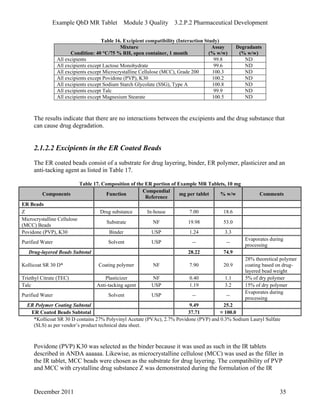
  • 56.
    Example QbD MRTablet Module 3 Quality 3.2.P.2 Pharmaceutical Development Table 33. Effect of ER polymer coating formulation variables on ER coated bead characteristics Factors: Formulation Variables Responses Std. Code Batch No. A: Theoretical polymer coating level B: Additional PVP level C: TEC level D: Polymer aging Y1: T20% Y2: T50% Y3: T80% Comments (%) (%) (%) (% Acetic Acid) (h) (h) (h) 1 6 20 0 2 0.5 1.29 3.37 8.67 2 3 40 0 2 1.5 2.92 6.71 17.74 3 1 20 10 2 1.5 0.81 2.79 5.98 4 5 40 10 2 0.5 2.39 5.81 16.04 5 10 20 0 10 1.5 1.48 4.15 9.12 6 8 40 0 10 0.5 3.07 7.54 19.18 7 2 20 10 10 0.5 1.08 3.27 7.42 8 7 40 10 10 1.5 2.69 6.33 16.48 Some tackiness due to excessive TEC was observed 9 11 30 5 6 1.0 2.12 5.12 13.07 10 9 30 5 6 1.0 2.02 4.98 12.61 11 4 30 5 6 1.0 1.91 4.83 12.27 Note to Reader: When center points are included in the factorial DOE, it is possible to test if the curvature effect is significant. The data analysis is done by separating the curvature term from the regression model in an adjusted model. This approach provides the factorial model coefficients as if there were no center points. If the curvature is significant, the design should be augmented to add runs that can estimate the quadratic terms. On the other hand, if the curvature is not significant, the adjusted model and unadjusted model will be similar. In this mock example, we have not included ANOVA results for each DOE. In practice, please be advised that ANOVA results should accompany all DOE data analysis, especially if conclusions concerning the significance of the model terms are discussed. For all DOE data analysis, the commonly used alpha of 0.05 was chosen to differentiate between significant and not significant factors. Significant factors for T50% of ER coated beads Since center points were included in the ER polymer coating optimization DOE, the significance of the curvature effect was tested using an adjusted model. The Analysis of Variance (ANOVA) results are presented in Table 34. December 2011 56
  • 57.
    Example QbD MRTablet Module 3 Quality 3.2.P.2 Pharmaceutical Development Table 34. ANOVA results for the model adjusted for curvature effect Source Sum of Squares df* Mean Square F Value p-value Probability > F Comments Model 22.96 3 7.65 322.39 < 0.0001 significant A-Theoretical polymer coating level (%) 20.51 1 20.51 864.17 < 0.0001 B-Additional PVP level (%) 1.59 1 1.59 67.12 0.0002 C-TEC level (%) 0.85 1 0.85 35.87 0.0010 Curvature 8.37E-04 1 8.37E-04 0.04 0.8573 not significant Residual 0.14 6 0.02 Lack of Fit 0.10 4 0.02 1.19 0.5035 not significant Pure Error 0.042 2 0.02 Total 23.10 10 *df: degrees of freedom Because the curvature effect is not significant for T50%, the center points were included for model fitting. As shown in the following half-normal plot (Figure 23) and ANOVA results for the unadjusted model (Table 35), the significant factors affecting T50% of ER coated beads were A (theoretical polymer coating level), B (additional PVP level) and C (TEC level). Half-Normal Plot Half-Normal%Probability |Standardized Effect| 0.00 0.80 1.60 2.40 3.20 0 10 20 30 50 70 80 90 95 A B C T50% (h) Shapiro-Wilk Test W-value = 0.814 p-value = 0.130 A: Theoretical polymer coating level (%) B: Additional PVP level (%) C: TEC level (%) D: Polymer aging (% Acetic Acid) Error Estimates Positive Effects Negative Effects Figure 23. Half-normal plot of the formulation variable effects on T50% of ER coated beads December 2011 57
  • 58.
    Example QbD MRTablet Module 3 Quality 3.2.P.2 Pharmaceutical Development Table 35. ANOVA results for the unadjusted model Source Sum of Squares df* Mean Square F Value p-value Probability > F Comments Model 22.96 3 7.65 373.92 < 0.0001 significant A-Theoretical polymer coating level (%) 20.51 1 20.51 1002.31 < 0.0001 B-Additional PVP level (%) 1.59 1 1.59 77.85 < 0.0001 C-TEC level (%) 0.85 1 0.85 41.61 0.0004 Residual 0.14 7 0.02 Lack of Fit 0.10 5 0.02 0.96 0.5807 not significant Pure Error 0.042 2 0.02 Total 23.10 10 *df: degrees of freedom Factor A (theoretical polymer coating level) was the dominating factor affecting the drug release, followed by B (additional PVP level) and C (TEC level). The remaining four model terms had no significant impact because they came from the normally distributed population as pure error based on Shapiro-Wilk hypothesis test results. The effect of additional pore former on ER T50% is presented in Figure 24. The T50% decreased with increasing amounts of pore former (i.e. the more pore former added, the faster the drug release). In addition, the initial part of the drug release profile differed significantly from the target drug release profile of the RLD. Therefore, the commercial product of Kollicoat SR 30 D was used in the formulation as is with no additional pore former. 0 2 4 6 8 10 B: Additional PVP level (%) T50%(h) 3.0 4.0 5.0 6.0 7.0T50% (h) X1 = B: Additional PVP level (%) Actual Factors A: Theoretical polymer coating level (%) = 30 C: TEC level (%) = 6 D: Polymer aging (% Acetic Acid) = 1.0 Design Points Figure 24. Main effect of additional pore former (% PVP) on T50% of ER coated beads The effect of theoretical polymer coating level and TEC level (with 0 % additional PVP) on T50% of ER coated beads is presented in Figure 25. The T50% increased (i.e. slower drug release) as theoretical polymer coating level and TEC level increased. December 2011 58
  • 59.
    Example QbD MRTablet Module 3 Quality 3.2.P.2 Pharmaceutical Development Some agglomeration due to film tackiness was observed for batches with 10% TEC as plasticizer. Therefore, the amount of TEC was reduced to 5 % for the final formulation. T50% (h) 7.5 2.8 X1 = A: Theoretical polymer coating level (%) X2 = C: TEC level (%) Actual Factors B: Additional PVP level (%) = 0 D: Polymer aging (% Acetic Acid) = 1 10 20 25 30 35 40 2 4 6 8 A: Theoretical polymer coating level (%) C:TEClevel(%) 7.0 4.0 6.05.0 Figure 25. Effect of theoretical polymer coating level and TEC level on T50% of ER coated beads Similar cause and effect relationships were observed for T20% and T80% of ER coated beads (data not shown). There were no interaction terms or curvature effects for any of the factors on the responses studied. Therefore, further optimization was not necessary. The DOE studies showed that the formulation with 25% theoretical polymer coating, 5% TEC and 15% Talc (both of the dry polymer) had optimal performance characteristics when compared to the drug release characteristics of the RLD using USP apparatus 2 at 50 rpm in 900 mL of pH 6.8 phosphate buffer. The viscosity of the coating dispersion caused no concerns during atomization. The amount of acetic acid present as a degradant in the commercial polymer had no impact on the ER coated bead drug release when present in the range of 0.5 – 1.5%. The drug release profile of the coated beads was not affected under accelerated storage conditions (6 months at 40 °C/75% RH, data not shown). The commercial product of Kollicoat SR 30 D aqueous dispersion lot-to-lot variability (PVAc content ranging from 25 – 29 g/100g and apparent viscosity ranging from 50 – 90 mPa•s) was studied and no impact on the drug release profile of ER coated beads was observed. Formulation of the ER Coated Beads Based on these studies, the formulation of the ER coated beads was selected for the pilot scale batch as shown in Table 36. December 2011 59
  • 60.
    Example QbD MRTablet Module 3 Quality 3.2.P.2 Pharmaceutical Development Table 36. Composition of the ER coated beads Components Function mg per tablet Comments ER Beads Z Drug substance 7.00 Microcrystalline Cellulose (MCC) Beads Substrate 19.98 Povidone (PVP), K30 Binder 1.24 Purified Water Solvent -- Drug-layered Beads Subtotal 28.22 Kollicoat SR 30 D* Coating polymer 7.06 25% theoretical polymer coating based on drug-layered bead weight Triethyl Citrate (TEC) Plasticizer 0.35 5% of the dry polymer Talc Anti-tacking agent 1.06 15% of the dry polymer Purified Water Solvent -- ER Polymer Coating Subtotal 8.47 ER Coated Beads Subtotal 36.69 14.0% *Kollicoat SR 30 D contains 27% PVAc, 2.7% PVP and 0.3% SLS as per product technical data sheet. Effect of Compression on Drug Release from ER Coated Beads Since it is desirable that the drug release from ER coated beads remain unaltered after compression into tablets, a compression study was conducted on ER coated beads from the DOE study in the previous section (Batch No. 1 with 2% TEC and 15% Talc) with placebo IR granules. The relationship between drug release and compression force was investigated. Significantly faster drug release from ER coated beads was observed and it indicated the existence of damaged beads. Therefore, cushioning from the IR granules alone was not sufficient. One way to eliminate the damage is to add additional cushioning agents. MCC was selected initially as the cushioning agent based on its use as such in the scientific literature.7 The formulation of the final blend is discussed in Section 2.2.1.4. Alcohol-induced Dose Dumping Study An in vitro alcohol-induced dose dumping study was conducted using 0.1 N HCl with 5%, 20% and 40% (v/v) of Alcohol USP. Data was collected every 15 minutes for a total of two hours. The ER coated beads performed similarly to the RLD tablets under each condition (data included in Module 5). The study also investigated if Kollicoat SR 30 D aging or lot-to-lot variability impacted alcohol- induced dose dumping and concluded that, for this formulation, these variables played an insignificant role in susceptibility to alcohol-induced dose dumping. Updated Risk Assessment of the ER Polymer Coating Formulation Variables These formulation development studies addressed the identified high risks. The updated risk assessment is presented in Table 37 followed by the justification for the reduced risks in Table 38. 7 Mount, DL. and Schwartz, JB. Formulation and Compaction of Nonfracturing Deformable Coated Beads. Drug Development and Industrial Pharmacy, 1996, 22(7): 609-621. December 2011 60
  • 61.
    Example QbD MRTablet Module 3 Quality 3.2.P.2 Pharmaceutical Development Table 37. Updated risk assessment of the ER polymer coating formulation variables ER Polymer Coating Formulation Variables ER coated beads CQAs Theoretical polymer coating level** Polymer aging Polymer lot to lot variability Additional pore former level Plasticizer level Anti- tacking agent level Viscosity of coating dispersion Drug release Medium Low Low N/A Low Low Low Drug release – alcohol- induced dose dumping Medium Low Low N/A Low Low* Low *The level of risk is not reduced from the initial risk assessment. **The percentage of theoretical polymer coating is calculated using total weight of polymer sprayed into the fluid bed divided by the total weight of drug-layered beads. Table 38. Justification for the reduced risks of the ER polymer coating formulation variables Formulation Variables ER coated beads CQAs Justification Drug release The theoretical polymer coating level (based on drug-layered bead weight) was identified as 25% because this coating level resulted in comparable drug release to the RLD using USP apparatus 2. A trial BE study will be conducted to verify that the dissolution method is predictive. Therefore, the risk of theoretical polymer coating level to impact drug release from the ER coated beads is reduced from high to medium. Theoretical polymer coating level Drug release – alcohol-induced dose dumping The alcohol-induced dose dumping study showed that the ER coated beads and RLD tablets had comparable in vitro drug release profiles. However, drug release is sensitive to polymer coating level. If the theoretical polymer coating level is adjusted based on the results of the trial BE study, then alcohol-induced dose dumping may be impacted. The risk is reduced from high to medium. Drug release Polymer aging Drug release – alcohol-induced dose dumping Polymer aging was studied and found to have no impact on in vitro drug release. The risk of polymer aging to impact drug release from ER coated beads is reduced from high to low. Drug release Polymer lot-to-lot variability Drug release – alcohol-induced dose dumping Polymer lot-to-lot variability did not show any significant impact on drug release from ER coated beads within the range investigated. The risk is reduced from high to low. Drug release Additional pore former level Drug release – alcohol-induced dose dumping The concentration of pore former is no longer considered a risk to drug release from ER coated beads because optimal release was achieved without adding additional pore former to the formulation. Drug release Plasticizer concentration was optimized at 5% of the dry polymer. This level resulted in adequate film quality. The risk of plasticizer concentration to impact drug release from the ER coated beads is reduced from high to low. Plasticizer level Drug release – alcohol-induced dose dumping In vitro drug release studies demonstrated comparable alcohol-induced dose dumping to the RLD. The risk is reduced from high to low. Anti-tacking agent level Drug release Talc is used to minimize stickiness during coating. Its concentration was adequate at 15% of the dry polymer. The risk of anti-tacking agent concentration to impact drug release from the ER coated beads is reduced from medium to low. December 2011 61
  • 62.
    Example QbD MRTablet Module 3 Quality 3.2.P.2 Pharmaceutical Development Formulation ER coated beads Justification Variables CQAs Drug releaseViscosity of coating dispersion Drug release – alcohol-induced dose dumping The viscosity of the selected coating dispersion can be effectively atomized. The risk of dispersion viscosity to impact drug release from ER coated beads under both normal and alcohol stress conditions is reduced from medium to low. 2.2.1.4 Prototype Tablet Formulation Development The objectives of the prototype tablet formulation development were to 1) prevent segregation of the blend, and 2) ensure an adequate cushioning effect to maintain ER bead integrity during tablet compression. A validated NIR spectroscopic method was used to determine the blending endpoint in the development studies (see Section 2.3.4 for details). Studies to optimize the filler and disintegrant levels in the prototype formulation used a 4 kg batch size. To optimize the lubricant, the batch size was increased to 10 kg for the compression unit operation. Initial Risk Assessment of the Extragranular Excipients in the Prototype Tablet Formulation The IR granules and ER coated beads are both components of the prototype tablet formulation that have been previously optimized, and the associated risk of these components on drug product CQAs has been reduced to acceptable levels. In addition to the IR granules and the ER coated beads, the prototype formulation was designed to contain cushioning agent, disintegrant and lubricant. As discussed previously, MCC was selected as a cushioning agent based on scientific literature.7 After consideration of the PSD and bulk density of both the IR granules and ER coated beads, MCC grade 200 was chosen as a starting point. The choice of disintegrant was made with respect to its effect on disintegration and dissolution. Crospovidone and SSG were initially evaluated as potential disintegrants in the formulation and preliminary studies showed that both excipients performed similarly in promoting tablet disintegration. Therefore, SSG was selected for further development because it was used in approved ANDA aaaaaa for Example IR Tablets and demonstrated good compatibility with drug substance Z. Magnesium stearate was selected as the lubricant based on its use in the RLD and its compatibility with drug substance Z. To identify formulation variables for further study, an initial risk assessment of the extragranular excipients was conducted. Differences in particle size and other physiochemical characteristics such as bulk density, morphology between the IR granules, ER coated beads and extragranular excipients may cause blend uniformity and tablet content uniformity failure due to segregation during downstream processing after blending. All the excipients used in the prototype formulation were evaluated in order to identify formulation variables with high risk as shown in Table 39. In Table 40, the justification for the risk prioritization is provided. December 2011 62
  • 63.
    Example QbD MRTablet Module 3 Quality 3.2.P.2 Pharmaceutical Development Table 39. Initial risk assessment of the extragranular excipients in the prototype tablet formulation Extragranular Excipients in the Prototype Tablet Formulation Prototype Tablet Formulation CQAs Filler (Cushioning Agent) Disintegrant Lubricant Physical Attributes (size and splitability) High Low Medium Content Uniformity High Low Medium Drug Release – whole tablets High High High Drug Release – split tablets High High High Table 40. Justification for the initial risk assessment of the extragranular excipients in the prototype tablet formulation Formulation Variables Prototype Tablet Formulation CQAs Justification Physical Attributes (size and splitability) MCC was selected as the extragranular cushioning agent. A lower than optimal amount of MCC may lead to ER polymer film rupture or bead fusion during compression and could facilitate segregation. Furthermore, the compressibility and compactability of the formulation may be poor. However, a greater than optimal amount of MCC may significantly impact the size of the tablets. Additionally, if the final formulation is overly compactable, high tablets that are difficult to split may result. The risk of extragranular filler level to impact the tablet physical attributes (size and splitability) is high. Content Uniformity PSD and bulk density differences between IR granules, ER coated beads and extragranular excipients can cause segregation. The MCC comprises the greatest percentage of the prototype formulation; thus, the risk of the MCC 200 PSD and bulk density to impact the tablet CU is high. Drug Release – whole tablets Insufficient extragranular cushioning agent may cause ER film rupture or fusion during compression. The risk of the extragranular filler level to impact whole tablet drug release is high. Filler (Cushioning Agent) Drug Release – split tablets The risk of MCC 200 to impact both tablet CU and whole tablet drug release is high. Therefore, the risk of impact on split tablet drug release is also high. Physical Attributes (size and splitability) SSG is a super-disintegrant. Since this super-disintegrant is used at low levels (< 5%), it will not significantly impact flowability, compressibility, compactability or tablet size. The risk of SSG to impact the tablet physical attributes (size and splitability) is low. Content Uniformity Because SSG is used at low levels (< 5%), its PSD will have a minimal impact on segregation. The risk of SSG to impact tablet CU is low. Drug Release – whole tablets Insufficient extragranular super-disintegrant will delay the disintegration of the tablet as well as the desired immediate release of drug substance from the IR granules. The degree of substitution for SSG Type A may also affect drug release. The risk of SSG to impact drug release from whole tablets is high. Disintegrant Drug Release – split tablets Although the risk of SSG to impact tablet CU is low, the risk of impact on drug release from whole tablets is high. Therefore, the risk of impact on drug release from split tablets is also high. December 2011 63
  • 64.
    Example QbD MRTablet Module 3 Quality 3.2.P.2 Pharmaceutical Development Physical Attributes (size and splitability) The amount of lubricant used in the formulation may impact the appearance of the tablets. If the amount is lower than optimal, picking may occur. If the amount is higher than optimal, it may adversely affect compressibility and compactability of the formulation. The risk of magnesium stearate to impact tablet physical attributes (size and splitability) is medium. Content Uniformity Because magnesium stearate reduces the friction between particles and may impact the flowability of the tablet formulation, the risk of impact on tablet CU is medium. Drug Release – whole tablets If the prototype formulation contains more than the optimal level of magnesium stearate or if the magnesium stearate specific surface area is not optimal, the powder particles may be over coated, leading to a delayed drug release profile. The risk of the lubricant to impact drug release from whole tablets is high. Lubricant Drug Release – split tablets The risk of the lubricant to impact tablet CU is medium and the risk of impact on whole tablet drug release is high. For these reasons, the risk of the lubricant to impact split tablet drug release is high. Optimizing the Ratio of Filler to ER Coated Beads Previous experience with multi-particulate systems compressed into tablets suggests that, as a starting point, the drug product formulation should contain not more than 25% w/w of coated beads per tablet to ensure sufficient ER bead cushioning during compression.7 Cushioning prevents the polymer film on the beads from rupturing. It also prevents beads from fusing together during compression. Table 41 lists the weight ratios of extragranular filler to ER coated beads that were considered in prototype tablet formulations. For these batches, the quantity of disintegrant and lubricant in the formulation was held constant for simplicity and the corresponding percentages used were kept within the ranges recommended in the Handbook of Pharmaceutical Excipients.8 Lubricant and disintegrant levels will be optimized in subsequent experiments. Table 41. Prototype tablet formulations with different ratios of extragranular MCC 200 to ER coated beads Batch No. IR Granules ER Beads MCC 200 SSG Magnesium Stearate Tablet Weight Beads Weight Ratio Filler:Beads (mg) (mg) (mg) (mg) (mg) (mg) (% w/w) RD-22 62.50 36.69 50.00 10.00 2.50 161.69 22.69 1.36 RD-23 62.50 36.69 75.00 10.00 2.50 186.69 19.65 2.04 RD-24 62.50 36.69 100.00 10.00 2.50 211.69 17.33 2.73 RD-25 62.50 36.69 150.00 10.00 2.50 261.69 14.02 4.09 RD-26 62.50 36.69 200.00 10.00 2.50 311.69 11.77 5.45 All five batches were compressed into tablets with a target hardness of 8 kP and the drug release profiles were compared with the drug release profile of active components (IR granules and ER coated beads) in a capsule. The results are graphed in Figure 26. 8 Rowe, RC., PJ Sheskey and ME Quinn. Handbook of Pharmaceutical Excipients, 6th Edition. Grayslake, IL: RPS Publishing, 2009. December 2011 64
  • 65.
    Example QbD MRTablet Module 3 Quality 3.2.P.2 Pharmaceutical Development 0 10 20 30 40 50 60 70 80 90 100 0 2 4 6 8 10 12 14 16 18 20 22 24 Time (h) DrugReleased(%) Batch RD-22 Batch RD-23 Batch RD-24 Batch RD-25 Batch RD-26 Capsule Figure 26. Drug release profile comparison of batches made with different ratios of filler to ER coated beads Batches RD-22 and RD-23 showed significantly faster drug release compared to drug filled capsules which suggested that the higher ratio of extragranular excipients to ER coated beads is essential to provide enough cushioning to avert bead rupture. The drug release profiles for batches RD-24, RD-25 and RD-26 are very similar to the release profile for the drug filled capsules. Based on this data, 150 mg of extragranular filler per tablet was selected for the final MR tablet formulation, which would yield a tablet with a similar size and total weight as the RLD. Subsequent to optimizing the ratio of filler to ER coated beads, a predictive dissolution method was developed. The drug release study was repeated and once again, a level of 150 mg of extragranular filler per tablet provided adequate cushioning to protect ER coated beads from rupture during compression. Segregation was observed during manufacturing (see detail in Section 2.3.4 Blending and Lubrication Process Development). To address the issue of segregation in the prototype formulation and to reduce the risk of poor content uniformity, the following approaches were considered: 1) keep the bulk density and the particle size of most materials as close as possible while filling voids with small particles, 2) roller compaction, and 3) multiple layer tableting. Approach 1 is discussed in the following section. As roller compaction may damage the membrane of the coated beads, this approach was ruled out. Multiple-layer tableting increases development complexity, especially when developing scored tablets; therefore, it was also ruled out. Optimizing the Ratio of Different Grades of Extragranular Filler to Minimize Segregation To minimize segregation, the prototype formulation had to be optimized such that the bulk density and the particle size of most materials were similar and any voids were filled with small particles. Various combinations of excipients having 1) bulk density and particle sizes as close as possible to the ER beads, and 2) particle sizes sufficiently small to fill the void volume were considered. December 2011 65
  • 66.
    Example QbD MRTablet Module 3 Quality 3.2.P.2 Pharmaceutical Development Multiple excipients were selected to be evaluated in trial batches to test blend uniformity and the cushioning effect on beads. From previous experience, differences in bulk density and PSD among excipients can lead to segregation in a blend. In order to maintain the cushioning effect required to prevent ER bead damage during tablet compression and to minimize blend segregation, a combination of MCC fillers with different PSDs was investigated. The rationale is that two distinctly different grades of filler are more likely to fill large and small spaces in the formulation microenvironment than a single grade, thereby producing a more uniform and compressible prototype formulation. A variety of MCC grades are commercially available. After an extensive review of vendor technical data sheets, two MCC grades were selected based on bulk density and particle size distribution. MCC Filler 1 (Grade 200, bulk density: 0.32 g/cm3 , d50: 180 µm) and Filler 2 (Grade 101, bulk density: 0.28 g/cm3 , d50: 50 µm) were chosen for further optimization. A series of trial lab batches were made with different ratios of the two fillers mixed with ER beads and IR granules. These prototype formulations were tested for blend uniformity (after discharging into drums). The results for blend uniformity measured by the assay percent relative standard deviation (RSD) are summarized in Table 42. Table 42. Selection of filler ratio based on blend uniformity (optimal ratios highlighted) Trial Batch No. Filler 1: Filler 2 Ratio Label Claim RSD (% w/w) (%) RD-41 10:90 95.8 5.6 RD-42 20:80 96.5 4.6 RD-43 30:70 96.8 4.5 RD-44 40:60 98.6 2.6 RD-45 50:50 99.9 2.2 RD-46 60:40 100.3 1.3 RD-47 70:30 100.2 1.5 RD-48 80:20 96.4 4.3 RD-49 90:10 96.3 4.1 From the above experiment, Filler 1 and Filler 2 best prevent segregation and provide good blend uniformity when used in the ratios of 60:40 and 70:30. Both trial batches RD-46 and RD-47 were compressed into tablets with a target hardness of 8.0 kP and drug release profiles were compared to that of the reference tablet as shown in Figure 27. December 2011 66
  • 67.
    Example QbD MRTablet Module 3 Quality 3.2.P.2 Pharmaceutical Development 0 10 20 30 40 50 60 70 80 90 100 0 2 4 6 8 10 12 14 16 18 20 22 24 Time (h) DrugReleased(%) Batch RD-46 Batch RD-47 RLD Figure 27. Drug release profiles of trial batches RD-46 and RD-47 and RLD tablets Compressed tablets from both trial batches RD-46 and RD-47 showed comparable drug release profiles, indicting that Filler 1 and Filler 2 used in a ratio of 60:40 to 70:30 can prevent ER membrane rupture. A Filler 1 to Filler 2 ratio of 65:35 was selected for the final formulation. Optimizing the Level of Disintegrant The quantity of SSG Type A was varied (2 – 5%) within the range recommended in the Handbook of Pharmaceutical Excipients to evaluate its influence on product performance.8 Compressed tablets containing both IR granules, ER coated beads, MCC 200, MCC 101 and magnesium stearate were used. The results are provided in Table 43. Table 43. Optimization of the sodium starch glycolate level Batch No. RD-56 RD-57 RD-58 RD-59 RLD SSG (%) 2 3 4 5 Unknown Disintegration 6 min 2.5 min 1.5 min 1.5 min 1.5 min Drug Release % Drug dissolved in 900 mL of pH 6.8 phosphate buffer using USP Apparatus 2 at 50 rpm 10 min 5 12 11 11 11 20 min 10 12 14 13 16 30 min 18 32 33 33 33 The dissolution profiles of the formulations containing 3 – 5% SSG were comparable to the RLD sample. Thus, 4% SSG was selected in the final formulation. A subsequent study using 4% SSG Type A in the formulation demonstrated that the degree of substitution investigated (0.25 – 0.35) had no impact on disintegration or drug release of the tablets. Optimizing the Level of Lubricant The goal of this study was to find the minimum level of magnesium stearate needed to provide adequate lubrication for tableting. The range of lubricant studied (0.2 – 1.2%) was within the range December 2011 67
  • 68.
    Example QbD MRTablet Module 3 Quality 3.2.P.2 Pharmaceutical Development recommended in the Handbook of Pharmaceutical Excipients.8 Four batches (10 kg each) of prototype formulation were manufactured with the following quantities of lubricant: 0.2%, 0.4%, 0.8%, and 1.2%. The lubrication was carried out in a 1 cu ft V-blender at 15 rpm. The sensitivity of the responses to the number of revolutions (Nrev) was also investigated. Samples (500 g) were withdrawn at 60, 90, and 120 revolutions. These samples were compressed at 8 kN. The responses measured were: • Tablet appearance • Tablet tooling appearance • Hardness • Friability • Ejection force • Disintegration • Drug Release The study results are summarized in Table 44. Table 44. Effect of lubricant and lubrication parameters on tablet properties Batch No. RD-60 RLD Lubricant (%) 0.2 - Nrev 60 90 120 - Tablet appearance Unclear score, uneven tablet surface and striations on the side - Tablet tooling appearance Visible indication of sticking on punches and binding in the die - Ejection force (N) 650 500 450 The remaining responses were not evaluated based on the results of tablet and tooling appearance. Batch No. RD-61 RLD Lubricant (%) 0.4 - Nrev 60 90 120 - Tablet appearance Slightly rough surfaces but no visible picking/sticking - Tablet tooling appearance Slight hazing of the punch surfaces but no evidence of binding in the die - Ejection force (N) 350 325 275 - Hardness (kP) 10 9.5 9.5 - Friability (%) 0.1 0.12 0.1 - Disintegration time (min) 1.5 1.5 2 - Drug release % Drug dissolved in 900 mL of pH 6.8 phosphate buffer using USP Apparatus 2 at 50 rpm 0.25 h 11 9 10 11 0.5 h 34 32 31 33 3 h 41 43 42 42 6 h 67 64 66 65 12 h 86 89 86 87 December 2011 68
  • 69.
    Example QbD MRTablet Module 3 Quality 3.2.P.2 Pharmaceutical Development Batch No. RD-62 RLD Lubricant (%) 0.8 - Nrev 60 90 120 - Tablet appearance Shiny appearance with smooth surface - Tablet tooling appearance Shiny appearance with no evidence of picking and sticking - Ejection force (N) 150 100 125 - Hardness (kP) 8.9 8.4 8.6 - Friability (%) 0.08 0.07 0.07 - Disintegration time (min) 2 1.5 2.5 - Drug release % Drug dissolved in 900 mL of pH 6.8 phosphate buffer using USP Apparatus 2 at 50 rpm 0.25 h 11 10 11 11 0.5 h 31 33 32 33 3 h 38 39 40 42 6 h 66 67 65 65 12 h 90 86 88 87 Batch No. RD-63 RLD Lubricant (%) 1.2 - Nrev 60 90 120 - Tablet appearance Shiny appearance with smooth surface - Tablet tooling appearance Shiny appearance with no evidence of picking and sticking - Ejection force (N) 130 115 100 - Hardness (kP) 8.0 8.2 8.3 - Friability (%) 0.11 0.09 0.06 - Disintegration time (min) 2.5 2 2 - Drug release % Drug dissolved in 900 mL of pH 6.8 phosphate buffer using USP Apparatus 2 at 50 rpm 0.25 h 13 10 12 11 0.5 h 32 33 31 33 3 h 39 40 44 42 6 h 68 65 66 65 12 h 87 87 89 87 The results indicated that 0.2% and 0.4% magnesium stearate provide sub-optimal lubrication based on the appearance of the tablets. The 0.8% and 1.2% lubricant levels gave the desired drug release profile without significant compression-related issues such as tablet picking and sticking. In addition, none of the responses studied were sensitive to the number of revolutions. Based on these results, 0.8% magnesium stearate was used in the final formulation and 60-120 revolutions results in adequate lubrication. Furthermore, the impact of magnesium stearate specific surface area on the responses listed above was studied using a level of 0.8% magnesium stearate in the formulation. Within the range investigated (6-10 m2 /g), the impact on the responses was not significant (data not shown). The tablets compressed during Batch No. RD-62 (150 mg of cushioning agent, 4% SSG, and 0.8% magnesium stearate) were split either with a tablet splitter or by hand and were then evaluated for weight loss. For both splitting methods, the split tablets had a loss of mass less than 1.5% indicating that either method could be used. Regardless of splitting method, whole and hand-split tablets December 2011 69
  • 70.
    Example QbD MRTablet Module 3 Quality 3.2.P.2 Pharmaceutical Development performed similarly and met the drug product specifications for friability, assay and drug release (similarity factor (f2) > 80). Both whole and split tablets demonstrated content uniformity (AV< 5). Updated Risk Assessment of the Extragranular Excipients in the Prototype Tablet Formulation The prototype formulation development studies addressed the identified risks. The updated risk assessment is presented in Table 45 followed by the justification for the reduced risks in Table 46. Table 45. Updated risk assessment of the extragranular excipients in the prototype tablet formulation Extragranular Excipients in the Prototype Tablet Formulation Prototype Tablet Formulation CQAs Filler Disintegrant Lubricant Physical Attributes (size and splitability) Low Low* Low Content Uniformity Low Low* Low Drug Release – whole tablets Low Low Low Drug Release – split tablets Low Low Low *The level of risk is not reduced from the initial risk assessment. Table 46. Justification for the reduced risks of the extragranular excipients in the prototype tablet formulation Formulation Variables Prototype Tablet Formulation CQAs Justification Physical Attributes (size and splitability) The level of filler required to cushion the ER coated beads was optimized to control the size of the tablet. The tablet size is similar to the RLD. The formulation demonstrated good compressibility and compactability. Therefore, the risk of extragranular filler level to impact physical attributes (size and splitability) is reduced from high to low. Content Uniformity MCC 200 (d50: 150 -250 µm) and MCC 101 (d50: 30-80 µm) are fixed in the ratio 65:35 to prevent segregation. The flow of the prototype formulation was adequate based on a minimum orifice diameter of 20 mm as determined by Flowdex. Tablets demonstrated acceptable CU per USP <905>. The risk of extragranular filler level and grade to impact tablet CU is reduced from high to low. Drug Release – whole tablets The level and grades of MCC were optimized to prevent segregation and to protect the ER coated beads from damage during compression. Therefore, the risk of MCC to impact drug release from whole tablets is reduced from high to low. Filler (Cushioning Agent) Drug Release – split tablets Both whole and split tablets demonstrated CU as per USP <905>. The drug release from whole and split tablets was comparable. The risk of extragranular filler to impact drug release from split tablets is reduced from high to low. December 2011 70
  • 71.
    Example QbD MRTablet Module 3 Quality 3.2.P.2 Pharmaceutical Development Drug Release – whole tablets The level of SSG Type A was optimized to achieve the desired drug release profile. The degree of substitution showed no effect on release. Thus, the risk of disintegrant to impact drug release from whole tablets is reduced from high to low. Disintegrant Drug Release – split tablets The drug release from whole and split tablets was comparable. The risk of impact on drug release from split tablets is reduced from high to low. Physical Attributes (size and splitability) The level of magnesium stearate used in the prototype formulation (0.8%) did not cause any tablet appearance issues during compression. Thus, the risk of lubricant to impact tablet physical attributes (size and splitability) is reduced from medium to low. Content Uniformity Tablets compressed with the selected level of magnesium stearate achieved acceptable tablet CU as per USP <905>. The risk of lubricant to impact tablet CU is reduced from medium to low. Drug Release – whole tablets The impact of the magnesium stearate level and specific surface area on the drug release profile is not significant. The risk of impact on whole tablet drug release is reduced from high to low. Lubricant Drug Release – split tablets Both whole and split prototype tablets demonstrated good CU. The drug release from whole and split tablets was comparable. Thus, the risk of lubricant to impact drug release from split tablets is reduced from high to low. 2.2.1.5 Prototype Tablet Formulations and Trial BE Studies The conclusions from the formulation development work supported the manufacture of a 4 kg lab scale batch of ER coated beads. The beads were blended with IR granules and extragranular excipients, and the blend was compressed into tablets for further evaluation. The formulation of prototype F-1, Lot No. ZAp030110, is summarized in Table 47. December 2011 71
  • 72.
    Example QbD MRTablet Module 3 Quality 3.2.P.2 Pharmaceutical Development Table 47. Formulation of prototype F-1 Components Function Compendial Reference mg per tablet Comments IR Granules Z Drug substance In-house 3.00 Microcrystalline Cellulose (MCC), Grade 200 Filler NF 32.62 Lactose Monohydrate Filler NF 21.88 Povidone (PVP), K30 Binder USP 2.50 Sodium Starch Glycolate (SSG), Type A Disintegrant NF 2.50 Purified Water Solvent USP -- IR Granules Subtotal 62.50 ER Beads Z Drug substance In-house 7.00 Microcrystalline Cellulose (MCC) Beads Substrate NF 19.98 Povidone (PVP), K30 Binder USP 1.24 Purified Water Solvent USP -- Drug-layered Beads Subtotal 28.22 Kollicoat SR 30 D* Coating polymer NF 7.06 25% theoretical polymer coating based on drug-layered bead weight Triethyl Citrate (TEC) Plasticizer NF 0.35 5% of the dry polymer Talc Anti-tacking agent USP 1.06 15% of the dry polymer Purified Water Solvent USP -- ER Polymer Coating Subtotal 8.47 ER Coated Beads Subtotal 36.69 Extragranular Excipients Microcrystalline Cellulose (MCC), Grade 200 Filler NF 97.50 Microcrystalline Cellulose (MCC), Grade 101 Filler NF 52.50 Sodium Starch Glycolate (SSG), Type A Disintegrant NF 10.47 Magnesium Stearate Lubricant NF 2.09 Total tablet weight 261.75 *Kollicoat SR 30 D contains 90% PVAc, 9% PVP and 1% SLS calculated on a solids basis. The drug release profiles of prototype F-1 were obtained using USP apparatus 2 at 50 rpm in various media and the data showed that the in vitro drug release of this formulation matched the RLD profile (see Section 1.4.1 Figure 5). The drug release of the prototype showed pH- independence. In addition, in vitro alcohol-induced dose dumping studies were conducted in 5%, 20% and 40% v/v Alcohol USP in 0.1 N HCl medium. The drug release profile for the prototype did not indicate any increased alcohol-induced dose dumping potential for whole or split tablets as both the RLD and prototype performed comparably under each condition (data included in Section 5.3). December 2011 72
  • 73.
    Example QbD MRTablet Module 3 Quality 3.2.P.2 Pharmaceutical Development A pilot BE study was conducted using prototype F-1. The RLD provided a biphasic profile representing the IR and ER portions which was not observed for prototype F-1 (see Section 1.4.1 Figure 4). The data suggested the need to slow the release rate from the ER beads in the prototype formulation. The BE study results also suggested that the in vitro dissolution method was not predictive of the in vivo performance of the prototype formulation. Although multimedia dissolution testing using USP apparatus 2 provided similar drug release profiles for the RLD and prototype F-1, the prototype released drug at a much faster rate in vivo. Based on the results of the failed BE study, a more predictive dissolution method using USP apparatus 3 at 10 dpm in 250 mL of pH 6.8 phosphate buffer was developed and an IVIVR was established (see sections 1.4.1 and 1.4.2). The dissolution test on the first prototype formulation (F- 1) was rerun using the new predictive dissolution method. It was evident that the in vitro drug release rate was much faster when measured by the new dissolution method (see Section 1.4.1 Figure 9). Therefore, the formulation needed an adjustment in the theoretical polymer coating level to achieve the optimal release profile. The formulation of the ER coated beads was further modified to develop two new prototypes F-2 and F-3 as shown in Table 48. December 2011 73
  • 74.
    Example QbD MRTablet Module 3 Quality 3.2.P.2 Pharmaceutical Development Table 48. Formulation of prototypes F-2 and F-3 mg per tablet Components Function Compendial Reference F-2 F-3 Comments IR Granules Z Drug substance In-house 3.00 3.00 Microcrystalline Cellulose (MCC), Grade 200 Filler NF 32.62 32.62 Lactose Monohydrate Filler NF 21.88 21.88 Povidone (PVP), K30 Binder USP 2.50 2.50 Sodium Starch Glycolate (SSG), Type A Disintegrant NF 2.50 2.50 Purified Water Solvent USP -- -- IR Granules Subtotal 62.50 62.50 ER Beads Z Drug substance In-house 7.00 7.00 Microcrystalline Cellulose (MCC) Beads Bead NF 19.98 19.98 Povidone (PVP), K30 Binder USP 1.24 1.24 Purified Water Solvent USP -- -- Drug-layered Beads Subtotal 28.22 28.22 Kollicoat SR 30 D* Coating polymer NF 8.47 9.88 30% (F-2) and 35% (F-3) theoretical polymer coating based on drug- layered bead weight Triethyl Citrate (TEC) Plasticizer NF 0.42 0.49 5% of dry polymer Talc Anti-tacking agent USP 1.27 1.48 15% of dry polymer Purified Water Solvent USP -- -- ER Polymer Coating Subtotal 10.16 11.85 ER Coated Beads Subtotal 38.38 40.07 Extragranular Excipients Microcrystalline Cellulose (MCC), Grade 200 Filler NF 97.50 97.50 Microcrystalline Cellulose (MCC), Grade 101 Filler NF 52.50 52.50 Sodium Starch Glycolate (SSG), Type A Disintegrant NF 10.47 10.47 Magnesium Stearate Lubricant NF 2.09 2.09 Total tablet weight 263.44 265.13 *Kollicoat SR 30 D contains 90% PVAc, 9% PVP and 1% SLS calculated on a solids basis. In vitro drug release profiles were generated for prototypes F-2 and F-3 using the predictive dissolution method (see Section 1.4.2 Figure 12). The increase in the theoretical polymer coating level from 25% (F-1) to 30% (F-2) led to a formulation exhibiting a drug release profile which was similar to the RLD drug release profile. However, a 35% theoretical polymer coating (F-3) showed a slower drug release profile. A second pilot BE study was conducted comparing prototypes F-2 and F-3 to the RLD (see Section 1.4.2 Table 7 and Figure 14). Only prototype F-2 exhibited bioequivalence to the RLD. Based on the results, prototype F-2 with 30% theoretical polymer coating was selected and used in the subsequent development. Table 48 lists the composition of prototype F-2. Accelerated stability data (6 months at 40 °C/75% RH) for prototype F-2 confirmed that the selected drug product formulation is stable and meets all quality attributes defined in the QTPP. December 2011 74
  • 75.
    Example QbD MRTablet Module 3 Quality 3.2.P.2 Pharmaceutical Development Water activity was measured and shown to be below 0.4, demonstrating that Example MR Tablets do not support survival or proliferation of microorganisms. An in-use stability study (3 months at 25 °C/60% RH) conducted on split tablets stored in the proposed packaging demonstrated that the split tablets also meet the established stability requirements. Detailed stability data for both studies can be found in Section 3.2.P.8. A study comparing the drug release profiles of whole and split tablets was conducted using prototype F-2 tablets and the predictive dissolution method. Whole and split tablets demonstrated comparable drug release (f2 = 80). Prototype F-2 tablets were also tested in the indicated patient population to ensure that the patients could split the tablet correctly. The patient population found the tablet splitability to be acceptable whether tablets were split by hand or with a tablet splitter. 2.2.1.6 Updated Risk Assessment of the Formulation Components During formulation development, the high risks for each component of the overall drug product formulation were addressed. Experimental studies were defined and executed to develop additional scientific knowledge and understanding and to reduce the risk to an acceptable level. After detailed experimentation, the initial overall risk assessment of the formulation components was updated in- line with the current product understanding. Tables 49 and 50 provide the updated risk assessment of the formulation of Example MR Tablets, 10 mg, and the justification for the reduced risk following formulation development, respectively. Table 49. Updated risk assessment of the formulation components Formulation Components Drug Product CQAs IR Granules ER Beads: drug-layered beads ER Beads: coated beads Extragranular Excipients Physical Attributes (size and splitability) Low* Low* Low* Low Assay Low* Low Low* Low Content Uniformity Low* Low Low* Low Drug Release – whole tablets Low Low Medium Low Drug Release – split tablets Low Low Medium Low Drug Release – alcohol-induced dose dumping N/A* N/A* Medium Low *The level of risk is not reduced from the initial risk assessment. December 2011 75
  • 76.
    Example QbD MRTablet Module 3 Quality 3.2.P.2 Pharmaceutical Development Table 50. Justification for the reduced risks of the formulation components Formulation Components Drug Product CQAs Justification Drug Release – whole tablets The target drug release from the IR granules (NLT 80% in 30 min) can be met when IR granules are compressed with placebo beads. Therefore, the risk of the IR granules to impact drug release from whole tablets is reduced from medium to low. IR Granules Drug Release – split tablets Split tablets had adequate CU with an AV < 5 as per USP <905> and comparable drug release to whole tablets (f2 = 80). The risk of the IR granules to impact drug release from split tablets is reduced from medium to low. Assay The drug substance to binder ratio of 85:15 was selected and provided adequate adhesion of the drug substance to the beads. The risk of the drug-layered beads to impact tablet assay is reduced from high to low. Content Uniformity In order to prevent segregation, MCC beads with a comparable PSD and bulk density to the IR granules were selected as the cores for drug layering. The tablets had acceptable CU with an AV < 5. Thus, the risk of the drug-layered beads to impact tablet CU is reduced from medium to low. Drug Release – whole tablets MCC beads are insoluble and it is unlikely that the drug substance diffuses into the core. MCC beads have very low friability (< 0.1%) and the drug-layered beads showed rapid dissolution with low variability. An 85:15 drug substance to binder ratio produced uniform drug-layered beads. Drug substance was stabilized in an amorphous state in the drug layer, and no form conversion was observed at room temperature for up to two years. Thus, the risk of the drug-layered beads to impact drug release from whole tablets is reduced from high to low. ER Beads: drug-layered beads Drug Release – split tablets Split tablets had adequate CU with an AV < 5 and comparable drug release to whole tablets (f2 = 80). The risk of drug-layered beads to impact drug release from split tablets is reduced from high to low. Drug Release – whole tablets The theoretical polymer coating level needed to match the RLD performance was identified as 30%. However, drug release is sensitive to polymer coating level based on the BE studies. Further evaluation during process development and scale-up is needed since process variables may affect the actual coating level achieved. The risk of the ER coated beads to impact drug release from whole tablets is reduced from high to medium. Drug Release – split tablets Split tablets had adequate CU with an AV < 5 and comparable drug release to whole tablets (f2 = 80). The risk is reduced because there was no evidence that tablet splitting damaged the integrity of the ER coated beads. However, drug release is sensitive to polymer coating level based on the BE studies. Further evaluation during process development and scale-up is needed since process variables may affect the actual coating level achieved. Therefore, the risk of the ER coated beads to impact split tablet drug release is medium. ER Beads: coated beads Drug Release – alcohol-induced dose dumping Alcohol-induced dose dumping was evaluated and found to be comparable to the RLD. However, this study will need to be repeated to confirm that tablets made at commercial scale also perform comparably to the RLD. Thus, the risk of the ER coated beads to impact alcohol- induced dose dumping is reduced from high to medium. December 2011 76
  • 77.
    Example QbD MRTablet Module 3 Quality 3.2.P.2 Pharmaceutical Development Formulation Drug Product Justification Components CQAs Physical Attributes (size and splitability) The type and level of cushioning agent, disintegrant and lubricant used in the prototype formulation was identified and the tablet size is similar to that of the RLD. Tablets could be split by the intended patient population and splitting resulted in less than 2% mass loss. Therefore, the risk of extragranular excipients to impact tablet physical attributes (size and splitability) is reduced from high to low. Assay The flow of the prototype formulation was good based on a minimum orifice diameter of 20 mm as determined by Flowdex. The risk of the extragranular excipients to impact tablet assay is reduced from medium to low. Content Uniformity The risk of segregation and poor BU was reduced using two grades of MCC with complementary PSDs (one similar to the IR granules and ER coated beads and one smaller to fill void space). Both whole and split prototype tablets demonstrated acceptable CU with an AV < 5. Therefore, the risk of extragranular excipients to impact tablet CU is reduced from high to low. Drug Release – whole tablets MCC used as a cushioning agent in the prototype formulation prevented the ER polymer film from rupturing and from fusing during compression, and it reduced variability in the overall drug release profile. The level of SSG Type A was optimized to achieve the desired initial rapid drug release from the IR granules. The impact of the magnesium stearate amount and specific surface area on the drug release profile was not significant. The risk of extragranular excipients to impact whole tablet drug release is reduced from high to low. Drug Release – split tablets Development studied showed that split tablets had adequate CU as per USP <905> and comparable drug release to whole tablets (f2 = 80). The risk of extragranular excipients to impact split tablet drug release is reduced from high to low. Extragranular Excipients Drug Release – alcohol-induced dose dumping The level of extragranular cushioning agent was optimized and the tablets performed comparably to the RLD under alcohol stress conditions. The risk is reduced from medium to low. 2.2.2 Overages There are no overages used in the formulation of Example MR Tablets, 10 mg. 2.2.3 Physicochemical and Biological Properties Please refer to Section 1.4 Dissolution Method Development and Bioequivalence Studies for a discussion of the development of a predictive dissolution method, the results of bioequivalence studies, and the establishment of an IVIVR. December 2011 77
  • 78.
    Example QbD MRTablet Module 3 Quality 3.2.P.2 Pharmaceutical Development December 2011 78 2.3 Manufacturing Process Development Note to Reader: This section involves process development and understanding. Steps to establish process understanding are as follows: • Identify all possible known material attributes and process parameters that could impact the performance of the process. • Use risk assessment and scientific knowledge to identify potentially high risk attributes and/or parameters. • Identify levels or ranges of these potentially high risk attributes and/or parameters. • Design and conduct experiments, using DOE when appropriate. • Analyze the experimental data to determine if a material attribute or process parameter is critical. – A material attribute or process parameter is critical when a realistic change in that attribute or parameter can significantly impact the quality of the output material. • Develop a control strategy. – For CMAs and CPPs, define acceptable ranges. For non-critical attributes and parameters, the acceptable range is the range investigated. The process map for Example MR Tablets, 10 mg, is presented in Figure 28. This process map lists all of the unit operations in the manufacturing process for Example MR Tablets in the sequence of occurrence. It also presents how input material attributes and manufacturing process parameters can potentially impact intermediate and finished product quality attributes. The attributes of incoming raw materials and the process parameters used at the very first unit operation determine the quality attributes of the output material (intermediate) produced at this step. Attributes of the intermediate and processing parameters of the subsequent unit operations in the manufacturing scheme will determine quality attributes of the next intermediate and, eventually, those of the finished drug product. This cycle repeats until the final unit operation where finished product is manufactured and the finished product quality attributes are evaluated. Note that this process map excludes the quantities of raw materials (i.e. binder, coating agent, plasticizer, pore former, anti-tacking agent and extragranular excipients) from the material attributes column because these are evaluated as part of formulation development.
  • 79.
    Example QbD MRTablet Module 3 Quality 3.2.P.2 Pharmaceutical Development December 2011 79 Drug substance solid state form Drug substance PSD and bulk density Core beads friability, PSD and bulk density Binder type/grade Binder Lot-to-lot variation Drug layering solution viscosity Inlet air volume Inlet air temperature Product temperature Spray rate per nozzle Nozzle diameter and number of nozzles Atomization air pressure Partition diameter and height Capacity utilized Inlet air dew point Filter type Filter shake interval/duration Holding time Screen size Screen type Inlet air volume Inlet air temperature Product temperature Spray rate per nozzle Nozzle diameter and number of nozzles Atomization air pressure Partition diameter and height Capacity utilized Inlet air dew point Filter type Filter shake interval/duration Holding time Screen size Screen type Holding Time Material Transfer Method Order of Addition Blender Type/Geometry No. of revolutions (time and speed) Capacity utilized Intensifier bar (on/off) Compression tooling selection Pre-compression force Main compression force Press speed Feeder speed/Type Ejection force Hopper design: Height and Vibration Hopper fill Compressed Tablets Assay Content uniformity - whole and split Disintegration/Drug release profile Weight Variation Hardness Splitability Friability Drug-layered Beads Assay Uniformity Drug substance solid state form Dissolution LOD Process efficiency ER Polymer Coated Beads PSD Drug release profile Alcohol-induced dose dumping LOD Process efficiency Screened ER Coated Beads PSD Drug release profile of sieve cuts Fines/Agglomerates (Rejects) Final Blend Blend uniformity PSD Bulk density Potential for segregation Flowability Compressibility/Compactability Screened Drug-layered Beads PSD Fines/Agglomerates (Rejects) Drug-layered Bead PSD and bulk density Drug-layered bead assay, LOD and dissolution Coating polymer type/grade/variability Plasticizer type/grade Pore former type/grade Anti-tacking agent type/PSD Coating dispersion solids content and viscosity Coating dispersion sedimentation IR granules assay, BU, drug release profile IR granules PSD and bulk density Extragranular excipient type/grade Extragranular excipient PSD Extragranular excipient bulk density Extragranular excipient moisture content Extragranular excipient lot-to-lot variability ER coated beads PSD and bulk density Blend uniformity Particle size distribution Bulk density Potential for segregation Flowability/Compressibility/Compactability ER Polymer Coating Sieving II (ER Coated Beads) Blending and Lubrication Compression Drug Layering Sieving I (Drug-layered Beads) Manufacturing Process Steps Quality Attributes of Output Materials Material Attributes of Input Materials Process Parameters Figure 28. Process map for Example MR Tablets, 10 mg
  • 80.
    Example QbD MRTablet Module 3 Quality 3.2.P.2 Pharmaceutical Development 2.3.1 Initial Risk Assessment of the Drug Product Manufacturing Process A risk assessment of the overall drug product manufacturing process was performed to identify the high risk steps that could affect the final drug product CQAs. Subsequently, the drug product intermediate CQAs that are directly linked to the identified final drug product CQAs were identified. The process variables that could impact the identified drug product intermediate CQAs became the focus of the risk assessment to determine which variables have the highest potential to cause a CQA failure. These variables then needed to be investigated in order to optimize the drug product manufacturing process and reduce the risk of failure. For example, the overall risk assessment of the manufacturing process found assay of the tablets to be at high risk of failure due to the drug layering step. Subsequently, assay of the layered beads is directly linked to final tablet assay and was identified as the CQA of the drug-layered beads. Process variables that could directly impact the assay of the drug-layered beads were assessed to identify which of the variables could have the highest potential to cause a bead assay failure. This method of identifying process variables for further study was also illustrated previously in Figure 19. In the initial risk assessment of the overall manufacturing process shown in Table 51, drug layering, ER polymer coating, blending and lubrication, and compression were identified as high risk steps that could affect the quality of the final product. Justification for each risk assignment is presented in Table 52. Table 51. Initial risk assessment of the manufacturing process for Example MR Tablets, 10 mg Process Steps Drug Product CQAs IR granulation ER beads: drug layering Sieving I ER beads: polymer coating Sieving II Blending and Lubrication Compression Physical Attributes (size and splitability) Low Low Low Low Low Low High Assay Low High Low Low Low Medium High Content Uniformity Low Medium Low Low Low High High Drug Release – whole tablets Low Low Low High Medium Medium High Drug Release – split tablets Low Medium Low High Medium High High Drug Release – alcohol-induced dose dumping N/A N/A N/A Low Low Low Low Table 52. Justification for the initial risk assessment of the manufacturing process for Example MR Tablets, 10 mg Process Steps Drug Product CQAs Justification IR granulation Physical Attributes (size and splitability) The IR granules in Example MR Tablets are prepared the same as the IR granules in Example IR Tablets (ANDA aaaaaa(Appendix I)). The manufacturing process has been optimized previously and low variability of granule PSD and bulk density between commercial batches were observed. The risk of the IR granulation process variables to impact the tablet size and splitability is low. December 2011 80
  • 81.
    Example QbD MRTablet Module 3 Quality 3.2.P.2 Pharmaceutical Development Process Steps Drug Product CQAs Justification Assay The approved commercial IR granulation routinely delivers granules with an assay of 95 – 105%. The risk is low. Content Uniformity On the commercial scale, the IR granules routinely demonstrate good blend uniformity and Example IR Tablets show acceptable CU. The risk of the IR granulation process variables to impact Example MR Tablet CU is low. Drug Release – whole tablets Example IR Tablets manufactured using the approved IR granulation process consistently demonstrate rapid drug release. During formulation development, the drug release from IR granules compressed with placebo beads was unaffected. Therefore, the risk of the IR granulation process variables to impact drug release from the IR portion of Example MR Tablets is low. Drug Release – split tablets The commercial IR granulation delivers granules with acceptable BU and the Example IR Tablets have acceptable CU. Additionally, rapid drug release from Example IR Tablets is achieved. Thus, the risk of the IR granulation process variables to impact drug release from split tablets is low. Drug Release – alcohol-induced dose dumping Alcohol-induced dose dumping is determined by the ER polymer coating formulation and the ER polymer coating step and is not related to the IR granulation. Physical Attributes (size and splitability) The impact of drug layering on the size of beads is low due to the low dose (7 mg) in the drug layer. The weight gain is low. Process variables may cause some variability in the coating efficiency; however, the impact on bead size is minimal and the risk of the drug layering process variables to impact tablet physical attributes is low. Assay Poor adhesion and/or spray drying can have an impact on the potency of the drug-layered beads. The risk of impact on tablet assay is high. Content Uniformity Drug substance and binder are uniformly dissolved and the resulting solution is sprayed onto beads in a fluid bed coater. Suboptimal fluidization may lead to some beads receiving more layering than others. The risk of the drug layering process variables to impact the uniformity of the beads, and therefore the tablet CU, is medium. Drug Release – whole tablets Rapid dissolution of the drug-layered beads was achieved during formulation development. The risk of the drug layering process variables to impact drug release from whole tablets is low. Drug Release – split tablets Although the risk of the drug layering step to impact whole tablet drug release is low, the risk of the step to impact tablet CU is medium. Therefore, the risk of the layering process variables to impact split tablet drug release is also medium. ER beads: drug layering Drug Release – alcohol-induced dose dumping Alcohol-induced dose dumping is determined by the ER polymer coating formulation and the ER polymer coating step and is not related to the drug layering step. Physical Attributes (size and splitability) Assay Content Uniformity Drug Release – whole tablets Drug Release – split tablets The main purpose of the sieving I step is to screen out agglomerates and fines produced during the drug layering process. The risk of this separation procedure to impact the drug product CQAs is low.Sieving I Drug Release – alcohol-induced dose dumping Alcohol-induced dose dumping is determined by ER polymer coating formulation and the ER polymer coating step and is not related to sieving I. December 2011 81
  • 82.
    Example QbD MRTablet Module 3 Quality 3.2.P.2 Pharmaceutical Development Process Steps Drug Product CQAs Justification Physical Attributes (size and splitability) The ER polymer coating formulation is optimized and the ER polymer coating thickness is ~ 50 μm. The impact of the ER polymer coating process variables on bead size is minimal. The risk of the ER polymer coating process variables to impact the tablet physical attributes (size and splitability) is low. Assay Assay is mainly determined by the drug layering step. Although attrition of the drug-layered beads may occur during initial ER polymer coating, the risk of the ER polymer coating process variables to impact tablet assay is low. Content Uniformity Drug uniformity of the beads is mainly determined by the drug layering process step and is unaffected by the ER polymer coating process variables. The risk of the ER polymer coating process variables to impact tablet CU is low. Drug Release – whole tablets ER polymer coating is the drug release rate controlling step for the ER coated beads. The risk of the ER polymer coating process variables to impact drug release from whole tablets is high. Drug Release – split tablets Despite the fact that the ER polymer coating process has minimal impact on the drug uniformity of the beads, the process has a high potential to impact whole tablet drug release. For this reason, the risk of the ER polymer coating process variables to impact split tablet drug release is high. ER beads: polymer coating Drug Release – alcohol-induced dose dumping Alcohol-induced dose dumping is determined by the ER polymer coating formulation which was optimized during development and shown to perform comparably to the RLD. Therefore, the risk of the coating process variability to alter susceptibility to alcohol-induced dose dumping is low. Physical Attributes (size and splitability) Assay Content Uniformity The main purpose of the sieving II step is to screen out agglomerates and fines produced during the ER polymer coating step. The risk of this separation procedure to impact physical attributes, assay, or content uniformity of the tablets is low. Drug Release – whole tablets There is a chance that the polymer film on the ER coated beads may be damaged if excessive force is used during sieving II. This may change the drug release profile. The risk of sieving II to impact the drug release from whole tablets is medium. Drug Release – split tablets Although the risk of sieving II to impact tablet CU is low, the risk of impact on drug release from whole tablets is medium. As such, the risk of sieving II to impact drug release from split tablets is also medium. Sieving II Drug Release – alcohol-induced dose dumping Alcohol-induced dose dumping is determined by the ER polymer coating formulation and the ER polymer coating step. Prototype tablets were shown to perform comparably to the RLD during formulation development. Therefore, the risk of sieving II to alter susceptibility to alcohol-induced dose dumping is low. Physical Attributes (size and splitability) Suboptimal blending may impact the distribution of magnesium stearate in the final blend. However, the risk of blending and lubrication process variables to impact tablet physical attributes (size and splitability) is considered low. Assay Blending process variables will impact BU. However, good flowability of the final blend was achieved during formulation development which will facilitate BU if process variables are optimized. The risk of blending and lubrication to impact tablet assay is medium. Blending and Lubrication Content Uniformity Segregation is possible during the blending and lubrication step, during holding in the blender and during blender discharge. If segregation occurs, the CU of the final drug product will be impacted. The risk of impact on tablet CU is high. December 2011 82
  • 83.
    Example QbD MRTablet Module 3 Quality 3.2.P.2 Pharmaceutical Development Process Steps Drug Product CQAs Justification Drug Release – whole tablets Blending process variables may impact the distribution of the extragranular disintegrant and lubricant. The risk of impact on whole tablet drug release is medium. Drug Release – split tablets The risk of blending and lubrication to impact whole tablet drug release is medium. However, for a tablet with poor CU, the drug release profile of split tablets may differ from that of whole tablets. Since the risk of the blending and lubrication process variables to impact tablet CU is high, the risk of the step to impact split tablet drug release is also high. Drug Release – alcohol-induced dose dumping The ER polymer coating formulation and the ER polymer coating step control alcohol-induced dose dumping. Prototype tablets performed comparably to the RLD. Therefore, the risk of blending and lubrication process variables to impact alcohol-induced dose dumping is low. Physical Attributes (size and splitability) Through tooling design, the shape and score configuration of the tablets are defined. Compression force may impact the splitability of the scored tablets. The risk of the compression process variables to impact the tablet physical attributes (size and splitability) is high. Assay Segregation may occur when the final blend is transferred from the drum into the hopper or when the blend flows from the hopper to the feed frame and into the die cavity. In addition, tablet press speed and feeder speed may impact the flow of the blend into the die cavity. Although good flowability was achieved during optimization of the prototype formulation, the risk of compression process variables to impact tablet assay is high. Content Uniformity Segregation may occur during compression due to vibration as well as poor flow from the hopper to feeder frame and, ultimately, into the die cavity. The risk of compression process variables to impact tablet CU is high. Drug Release – whole tablets Excessive compression force may damage the integrity of the ER polymer coating and impact the drug release profile. As such, dose dumping may be a concern and needs to be evaluated. The risk of compression process variables to impact whole tablet drug release is high. Drug Release – split tablets Because the risk of compression to impact both tablet CU and whole tablet drug release is high, the risk of this step to impact split tablet drug release is also high. Compression Drug Release – alcohol-induced dose dumping Alcohol-induced dose dumping is determined by the ER polymer coating formulation and the ER polymer coating step. Excessive compression force may cause dose dumping but not alcohol-induced dose dumping. The risk of compression process variables to impact alcohol induced dose dumping is low. 2.3.2 IR Granule Process Development For complete details of the IR granule development, refer to ANDA aaaaaa (Appendix I). In brief, the granulation process involves dry mixing followed by the addition of granulating fluid, purified water. After wet granulation and milling, the wet mass is transferred to the fluid bed dryer. Granules are then dried to a target product bed temperature of 52 °C, corresponding to a LOD of < 2.0%. Dried granules are passed through a mill where the granule particle size is controlled to have a d50 between 250-350 µm. Batches were scaled-up by maintaining impeller tip speed. Assay of pilot batches was maintained between 95% and 105% and the acceptance value for content uniformity was less than 5. The critical operating parameters are summarized in Table 53. December 2011 83
  • 84.
    Example QbD MRTablet Module 3 Quality 3.2.P.2 Pharmaceutical Development Table 53. Critical operating parameters for IR granules based on ANDA aaaaaa Process Parameters Lab Scale Pilot Scale Active Powder Mixing Equipment model Collette Gral 10 Collette Gral 300 Impeller speed Low (285 rpm) Low (125 rpm) Mixing time 5 min 5 min Granulation using Purified Water Equipment model Collette Gral 10 Collette Gral 300 Impeller speed Low (285 rpm) Low (125 rpm) Chopper speed Low Off Solution addition rate 60 g/min 1.28 kg/min Mixing time 12 min 12 min Drying Equipment Fluid Bed Dryer Fluid Bed Dryer Bed air temperature 52 ºC (50 – 55 °C) 52 ºC (50 – 55 °C) Milling Equipment model Fitzmill L1A Fitzmill DA6 Screen size: 20 mesh Screen size: 20 mesh Screening mill Speed: 4740 ± 20 rpm Speed: 2500 ± 20 rpm 2.3.3 ER Bead Process Development This section addresses the potentially critical material attributes and process parameters involved in the fluid bed drug layering and ER polymer coating process development. Figure 29 shows the functional components of bottom spray fluid bed equipment for the pilot scale drug layering operation. Important equipment parameters in the Wurster coating process include the insert diameter, nozzle diameter, and distribution plate and partition gap (distance between distribution plate and the bottom of partition column, also referred to as partition height). These parameters can affect the dynamics of air flow, fluidization pattern, heat transfer and moisture content which are all directly related to the quality of the layered product. Settings for these equipment parameters need to be determined in concert with operating conditions and scale of operation, but can usually remain fixed after optimization if the scale and equipment do not change. Figure 29. Schematic diagram of the bottom spray fluid bed coating equipment December 2011 84
  • 85.
    Example QbD MRTablet Module 3 Quality 3.2.P.2 Pharmaceutical Development 2.3.3.1 Drug Layering Process Development Initial Risk Assessment of the Drug Layering Process Variables The initial risk assessment of the overall manufacturing process presented in Table 51 identified the risk of the drug layering step to impact assay of the drug product as high. Subsequently, assay of the drug-layered beads was identified as a CQA for the drug layering step. Process variables that could potentially impact assay of the drug-layered beads were identified and their associated risk was evaluated. Conducting DOEs to evaluate all the variables is not feasible. Therefore, variables ranked as low to medium risk during the assessment were set constant based on feasibility studies and previous experience. The variables ranked as high risk were evaluated by conducting DOE studies to gain process understanding. Assay of the drug-layered beads will be controlled in the range of 95.0 – 105.0% of label claim. A suboptimal process may generate excessive fines or agglomerates which could adversely affect the drug-layered bead assay. Table 54 summarizes the initial risk assessment of the identified drug layering process variables that may impact the drug-layered bead assay. Table 54. Initial risk assessment of the drug layering process variables Unit Operation: Drug Layering Output Material CQA: Assay of the drug-layered beads Variables Risk Assessment Justification and Initial Strategy Input Material Attributes Drug substance PSD Low The drug substance is dissolved and then sprayed. Its PSD has no impact on the assay of the beads. Drug substance solid state form Low The drug substance is dissolved and is amorphous after drying on the bead surface. The initial solid state form of the drug substance has no impact on the drug-layered bead assay. MCC beads PSD Low MCC beads are sieved and only the fraction between 250-350 μm is used for the layering process. Within this tight control, the risk of MCC PSD to impact drug-layered bead assay is low. MCC beads friability Low MCC beads have low friability (< 0.1%). As such, the risk of friability to impact drug-layered bead assay is low. PVP K30 K-value Low PVP K-30 is supplied with a K-value in the range of 29-32. This variability should not impact drug-layered bead assay. Drug layering solution viscosity Low The drug layering solution viscosity is low (< 5 mPa•s) and can be effectively atomized. Equipment Variables Equipment Low Glatt GPCG-5 selected based on availability. Wurster insert diameter Low 7″ Wurster HS insert is selected based on its capacity, 8.3 L, and the planned batch size. Partition column diameter Low Fixed by equipment design: 89 mm in diameter. Air distribution plate Low The air distribution plate can impact the fluidization pattern of beads passing through the partition column. C plate is selected based on the size of the beads and previous experience. December 2011 85
  • 86.
    Example QbD MRTablet Module 3 Quality 3.2.P.2 Pharmaceutical Development Unit Operation: Drug Layering Output Material CQA: Assay of the drug-layered beads Variables Risk Assessment Justification and Initial Strategy Partition height (gap) Medium Partition gap can impact the circulation rate of beads passing through the coating zone. When the gap is more than optimal, insufficient differential pressure to draw beads into and up the partition column can be generated. Spraying cannot commence. When the gap is less than optimal, the circulation rate of beads increases, but the mass flow of beads is limited. Beads will be lost to the filter or the bed will collapse. This can be observed and remedied before spraying commences. Thus, the risk of impact on drug-layered bead assay is medium. The initial gap is set to 25 mm based on bed fill level and previous experience and may need adjustment for proper fluidization. Nozzle tip diameter Medium Improper selection of nozzle tip size may impact atomization and spray rate capability and, ultimately, drug-layered bead assay. Based on the planned spray rate, a nozzle with a 1.0 mm orifice diameter is selected. Nozzle tip/air cap position Low If the nozzle tip and air cap are kept flush, the impact on atomization is minimized. The risk of impact on drug-layered bead assay is low. No. of nozzles Low Fixed by equipment design: one nozzle. Filter type Medium A filter bag is used to prevent loss of material and to allow air to pass through. If the porosity is higher than optimal, the loss of material will be high. If the porosity is lower than optimal, the filter will clog and processing will be interrupted. The risk of impact on drug-layered bead assay is medium. A filter porosity of 10 μm is selected based on previous experience and differential pressure will be monitored. Solution Preparation Variables Drug substance concentration Low The drug substance concentration of the layering solution is just below the solubility limit of the drug substance and is chosen to maintain a solution. The viscosity of the drug layering solution is low (< 5 mPa•s) and can be effectively atomized so the risk of impact on drug-layered bead assay is low. Solution viscosity Low High viscosity may impact the droplet size of the atomized solution. The viscosity is low (< 5 mPa•s) and can be effectively atomized. Delivery pump Low A peristaltic pump is selected to transfer the drug-layering solution to the column based upon availability and reliability to deliver consistent flow. The risk of impact on drug-layered bead assay is low. Holding time Low The microbial limit of the drug layering solution needs to be controlled for patient safety; however, the risk of holding time to impact assay is low. Drug solution is used within 36 hours based on microbial test results. Preheating Variables Inlet air dew point Medium Dew point needs to be controlled to minimize the static charge on the beads which may cause agglomeration. A dew point of 5-15 ºC is selected based on previous experience. Shaking interval/duration Low Shaking prevents beads from being trapped in the filter bag. The risk of shaking to impact assay is low during preheating. Initial setting is 60 sec/5sec based on previous experience. December 2011 86
  • 87.
    Example QbD MRTablet Module 3 Quality 3.2.P.2 Pharmaceutical Development Unit Operation: Drug Layering Output Material CQA: Assay of the drug-layered beads Variables Risk Assessment Justification and Initial Strategy Inlet air temperature Medium Higher than optimal temperature may lead to excessive static charge and processing difficulties. Equipment warm up: 50-60 ºC. Product temperature Medium Higher than optimal temperature may lead to excessive static charge and processing difficulties. Equipment warm up: 40-50 ºC. Air volume Medium Higher than optimal air volume may trap MCC beads in the filter bag. If these beads are shaken loose once spraying starts, it may result in variable drug- layered bead assay. Lower than optimal air volume may cause suboptimal bead fluidization and uneven heating. Drug-layered bead assay may be affected. The air volume range of 70 – 110 cfm was selected based on visual observation and previous experience. Atomization air pressure Low Set at the minimum to prevent nozzle clog: 0.5 bar. Preheat time Low Assay may be affected if the target bead temperature is not reached or if the bead population temperature is not uniform. Heat until target product temperature is reached. Spraying Variables Inlet air dew point Medium Dew point affects droplet evaporation. If it is not controlled, the drying may be variable and assay may be impacted. A set point of 5-15 ºC is selected based on previous experience. Shaking interval/duration Low Shaking prevents beads from being trapped in the filter bag. An appropriate interval is necessary to avoid high differential pressure and processing interruptions. Initial setting is 60 sec/5sec based on previous experience. Inlet air temperature Medium Inlet temperature will be adjusted to reach the desired product temperature. If it is set higher than optimal, spray drying may occur and if it is set lower than optimal, agglomeration may occur. The range of 50-70 ºC is selected based on trial batches in a Glatt GPCG-1. Product temperature High Product temperature is a function of inlet air temperature, air volume, and spray rate. If product temperature is higher than optimal, spray drying may occur resulting in a large amount of fines. If product temperature is lower than optimal, agglomeration may occur. Investigate with DOE to optimize and reduce risk. Air volume High If air volume is higher than optimal, spray drying may occur. Product may also be blown into the filter. If air volume is lower than optimal, suboptimal fluidization may result and agglomeration may occur. Investigate with DOE to optimize and reduce risk. Spray rate per nozzle High If spray rate is higher than optimal, agglomeration may occur. If spray rate is lower than optimal, spraying time may be long and spray drying may occur. Investigate with DOE to optimize and reduce risk. December 2011 87
  • 88.
    Example QbD MRTablet Module 3 Quality 3.2.P.2 Pharmaceutical Development Unit Operation: Drug Layering Output Material CQA: Assay of the drug-layered beads Variables Risk Assessment Justification and Initial Strategy Atomization air pressure High If atomization air pressure is higher than optimal, attrition of the beads may occur. If atomization air pressure is lower than optimal, agglomeration may occur. Investigate with DOE to optimize and reduce risk. Drying Variables Inlet air dew point Medium Dew point needs to be controlled to achieve consistent drying. A dew point of 5-15 ºC is selected based on previous experience. Inlet air temperature Medium A lower than optimal temperature will increase the drying time. A higher than optimal temperature may speed up surface drying but will increase the product temperature before diffusion-limited water has evaporated, resulting in a false endpoint determination. Range of 50-60 ºC was selected based on desired product temperature. Inlet air volume Medium A lower than optimal air volume will not maintain adequate fluidization to facilitate drying. A higher than optimal air volume may cause attrition of the drug layer which may impact assay. The air volume range of 70 – 110 cfm was selected based on visual observation and previous experience. Exhaust temperature Low Exhaust temperature cannot be controlled directly but is an indicator of the drying endpoint and will be monitored. Atomization air pressure Low Minimum setting to prevent nozzle clog: 0.5 bar. Drying time Medium Water content is controlled to prevent microbial growth. However, unnecessary over-drying may cause attrition of the drug layer and statically charge the beads The LOD target is 2% based on previous experience. Drug Layering Process Feasibility Study A feasibility study was performed to test the initial parameters selected based on scientific literature and previous experience and to set the scope for future studies. The optimized formulation for the drug-layered beads shown in Table 25 was used for this study. Drug substance and binder were dissolved in purified water. The solids content of the drug layering solution is 12.4% as calculated in Table 55. During the process feasibility study, the dew point was initially set at 5 ± 2 ºC. At this temperature, the beads became statically charged; thus, the dew point was increased to 10 ± 2 ºC. The spray rate was initially 15 g/min and was incrementally ramped up during the course of the feasibility batch. At 50 g/min, agglomeration was observed, suggesting that the spray rate should not exceed the upper limit of 50 g/min. All the process parameters used in the feasibility study are summarized in Table 56. December 2011 88
  • 89.
    Example QbD MRTablet Module 3 Quality 3.2.P.2 Pharmaceutical Development Table 55. Composition of the drug layering solution Components Function Concentration Solids Content Comments (mg/g of solution) (% w/w) Z Drug substance 105.2 10.5 Povidone (PVP), K30 Binder 18.6 1.9 Purified Water Solvent 876.3 removed during drying process Total ~1000 12.4 Table 56. Equipment and process parameters for the lab scale layering feasibility batch Drug Layering Lab Scale Equipment model Glatt GPCG-5 Batch size 4 kg Fluid bed insert 7″ Wurster Partition height 25 mm Distribution plate C plate Nozzle tip diameter 1.0 mm Dew point 10 ± 2 ºC Inlet temperature 50 – 60 ºC Product temperature 45ºC Spray rate 15 – 50 g/min Atomization air pressure 1.5 bar Air volume ~100 cfm In order to optimize the drug layering process, gain insight on how process variables interact and identify potential boundary limits for acceptable operating ranges at full scale operation, a DOE was performed. All parameters were targeted at steady state. Drug Layering Optimization Studies at Lab Scale (4 kg) The rate of aqueous vehicle evaporation plays a critical role during the drug layering process. An overly wet environment can lead to bead agglomeration whereas an overly dry environment can impact adherence of the drug to the MCC beads and lead to spray drying (fine particles). Input variables such as air volume, spray rate, atomization pressure9 and product temperature (as well as equipment design and scale) contribute interactively to the equilibrium between deposition on MCC beads and coating solution evaporation. These potential high risk process variables identified from initial risk assessment were investigated. All other process parameters were set the same as in the feasibility study (Table 56). All of the formulation development for drug-layered beads was performed in a Glatt GPCG-1 using a 1 kg batch size. However, the drug layering process development batches were 4 kg in size and were manufactured using a Glatt GPCG-5 equipped with a 7″ Wurster HS insert because this equipment is more predictive of the pilot batch equipment. A 24-1 fractional factorial DOE study 9 Atomization air pressure is generally recognized as an easily adjustable variable for a given application depending on a company’s level of prior experience using a Wurster column coating process. However, this variable may pose a serious impact on the coating process and, therefore, on product performance. Atomization air pressure in this example is studied with the assumption that prior knowledge about such a coating process either does not exist or is very minimal or not applicable. December 2011 89
  • 90.
    Example QbD MRTablet Module 3 Quality 3.2.P.2 Pharmaceutical Development with three center points was performed. Table 57 summarizes the study design and acceptance criteria for the responses. Upon completion of spraying the drug solution, the product was dried until the bed temperature reached 55 °C. Moisture content of the drug-layered beads was controlled to be less than 2.0% for each batch (actual LOD ranging from 0.5 – 1.2%). The responses studied were fine particles (< 250 μm), agglomerates (> 420 μm), and assay of drug-layered beads. Other physical properties of the drug-layered beads that were evaluated (data not shown) include bead surface roughness, film thickness (by SEM) and bead size distribution (by sieve analysis). Table 58 presents the experimental results. 4-1 Table 57. Design of the 2 drug layering optimization study Defining Relation I = ABCD Resolution IV Factors: Process Parameters Levels -1 +1 A Air volume (cfm) 80 120 B Spray rate (g/min) 25 45 C Atomization pressure (bar) 1.2 2.0 D Product temperature (°C) 42 50 Responses Target Ranges Y1 Fines < 250 μm (%) ≤ 5 Y2 Agglomerates > 420 μm (%) ≤ 5 Y3 Assay (HPLC method) (% w/w) 95.0 105.0 Table 58. Results of the drug layering optimization study (Glatt GPCG-5, 4 kg batch size) Std. Code Batch No. Factors: Process Parameters Responses A: Air volume B: Spray rate C: Atomization pressure D: Product temperature* Y1: Fines < 250 μm Y2: Agglomerates > 420 μm Y3: HPLC Assay (cfm) (g/min) (bar) (C) (%) (%) (% w/w) 1 22 80 25 1.2 42 0.4 8.0 99.7 2 18 120 25 1.2 50 6.3 0.5 94.5 3 19 80 45 1.2 50 2.8 3.9 97.9 4 15 120 45 1.2 42 0.8 6.4 99.4 5 17 80 25 2.0 50 3.5 1.9 97.5 6 16 120 25 2.0 42 0.9 3.4 99.4 7 21 80 45 2.0 42 0.5 11.0 99.6 8 13 120 45 2.0 50 5.5 0.8 96.0 9 12 100 35 1.6 46 2.2 4.1 98.4 10 20 100 35 1.6 46 1.8 3.8 98.7 11 14 100 35 1.6 46 2.5 4.4 98.2 *Inlet temperature was adjusted during the process to maintain the desired product temperature. Note to Reader: For all drug layering process DOE studies in this example, the process parameter settings were targeted at steady state. During the drug layering process, the spray rate was ramped up from the low to the steady state value in the first two hours and the air volume was adjusted accordingly to maintain the desired product temperature and optimum fluidization pattern. December 2011 90
  • 91.
    Example QbD MRTablet Module 3 Quality 3.2.P.2 Pharmaceutical Development Significant factors for fines (< 250μm) generated during the drug layering step As shown in the following half-normal plot (Figure 30), the significant factors affecting fines (< 250 μm) of drug-layered beads were D (product temperature) and A (air volume). These two process variables also showed strong interaction (AD). The remaining four model terms had no significant impact on fines (< 250 μm) based on Shapiro-Wilk hypothesis test results. As shown in the contour plot (Figure 31), % fines (< 250 μm) of the drug-layered beads increased with increasing product temperature and air volume. Air volume showed a more pronounced impact on % fines when coating at high product temperature. %Fines (< 250 μm) Shapiro-Wilk test W-value = 0.827 p-value = 0.161 A: Air volume (cfm) B: Spray rate (g/min) C: Atomization pressure (bar) D: Product temperature (°C) Half-Normal Plot Half-Normal%Probability |Standardized Effect| 0.00 0.97 1.94 2.91 3.88 0 10 20 30 50 70 80 90 95 A D AD Error Estimates Positive Effects Negative Effects Figure 30. Half-normal plot of the process parameter effects on fines (< 250 μm) generated during the drug layering step December 2011 91
  • 92.
    Example QbD MRTablet Module 3 Quality 3.2.P.2 Pharmaceutical Development 6.3 0.4 X1 = D: Product temperature (°C) X2 = A: Air volume (cfm) Actual Factors B: Spray rate (g/min) = 35 C: Atomization pressure (bar) = 1.6 42 44 46 48 50 80 90 100 110 120 % Fines (< 250 μm) D: Product temperature (°C) 5.0 A:Airvolume(cfm) 4.0 2.0 3.0 1.0 Figure 31. Effect of product temperature and air volume on fines (< 250 μm) generated during the drug layering step Significant factors for agglomerates (> 420 μm) generated during the drug layering step As shown in the following half-normal plot (Figure 32), the significant factors affecting agglomerates (> 420 μm) of drug-layered beads were D (product temperature), A (air volume), and B (spray rate). The remaining four model terms had no significant impact on agglomerates (> 420 μm) based on Shapiro-Wilk hypothesis test results. The effect of product temperature and air volume on agglomerates (> 420 μm) of drug-layered beads is presented in Figure 33. The percent of agglomerates decreased with increasing product temperature and air volume. December 2011 92
  • 93.
    Example QbD MRTablet Module 3 Quality 3.2.P.2 Pharmaceutical Development % agglomerates (> 420 μm) Shapiro-Wilk test W-value = 0.831 p-value = 0.170 A: Air volume (cfm) B: Spray rate (g/min) C: Atomization pressure (bar) D: Product temperature (°C) Half-Normal Plot Half-Normal%Probability |Standardized Effect| 0.00 0.90 1.81 2.71 3.62 4.52 5.43 0 10 20 30 50 70 80 90 95 A B D Error Estimates Positive Effects Negative Effects Figure 32. Half-normal plot of the process parameter effects on agglomerates (> 420 μm) generated during the drug layering step 11.0 0.5 X1 = D: Product temperature (°C) X2 = A: Air volume (cfm) Actual Factors B: Spray rate (g/min) = 35 C: Atomization pressure (bar) = 1.6 120 42 44 46 48 50 80 90 100 110 % agglomerates (> 420 μm) D: Product temperature (°C) A:Airvolume(cfm) 2.0 4.0 6.0 8.0 Figure 33. Effect of product temperature and air volume on agglomerates (> 420 μm) generated during the drug layering step December 2011 93
  • 94.
    Example QbD MRTablet Module 3 Quality 3.2.P.2 Pharmaceutical Development Significant factors for assay of the drug-layered beads As shown in the following half-normal plot (Figure 34), the significant factors affecting the assay of drug-layered beads were D (product temperature) and A (air volume). These two process variables showed a significant interaction (AD). The remaining four model terms had no significant impact on assay based on Shapiro-Wilk hypothesis test results. The effect of product temperature and air volume on assay is presented in Figure 35. Assay decreased with increasing product temperature and air volume. Half-Normal Plot Half-Normal%Probability |Standardized Effect| 0.00 0.44 0.87 1.31 1.74 2.18 2.61 3.05 0 10 20 30 50 70 80 90 95 A D AD Assay (%) Shapiro-Wilk test W-value = 0.911 p-value = 0.488 A: Air volume (cfm) B: Spray rate (g/min) C: Atomization pressure (bar) D: Product temperature (°C) Error Estimates Positive Effects Negative Effects Figure 34. Half-normal plot of the process parameter effects on assay of drug-layered beads December 2011 94
  • 95.
    Example QbD MRTablet Module 3 Quality 3.2.P.2 Pharmaceutical Development 99.7 94.5 X1 = D: Product temperature (°C) X2 = A: Air volume (cfm) Actual Factors B: Spray rate (g/min) = 35 C: Atomization pressure (bar) = 1.6 42 44 46 48 50 80 90 100 110 120 Assay (%) D: Product temperature (°C) A:Airvolume(cfm) 96.0 97.0 98.0 99.0 Figure 35. Effect of product temperature and air volume on assay of drug-layered beads This process optimization study showed that at the 4 kg scale: • Product temperature, air volume and spray rate were identified as CPPs for drug layering. Change of atomization air pressure within the study range (1.2 – 2.0 bar) had no significant impact on the three responses studied. • Higher product temperature and higher air volume generally resulted in higher levels of fines. These two process variables also showed a significant interaction. • Conversely, there was slightly greater agglomeration at lower product temperature and air volume. Spray rate also impacted agglomeration, but to a lesser extent within the study range (25 – 45 g/min). • Higher product temperature and higher air volume generally resulted in lower assay of drug- layered beads. To achieve the target assay level and to avoid excessive fines and particle agglomeration, the ranges for these three CPPs were proposed as shown in Table 59. Atomization pressure was found not critical within the range studied at this scale. Therefore, the studied range of 1.6 ± 0.4 bar was recommended for this scale. These critical factors will be further confirmed during scale-up. December 2011 95
  • 96.
    Example QbD MRTablet Module 3 Quality 3.2.P.2 Pharmaceutical Development Table 59. Optimum CPPs for Glatt GPCG-5 with a 7″ Wurster HS insert Process Parameters Ranges Rationale Product temperature 45 ± 3C Lower than optimum led to agglomeration. Higher than optimum increased the amount of fines. Scale independent. Air volume 100 ± 20 cfm Range set based on studies at the laboratory scale. Scale dependent. Spray rate 35 ± 10 g/min Ranges studied produced uniform distribution of drug substance on the MCC core without issues of product agglomeration. Scale dependent. Drug Layering Process Robustness Study at Pilot Scale (40 kg) A Glatt GPCG-60 with an 18″ Wurster HS insert (partition column diameter of 219 mm) was selected for the pilot scale batch because the chamber design and the distribution plate are geometrically similar to the intended commercial scale equipment (Glatt GPCG-120 with a 32″ Wurster HS insert). A comparison between lab scale and pilot scale equipment for the drug layering process is presented in Table 60. Table 60. Comparison between lab scale and pilot scale equipment for the drug layering process Drug Layering Lab Scale Pilot Scale Equipment model Glatt GPCG-5 Glatt GPCG-60 Fluid bed insert 7″ Wurster 18″ Wurster Equipment capacity* 8.3 L 102 L Partition column diameter 89 mm 219 mm Starting batch size 4 kg 40 kg Theoretical ending batch size (~41% weight gain based on substrate weight) 5.6 kg 56 kg Estimated use of capacity** 79% 65% Number of partition(s) 1 1 Partition height (gap) 25 mm 45 ± 3 mm Nozzle diameter 1.0 mm 1.2 mm *Volume outside of the partition column at rest on the orifice plate **Calculated based on the bulk density of the ER coated beads = 0.85 g/cc Linear scale-up from lab scale to pilot scale assumes that the bed fill levels are the same and the distribution plate in each piece of equipment is geometrically similar. Additionally, the ratios of air volume to plate area and of spray rate to air volume should be maintained. The scale-up factor from a 7″ Wurster to an 18″ Wurster is approximately 6-fold. Even though atomization pressure in the studied range (1.6 ± 0.4 bar) was not critical at lab scale, it will be further evaluated at pilot scale due to the significant increase in spray rate and change in nozzle diameter. During scale-up, it is essential to keep the droplet size unchanged. However, since we don’t have the capability to measure droplets less than 30 µm, atomization air pressure will be included as a factor in the pilot scale process understanding study. Based on the manufacturer’s recommendation, the atomization pressure should range from 2.0 – 3.0 bar at pilot scale based on the intended increase in spray rate and nozzle diameter. Product temperature is a critical process parameter. However, it is a scale independent parameter. Therefore, it was maintained in the recommend range (45 ± 3C) during scale-up and was not December 2011 96
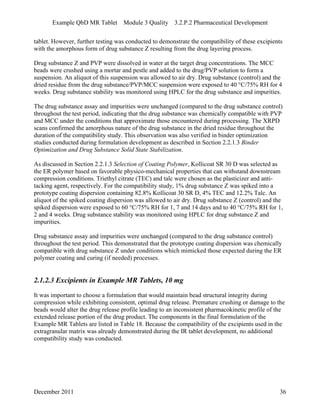
  • 97.
    Example QbD MRTablet Module 3 Quality 3.2.P.2 Pharmaceutical Development purposely varied for further investigation. The risk of extended processing at this temperature to drug product stability is low based on the results of the drug substance forced degradation studies. A 23-1 factorial DOE study with one center point was performed on the pilot batch scale (40 kg) to confirm process knowledge gained from the lab scale (4 kg). The study design and acceptance criteria for the responses are presented in Table 61 and experimental results are reported in Table 62. Table 61. Design of the 23-1 drug layering confirmation study Defining Relation I = ABC Resolution III Levels Factors: Process Parameters -1 +1 A Air volume (cfm) 510 690 B Spray rate (g/min) 180 240 C Atomization pressure (bar) 2.0 3.0 Responses Target Ranges Y1 Fines < 250 μm (%) ≤ 5 Y2 Agglomerates > 420 μm (%) ≤ 5 Y3 Assay (HPLC method) (% w/w) 95.0 105.0 Y4 LOD (%) ≤ 2 Y5 Process Efficiency (%) ≥ 90 Table 62. Results of the drug layering process confirmation study (Glatt GPCG-60, 40 kg batch size) Factors: Process Parameters Responses A: Air volume B: Spray rate C: Atomization pressure Y1: Fines (< 250 µm) Y2: Agglomerates (> 420 µm) Y3: Assay HPLC Y4: LOD Y5: Process Efficiency10 Std. Code Batch No. (cfm) (g/min) (bar) (%) (%) (% w/w) (%) (%) 1 26 510 180 3.0 2.4 1.5 98.1 0.6 98 2 25 690 180 2.0 2.0 2.2 98.4 0.5 96 3 24 510 240 2.0 2.5 2.9 98.2 0.6 94 4 27 690 240 3.0 1.8 1.8 98.9 0.5 96 5 23 600 210 2.5 2.4 1.6 99.5 0.5 95 The data in Table 62 indicate that the various processing conditions employed for drug layering provided satisfactory drug-layered beads at the 40 kg scale. DOE statistical analysis also demonstrated that the impact of all factors (in the range studied) on the responses was not significant (α = 0.05) since all the factor effects lie on the pure error line. See the half-normal plot of the process parameter effects on agglomerates (d50 > 420 µm) in Figure 36 as a representative example. Similar plots were obtained for all other responses studied (figures not shown). The study confirmed that when the CPPs are set within the optimized range, drug-layered beads that meet the 10 Process Efficiency was defined as the ratio of the actual final weight of coated beads (Wf) to the theoretical final weight of coated beads (Wt) expressed as a percentage. Weight was corrected for moisture content.   100%  t f W W EfficiencyocessPr December 2011 97
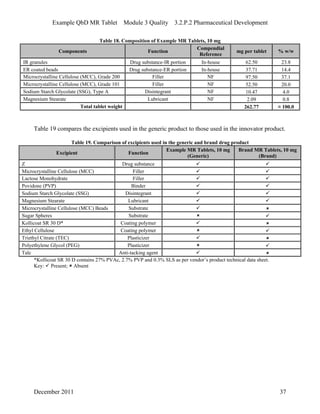
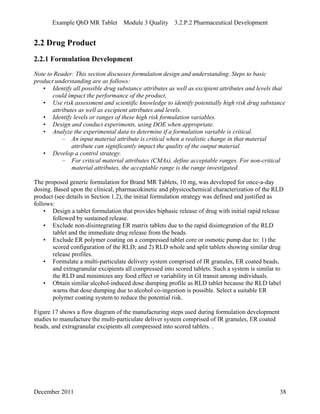
  • 98.
    Example QbD MRTablet Module 3 Quality 3.2.P.2 Pharmaceutical Development predefined targets are produced. Based on the results of the confirmation study, a 40 kg scale design space for the drug layering unit operation was defined as shown in Table 63. The drug-layered beads were sieved to remove the agglomerates (> 420 μm) and fines (< 250 μm). Only the beads between 250 μm and 420 μm were used for subsequent processing. Note to Reader: The design space for the drug layering unit operation is for the 40 kg scale only and the use of linear scale-up principles needs to be further verified at commercial scale (180 kg). Agglomerates (> 420 μm) Shapiro-Wilk test W-value = 1.000 p-value = 1.000 A: Air volume (cfm) B: Spray rate (g/min) C: Atomization pressure (bar) Half-Normal Plot Half-Normal%Probability |Standardized Effect| 0.0 0.1 0.2 0.3 0.4 0.5 0.6 0.7 0.8 0.9 0 10 20 30 50 70 80 90 95 Positive Effects Negative Effects ure 36. Half-normal plot of the process parameter effects on agglomerates (> 420µm) generated during the drug layering stepFig Table 63. Design space at 40 kg scale for the drug layering unit operation (Glatt GPCG-60 with an 18″ Wurster HS insert) Process Parameters Ranges Product temperature 45 ± 3 C Atomization pressure 2.5 ± 0.5 bar Air volume 600 ± 90 cfm Spray rate 210 ± 30 g/min Updated Risk Assessment of the Drug Layering Process Variables Table 64 presents the risk reduction for the drug layering process as a result of the development work. Only the spraying process variables that were initially identified as high risk to the assay of drug-layered beads are shown. December 2011 98
  • 99.
    Example QbD MRTablet Module 3 Quality 3.2.P.2 Pharmaceutical Development Table 64. Updated risk assessment of the drug layering process variables Unit Operation: Drug Layering Output Material CQA: Assay of the drug-layered beads Spraying Variables Risk Assessment Justification for the Reduced Risks Product temperature Low An acceptable product temperature range was identified. In the studied range, drug-layered beads with consistent quality were produced at the 40 kg scale. Spray drying and agglomeration were minimized. Product temperature is a scale-independent parameter and will be applied to other scales. The risk of product temperature to impact the assay of the drug-layered beads is reduced from high to low. Air volume Low Air volume range was identified and an optimal fluidization pattern was achieved. In the studied range, drug-layered beads with consistent quality were produced at the 40 kg scale. Air volume is a scale-dependent parameter. However, processing equipment change from an 18″ to a 32″ Wurster is a scale-out process instead of a scale-up process. For commercial scale, air volume will be increased 3-fold. The risk of air volume to impact drug-layered bead assay is reduced from high to low. Spray rate Low Spray rate range was identified. In the studied range, drug-layered beads with consistent quality were produced at the 40 kg scale. Spray rate is a scale- dependent parameter. However, a processing equipment change from an 18″ to a 32″ Wurster is a scale-out process and each of the three nozzles used in the 32″ Wurster are identical to the one used in the 18″ Wurster. The spray rate per nozzle will be kept the same. The total spray rate will be increased 3-fold. The risk of spray rate to impact drug-layered bead assay is reduced from high to low. Atomization air pressure Low Atomization air pressure was identified. In the studied range, drug-layered beads with consistent quality were produced at the 40 kg scale. Attrition was minimized. Atomization air pressure is an equipment-dependent parameter. As this is a scale-out process and each of the three nozzles used in the 32″ Wurster are identical to the one used in the 18″ Wurster, the atomization air pressure for each nozzle will be kept the same. The risk of atomization air pressure to impact drug-layered bead assay is reduced from high to low. 2.3.3.2 ER Polymer Coating Process Development Based on the choice of a multi-particulate delivery system and an aqueous ER layer coating, bottom spray fluid bed coating and drying was selected as an appropriate manufacturing process. Input variables such as air volume, spray rate, atomization pressure and product temperature (as well as equipment design and scale) contribute interactively to the film quality and film thickness. A laboratory scale process (1 kg) was implemented in formulation development while a larger scale (4 kg) was implemented in process development. On the basis of prior experience and availability of equipment, all process development studies were conducted in a Glatt GPCG-5 with a 7″ Wurster HS insert (89 mm diameter partition) which was more predictive of the pilot batch equipment. Initial Risk Assessment of the ER Polymer Coating Process Variables The initial risk assessment of the overall manufacturing process presented in Table 51 identified the risk of the ER polymer coating step to impact drug release from the drug product as high. Subsequently, drug release from the ER coated beads was identified as a CQA for the ER polymer coating step. Process variables that could potentially impact drug release from the ER coated beads were identified and their associated risk was evaluated. Conducting DOEs to evaluate all the December 2011 99
  • 100.
    Example QbD MRTablet Module 3 Quality 3.2.P.2 Pharmaceutical Development variables involved in a Wurster coating process is not feasible. Therefore, variables ranked as low to medium risk during the assessment were set constant based on feasibility studies and previous experience. The variables ranked as high risk were evaluated by conducting DOE studies to gain process understanding. Table 65 summarizes the initial risk assessment of the ER polymer coating step. Table 65. Initial risk assessment of the ER polymer coating process variables Unit Operation: ER polymer coating Output Material CQA: Drug release from the ER coated beads Variables Risk Assessment Justification and Initial Strategy Input Material Attributes Drug-layered beads assay Low Assay of drug-layered beads within 95-105% was achieved during the layering step. The risk of drug-layered bead assay to impact the drug release from ER coated beads is low. Drug substance solid state form in the drug layer Low Drug substance Z was shown to remain amorphous on drug-layered beads stored up to 6 months at 40 °C/75% RH. The risk of form conversion resulting in altered drug release from the ER coated beads is low. Drug-layered beads size distribution Low The drug-layered beads are sieved and only the fraction between 250- 420 μm is used for the ER polymer coating step. The risk of this tight size distribution to impact the uniformity of the coating applied by a Wurster process and the resultant drug release profile of the ER coated beads is low. Drug-layered beads LOD Low If the LOD of the drug-layered beads higher than optimal, it may impact film formation and drying of the ER coated beads. The LOD of the drug- layered beads is controlled to < 2% so the risk of drug-layered bead LOD to impact drug release from the ER coated beads is low. Drug-layered beads release profile Low Rapid drug release from the drug-layered beads was achieved during formulation development. The risk of drug release from the layered beads to impact release from the ER coated beads is low. Acetic Acid content Low Kollicoat SR 30 D supplied with an acetic acid content of NMT 1.5% was shown to have no impact on drug release from the ER coated beads. Therefore, the risk is low. PVAc content Low A PVAc content of 25-29 g/100g was shown to have no impact on drug release. The risk is low. PVP content Low Based on the variability of the raw material observed during formulation development, an in-house specification was established to control the PVP content between 2.5-2.9% (target 2.7%) which is tighter than the vendor’s specification of NMT 4%. Within this established range, PVP content variability did not have any impact on drug release from the ER coated beads. The risk is low. Kollicoat SR 30 D Apparent viscosity Low The apparent viscosity range of 50-90 mPa•s was shown to have no impact on drug release from the ER coated beads. The risk is low. Talc PSD Low Used material within in-house spec (d50: 2-8 µm NLT 99% passing 325 mesh (44 μm)) to reduce the risk of clogging the nozzle or tubing. The risk of talc PSD to impact drug release from the ER coated beads is low. Equipment Variables Equipment Low Glatt GPCG-5 selected based on equipment availability. Wurster insert diameter Low 7″ Wurster HS insert is selected based on its capacity, 8.3 L, and the planned batch size. Partition column diameter Low Fixed by equipment design: 89 mm in diameter. December 2011 100
  • 101.
    Example QbD MRTablet Module 3 Quality 3.2.P.2 Pharmaceutical Development Unit Operation: ER polymer coating Output Material CQA: Drug release from the ER coated beads Variables Risk Assessment Justification and Initial Strategy Air distribution plate Medium The air distribution plate can impact the fluidization pattern of beads passing through the partition column. C plate is selected based on the size of the beads and previous experience. Partition height (gap) Medium Partition gap can impact the circulation rate of beads passing through the coating zone. When the gap is more than optimal, insufficient differential pressure to draw beads up the partition column can be generated. Spraying cannot commence. When the gap is less than optimal, the circulation rate of beads increases, but the mass flow of beads is limited. Beads will be lost to the filter or the bed will collapse due to over-wetting. This can be observed and remedied before spraying commences. Thus, the risk of partition height (gap) to impact drug release from the ER coated beads is medium. The initial gap is set to 25 mm based on bed fill level and previous experience and may need adjustment for proper fluidization during the coating process. Nozzle tip diameter Medium Improper selection of nozzle tip size may impact atomization and spray rate capability and, ultimately, drug release from the ER coated beads. The risk is medium. Based on potential spray rate, a nozzle with a 1.0 mm orifice diameter is selected for the planned batch size. Nozzle tip/air cap position Low If the nozzle tip and air cap are kept flush, the impact on atomization is minimized. The risk is low. No. of nozzles Low Fixed by equipment design: one nozzle. The risk is low. Filter type Medium A filter bonnet is used to prevent loss of material and to allow air to pass through. If the porosity is higher than optimal, the loss of material will be high. If the porosity is lower than optimal, the filter will clog and processing will be interrupted. The risk of filter type to impact drug release from ER coated beads is medium. A filter porosity of 200 μm is selected based on previous experience. Coating Dispersion Variables Solids content Medium The solids content of the coating dispersion was approximately 18%. This level was selected based on formulation design, supplier recommendation and previous experience. If the solids content is higher than optimal, it may not be effectively atomized. If the solids content is lower than optimal, total coating time will be long. The risk of coating dispersion solids content to impact drug release from the ER coated beads is medium. Viscosity Low High viscosity may impact droplet size of the atomized dispersion. The viscosity of the coating dispersion is low (50 – 90 mPa•s) and did not show an impact on drug release from the ER coated beads during formulation development (Section 2.2.1.3). The risk of dispersion viscosity to impact drug release is low. December 2011 101
  • 102.
    Example QbD MRTablet Module 3 Quality 3.2.P.2 Pharmaceutical Development Unit Operation: ER polymer coating Output Material CQA: Drug release from the ER coated beads Variables Risk Assessment Justification and Initial Strategy Sedimentation Medium Talc may settle during the coating process and subsequently change the dispersion composition. If the talc concentration is suboptimal, the ER polymer coating may become sticky and cause agglomeration. The risk is medium. The coating dispersion should be stirred continuously during the coating process. Mixer type/mixing speed Medium The mixer is used to prepare the coating dispersion. An improper mixer type or speed selection may impact the coating dispersion shear stability. The risk of impact on drug release is medium. Proper mixer selection is based on previous experience. A shear stability test will be conducted. Delivery pump Low The pump is used to deliver the coating dispersion to the column. The risk of the pump selection to impact drug release from the ER coated beads is low. A peristaltic pump is selected based upon availability and reliability to deliver consistent flow. Holding time Low The microbial limit of the coating dispersion needs to be controlled for patient safety; however, the risk of holding time to impact drug release of the ER coated beads is low. The coating dispersion is used within 36 hours based on microbial test results. Pre-heating Variables Inlet air dew point Medium Dew point needs to be controlled to minimize the static charge on the drug-layered beads which may cause agglomeration. The risk of impact on the drug release from ER coated beads is medium. A dew point of 5-15º C is selected based on previous experience. Shaking interval/duration Low Shaking prevents beads from being trapped in the filter bag. The risk of shaking to impact drug release is low during preheating. Initial setting is 60 sec/5sec based on previous experience. Inlet air temperature Medium Higher than optimal temperature may cause excessive static charge and lead to processing difficulties. Equipment warm up: 40-50ºC. Product temperature Medium Higher than optimal temperature may cause excessive static charge and lead to processing difficulties. Equipment warm up: 30-40ºC. Exhaust temperature Low Exhaust temperature is determined by a combination of inlet air temperature, air volume and humidity. It is an indicator of drying and it is monitored. The risk is low. December 2011 102
  • 103.
    Example QbD MRTablet Module 3 Quality 3.2.P.2 Pharmaceutical Development Unit Operation: ER polymer coating Output Material CQA: Drug release from the ER coated beads Variables Risk Assessment Justification and Initial Strategy Air volume Medium If the air volume is higher than optimal, attrition to the drug-layered beads may occur. Lower than optimal air volume may cause poor bead fluidization and uneven heating. Drug release from ER beads may be affected. The risk is medium. The air volume range of 80 -120 cfm is selected based on the optimization result of the drug layering process. Atomization air pressure Low Set at the minimum to prevent nozzle clog: 0.5 bar. Preheat time Low Film formation may be affected if the target bead temperature is not reached or if the bead population temperature is not uniform. The risk of preheat time to impact drug release from the ER coated beads is low. Heat until the target product temperature is reached. Spraying Variables Inlet air dew point Medium Variation of inlet air humidity may have an impact on droplet evaporation and the quality of the polymer film. The risk of inlet air dew point to impact drug release from ER beads is medium and needs to be evaluated. A set point of 5-15 ºC is selected based on previous experience. Shaking interval/duration Low Shaking prevents beads from trapping the filter bonnet. The risk is low. Based on previous experience, 60 sec/5 sec is selected. Inlet air temperature Medium Inlet temperature will be adjusted to reach the desired product temperature. If it is set higher than optimal, spray drying may occur and if it is set lower than optimal, agglomeration may occur. The product temperature will be monitored and optimized. Therefore, the risk of inlet air temperature to impact drug release from the ER coated beads is medium. The range of 40-60ºC is selected based on trial batches in a Glatt GPCG- 1. Product temperature High Product temperature is a function of inlet air temperature, air volume, and spray rate. If product temperature is higher than optimal, spray drying may occur and a large amount of fines may be generated. If product temperature is lower than optimal, agglomeration may occur. The risk of product temperature to impact drug release from the ER coated beads is high. Investigate with DOE to optimize and reduce the risk. Air volume High If air volume is higher than optimal, spray drying may occur. Product may also be blown into the filter. If air volume is lower than optimal, suboptimal fluidization may result and agglomeration may occur. The risk of air volume to impact drug release from the ER coated beads is high. Investigate with DOE to optimize and reduce the risk. December 2011 103
  • 104.
    Example QbD MRTablet Module 3 Quality 3.2.P.2 Pharmaceutical Development Unit Operation: ER polymer coating Output Material CQA: Drug release from the ER coated beads Variables Risk Assessment Justification and Initial Strategy Spray rate/nozzle High If spray rate is higher than optimal, agglomeration may occur. If spray rate is lower than optimal, spraying time may be long and spray drying may occur. The risk of spray rate to impact drug release from the ER coated beads is high. Investigate with DOE to optimize and reduce the risk. Atomization air pressure High If atomization air pressure is higher than optimal, attrition to the beads may occur. If atomization air pressure is lower than optimal, agglomeration may occur. The risk of atomization air pressure to impact drug release from the ER coated beads is high. Investigate with DOE to optimize and reduce the risk. Coating time Medium The coating dispersion may settle because the coating time is long. This may impact the homogeneity of the coating dispersion. The risk is medium. Drying Variables Inlet air dew point Medium Variation of inlet air humidity may have an impact on drying and the quality of the polymer film. Dew point needs to be controlled to achieve consistent drying. The risk of inlet air dew point to impact drug release from ER coated beads is medium. A dew point of 5-15 ºC is selected based on previous experience. Inlet air temperature Medium A lower than optimal temperature will increase the drying time. A higher than optimal temperature may cause agglomeration of the ER coated beads. The risk is medium. A range of 40-50 ºC is selected based on the desired product temperature. Air volume Medium A lower than optimal air volume will not maintain adequate fluidization to facilitate drying. A higher than optimal air volume may cause attrition. The risk is medium. The air volume range of 80-120 cfm is selected based on the optimized drug layering process. Atomization air pressure Low Set at the minimum to prevent nozzle clog: 0.5 bar. Drying time Medium Water content is controlled to prevent microbial growth. However, unnecessary over-drying may increase the processing time. The risk is medium. The LOD target is 2% based on previous experience. December 2011 104
  • 105.
    Example QbD MRTablet Module 3 Quality 3.2.P.2 Pharmaceutical Development The following DOE studies were performed to identify and optimize critical process parameters and their ranges: • A laboratory scale screening DOE study was conducted to assess the effect of process parameters on the drug release and to identify the CPPs. • A laboratory scale optimization DOE study was conducted to optimize CPP ranges. • A pilot scale robustness DOE study was conducted to confirm the knowledge gained from lab scale. In the formulation studies, the theoretical polymer coating level had a significant impact on the drug release profile of the ER coated beads. During the ER polymer coating process, the theoretical polymer coating level was kept the same as formulation F-2 (30%) and the amount to be sprayed into the fluid bed was calculated based on the weight of the beads for each batch. The actual polymer weight gain on the beads will vary based on the process efficiency. Therefore, it is important to optimize the process to obtain high and consistent process efficiency. Coating Dispersion Evaluation The coating dispersion was prepared in two stages. Initially, an aqueous dispersion of TEC and Talc was prepared and homogenized using a corundum mill. The final coating material was prepared by slowly adding the TEC and Talc aqueous dispersion to the Kollicoat SR 30 D aqueous dispersion while stirring. A shear stability test was conducted on the coating dispersion by stirring at 2000 rpm for 15 minutes as suggested by the Kollicoat SR 30 D supplier. Afterward, the dispersion was passed through a 125 μm sieve and exhibited minimum coagulation. The dispersion is continuously stirred during the application of the ER polymer coating to the drug- layered beads. A study was conducted to demonstrate that the viscosity of the coating dispersion retains its homogeneity during the spraying process. The coating material was prepared as previously described and was stirred continuously at 250 rpm for 48 hours. Samples were pulled periodically to evaluate the viscosity. Table 66 summarizes the results. Table 66. Effect of continuous stirring on viscosity of the ER polymer coating dispersion Holding time Viscosity at 25 °C (h) (mPa•s) 0 58 3 58 6 55 24 57 48 57 The ER polymer coating dispersion retained its viscosity under continuous shear conditions for 48 hours. Therefore, a hold time of 48 hours will be included in the batch manufacturing records. ER Polymer Coating Process Feasibility Study A feasibility study was performed to test the initial process parameters selected based on scientific literature and previous experience and to set the scope of future studies. The optimized ER coated beads formulation (prototype F-2 in Table 48) was used for this study. Table 67 shows the composition of the ER polymer coating dispersion. After preparation, the coating dispersion was December 2011 105
  • 106.
    Example QbD MRTablet Module 3 Quality 3.2.P.2 Pharmaceutical Development mixed for at least one hour prior to the commencement of spraying. The coating dispersion was continuously stirred during the coating process. The solids content of the coating dispersion was 18%. During the process feasibility study, the dew point was initially set at 5 ± 2 ºC. At this point, the beads became very statically charged; thus, the dew point temperature was increased to 10 ± 2 ºC. The spray rate was initially 5 g/min and was incrementally ramped up during the course of the feasibility batch. At 35 g/min, agglomeration was observed, suggesting that the spray rate should not exceed 35 g/min. All process parameters for the lab scale coating feasibility study are summarized in Table 68. Table 67. Composition of the ER polymer coating dispersion Components Function Weight Solids Content Comments (% w/w) (% w/w) Kollicoat SR 30 D Coating polymer 50.00 15.00 30% solids content based on vendor COA Triethyl Citrate (TEC) Plasticizer 0.75 0.75 5% of dry polymer Talc Anti-tacking agent 2.25 2.25 15% of dry polymer Purified Water Solvent 47.00 -- removed during drying Total 100.00 18.00 Table 68. Equipment and process parameters for the lab scale coating feasibility study ER Polymer Coating Lab Scale Equipment model Glatt GPCG-5 Batch size 4 kg Fluid bed insert 7″ Wurster Partition height 25 mm Distribution plate C plate Nozzle diameter 1.0 mm Dew point 10 ± 2 ºC Inlet temperature 40 – 50 ºC Product temperature 30 ºC Spray rate 5 – 35 g/min Atomization air pressure 1.5 bar Air volume ~100 cfm In order to optimize the ER polymer coating process, gain insight on how process variables interact and identify CPPs and operating ranges, DOE studies were performed. ER Polymer Coating Process Screening Study The process parameters and ranges were selected based on the knowledge gained from the drug layering section and the ER polymer coating process feasibility study. A 24-1 fractional factorial design with three center points was performed to screen the effect of process parameters on the drug release profile of ER coated beads (T20%, T50% and T80%), the amount of fines and agglomerates generated and the process efficiency. Moisture content for ER coated beads was controlled to not more than 2.0%. The ER coated beads were sieved to remove the agglomerates (> 590 μm) and fines (< 350 μm). Only the beads between 350 μm and 590 μm will be used for subsequent processing. Other physical properties of the beads were evaluated (data not shown) including bead December 2011 106
  • 107.
    Example QbD MRTablet Module 3 Quality 3.2.P.2 Pharmaceutical Development surface roughness, film thickness (by SEM), and friability. Yield was also calculated. Table 69 summarizes the study design and acceptance criteria. Experimental results (Y1 and Y4, other responses not shown) are presented in Table 70. Table 69. Design of the 24-1 ER polymer coating process screening study Defining Relation I = ABCD Resolution IV Levels Factors: Process Parameters -1 +1 A Air volume (cfm) 70 170 B Atomization pressure (bar) 1.2 2.0 C Spray rate (g/min) 10 30 D Product temperature (°C) 25 39 Responses Target Ranges Y1 T20% (h) 2.5 2.9 Y2 T50% (h) 4.5 6.5 Y3 T80% (h) 8 12 Y4 Process Efficiency (%) ≥ 90.0 Y5 Fines < 350 μm (%) ≤ 5 Y6 Agglomerates > 590 μm (%) ≤ 5 Table 70. Results of the ER polymer coating process screening study Factors: Process Parameters Responses Std. Code Batch No. A: Air volume B: Atomization pressure C: Spray rate D: Product temperature* Y1: T20% Y4: Process Efficiency (cfm) (bar) (g/min) (°C) (h) (%) 1 30 70 1.2 10 25 2.8 90 2 31 170 1.2 10 39 2.0 86 3 38 70 2.0 10 39 2.2 87 4 36 170 2.0 10 25 2.7 90 5 34 70 1.2 30 39 2.7 82 6 29 170 1.2 30 25 3.0 85 7 35 70 2.0 30 25 3.1 85 8 28 170 2.0 30 39 2.4 82 9 32 120 1.6 20 32 2.6 92 10 33 120 1.6 20 32 2.7 93 11 37 120 1.6 20 32 2.8 91 *The inlet temperature was adjusted during the process to maintain the desired product temperature. Note to Reader: For all coating process DOE studies in this example, the process parameter settings were targeted at steady state. During the coating process, the spray rate was ramped up from low to the steady state value in the first two hours and air volume was adjusted accordingly to maintain the desired product temperature and optimum fluidization pattern. December 2011 107
  • 108.
    Example QbD MRTablet Module 3 Quality 3.2.P.2 Pharmaceutical Development Significant factors for T20% of the ER coated beads As shown in the following half-normal plot (Figure 37), the most significant factors affecting T20% of ER coated beads were D (product temperature), followed by C (spray rate), and A (air volume). The remaining three model terms ranked had no significant impact on T20% based on Shapiro-Wilk hypothesis test results. The effect of product temperature and spray rate on T20% of ER coated beads is presented in Figure 38. T20% decreased with increasing product temperature and decreasing spray rate. Air volume showed a negative effect on T20% but to a lesser extent than product temperature and spray rate. T20% (h) Shapiro-Wilk Test W-value = 0.895 p-value = 0.406 A: Air volume (cfm) B: Atomization pressure (bar) C: Spray rate (g/min) D: Product temperature (°C) Half-Normal Plot Half-Normal%Probability |Standardized Effect| 0.00 0.10 0.19 0.29 0.38 0.48 0.58 0 10 20 30 50 70 80 90 95 A C D Error Estimates Positive Effects Negative Effects Figure 37. Half-normal plot of the process parameter effects on T20% of ER coated beads December 2011 108
  • 109.
    Example QbD MRTablet Module 3 Quality 3.2.P.2 Pharmaceutical Development 3.1 2.0 X1 = D: Product temperature (°C) X2 = C: Spray rate (g/min) Actual Factors A: Air volume (cfm) = 120 B: Atomization pressure (bar) = 1.6 30 25 29 32 36 39 10 15 20 25 T20% (h) D: Product temperature (°C) C:Sprayrate(g/min) 3.0 2.8 2.6 2.4 2.2 Figure 38. Effect of product temperature and spray rate on T20% of ER coated beads Similar cause and effect relationships were observed for T50% and T80% of ER coated beads (data not shown). Significant factors for process efficiency of the ER polymer coating step As shown in the following half-normal plot (Figure 39), the most significant factors affecting the process efficiency of the ER polymer coating step were C (spray rate) and D (product temperature). However, the p-value is less than 0.05 which indicates that the non-selected effects deviate from the Shapiro-Wilk test assumption of normalcy. Based on the ANOVA results presented in Table 71, the curvature effect was significant. Figure 40 shows the impact that product temperature has on process efficiency. Further optimization was necessary to gain more understanding of this curvature effect. December 2011 109
  • 110.
    Example QbD MRTablet Module 3 Quality 3.2.P.2 Pharmaceutical Development Process Efficiency (%) Shapiro-Wilk test W-value = 0.684 p-value = 0.006 A: Air volume (cfm) B: Atomization pressure (bar) C: Spray rate (g/min) D: Product temperature (°C) Half-Normal Plot Half-Normal%Probability |Standardized Effect| 0.00 1.19 2.37 3.56 4.75 0 10 20 30 50 70 80 90 95 C D Error Estimates Positive Effects Negative Effects Figure 39. Half-normal plot of the process parameter effects on efficiency of the ER polymer coating process Table 71. ANOVA results for the ER polymer coating process efficiency Source Sum of Squares df* Mean Square F Value p-value Probability > F Comments Model 66.25 2 33.13 88.33 < 0.0001 Significant C-Spray rate (g/min) 45.13 1 45.13 120.33 < 0.0001 D-Product temp (°C) 21.13 1 21.13 56.33 0.0001 Curvature 81.85 1 81.85 218.27 < 0.0001 Significant Residual 2.62 7 0.37 Lack of Fit 0.62 5 0.12 0.125 0.9723 not significant Pure Error 2 2 1 Total 150.73 10 *df: degree of freedom December 2011 110
  • 111.
    Example QbD MRTablet Module 3 Quality 3.2.P.2 Pharmaceutical Development Process efficiency (%) X1 = D: Product temperature (°C) Actual Factors A: Air volume (cfm) = 120 B: Atomization pressure (bar) = 1.6 C: Spray rate (g/min) = 20 25 29 32 36 39 D: Product temperature (°C) ProcessEfficiency(%) 82 84 86 88 90 92 94 Design Center Points Figure 40. Main effect of product temperature on efficiency of the ER polymer coating process Results from the screening DOE study demonstrated that product temperature, spray rate and air volume are the CPPs for the ER polymer coating process. Within the range studied, the impact of a change in atomization air pressure on the responses measured was not significant (α = 0.05). Although the risk of atomization air pressure to impact the drug release profile of the ER coated beads was considered high during the initial assessment, atomization air pressure was not found to be a critical process parameter at lab scale. ER Polymer Coating Process Optimization Study at Lab Scale (4 kg) An optimization study was performed to optimize the three CPPs (product temperature, spray rate and air volume) identified in the previous screening and feasibility studies. The same equipment (Glatt GPCG-5 with a 7″ Wurster insert) was used as in the process screening study. Since the impact of atomization air pressure was not significant (α = 0.05) in the screening study, it was kept constant at 1.6 bar for the optimization study. In a full factorial design for three factors at three levels including six center point replicates, the total number of experiments needed would be 33. Though a full factorial design offers maximum resolution, a Central Composite Face-centered (CCF) design was chosen to reduce the number of runs and allow a quadratic model fit while evaluating three levels for each factor. The design had one center point, no replicates, α = 1.0 and 15 runs total. Table 72 shows the study design and acceptance criteria. The measured responses were the drug release profiles (T20%, T50% and T80%), the amount of fines and agglomerates generated and process efficiency. Table 73 summarizes experimental results (Y1 and Y4, other responses not shown). December 2011 111
  • 112.
    Example QbD MRTablet Module 3 Quality 3.2.P.2 Pharmaceutical Development Table 72. Design of the CCF study to optimize the ER polymer coating process Levels Factors: Process Parameters -1 0 +1 A Air volume (cfm) 80 110 140 B Product temperature (°C) 28 32 36 C Spray rate (g/min) 10 20 30 Responses Target Ranges Y1 T20% (h) 2.5 2.7 2.9 Y2 T50% (h) 4.5 5.5 6.5 Y3 T80% (h) 8 10 12 Y4 Process Efficiency (%) ≥ 90 Y5 Fines < 350 μm (%) ≤ 5 Y6 Agglomerates > 590 μm (%) ≤ 5 Table 73. Results of the ER polymer coating process optimization study Factors: Process Parameters Responses Std. Code Batch No. A: Air volume B: Product temperature C: Spray rate Y1: T20% Y4: Process Efficiency (cfm) (°C) (g/min) (h) (%) 1 51 80 28 10 2.8 94 2 40 140 28 10 2.6 95 3 53 80 36 10 2.5 93 4 48 140 36 10 2.4 93 5 42 80 28 30 3.1 90 6 44 140 28 30 3.0 90 7 41 80 36 30 2.7 88 8 50 140 36 30 2.6 88 9 47 80 32 20 2.7 93 10 45 140 32 20 2.6 93 11 46 110 28 20 2.7 92 12 43 110 36 20 2.5 91 13 49 110 32 10 2.6 96 14 52 110 32 30 2.7 91 15 39 110 32 20 2.6 93 Based on the sum of squares of sequential models (i.e. linear, 2 factor interaction, quadratic and cubic), the highest order polynomial model was selected where the additional terms were significant and the model was not aliased. The model terms were further reduced based on the significance level (α = 0.05) using the backward model selection method. Significant factors for T20% of the ER coated beads Based on ANOVA results, the significant factors affecting T20% of ER coated beads were B (product temperature), C (spray rate), and A (air volume). The effect of product temperature and spray rate on T20% of ER coated beads is presented in Figure 41. The T20% decreased with increasing product temperature but increased with increasing spray rate. Air volume showed a negative effect December 2011 112
  • 113.
    Example QbD MRTablet Module 3 Quality 3.2.P.2 Pharmaceutical Development on T20%, but to a lesser extent than product temperature. Similar cause and effect relationships were observed for T50% and T80% of ER coated beads (data not shown). 2.4 X1 = B: Product temperature (°C) X2 = C: Spray rate (g/min) Actual Factor A: Air volume (cfm) = 110 28 30 32 34 36 10 15 20 25 30 T20% (h) B: Product temperature (°C) C:Sprayrate(g/min) 2.9 2.8 2.7 2.6 2.5 3.1 Figure 41. Effect of product temperature and spray rate on T20% of ER coated beads Significant factors for the process efficiency of the ER polymer coating step Based on ANOVA results, the significant factors affecting the process efficiency of the ER polymer coating step were B (product temperature) and C (spray rate). The curvature effect identified in the screening DOE was well modeled by the square term of product temperature as illustrated in Figure 42. December 2011 113
  • 114.
    Example QbD MRTablet Module 3 Quality 3.2.P.2 Pharmaceutical Development 96 88 30 28 30 32 34 36 10 15 20 25 Process Efficiency (%) B: Product temperature (°C) C:Sprayrate(g/min) 91 95 X1 = B: Product temperature (°C) X2 = C: Spray rate (g/min) Actual Factor A: Air volume (cfm) = 110 93 89 Figure 42. Effect of product temperature and spray rate on efficiency of the ER polymer coating process Based on the results from the screening and optimization DOE studies, product temperature, spray rate and air volume were identified as CPPs. The design space (green zone in Figure 43) was determined from the common region of successful operating ranges for multiple CQAs for the ER polymer coating unit operation at the 4 kg scale using the Glatt GPCG-5 equipped with a 7″ Wurster insert. In this case, the overlap region is comprised of the ranges for T20% and process efficiency.11 The acceptable ranges for these three CPPs were proposed as shown in Table 74. Note that in this table, the acceptable range of one process parameter is dependent on the value of the other. This approach allows the maximum range of operation to achieve the desired quality attributes. Atomization pressure was found not critical within the range studied. Therefore, the studied range of 1.2 – 2.0 bar was recommended for this scale. The relevance of the proposed 4 kg scale design space for this unit operation will be verified when scaling up to pilot scale and, ultimately, to commercial scale. 11 This is for concept demonstration only. All identified CQAs should be studied and included for a real drug product. December 2011 114
  • 115.
    Example QbD MRTablet Module 3 Quality 3.2.P.2 Pharmaceutical Development Figure 43. Overlay plots of the ER polymer coating unit operation at 4 kg scale (Glatt GPCG-5 with a 7″ Wurster HS insert) Note to Reader: At this scale, the edge of failure for process parameters was determined because the CQAs cannot be met beyond a certain range. However, determining the edge of failure or demonstrating failure modes are not essential parts of establishing a design space. Table 74. Acceptable ranges for the ER polymer coating process parameters at 4 kg scale (Glatt GPCG-5 with a 7″ Wurster HS insert) Process Parameters Ranges Rationale Product temperature 31 ± 3 C Lower than optimum led to agglomeration. Higher than optimum increased the amount of fines. Scale-independent parameter. Air volume 110 ± 30 cfm Range set based on studies on the laboratory scale. Scale-dependent parameter Spray rate 20 ± 10 g/min Ranges studied produced acceptable ER bead with desired release profile. Scale-dependent parameter. ER Polymer Coating Process Robustness Study at Pilot Scale (40 kg) To minimize the scale-up risk from lab scale (4 kg) to commercial scale (180 kg), a robustness study was performed to evaluate the CPPs at pilot scale (40 kg). A Glatt GPCG-60 with an 18″ Wurster HS insert (partition column diameter of 219 mm) was selected for the pilot scale batch because the chamber design and the distribution plate are geometrically similar to the intended commercial scale equipment (Glatt GPCG-120 with a 32″ Wurster HS insert). A comparison between lab scale and pilot scale equipment for the ER polymer coating process is presented in Table 75. December 2011 115
  • 116.
    Example QbD MRTablet Module 3 Quality 3.2.P.2 Pharmaceutical Development Table 75. Comparison between lab scale and pilot scale equipment for the ER polymer coating process ER Polymer Coating Lab Scale Pilot Scale Equipment model Glatt GPCG-5 Glatt GPCG-60 Fluid bed insert 7″ Wurster 18″ Wurster Equipment capacity* 8.3 L 102 L Partition column diameter 89 mm 219 mm Starting batch size 4 kg 40 kg Theoretical ending batch size (~36% weight gain based on drug-layered bead weight) 5.4 kg 54 kg Estimated use of capacity** 77% 62% Number of partition(s) 1 1 Partition height (gap) 25 mm 45 ± 3 mm Nozzle diameter 1.0 mm 1.2 mm *Volume outside of the partition column at rest on the orifice plate **Calculated based on the bulk density of the ER coated beads = 0.85 g/cc Linear scale-up from lab scale to pilot scale assumes that the bed fill levels are the same and the distribution plate in each piece of equipment is geometrically similar. Additionally, ratios of air volume to plate area and spray rate to air volume should be maintained. The scale-up factor from a 7″ Wurster to an 18″ Wurster is approximately 6-fold based on vendor recommendation. Even though atomization pressure was not critical within the studied range (1.2-2.0 bar) at lab scale, it will be further evaluated at pilot scale due to the significant increase in spray rate and change in nozzle diameter. During scale-up, it is essential that the atomization air pressure selected is capable of efficiently atomizing the coating dispersion at increased spray rate and nozzle diameter. An excessively high atomization air pressure generates smaller droplets which have a greater surface area. Thus, these smaller droplets evaporate faster while in the air making them susceptible to spray drying. On the contrary, when the atomization pressure is suboptimal, the nozzle can not develop a full spray pattern and may result in larger droplets which can potentially cause agglomeration. Based on the intended spray rate and air volume for pilot scale, the manufacturer recommended an atomization pressure range of 2.0 – 3.0 bar. By a visual check, the coating dispersion spray pattern was acceptable in this range. Although product temperature is a CPP, it is a scale independent parameter; therefore, product temperature will be tightly controlled to 31 ± 3 C based on the lab scale optimization and will be monitored during scale-up. The study design and acceptance criteria at pilot scale are given in Table 76. To reduce the number of runs, a 23-1 fractional factorial DOE with one center point was performed instead of a full factorial design. The experimental runs and results (Y1 and Y4, other responses not shown) are summarized in Table 77. December 2011 116
  • 117.
    Example QbD MRTablet Module 3 Quality 3.2.P.2 Pharmaceutical Development Table 76. Design of the 23-1 ER polymer coating process robustness study Defining Relation I = ABC Resolution III Levels Factors: Process Parameters -1 +1 A Air volume (cfm) 600 720 B Atomization pressure (bar) 2.0 3.0 C Spray rate (g/min) 100 140 Responses Target Ranges Y1 T20% (h) 2.5 2.9 Y2 T50% (h) 4.5 6.5 Y3 T80% (h) 8 12 Y4 Process Efficiency (%) ≥ 90% Y5 Fines < 350 μm (%) ≤ 5 Y6 Agglomerates > 590 μm (%) ≤ 5 Table 77. Results of the ER polymer coating process robustness study Factors: Process Parameters Responses Std. Code Batch No. A: Air volume B: Atomization pressure C: Spray rate Y1: T20% Y4: Process Efficiency (cfm) (bar) (g/min) (h) (%) 1 57 600 2.0 140 2.8 94 2 55 720 2.0 100 2.6 93 3 59 600 3.0 100 2.7 95 4 58 720 3.0 140 2.9 92 5 56 660 2.5 120 2.7 94 The data in Table 77 indicate that the various processing conditions investigated for the ER polymer coating step provided satisfactory ER coated beads at the 40 kg scale. DOE statistical analysis also demonstrated that the impact of all factors (in the range studied) on the responses studied was not significant (α = 0.05) since all the factor effects lie on the pure error line. See the half-normal plot of the process parameter effects on T20% in Figure 44 as a representative example. Similar plots were obtained for all other responses studied (figures not shown). Based on the results of the confirmation study, a 40 kg scale design space for the ER polymer coating unit operation was defined as shown in Table 78. Operation within the design space resulted in a product meeting all predefined CQAs. Again, because air volume and spray rate are scale dependent variables, the 40 kg scale design space needs to be verified at commercial scale (180 kg). Atomization air pressure is an equipment-dependent parameter. However, scaling the coating unit operation from an 18″ Wurster to a 32″ Wurster is a scale-out instead of a scale-up. The three nozzles used in the 32″ Wurster are identical to the one used in the 18″ Wurster. The atomization air pressure is kept the same per nozzle. December 2011 117
  • 118.
    Example QbD MRTablet Module 3 Quality 3.2.P.2 Pharmaceutical Development T20% (h) Shapiro-Wilk Test W-value = 1.000 p-value = 1.000 A: Air volume (cfm) B: Atomization pressure (bar) C: Spray rate (g/min) Half-Normal Plot Half-Normal%Probability |Standardized Effect| 0.00 0.05 0.10 0.15 0.20 0 10 20 30 50 70 80 90 95 Positive Effects Negative Effects Figure 44. Half-normal plot of the process parameter effects on T20% of ER coated beads Note to Reader: At this scale, the edge of failure for process parameters was not defined because all relevant quality attributes were met in the studied ranges. Table 78. Design space at 40 kg scale for the ER polymer coating unit operation (Glatt GPCG-60 with an 18″ Wurster HS insert) Process Parameters Ranges Product temperature 31 ± 3 C Atomization pressure 2.5 ± 0.5 bar Air volume 660 ± 60 cfm Spray rate 120 ± 20 g/min ER Beads Curing Process Confirmation Study Because of the low MFT (8 °C) for Kollicoat SR 30 D with 5% TEC as plasticizer, the vendor claims that a thermal after-treatment (curing) of coated beads is not required. Drug release profiles of coated and uncoated beads showed no curing effect in the formulation feasibility study conducted in Glatt GPCG-1. This study was conducted to investigate if curing is required for beads coated in large scale equipment due to high attrition. The beads manufactured in the pilot scale confirmation study (Batch No. 55) were cured in a laboratory oven at 60 °C for 12 and 24 hours. Figure 45 compares the obtained drug release profiles with that of the uncured beads. The percent of drug released from the ER coated beads is calculated based on the nominal dose of 7 mg. The study confirmed that curing has little impact on the drug release from ER coated beads. December 2011 118
  • 119.
    Example QbD MRTablet Module 3 Quality 3.2.P.2 Pharmaceutical Development 0 10 20 30 40 50 60 70 80 90 100 0 2 4 6 8 10 12 14 16 18 20 22 24 Time (h) DrugReleased(%) Uncured 12 h / 60 °C 24 h / 60 °C Figure 45. Effect of curing on the drug release profiles of ER coated beads Updated Risk Assessment of the ER Polymer Coating Process Variables Table 79 presents the risk reduction for the drug layering process as a result of the development work. Table 79. Updated risk assessment of the ER polymer coating process variables Unit Operation: ER polymer coating Output Material CQA: Drug release from the ER coated beads Spraying Variables Risk Assessment Justification for the Reduced Risks Product temperature Low Product temperature range was identified. In the studied range, ER coated beads with consistent quality were produced at the 40 kg scale. Spray drying and agglomeration were minimized. Product temperature is a scale- independent parameter and will be applied to other scales. The risk of product temperature to impact drug release from the ER coated beads is reduced from high to low. Air volume Medium Air volume range was identified. In the studied range, ER coated beads with consistent quality were produced at the 40 kg scale. An optimal fluidization pattern was achieved. Air volume is a scale-dependent parameter. However, processing equipment change from an 18″ to a 32″ Wurster is a scale-out process instead of a scale-up process. For commercial scale, air volume will be increased 3-fold. Further adjustment may be necessary. The risk of air volume to impact drug release from the ER coated beads is reduced from high to medium. Spray rate Medium Spray rate range was identified. In the studied range, ER coated beads with consistent quality were produced at the 40 kg scale. Spray rate is a scale- dependent parameter. However, a processing equipment change from an 18″ to a 32″ Wurster is a scale-out process and each of the three nozzles used in the 32″ Wurster are identical to the one used in the 18″ Wurster. The spray rate per nozzle will be kept the same. The total spray rate will be increased 3- fold. Further adjustment may be necessary. The risk of spray rate to impact drug release from the ER coated beads is reduced from high to medium. December 2011 119
  • 120.
    Example QbD MRTablet Module 3 Quality 3.2.P.2 Pharmaceutical Development Unit Operation: ER polymer coating Output Material CQA: Drug release from the ER coated beads Spraying Variables Risk Assessment Justification for the Reduced Risks Atomization air pressure Low Atomization air pressure was identified. In the studied range, ER coated beads with consistent quality were produced at the 40 kg scale. Neither attrition nor agglomeration was an issue within the identified range. Atomization air pressure is an equipment-dependent parameter. As this is a scale-out process and each of the three nozzles used in the 32″ Wurster are identical to the one used in the 18″ Wurster, the atomization air pressure for each nozzle will be kept the same. The risk of atomization air pressure to impact drug release from the ER coated beads is reduced from high to low. 2.3.4 Blending and Lubrication Process Development Initial Risk Assessment of the Blending and Lubrication Process Variables The initial risk assessment of the overall manufacturing process presented in Table 51 identified blending and lubrication as high risk steps that could impact tablet CU and drug release from split tablets. Subsequently, blend uniformity of the final blend was identified as a CQA for the blending and lubrication step. Process variables that could directly impact blend uniformity were assessed to identify which variables may cause poor blend uniformity. The results of the initial risk assessment of the blending and lubrication process variables are summarized in Table 80. Table 80. Initial risk assessment of blending and lubrication process variables on blend uniformity Unit Operation: Blending and Lubrication Output Material CQA: Blend uniformity of the final blend Variables Risk Assessment Justification and Initial Strategy Input Material Attributes IR granules assay Low The approved commercial IR granulation process (ANDA aaaaaa) routinely produces granules with an assay of 95 – 105%. The risk of the IR granule assay to impact blend uniformity is low. IR granules content uniformity Low At commercial scale, the IR granules routinely demonstrate good blend uniformity (RSD < 5%) and Example IR Tablets show acceptable CU as per USP <905>. The risk of the IR granule CU to impact blend uniformity is low. IR granules size distribution Medium The granule size distribution is fixed by ANDA aaaaaa: Retained on 45 mesh (> 350 μm): NMT 5% Retained on 60 mesh (> 250 μm, but < 350 μm): NLT 85% Retained on fine collector (< 250 μm): NMT 10% Due to the differences in size distribution, density, shape and aspect ratio between IR granules and ER beads, segregation is possible. The risk is medium. ER coated beads assay Low The drug layering process was optimized to minimize spray drying and agglomeration. Assay of the drug-layered beads within 95 – 105% was achieved and the ER polymer coating step did not cause attrition to the drug layer. The risk of ER coated beads assay to impact blend uniformity is low. December 2011 120
  • 121.
    Example QbD MRTablet Module 3 Quality 3.2.P.2 Pharmaceutical Development Unit Operation: Blending and Lubrication Output Material CQA: Blend uniformity of the final blend Variables Risk Assessment Justification and Initial Strategy ER coated beads size distribution Medium Fixed: 350 – 590 μm. Due to the differences in size distribution, density, shape and aspect ratio between IR granules and ER beads, segregation is possible. The risk is medium. MCC Grade 200 and MCC Grade 101 PSD Low The total amount of MCC was optimized and the formulation demonstrated good compressibility. Two grades of MCC were used to prevent segregation. The ratio between MCC 200 (d50: 150 -250 µm) and MCC 101 (d50: 30-80 µm) was optimized and fixed at 65:35. A uniform tablet was achieved with the optimized formulation. The risk of cushioning agent PSD to impact blend uniformity is low. Sodium starch glycolate, Type A (SSG) PSD Low Due to the low level of SSG used in the final formulation, the risk of its PSD to impact blend uniformity is low. Magnesium stearate specific surface area Low The impact of magnesium stearate specific surface area on blend uniformity and tablet quality attributes was studied during formulation development. Within the range studied (6-10 m2 /g), the impact of magnesium stearate specific surface area on all the response variables was not significant. Blending Variables Blender type Medium Fixed: V-blender Order of addition Medium The risk of the order of addition to impact blend uniformity is medium. To reduce the potential for damage to the coating on the ER beads during loading into the V-blender, a “sandwich” approach will be used, i.e. the cushioning agent MCC will be added first followed by ER coated beads and SSG. Then, IR granules will be added last. After the blending endpoint is determined by inline NIR, magnesium stearate will be added. Rotation speed (rpm) Medium The risk of rotation speed to impact blend uniformity is medium. The rpm is fixed by equipment constraint: lab scale (16 qt, 25 rpm) pilot scale (7.5 cu ft, 15 rpm) commercial scale (30 cu ft, 10 rpm) Intensifier bar (on/off) Medium The intensifier bar is kept off to prevent damage to the ER coated beads. The risk of not using the intensifier bar to impact BU is medium. Number of blender revolutions High Under- or over-blending may occur if the number of revolutions is not optimized. Investigate to reduce the risk. Blender fill level High Under-blending may occur due to a suboptimal blender fill level. Investigate to reduce the risk. Holding time High Segregation may occur during holding. The risk of impact on BU is high. Investigate to reduce the risk. Blender discharge High Segregation may occur during discharge. The risk of impact on BU is high. Investigate to reduce the risk. Drum-to-Hopper transfer High Segregation may occur during transfer. The risk of impact on BU is high. Investigate to reduce the risk. Environment temperature Low Fixed: 25 ºC ± 5%. The risk is low. Environment RH Low Fixed: 40% – 60%. The risk is low. December 2011 121
  • 122.
    Example QbD MRTablet Module 3 Quality 3.2.P.2 Pharmaceutical Development Unit Operation: Blending and Lubrication Output Material CQA: Blend uniformity of the final blend Variables Risk Assessment Justification and Initial Strategy Lubrication Variables Number of blender revolutions Low Investigated during formulation development. A proven acceptable range for Nrev (60 – 120) was established based on drug release profile and tablet appearance. The risk of the number of blender revolutions during lubrication to impact BU is low. The target setting is 90 revolutions. Effect of Number of Revolutions on Blend Uniformity Note to Reader: NIR method validation is beyond the scope of the pharmaceutical development report and the details are not discussed in this example. The validation report should be included in Section 3.2.P.5.3 Validation of Analytical Procedures. Inline NIR provides a real time response and eliminates the challenges and errors associated with thief sampling blends. An inline validated NIR spectrophotometric method with specificity for drug substance Z was used to determine the blending endpoint for development work. During validation, blend uniformity data collected at various time points by the NIR method was compared to that obtained by traditional thief sampling followed by offline HPLC analysis and was found to be comparable. Based on these findings, NIR is capable of accurately assessing the real-time homogeneity of the blend and can be used to control the endpoint of the blending process. During blending, one spectrum was acquired non-invasively through the sight glass of the V- blender for each revolution as the V-blender was in the inverted position. To assess the homogeneity of the blend, RSD was calculated for each moving block of ten consecutive spectra and plotted as a function of time. The blend was considered uniform once the RSD was below 5% for ten consecutive measurements. Figure 46 shows the NIR measurements for a lab scale and pilot scale (Lot # XXX-10-058) batch. Blend uniformity was achieved in 12 minutes at the lab scale (16 qt V-blender, 25 rpm, 300 revolutions) and 20 minutes at the pilot scale (7.5 cu ft V-blender, 15 rpm, 300 revolutions). No demixing was observed at either scale when the V-blender was operated well beyond the blending endpoint. Figure 46 clearly supports that while blending time and blender speed are not scalable, the number of revolutions is scalable. For further drug product batches, 300 revolutions (25 minutes) are proposed to achieve blend uniformity and RSD values that are within the acceptable range. December 2011 122
  • 123.
    Example QbD MRTablet Module 3 Quality 3.2.P.2 Pharmaceutical Development 5 7 9 11 13 BlendUniformity(%RSD) 15 Figure 46. Blend uniformity of prototype F-2 determined by a validated inline NIR method at both lab (25 rpm) and pilot (15 rpm) scale.12 3 0 5 10 15 20 25 Time (min) 30 35 40 45 The final blend was sampled for blend uniformity in the blender 24 hours post blending and again in the drum after discharge. The data in Table 81 were obtained. Table 81. Blend uniformity of the final blend for Example MR Tablets, 10 mg Batch No: XXX- 10-058 Final blend (in blender, 24 hrs after mixing) Final blend (in drum after discharge)Sample point (% w/w of label claim) (% w/w of label claim) 1 105.8 93.1 2 95.7 99.2 3 102.5 92.4 4 108.4 96.8 5 97.5 98.3 6 99.3 91.6 7 96.1 106.5 8 94.8 109.5 9 104.8 104.7 10 91.1 90.4 Mean 99.6 98.3 RSD 5.6 6.8 Minimum 91.1 90.4 Maximum 108.4 109.5 12 Figure modified from Pharmaceutical Development Case Study: “ACE Tablets”, Prepared by CMC-IM Working Group, March 13, 2008, Version 2.0. December 2011 123
  • 124.
    Example QbD MRTablet Module 3 Quality 3.2.P.2 Pharmaceutical Development The results in Table 81 suggest that blend segregation occurred in the blender during the 24 hour holding period. Furthermore, the data suggest that the extent of segregation was exacerbated during discharge to the drum. The blend was also tested using a segregation tester13 and the data showed significant variability in average particle size, thus corroborating the earlier findings. To address the issue of segregation in the final blend and to reduce the risk of poor content uniformity, MCC 101 (bulk density: 0.28 g/cm3 , d50: 50 µm) was combined with MCC 200 (bulk density: 0.32 g/cm3 , d50: 180 µm) to fill the void volume between ER beads and IR granules. The ratio between MCC 200 and MCC 101 was optimized at 65:35 (see Table 42 in Section 2.2.1.4 for optimization data). Confirmatory Study of the Effect of Number of Revolutions on Blend Uniformity Upon optimizing the ratio of extragranular fillers in the final blend, a second 40 kg trial batch (XXX-10-110) was manufactured in a 7.5 cu ft V-blender at 15 rpm and monitored using an NIR probe. Blend uniformity was achieved after 20 minutes (300 revolutions) of blending. Samples were taken from the blender 24 hours after mixing and from the drum after discharge. Table 82 shows the blend uniformity results of these samples. Table 82. Blend uniformity of the optimized final blend for Example MR Tablets, 10 mg Batch No: XXX-10-110 Final blend (in blender, 24 hrs after mixing) Final blend (in drum after discharge)Sample point (% w/w of label claim) (% w/w of label claim) 1 101.3 100.4 2 100.2 101.9 3 102.5 98.7 4 101.8 99.5 5 99.4 99.2 6 99.3 100.3 7 101.5 101.5 8 101.2 102.7 9 101.5 102.3 10 98.9 99.7 Mean 100.8 100.6 RSD 1.2 1.4 Minimum 98.9 98.7 Maximum 102.5 102.7 Unlike in the first segregation study, the optimized final blend with MCC Grade 200 and MCC Grade 101 in the ratio of 65:35 had acceptable blend uniformity (RSD < 2%) both in the blender (24 hours post blending) and after discharging into the drum. 13 An automated fluidization segregation tester was used where particle-size measurements were carried out with a laser-diffraction sensor system equipped with a dry-powder feeder system. December 2011 124
  • 125.
    Example QbD MRTablet Module 3 Quality 3.2.P.2 Pharmaceutical Development Effect of Blender Fill Level on Blend Uniformity A study was performed to evaluate the impact of blender fill level (40% to 60%) on blend uniformity. Each blend was mixed in a 7.5 cu ft (212.4 L) V-blender at 15 rpm and monitored using an NIR probe. Blend uniformity was achieved after 20 minutes (300 revolutions) of blending for all three fill levels, 40%, 50% and 60%. Effect of Transfer Method on Blend Uniformity In addition, a study was conducted to look at the effect of drum-to-hopper transfer method on blend uniformity in the compression machine hopper. The blends were transferred to the hopper by charging from a higher location (with respect to the hopper) or by manual scooping, respectively. As shown in Table 83, blend uniformity data for the blend transferred by using either of these two methods met the acceptance criteria. Since manual scooping is time consuming, the method of charging from a higher location was selected for future processing. Table 83. Blend uniformity of the final blend after it is transferred to the hopper Batch No: XXX-10-111 Drum-to-Hopper: dropping from a higher location Drum-to-Hopper: scooping manuallySample point (% w/w of label claim) (% w/w of label claim) 1 96.5 98.5 2 98.5 98.9 3 104.3 96.3 4 102.5 100.5 5 96.6 99.7 6 96.9 98.7 7 97.6 96.5 8 100.5 102.3 9 102.5 104.2 10 98.1 98.9 Mean 99.4 99.5 RSD 2.9 2.4 Minimum 96.5 96.3 Maximum 104.3 104.2 Summary of Proposed V-blender Operating Parameters Table 84 lists the V-blender operating parameters optimized for laboratory and pilot scale blending. The operating parameters proposed for commercial scale are based on 300 revolutions and will need to be verified. NIR monitoring will be used to determine the end point of blending. December 2011 125
  • 126.
    Example QbD MRTablet Module 3 Quality 3.2.P.2 Pharmaceutical Development Table 84. Summary of V-blender operating parameters Scale Amount Blender Capacity Blending Speed Blending Time Nrev Volume Fill Ratio (kg) (rpm) (min) (%) Lab 4 16 qt 25 12 300 ~50 Pilot 40 7.5 cu ft 15 20 300 ~50 Commercial 180 30 cu ft 10 30* 300* ~50 *Proposed initial parameters to be verified at commercial scale as discussed in Section 2.3.7 Updated Risk Assessment of the Final Blending Process Variables Table 85 presents the update risk assessment after blending process study. The justification for the reduced risks is also provided. Table 85. Updated risk assessment of the blending and lubrication process variables Unit Operation: Blending and Lubrication Output Material CQA: Blend uniformity of the final blend Blending Variables Risk Assessment Justification for the Reduced Risks Number of blender revolutions Low Target: 300 revolutions The blending process was optimized and monitored using inline NIR. The blending endpoint is reached when the moving block RSD is < 5.0% for the last ten revolutions of the blending process. The risk of the number of blender revolutions to impact BU is reduced from high to low. Blender fill level Low Acceptable BU (RSD < 2%) was achieved for blender fill levels of 40- 60%. With inline NIR monitoring, the risk of blender fill level to impact BU is reduced from high to low. Holding time Low The optimized formulation showed good BU (RSD < 2%) after holding 24 hours in the blender before discharge to drums. The risk is reduced from high to low. Blender discharge Medium Study results suggested that BU was not impacted by blender discharge at pilot scale. Therefore, the risk is reduced; however, due to the potential change of the effective length of the mixer at commercial scale, the risk of discharge to impact BU is considered medium. Drum-to-hopper transfer Medium Study results suggested that BU is not impacted by drum-to-hopper transfer. Therefore, the risk is reduced, however, due to potential change of transfer distance at commercial scale, the risk of transfer to impact BU is considered medium. 2.3.5 Tablet Compression Process Development Initial Risk Assessment of the Tablet Compression Process Variables Based on the initial risk assessment of the overall manufacturing process shown in Table 51, the risk of the compression step to impact tablet physical attributes (size and splitability), assay, content uniformity and drug release from both whole and split tablets was identified as high. Process variables that could directly impact these five CQAs were assessed to identify which variables may cause a CQA failure. The results of the initial risk assessment of the compression process variables are summarized in Table 86. December 2011 126
  • 127.
    Example QbD MRTablet Module 3 Quality 3.2.P.2 Pharmaceutical Development Table 86. Initial risk assessment of the tablet compression process variables Unit Operation: Compression Drug Product CQAs: Physical attributes (size and splitability), assay, content uniformity, drug release from both whole and split tablets Variables Drug Product CQAs Risk Assessment Justification and Initial Strategy Input Material Attributes Physical Attributes (size and splitability) Low Tablet size is determined by the formulation and tooling design. Splitability is determined by the formulation, tooling design and compression force. Therefore, the risk of the blend assay to impact the physical attributes (size and splitability) of the tablet is low. Assay Low Content Uniformity Low Drug Release – whole tablets Low Blend assay Drug Release – split tablets Low The blending and lubrication process variables were optimized and the assay of the final blend was consistently within 95-105%. The risk of the blend assay to impact tablet assay, CU, and both whole and split tablet drug release is low. Physical Attributes (size and splitability) Low Tablet size is determined by the formulation and tooling design. Splitability is determined by the formulation, tooling design and compression force. Therefore, blend uniformity has little impact on the physical attributes (size and splitability) of the tablet. The risk is low. Assay Low Content Uniformity Low Drug Release – whole tablets Low Blend uniformity Drug Release – split tablets Low Inline NIR monitoring was used to achieve adequate BU (RSD < 5%). The risk of blend uniformity to impact tablet assay, CU, and both whole and split tablet drug release is low. Physical Attributes (size and splitability) Low The bulk density of the final blend is consistently between 0.45 – 0.52 g/cc. The chosen tooling design yields a tablet similar in size and score configuration to the RLD. The risk of blend bulk density to impact tablet physical attributes (size and splitability) is low. Assay Low The die cavity can sufficiently accommodate the blend amount needed to obtain the target tablet assay. The risk of blend bulk density to impact tablet assay is low. Content Uniformity Low Tablet CU is directly related to BU and flowability and is not affected by bulk density. Therefore, the risk of bulk density to impact tablet CU is low. Drug Release – whole tablets Low Blend bulk density Drug Release – split tablets Low The observed bulk density variability during formulation development (0.45 – 0.52 g/cc) did not have any impact on drug release from whole or split tablets. Therefore, the risk is low. December 2011 127
  • 128.
    Example QbD MRTablet Module 3 Quality 3.2.P.2 Pharmaceutical Development Unit Operation: Compression Drug Product CQAs: Physical attributes (size and splitability), assay, content uniformity, drug release from both whole and split tablets Variables Drug Product CQAs Risk Assessment Justification and Initial Strategy Physical Attributes (size and splitability) Low If the flowability of the blend is poor, then the die filling and resultant tablet size and splitability could be variable during the compression run. However, adequate flow was achieved during formulation development based on a minimum orifice diameter of 20 mm as determined by Flowdex. The risk of blend flowability to impact tablet physical attributes (size and splitability) is low. Assay Low Content Uniformity Low Drug Release – whole tablets Low Blend flowability Drug Release – split tablets Low Blend flowability could impact powder flow from the hopper to the feeder frame and ultimately to the die cavity. However, adequate flow was demonstrated during formulation development. Thus, the risk of blend flowability to impact tablet assay, CU and drug release is low. Physical Attributes (size and splitability) Low Compressibility and compactability were optimized during prototype tablet formulation development. The tablet size is similar to the RLD. The patient population found the tablet splitability to be acceptable. Thus, the risk of blend compressibility and compactability to impact tablet physical attributes (size and splitability) is low. Assay Low Tablet assay is mainly related to blend flowability, uniformity and tablet weight control. Compressibility and compactability are unlikely to impact tablet assay. The risk is low. Content Uniformity Low Tablet CU is directly related to BU and flowability. The compressibility and compatibility of the blend, while important, have no direct impact on tablet CU. The risk is low. Drug Release – whole tablets Low If the compressibility and compactability of the final blend are suboptimal, then a greater compression force may be required to form a tablet which may rupture the polymer coating on the ER beads. However, the compressibility and compactability were optimized during prototype development. The risk of impact on drug release from whole tablets is low. Blend compressibility and compactability Drug Release – split tablets Low The risk of the blend compressibility and compactability to impact both tablet CU and drug release from whole tablets is low; therefore, the risk of impact on drug release from split tablet is also low. Physical Attributes (size and splitability) N/A Assay N/A Drug release from the IR and ER components of the blend Content Uniformity N/A The drug release profile of the IR granules and the ER coated beads is not applicable to tablet physical attributes (size and splitability), assay, or CU. December 2011 128
  • 129.
    Example QbD MRTablet Module 3 Quality 3.2.P.2 Pharmaceutical Development Unit Operation: Compression Drug Product CQAs: Physical attributes (size and splitability), assay, content uniformity, drug release from both whole and split tablets Variables Drug Product CQAs Risk Assessment Justification and Initial Strategy Drug Release – whole tablets Medium Example IR Tablets consistently demonstrate rapid disintegration (< 5 min) and drug release (ANDA aaaaaa in Appendix I). During formulation development, the drug release from IR granules was unaffected when compressed with placebo beads. The risk of the IR component of the blend to impact whole tablet drug release is low. The target drug release profile of ER coated beads was obtained using a 30% theoretical polymer coating. However, drug release is sensitive to polymer coating level based on the BE studies. Therefore, the risk of the ER component of the blend to impact whole tablet drug release is medium. Drug Release – split tablets Medium Since the risk of the ER component of the blend to impact whole tablet drug release is medium, the risk of impact on drug release from split tablets is also medium. Compression Variables Physical Attributes (size and splitability) Low Assay Low Content Uniformity Low Drug Release – whole tablets Low Press model and number of stations used Drug Release – split tablets Low The press model was selected based on equipment availability and all 49 stations will be used. The equipment selection is fixed. The same tablet press model and number of stations will be used for pilot scale and commercial scale manufacture. The risk of impact on the tablet CQAs is low. Physical Attributes (size and splitability) Low Assay Low Content Uniformity Low Drug Release – whole tablets Low Tooling design Drug Release – split tablets Low Tooling design was selected to compress a tablet with a similar size, shape, and score as the RLD. The tooling is fixed and the risk of its design to impact all tablet CQAs is low. Physical Attributes (size and splitability) Low Tablet size and score configuration is determined by tooling design. Tablet splitability is mainly related to the formulation compactability and compression force. The risk of feeder speed to impact tablet physical attributes (size and splitability) is low. Assay High Content Uniformity High Drug Release – whole tablets High Feeder speed Drug Release – split tablets High A higher than optimal feeder speed may impact drug release by damaging the ER bead coating integrity or causing over lubrication. A lower than optimal feeder speed may cause inconsistent die filling and variable tablet assay, CU and drug release. The risk is high. Investigate to reduce the risk. December 2011 129
  • 130.
    Example QbD MRTablet Module 3 Quality 3.2.P.2 Pharmaceutical Development Unit Operation: Compression Drug Product CQAs: Physical attributes (size and splitability), assay, content uniformity, drug release from both whole and split tablets Variables Drug Product CQAs Risk Assessment Justification and Initial Strategy Physical Attributes (size and splitability) Low Tablet size and score configuration is determined by tooling design. Tablet splitability is mainly related to the formulation compactability and compression force. The risk of feeder fill depth to impact tablet physical attributes (size and splitability) is low. Assay High Content Uniformity High Drug Release – whole tablets High Feeder fill depth Drug Release – split tablets High A greater than optimal feeder fill depth may result in excessive powder that could jam the feeder. This would cause processing interruptions and variable tablet CU. A less than optimal feeder fill depth will not deliver enough powder for consistent die filling. This may cause variable tablet assay, CU and drug release. The risk is high. Investigate to reduce the risk. Physical Attributes (size and splitability) High A greater than optimal pre-compression force will increase tablet hardness and may subsequently impact tablet splitability. A lower than optimal pre- compression force may trap air in the tablets, leading to capping. The risk of pre-compression force to impact tablet physical attributes (size and splitability) is high. Investigate to reduce the risk. Assay Low Content Uniformity Low Tablet assay and CU are dominated by blend flowability and uniformity. The pre-compression force is unrelated to tablet assay and CU; therefore, the risk of pre-compression force to impact tablet assay and CU is low. Drug Release – whole tablets High A greater than optimal pre-compression force may cause lamination and affect drug release from whole tablets. A lower than optimal pre-compression force may trap air in the tablets, leading to capping. The risk of pre-compression force to impact drug release from whole tablet is high. Investigate to reduce the risk. Pre-compression force Drug Release – split tablets High The risk of pre-compression force to impact tablet CU is low. However, the risk of impact on drug release from whole tablets is high. Therefore, the risk of impact on drug release from split tablets is also high. Investigate to reduce the risk. Compression force Physical Attributes (size and splitability) High A greater than optimal compression force will increase tablet hardness and may subsequently impact tablet splitability. A lower than optimal compression force may result in tablets that are friable. The risk of compression force to impact tablet physical attributes (size and splitability) is high. Investigate to reduce the risk. December 2011 130
  • 131.
    Example QbD MRTablet Module 3 Quality 3.2.P.2 Pharmaceutical Development Unit Operation: Compression Drug Product CQAs: Physical attributes (size and splitability), assay, content uniformity, drug release from both whole and split tablets Variables Drug Product CQAs Risk Assessment Justification and Initial Strategy Assay Low Content Uniformity Low Tablet assay and CU are dominated by blend flowability and uniformity. The pre-compression force is unrelated to tablet assay and CU; therefore, the risk of pre-compression force to impact tablet assay and CU is low. Drug Release – whole tablets High A greater than optimal compression force may damage the ER bead coating and affect drug release from whole tablets. A lower than optimal compression force may result in tablets that are friable. The risk of compression force to impact drug release from whole tablets is high. Investigate to reduce the risk. Drug Release – split tablets High The risk of compression force to impact tablet CU is low. However, the risk of impact on drug release from whole tablets is high. Therefore, the risk of compression force to impact drug release from split tablets is also high. Investigate to reduce the risk. Physical Attributes (size and splitability) Low Assay Low Content Uniformity Low Drug Release – whole tablets Low Ejection force Drug Release – split tablets Low The level of lubricant was optimized during formulation development and tablets had acceptable appearance. In addition, ejection force will be monitored during tablet compression. The risk of ejection force to impact all tablets CQAs is low. Physical Attributes (size and splitability) Medium Tablet size and score configuration is determined by tooling design. The risk of press speed to impact physical attributes (size) is low. Tablet splitability is mainly related to the formulation compactability and compression force. However, if a change in press speed leads to a change in dwell time, then the tablet hardness and splitability may be affected. The risk of press speed to impact tablet physical attributes (splitability) is medium. Assay High Content Uniformity High Drug Release – whole tablets High Press speed Drug Release – split tablets High A faster than optimal press speed may cause inconsistent die filling and affect tablet assay, CU, and hardness. Subsequently, it may impact release from whole and split tablets. To improve manufacturing efficiency, the press speed will be set as fast as practically possible without adversely impacting tablet quality. The risk of press speed to impact tablet assay, CU and drug release is high. Investigate to reduce the risk. December 2011 131
  • 132.
    Example QbD MRTablet Module 3 Quality 3.2.P.2 Pharmaceutical Development Unit Operation: Compression Drug Product CQAs: Physical attributes (size and splitability), assay, content uniformity, drug release from both whole and split tablets Variables Drug Product CQAs Risk Assessment Justification and Initial Strategy Physical Attributes (size and splitability) Low Tablet size and score configuration is determined by tooling design. Tablet splitability is mainly related to the formulation compactability and compression force. The risk of hopper design and vibration to impact tablet physical attributes (size and splitability) is low. Assay Medium Content Uniformity Medium Drug Release – whole tablets Medium Hopper design and vibration Drug Release – split tablets Medium The flow of the blend and the potential for segregation may be impacted by the tablet press vibrations and the hopper angle design. Therefore, hopper design may impact tablet assay, CU, and drug release. The risk is medium. Physical Attributes (size and splitability) Low Tablet size and score configuration is determined by the tooling design. Tablet splitability is mainly related to the formulation compactability and compression force. The risk of hopper fill level to impact tablet physical attributes (size and splitability) is low. Assay Medium Content Uniformity Medium Drug Release – whole tablets Medium Hopper fill level Drug Release – split tablets Medium If the hopper fill level is suboptimal, the mass effect on flow could be insufficient to supply a consistent amount of blend to the feeder frame, thus impacting tablet assay, CU, and drug release. Ideally, the hopper fill level should be maintained at a constant level during the compression step. The risk of hopper fill level to impact these tablet CQAs is medium. It will be monitored during the compression step. Physical Attributes (size and splitability) Medium Assay Medium Content Uniformity Medium Drug Release – whole tablets Medium Drop height of finished tablets Drug Release – split tablets Medium A higher than optimal finished tablet drop height may affect tablet appearance. If the tablets chip, crack, cleave or break, then all tablet CQAs could be affected. The risk of the drop height on finished tablet CQAs is medium. Physical Attributes (size and splitability) Low Assay Low Content Uniformity Low Drug Release – whole tablets Low Environment temperature Drug Release – split tablets Low Routine environment temperature set point in the cGMP manufacturing facility is 25 ºC ± 5%. It will be monitored during tablet compression. The risk of environment temperature to impact tablet CQAs is low. December 2011 132
  • 133.
    Example QbD MRTablet Module 3 Quality 3.2.P.2 Pharmaceutical Development Unit Operation: Compression Drug Product CQAs: Physical attributes (size and splitability), assay, content uniformity, drug release from both whole and split tablets Variables Drug Product CQAs Risk Assessment Justification and Initial Strategy Physical Attributes (size and splitability) Low Assay Low Content Uniformity Low Drug Release – whole tablets Low Environment RH Drug Release – split tablets Low Routine environment RH set point in the cGMP manufacturing facility is 40%-60%. It will be monitored during the compression step. The risk of environment RH to impact tablet CQAs is low. A series of experiments were undertaken to investigate the relationship between the input material attributes and process parameters related to compression and the output drug product quality attributes. Three lots of the optimized final blend (RD 64-66, 40 kg each) were manufactured at the pilot scale using a 7.5 cu ft blender for the compression studies. The observed bulk density for these three batches ranged from 0.45 g/cc to 0.52 g/cc. Effect of Feeder Speed and Feeder Fill Depth A screening study to investigate the impact of the compression process parameters on the tablet quality attributes was conducted. The study confirmed that feeder speed (8-20 rpm) and feeder fill (low to full) have no impact on quality over the ranges investigated. Effect of Pre-compression Force, Compression Force and Press Speed Pre-compression force, compression force and press speed (which is related to dwell time) can affect numerous quality attributes including hardness, friability, uniformity of weight, disintegration, and drug release. Therefore, a 23 full factorial DOE with one center point was performed to understand the effects of these parameters on these quality attributes. Table 87 presents the study design and acceptance criteria for the responses. December 2011 133
  • 134.
    Example QbD MRTablet Module 3 Quality 3.2.P.2 Pharmaceutical Development Table 87. Design of the 23 study to optimize tablet compression Defining Relation Resolution N/A (No aliased term in full factorial DOE) Input Material Blend Batch No. RD-64, Pilot Scale, 40 kg Magnesium Stearate: 0.8% lubricated at 90 revolutions Tablet target weight: 263.44 mg Levels Factors: Process Parameters -1 +1 A Pre-compression force (kN) 0.5 2.0 B Compression force (kN) 7 11 C Press speed (rpm) 20 60 Responses Target Ranges Y1 Hardness 4 11 Y2 Friability NMT 1.0 % Y3 Weight Variability Individual: Target ± 5% Composite: Target ± 3% Y4 Disintegration Time NMT 5 min Y5 Drug Release 0.5 h: 25 – 35% 3 h: 35% – 45% 6 h: 55% – 75% 12 h: NLT 80% Y6 Assay 95 – 105% Y7 Content Uniformity AV < 15 Note to Reader: For demonstration purposes, hardness is the only response presented for data analysis. The tablets were sampled after the press was run at the steady state of the specified DOE run conditions for at least five minutes. The half-normal plot presented in Figure 47 shows that only the main compression force had a significant impact on tablet hardness (α = 0.05). Pre-compression force and press speed did not affect tablet hardness within the range studied. There was no interaction between these three parameters. The main effects plot in Figure 48 illustrates that an increase in main compression force resulted in an increase in tablet hardness. The compression force was specified at 7.0-11.0 kN, corresponding to the hardness range of 4.7-10.6 kP. December 2011 134
  • 135.
    Example QbD MRTablet Module 3 Quality 3.2.P.2 Pharmaceutical Development Hardness (kP) Shapiro-Wilk Test W-value = 0.973 p-value = 0.913 A: Pre-compression force (kN) B: Main compression force (kN) C: Press speed (rpm) Half-Normal Plot Half-Normal%Probability |Standardized Effect| 0.00 1.30 2.60 3.90 5.20 0 10 20 30 50 70 80 90 95 B Positive Effects Negative Effects Figure 47. Half-normal plot of the process parameter effects on tablet hardness Hardness (kP) X1 = B: Main compression force (kN) Actual Factors A: Pre-compression force (kN) = 1.25 C: Press speed (rpm) = 40 7 8 9 10 11 B: Main compression force (kN) Hardness(kP) 4.0 5.0 6.0 7.0 8.0 9.0 10.0 11.0 Design Points Figure 48. Main effect of the main compression force on tablet hardness Bead integrity was examined using SEM on tablets compressed at 11 kN. Tablets shown in Figure 49 had a hardness of 10.6 kP. These images corroborate the drug release data as there was not any evidence of bead fracture in the tablets compressed at the highest compression force. Additionally, the drug release profile of the pre-compressed beads matched that of compressed tablets (f2 = 79). December 2011 135
  • 136.
    Example QbD MRTablet Module 3 Quality 3.2.P.2 Pharmaceutical Development a b Figure 49. SEM images demonstrating bead integrity: (a) Cross section of a tablet compressed at 11 kP; (b) ER beads recovered from dissolution medium after 5 min Within the range studied, pre-compression force, main compression force, and press speed did not show a significant impact on responses Y2-Y7 (α = 0.05, data not shown). The pre-compression force, which is generally overridden by the compression force, was specified at 0.5-2.0 kN. Based upon the target individual tablet weight range of 263.44 mg (± 5 %), the press speed range was specified at 20-60 rpm. Evaluation of Potential Segregation and Weight Variation during Compression at Pilot Scale The compression process must provide the desired dose in each tablet by avoiding segregation of the uniform blend. Segregation during compression may occur due to longer run times and vibrations of the hopper and the press. Blend uniformity was demonstrated as described in Section 2.3.4. The potential for segregation of the blend during compression was investigated during compression of a 40 kg pilot scale batch (RD-65) by measuring content uniformity of tablets taken from ten approximately evenly spaced time points throughout the entire batch. The results of these studies are summarized in Figure 50 and demonstrate that content uniformity was well controlled. This data showed no evidence of segregation during compression as no trend for tablet strength was observed throughout the entire compression run. December 2011 136
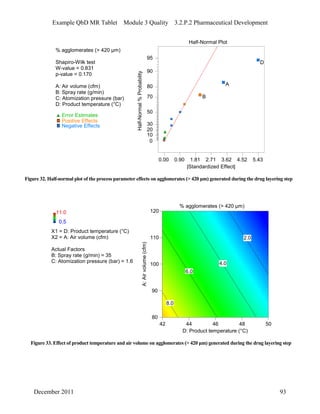
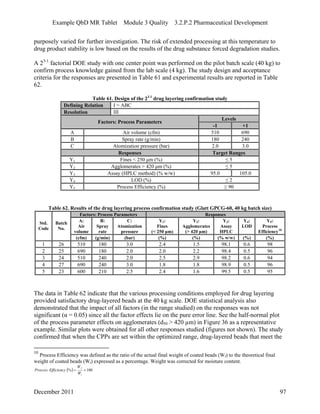
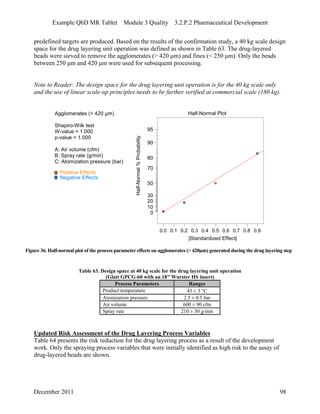
  • 137.
    Example QbD MRTablet Module 3 Quality 3.2.P.2 Pharmaceutical Development 90 100 110 1 2 3 4 5 6 7 8 9 10 Sampling Time Points %LabelClaim Average Claim Maximum Individual Claim Minimum Individual Claim Figure 50. Content uniformity of the tablets at ten evenly space sampling time points during compression A sample size of 20 tablets was pulled at each of the ten sampling time points. Weight variability was evaluated by weighing a composite sample of tablets (n = 20) as well as individual tablets (n = 10) collected at each time point. The results shown in Figure 51 demonstrate that weight variability was well controlled for the individual tablets within ± 5% of the target weight. The average tablet weight for a sample size of 20 tablets was controlled within ± 3% of the target weight. No trend for tablet weight was observed throughout the entire compression run. 237.15 250.325 263.5 276.675 289.85 1 2 3 4 5 6 7 8 9 10 11 TabletWeight(mg) Target ± 3% for average tablet weight Average weight Minimum individual tablet weight Maximum individual tablet weight Sampling Time Points Target ± 5% for individual tablet weight Figure 51. Weight variation of the tablets at ten evenly spaced sampling time points during compression December 2011 137
  • 138.
    Example QbD MRTablet Module 3 Quality 3.2.P.2 Pharmaceutical Development Performance of Split Tablets To evaluate the performance of split tablets at both ends of the target hardness range, a 40 kg pilot scale blend batch (RD-66) was compressed with the pre-compression force and press speed set to 1.25 kN and 40 rpm, respectively. The first half of the batch used a main compression force set point of 7 kN and the second half of the batch used a main compression force set point of 11 kN. Table 88 presents the responses measured for both whole and split tablets. Table 88. Evaluation of tablet quality attributes for both whole and split tablets (1.25 kN pre-compression force and 40 rpm press speed) Weight Loss Drug Release Compression Force Hardness Hand Tablet Splitter Friability Assay CU Disintegration Time 0.5 h 3 h 6 h 12 h (kN) (kP) (%) (%) (AV) (min) (%) (%) (%) (%) 7 4.7-5.1 N/A N/A 0.09 97.3 4.2 1.25 31 38 60 84 Whole 11 9.6-10.6 N/A N/A 0.1 98.5 4.7 1.75 33 41 63 81 7 N/A 1.1 1.2 0.1 98.4 6.2 1.0 32 42 59 82Split (n=12) 11 N/A 1.0 0.9 0.2 97.6 5.9 1.25 31 39 64 85 The results of the investigation indicated that split tablets had well below 3% weight loss whether the tablets were split by hand or with a tablet splitter. Friability was not affected by tablet splitting as tablets with lower hardness (4.7 kP) still had acceptable friability results. Split tablets also met predefined targets for assay, content uniformity, disintegration and drug release. Drug release profiles for whole and split tablets were comparable at both the low end (f2 = 84) and high end (f2 = 83) of the target hardness range. The drug release profiles of the pre-compressed beads versus the compressed split tablet portions were also comparable (f2 = 81). In summary, the split tablets demonstrated equivalent performance to the whole tablets, suggesting that Example MR Tablets are designed effectively for half dosing. Summary of Compression In-Process Controls Based on the results of the studies undertaken to understand the process variables affecting compression, Table 89 lists the proposed in-process controls for the compression step. Table 89. Proposed in-process controls for the compression step Test Frequency Limits Individual tablet weight (n = 10) 20 min 263.44 mg ± 5% Composite tablet weight (n = 20) 20 min 5.269 g ± 3% Hardness (n = 10) 20 min Target: 8.0 kP Range: 4.7-10.6 kP Thickness (n = 10) 20 min Target: 5.75 mm Range: 5.60-5.90 mm Disintegration* (n = 12) 3x during run NMT 5 min Friability* (sample weight = 6.5 g) 3x during run NMT 1.0% *Tested at the beginning, middle and end of the run. December 2011 138
  • 139.
    Example QbD MRTablet Module 3 Quality 3.2.P.2 Pharmaceutical Development Updated Risk Assessment of the Tablet Compression Process Variables Risks identified during initial assessment of the compression process were reduced through development studies. The updated risk assessment is presented in Table 90. Table 90. Updated risk assessment of the tablet compression process variables Unit Operation: Compression Drug Product CQAs: Physical attributes (size and splitability), assay, content uniformity, drug release from both whole and split tablets Compression Variables Drug Product CQAs Risk Assessment Justification for the Reduced Risks Assay Low Content Uniformity Low Drug Release – whole tablets LowFeeder speed Drug Release – split tablets Low In the range studied, the feeder speed had no impact on tablet assay, CU, or drug release. The same tablet press model will be used for pilot scale and commercial scale manufacture. Thus, the risk of feeder speed to impact tablet assay, CU and drug release is reduced from high to low. Assay Low Content Uniformity Low Drug Release – whole tablets LowFeeder fill depth Drug Release – split tablets Low In the range studied, the feeder fill depth had no impact on tablet assay, CU, or drug release. Thus, the risk of impact on tablet assay, CU and drug release is reduced from high to low. Physical Attributes (size and splitability) Low Drug Release – whole tablets Low Pre-compression force Drug Release – split tablets Low The pre-compression force settings that were investigated did not result in tablet lamination or capping. No effect on tablet physical attributes (size and splitability), or drug release from whole or split tablets was observed. Thus, the risk of pre- compression force to impact the tablet physical attributes (size and splitability) and drug release is reduced from high to low. Physical Attributes (size and splitability) Low Drug Release – whole tablets LowCompression force Drug Release – split tablets Low The compression force is correlated to tablet hardness. However, in the range of force studied, there was no impact on the tablet physical attributes (size and splitability) or drug release from whole or split tablets. Thus, the risk of impact on these CQAs is reduced from high to low. Assay Low Content Uniformity Low Drug Release – whole tablets LowPress speed Drug Release – split tablets Low The range of press speeds investigated had no impact on tablet assay, CU, or drug release. Thus, the risk of press speed to impact these tablet CQAs is reduced from high to low. 2.3.6 Exhibit Batch Based on the product and process understanding gained throughout development and the established IVIVR, an exhibit batch (Batch No. ZAb041911) at pilot scale (40 kg) was manufactured. The in- process and release performance characteristics of the drug product were evaluated and are summarized in Table 91 and Table 92, respectively. Split tablets met the finished product release December 2011 139
  • 140.
    Example QbD MRTablet Module 3 Quality 3.2.P.2 Pharmaceutical Development requirements for assay, content uniformity, and drug release. Whole and split tablets met the similarity factor (f2) criteria for drug release. The exhibit batch was used for a pivotal BE study which demonstrated bioequivalence to the RLD (see Section 1.4.3). In addition, an in vitro alcohol-induced dose dumping study was conducted using 0.1 N HCl with 5%, 20% and 40% (v/v) of Alcohol USP. For each condition, 12 units were tested and data was collected every 15 minutes for a total of two hours. Based on an analysis of the means, range and RSD, both whole and split tablets performed comparably to the RLD under each condition (data included in module 5.3). Table 91. In-process testing results for the exhibit batch (Batch No. ZAb041911) Test In-process Control Range Observed for Entire Batch Individual tablet weight (n = 10) Target: 263.44 mg ± 5% Range: 250.27 – 276.61 mg 259.32 – 266.21 mg Composite tablet weight (n = 20) Target: 5.269 g ± 3% Range: 5.006 – 5.532 g 5.157 – 5.386 g Hardness (n = 10) Target: 8.0 kP Range: 4.7 – 10.6 kP 7.5 – 9.3 kP Thickness (n = 10) Target: 5.75 mm ± 0.15 mm Range: 5.60 – 5.90 mm 5.67 – 5.81 mm Disintegration (n = 12) NMT 5 min 1.0 – 1.75 min Friability (sample weight = 6.5 g) NMT 1.0 % 0.09 – 0.1% Table 92. Release testing results for the exhibit batch (Batch No. ZAb041911) Results Test Acceptance Criteria Whole Tablets Split Tablets Description White capsule-shaped tablet debossed with “OGD” on one side of the breakline and “123” on the other side White capsule-shaped tablet debossed with “OGD” on one side of the breakline and “123” on the other side N/A Identification A. HPLC Retention time: corresponds to standard B. UV spectrum: corresponds to standard Corresponds to standard N/A Assay 95.0% – 105.0% 99.6% 99.3% Content Uniformity AV < 15 4.2 6.1 Degradation Products Individual unknown degradation product: NMT 0.2% Total degradation products: NMT 1.0% Individual unknown degradation product: 0.06% Total degradation products: 0.3% N/A 30 min: 32% 3 h: 41% 6 h: 65% 12 h: 83% 30 min: 34% 3 h: 39% 6 h: 68% 12 h: 86% Drug Release (N = 12) 30 min: 25 – 35% 3 h: 35% – 45% 6 h: 55% – 75% 12 h: NLT 80% f2 = 83 Residual Solvents Complies with USP <467> Option 1 Complies with USP <467> Option I N/A December 2011 140
  • 141.
    Example QbD MRTablet Module 3 Quality 3.2.P.2 Pharmaceutical Development 2.3.7 Scale-up to Commercial Scale Note to Reader: Currently, scale-up information is limited at the time of submission. The applicant should discuss product specific scale-up principles including their planned approach to the scale- up process. OGD will evaluate the applicant’s plan to determine its adequacy. However, if a substantial amendment needs to be submitted due to the inadequacy of the scale-up plan, it may significantly extend the review process. It is the firm’s discretion to submit scale-up data such as actual process verification information at the time of submission for a complex drug product which has a high risk of scale-up failure; however, in some cases it may be requested by OGD. 2.3.7.1 Scale-up of IR Granulation Scale-up using a high shear granulator Collete Gral was performed previously for the IR granule formulation in ANDA aaaaaa, Section 2.3 (Appendix I). Table 93 summarizes the scaled granulation process utilizing the same equipment design and operating principles. Table 93. Scale-up and acceptable operating ranges for the IR granulation Lab Scale Pilot Scale Commercial Scale Batch load 2.0 kg 40.0 kg 180 kg Active Powder Mixing Equipment model Collette Gral 10 Collette Gral 300 Collette Gral 1200 Impeller speed Low (285 rpm) Low (125 rpm) Low (75 rpm) Mixing time 5 min 5 min 5 min Granulation using Purified Water Equipment model Collette Gral 10 Collette Gral 300 Collette Gral 1200 Impeller speed Low (285 rpm) Low (125 rpm) Low (75 rpm) Chopper speed Low Off Off Solution addition rate 60 g/min 1.3 kg/min 10.0 kg/min Mixing time 12 min 12 min 12 min Drying Equipment Fluid Bed Dryer Fluid Bed Dryer Fluid Bed Dryer Bed air temperature 52ºC (50 – 55 °C) 52ºC (50 – 55 °C) 52ºC (50 – 55 °C) Milling Equipment Fitzmill L1A Fitzmill DA6 Fitzmill DA6 Screen size: 20 mesh Screen size: 20 mesh Screen size: 20 mesh Screening mill Speed: 4740 ± 20 rpm Speed: 2500 ± 20 rpm Speed: 2500 ± 20 rpm December 2011 141
  • 142.
    Example QbD MRTablet Module 3 Quality 3.2.P.2 Pharmaceutical Development 2.3.7.2 Scale-up of ER Beads Drug Layering and Polymer Coating Scale-up Principles for Bottom Spray Fluid Bed Coating Process variables most likely to impact the quality of coated beads were optimized at the pilot batch scale. A batch at commercial scale was used to confirm the critical process parameter ranges and consistent product performance for the drug layering and ER polymer coating unit operations. The commercial batch was processed in a Glatt GPCG -120 with a 32″ Wurster HS insert. The 32″ insert has three partition columns and spray nozzles. Figure 52 illustrates the key operational features of this equipment, specifically the three partition columns and spray nozzles. Each of these three configurations has the same geometry and dimensions as the single-spray unit (18″ Wurster HS insert with a partition column diameter of 219 mm) used for pilot scale processing. Figure 52. Glatt GPCG-120 with a 32″ Wurster insert used at commercial scale Linear scale-up of drug layering using a fluid bed process is possible by utilizing properly designed distribution plates and chambers and by maintaining the ratios of air volume to distribution plate area and spray rate to air volume. Assuming that bed fill levels are the same and that the chamber design and the distribution plate in each piece of equipment is geometrically similar, fluid bed scaling from a coater with an 18″ insert to one with a 32″ insert is straightforward. The number of nozzles, air volume, and total spray rate at the 32″ insert scale are all a direct multiple of the parameters optimized in a single nozzle unit at the 18″ insert scale. The spray rate and atomization air pressure per nozzle are maintained the same as those optimized at the pilot scale. The linear air flow rate in the equipment is kept constant as the process is scaled up. The air volume is scaled up by a factor of three based upon the distribution plate area. During scale-up, product temperature and relative humidity of the inlet air (dew point) are scale- independent variables and kept the same as the values optimized in the pilot scale process development study. Table 94 compares the fluid bed equipment used at pilot and commercial scale. December 2011 142
  • 143.
    Example QbD MRTablet Module 3 Quality 3.2.P.2 Pharmaceutical Development Table 94. Fluid bed equipment for pilot and commercial scale Lab Scale Pilot Scale Verification Batch at Commercial Scale Equipment model Glatt GPCG - 5 Glatt GPCG - 60 Glatt GPCG - 120 Fluid bed insert 7″ Wurster 18″ Wurster 32″ Wurster Equipment working capacity* 8.3 L 102 L 405 L Partition column diameter 89 mm 219 mm 219 mm Number of partition columns 1 1 3 Nozzle diameter 1.0 1.2 mm 1.2 mm Number of spray nozzles 1 1 3 *Volume outside of the partition column at rest on the orifice plate Scale-up of the Drug Layering Process A verification batch at commercial scale was manufactured using the target settings listed in Table 95 based on linear scale-up of the pilot scale process robustness study. The spray rate and atomization air pressure were maintained at the pilot scale settings per nozzle. Partition height was set at 40 ± 10 mm on the basis of prior experience to maintain optimal fluidization. Table 95. Equipment and process parameters for pilot and commercial scale drug layering Pilot Scale Verification Batches at Commercial Scale Equipment model Glatt GPCG - 60 Glatt GPCG - 120 Starting weight of substrate 40 kg 140 kg Theoretical ending weight of batch (~ 41% weight gain based on coating substrate weight) 56 kg 198 kg Estimated use of capacity* 65% 58% Partition height 45 ± 3 mm 45 ± 3 mm Product temperature (°C) 45 ± 3 C 45 ± 3 C Dew point (°C) 10 ± 2 C 10 ± 2 C Air volume (cfm) 600 ± 90 cfm 1800 ± 270 cfm Spray rate per nozzle (g/min) 210 ± 30 g/min 210 ± 30 g/min Total spray rate (g/min) 210 ± 30 g/min 630 ± 90 g/min Atomization air pressure per nozzle (bar) 2.5 ± 0.5 bar 2.5 ± 0.5 bar *Calculated based on bulk density of drug-layered beads = 0.85 g/cc Note: All coating process parameter settings were target values at steady state. Table 96 presents the data collected for the quality attributes of the drug-layered beads. The drug- layered beads manufactured at commercial scale were carried forward for further processing. Table 96. Quality attributes of drug-layered beads manufactured at commercial scale PSD LOD Fines < 250 µm Agglomerates > 420 µm 250 µm < usable fraction < 420 µm Assay Process Efficiency (%) (%) (%) (%) (%) (%) 0.8 0.8 0.2 98.8 99.9 99.6 December 2011 143
  • 144.
    Example QbD MRTablet Module 3 Quality 3.2.P.2 Pharmaceutical Development Scale-up of the ER Polymer Coating Process Similar to drug layering, scale-up of the ER polymer coating process was also a linear scale-up from an 18″ to a 32″ Wurster HS insert. A verification batch at commercial scale was manufactured using the equipment and process parameters optimized during the pilot scale process robustness study. The target settings are detailed in Table 97. Drug-layered beads from the previous unit operation were loaded into the fluid bed coater after testing was completed for performance characteristics such as particle size distribution and LOD. Table 97. Equipment and process parameters for pilot and commercial scale ER polymer coating Pilot Scale Verification Batches at Commercial Scale Equipment model Glatt GPCG - 60 Glatt GPCG - 120 Starting weight of drug-layered beads 40 kg 180 kg Theoretical ending weight of batch (~ 36% weight gain based on drug-layered bead weight) 54 kg 245 kg Estimated use of capacity* 62% 71% Partition height 45 ± 3 mm 50 ± 3 mm Product temperature (°C) 31 ± 3 31 ± 3 Dew point (°C) 10 ± 2 ºC 10 ± 2 ºC Air volume (cfm) 660 ± 60 1980 ± 180 Spray rate per nozzle (g/min) 120 ± 20 120 ± 20 Total spray rate (g/min) 120 ± 20 360 ± 60 Atomization air pressure per nozzle (bar) 2.5 ± 0.5 2.5 ± 0.5 *Calculated based on the bulk density of the ER coated beads = 0.85 g/cc Note: All coating process parameter settings were target values at steady state. Based on previous experience with Wurster coating, it is possible for process efficiency to differ between pilot and commercial scale. The actual polymer coating level applied to the beads will vary based on the process efficiency. During the verification batch, samples were pulled at different theoretical polymer coating levels of 26%, 27%, 28%, 29%, 30%, 31% and 32% to determine the optimum theoretical polymer coating level that would result in the desired drug release profile. These samples were dried until the LOD was less than 2% and evaluated for drug release by dissolution testing. Table 98 presents the data collected for the quality attributes of the ER coated beads. Table 98. Quality attributes of the ER coated beads manufactured at commercial scale (Batch No. COM001) PSD LOD Fines < 350 µm Agglomerates > 590 µm 350 µm < usable fraction < 590 µm Assay Process Efficiency (%) (%) (%) (%) (%) (%) 0.9 0.7 0.1 99.2 98.9 99.0 The first commercial verification batch (Batch No. COM001) of ER coated beads with a theoretical polymer coating level between 30-32% exhibited slower release when compared to the pivotal bio- batch (Lot No. ZAb041911) manufactured at pilot scale and failed the predefined drug release December 2011 144
  • 145.
    Example QbD MRTablet Module 3 Quality 3.2.P.2 Pharmaceutical Development specification (data not shown). The ER coated beads with 26% theoretical polymer coating showed faster drug release when compared to the pivotal bio-batch. However, there was no significant difference between beads with 27-29% theoretical polymer coating and the pivotal bio-batch. The ER coated beads were further examined using SEM and no obvious difference in film quality was observed. In order to understand whether the drug release failure was due to a film coat thickness change, the usable ER beads (350-590 μm) were further sieved to minimize the effect of bead size on film thickness measurement. The fraction between sieve No. 40 and 35 (420-500 μm) was collected from both the verification batch (Lot No. COM001) and the pivotal bio-batch. Samples were sent to an outside testing laboratory for film thickness testing by Terahertz Pulse Imaging (TPI)14 and the data presented in Figure 53 was obtained. 0 10 20 30 40 50 60 Pilot COM001 FilmCoatThickness(µm) Figure 53. Film coat thickness of beads with 30% theoretical polymer coating from pilot (red) and commercial (blue) batches Drug-layered beads with 30% theoretical polymer coating showed an increase in total film thickness from 41 ± 2 µm at pilot scale to 46 ± 3 µm at commercial scale. The T50% increased from 5.6 hours to 6.6 hours and failed to meet the pre-defined CQA acceptance criteria. This could potentially be attributed to the fact that in the commercial scale equipment, 71% of capacity was utilized compared to 62% use of capacity at pilot scale. When the bed fill level was low at pilot scale, the partition height was also set low, which may limit the mass flow of beads into the partition column. Therefore, coating material may be lost to the partition column wall, resulting in overall lower process efficiency at pilot scale. In order to achieve similar drug release and bioequivalence results as those obtained at the pilot scale, the theoretical polymer coating level was reduced from 30% to 28% based on the drug release 14 Taday P.F., et al. Nondestructive analysis of tablet coating thickness using terahertz pulsed imaging, J. Pharm. Sci. 2005; 94 (1); 177-183. December 2011 145
  • 146.
    Example QbD MRTablet Module 3 Quality 3.2.P.2 Pharmaceutical Development results of samples with different coating levels (26-32%) pulled during the first verification batch. Using the same process parameters, a second verification batch (Batch No. COM002) at commercial scale was manufactured with a 28% theoretical polymer coating. Table 99 summarizes LOD, PSD, assay and process efficiency results. Table 99. Quality attributes of the ER coated beads manufactured at commercial scale (Batch No. COM002) PSD LOD Fines < 350 µm Agglomerates > 590 µm 350 µm < usable fraction < 590 µm Assay Process Efficiency (%) (%) (%) (%) (%) (%) 0.8 0.7 0.2 99.1 98.6 99.0 Similar to the evaluation of the first verification batch (Batch No. COM001), a non-destructive TPI method performed at an outside testing lab was used to measure polymer coating thickness of the second verification batch (Batch No. COM002). Results indicated that a difference in film thickness between the pivotal bio-batch and the second verification batch was not statistically significant (α = 0.05). Similarity in drug release characteristics for the ER coated beads was also tested and confirmed using the established discriminatory dissolution method (data not shown). ER coated beads (Batch No. COM002) were subsequently blended with extragranular excipients and compressed into tablets. The final drug product exhibited a drug release profile equivalent to tablets from the pilot scale bio-batch and the RLD as shown in Figure 54. 0 10 20 30 40 50 60 70 80 90 100 0 2 4 6 8 10 12 14 16 18 20 22 24 Time (h) DrugReleased(%) Verification Batch No. COM002 Bio-Batch No. ZAb041911 RLD Figure 54. Drug release profiles of the 2nd verification batch (COM002) and the bio-batch (ZAb041911) Although the formulation for Example MR Tablets was modified to reduce the theoretical polymer coating level by 2%, no additional bioequivalence studies were necessary. The comparable in vitro drug release between the second commercial batch and the bio-batch demonstrated in Figure 54 and the established IVIVR ensure the desired performance of the drug product in vivo. December 2011 146
  • 147.
    Example QbD MRTablet Module 3 Quality 3.2.P.2 Pharmaceutical Development 2.3.7.3 Scale-up of Blending and Compression The equipment employed in the critical unit operations to manufacture the trial, pilot and commercial batches have the same principle of operation as outlined in Table 100. However, the equipment capacity varies based on the intended size of the commercial batches. In order to avoid scale-up issues, the same type of equipment was used. Table 100. Scale-up of MR Tablet blending, lubrication and compression Unit Operation Lab Scale Pilot Scale Commercial Scale Operating Principle Constant Parameter Blending V (tumble) blender (16 qt) V (tumble) blender (7.5 cu ft) V (tumble) blender (30 cu ft) Diffusion Mixing Nrev = 300 Use inline NIR for endpoint determination Lubrication V (tumble) blender (16 qt) V (tumble) blender (7.5 cu ft) V (tumble) blender (30 cu ft) Diffusion Mixing Nrev = 90 Compression 10-station Rotary Tablet Press with ‘B’ type tooling 49-station Rotary Tablet Press with ‘B’ type tooling 49-station Rotary Tablet Press with ‘B’ type tooling Compression Individual Weight: 263.44 mg ± 5% Hardness: 8.0 kP (4.7 – 10.6 kP) Thickness: 5.75 mm ± 0.15 mm Scale-up of the Blending Process The inline NIR method developed and validated at pilot scale was verified at commercial scale and will be used for blending endpoint determination of all commercial batches. The target endpoint for blending will remain at 300 revolutions of the blender; however, the actual endpoint is based on inline NIR measurements. To assess the homogeneity of the blend, a moving block RSD was calculated for each moving block of ten consecutive spectra and plotted as a function of time. The blend was considered uniform once the RSD was below 5% for ten consecutive measurements. Table 101 summarizes the blending process parameters and endpoints for the different scales. Table 101. Scale-up of blending process parameters for diffusion mixing in a V-blender Scale (V-blender size) Blender rotation speed Target Nrev Target mixing time Blend Uniformity by NIR (rpm) (min) (% RSD) Lab Scale (16 qt) 25 300 12 1.19 Pilot Scale (7.5 cu ft) 15 300 20 1.02 Commercial Scale (30 cu ft) 10 300 30 1.20 Scale-up of the Tableting Process The tablet compression machine is equipped with a modern compression force feedback control that adjusts the fill depth to ensure target tablet weight and, consequently, content uniformity. Based on compression force feedback, the fill cam below the die table adjusts the lower punch to the December 2011 147
  • 148.
    Example QbD MRTablet Module 3 Quality 3.2.P.2 Pharmaceutical Development appropriate height to control fill depth (and ultimately tablet weight). Detailed parameters that affect the tableting process were already explored and discussed in Section 2.3.5. Commercial batches of drug product produced comparable results as those presented in Section 2.3.5 because the same model of rotary tablet press was used and tablets were compressed at the same speed. Therefore, dwell time remains unchanged during scale-up. 2.3.8 Updated Risk Assessment of the Drug Product Manufacturing Process During process development, high risks for each unit operation were addressed. Experimental studies were defined and executed in order to establish additional scientific knowledge and understanding, to allow appropriate controls to be developed and implemented, and to reduce the risk to an acceptable level. After detailed experimentation, the initial manufacturing process risk assessment was updated in-line with the current process understanding. Table 102 presents how the application of the control strategy to the manufacturing process has reduced the identified risks. Table 103 provides the justification for the reduced risk following process development. Table 102. Updated risk assessment of the manufacturing process for Example MR Tablets, 10 mg Process Steps Drug Product CQAs IR granulation ER beads: drug layering Sieving I ER beads: polymer coating Sieving II Blending and Lubrication Compression Physical Attributes (size and splitability) Low* Low* Low* Low* Low* Low* Low Assay Low* Low Low* Low* Low* Low Low Content Uniformity Low* Low Low* Low* Low* Low Low Drug Release – Whole tablets Low* Low* Low* Medium Low Low Low Drug Release – split tablets Low* Low Low* Medium Low Low Low Drug Release – alcohol-induced dose dumping N/A* N/A* N/A* Low* Low* Low* Low* *The level of risk was not reduced from the initial risk assessment. Table 103. Justification for the reduced risks of the manufacturing process for Example MR Tablets, 10 mg Process Steps Drug Product CQAs Justification Assay The drug layering process was optimized to minimize spray drying and agglomeration. Fines and agglomerates generated during the verification batch were both below 1%. Drug-layered beads had an assay within the target range of 95.0 – 105.0%. Within the range studied, the risk of drug layering process variables to impact tablet assay is reduced from high to low. ER beads: drug layering Content Uniformity Optimal fluidization and uniform spray was achieved using process parameters within the range studied. The drug-layered beads had acceptable uniformity. Thus, the risk of drug layering process variables to impact tablet CU is reduced from medium to low. December 2011 148
  • 149.
    Example QbD MRTablet Module 3 Quality 3.2.P.2 Pharmaceutical Development Process Steps Drug Product CQAs Justification Drug Release – split tablets Split tablets had adequate CU with an AV < 7 and the drug release profile between whole and split tablets met the similarity factor (f2 > 80) criteria. The risk of the drug layering process variables to impact drug release from split tablet is reduced from medium to low. Drug Release – whole tablets The ER polymer coating process was optimized to minimize spray drying and agglomeration. Fines and agglomerates were both below 1% in the verification batches. Within the range studied, the risk of ER polymer coating process variables to impact drug release from whole tablets is reduced at pilot scale. However, some variability in process efficiency and ER polymer coating layer thickness was observed during scale-up from pilot to commercial scale. The theoretical polymer coating level was decreased from 30% to 28% to achieve the target drug release profile. The impact of ER polymer coating process variability on drug release from whole tablets needs to be further monitored during validation and routine commercial manufacturing to gain additional knowledge and to facilitate continual improvement. Therefore, the risk for drug release from whole tablets is considered acceptable but at a medium level. ER beads: polymer coating Drug Release – split tablets Split tablets had adequate CU with an AV < 7 and comparable drug release to whole tablets (f2 > 80). The risk is reduced but because drug release is sensitive to polymer coating level based on the BE studies, further evaluation during process validation and routine commercial manufacturing is needed to gain additional knowledge. Therefore, the risk of ER polymer coating process variables to impact split tablet drug release is medium. Drug Release – whole tablets The risk of damaging the coated beads is reduced with the instructions “do not use force during sieving” included in the batch record. The risk of sieving II to impact drug release from whole tablets is reduced from medium to low. Sieving II Drug Release – split tablets Split tablets had adequate CU with an AV < 7. The risk of sieving II to impact drug release from whole tablet is reduced from medium to low. As such, the risk of this step to impact drug release from split tablets is also reduced from medium to low. Assay The blending process was optimized and the risk of segregation was reduced during prototype formulation optimization by using two MCC grades. The risk of the blending and lubrication process variables to impact tablet assay is reduced from medium to low. Content Uniformity Inline NIR was utilized to ensure blend uniformity and no segregation was observed after discharge from the blender. In addition, tablet CU met the requirements set forth in USP <905>. The risk of the blending and lubrication process variables to impact tablet CU is reduced from high to low. Drug Release – whole tablets The blending process was optimized and blend uniformity was achieved by utilizing inline NIR for endpoint determination. The lubrication process was also optimized. Whole tablets demonstrated acceptable CU with an AV < 5, exhibited rapid disintegration, and met the target drug release profile. The fact that the tablets showed rapid disintegration and had no appearance defects during the entire compression run provides evidence that the disintegrant and lubricant were adequately distributed in the final blend. Therefore, the risk of the blending and lubrication process variables to impact drug release from whole tablet is reduced from medium to low. Blending and Lubrication Drug Release – split tablets Both whole and split tablets complied with USP <905> and demonstrated acceptable CU. Similar drug release profiles between whole and split tablets were obtained (f2 > 80). The risk is reduced from high to low. Compression Physical Attributes (size and splitability) The shape and score configuration of the tablets were defined and compression process parameters were optimized. The tablet has a similar size as the RLD tablet. Tablets were easily split by the target patient population. Thus, the risk of the compression process variables to impact tablet physical attributes (size and splitability) is reduced from high to low. December 2011 149
  • 150.
    Example QbD MRTablet Module 3 Quality 3.2.P.2 Pharmaceutical Development Process Steps Drug Product CQAs Justification Assay Feeder speed, feeder fill depth and press speed were investigated and acceptable tablet assay (95 – 105%) was achieved within the studied ranges. The risk of the compression process variables to impact tablet assay is reduced from high to low. Content Uniformity Tablets were sampled at ten evenly spaced time intervals during compression of a batch and CU testing at each time point was performed. The data revealed no evidence of segregation in the hopper. The risk of impact on tablet CU is reduced from high to low. Drug Release – whole tablets The compression process was optimized. Bead integrity was confirmed after tablet compression at the highest force studied. The drug release from whole tablets was not significantly impacted by the compression force within the studied range. Therefore, the risk of the compression process variables to impact drug release from whole tablets is reduced from high to low. Drug Release – split tablets The split tablet portions demonstrated adequate CU and comparable drug release to the whole tablets. Thus, the risk of the compression process variables to impact drug release from split tablets is reduced from high to low. 2.4 Container Closure System To be consistent with the RLD, the drug product Example MR Tablets, 10 mg, is intended to be labeled for storage at 25 °C (77 °F) with excursions permitted to 15-30 °C (59 – 86 °F). The innovator has chosen round white opaque HDPE bottles with an induction seal liner and child resistant (CR) closure. Example MR Tablets, 10 mg, will be similarly packed and the bottle pack details are summarized in Table 104. Table 104. Proposed commercial packaging for Example MR Tablets, 10 mg Count HDPE Bottle Closure 30 Tablets 40 cc 33 mm white CR cap with pulp liner 90 Tablets 60 cc 38 mm white CR cap with pulp liner Information on conformance to USP <661> and USP <671>, food safety certification, and stability data available to date can be found in the relevant sections of Module 3. The selected commercial packaging provides adequate protection from light, heat, oxygen, and moisture and is suitable for its intended use. 2.5 Microbiological Attributes An accelerated stability study of prototype F-2 demonstrated that the drug product has low water activity and is not capable of supporting microbial growth. Routine microbiological testing of Example MR Tablets is unnecessary due to the low water activity of the product, controls on incoming raw materials, and controls on in-process water content. December 2011 150
  • 151.
    Example QbD MRTablet Module 3 Quality 3.2.P.2 Pharmaceutical Development 2.6 Compatibility This section is not applicable because the drug product is a solid oral dosage form and there are no reconstitution diluents. 2.7 Control Strategy Note to Reader: The control strategy is “a planned set of controls, derived from current product and process understanding, that assures process performance and product quality. The controls can include parameters and attributes related to drug substance and drug product materials and components, facility and equipment operating conditions, in-process controls, finished product specifications, and the associated methods and frequency of monitoring and control.”15 The control strategy for Example MR Tablets is built upon the outcome of extensive product and process understanding studies. These studies investigated the material attributes and process parameters that were deemed high risk to the CQAs of the drug product during the initial risk assessment. In some cases, variables considered medium risk were also investigated. Through these systematic studies, the CMAs and CPPs were identified and the acceptable operating ranges were established. For the drug layering and the ER polymer coating unit operations, a design space was established at both lab and pilot scale. All variables ranked as high risk in the initial risk assessment are included in the control strategy because the conclusion of the experiments was dependant on the range studied and the complex multivariate relationship between variables. Thus, the control strategy is an integrated overview of how quality is assured based on current process and product knowledge. The control strategy may be further refined based on additional experience gained during the commercial lifecycle of the product. However, any post-approval changes should be reported to the agency in accordance with CFR 314.70 and should follow steps as outlined by guidances used for scale-up and post-approval changes. 2.7.1 Control Strategy for IR Granules The control strategy for the commercial manufacture of IR granules was first submitted in ANDA aaaaaa (Appendix I). Table 105 summarizes the proven acceptable ranges for each critical material attribute and process parameter involved in the granulation unit operation for the IR portion of the MR tablets. 15 ICH Harmonised Tripartite Guideline: Q10 Pharmaceutical Quality Systems. June 2008. December 2011 151
  • 152.
    Example QbD MRTablet Module 3 Quality 3.2.P.2 Pharmaceutical Development Table 105. Control Strategy for IR granules Factor Attribute/ Parameter Range studied Set point for the verification batch Validated operating range for commercial scale (min, max) Purpose of control IR Granules Input Material Attributes Z Particle size distribution d10: 1- 10 µm d50: 10-30 µm d90: 25-50 µm d10: 5 µm d50: 20 µm d90: 35 µm d10: 1- 10 µm d50: 10-30 µm d90: 25-50 µm Microcrystalline Cellulose (MCC), Grade 200 Particle size distribution d50: 150-250 µm d50: 196 µm d50: 150 -250 µm Lactose Monohydrate Particle size distribution d50: 50-100 µm d50: 65 µm d50: 50-100 µm To reduce granulation process variability Povidone (PVP), K30 K-value Used material within in-house spec (K-value: 29-32) 30 29-32 To ensure consistent binding functionality Particle size distribution d50: 50-100 μm d50: 65 μm d50: 50-100 μmSodium Starch Glycolate (SSG), Type A Degree of substitution* 0.25-0.35 0.30 0.25-0.35 To ensure batch to batch consistency Powder Mixing and Granulation Process Variables (Validated Process) Impeller speed Low and High Low Low Chopper speed On and Off Off Off Powder mixing time 2-10 min 5 min 2-10 min Granulation mixing time 10-20 min 12 min 10-20 min Solution addition rate 5-20 kg/min 10 kg/min 5-20 kg/min Granulation fluid quantity* 32-42% w/w 36.5% w/w 35-38% w/w To ensure IR granule CQAs (PSD and bulk density) are met consistently Drying Process Variables and In-Process Controls (Validated Process) Drying 50-55 °C 52 °C 50-55 °C Water content NMT 2.0% NMT 2.0% NMT 2.0% To ensure low water activity in order to prevent microbial growth Milling and Blending Process Variables and In-process controls (Validated Process) Milling Speed 4740 rpm 2500 rpm 2500 ± 20 rpm Mill screen size 20 20 20 To ensure IR granule PSD is met consistently Blend Uniformity, (% RSD)* 95.0-105.0% NMT 3.0% 95.0-105.0% NMT 3.0% To ensure tablet CU is met consistently IR Granules In-Process Controls Granule size distribution* Retained on 45 mesh (coarse granules > 350 μm): NMT 5% Retained on 60 mesh (> 250 μm, but < 350 μm): NLT 85% Retained on fine collector (< 250 μm): NMT 10% LOD < 2.0% Dissolution* NLT 80% in 30 min in 0.1 HCl Assay* 95.0 – 105.0% w/w of label claim *critical input material attributes (CMA), critical process parameters (CPP) or critical quality attributes (CQA) of in- process material or final drug product December 2011 152
  • 153.
    Example QbD MRTablet Module 3 Quality 3.2.P.2 Pharmaceutical Development 2.7.2 Control Strategy for ER Coated Beads Since extensive DOE studies were carried out during the formulation and process development of the ER coated beads, a pilot scale (40 kg) design space for critical parameters has been established. Table 106 summarizes the proposed ranges for the commercial manufacture of ER coated beads. Because dissolution apparatus 3 has been used to establish an IVIVR, this method was selected and validated for quality control of the ER coated beads and the release assay of the final drug product. Note that the process parameters presented in the control strategy are the target values achieved at steady state. Table 106. Control Strategy for ER beads Factor Attribute/ Parameter Range studied Set point for the verification batch Proposed operating range for commercial scale (min, max)1 Purpose of control ER Coated Beads Input Material Attributes Z Particle size distribution d10: 1- 10 µm d50: 10-30 µm d90: 25-50 µm d10: 5 µm d50: 20 µm d90: 35 µm d10: 1- 10 µm d50: 10-30 µm d90: 25-50 µm To ensure batch to batch consistency (same as Example IR Tablets) Microcrystalline Cellulose (MCC) beads Bead size distribution* Fraction between 250-350 µm was used Fraction between 250-350 µm was used Fraction between 250-350 µm was used To prevent segregation and to reduce coating process variability Povidone (PVP), K30 K-value Used material within in-house spec (K: 29-32) 30 29-32 To ensure consistent binding functionality Acetic acid content 0.5-1.5% 1.4% NMT 1.5% Poly vinyl acetate content Used material within in-house spec (25-29 g/100g) 27 g/100g 25-29 g/100g Povidone* content Used material within in-house spec (2.5- 2.9%) + 0-2.7% additional 2.7% (as is) 0% additional 2.5-2.9% (as is) 0% additional Kollicoat SR 30 D Apparent viscosity 50-90 mPa•s 88 mPa•s 50-90 mPa•s To ensure desired drug release from ER coated beads is achieved consistently Talc Particle size Used material within in-house spec d50: 2-8 µm NLT 99% passing 325 mesh (44 μm) Used as-is d50: 4.7 µm 99.9% passing 325 mesh (44 μm) d50: 2-8 µm NLT 99% passing 325 mesh (44 μm) To ensure batch to batch consistency and to reduce nozzle and tubing clogging December 2011 153
  • 154.
    Example QbD MRTablet Module 3 Quality 3.2.P.2 Pharmaceutical Development Factor Attribute/ Parameter Range studied Set point for the verification batch Proposed operating range for commercial scale (min, max)1 Purpose of control Drug Layering Process Parameters Drug solution preparation Mixing time Mix until dissolved but NLT 1 hour Mix until dissolved (1.5 hour) Mix until dissolved but NLT 1 hour Drug solution Holding time 0-48 hr 8 hr Up to 48 hr Atomization air pressure 1.2 -2.0 bar (lab) 2.0-3.0 bar (pilot) 2.5 bar (bio-batch) 2.5 bar 2.5 ± 0.5 bar Spray rate per nozzle* 25-45 g/min (lab) 180-240 g/min (pilot) 210 g/min (bio- batch) 210 g/min (total spray rate: 630 g/min) 210 ± 30 g/min (total spray rate: 630 ± 90 g/min) Product temperature* 42-50 °C (lab) 42-48 C (pilot) 45 C (bio-batch) 45 C 45 ± 3 C Air volume* 80-120 cfm (lab) 510-690 cfm (pilot) 600 cfm (bio-batch) 1800 cfm 1800 ± 270 cfm Wurster column coating Use of capacity 79% (lab) 65% (pilot) 58% 58% To ensure target assay of drug- layered beads is achieved consistently Drug-Layered Beads In-Process Controls Beads size distribution* Retained on 40 mesh (Agglomerates > 420 μm): NMT 5% Retained on 60 mesh (250 μm < usable fraction < 420 μm): NLT 90% Retained on fine collector (Fines < 250 μm): NMT 5% LOD < 2.0% Assay* 95.0 – 105.0% w/w of label claim Content Uniformity* RSD < 5.0% December 2011 154
  • 155.
    Example QbD MRTablet Module 3 Quality 3.2.P.2 Pharmaceutical Development Factor Attribute/ Parameter Range studied Set point for the verification batch Proposed operating range for commercial scale (min, max)1 Purpose of control ER Polymer Coating Process Parameters Coating dispersion preparation Mixing time Mix for at least 1 hour before spraying and mix continuously during the entire coating process Mix for at least 1 hour before spraying and mix continuously during the entire coating process Mix for at least 1 hour before spraying and mix continuously during the entire coating process Coating dispersion Holding time 0-48 hr 8 hr Up to 48 hr Air volume* 70-170 cfm (lab) 600-720 cfm (pilot) 660 cfm (bio-batch) 1980 cfm 1980 ± 180 cfm Atomization air pressure 1.2-2.0 bar (lab) 2.0-3.0 bar (pilot) 2.5 bar (bio-batch) 2.5 bar 2.5 ± 0.5 bar Spray rate per nozzle* 10-30 g/mim (lab) 100-140 g/min (pilot) 120 g/min (bio- batch) 120 g/min (total spray rate: 360 g/min) 120 ± 20 g/min (total spray rate: 360 ± 60 g/min) Product temperature* 25-39 °C (lab) 28-36 °C (pilot) 31 °C (bio-batch) 31 °C 31 ± 3 °C Use of capacity 77% (lab) 62% (pilot) 71% 71% Wurster column coating Theoretical polymer coating level* 20-40% (formulation study) 25% (1st BE) 30% (passed) and 35% (failed) (2nd BE) 30% (process study) 30% (bio-batch) 30% (1st verification batch failed2 ) 28% (2nd verification batch passed) 28 ± 1% To ensure desired drug release from ER coated beads is achieved consistently ER Coated Beads In-Process Controls Beads size distribution* Retained on 30 mesh (Agglomerates > 590 μm): NMT 5% Retained on 45 mesh (350 μm < usable fraction < 590 μm): NLT 90% Retained on fine collector (Fines < 350 μm): NMT 5% LOD < 2.0% Assay* 95.0 – 105.0% w/w of label claim Drug release*,3 T20% 2.5 ± 0.2 h T50% 4.5 ± 1.0 h T80% 10.0 ± 2.0 h *critical input material attributes (CMA), critical process parameters (CPP) or critical quality attributes (CQA) of in-process material or final drug product 1 The proposed operating range for commercial scale will be qualified and continually verified. 2 Failed drug release specification for ER beads. 3 The validated apparatus 3 method is used. 2.7.3 Control Strategy for Example MR Tablets, 10 mg The control strategy for the commercial manufacture of the final product is presented in Table 107. In addition to input material specifications, critical process parameters and the proposed operating December 2011 155
  • 156.
    Example QbD MRTablet Module 3 Quality 3.2.P.2 Pharmaceutical Development ranges are given for the blending, lubrication and compression steps. Release specifications for the final product are provided in Table 108. Table 107. Control Strategy for Example MR Tablets, 10 mg Factor Attribute/ Parameter Range studied Set point for the verification batch Proposed operating range for commercial scale (min, max)1 Purpose of control MR Tablet Input Material Attributes IR granules Particle size distribution Retained on 45 mesh (> 350 μm): NMT 5% Retained on 60 mesh (> 250 μm, but < 350 μm): NLT 85% Retained on fine collector (< 250 μm): NMT 10% Retained on 45 mesh (> 350 μm): NMT 5% Retained on 60 mesh (> 250 μm, but < 350 μm): NLT 85% Retained on fine collector (< 250 μm): NMT 10% Retained on 45 mesh (> 350 μm): NMT 5% Retained on 60 mesh (> 250 μm, but < 350 μm): NLT 85% Retained on fine collector (< 250 μm): NMT 10% To ensure batch to batch consistency. MR formulation and manufacturing process is designed to accommodate the IR granule properties defined in approved ANDA aaaaaa. ER beads Particle size* Fraction between 350 μm and 590 μm was used Fraction between 350 μm and 590 μm was used Fraction between 350 μm and 590 μm was used Microcrystalline Cellulose (MCC), Grade 200 Particle size* d50: 150-250 µm d50: 196 µm d50: 150-250 µm Microcrystalline Cellulose (MCC), Grade 101 Particle size* d50: 30-80 µm d50: 55 µm d50: 30-80 µm To prevent segregation of the blend Particle size distribution d50: 50-100 μm d50: 65 μm d50: 50-100 μmSodium Starch Glycolate (SSG), Type A Degree of substitution* 0.25-0.35 0.30 0.25-0.35 To ensure batch to batch consistency Magnesium Stearate Specific surface area 6-10 m2 /g 8.2 m2 /g 6-10 m2 /g To ensure sufficient lubrication and to reduce the risk of retarded drug release December 2011 156
  • 157.
    Example QbD MRTablet Module 3 Quality 3.2.P.2 Pharmaceutical Development Factor Attribute/ Parameter Range studied Set point for the verification batch Proposed operating range for commercial scale (min, max)1 Purpose of control Blending and Lubrication Process Parameters Blending uniformity* 25 rpm, 12 min (lab) 15 rpm, 20 min (pilot) 15 rpm, 20 min (bio-batch) Blend to endpoint < 5.0% RSD Blend to endpoint < 5.0% RSD Inline NIR is used for endpoint determination to ensure BU is met consistently Lubrication 25 rpm, 3-7 min (lab) 15 rpm, 4-8 min (pilot) 15 rpm, 5 min (bio- batch) Nrev = 90 Nrev = 60-120 Target Nrev = 90 V-blender Estimated use of capacity 40-60% (pilot) 50% (bio-batch) ~50% 40-60% To ensure lubricant is well distributed and to avoid over- lubrication Compression Process Parameters Press speed 20-60 (rpm) 40 (rpm) 40 ± 20 (rpm) Pre-compression 0.5-2.0 (kN) 1.0 (kN) 0.5-2.0 (kN) Rotary press Compression* 7.0-11.0 (kN) 7.0-11.0 (kN) 7.0-11.0 (kN) To ensure all tablet CQAs (size, splitability, assay, CU and drug release) are met consistently Compression In-Process Controls Individual weight (n=10; every 20 min) 262.77 mg ± 5% Composite weight (n=20; every 20 min) 5.255 g ± 3% Hardness (n=10; every 20 min) 8.0 (4.7-10.6) kP Thickness (n=10; every 20 min) 5.75 mm ± 0.15 mm Disintegration (n=12; 3x during run) NMT 5 min Friability (sample weight = 6.5 g; 3x during run) NMT 1.0 % *critical input material attributes (CMA), critical process parameters (CPP) or critical quality attributes (CQA) of in- process material or final drug product 1 The proposed operating range for commercial scale will be qualified and continually verified. December 2011 157
  • 158.
    Example QbD MRTablet Module 3 Quality 3.2.P.2 Pharmaceutical Development Table 108. Example MR Tablets, 10 mg, release specifications Test Acceptance Criteria Description White capsule-shaped tablet debossed with “OGD” on one side of the breakline and “123” on the other side Identification A. HPLC Retention time: corresponds to standard B. UV spectrum: corresponds to standard Assay 95.0%-105.0% Content Uniformity AV < 15 Degradation Products Individual unknown degradation product: NMT 0.2% Total degradation products: NMT 1.0% Drug Release (N=12) 30 min: 25 - 35% 3 h: 35% - 45% 6 h: 55% - 75% 12 h: NLT 80% Residual Solvents Complies with USP <467> Option I Through development work, the split tablets were shown to meet finished product release requirements for assay, content uniformity, and drug release. Split tablets are not tested routinely at drug product release but, if tested, would conform to finished drug product release specifications. 2.7.4 Product Lifecycle Management and Continual Improvement Upon approval, the manufacturing process for Example MR Tablets will be validated using the lifecycle approach that employs risk-based decision making throughout the drug product lifecycle as defined in the FDA process validation guidance.16 The QbD approach taken during pharmaceutical development of Example MR Tablets, 10 mg, facilitated product and process understanding relevant to Stage 1 (Process Design) of process validation. During Stage 1, the commercial manufacturing process was defined based on knowledge gained through development and scale up activities and a strategy for process control was developed. The goal of Stage 2 (Process Qualification) is to evaluate if the process is capable of reproducible commercial manufacturing. We will design the manufacturing facility according to cGMP regulations on Building and Facilities.17 Activities will be taken to demonstrate that utilities and equipment are suitable for their intended use and perform properly. The protocol for process performance qualification will be written, reviewed, approved, and then executed to demonstrate that the commercial manufacturing process performs as expected. The goal of Stage 3 (Continued Process Verification) is continual assurance that the process remains in a state of control (the validated state) during commercial manufacture. Throughout the product lifecycle, the manufacturing process performance will be monitored to ensure that it is working as anticipated to deliver the desired product quality attributes. Process stability and process capability will be measured and evaluated. If any undesired process variability is 16 U.S. Food and Drug Administration. Guidance for Industry. Process Validation: General Principles and Practices. January 2011. 17 21 CFR Part 211 Current Good Manufacturing Practice for Finished Pharmaceuticals, Subpart C. December 2011 158
  • 159.
    Example QbD MRTablet Module 3 Quality 3.2.P.2 Pharmaceutical Development detected, appropriate actions will be taken to correct, anticipate, and prevent future problems so that the process remains in control. The additional knowledge gained during routine manufacturing will be utilized for adjustment of process parameters as part of the continual improvement of the drug product. As a commitment, the regulatory agency will be notified in accordance with CFR 314.70 regarding each change in each condition beyond the variability already provided in this application. December 2011 159
  • 160.
    Example QbD MRTablet Module 3 Quality 3.2.P.2 Pharmaceutical Development A.1 Appendix I Note to Reader: This is where the referenced sections of ANDA aaaaaa for Example IR Tablets, 3 mg, would reside. A reference to the specific section and page number of ANDA aaaaaa where the information is located would be provided. Additionally, a concise summary of the information in ANDA aaaaaa and its relevance to this ANDA is expected. December 2011 160
  • 161.
    Example QbD MRTablet Module 3 Quality 3.2.P.2 Pharmaceutical Development December 2011 161 List of Abbreviations ANDA: Abbreviated New Drug Application ANOVA: Analysis of Variance AUC: Area Under the Curve AV: Acceptance Value BE: Bioequivalence BU: Blend Uniformity CCF: Central Composite Face-centered CFR: Code of Federal Regulations CMA: Critical Material Attribute Cmax: Concentration Maximum CPP: Critical Process Parameter CQA: Critical Quality Attribute CU: Content Uniformity df: degrees of freedom DOE: Design of Experiments DS: Drug Substance ER: Extended Release f2: Similarity factor HPC: Hydroxypropyl Cellulose HPMC: Hydroxypropyl Methylcellulose ICH: International Conference on Harmonization IR: Immediate Release IVIVC: In Vitro-In Vivo Correlation IVIVR: In Vitro-In Vivo Relationship LOD: Loss on Drying MCC: Microcrystalline Cellulose MFT: Minimum Film-forming Temperature MR: Modified Release NIR: Near-infrared No.: Number Nrev: Number of revolutions PEG: Polyethylene Glycol PG: Propylene Glycol PSD: Particle Size Distribution PVAc: Polyvinyl Acetate PVP: Polyvinylpyrrolidone, Povidone QTPP: Quality Target Product Profile R2 : Coefficient of Determination RLD: Reference Listed Drug RSD: Relative Standard Deviation RT: Room Temperature SLS: Sodium Lauryl Sulfate SSG: Sodium Starch Glycolate TEC: Triethyl Citrate Tmax: Time for achieving Maximum Plasma Concentration TPI: Terahertz Pulse Imaging XRPD: X-Ray Powder Diffraction