ICH GUIDELINE –Q,S,E,M
PRESENTED BY:
MISS SYEDA HASSAN YAMEEN
ROLL NO.170720886008
Subject: Regulatory affairs.
UNDER THE GUIDANCE OF:
DR. ABDUL MANNAN
M.PHARM,Ph.D
DEPARTMENT:PHARMACEUTICS.
1
DECCAN SCHOOL OF PHARMACY
Dar-us salam, Aghapura, Hyderabad.-504001
INTERNATIONAL
COUNCIL FOR
HARMONISATION
2
ICH is a joint organization in bringing together regulatory
authority and pharmaceutical industry to discuss scientific
and technical aspects of pharmaceuticals and develop ICH
Guidelines.
OBJECTIVE:
3
INITIATION OF ICH:
Inception -1990
Its been 30 years in 2020 since its inception.
ICH meeting was held in Singapore in NOV 19 and
20
It now has 17 members and 32 observers
4
WHY ICH IS FORMED?
MISSION:
To achieve greater harmonization worldwide to
ensure safe,effective high quality medicines are
developed ,registered and maintained in most
efficient manner meeting high quality standards.
5
ICH MEMBERS:
6
Table 1
7
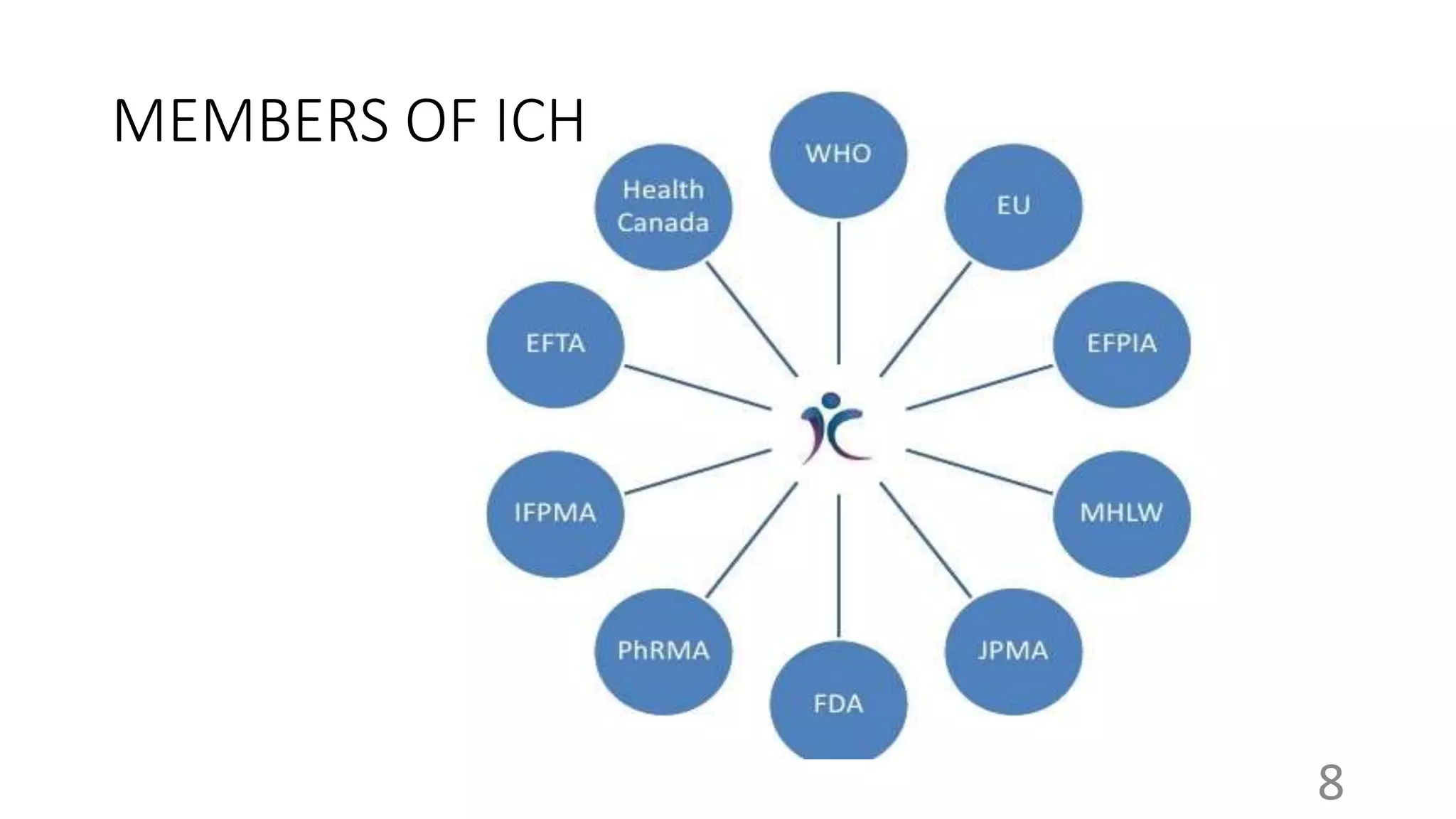
MEMBERS OF ICH
8
ORGANISATIONAL CHART
9
AUDITORS:
• The responsibility of the Auditors is to audit (inspection of accounts)the financial
statements of the Association upon conclusion of each Final year.They should
ensure that the accounting of the Association complies with Swiss law .
10
ASSEMBLY:
• The ICH Assembly include all Members and Observers of the ICH Association.
11
12
MANAGEMENT COMMITTEE:
• The MC is responsible for submitting recommendations or proposals to the
Assembly in preparation of Assembly discussions.
13
ICH SECRETARIAT:
• The ICH Secretariat is responsible for day-to-day management of ICH,
coordinating ICH activities as well as providing support to the Assembly, the ICH
Management Committee and its Working Groups
14
15
EWG:Develop
guideline
IWG:Implement
guideline
INFORMAL:develop
concept paper or
business plan
DG:Discuss scientific
procedures
Working
group
16
17
18
QUALITY:IT is an attribute or property
characteristic that affect performance n
safety efficacy of drug .
Stability -defined as time lapse during
which the product retains the same
properties and characteristics that it
possessed at the time of
manufacture.the stability of the product
is expressed as shelf life.
19
Stability studies : are necessary to
evaluate instability due to physical
change (creaming of emulsion n caking of
suspension,loss of volatile
constituents,polymorphism ,color change
)microbiological changes, chemical
degradation of drug
under(hydrolysis,drug decomposition can
produce toxic products)
EX:P-AMINO SALICYLIC ACID( Tb)IS
CONVERTED TO P-AMINOPHENOL WHICH
IS TOXIC
20
Why stability studies are done:
• Assurance to the patient
• Legal requirement
• Economy wastage n establish reputation of the company
21
CLIMATIC ZONES FOR STABILITY TESTING:
22
Stability testing methods:
REAL TIME ACCELERATED RETAINED SAMPLE CYCLIC TEMPERATURE
Product is stored
at longer
periods to
assess
degradation
under normal
storage
condition.
Product is
subjected to high
degree of stress
temperatures(40-
80) n humidity (30-
65%) for 6 months.
To detect the
amount of heat
required to
degrade the
product.
From Marketed
product atleast
one batch is
retained
Samples are
tested for eg:if
the product
actually has 5
years of shelf
life.
Cyclic
temperature
stress tests are
designed to
mimic
conditions in
market place
storage.The test
should have 20
cycles
23
ICH GUIDELINES
QUALITY:
QIA –Q1F :- Stability testing
Q2:-Analytical validation
Q3A-Q3E :- Impurities
Q4:-Pharmacopoeial harmonization
Q5:-Biotechnological products
Q 6:-Specification
Q7-Good manufacturing practices
Q8:-Pharmaceutical development of product
Q 9: -Quality risk management
QIo:-Pharmaceutical quality system
Q11 :-Development and manufacture of drug
substance 24
Q12 :-Lifecycle management
Q13 :-Manufacture of drug product and
drug substance
Q14 :-Analytical procedure
development.
25
• Drug safety studies may
include pharmacokinetics,
acute toxicity, repeat dose
toxicity, genotoxicity,
carcinogenesis, tumorigenicity,
and developmental and
reproductive toxicology
testing, toxicity to foetus .It is
the major aspect which
determine drug benefit risk
balance. drugs with high risk
profile should be avoided
unless needed 26
27
• In the United States, most pharmaceuticals are tested
in animals for their carcinogenic potential before
widespread use in humans(pre clinical). Carcinogenicity
studies should be performed for any pharmaceutical
whose expected clinical use is continuous for at least 6
months(clinical) .
28
Carcinogenecity preclinical studies:
29
50
animals
Drug
(injection
/oral)
24 month
dissected
Carcinoge
Necity
/ Tumour
SAFETY:-
SIA-S1C:- carcinogenicity studies of pharmaceuticals
S2:- Genotoxicity studies
S3A:- toxicokinetic and pharmacokinetics studies
S3B: -Guidance for repeated dose tissue distribution
studies
S4 :-Chronic toxicity
S5 :-Reproductive toxicology
S6 :-Preclinical safety evaluation of biotechnology derived
productsntesting in animals(rodents)
S7A- S7B:-Safety pharmacology studies
S8 :-lmmunotoxicity studies for human
pharmaceuticals
30
S9 :-Non clinical evaluation for anti cancer drugs
s10:photosafety evaluation(eg: methotrexate)
S11:non clinical paediatric safety
S12:non clinical biodistribution studies for gene
therapy(gentic material introduction to make proteins)
31
•Efficacy is the capacity to produce an effect
(eg, lower blood pressure).
Efficacy can be assessed accurately only in ideal
conditions (ie, when patients strictly adhere to
the dosing schedule). Thus, efficacy is
measured under expert supervision .
Each drug behave differently in each individual
deoending upon genetic makeup of an
individual( pharmacogenomics)
32
EFFICACY:
El:- Clinical Safety
E2A-E2F:-Pharmacovigilance (mechanism of
handling n reporting ADRs)
E3:- Clinical Study Reports
E4 :- Dose-response Studies
E5:- Ethnic Factors(Genetic,physiological,env)
E6:- Good Clinical Practice
E7:Clinical Trials in generic population
E8:General consideration for clinical trials
E9:-statistical principle for clinical trials
E10:Choice of control group in clinical trials
E11:-Clinical trial in paediatric population
33
E14:- Clinical Evaluation of QT interval for non
anti arrhythmic drugs
E15:-Pharmacogenomics
E16:-Qualification of genomic
biomarkers(biological measures – B.p,heart
rate,triglycerides etc)
E17:-Multiregional clinical trials
E18:-Genomic sampling
E19:-Safety data collection
E20:Adaptive clinical trials
34
Multidisciplinary Guidelines Those are the
cross-cutting topics which do not fit
uniquely into one of the Quality, Safety and
Efficacy categories. It includes the ICH
medical dictionary for regulatory activities
(MedDRA), the Common Technical
Document (CTD) and the development of
Electronic Standards for the Transfer of
Regulatory Information (ESTRI).
Ctd –set of specification for manufacturer n
is used across European countries divided
into 5 module
35
36
MULTIDISCIPLANARY:
MI : MedDRA Terminology
M2 : Electronic Standards
M3 . Nonclinical Safety Studies
M4 : Common Technical Document
M5:-Data element and standard for drug
substance
M6: Gene Therapy
M7 : Mutagenic impurities
37
• M8 : Electronic Common Technical Document (eCTD)
• M9 : Biopharmaceutics Classification System-based Biowaivers
• MI0 : Bioanalytical Method Validation
• M11:-Clinical electronic structured harmonized protocols
• M12:-drug interaction studies
• M13:-Bioequivalence for immediate release solid oral dosage
forms
38
REFERENCE :
ICH Official web site : ICH
Ames test-a test for Mutagenicity: Principle, Procedure and Application
- Online Biology Notes
Physical pharmacy by cvs Subramanyam.
39
40
41

ich guideline q,s,e,m

  • 1.
    ICH GUIDELINE –Q,S,E,M PRESENTEDBY: MISS SYEDA HASSAN YAMEEN ROLL NO.170720886008 Subject: Regulatory affairs. UNDER THE GUIDANCE OF: DR. ABDUL MANNAN M.PHARM,Ph.D DEPARTMENT:PHARMACEUTICS. 1 DECCAN SCHOOL OF PHARMACY Dar-us salam, Aghapura, Hyderabad.-504001
  • 2.
  • 3.
    ICH is ajoint organization in bringing together regulatory authority and pharmaceutical industry to discuss scientific and technical aspects of pharmaceuticals and develop ICH Guidelines. OBJECTIVE: 3
  • 4.
    INITIATION OF ICH: Inception-1990 Its been 30 years in 2020 since its inception. ICH meeting was held in Singapore in NOV 19 and 20 It now has 17 members and 32 observers 4
  • 5.
    WHY ICH ISFORMED? MISSION: To achieve greater harmonization worldwide to ensure safe,effective high quality medicines are developed ,registered and maintained in most efficient manner meeting high quality standards. 5
  • 6.
  • 7.
  • 8.
  • 9.
  • 10.
    AUDITORS: • The responsibilityof the Auditors is to audit (inspection of accounts)the financial statements of the Association upon conclusion of each Final year.They should ensure that the accounting of the Association complies with Swiss law . 10
  • 11.
    ASSEMBLY: • The ICHAssembly include all Members and Observers of the ICH Association. 11
  • 12.
  • 13.
    MANAGEMENT COMMITTEE: • TheMC is responsible for submitting recommendations or proposals to the Assembly in preparation of Assembly discussions. 13
  • 14.
    ICH SECRETARIAT: • TheICH Secretariat is responsible for day-to-day management of ICH, coordinating ICH activities as well as providing support to the Assembly, the ICH Management Committee and its Working Groups 14
  • 15.
  • 16.
  • 17.
  • 18.
  • 19.
    QUALITY:IT is anattribute or property characteristic that affect performance n safety efficacy of drug . Stability -defined as time lapse during which the product retains the same properties and characteristics that it possessed at the time of manufacture.the stability of the product is expressed as shelf life. 19
  • 20.
    Stability studies :are necessary to evaluate instability due to physical change (creaming of emulsion n caking of suspension,loss of volatile constituents,polymorphism ,color change )microbiological changes, chemical degradation of drug under(hydrolysis,drug decomposition can produce toxic products) EX:P-AMINO SALICYLIC ACID( Tb)IS CONVERTED TO P-AMINOPHENOL WHICH IS TOXIC 20
  • 21.
    Why stability studiesare done: • Assurance to the patient • Legal requirement • Economy wastage n establish reputation of the company 21
  • 22.
    CLIMATIC ZONES FORSTABILITY TESTING: 22
  • 23.
    Stability testing methods: REALTIME ACCELERATED RETAINED SAMPLE CYCLIC TEMPERATURE Product is stored at longer periods to assess degradation under normal storage condition. Product is subjected to high degree of stress temperatures(40- 80) n humidity (30- 65%) for 6 months. To detect the amount of heat required to degrade the product. From Marketed product atleast one batch is retained Samples are tested for eg:if the product actually has 5 years of shelf life. Cyclic temperature stress tests are designed to mimic conditions in market place storage.The test should have 20 cycles 23
  • 24.
    ICH GUIDELINES QUALITY: QIA –Q1F:- Stability testing Q2:-Analytical validation Q3A-Q3E :- Impurities Q4:-Pharmacopoeial harmonization Q5:-Biotechnological products Q 6:-Specification Q7-Good manufacturing practices Q8:-Pharmaceutical development of product Q 9: -Quality risk management QIo:-Pharmaceutical quality system Q11 :-Development and manufacture of drug substance 24
  • 25.
    Q12 :-Lifecycle management Q13:-Manufacture of drug product and drug substance Q14 :-Analytical procedure development. 25
  • 26.
    • Drug safetystudies may include pharmacokinetics, acute toxicity, repeat dose toxicity, genotoxicity, carcinogenesis, tumorigenicity, and developmental and reproductive toxicology testing, toxicity to foetus .It is the major aspect which determine drug benefit risk balance. drugs with high risk profile should be avoided unless needed 26
  • 27.
    27 • In theUnited States, most pharmaceuticals are tested in animals for their carcinogenic potential before widespread use in humans(pre clinical). Carcinogenicity studies should be performed for any pharmaceutical whose expected clinical use is continuous for at least 6 months(clinical) .
  • 28.
  • 29.
  • 30.
    SAFETY:- SIA-S1C:- carcinogenicity studiesof pharmaceuticals S2:- Genotoxicity studies S3A:- toxicokinetic and pharmacokinetics studies S3B: -Guidance for repeated dose tissue distribution studies S4 :-Chronic toxicity S5 :-Reproductive toxicology S6 :-Preclinical safety evaluation of biotechnology derived productsntesting in animals(rodents) S7A- S7B:-Safety pharmacology studies S8 :-lmmunotoxicity studies for human pharmaceuticals 30
  • 31.
    S9 :-Non clinicalevaluation for anti cancer drugs s10:photosafety evaluation(eg: methotrexate) S11:non clinical paediatric safety S12:non clinical biodistribution studies for gene therapy(gentic material introduction to make proteins) 31
  • 32.
    •Efficacy is thecapacity to produce an effect (eg, lower blood pressure). Efficacy can be assessed accurately only in ideal conditions (ie, when patients strictly adhere to the dosing schedule). Thus, efficacy is measured under expert supervision . Each drug behave differently in each individual deoending upon genetic makeup of an individual( pharmacogenomics) 32
  • 33.
    EFFICACY: El:- Clinical Safety E2A-E2F:-Pharmacovigilance(mechanism of handling n reporting ADRs) E3:- Clinical Study Reports E4 :- Dose-response Studies E5:- Ethnic Factors(Genetic,physiological,env) E6:- Good Clinical Practice E7:Clinical Trials in generic population E8:General consideration for clinical trials E9:-statistical principle for clinical trials E10:Choice of control group in clinical trials E11:-Clinical trial in paediatric population 33
  • 34.
    E14:- Clinical Evaluationof QT interval for non anti arrhythmic drugs E15:-Pharmacogenomics E16:-Qualification of genomic biomarkers(biological measures – B.p,heart rate,triglycerides etc) E17:-Multiregional clinical trials E18:-Genomic sampling E19:-Safety data collection E20:Adaptive clinical trials 34
  • 35.
    Multidisciplinary Guidelines Thoseare the cross-cutting topics which do not fit uniquely into one of the Quality, Safety and Efficacy categories. It includes the ICH medical dictionary for regulatory activities (MedDRA), the Common Technical Document (CTD) and the development of Electronic Standards for the Transfer of Regulatory Information (ESTRI). Ctd –set of specification for manufacturer n is used across European countries divided into 5 module 35
  • 36.
  • 37.
    MULTIDISCIPLANARY: MI : MedDRATerminology M2 : Electronic Standards M3 . Nonclinical Safety Studies M4 : Common Technical Document M5:-Data element and standard for drug substance M6: Gene Therapy M7 : Mutagenic impurities 37
  • 38.
    • M8 :Electronic Common Technical Document (eCTD) • M9 : Biopharmaceutics Classification System-based Biowaivers • MI0 : Bioanalytical Method Validation • M11:-Clinical electronic structured harmonized protocols • M12:-drug interaction studies • M13:-Bioequivalence for immediate release solid oral dosage forms 38
  • 39.
    REFERENCE : ICH Officialweb site : ICH Ames test-a test for Mutagenicity: Principle, Procedure and Application - Online Biology Notes Physical pharmacy by cvs Subramanyam. 39
  • 40.
  • 41.