
Quality-by-Design In
Pharmaceutical Development
Submitted to : Dr. U. Nagaich Submitted by : Ritu Mishra
A10647019003
M.Pharm (Pharmaceutics)
2nd Semester
Introduction
Pharmaceutical quality refers to product free of contamination and reproducibly
delivers the therapeutic benefit promised in the label to the consumer. The Quality
of the pharmaceutical product can be evaluated by in vivo or in vitro performance
tests. Quality by design assures in vitro product performance and In vitro product
performance provides assurance of in vivo product performance. “Hence Quality by
design relate to Product Performance”.
Definition : The pharmaceutical Quality by Design (QbD) is a systematic approach
to development that begins with predefined objectives and emphasizes product and
process understanding and process control, based on sound science and quality risk
management. Quality by Design (QbD) is emerging to enhance the assurance of
safe, effective drug supply to the consumer, and also offers promise to significantly
improve manufacturing quality performance.
Key characteristics of QbD
• A tool for focused & efficient drug development
• Dynamic and systematic process
• Relies on the concept that Quality can be built in as a continuum
• It is applicable to Drug Product and Drug Substance development (chemicals / biologics)
• It is applicable to analytical methods
• Can implemented partially or totally
• Can be used at any time in the life cycle of the Drug
• Always encouraged by Regulators.
ICH Q8 Guideline
Table of contents
1. Introduction
1.1 Objective
1.2 Scope
2. Pharmaceutical Development
2.1 Components of Drug Product
2.1.1 Drug Substance
2.1.2 Excipients
2.2 Drug Product
2.2.1Formulation Development
2.2.2 Overages
2.2.3 Physiochemical and Biological Properties
2.3 Manufacturing Process Development
2.4 Container Closure System
2.5 Microbial Attributes
2.6 Compatibility
1. Introduction : The Pharmaceutical Development section provides an
opportunity to present the knowledge gained through the application of
scientific approaches and quality risk management to the development of a
product and its manufacturing process
Objective : This guideline describes the suggested contents for the 3.2.P.2
(Pharmaceutical Development) section of a regulatory submission in the
ICH M4 Common Technical Document (CTD) format.
Scope : This guideline is intended to provide guidance on the contents of
Section 3.2.P.2 (Pharmaceutical Development) for drug products as defined
in the scope of Module 3 of the Common Technical Document (ICH
guideline M4).
2. Pharmaceutical development : The aim of pharmaceutical
development is to design a quality product and its manufacturing process to
consistently deliver the intended performance of the product.
The information and knowledge gained from pharmaceutical development
studies and manufacturing experience provide scientific understanding to
support the establishment of the design space, specifications, and
manufacturing controls.
•Drug
substances
•Excipients
Components
Of Drug
Products :
DRUG SUBSTANCES : “The physicochemical and biological properties of the
drug substance that can influence the performance of the drug product and its
manufacturability.” Examples of physicochemical and biological properties that
might need to be examined include •Solubility, •Water content, •Particle size,
•Crystal properties, •Biological activity, •Permeability.
EXCIPIENTS :
• The excipients chosen, their concentration, and the characteristics that can
influence the drug product performance or manufacturability should be discussed
relative to the respective function of each excipients.
• The compatibility of the drug substance with excipients should be evaluated.
For products that contain more than one drug substance, the compatibility of the
drug substances with each other should also be evaluated.
• Formulation
development
• Overages
• Physiochemical
and biological
properties
Drug
Product
FORMULATION DEVELOPMENT :
• A summary should be provided describing the development of the
formulation, including identification of those attributes that are critical to the
quality of the drug product and also highlight the evolution of the formulation
design from initial concept up to the final design.
• Information from comparative in vitro studies (e.g., dissolution) or
comparative in vivo studies (e.g., BE) that links clinical formulations to the
proposed commercial formulation.
• A successful correlation can assist in the selection of appropriate dissolution
acceptance criteria, and can potentially reduce the need for further
bioequivalence studies following changes to the product or its manufacturing
process.
OVERAGES: Overages in the manufacture of the drug product, whether they
appear in the final formulated product or not, should be justified considering the
safety and efficacy of the product. Information should be provided on the
1) Amount of overage,
2) Reason for the overage (e.g., to compensate for expected and documented
manufacturing losses),
3) Justification for the amount of overage.
PHYSIOCHEMICAL & BIOLOGICAL PROPERTIES :
• The physicochemical and biological properties relevant to the safety,
performance or manufacturability of the drug product should be identified and
discussed.
• This includes the physiological implications of drug substance and formulation
attributes.
Manufacturing
Process
Development
Microbial
Attributes
Container
Closure
System
Compatibility
MANUFACTURING PROCESS DEVELOPMENT :
• Important consideration to critical formulation attributes, together with the available
manufacturing process options, in order to address the selection of the manufacturing
process and confirm the appropriateness of the components.
•Appropriateness of the equipment used for the intended products should be discussed.
•The manufacturing process development programme or process improvement
programme should identify any critical process parameters that should be monitored or
controlled (e.g., granulation end point) to ensure that the product is of the desired quality.
CONTAINER CLOSURE SYSTEM :The choice for selection of the container closure
system for the commercial product should be discussed.
• The choice of materials for primary packaging and secondary packaging should be
justified.
• A possible interaction between product and container or label should be considered.
MICROBIOLOGICAL ATTRIBUTES : The selection and effectiveness of
preservative systems in products containing antimicrobial preservative or the
antimicrobial effectiveness of products that are inherently antimicrobial.
• For sterile products, the integrity of the container closure system as it relates
to preventing microbial contamination.
• The lowest specified concentration of antimicrobial preservative should be
justified in terms of efficacy and safety, such that the minimum concentration
of preservative that gives the required level of efficacy throughout the intended
shelf life of the product is used.
COMPATIBILITY : The compatibility of the drug product with
reconstitution diluents (e.g., precipitation, stability) should be addressed to
provide appropriate and supportive information for the labeling.
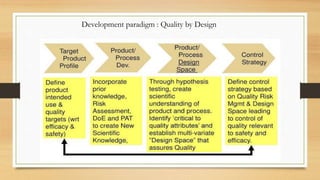
Development paradigm : Quality by Design
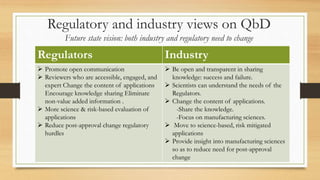
Regulatory and industry views on QbD
Future state vision: both industry and regulatory need to change
Regulators Industry
 Promote open communication
 Reviewers who are accessible, engaged, and
expert Change the content of applications
Encourage knowledge sharing Eliminate
non-value added information .
 More science & risk-based evaluation of
applications
 Reduce post-approval change regulatory
hurdles
 Be open and transparent in sharing
knowledge: success and failure.
 Scientists can understand the needs of the
Regulators.
 Change the content of applications.
-Share the knowledge.
-Focus on manufacturing sciences.
 Move to science-based, risk mitigated
applications
 Provide insight into manufacturing sciences
so as to reduce need for post-approval
change
Scientifically based QbD - examples of
application.
• Application of QbD for Enhancement of the Solubility and Dissolution of Class II
BCS Drug Using Polymeric Surfactants and Crystallization Inhibitors: Development
of Controlled - Release Tablets
• Application of QbD to Development of Analytical Separation Methods
For chromatographic technique e.g
i. In determination of impurity
ii. In screening of column used for chromatography
iii. In development of HPLC method for drug products/substances
For hyphenated techniques e.g.
i. In LC–MS method development
ii. In bioanalytical method development
• Quality-by-Design Based Development of a Self-Micro-emulsifying Drug Delivery
System [SMEDDS] to Reduce Food Effect of Nelfinavir Mesylate
• Quality by Design Approach for Optimizing the Formulation and Physical
Properties of Extemporaneously Prepared Orodispersible Films:
Conclusion
• Agencies and Industry are moving from ‘blind’ compliance to ‘science and risk-based’
compliance Industry wants this to be global.
• This evolution is based on process understanding and continuous improvement throughout
the product life cycle Traditional process validation being replaced by a much better
alternative.
- Building in quality.
- Continuous quality verification and improvement.
• Moving from ‘Quality by Testing’ to ‘Quality by Design’ should, in principle, allow
significant regulatory flexibility helps both regulators and industry focus on higher risk or
added value activities.
References
• Patwardhan DM, Amrutkar SS, Kotwal TS and Wagh MP: Application of quality by
design to different aspects of pharmaceutical technologies. Int J Pharm Sci Res
2017; 8(9) 3649-62
• Jaiprakash N. Sangshetti Mrinmayee Deshpande Zahid Zaheer Devanand B. Shinde
Rohidas Arote Quality by design approach: Regulatory need Arabian Journal of
Chemistry 2014 Volume 10, S3412-S3425
• ICH HARMONISED TRIPARTITE GUIDELINE: PHARMACEUTICAL
DEVELOPMENT Q8(R2) INTERNATIONAL CONFERENCE ON
HARMONISATION OF TECHNICAL REQUIREMENTS FOR
REGISTRATION OF PHARMACEUTICALS FOR HUMAN USE. 2009
Quality by-design in pharmaceutical development

Quality by-design in pharmaceutical development

  • 1.
    Quality-by-Design In Pharmaceutical Development Submittedto : Dr. U. Nagaich Submitted by : Ritu Mishra A10647019003 M.Pharm (Pharmaceutics) 2nd Semester
  • 2.
    Introduction Pharmaceutical quality refersto product free of contamination and reproducibly delivers the therapeutic benefit promised in the label to the consumer. The Quality of the pharmaceutical product can be evaluated by in vivo or in vitro performance tests. Quality by design assures in vitro product performance and In vitro product performance provides assurance of in vivo product performance. “Hence Quality by design relate to Product Performance”. Definition : The pharmaceutical Quality by Design (QbD) is a systematic approach to development that begins with predefined objectives and emphasizes product and process understanding and process control, based on sound science and quality risk management. Quality by Design (QbD) is emerging to enhance the assurance of safe, effective drug supply to the consumer, and also offers promise to significantly improve manufacturing quality performance.
  • 3.
    Key characteristics ofQbD • A tool for focused & efficient drug development • Dynamic and systematic process • Relies on the concept that Quality can be built in as a continuum • It is applicable to Drug Product and Drug Substance development (chemicals / biologics) • It is applicable to analytical methods • Can implemented partially or totally • Can be used at any time in the life cycle of the Drug • Always encouraged by Regulators.
  • 4.
  • 5.
    Table of contents 1.Introduction 1.1 Objective 1.2 Scope 2. Pharmaceutical Development 2.1 Components of Drug Product 2.1.1 Drug Substance 2.1.2 Excipients 2.2 Drug Product 2.2.1Formulation Development 2.2.2 Overages 2.2.3 Physiochemical and Biological Properties 2.3 Manufacturing Process Development 2.4 Container Closure System 2.5 Microbial Attributes 2.6 Compatibility
  • 6.
    1. Introduction :The Pharmaceutical Development section provides an opportunity to present the knowledge gained through the application of scientific approaches and quality risk management to the development of a product and its manufacturing process Objective : This guideline describes the suggested contents for the 3.2.P.2 (Pharmaceutical Development) section of a regulatory submission in the ICH M4 Common Technical Document (CTD) format. Scope : This guideline is intended to provide guidance on the contents of Section 3.2.P.2 (Pharmaceutical Development) for drug products as defined in the scope of Module 3 of the Common Technical Document (ICH guideline M4).
  • 7.
    2. Pharmaceutical development: The aim of pharmaceutical development is to design a quality product and its manufacturing process to consistently deliver the intended performance of the product. The information and knowledge gained from pharmaceutical development studies and manufacturing experience provide scientific understanding to support the establishment of the design space, specifications, and manufacturing controls.
  • 8.
  • 9.
    DRUG SUBSTANCES :“The physicochemical and biological properties of the drug substance that can influence the performance of the drug product and its manufacturability.” Examples of physicochemical and biological properties that might need to be examined include •Solubility, •Water content, •Particle size, •Crystal properties, •Biological activity, •Permeability. EXCIPIENTS : • The excipients chosen, their concentration, and the characteristics that can influence the drug product performance or manufacturability should be discussed relative to the respective function of each excipients. • The compatibility of the drug substance with excipients should be evaluated. For products that contain more than one drug substance, the compatibility of the drug substances with each other should also be evaluated.
  • 10.
    • Formulation development • Overages •Physiochemical and biological properties Drug Product
  • 11.
    FORMULATION DEVELOPMENT : •A summary should be provided describing the development of the formulation, including identification of those attributes that are critical to the quality of the drug product and also highlight the evolution of the formulation design from initial concept up to the final design. • Information from comparative in vitro studies (e.g., dissolution) or comparative in vivo studies (e.g., BE) that links clinical formulations to the proposed commercial formulation. • A successful correlation can assist in the selection of appropriate dissolution acceptance criteria, and can potentially reduce the need for further bioequivalence studies following changes to the product or its manufacturing process.
  • 12.
    OVERAGES: Overages inthe manufacture of the drug product, whether they appear in the final formulated product or not, should be justified considering the safety and efficacy of the product. Information should be provided on the 1) Amount of overage, 2) Reason for the overage (e.g., to compensate for expected and documented manufacturing losses), 3) Justification for the amount of overage. PHYSIOCHEMICAL & BIOLOGICAL PROPERTIES : • The physicochemical and biological properties relevant to the safety, performance or manufacturability of the drug product should be identified and discussed. • This includes the physiological implications of drug substance and formulation attributes.
  • 13.
  • 14.
    MANUFACTURING PROCESS DEVELOPMENT: • Important consideration to critical formulation attributes, together with the available manufacturing process options, in order to address the selection of the manufacturing process and confirm the appropriateness of the components. •Appropriateness of the equipment used for the intended products should be discussed. •The manufacturing process development programme or process improvement programme should identify any critical process parameters that should be monitored or controlled (e.g., granulation end point) to ensure that the product is of the desired quality. CONTAINER CLOSURE SYSTEM :The choice for selection of the container closure system for the commercial product should be discussed. • The choice of materials for primary packaging and secondary packaging should be justified. • A possible interaction between product and container or label should be considered.
  • 15.
    MICROBIOLOGICAL ATTRIBUTES :The selection and effectiveness of preservative systems in products containing antimicrobial preservative or the antimicrobial effectiveness of products that are inherently antimicrobial. • For sterile products, the integrity of the container closure system as it relates to preventing microbial contamination. • The lowest specified concentration of antimicrobial preservative should be justified in terms of efficacy and safety, such that the minimum concentration of preservative that gives the required level of efficacy throughout the intended shelf life of the product is used. COMPATIBILITY : The compatibility of the drug product with reconstitution diluents (e.g., precipitation, stability) should be addressed to provide appropriate and supportive information for the labeling.
  • 16.
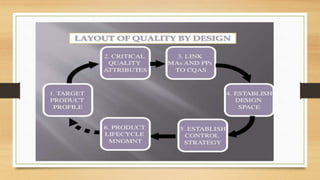
    Development paradigm :Quality by Design
  • 18.
    Regulatory and industryviews on QbD Future state vision: both industry and regulatory need to change Regulators Industry  Promote open communication  Reviewers who are accessible, engaged, and expert Change the content of applications Encourage knowledge sharing Eliminate non-value added information .  More science & risk-based evaluation of applications  Reduce post-approval change regulatory hurdles  Be open and transparent in sharing knowledge: success and failure.  Scientists can understand the needs of the Regulators.  Change the content of applications. -Share the knowledge. -Focus on manufacturing sciences.  Move to science-based, risk mitigated applications  Provide insight into manufacturing sciences so as to reduce need for post-approval change
  • 19.
    Scientifically based QbD- examples of application. • Application of QbD for Enhancement of the Solubility and Dissolution of Class II BCS Drug Using Polymeric Surfactants and Crystallization Inhibitors: Development of Controlled - Release Tablets • Application of QbD to Development of Analytical Separation Methods For chromatographic technique e.g i. In determination of impurity ii. In screening of column used for chromatography iii. In development of HPLC method for drug products/substances
  • 20.
    For hyphenated techniquese.g. i. In LC–MS method development ii. In bioanalytical method development • Quality-by-Design Based Development of a Self-Micro-emulsifying Drug Delivery System [SMEDDS] to Reduce Food Effect of Nelfinavir Mesylate • Quality by Design Approach for Optimizing the Formulation and Physical Properties of Extemporaneously Prepared Orodispersible Films:
  • 21.
    Conclusion • Agencies andIndustry are moving from ‘blind’ compliance to ‘science and risk-based’ compliance Industry wants this to be global. • This evolution is based on process understanding and continuous improvement throughout the product life cycle Traditional process validation being replaced by a much better alternative. - Building in quality. - Continuous quality verification and improvement. • Moving from ‘Quality by Testing’ to ‘Quality by Design’ should, in principle, allow significant regulatory flexibility helps both regulators and industry focus on higher risk or added value activities.
  • 22.
    References • Patwardhan DM,Amrutkar SS, Kotwal TS and Wagh MP: Application of quality by design to different aspects of pharmaceutical technologies. Int J Pharm Sci Res 2017; 8(9) 3649-62 • Jaiprakash N. Sangshetti Mrinmayee Deshpande Zahid Zaheer Devanand B. Shinde Rohidas Arote Quality by design approach: Regulatory need Arabian Journal of Chemistry 2014 Volume 10, S3412-S3425 • ICH HARMONISED TRIPARTITE GUIDELINE: PHARMACEUTICAL DEVELOPMENT Q8(R2) INTERNATIONAL CONFERENCE ON HARMONISATION OF TECHNICAL REQUIREMENTS FOR REGISTRATION OF PHARMACEUTICALS FOR HUMAN USE. 2009