NDA
NEW DRUG APPLICATION
SACHIN.C.P
M. PHARM. (SEM – I)
DEPT. OF
PHARMACEUTICS
RGIP TRIKARIPUR 1
INTRODUCTION:
 For decades, the regulation and control of new drugs in the
United States has been based on the New Drug Application
(NDA).
 Since 1938, every new drug has been the subject of an
approved NDA before U.S. commercialization.
 The data gathered during the animal studies and human
clinical trials of an Investigational New Drug (IND) becomes
part of the NDA.
2
 When the Food, Drug, and Cosmetic Act (FD&C Act) was
passed in 1938, NDAs were only required to contain
information pertaining to the investigational drug's safety.
 In 1962, the Kefauver-Harris Amendments to the FD&C
Act required NDAs to contain evidence that a new drug
was effective for its intended use as well, and that the
established benefits of the drug outweighed its known
risks.
3
 The NDA was again the subject of change in 1985, when
the FDA completed a comprehensive revision of the
regulations pertaining to NDAs.
 While this revision, commonly called the NDA Rewrite,
modified content requirements, it was mainly intended to
restructure the ways in which information and data are
organized and presented in the NDA to easily access
FDA reviews.
4
NDA CLASSIFICATIONS
 CDER classifies new drug applications with a code that
reflects both the type of drug being submitted and its
intended uses. The numbers 1 through 7 are used to describe
the type of drug
8/50
5
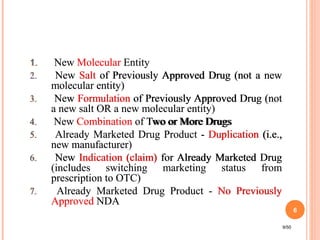
1. New Molecular Entity
2. New Salt of Previously Approved Drug (not a new
molecular entity)
3. New Formulation of Previously Approved Drug (not
a new salt OR a new molecular entity)
4. New Combination of Two or More Drugs
5. Already Marketed Drug Product - Duplication (i.e.,
new manufacturer)
6. New Indication (claim) for Already Marketed Drug
(includes switching marketing status from
prescription to OTC)
7. Already Marketed Drug Product - No Previously
Approved NDA
9/50
1. New Molecular Entity
2. New Salt of Previously Approved Drug (not a new
molecular entity)
3. New Formulation of Previously Approved Drug (not
a new salt OR a new molecular entity)
4. New Combination of Two or More Drugs
5. Already Marketed Drug Product - Duplication (i.e.,
new manufacturer)
6. New Indication (claim) for Already Marketed Drug
(includes switching marketing status from
prescription to OTC)
7. Already Marketed Drug Product - No Previously
Approved NDA
6
7
FUNDAMENTALS OF NDA
SUBMISSION
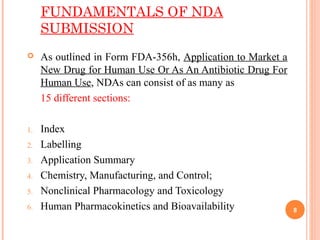
 As outlined in Form FDA-356h, Application to Market a
New Drug for Human Use Or As An Antibiotic Drug For
Human Use, NDAs can consist of as many as
15 different sections:
1. Index
2. Labelling
3. Application Summary
4. Chemistry, Manufacturing, and Control;
5. Nonclinical Pharmacology and Toxicology
6. Human Pharmacokinetics and Bioavailability 8
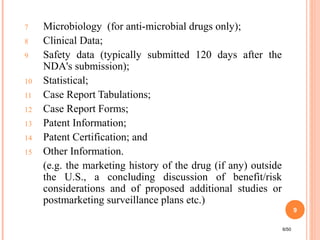
7 Microbiology (for anti-microbial drugs only);
8 Clinical Data;
9 Safety data (typically submitted 120 days after the
NDA's submission);
10 Statistical;
11 Case Report Tabulations;
12 Case Report Forms;
13 Patent Information;
14 Patent Certification; and
15 Other Information.
(e.g. the marketing history of the drug (if any) outside
the U.S., a concluding discussion of benefit/risk
considerations and of proposed additional studies or
postmarketing surveillance plans etc.)
6/50
9
NDA CONTENT AND FORMAT
REQUIREMENTS
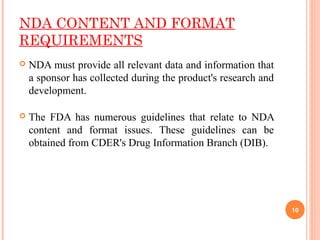
 NDA must provide all relevant data and information that
a sponsor has collected during the product's research and
development.
 The FDA has numerous guidelines that relate to NDA
content and format issues. These guidelines can be
obtained from CDER's Drug Information Branch (DIB).
10
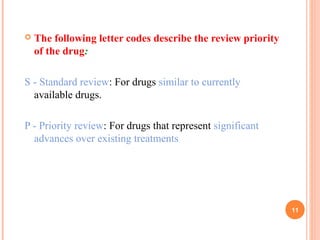
 The following letter codes describe the review priority
of the drug:
S - Standard review: For drugs similar to currently
available drugs.
P - Priority review: For drugs that represent significant
advances over existing treatments
11
GENERAL REQUIREMENTS
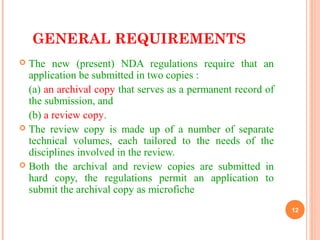
 The new (present) NDA regulations require that an
application be submitted in two copies :
(a) an archival copy that serves as a permanent record of
the submission, and
(b) a review copy.
 The review copy is made up of a number of separate
technical volumes, each tailored to the needs of the
disciplines involved in the review.
 Both the archival and review copies are submitted in
hard copy, the regulations permit an application to
submit the archival copy as microfiche
12
 The NDA application form (FORM NDA 356 h) consist
of :
Twelve items (including index) deals with the safety and
efficacy features of drug product, two are concerned with
patent information.
13
INDEX
A comprehensive index by volume number &
page number to the summary, the technical
sections, & the supporting information.
LABELLING
It must include all draft labelling that is
intended for use on the product
container,cartons or packages,including the
proposed package insert
14
SUMMARY
 It has been suggested that the summary consists
of 50 - 200 pages. The summary should discuss
all aspects of the application and needs to be
written at approximately level of detail required
for publication and meet the editorial standards
applied by referred scientific and medical
journals.
 It is advantageous to provide data in the
summary in tabular and graphic form with clear
explanation of any terminology used in the
tabulations or graphics.
15
THE SAFETY DATA
 The required safety data (from view point of
clinical studies, animal studies, other sources
generated or reported to sponsor) must be
submitted in same format as integrated summary
of safety described under clinical data section of
the NDA content and format (21 CFR 314.50).
Additionally the NDA format is required to
include case report forms for each patient who
died during a clinical study or who did not
complete the study due to an adverse event.
16
CHEMISTRY, MANUFACTURING
AND CONTROLS
Important point is the specific citation
needed for the solid state forms of the
drug substance and their relationship to
bioavailability.
Chemistry, manufacturing and controls
summary must provide a general
overview of the drug substance and drug
product.
17
 Drug substance:
Description including physical and chemical
characteristics and stability
 Drug product:
Composition and type of dosage form, manufacture,
specifications and analytical methods, container/closure
system, stability, investigational formulations.
Details are provided in 21CFR 25.1
18
NONCLINICAL PHARMACOLOGY AND
TOXICOLOGY
 Nonclinical laboratory studies include any
invivo/invitro experiment with the test drug to
determine its safety, activity or disposition. This
section includes Toxicological effects of drugs
on reproduction and the developing foetus,
ADME animal experiments of the drugs
 This section should provide a description,
tabulation and graphics from Nonclinical
laboratory studies of drug.
19
HUMAN PHARMACOKINETICS
AND BIOAVAILIBILITY
 First section : There should be an overall
tabulated summary of all invivo
biopharmaceutic studies carried out on the drug
grouped by type of study.
 Second section : The summary of
bioavailability or pharmacokinetic data and
overall conclusions (Cmax, Tmax, Kel, AUC
etc.)
20
 Third section : List of all formulations used in
clinical trials and invivo bioavailability or
pharmacokinetic studies together with each
formulation used in studies.
 Fourth section : Analytical methods used to
measure the levels of drug and major
metabolite
 Fifth section : Dissolution data on each
strength and dosage form for which approval
is being sought. A comparative dissolution
study with the lots used. In vivo
biopharmaceutics studies should also be
included. 21
MICROBIOLOGY
 Applicable to anti-infective and antiviral drugs.
 It should include description of :
Biochemical basis of the drug’s action / microbial
physiology.
Antimicrobial spectra of the drug, including results of
invitro preclinical studies that demonstrate
effectiveness.
Any known mechanisms of resistance to the drug,
including results of epidemiological studies to
demonstrate privilege of resistance factors.
Clinical microbiological laboratory methods needed
for effective use of the drug.
22
CLINICAL DATA
This section includes descriptions, summaries and
analysis of :
Clinical pharmacology studies including
animal study and toxicology.
Controlled clinical studies including the
protocol and description of the statistical
analyses used to evaluate the studies.
Uncontrolled clinical studies, including all
necessary details of the studies.
Any other data/information relevant to an
evaluation of safety and effectiveness obtained
from any source, foreign or domestic (U.S.). 23
STATISTICS
Statistics section should include:
A statistical evaluation of the clinical data
 A copy of the data given in the description
and analysis of each controlled clinical study,
along with the statistical analysis.
 A copy of the data included in the integrated
summary of all available information about
the safety of the drug.
24
25
CASE REPORT TABULATIONS:
•Tabulations of the data from each adequate & well
controlled study phase 2 & phase 3 studies.
•Tabulations of the data from the earliest clinical
pharmacology studies phase 1 studies
•Tabulations of the safety data from other clinical
studies.
CASE REPORT FORMS :
•Copies of individual case report forms for each
patient who died during a clinical study.
•who did not complete the study because of an
adverse event whether believed to be drug related or
not, including patients receiving reference drugs or
placebo
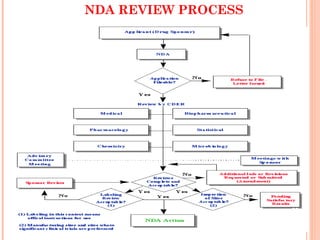
NDA REVIEW PROCESS
26
NDA REGULATIONS
Review Time Frames (21 CFR 314.100)
This time frames includes:
 Within 180 days of receipt of an application, the FDA
will review and issue an approval, approvable, or not
approvable letter. This 180-day period is called the
‘review-clock”
 During the review period an applicant may withdraw an
application (21 CFR 314-65) and later resubmit it.
 The time period may be extended by mutual agreement
between the FDA and the applicant or as the result of
submission of a major amendment (21 CFR 314.60)
27
Filing Time Frames (21 CFR 314.101):
 Within 60 days after the FDA receives an application, a
determination will be made whether the application may
be filed.
 This will determine whether sufficient information is
provided to proceed with an in-depth review of
application.
 If FDA files the application, the applicant will be
notified in written. The date of filing will be the date 60
days after the FDA received the application.
 The date of filing begins the 180-days period of the
review. If FDA refuses to file the application, the sponsor
will be given the opportunity to meet with FDA to
discuss the reasons why the application is not fileable.
28
REFERENCES
Remington: The Science And Practice Of Pharmacy,
20th edition, Lippincott,Williams & Wilkins, page no:
930-943
New Drug Approval Process: second edition, revised
and expanded, edited by Richard A. Guarino page no:
39-64, 243-263
29
T H A N K Y O U
30

NEW DRUG APPLICATION

  • 1.
    NDA NEW DRUG APPLICATION SACHIN.C.P M.PHARM. (SEM – I) DEPT. OF PHARMACEUTICS RGIP TRIKARIPUR 1
  • 2.
    INTRODUCTION:  For decades,the regulation and control of new drugs in the United States has been based on the New Drug Application (NDA).  Since 1938, every new drug has been the subject of an approved NDA before U.S. commercialization.  The data gathered during the animal studies and human clinical trials of an Investigational New Drug (IND) becomes part of the NDA. 2
  • 3.
     When theFood, Drug, and Cosmetic Act (FD&C Act) was passed in 1938, NDAs were only required to contain information pertaining to the investigational drug's safety.  In 1962, the Kefauver-Harris Amendments to the FD&C Act required NDAs to contain evidence that a new drug was effective for its intended use as well, and that the established benefits of the drug outweighed its known risks. 3
  • 4.
     The NDAwas again the subject of change in 1985, when the FDA completed a comprehensive revision of the regulations pertaining to NDAs.  While this revision, commonly called the NDA Rewrite, modified content requirements, it was mainly intended to restructure the ways in which information and data are organized and presented in the NDA to easily access FDA reviews. 4
  • 5.
    NDA CLASSIFICATIONS  CDERclassifies new drug applications with a code that reflects both the type of drug being submitted and its intended uses. The numbers 1 through 7 are used to describe the type of drug 8/50 5
  • 6.
    1. New MolecularEntity 2. New Salt of Previously Approved Drug (not a new molecular entity) 3. New Formulation of Previously Approved Drug (not a new salt OR a new molecular entity) 4. New Combination of Two or More Drugs 5. Already Marketed Drug Product - Duplication (i.e., new manufacturer) 6. New Indication (claim) for Already Marketed Drug (includes switching marketing status from prescription to OTC) 7. Already Marketed Drug Product - No Previously Approved NDA 9/50 1. New Molecular Entity 2. New Salt of Previously Approved Drug (not a new molecular entity) 3. New Formulation of Previously Approved Drug (not a new salt OR a new molecular entity) 4. New Combination of Two or More Drugs 5. Already Marketed Drug Product - Duplication (i.e., new manufacturer) 6. New Indication (claim) for Already Marketed Drug (includes switching marketing status from prescription to OTC) 7. Already Marketed Drug Product - No Previously Approved NDA 6
  • 7.
  • 8.
    FUNDAMENTALS OF NDA SUBMISSION As outlined in Form FDA-356h, Application to Market a New Drug for Human Use Or As An Antibiotic Drug For Human Use, NDAs can consist of as many as 15 different sections: 1. Index 2. Labelling 3. Application Summary 4. Chemistry, Manufacturing, and Control; 5. Nonclinical Pharmacology and Toxicology 6. Human Pharmacokinetics and Bioavailability 8
  • 9.
    7 Microbiology (foranti-microbial drugs only); 8 Clinical Data; 9 Safety data (typically submitted 120 days after the NDA's submission); 10 Statistical; 11 Case Report Tabulations; 12 Case Report Forms; 13 Patent Information; 14 Patent Certification; and 15 Other Information. (e.g. the marketing history of the drug (if any) outside the U.S., a concluding discussion of benefit/risk considerations and of proposed additional studies or postmarketing surveillance plans etc.) 6/50 9
  • 10.
    NDA CONTENT ANDFORMAT REQUIREMENTS  NDA must provide all relevant data and information that a sponsor has collected during the product's research and development.  The FDA has numerous guidelines that relate to NDA content and format issues. These guidelines can be obtained from CDER's Drug Information Branch (DIB). 10
  • 11.
     The followingletter codes describe the review priority of the drug: S - Standard review: For drugs similar to currently available drugs. P - Priority review: For drugs that represent significant advances over existing treatments 11
  • 12.
    GENERAL REQUIREMENTS  Thenew (present) NDA regulations require that an application be submitted in two copies : (a) an archival copy that serves as a permanent record of the submission, and (b) a review copy.  The review copy is made up of a number of separate technical volumes, each tailored to the needs of the disciplines involved in the review.  Both the archival and review copies are submitted in hard copy, the regulations permit an application to submit the archival copy as microfiche 12
  • 13.
     The NDAapplication form (FORM NDA 356 h) consist of : Twelve items (including index) deals with the safety and efficacy features of drug product, two are concerned with patent information. 13
  • 14.
    INDEX A comprehensive indexby volume number & page number to the summary, the technical sections, & the supporting information. LABELLING It must include all draft labelling that is intended for use on the product container,cartons or packages,including the proposed package insert 14
  • 15.
    SUMMARY  It hasbeen suggested that the summary consists of 50 - 200 pages. The summary should discuss all aspects of the application and needs to be written at approximately level of detail required for publication and meet the editorial standards applied by referred scientific and medical journals.  It is advantageous to provide data in the summary in tabular and graphic form with clear explanation of any terminology used in the tabulations or graphics. 15
  • 16.
    THE SAFETY DATA The required safety data (from view point of clinical studies, animal studies, other sources generated or reported to sponsor) must be submitted in same format as integrated summary of safety described under clinical data section of the NDA content and format (21 CFR 314.50). Additionally the NDA format is required to include case report forms for each patient who died during a clinical study or who did not complete the study due to an adverse event. 16
  • 17.
    CHEMISTRY, MANUFACTURING AND CONTROLS Importantpoint is the specific citation needed for the solid state forms of the drug substance and their relationship to bioavailability. Chemistry, manufacturing and controls summary must provide a general overview of the drug substance and drug product. 17
  • 18.
     Drug substance: Descriptionincluding physical and chemical characteristics and stability  Drug product: Composition and type of dosage form, manufacture, specifications and analytical methods, container/closure system, stability, investigational formulations. Details are provided in 21CFR 25.1 18
  • 19.
    NONCLINICAL PHARMACOLOGY AND TOXICOLOGY Nonclinical laboratory studies include any invivo/invitro experiment with the test drug to determine its safety, activity or disposition. This section includes Toxicological effects of drugs on reproduction and the developing foetus, ADME animal experiments of the drugs  This section should provide a description, tabulation and graphics from Nonclinical laboratory studies of drug. 19
  • 20.
    HUMAN PHARMACOKINETICS AND BIOAVAILIBILITY First section : There should be an overall tabulated summary of all invivo biopharmaceutic studies carried out on the drug grouped by type of study.  Second section : The summary of bioavailability or pharmacokinetic data and overall conclusions (Cmax, Tmax, Kel, AUC etc.) 20
  • 21.
     Third section: List of all formulations used in clinical trials and invivo bioavailability or pharmacokinetic studies together with each formulation used in studies.  Fourth section : Analytical methods used to measure the levels of drug and major metabolite  Fifth section : Dissolution data on each strength and dosage form for which approval is being sought. A comparative dissolution study with the lots used. In vivo biopharmaceutics studies should also be included. 21
  • 22.
    MICROBIOLOGY  Applicable toanti-infective and antiviral drugs.  It should include description of : Biochemical basis of the drug’s action / microbial physiology. Antimicrobial spectra of the drug, including results of invitro preclinical studies that demonstrate effectiveness. Any known mechanisms of resistance to the drug, including results of epidemiological studies to demonstrate privilege of resistance factors. Clinical microbiological laboratory methods needed for effective use of the drug. 22
  • 23.
    CLINICAL DATA This sectionincludes descriptions, summaries and analysis of : Clinical pharmacology studies including animal study and toxicology. Controlled clinical studies including the protocol and description of the statistical analyses used to evaluate the studies. Uncontrolled clinical studies, including all necessary details of the studies. Any other data/information relevant to an evaluation of safety and effectiveness obtained from any source, foreign or domestic (U.S.). 23
  • 24.
    STATISTICS Statistics section shouldinclude: A statistical evaluation of the clinical data  A copy of the data given in the description and analysis of each controlled clinical study, along with the statistical analysis.  A copy of the data included in the integrated summary of all available information about the safety of the drug. 24
  • 25.
    25 CASE REPORT TABULATIONS: •Tabulationsof the data from each adequate & well controlled study phase 2 & phase 3 studies. •Tabulations of the data from the earliest clinical pharmacology studies phase 1 studies •Tabulations of the safety data from other clinical studies. CASE REPORT FORMS : •Copies of individual case report forms for each patient who died during a clinical study. •who did not complete the study because of an adverse event whether believed to be drug related or not, including patients receiving reference drugs or placebo
  • 26.
  • 27.
    NDA REGULATIONS Review TimeFrames (21 CFR 314.100) This time frames includes:  Within 180 days of receipt of an application, the FDA will review and issue an approval, approvable, or not approvable letter. This 180-day period is called the ‘review-clock”  During the review period an applicant may withdraw an application (21 CFR 314-65) and later resubmit it.  The time period may be extended by mutual agreement between the FDA and the applicant or as the result of submission of a major amendment (21 CFR 314.60) 27
  • 28.
    Filing Time Frames(21 CFR 314.101):  Within 60 days after the FDA receives an application, a determination will be made whether the application may be filed.  This will determine whether sufficient information is provided to proceed with an in-depth review of application.  If FDA files the application, the applicant will be notified in written. The date of filing will be the date 60 days after the FDA received the application.  The date of filing begins the 180-days period of the review. If FDA refuses to file the application, the sponsor will be given the opportunity to meet with FDA to discuss the reasons why the application is not fileable. 28

  • 29.
    REFERENCES Remington: The ScienceAnd Practice Of Pharmacy, 20th edition, Lippincott,Williams & Wilkins, page no: 930-943 New Drug Approval Process: second edition, revised and expanded, edited by Richard A. Guarino page no: 39-64, 243-263 29
  • 30.
    T H AN K Y O U 30