ABBREVIATED NEW DRUG APPLICATION
[ANDA]
Mr. Sagar Kishor savale
[Department of Pharmaceutics)]
avengersagar16@gmail.com
2015-2016
1
CONTENTS
1. Introduction.
2. History.
3. Content of ANDA.
4. Requirements of ANDA.
5. Supplemental New drug application (SNDA)
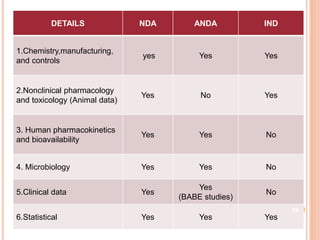
6. Difference between ANDA & NDA.
7. References. 2
INTRODUCTION
 An abbreviated new drug application (ANDA) is
specifically designed for an approval of generic drug product*.
 *Application for products similar to “already approved drugs" in
terms of same dosage form, same route of administration, active
ingredients and other conditions
 Such applications were required to show bioequivalence if
FDA thought the products have potential bioavailability problem.
3
GENERIC DRUG ……
To nominate a generic drug, it must be a drug product that is
comparable to an innovator drug product in:-
 Dosage form.
Strength.
Route of administration.
Quality.
 Performance characteristics.
Intended use.
4
IT TERMED "ABBREVIATED" BECAUSE THEY
GENERALLY NOT REQUIRED TO INCLUDE
PRECLINICAL (ANIMAL) AND CLINICAL (HUMAN)
DATA TO ESTABLISH SAFETY AND
EFFECTIVENESS.
5
GOAL OF ANDA
To reduce the price of the drug.
To reduce the time development.
Increase the bioavailability of the drug in
comparison to references list drug.
6
HISTORY
 The Waxman-Hatch Act also known as the “Drug Price
Competition and Patent term restoration Act of 1984”.
 It established bioequivalence as the basis for approving generic
copies of drug products.
 This Act permits FDA to approve ANDAs submitted to market
generic version of brand name drugs without conducting costly
and duplicative preclinical and clinical trials to establish safety and
efficacy.
7
REFERENCE LISTED DRUGS:
A reference listed drug (21 CFR 314.94(a)(3)) means the
listed drug identified by FDA as the drug product upon
which an applicant relies in seeking approval of its
ANDA.
8
INFORMATION REQUIRED FOR FILLING ANDA.
1. Product’s formulation
2. Manufacturer’s procedure
3. Control procedure
4. Testing Facilities
5. Dissolution profile
6. Labeling
9
ADDITIONAL INFORMATION
In vivo bioavailability of the prepared generic drug product
comparing it to the brand name drug product.
Criteria for bio-equivalence was known as 75/75 rule.
It means that 75% of the subjects required to have
concentration in the plasma between 75% - 125% when
compared with the branded product
10
CONTENT OF ANDA
GENERAL:
 It includes Bio-availability & bioequivalence studies. ( BABE)
“Bioequivalence measures the time it takes for generic drug to
reach blood stream as compared to reference drug in healthy
volunteers.”
11
LEGAL REQUIREMENTS & GUIDANCE DOCUMENTS:
Guidance documents are prepared for FDA review staff and
applicants to provide guidelines for processing, content,
evaluation, and approval of application.
An ANDA may follow the same items as referred to in NDA
except Clinical data section.
Information on Submission of ANDA in eCTD format can be
found at http://www.fda.gov/cder/regulatory/ersr/ectd.htm
http://www.fda.gov/cder/regulatory/ersr/ectd/5640-v1.2.pdf
http://www.fda.gov/cder/ogd 12
13
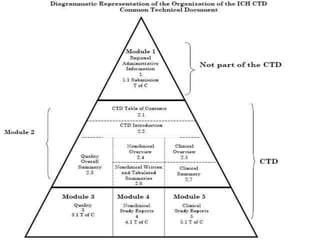
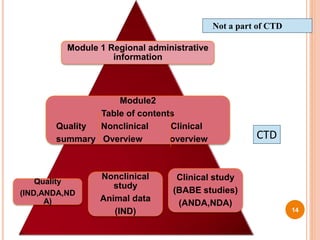
Module 1 Regional administrative
information
Module2
Table of contents
Quality Nonclinical Clinical
summary Overview overview
Quality
(IND,ANDA,ND
A)
Nonclinical
study
Animal data
(IND)
Clinical study
(BABE studies)
(ANDA,NDA)
Not a part of CTD
CTD
Not a part of CTD
CTD
14
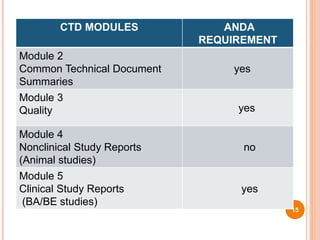
CTD MODULES ANDA
REQUIREMENT
Module 2
Common Technical Document
Summaries
yes
Module 3
Quality yes
Module 4
Nonclinical Study Reports
(Animal studies)
no
Module 5
Clinical Study Reports
(BA/BE studies)
yes
15
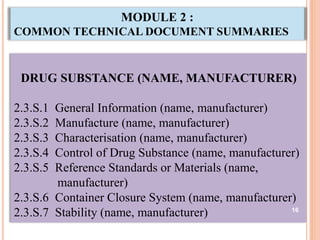
MODULE 2 :
COMMON TECHNICAL DOCUMENT SUMMARIES
DRUG SUBSTANCE (NAME, MANUFACTURER)
2.3.S.1 General Information (name, manufacturer)
2.3.S.2 Manufacture (name, manufacturer)
2.3.S.3 Characterisation (name, manufacturer)
2.3.S.4 Control of Drug Substance (name, manufacturer)
2.3.S.5 Reference Standards or Materials (name,
manufacturer)
2.3.S.6 Container Closure System (name, manufacturer)
2.3.S.7 Stability (name, manufacturer) 16
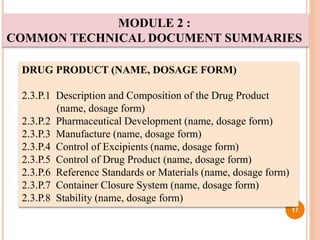
MODULE 2 :
COMMON TECHNICAL DOCUMENT SUMMARIES
DRUG PRODUCT (NAME, DOSAGE FORM)
2.3.P.1 Description and Composition of the Drug Product
(name, dosage form)
2.3.P.2 Pharmaceutical Development (name, dosage form)
2.3.P.3 Manufacture (name, dosage form)
2.3.P.4 Control of Excipients (name, dosage form)
2.3.P.5 Control of Drug Product (name, dosage form)
2.3.P.6 Reference Standards or Materials (name, dosage form)
2.3.P.7 Container Closure System (name, dosage form)
2.3.P.8 Stability (name, dosage form)
17
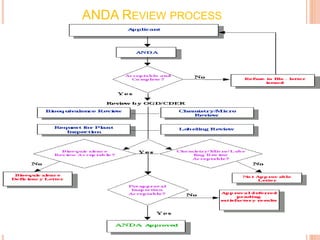
ANDA REVIEW PROCESS
18
DETAILS NDA ANDA IND
1.Chemistry,manufacturing,
and controls
yes Yes Yes
2.Nonclinical pharmacology
and toxicology (Animal data)
Yes No Yes
3. Human pharmacokinetics
and bioavailability
Yes Yes No
4. Microbiology Yes Yes No
5.Clinical data Yes
Yes
(BABE studies)
No
6.Statistical Yes Yes Yes
19
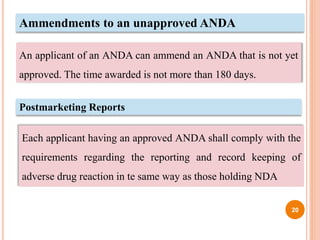
Ammendments to an unapproved ANDA
An applicant of an ANDA can ammend an ANDA that is not yet
approved. The time awarded is not more than 180 days.
Postmarketing Reports
Each applicant having an approved ANDA shall comply with the
requirements regarding the reporting and record keeping of
adverse drug reaction in te same way as those holding NDA
20
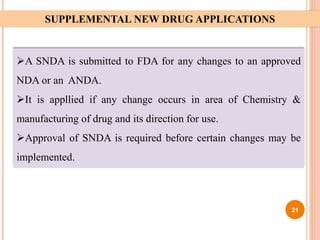
SUPPLEMENTAL NEW DRUG APPLICATIONS
A SNDA is submitted to FDA for any changes to an approved
NDA or an ANDA.
It is appllied if any change occurs in area of Chemistry &
manufacturing of drug and its direction for use.
Approval of SNDA is required before certain changes may be
implemented.
21
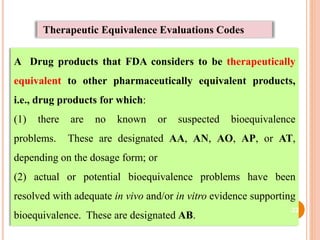
Therapeutic Equivalence Evaluations Codes
A Drug products that FDA considers to be therapeutically
equivalent to other pharmaceutically equivalent products,
i.e., drug products for which:
(1) there are no known or suspected bioequivalence
problems. These are designated AA, AN, AO, AP, or AT,
depending on the dosage form; or
(2) actual or potential bioequivalence problems have been
resolved with adequate in vivo and/or in vitro evidence supporting
bioequivalence. These are designated AB.
22
B Drug products that FDA at this time, considers NOT to be
therapeutically equivalent to other pharmaceutically equivalent
products, i.e.,
drug products for which actual or potential bioequivalence
problems have not been resolved by adequate evidence of
bioequivalence. Often the problem is with specific dosage forms
rather than with the active ingredients. These are designated BC,
BD, BE, BN, BP, BR, BS, BT, BX, or B*.
23
Patent Certification(s) Reference Listed Drug based upon a
suitability petition.
An abbreviated new drug application that refers to a Reference
Listed Drug (RLD) approved pursuant to a suitability petition
must demonstrate that the proposed product is bioequivalent to the
RLD, and it must include appropriate patent certification(s) and an
exclusivity statement with respect to the listed drug which served
as the basis for the approved suitability petition.
24
SUMMARY
ANDA are specifically designed to facilitate the manufacturers
of generic drug products to rapidly provide these products to
consumer at a cheaper rate.
25

ANDA

  • 1.
    ABBREVIATED NEW DRUGAPPLICATION [ANDA] Mr. Sagar Kishor savale [Department of Pharmaceutics)] avengersagar16@gmail.com 2015-2016 1
  • 2.
    CONTENTS 1. Introduction. 2. History. 3.Content of ANDA. 4. Requirements of ANDA. 5. Supplemental New drug application (SNDA) 6. Difference between ANDA & NDA. 7. References. 2
  • 3.
    INTRODUCTION  An abbreviatednew drug application (ANDA) is specifically designed for an approval of generic drug product*.  *Application for products similar to “already approved drugs" in terms of same dosage form, same route of administration, active ingredients and other conditions  Such applications were required to show bioequivalence if FDA thought the products have potential bioavailability problem. 3
  • 4.
    GENERIC DRUG …… Tonominate a generic drug, it must be a drug product that is comparable to an innovator drug product in:-  Dosage form. Strength. Route of administration. Quality.  Performance characteristics. Intended use. 4
  • 5.
    IT TERMED "ABBREVIATED"BECAUSE THEY GENERALLY NOT REQUIRED TO INCLUDE PRECLINICAL (ANIMAL) AND CLINICAL (HUMAN) DATA TO ESTABLISH SAFETY AND EFFECTIVENESS. 5
  • 6.
    GOAL OF ANDA Toreduce the price of the drug. To reduce the time development. Increase the bioavailability of the drug in comparison to references list drug. 6
  • 7.
    HISTORY  The Waxman-HatchAct also known as the “Drug Price Competition and Patent term restoration Act of 1984”.  It established bioequivalence as the basis for approving generic copies of drug products.  This Act permits FDA to approve ANDAs submitted to market generic version of brand name drugs without conducting costly and duplicative preclinical and clinical trials to establish safety and efficacy. 7
  • 8.
    REFERENCE LISTED DRUGS: Areference listed drug (21 CFR 314.94(a)(3)) means the listed drug identified by FDA as the drug product upon which an applicant relies in seeking approval of its ANDA. 8
  • 9.
    INFORMATION REQUIRED FORFILLING ANDA. 1. Product’s formulation 2. Manufacturer’s procedure 3. Control procedure 4. Testing Facilities 5. Dissolution profile 6. Labeling 9
  • 10.
    ADDITIONAL INFORMATION In vivobioavailability of the prepared generic drug product comparing it to the brand name drug product. Criteria for bio-equivalence was known as 75/75 rule. It means that 75% of the subjects required to have concentration in the plasma between 75% - 125% when compared with the branded product 10
  • 11.
    CONTENT OF ANDA GENERAL: It includes Bio-availability & bioequivalence studies. ( BABE) “Bioequivalence measures the time it takes for generic drug to reach blood stream as compared to reference drug in healthy volunteers.” 11
  • 12.
    LEGAL REQUIREMENTS &GUIDANCE DOCUMENTS: Guidance documents are prepared for FDA review staff and applicants to provide guidelines for processing, content, evaluation, and approval of application. An ANDA may follow the same items as referred to in NDA except Clinical data section. Information on Submission of ANDA in eCTD format can be found at http://www.fda.gov/cder/regulatory/ersr/ectd.htm http://www.fda.gov/cder/regulatory/ersr/ectd/5640-v1.2.pdf http://www.fda.gov/cder/ogd 12
  • 13.
  • 14.
    Module 1 Regionaladministrative information Module2 Table of contents Quality Nonclinical Clinical summary Overview overview Quality (IND,ANDA,ND A) Nonclinical study Animal data (IND) Clinical study (BABE studies) (ANDA,NDA) Not a part of CTD CTD Not a part of CTD CTD 14
  • 15.
    CTD MODULES ANDA REQUIREMENT Module2 Common Technical Document Summaries yes Module 3 Quality yes Module 4 Nonclinical Study Reports (Animal studies) no Module 5 Clinical Study Reports (BA/BE studies) yes 15
  • 16.
    MODULE 2 : COMMONTECHNICAL DOCUMENT SUMMARIES DRUG SUBSTANCE (NAME, MANUFACTURER) 2.3.S.1 General Information (name, manufacturer) 2.3.S.2 Manufacture (name, manufacturer) 2.3.S.3 Characterisation (name, manufacturer) 2.3.S.4 Control of Drug Substance (name, manufacturer) 2.3.S.5 Reference Standards or Materials (name, manufacturer) 2.3.S.6 Container Closure System (name, manufacturer) 2.3.S.7 Stability (name, manufacturer) 16
  • 17.
    MODULE 2 : COMMONTECHNICAL DOCUMENT SUMMARIES DRUG PRODUCT (NAME, DOSAGE FORM) 2.3.P.1 Description and Composition of the Drug Product (name, dosage form) 2.3.P.2 Pharmaceutical Development (name, dosage form) 2.3.P.3 Manufacture (name, dosage form) 2.3.P.4 Control of Excipients (name, dosage form) 2.3.P.5 Control of Drug Product (name, dosage form) 2.3.P.6 Reference Standards or Materials (name, dosage form) 2.3.P.7 Container Closure System (name, dosage form) 2.3.P.8 Stability (name, dosage form) 17
  • 18.
  • 19.
    DETAILS NDA ANDAIND 1.Chemistry,manufacturing, and controls yes Yes Yes 2.Nonclinical pharmacology and toxicology (Animal data) Yes No Yes 3. Human pharmacokinetics and bioavailability Yes Yes No 4. Microbiology Yes Yes No 5.Clinical data Yes Yes (BABE studies) No 6.Statistical Yes Yes Yes 19
  • 20.
    Ammendments to anunapproved ANDA An applicant of an ANDA can ammend an ANDA that is not yet approved. The time awarded is not more than 180 days. Postmarketing Reports Each applicant having an approved ANDA shall comply with the requirements regarding the reporting and record keeping of adverse drug reaction in te same way as those holding NDA 20
  • 21.
    SUPPLEMENTAL NEW DRUGAPPLICATIONS A SNDA is submitted to FDA for any changes to an approved NDA or an ANDA. It is appllied if any change occurs in area of Chemistry & manufacturing of drug and its direction for use. Approval of SNDA is required before certain changes may be implemented. 21
  • 22.
    Therapeutic Equivalence EvaluationsCodes A Drug products that FDA considers to be therapeutically equivalent to other pharmaceutically equivalent products, i.e., drug products for which: (1) there are no known or suspected bioequivalence problems. These are designated AA, AN, AO, AP, or AT, depending on the dosage form; or (2) actual or potential bioequivalence problems have been resolved with adequate in vivo and/or in vitro evidence supporting bioequivalence. These are designated AB. 22
  • 23.
    B Drug productsthat FDA at this time, considers NOT to be therapeutically equivalent to other pharmaceutically equivalent products, i.e., drug products for which actual or potential bioequivalence problems have not been resolved by adequate evidence of bioequivalence. Often the problem is with specific dosage forms rather than with the active ingredients. These are designated BC, BD, BE, BN, BP, BR, BS, BT, BX, or B*. 23
  • 24.
    Patent Certification(s) ReferenceListed Drug based upon a suitability petition. An abbreviated new drug application that refers to a Reference Listed Drug (RLD) approved pursuant to a suitability petition must demonstrate that the proposed product is bioequivalent to the RLD, and it must include appropriate patent certification(s) and an exclusivity statement with respect to the listed drug which served as the basis for the approved suitability petition. 24
  • 25.
    SUMMARY ANDA are specificallydesigned to facilitate the manufacturers of generic drug products to rapidly provide these products to consumer at a cheaper rate. 25