KEY COMPONENTS OF 
PHARMACEUTICAL 
QUALITY BY DESIGN (QBD) 
– AN INTRODUCTION 
By 
Dr. Saurabh Arora 
Managing Director 
Auriga Research Limited
CONTENTS 
 Introduction 
 Current approach vs QbD 
 Why QbD is Win-Win 
 Implications of QbD 
 Overview of QbD 
 Key Components 
 Conclusion
HOW DO WE ESTABLISH PRODUCT 
QUALITY? 
Then and Now
HISTORICAL APPROACH TO QUALITY 
 No testing required 
 Testing of final products 
 Testing of ingredients and final product 
 Extensive testing of ingredients, final products and 
control of process parameters 
 Testing and control based on process validation 
and strict adherence to process
JUST GET FROM A TO B 
 Traditional approach focused on achieving 
compliance to product specifications 
 Only minor variations studied to established that the 
product is reproducible 
 Not necessarily the best way to get from A to B
A BETTER WAY TO CROSS THE RIVER?
QBD 
 What is the best way to get from A to B? 
 What are the other routes can I take to safely get 
from A to B? 
 It is like having a GPS navigation system for your 
product and process!
NEW LEVEL OF QUALITY 
 Systematic development process 
 Moving away from “hit and trial” 
 Quality is built into the product not only controlled 
by testing
CURRENT VS. QBD APPROACH TO 
PHARMACEUTICAL DEVELOPMENT 
Current Approach QbD Approach 
Quality assured by testing and 
inspection 
Quality built into the product & 
process by design, based on 
scientific understanding 
Data intensive submission – 
disjoined information without “big 
picture” 
Knowledge rich submission – 
showing product knowledge & 
process understanding 
Specifications based on batch 
history 
Specifications based on product 
performance requirements 
“Frozen Process” discouraging 
changes 
Flexible process within design 
space, allowing continuous 
improvement 
Focus on reproducibility – often 
avoiding or ignoring variations 
Focus on robustness – 
understanding and controlling 
variations
THINK WIN-WIN 
QbD is good for both the manufacturers and the 
regulators
QBD IS WIN-WIN 
Wins for the regulator 
More pharmaceutical products 
approved in shorter timeline 
Better quality products 
reaching the market 
Lower-cost products available 
to the consumer 
Reduced audit frequency
QBD IS WIN-WIN 
Wins for the manufacturer 
Reduced time to market 
Space and flexibility for more innovation 
Reduced documentation 
Better communication between authorities and 
industry 
Guaranteed quality for every unit produced 
Decreased cost of production by improved 
productivity 
Competitive advantage in the market 
Image improvement 
Creating value using existing data and resources 
Better knowledge management
IMPLICATIONS ON THE 
ORGANISATION 
Implications on of QbD
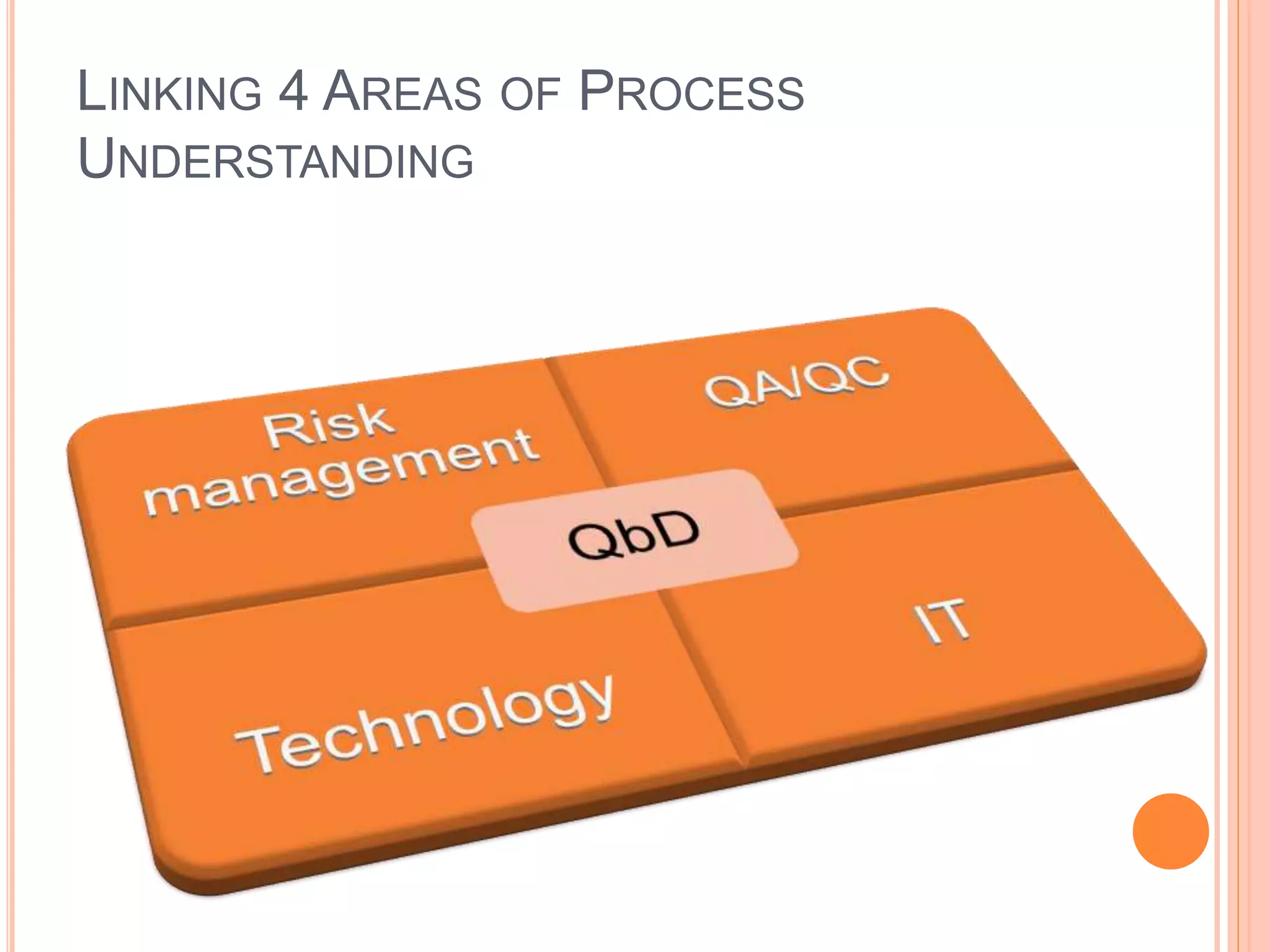
QBD IMPLICATIONS 
QbD 
Organization Process 
Management 
Personnel 
QA/QC 
IT 
Understanding 
Technology
IMPLICATIONS ON PERSONNEL 
 Employees need new skills 
 Scientific data analysis 
 Statistics 
 Process control 
 Very similar to 6 Sigma training structure 
 Master black belts 
 Black belts 
 Green belts
IMPLICATIONS ON PERSONNEL 
 Structural changes might be required 
 There might be need for new Department 
 There is a need for increased collaboration between 
departments and functions 
 Increased contact with regulatory authorities 
 Clearly defined to accountability roles and responsibility 
 Interdisciplinary project team, QA, R&D, IT, 
manufacturing
IMPLICATIONS ON MANAGEMENT 
 Commitment of management 
 Initial phase will require more investment, though there 
will be saving in the long run. 
 Define the QbD development strategy, team, goals, 
objectives, commit to resources, expected benefits 
 Might be risky to ignore QbD 
 Regular review of the progress 
 Choice of outsourcing partner 
 Ensuring proper communication
IMPLICATIONS ON QA 
Must be aware of changes in the regulatory 
process 
 The structure of audits will change 
 Scrutiny will challenge scientific understanding of 
quality factors and risk mitigation 
 More focus on the development Department 
 Comparison between real design space and 
documented design space 
 Documentation of improvements, changes and 
deviations
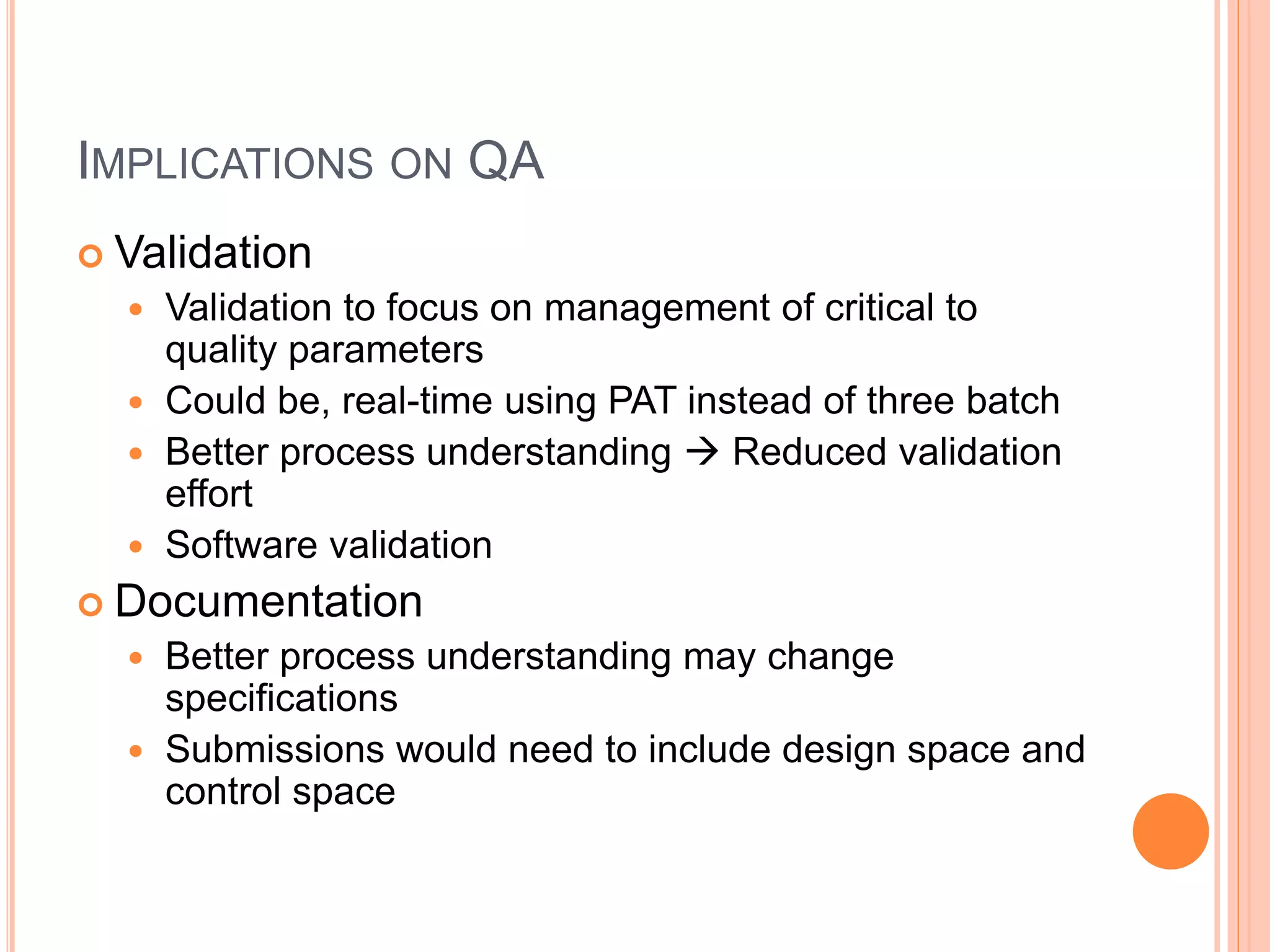
IMPLICATIONS ON QA 
 Validation 
 Validation to focus on management of critical to 
quality parameters 
 Could be, real-time using PAT instead of three batch 
 Better process understanding  Reduced validation 
effort 
 Software validation 
 Documentation 
 Better process understanding may change 
specifications 
 Submissions would need to include design space and 
control space
LINKING 4 AREAS OF PROCESS 
UNDERSTANDING
BASIC TERMINOLOGY 
Definitions and acronyms
WHAT IS PQ? 
 What is Pharmaceutical Quality (PQ)? 
 According to USFDA – 
a product should be called as of pharmaceutical 
quality when it is - 
 Free of Contamination 
 Reproducibly delivers the therapeutic benefits promised in 
the label to the consumer 
 Pharmaceutical Quality = f (Properties of Drug Substance, 
excipients, Mfg. Process, 
Packaging)
WHAT IS PHARMACEUTICAL QBD ? 
 It is a systematic approach to pharmaceutical 
development that begins with predefined objectives 
and emphasizes product and process 
understanding and process control, based on 
sound science and quality risk management.
OVERVIEW OF QBD 
Labeled Use 
Safety & Efficacy 
Design Formulation 
Design Process 
Identify 
Critical Material 
Attributes (CMA) & 
Critical Process 
Parameters (CPP) 
Define 
Target Product Quality 
Profile (TPQP) 
Knowledge Space 
Establish 
Control Strategy 
Monitor & 
Update 
Process 
Target --------------------------- Design ----------------------- Implementation
KEY COMPONENTS OF QBD 
Target Product Profile (TPP) 
 It is patient & labeling centered concept 
 It includes 
 Route of administration 
 Dosage form and size 
 Max. & Min. Doses 
 Pharmaceutical elegance (appearance) 
 Target patient population
KEY COMPONENTS OF QBD 
Target Product Quality Profile (TPQP) 
 It is quantitative surrogate for aspects of 
clinical safety & efficacy 
 It includes quantitative targets for 
 Impurities & stability 
 Dissolution release profile & 
 Other product specific performance requirements 
e.g. 
 Bioequivalence to the RLD for generic products 
 Resuspendability for an oral suspension 
 Adhesion for a transdermal system 
 Viscosity for a topical cream etc.
KEY COMPONENTS OF QBD 
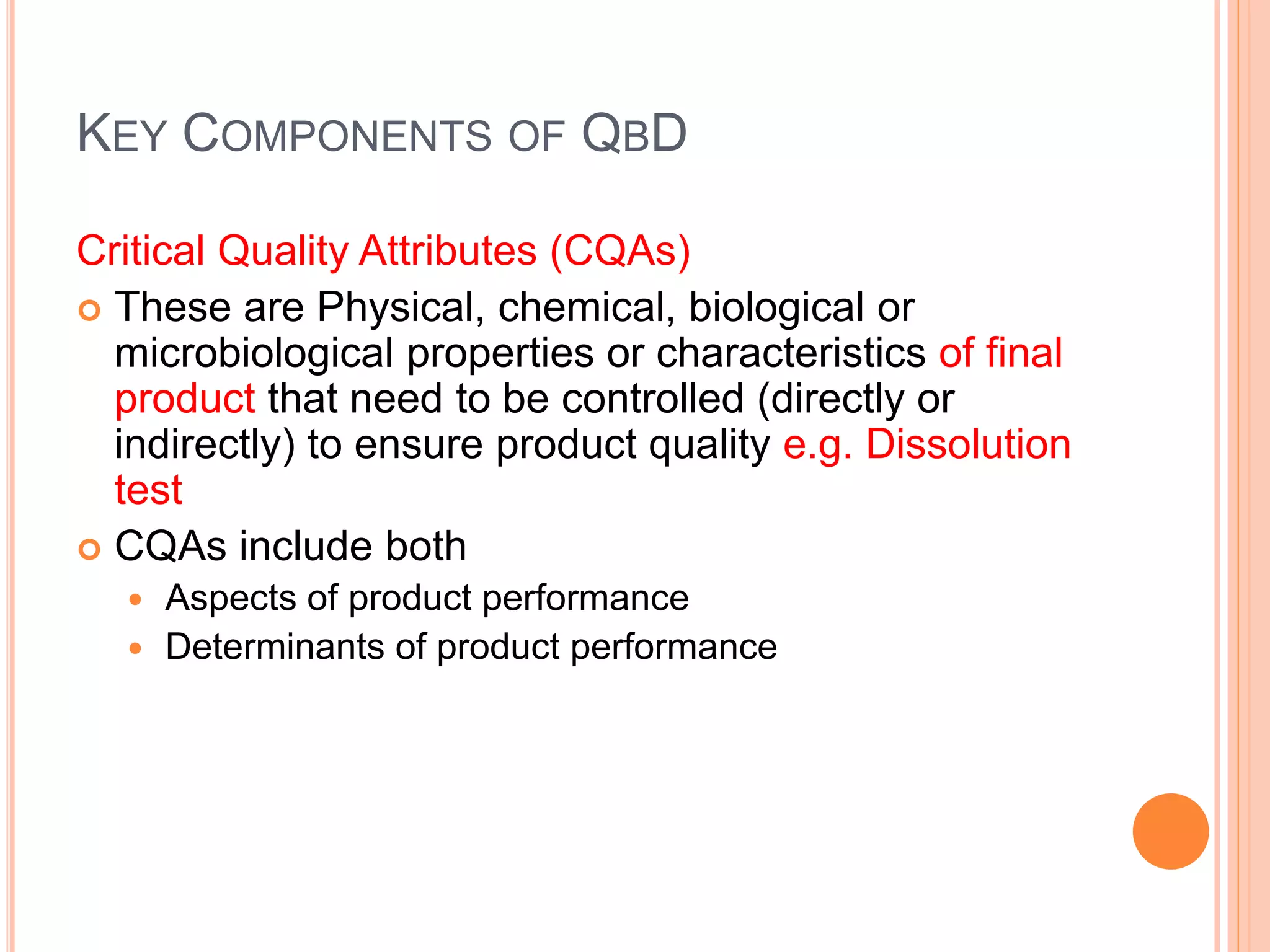
Critical Quality Attributes (CQAs) 
 These are Physical, chemical, biological or 
microbiological properties or characteristics of final 
product that need to be controlled (directly or 
indirectly) to ensure product quality e.g. Dissolution 
test 
 CQAs include both 
 Aspects of product performance 
 Determinants of product performance
KEY COMPONENTS OF QBD 
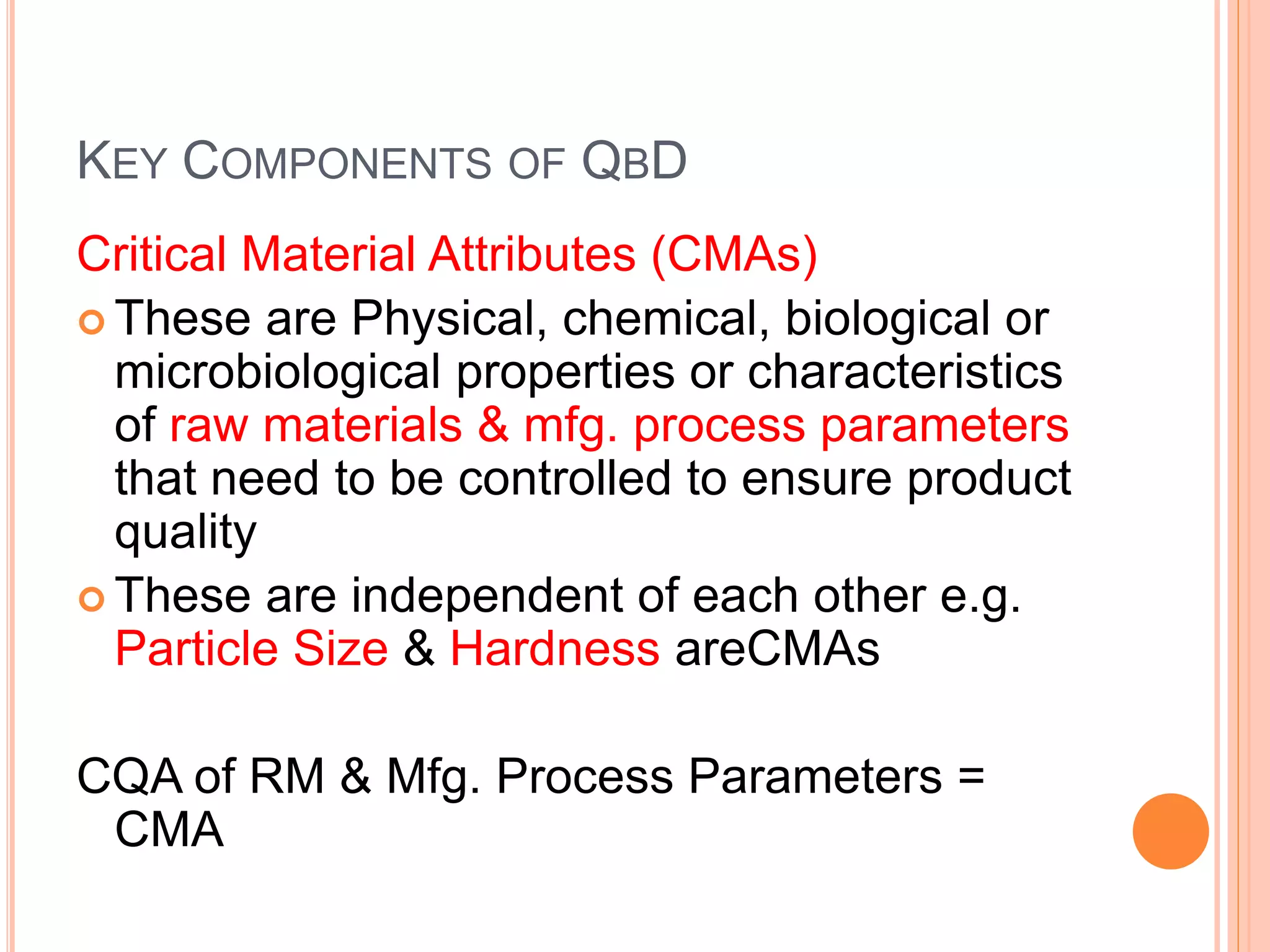
Critical Material Attributes (CMAs) 
 These are Physical, chemical, biological or 
microbiological properties or characteristics 
of raw materials & mfg. process parameters 
that need to be controlled to ensure product 
quality 
 These are independent of each other e.g. 
Particle Size & Hardness areCMAs 
CQA of RM & Mfg. Process Parameters = 
CMA
KEY COMPONENTS OF QBD 
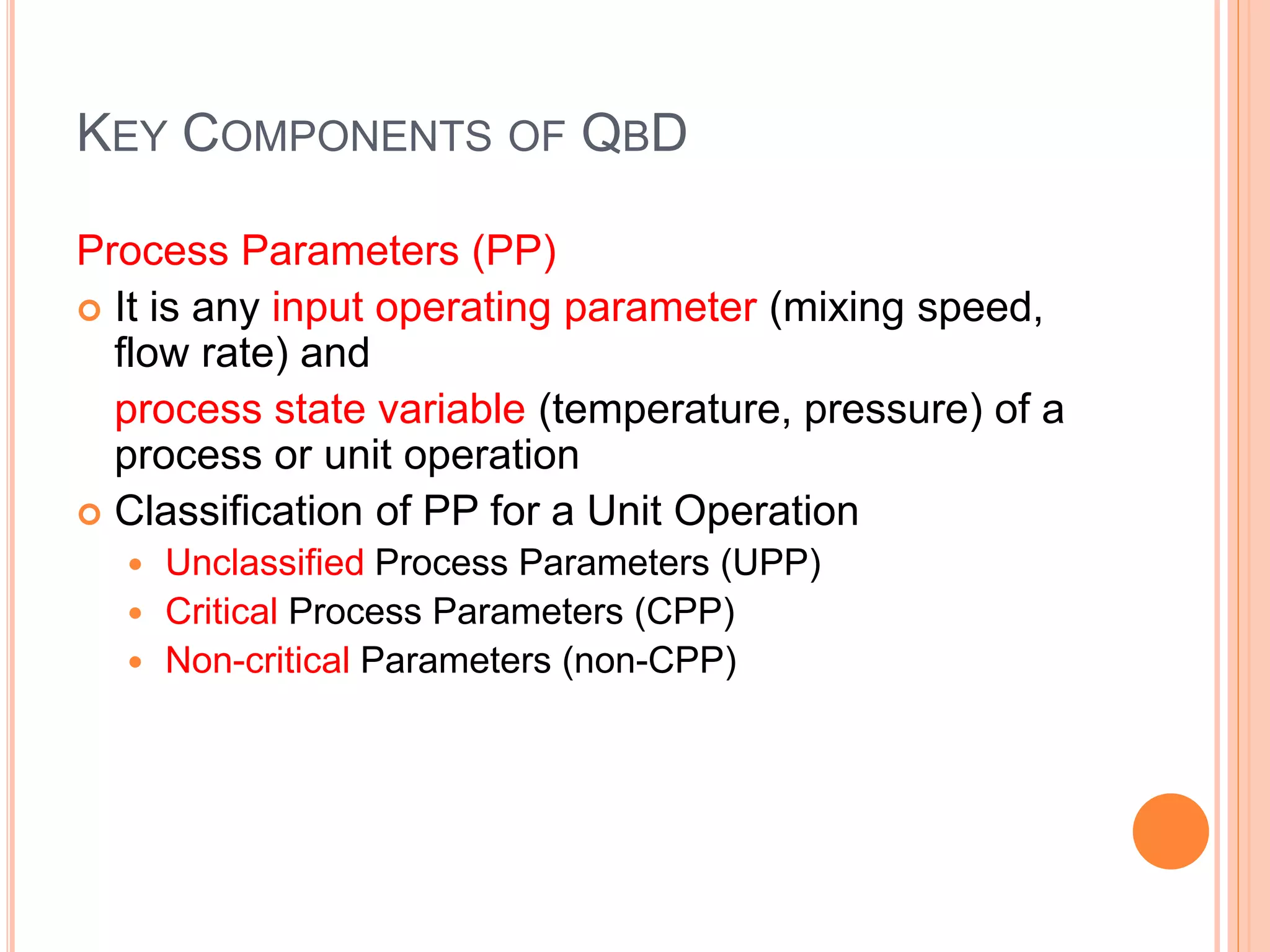
Process Parameters (PP) 
 It is any input operating parameter (mixing speed, 
flow rate) and 
process state variable (temperature, pressure) of a 
process or unit operation 
 Classification of PP for a Unit Operation 
 Unclassified Process Parameters (UPP) 
 Critical Process Parameters (CPP) 
 Non-critical Parameters (non-CPP)
CLASSIFICATION OF 
PROCESS PARAMETERS 
Parameter 
Type 
Definition Sensitivity 
non-CPP Not critical • No failure in target product quality profile 
(TPQP) observed or predicted in the potential 
operating space (POS), and 
• No interactions with other parameters in the 
proven acceptable range (PAR) 
UPP Criticality 
Unknown 
• Not established 
• The default in the absence of pharmaceutical 
Development 
CPP Critical 
(control needed 
to ensure 
quality) 
• Failure in target product quality profile (TPQP) 
observed or predicted in the potential operating 
space (POS), or 
• Interactions with other parameters in the proven 
acceptable range (PAR)
IDENTIFICATION OF 
PROCESS PARAMETERS 
Wet 
Granulation 
Material Attributes 
Drug Substance 
DS Amount 
DS Form 
DS Particle Size 
DS Moisture Content 
DS Bulk Density 
Material Attributes 
Excipients 
Exp. Amount 
Exp. Particle Size 
Exp. Bulk Density 
Granulation 
Operating Parameters 
Chopper Configuration 
Impeller Speed 
Granulation Time 
Order of Addition 
Temperature 
Spray Nozzle Type 
Binder Addition Rate 
Granulation 
State Conditions 
Power Consumption 
Temperature 
Material Attributes 
After Granulation 
Blend Uniformity 
Granule Size Distribution 
Agglomerate Size 
Moisture 
Bulk Density 
Flow Properties
KEY COMPONENTS OF QBD 
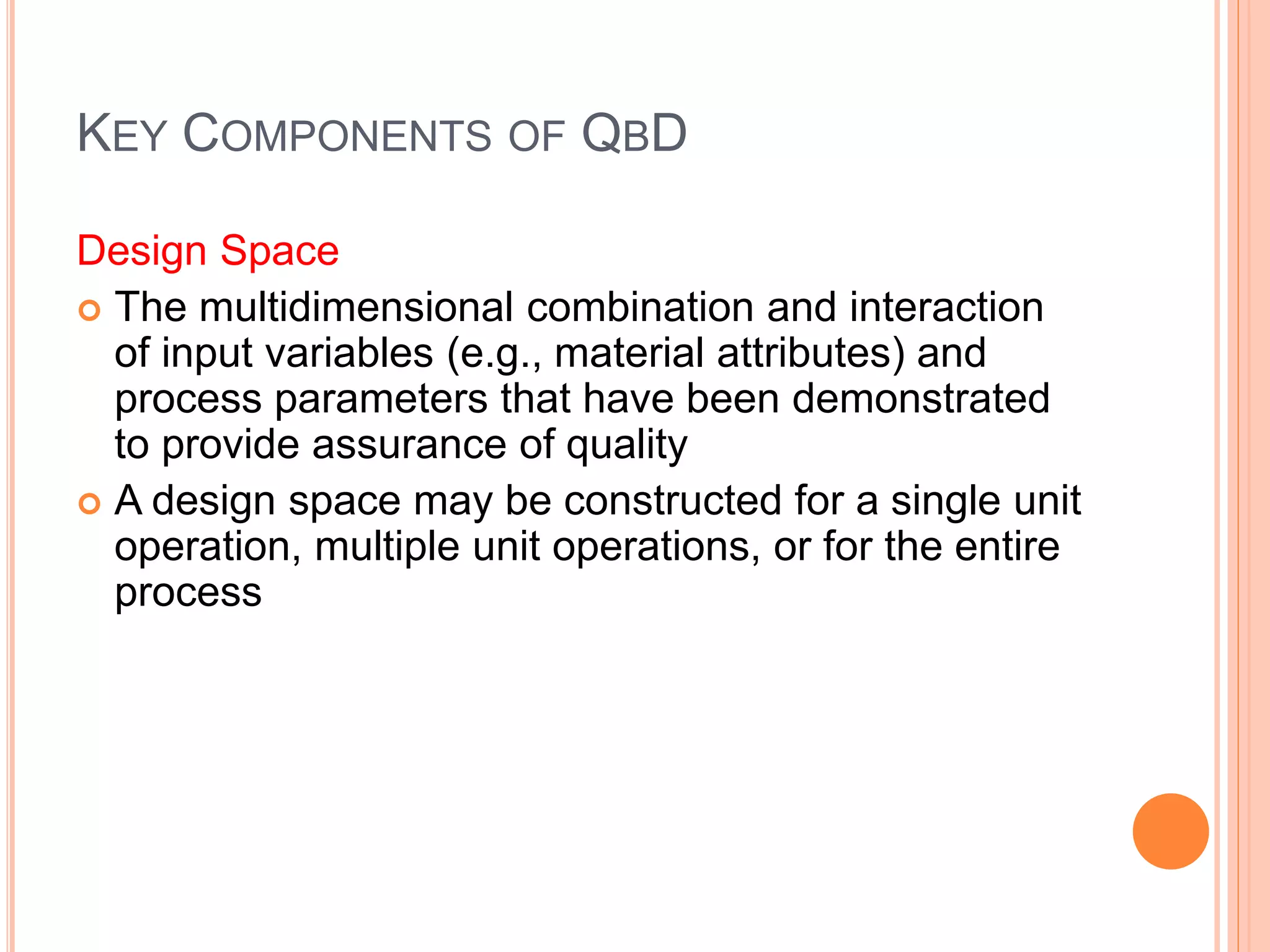
Design Space 
 The multidimensional combination and interaction 
of input variables (e.g., material attributes) and 
process parameters that have been demonstrated 
to provide assurance of quality 
 A design space may be constructed for a single unit 
operation, multiple unit operations, or for the entire 
process
TOOLS TO IMPLEMENT QBD 
 Design of experiments (DOE) 
 Risk assessment 
 Process analytical technology (PAT)
DESIGN OF EXPERIMENT (DOE) 
 Structured, organized method for 
determining the relationship between 
factors affecting a process and the 
response of that process 
 DOE Methodology 
1. Choose Experimental Design (e.g. Full 
Factorial design) 
2. Conduct randomized experiments 
3. Analyze data 
4. Create multidimensional surface model
RISK ASSESSMENT 
 Risk 
 It is defined as the combination of the probability 
of occurrence of harm and the severity of that 
harm 
 Risk assessment 
 A systematic process of organizing information to 
support a risk decision to be made within a risk 
mgmt process. 
 It consists of the identification of hazards and the 
analysis and evaluation of risks associated with 
exposure to those hazards
PROCESS ANALYTICAL TECHNOLOGY 
(PAT) 
A system for designing, analyzing and 
controlling manufacturing through timely 
measurements (i.e. during processing) of 
critical quality and performance attributes of 
raw & in process materials and processes 
with the goal of ensuring final product 
quality. 
 The term analytical in PAT is viewed broadly 
to include chemical, physical, 
microbiological, mathematical and risk 
analysis conducted in an integrated manner.
CONCLUSION 
The End
CONCLUSION 
Quality by design is an essential part of the 
modern approach to pharmaceutical quality 
QbD is Win-Win 
PAT, DOE and Risk Assessments are tools 
to facilitate the implementation of QbD.
THANK YOU! 
Dr. Saurabh Arora 
Presentation will be available for download @ 
WWW.Lab-Training.Com

Key Components of Pharmaceutical QbD, an Introduction

  • 1.
    KEY COMPONENTS OF PHARMACEUTICAL QUALITY BY DESIGN (QBD) – AN INTRODUCTION By Dr. Saurabh Arora Managing Director Auriga Research Limited
  • 2.
    CONTENTS  Introduction  Current approach vs QbD  Why QbD is Win-Win  Implications of QbD  Overview of QbD  Key Components  Conclusion
  • 3.
    HOW DO WEESTABLISH PRODUCT QUALITY? Then and Now
  • 4.
    HISTORICAL APPROACH TOQUALITY  No testing required  Testing of final products  Testing of ingredients and final product  Extensive testing of ingredients, final products and control of process parameters  Testing and control based on process validation and strict adherence to process
  • 5.
    JUST GET FROMA TO B  Traditional approach focused on achieving compliance to product specifications  Only minor variations studied to established that the product is reproducible  Not necessarily the best way to get from A to B
  • 6.
    A BETTER WAYTO CROSS THE RIVER?
  • 7.
    QBD  Whatis the best way to get from A to B?  What are the other routes can I take to safely get from A to B?  It is like having a GPS navigation system for your product and process!
  • 8.
    NEW LEVEL OFQUALITY  Systematic development process  Moving away from “hit and trial”  Quality is built into the product not only controlled by testing
  • 9.
    CURRENT VS. QBDAPPROACH TO PHARMACEUTICAL DEVELOPMENT Current Approach QbD Approach Quality assured by testing and inspection Quality built into the product & process by design, based on scientific understanding Data intensive submission – disjoined information without “big picture” Knowledge rich submission – showing product knowledge & process understanding Specifications based on batch history Specifications based on product performance requirements “Frozen Process” discouraging changes Flexible process within design space, allowing continuous improvement Focus on reproducibility – often avoiding or ignoring variations Focus on robustness – understanding and controlling variations
  • 10.
    THINK WIN-WIN QbDis good for both the manufacturers and the regulators
  • 11.
    QBD IS WIN-WIN Wins for the regulator More pharmaceutical products approved in shorter timeline Better quality products reaching the market Lower-cost products available to the consumer Reduced audit frequency
  • 12.
    QBD IS WIN-WIN Wins for the manufacturer Reduced time to market Space and flexibility for more innovation Reduced documentation Better communication between authorities and industry Guaranteed quality for every unit produced Decreased cost of production by improved productivity Competitive advantage in the market Image improvement Creating value using existing data and resources Better knowledge management
  • 13.
    IMPLICATIONS ON THE ORGANISATION Implications on of QbD
  • 14.
    QBD IMPLICATIONS QbD Organization Process Management Personnel QA/QC IT Understanding Technology
  • 15.
    IMPLICATIONS ON PERSONNEL  Employees need new skills  Scientific data analysis  Statistics  Process control  Very similar to 6 Sigma training structure  Master black belts  Black belts  Green belts
  • 16.
    IMPLICATIONS ON PERSONNEL  Structural changes might be required  There might be need for new Department  There is a need for increased collaboration between departments and functions  Increased contact with regulatory authorities  Clearly defined to accountability roles and responsibility  Interdisciplinary project team, QA, R&D, IT, manufacturing
  • 17.
    IMPLICATIONS ON MANAGEMENT  Commitment of management  Initial phase will require more investment, though there will be saving in the long run.  Define the QbD development strategy, team, goals, objectives, commit to resources, expected benefits  Might be risky to ignore QbD  Regular review of the progress  Choice of outsourcing partner  Ensuring proper communication
  • 18.
    IMPLICATIONS ON QA Must be aware of changes in the regulatory process  The structure of audits will change  Scrutiny will challenge scientific understanding of quality factors and risk mitigation  More focus on the development Department  Comparison between real design space and documented design space  Documentation of improvements, changes and deviations
  • 19.
    IMPLICATIONS ON QA  Validation  Validation to focus on management of critical to quality parameters  Could be, real-time using PAT instead of three batch  Better process understanding  Reduced validation effort  Software validation  Documentation  Better process understanding may change specifications  Submissions would need to include design space and control space
  • 20.
    LINKING 4 AREASOF PROCESS UNDERSTANDING
  • 21.
  • 22.
    WHAT IS PQ?  What is Pharmaceutical Quality (PQ)?  According to USFDA – a product should be called as of pharmaceutical quality when it is -  Free of Contamination  Reproducibly delivers the therapeutic benefits promised in the label to the consumer  Pharmaceutical Quality = f (Properties of Drug Substance, excipients, Mfg. Process, Packaging)
  • 23.
    WHAT IS PHARMACEUTICALQBD ?  It is a systematic approach to pharmaceutical development that begins with predefined objectives and emphasizes product and process understanding and process control, based on sound science and quality risk management.
  • 24.
    OVERVIEW OF QBD Labeled Use Safety & Efficacy Design Formulation Design Process Identify Critical Material Attributes (CMA) & Critical Process Parameters (CPP) Define Target Product Quality Profile (TPQP) Knowledge Space Establish Control Strategy Monitor & Update Process Target --------------------------- Design ----------------------- Implementation
  • 25.
    KEY COMPONENTS OFQBD Target Product Profile (TPP)  It is patient & labeling centered concept  It includes  Route of administration  Dosage form and size  Max. & Min. Doses  Pharmaceutical elegance (appearance)  Target patient population
  • 26.
    KEY COMPONENTS OFQBD Target Product Quality Profile (TPQP)  It is quantitative surrogate for aspects of clinical safety & efficacy  It includes quantitative targets for  Impurities & stability  Dissolution release profile &  Other product specific performance requirements e.g.  Bioequivalence to the RLD for generic products  Resuspendability for an oral suspension  Adhesion for a transdermal system  Viscosity for a topical cream etc.
  • 27.
    KEY COMPONENTS OFQBD Critical Quality Attributes (CQAs)  These are Physical, chemical, biological or microbiological properties or characteristics of final product that need to be controlled (directly or indirectly) to ensure product quality e.g. Dissolution test  CQAs include both  Aspects of product performance  Determinants of product performance
  • 28.
    KEY COMPONENTS OFQBD Critical Material Attributes (CMAs)  These are Physical, chemical, biological or microbiological properties or characteristics of raw materials & mfg. process parameters that need to be controlled to ensure product quality  These are independent of each other e.g. Particle Size & Hardness areCMAs CQA of RM & Mfg. Process Parameters = CMA
  • 29.
    KEY COMPONENTS OFQBD Process Parameters (PP)  It is any input operating parameter (mixing speed, flow rate) and process state variable (temperature, pressure) of a process or unit operation  Classification of PP for a Unit Operation  Unclassified Process Parameters (UPP)  Critical Process Parameters (CPP)  Non-critical Parameters (non-CPP)
  • 30.
    CLASSIFICATION OF PROCESSPARAMETERS Parameter Type Definition Sensitivity non-CPP Not critical • No failure in target product quality profile (TPQP) observed or predicted in the potential operating space (POS), and • No interactions with other parameters in the proven acceptable range (PAR) UPP Criticality Unknown • Not established • The default in the absence of pharmaceutical Development CPP Critical (control needed to ensure quality) • Failure in target product quality profile (TPQP) observed or predicted in the potential operating space (POS), or • Interactions with other parameters in the proven acceptable range (PAR)
  • 31.
    IDENTIFICATION OF PROCESSPARAMETERS Wet Granulation Material Attributes Drug Substance DS Amount DS Form DS Particle Size DS Moisture Content DS Bulk Density Material Attributes Excipients Exp. Amount Exp. Particle Size Exp. Bulk Density Granulation Operating Parameters Chopper Configuration Impeller Speed Granulation Time Order of Addition Temperature Spray Nozzle Type Binder Addition Rate Granulation State Conditions Power Consumption Temperature Material Attributes After Granulation Blend Uniformity Granule Size Distribution Agglomerate Size Moisture Bulk Density Flow Properties
  • 32.
    KEY COMPONENTS OFQBD Design Space  The multidimensional combination and interaction of input variables (e.g., material attributes) and process parameters that have been demonstrated to provide assurance of quality  A design space may be constructed for a single unit operation, multiple unit operations, or for the entire process
  • 33.
    TOOLS TO IMPLEMENTQBD  Design of experiments (DOE)  Risk assessment  Process analytical technology (PAT)
  • 34.
    DESIGN OF EXPERIMENT(DOE)  Structured, organized method for determining the relationship between factors affecting a process and the response of that process  DOE Methodology 1. Choose Experimental Design (e.g. Full Factorial design) 2. Conduct randomized experiments 3. Analyze data 4. Create multidimensional surface model
  • 35.
    RISK ASSESSMENT Risk  It is defined as the combination of the probability of occurrence of harm and the severity of that harm  Risk assessment  A systematic process of organizing information to support a risk decision to be made within a risk mgmt process.  It consists of the identification of hazards and the analysis and evaluation of risks associated with exposure to those hazards
  • 36.
    PROCESS ANALYTICAL TECHNOLOGY (PAT) A system for designing, analyzing and controlling manufacturing through timely measurements (i.e. during processing) of critical quality and performance attributes of raw & in process materials and processes with the goal of ensuring final product quality.  The term analytical in PAT is viewed broadly to include chemical, physical, microbiological, mathematical and risk analysis conducted in an integrated manner.
  • 37.
  • 38.
    CONCLUSION Quality bydesign is an essential part of the modern approach to pharmaceutical quality QbD is Win-Win PAT, DOE and Risk Assessments are tools to facilitate the implementation of QbD.
  • 39.
    THANK YOU! Dr.Saurabh Arora Presentation will be available for download @ WWW.Lab-Training.Com