ICH GUIDELINE Q8
(PRODUCT DEVELOPMEMT)
PRESENTED BY:
SWASTIK JYOTI PAL
M.PHARM 2ND SEM
PHARMACEUTICS DEPARTMENT
BENGAL SCHOOL OF TECHNOLOGY
ROLL NO. - 19320318001
1
PRESENTATION OUTLINE
1. Introduction
2. QbD approach
3. QbD process flow
4. ICH Q8 R2 guidelines
5. Contents for 3. 2.P.2 for CTD module 3
6. Component of drug product
7. Formulation development
8. Container and closure system
9. Microbiological attributes
10. Compatibility
11. Conclusion
12. Reference
2
INTRODUCTION:
 The pharmaceutical industry is one of the most strictly regulated and its products are of
excellent quality.
 However, issues suggesting improvements pharmaceutical development and
manufacturing are noticeable in cases of batch failures and reworks, regulatory issues,
implementation of new technologies, etc.
 QbD assures the quality of a pharmaceutical product through scientific development and
risk management tools, and will eventually enable real-time release, regardless of the
formulation type.
 QUALITY BY DESIGN (QBD) IS A CONCEPT INTRODUCED BY THE
INTERNATIONAL CONFERENCE ON HARMONIZATION (ICH)Q8 GUIDELINE,
AS A SYSTEMATIC APPROACH TO DEVELOPMENT, WHICH BEGINS WITH
PREDEFINED OBJECTIVES AND EMPHASIZES PRODUCT AND PROCESS
UNDERSTANDING AND PROCESS CONTROL, BASED ON SOUND SCIENCE
AND QUALITY RISK MANAGEMENT
3
QbD Approach:
 Quality Target Product Profile (QTPP): According to the ICH Q8
guideline, QTPP is a prospective summary of the quality characteristics of
a drug product to ensure the desired quality, taking into account safety and
efficacy of that drug product.
 Through the scientifically based process of product development, critical
process parameters (CPPs), and critical quality attributes (CQAs) of
the product are identified.
 CQA is a physical, chemical, biological, or microbiological property or
characteristic that should be within an appropriate limit, range, or
distribution to ensure the desired product quality.
 CPP is a process parameter whose variability has an impact on a CQA.
4
QbD process flow
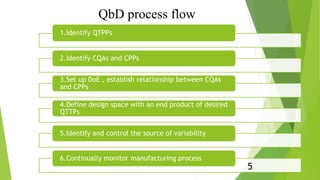
1.Identify QTPPs
2.Identify CQAs and CPPs
3.Set up DoE , establish relationship between CQAs
and CPPs
4.Define design space with an end product of desired
QTTPs
5.Identify and control the source of variability
6.Continually monitor manufacturing process
5
ICHQ8(R2): Pharmaceutical Development
Guideline:
•The ICH Q8 guideline describes GOOD PRACTICES FOR
PHARMACEUTICAL PRODUCT DEVELOPMENT.
•ICHQ8 Pharmaceutical Development describes the principles of QbD,
outlines the key elements, and provides illustrative examples for
pharmaceutical drug products.
•It is often emphasized that the QUALITY of a pharmaceutical product
should be BUILT IN BY DESIGN RATHER THAN BY TESTING ALONE.
6
• The ICH Q8 guideline suggests that those aspects of drug substances, excipients,
container closure systems, and manufacturing processes that are critical to product
quality, should be DETERMINED AND CONTROL STRATEGIES justified.
• Some of the tools that should be applied during the design space appointment include
experimental designs, PAT, prior knowledge, quality risk management principles, etc.
• PAT(Process Analytical Technology) is a system for designing, analyzing, and
controlling manufacturing through timely measurements (i.e. during processing) of
critical quality and performance attributes of raw and in-process materials and
processes with the goal of ensuring final product quality .
• Pfizer was one of the first companies to implement QbD and PAT concepts.
7
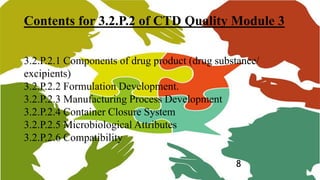
Contents for 3.2.P.2 of CTD Quality Module 3
3.2.P.2.1 Components of drug product (drug substance/
excipients)
3.2.P.2.2 Formulation Development.
3.2.P.2.3 Manufacturing Process Development
3.2.P.2.4 Container Closure System
3.2.P.2.5 Microbiological Attributes
3.2.P.2.6 Compatibility
8
COMPONENTS OF DRUG PRODUCT GIVEN BY ICH
Q8
DRUG SUBSTANCES-
“The physicochemical and biological properties of the drug substance that can influence the
performance of the drug product and its manufacturability.”
Examples of physicochemical and biological properties that might need to be examined
include-
Solubility,Water content,Particle size,Crystal properties,Biological activity,Permeability
EXCIPIENTS -
The excipients chosen, their concentration, and the characteristics that can influence the
drug product performance or manufacturability should be discussed relative to the
respective function of each excipients.
The compatibility of the drug substance with excipients should be evaluated.
For products that contain more than one drug substance, the compatibility of the drug
substances with each other should also be evaluated. 9
FORMULATION DEVELOPMENT
• A summary should be provided describing the development of the formulation,
including identification of those attributes that are critical to the quality of the drug
product and also highlight the evolution of the formulation design from initial
concept up to the final design.
• Information from comparative in vitro studies (e.g., dissolution) or comparative in
vivo studies (e.g., BE) that links clinical formulations to the proposed commercial
formulation.
• A successful correlation can assist in the selection of appropriate dissolution
acceptance criteria, and can potentially reduce the need for further bioequivalence
studies following changes to the product or its manufacturing process.
10
CONTAINER AND CLOSURE SYSTEM
• The choice for selection of the container closure system for the commercial product
should be discussed.
• The choice of materials for primary packaging and secondary packaging should be
justified.
• A possible interaction between product and container or label should be considered.
11
MICROBIOLOGICALATTRIBUTES
• The selection and effectiveness of preservative systems in products containing
antimicrobial preservative or the antimicrobial effectiveness of products that are
inherently antimicrobial.
• For sterile products, the integrity of the container closure system as it relates to
preventing microbial contamination.
• The lowest specified concentration of antimicrobial preservative should be
justified in terms of efficacy and safety, such that the minimum concentration of
preservative that gives the required level of efficacy throughout the intended
shelf life of the product is used.
12
COMPATIBILITY
• The compatibility of the drug product with reconstitution diluents (e.g., precipitation,
stability) should be addressed to provide appropriate and supportive information for
the labelling.
• This information should cover the recommended in-use shelf life, at the
recommended storage temperature and at the likely extremes of concentration.
Similarly, admixture or dilution of products prior to administration (e.g.,product
added to large volume infusion containers) might need to be addressed.
13
CONCLUSION:
 Concepts of QbD are ever-growing need for better
understanding of the formulation and process
development by pharmaceutical scientists.
 Benefits of QbD application for both regulatory
agencies and manufacturers have been proven.
 It is clear the QbD will become a necessity, therefore all
the stakeholders should adapt to its implementation.
14
REFERENCE
1. Pharmaceutical development. Q8(R2). ICH Harmonised Tripartite Guideline.
Accessed from
https://www.ich.org/fileadmin/Public_Web.../Guidelines/.../Q8_R2_Guideline.pdf
2. Zhang L, Mao S. Application of quality by design in the current drug development.
Asian Journal of Pharmaceutical Sciences. 2017 Jan 1;12(1):1-8.
3. Djuris.L.Computer Aided Application in Pharmaceutical Technology. Woodhead
Publishing; 2013 ; page 1-14.
15
16

Ich q8

  • 1.
    ICH GUIDELINE Q8 (PRODUCTDEVELOPMEMT) PRESENTED BY: SWASTIK JYOTI PAL M.PHARM 2ND SEM PHARMACEUTICS DEPARTMENT BENGAL SCHOOL OF TECHNOLOGY ROLL NO. - 19320318001 1
  • 2.
    PRESENTATION OUTLINE 1. Introduction 2.QbD approach 3. QbD process flow 4. ICH Q8 R2 guidelines 5. Contents for 3. 2.P.2 for CTD module 3 6. Component of drug product 7. Formulation development 8. Container and closure system 9. Microbiological attributes 10. Compatibility 11. Conclusion 12. Reference 2
  • 3.
    INTRODUCTION:  The pharmaceuticalindustry is one of the most strictly regulated and its products are of excellent quality.  However, issues suggesting improvements pharmaceutical development and manufacturing are noticeable in cases of batch failures and reworks, regulatory issues, implementation of new technologies, etc.  QbD assures the quality of a pharmaceutical product through scientific development and risk management tools, and will eventually enable real-time release, regardless of the formulation type.  QUALITY BY DESIGN (QBD) IS A CONCEPT INTRODUCED BY THE INTERNATIONAL CONFERENCE ON HARMONIZATION (ICH)Q8 GUIDELINE, AS A SYSTEMATIC APPROACH TO DEVELOPMENT, WHICH BEGINS WITH PREDEFINED OBJECTIVES AND EMPHASIZES PRODUCT AND PROCESS UNDERSTANDING AND PROCESS CONTROL, BASED ON SOUND SCIENCE AND QUALITY RISK MANAGEMENT 3
  • 4.
    QbD Approach:  QualityTarget Product Profile (QTPP): According to the ICH Q8 guideline, QTPP is a prospective summary of the quality characteristics of a drug product to ensure the desired quality, taking into account safety and efficacy of that drug product.  Through the scientifically based process of product development, critical process parameters (CPPs), and critical quality attributes (CQAs) of the product are identified.  CQA is a physical, chemical, biological, or microbiological property or characteristic that should be within an appropriate limit, range, or distribution to ensure the desired product quality.  CPP is a process parameter whose variability has an impact on a CQA. 4
  • 5.
    QbD process flow 1.IdentifyQTPPs 2.Identify CQAs and CPPs 3.Set up DoE , establish relationship between CQAs and CPPs 4.Define design space with an end product of desired QTTPs 5.Identify and control the source of variability 6.Continually monitor manufacturing process 5
  • 6.
    ICHQ8(R2): Pharmaceutical Development Guideline: •TheICH Q8 guideline describes GOOD PRACTICES FOR PHARMACEUTICAL PRODUCT DEVELOPMENT. •ICHQ8 Pharmaceutical Development describes the principles of QbD, outlines the key elements, and provides illustrative examples for pharmaceutical drug products. •It is often emphasized that the QUALITY of a pharmaceutical product should be BUILT IN BY DESIGN RATHER THAN BY TESTING ALONE. 6
  • 7.
    • The ICHQ8 guideline suggests that those aspects of drug substances, excipients, container closure systems, and manufacturing processes that are critical to product quality, should be DETERMINED AND CONTROL STRATEGIES justified. • Some of the tools that should be applied during the design space appointment include experimental designs, PAT, prior knowledge, quality risk management principles, etc. • PAT(Process Analytical Technology) is a system for designing, analyzing, and controlling manufacturing through timely measurements (i.e. during processing) of critical quality and performance attributes of raw and in-process materials and processes with the goal of ensuring final product quality . • Pfizer was one of the first companies to implement QbD and PAT concepts. 7
  • 8.
    Contents for 3.2.P.2of CTD Quality Module 3 3.2.P.2.1 Components of drug product (drug substance/ excipients) 3.2.P.2.2 Formulation Development. 3.2.P.2.3 Manufacturing Process Development 3.2.P.2.4 Container Closure System 3.2.P.2.5 Microbiological Attributes 3.2.P.2.6 Compatibility 8
  • 9.
    COMPONENTS OF DRUGPRODUCT GIVEN BY ICH Q8 DRUG SUBSTANCES- “The physicochemical and biological properties of the drug substance that can influence the performance of the drug product and its manufacturability.” Examples of physicochemical and biological properties that might need to be examined include- Solubility,Water content,Particle size,Crystal properties,Biological activity,Permeability EXCIPIENTS - The excipients chosen, their concentration, and the characteristics that can influence the drug product performance or manufacturability should be discussed relative to the respective function of each excipients. The compatibility of the drug substance with excipients should be evaluated. For products that contain more than one drug substance, the compatibility of the drug substances with each other should also be evaluated. 9
  • 10.
    FORMULATION DEVELOPMENT • Asummary should be provided describing the development of the formulation, including identification of those attributes that are critical to the quality of the drug product and also highlight the evolution of the formulation design from initial concept up to the final design. • Information from comparative in vitro studies (e.g., dissolution) or comparative in vivo studies (e.g., BE) that links clinical formulations to the proposed commercial formulation. • A successful correlation can assist in the selection of appropriate dissolution acceptance criteria, and can potentially reduce the need for further bioequivalence studies following changes to the product or its manufacturing process. 10
  • 11.
    CONTAINER AND CLOSURESYSTEM • The choice for selection of the container closure system for the commercial product should be discussed. • The choice of materials for primary packaging and secondary packaging should be justified. • A possible interaction between product and container or label should be considered. 11
  • 12.
    MICROBIOLOGICALATTRIBUTES • The selectionand effectiveness of preservative systems in products containing antimicrobial preservative or the antimicrobial effectiveness of products that are inherently antimicrobial. • For sterile products, the integrity of the container closure system as it relates to preventing microbial contamination. • The lowest specified concentration of antimicrobial preservative should be justified in terms of efficacy and safety, such that the minimum concentration of preservative that gives the required level of efficacy throughout the intended shelf life of the product is used. 12
  • 13.
    COMPATIBILITY • The compatibilityof the drug product with reconstitution diluents (e.g., precipitation, stability) should be addressed to provide appropriate and supportive information for the labelling. • This information should cover the recommended in-use shelf life, at the recommended storage temperature and at the likely extremes of concentration. Similarly, admixture or dilution of products prior to administration (e.g.,product added to large volume infusion containers) might need to be addressed. 13
  • 14.
    CONCLUSION:  Concepts ofQbD are ever-growing need for better understanding of the formulation and process development by pharmaceutical scientists.  Benefits of QbD application for both regulatory agencies and manufacturers have been proven.  It is clear the QbD will become a necessity, therefore all the stakeholders should adapt to its implementation. 14
  • 15.
    REFERENCE 1. Pharmaceutical development.Q8(R2). ICH Harmonised Tripartite Guideline. Accessed from https://www.ich.org/fileadmin/Public_Web.../Guidelines/.../Q8_R2_Guideline.pdf 2. Zhang L, Mao S. Application of quality by design in the current drug development. Asian Journal of Pharmaceutical Sciences. 2017 Jan 1;12(1):1-8. 3. Djuris.L.Computer Aided Application in Pharmaceutical Technology. Woodhead Publishing; 2013 ; page 1-14. 15
  • 16.