
Quality by design in
pharmaceutical development-
ICH Q8 guidelines
PRESENTED BY
SUJITHA MARY
M PHARM
ST JOSEPH COLLEGE OF PHARMACY
1
Contents
• Introduction
• Objective
• ICH Q8 Guidelines
• Regulatory and industry views on QbD
• Scientifically based QbD
• Conclusion
• Reference
2
INTRODUCTION
• The quality of Pharmaceutical product can be defined as
acceptable low risk of failing to achieve the desired
clinical attributes of the drug.
• Quality by design (QbD) is a concept introduced by
international conference of harmonization (ICH) Q8
guidelines, as a systemic approach to development,
which begins with Predefined objective and emphasizes
product and process understanding and process control,
based on the sound science and the quality risk
management.
3
Q8 What is it?
• The Pharmaceutical Development section provides an
opportunity to present the knowledge gained through
the application of scientific approaches and quality risk
management to the development of a product and its
manufacturing process.
4
OBJECTIVE OF GUIDELINES
• To provide guidance on the contents of section 3.2.P.2
(Pharmaceutical development) for drug products defined
in the scope of module 3 of a common Technical
document (CTD).
• This concept is now broadened to whole drug product
lifecycle. It is often emphasized that the quality of the
Pharmaceutical product should be built in by design
rather than by testing alone.
5
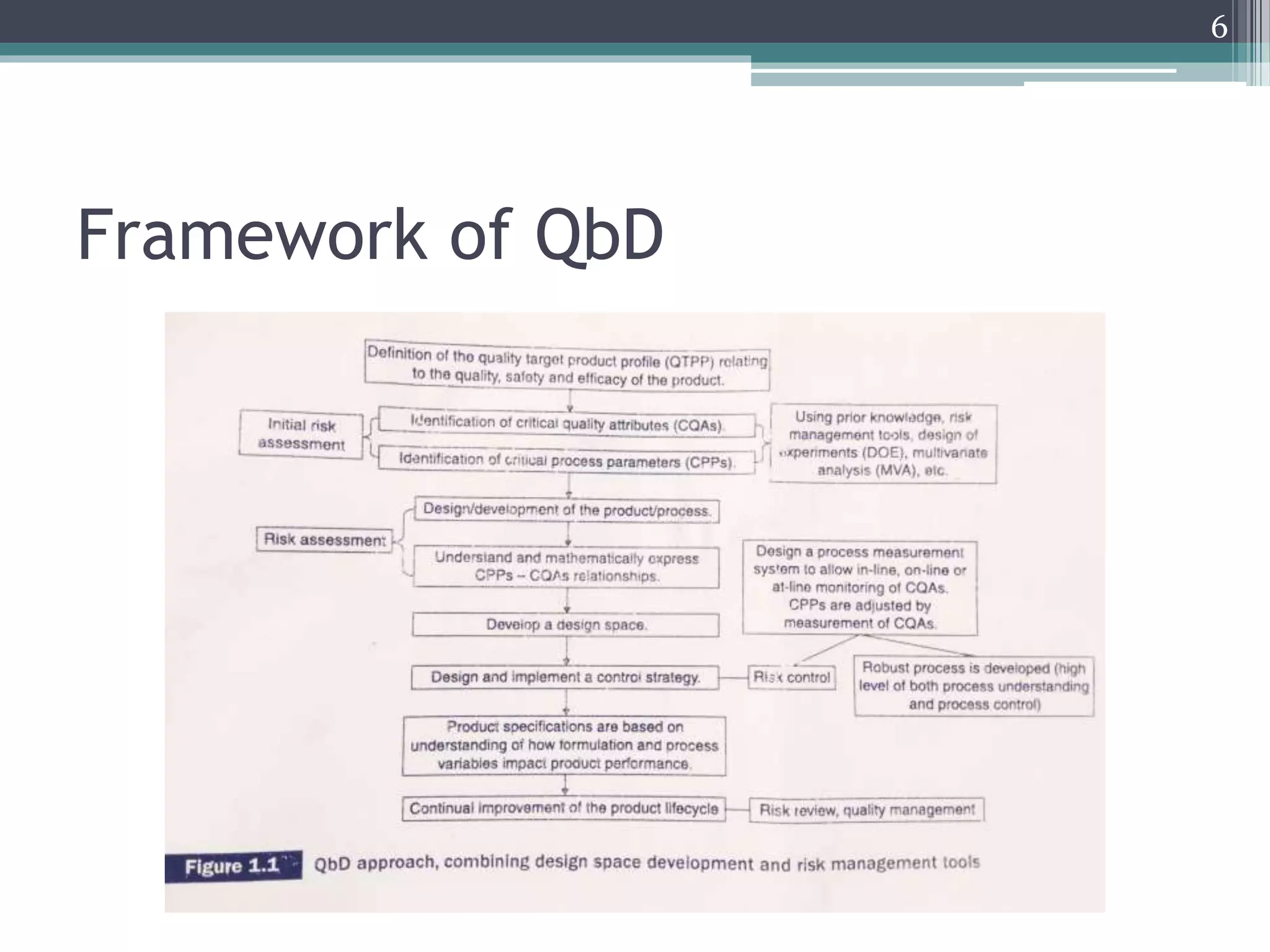
Framework of QbD
6
ICH Q8 guidelines
• The ICH Q8 guidelines on scientifically based Pharmaceutical
development serves to provide opportunities for
pharmaceutical manufacturers to seek regulatory flexibility
and Mitigation of some activities required for product
registration and/or subsequent post approval change process.
• Working within the defined design space is not recognised as
the change that would require regulatory approval. This
example can be used to significantly improve the productivity
and Quality Assurance in the pharmaceutical industry.
7
• The ICH Q8 guidelines suggest that those aspects of drug
substance, excipients, and container closure systems,
and manufacturing processes that are critical to provide
quality, should be determined and control strategies
justifies.
• If an adequately organized development studies is
conducted, it is possible for the pharmaceutical
manufacturer to gain the reduction in both the post
approval submissions and review/inspections by the
regulatory authorities.
8
• PAT (Process Analytical Technology) is a system of Designing,
analysing, and controlling manufacturing through timely
measurements of critical quality performance attributes of
Raw and in process material and processes with the goal of
ensuring final product quality.
• In order to ensure that a product of required quality is
produced consistently, various control strategies are designed.
These strategies are based on the product, formulation and
process understanding and include control of the COAs and
CPPs.
9
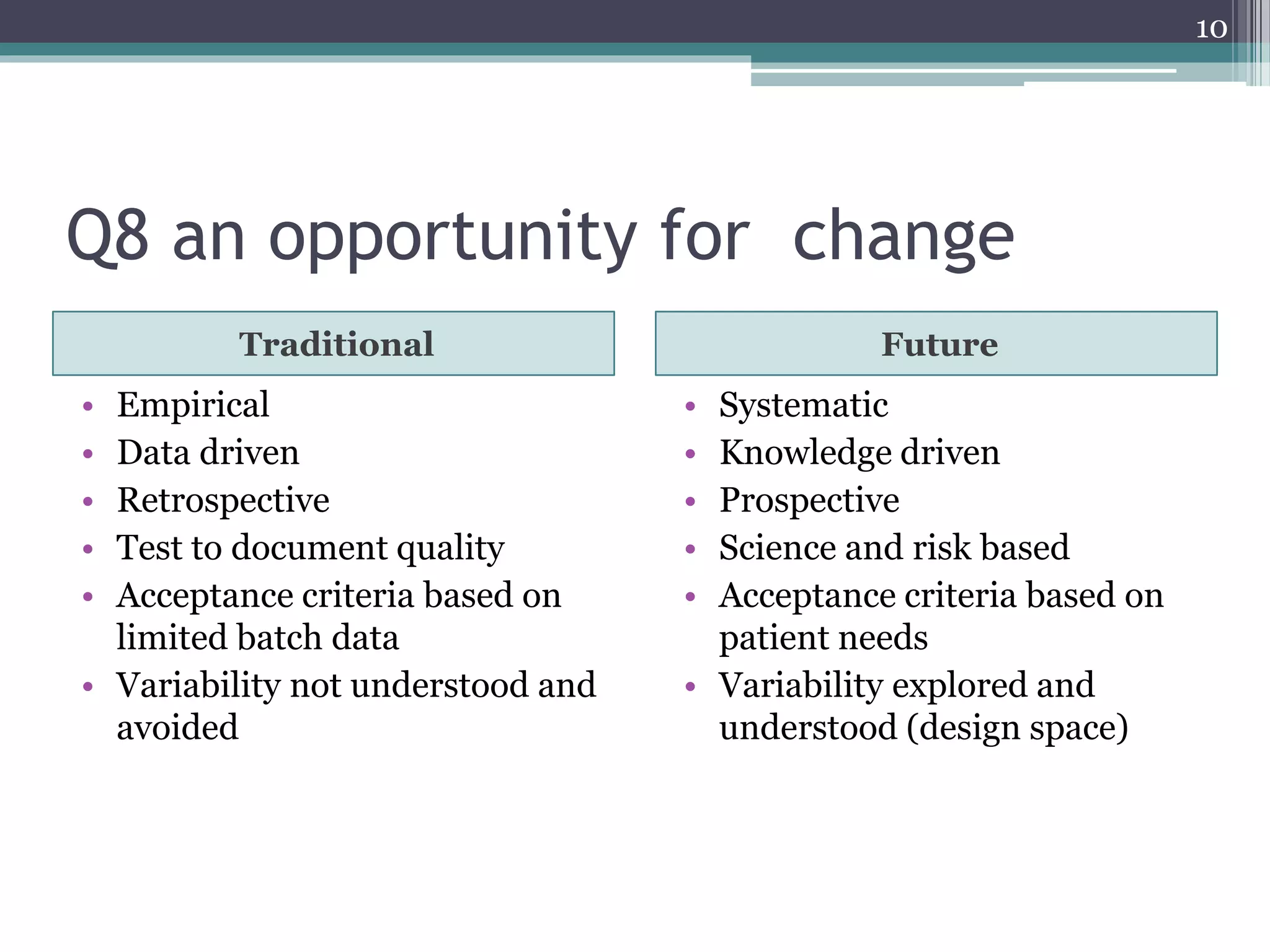
Q8 an opportunity for change
Traditional Future
• Empirical
• Data driven
• Retrospective
• Test to document quality
• Acceptance criteria based on
limited batch data
• Variability not understood and
avoided
• Systematic
• Knowledge driven
• Prospective
• Science and risk based
• Acceptance criteria based on
patient needs
• Variability explored and
understood (design space)
10
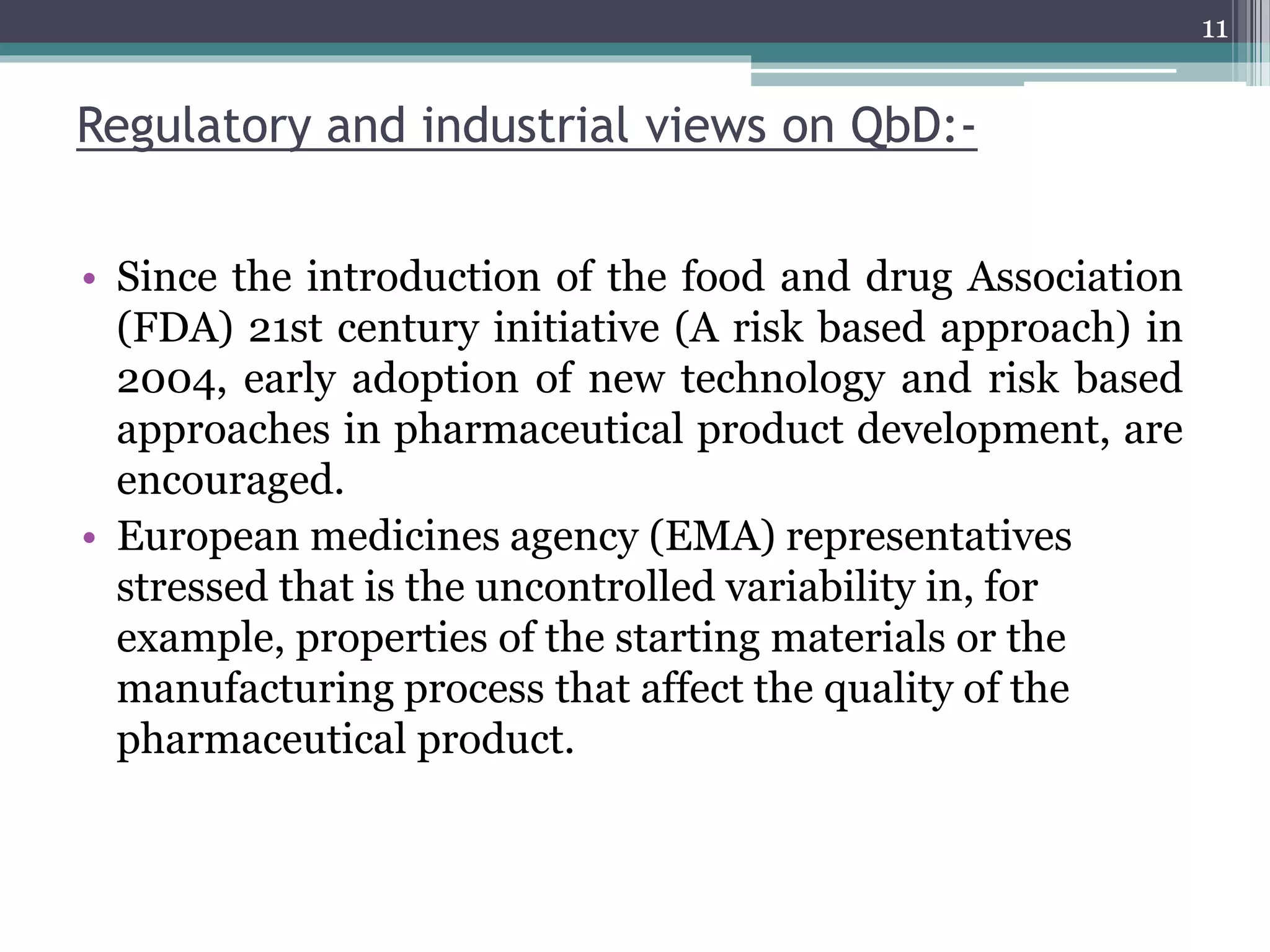
Regulatory and industrial views on QbD:-
• Since the introduction of the food and drug Association
(FDA) 21st century initiative (A risk based approach) in
2004, early adoption of new technology and risk based
approaches in pharmaceutical product development, are
encouraged.
• European medicines agency (EMA) representatives
stressed that is the uncontrolled variability in, for
example, properties of the starting materials or the
manufacturing process that affect the quality of the
pharmaceutical product.
11
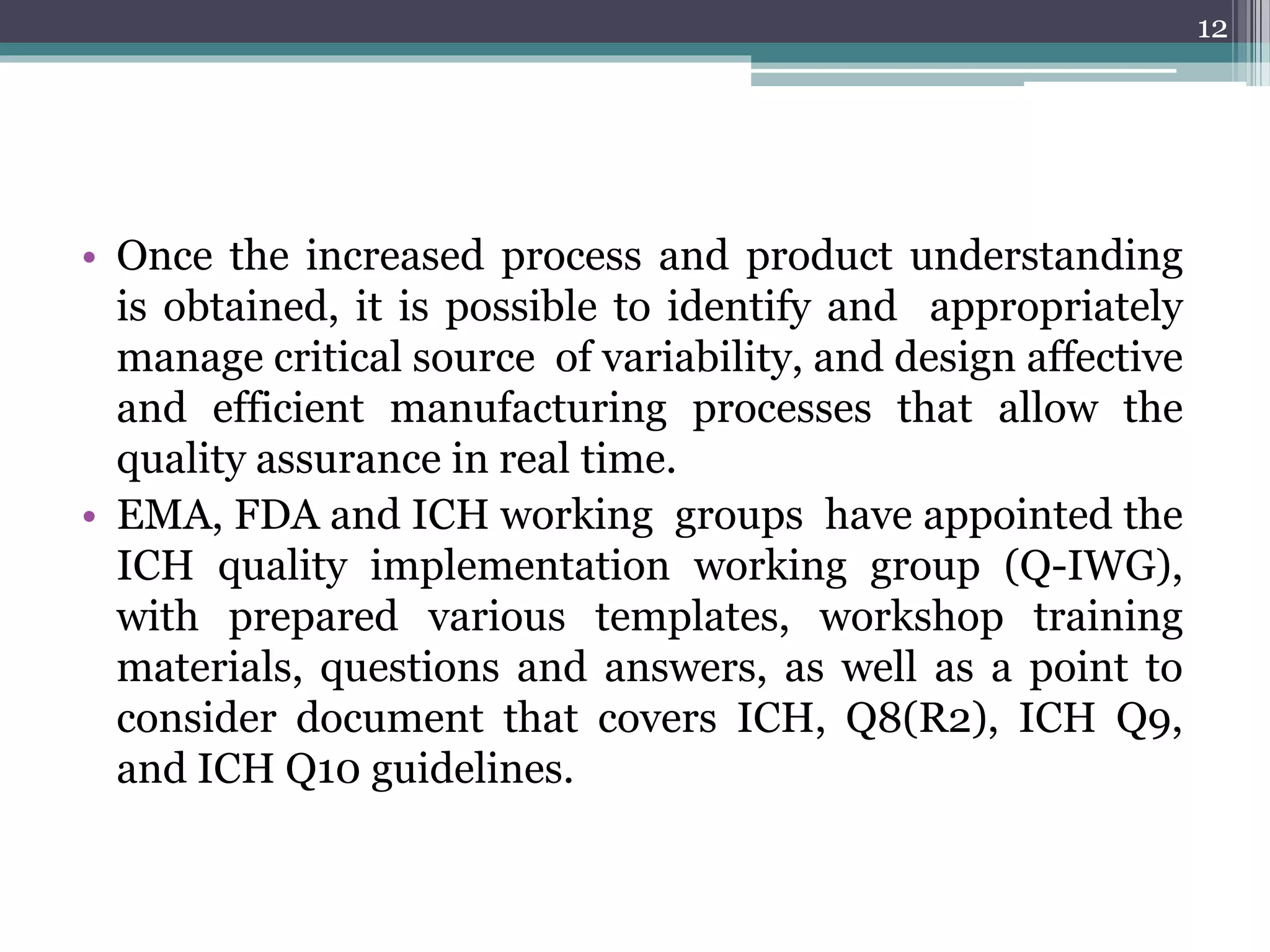
• Once the increased process and product understanding
is obtained, it is possible to identify and appropriately
manage critical source of variability, and design affective
and efficient manufacturing processes that allow the
quality assurance in real time.
• EMA, FDA and ICH working groups have appointed the
ICH quality implementation working group (Q-IWG),
with prepared various templates, workshop training
materials, questions and answers, as well as a point to
consider document that covers ICH, Q8(R2), ICH Q9,
and ICH Q10 guidelines.
12
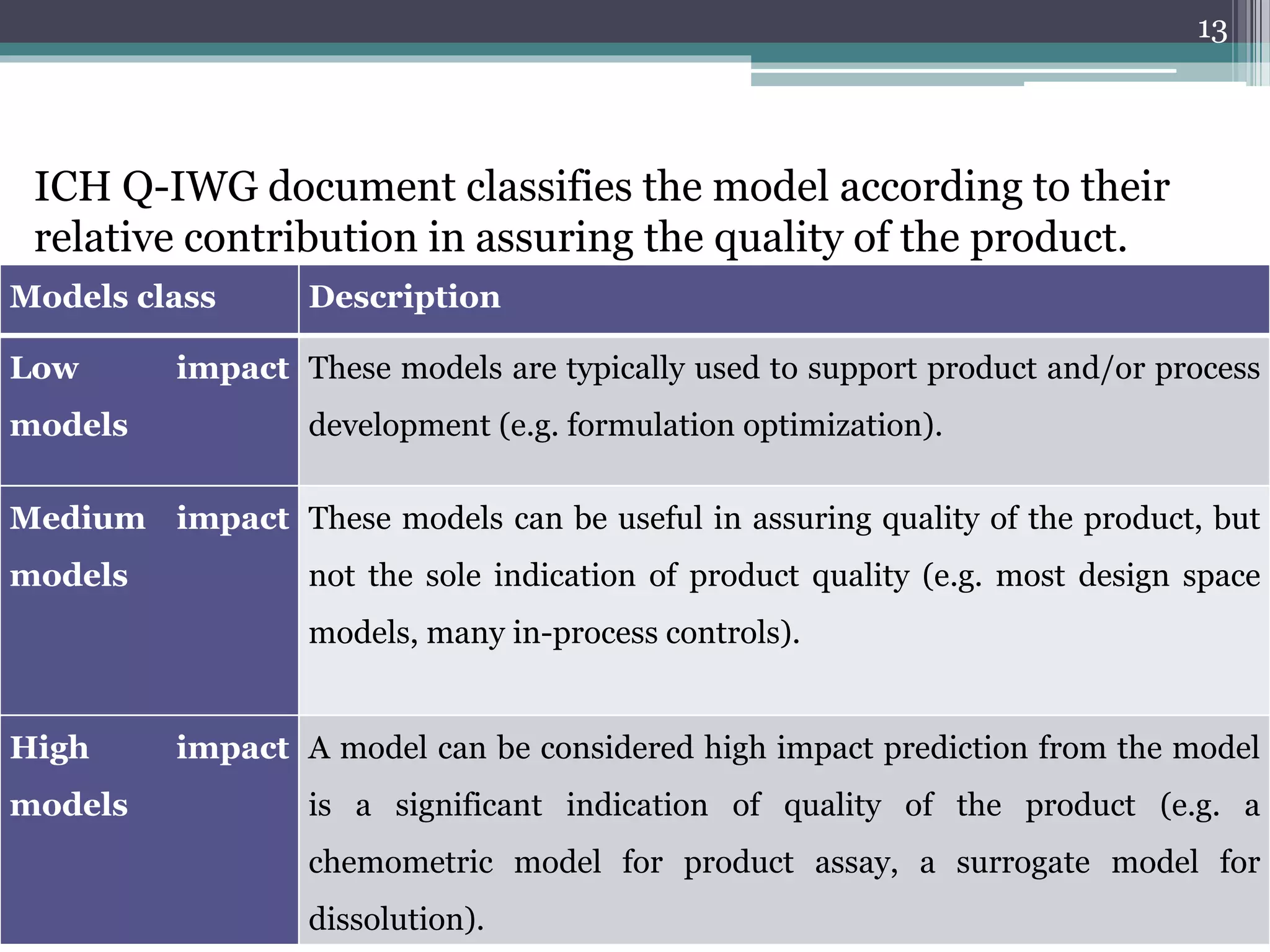
ICH Q-IWG document classifies the model according to their
relative contribution in assuring the quality of the product.
13
Models class Description
Low impact
models
These models are typically used to support product and/or process
development (e.g. formulation optimization).
Medium impact
models
These models can be useful in assuring quality of the product, but
not the sole indication of product quality (e.g. most design space
models, many in-process controls).
High impact
models
A model can be considered high impact prediction from the model
is a significant indication of quality of the product (e.g. a
chemometric model for product assay, a surrogate model for
dissolution).
Scientifically based QbD
• Many scientific projects are devoted to design space
appointment, in-line process monitoring, and modeling
of products and processes. This knowledge should serve
to provide foundation for the scientifically based QbD
concept application.
• The QbD approach was used to establish a relationship
between the CPPs, CQAs, and clinical performance of the
drug.
14
• A combined QbD and Discrete Element Model (DEM)
simulation approach was used to characterize a blending
unit operation, by evaluating the impact of formulation
parameters and process variables on the blending quality
and blending endpoint.
• A quantitative approach was developed to
simultaneously predict particle, powder, and compact
Mechanical properties of a Pharmaceutical blend, based
on the properties of the raw materials.
15
• A multivariate modeling method was developed to
address the challenge of predicting the properties of a
powder blend, while enabling process understanding.
• QbD was applied in development of liposomes
containing a hydrophilic drug and applied to an existing
industrial fluidized bed granulation process.
• PAT (Process Analytical Technology) monitoring tools
were implemented at the industrial scale process,
combined with the multivariate data analysis of process
to increase the process knowledge.
16
Conclusion
• There is an ever growing needs for better understanding
of the formulation and process development by
pharmaceutical scientists.
• Benefits of QbD application for both regulatory agencies
and manufactures have been proven.
• It is clear the QbD will become a necessity therefore all
the stakeholders should adapt to its implementation.
17
Reference
• Djuris Jelena. Computer-aided applications in
pharmaceutical technology. 1st edition. U.k. 2013.
Woodhead Publishing. p. 1-14.
• Sean Ekins. Computer applications in pharmaceutical
research and development. Wiley interscience. 2006. A
john wiley & sons inc publication. P. 443-549
18

quality by design in pharmaceutical development ICH Q8 guideliness

  • 1.
    Quality by designin pharmaceutical development- ICH Q8 guidelines PRESENTED BY SUJITHA MARY M PHARM ST JOSEPH COLLEGE OF PHARMACY 1
  • 2.
    Contents • Introduction • Objective •ICH Q8 Guidelines • Regulatory and industry views on QbD • Scientifically based QbD • Conclusion • Reference 2
  • 3.
    INTRODUCTION • The qualityof Pharmaceutical product can be defined as acceptable low risk of failing to achieve the desired clinical attributes of the drug. • Quality by design (QbD) is a concept introduced by international conference of harmonization (ICH) Q8 guidelines, as a systemic approach to development, which begins with Predefined objective and emphasizes product and process understanding and process control, based on the sound science and the quality risk management. 3
  • 4.
    Q8 What isit? • The Pharmaceutical Development section provides an opportunity to present the knowledge gained through the application of scientific approaches and quality risk management to the development of a product and its manufacturing process. 4
  • 5.
    OBJECTIVE OF GUIDELINES •To provide guidance on the contents of section 3.2.P.2 (Pharmaceutical development) for drug products defined in the scope of module 3 of a common Technical document (CTD). • This concept is now broadened to whole drug product lifecycle. It is often emphasized that the quality of the Pharmaceutical product should be built in by design rather than by testing alone. 5
  • 6.
  • 7.
    ICH Q8 guidelines •The ICH Q8 guidelines on scientifically based Pharmaceutical development serves to provide opportunities for pharmaceutical manufacturers to seek regulatory flexibility and Mitigation of some activities required for product registration and/or subsequent post approval change process. • Working within the defined design space is not recognised as the change that would require regulatory approval. This example can be used to significantly improve the productivity and Quality Assurance in the pharmaceutical industry. 7
  • 8.
    • The ICHQ8 guidelines suggest that those aspects of drug substance, excipients, and container closure systems, and manufacturing processes that are critical to provide quality, should be determined and control strategies justifies. • If an adequately organized development studies is conducted, it is possible for the pharmaceutical manufacturer to gain the reduction in both the post approval submissions and review/inspections by the regulatory authorities. 8
  • 9.
    • PAT (ProcessAnalytical Technology) is a system of Designing, analysing, and controlling manufacturing through timely measurements of critical quality performance attributes of Raw and in process material and processes with the goal of ensuring final product quality. • In order to ensure that a product of required quality is produced consistently, various control strategies are designed. These strategies are based on the product, formulation and process understanding and include control of the COAs and CPPs. 9
  • 10.
    Q8 an opportunityfor change Traditional Future • Empirical • Data driven • Retrospective • Test to document quality • Acceptance criteria based on limited batch data • Variability not understood and avoided • Systematic • Knowledge driven • Prospective • Science and risk based • Acceptance criteria based on patient needs • Variability explored and understood (design space) 10
  • 11.
    Regulatory and industrialviews on QbD:- • Since the introduction of the food and drug Association (FDA) 21st century initiative (A risk based approach) in 2004, early adoption of new technology and risk based approaches in pharmaceutical product development, are encouraged. • European medicines agency (EMA) representatives stressed that is the uncontrolled variability in, for example, properties of the starting materials or the manufacturing process that affect the quality of the pharmaceutical product. 11
  • 12.
    • Once theincreased process and product understanding is obtained, it is possible to identify and appropriately manage critical source of variability, and design affective and efficient manufacturing processes that allow the quality assurance in real time. • EMA, FDA and ICH working groups have appointed the ICH quality implementation working group (Q-IWG), with prepared various templates, workshop training materials, questions and answers, as well as a point to consider document that covers ICH, Q8(R2), ICH Q9, and ICH Q10 guidelines. 12
  • 13.
    ICH Q-IWG documentclassifies the model according to their relative contribution in assuring the quality of the product. 13 Models class Description Low impact models These models are typically used to support product and/or process development (e.g. formulation optimization). Medium impact models These models can be useful in assuring quality of the product, but not the sole indication of product quality (e.g. most design space models, many in-process controls). High impact models A model can be considered high impact prediction from the model is a significant indication of quality of the product (e.g. a chemometric model for product assay, a surrogate model for dissolution).
  • 14.
    Scientifically based QbD •Many scientific projects are devoted to design space appointment, in-line process monitoring, and modeling of products and processes. This knowledge should serve to provide foundation for the scientifically based QbD concept application. • The QbD approach was used to establish a relationship between the CPPs, CQAs, and clinical performance of the drug. 14
  • 15.
    • A combinedQbD and Discrete Element Model (DEM) simulation approach was used to characterize a blending unit operation, by evaluating the impact of formulation parameters and process variables on the blending quality and blending endpoint. • A quantitative approach was developed to simultaneously predict particle, powder, and compact Mechanical properties of a Pharmaceutical blend, based on the properties of the raw materials. 15
  • 16.
    • A multivariatemodeling method was developed to address the challenge of predicting the properties of a powder blend, while enabling process understanding. • QbD was applied in development of liposomes containing a hydrophilic drug and applied to an existing industrial fluidized bed granulation process. • PAT (Process Analytical Technology) monitoring tools were implemented at the industrial scale process, combined with the multivariate data analysis of process to increase the process knowledge. 16
  • 17.
    Conclusion • There isan ever growing needs for better understanding of the formulation and process development by pharmaceutical scientists. • Benefits of QbD application for both regulatory agencies and manufactures have been proven. • It is clear the QbD will become a necessity therefore all the stakeholders should adapt to its implementation. 17
  • 18.
    Reference • Djuris Jelena.Computer-aided applications in pharmaceutical technology. 1st edition. U.k. 2013. Woodhead Publishing. p. 1-14. • Sean Ekins. Computer applications in pharmaceutical research and development. Wiley interscience. 2006. A john wiley & sons inc publication. P. 443-549 18