|QAB>
Quantum Computer, AI, and Blockchain
Kan Yuenyong
[QBronze64-412]
△
g
geopolitics.io
“We are hitting the limits of optical lithography; we can’t make microchips any smaller,” said Associate Professor Dimitris
Angelakis, a principal investigator at the Centre for Quantum Technologies (CQT) at the National University of Singapore.
“This is because at smaller scales the quantum noise becomes bigger than the signal.”
https://www.asianscientist.com/2019/04/features/sginnovate-quantum-computing-technology-supercomputer/
“Quantum algorithms such as Shor’s algorithm would enable RSA
encryption to be cracked in just ten hours compared to
10,000,000 CPU years on a classical computer,” Professor
Angelakis said. “However, to implement Shor’s algorithm in
hardware we would need many qubits, around 4,000. This is not
something we can honestly say can be done now or in the near
future, so it’s unlikely to be quantum computing’s ‘killer app’.” 

“On the one hand, quantum effects are part of the problem, but quantum computing is a
solution at the same time,” Professor Angelakis told a full-house crowd gathered at 32
Carpenter Street for a dialogue titled ‘Quantum Computers: How They Work and What They’ll
Mean for Big Data and Business’.
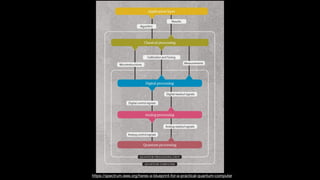
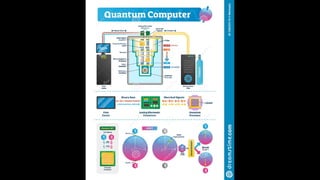
https://spectrum.ieee.org/heres-a-blueprint-for-a-practical-quantum-computer
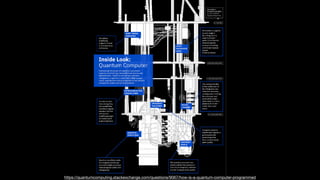
https://quantumcomputing.stackexchange.com/questions/9067/how-is-a-quantum-computer-programmed
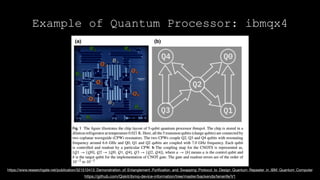
https://www.researchgate.net/publication/321510413_Demonstration_of_Entanglement_Purification_and_Swapping_Protocol_to_Design_Quantum_Repeater_in_IBM_Quantum_Computer
Example of Quantum Processor: ibmqx4
https://github.com/Qiskit/ibmq-device-information/tree/master/backends/tenerife/V1
A number of companies, such as IBM, Rigetti, Amazon and Microsoft have made quantum computers publicly available over the cloud. These all rely on qubits based either on
superconducting circuits or trapped ions. One drawback with these approaches is that they both demand temperatures colder than those found in deep space, because thermal
vibrations can disrupt the qubits. The expensive, bulky systems required to hold qubits at such frigid temperatures can also make it an extraordinary challenge to scale these
platforms up to high numbers of qubits.

In contrast, quantum computers that rely on qubits based on photons can, in principle, operate at room temperature. They can also readily integrate into existing fiber optic–
based telecommunications infrastructure, potentially helping connect quantum computers together into powerful networks and even a quantum Internet. With the addition of so-
called “time multiplexing” architectures, photonic quantum computing can in principle scale up to millions of qubits.

According to Christian Weedbrook, Xanadu’s founder and CEO, the company can roughly double the number of qubits in its cloud systems every six months. In the coming
months, Xanadu will release a blueprint for photonic quantum computing that is essentially a primer on “how to scale to millions of qubits in a fault-tolerant manner,” says
Weedbrook.

The classic approach to photonic quantum computing, linear optical quantum computing, relies on qubits each based on a single photon. This strategy manipulates photons with
mirrors, beam splitters, and phase shifters. Single photon detectors are then used to help read the results of what these devices have done. The problem with this approach is
that single photons are difficult to experiment with, generally limiting this strategy to a handful of photons, Weedbrook says.

In contrast, Xanadu's strategy, known as continuous variable quantum computing, does not employ single-photon generators. Instead, the company relies on so-called
“squeezed states” consisting of superpositions of multiple photons.

https://spectrum.ieee.org/photonic-quantum
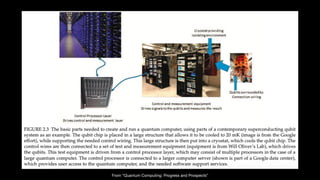
From “Quantum Computing: Progress and Prospects”
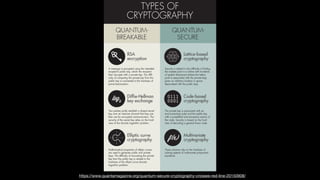
https://www.quantamagazine.org/quantum-secure-cryptography-crosses-red-line-20150908/
from numpy import *
a = array[[-4,1],[3,2]])
b = a.transpose()
print(a)
print(b)
print(a*b)
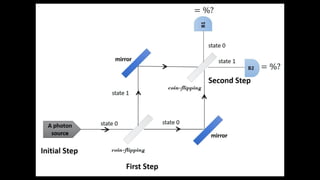
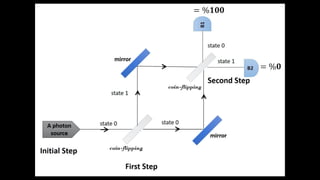
What’s the correct answer?
Why?
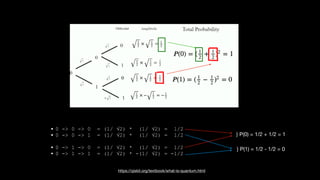
https://qiskit.org/textbook/what-is-quantum.html
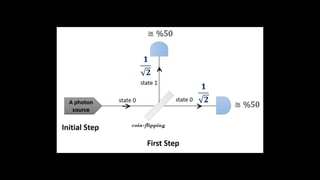
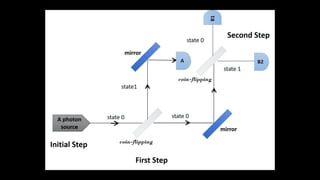
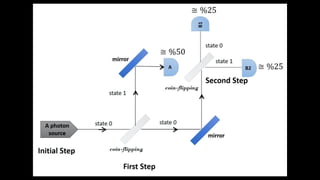
• 0 -> 0 -> 0 = (1/ √2) * (1/ √2) = 1/2
• 0 -> 0 -> 1 = (1/ √2) * (1/ √2) = 1/2
• 0 -> 1 -> 0 = (1/ √2) * (1/ √2) = 1/2
• 0 -> 1 -> 1 = (1/ √2) * -(1/ √2) = -1/2
} P(0) = 1/2 + 1/2 = 1
} P(1) = 1/2 - 1/2 = 0
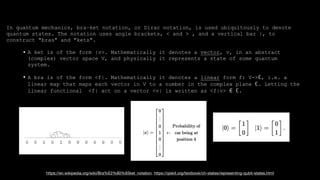
In quantum mechanics, bra–ket notation, or Dirac notation, is used ubiquitously to denote
quantum states. The notation uses angle brackets, < and > , and a vertical bar |, to
construct "bras" and "kets".
• A ket is of the form |v>. Mathematically it denotes a vector, v, in an abstract
(complex) vector space V, and physically it represents a state of some quantum
system.
• A bra is of the form <f|. Mathematically it denotes a linear form f: V->ℂ, i.e. a
linear map that maps each vector in V to a number in the complex plane ℂ. Letting the
linear functional <f| act on a vector <v| is written as <f|v> ∈ ℂ.
https://en.wikipedia.org/wiki/Bra%E2%80%93ket_notation, https://qiskit.org/textbook/ch-states/representing-qubit-states.html
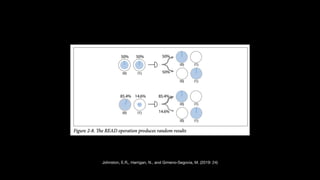
Johnston, E.R,, Harrigan, N., and Gimeno-Segovia, M. (2019: 24)
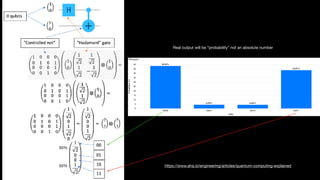
https://www.aha.io/engineering/articles/quantum-computing-explained
50%
50%
Real output will be “probability” not an absolute number
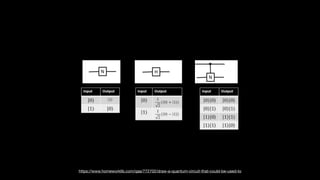
https://www.homeworklib.com/qaa/772702/draw-a-quantum-circuit-that-could-be-used-to
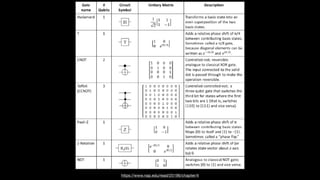
https://www.nap.edu/read/25196/chapter/4
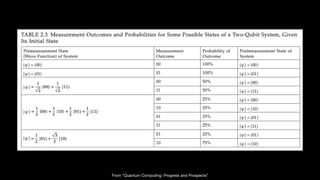
From “Quantum Computing: Progress and Prospects”
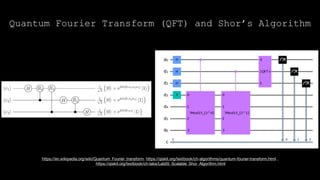
Quantum Fourier Transform (QFT) and Shor’s Algorithm
https://en.wikipedia.org/wiki/Quantum_Fourier_transform, https://qiskit.org/textbook/ch-algorithms/quantum-fourier-transform.html ,

https://qiskit.org/textbook/ch-labs/Lab05_Scalable_Shor_Algorithm.html
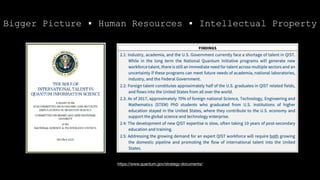
https://www.quantum.gov/strategy-documents/
Bigger Picture ▪ Human Resources ▪ Intellectual Property
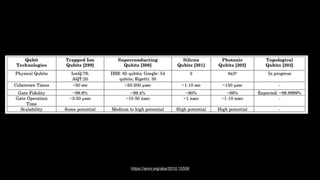
https://arxiv.org/abs/2010.15559
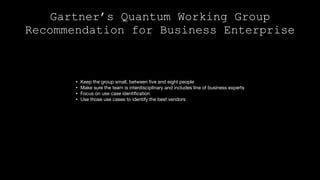
• Keep the group small, between five and eight people

• Make sure the team is interdisciplinary and includes line of business experts

• Focus on use case identification

• Use those use cases to identify the best vendors

Gartner’s Quantum Working Group
Recommendation for Business Enterprise
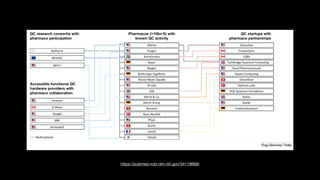
https://pubmed.ncbi.nlm.nih.gov/34119668/
https://www.cell.com/patterns/fulltext/S2666-3899(21)00066-0?
_returnURL=https%3A%2F%2Flinkinghub.elsevier.com%2Fretrieve%2Fpii%2FS2666389921000660%3Fshowall%3Dtrue
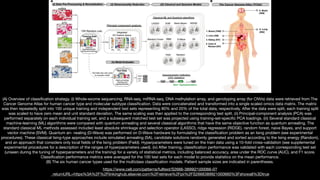
(A) Overview of classification strategy. (i) Whole-exome sequencing, RNA-seq, miRNA-seq, DNA methylation array, and genotyping array (for CNVs) data were retrieved from The
Cancer Genome Atlas for human cancer type and molecular subtype classification. Data were concatenated and transformed into a single scaled omics data matrix. The matrix
was then repeatedly split into 100 unique training and independent test sets representing 80% and 20% of the total data, respectively. After the data were split, each training split
was scaled to have zero mean and unit standard deviation. The same scaling was then applied to the corresponding test split. (ii) Principal-component analysis (PCA) was
performed separately on each individual training set, and a subsequent matched test set was projected using training-set-specific PCA loadings. (iii) Several standard classical
machine-learning (ML) algorithms were compared with quantum annealing and several classical algorithms that have the same objective function as quantum annealing. The
standard classical ML methods assessed included least absolute shrinkage and selection operator (LASSO), ridge regression (RIDGE), random forest, naive Bayes, and support
vector machine (SVM). Quantum an- nealing (D-Wave) was performed on D-Wave hardware by formulating the classification problem as an Ising problem (see experimental
procedures). These classical Ising-type approaches include simulated annealing (SA), candidate solutions randomly generated and sorted according to the Ising energy (Random),
and an approach that considers only local fields of the Ising problem (Field). Hyperparameters were tuned on the train data using a 10-fold cross-validation (see supplemental
experimental procedures for a description of the ranges of hyperparameters used). (iv) After training, classification performance was validated with each corresponding test set
(unseen during the tuning of hyperparameters and the training) for a variety of statistical metrics, including balanced accuracy, area under the ROC curve (AUC), and F1 score.
Classification performance metrics were averaged for the 100 test sets for each model to provide statistics on the mean performance. 

(B) The six human cancer types used for the multiclass classification models. Patient sample sizes are indicated in parentheses.
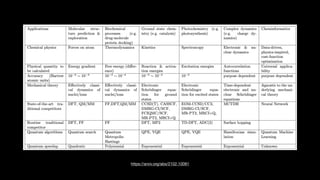
https://arxiv.org/abs/2102.10081
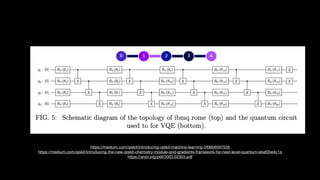
https://medium.com/qiskit/introducing-qiskit-machine-learning-5f06b6597526 

https://medium.com/qiskit/introducing-the-new-qiskit-chemistry-module-and-gradients-framework-for-next-level-quantum-ebaf2be4c1a 

https://arxiv.org/pdf/2003.02303.pdf
• Install numpy via jupyter notebook: https://stackoverflow.com/questions/63756673/modulenotfounderror-no-module-named-numpy-
jupyter-notebook 

• Quantum Algorithm Zoo: https://web.archive.org/web/20180429014516/https://math.nist.gov/quantum/zoo/

• Qiskit: https://en.wikipedia.org/wiki/Qiskit

• Cirq: https://en.wikipedia.org/wiki/Cirq 

• Online Quantum Circuit Simulator: https://algassert.com/ 

• Quantum Machine Learning Monitoring: https://www.chipprbots.com/blog/ 

• O’Reilly’s Programming Quantum Computers: https://www.oreilly.com/library/view/programming-quantum-computers/9781492039679/

• Leonard Susskind’s Quantum Mechanics: The Theoretical Minimum: https://www.amazon.com/Quantum-Mechanics-Theoretical-Leonard-
Susskind/dp/0465062903 

• Reading Elon Musk’s Dogecoin Plan: https://sikkha.medium.com/reading-elon-musks-dogecoin-plan-e60dd56c2bf 

• The Public Administration’s Cybernetic Governance Paradigm in Digital Era: https://www.academia.edu/62322497/
The_Public_Administration_s_Cybernetic_Governance_Paradigm_in_Digital_Era 

• Katechon and Cognitive Revolution: An Emergence of the 21st Century Global Politics: https://www.academia.edu/45408259/
Katechon_and_Cognitive_Revolution_An_Emergence_of_the_21st_Century_Global_Politics 

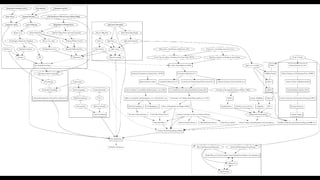
• Cybernetic Governance Diagram: https://github.com/sikkha/CyberneticGovernance/blob/main/Image/imgNewBureau.png

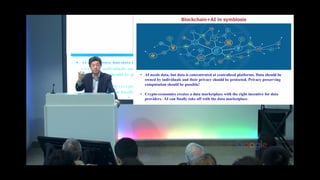
• Zhang Shoucheng’s Quantum Computing, AI and Blockchain: The Future of IT: https://www.youtube.com/watch?v=MozDSajpLTY 

• The CIO’s guide to Quantum Computing: https://quantumcurious.org/wp-content/uploads/2021/02/CIOs-Guide-QC-ZDNet.pdf 

• Quantum reality check: Gartner expects more 10 years of hype but CIOs should start finding use cases now: https://www.techrepublic.com/
article/quantum-reality-check-gartner-expects-more-10-years-of-hype-but-cios-should-start-finding-use-cases-now/ 

References
|QAB>
Quantum Computer, AI, and Blockchain
Kan Yuenyong
[QBronze64-412]
△
g
geopolitics.io

|QAB> : Quantum Computing, AI and Blockchain

  • 1.
    |QAB> Quantum Computer, AI,and Blockchain Kan Yuenyong [QBronze64-412] △ g geopolitics.io
  • 2.
    “We are hittingthe limits of optical lithography; we can’t make microchips any smaller,” said Associate Professor Dimitris Angelakis, a principal investigator at the Centre for Quantum Technologies (CQT) at the National University of Singapore. “This is because at smaller scales the quantum noise becomes bigger than the signal.” https://www.asianscientist.com/2019/04/features/sginnovate-quantum-computing-technology-supercomputer/ “Quantum algorithms such as Shor’s algorithm would enable RSA encryption to be cracked in just ten hours compared to 10,000,000 CPU years on a classical computer,” Professor Angelakis said. “However, to implement Shor’s algorithm in hardware we would need many qubits, around 4,000. This is not something we can honestly say can be done now or in the near future, so it’s unlikely to be quantum computing’s ‘killer app’.” “On the one hand, quantum effects are part of the problem, but quantum computing is a solution at the same time,” Professor Angelakis told a full-house crowd gathered at 32 Carpenter Street for a dialogue titled ‘Quantum Computers: How They Work and What They’ll Mean for Big Data and Business’.
  • 3.
  • 5.
  • 7.
  • 8.
    A number ofcompanies, such as IBM, Rigetti, Amazon and Microsoft have made quantum computers publicly available over the cloud. These all rely on qubits based either on superconducting circuits or trapped ions. One drawback with these approaches is that they both demand temperatures colder than those found in deep space, because thermal vibrations can disrupt the qubits. The expensive, bulky systems required to hold qubits at such frigid temperatures can also make it an extraordinary challenge to scale these platforms up to high numbers of qubits. In contrast, quantum computers that rely on qubits based on photons can, in principle, operate at room temperature. They can also readily integrate into existing fiber optic– based telecommunications infrastructure, potentially helping connect quantum computers together into powerful networks and even a quantum Internet. With the addition of so- called “time multiplexing” architectures, photonic quantum computing can in principle scale up to millions of qubits. According to Christian Weedbrook, Xanadu’s founder and CEO, the company can roughly double the number of qubits in its cloud systems every six months. In the coming months, Xanadu will release a blueprint for photonic quantum computing that is essentially a primer on “how to scale to millions of qubits in a fault-tolerant manner,” says Weedbrook. The classic approach to photonic quantum computing, linear optical quantum computing, relies on qubits each based on a single photon. This strategy manipulates photons with mirrors, beam splitters, and phase shifters. Single photon detectors are then used to help read the results of what these devices have done. The problem with this approach is that single photons are difficult to experiment with, generally limiting this strategy to a handful of photons, Weedbrook says. In contrast, Xanadu's strategy, known as continuous variable quantum computing, does not employ single-photon generators. Instead, the company relies on so-called “squeezed states” consisting of superpositions of multiple photons. https://spectrum.ieee.org/photonic-quantum
  • 9.
    From “Quantum Computing:Progress and Prospects”
  • 15.
  • 19.
    from numpy import* a = array[[-4,1],[3,2]]) b = a.transpose() print(a) print(b) print(a*b) What’s the correct answer?
  • 25.
  • 26.
    https://qiskit.org/textbook/what-is-quantum.html • 0 ->0 -> 0 = (1/ √2) * (1/ √2) = 1/2 • 0 -> 0 -> 1 = (1/ √2) * (1/ √2) = 1/2 • 0 -> 1 -> 0 = (1/ √2) * (1/ √2) = 1/2 • 0 -> 1 -> 1 = (1/ √2) * -(1/ √2) = -1/2 } P(0) = 1/2 + 1/2 = 1 } P(1) = 1/2 - 1/2 = 0
  • 27.
    In quantum mechanics,bra–ket notation, or Dirac notation, is used ubiquitously to denote quantum states. The notation uses angle brackets, < and > , and a vertical bar |, to construct "bras" and "kets". • A ket is of the form |v>. Mathematically it denotes a vector, v, in an abstract (complex) vector space V, and physically it represents a state of some quantum system. • A bra is of the form <f|. Mathematically it denotes a linear form f: V->ℂ, i.e. a linear map that maps each vector in V to a number in the complex plane ℂ. Letting the linear functional <f| act on a vector <v| is written as <f|v> ∈ ℂ. https://en.wikipedia.org/wiki/Bra%E2%80%93ket_notation, https://qiskit.org/textbook/ch-states/representing-qubit-states.html
  • 29.
    Johnston, E.R,, Harrigan,N., and Gimeno-Segovia, M. (2019: 24)
  • 30.
  • 31.
  • 32.
  • 33.
    From “Quantum Computing:Progress and Prospects”
  • 35.
    Quantum Fourier Transform(QFT) and Shor’s Algorithm https://en.wikipedia.org/wiki/Quantum_Fourier_transform, https://qiskit.org/textbook/ch-algorithms/quantum-fourier-transform.html , https://qiskit.org/textbook/ch-labs/Lab05_Scalable_Shor_Algorithm.html
  • 36.
    https://www.quantum.gov/strategy-documents/ Bigger Picture ▪Human Resources ▪ Intellectual Property
  • 39.
  • 40.
    • Keep thegroup small, between five and eight people • Make sure the team is interdisciplinary and includes line of business experts • Focus on use case identification • Use those use cases to identify the best vendors Gartner’s Quantum Working Group Recommendation for Business Enterprise
  • 41.
  • 42.
    https://www.cell.com/patterns/fulltext/S2666-3899(21)00066-0? _returnURL=https%3A%2F%2Flinkinghub.elsevier.com%2Fretrieve%2Fpii%2FS2666389921000660%3Fshowall%3Dtrue (A) Overview ofclassification strategy. (i) Whole-exome sequencing, RNA-seq, miRNA-seq, DNA methylation array, and genotyping array (for CNVs) data were retrieved from The Cancer Genome Atlas for human cancer type and molecular subtype classification. Data were concatenated and transformed into a single scaled omics data matrix. The matrix was then repeatedly split into 100 unique training and independent test sets representing 80% and 20% of the total data, respectively. After the data were split, each training split was scaled to have zero mean and unit standard deviation. The same scaling was then applied to the corresponding test split. (ii) Principal-component analysis (PCA) was performed separately on each individual training set, and a subsequent matched test set was projected using training-set-specific PCA loadings. (iii) Several standard classical machine-learning (ML) algorithms were compared with quantum annealing and several classical algorithms that have the same objective function as quantum annealing. The standard classical ML methods assessed included least absolute shrinkage and selection operator (LASSO), ridge regression (RIDGE), random forest, naive Bayes, and support vector machine (SVM). Quantum an- nealing (D-Wave) was performed on D-Wave hardware by formulating the classification problem as an Ising problem (see experimental procedures). These classical Ising-type approaches include simulated annealing (SA), candidate solutions randomly generated and sorted according to the Ising energy (Random), and an approach that considers only local fields of the Ising problem (Field). Hyperparameters were tuned on the train data using a 10-fold cross-validation (see supplemental experimental procedures for a description of the ranges of hyperparameters used). (iv) After training, classification performance was validated with each corresponding test set (unseen during the tuning of hyperparameters and the training) for a variety of statistical metrics, including balanced accuracy, area under the ROC curve (AUC), and F1 score. Classification performance metrics were averaged for the 100 test sets for each model to provide statistics on the mean performance. (B) The six human cancer types used for the multiclass classification models. Patient sample sizes are indicated in parentheses.
  • 43.
  • 44.
  • 47.
    • Install numpyvia jupyter notebook: https://stackoverflow.com/questions/63756673/modulenotfounderror-no-module-named-numpy- jupyter-notebook • Quantum Algorithm Zoo: https://web.archive.org/web/20180429014516/https://math.nist.gov/quantum/zoo/ • Qiskit: https://en.wikipedia.org/wiki/Qiskit • Cirq: https://en.wikipedia.org/wiki/Cirq • Online Quantum Circuit Simulator: https://algassert.com/ • Quantum Machine Learning Monitoring: https://www.chipprbots.com/blog/ • O’Reilly’s Programming Quantum Computers: https://www.oreilly.com/library/view/programming-quantum-computers/9781492039679/ • Leonard Susskind’s Quantum Mechanics: The Theoretical Minimum: https://www.amazon.com/Quantum-Mechanics-Theoretical-Leonard- Susskind/dp/0465062903 • Reading Elon Musk’s Dogecoin Plan: https://sikkha.medium.com/reading-elon-musks-dogecoin-plan-e60dd56c2bf • The Public Administration’s Cybernetic Governance Paradigm in Digital Era: https://www.academia.edu/62322497/ The_Public_Administration_s_Cybernetic_Governance_Paradigm_in_Digital_Era • Katechon and Cognitive Revolution: An Emergence of the 21st Century Global Politics: https://www.academia.edu/45408259/ Katechon_and_Cognitive_Revolution_An_Emergence_of_the_21st_Century_Global_Politics • Cybernetic Governance Diagram: https://github.com/sikkha/CyberneticGovernance/blob/main/Image/imgNewBureau.png • Zhang Shoucheng’s Quantum Computing, AI and Blockchain: The Future of IT: https://www.youtube.com/watch?v=MozDSajpLTY • The CIO’s guide to Quantum Computing: https://quantumcurious.org/wp-content/uploads/2021/02/CIOs-Guide-QC-ZDNet.pdf • Quantum reality check: Gartner expects more 10 years of hype but CIOs should start finding use cases now: https://www.techrepublic.com/ article/quantum-reality-check-gartner-expects-more-10-years-of-hype-but-cios-should-start-finding-use-cases-now/ References
  • 48.
    |QAB> Quantum Computer, AI,and Blockchain Kan Yuenyong [QBronze64-412] △ g geopolitics.io