Development Policy and
Strategy for Post .
Resilience and Recovery
Presented by:
Ziauddin Ahmed
Kan Yuenyong
Nathanan Mitkasem
Introduction
COVID-19 has brought forward some major challenges for
the governments of different countries:
✓ It has exposed and exacerbated preexisting weak
economy, inequalities in incomes and access to basic
public services.
✓ Demand for health care and vaccination, both within and
across countries, is increasing pressure on budget.
✓ Disruptions to education threaten social mobility by leaving
long-lasting effects on children and youth.
✓ These challenges are being compounded by accelerated
digitalization and the transformational effect of the
pandemic on the economy, posing low skilled workers with
difficulties in finding employment.
Key Policy Issues for Sustainable COVID-19 Recovery & Resilience
• Global institutions (UN, WB, IMF, ADB) consider that,
Development Policies along with post COVID recovery and
resilience should include a green, digital, and inclusive
(including gender issues) transformation of the economy.
• Key issues for a sustainable COVID-19 recovery &
resilience:
✓ Better health and well-being reduces vulnerability
✓ Cleaner air relieves health services
✓ Public participation makes for durable policy
✓ Equitable resilience, economic resilience
✓ The green in green recovery
✓ Recovery beyond the rich world
Development Policy for
Post COVID-19 Recovery
& Resilience
• In the response to COVID-19 governments used the
budget promptly and decisively through fiscal policy;
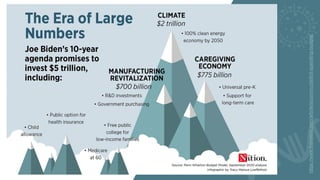
countries have announced $16 trillion in fiscal actions to
enable health systems and hence, have provided
emergency lifelines to households and firms. By doing so,
fiscal policy has also mitigated the contraction in economic
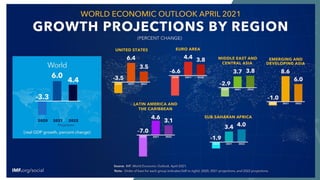
activity. Indeed, economic growth surprised, on the upside
as 2020 unfolded, and growth forecasts for 2021 have
been revised up as well. Gradually, economies and
societies have improved their ability to cope with the
pandemic.
• Fiscal policy priorities include continuing support as
needed while vaccinations proceed and the recovery
strengthens; promptly implementing the announced fiscal
measures with upgraded project execution capacities and
procurement procedures; pursuing a green, digital, and
inclusive transformation of the economy; tackling long-
standing weaknesses in public finances once the recovery
is firmly in place; developing medium-term fiscal strategies
to manage fiscal and financing risks; and renewing efforts
to achieve the SDGs.
Development Policy for
Post COVID-19 Recovery
& Resilience (cont.)
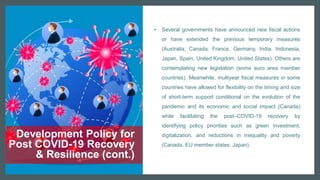
• Several governments have announced new fiscal actions
or have extended the previous temporary measures
(Australia, Canada, France, Germany, India, Indonesia,
Japan, Spain, United Kingdom, United States). Others are
contemplating new legislation (some euro area member
countries). Meanwhile, multiyear fiscal measures in some
countries have allowed for flexibility on the timing and size
of short-term support conditional on the evolution of the
pandemic and its economic and social impact (Canada)
while facilitating the post–COVID-19 recovery by
identifying policy priorities such as green investment,
digitalization, and reductions in inequality and poverty
(Canada, EU member states, Japan).
2
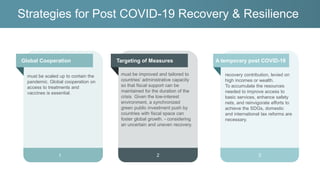
Strategies for Post COVID-19 Recovery & Resilience
Fiscal policy
3
1
must be scaled up to contain the
pandemic. Global cooperation on
access to treatments and
vaccines is essential.
must be improved and tailored to
countries’ administrative capacity
so that fiscal support can be
maintained for the duration of the
crisis Given the low-interest
environment, a synchronized
green public investment push by
countries with fiscal space can
foster global growth. - considering
an uncertain and uneven recovery.
recovery contribution, levied on
high incomes or wealth.
To accumulate the resources
needed to improve access to
basic services, enhance safety
nets, and reinvigorate efforts to
achieve the SDGs, domestic
and international tax reforms are
necessary.
Global Cooperation Targeting of Measures A temporary post COVID-19
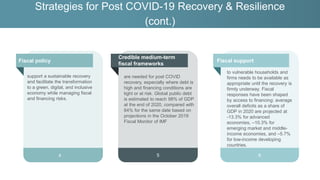
are needed for post COVID
recovery, especially where debt is
high and financing conditions are
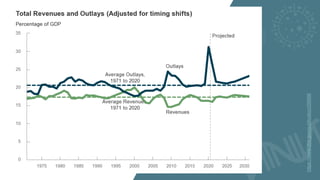
tight or at risk. Global public debt
is estimated to reach 98% of GDP
at the end of 2020, compared with
84% for the same date based on
projections in the October 2019
Fiscal Monitor of IMF
5
Strategies for Post COVID-19 Recovery & Resilience
(cont.)
Fiscal support
Fiscal policy
6
to vulnerable households and
firms needs to be available as
appropriate until the recovery is
firmly underway. Fiscal
responses have been shaped
by access to financing: average
overall deficits as a share of
GDP in 2020 are projected at
-13.3% for advanced
economies, –10.3% for
emerging market and middle-
income economies, and –5.7%
for low-income developing
countries.
Credible medium-term
fiscal frameworks
Fiscal policy
4
support a sustainable recovery
and facilitate the transformation
to a green, digital, and inclusive
economy while managing fiscal
and financing risks.
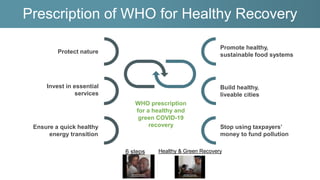
Prescription of WHO for Healthy Recovery
Ensure a quick healthy
energy transition
Invest in essential
services
Protect nature
Stop using taxpayers’
money to fund pollution
Build healthy,
liveable cities
Promote healthy,
sustainable food systems
WHO prescription
for a healthy and
green COVID-19
recovery
Healthy & Green Recovery
6 steps
Crossing the Rubicon
Post Covid-19 Policy
https://public.tableau.com/profile/brooks.miner#!/vizhome/MapVariants/Dashboard
https://twitter.com/EricTopol/status/1358468531986210817
https://ourworldindata.org/covid-vaccinations
https://ourworldindata.org/vaccination-israel-impact
https://en.wikipedia.org/wiki/COVID-19_vaccine
Israeli case study
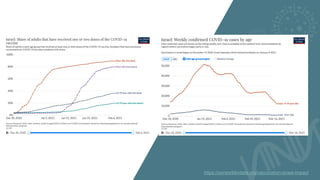
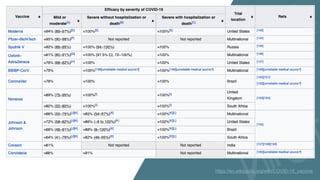
• Israel was well ahead of most countries in signing a purchase
agreement for Moderna’s high-efficacy mRNA vaccine in June
2020. Later in 2020 it made more deals with Pfizer (which also
produces a very high-efficacy vaccine) and AstraZeneca.
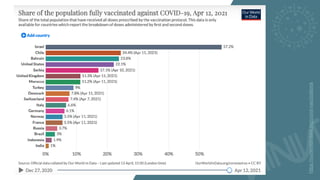
• About 57% of Israel’s population of 9 million have now received
at least one dose of the vaccine. More than 48% are fully
vaccinated. Life is getting back to normal. People are going to
concerts and congregating in coffee shops.
• Approaching fast + political will
• Israel has also introduced a “green passport” – a phone app that
certifies the owner has been fully immunised or is presumed
immune as a result of having previously had COVID-19.
• The “green pass” (as it has become known) permits holders —
and only holders — access to gyms, swimming pools, cultural
events, weddings and other gatherings. (extended to “green
visa”?)
• https://www.themandarin.com.au/152004-israel-shows-how-to-
do-vaccinations-right-its-a-race-and-were-behind/
Thailand’s recent Covid-19 containment strategy
• [14/04/2021] Cases: 35,910 (+1,335); Recovered: 28,322;
Hospitalized: 7,491; Died: 97
• Vaccinated: 498,791, 0.7% of total population
• Current portfolio: AstraZeneca (UK), Sinovac (China)
• Domestic production (via SiamBioscience): 5-10 million
doses monthly, started mid-2021 (currently on quality
controlling process, via AstraZeneca)
• Recent domestic research: NVD-HXP-S (Mahidol & Texas
Austin, viral vector), ChulaCov19 (Chula Univ, RNA), both
on preclinical trial phase.
• Seems to focus on domestic self-reliance to contain future
emerging pandemic
Post Covid-19 Policy
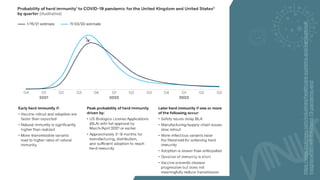
• Vaccinated 80-90% of population to build herd immunity
• New normal life style: Social Distancing, Mask Wearing, Hand
Washing, Testing, Surveillance Apps (Thai Chana): D-M-H-T-T
• Domestic vaccine research and production capacity to attain
self-reliance policy
• Extended “green passport & visa” (Israeli case)
• Boosting Digital Transformation both in public and private
sector (prepare for digital and 5G communication
infrastructure)
• Observing contingency plan for sensitive business sector
impacted by Covid-19, i.e. tourism, airlines, restaurants,
entertaining business, etc.
• Orchestrate global stimulus budget package to revive global
economy
https://www.mckinsey.com/industries/healthcare-systems-and-services/our-
insights/when-will-the-covid-19-pandemic-end
https://www.thenation.com/article/economy/deficit-spending-budget/
https://www.cbo.gov/publication/56996
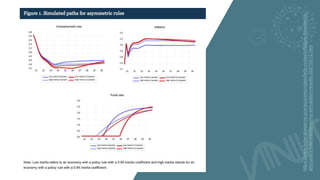
https://www.federalreserve.gov/econres/notes/feds-notes/inflation-thresholds-
and-policy-rule-inertia-some-simulation-results-20210412.htm
LESSON LEARNED
from the past year
01
Greece
02
Vietnam
03
Taiwan
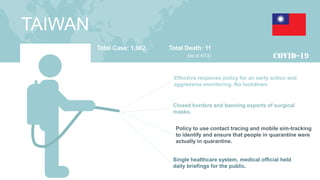
TAIWAN
Total Case: 1,062 Total Death: 11
(as of 4/13)
Effective response policy for an early action and
aggressive monitoring. No lockdown.
Closed borders and banning exports of surgical
masks.
Single healthcare system, medical official held
daily briefings for the public.
Policy to use contact tracing and mobile sim-tracking
to identify and ensure that people in quarantine were
actually in quarantine.
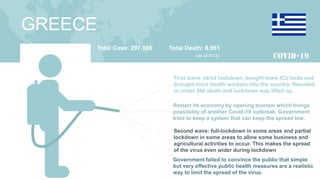
GREECE
Total Case: 297,086 Total Death: 8,961
(as of 4/13)
First wave: strict lockdown, bought more ICU beds and
brought more health workers into the country. Resulted
in under 200 death and lockdown was lifted up.
Restart its economy by opening tourism which brings
possibility of another Covid-19 outbreak. Government
tried to keep a system that can keep the spread low.
Government failed to convince the public that simple
but very effective public health measures are a realistic
way to limit the spread of the virus.
Second wave: full-lockdown in some areas and partial
lockdown in some areas to allow some business and
agricultural activities to occur. This makes the spread
of the virus even wider during lockdown
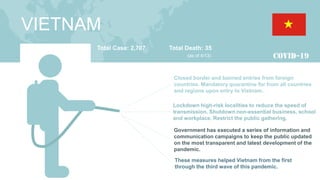
VIETNAM
Total Case: 2,707 Total Death: 35
(as of 4/13)
Closed border and banned entries from foreign
countries. Mandatory quarantine for from all countries
and regions upon entry to Vietnam.
Lockdown high-risk localities to reduce the speed of
transmission. Shutdown non-essential business, school
and workplace. Restrict the public gathering.
These measures helped Vietnam from the first
through the third wave of this pandemic.
Government has executed a series of information and
communication campaigns to keep the public updated
on the most transparent and latest development of the
pandemic.
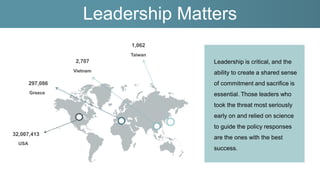
Leadership Matters
USA
32,007,413
Greece
297,086
Vietnam
2,707
Taiwan
1,062
Leadership is critical, and the
ability to create a shared sense
of commitment and sacrifice is
essential. Those leaders who
took the threat most seriously
early on and relied on science
to guide the policy responses
are the ones with the best
success.
THE NEW NORMAL
01
School
02
Workplace
03
Daily Life
WHO Guidelines
Example from Thailand
ILO Guidelines and
Example from the EU.
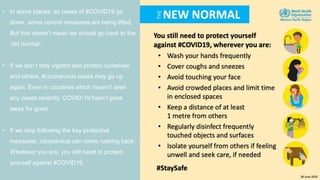
• In some places, as cases of #COVID19 go
down, some control measures are being lifted.
But this doesn’t mean we should go back to the
‘old normal’.
• If we don’t stay vigilant and protect ourselves
and others, #coronavirus cases may go up
again.​ Even in countries which haven’t seen
any cases recently, COVID-19 hasn’t gone
away for good.
• If we stop following the key protective
measures, coronavirus can come rushing back.​
Wherever you are, you still need to protect
yourself against #COVID19.
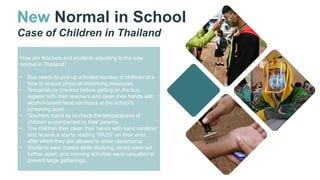
New Normal in School
Case of Children in Thailand
How are teachers and students adjusting to the new
normal in Thailand?
• Bus needs to pick up a limited number of children at a
time to ensure physical distancing measures.
• Temperature checked before getting on the bus,
register with their teachers and clean their hands with
alcohol-based hand sanitizers at the school’s
screening point.
• Teachers stand by to check the temperatures of
children accompanied by their parents.
• The children then clean their hands with hand sanitizer
and receive a stamp reading “PASS” on their wrist,
after which they are allowed to enter classrooms.
• Students wear masks while studying, desks were set
further apart, and morning activities were cancelled to
prevent large gatherings.
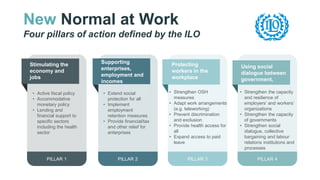
New Normal at Work
Four pillars of action defined by the ILO
Stimulating the
economy and
jobs
• Active fiscal policy
• Accommodative
monetary policy
• Lending and
financial support to
specific sectors
including the health
sector
PILLAR 1
Supporting
enterprises,
employment and
incomes
Protecting
workers in the
workplace
Using social
dialogue between
government,
• Extend social
protection for all
• Implement
employment
retention measures
• Provide financial/tax
and other relief for
enterprises
PILLAR 2 PILLAR 3 PILLAR 4
• Strengthen OSH
measures
• Adapt work arrangements
(e.g. teleworking)
• Prevent discrimination
and exclusion
• Provide health access for
all
• Expand access to paid
leave
• Strengthen the capacity
and resilience of
employers’ and workers’
organizations
• Strengthen the capacity
of governments
• Strengthen social
dialogue, collective
bargaining and labour
relations institutions and
processes
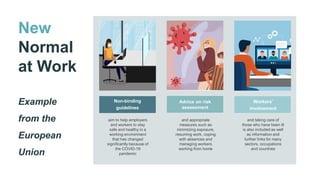
Non-binding
guidelines
Advice on risk
assessment
Workers’
involvement
aim to help employers
and workers to stay
safe and healthy in a
working environment
that has changed
significantly because of
the COVID-19
pandemic
and appropriate
measures such as
minimizing exposure,
resuming work, coping
with absences and
managing workers
working from home
and taking care of
those who have been ill
is also included as well
as information and
further links for many
sectors, occupations
and countries
New
Normal
at Work
Example
from the
European
Union
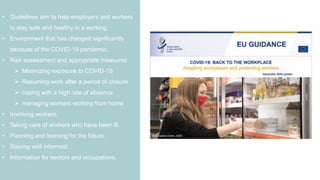
• Guidelines aim to help employers and workers
to stay safe and healthy in a working.
• Environment that has changed significantly
because of the COVID-19 pandemic.
• Risk assessment and appropriate measures
➢ Minimizing exposure to COVID-19
➢ Resuming work after a period of closure
➢ coping with a high rate of absence
➢ managing workers working from home
• Involving workers.
• Taking care of workers who have been ill.
• Planning and learning for the future.
• Staying well informed.
• Information for sectors and occupations.
THANK YOU

Crossing the Rubicon: Post Covid-19 Policy

  • 1.
    Development Policy and Strategyfor Post . Resilience and Recovery Presented by: Ziauddin Ahmed Kan Yuenyong Nathanan Mitkasem
  • 2.
    Introduction COVID-19 has broughtforward some major challenges for the governments of different countries: ✓ It has exposed and exacerbated preexisting weak economy, inequalities in incomes and access to basic public services. ✓ Demand for health care and vaccination, both within and across countries, is increasing pressure on budget. ✓ Disruptions to education threaten social mobility by leaving long-lasting effects on children and youth. ✓ These challenges are being compounded by accelerated digitalization and the transformational effect of the pandemic on the economy, posing low skilled workers with difficulties in finding employment.
  • 3.
    Key Policy Issuesfor Sustainable COVID-19 Recovery & Resilience • Global institutions (UN, WB, IMF, ADB) consider that, Development Policies along with post COVID recovery and resilience should include a green, digital, and inclusive (including gender issues) transformation of the economy. • Key issues for a sustainable COVID-19 recovery & resilience: ✓ Better health and well-being reduces vulnerability ✓ Cleaner air relieves health services ✓ Public participation makes for durable policy ✓ Equitable resilience, economic resilience ✓ The green in green recovery ✓ Recovery beyond the rich world
  • 4.
    Development Policy for PostCOVID-19 Recovery & Resilience • In the response to COVID-19 governments used the budget promptly and decisively through fiscal policy; countries have announced $16 trillion in fiscal actions to enable health systems and hence, have provided emergency lifelines to households and firms. By doing so, fiscal policy has also mitigated the contraction in economic activity. Indeed, economic growth surprised, on the upside as 2020 unfolded, and growth forecasts for 2021 have been revised up as well. Gradually, economies and societies have improved their ability to cope with the pandemic. • Fiscal policy priorities include continuing support as needed while vaccinations proceed and the recovery strengthens; promptly implementing the announced fiscal measures with upgraded project execution capacities and procurement procedures; pursuing a green, digital, and inclusive transformation of the economy; tackling long- standing weaknesses in public finances once the recovery is firmly in place; developing medium-term fiscal strategies to manage fiscal and financing risks; and renewing efforts to achieve the SDGs.
  • 5.
    Development Policy for PostCOVID-19 Recovery & Resilience (cont.) • Several governments have announced new fiscal actions or have extended the previous temporary measures (Australia, Canada, France, Germany, India, Indonesia, Japan, Spain, United Kingdom, United States). Others are contemplating new legislation (some euro area member countries). Meanwhile, multiyear fiscal measures in some countries have allowed for flexibility on the timing and size of short-term support conditional on the evolution of the pandemic and its economic and social impact (Canada) while facilitating the post–COVID-19 recovery by identifying policy priorities such as green investment, digitalization, and reductions in inequality and poverty (Canada, EU member states, Japan).
  • 6.
    2 Strategies for PostCOVID-19 Recovery & Resilience Fiscal policy 3 1 must be scaled up to contain the pandemic. Global cooperation on access to treatments and vaccines is essential. must be improved and tailored to countries’ administrative capacity so that fiscal support can be maintained for the duration of the crisis Given the low-interest environment, a synchronized green public investment push by countries with fiscal space can foster global growth. - considering an uncertain and uneven recovery. recovery contribution, levied on high incomes or wealth. To accumulate the resources needed to improve access to basic services, enhance safety nets, and reinvigorate efforts to achieve the SDGs, domestic and international tax reforms are necessary. Global Cooperation Targeting of Measures A temporary post COVID-19
  • 7.
    are needed forpost COVID recovery, especially where debt is high and financing conditions are tight or at risk. Global public debt is estimated to reach 98% of GDP at the end of 2020, compared with 84% for the same date based on projections in the October 2019 Fiscal Monitor of IMF 5 Strategies for Post COVID-19 Recovery & Resilience (cont.) Fiscal support Fiscal policy 6 to vulnerable households and firms needs to be available as appropriate until the recovery is firmly underway. Fiscal responses have been shaped by access to financing: average overall deficits as a share of GDP in 2020 are projected at -13.3% for advanced economies, –10.3% for emerging market and middle- income economies, and –5.7% for low-income developing countries. Credible medium-term fiscal frameworks Fiscal policy 4 support a sustainable recovery and facilitate the transformation to a green, digital, and inclusive economy while managing fiscal and financing risks.
  • 8.
    Prescription of WHOfor Healthy Recovery Ensure a quick healthy energy transition Invest in essential services Protect nature Stop using taxpayers’ money to fund pollution Build healthy, liveable cities Promote healthy, sustainable food systems WHO prescription for a healthy and green COVID-19 recovery Healthy & Green Recovery 6 steps
  • 9.
  • 10.
  • 11.
  • 12.
  • 13.
  • 14.
  • 15.
    Israeli case study •Israel was well ahead of most countries in signing a purchase agreement for Moderna’s high-efficacy mRNA vaccine in June 2020. Later in 2020 it made more deals with Pfizer (which also produces a very high-efficacy vaccine) and AstraZeneca. • About 57% of Israel’s population of 9 million have now received at least one dose of the vaccine. More than 48% are fully vaccinated. Life is getting back to normal. People are going to concerts and congregating in coffee shops. • Approaching fast + political will • Israel has also introduced a “green passport” – a phone app that certifies the owner has been fully immunised or is presumed immune as a result of having previously had COVID-19. • The “green pass” (as it has become known) permits holders — and only holders — access to gyms, swimming pools, cultural events, weddings and other gatherings. (extended to “green visa”?) • https://www.themandarin.com.au/152004-israel-shows-how-to- do-vaccinations-right-its-a-race-and-were-behind/
  • 16.
    Thailand’s recent Covid-19containment strategy • [14/04/2021] Cases: 35,910 (+1,335); Recovered: 28,322; Hospitalized: 7,491; Died: 97 • Vaccinated: 498,791, 0.7% of total population • Current portfolio: AstraZeneca (UK), Sinovac (China) • Domestic production (via SiamBioscience): 5-10 million doses monthly, started mid-2021 (currently on quality controlling process, via AstraZeneca) • Recent domestic research: NVD-HXP-S (Mahidol & Texas Austin, viral vector), ChulaCov19 (Chula Univ, RNA), both on preclinical trial phase. • Seems to focus on domestic self-reliance to contain future emerging pandemic
  • 17.
    Post Covid-19 Policy •Vaccinated 80-90% of population to build herd immunity • New normal life style: Social Distancing, Mask Wearing, Hand Washing, Testing, Surveillance Apps (Thai Chana): D-M-H-T-T • Domestic vaccine research and production capacity to attain self-reliance policy • Extended “green passport & visa” (Israeli case) • Boosting Digital Transformation both in public and private sector (prepare for digital and 5G communication infrastructure) • Observing contingency plan for sensitive business sector impacted by Covid-19, i.e. tourism, airlines, restaurants, entertaining business, etc. • Orchestrate global stimulus budget package to revive global economy
  • 19.
  • 20.
  • 21.
  • 22.
  • 23.
    LESSON LEARNED from thepast year 01 Greece 02 Vietnam 03 Taiwan
  • 24.
    TAIWAN Total Case: 1,062Total Death: 11 (as of 4/13) Effective response policy for an early action and aggressive monitoring. No lockdown. Closed borders and banning exports of surgical masks. Single healthcare system, medical official held daily briefings for the public. Policy to use contact tracing and mobile sim-tracking to identify and ensure that people in quarantine were actually in quarantine.
  • 25.
    GREECE Total Case: 297,086Total Death: 8,961 (as of 4/13) First wave: strict lockdown, bought more ICU beds and brought more health workers into the country. Resulted in under 200 death and lockdown was lifted up. Restart its economy by opening tourism which brings possibility of another Covid-19 outbreak. Government tried to keep a system that can keep the spread low. Government failed to convince the public that simple but very effective public health measures are a realistic way to limit the spread of the virus. Second wave: full-lockdown in some areas and partial lockdown in some areas to allow some business and agricultural activities to occur. This makes the spread of the virus even wider during lockdown
  • 26.
    VIETNAM Total Case: 2,707Total Death: 35 (as of 4/13) Closed border and banned entries from foreign countries. Mandatory quarantine for from all countries and regions upon entry to Vietnam. Lockdown high-risk localities to reduce the speed of transmission. Shutdown non-essential business, school and workplace. Restrict the public gathering. These measures helped Vietnam from the first through the third wave of this pandemic. Government has executed a series of information and communication campaigns to keep the public updated on the most transparent and latest development of the pandemic.
  • 27.
    Leadership Matters USA 32,007,413 Greece 297,086 Vietnam 2,707 Taiwan 1,062 Leadership iscritical, and the ability to create a shared sense of commitment and sacrifice is essential. Those leaders who took the threat most seriously early on and relied on science to guide the policy responses are the ones with the best success.
  • 28.
    THE NEW NORMAL 01 School 02 Workplace 03 DailyLife WHO Guidelines Example from Thailand ILO Guidelines and Example from the EU.
  • 29.
    • In someplaces, as cases of #COVID19 go down, some control measures are being lifted. But this doesn’t mean we should go back to the ‘old normal’. • If we don’t stay vigilant and protect ourselves and others, #coronavirus cases may go up again.​ Even in countries which haven’t seen any cases recently, COVID-19 hasn’t gone away for good. • If we stop following the key protective measures, coronavirus can come rushing back.​ Wherever you are, you still need to protect yourself against #COVID19.
  • 30.
    New Normal inSchool Case of Children in Thailand How are teachers and students adjusting to the new normal in Thailand? • Bus needs to pick up a limited number of children at a time to ensure physical distancing measures. • Temperature checked before getting on the bus, register with their teachers and clean their hands with alcohol-based hand sanitizers at the school’s screening point. • Teachers stand by to check the temperatures of children accompanied by their parents. • The children then clean their hands with hand sanitizer and receive a stamp reading “PASS” on their wrist, after which they are allowed to enter classrooms. • Students wear masks while studying, desks were set further apart, and morning activities were cancelled to prevent large gatherings.
  • 31.
    New Normal atWork Four pillars of action defined by the ILO Stimulating the economy and jobs • Active fiscal policy • Accommodative monetary policy • Lending and financial support to specific sectors including the health sector PILLAR 1 Supporting enterprises, employment and incomes Protecting workers in the workplace Using social dialogue between government, • Extend social protection for all • Implement employment retention measures • Provide financial/tax and other relief for enterprises PILLAR 2 PILLAR 3 PILLAR 4 • Strengthen OSH measures • Adapt work arrangements (e.g. teleworking) • Prevent discrimination and exclusion • Provide health access for all • Expand access to paid leave • Strengthen the capacity and resilience of employers’ and workers’ organizations • Strengthen the capacity of governments • Strengthen social dialogue, collective bargaining and labour relations institutions and processes
  • 32.
    Non-binding guidelines Advice on risk assessment Workers’ involvement aimto help employers and workers to stay safe and healthy in a working environment that has changed significantly because of the COVID-19 pandemic and appropriate measures such as minimizing exposure, resuming work, coping with absences and managing workers working from home and taking care of those who have been ill is also included as well as information and further links for many sectors, occupations and countries New Normal at Work Example from the European Union
  • 33.
    • Guidelines aimto help employers and workers to stay safe and healthy in a working. • Environment that has changed significantly because of the COVID-19 pandemic. • Risk assessment and appropriate measures ➢ Minimizing exposure to COVID-19 ➢ Resuming work after a period of closure ➢ coping with a high rate of absence ➢ managing workers working from home • Involving workers. • Taking care of workers who have been ill. • Planning and learning for the future. • Staying well informed. • Information for sectors and occupations.
  • 34.