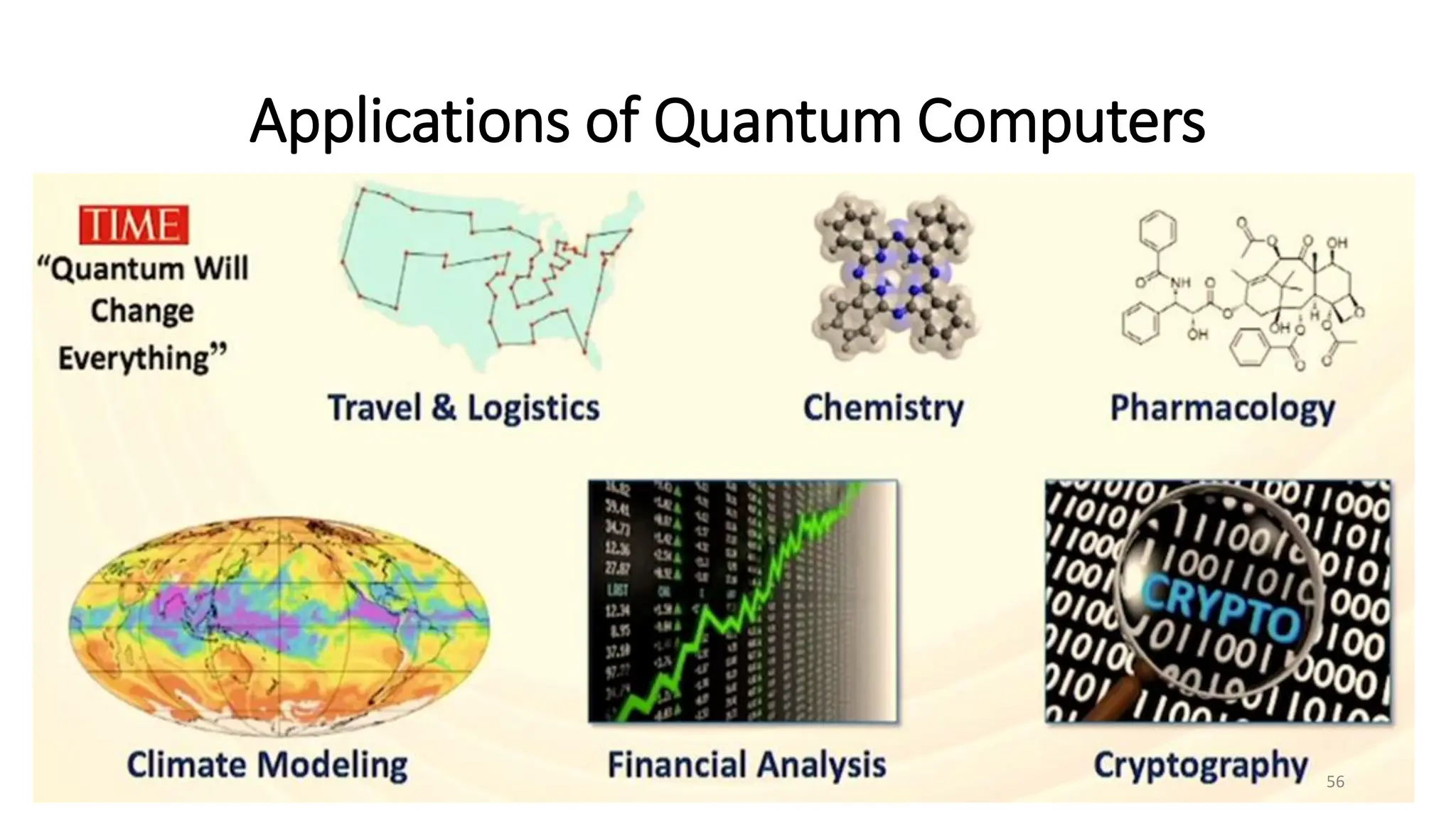
A quantum computer uses quantum mechanics principles like superposition and entanglement to perform massively parallel computations. The basic unit of information in a quantum computer is called a qubit, which can exist in superpositions of states unlike classical bits. The document discusses the history and development of quantum computing, basic quantum mechanics concepts, how quantum computers work and their potential applications in optimization, simulation and communication. It also provides an overview of the speaker's background and agenda for the workshop on introducing quantum computing basics.
Shubin Liu, Ph.D.
ResearchComputing Center
University of North Carolina at Chapel Hill
Chapel Hill, NC 27599-3420
Introduction to Quantum Computers
2.
Objectives & Prerequisites
•After this workshop, you should be
• Familiar with basics and general trends of quantum computers
• Able to understand simple quantum circuits
• Ready to build and run simple quantum computing tasks with QISKit
• We assume that you know
• Basic knowledge of linear algebra and statistics, but not mandatory
• No prior knowledge of quantum mechanics required
• Recommendation: An account @ IBM Quantum Experience
https://quantum-computing.ibm.com
2
3.
A BEGINNER'S GUIDETO QUANTUM COMPUTING | Shohini Ghose
https://www.youtube.com/watch?v=QuR969uMICM
4.
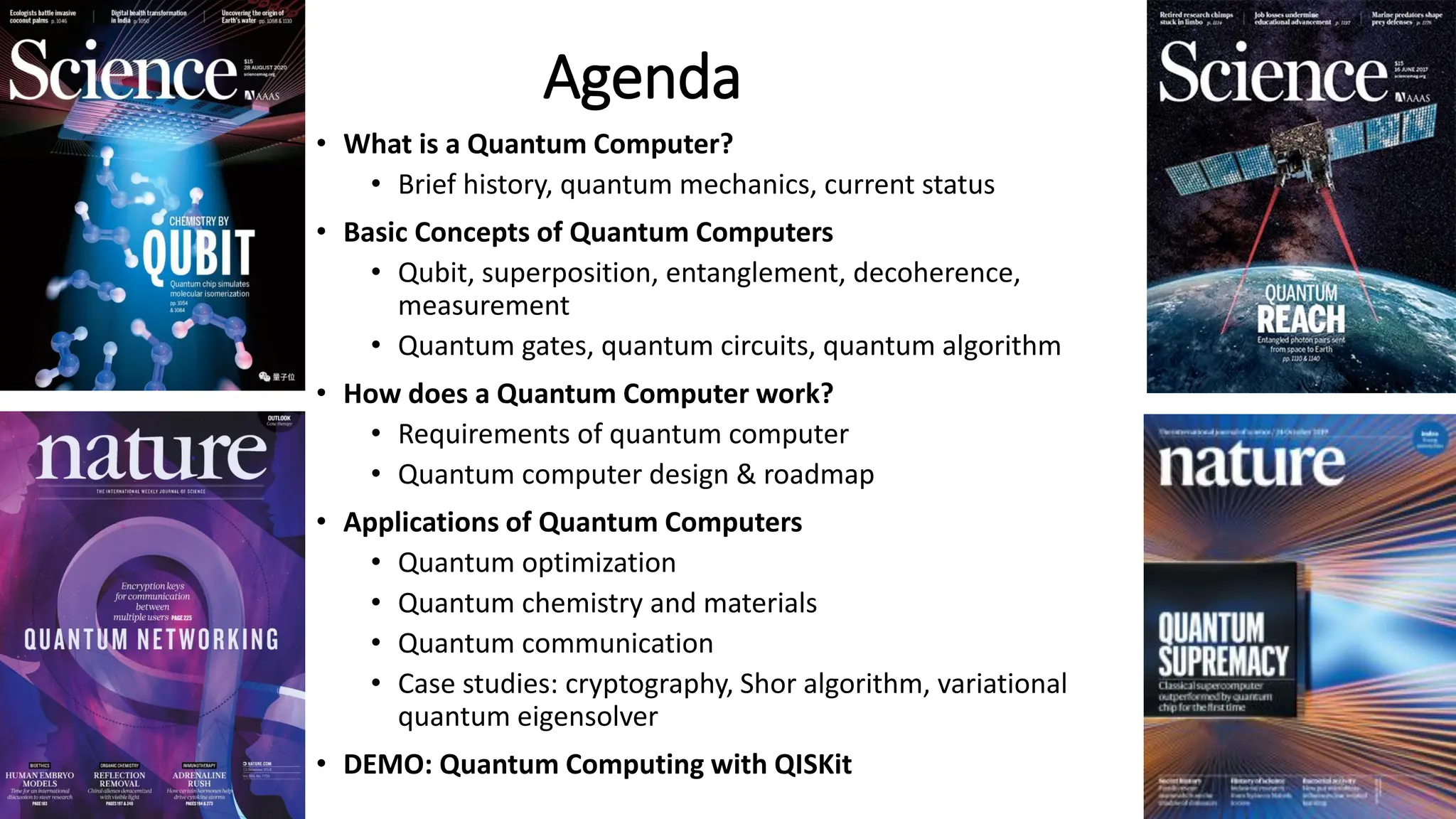
Agenda
• What isa Quantum Computer?
• Brief history, quantum mechanics, current status
• Basic Concepts of Quantum Computers
• Qubit, superposition, entanglement, decoherence,
measurement
• Quantum gates, quantum circuits, quantum algorithm
• How does a Quantum Computer work?
• Requirements of quantum computer
• Quantum computer design & roadmap
• Applications of Quantum Computers
• Quantum optimization
• Quantum chemistry and materials
• Quantum communication
• Case studies: cryptography, Shor algorithm, variational
quantum eigensolver
• DEMO: Quantum Computing with QISKit 4
5.
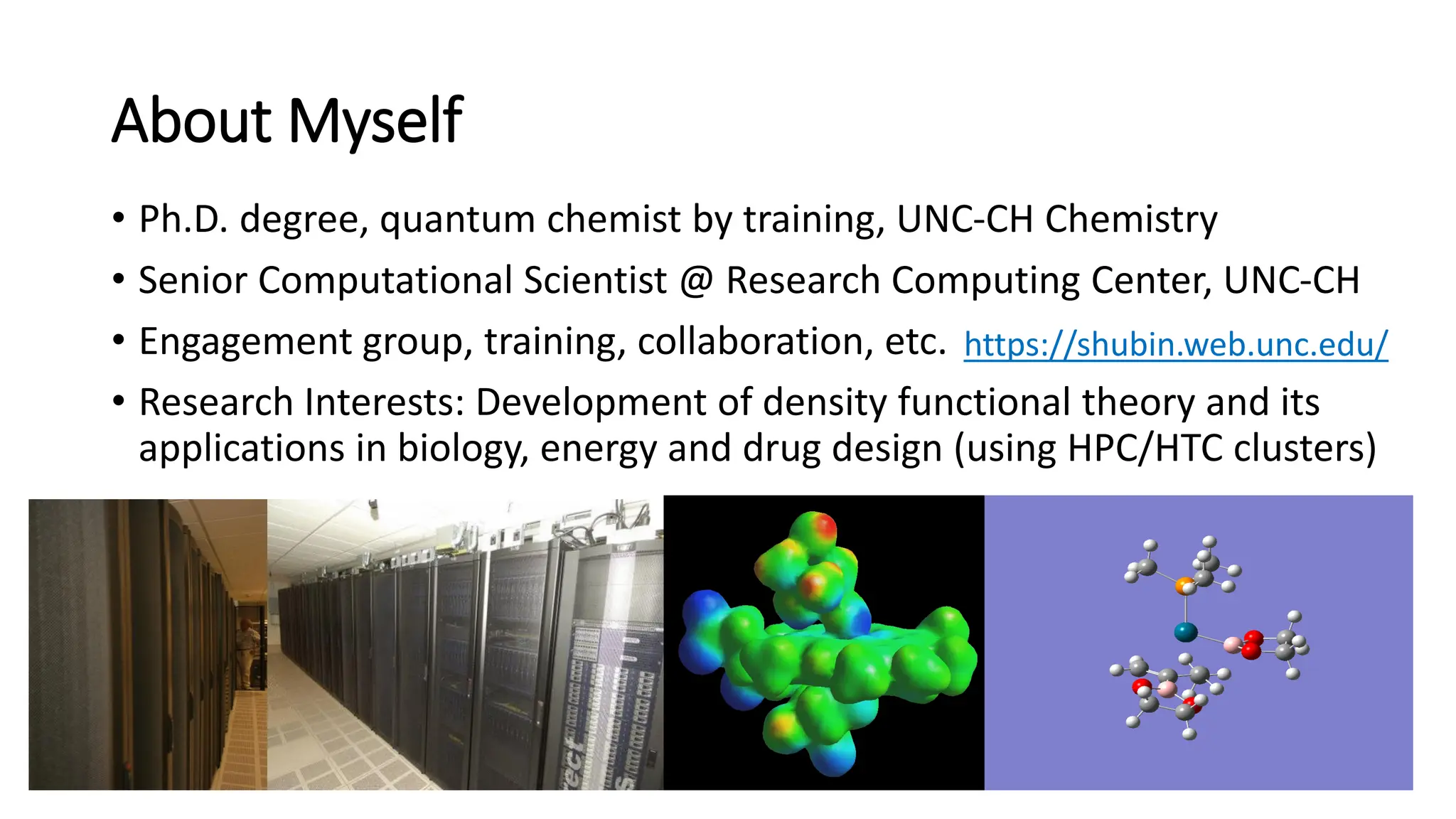
About Myself
• Ph.D.degree, quantum chemist by training, UNC-CH Chemistry
• Senior Computational Scientist @ Research Computing Center, UNC-CH
• Engagement group, training, collaboration, etc.
• Research Interests: Development of density functional theory and its
applications in biology, energy and drug design (using HPC/HTC clusters)
5
https://shubin.web.unc.edu/
6.
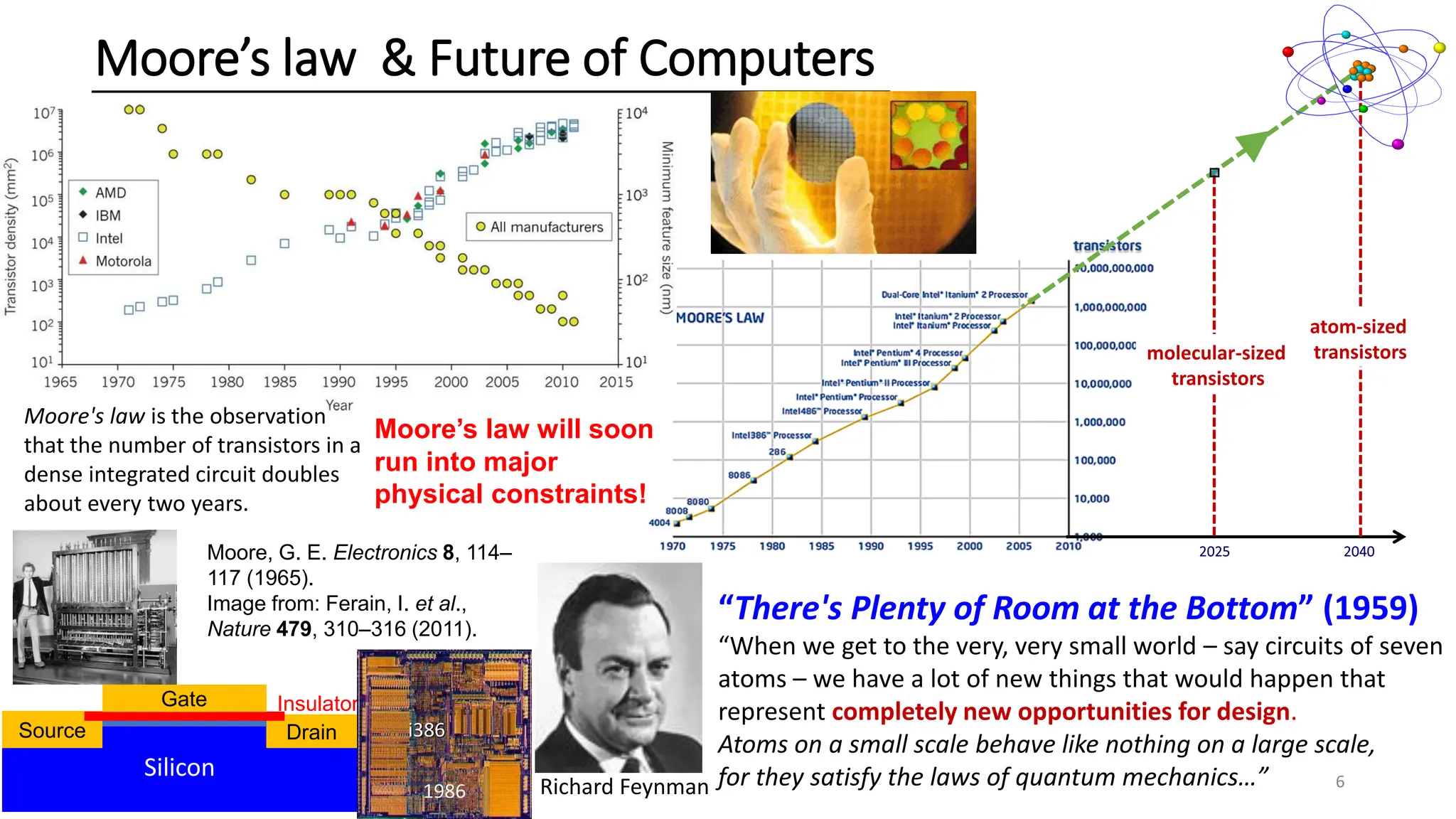
“There's Plenty ofRoom at the Bottom” (1959)
“When we get to the very, very small world – say circuits of seven
atoms – we have a lot of new things that would happen that
represent completely new opportunities for design.
Atoms on a small scale behave like nothing on a large scale,
for they satisfy the laws of quantum mechanics…”
Richard Feynman
Moore’s law & Future of Computers
2040
2025
atom-sized
transistors
molecular-sized
transistors
Moore, G. E. Electronics 8, 114–
117 (1965).
Image from: Ferain, I. et al.,
Nature 479, 310–316 (2011).
Silicon
Source Drain
Gate Insulator
i386
1986
Moore’s law will soon
run into major
physical constraints!
Moore's law is the observation
that the number of transistors in a
dense integrated circuit doubles
about every two years.
6
7.
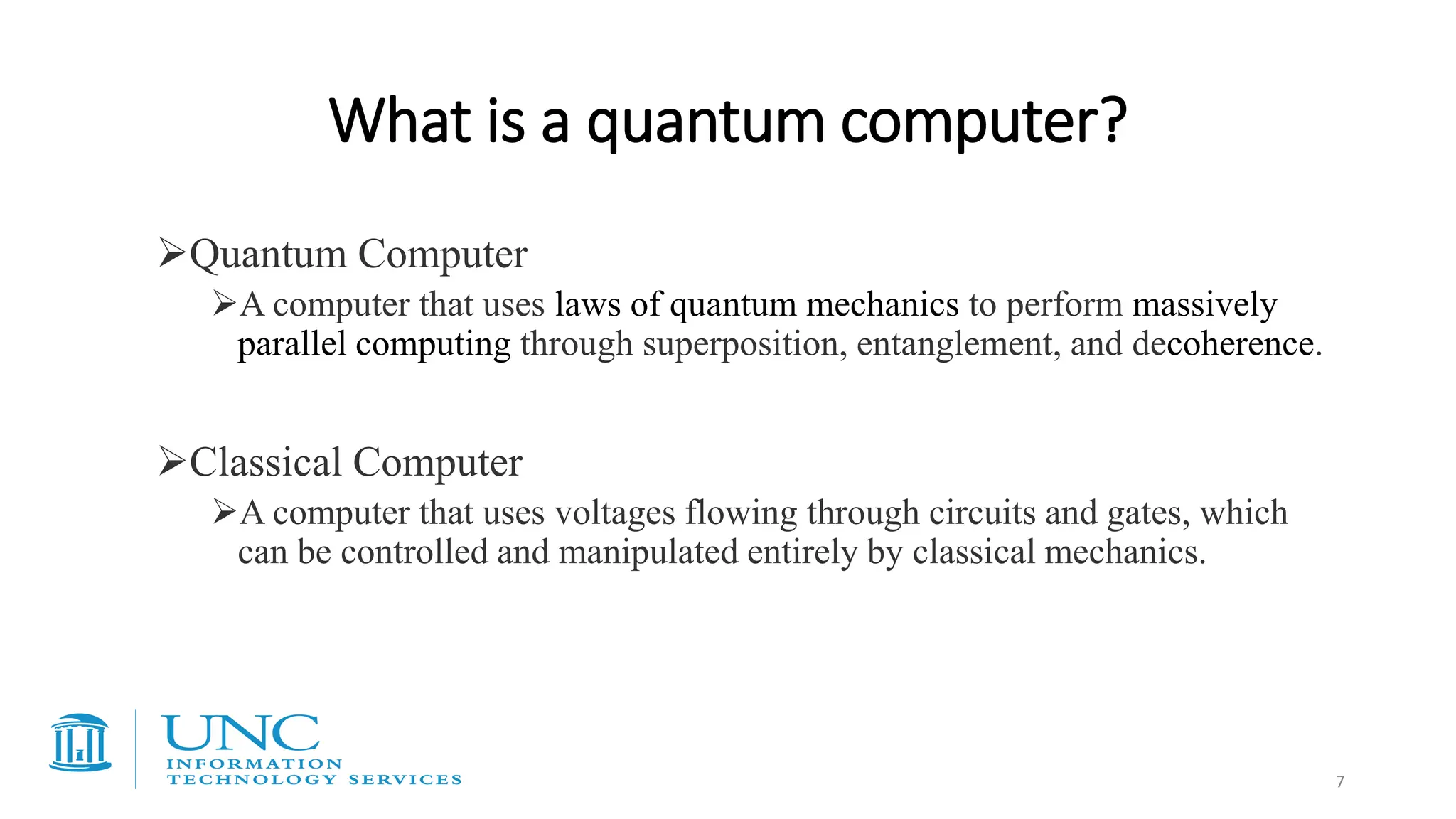
What is aquantum computer?
➢Quantum Computer
➢A computer that uses laws of quantum mechanics to perform massively
parallel computing through superposition, entanglement, and decoherence.
➢Classical Computer
➢A computer that uses voltages flowing through circuits and gates, which
can be controlled and manipulated entirely by classical mechanics.
7
8.
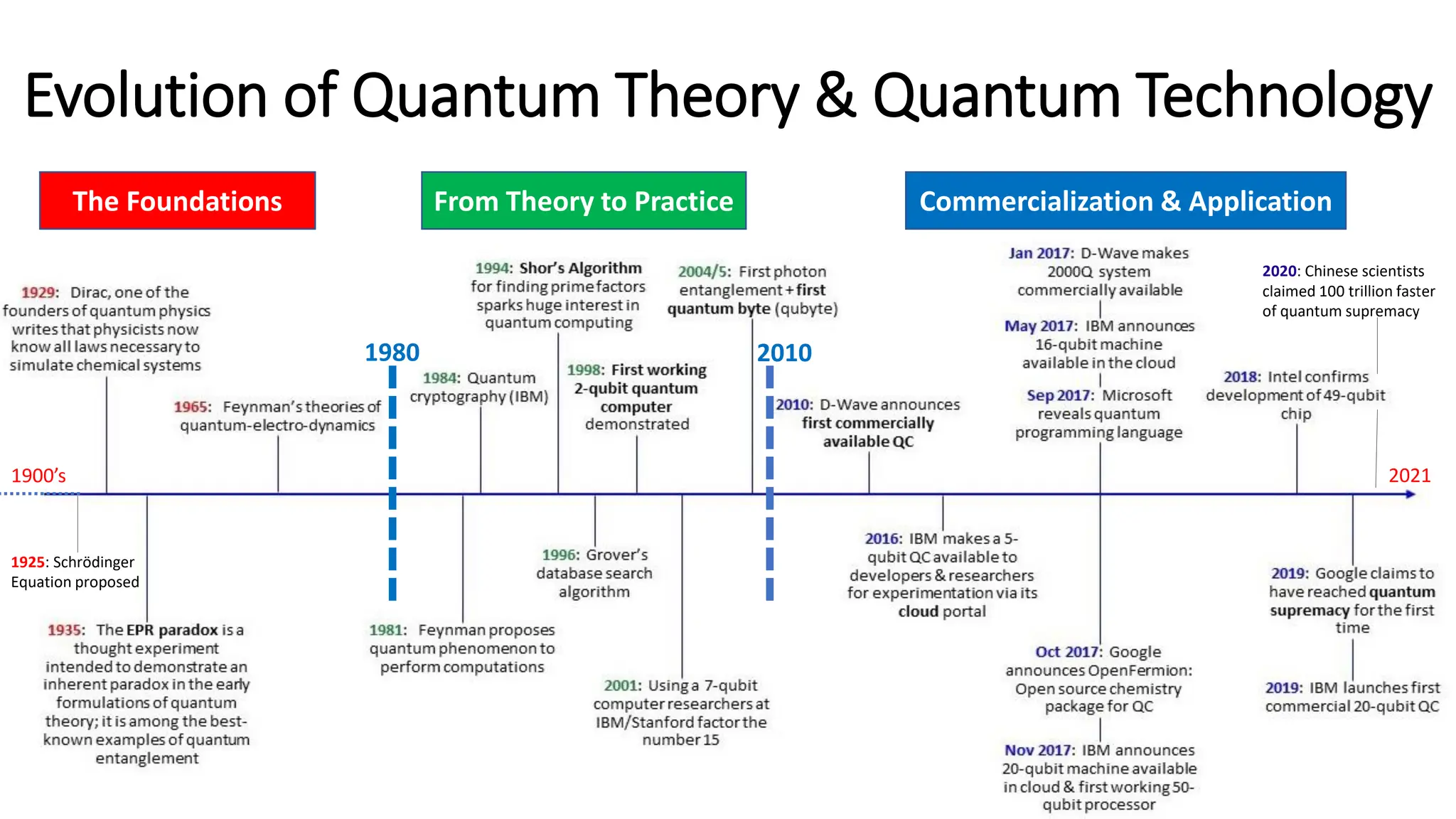
Evolution of QuantumTheory & Quantum Technology
8
The Foundations From Theory to Practice Commercialization & Application
1980 2010
1900’s 2021
1925: Schrödinger
Equation proposed
2020: Chinese scientists
claimed 100 trillion faster
of quantum supremacy
9.
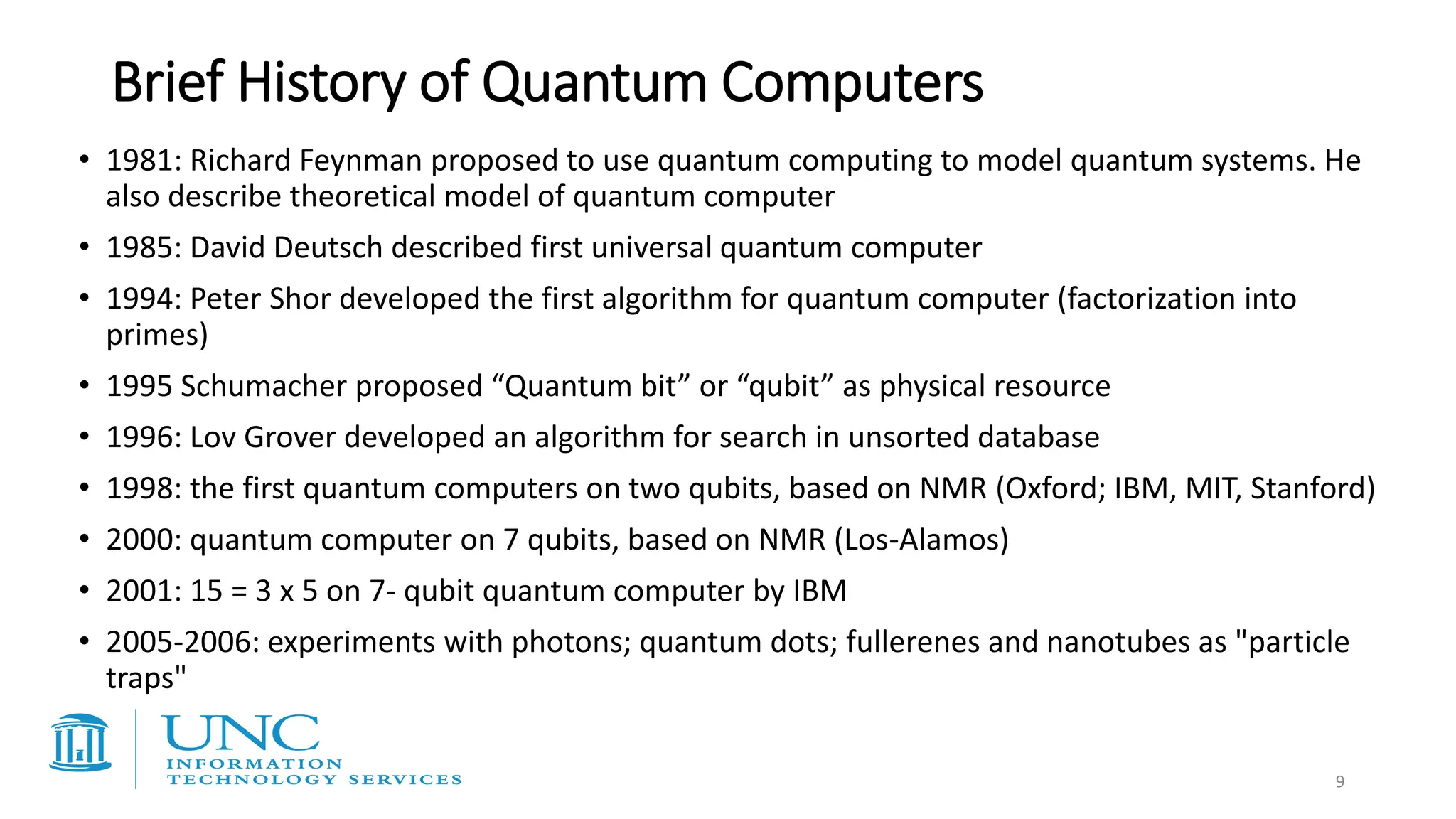
Brief History ofQuantum Computers
• 1981: Richard Feynman proposed to use quantum computing to model quantum systems. He
also describe theoretical model of quantum computer
• 1985: David Deutsch described first universal quantum computer
• 1994: Peter Shor developed the first algorithm for quantum computer (factorization into
primes)
• 1995 Schumacher proposed “Quantum bit” or “qubit” as physical resource
• 1996: Lov Grover developed an algorithm for search in unsorted database
• 1998: the first quantum computers on two qubits, based on NMR (Oxford; IBM, MIT, Stanford)
• 2000: quantum computer on 7 qubits, based on NMR (Los-Alamos)
• 2001: 15 = 3 x 5 on 7- qubit quantum computer by IBM
• 2005-2006: experiments with photons; quantum dots; fullerenes and nanotubes as "particle
traps"
9
10.
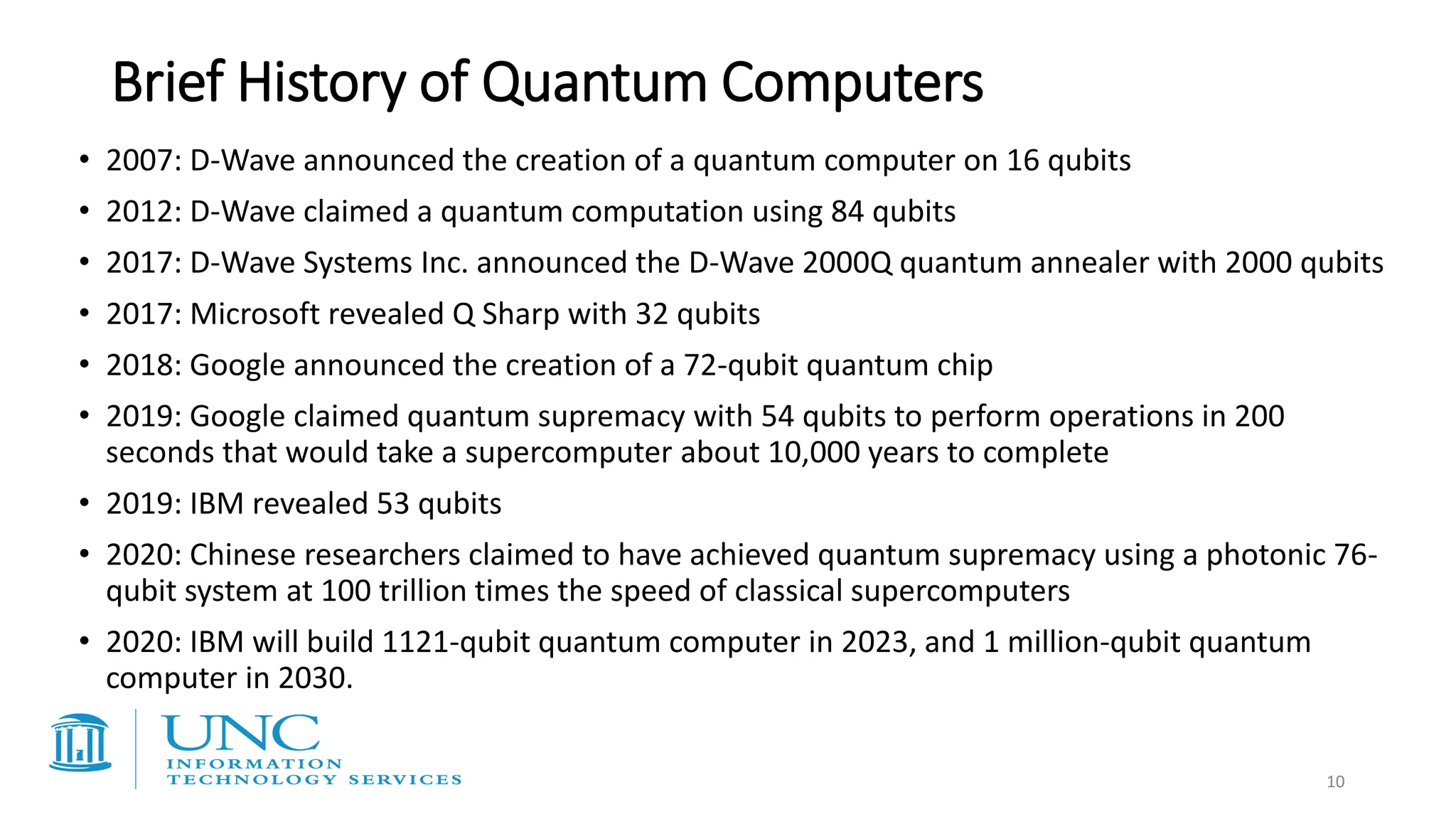
Brief History ofQuantum Computers
• 2007: D-Wave announced the creation of a quantum computer on 16 qubits
• 2012: D-Wave claimed a quantum computation using 84 qubits
• 2017: D-Wave Systems Inc. announced the D-Wave 2000Q quantum annealer with 2000 qubits
• 2017: Microsoft revealed Q Sharp with 32 qubits
• 2018: Google announced the creation of a 72-qubit quantum chip
• 2019: Google claimed quantum supremacy with 54 qubits to perform operations in 200
seconds that would take a supercomputer about 10,000 years to complete
• 2019: IBM revealed 53 qubits
• 2020: Chinese researchers claimed to have achieved quantum supremacy using a photonic 76-
qubit system at 100 trillion times the speed of classical supercomputers
• 2020: IBM will build 1121-qubit quantum computer in 2023, and 1 million-qubit quantum
computer in 2030.
10
11.
Quantum Mechanics
Quantum mechanicsis the theory that describes the behavior of microscopic
systems, such as photons, electrons, atoms, molecules, etc.
Nobody understands quantum mechanics!
“No, you’re not going to be able to understand it.... You see, my physics
students don’t understand it either. That is because I don’t understand it.
Nobody does. ... The theory of quantum electrodynamics describes Nature
as absurd from the point of view of common sense. And it agrees fully with
an experiment. So I hope that you can accept Nature as She is – absurd”
--Richard Feynman
11
12.
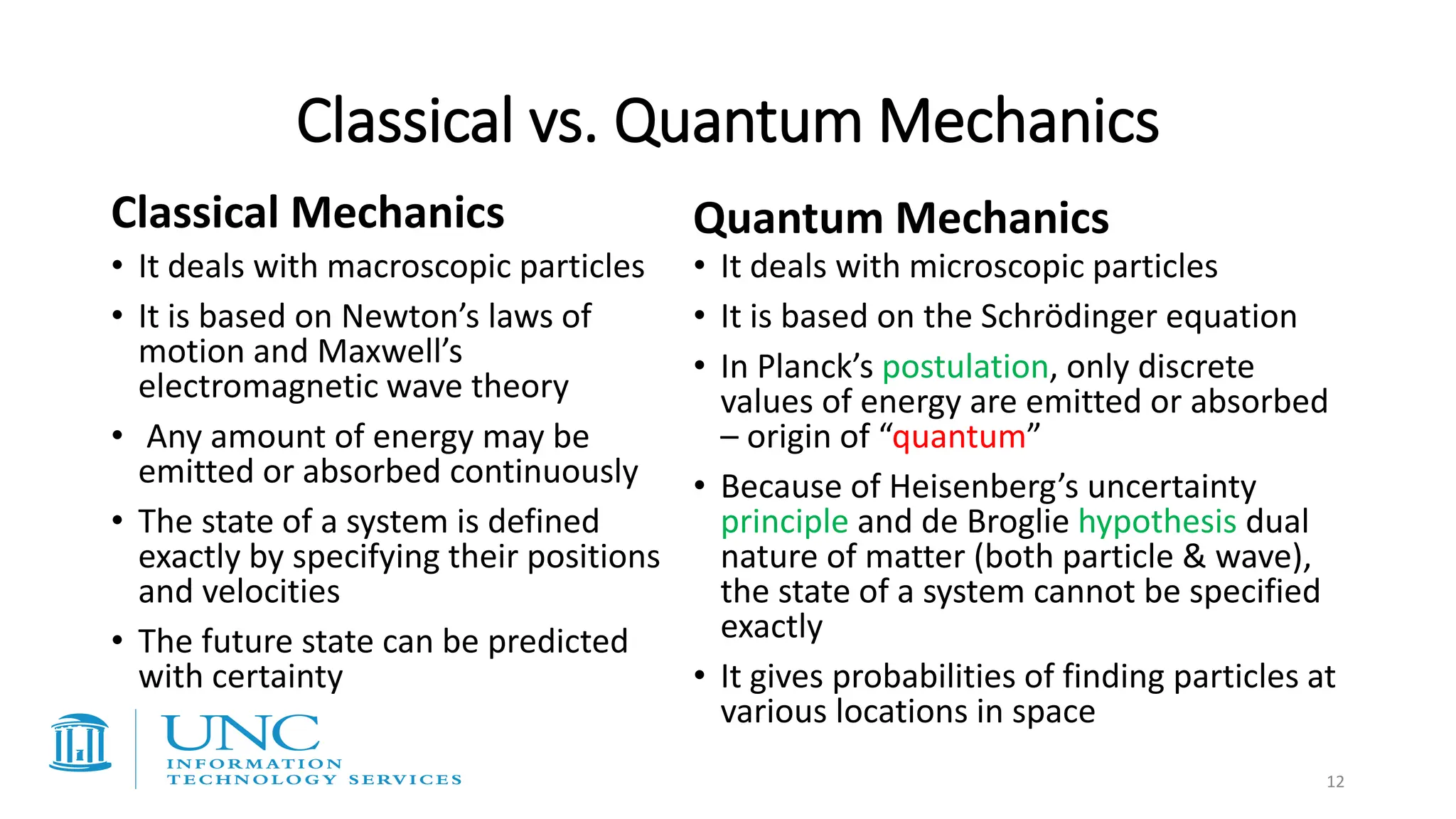
Classical vs. QuantumMechanics
Classical Mechanics
• It deals with macroscopic particles
• It is based on Newton’s laws of
motion and Maxwell’s
electromagnetic wave theory
• Any amount of energy may be
emitted or absorbed continuously
• The state of a system is defined
exactly by specifying their positions
and velocities
• The future state can be predicted
with certainty
Quantum Mechanics
• It deals with microscopic particles
• It is based on the Schrödinger equation
• In Planck’s postulation, only discrete
values of energy are emitted or absorbed
– origin of “quantum”
• Because of Heisenberg’s uncertainty
principle and de Broglie hypothesis dual
nature of matter (both particle & wave),
the state of a system cannot be specified
exactly
• It gives probabilities of finding particles at
various locations in space
12
13.
Quantum Mechanics
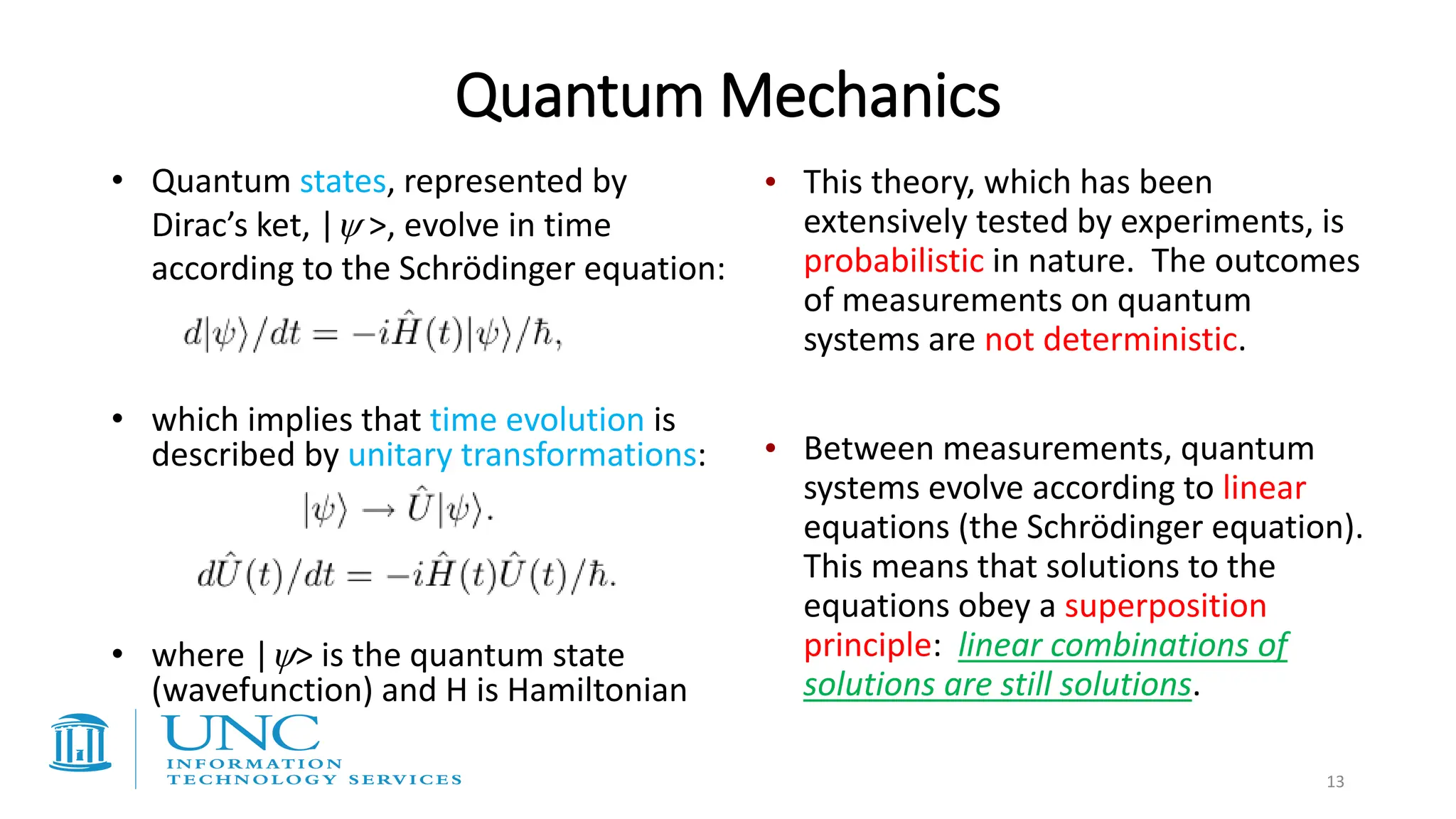
• Quantumstates, represented by
Dirac’s ket, | >, evolve in time
according to the Schrödinger equation:
• which implies that time evolution is
described by unitary transformations:
• where |> is the quantum state
(wavefunction) and H is Hamiltonian
• This theory, which has been
extensively tested by experiments, is
probabilistic in nature. The outcomes
of measurements on quantum
systems are not deterministic.
• Between measurements, quantum
systems evolve according to linear
equations (the Schrödinger equation).
This means that solutions to the
equations obey a superposition
principle: linear combinations of
solutions are still solutions.
13
14.
Unitary Transformation asQuantum Computing
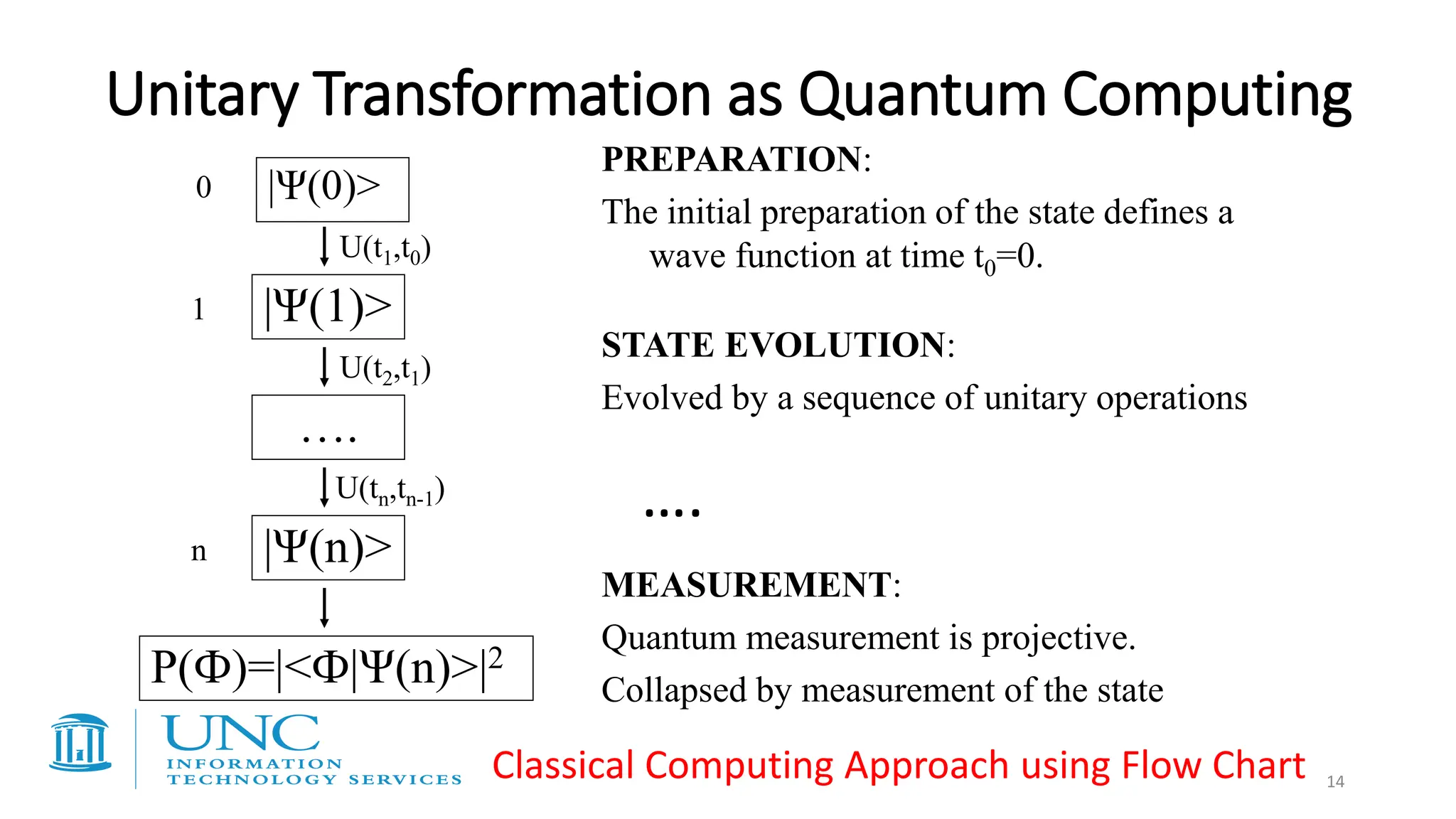
|Ψ(0)>
PREPARATION:
The initial preparation of the state defines a
wave function at time t0=0.
|Ψ(1)>
….
|Ψ(n)>
P(Ф)=|<Ф|Ψ(n)>|2
U(t1,t0)
U(t2,t1)
U(tn,tn-1)
0
1
n
STATE EVOLUTION:
Evolved by a sequence of unitary operations
MEASUREMENT:
Quantum measurement is projective.
Collapsed by measurement of the state
….
14
Classical Computing Approach using Flow Chart
15.
15
Unitary Transformation asQuantum Computing
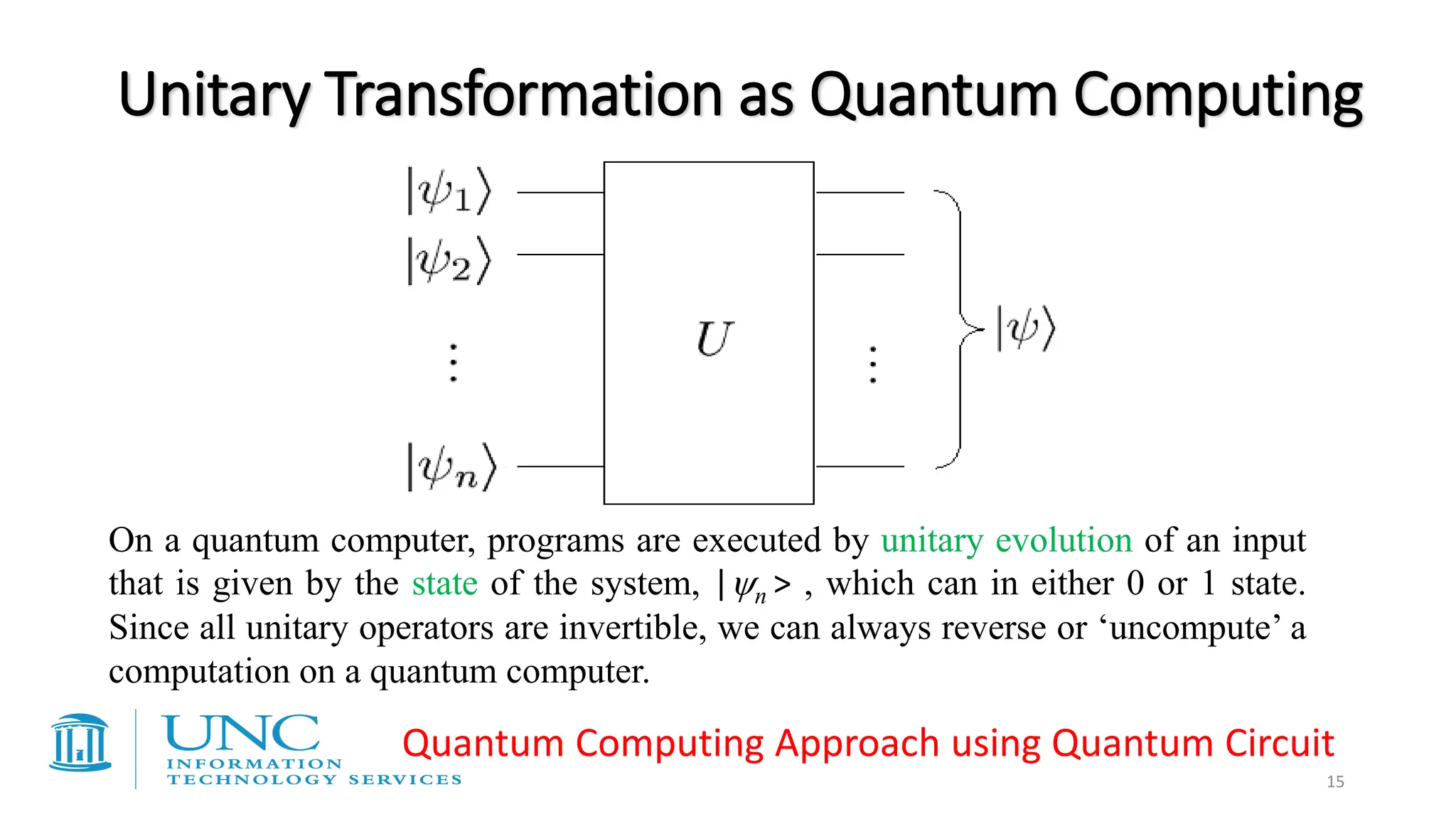
On a quantum computer, programs are executed by unitary evolution of an input
that is given by the state of the system, |n > , which can in either 0 or 1 state.
Since all unitary operators are invertible, we can always reverse or ‘uncompute’ a
computation on a quantum computer.
Quantum Computing Approach using Quantum Circuit
16.
What does aquantum computer look like?
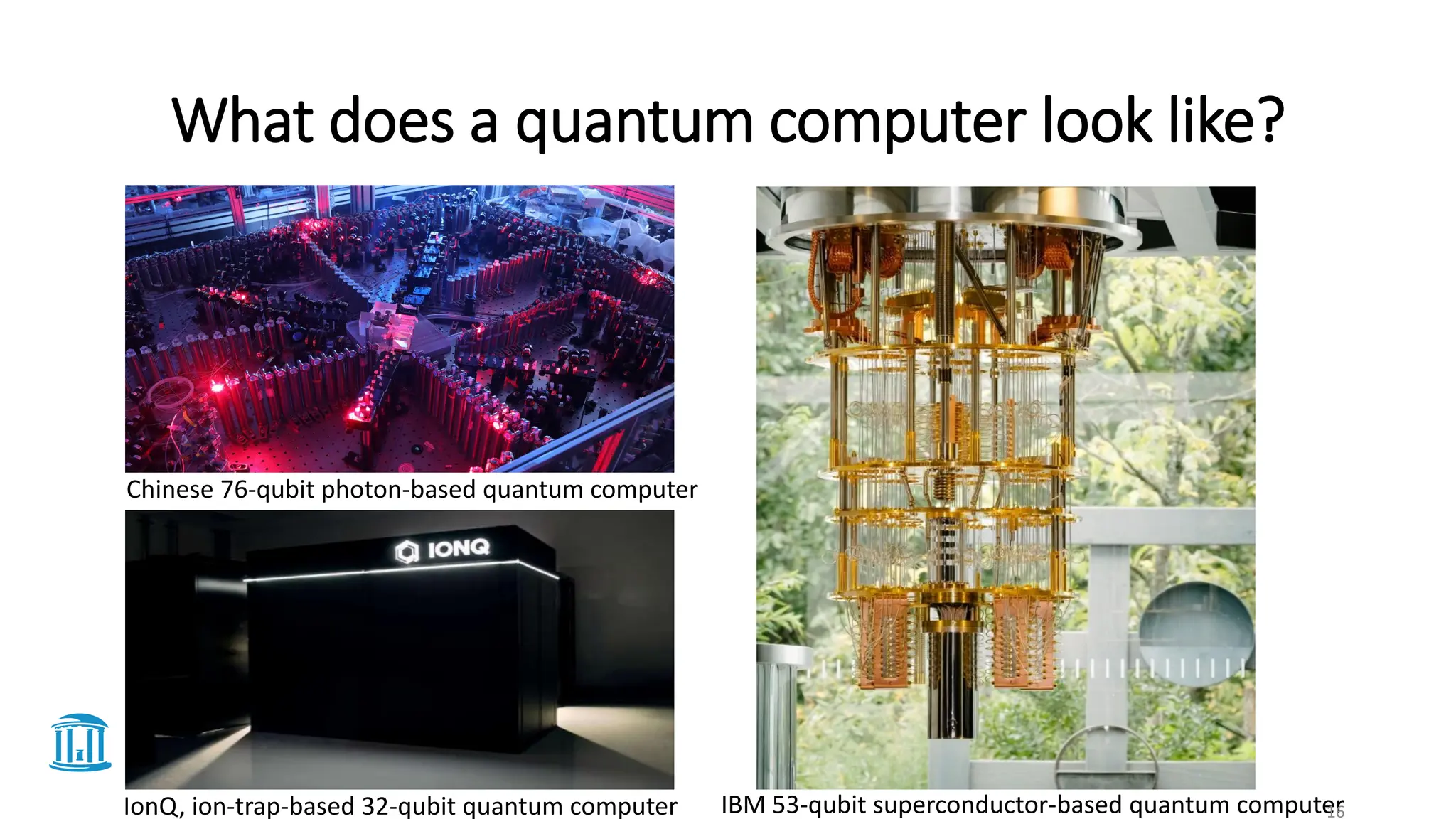
IBM 53-qubit superconductor-based quantum computer
Chinese 76-qubit photon-based quantum computer
IonQ, ion-trap-based 32-qubit quantum computer 16
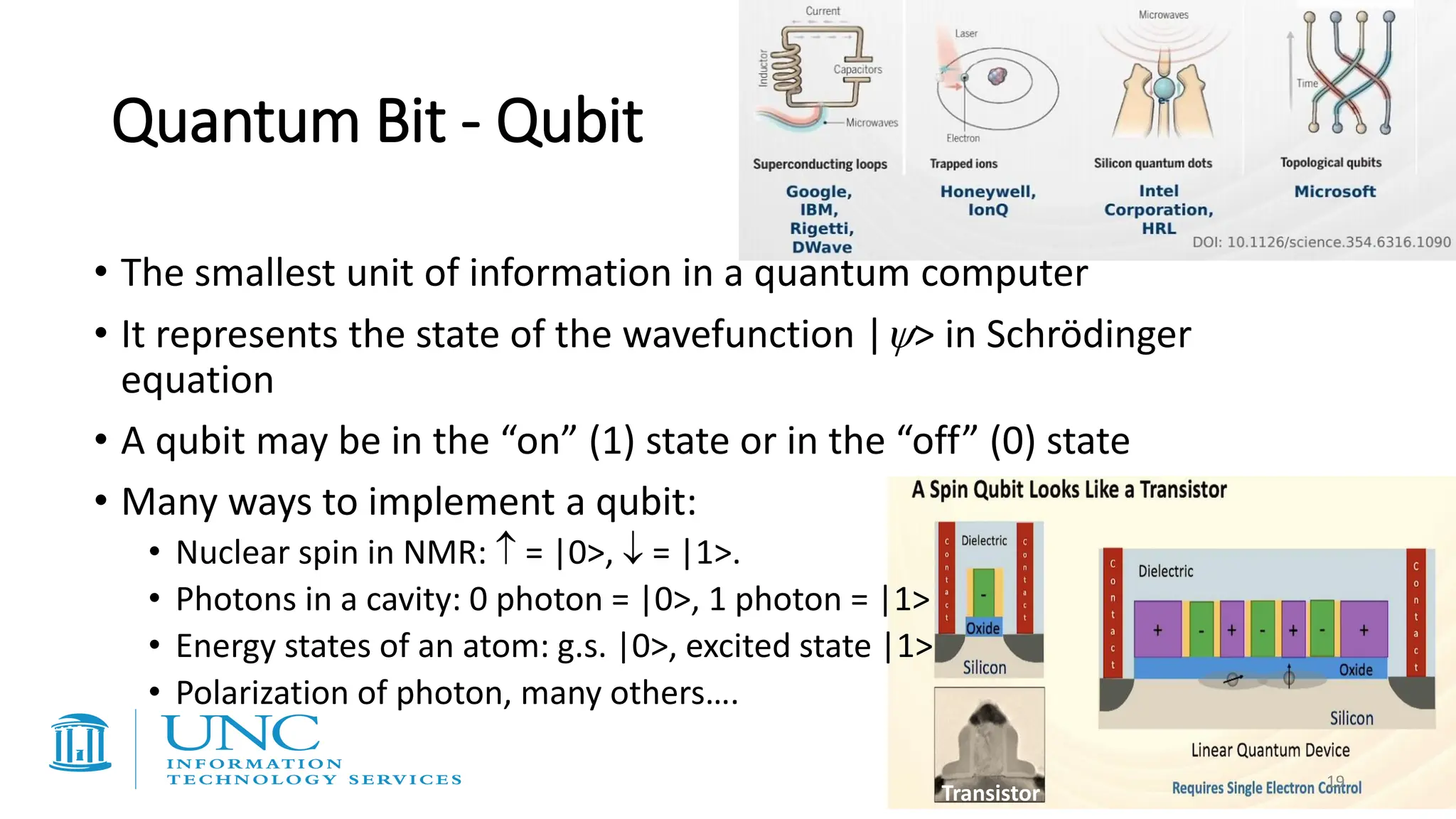
Quantum Bit -Qubit
• The smallest unit of information in a quantum computer
• It represents the state of the wavefunction |> in Schrödinger
equation
• A qubit may be in the “on” (1) state or in the “off” (0) state
• Many ways to implement a qubit:
• Nuclear spin in NMR: = |0>, = |1>.
• Photons in a cavity: 0 photon = |0>, 1 photon = |1>
• Energy states of an atom: g.s. |0>, excited state |1>
• Polarization of photon, many others….
Transistor
19
20.
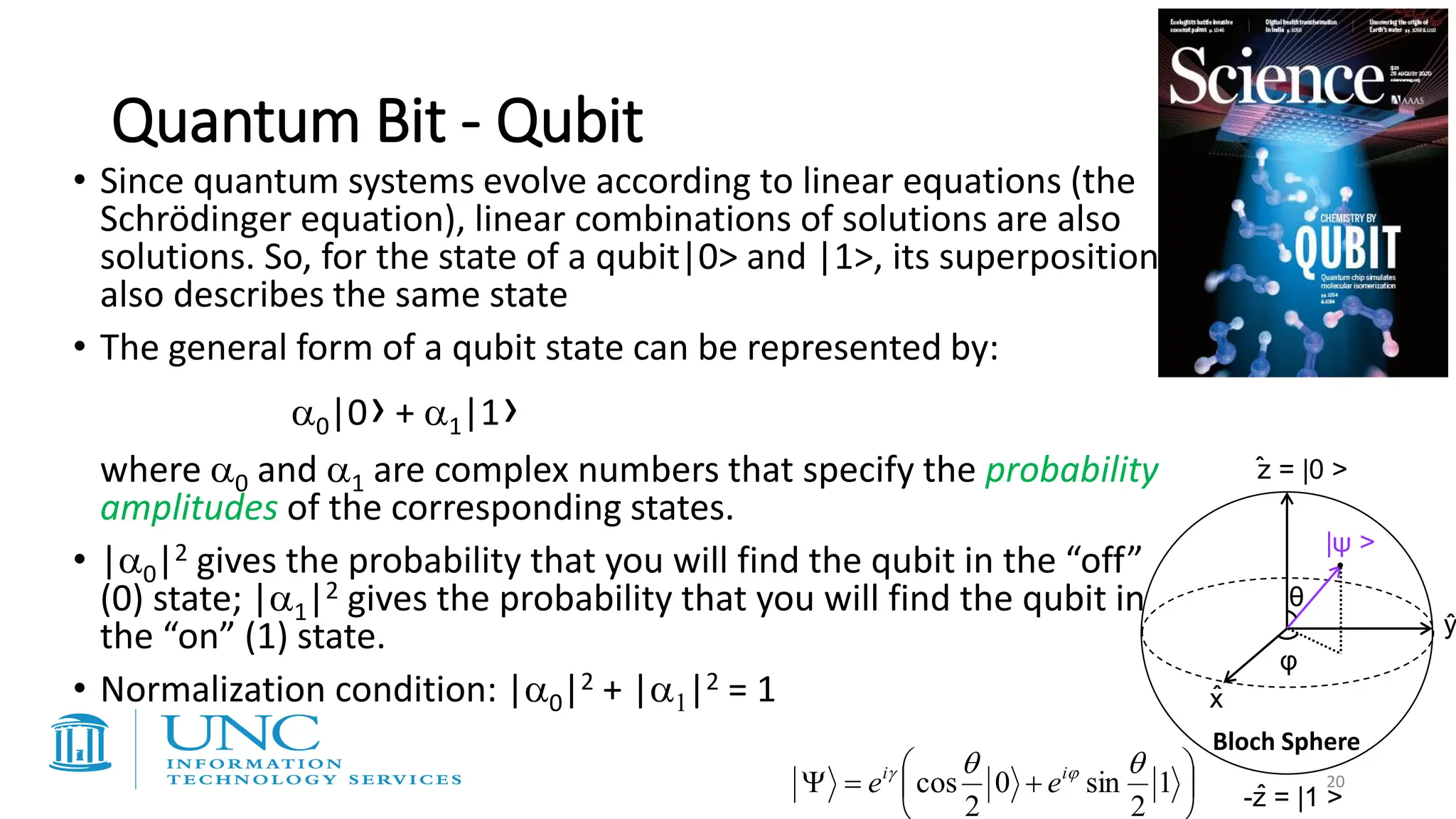
Quantum Bit -Qubit
z = |0 >
-z = |1 >
x
y
θ
φ
|ψ >
ˆ
ˆ
ˆ
ˆ
+
=
1
2
sin
0
2
cos
i
i
e
e
• Since quantum systems evolve according to linear equations (the
Schrödinger equation), linear combinations of solutions are also
solutions. So, for the state of a qubit|0> and |1>, its superposition
also describes the same state
• The general form of a qubit state can be represented by:
0|0› + 1|1›
where 0 and 1 are complex numbers that specify the probability
amplitudes of the corresponding states.
• |0|2 gives the probability that you will find the qubit in the “off”
(0) state; |1|2 gives the probability that you will find the qubit in
the “on” (1) state.
• Normalization condition: |0|2 + |1|2 = 1
20
Bloch Sphere
21.
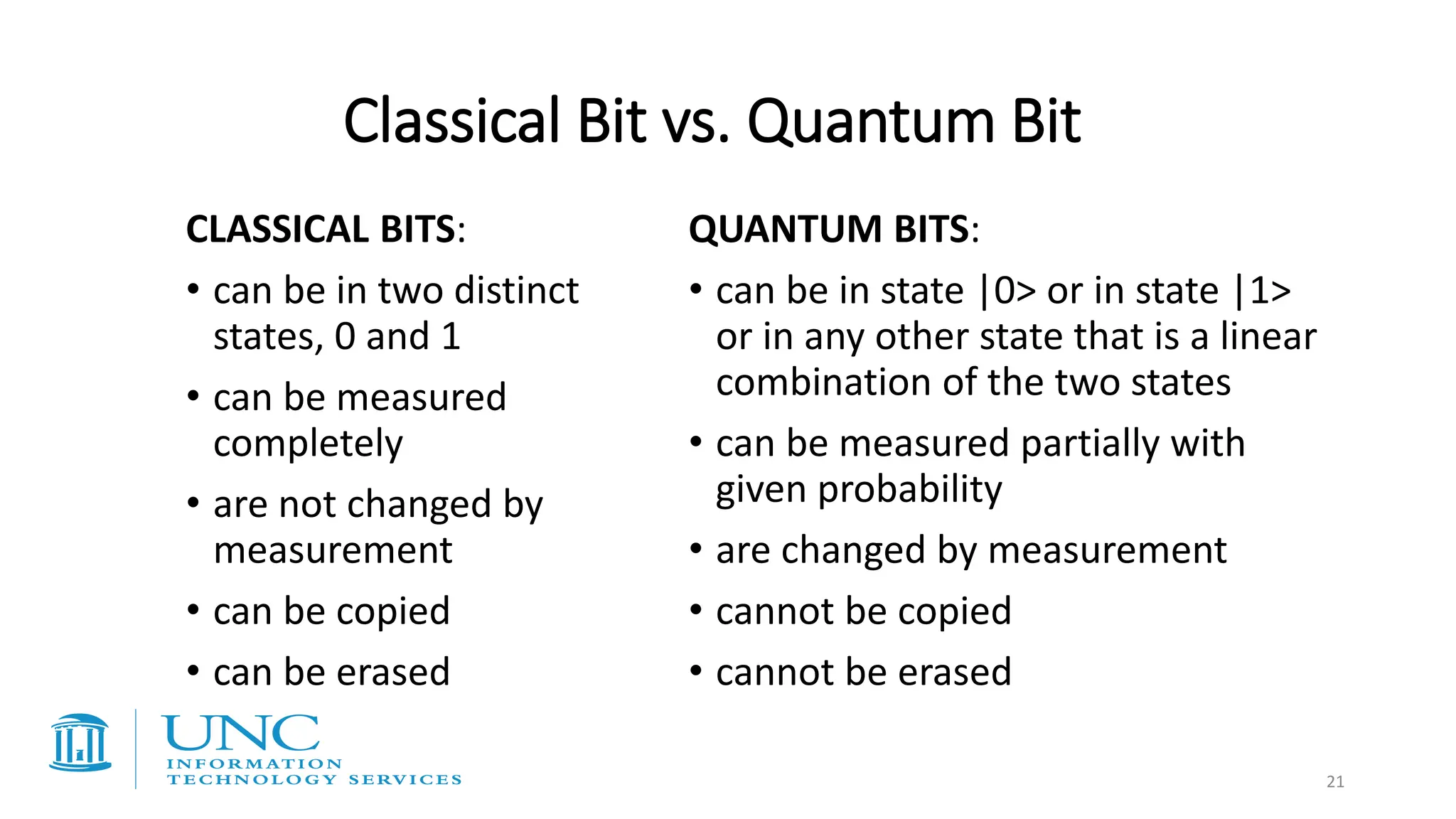
Classical Bit vs.Quantum Bit
CLASSICAL BITS:
• can be in two distinct
states, 0 and 1
• can be measured
completely
• are not changed by
measurement
• can be copied
• can be erased
QUANTUM BITS:
• can be in state |0> or in state |1>
or in any other state that is a linear
combination of the two states
• can be measured partially with
given probability
• are changed by measurement
• cannot be copied
• cannot be erased
21
22.
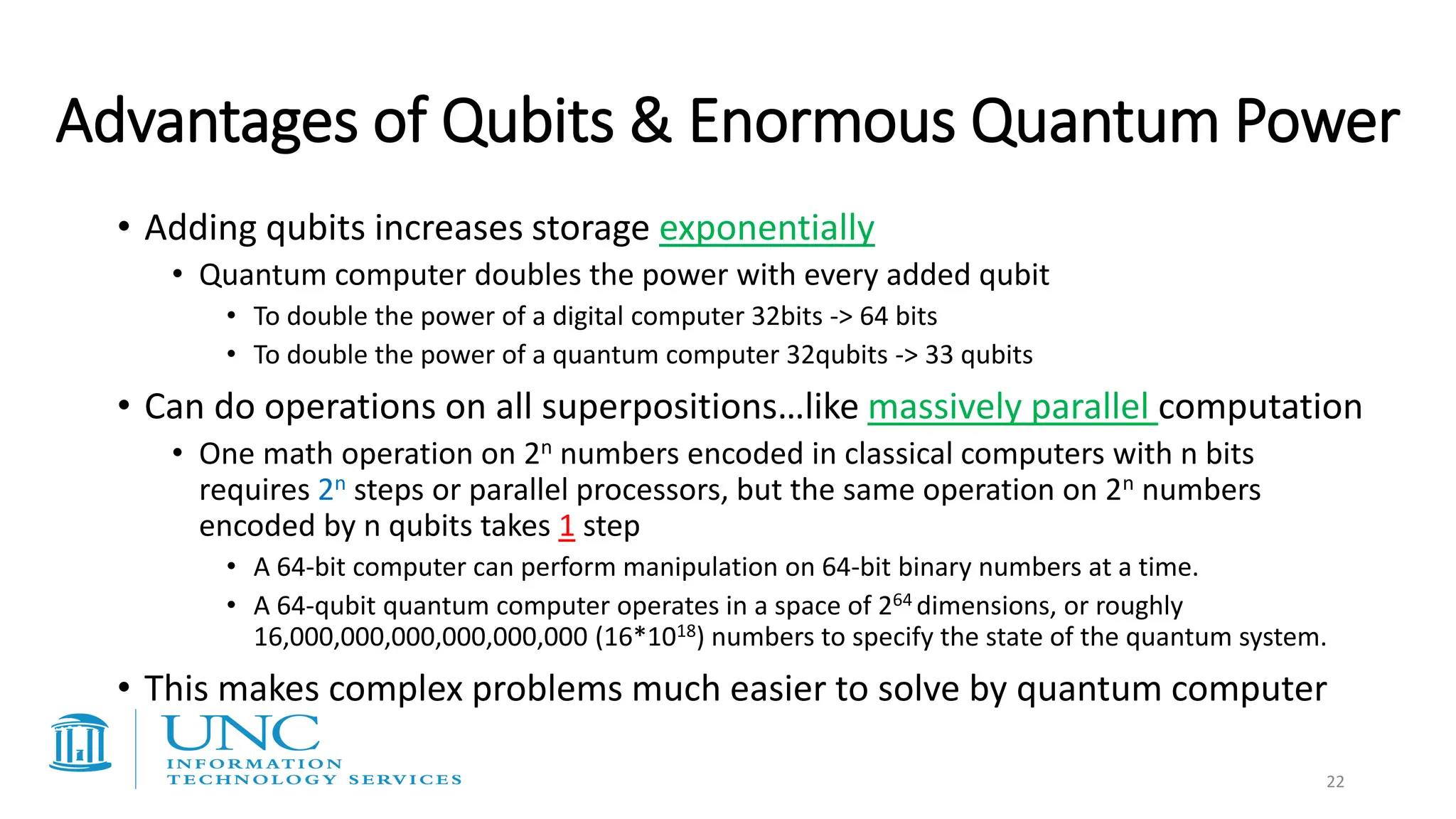
• Adding qubitsincreases storage exponentially
• Quantum computer doubles the power with every added qubit
• To double the power of a digital computer 32bits -> 64 bits
• To double the power of a quantum computer 32qubits -> 33 qubits
• Can do operations on all superpositions…like massively parallel computation
• One math operation on 2n numbers encoded in classical computers with n bits
requires 2n steps or parallel processors, but the same operation on 2n numbers
encoded by n qubits takes 1 step
• A 64-bit computer can perform manipulation on 64-bit binary numbers at a time.
• A 64-qubit quantum computer operates in a space of 264 dimensions, or roughly
16,000,000,000,000,000,000 (16*1018) numbers to specify the state of the quantum system.
• This makes complex problems much easier to solve by quantum computer
Advantages of Qubits & Enormous Quantum Power
22
23.
However, Quantum Systemsare SPOOKY!
Schrödinger’s Cat: Superposition
“I cannot seriously believe in [the quantum theory] because it cannot be
reconciled with the idea that physics should represent a reality in time and
space, free from spooky actions at a distance.” Albert Einstein, March 1947.
Entanglement
23
Schrödinger’s
Cat in a black
box
24.
Superposition
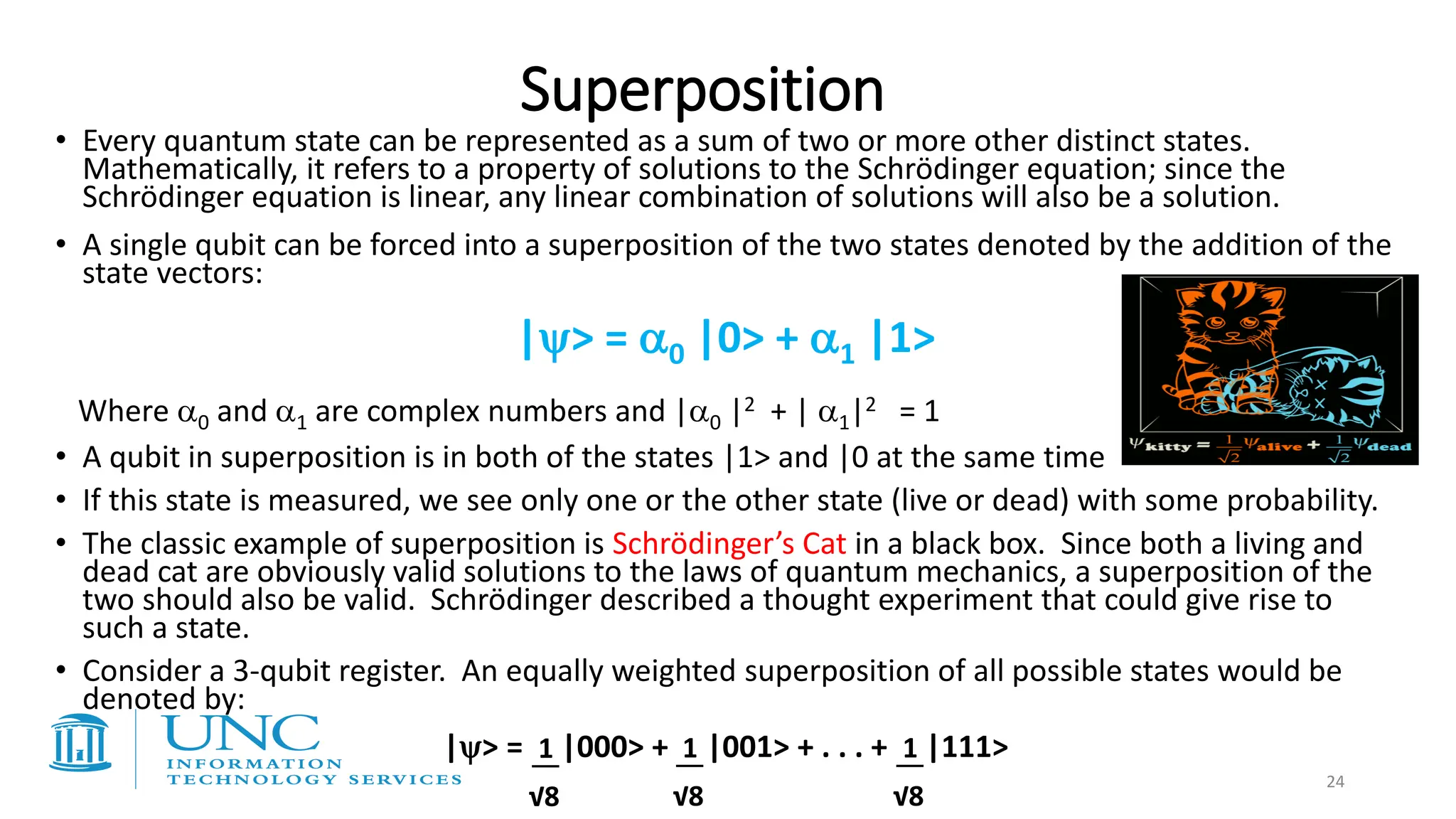
• Every quantumstate can be represented as a sum of two or more other distinct states.
Mathematically, it refers to a property of solutions to the Schrödinger equation; since the
Schrödinger equation is linear, any linear combination of solutions will also be a solution.
• A single qubit can be forced into a superposition of the two states denoted by the addition of the
state vectors:
|> = 0 |0> + 1 |1>
Where 0 and 1 are complex numbers and |0 |2 + | 1|2 = 1
• A qubit in superposition is in both of the states |1> and |0 at the same time
• If this state is measured, we see only one or the other state (live or dead) with some probability.
• The classic example of superposition is Schrödinger’s Cat in a black box. Since both a living and
dead cat are obviously valid solutions to the laws of quantum mechanics, a superposition of the
two should also be valid. Schrödinger described a thought experiment that could give rise to
such a state.
• Consider a 3-qubit register. An equally weighted superposition of all possible states would be
denoted by:
|> = |000> + |001> + . . . + |111>
1
√8
1
√8
1
√8
24
25.
Entanglement
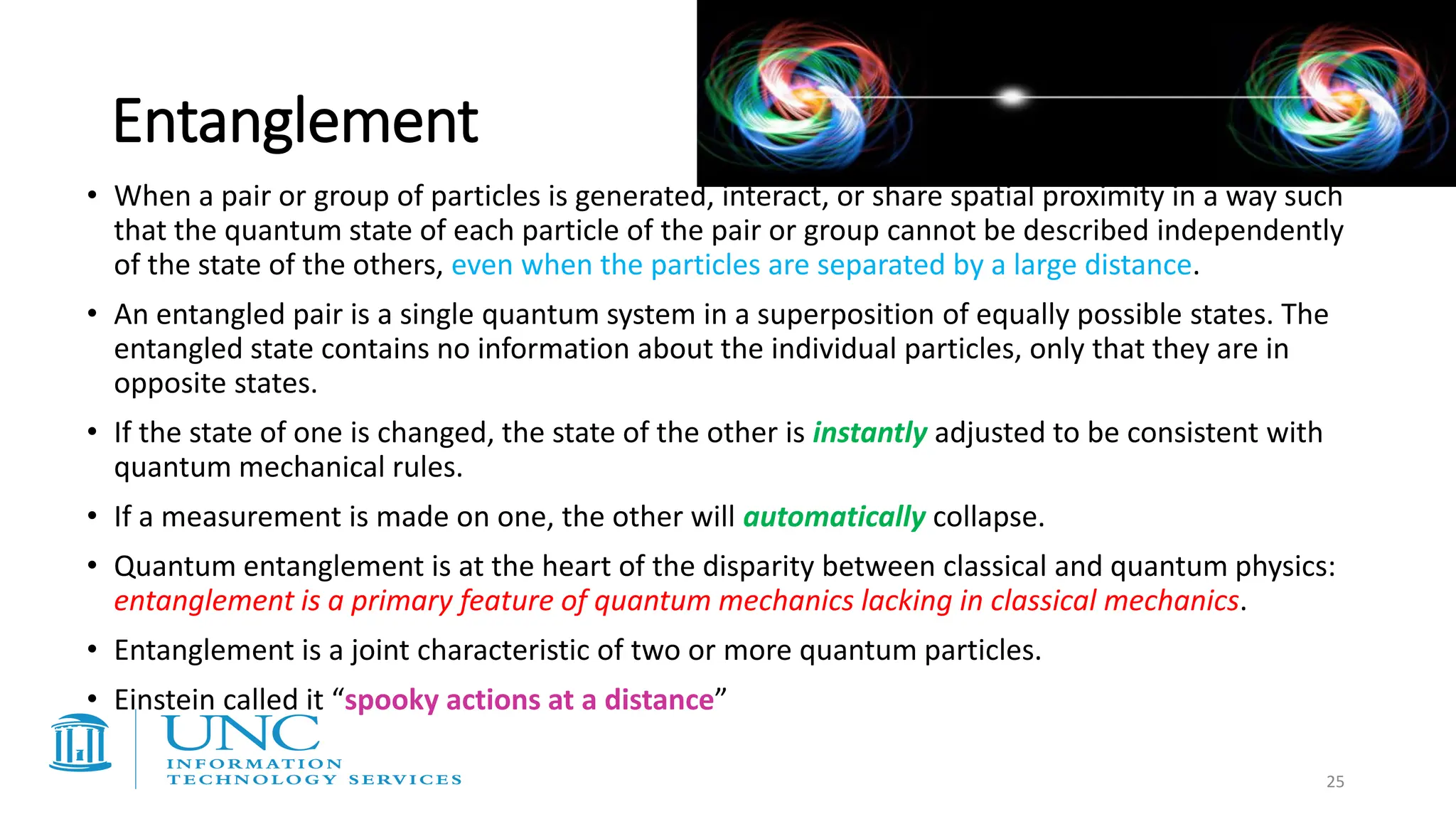
• When apair or group of particles is generated, interact, or share spatial proximity in a way such
that the quantum state of each particle of the pair or group cannot be described independently
of the state of the others, even when the particles are separated by a large distance.
• An entangled pair is a single quantum system in a superposition of equally possible states. The
entangled state contains no information about the individual particles, only that they are in
opposite states.
• If the state of one is changed, the state of the other is instantly adjusted to be consistent with
quantum mechanical rules.
• If a measurement is made on one, the other will automatically collapse.
• Quantum entanglement is at the heart of the disparity between classical and quantum physics:
entanglement is a primary feature of quantum mechanics lacking in classical mechanics.
• Entanglement is a joint characteristic of two or more quantum particles.
• Einstein called it “spooky actions at a distance”
25
26.
26
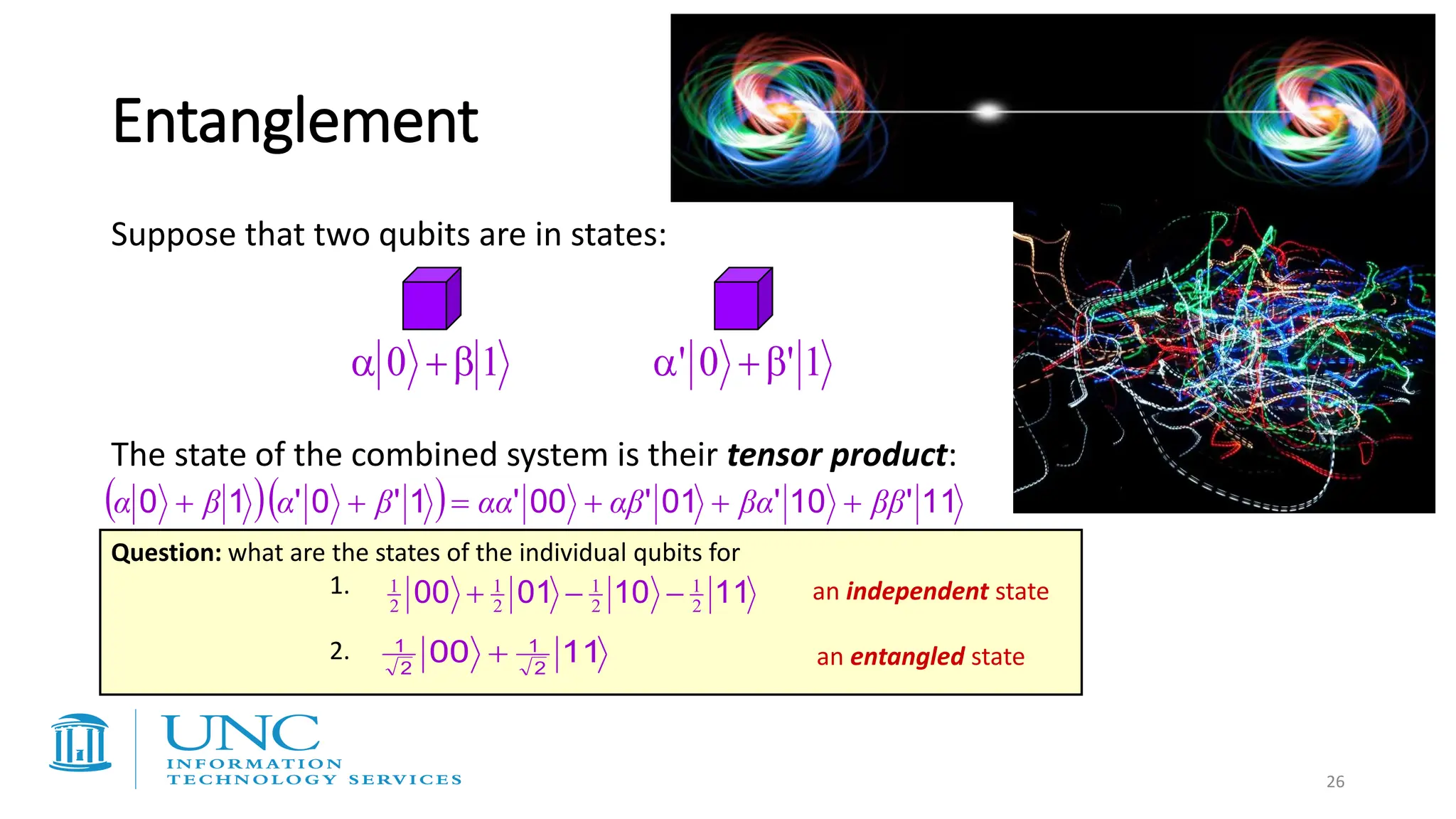
( )( )11
'
10
'
01
'
00
'
1
'
0
'
1
0 ββ
βα
αβ
αα
β
α
β
α +
+
+
=
+
+
The state of the combined system is their tensor product:
Suppose that two qubits are in states:
1
0
+
1
'
0
'
+
Entanglement
11
10
01
00 2
1
2
1
2
1
2
1
−
−
+
Question: what are the states of the individual qubits for
1.
2. 11
00 2
1
2
1
+ an entangled state
an independent state
27.
Decoherence
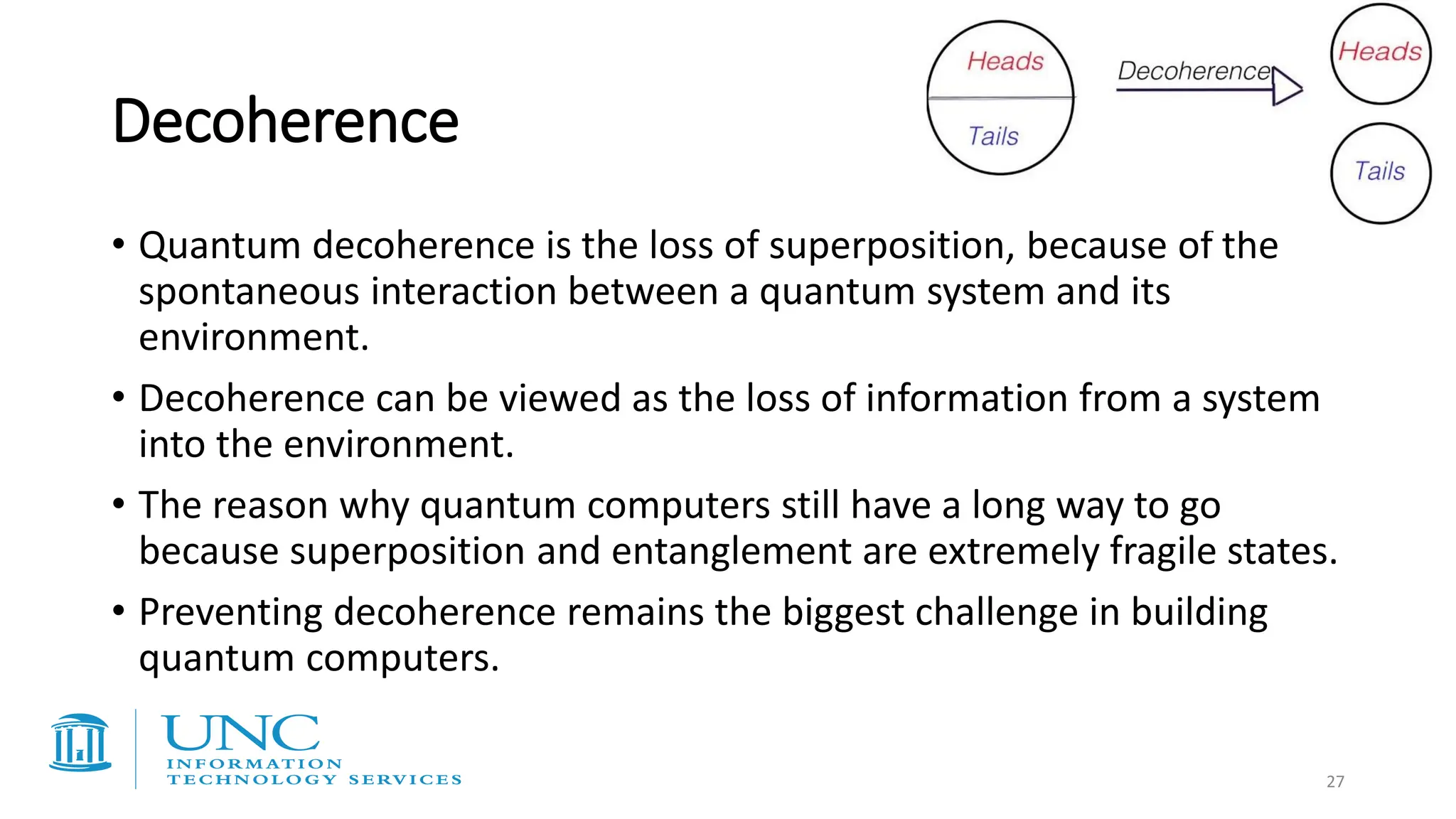
• Quantum decoherenceis the loss of superposition, because of the
spontaneous interaction between a quantum system and its
environment.
• Decoherence can be viewed as the loss of information from a system
into the environment.
• The reason why quantum computers still have a long way to go
because superposition and entanglement are extremely fragile states.
• Preventing decoherence remains the biggest challenge in building
quantum computers.
27
28.
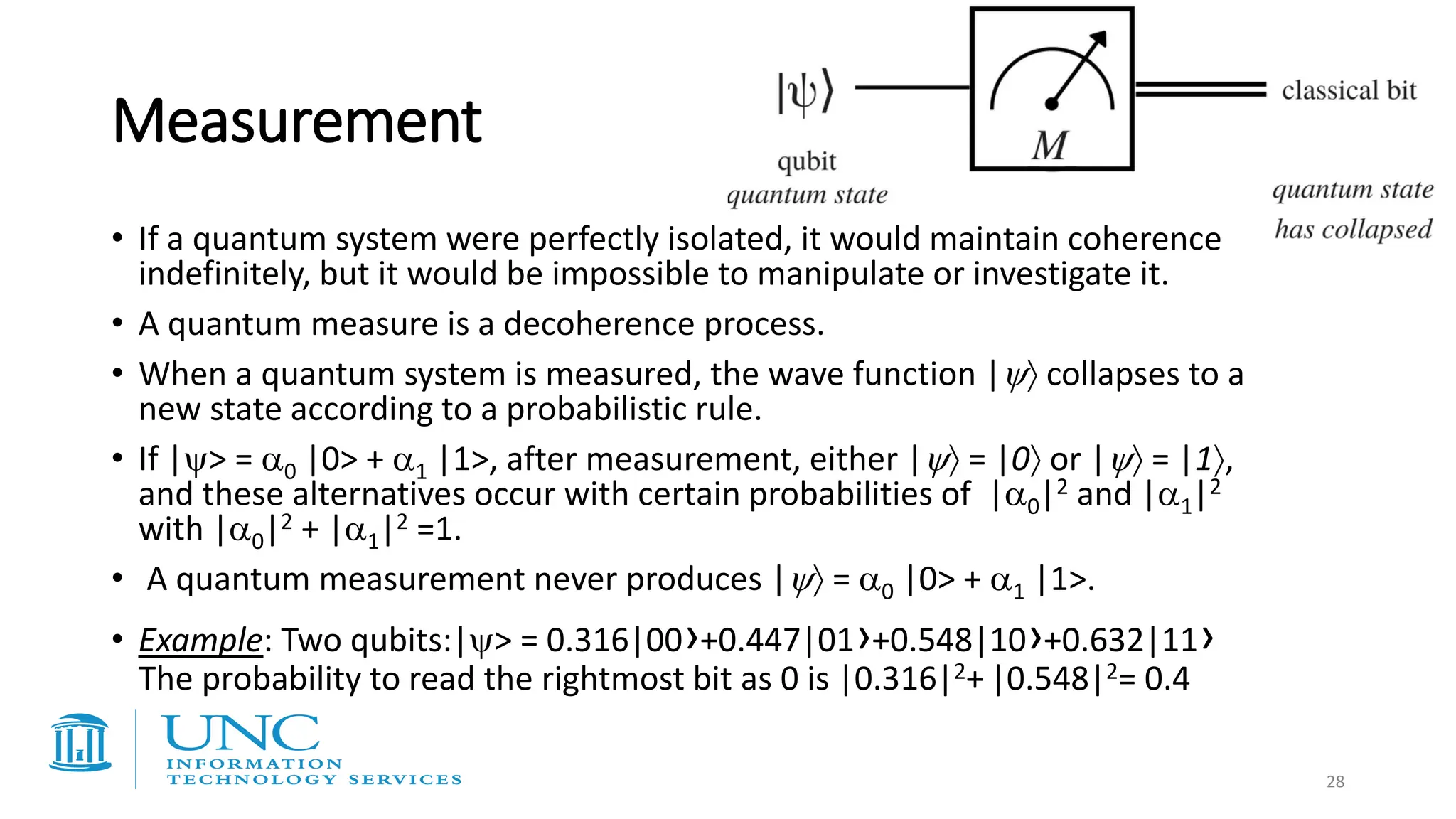
Measurement
• If aquantum system were perfectly isolated, it would maintain coherence
indefinitely, but it would be impossible to manipulate or investigate it.
• A quantum measure is a decoherence process.
• When a quantum system is measured, the wave function | collapses to a
new state according to a probabilistic rule.
• If |> = 0 |0> + 1 |1>, after measurement, either | = |0 or | = |1,
and these alternatives occur with certain probabilities of |0|2 and |1|2
with |0|2 + |1|2 =1.
• A quantum measurement never produces | = 0 |0> + 1 |1>.
• Example: Two qubits:|> = 0.316|00›+0.447|01›+0.548|10›+0.632|11›
The probability to read the rightmost bit as 0 is |0.316|2+ |0.548|2= 0.4
28
29.
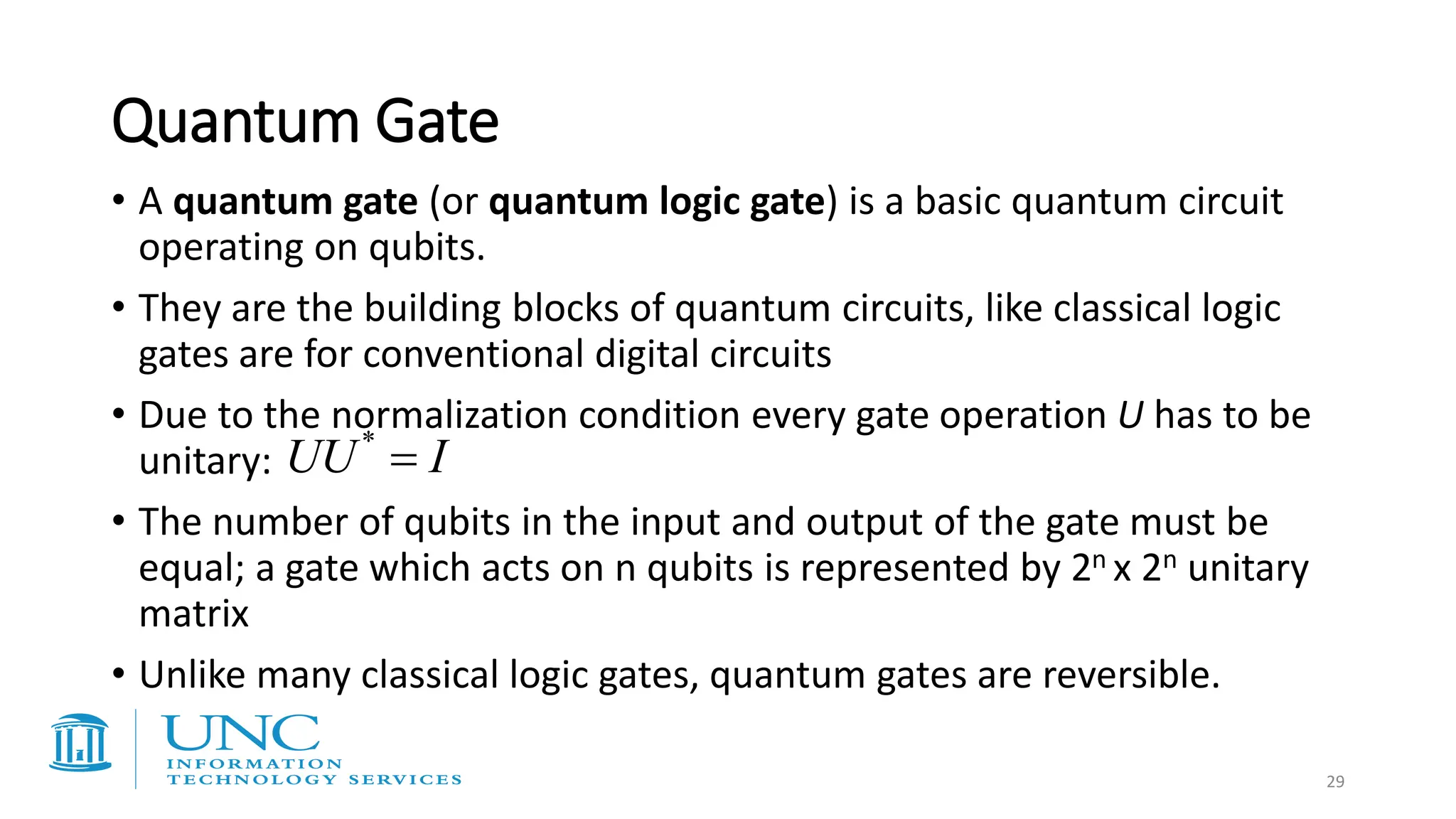
Quantum Gate
• Aquantum gate (or quantum logic gate) is a basic quantum circuit
operating on qubits.
• They are the building blocks of quantum circuits, like classical logic
gates are for conventional digital circuits
• Due to the normalization condition every gate operation U has to be
unitary:
• The number of qubits in the input and output of the gate must be
equal; a gate which acts on n qubits is represented by 2n x 2n unitary
matrix
• Unlike many classical logic gates, quantum gates are reversible.
I
UU =
*
29
30.
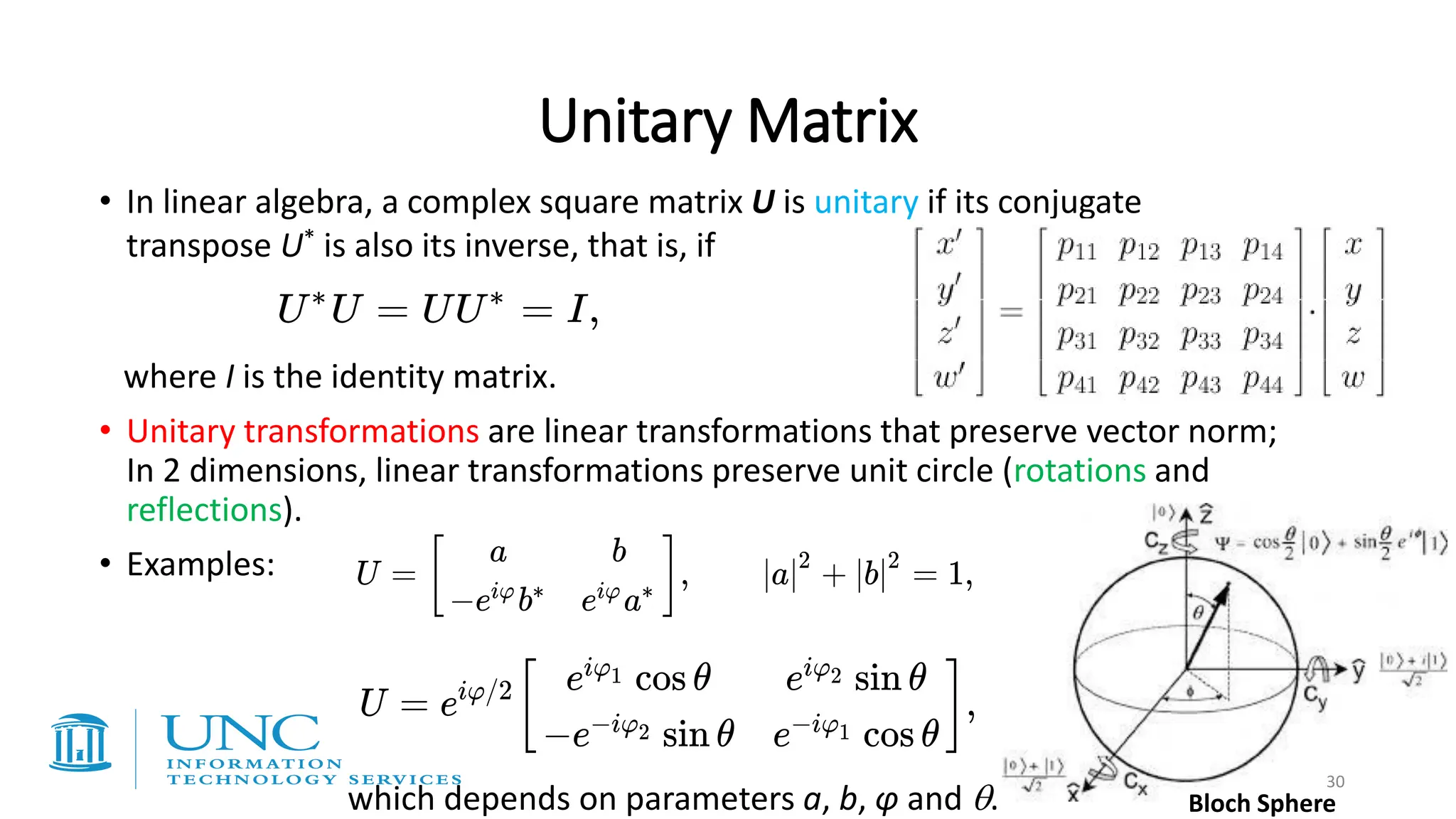
Unitary Matrix
• Inlinear algebra, a complex square matrix U is unitary if its conjugate
transpose U* is also its inverse, that is, if
where I is the identity matrix.
• Unitary transformations are linear transformations that preserve vector norm;
In 2 dimensions, linear transformations preserve unit circle (rotations and
reflections).
• Examples:
which depends on parameters a, b, φ and . Bloch Sphere
30
31.
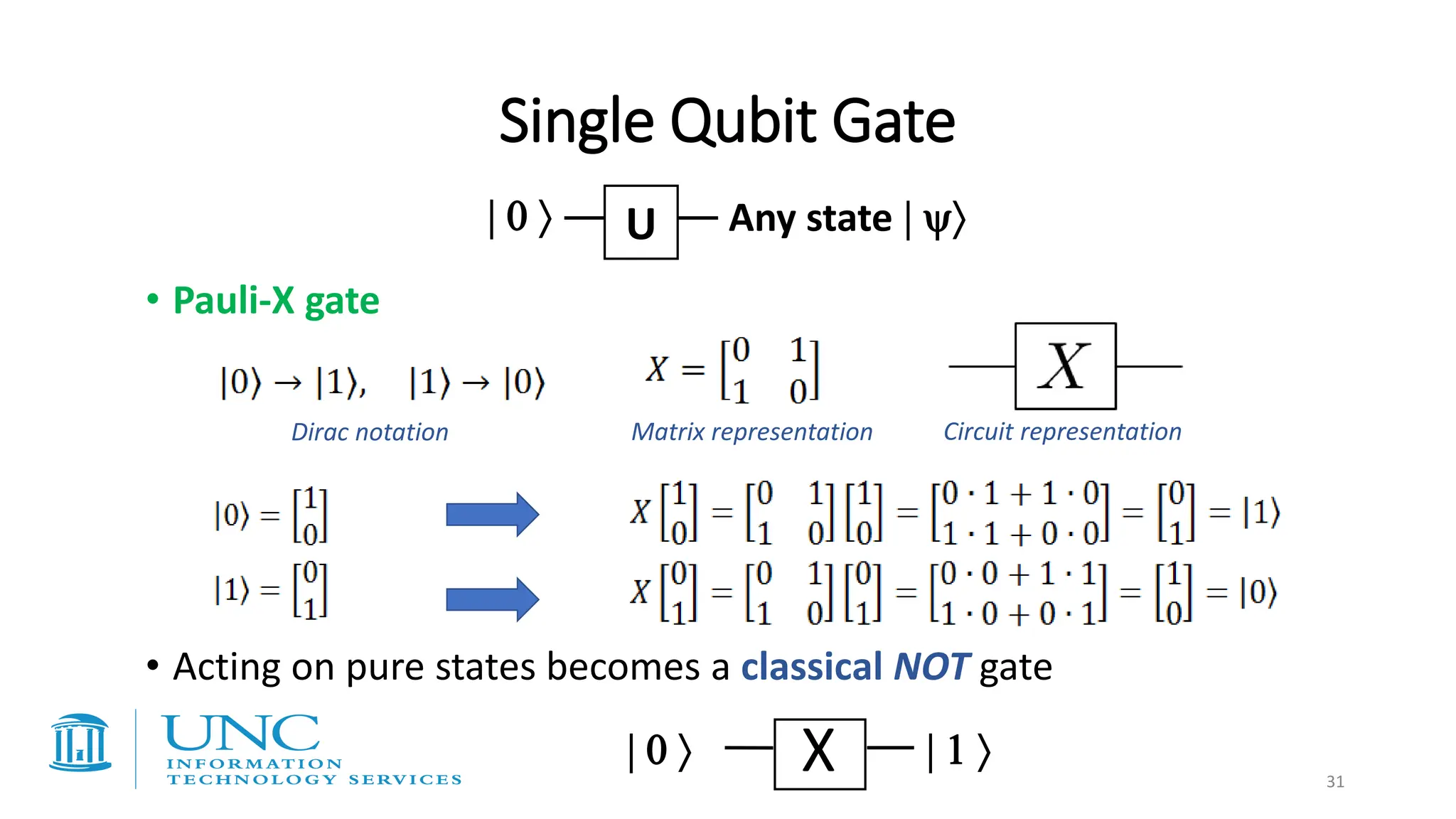
Single Qubit Gate
•Pauli-X gate
• Acting on pure states becomes a classical NOT gate
U
| 0 Any state |
X
| 0 | 1
Dirac notation Matrix representation Circuit representation
31
32.
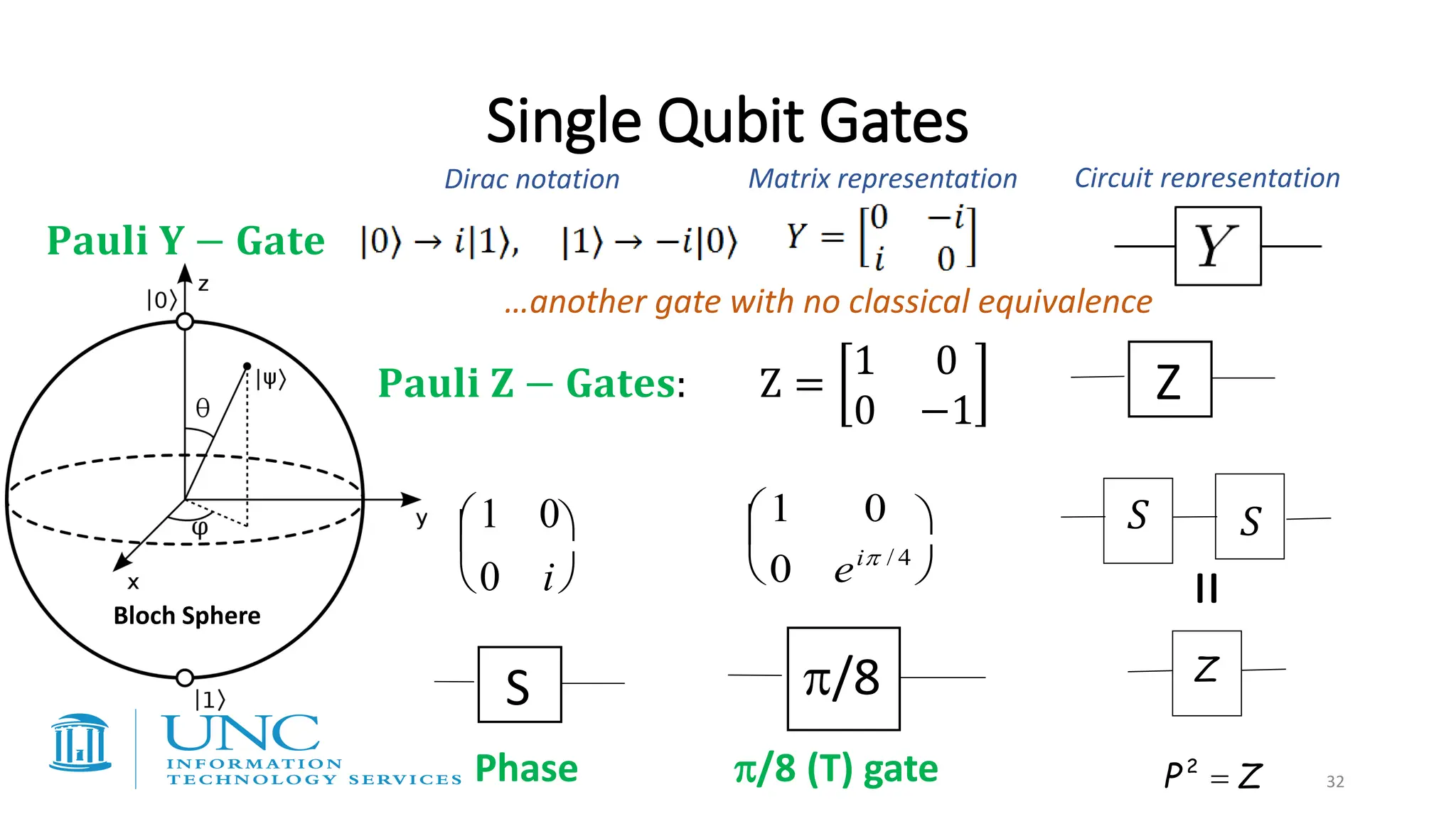
Single Qubit Gates
Diracnotation Matrix representation Circuit representation
…another gate with no classical equivalence
1 0
0 i
S /8
1 0
0 ei / 4
Phase /8 (T) gate
𝐏𝐚𝐮𝐥𝐢 𝐙 − 𝐆𝐚𝐭𝐞𝐬: Z =
1 0
0 −1
𝑆 𝑆
Z
=
2
P Z
=
𝐏𝐚𝐮𝐥𝐢 𝐘 − 𝐆𝐚𝐭𝐞
Z
Bloch Sphere
32
33.
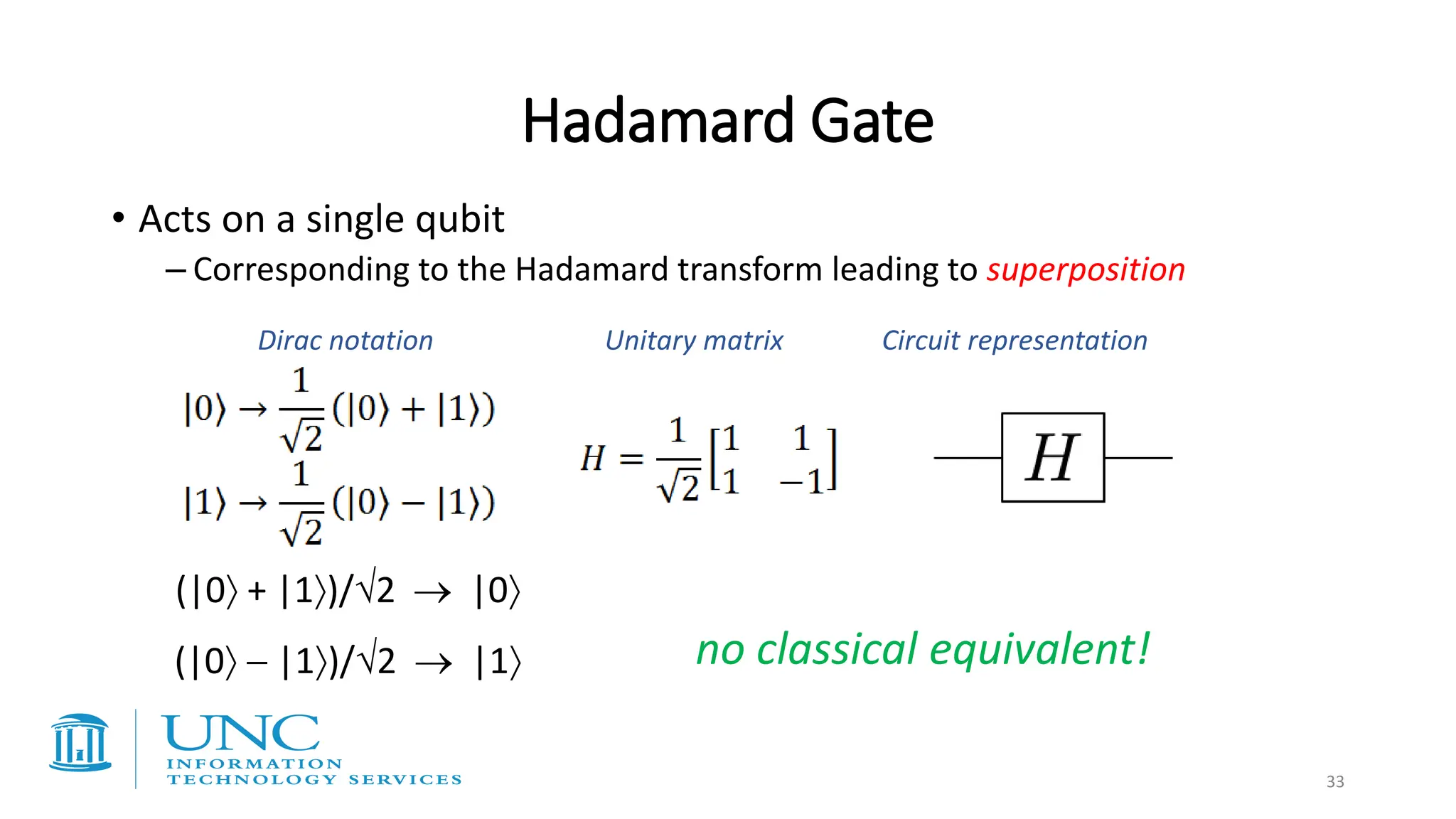
Hadamard Gate
• Actson a single qubit
– Corresponding to the Hadamard transform leading to superposition
Dirac notation Unitary matrix Circuit representation
no classical equivalent!
(|0 + |1)/2 → |0
(|0 − |1)/2 → |1
33
34.
The Amazing H-Gate
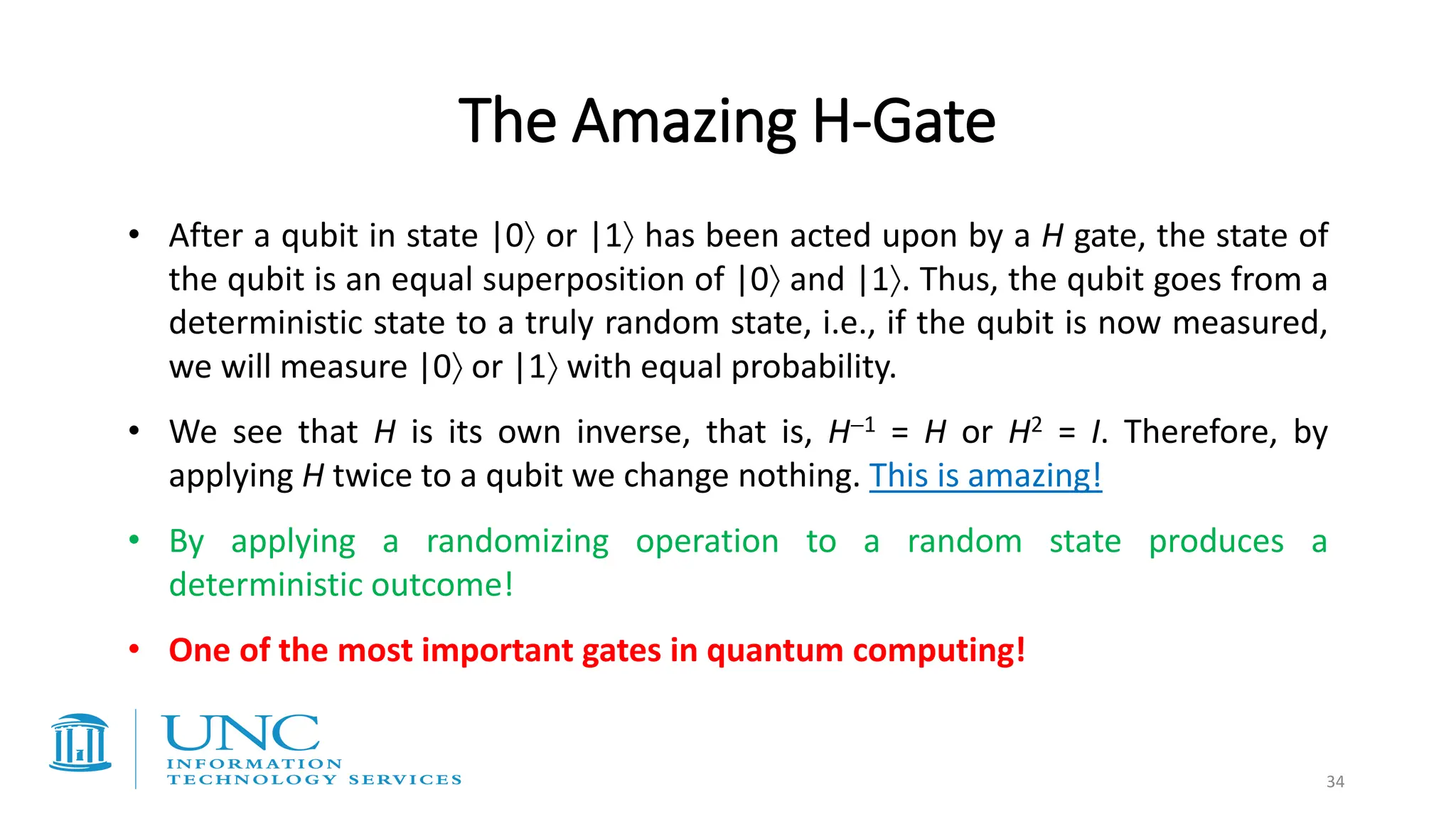
•After a qubit in state |0 or |1 has been acted upon by a H gate, the state of
the qubit is an equal superposition of |0 and |1. Thus, the qubit goes from a
deterministic state to a truly random state, i.e., if the qubit is now measured,
we will measure |0 or |1 with equal probability.
• We see that H is its own inverse, that is, H−1 = H or H2 = I. Therefore, by
applying H twice to a qubit we change nothing. This is amazing!
• By applying a randomizing operation to a random state produces a
deterministic outcome!
• One of the most important gates in quantum computing!
34
35.
CNOT Gate
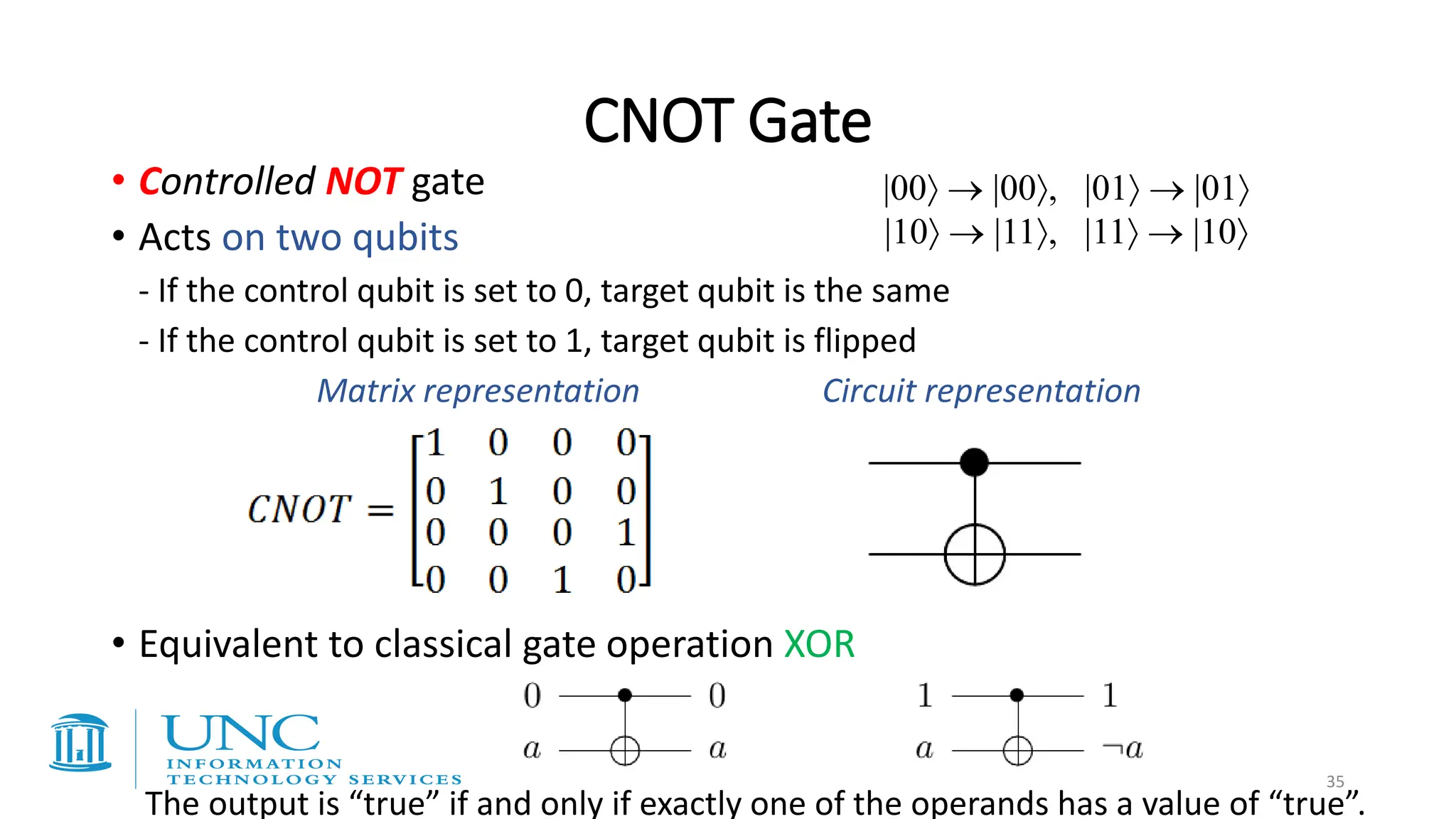
• ControlledNOT gate
• Acts on two qubits
- If the control qubit is set to 0, target qubit is the same
- If the control qubit is set to 1, target qubit is flipped
• Equivalent to classical gate operation XOR
Matrix representation Circuit representation
|00 → |00, |01 → |01
|10 → |11, |11 → |10
The output is “true” if and only if exactly one of the operands has a value of “true”.
35
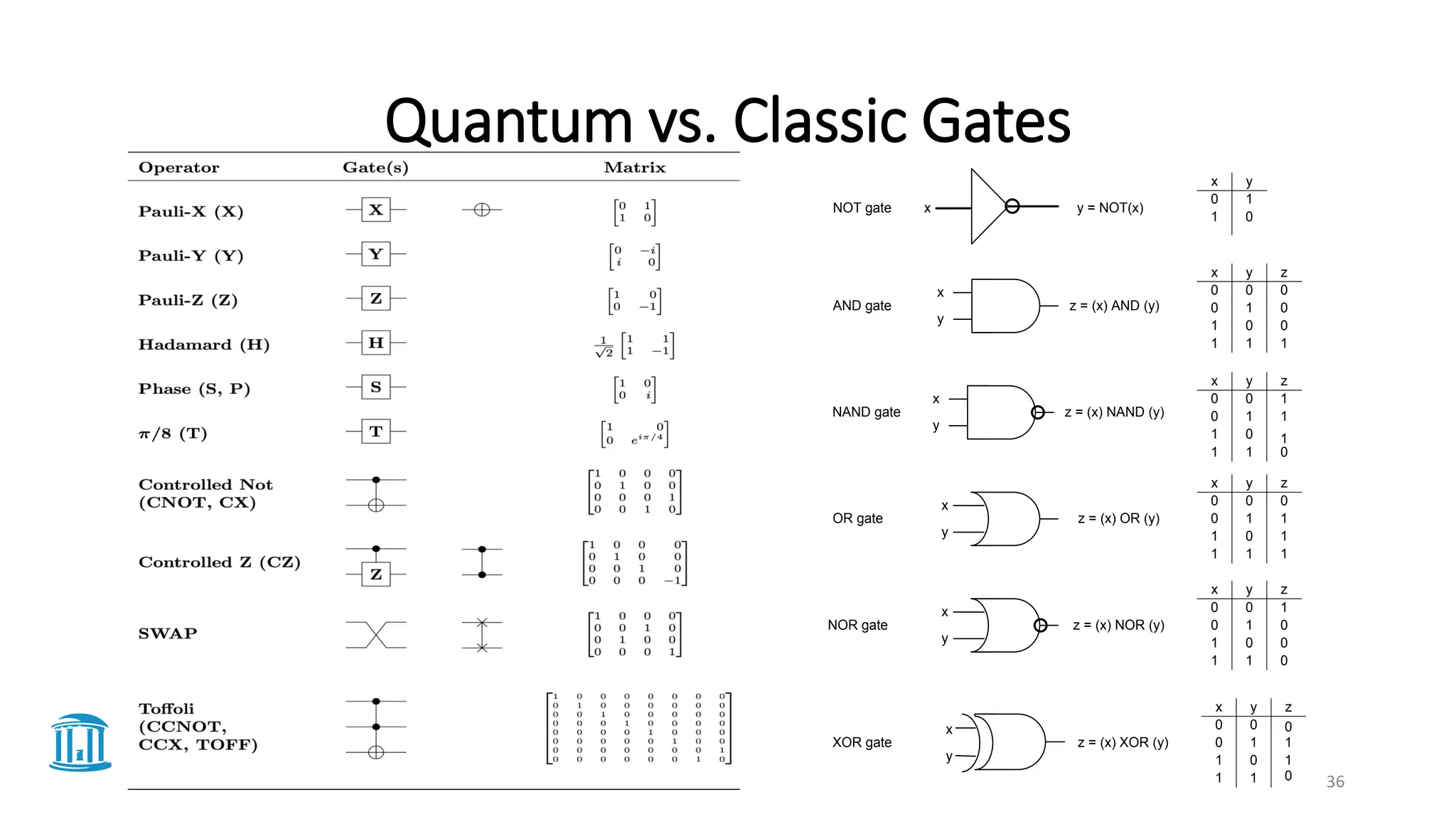
36.
Quantum vs. ClassicGates
NOT gate
AND gate
x y = NOT(x)
x y z
0
1
1
1 1 1
0 0
0 0
0 0
x y z
0
1
1
1 1
1
0
0
0
0
NAND gate
x
y
z = (x) AND (y)
x
y
z = (x) NAND (y) 1
1
x y
0
0
1
1
0
1
1
x y z
0
1
1
1 1
1
0
0
0
x
y
z = (x) OR (y)
OR gate
x y z
0
1
1
1 1
1
0
0
0
x
y
z = (x) NOR (y)
NOR gate 0
0
0
x y z
0
1
1
1 1
1
0
0
0
x
y
z = (x) XOR (y)
XOR gate
1
0
0 36
37.
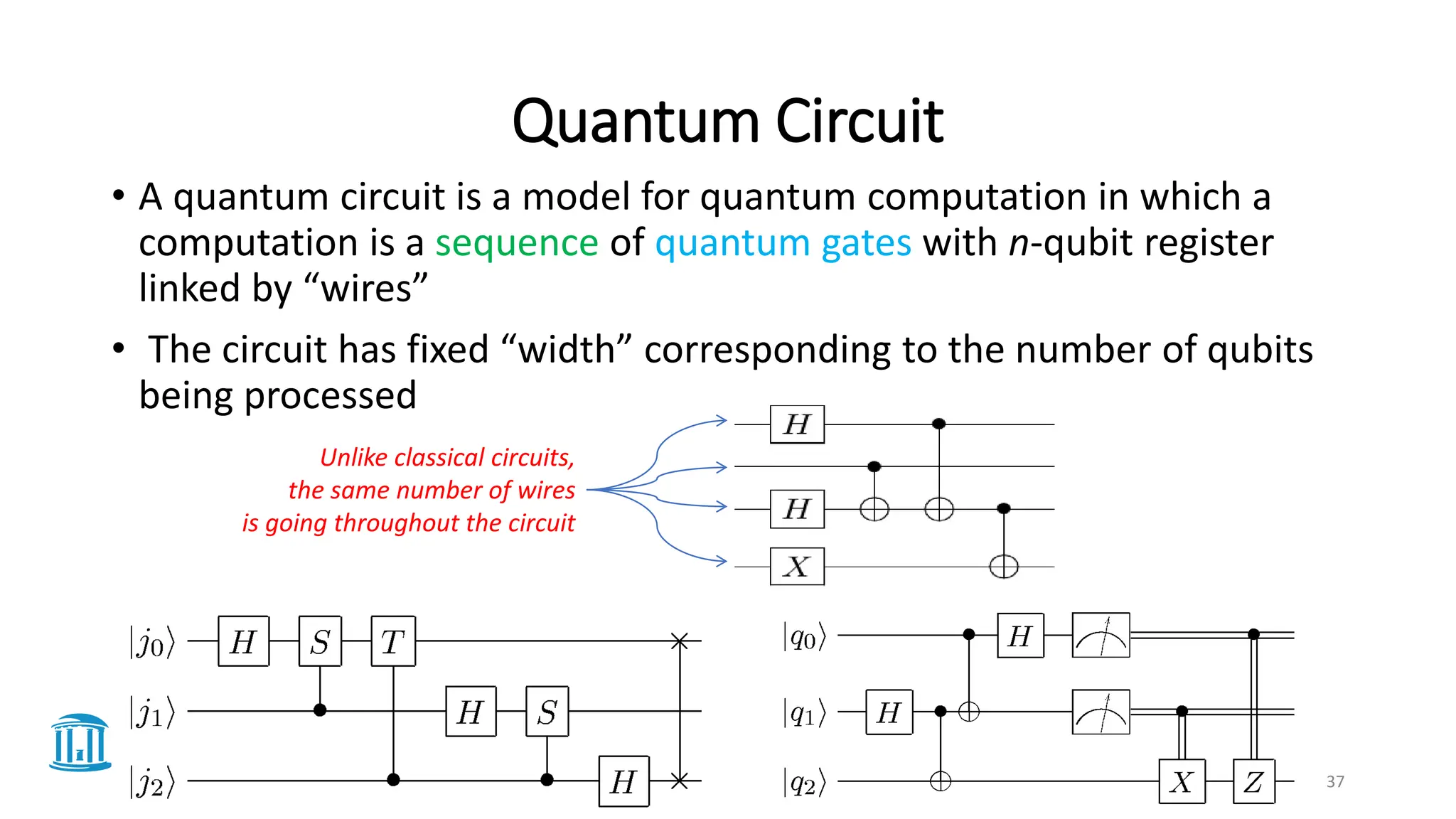
Quantum Circuit
• Aquantum circuit is a model for quantum computation in which a
computation is a sequence of quantum gates with n-qubit register
linked by “wires”
• The circuit has fixed “width” corresponding to the number of qubits
being processed
Unlike classical circuits,
the same number of wires
is going throughout the circuit
37
38.
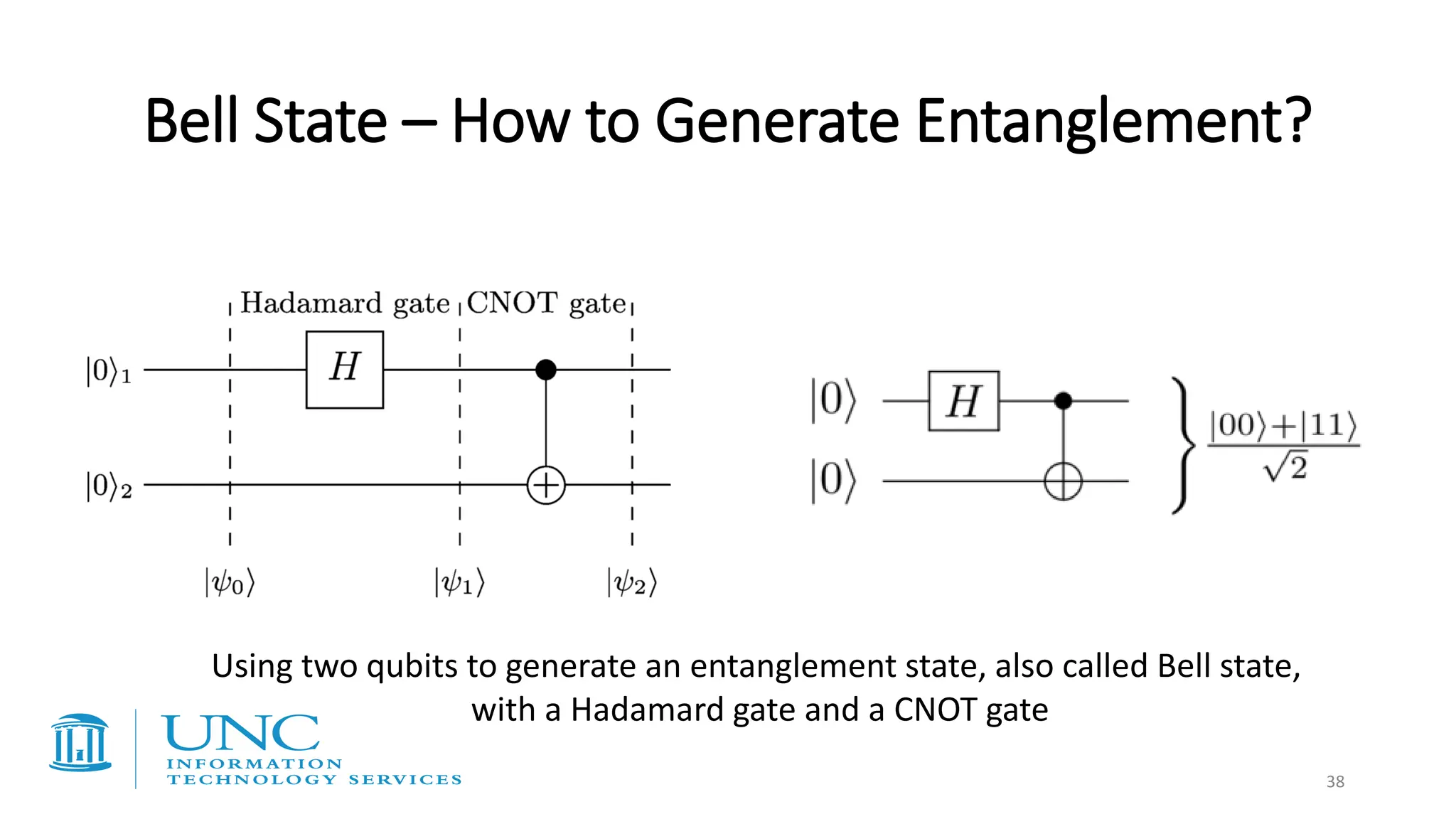
Bell State –How to Generate Entanglement?
38
Using two qubits to generate an entanglement state, also called Bell state,
with a Hadamard gate and a CNOT gate
39.
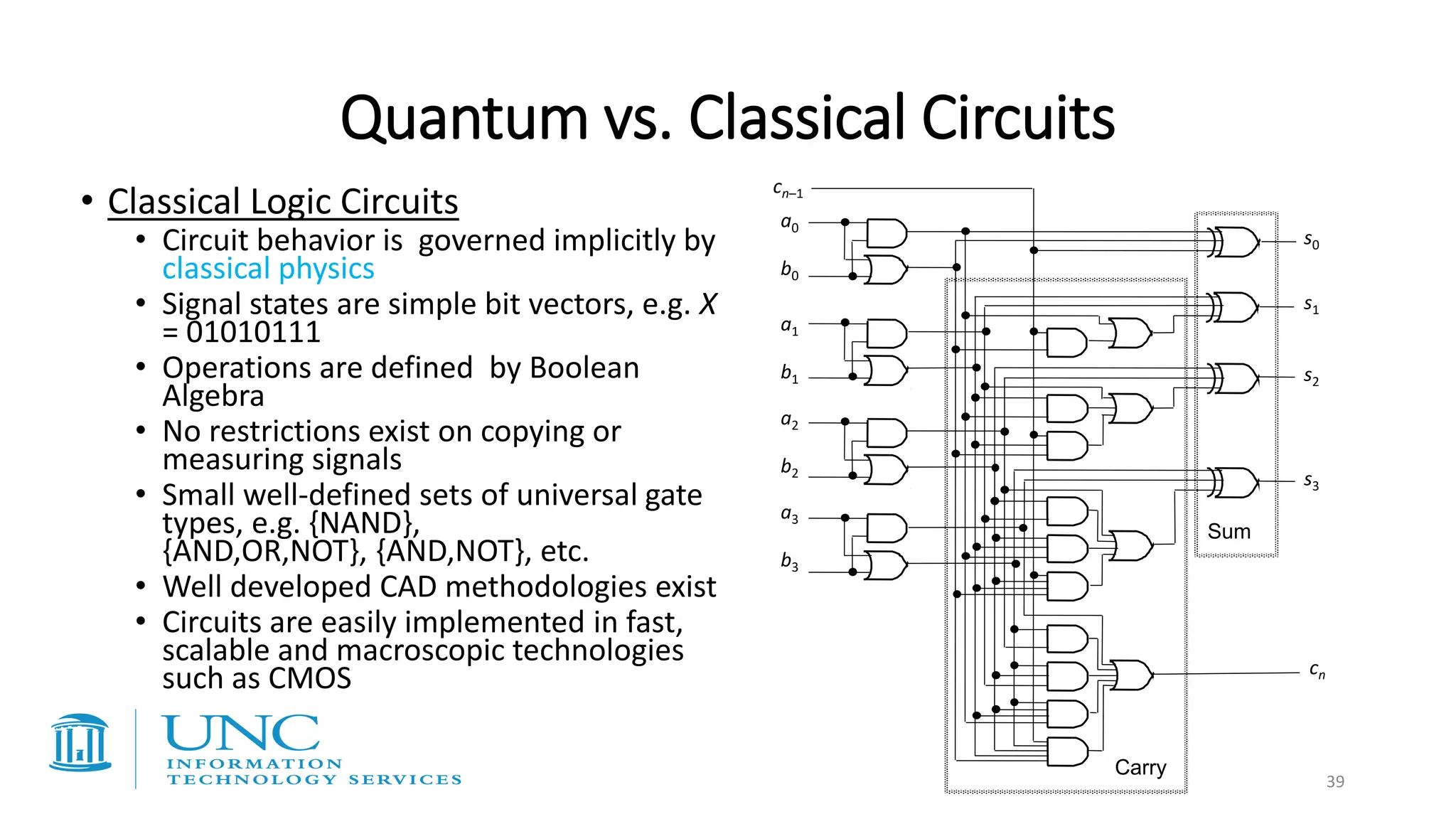
Quantum vs. ClassicalCircuits
cn–1
s0
s1
s2
s3
cn
a0
b0
a1
b1
a3
b3
a2
b2
Sum
Carry
• Classical Logic Circuits
• Circuit behavior is governed implicitly by
classical physics
• Signal states are simple bit vectors, e.g. X
= 01010111
• Operations are defined by Boolean
Algebra
• No restrictions exist on copying or
measuring signals
• Small well-defined sets of universal gate
types, e.g. {NAND},
{AND,OR,NOT}, {AND,NOT}, etc.
• Well developed CAD methodologies exist
• Circuits are easily implemented in fast,
scalable and macroscopic technologies
such as CMOS
39
40.
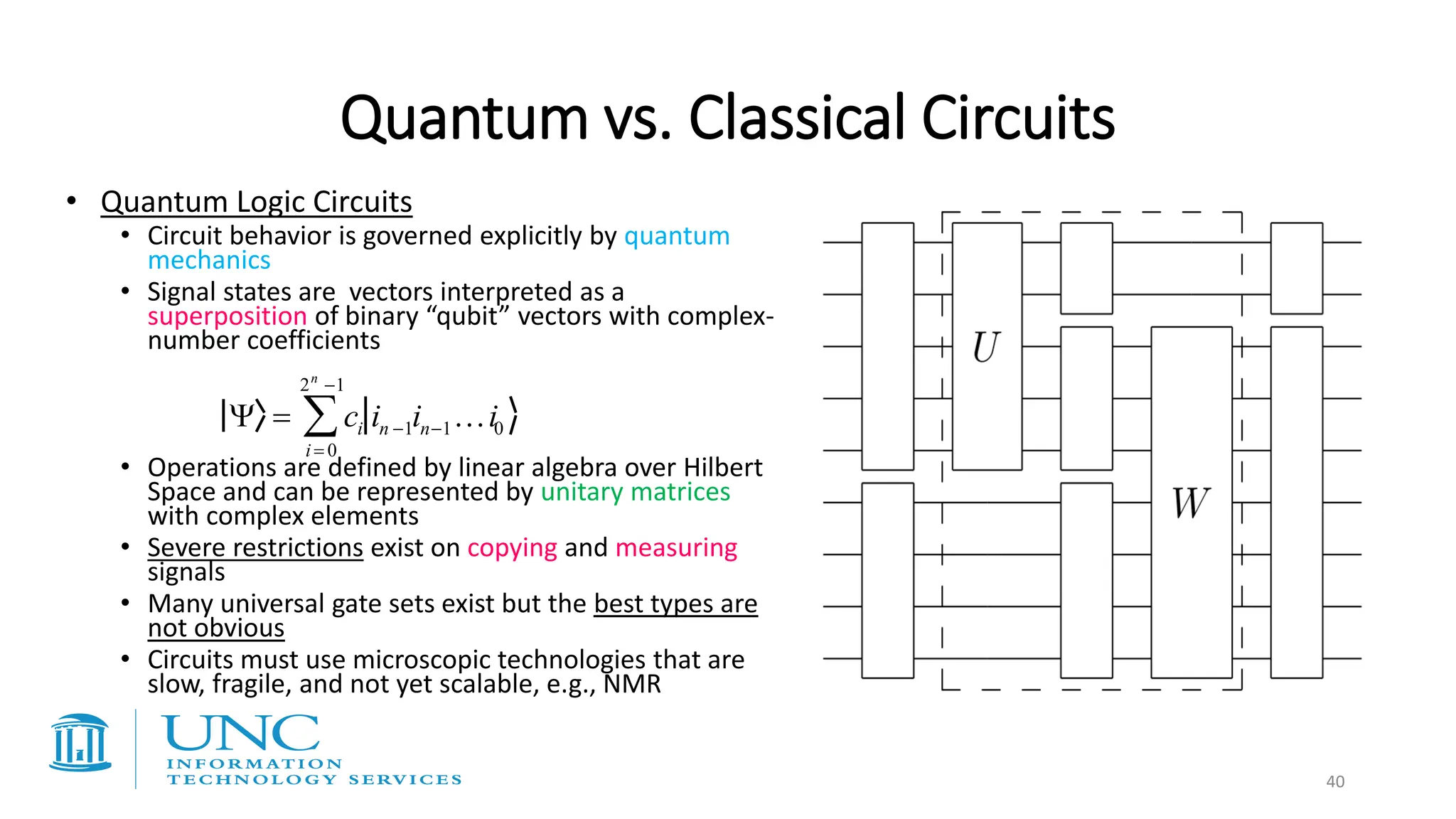
• Quantum LogicCircuits
• Circuit behavior is governed explicitly by quantum
mechanics
• Signal states are vectors interpreted as a
superposition of binary “qubit” vectors with complex-
number coefficients
• Operations are defined by linear algebra over Hilbert
Space and can be represented by unitary matrices
with complex elements
• Severe restrictions exist on copying and measuring
signals
• Many universal gate sets exist but the best types are
not obvious
• Circuits must use microscopic technologies that are
slow, fragile, and not yet scalable, e.g., NMR
= ci in −1in−1i0
i = 0
2n
−1
Quantum vs. Classical Circuits
40
41.
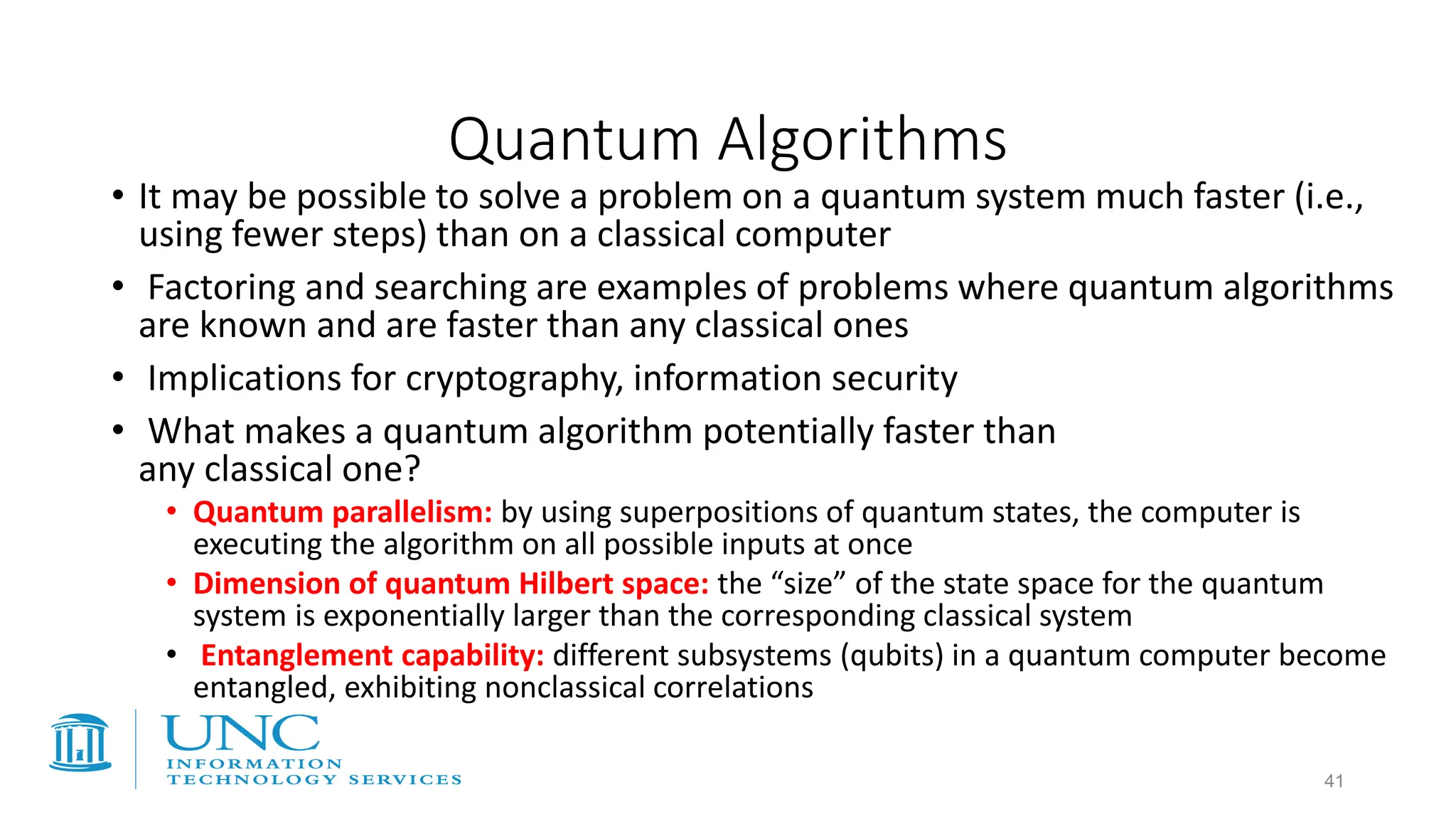
Quantum Algorithms
• Itmay be possible to solve a problem on a quantum system much faster (i.e.,
using fewer steps) than on a classical computer
• Factoring and searching are examples of problems where quantum algorithms
are known and are faster than any classical ones
• Implications for cryptography, information security
• What makes a quantum algorithm potentially faster than
any classical one?
• Quantum parallelism: by using superpositions of quantum states, the computer is
executing the algorithm on all possible inputs at once
• Dimension of quantum Hilbert space: the “size” of the state space for the quantum
system is exponentially larger than the corresponding classical system
• Entanglement capability: different subsystems (qubits) in a quantum computer become
entangled, exhibiting nonclassical correlations
41
42.
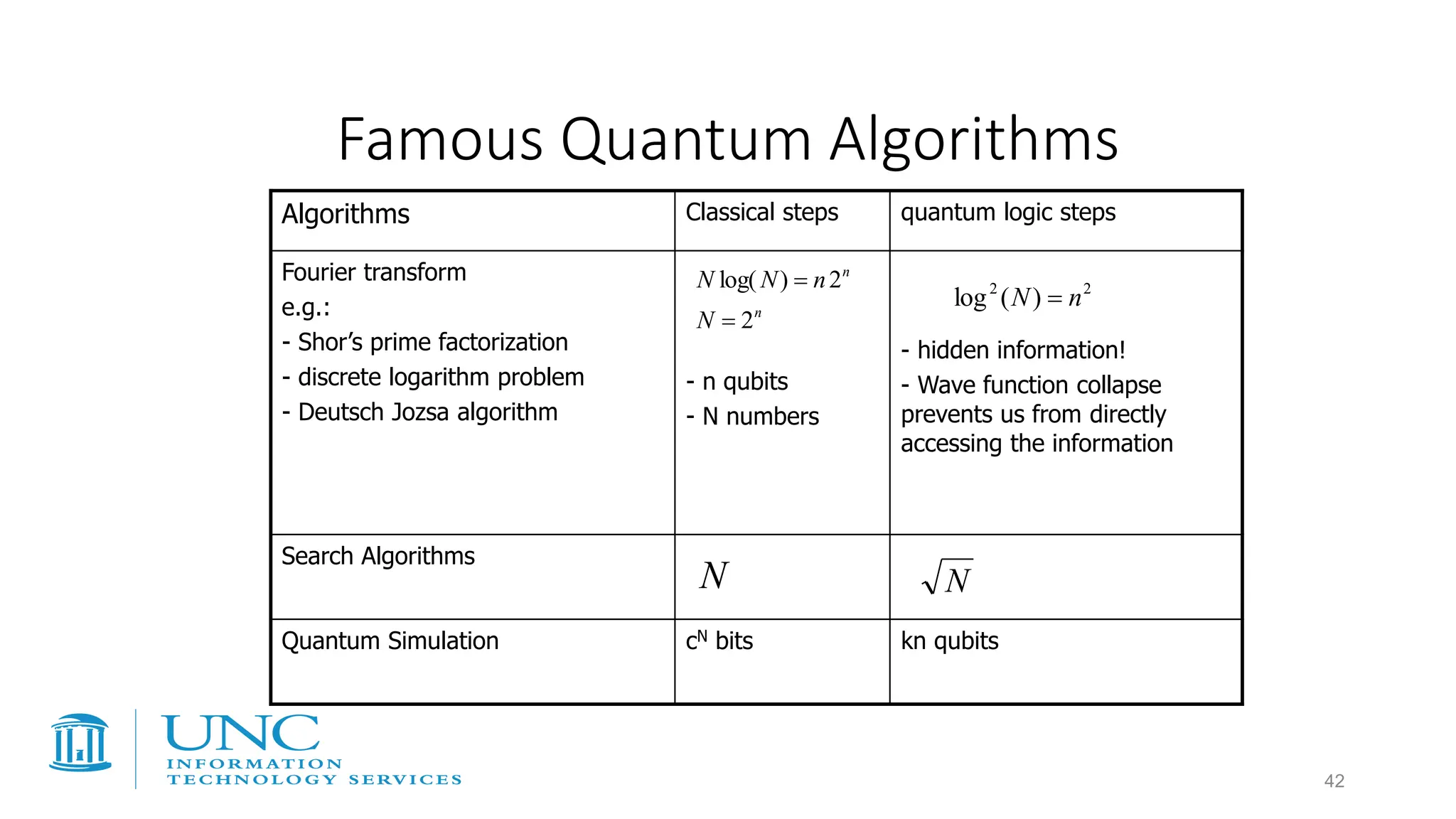
Famous Quantum Algorithms
2
2
)
(
logn
N =
n
n
N
n
N
N
2
2
)
log(
=
=
Algorithms Classical steps quantum logic steps
Fourier transform
e.g.:
- Shor’s prime factorization
- discrete logarithm problem
- Deutsch Jozsa algorithm
- n qubits
- N numbers
- hidden information!
- Wave function collapse
prevents us from directly
accessing the information
Search Algorithms
Quantum Simulation cN bits kn qubits
N N
42
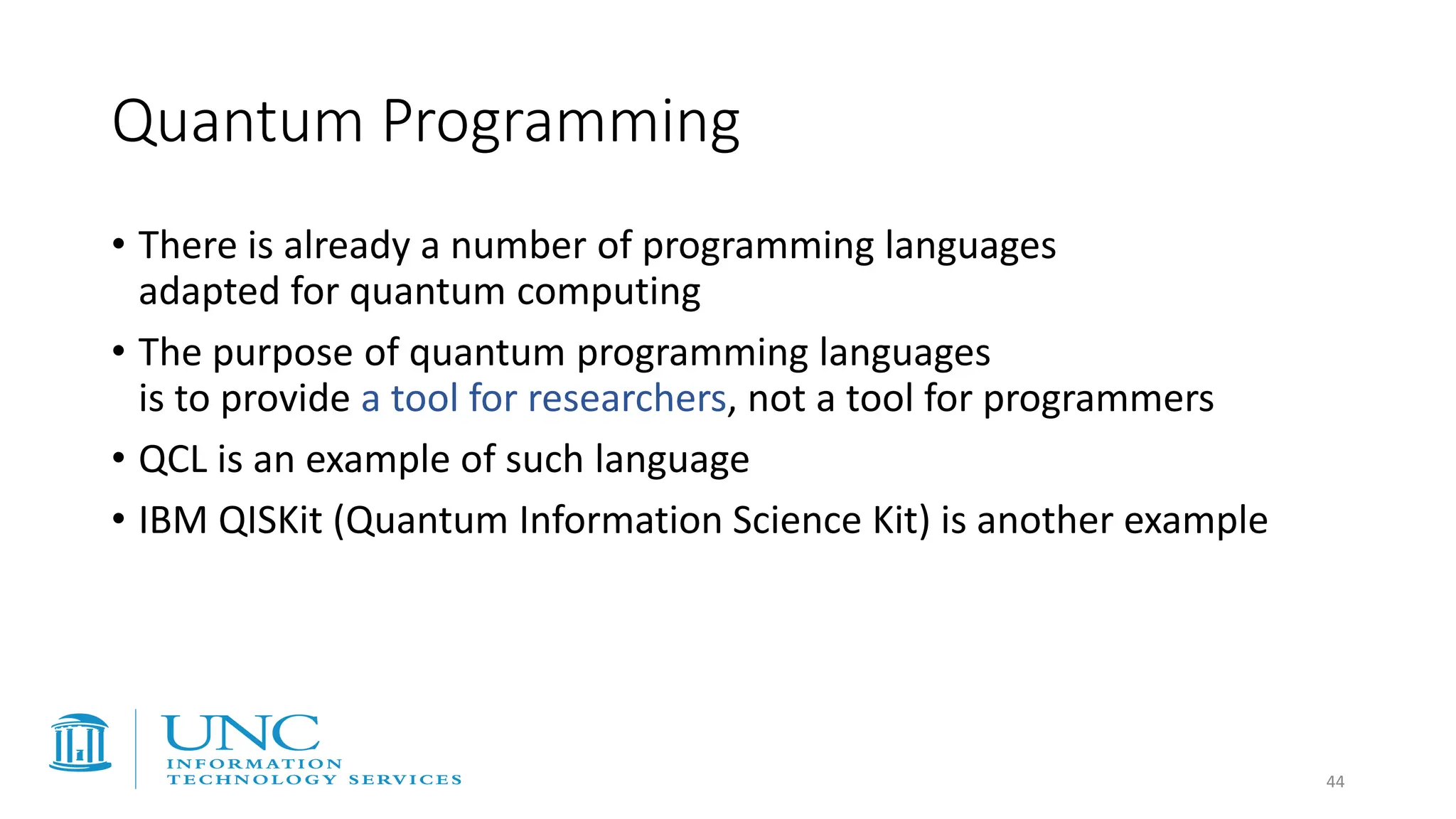
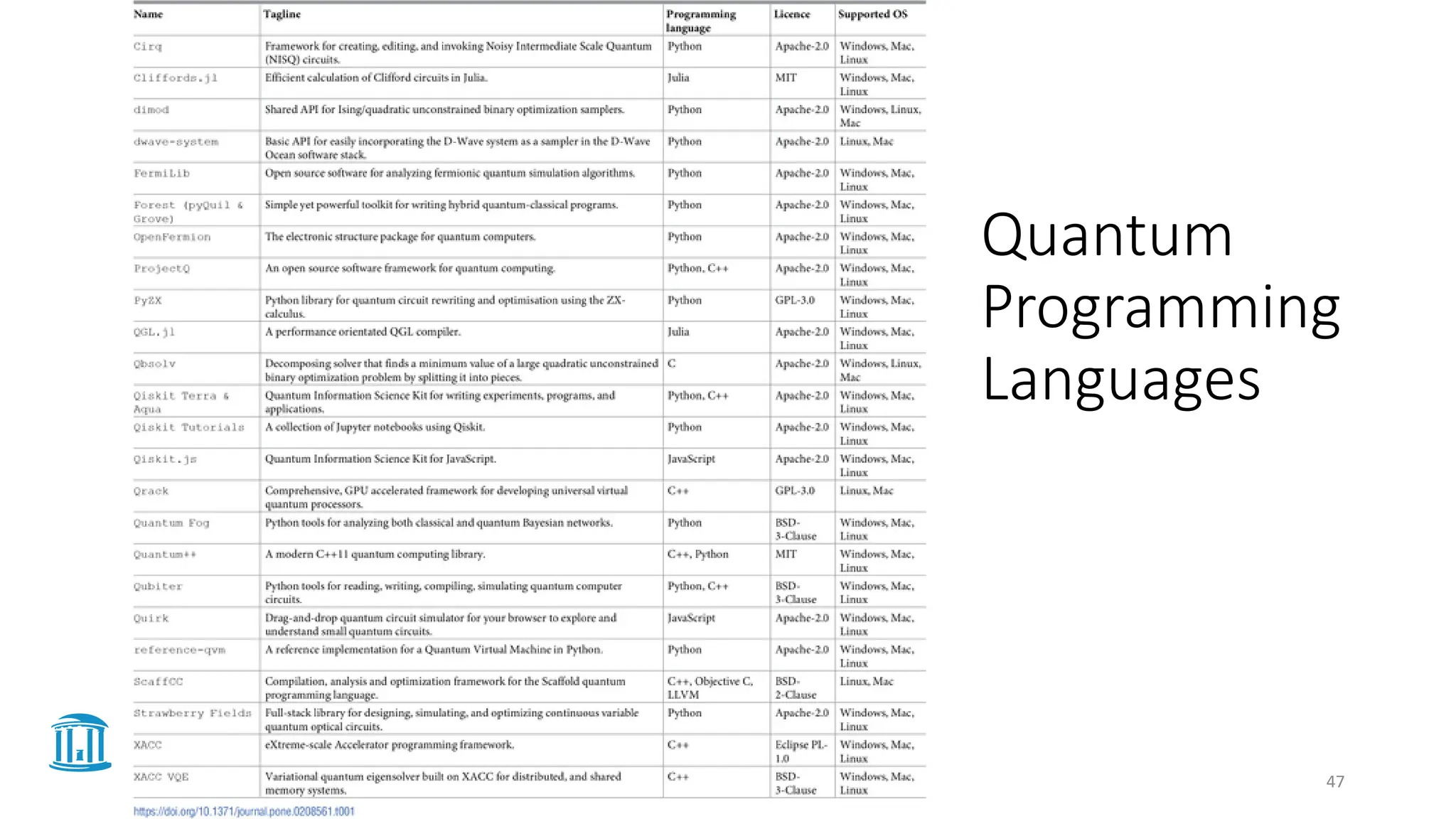
• There isalready a number of programming languages
adapted for quantum computing
• The purpose of quantum programming languages
is to provide a tool for researchers, not a tool for programmers
• QCL is an example of such language
• IBM QISKit (Quantum Information Science Kit) is another example
Quantum Programming
44
45.
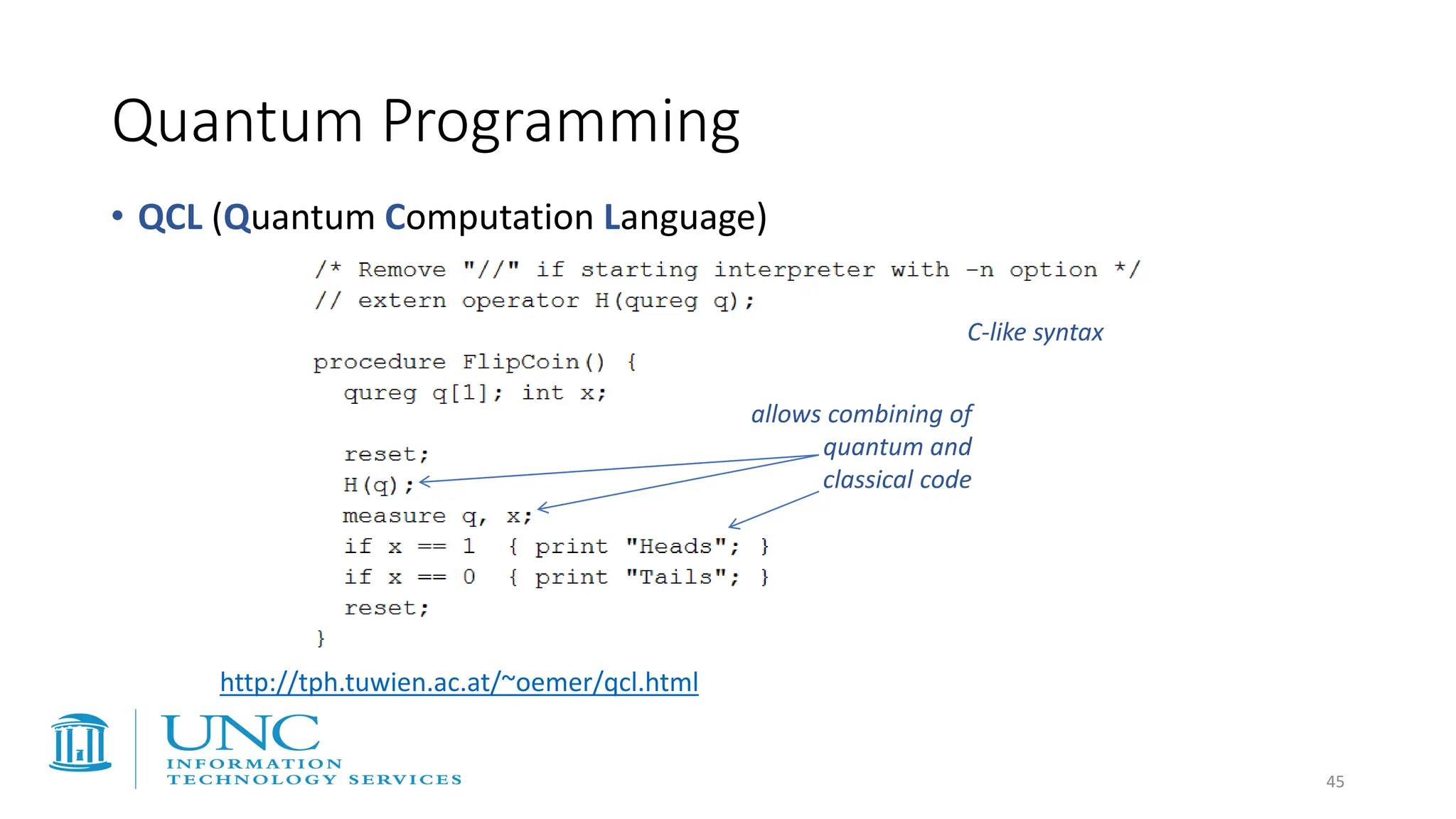
• QCL (QuantumComputation Language)
http://tph.tuwien.ac.at/~oemer/qcl.html
Quantum Programming
C-like syntax
allows combining of
quantum and
classical code
45
46.
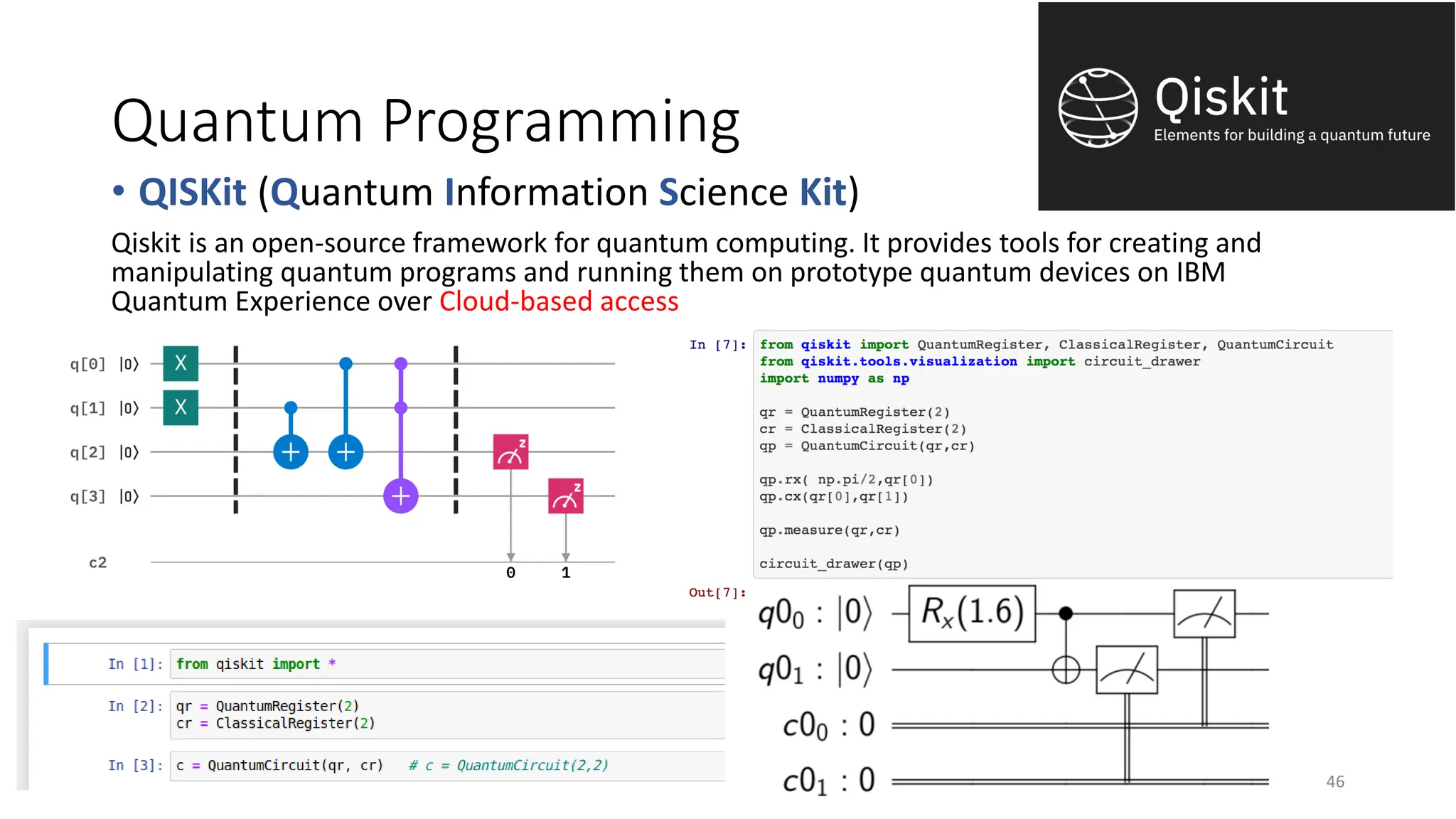
• QISKit (QuantumInformation Science Kit)
Qiskit is an open-source framework for quantum computing. It provides tools for creating and
manipulating quantum programs and running them on prototype quantum devices on IBM
Quantum Experience over Cloud-based access
Quantum Programming
46
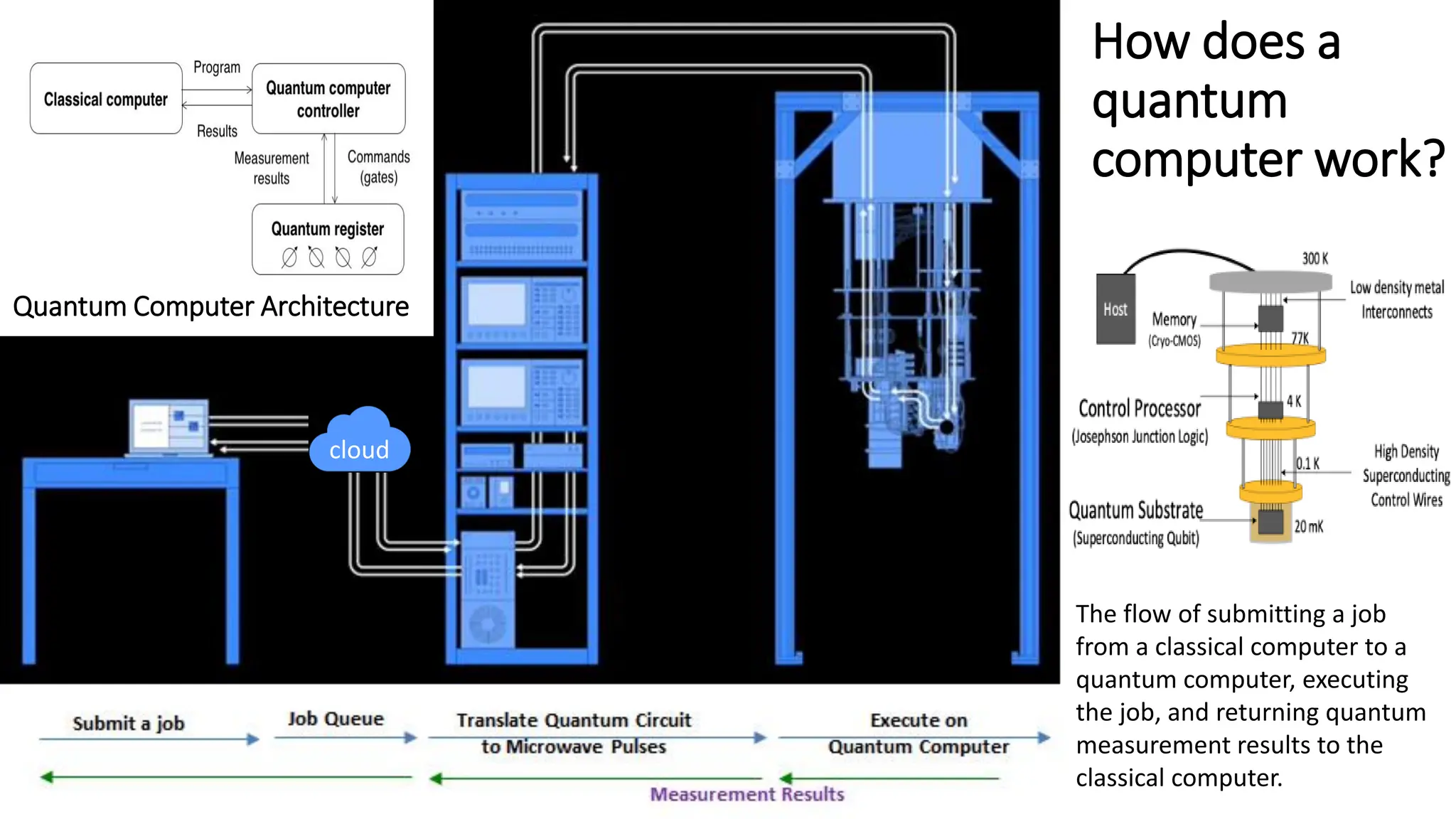
How does a
quantum
computerwork?
The flow of submitting a job
from a classical computer to a
quantum computer, executing
the job, and returning quantum
measurement results to the
classical computer.
Quantum Computer Architecture
cloud
49.
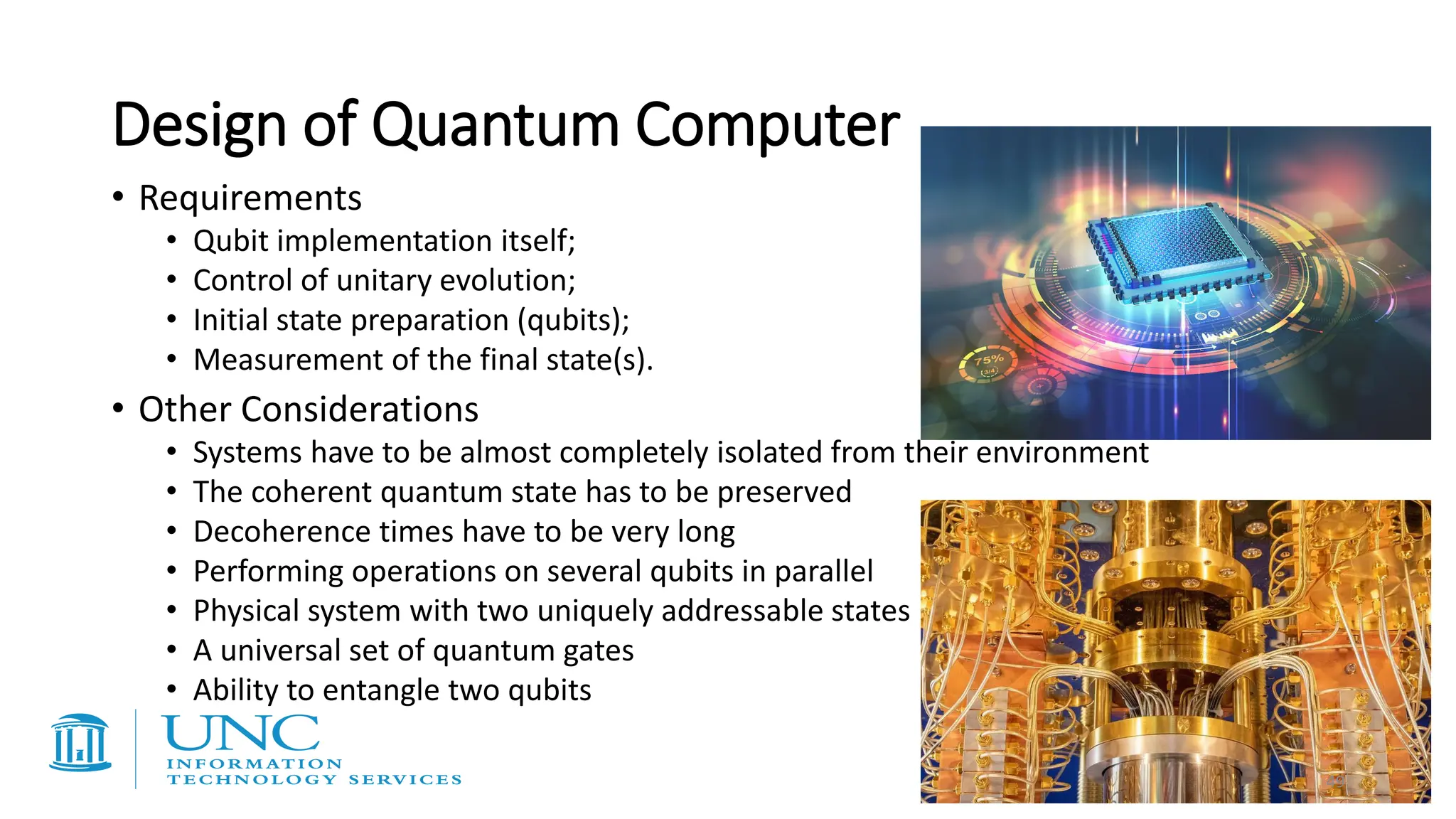
• Requirements
• Qubitimplementation itself;
• Control of unitary evolution;
• Initial state preparation (qubits);
• Measurement of the final state(s).
• Other Considerations
• Systems have to be almost completely isolated from their environment
• The coherent quantum state has to be preserved
• Decoherence times have to be very long
• Performing operations on several qubits in parallel
• Physical system with two uniquely addressable states
• A universal set of quantum gates
• Ability to entangle two qubits
Design of Quantum Computer
49
50.
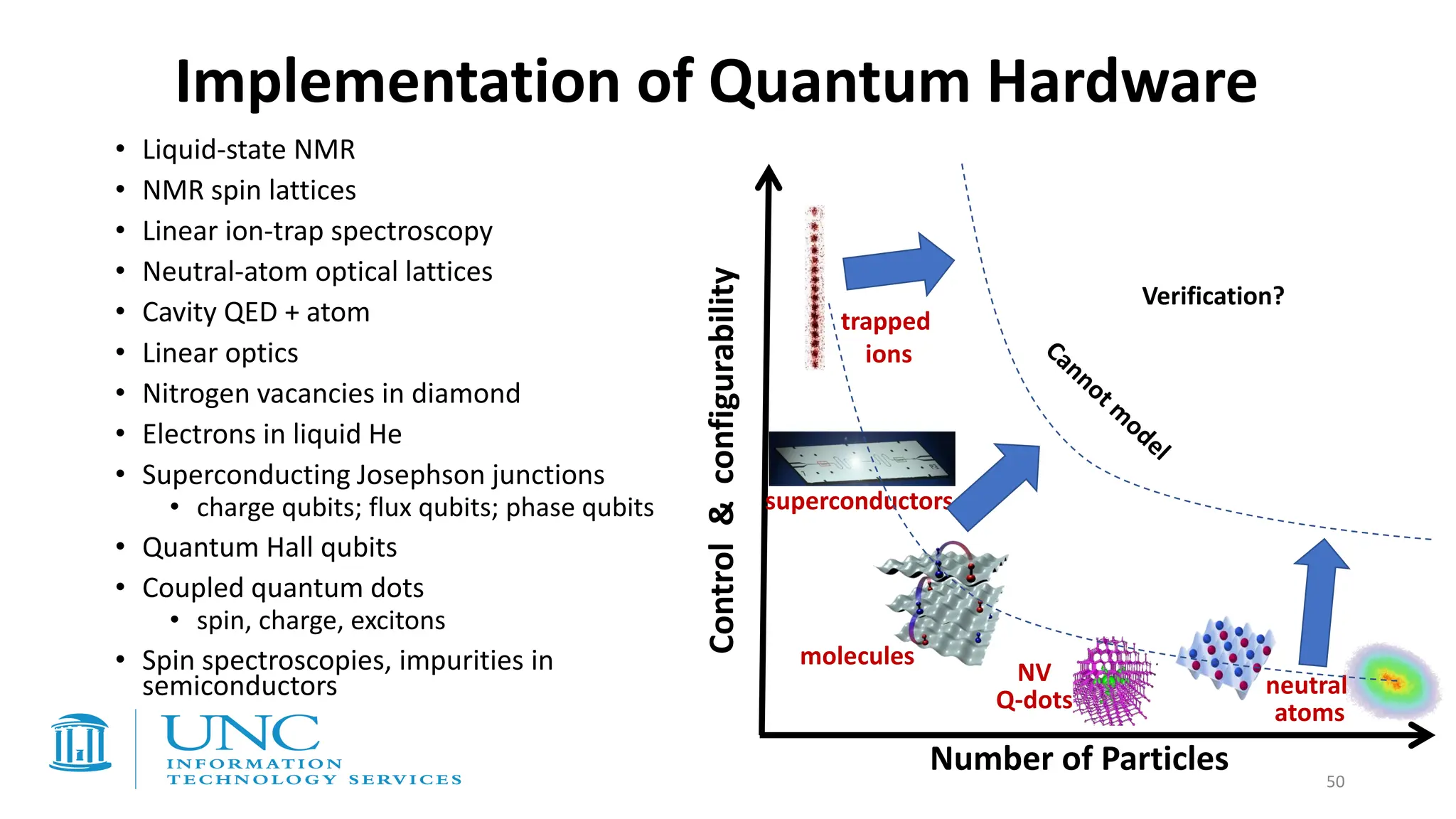
Implementation of QuantumHardware
Number of Particles
Control
&
configurability
molecules
trapped
ions
Verification?
NV
Q-dots
superconductors
neutral
atoms
• Liquid-state NMR
• NMR spin lattices
• Linear ion-trap spectroscopy
• Neutral-atom optical lattices
• Cavity QED + atom
• Linear optics
• Nitrogen vacancies in diamond
• Electrons in liquid He
• Superconducting Josephson junctions
• charge qubits; flux qubits; phase qubits
• Quantum Hall qubits
• Coupled quantum dots
• spin, charge, excitons
• Spin spectroscopies, impurities in
semiconductors
50
51.
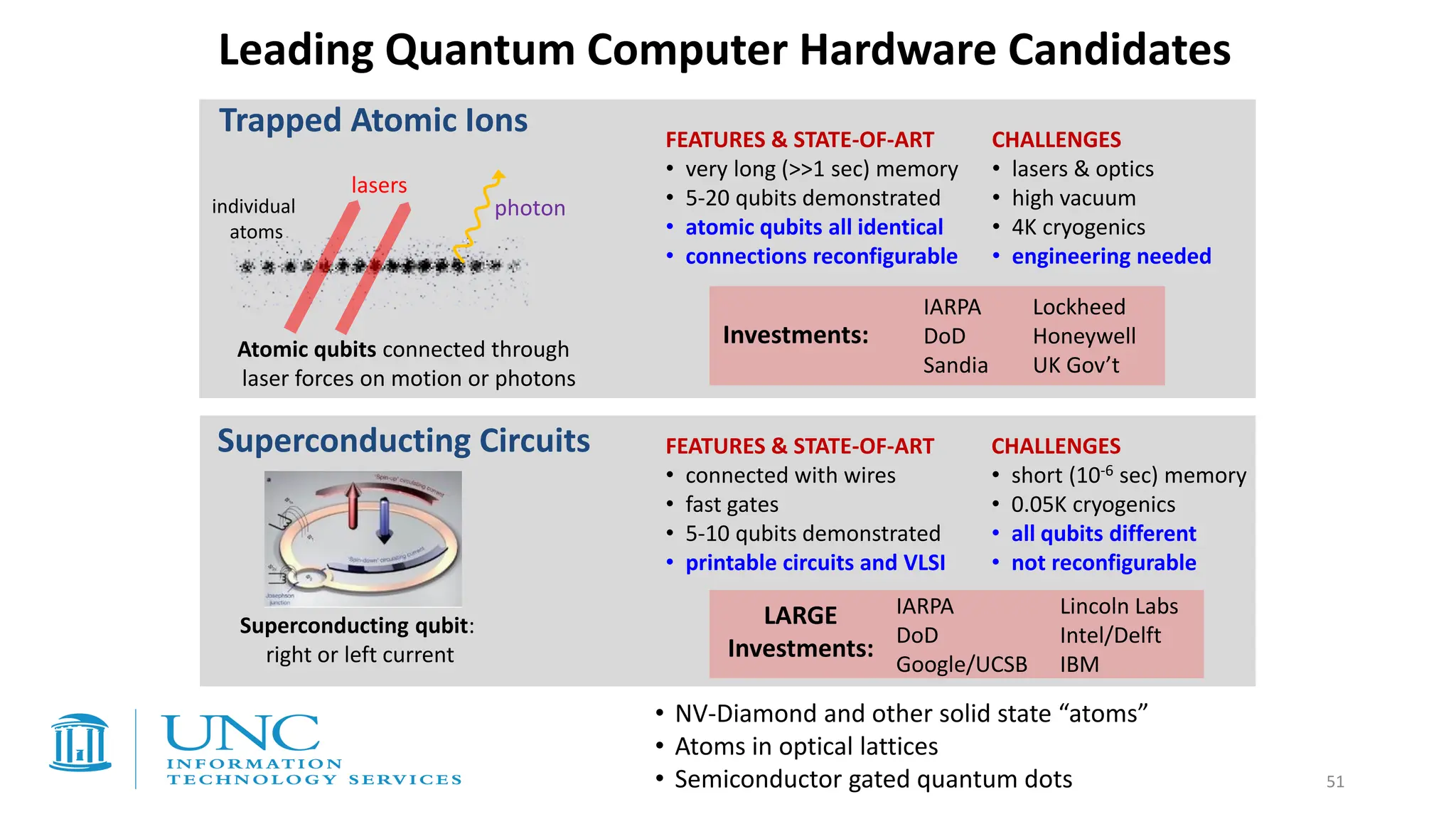
Superconducting Circuits
Leading QuantumComputer Hardware Candidates
CHALLENGES
• short (10-6 sec) memory
• 0.05K cryogenics
• all qubits different
• not reconfigurable
Superconducting qubit:
right or left current
FEATURES & STATE-OF-ART
• connected with wires
• fast gates
• 5-10 qubits demonstrated
• printable circuits and VLSI
Atomic qubits connected through
laser forces on motion or photons
individual
atoms
lasers
photon
Trapped Atomic Ions FEATURES & STATE-OF-ART
• very long (>>1 sec) memory
• 5-20 qubits demonstrated
• atomic qubits all identical
• connections reconfigurable
CHALLENGES
• lasers & optics
• high vacuum
• 4K cryogenics
• engineering needed
• NV-Diamond and other solid state “atoms”
• Atoms in optical lattices
• Semiconductor gated quantum dots
Investments:
IARPA Lockheed
DoD Honeywell
Sandia UK Gov’t
LARGE
Investments:
IARPA Lincoln Labs
DoD Intel/Delft
Google/UCSB IBM
51
52.
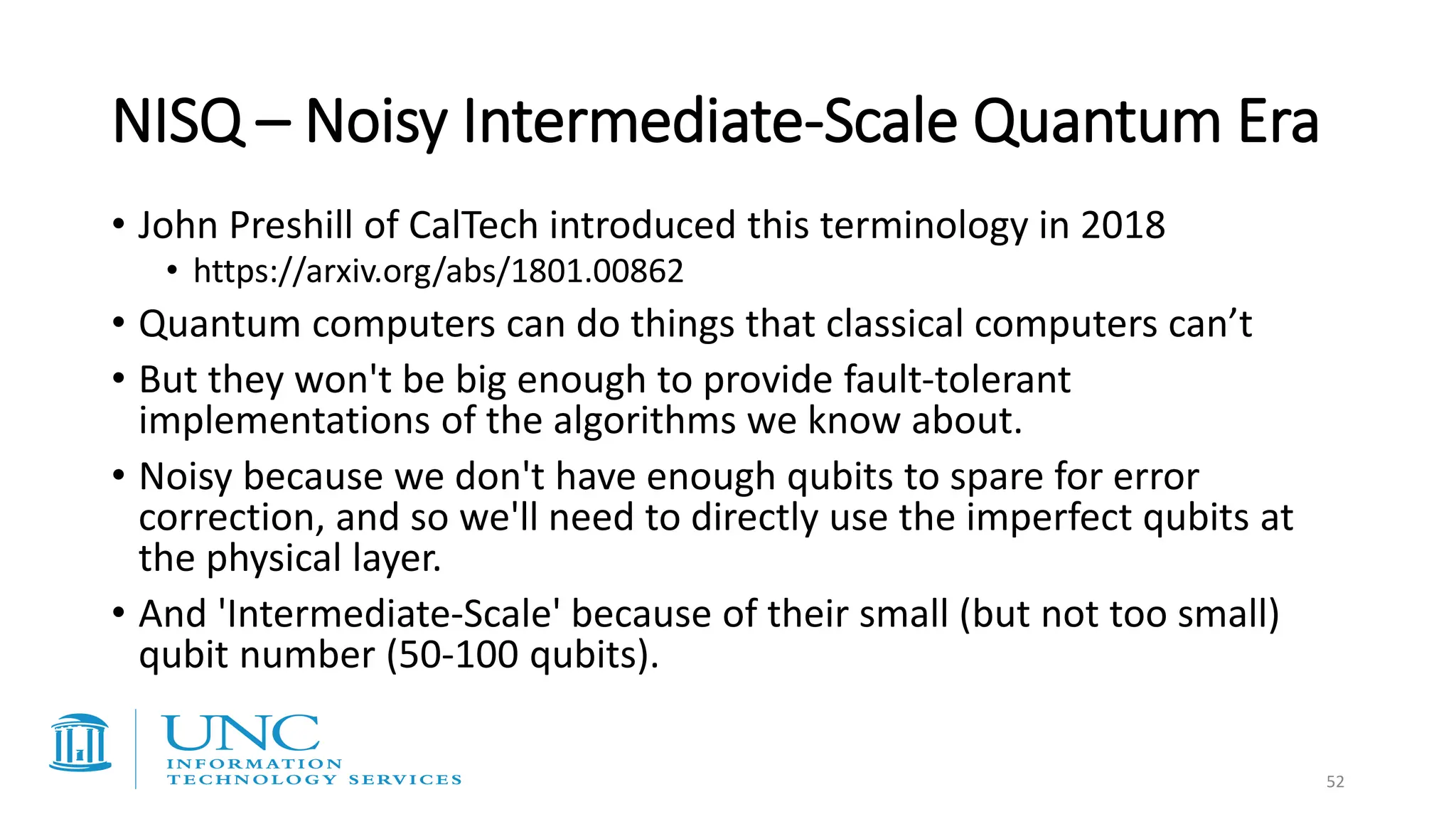
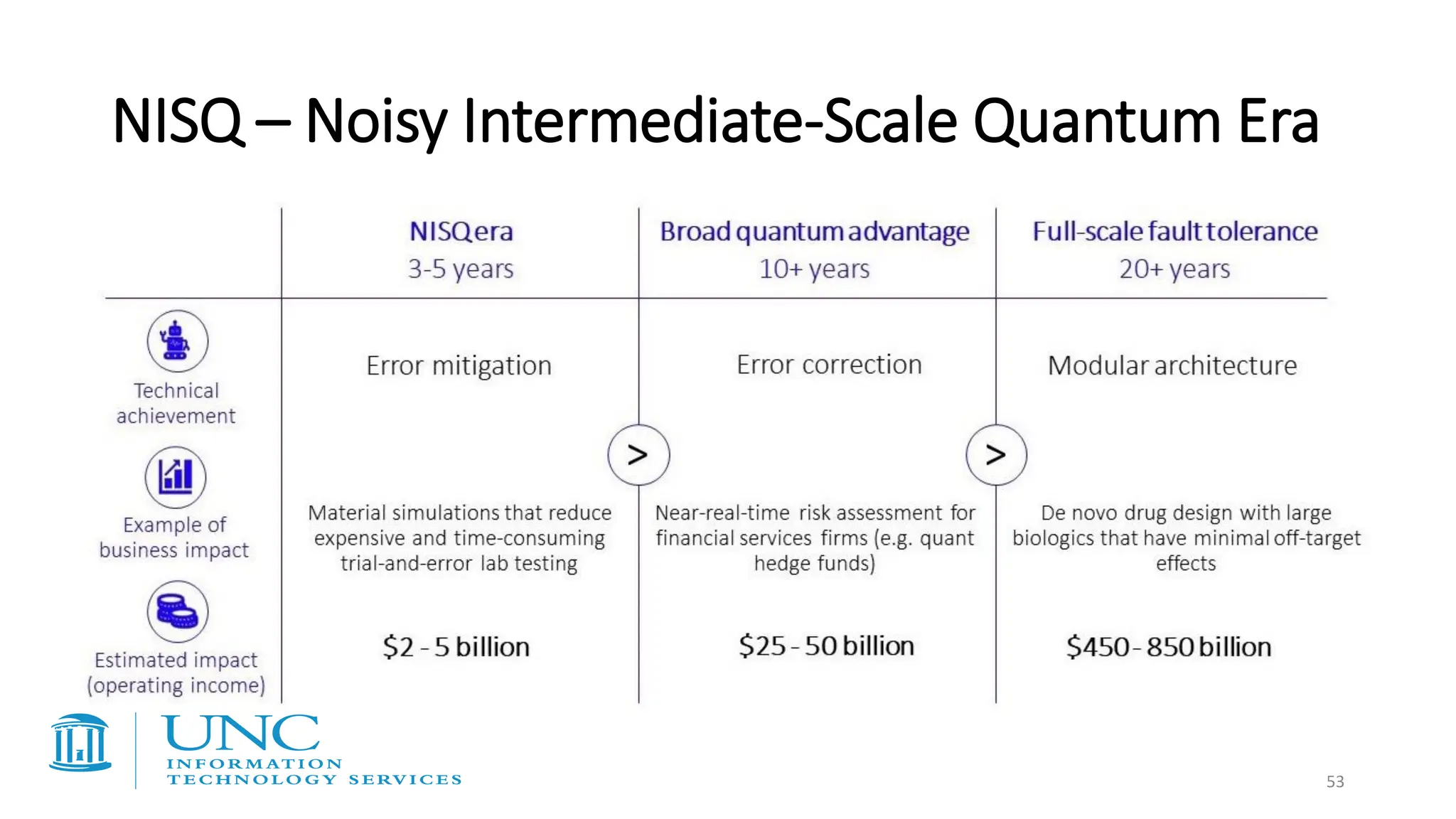
NISQ – NoisyIntermediate-Scale Quantum Era
• John Preshill of CalTech introduced this terminology in 2018
• https://arxiv.org/abs/1801.00862
• Quantum computers can do things that classical computers can’t
• But they won't be big enough to provide fault-tolerant
implementations of the algorithms we know about.
• Noisy because we don't have enough qubits to spare for error
correction, and so we'll need to directly use the imperfect qubits at
the physical layer.
• And 'Intermediate-Scale' because of their small (but not too small)
qubit number (50-100 qubits).
52
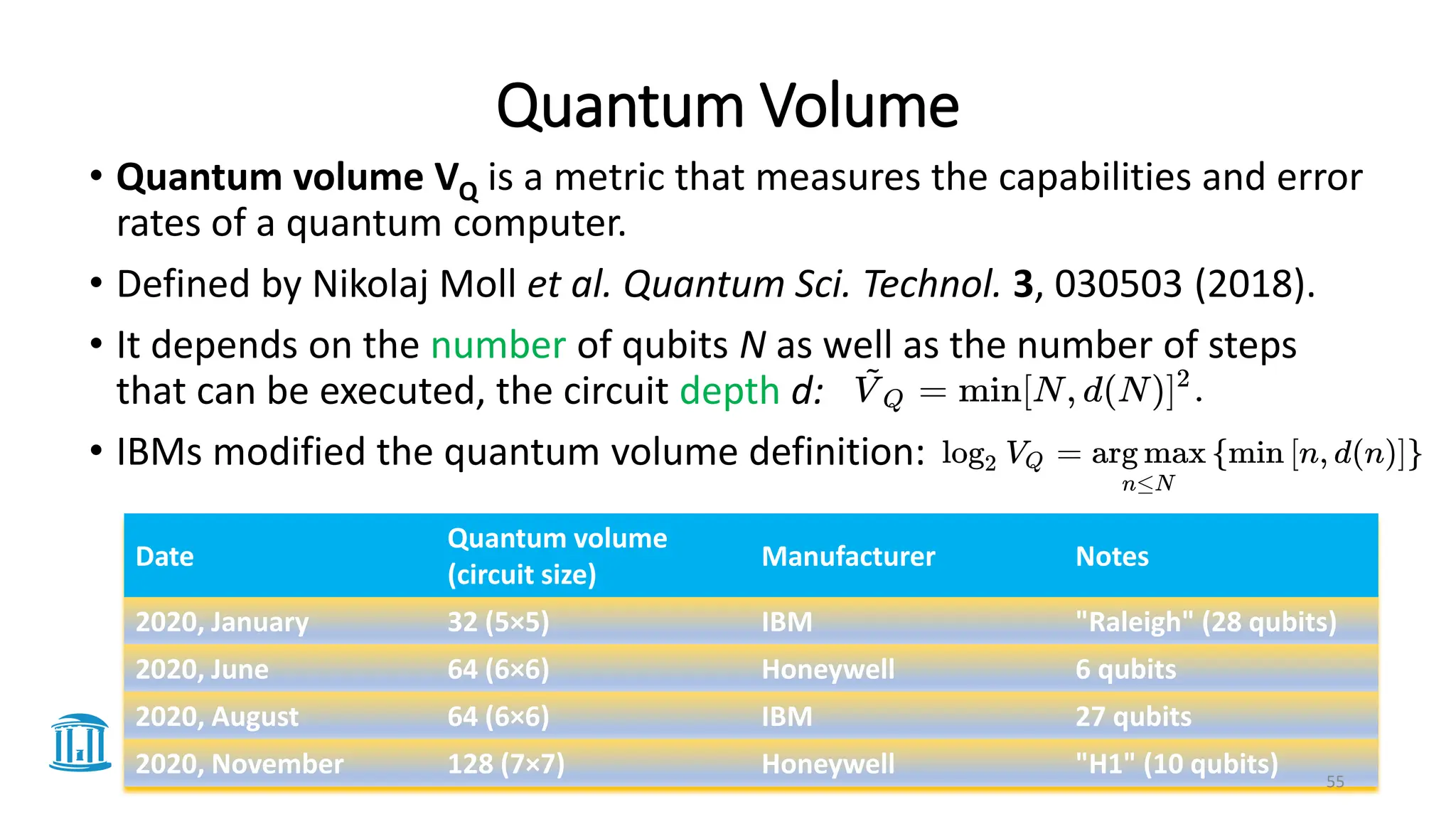
Quantum Volume
• Quantumvolume VQ is a metric that measures the capabilities and error
rates of a quantum computer.
• Defined by Nikolaj Moll et al. Quantum Sci. Technol. 3, 030503 (2018).
• It depends on the number of qubits N as well as the number of steps
that can be executed, the circuit depth d:
• IBMs modified the quantum volume definition:
Date
Quantum volume
(circuit size)
Manufacturer Notes
2020, January 32 (5×5) IBM "Raleigh" (28 qubits)
2020, June 64 (6×6) Honeywell 6 qubits
2020, August 64 (6×6) IBM 27 qubits
2020, November 128 (7×7) Honeywell "H1" (10 qubits) 55
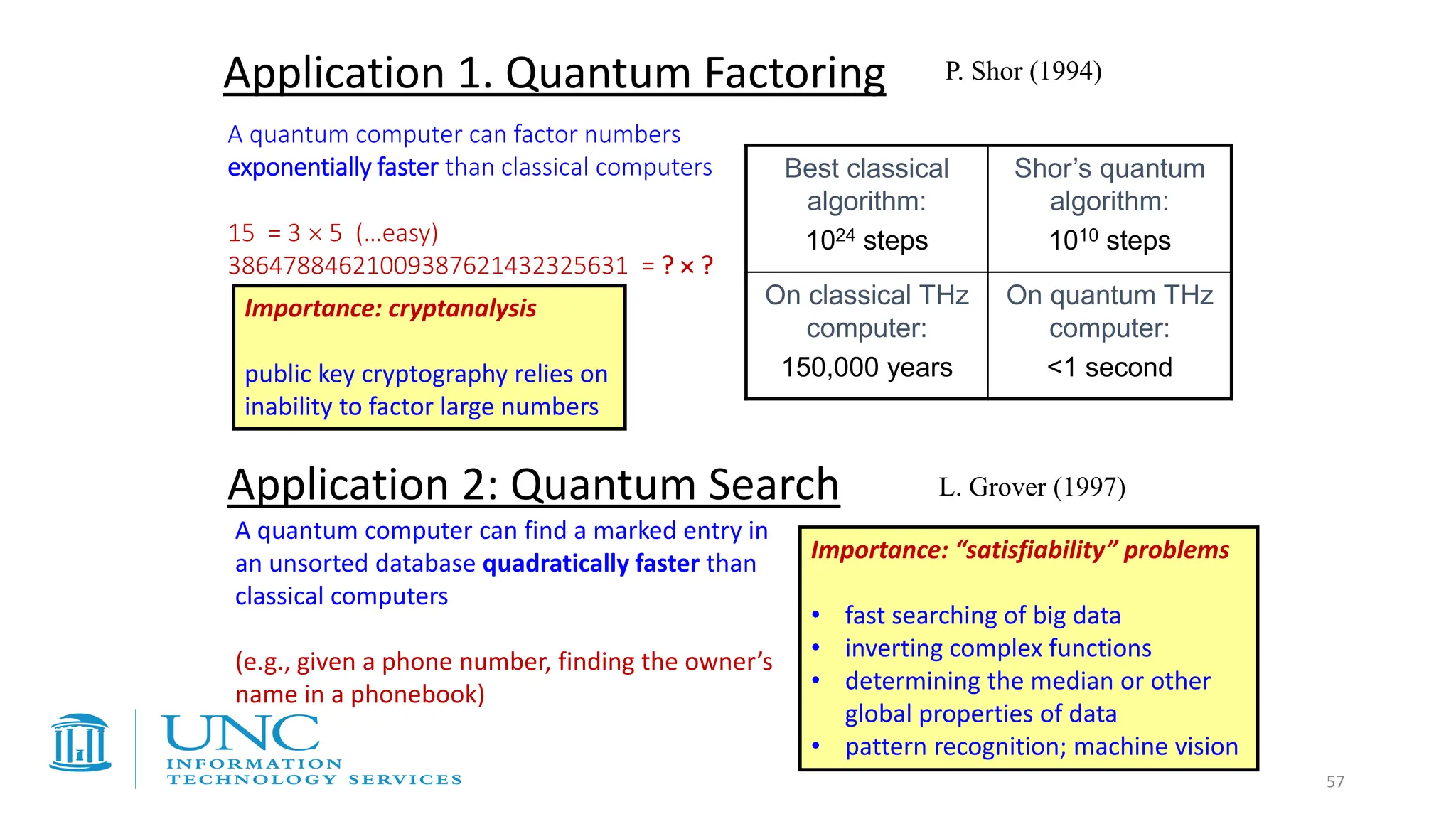
Application 1. QuantumFactoring
A quantum computer can factor numbers
exponentially faster than classical computers
15 = 3 5 (…easy)
38647884621009387621432325631 = ? ?
P. Shor (1994)
Importance: cryptanalysis
public key cryptography relies on
inability to factor large numbers
Application 2: Quantum Search L. Grover (1997)
A quantum computer can find a marked entry in
an unsorted database quadratically faster than
classical computers
(e.g., given a phone number, finding the owner’s
name in a phonebook)
Importance: “satisfiability” problems
• fast searching of big data
• inverting complex functions
• determining the median or other
global properties of data
• pattern recognition; machine vision
Best classical
algorithm:
1024 steps
Shor’s quantum
algorithm:
1010 steps
On classical THz
computer:
150,000 years
On quantum THz
computer:
<1 second
57
58.
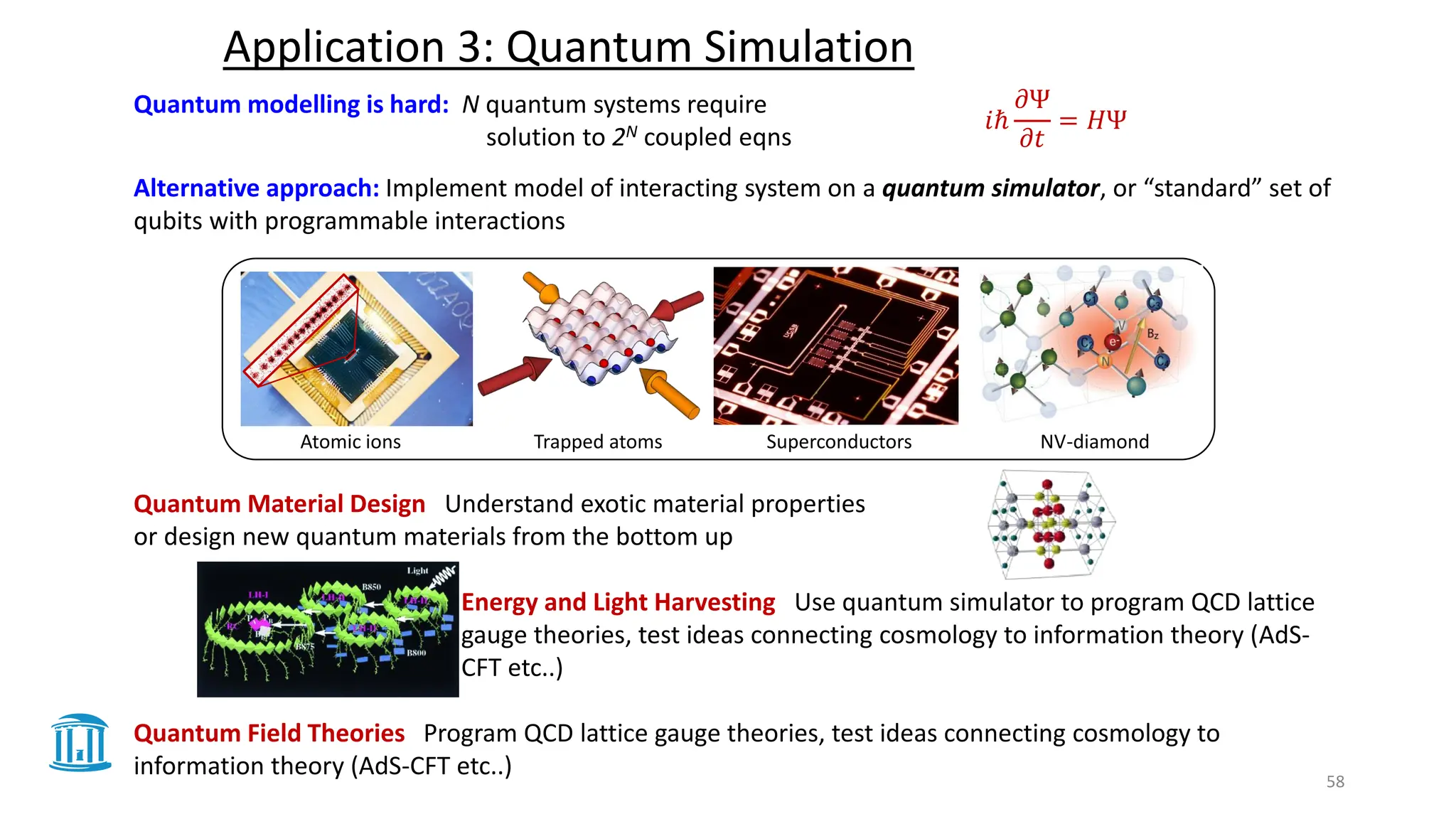
Application 3: QuantumSimulation
high-TC
super-
conductor
Quantum modelling is hard: N quantum systems require
solution to 2N coupled eqns
Alternative approach: Implement model of interacting system on a quantum simulator, or “standard” set of
qubits with programmable interactions
𝑖ℏ
𝜕Ψ
𝜕𝑡
= 𝐻Ψ
Atomic ions Trapped atoms Superconductors NV-diamond
Quantum Material Design Understand exotic material properties
or design new quantum materials from the bottom up
Energy and Light Harvesting Use quantum simulator to program QCD lattice
gauge theories, test ideas connecting cosmology to information theory (AdS-
CFT etc..)
Quantum Field Theories Program QCD lattice gauge theories, test ideas connecting cosmology to
information theory (AdS-CFT etc..) 58
59.
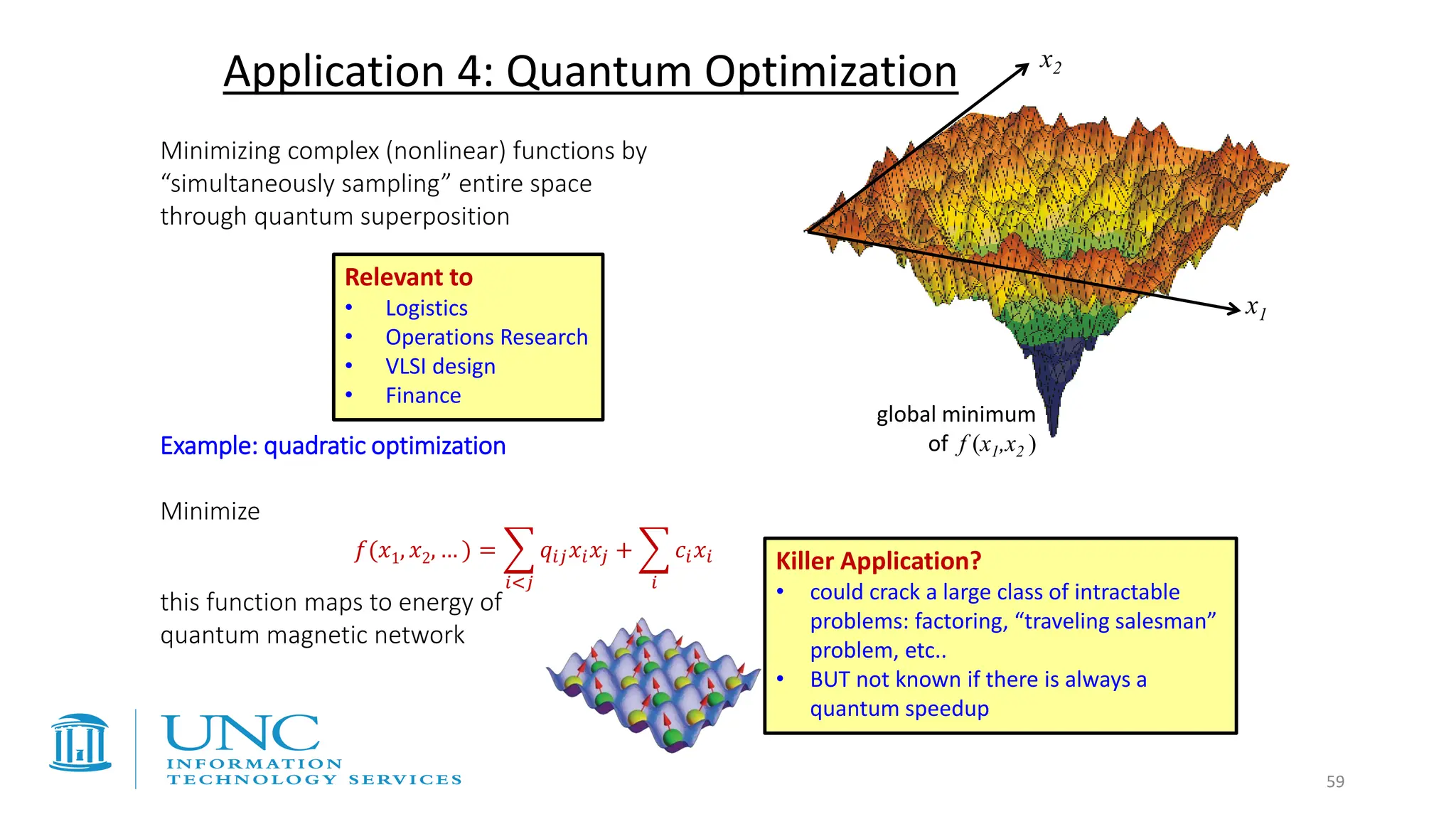
Minimizing complex (nonlinear)functions by
“simultaneously sampling” entire space
through quantum superposition
Example: quadratic optimization
Minimize
this function maps to energy of
quantum magnetic network
Killer Application?
• could crack a large class of intractable
problems: factoring, “traveling salesman”
problem, etc..
• BUT not known if there is always a
quantum speedup
Application 4: Quantum Optimization
𝑓(𝑥1, 𝑥2, … ) =
𝑖<𝑗
𝑞𝑖𝑗𝑥𝑖𝑥𝑗 +
𝑖
𝑐𝑖𝑥𝑖
Relevant to
• Logistics
• Operations Research
• VLSI design
• Finance
global minimum
of f (x1,x2 )
x1
x2
59
60.
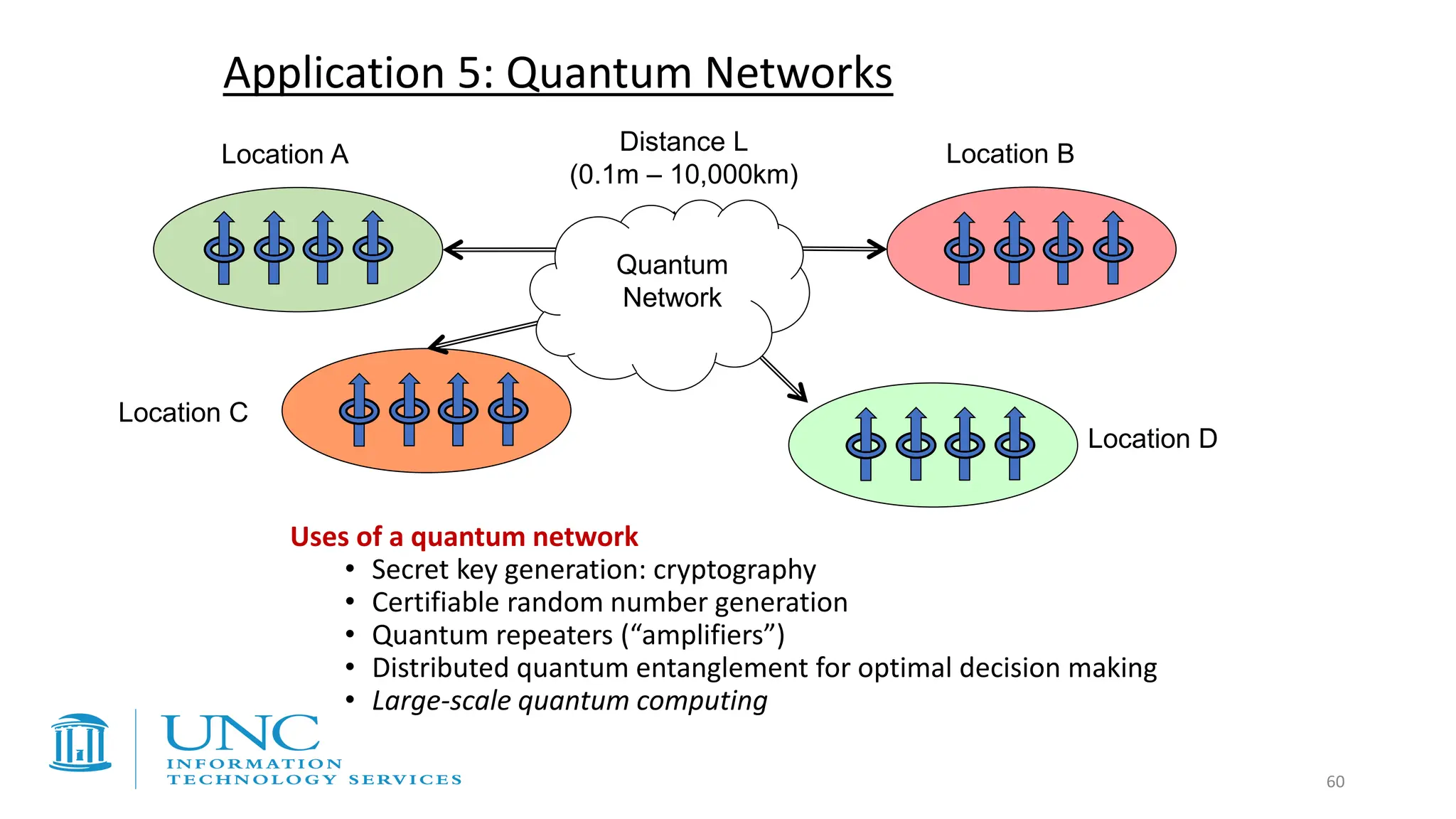
Uses of aquantum network
• Secret key generation: cryptography
• Certifiable random number generation
• Quantum repeaters (“amplifiers”)
• Distributed quantum entanglement for optimal decision making
• Large-scale quantum computing
Location A Location B
Distance L
(0.1m – 10,000km)
Location C
Location D
Quantum
Network
Application 5: Quantum Networks
60
61.
Case Study 1:Quantum Cryptography
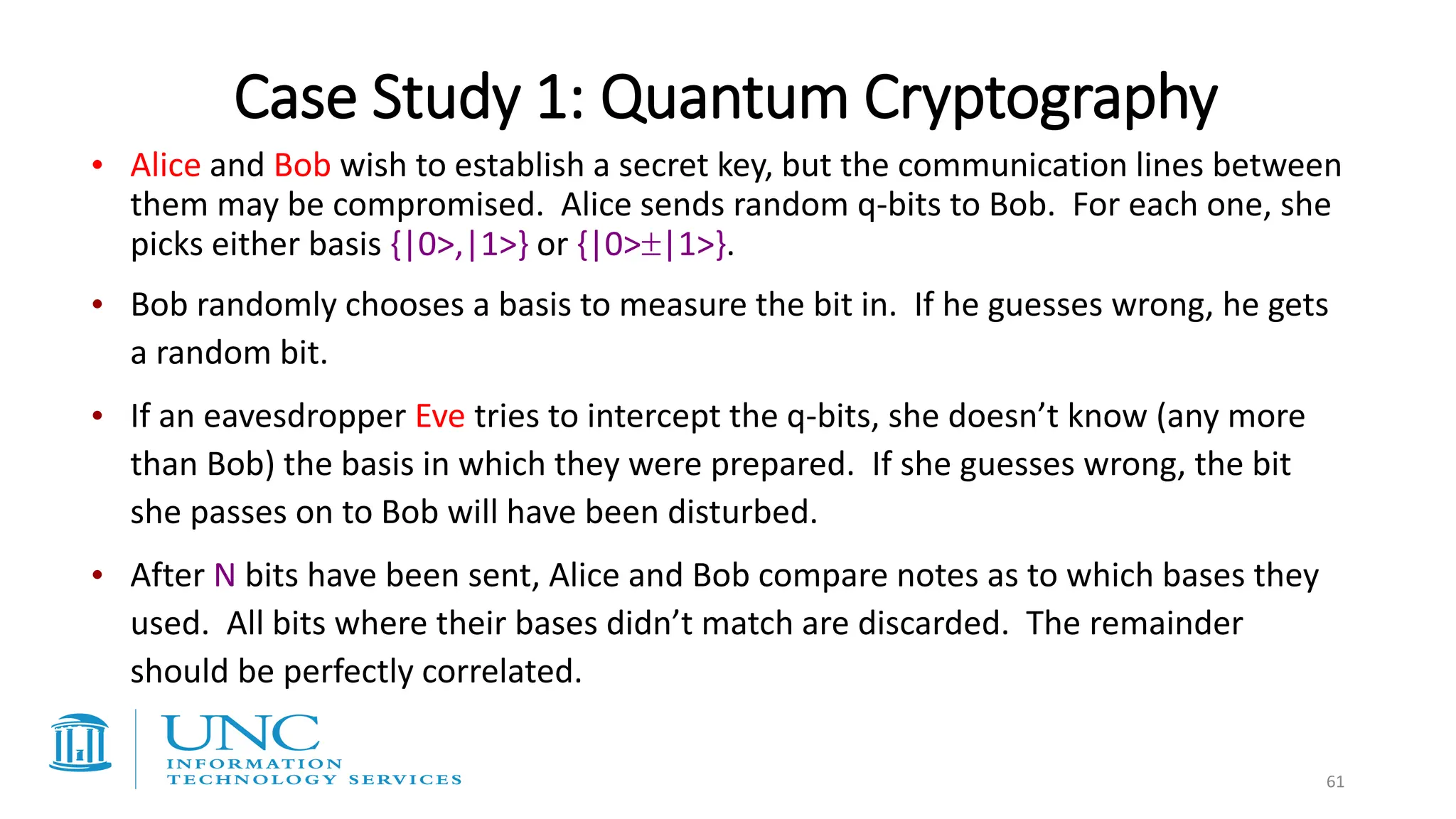
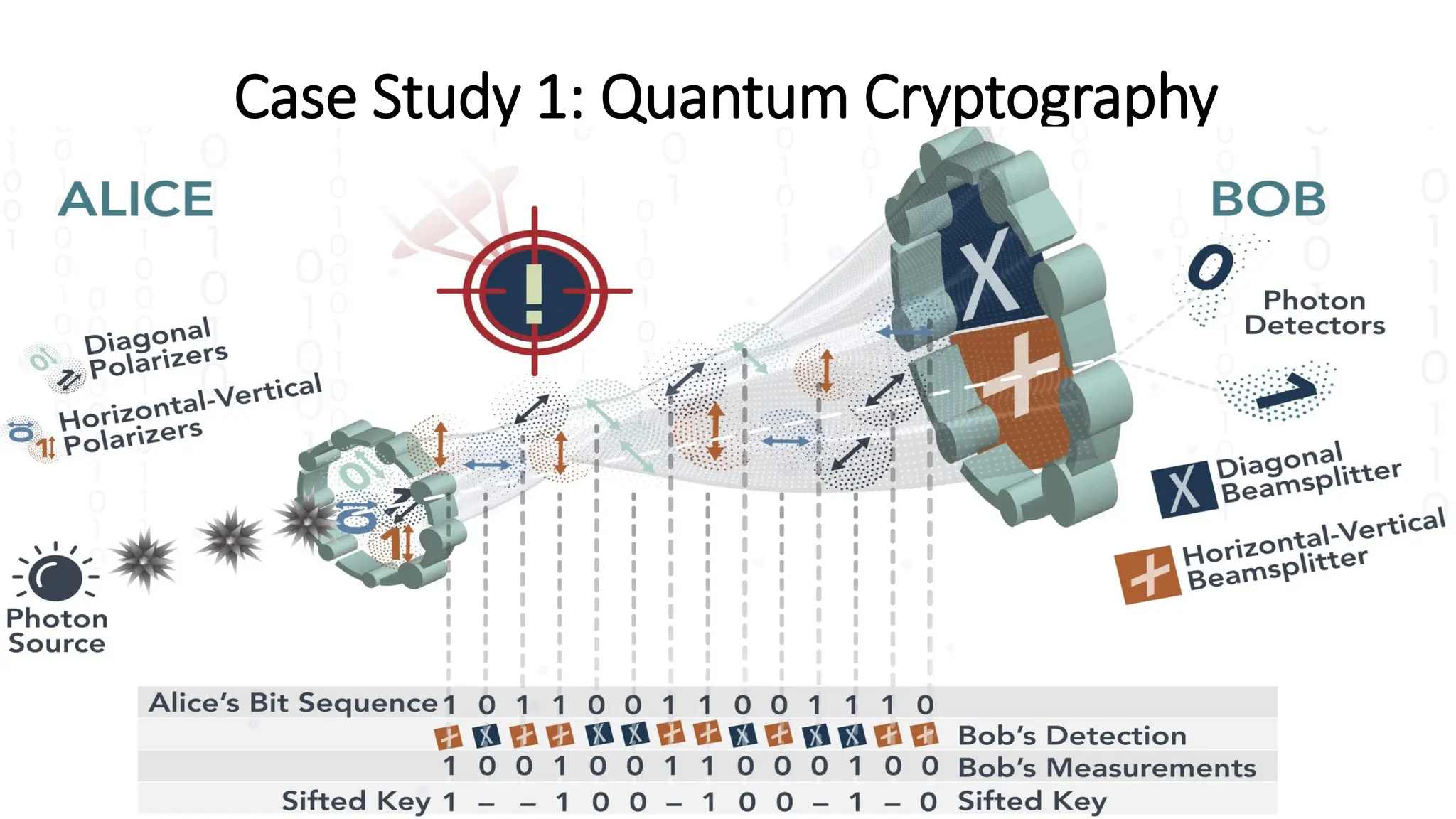
• Alice and Bob wish to establish a secret key, but the communication lines between
them may be compromised. Alice sends random q-bits to Bob. For each one, she
picks either basis {|0>,|1>} or {|0>|1>}.
• Bob randomly chooses a basis to measure the bit in. If he guesses wrong, he gets
a random bit.
• If an eavesdropper Eve tries to intercept the q-bits, she doesn’t know (any more
than Bob) the basis in which they were prepared. If she guesses wrong, the bit
she passes on to Bob will have been disturbed.
• After N bits have been sent, Alice and Bob compare notes as to which bases they
used. All bits where their bases didn’t match are discarded. The remainder
should be perfectly correlated.
61
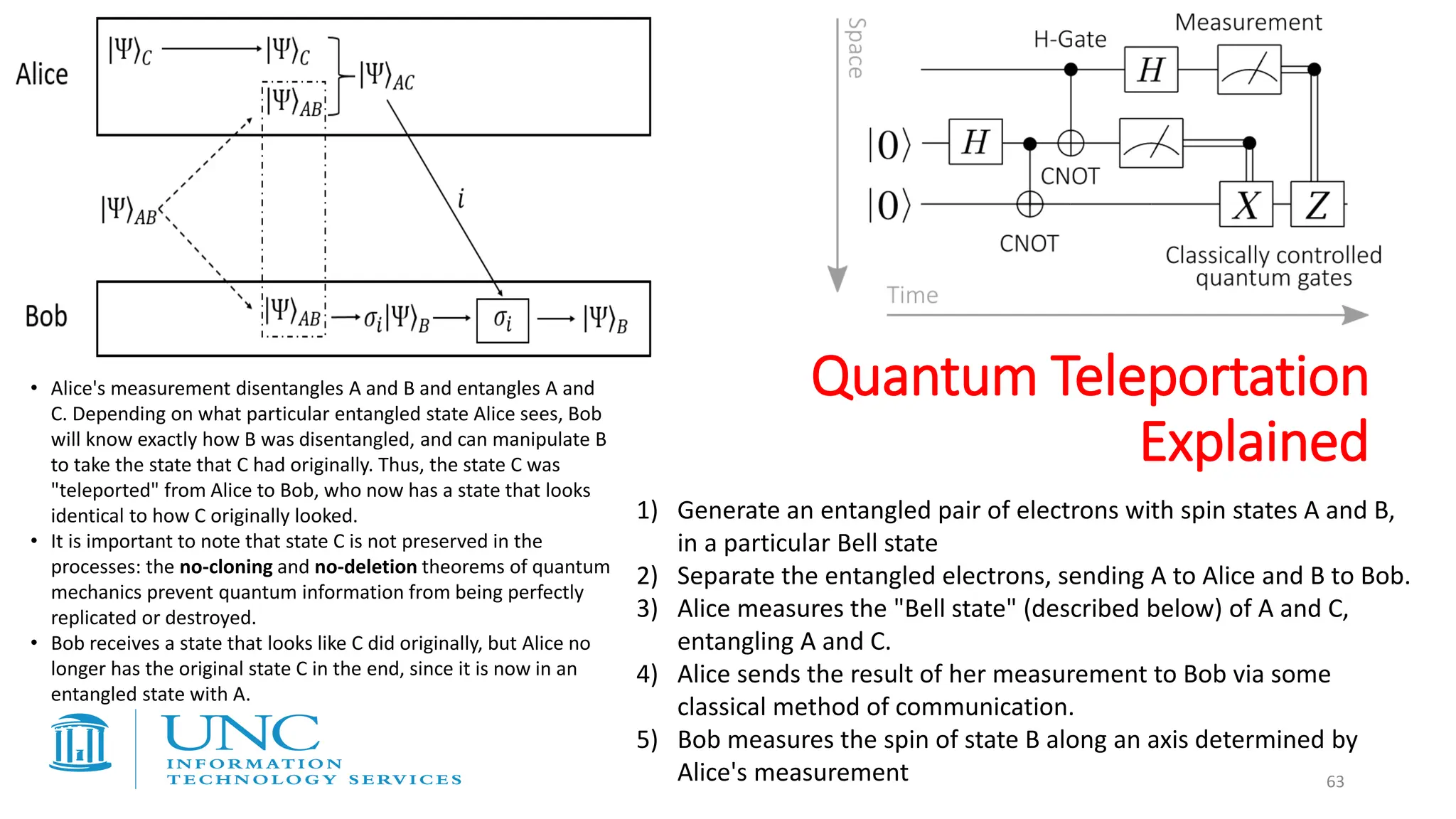
Quantum Teleportation
Explained
63
1) Generatean entangled pair of electrons with spin states A and B,
in a particular Bell state
2) Separate the entangled electrons, sending A to Alice and B to Bob.
3) Alice measures the "Bell state" (described below) of A and C,
entangling A and C.
4) Alice sends the result of her measurement to Bob via some
classical method of communication.
5) Bob measures the spin of state B along an axis determined by
Alice's measurement
• Alice's measurement disentangles A and B and entangles A and
C. Depending on what particular entangled state Alice sees, Bob
will know exactly how B was disentangled, and can manipulate B
to take the state that C had originally. Thus, the state C was
"teleported" from Alice to Bob, who now has a state that looks
identical to how C originally looked.
• It is important to note that state C is not preserved in the
processes: the no-cloning and no-deletion theorems of quantum
mechanics prevent quantum information from being perfectly
replicated or destroyed.
• Bob receives a state that looks like C did originally, but Alice no
longer has the original state C in the end, since it is now in an
entangled state with A.
64.
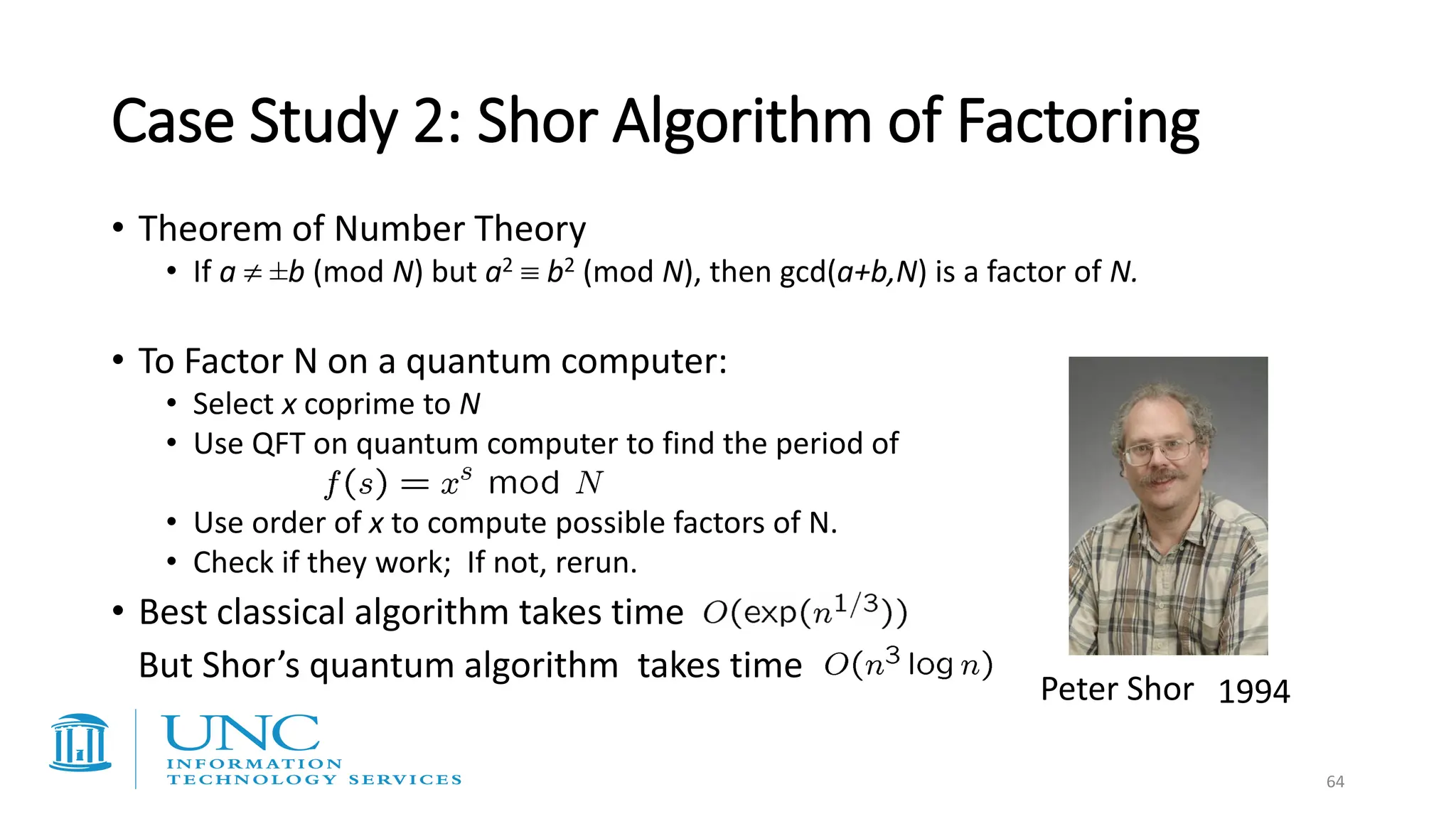
Case Study 2:Shor Algorithm of Factoring
• Theorem of Number Theory
• If a ±b (mod N) but a2 b2 (mod N), then gcd(a+b,N) is a factor of N.
• To Factor N on a quantum computer:
• Select x coprime to N
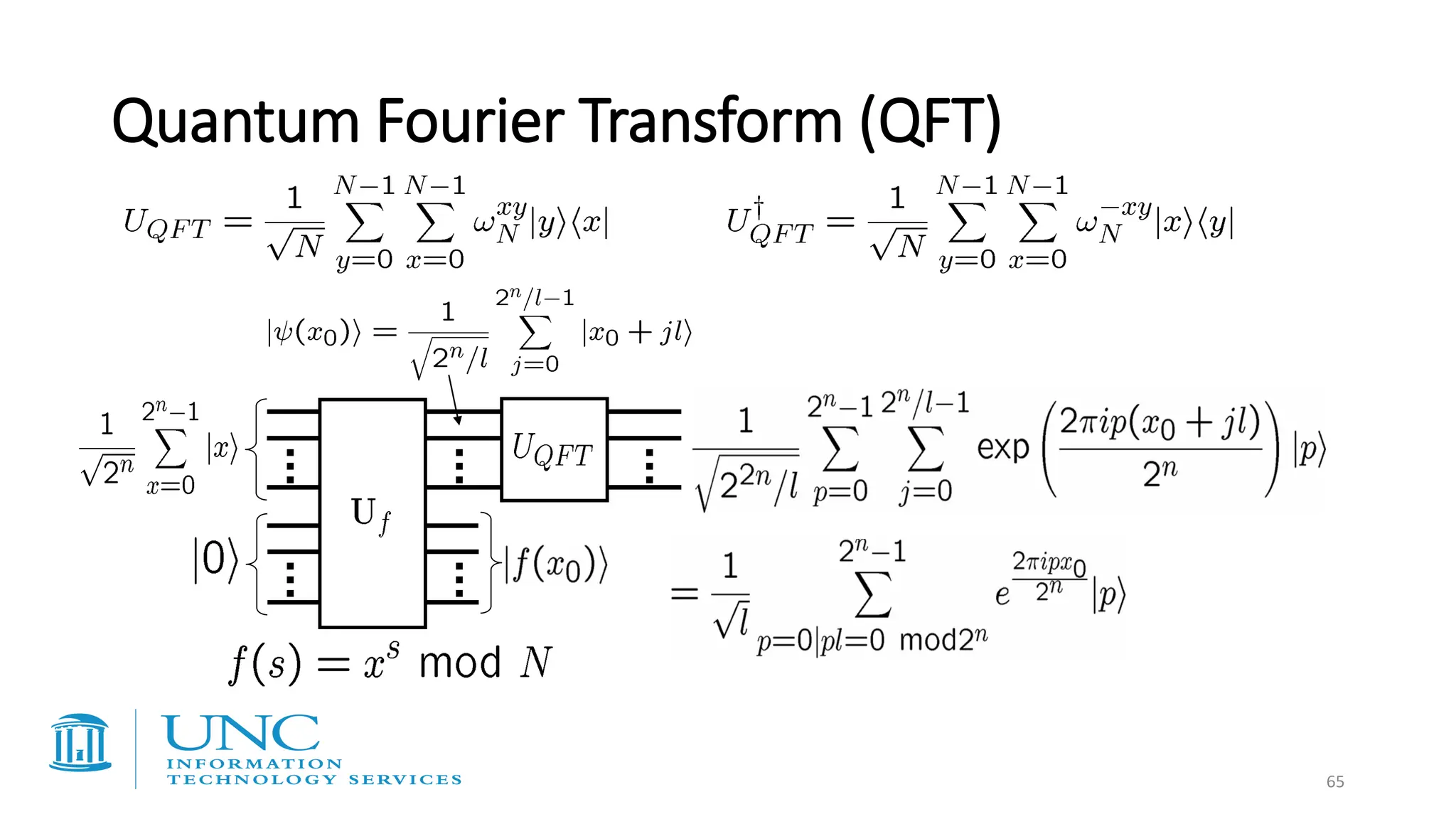
• Use QFT on quantum computer to find the period of
• Use order of x to compute possible factors of N.
• Check if they work; If not, rerun.
• Best classical algorithm takes time
But Shor’s quantum algorithm takes time
Peter Shor 1994
64
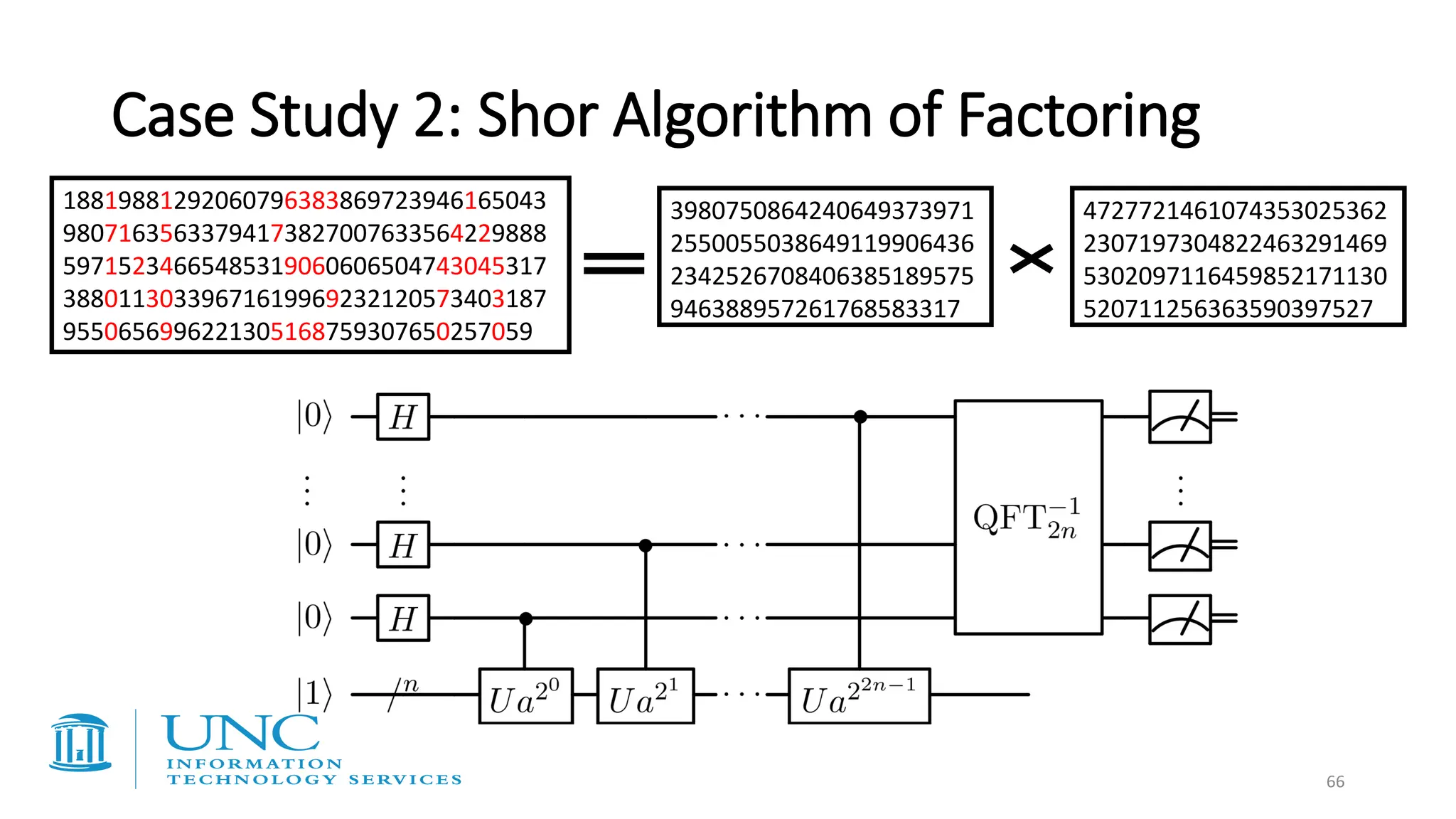
Case Study 2:Shor Algorithm of Factoring
4727721461074353025362
2307197304822463291469
5302097116459852171130
520711256363590397527
3980750864240649373971
2550055038649119906436
2342526708406385189575
946388957261768583317
18819881292060796383869723946165043
98071635633794173827007633564229888
59715234665485319060606504743045317
38801130339671619969232120573403187
9550656996221305168759307650257059
66
67.
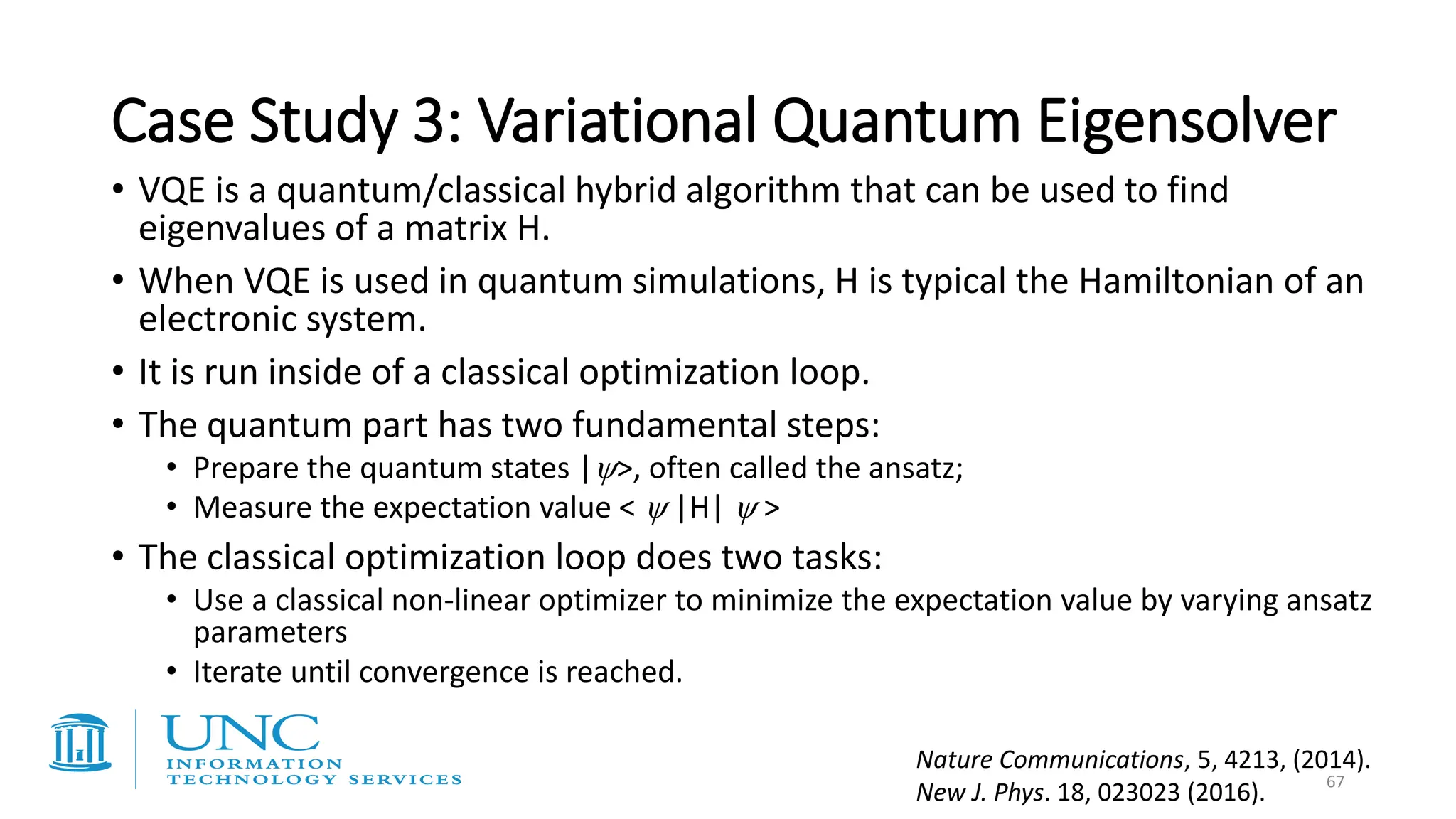
Case Study 3:Variational Quantum Eigensolver
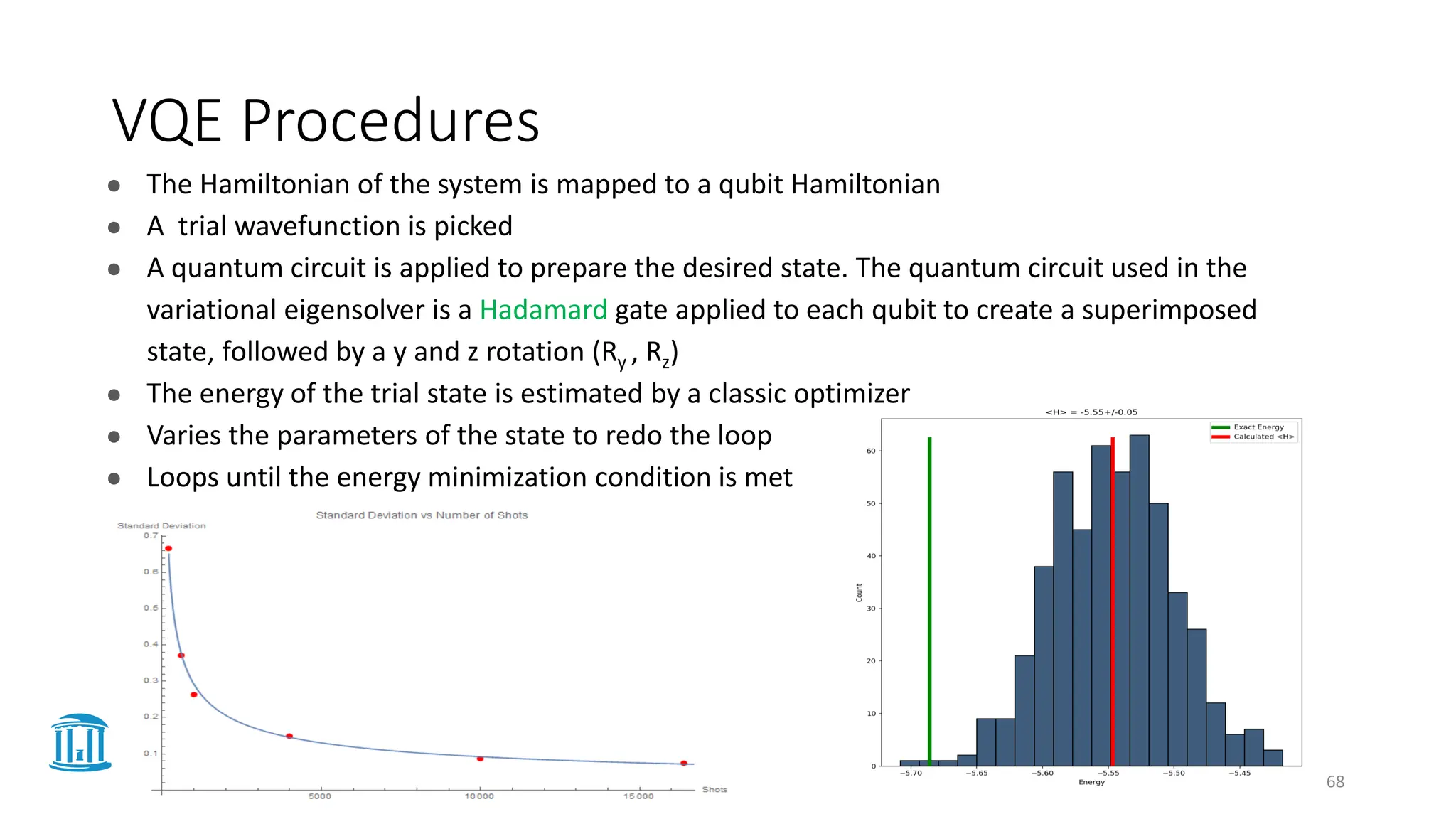
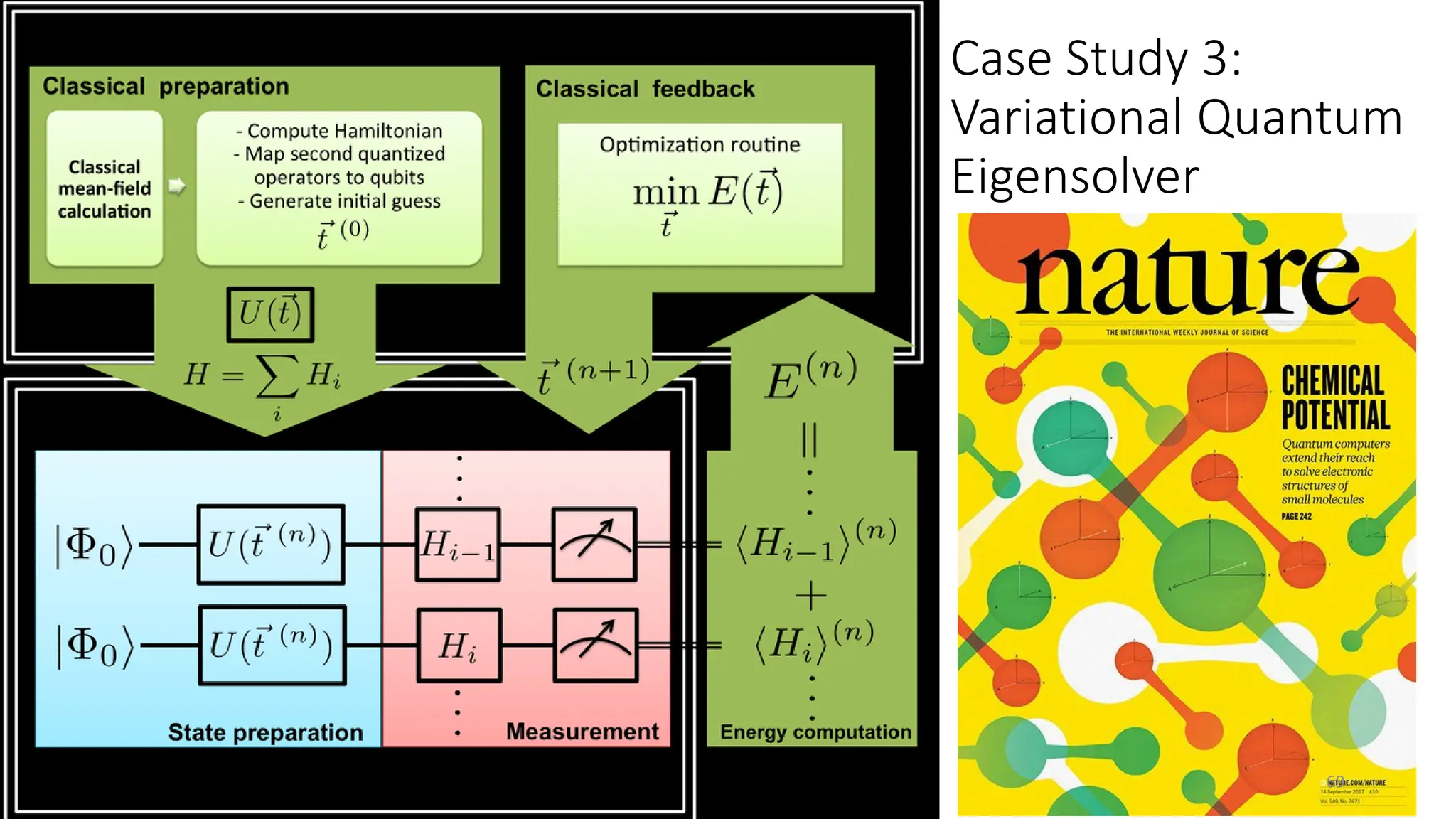
• VQE is a quantum/classical hybrid algorithm that can be used to find
eigenvalues of a matrix H.
• When VQE is used in quantum simulations, H is typical the Hamiltonian of an
electronic system.
• It is run inside of a classical optimization loop.
• The quantum part has two fundamental steps:
• Prepare the quantum states |>, often called the ansatz;
• Measure the expectation value < |H| >
• The classical optimization loop does two tasks:
• Use a classical non-linear optimizer to minimize the expectation value by varying ansatz
parameters
• Iterate until convergence is reached.
Nature Communications, 5, 4213, (2014).
New J. Phys. 18, 023023 (2016). 67
68.
VQE Procedures
● TheHamiltonian of the system is mapped to a qubit Hamiltonian
● A trial wavefunction is picked
● A quantum circuit is applied to prepare the desired state. The quantum circuit used in the
variational eigensolver is a Hadamard gate applied to each qubit to create a superimposed
state, followed by a y and z rotation (Ry , Rz)
● The energy of the trial state is estimated by a classic optimizer
● Varies the parameters of the state to redo the loop
● Loops until the energy minimization condition is met
68
Case Study 3:Variational Quantum Eigensolver
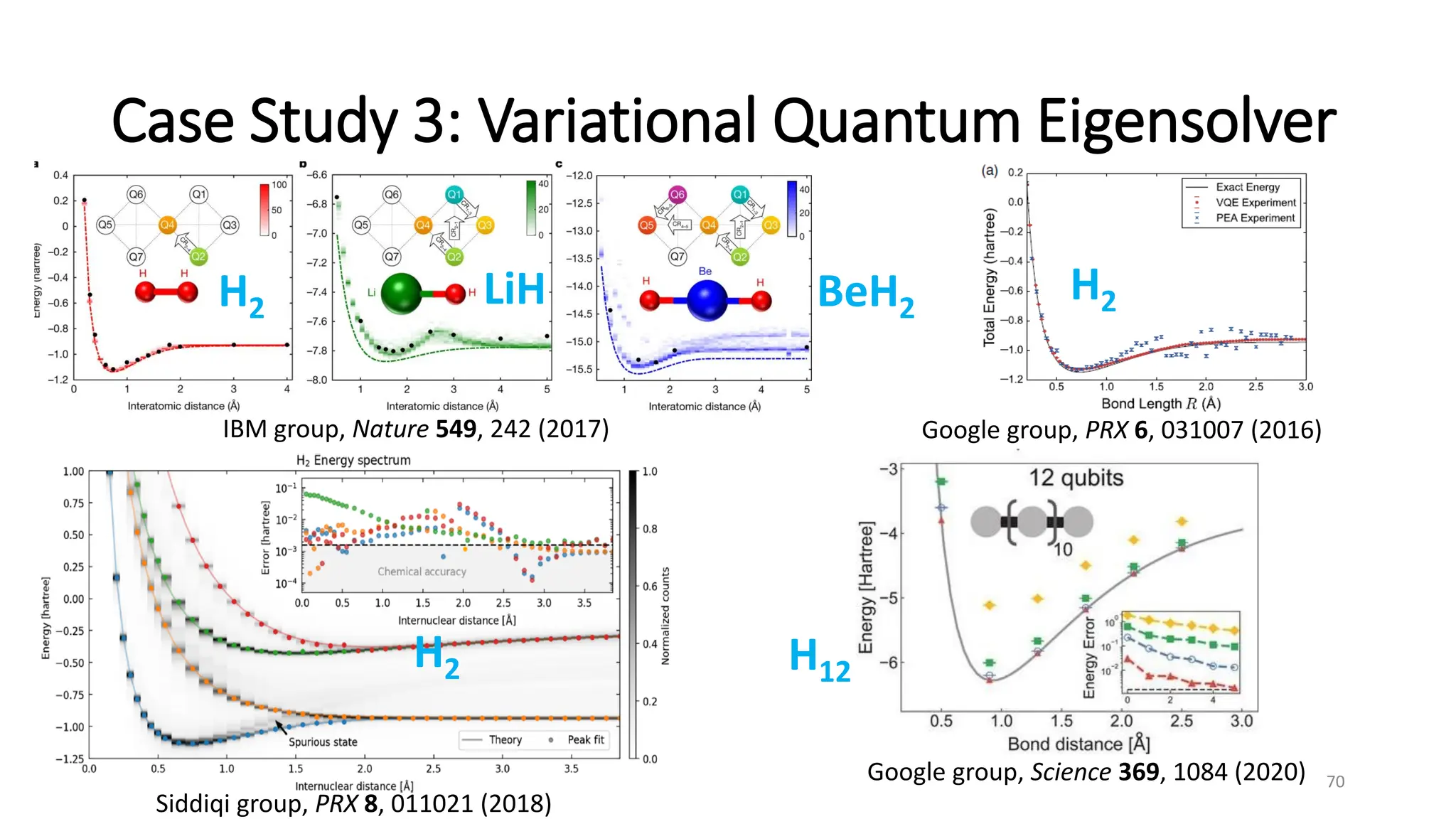
70
Google group, Science 369, 1084 (2020)
IBM group, Nature 549, 242 (2017) Google group, PRX 6, 031007 (2016)
Siddiqi group, PRX 8, 011021 (2018)
H12
H2 LiH H2
H2
BeH2
71.
Post-Quantum World
There isa good chance that quantum computers will be able to crack RSA-2048 within five-ten years
(need about 8,000 qubits in a universal computer to do this).
Some encrypted data has a shelf-life of more than ten years. It may take ten years to cut over to a new
encryption scheme, so companies and governments are scrambling to figure out what to do.
Most encryption used today is not safe in a quantum world.
If someone has been recording a https session, say, they may not be able to decrypt it now, but a few
years from now, who knows.
There are encryption algorithms that are safe:
Secure communications will move to symmetric encryption or hash algorithms, or perhaps lattice
algorithms.
QKD (Quantum Key Distribution) will likely be more popular for the most sensitive communications
Some governments and banks are already starting to use “Quantum Safe” algorithms, and this is
expected to increase over the next decade.
71
72.
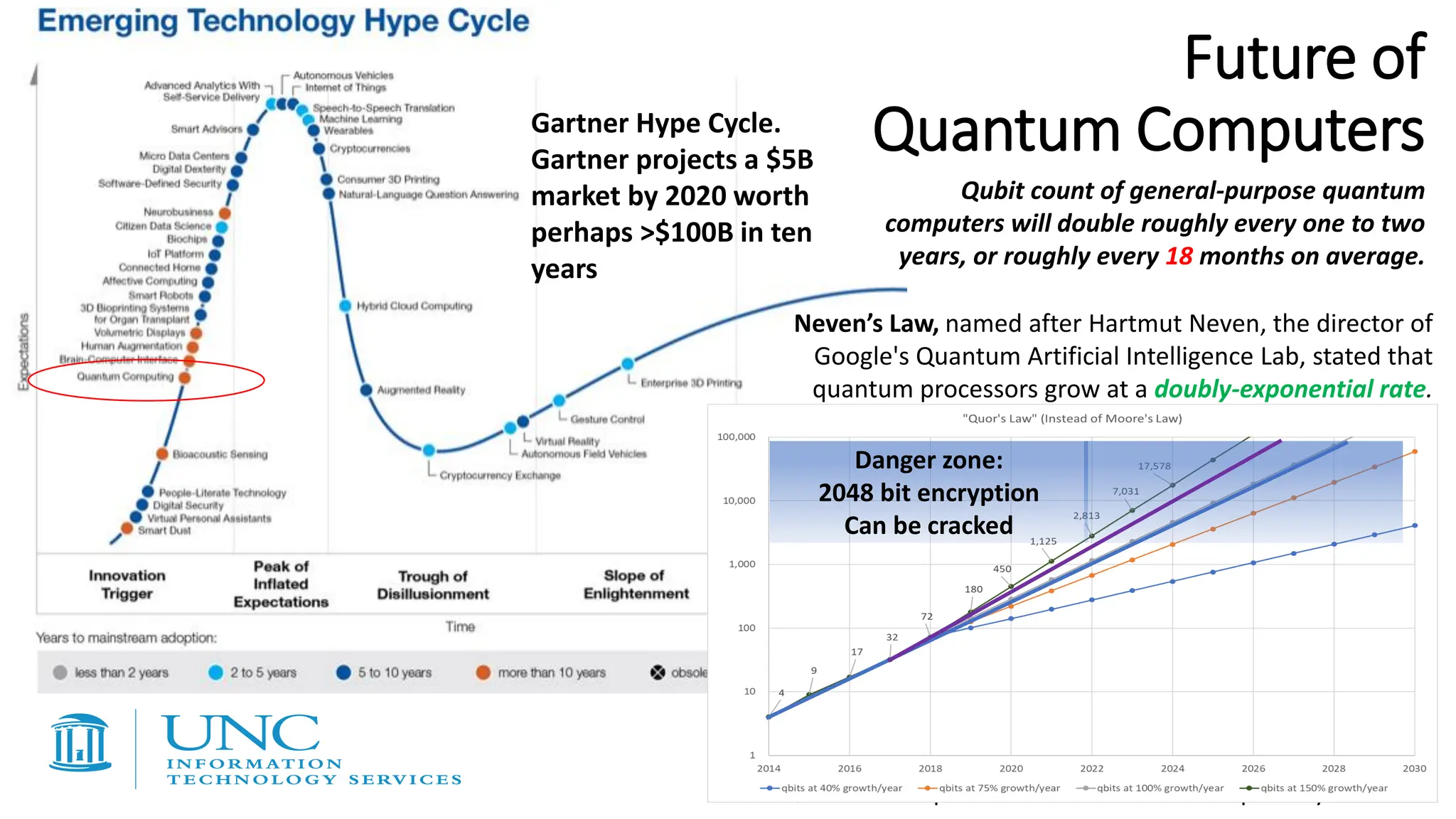
Gartner Hype Cycle.
Gartnerprojects a $5B
market by 2020 worth
perhaps >$100B in ten
years
72
Qubits in computers announced over the past 5 years
Danger zone:
2048 bit encryption
Can be cracked
Future of
Quantum Computers
Neven’s Law, named after Hartmut Neven, the director of
Google's Quantum Artificial Intelligence Lab, stated that
quantum processors grow at a doubly-exponential rate.
Qubit count of general-purpose quantum
computers will double roughly every one to two
years, or roughly every 18 months on average.
73.
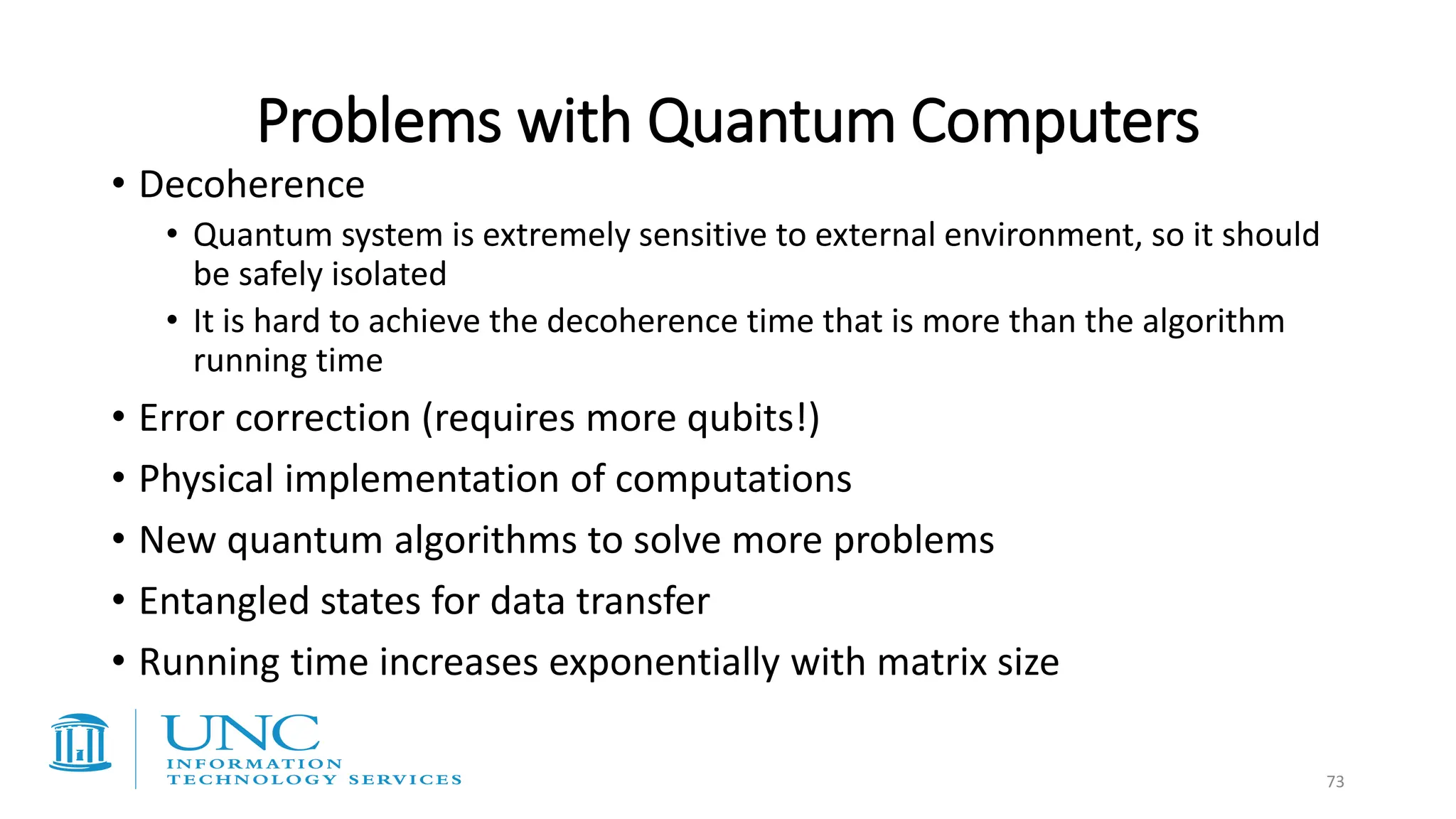
Problems with QuantumComputers
• Decoherence
• Quantum system is extremely sensitive to external environment, so it should
be safely isolated
• It is hard to achieve the decoherence time that is more than the algorithm
running time
• Error correction (requires more qubits!)
• Physical implementation of computations
• New quantum algorithms to solve more problems
• Entangled states for data transfer
• Running time increases exponentially with matrix size
73
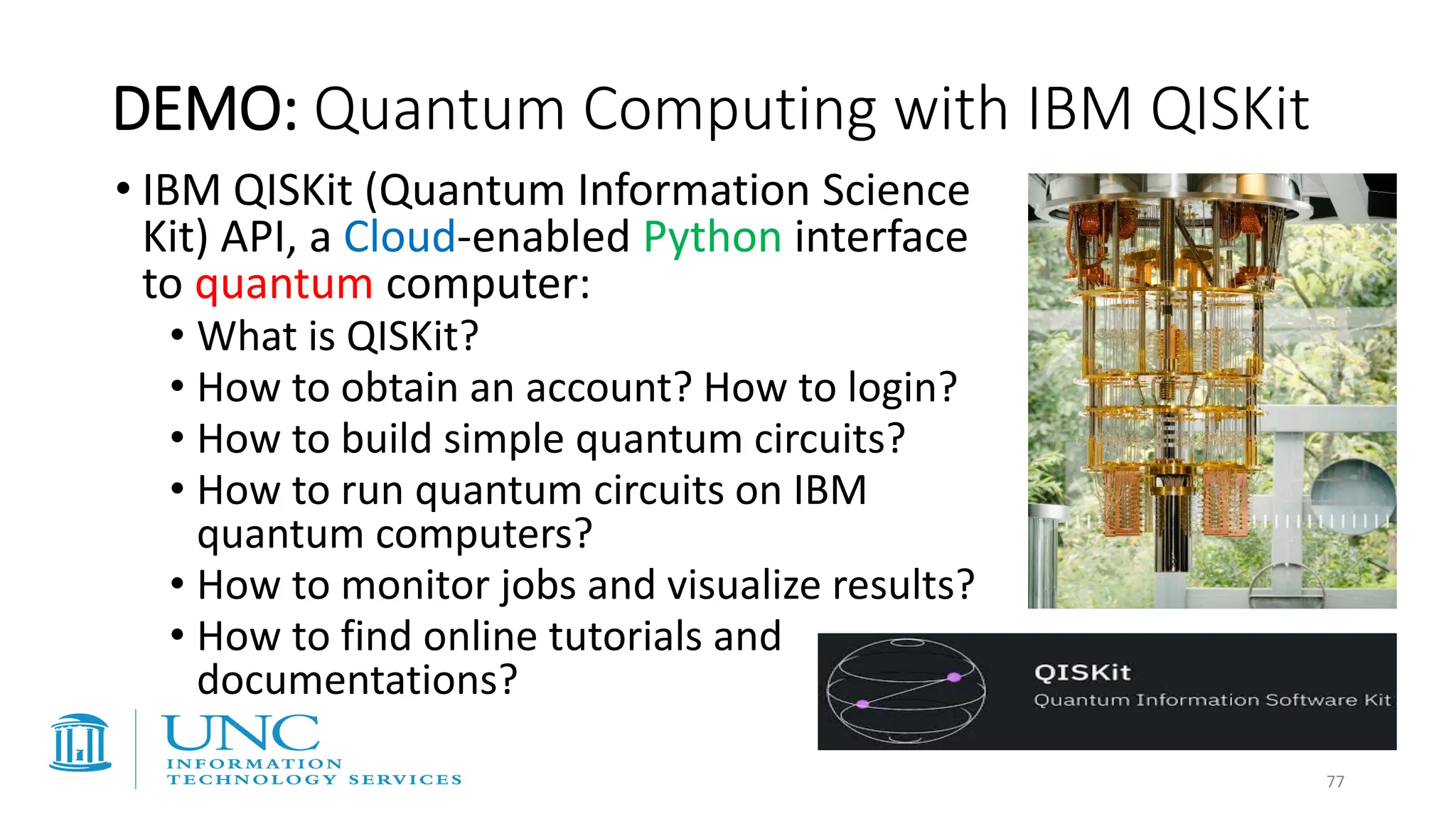
DEMO: Quantum Computingwith IBM QISKit
• IBM QISKit (Quantum Information Science
Kit) API, a Cloud-enabled Python interface
to quantum computer:
• What is QISKit?
• How to obtain an account? How to login?
• How to build simple quantum circuits?
• How to run quantum circuits on IBM
quantum computers?
• How to monitor jobs and visualize results?
• How to find online tutorials and
documentations?
77
78.
GETTING STARTED WITHQISKIT DEMO|Anastasia Marchenkova
https://www.youtube.com/watch?v=yprDIC-9D0k
QISKit DEMO
79.
Questions & Comments???
Pleasedirect comments/questions about research computing to
E-mail: research@unc.edu
Please direct comments/questions pertaining to this presentation to
E-Mail: shubin@email.unc.edu
The PPT file of this presentation is available here:
http://its2.unc.edu/divisions/rc/training/scientific/short_courses/Quantum_Computer.ppt
79
![However, Quantum Systems are SPOOKY!
Schrödinger’s Cat: Superposition
“I cannot seriously believe in [the quantum theory] because it cannot be
reconciled with the idea that physics should represent a reality in time and
space, free from spooky actions at a distance.” Albert Einstein, March 1947.
Entanglement
23
Schrödinger’s
Cat in a black
box](https://image.slidesharecdn.com/introductiontoquantumcomputers-231026053818-d510d75b/75/Introduction_to_Quantum_Computers-pdf-23-2048.jpg)