BOP REAGENT
PREPARED BY :
SAURAV KR TALUKDAR
M PHARM 1ST
SEMESTER
DEPT OF PHARMACEUTICAL CHEMISTRY
INTRODUCTION TO BOP REAGENT
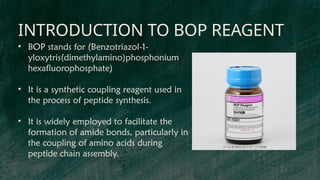
• BOP stands for (Benzotriazol-1-
yloxytris(dimethylamino)phosphonium
hexafluorophosphate)
• It is a synthetic coupling reagent used in
the process of peptide synthesis.
• It is widely employed to facilitate the
formation of amide bonds, particularly in
the coupling of amino acids during
peptide chain assembly.
CHEMICAL STRUCTURE
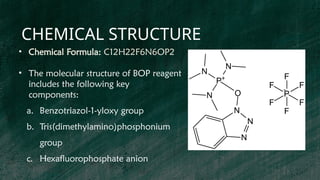
• Chemical Formula: C12H22F6N6OP2
• The molecular structure of BOP reagent
includes the following key
components:
a. Benzotriazol-1-yloxy group
b. Tris(dimethylamino)phosphonium
group
c. Hexafluorophosphate anion
SYNTHESIS OF BOP REAGENT
P
Cl
O
Cl
Cl
H
N
P
N N
N
tris(dimethylamino)phosphine
intermediate.
phosphoryl trichloride
dimethylamine
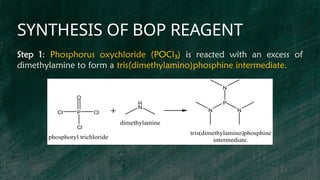
Step 1: Phosphorus oxychloride (POCl )
₃ is reacted with an excess of
dimethylamine to form a tris(dimethylamino)phosphine intermediate.
SYNTHESIS OF BOP REAGENT
P
N N
N
N
N
N
OH
P+
N
N
N
O
N
N
N
Cl-
1H-benzo[d][1,2,3]triazol-1-ol
tris(dimethylamino)phosphine
intermediate.
((1H-benzo[d][1,2,3]triazol-1-
yl)oxy)tris(dimethylamino)phosphonium chloride
Step 2: This intermediate is then reacted with 1-Hydroxybenzotriazole
(HOBt) to produce Benzotriazol-1-yloxytris(dimethylamino)phosphonium
chloride.
SYNTHESIS OF BOP REAGENT
P+
N
N
N
O
N
N
N
Cl-
P+
N
N
N
O
N
N
N
P-
F
F
F
F
F
F
((1H-benzo[d][1,2,3]triazol-1-
yl)oxy)tris(dimethylamino)phosphonium chloride
NH4PF6
((1H-benzo[d][1,2,3]triazol-1-
yl)oxy)tris(dimethylamino)phosphonium hexafluorophosphate
Step 3: The final step involves exchanging the chloride ion with
hexafluorophosphate (PF )
₆⁻ by treating the phosphonium chloride with a
hexafluorophosphate salt to form the BOP (Benzotriazol-1-
yloxytris(dimethylamino)phosphonium hexafluorophosphate) reagent.
MECHANISM OF ACTION
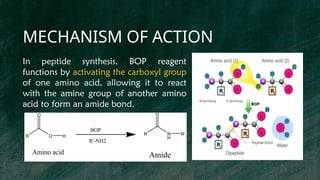
In peptide synthesis, BOP reagent
functions by activating the carboxyl group
of one amino acid, allowing it to react
with the amine group of another amino
acid to form an amide bond.
R N
H
O
R'
Ester
R O
O
H
Amino acid
BOP
R'-NH2
Amide
BOP
MECHANISM OF ACTION
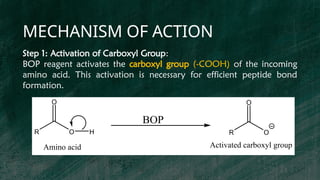
Step 1: Activation of Carboxyl Group:
BOP reagent activates the carboxyl group (-COOH) of the incoming
amino acid. This activation is necessary for efficient peptide bond
formation.
R O
O
H
Amino acid
R O
O
Activated carboxyl group
BOP
MECHANISM OF ACTION
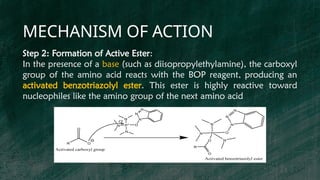
Step 2: Formation of Active Ester:
In the presence of a base (such as diisopropylethylamine), the carboxyl
group of the amino acid reacts with the BOP reagent, producing an
activated benzotriazolyl ester. This ester is highly reactive toward
nucleophiles like the amino group of the next amino acid
R O
O
Activated carboxyl group
P+
N
N
N
O
N
N
N
Cl-
P
N
N
N
O
N
N
N
O
R
O
Activated benzotriazolyl ester
MECHANISM OF ACTION
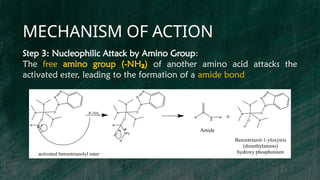
Step 3: Nucleophilic Attack by Amino Group:
The free amino group (-NH )
₂ of another amino acid attacks the
activated ester, leading to the formation of a amide bond
R N
H
O
R'
Ester
P
N
N
N
O
N
N
N
O
R
O
activated benzotriazolyl ester
R'-NH2
P
N
N
N
O
N
N
N
O
R
NH2
R
O
P
N
N
N
O
N
N
N
O
H
Benzotriazol-1-yloxytris
(dimethylamino)
hydroxy phosphonium
Amide
APPLICATION OF BOP
• Solid-Phase Peptide Synthesis (SPPS)
BOP reagent is a popular choice in SPPS due to its compatibility with
protecting groups and its ability to efficiently activate amino acids on
solid support matrices like polystyrene or polyethylene glycol (PEG).
• Natural Product Synthesis
Its utility extends beyond peptides, as it can be used to synthesize other
amide-containing compounds in the construction of natural products
and complex organic molecules.
• Custom Peptide Design
It involves the synthesis of specific peptide sequences with desired
properties for research, medical, or industrial applications
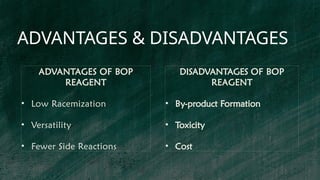
ADVANTAGES & DISADVANTAGES
ADVANTAGES OF BOP
REAGENT
• Low Racemization
• Versatility
• Fewer Side Reactions
DISADVANTAGES OF BOP
REAGENT
• By-product Formation
• Toxicity
• Cost
REFERENCE
• Dormoy JR, Castro B, Rabanal F, Giralt E.(2001) “Benzotriazol 1
‐ ‐
yloxytris (dimethylamino) phosphonium Hexafluorophosphate.”
Encyclopedia of Reagents for Organic Synthesis.
• Carpino, L. A., & El-Faham, A. (1995). "BOP Reagent: A Critical
Overview of its Applications in Peptide Synthesis." Journal of Organic
Chemistry, 60(24), 7511–7515.
• Bodanszky, M. (1993). "Principles of Peptide Synthesis." 2nd ed.
Springer-Verlag.
THANK YOU

BOP REAGENT| SYNTHETIC COUPLING REAGENT.pptx

  • 1.
    BOP REAGENT PREPARED BY: SAURAV KR TALUKDAR M PHARM 1ST SEMESTER DEPT OF PHARMACEUTICAL CHEMISTRY
  • 2.
    INTRODUCTION TO BOPREAGENT • BOP stands for (Benzotriazol-1- yloxytris(dimethylamino)phosphonium hexafluorophosphate) • It is a synthetic coupling reagent used in the process of peptide synthesis. • It is widely employed to facilitate the formation of amide bonds, particularly in the coupling of amino acids during peptide chain assembly.
  • 3.
    CHEMICAL STRUCTURE • ChemicalFormula: C12H22F6N6OP2 • The molecular structure of BOP reagent includes the following key components: a. Benzotriazol-1-yloxy group b. Tris(dimethylamino)phosphonium group c. Hexafluorophosphate anion
  • 4.
    SYNTHESIS OF BOPREAGENT P Cl O Cl Cl H N P N N N tris(dimethylamino)phosphine intermediate. phosphoryl trichloride dimethylamine Step 1: Phosphorus oxychloride (POCl ) ₃ is reacted with an excess of dimethylamine to form a tris(dimethylamino)phosphine intermediate.
  • 5.
    SYNTHESIS OF BOPREAGENT P N N N N N N OH P+ N N N O N N N Cl- 1H-benzo[d][1,2,3]triazol-1-ol tris(dimethylamino)phosphine intermediate. ((1H-benzo[d][1,2,3]triazol-1- yl)oxy)tris(dimethylamino)phosphonium chloride Step 2: This intermediate is then reacted with 1-Hydroxybenzotriazole (HOBt) to produce Benzotriazol-1-yloxytris(dimethylamino)phosphonium chloride.
  • 6.
    SYNTHESIS OF BOPREAGENT P+ N N N O N N N Cl- P+ N N N O N N N P- F F F F F F ((1H-benzo[d][1,2,3]triazol-1- yl)oxy)tris(dimethylamino)phosphonium chloride NH4PF6 ((1H-benzo[d][1,2,3]triazol-1- yl)oxy)tris(dimethylamino)phosphonium hexafluorophosphate Step 3: The final step involves exchanging the chloride ion with hexafluorophosphate (PF ) ₆⁻ by treating the phosphonium chloride with a hexafluorophosphate salt to form the BOP (Benzotriazol-1- yloxytris(dimethylamino)phosphonium hexafluorophosphate) reagent.
  • 7.
    MECHANISM OF ACTION Inpeptide synthesis, BOP reagent functions by activating the carboxyl group of one amino acid, allowing it to react with the amine group of another amino acid to form an amide bond. R N H O R' Ester R O O H Amino acid BOP R'-NH2 Amide BOP
  • 8.
    MECHANISM OF ACTION Step1: Activation of Carboxyl Group: BOP reagent activates the carboxyl group (-COOH) of the incoming amino acid. This activation is necessary for efficient peptide bond formation. R O O H Amino acid R O O Activated carboxyl group BOP
  • 9.
    MECHANISM OF ACTION Step2: Formation of Active Ester: In the presence of a base (such as diisopropylethylamine), the carboxyl group of the amino acid reacts with the BOP reagent, producing an activated benzotriazolyl ester. This ester is highly reactive toward nucleophiles like the amino group of the next amino acid R O O Activated carboxyl group P+ N N N O N N N Cl- P N N N O N N N O R O Activated benzotriazolyl ester
  • 10.
    MECHANISM OF ACTION Step3: Nucleophilic Attack by Amino Group: The free amino group (-NH ) ₂ of another amino acid attacks the activated ester, leading to the formation of a amide bond R N H O R' Ester P N N N O N N N O R O activated benzotriazolyl ester R'-NH2 P N N N O N N N O R NH2 R O P N N N O N N N O H Benzotriazol-1-yloxytris (dimethylamino) hydroxy phosphonium Amide
  • 11.
    APPLICATION OF BOP •Solid-Phase Peptide Synthesis (SPPS) BOP reagent is a popular choice in SPPS due to its compatibility with protecting groups and its ability to efficiently activate amino acids on solid support matrices like polystyrene or polyethylene glycol (PEG). • Natural Product Synthesis Its utility extends beyond peptides, as it can be used to synthesize other amide-containing compounds in the construction of natural products and complex organic molecules. • Custom Peptide Design It involves the synthesis of specific peptide sequences with desired properties for research, medical, or industrial applications
  • 12.
    ADVANTAGES & DISADVANTAGES ADVANTAGESOF BOP REAGENT • Low Racemization • Versatility • Fewer Side Reactions DISADVANTAGES OF BOP REAGENT • By-product Formation • Toxicity • Cost
  • 13.
    REFERENCE • Dormoy JR,Castro B, Rabanal F, Giralt E.(2001) “Benzotriazol 1 ‐ ‐ yloxytris (dimethylamino) phosphonium Hexafluorophosphate.” Encyclopedia of Reagents for Organic Synthesis. • Carpino, L. A., & El-Faham, A. (1995). "BOP Reagent: A Critical Overview of its Applications in Peptide Synthesis." Journal of Organic Chemistry, 60(24), 7511–7515. • Bodanszky, M. (1993). "Principles of Peptide Synthesis." 2nd ed. Springer-Verlag.
  • 14.