The document describes a new flexible synthesis of pyrazoles that allows for varying substituents at the C3 and C5 positions of the pyrazole ring. The synthesis involves coupling protected alkynols with acid chlorides to form alkynyl ketones, which are reacted with hydrazine to install the pyrazole nucleus. Alcohol deprotection and conversion to chlorides provides access to 5-substituted 3-(chloromethyl)- or 3-(2-chloroethyl)pyrazoles. These chlorides can then undergo nucleophilic substitution to generate other polyfunctional pyrazoles. The significance is that substituents at C5 control the steric environment around the pyrazole N-H
![New Flexible Synthesis of Pyrazoles with Different,
Functionalized Substituents at C3 and C5
Douglas B. Grotjahn,* Sang Van, David Combs,† Daniel A. Lev, Christian Schneider,‡
Marc Rideout,‡ Christoph Meyer,‡ Genaro Hernandez,‡ and Lupe Mejorado‡
Department of Chemistry, San Diego State University, 5500 Campanile Drive,
San Diego, California 92182-1030
grotjahn@chemistry.sdsu.edu
Received June 19, 2002
Syntheses of pyrazoles featuring a functionalized side chain attached to carbon 3 and varying alkyl
and aryl substituents attached to carbon 5 are presented. Installation of R ) methyl, isopropyl,
tert-butyl, adamantyl, or phenyl groups at C5 is reported here, starting by coupling protected
alkynols with acid chlorides RCOCl, forming alkynyl ketones, which are reacted with hydrazine to
form the pyrazole nucleus. Alcohol deprotection and conversion to a chloride gave 5-substituted
3-(chloromethyl)- or 3-(2-chloroethyl)pyrazoles. This sequence can be done within 2 d on a 30 g
scale in excellent overall yield. Through nucleophilic substitution reactions, the chlorides are useful
precursors to other polyfunctional pyrazoles. In the work here, derivatives with side chains LCH2-
and LCH2CH2- at C3 (L ) thioether or phosphine) were made as ligands. The significance of the
ligands made here is that by placing a ligating side chain on a ring carbon (C3), rather than on a
ring nitrogen, the ring nitrogen not bound to the metal and its attached proton will be available
for hydrogen bonding, depending on the steric environment created by R at C5.
Introduction
It is clear that we can learn much about ligand and
catalyst design by looking to Nature and some of its
catalysts, the enzymes. For example, the active site of
the enzyme carboxypeptidase1 is typical of many metal-
loenzymes,2 containing a Lewis acidic transition-metal
center [a Zn(II) ion] bound tightly to the protein and
several nearby organic functional groups capable of
accepting or donating a proton or a hydrogen bond. It is
thought that the combined effects (cooperativity) of the
metal ion and nearby Brønsted-Lowry acids and bases
are responsible for facilitating the addition of a water
molecule to a carboxylic acid amide, accelerating amide
hydrolysis by a factor of more than 1011
.3,4
In simplified systems, the effects of cooperativity have
been studied using a variety of metal ions and organic
functional groups such as phenol,5
imidazole or imida-
zolium,6 and alkylamine or -ammonium moieties.7,8 The
pKa of the phenol, imidazolium, and alkylammonium
moieties used is in the range of 7-10. Recently, organo-
metallic examples of bifunctional catalysis have featured
systems in which a transition-metal hydride and an
electronically coupled N-H or O-H9-14 act in concert to
catalyze addition of hydrogen to polar functional groups
(aldehydes, ketones, imines), in some cases with very
high enantioselectivity.
Metal complexation to the pyrazole heterocycle15-18
could offer a straightforward way to couple the effect of
a metal bound to one heterocyclic nitrogen with the
ability of the N-H to donate a proton or hydrogen bond
(see Chart 1, structures A and B). The ability of metal-
coordinated pyrazole to donate a hydrogen bond intramo-
lecularly to a halide, hydroxide, carboxylate, or peroxo
ligand is well-documented.19
Literature data on proton
donation of metal-coordinated pyrazoles is much more
† Current address: Trilink Biotechnologies, San Diego, CA.
‡ Undergraduate research participant.
(1) Creighton, T. E. Proteins: Structures and Molecular Properties,
2nd ed.; W. H. Freeman: New York, 1993.
(2) Sadler, P. J. Metal Sites in Proteins and Models; Springer:
Heidelberg, Germany, 1997; Vol. 89.
(3) Bryant, R. A. R.; Hansen, D. E. J. Am. Chem. Soc. 1996, 118,
5498-5499.
(4) Radzicka, A.; Wolfenden, R. J. Am. Chem. Soc. 1996, 118, 6105-
6109.
(5) Schepartz, A.; Breslow, R. J. Am. Chem. Soc. 1987, 109, 1814-
1826.
(6) Breslow, R.; Berger, D.; Huang, D. J. Am. Chem. Soc. 1990, 112,
3687-3688.
(7) Ko¨va´ri, E.; Kra¨mer, R. J. Am. Chem. Soc. 1996, 118, 12704-
12709.
(8) Wall, M.; Linkletter, B.; Williams, D.; Lebuis, A.-M.; Hynes, R.
C.; Chin, J. J. Am. Chem. Soc. 1999, 121, 4710-4711.
(9) Noyori, R.; Hashiguchi, S. Acc. Chem. Res. 1997, 30, 97-102.
(10) Palmer, M. J.; Wills, M. Tetrahedron: Asymmetry 1999, 10,
2045-2061.
(11) Yamakawa, M.; Ito, H.; Noyori, R. J. Am. Chem. Soc. 2000, 122,
1466-1478.
(12) Abdur-Rashid, K.; Faatz, M.; Lough, A. J.; Morris, R. H. J. Am.
Chem. Soc. 2001, 123, 7473-7474.
(13) Noyori, R.; Ohkuma, T. Angew. Chem., Int. Ed. 2001, 40, 40-
73.
(14) Casey, C. P.; Singer, S. W.; Powell, D. R.; Hayashi, R. K.;
Kavana, M. J. Am. Chem. Soc. 2001, 123, 1090-1100.
(15) Elguero, J. Pyrazoles. In Comprehensive Heterocyclic Chemistry;
Shinkai, I., Ed.; Pergamon: Oxford, 1996; Vol. 3, pp 1-75.
(16) Sadimenko, A. P.; Basson, S. S. Coord. Chem. Rev. 1996, 147,
247-297.
(17) Garnovskii, A. D.; Sadimenko, A. P. Adv. Heterocycl. Chem.
1999, 72, 1-77.
(18) Mukherjee, R. Coord. Chem. Rev. 2000, 203, 151-218.
9200 J. Org. Chem. 2002, 67, 9200-9209
10.1021/jo026083e CCC: $22.00 © 2002 American Chemical Society
Published on Web 11/27/2002](https://image.slidesharecdn.com/2f2e6b24-6ffd-405f-af6d-eaaf81cc3c0a-160616153510/75/J-Org-Chem-2002-Grotjahn-1-2048.jpg)
![rare, but it appears that the acidity of pyrazole itself (pKa
) 14.2)20
moves into the range 5.98-7.21 (similar to that
of protonated imidazole) upon coordination to [M(NH3)5]3+
(M ) Cr, Co, Ru).21,22
Surprisingly, we are unaware of attempts to use
pyrazole proton or hydrogen bond donation properties in
catalysis or enzyme modeling until recently. In 1998, as
we began our work,19e,23 Deters and Kra¨mer reported that
Cu(II) complexes of type B underwent deprotonation and
dimerization (forming structures similar to C or D) rather
than catalyzing phosphate ester hydrolysis.24 This result
shows one of the potential difficulties in maintaining
structures such as A and B: deprotonation of pyrazole
produces a pyrazolate, a monoanionic ligand, usually
bridging two metals by coordination of both nitrogens as
in C or D.25,26
We felt that if we could hinder the
intermolecular approach of hydrogen bond acceptors,
bulky metal fragments, or bases to the pyrazole N-H,
we would be able to focus our studies on the intramo-
lecular hydrogen-bonding interactions schematically il-
lustrated in structures A and B.
In fact, in our pursuit of structure B in which a N-H
bond is retained, we have reported the preparation of
pyrazole ligands 1 (Chart 2) featuring a soft thioether or
phosphine group.19e (For clarity in this paper, in all cases
where two tautomeric forms of a pyrazole are possible
and probable, e.g., 1, only one form will be shown.) In
the crystal structures of Pd(II) species of type B (e.g., 2,
Chart 2) it was obvious that a lack of steric hindrance at
the pyrazole N-H allowed multiple hydrogen-bonding
interactions, both the desired intramolecular one shown
and undesired intermolecular ones. Because we wanted
to study the cooperative effects of intramolecular hydro-
gen bonding, our synthetic tactic, the fruits of which are
reported here, has been to increase steric hindrance at
the NH by introducing alkyl or aryl groups at C5. We
now report a versatile synthesis of pyrazoles which allows
us to vary the steric environment of the pyrazole ring as
well as the length of the side chain spacer between L and
C3 of the heterocycle. The crystal structures of several
PdCl2 complexes show that changing these groups allows
control of the structure of the complexes and their
intermolecular hydrogen bonding.27 The ability to create
pyrazole-containing ligands with different steric and
electronic properties will facilitate future studies of
pyrazole-metal complexes. These synthetic advances
should have application not only to the field of ligand and
catalyst design, but also in pharmaceutical chemistry,
since hundreds of pyrazole derivatives have already been
made as drugs, herbicides, etc.28
Results and Discussion
Synthesis Design. We sought a general route which
would allow one to vary systematically both the steric
and electronic properties of the pyrazole ligand system.
(19) For leading references, see: (a) Kitajima, N.; Osawa, M.;
Tamura, N.; Moro-oka, Y.; Hirano, T.; Hirobe, M.; Nagano, T. Inorg.
Chem. 1993, 32, 1879-1880. (b) Esteruelas, M. A.; Garcı´a, M. P.;
Martı´n, M.; Nu¨rnberg, O.; Oro, L. A.; Werner, H. J. Organomet. Chem.
1994, 466, 249-257. (c) Komatsuzaki, H.; Icikawa, S.; Hikichi, S.;
Akita, M.; Moro-oka, Y. Inorg. Chem. 1998, 37, 3652-3656. (d)
Esteruelas, M. A.; Oliva´n, M.; On˜ate, E.; Ruiz, N.; Tajada, M. A.
Organometallics 1999, 18, 2953-2960. (e) Grotjahn, D. B.; Combs, D.;
Van, S.; Aguirre, G.; Ortega, F. Inorg. Chem. 2000, 39, 2080-2086.
(20) Yagil, G. Tetrahedron 1967, 23, 2855-2861.
(21) Johnson, C. R.; Henderson, W. W.; Shepherd, R. E. Inorg. Chem.
1984, 23, 2754-2763.
(22) Winter, J. A.; Caruso, D.; Shepherd, R. A. Inorg. Chem. 1988,
27, 1086-1089.
(23) Grotjahn, D. B.; Van, S.; Combs, D.; Kassel, W. S.; Rheingold,
A. L. J. Inorg. Biochem. 2001, 85, 61-65.
(24) Deters, R.; Kra¨mer, R. Inorg. Chim. Acta 1998, 269, 117-124.
(25) la Monica, G.; Ardizzoia, G. A. Prog. Inorg. Chem. 1997, 46,
151-238.
(26) For leading references to the many excellent uses of anionic
pyrazolate ligands, see reviews of poly(pyrazolyl)borate complexes: (a)
Trofimenko, S. Chem. Rev. 1993, 93, 943-980. (b) Kitajima, N.;
Tolman, W. B. Prog. Inorg. Chem. 1995, 43, 419-531. Further, for some
uses of bridging pyrazolates (C and D) in studying bimetallic reactivity,
cooperativity, and electronic communication between metals, to name
a few properties of interest in coordination, bioinorganic, and organo-
metallic chemistry, see: (c) Bode, R. H.; Bol, J. E.; Driessen, W. L.;
Hulsbergen, F. B.; Reedijk, J.; Spek, A. L. Inorg. Chem. 1999, 38, 1239-
1243. (d) Yu, Z.; Wittbrodt, J. M.; Heeg, M. J.; Schlegel, H. B.; Winter,
C. H. J. Am. Chem. Soc. 2000, 122, 9338-9339. (e) Ca´mpora, J.; Lo´pez,
J. A.; Maya, C. M.; Palma, P.; Carmona, E. Organometallics 2000, 19,
2707-2715. (f) Carmona, D.; Ferrer, J.; Arilla, J. M.; Reyes, J.; Lahoz,
F. J.; Elipe, S.; Modrego, F. J.; Oro, L. A. Organometallics 2000, 19,
798-808. (g) Meyer, F.; Jacobi, A.; Zsolnai, L. Chem. Ber./Recl. 1997,
130, 1441-1447. (h) Meyer, F.; Kaifer, E.; Kircher, P.; Heinze, K.;
Pritzkow, H. Chem.sEur. J. 1999, 5, 1617-1630.
(27) Grotjahn, D. B.; Van, S.; Combs, D.; Lev, D.; Schneider, C.;
Meyer, C.; Rideout, M.; Hernandez, G.; Mejorado, L.; Incarvito, C.;
Lam, K.-C.; Rossi, G.; Rheingold, A. L. Inorg. Chem., submitted for
publication.
(28) For recent leading references, see Katritzky, A. R.; Wang, M.;
Zhang, S.; Voronkov, M. V.; Steel, P. J. J. Org. Chem. 2001, 66, 6787-
6791, especially ref 1 therein. Pinto, D. J. P.; Orwat, M. J.; Wang, S.;
Fevig, J. M.; Quan, M. L.; Amparo, E.; Cacciola, J.; Rossi, K. A.;
Alexander, R. S.; Smallwood, A. M.; Luettgen, J. M.; Liang, L.; Aungst,
B. J.; Wright, M. R.; Knabb, R. M. J. Med. Chem. 2001, 44, 566-578.
Donohue, B. A.; Michelotti, E. L.; Reader, J. C.; Reader, V.; Stirling,
M.; Tice, C. M. J. Comb. Chem. 2002, 4, 23-32.
CHART 1. Pyrazole Derivatives as Ligands CHART 2. Ligands and Complexes Made
Previously
New Flexible Synthesis of Pyrazoles
J. Org. Chem, Vol. 67, No. 26, 2002 9201](https://image.slidesharecdn.com/2f2e6b24-6ffd-405f-af6d-eaaf81cc3c0a-160616153510/75/J-Org-Chem-2002-Grotjahn-2-2048.jpg)
![We wanted to avoid using reducing or oxidizing reagents,
so as to increase the variety of functional groups toler-
ated. Many pyrazoles have been made as ligands, but
virtually all of these feature a substituent on one of the
ring nitrogens. Perhaps the most common type of pyra-
zole-containing ligands are poly(pyrazolyl)borates (e.g.,
structure E).26a Because substitution at one of the ring
nitrogens is such a facile reaction, virtually all pyrazole
ligands have been made by one of two routes, alkylation
at one ring nitrogen with either aldehydes or alkyl
halides or tosylates29
or attachment of a boron.26a,b
These
strategies result in blockage of the substituted nitrogen
to coordination and loss of the critical NH group, which
we required.
The number of pyrazole-containing ligands in which
both ring nitrogens are unsubstituted and a side chain
is attached at a ring carbon is rather small,30 probably
because it is relatively difficult to make such systems.
In our reported approach to 1 and 2 (Scheme 1),19e
we
overcame this problem by attaching a functionalized side
chain at the pyrazole 3-position starting with pyrazole
itself, which was converted to its N-hydroxymethyl
derivative 3a with formaldehyde. The ring of 3a was
lithiated using n-BuLi, and the resulting species treated
with formaldehyde. After N-deprotection, the hydro-
choride salt of pyrazole-3-methanol (4a) resulted; sub-
sequent conversions of 4a led to 1. In early stages of this
work, we treated 3(5)-tert-butylpyrazole31
with formal-
dehyde, isolating a single N-hydroxymethyl derivative,
3b. The structure shown is tentatively assigned on the
basis of ample literature precedents involving the reac-
tion of sterically biased 3(5)-substituted pyrazoles under
thermodynamic control, which show that N-substitution
is preferred on the less-hindered nitrogen.29,32 However,
limited attempts at lithiation of 3b and trapping with
electrophiles suggested that alternative routes were
desirable. Even if the chemistry proceeded smoothly, if
we were to use lithiation of preformed pyrazole deriva-
tives, for each desired pyrazole 5-substituent we would
have to first make the pyrazole itself and then its
N-hydroxymethyl derivative 3.
Perhaps the most common route to construction of
pyrazoles with different substituents at C3 and C5 is
condensation of hydrazine with an unsymmetrical 1,3-
diketone [path a in Scheme 2, in equilibrium with its
tautomeric enol form(s)].15,33-35 For our purposes, forma-
tion of the requisite 1,3-diketone would require selective,
directed Claisen condensation between compounds such
as those shown in path a. Initial experiments in this
direction were not promising, so another kind of 1,3-bis-
(electrophile) was sought.
There are scattered but increasingly frequent literature
reports that pyrazoles can be made by adding hydrazine
(as a double nucleophile) to other three-carbon units
featuring two electrophilic carbons in a 1,3-relationship.
Vinyl ketones with a potential leaving group β to the
carbonyl are one candidate.36-38 However, a century ago
it was discovered that acetylenic ketones can react with
hydrazine derivatives to give pyrazoles.39-41 Until re-
cently, there have only been a few reports of this
reaction,33,42-48
though in recent years it has assumed
(29) Watson, A. A.; House, D. A.; Steel, P. J. Aust. J. Chem. 1995,
48, 1549-1572.
(30) See the eight publications cited in ref 10 of our previous
paper.19e
(31) Trofimenko, S.; Calabrese, J. C.; Thompson, J. S. Inorg. Chem.
1987, 26, 1507-1514.
(32) Reger, D. L.; Collins, J. E.; Jameson, D. L.; Castellano, R. K.
Inorg. Synth. 1998, 32, 63-65.
(33) Kost, A. N.; Grandberg, I. I. Adv. Heterocycl. Chem. 1966, 6,
347-429, especially pp 366-368.
(34) Wiley, R. H. Pyrazoles, Pyrazolines, Pyrazolidines, Indazoles,
and Condensed Rings; Interscience Publishers: New York, 1967.
(35) Elguero, J. Pyrazoles and Derivatives. In Comprehensive
Heterocyclic Chemistry; Potts, K. T., Ed.; Pergamon: Oxford, 1984; Vol.
5, pp 167-303.
(36) Zelenin, K. N. Org. Prep. Proc. Int. 1995, 27, 521-540.
(37) Lue, P.; Greenhill, J. V. Adv. Heterocycl. Chem. 1997, 67, 225-
314, esp. pp 253-258.
(38) Manferdini, M.; Morelli, C.; Veronese, A. C. Heterocycles 2000,
53, 2775-2780.
(39) Moureu, C.; Delange, R. Bull. Soc. Chim. Fr. 1901, 25, 302-
313.
(40) Moureu, C.; Delange, R. Ann. Chim. Phys. 1902, 25, 239-268,
esp. 252-255.
(41) Claisen, L. Ber. Dtsch. Chem. Ges. 1903, 36, 3664-3673.
(42) Bowden, K.; Jones, E. R. H. J. Chem. Soc. 1946, 953-954.
(43) Coispeau, G.; Elguero, J.; Jacquier, R. Bull. Soc. Chim. Fr. 1970,
689-696.
(44) Coispeau, G.; Elguero, J. Bull. Soc. Chim. Fr. 1970, 2717-2736.
(45) Ta¨mnefors, I.; Claesson, A.; Karlsson, M. Acta Pharm. Suec.
1975, 12, 435-444.
(46) Baddar, F. G.; Al-Hajjar, F. H.; El-Rayyes, N. R. J. Heterocycl.
Chem. 1976, 13, 257-268.
SCHEME 1. Attempt To Extend Previously Used
Chemistry
SCHEME 2. 1,3-Electrophiles as Pyrazole
Precursors
Grotjahn et al.
9202 J. Org. Chem., Vol. 67, No. 26, 2002](https://image.slidesharecdn.com/2f2e6b24-6ffd-405f-af6d-eaaf81cc3c0a-160616153510/75/J-Org-Chem-2002-Grotjahn-3-2048.jpg)
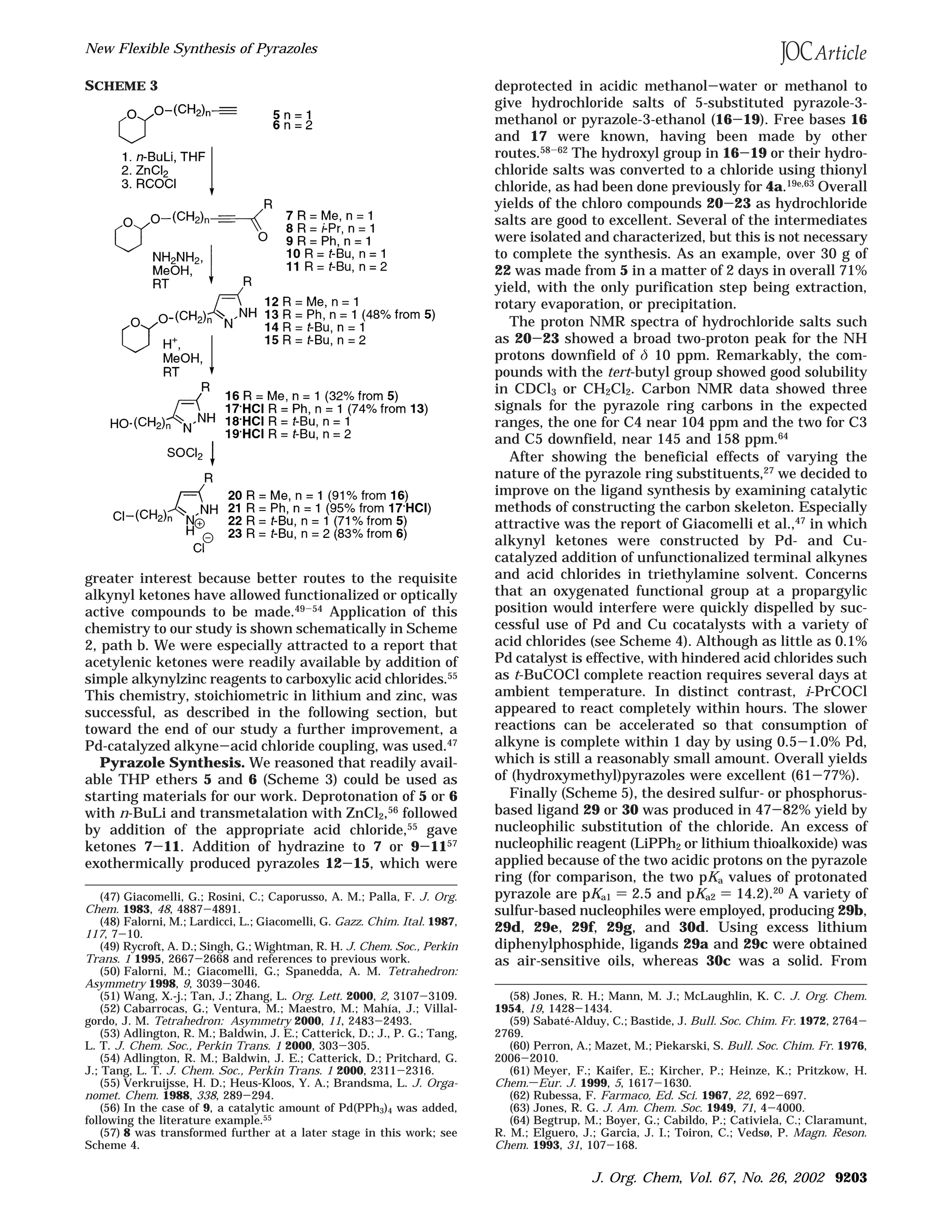
![literature precedents, all of the unsymmetrical pyrazole
derivatives in this study would exist as two tautomers,
only one of which is shown for clarity. However, in the
13
C NMR spectra of 29 and 30 (as well as those of 12-
15) the two downfield resonances for C3 and C5 were
unusually broadened, a result ascribed to the dynamic
equilibrium between the two tautomers and the espe-
cially large change in chemical shift for the two ring
carbons (C3 and C5) closest to the shifting proton.64
Conclusions
Here we present flexible syntheses of pyrazoles with
two different substituents at C3 and C5, which are
expected to be of interest not only to coordination and
organometallic chemists, but to anyone who wants to
make pyrazoles with functionalized substituents in de-
fined positions on the heterocycle. Although the focus of
this paper is the synthesis of thioethers and phosphines,
we note that 3-(chloromethyl)pyrazole itself and its
5-methyl derivative 20 have been converted to a number
of amines and other products through nucleophilic
substitutions.61,63,65-67 Future reports from our laborato-
ries will show ways in which the new, related chloroalkyl
compounds 21-23 display similar reactivity and versatil-
ity.
Experimental Section
General Procedures. Compounds 5 and 6 were either
purchased or readily made by reacting the appropriate alcohol
with dihydropyran under catalysis of toluenesulfonic acid. Dry
THF and ether were distilled from benzophenone and sodium.
Other solvents for manipulations of phosphines were deoxy-
genated by bubbling nitrogen through them. Other reagents
were purchased and used as received. Reactions were per-
formed under nitrogen using a combination of Schlenk and
inert-atmosphere glovebox techniques, and workups were done
in air unless otherwise specified.
Unless otherwise specified, NMR spectra were recorded
using a 200 or 500 MHz spectrometer at room temperature.
1
H and 13
C NMR chemical shifts are reported in parts per
million downfield from tetramethylsilane and referenced to
residual solvent resonances (1H NMR, 7.27 ppm for CHCl3 in
CDCl3, 2.05 ppm for CHD2COCD3 in acetone-d6, 2.50 ppm for
CHD2SOCD3 in DMSO-d6, 3.31 ppm for CHD2OD in CD3OD;
13C NMR, 77.23 ppm for CDCl3, 29.92 ppm for CD3COCD3,
39.51 ppm for CD3SOCD3, 49.15 ppm for CD3OD), where 1
H
NMR signals are given followed by multiplicity, coupling
constants J in hertz, and integration in parentheses. For
complex coupling patterns, the first coupling constant listed
corresponds to the first splitting listed, e.g., for “(dt, J ) 3.2,
7.9 Hz, 1 H)” the doublet exhibits the 3.2 Hz coupling constant.
31
P{1
H} NMR chemical shifts were referenced to external 85%
H3PO4(aq). Elemental analyses were performed at NuMega
Resonance Labs (San Diego).
General Procedure for the Synthetic Route shown in
Scheme 3. 5-tert-Butyl-3-(chloromethyl)pyrazole hydro-
chloride (22) and Intermediates 6-[(Tetrahydro-2H-
pyran-2-yl)oxy]-2,2-dimethylpent-4-yn-3-one (10), 5-tert-
Butyl-3-[(tetrahydro-2H-pyran-2-yl)oxy]methylpyra-
zole (14), and 5-tert-Butylpyrazole-3-methanol Hydro-
chloride (18‚HCl). A solution of 5 (30.0 g, 0.214 mol) in dry
THF (250 mL) under a nitrogen atmosphere was cooled to -78
°C. A solution of n-BuLi in hexane (2.5 M, 85.0 mL, 0.214 mol)
was added dropwise over 30 min to the cold reaction mixture.
The mixture was stirred for 1 h at -78 °C and slowly warmed
to room temperature. After being stirred for 2.5 h, the mixture
was cooled to -40 °C. A solution of ZnCl2 (29.17 g, 0.214 mol)
in THF (100 mL) was slowly added over 15 min before the
reaction mixture was warmed to room temperature and stirred
for 1 h. The reaction mixture was cooled to 0 °C, and pivaloyl
chloride (25.5 g, 0.214 mol) was added. The reaction was slowly
warmed to room temperature and stirred overnight (14 h)
before addition of saturated NH4Cl solution, followed by NH3
in water. The organic layer was extracted with diethyl ether
(2 × 100 mL). The organic phases were combined, dried with
MgSO4, and filtered, and the filtrate was concentrated by
(65) Di Vaira, M.; Mani, F.; Stoppioni, P. J. Chem. Soc., Dalton
Trans. 1994, 3739-3743.
(66) Meyer, F.; Beyreuther, S.; Heinze, K.; Zsolnai, L. Chem. Ber./
Recl. 1997, 130, 605-613.
(67) Yuan, Y.; Jime´nez, M. V.; Sola, E.; Lahoz, F. J.; Oro, L. A. J.
Am. Chem. Soc. 2002, 124, 752-753.
SCHEME 4. Pd-Catalyzed Route
SCHEME 5. Ligands from Side Chain
Functionalizations
Grotjahn et al.
9204 J. Org. Chem., Vol. 67, No. 26, 2002](https://image.slidesharecdn.com/2f2e6b24-6ffd-405f-af6d-eaaf81cc3c0a-160616153510/75/J-Org-Chem-2002-Grotjahn-5-2048.jpg)
![rotary evaporation. The residue containing 10 was dissolved
in methanol (100 mL) and the resulting solution cooled to 0
°C. Hydrazine monohydrate (10.7 g, 0.214 mol) was added to
the cold reaction mixture. Within a minute, the reaction had
warmed to reflux by itself but was allowed to cool to room
temperature and stirred for 2 h. To deprotect the THP
derivative 14, the reaction solution was acidified with aqueous
HCl until the pH of the mixture reached 2 and then stirred
for 14 h. The reaction mixture was concentrated by rotary
evaporation and the residue placed under vacuum for 14 h to
give crude hydrochloride salt 18‚HCl. The solid residue was
then stirred in thionyl chloride (100 mL) for 15 h. After hexane
was added, precipitated solid was filtered, washed with hexane
(100 mL), and placed under vacuum to give hydrochloride salt
22 (31.9 g, 0.152 mol, 71% from 5): 1H NMR (CDCl3, 200 MHz)
δ 14.8 (br s, 2 H), 6.42 (s, 1 H), 4.79 (s, 2 H), 1.46 (s, 9 H) ppm;
13
C{1
H} NMR and APT δ 158.6, 144.5, 103.7, 33.6 (CH2), 32.1
[-C(CH3)3], 29.7 [-C(CH3)3] ppm. Anal. Calcd for C8H14N2Cl2
(209.12): C, 45.95; H, 6.75; N, 13.39. Found: C, 45.70; H, 6.97;
N, 13.13.
Spectral data for a sample of 10 purified by chromatography
(silica; hexanes/ethyl acetate, 4:1): 1
H (CDCl3, 500 MHz) δ 4.74
(t, J ) 5.5 Hz, 1 H), 4.36 (s, 2 H), 3.75 (m, 1 H), 3.47 (m, 1 H),
1.8-1.62 (2 H), 1.6-1.42 (4 H), 1.12 (s, 9 H) ppm; 13C NMR
(CDCl3, 125.7 MHz) δ 193.3, 97.1, 89.6, 82.9, 62.0, 53.8, 44.6,
30.2, 25.9, 25.3, 18.9 ppm. Anal. Calcd for C13H20O4 (240.30):
C, 69.61; H, 8.99. Found: C, 69.23; H, 9.02.
Spectral data for a sample of 14 purified by chromatography
(silica; hexanes/ethyl acetate, 4:1): 1H (CDCl3, 500 MHz) δ
9.3-11.0 (br, 1 H), 6.09 (s, 1 H), 4.75 (d, J ) 12.3 Hz, 1 H),
4.72 (narrow m, 1 H), 4.56 (d, J ) 12.3 Hz, 1 H), 3.93 (ddd, J
) 3, 8, 11 Hz, 1 H), 3.54-3.58 (m, 1 H), 1.82-1.90 (m, 1 H),
1.72-1.78 9m, 1 H), 1.50-1.68 (m, 4 H), 1.33 (s, 9 H) ppm;
13C{1H} NMR (125.7 MHz, CDCl3) δ 156.8 (br), 146.4 (br),
101.0, 98.3, 62.5, 62.3 (sl br), 30.7, 30.5, 25.6, 19.6 ppm. Anal.
Calcd for C13H22N2O2 (238.33): C, 65.55; H, 9.30; N, 11.75.
Found: C, 65.86; H, 8.91; N, 11.79.
1
H NMR data for hydrochloride salt 18‚HCl in CDCl3 were
as follows: δ 6.28 (s, 1 H), 4.85 (s, 2 H), 1.41 (s, 9 H)
(resonances for OH and NH not assignable) ppm.
5-Methyl-3-[(tetrahydro-2H-pyran-2-yl)oxy]methylpyra-
zole (12) and Intermediate 5-[(tetrahydro-2H-pyran-2-
yl)oxy]pent-3-yn-2-one (7). Following the first part of the
general procedure above, to 5 (14.93 g, 107 mmol) and dry THF
(60 mL) cooled to -78 °C was added dropwise n-butyllithium
(50 mL, 120 mmol, 2.4 M in hexanes). After addition was
completed a solution of ZnCl2 (14.65 g, 107 mmol) in THF (80
mL) was added dropwise. The reaction slurry was slowly
brought to 0 °C, and acetyl chloride (9.15 g, 117 mmol) was
added at once. The solution was heated for 30 min at 40 °C
and then cooled to room temperature. The reaction was
quenched with saturated aqueous NH4Cl (50 mL), and the
phases were separated. The aqueous phase was extracted with
Et2O (2 × 75 mL). The combined organic phases were washed
with saturated aqueous NaHCO3 (50 mL) and saturated
aqueous NH4Cl (5 × 50 mL), dried over MgSO4, filtered, and
concentrated. To a solution of the crude residue in methanol
(100 mL) was added hydrazine hydrate (7.50 g, 150 mmol).
The mixture warmed, then cooled to ambient temperature, and
stirred for 12 h before the solvent was removed by rotary
evaporation. The crude material was normally carried to the
next step without further purification. For characterization
purposes a small sample was chromatographed (SiO2, 25%
ethyl acetate/petroleum ether and then Et2O) to give 12 as a
thick colorless oil: 1
H NMR (CDCl3, 500 MHz) δ 10.04 (br s, 1
H), 6.03 (s, 1 H), 4.73 (d, J ) 12.3 Hz, 1 H), 4.72-4.68 (m, 1
H), 4.55 (d, J ) 12.3 Hz, 1 H), 3.91-3.86 (m, 1 H), 3.54-3.50
(m, 1 H), 2.28 (s, 3 H), 2.00-1.40 (m, 6 H) ppm; 13
C{1
H} NMR
(CDCl3, 125.7 MHz) δ 146.6, 143.3, 104.2, 97.9, 62.3, 61.7, 30.6,
25.5, 19.4, 11.9 ppm; IR (neat, NaCl) 3200, 2948, 1580, 1441,
1385, 1343, 1262, 1200, 1120, 1023 cm-1. Anal. Calcd for
C10H16N2O2 (196.25): C, 61.20; H, 8.22; N, 14.27. Found: C,
60.87; H, 8.12; N, 13.94.
From another reaction, a sample of 7 was purified using
silica gel and exhibited the following data: 1
H NMR (CDCl3,
500 MHz) δ 4.79 (t, J ) 3.3 Hz, 1 H), 4.44-4.37 (m, 2 H), 3.84-
3.80 (m, 1 H), 3.56-3.52 (m, 1 H), 2.34 (s, 3 H), 1.85-1.71 (m,
2 H), 1.66-1.51 (m, 4 H) ppm; 13
C{1
H} NMR (CDCl3, 125.7
MHz) δ 184.1, 97.4, 87.9, 85.4, 62.2, 54.0, 32.7, 30.3, 25.4, 19.0
ppm; IR (CDCl3) 2214, 1677, 1442 cm-1
.
5-Phenyl-3-[(tetrahydro-2H-pyran-2-yl)oxy]methylpyra-
zole (13) and Intermediate 4-[(tetrahydro-2H-pyran-2-
yl)oxy]-1-phenylbut-2-yn-1-one (9). In a manner similar to
that used to make 12, 5 (1.4898 g, 10.6 mmol) in THF (10 mL)
was cooled to -78 °C, and n-butyllithium (4.3 mL, 10.7 mmol,
2.5 M in hexanes) was added dropwise. After addition was
completed, the cooling (dry ice) bath was removed for 10 min
before being returned. To the cold flask was added dropwise a
solution of ZnCl2 (1.448 g, 10.6 mmol) in THF (10 mL). After
0.5 h, a water/ice bath was put around the flask. After an
additional 1 h at 0 °C, Pd(PPh3)4 (0.22 g, 0.19 mmol) was added
as a suspension in THF, followed 20 min later by benzoyl
chloride (1.49 g, 10.6 mmol). The solution was heated for 30
min at 40 °C and then cooled to room temperature. The
reaction was quenched with saturated aqueous NH4Cl. The
crude material from further workup was chromatographed
over a silica column (15 cm long × 2.2 cm diameter) using ethyl
acetate/petroleum ether (1:10) to afford alkynyl ketone 9 as a
pale yellow oil (1.266 g, 49%): 1H NMR (CDCl3, 500 MHz) δ
8.08-8.06 (m, 2 H), 7.55-7.52 (m, 1 H), 7.42-7.41 (m, 2 H),
4.80 (s, 1 H), 4.48 (s, 2 H), 3.82-3.78 (m, 1 H), 3.52-3.48 (m,
1 H), 1.79-1.68 (m, 2 H), 1.63-1.48 (m, 4 H) ppm; 13C{1H}
NMR (CDCl3, 125.7 MHz) δ 177.3, 136.4, 134.2, 129.5, 128.5,
97.4, 90.5, 83.5, 62.0, 54.0, 30.1, 25.2, 18.9 ppm; IR (CDCl3)
2233, 1646, 1450 cm-1. To a solution of the ketone (0.987 g,
4.04 mmol) in methanol (10 mL) at room temperature was
added hydrazine hydrate (0.202 g, 4.04 mmol). Immediate
warming of the mixture was noted. After 1 h, TLC using ethyl
acetate/diethyl ether (1:10) and anisaldehyde showed a single
major spot with Rf ) 0.9 as well as a trace of impurity with Rf
) 0.5. The mixture was concentrated by rotary evaporation
and the residue stored overnight under vacuum. Only the
major TLC spot (Rf ) 0.9) remained. Compound 13 was
obtained as a pale yellow, thick oil (1.03 g, 98% from 9, 48%
overall from 5): 1H NMR (CDCl3, 500 MHz) δ 7.72 (t, J ) 7
Hz, 2 H), 7.36 (dd, J ) 7.0 Hz, 7.3 Hz, 2 H), 7.29 (t, J ) 7.3
Hz, 1 H), 6.58 (s, 1 H), 4.80 (d, J ) 12.5 Hz, 1 H), 4.72 (t, J )
3.8 Hz, 1 H), 4.64 (d, J ) 12.5 Hz, 1 H), 3.93-3.88 (m, 1 H),
3.57-3.52 (m, 1 H), 1.85-1.82 (m, 1 H), 1.75-1.70 (m, 1 H),
1.64-1.50 (m, 4 H) ppm; 13
C{1
H} NMR (CDCl3, 125.7 MHz) δ
148.9, 145.3, 132.0, 128.8, 128.1, 125.8, 102.2, 98.2, 62.5, 61.3,
30.6, 25.5, 19.5 ppm; IR (neat, NaCl) 3268 (νNH), 2943, 1746,
1461, 1438, 1113 cm-1.
5-Methylpyrazole-3-methanol (16). Crude THP-protected
(hydroxymethyl)pyrazole 12 (21.00 g, 107 mmol) was dissolved
in methanol (100 mL) along with p-TsOH‚H2O (0.250 g, 1.0
mmol). The reaction solution was brought to reflux for 8 h,
then cooled to room temperature, and quenched with solid K2-
CO3. The reaction slurry was concentrated on a rotary
evaporator, and the crude residue was chromatographed (SiO2;
ethyl acetate/petroleum ether, 1:1) to yield 16 (3.89 g, 35.7
mmol, 32%, two steps from 5) as an off-white powder: mp 78-
80 °C (lit. mp 86-87 °C,58
80 °C,59
86 °C60
); 1
H NMR (acetone-
d6, 500 MHz) δ 11.94 (br s, 1 H), 5.98 (s, 1 H), 4.58 (s, 2 H),
2.23 (s, 3 H) ppm; 13
C{1
H} NMR (acetone-d6, 125.7 MHz) δ
151.1, 143.3, 103.4, 57.9, 11.8 ppm; IR (neat, NaCl) 3226, 2876,
1579, 1437, 1303, 1143, 1023, 1002 cm-1
. Anal. Calcd for
C5H8N2O (112.13): C, 53.56; H, 7.19; N, 24.98. Found: C,
53.52; H, 7.12; N, 24.37.
5-Phenylpyrazole-3-methanol Hydrochloride (17‚HCl).
The THP ether 13 (1.02 g, 3.98 mmol) was dissolved in
methanol (12 mL), and at room temperature a solution of
concentrated aqueous hydrochloric acid and methanol (1:1) was
New Flexible Synthesis of Pyrazoles
J. Org. Chem, Vol. 67, No. 26, 2002 9205](https://image.slidesharecdn.com/2f2e6b24-6ffd-405f-af6d-eaaf81cc3c0a-160616153510/75/J-Org-Chem-2002-Grotjahn-6-2048.jpg)
![added slowly until the pH of the reaction mixture was 2. After
the mixture was stirred for 3 h, TLC showed conversion to a
new product (Rf ) 0.8; ethyl acetate/petroleum ether, 1:10;
anisaldehyde]. The solution was concentrated under vacuum
and the white crystalline residue recrystallized from CH2Cl2,
affording 17‚HCl (0.616 g, 74%) as white crystals: 1
H NMR
(200 MHz, DMSO-d6) δ 7.82 (d, J ) 6.8 Hz, 2 H), 7.38-7.42
(m, 3 H), 6.73 (s, 1 H), 4.54 (s, 2 H) ppm; 13
C{1
H} NMR (50.3
MHz, DMSO-d6) δ 148.9, 147.2, 130.9, 129.0, 128.4, 125.6,
101.1, 55.3 ppm. Anal. Calcd for C10H11ClN2O (210.66): C,
57.00; H, 5.26; N, 13.29. Found: C, 56.97; H, 5.07; N, 13.26.
General Procedure for the Palladium-Catalyzed Route
Shown in Scheme 4. 5-Phenylpyrazole-3-methanol (17).
To a solution of 5 (5.00 g, 35.7 mmol) in triethylamine (100
mL) at room temperature under a nitrogen atmosphere was
added PhCOCl (5.01 g, 35.7 mmol). Catalytic amounts of CuI
(0.339 g, 1.78 mmol) and (PPh3)2PdCl2 (0.25 g, 0.36 mmol) were
added to the mixture, which was stirred for 15 h, at which
time analysis of an aliquot by NMR spectroscopy showed that
the reaction was complete. The mixture was filtered and the
filtrate concentrated by rotary evaporation. The residue was
passed through a short silica gel column, eluted with diethyl
ether. The eluant was concentrated by rotary evaporation. The
concentrate was dissolved in methanol (30 mL), and hydrazine
monohydrate (1.790 g, 35.7 mmol) was added. After 5 s, the
reaction warmed by itself but was stirred for 2 h. The solution
was acidified until pH 2 using concentrated aqueous HCl and
heated under reflux for 15 h. After cooling, the reaction
mixture was neutralized with saturated aqueous NaHCO3, and
water (100 mL) was added. Extraction with diethyl ether (50
mL) resulted in some precipitation (which turned out to be
product), which was removed by filtration and washed with
ether. The aqueous phase was further extracted with CH2Cl2
(3 × 50 mL). Combined organic extracts were dried over
MgSO4 and filtered, and the filtrate was concentrated. The
residue was purified over a short column of silica. The
combined yield of product 17 as a solid was 3.41 g, 19.6 mmol,
55%. In another run on a smaller scale, the crude product was
recrystallized from acetone and petroleum ether to give 17
(61%): mp 149.0-149.4 °C; 1
H NMR (CD3OD, 200 MHz) δ 7.71
(d, J ) 7.2 Hz, 2 H), 7.41-7.24 (m, 3 H), 6.59 (s, 1 H), 4.66 (s,
2 H) ppm; 13
C{1
H} (CD3OD, 125.7 MHz) δ 154.8, 145.1, 132.9,
129.9, 129.2, 126.7, 102.2, 57.7 ppm; IR (acetone-d6) 3518,
3302, 3064, 2940, 2876, 1607, 1463, 1267, 1259, 1200, 956, 918,
771, 698 cm-1
. Anal. Calcd for C10H10N2O (174.20): C, 68.95;
H, 5.79; N, 16.08. Found: C, 68.67; H, 5.86; N, 16.12.
3-(Chloromethyl)-5-methylpyrazole Hydrochloride (20).
To thionyl chloride (20 mL) was added slowly the free base of
hydroxymethyl compound 16 (1.566 g, 14.0 mmol). After the
addition the reaction solution was heated to 80 °C for 1 h. The
reaction was cooled to room temperature, and hexanes (50 mL)
was added. The resulting precipitate was filtered and washed
with hexanes (2 × 10 mL). The solid was placed under vacuum
to give 20 (2.11 g, 12.7 mmol, 91%) as a light brown powder:
1
H NMR (DMSO-d6, 200 MHz) δ 14.24 (s, 2 H), 6.31 (s, 1 H),
4.71 (s, 2 H), 2.25 (s, 3 H) ppm; 13
C{1
H} NMR (DMSO-d6, 50.3
MHz) δ 145.6, 143.0, 105.3, 36.6, 10.7 ppm; IR (KBr) 3400,
2745, 1596, 1292, 1240, 1161 cm-1
. Anal. Calcd for C5H8Cl2N2
(166.01): C, 35.95; H, 4.83; N, 16.77. Found: C, 35.92; H, 4.78;
N, 16.62. This compound was made previously without NMR
or analytical data.58,61
3-(Chloromethyl)-5-phenylpyrazole Hydrochloride (21).
Hydroxymethyl compound 17‚HCl (0.59 g, 2.79 mmol) was
dissolved in thionyl chloride (5.8 mL, 80 mmol), and the
resulting mixture was heated at 40 °C for 2 h, followed by
heating at 65 °C for 10 min. The mixture was allowed to cool
to room temperature, and hexanes (12 mL) was added. The
resulting white solid was filtered off and dried under vacuum,
affording 0.608 g (95%) of the product 21: mp 171.8-172.4
°C dec; 1
H NMR (200 MHz, DMSO-d6) δ 9.42 (s, 2 H), 7.80 (d,
J ) 8 Hz, 2 H), 7.28-7.60 (m, 3 H), 6.78 (s, 1 H), 4.75 (s, 2 H)
ppm; 13C{1H} NMR (50.3 MHz, DMSO-d6) δ 146.3, 145.8,
130.2, 129.1, 128.4, 125.5, 102.6, 37.9 ppm; IR (KBr) 3152,
3000-2200, 1605, 1595, 1458, 1266 cm-1. Anal. Calcd for
C10H10Cl2N2 (229.11): C, 52.42; H, 4.39; N, 12.23. Found: C,
52.46; H, 4.23; N, 12.26. This compound was made previously
with only elemental analysis for N reported.58
Palladium-Catalyzed Route to 5-tert-butylpyrazole-3-
methanol (18). To a solution of 5 (5.00 g, 35.7 mmol) in
triethylamine (50 mL) was added 2,2-dimethylpropionyl chlo-
ride (4.70 g, 39.0 mmol), followed by CuI (0.0312 g, 0.0164
mmol, 0.5%) and (PPh3)2PdCl2 (0.0342 g, 0.00489 mmol, 0.1%).
The mixture was stirred for 4 days, after which time the
reaction was complete on the basis of the disappearance of the
alkyne (Rf ) 0.70; petroleum ether/dichloromethane, 8:1). This
reaction time can be shortened to a day by using 5-10 times
more of the two catalysts. The mixture was diluted with water
(100 mL), and the aqueous layer was extracted with diethyl
ether (2 × 100 mL). The organic phases were combined and
washed with 2 N HCl (50 mL), followed by saturated NaHCO3
(50 mL) and then H2O (50 mL). The organic phase was dried
with MgSO4 and filtered. The organic solution was concen-
trated by rotary evaporation, leaving crude alkynyl ketone
(7.00 g). The crude ketone was dissolved in methanol (30 mL),
and hydrazine monohydrate (1.57 g, 31.4 mol) was added to
the mixture. After 5 s, the reaction warmed to reflux temper-
ature. After being stirred for another 2 h, the reaction mixture
was acidified until pH 2 with concentrated HCl and allowed
to stir for 15 h. The reaction mixture was neutralized with
solid NaHCO3 and concentrated by rotary evaporation. To the
residue was added diethyl ether (100 mL), and insoluble solids
were filtered off. The filtrate was concentrated by rotary
evaporation, and the residue was purified by Kugelrohr
distillation at 120 °C and ca. 1.5 Torr to give 18 (4.13 g, 26.8
mmol, 75%) as a thick oil of sufficient purity for subsequent
use (1
H NMR): mp 108.0-108.8 °C; 1
H NMR (CD3OD, 500
MHz) δ 6.10 (s, 1 H), 4.56 (s, 2 H), 1.30 (s, 9 H) ppm; 13C {1H}
(CD3OD, 50.3 MHz) δ 158.0, 151.3, 101.1, 58.4, 32.3, 30.9 ppm;
IR (neat oil, NaCl plates) 3248 (br), 3138, 2952, 2919, 2865,
1560, 1458, 1357, 1294, 1232, 1143, 997, 802 cm-1
. For
elemental analysis, the oil was crystallized from a minimum
of acetone and petroleum ether to give a crystalline solid. Anal.
Calcd for C8H14N2O (154.21): C, 62.31; H, 9.15; N, 18.17.
Found: C, 62.12; H, 8.91; N, 18.18.
5-tert-Butyl-3-(chloroethyl)pyrazole Hydrochloride (23)
and Intermediates 7-[(Tetrahydro-2H-pyran-2-yl)oxy]-
2,2-dimethylhept-4-yn-3-one (11), 5-tert-Butyl-3-{2-[(tet-
rahydro-2H-pyran-2-yl)oxy]ethyl}pyrazole (15), and 5-tert-
Butylpyrazole-3-ethanol Hydrochloride (19‚HCl). Follow-
ing the general procedure, to THP-protected butynol 6 (5.30
g, 34.4 mmol) in dry THF (60 mL) cooled to -78 °C over 10
min was added a solution of n-BuLi in hexane (1.6 M, 22.0
mL, 34.4 mmol). The mixture was slowly warmed to -30 °C
and stirred for 0.5 h. The reaction mixture was stirred for 2.5
h and then cooled to -40 °C. A solution of ZnCl2 (4.68 g, 34.4
mmol) in THF (30 mL) was slowly added to the reaction
mixture over 5 min. The reaction mixture was warmed to room
temperature and stirred for 15 min before pivaloyl chloride
(4.14 g, 34.4 mmol) was added. The reaction was slowly
warmed to room temperature and stirred overnight (14 h),
after which the reaction mixture was quenched with saturated
NH4Cl solution, followed by NH3 in water. The organic layer
was extracted with diethyl ether (2 × 50 mL). The organic
phases were combined, dried with MgSO4, and filtered. The
solution was concentrated by rotary evaporation. The residue
was dissolved in methanol (50 mL) and cooled to 0 °C.
Hydrazine monohydrate (1.72 g, 34.4 mmol) was added to the
cold reaction mixture. After a few seconds, the reaction had
warmed to reflux, but cooled quickly. Stirring was continued
for 2 h. (In another run, volatile materials were removed,
leaving a gummy residue. Trituration of the residue with ether
and filtration led to isolation of pure THP derivative 15 as a
solid. See the spectral data below.) The reaction solution was
Grotjahn et al.
9206 J. Org. Chem., Vol. 67, No. 26, 2002](https://image.slidesharecdn.com/2f2e6b24-6ffd-405f-af6d-eaaf81cc3c0a-160616153510/75/J-Org-Chem-2002-Grotjahn-7-2048.jpg)
![acidified to pH 2 using concentrated aq HCl (as monitored
using pH paper) and stirred for 14 h. The reaction mixture
was concentrated by rotary evaporation and the residue
containing 19‚HCl placed under vacuum for 14 h. The solid
residue was then dissolved in thionyl chloride (12 mL) and
dichloromethane (150 mL) and the resulting solution stirred
for 72 h. The precipitate occurred when petroleum ether (200
mL) was added to the reaction mixture. After concentration
under vacuum, the residual solid was washed with petroleum
ether (50 mL) and placed under vacuum to give hydrochloride
salt 23 (6.40 g, 28.7 mmol, 83%): 1
H NMR (CDCl3, 500 MHz)
δ 15.6 (br s, 2 H), 6.24 (s, 1 H), 3.86 (t, J ) 6.5 Hz, 2 H), 3.33
(t, J ) 6.5 Hz, 2 H), 1.43 (s, 9 H) ppm; 13C{1H} NMR (CDCl3,
125.7 MHz) δ 158.2, 145.3, 103.8, 42.1, 32.2, 30.0, 29.0 ppm.
Anal. Calcd for C9H16Cl2N2 (223.14): C, 48.44; H, 7.23; N,
12.55. Found: C, 48.83; H, 6.91; N, 12.36.
Data for alkynyl ketone 11: 1H NMR (CDCl3, 500 MHz) δ
4.67 (t, J ) 3.5 Hz, 1 H), 3.92-3.86 (m, 2 H), 3.64-3.60 (m, 1
H), 3.56-3.51 (m, 1 H), 2.70 (t, J ) 6.8 Hz, 2 H), 1.86-1.80
(m, 1 H), 1.75-1.70 (m, 1 H), 1.64-1.52 (m, 4 H), 1.20 (s, 9 H)
ppm; 13C{1H} NMR (CDCl3, 125.7 MHz) δ 194.1, 98.9, 92.5,
79.5, 64.8, 62.2, 44.7, 30.6, 26.1, 25.5, 20.7, 19.3 ppm; IR
(CDCl3) 2213, 1668, 1477 cm-1
.
Data for THP-protected intermediate pyrazole 15: 1H NMR
(CDCl3, 500 MHz) δ 9.65 (br, 1 H), 5.94 (s, 1 H), 4.63 (t, J )
3.5 Hz, 1 H), 4.02-3.98 (m, 1 H), 3.83-3.79 (m, 1 H), 3.69-
3.65 (m, 1 H), 3.49-3.47 (m, 1 H), 2.93 (t, J ) 6.5 Hz, 2 H),
1.85-1.80 (m, 1 H), 1.75-1.69 (m, 1 H), 1.61-1.51 (m, 4 H),
1.31 (s, 9 H) ppm; 13C{1H} NMR (CDCl3, 125.7 MHz) δ 157.8,
145.5, 100.4, 98.8, 66.6, 62.2, 31.4, 30.7, 30.4, 27.7, 25.4, 19.5
ppm.
Data for intermediate hydrochloride salt 19‚HCl: mp
188.9-189.7 °C; 1H NMR (CDCl3, 500 MHz) δ 15.3 (br, 2 H),
6.21 (s, 1 H), 3.98 (s, 2 H), 3.10 (s, 2 H), 1.44 (br s, 1 H), 1.43
(s, 9 H) ppm; 13C{1H} NMR (CDCl3, 125.7 MHz) δ 158.2, 146.8,
103.5, 60.3, 32.1, 30.0, 29.3 ppm; IR (CDCl3) 3406, 3387 (br),
1598, 1481 cm-1.
Palladium-Catalyzed Route to 5-Isopropylpyrazole-3-
methanol (27) via Intermediates 1-[(Tetrahydro-2H-
pyran-2-yl)oxy]-5-methylhex-2-yn-3-one (8) and 5-Isopro-
pyl-3-(tetrahydro-2H-pyran-2-yl)oxymethylpyrazole (25).
To a solution of 5 (5.00 g, 35.7 mmol) in triethylamine (50 mL)
at room temperature under a nitrogen atmosphere was added
isobutyryl chloride (4.18 g, 39.2 mol), followed by CuI (0.0312
g, 0.0164 mmol, 0.5%) and (PPh3)2PdCl2 (0.0342 g, 0.00489
mmol, 0.1%). After 2 h, the mixture had become so thick with
precipitate that more Et3N (5 mL) was added to aid stirring.
The reaction was complete on the basis of the disappearance
of the alkyne, but as a precaution the reaction was stirred for
an additional 14 h. The mixture was diluted with water (100
mL) and extracted with diethyl ether (2 × 100 mL). The
organic phases were combined and washed with 2 N HCl (50
mL), followed by saturated NaHCO3 (50 mL). The organic
phase was dried with MgSO4 and filtered and the filtrate
concentrated by rotary evaporation, leaving crude alkynyl
ketone 8 (6.88 g). The crude ketone was dissolved in methanol
(30 mL). Hydrazine monohydrate (1.64 g, 32.7 mol) was added,
after 5 s leading to reflux. After an additional 2 h, the reaction
was acidified to pH 2 with concentrated HCl and stirred for
15 h to deprotect 25. The reaction mixture was neutralized
with solid NaHCO3 and concentrated by rotary evaporation,
and to the residue was added diethyl ether (100 mL). Insoluble
solids were filtered off, and the filtrate was concentrated by
rotary evaporation. The crude residue was purified by Kugel-
rohr distillation at 120 °C and ca. 1.5 Torr to give 27 (3.14 g,
22.4 mmol, 63%) as a thick oil: 1
H NMR (CDCl3, 500 MHz) δ
6.96 (br s, 2 H), 5.99 (s, 1 H), 4.63 (s, 2 H), 2.93 (sept, J ) 7.0
Hz, 1 H), 1.23 (d, J ) 7.0 Hz, 6 H) ppm; 13
C{1
H} (CDCl3, 50.3
MHz) δ 154.4, 149.8, 100.4, 57.8, 26.6, 22.6 ppm; IR (neat,
NaCl plates) 3220 (br), 3141, 2962, 2926, 2869, 1567, 1459,
1358, 1165, 994, 800 cm-1. Anal. Calcd for C7H12N2O
(140.18): C, 59.98; H, 8.63; N, 19.98. Found: C, 58.93; H, 8.42;
N, 18.90.
In another run, alkynyl ketone 8 was purified by chroma-
tography over silica and exhibited the following data: 1
H NMR
(CDCl3, 500 MHz) δ 4.79 (t, J ) 3.3 Hz, 1 H), 4.40 (s, 2 H),
3.83-3.78 (m, 1 H), 3.55-3.50 (m, 1 H), 2.62 (q, J ) 7 Hz, 1
H), 1.82-1.69 (m, 2 H), 1.68-1.49 (m, 4 H), 1.16 (d, J ) 7 Hz,
6 H) ppm; 13C{1H} NMR (CDCl3, 125.7 MHz) δ 191.5, 97.3,
89.0, 84.0, 62.2, 54.0, 43.0, 30.3, 25.4, 19.0, 17.9 ppm; IR
(CDCl3) 2213, 1677, 1468 cm-1
.
Similarly, data for THP-protected pyrazolemethanol deriva-
tive 25 were obtained: 1
H NMR (CDCl3, 500 MHz) δ 9.6 (br s,
1 H), 6.05 (s, 1 H), 4.74-4.70 (m, 2 H), 4.53 (d, J ) 12 Hz, 1
H), 3.91-3.87 (m, 1 H), 3.55-3.51 (m, 1 H), 2.99 (q, J ) 7 Hz,
1 H), 1.83-1.79 (m, 1 H), 1.72-1.67 (m, 1 H), 1.61-1.49 (m, 4
H), 1.24 (d, J ) 7 Hz, 6 H) ppm; 13
C{1
H} NMR (CDCl3, 125.7
MHz) δ 154.3, 146.4, 101.3, 98.1, 62.3, 62.0, 30.6, 26.7, 25.5,
22.6, 19.5 ppm.
Palladium-Catalyzed Route to 5-(Adamantan-1-yl)-
pyrazole-3-methanol (28) via Intermediates 4-(Tetrahy-
dro-2H-pyran-2-yl)oxy-1-(adamantan-1-yl)but-2-yn-1-
one (24) and 3-(Tetrahydro-2H-pyran-2-yl)oxymethyl-5-
(adamantan-1-yl)pyrazole (26). To a solution of 5 (2.50 g,
17.8 mmol) in triethylamine (40 mL) at room temperature
under a nitrogen atmosphere was added 1-adamantanecarbo-
nyl chloride (3.90 g, 19.6 mmol), followed by CuI (0.0312 g,
0.0164 mmol, 0.9%) and (PPh3)2PdCl2 (0.0342 g, 0.00489 mmol,
0.3%). After 5 days of stirring, the reaction was complete on
the basis of the disappearance of the alkyne. This reaction time
can be shortened to a day by using 5-10 times more of the
catalysts. The mixture was diluted with water (100 mL) and
extracted with diethyl ether (100 mL). The combined organic
phases were washed with 2 N HCl (50 mL), followed by
saturated NaHCO3 (50 mL) and then H2O (50 mL). The organic
phase was dried with MgSO4 and filtered and the filtrate
concentrated by rotary evaporation, leaving crude alkynyl
ketone 24 (4.64 g). The crude ketone was dissolved in methanol
(30 mL). Hydrazine monohydrate (0.783 g, 15.6 mol) was
added, and within 5 s, the reaction had warmed to reflux. The
cooling mixture was stirred for 2 h, acidified to pH 2 with
concentrated HCl, and stirred for an additional 15 h to
deprotect 26. The reaction mixture was neutralized with solid
NaHCO3, diluted with water (50 mL), and extracted with ethyl
acetate (2 × 100 mL). The organic phases were combined, dried
with MgSO4, and filtered, and the filtrate was concentrated
by rotary evaporation. The crude residue was recrystallized
from a minimal amount of acetone and hexane, affording 28
(3.20 g, 13.7 mmol, 77%) as a solid: mp 171.2-172.0 °C; 1
H
NMR (CD3OD, 200 MHz) δ 6.08 (s, 1 H, H4), 4.55 (s, 2 H),
2.03 (s, 3 H), 1.95 (s, 6 H), 1.80 (s, 6 H) ppm; 13
C{1
H} (CD3OD,
50.3 MHz) δ 158.1, 151.5, 100.4, 58.5, 43.6, 37.9, 34.4, 30.1
ppm; IR (KBr) 3213 (br), 3155, 2919, 2855, 1566, 1445, 1359,
1159, 1051, 987, 808 cm-1
. Anal. Calcd for C14H20N2O
(232.32): C, 72.38; H, 8.68; N, 12.06. Found: C, 71.98; H, 8.34;
N, 11.90.
From another run, alkynyl ketone 24 was purified on silica
using hexanes/ethyl acetate solution (4:1) and exhibited the
following data: 1
H NMR (CDCl3, 500 MHz) δ 4.79 (t, J ) 3
Hz, 1 H), 4.39 (s, 2 H), 3.79 (m, 1 H), 3.49 (m, 1H), 2.0-1.4
(m, 21 H) ppm; 13
C NMR (CDCl3, 125.7 MHz) δ 193.1, 173.3,
97.1, 89.5, 83.0, 62.1, 53.9, 44.7, 42.2, 38.3, 37.9, 36.5, 36.3,
30.2, 27.9, 27.4, 25.3, 19.0 ppm; IR (neat, NaCl plates) 2216,
1668 cm-1
. Anal. Calcd for C19H26O3 (302.41): C, 75.46; H, 8.66.
Found: C, 75.19; H, 8.36.
Similarly, purified THP-protected pyrazolemethanol deriva-
tive 26 exhibited the following data: 1H NMR (CDCl3, 500
MHz) δ 6.08 (s, 1 H), 5.3-6.1 (br s, 2 H), 4.74 (d, J ) 12 Hz,
1 H), 4.73 (narrow m, 1 H), 4.55 (d, J ) 12 Hz, 1 H), 3.92 (dt,
J ) 2.5, 9.5 Hz, 1 H), 3.54-3.57 (m, 1 H), 1.5-2.1 (m, 21 H)
ppm; 13
C NMR (CDCl3, 125.7 MHz) δ 157.2 (br), 146.9 (br),
100.5 (br), 98.4, 62.5, 62.4, 42.7, 39.2, 36.9, 36.7, 30.7, 28.7,
New Flexible Synthesis of Pyrazoles
J. Org. Chem, Vol. 67, No. 26, 2002 9207](https://image.slidesharecdn.com/2f2e6b24-6ffd-405f-af6d-eaaf81cc3c0a-160616153510/75/J-Org-Chem-2002-Grotjahn-8-2048.jpg)
![28.2, 25.6, 19.6 ppm; IR (neat, NaCl plates) 2216, 1668 cm-1.
Anal. Calcd for C19H28N2O2 (316.44): C, 72.12; H, 8.92.
Found: C, 72.10; H, 9.18.
3-(Diphenylphosphinomethyl)-5-methylpyrazole (29a).
To a flask purged with argon were added dry THF (20 mL)
and diphenylphosphine (3.191 g, 17.1 mmol). The solution was
cooled to -78 °C in an acetone/dry ice bath, and n-BuLi was
added dropwise (7.5 mL, 2.50 M in hexanes, 18.8 mmol). The
resulting red solution was stirred for 2 h at -78 °C before
hydrochloride salt 20 (0.576 g, 3.45 mmol) was added as a solid.
The cold bath was removed, and the reaction was stirred at
room temperature for 19 h. Degassed water (25 mL) was
added, and the layers were separated. The aqueous layer was
extracted with Et2O (2 × 25 mL), and the combined organic
layers were dried over MgSO4, filtered, and concentrated. The
crude residue was purified by radial chromatography using
SiO2 and ethyl acetate/petroleum ether (1:9) to give pure 29a
(0.7521 g, 2.68 mmol, 78%) as a thick colorless air-sensitive
oil: 1H NMR (CDCl3, 500 MHz) δ 10.14 (br s, 1 H), 7.45-7.40
(m, 4 H), 7.36-7.30 (m, 6 H), 5.77 (s, 1 H), 3.41 (s, 2 H), 2.21
(s, 3 H) ppm; 13
C{1
H} NMR (CDCl3, 125.7 MHz) δ 145.5 (br
s), 143.8 (br s), 138.4 (d, J ) 14.2 Hz), 132.9 (d, J ) 18.9 Hz),
129.0, 128.6 (d, J ) 6.5 Hz), 104.6 (d, J ) 5.0 Hz), 27.3 (d, J
) 15.2 Hz), 12.3 ppm; 31
P{1
H} NMR (CDCl3, 81.0 MHz) δ
-14.56 ppm; IR (neat, NaCl) 3192, 3134, 3027, 2926, 1582,
1480, 1433, 1306, 1096, 1026 cm-1.
5-(Methylthiomethyl)-3-phenylpyrazole (29b). To the
chloride 21 (0.286 g, 1.25 mmol) suspended in dry THF (5 mL)
under nitogen was added lithium thiomethoxide (0.135 g, 2.5
mmol) as a slurry in THF (5 mL). After the mixture was stirred
for 4 h, a clear solution resulted. TLC (ethyl acetate/petroleum
ether, 1:1) showed a new compound, Rf ) 0.7. The reaction
solution was diluted with water (10 mL) and extracted with
CH2Cl2. The organic phases were combined, dried over MgSO4,
and filtered, and the filtrate was concentrated, leaving 29b
(0.211 g, 82%) as a pale brown oil. From another run starting
with 21 (0.500 g), product was purified by Kugelrohr distilla-
tion (170 °C, 0.8 mmHg) to give analytically pure product in
48% yield: 1H NMR (CDCl3, 200 MHz) δ 12.0 (s, 1 H), 7.50-
7.80 (m, 2 H), 7.10-7.30 (m, 3 H), 6.43 (s, 1 H), 3.60 (s, 2 H),
1.98 (s, 3 H) ppm; 13
C{1
H} NMR (CDCl3, 50.3 MHz) δ 148.2,
146.6, 131.2, 128.9, 128.3, 125.8, 102.3, 29.5, 15.3 ppm. Anal.
Calcd for C11H12N2S (204.29): C, 64.67; H, 5.92; N, 13.71.
Found: C, 64.45; H, 5.72; N, 13.50.
5-tert-Butyl-3-(diphenylphosphinomethyl)pyrazole
(29c). A dry argon-filled Schlenk flask was charged with a stir
bar and triphenylphosphine (1.0356 g, 3.948 mmol), followed
by dry THF (10 mL). The resulting solution was cooled to 0
°C, and lithium ribbon (0.0558 g, 8.039 mmol) was added. After
15 min the mixture was allowed to warm to room temperature
and stirred until lithium metal was gone (4 h). The resulting
dark red solution was cooled in a dry ice/acetone bath, and
solid 22 (0.2792 g, 1.335 mmol) was added all at once before
the reaction mixture was slowly allowed to warm to room
temperature. After 16 h, water (1 mL) was added. The organic
layer was separated, dried over MgSO4, and filtered and the
filtrate concentrated. The residue was purified by radial
chromatography using petroleum ether, followed by diethyl
ether to elute product 29c (0.279 g, 47%) as a thick air-
sensitive oil: 1
H NMR (CDCl3, 500 MHz) δ 8.73 (br s, 1 H),
7.42-7.46 (m, 4 H), 7.33-7.35 (m, 6 H), 5.75 (s, 1 H, H4), 3.41
(s, 2 H), 1.26 (s, 9 H) ppm; 13
C{1
H} NMR (CDCl3, 125.7 MHz)
δ 157.3 (br s), 145.4 (br s), 138.5 (d, J ) 14.7 Hz), 133.0 (d, J
) 18.9 Hz), 129.0 (s), 128.6 (d, J ) 6.4 Hz), 101.6 (d, J ) 4.7
Hz), 31.5 (s), 30.5 (s), 27.5 (d, J ) 15.1 Hz), 15.5 (s) ppm; 31P-
{1
H} NMR (CDCl3, 80.95 MHz) δ -14.31 ppm; IR (NaCl) 3186,
3071, 2963, 1567, 1481, 1462, 1434, 1366, 1299, 1237, 1184,
1097, 1027, 999, 910, 736, 695 cm-1
.
5-(tert-Butyl)-3-(methylthiomethyl)pyrazole (29d). Chlo-
romethyl compound 22 (1.00 g, 4.78 mmol) was partially
dissolved in dry THF (25 mL) under a nitrogen atmosphere.
At room temperature, lithium thiomethoxide (0.52 g, 9.60
mmol) was added to the mixture. The reaction mixture became
slightly brown. While the reaction was stirring, it was moni-
tored with TLC. It was complete after 5 h on the basis of TLC
(Rf ) 0.52; THF/hexanes, 2:1). The reaction was quenched with
water (3 mL), and the organic phase was extracted with diethyl
ether (3 × 25 mL). The organic phases were combined, dried
over MgSO4, filtered, and concentrated. The crude residue was
purified by Kugelrohr distillation at 135-150 °C under oil
pump vacuum (1.4 Torr) to give 29d (0.66 g, 3.59 mmol, 75%)
as a solid: mp 62.9-63.5 °C; 1
H NMR (CDCl3, 500 MHz) δ
6.82 (br s, 1 H), 6.09 (s, 1 H), 3.72 (s, 2 H), 2.11 (s, 3 H), 1.35
(s, 9 H) ppm; 13
C{1
H} NMR (CDCl3, 125.7 MHz) δ 156.6, 147.7,
101.0, 31.4, 30.6, 30.5, 15.6 ppm; IR (KBr) 3167, 3082, 2974,
2914, 2870, 1663, 1567, 1464, 1366, 1301, 1236, 1143, 1015,
834 cm-1. Anal. Calcd for C9H16N2S (184.31): C, 58.65; H, 8.75;
N, 15.20. Found: C, 58.32; H, 8.87; N, 14.94.
5-(tert-Butyl)-3-(phenylthiomethyl)pyrazole (29e). To
a solution of benzenethiol (526.7 mg, 4.78 mmol) in dry DMF
(5 mL) was added NaH (191.1 mg of a 60% suspension in oil,
4.78 mmol). The mixture was allowed to stir for 0.5 h before
the chloride 22 (0.500 g, 2.39 mmol) was added in one portion.
After 21 h, the mixture was worked up with ether and water,
followed by radial chromatography over silica using ethyl
acetate/petroleum ether, affording 29e as a thick oil (479.7 mg,
63%): 1
H NMR (CDCl3, 500 MHz) δ 7.37 (∼d, J ≈ 8 Hz, 2 H),
7.27 (∼t, J ≈ 8 Hz, 2 H), 7.19 (tt, J ) 1.5, 7.5 Hz, 1 H), 6.01
(s, 1 H), 4.16 (s, 2 H), 1.31 (s, 9 H) ppm; 13
C{1
H} NMR (CDCl3,
125.7 MHz) δ 156.1, 147.1, 136.6, 129.7, 129.0, 126.4, 101.1,
31.4, 31.4, 30.4 ppm; IR (KBr) 3179, 3089, 2968, 2879, 1573,
1478, 1362, 1301, 1234, 1139, 1017, 839, 734, 689 cm-1. Anal.
Calcd for C14H18N2S (246.37): C, 68.25; H, 7.36; N, 11.37.
Found: C, 67.86; H, 7.70; N, 11.35.
5-(tert-Butyl)-3-[(2-hydroxyethyl)thiomethyl]pyra-
zole (29f). Chloromethyl compound 22 (0.204 g, 0.976 mmol)
was dissolved in dry DMF (5 mL) under a nitrogen atmo-
sphere. At room temperature, a mixture of 2-mercaptoethanol
and lithium hydroxide monohydrate (0.153 g, 1.95 mmol, and
0.0819 g, 1.95 mmol, respectively) in dry DMF (5 mL) was
added to the solution. After the reaction was stirred overnight
(15 h), it was complete (TLC Rf ) 0.2, ether). The reaction
mixture was poured into diethyl ether (25 mL) and the solution
washed with water (5 × 50 mL). The organic phases were dried
over MgSO4 and filtered, and the filtrate was concentrated.
The residual oil was placed under oil pump vacuum (1.4 Torr)
to give 29f (0.126 g, 0.586 mmol, 60%) as a solid: mp 85.7-
86.9 °C; 1
H NMR (CDCl3, 500 MHz) δ 6.02 (s, 1 H), 5.70 (v br
s, 2 H), 3.74-3.76 (m, 4 H), 2.73-2.76 (m, 2 H), 1.32 (s, 9 H)
ppm; 13
C{1
H} and DEPT NMR (CDCl3, 125.7 MHz) δ 156.3
(br, C), 148.5 (br, C), 100.8 (CH), 61.2 (CH2), 35.0 (CH2), 31.4
(C), 30.4 (CH3), 28.4 (CH2) ppm; IR (NaCl, CDCl3) 3467 (sharp),
3244 (br), 2966, 2867, 1556, 1461, 1283, 1139, 1056, 1000, 800,
755, 650 cm-1. Anal. Calcd for C10H18N2OS (214.32): C, 56.04;
H, 8.49; N, 13.07. Found: C, 56.19; H, 8.79; N, 13.06.
5-(tert-Butyl)-3-(tert-butylthiomethyl)pyrazole (29g).
Tert-Butyl disulfide (0.74 mL, 3.85 mmol) was dissolved in dry
THF (4 mL) under a nitrogen atmosphere. At -78 °C, n-BuLi
(2.40 mL, 3.85 mmol) was added to the mixture. After 2 h and
at room temperature, the chloromethyl compound 22 (0.2689
g, 1.28 mmol) was added to the mixture. As monitored by TLC,
the reaction was complete after 31 h (diethyl ether/petroleum
ether, 1:1; plate stained with iodine). The reaction was
quenched with water (150 mL), and the organic phase was
extracted with diethyl ether (3 × 25 mL). The organic phases
were combined, washed with brine, dried over MgSO4, filtered,
and concentrated. The crude residue was purified by Kugelrohr
distillation at 120-190 °C under oil pump vacuum (1.4 Torr)
to give 29g (0.1421 g, 0.628 mmol, 49%) as a white solid: 1
H
NMR (CDCl3, 500 MHz) δ 9.04 (br s, 1 H), 6.05 (s, 1 H), 3.79
(s, 2 H), 1.34 (s, 9 H), 1.31 (s, 9 H, C(CH3)3) ppm; 13C{1H} NMR
(CDCl3, 125.7 MHz) δ 156.7, 147.5, 100.9, 42.9, 31.5, 31.0, 30.5,
25.6 ppm; IR (neat, NaCl) 3200, 3103, 3047, 2956, 2900, 2865,
1567, 1461, 1367, 1267, 1161, 1006, 800, 739 cm-1. Anal. Calcd
Grotjahn et al.
9208 J. Org. Chem., Vol. 67, No. 26, 2002](https://image.slidesharecdn.com/2f2e6b24-6ffd-405f-af6d-eaaf81cc3c0a-160616153510/75/J-Org-Chem-2002-Grotjahn-9-2048.jpg)