Power Amplifiers
Unit – 4.1
Classification of Power Amplifiers
 Power amplifiers are classified based on the Q
point
 If the operating point is chosen at the middle of the
load line, it is called Class A amplifier
 If the operating point is chosen at the cut-off point
it is called Class B amplifier
 If the operating point is chosen beyond the cut-off
point it is called Class C amplifier
 It conducts for 3600
Class A amplifier
 The Q point is chosen at the middle of load line

 This will give equal swing on either direction
 Both halves of the input comes at the output
 Hence Class A will give (amplitude) distortionless
output
 It can handle only small signals
 Its efficiency is less
Ic
Vce
Ib = 60μA
Ib = 50μA
Ib = 20μA
Ib = 30μA
Ib = 40μA
10mA
2mA
4mA
6mA
8mA
24 V0 V
Q
A
B
Class A
Class B amplifier
 The Q point is chosen at the cut-off point
 This will give swing only on one direction
 Only one half of the input comes at the output
 Hence Class B will give (amplitude) distorted
output
 It can handle large signals
 Its efficiency is high
 It conducts for 1800
Ic
Vce
Ib = 60μA
Ib = 50μA
Ib = 20μA
Ib = 30μA
Ib = 40μA
10mA
2mA
4mA
6mA
8mA
24 V0 V
Q
Class B
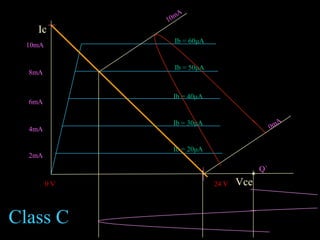
Class C amplifier
 The Q point is chosen at the beyond the cut-off
point
 This will give only a partial swing in one direction
 Only a portion of the input comes at the output
 Hence Class C will give (amplitude) severely
distorted output
 It can handle large signals
 It conducts for less than 1800
Ic
Vce
Ib = 60μA
Ib = 50μA
Ib = 20μA
Ib = 30μA
Ib = 40μA
10mA
2mA
4mA
6mA
8mA
24 V0 V
Q`
Class C
Class A
Class B
Class C
Distortionless amplifier
 Out of the 3 amplifiers, Class C is unsuitable as the
distortion is very heavy
 Class A is the best, as it gives distortionless output
 But Class A cannot handle large signals as
required by the Power Amplifier
 Though Class B gives heavy distortion, it gives out
one half of the signal perfectly
 And Class B can handle large signals
Class A Audio Amplifier
 As we have seen out of the 3 classifications, Class
A is the best, as it does not give any distortion
 Among the configurations, we know that CE is the
best as it gives maximum power gain
 A CE amplifier will have high output impedance
 Unfortunately for an audio amplifier, the output
device is the speaker which has a low impedance
Impedance Matching
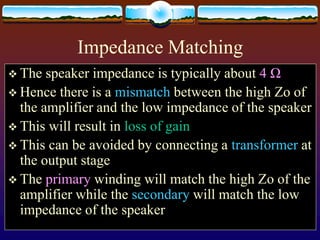
 The speaker impedance is typically about 4 Ω
 Hence there is a mismatch between the high Zo of
the amplifier and the low impedance of the speaker
 This will result in loss of gain
 This can be avoided by connecting a transformer at
the output stage
 The primary winding will match the high Zo of the
amplifier while the secondary will match the low
impedance of the speaker
Class A Audio Amplifier
270 K 5.6 K
Re
Rb1
Rb2 Ce
Rc
Vcc
270 K
Re
Rb1
Rb2 Ce
Drawback
 The drawback of this circuit is that it cannot handle
large signals
 In a Class A amplifier, the operating point is
chosen around the middle of the load line
 If the signal exceeds the cut-off point, the output
current stops and any signal with a lower
amplitude will not come at the output
 Similarly, if the signal exceeds the saturation point,
the output current cannot increase any further,
even if the input signal increases
Ic
Vce
Ib = 60μA
Ib = 50μA
Ib = 20μA
Ib = 30μA
Ib = 40μA
10mA
2mA
4mA
6mA
8mA
24 V0 V
Q
A
B
Class A
Class B Push-Pull Amplifier
 To avoid this we can use Class B which has a
greater signal handling capacity
 But Class B will give only one half of the signal
 Hence we can use 2 Class B amplifiers
 One for one half and one for the other half
 This type of amplifier is called Push-Pull
Amplifier
Class B Push-Pull
Vcc
T1
T2
T3
TR2
TR1
Push-Pull Circuit
 TR1 and TR2 are output transistors connected
back to back, with their emitters grounded
 The output transformer TR1 couples the push-pull
output to the speaker
 In the Push-Pull arrangement T1 conducts for one
half of the signal & T2 conducts for the other half
 Both are biased in Class B and each gives one half
of the signal & the combined output is coupled to
the speaker
Push-Pull Circuit
 The Driver Transformer TR2 gives 2 out of phase
signals
 During one half, the +ve half forward biases T1
while the –ve half reverse biases T2
 Thus when T1 conducts, T2 is cut-off & vice-
versa
 This way both the transistors conduct alternately
to give the full signal output
Class D Amplifier
 During the +ve half cycle Q1 gets Forward Bias and it
conducts
 During the -ve half cycle Q2 gets Forward Bias and it
conducts
 Thus both the transistors conduct alternately
 The amplifier works for 3600
 No distortion
 100% efficiency
 During the first half T1
conducts
 Ic flows from the
centre-tapping through
T1 to ground
 This half is coupled to
the speaker through
TR1
Working of Push-Pull Circuit
Vcc
T1
T2
T
3
TR2
TR1
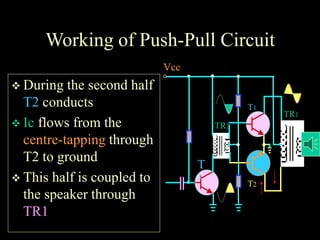
 During the second half
T2 conducts
 Ic flows from the
centre-tapping through
T2 to ground
 This half is coupled to
the speaker through
TR1
Working of Push-Pull Circuit
Vcc
T1
T2
T
3
TR2
TR1
Drawbacks
 Though this circuit functions well it has a few
drawbacks
 Transformer coupling affects the quality of
output
 Phase shifting circuit is a must
 Both these drawbacks can be avoided if we use
one pair of PNP and NPN transistors at the
output
T1
T2
Vcc Complementary Symmetry Amplifier
Complementary Symmetry Amplifier
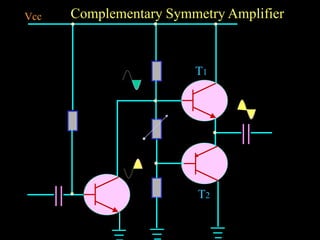
 This circuit uses one NPN transistor & one PNP
transistor at the output stage
 During the +ve half, T1(NPN) base gets forward bias &
it conducts while T2 (PNP) gets reverse biased and does
not conduct
 This gives one half of the signal at the speaker coupled
to the emitter
Complementary Symmetry Amplifier
 During the other half, T2 gets forward bias
and conducts while T1 gets reverse biased and
does not conduct
 Thus T1 & T2 conduct alternately giving a
distortionless output
 This circuit does not require a phase shifter
Cross – over distortion
 Class B Push-Pull amplifier has one limitation
 As the phase of the signal changes from +ve to –ve
(or vice-versa) one transistor stops conducting
while the other begins conducting
 But the transistor cannot conduct instantaneously
as it requires a minimum Vbe before it starts
conducting
 Thus as the signal crosses over zero, a distortion
occurs
 This is called Cross over distortion
Cross – over distortion
Vbe
-Vbe
Class AB amplifier
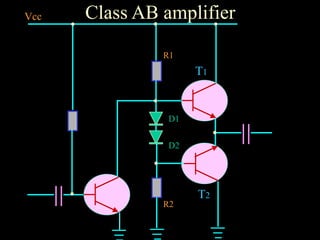
 This circuit overcomes cross-over distortion
 Biasing is done such that even if there is no input
signal, a small current keeps the output transistor
conducting
 This circuit uses 2 diodes whose characteristics
matches with that of the BE junction of the output
transistors
 Biasing resistors R1 & R2 are also identical values
T1
T2
Vcc Class AB amplifier
R1
R2
D1
D2
Symmetrical components
 Since R1 & D1 are identical to R2 & D2, the diode
junction as well as the output point will be at half
the supply voltage
 Because of symmetry both T1 & T2 will conduct
equally
 Even when there is no input signal, there will be a
current Icq = (I/2 Vcc – 0.6) / R1
 This will keep the output transistors conducting
Elimination of cross-over distortion
 Normally, during cross-over there will not be any
output till the non-conducting transistor gets the
minimum Vbe
 This causes distortion
 This has been eliminated here, since the 0.6 V
across the diodes keep the transistors on and gives
a continuous output signal without producing
cross-over distortion
Thermal stability
 In addition, the two diodes also provide thermal
stability
 They prevent the output transistors going to
Thermal Run Away
 When the output current is high, heat dissipation is
more
 The increase in temperature produces more charge
carrier in the BE junction of T1 & T2
 This increases Ib & hence Ic
 This in turn increases the power dissipation &
hence the heat
 This chain goes on till too much current flows and
destroys the transistors
 This is called Thermal Run Away
 This is arrested by the diodes in the output circuit
 When the charge carriers increase in the B-E
junction of T1 & T2, a similar increase takes place
in D1 & D2, due to matching characteristics
 This increase in the diode current, produces more
drop across R1 & R2 and brings down the forward
bias at the base of T1 & T2
 Thus the 2 diodes prevent cross-over distortion as
well as provide thermal stability
End of Unit – 4.1

July07 4[1].1 power_amplifiers01

  • 1.
  • 2.
    Classification of PowerAmplifiers  Power amplifiers are classified based on the Q point  If the operating point is chosen at the middle of the load line, it is called Class A amplifier  If the operating point is chosen at the cut-off point it is called Class B amplifier  If the operating point is chosen beyond the cut-off point it is called Class C amplifier  It conducts for 3600
  • 3.
    Class A amplifier The Q point is chosen at the middle of load line  This will give equal swing on either direction  Both halves of the input comes at the output  Hence Class A will give (amplitude) distortionless output  It can handle only small signals  Its efficiency is less
  • 4.
    Ic Vce Ib = 60μA Ib= 50μA Ib = 20μA Ib = 30μA Ib = 40μA 10mA 2mA 4mA 6mA 8mA 24 V0 V Q A B Class A
  • 5.
    Class B amplifier The Q point is chosen at the cut-off point  This will give swing only on one direction  Only one half of the input comes at the output  Hence Class B will give (amplitude) distorted output  It can handle large signals  Its efficiency is high  It conducts for 1800
  • 6.
    Ic Vce Ib = 60μA Ib= 50μA Ib = 20μA Ib = 30μA Ib = 40μA 10mA 2mA 4mA 6mA 8mA 24 V0 V Q Class B
  • 7.
    Class C amplifier The Q point is chosen at the beyond the cut-off point  This will give only a partial swing in one direction  Only a portion of the input comes at the output  Hence Class C will give (amplitude) severely distorted output  It can handle large signals  It conducts for less than 1800
  • 8.
    Ic Vce Ib = 60μA Ib= 50μA Ib = 20μA Ib = 30μA Ib = 40μA 10mA 2mA 4mA 6mA 8mA 24 V0 V Q` Class C
  • 9.
  • 10.
    Distortionless amplifier  Outof the 3 amplifiers, Class C is unsuitable as the distortion is very heavy  Class A is the best, as it gives distortionless output  But Class A cannot handle large signals as required by the Power Amplifier  Though Class B gives heavy distortion, it gives out one half of the signal perfectly  And Class B can handle large signals
  • 11.
    Class A AudioAmplifier  As we have seen out of the 3 classifications, Class A is the best, as it does not give any distortion  Among the configurations, we know that CE is the best as it gives maximum power gain  A CE amplifier will have high output impedance  Unfortunately for an audio amplifier, the output device is the speaker which has a low impedance
  • 12.
    Impedance Matching  Thespeaker impedance is typically about 4 Ω  Hence there is a mismatch between the high Zo of the amplifier and the low impedance of the speaker  This will result in loss of gain  This can be avoided by connecting a transformer at the output stage  The primary winding will match the high Zo of the amplifier while the secondary will match the low impedance of the speaker
  • 13.
    Class A AudioAmplifier 270 K 5.6 K Re Rb1 Rb2 Ce Rc Vcc 270 K Re Rb1 Rb2 Ce
  • 14.
    Drawback  The drawbackof this circuit is that it cannot handle large signals  In a Class A amplifier, the operating point is chosen around the middle of the load line  If the signal exceeds the cut-off point, the output current stops and any signal with a lower amplitude will not come at the output  Similarly, if the signal exceeds the saturation point, the output current cannot increase any further, even if the input signal increases
  • 15.
    Ic Vce Ib = 60μA Ib= 50μA Ib = 20μA Ib = 30μA Ib = 40μA 10mA 2mA 4mA 6mA 8mA 24 V0 V Q A B Class A
  • 16.
    Class B Push-PullAmplifier  To avoid this we can use Class B which has a greater signal handling capacity  But Class B will give only one half of the signal  Hence we can use 2 Class B amplifiers  One for one half and one for the other half  This type of amplifier is called Push-Pull Amplifier
  • 17.
  • 18.
    Push-Pull Circuit  TR1and TR2 are output transistors connected back to back, with their emitters grounded  The output transformer TR1 couples the push-pull output to the speaker  In the Push-Pull arrangement T1 conducts for one half of the signal & T2 conducts for the other half  Both are biased in Class B and each gives one half of the signal & the combined output is coupled to the speaker
  • 19.
    Push-Pull Circuit  TheDriver Transformer TR2 gives 2 out of phase signals  During one half, the +ve half forward biases T1 while the –ve half reverse biases T2  Thus when T1 conducts, T2 is cut-off & vice- versa  This way both the transistors conduct alternately to give the full signal output
  • 20.
    Class D Amplifier During the +ve half cycle Q1 gets Forward Bias and it conducts  During the -ve half cycle Q2 gets Forward Bias and it conducts  Thus both the transistors conduct alternately  The amplifier works for 3600  No distortion  100% efficiency
  • 21.
     During thefirst half T1 conducts  Ic flows from the centre-tapping through T1 to ground  This half is coupled to the speaker through TR1 Working of Push-Pull Circuit Vcc T1 T2 T 3 TR2 TR1
  • 22.
     During thesecond half T2 conducts  Ic flows from the centre-tapping through T2 to ground  This half is coupled to the speaker through TR1 Working of Push-Pull Circuit Vcc T1 T2 T 3 TR2 TR1
  • 23.
    Drawbacks  Though thiscircuit functions well it has a few drawbacks  Transformer coupling affects the quality of output  Phase shifting circuit is a must  Both these drawbacks can be avoided if we use one pair of PNP and NPN transistors at the output
  • 24.
  • 25.
    Complementary Symmetry Amplifier This circuit uses one NPN transistor & one PNP transistor at the output stage  During the +ve half, T1(NPN) base gets forward bias & it conducts while T2 (PNP) gets reverse biased and does not conduct  This gives one half of the signal at the speaker coupled to the emitter
  • 26.
    Complementary Symmetry Amplifier During the other half, T2 gets forward bias and conducts while T1 gets reverse biased and does not conduct  Thus T1 & T2 conduct alternately giving a distortionless output  This circuit does not require a phase shifter
  • 27.
    Cross – overdistortion  Class B Push-Pull amplifier has one limitation  As the phase of the signal changes from +ve to –ve (or vice-versa) one transistor stops conducting while the other begins conducting  But the transistor cannot conduct instantaneously as it requires a minimum Vbe before it starts conducting  Thus as the signal crosses over zero, a distortion occurs  This is called Cross over distortion
  • 28.
    Cross – overdistortion Vbe -Vbe
  • 29.
    Class AB amplifier This circuit overcomes cross-over distortion  Biasing is done such that even if there is no input signal, a small current keeps the output transistor conducting  This circuit uses 2 diodes whose characteristics matches with that of the BE junction of the output transistors  Biasing resistors R1 & R2 are also identical values
  • 30.
    T1 T2 Vcc Class ABamplifier R1 R2 D1 D2
  • 31.
    Symmetrical components  SinceR1 & D1 are identical to R2 & D2, the diode junction as well as the output point will be at half the supply voltage  Because of symmetry both T1 & T2 will conduct equally  Even when there is no input signal, there will be a current Icq = (I/2 Vcc – 0.6) / R1  This will keep the output transistors conducting
  • 32.
    Elimination of cross-overdistortion  Normally, during cross-over there will not be any output till the non-conducting transistor gets the minimum Vbe  This causes distortion  This has been eliminated here, since the 0.6 V across the diodes keep the transistors on and gives a continuous output signal without producing cross-over distortion
  • 33.
    Thermal stability  Inaddition, the two diodes also provide thermal stability  They prevent the output transistors going to Thermal Run Away  When the output current is high, heat dissipation is more  The increase in temperature produces more charge carrier in the BE junction of T1 & T2
  • 34.
     This increasesIb & hence Ic  This in turn increases the power dissipation & hence the heat  This chain goes on till too much current flows and destroys the transistors  This is called Thermal Run Away  This is arrested by the diodes in the output circuit
  • 35.
     When thecharge carriers increase in the B-E junction of T1 & T2, a similar increase takes place in D1 & D2, due to matching characteristics  This increase in the diode current, produces more drop across R1 & R2 and brings down the forward bias at the base of T1 & T2  Thus the 2 diodes prevent cross-over distortion as well as provide thermal stability
  • 36.
    End of Unit– 4.1