Electrical, Electronic and Digital Principles
(EEDP)
Lecture 6
Amplifiers Classes
‫د‬.‫الحلوانى‬ ‫ممدوح‬ ‫باسم‬
EEDP - Basem ElHalawany 2
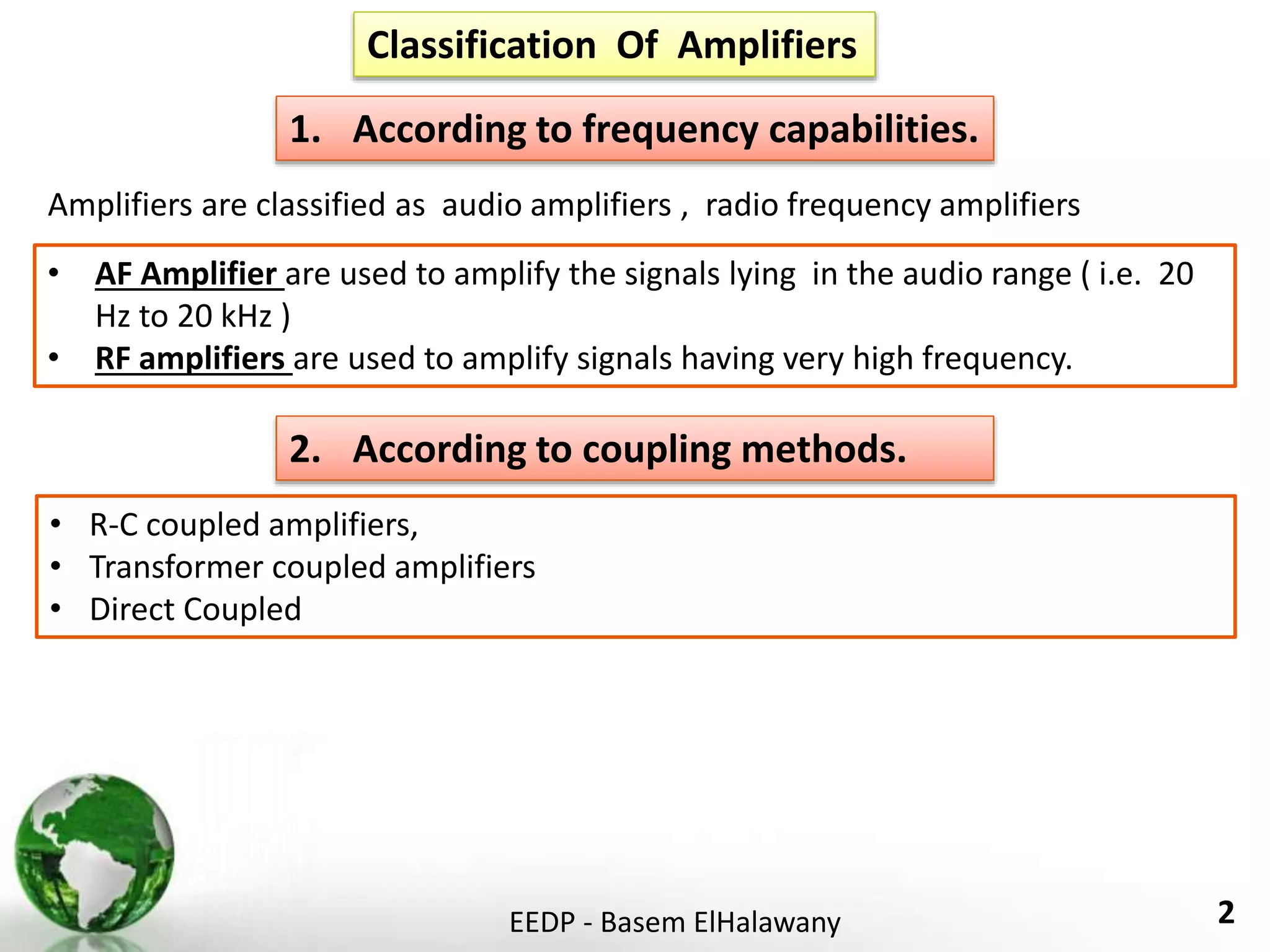
Classification Of Amplifiers
1. According to frequency capabilities.
2. According to coupling methods.
• AF Amplifier are used to amplify the signals lying in the audio range ( i.e. 20
Hz to 20 kHz )
• RF amplifiers are used to amplify signals having very high frequency.
Amplifiers are classified as audio amplifiers , radio frequency amplifiers
• R-C coupled amplifiers,
• Transformer coupled amplifiers
• Direct Coupled
EEDP - Basem ElHalawany 3
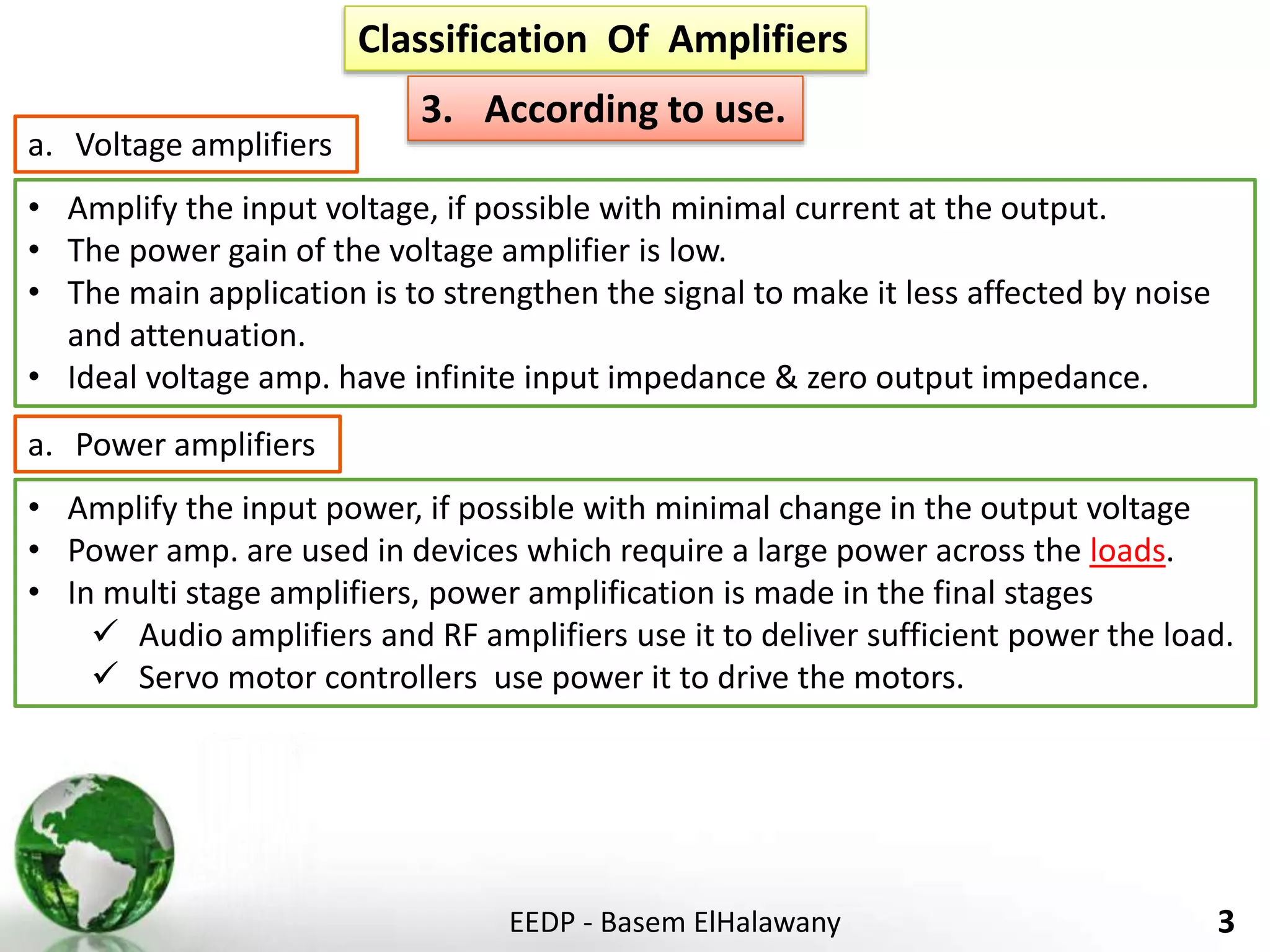
Classification Of Amplifiers
3. According to use.
• Amplify the input voltage, if possible with minimal current at the output.
• The power gain of the voltage amplifier is low.
• The main application is to strengthen the signal to make it less affected by noise
and attenuation.
• Ideal voltage amp. have infinite input impedance & zero output impedance.
a. Voltage amplifiers
• Amplify the input power, if possible with minimal change in the output voltage
• Power amp. are used in devices which require a large power across the loads.
• In multi stage amplifiers, power amplification is made in the final stages
 Audio amplifiers and RF amplifiers use it to deliver sufficient power the load.
 Servo motor controllers use power it to drive the motors.
a. Power amplifiers
EEDP - Basem ElHalawany 4
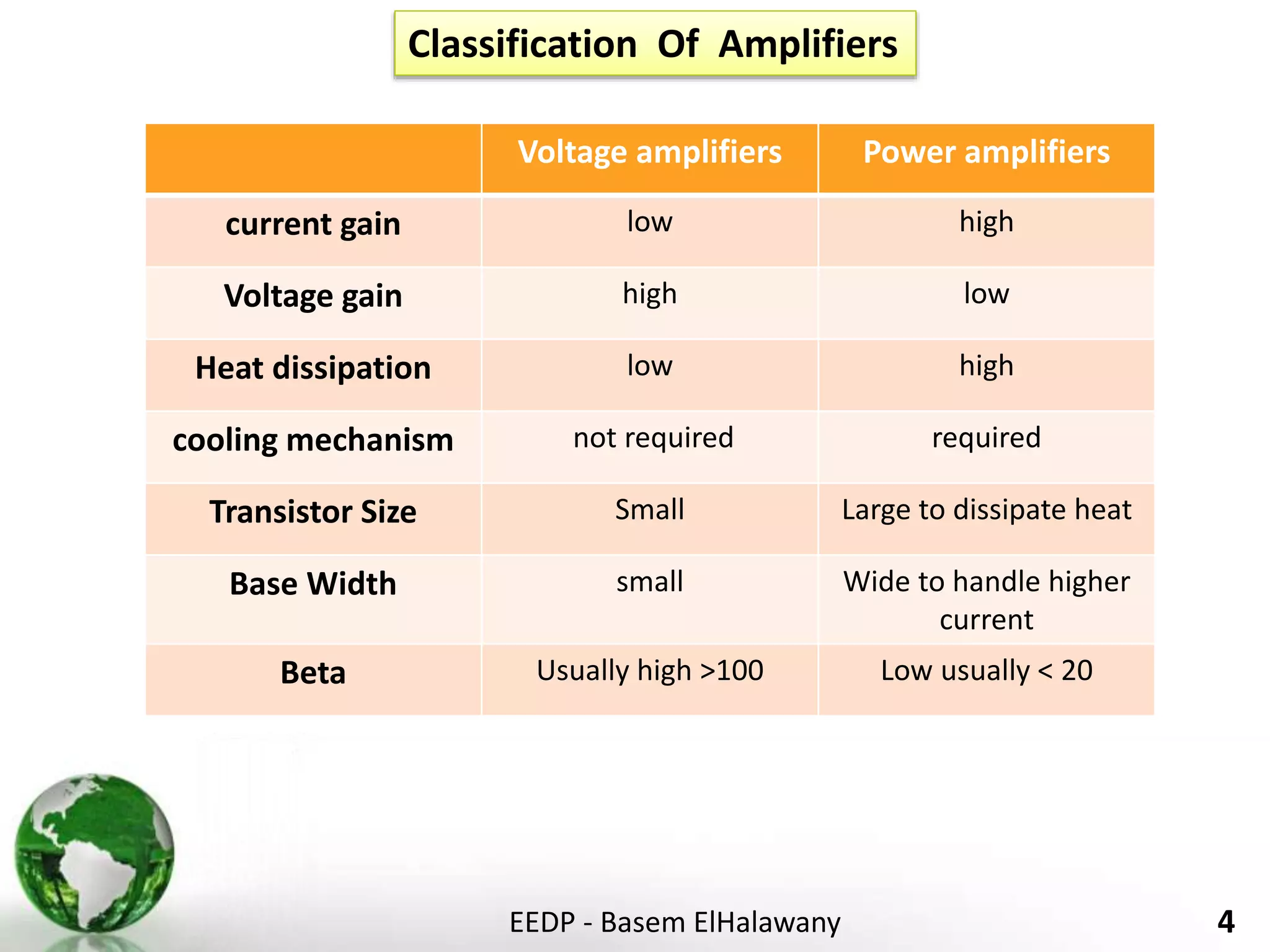
Classification Of Amplifiers
Voltage amplifiers Power amplifiers
current gain low high
Voltage gain high low
Heat dissipation low high
cooling mechanism not required required
Transistor Size Small Large to dissipate heat
Base Width small Wide to handle higher
current
Beta Usually high >100 Low usually < 20
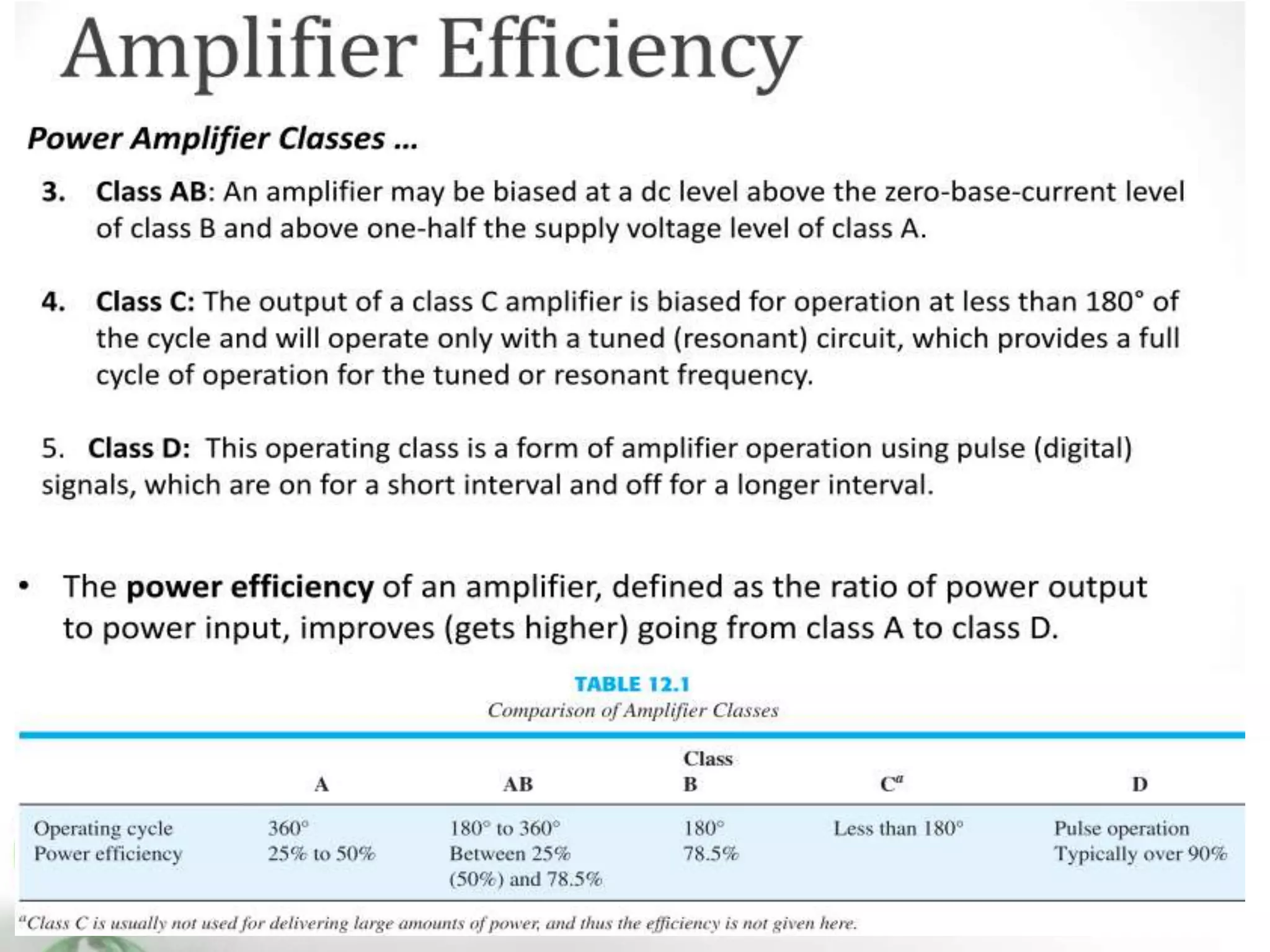
5
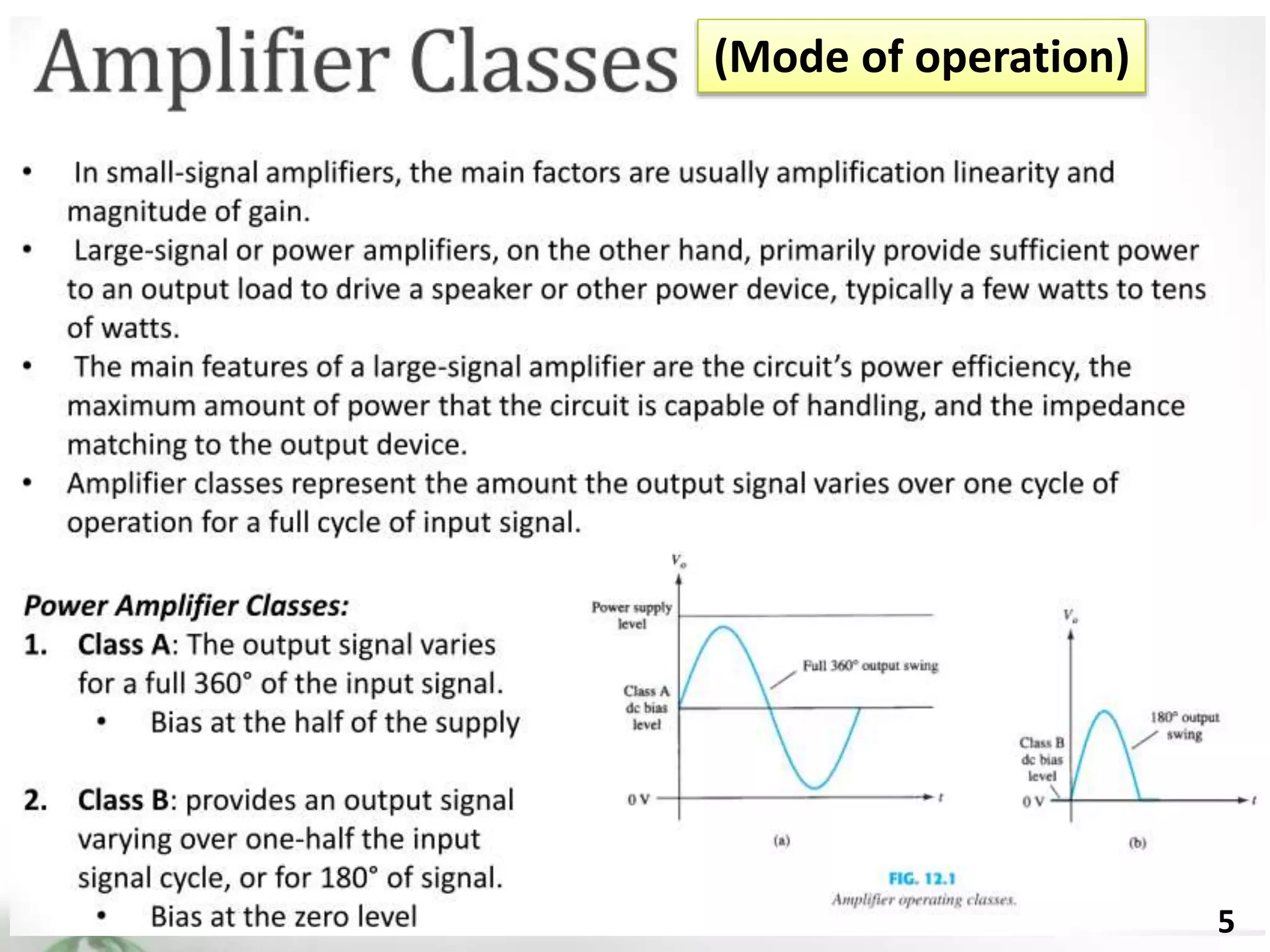
(Mode of operation)
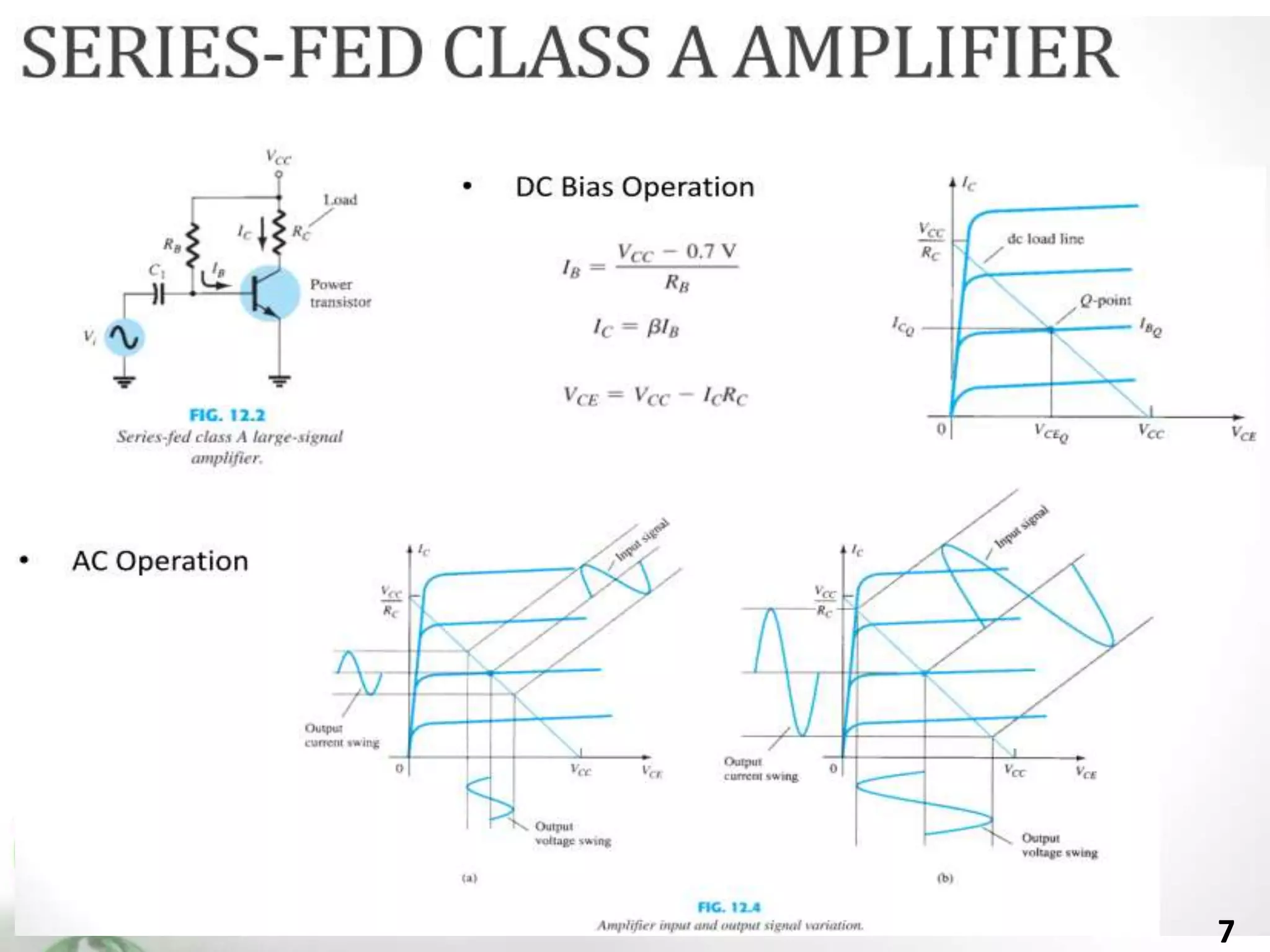
6
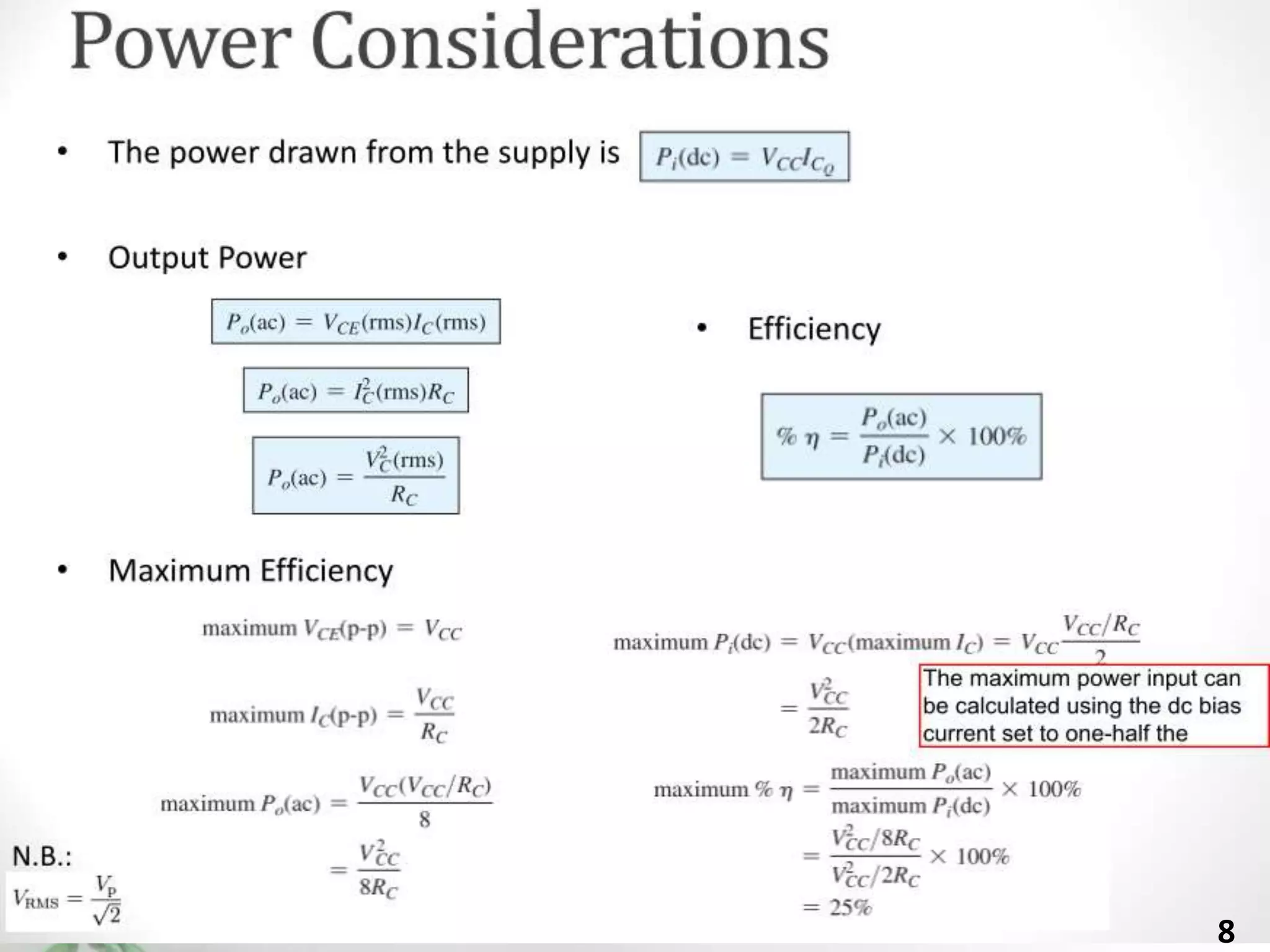
7
8
EEDP - Basem ElHalawany 9
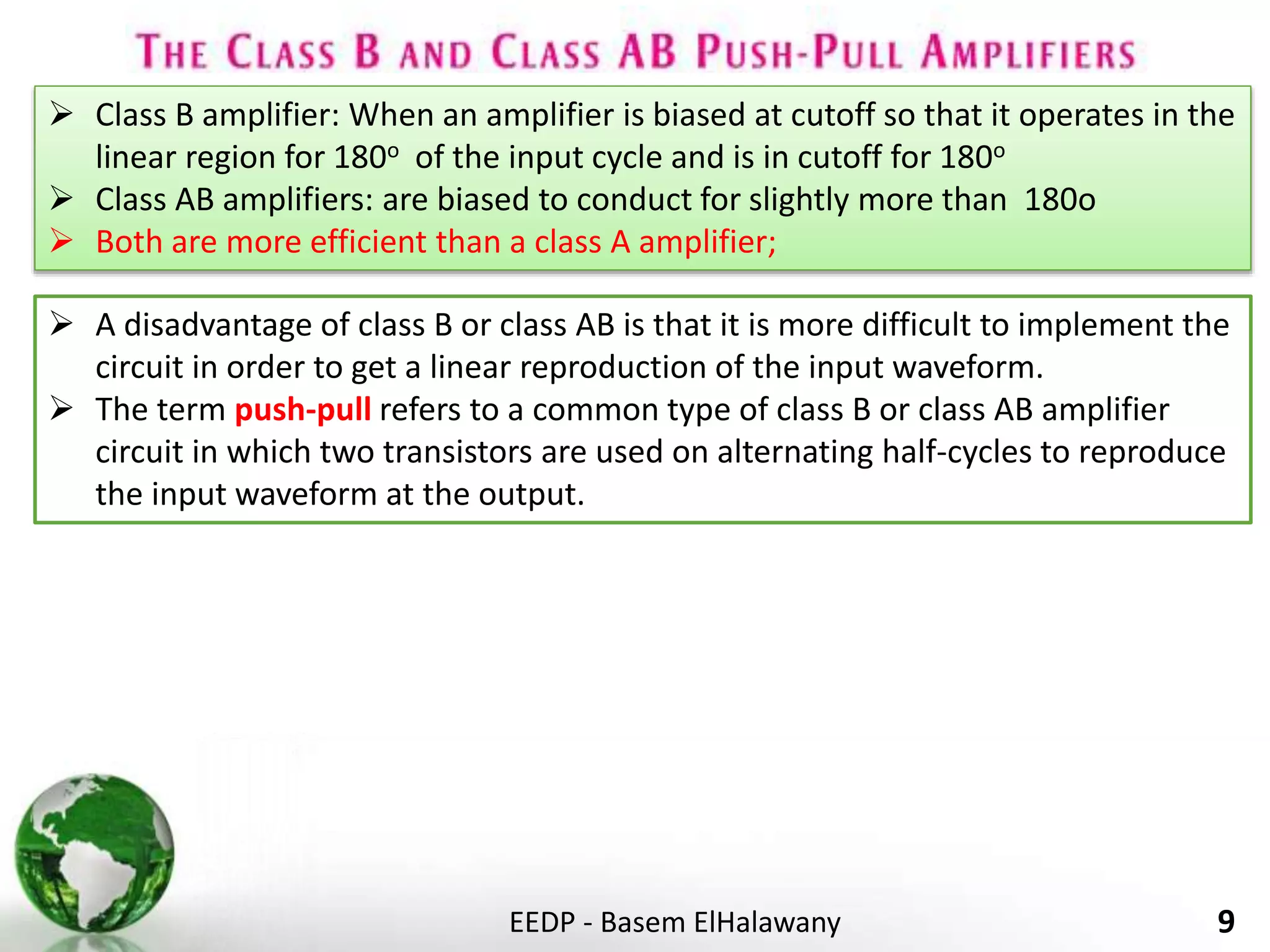
 Class B amplifier: When an amplifier is biased at cutoff so that it operates in the
linear region for 180o of the input cycle and is in cutoff for 180o
 Class AB amplifiers: are biased to conduct for slightly more than 180o
 Both are more efficient than a class A amplifier;
 A disadvantage of class B or class AB is that it is more difficult to implement the
circuit in order to get a linear reproduction of the input waveform.
 The term push-pull refers to a common type of class B or class AB amplifier
circuit in which two transistors are used on alternating half-cycles to reproduce
the input waveform at the output.
EEDP - Basem ElHalawany 10
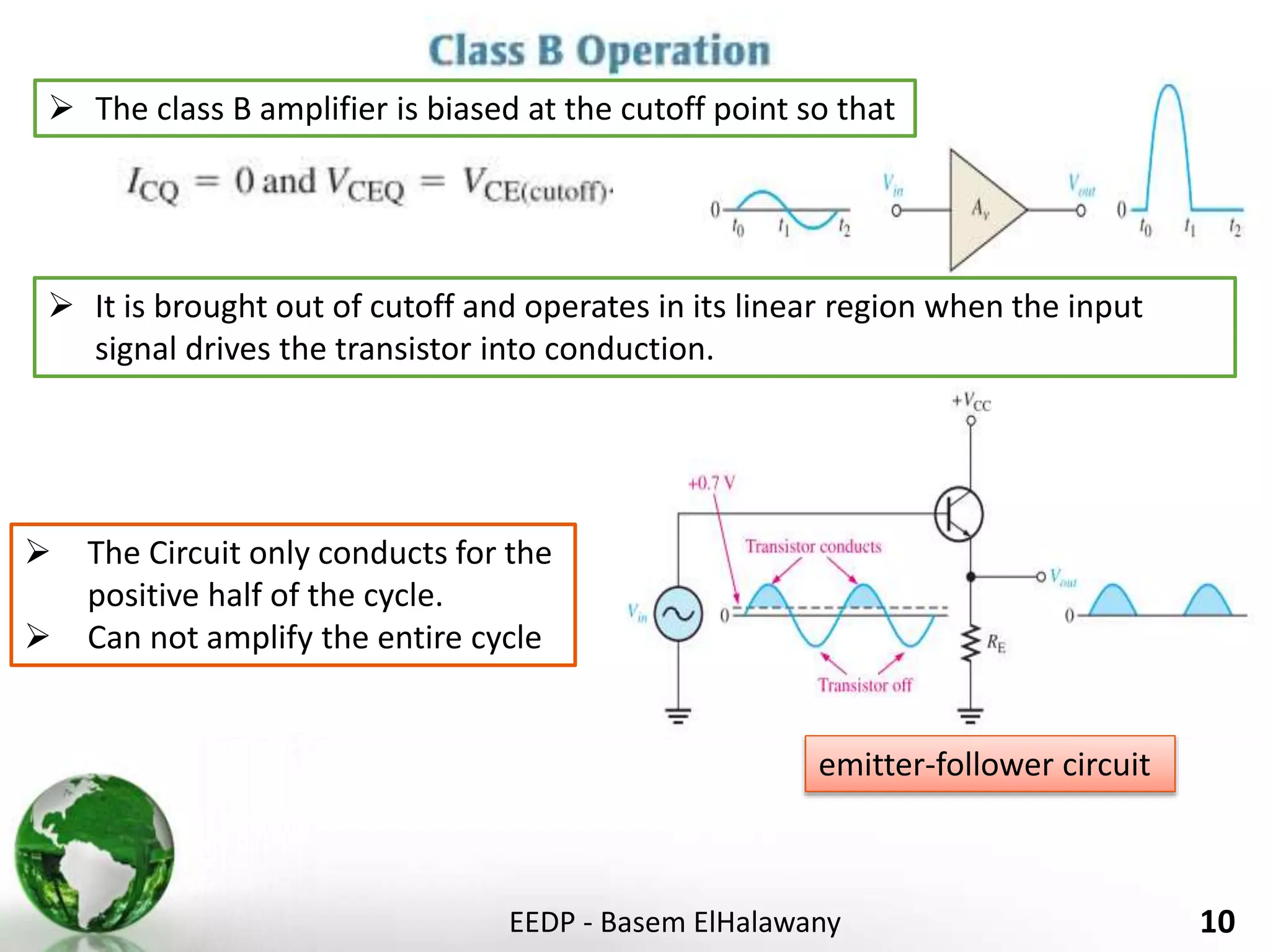
 The class B amplifier is biased at the cutoff point so that
 It is brought out of cutoff and operates in its linear region when the input
signal drives the transistor into conduction.
emitter-follower circuit
 The Circuit only conducts for the
positive half of the cycle.
 Can not amplify the entire cycle
EEDP - Basem ElHalawany 11
 To amplify the entire cycle, it is necessary to add a second class B amplifier
that operates on the negative half of the cycle.
 The combination of two class B amplifiers working together is called push-pull
operation
 There are two common approaches for using push-pull amplifiers to
reproduce the entire waveform.
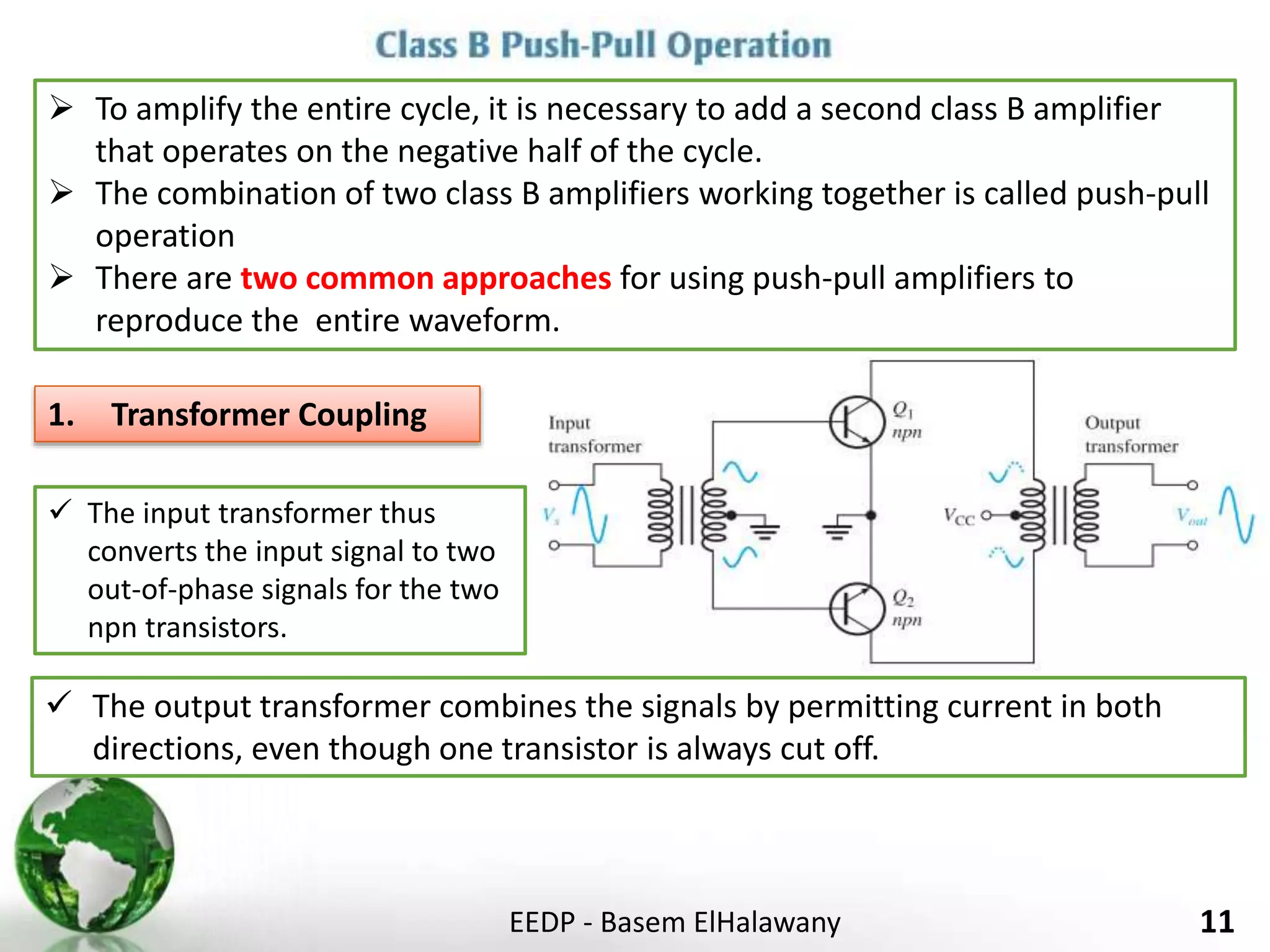
1. Transformer Coupling
 The input transformer thus
converts the input signal to two
out-of-phase signals for the two
npn transistors.
 The output transformer combines the signals by permitting current in both
directions, even though one transistor is always cut off.
EEDP - Basem ElHalawany 12
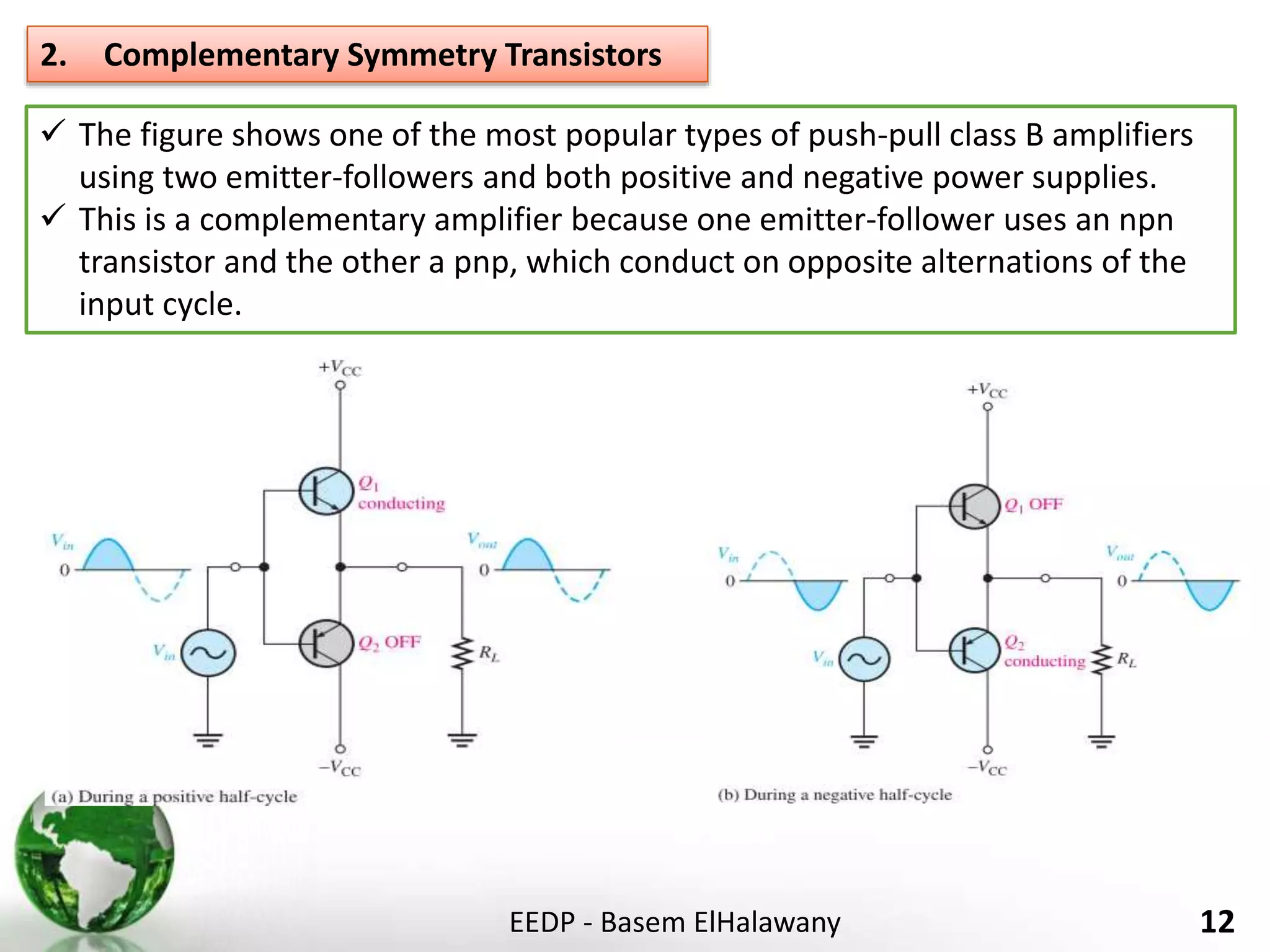
2. Complementary Symmetry Transistors
 The figure shows one of the most popular types of push-pull class B amplifiers
using two emitter-followers and both positive and negative power supplies.
 This is a complementary amplifier because one emitter-follower uses an npn
transistor and the other a pnp, which conduct on opposite alternations of the
input cycle.
EEDP - Basem ElHalawany 13
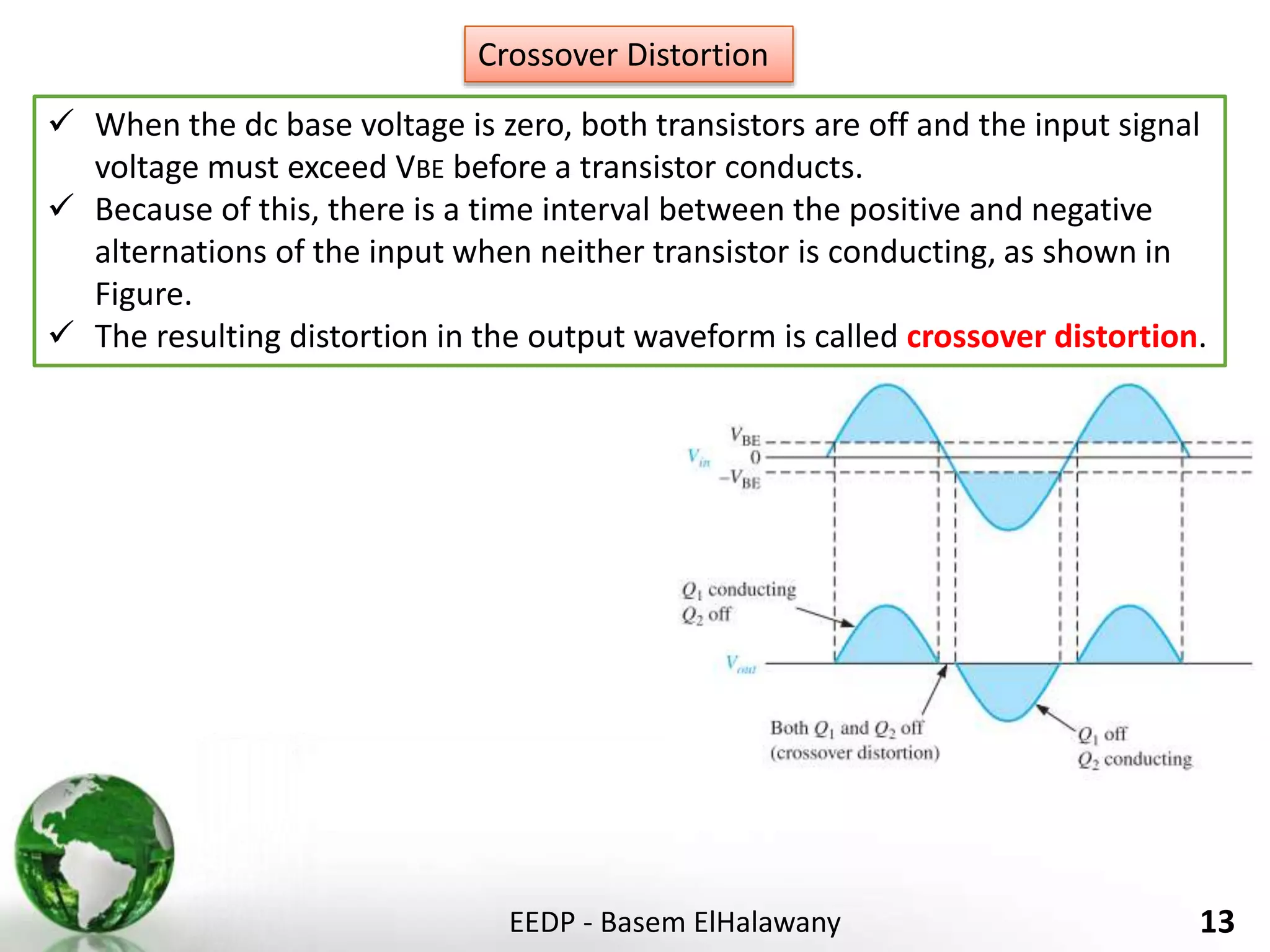
 When the dc base voltage is zero, both transistors are off and the input signal
voltage must exceed VBE before a transistor conducts.
 Because of this, there is a time interval between the positive and negative
alternations of the input when neither transistor is conducting, as shown in
Figure.
 The resulting distortion in the output waveform is called crossover distortion.
Crossover Distortion
14
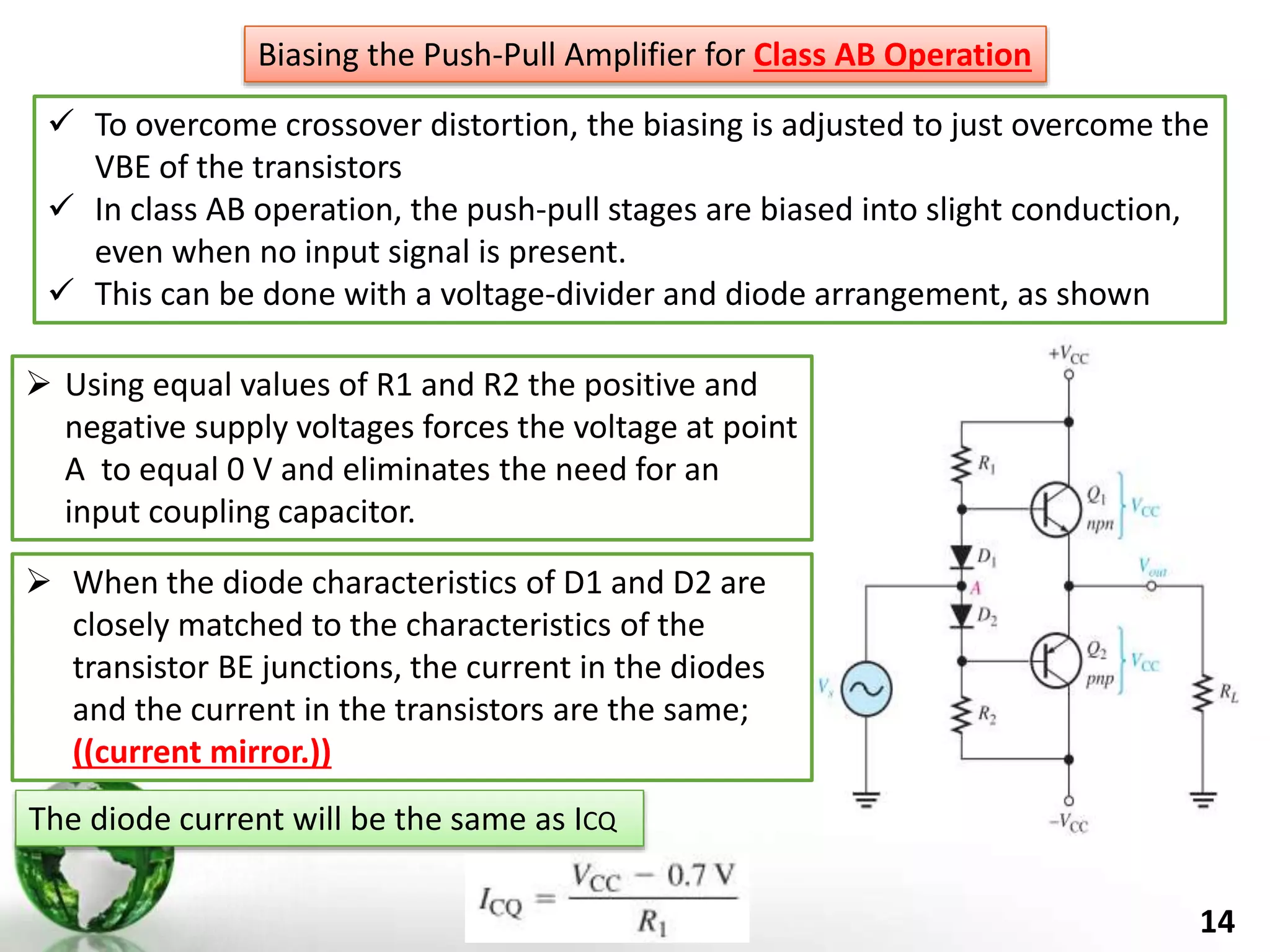
 To overcome crossover distortion, the biasing is adjusted to just overcome the
VBE of the transistors
 In class AB operation, the push-pull stages are biased into slight conduction,
even when no input signal is present.
 This can be done with a voltage-divider and diode arrangement, as shown
Biasing the Push-Pull Amplifier for Class AB Operation
 Using equal values of R1 and R2 the positive and
negative supply voltages forces the voltage at point
A to equal 0 V and eliminates the need for an
input coupling capacitor.
 When the diode characteristics of D1 and D2 are
closely matched to the characteristics of the
transistor BE junctions, the current in the diodes
and the current in the transistors are the same;
((current mirror.))
The diode current will be the same as ICQ
15
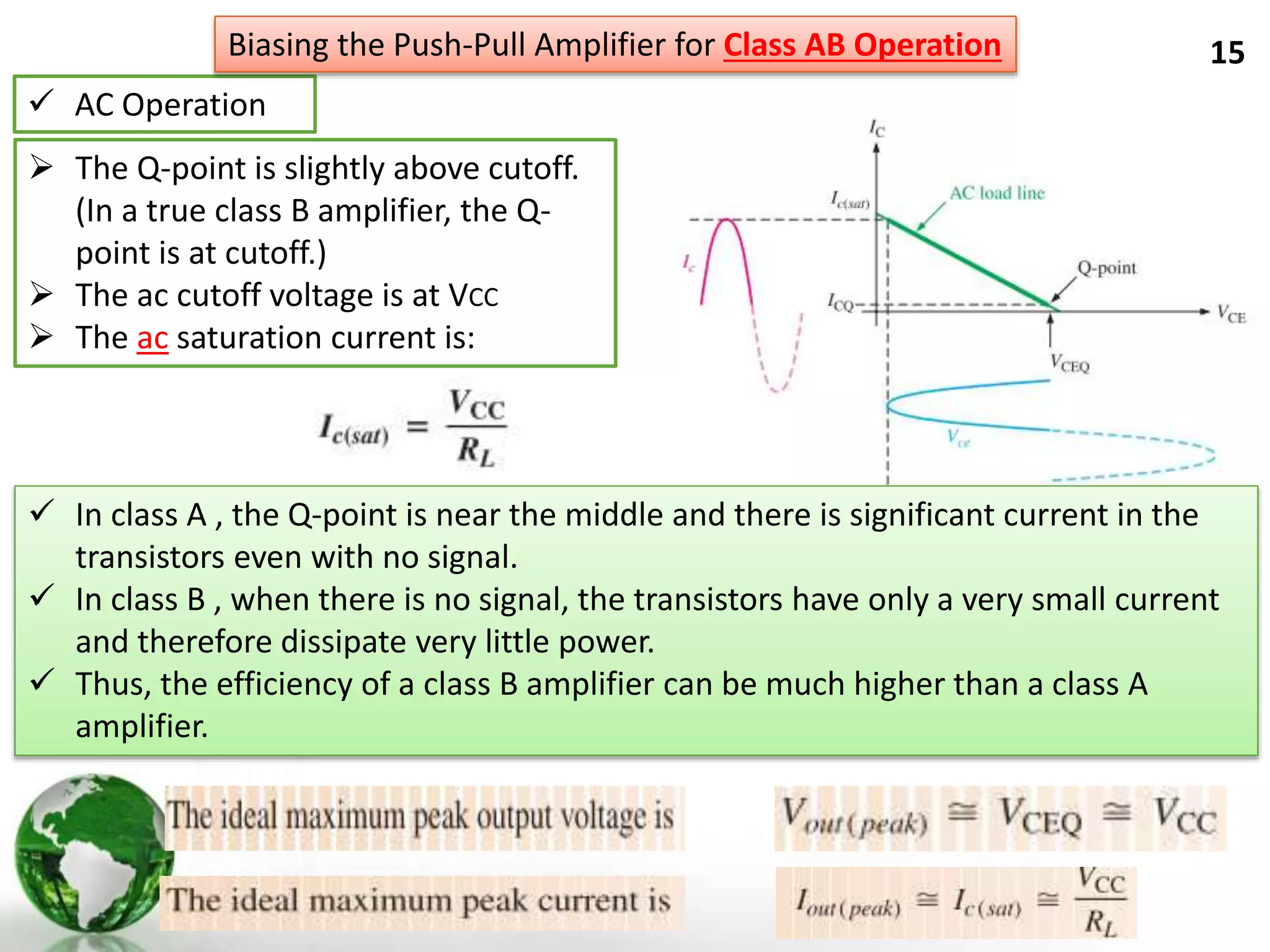
 AC Operation
Biasing the Push-Pull Amplifier for Class AB Operation
 The Q-point is slightly above cutoff.
(In a true class B amplifier, the Q-
point is at cutoff.)
 The ac cutoff voltage is at VCC
 The ac saturation current is:
 In class A , the Q-point is near the middle and there is significant current in the
transistors even with no signal.
 In class B , when there is no signal, the transistors have only a very small current
and therefore dissipate very little power.
 Thus, the efficiency of a class B amplifier can be much higher than a class A
amplifier.
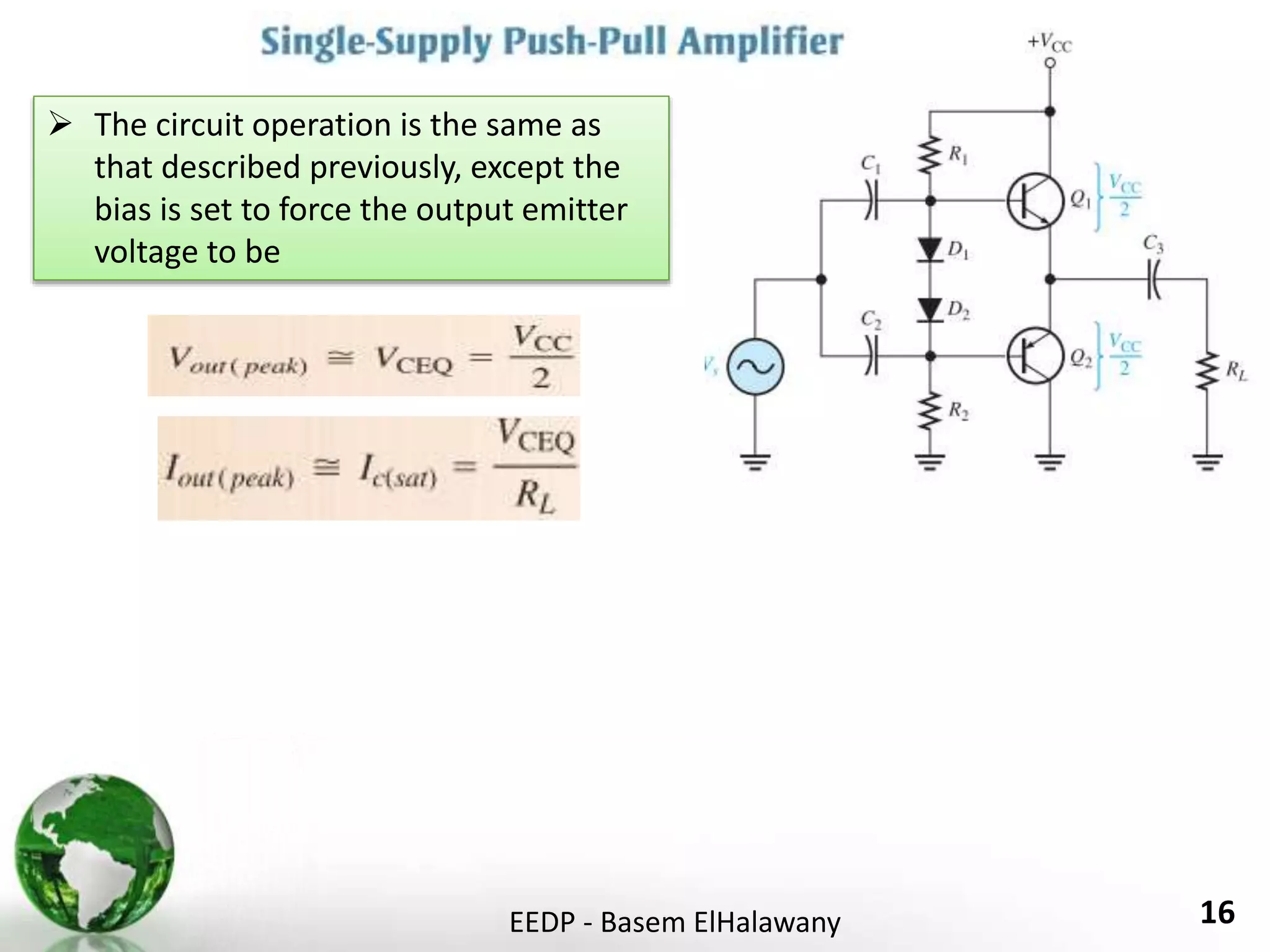
EEDP - Basem ElHalawany 16
 The circuit operation is the same as
that described previously, except the
bias is set to force the output emitter
voltage to be
17
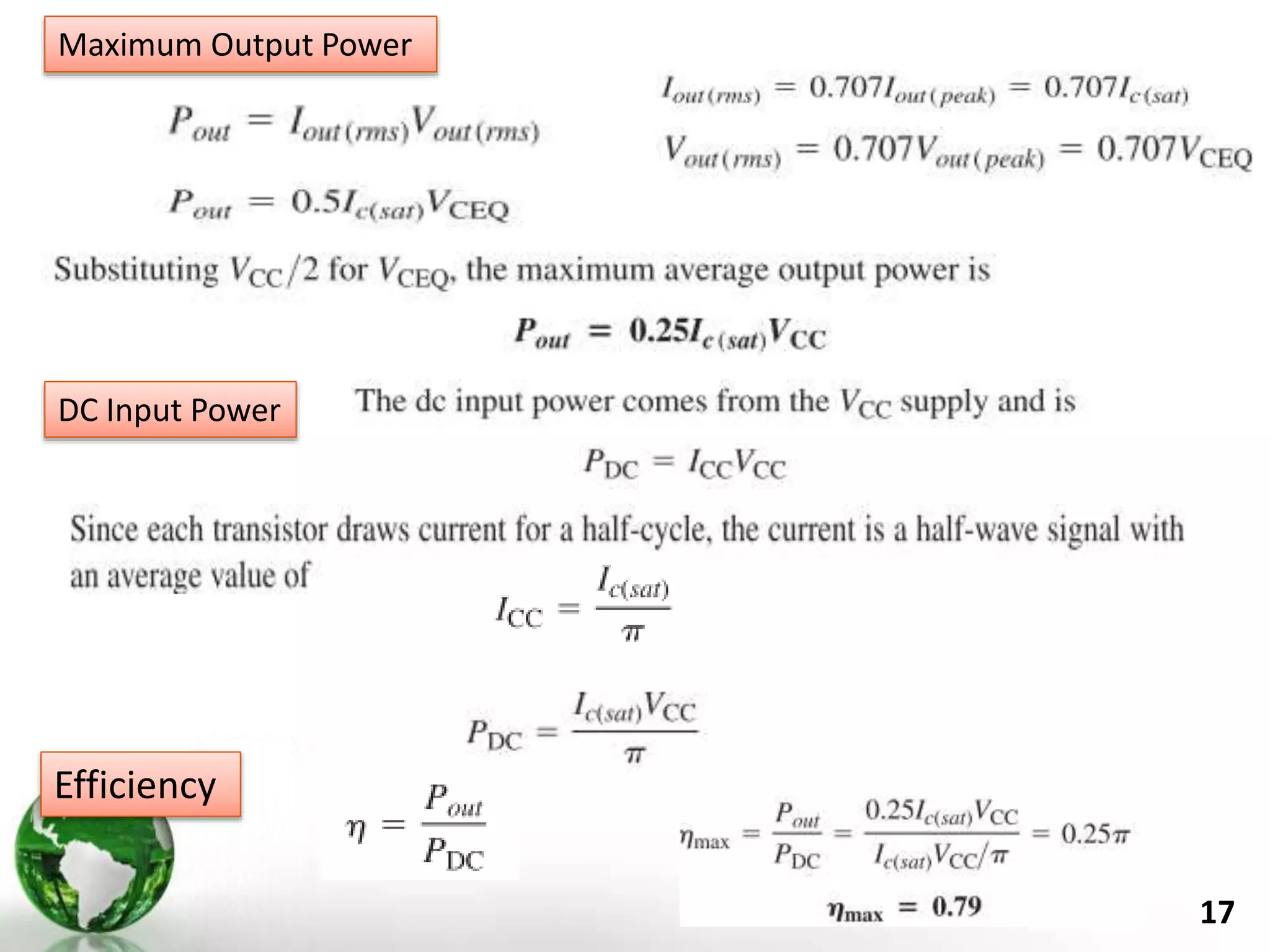
Maximum Output Power
DC Input Power
Efficiency
18
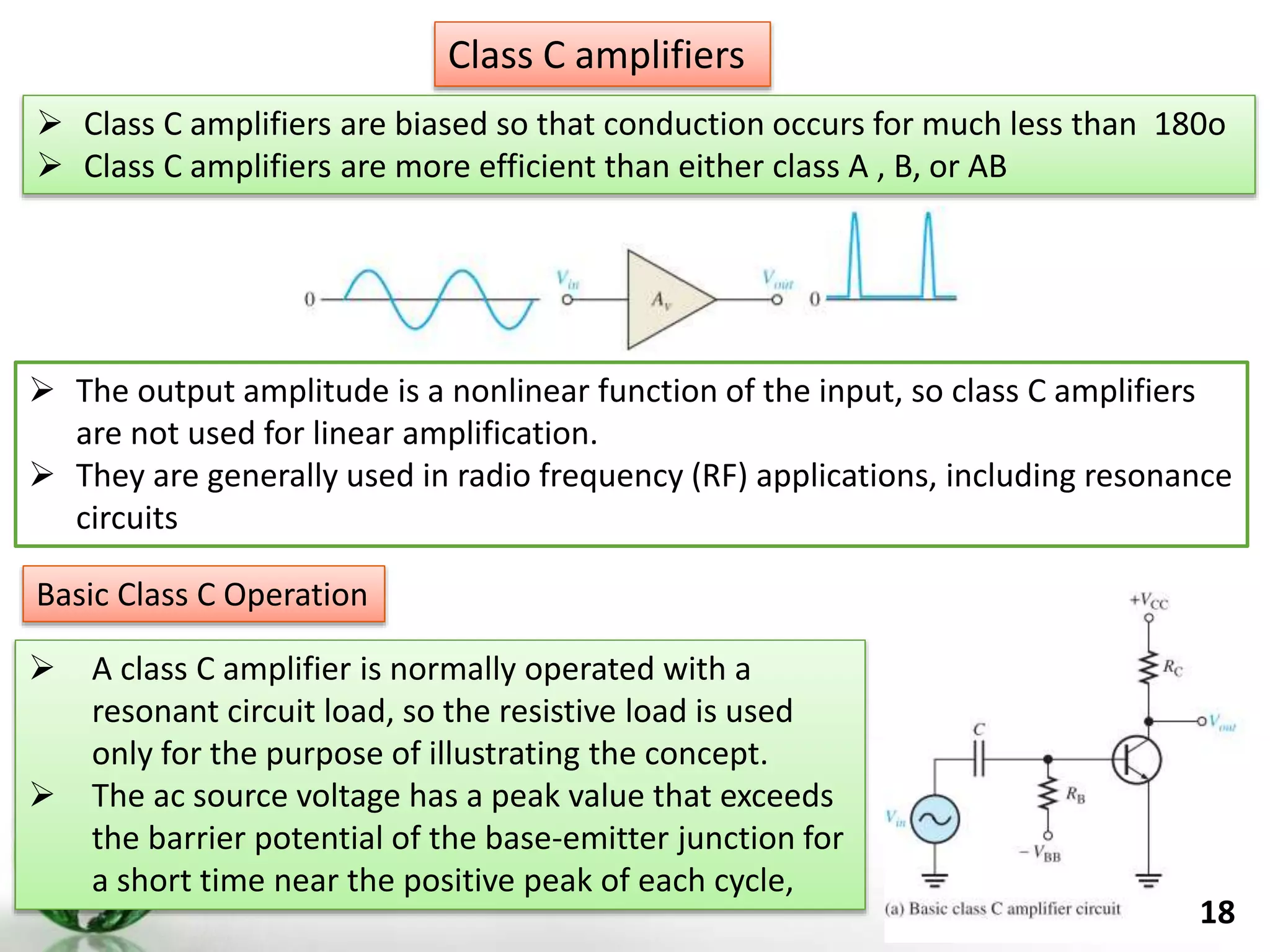
 Class C amplifiers are biased so that conduction occurs for much less than 180o
 Class C amplifiers are more efficient than either class A , B, or AB
Class C amplifiers
 The output amplitude is a nonlinear function of the input, so class C amplifiers
are not used for linear amplification.
 They are generally used in radio frequency (RF) applications, including resonance
circuits
Basic Class C Operation
 A class C amplifier is normally operated with a
resonant circuit load, so the resistive load is used
only for the purpose of illustrating the concept.
 The ac source voltage has a peak value that exceeds
the barrier potential of the base-emitter junction for
a short time near the positive peak of each cycle,
19
Class C amplifiers
Basic Class C Operation
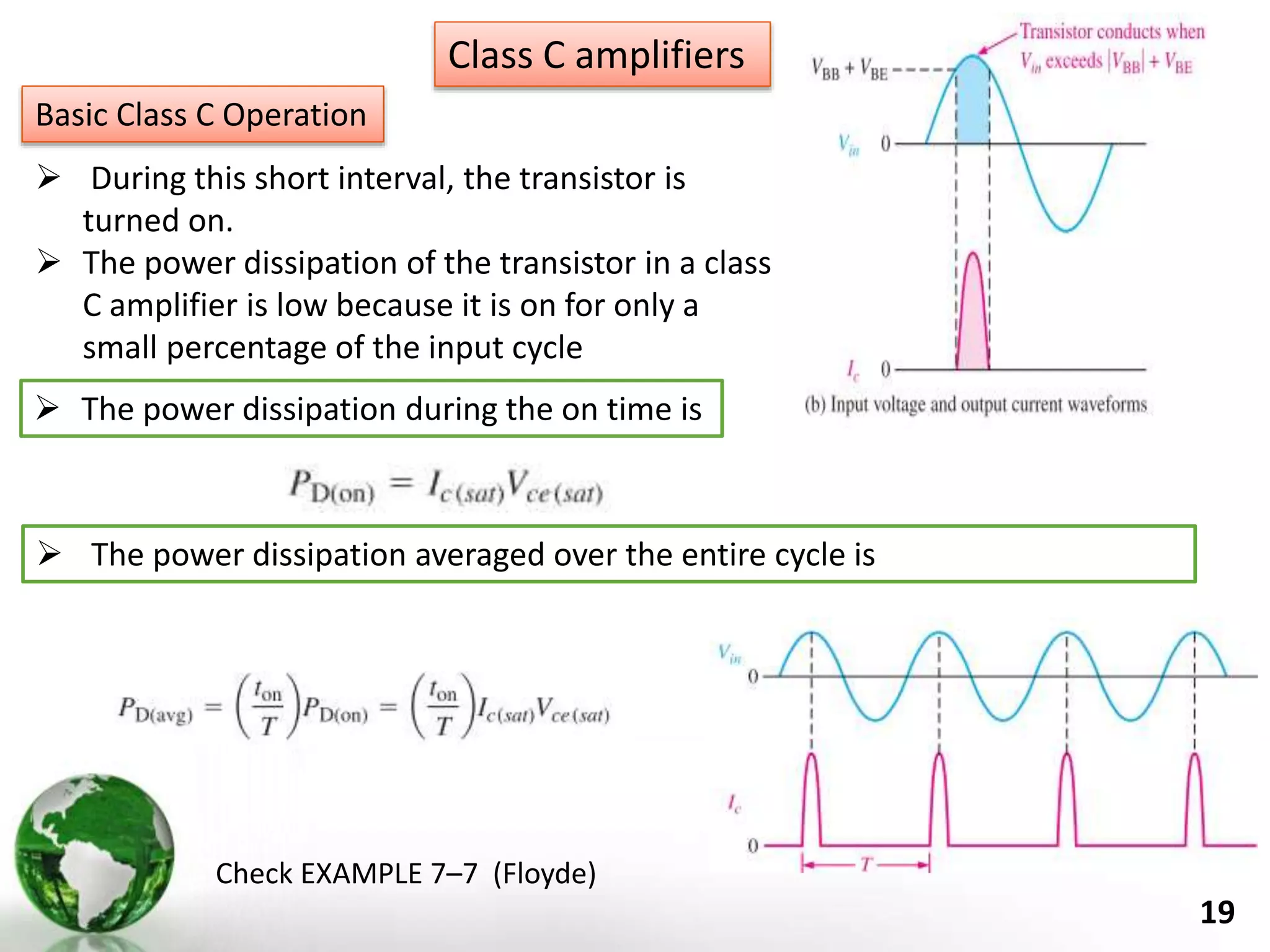
 During this short interval, the transistor is
turned on.
 The power dissipation of the transistor in a class
C amplifier is low because it is on for only a
small percentage of the input cycle
 The power dissipation during the on time is
 The power dissipation averaged over the entire cycle is
Check EXAMPLE 7–7 (Floyde)
EEDP - Basem ElHalawany 20
Tuned Class C Operation
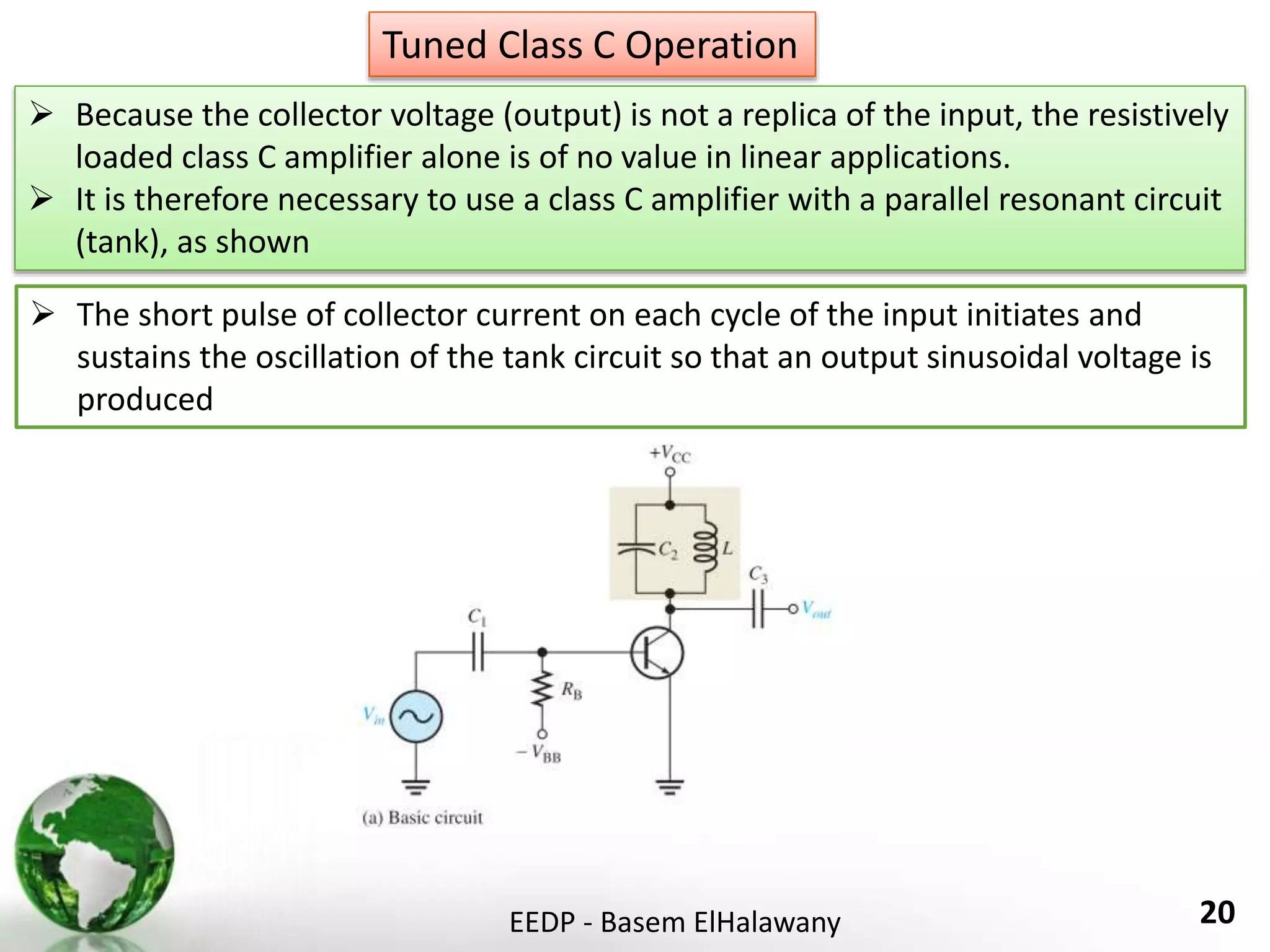
 Because the collector voltage (output) is not a replica of the input, the resistively
loaded class C amplifier alone is of no value in linear applications.
 It is therefore necessary to use a class C amplifier with a parallel resonant circuit
(tank), as shown
 The short pulse of collector current on each cycle of the input initiates and
sustains the oscillation of the tank circuit so that an output sinusoidal voltage is
produced

Eedp lect 06 amplifiers_3_classes

  • 1.
    Electrical, Electronic andDigital Principles (EEDP) Lecture 6 Amplifiers Classes ‫د‬.‫الحلوانى‬ ‫ممدوح‬ ‫باسم‬
  • 2.
    EEDP - BasemElHalawany 2 Classification Of Amplifiers 1. According to frequency capabilities. 2. According to coupling methods. • AF Amplifier are used to amplify the signals lying in the audio range ( i.e. 20 Hz to 20 kHz ) • RF amplifiers are used to amplify signals having very high frequency. Amplifiers are classified as audio amplifiers , radio frequency amplifiers • R-C coupled amplifiers, • Transformer coupled amplifiers • Direct Coupled
  • 3.
    EEDP - BasemElHalawany 3 Classification Of Amplifiers 3. According to use. • Amplify the input voltage, if possible with minimal current at the output. • The power gain of the voltage amplifier is low. • The main application is to strengthen the signal to make it less affected by noise and attenuation. • Ideal voltage amp. have infinite input impedance & zero output impedance. a. Voltage amplifiers • Amplify the input power, if possible with minimal change in the output voltage • Power amp. are used in devices which require a large power across the loads. • In multi stage amplifiers, power amplification is made in the final stages  Audio amplifiers and RF amplifiers use it to deliver sufficient power the load.  Servo motor controllers use power it to drive the motors. a. Power amplifiers
  • 4.
    EEDP - BasemElHalawany 4 Classification Of Amplifiers Voltage amplifiers Power amplifiers current gain low high Voltage gain high low Heat dissipation low high cooling mechanism not required required Transistor Size Small Large to dissipate heat Base Width small Wide to handle higher current Beta Usually high >100 Low usually < 20
  • 5.
  • 6.
  • 7.
  • 8.
  • 9.
    EEDP - BasemElHalawany 9  Class B amplifier: When an amplifier is biased at cutoff so that it operates in the linear region for 180o of the input cycle and is in cutoff for 180o  Class AB amplifiers: are biased to conduct for slightly more than 180o  Both are more efficient than a class A amplifier;  A disadvantage of class B or class AB is that it is more difficult to implement the circuit in order to get a linear reproduction of the input waveform.  The term push-pull refers to a common type of class B or class AB amplifier circuit in which two transistors are used on alternating half-cycles to reproduce the input waveform at the output.
  • 10.
    EEDP - BasemElHalawany 10  The class B amplifier is biased at the cutoff point so that  It is brought out of cutoff and operates in its linear region when the input signal drives the transistor into conduction. emitter-follower circuit  The Circuit only conducts for the positive half of the cycle.  Can not amplify the entire cycle
  • 11.
    EEDP - BasemElHalawany 11  To amplify the entire cycle, it is necessary to add a second class B amplifier that operates on the negative half of the cycle.  The combination of two class B amplifiers working together is called push-pull operation  There are two common approaches for using push-pull amplifiers to reproduce the entire waveform. 1. Transformer Coupling  The input transformer thus converts the input signal to two out-of-phase signals for the two npn transistors.  The output transformer combines the signals by permitting current in both directions, even though one transistor is always cut off.
  • 12.
    EEDP - BasemElHalawany 12 2. Complementary Symmetry Transistors  The figure shows one of the most popular types of push-pull class B amplifiers using two emitter-followers and both positive and negative power supplies.  This is a complementary amplifier because one emitter-follower uses an npn transistor and the other a pnp, which conduct on opposite alternations of the input cycle.
  • 13.
    EEDP - BasemElHalawany 13  When the dc base voltage is zero, both transistors are off and the input signal voltage must exceed VBE before a transistor conducts.  Because of this, there is a time interval between the positive and negative alternations of the input when neither transistor is conducting, as shown in Figure.  The resulting distortion in the output waveform is called crossover distortion. Crossover Distortion
  • 14.
    14  To overcomecrossover distortion, the biasing is adjusted to just overcome the VBE of the transistors  In class AB operation, the push-pull stages are biased into slight conduction, even when no input signal is present.  This can be done with a voltage-divider and diode arrangement, as shown Biasing the Push-Pull Amplifier for Class AB Operation  Using equal values of R1 and R2 the positive and negative supply voltages forces the voltage at point A to equal 0 V and eliminates the need for an input coupling capacitor.  When the diode characteristics of D1 and D2 are closely matched to the characteristics of the transistor BE junctions, the current in the diodes and the current in the transistors are the same; ((current mirror.)) The diode current will be the same as ICQ
  • 15.
    15  AC Operation Biasingthe Push-Pull Amplifier for Class AB Operation  The Q-point is slightly above cutoff. (In a true class B amplifier, the Q- point is at cutoff.)  The ac cutoff voltage is at VCC  The ac saturation current is:  In class A , the Q-point is near the middle and there is significant current in the transistors even with no signal.  In class B , when there is no signal, the transistors have only a very small current and therefore dissipate very little power.  Thus, the efficiency of a class B amplifier can be much higher than a class A amplifier.
  • 16.
    EEDP - BasemElHalawany 16  The circuit operation is the same as that described previously, except the bias is set to force the output emitter voltage to be
  • 17.
    17 Maximum Output Power DCInput Power Efficiency
  • 18.
    18  Class Camplifiers are biased so that conduction occurs for much less than 180o  Class C amplifiers are more efficient than either class A , B, or AB Class C amplifiers  The output amplitude is a nonlinear function of the input, so class C amplifiers are not used for linear amplification.  They are generally used in radio frequency (RF) applications, including resonance circuits Basic Class C Operation  A class C amplifier is normally operated with a resonant circuit load, so the resistive load is used only for the purpose of illustrating the concept.  The ac source voltage has a peak value that exceeds the barrier potential of the base-emitter junction for a short time near the positive peak of each cycle,
  • 19.
    19 Class C amplifiers BasicClass C Operation  During this short interval, the transistor is turned on.  The power dissipation of the transistor in a class C amplifier is low because it is on for only a small percentage of the input cycle  The power dissipation during the on time is  The power dissipation averaged over the entire cycle is Check EXAMPLE 7–7 (Floyde)
  • 20.
    EEDP - BasemElHalawany 20 Tuned Class C Operation  Because the collector voltage (output) is not a replica of the input, the resistively loaded class C amplifier alone is of no value in linear applications.  It is therefore necessary to use a class C amplifier with a parallel resonant circuit (tank), as shown  The short pulse of collector current on each cycle of the input initiates and sustains the oscillation of the tank circuit so that an output sinusoidal voltage is produced