COMMU
NICATIO
N
Week 1
(Lecture/Discussion
#1)
What is purposive
communication?
This is a 3 unit course that develops students’ communicative
competence and enhances their cultural and intercultural awareness
through multimodal tasks that provide them opportunities for
communicating effectively and appropriately to a multicultural
audience in a local or global context. It equips students with tools for
critical evaluation of a variety of texts and focuses on the power of
language and the impact of images to emphasize the importance of
conveying messages responsibly.
Objectives of the course
Describe the nature, elements, and functions of verbal and non-
verbal communication in various and multicultural contents.
Explain how cultural and global issues affect communication
Determine culturally appropriate terms, expressions and images.
Evaluate multimodal texts critically to enhance receptive (listening,
reading, viewing) skills;
Summarize the principles of academic text surface.
Processes and
principles of
effective
communication
Week 1
(Lecture/Discussion
#1)
WHAT IS COMMUNICATION?
The root of the word “communication” in Latin is
communicare, which means to share, or to make
common (Weekley, 1967). Communication is
defined as the process of understanding and
sharing meaning (Pearson & Nelson, 2000).
WHAT IS EFFECTIVE
COMMUNICATION?
Effective communication is a key
interpersonal skill and by learning
how you can improve your
communication has many benefits.
WHAT IS EFFECTIVE
COMMUNICATION?
Communication is beyond simply putting
words into thoughts and emotions. It is
done effectively only when information is
transmitted without changing both the content
and the context of the message. Simply put,
communication is the art of creating and
sharing ideas for a specific purpose..
FORMS OF COMMUNICATION
1. verbal communication, which includes the use of
language, sounds, and tone of voice
2. non-verbal communication, which includes body
language and facial expressions
3. written communication, such as through journals,
emails, blogs, and text messages
4. visual communication, which involves signs, symbols,
pictures, graphics, and emojis
WHAT IS AUDIENCE ANALYSIS?
A key element in effective communication is audience
analysis. “Audience” here does not only refer to the people
listening to you in a public speech. Rather, it refers to anyone
who is expected to receive the message you are sending.
Knowing the audience, understanding their level and how
they need to receive the information – also known as
skills on audience analysis – are extremely important in
“packaging” the message and sending it across.
WHAT IS AUDIENCE ANALYSIS?
Another aspect that needs consideration in analyzing the
audience is identifying and trying to overcome possible
communication barriers. These are not confined to physical
noise (cars passing by, someone pounding on the table)
and physiological issues (an upset stomach), but could
also include cultural difference, varying levels of
expectations and experiences, and difference in
perspectives and communication styles.
EFFECTIVE
COMMUNIC
ATION
Week 1
(Lecture/Discussion
#1)
PRINCIPLES OF EFFECTIVE
COMMUNICATION
CLARITY
This pertains to both the message and the purpose why the
message has to be sent. The message should be clear by
using appropriate language and communication channels,
but equally important is that the reason for sending and
receiving the message must be understood by both sender
and receiver
PRINCIPLES OF EFFECTIVE
COMMUNICATION
CLARITY
PRINCIPLES OF EFFECTIVE
COMMUNICATION
CONCISENESS
The message should be as brief as may be required
depending on one’s purpose, especially in most modern
contexts in the business and academic fields where time is of
the essence. It should be devoid of trivial details that would
hinder communication.
PRINCIPLES OF EFFECTIVE
COMMUNICATION
CONCISENESS
PRINCIPLES OF EFFECTIVE
COMMUNICATION
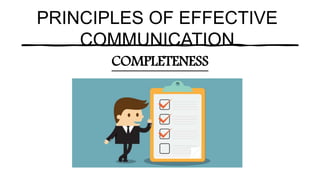
COMPLETENESS
Despite its conciseness, the message should still be complete
and accurate. Whenever necessary, background information
should be given to provide better context; facts and
observations may also be helpful.
PRINCIPLES OF EFFECTIVE
COMMUNICATION
COMPLETENESS
PRINCIPLES OF EFFECTIVE
COMMUNICATION
ORGANIZATION
Effective communication is usually planned in order to ensure
the systematic flow of ideas and transition from one point
to another. There are instances, however, when
communication is impromptu, but this should not be an
excuse for an organized presentation of ideas.
PRINCIPLES OF EFFECTIVE
COMMUNICATION
ORGANIZATION
PRINCIPLES OF EFFECTIVE
COMMUNICATION
EMPATHY
The sender of the message should be sensitive to the needs
and interests of the receiver. In case of face-to-face
communication, the speaker must always be conscious of the
reaction of the listener and adjust his/her communication
strategy accordingly
PRINCIPLES OF EFFECTIVE
COMMUNICATION
EMPATHY
PRINCIPLES OF EFFECTIVE
COMMUNICATION
FLEXIBILITY
Different people have different communication styles, and
consequently, different expectations. Effective
communicators know how to adapt to the varying needs
and expectations of their audience, and modify the
message or the way the message is sent to avoid
misunderstanding or misinterpretation.
PRINCIPLES OF EFFECTIVE
COMMUNICATION
FLEXIBILITY
ANY
QUESTIONS?
THANK YOU!

PURPOSIVE COMMUNICATION LECTURE #1.pptx

  • 1.
  • 2.
    What is purposive communication? Thisis a 3 unit course that develops students’ communicative competence and enhances their cultural and intercultural awareness through multimodal tasks that provide them opportunities for communicating effectively and appropriately to a multicultural audience in a local or global context. It equips students with tools for critical evaluation of a variety of texts and focuses on the power of language and the impact of images to emphasize the importance of conveying messages responsibly.
  • 3.
    Objectives of thecourse Describe the nature, elements, and functions of verbal and non- verbal communication in various and multicultural contents. Explain how cultural and global issues affect communication Determine culturally appropriate terms, expressions and images. Evaluate multimodal texts critically to enhance receptive (listening, reading, viewing) skills; Summarize the principles of academic text surface.
  • 4.
  • 5.
    WHAT IS COMMUNICATION? Theroot of the word “communication” in Latin is communicare, which means to share, or to make common (Weekley, 1967). Communication is defined as the process of understanding and sharing meaning (Pearson & Nelson, 2000).
  • 6.
    WHAT IS EFFECTIVE COMMUNICATION? Effectivecommunication is a key interpersonal skill and by learning how you can improve your communication has many benefits.
  • 7.
    WHAT IS EFFECTIVE COMMUNICATION? Communicationis beyond simply putting words into thoughts and emotions. It is done effectively only when information is transmitted without changing both the content and the context of the message. Simply put, communication is the art of creating and sharing ideas for a specific purpose..
  • 8.
    FORMS OF COMMUNICATION 1.verbal communication, which includes the use of language, sounds, and tone of voice 2. non-verbal communication, which includes body language and facial expressions 3. written communication, such as through journals, emails, blogs, and text messages 4. visual communication, which involves signs, symbols, pictures, graphics, and emojis
  • 9.
    WHAT IS AUDIENCEANALYSIS? A key element in effective communication is audience analysis. “Audience” here does not only refer to the people listening to you in a public speech. Rather, it refers to anyone who is expected to receive the message you are sending. Knowing the audience, understanding their level and how they need to receive the information – also known as skills on audience analysis – are extremely important in “packaging” the message and sending it across.
  • 10.
    WHAT IS AUDIENCEANALYSIS? Another aspect that needs consideration in analyzing the audience is identifying and trying to overcome possible communication barriers. These are not confined to physical noise (cars passing by, someone pounding on the table) and physiological issues (an upset stomach), but could also include cultural difference, varying levels of expectations and experiences, and difference in perspectives and communication styles.
  • 11.
  • 12.
    PRINCIPLES OF EFFECTIVE COMMUNICATION CLARITY Thispertains to both the message and the purpose why the message has to be sent. The message should be clear by using appropriate language and communication channels, but equally important is that the reason for sending and receiving the message must be understood by both sender and receiver
  • 13.
  • 14.
    PRINCIPLES OF EFFECTIVE COMMUNICATION CONCISENESS Themessage should be as brief as may be required depending on one’s purpose, especially in most modern contexts in the business and academic fields where time is of the essence. It should be devoid of trivial details that would hinder communication.
  • 15.
  • 16.
    PRINCIPLES OF EFFECTIVE COMMUNICATION COMPLETENESS Despiteits conciseness, the message should still be complete and accurate. Whenever necessary, background information should be given to provide better context; facts and observations may also be helpful.
  • 17.
  • 18.
    PRINCIPLES OF EFFECTIVE COMMUNICATION ORGANIZATION Effectivecommunication is usually planned in order to ensure the systematic flow of ideas and transition from one point to another. There are instances, however, when communication is impromptu, but this should not be an excuse for an organized presentation of ideas.
  • 19.
  • 20.
    PRINCIPLES OF EFFECTIVE COMMUNICATION EMPATHY Thesender of the message should be sensitive to the needs and interests of the receiver. In case of face-to-face communication, the speaker must always be conscious of the reaction of the listener and adjust his/her communication strategy accordingly
  • 21.
  • 22.
    PRINCIPLES OF EFFECTIVE COMMUNICATION FLEXIBILITY Differentpeople have different communication styles, and consequently, different expectations. Effective communicators know how to adapt to the varying needs and expectations of their audience, and modify the message or the way the message is sent to avoid misunderstanding or misinterpretation.
  • 23.
  • 24.