The Evolution of Traditional to New Media
Lesson 1 -
The
Evolution of
Traditional
to New
Media
Media have evolved throughout
time – from pre-industrial age to
information age. The evolution of
traditional to new media depicts the
records of the past on the progress of
media technology which helps people
communicate and disseminate
information in the fastest and efficient
ways. Furthermore, media also
shaped the values and norms of
people and society.
The term “media” is described as means of communication
for people which includes newspapers, radio, televisions, and
the internet.
In the advent of the “new normal”, the role of media has
been highlighted more than ever. The society relies heavily on
media and information technology, not only for communication,
but also for information dissemination, distance learning, work
at home, etc.
Pre-Industrial Age (Before 1700s)
• During pre-industrial age, about 4.5
million years ago, the early
hominids discovered fire, developed
paper from plants, and built
weapons.
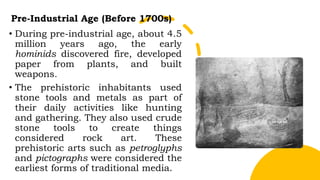
• The prehistoric inhabitants used
stone tools and metals as part of
their daily activities like hunting
and gathering. They also used crude
stone tools to create things
considered rock art. These
prehistoric arts such as petroglyphs
and pictographs were considered the
earliest forms of traditional media.
Industrial Age (1700s - 1930s)
• The industrial age occurs
during the industrial revolution in
Great Britain. This period brought
in economic and societal changes,
such as the substitution of handy
tools with machines like the power
loom and the steam engine.
• The transformation of the
manufacturing industry, and
commercial enterprise for mass
production of various products
occurred. Also, long-distance
communication became possible
via telegraph, a system used for
transmitting messages.
Electronic Age (1930s - 1980s)
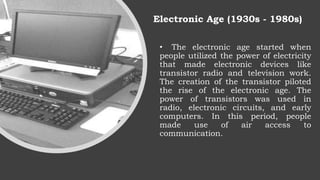
• The electronic age started when
people utilized the power of electricity
that made electronic devices like
transistor radio and television work.
The creation of the transistor piloted
the rise of the electronic age. The
power of transistors was used in
radio, electronic circuits, and early
computers. In this period, people
made use of air access to
communication.
Information Age (1900s - 2000s)
The information age is a period also
known as the digital age. This period
signified the use of the worldwide web
through an internet connection.
Communication became faster and easier
with the use of social networks or social
media platforms such as Facebook,
Messenger, Instagram, Twitter, among
others. The rapid technological
advancement and innovation with the use
of microelectronics lead to the
development of laptops, netbooks mobile
phones, and wearable technology.
Here are the lists of media that have evolved
throughout the four ages in history.
Pre-Industrial Age (Before 1700s)
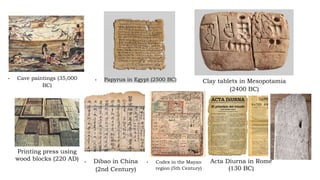
• Cave paintings (35,000 BC)
• Clay tablets in Mesopotamia (2400 BC)
• Papyrus in Egypt (2500 BC)
• Acta Diurna in Rome (130 BC)
• Dibao in China (2nd Century)
• Codex in the Mayan region (5th Century)
• Printing press using wood blocks (220 AD)
• Papyrus in Egypt (2500 BC) Clay tablets in Mesopotamia
(2400 BC)
• Cave paintings (35,000
BC)
Printing press using
wood blocks (220 AD) • Dibao in China
(2nd Century)
Acta Diurna in Rome
(130 BC)
• Codex in the Mayan
region (5th Century)
Industrial Age (1700s-1930s)
Printing press for mass
production (19th
century)
Newspaper- The London
Gazette (1640)
Typewriter (1800)
Telephone (1876)
Motion picture
photography/projection
(1890)
Commercial motion
pictures (1913)
Motion picture with
sound (1926)
Telegraph Punch cards
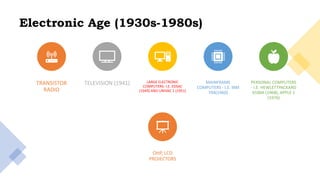
Electronic Age (1930s-1980s)
TRANSISTOR
RADIO
TELEVISION (1941) LARGE ELECTRONIC
COMPUTERS- I.E. EDSAC
(1949) AND UNIVAC 1 (1951)
MAINFRAME
COMPUTERS - I.E. IBM
704(1960)
PERSONAL COMPUTERS
- I.E. HEWLETTPACKARD
9100A (1968), APPLE 1
(1976)
OHP, LCD
PROJECTORS
Information
Age (1900-
2000s)
• Web browsers: Mosaic (1993), Internet
Explorer (1995)
• Blogs: Blogspot (1999), LiveJournal
(1999), Wordpress (2003)
• Social media: Friendster (2002),
Multiply (2003), Facebook (2004)
• Microblogs: Twitter (2006), Tumblr
(2007)
• Video: YouTube (2005)
• Augmented Reality / Virtual Reality
• Video chat: Skype (2003), Google
Hangouts (2013)
• Search Engines: Google (1996), Yahoo
(1995)
• Portable computers- laptops (1980),
tablets (1993) netbooks (2008),
• Smartphones
• Wearable technology
• Cloud and Big Data
The
influence
of media
on the
values and
norms of
people
•Norms are standards of behavior that
are expected in a society based on
their customary laws or conduct.
These norms entail conformist
behavior following social standards
like respect for elders, obtaining
education, getting married, and
gender roles. The set of norms begins
at home and continues to develop as
we expand ourselves to the social
world. With the use of social media,
people are no longer limited to his/her
social group and become more readily
connected to global society with
diverse values and norms.
The
influence
of media
on the
values and
norms of
people
• With the advent of the information age,
media become more influential in different
aspects of people’s lives. Media provide
access to ideas that are restricted in the
past. Due to people’s capability to relate,
deliberate, and communicate freely online,
the conventional ideas are challenged. For
example, there are different women's rights
organizations that share worldwide
awareness of woman equality in our society
through online platforms. Similarly, the
LGBTQ plus movement advocates gender
equality and acceptance in society. This
results in the development of new social
norms to conform to in search for equal
opportunity and tolerance.
The
influence
of media
on the
values and
norms of
people
• According to Arias (2016), the influence of
media may have(1) individual or direct effect,
and (2) social or indirect effect. He argued that
the process of information dissemination has
significance to the beliefs of a person and
subsequently to their behavior. The widely
spread of information helps the creation of
shared knowledge, hence expanding its impact
on the norms and values of the people in the
society. This is in line with Bandura's (1986)
Social Learning Theory, wherein media operates
by means of educational models. These
educational models perform vital functions by
transmitting information, values, and behaviors,
among others. Information that is recognized to
be publicly accessible improves the
understanding of shared beliefs (Mutz, 1998).
Reflection
Paper
Write a reflection
paper on how the
evolution of media
shaped the values and
norms of people and the
society. You can also
read news articles or surf
the internet to know
more about the effects of
media and information to
the values and norms of
the Filipinos.
Personal
Technology
Timeline
• Make a timeline of
the means of
communication that
you have used. You
can draw or paste
cut-outs of pictures
from magazines or
newspapers.

module 2 mil lecture.pptx

  • 2.
    The Evolution ofTraditional to New Media
  • 3.
    Lesson 1 - The Evolutionof Traditional to New Media Media have evolved throughout time – from pre-industrial age to information age. The evolution of traditional to new media depicts the records of the past on the progress of media technology which helps people communicate and disseminate information in the fastest and efficient ways. Furthermore, media also shaped the values and norms of people and society.
  • 4.
    The term “media”is described as means of communication for people which includes newspapers, radio, televisions, and the internet. In the advent of the “new normal”, the role of media has been highlighted more than ever. The society relies heavily on media and information technology, not only for communication, but also for information dissemination, distance learning, work at home, etc.
  • 5.
    Pre-Industrial Age (Before1700s) • During pre-industrial age, about 4.5 million years ago, the early hominids discovered fire, developed paper from plants, and built weapons. • The prehistoric inhabitants used stone tools and metals as part of their daily activities like hunting and gathering. They also used crude stone tools to create things considered rock art. These prehistoric arts such as petroglyphs and pictographs were considered the earliest forms of traditional media.
  • 6.
    Industrial Age (1700s- 1930s) • The industrial age occurs during the industrial revolution in Great Britain. This period brought in economic and societal changes, such as the substitution of handy tools with machines like the power loom and the steam engine. • The transformation of the manufacturing industry, and commercial enterprise for mass production of various products occurred. Also, long-distance communication became possible via telegraph, a system used for transmitting messages.
  • 7.
    Electronic Age (1930s- 1980s) • The electronic age started when people utilized the power of electricity that made electronic devices like transistor radio and television work. The creation of the transistor piloted the rise of the electronic age. The power of transistors was used in radio, electronic circuits, and early computers. In this period, people made use of air access to communication.
  • 8.
    Information Age (1900s- 2000s) The information age is a period also known as the digital age. This period signified the use of the worldwide web through an internet connection. Communication became faster and easier with the use of social networks or social media platforms such as Facebook, Messenger, Instagram, Twitter, among others. The rapid technological advancement and innovation with the use of microelectronics lead to the development of laptops, netbooks mobile phones, and wearable technology.
  • 9.
    Here are thelists of media that have evolved throughout the four ages in history. Pre-Industrial Age (Before 1700s) • Cave paintings (35,000 BC) • Clay tablets in Mesopotamia (2400 BC) • Papyrus in Egypt (2500 BC) • Acta Diurna in Rome (130 BC) • Dibao in China (2nd Century) • Codex in the Mayan region (5th Century) • Printing press using wood blocks (220 AD)
  • 10.
    • Papyrus inEgypt (2500 BC) Clay tablets in Mesopotamia (2400 BC) • Cave paintings (35,000 BC) Printing press using wood blocks (220 AD) • Dibao in China (2nd Century) Acta Diurna in Rome (130 BC) • Codex in the Mayan region (5th Century)
  • 11.
    Industrial Age (1700s-1930s) Printingpress for mass production (19th century) Newspaper- The London Gazette (1640) Typewriter (1800) Telephone (1876) Motion picture photography/projection (1890) Commercial motion pictures (1913) Motion picture with sound (1926) Telegraph Punch cards
  • 12.
    Electronic Age (1930s-1980s) TRANSISTOR RADIO TELEVISION(1941) LARGE ELECTRONIC COMPUTERS- I.E. EDSAC (1949) AND UNIVAC 1 (1951) MAINFRAME COMPUTERS - I.E. IBM 704(1960) PERSONAL COMPUTERS - I.E. HEWLETTPACKARD 9100A (1968), APPLE 1 (1976) OHP, LCD PROJECTORS
  • 13.
    Information Age (1900- 2000s) • Webbrowsers: Mosaic (1993), Internet Explorer (1995) • Blogs: Blogspot (1999), LiveJournal (1999), Wordpress (2003) • Social media: Friendster (2002), Multiply (2003), Facebook (2004) • Microblogs: Twitter (2006), Tumblr (2007) • Video: YouTube (2005) • Augmented Reality / Virtual Reality • Video chat: Skype (2003), Google Hangouts (2013) • Search Engines: Google (1996), Yahoo (1995) • Portable computers- laptops (1980), tablets (1993) netbooks (2008), • Smartphones • Wearable technology • Cloud and Big Data
  • 14.
    The influence of media on the valuesand norms of people •Norms are standards of behavior that are expected in a society based on their customary laws or conduct. These norms entail conformist behavior following social standards like respect for elders, obtaining education, getting married, and gender roles. The set of norms begins at home and continues to develop as we expand ourselves to the social world. With the use of social media, people are no longer limited to his/her social group and become more readily connected to global society with diverse values and norms.
  • 15.
    The influence of media on the valuesand norms of people • With the advent of the information age, media become more influential in different aspects of people’s lives. Media provide access to ideas that are restricted in the past. Due to people’s capability to relate, deliberate, and communicate freely online, the conventional ideas are challenged. For example, there are different women's rights organizations that share worldwide awareness of woman equality in our society through online platforms. Similarly, the LGBTQ plus movement advocates gender equality and acceptance in society. This results in the development of new social norms to conform to in search for equal opportunity and tolerance.
  • 16.
    The influence of media on the valuesand norms of people • According to Arias (2016), the influence of media may have(1) individual or direct effect, and (2) social or indirect effect. He argued that the process of information dissemination has significance to the beliefs of a person and subsequently to their behavior. The widely spread of information helps the creation of shared knowledge, hence expanding its impact on the norms and values of the people in the society. This is in line with Bandura's (1986) Social Learning Theory, wherein media operates by means of educational models. These educational models perform vital functions by transmitting information, values, and behaviors, among others. Information that is recognized to be publicly accessible improves the understanding of shared beliefs (Mutz, 1998).
  • 17.
    Reflection Paper Write a reflection paperon how the evolution of media shaped the values and norms of people and the society. You can also read news articles or surf the internet to know more about the effects of media and information to the values and norms of the Filipinos.
  • 18.
    Personal Technology Timeline • Make atimeline of the means of communication that you have used. You can draw or paste cut-outs of pictures from magazines or newspapers.