
Communication process,
principles, and ethics
Presented by:
DARYL P. CASIANO
Instructor, SSU Mercedes Campus
What is Communication Ethics?
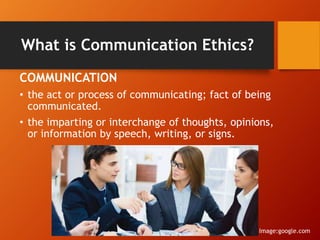
COMMUNICATION
• the act or process of communicating; fact of being
communicated.
• the imparting or interchange of thoughts, opinions,
or information by speech, writing, or signs.
Image:google.com
What is Communication Ethics?
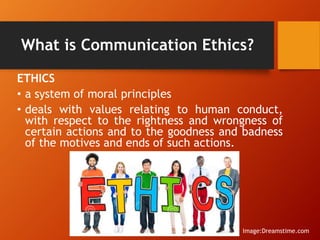
ETHICS
• a system of moral principles
• deals with values relating to human conduct,
with respect to the rightness and wrongness of
certain actions and to the goodness and badness
of the motives and ends of such actions.
Image:Dreamstime.com
COMMUNICATION ETHICS
• The principle governing communication, the right and wrong
aspects of it, the moral-immoral dimensions relevant to
Interpersonal communication are called the ethics of
Interpersonal communication.
• Maintaining the correct balance between the speaking and
listening
• the legitimacy of fear and emotional appeal
• degree of criticism and praise
• A death or an overdose of either of the factors could result in
unfavourable consequences.
• The principle of honesty on both sides should be completely
applied because any amount of insincerity from either the
listener or the speaker would not be prudent.
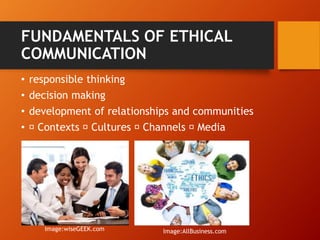
FUNDAMENTALS OF ETHICAL
COMMUNICATION
• responsible thinking
• decision making
• development of relationships and communities
• Contexts Cultures Channels Media
Image:AllBusiness.comImage:wiseGEEK.com
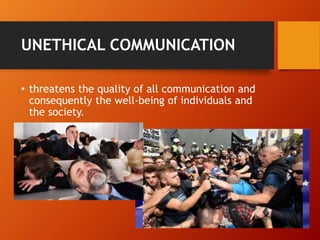
UNETHICAL COMMUNICATION
• threatens the quality of all communication and
consequently the well-being of individuals and
the society.
PRINCIPLES OF ETHICAL
COMMUNICATION
• advocate truthfulness, accuracy, honesty, and
reason as essential to the integrity of
communication.
• endorse freedom of expression, diversity of
perspective, and tolerance of dissent to
achieve the informed and responsible decision
making fundamental to a civil society.
• strive to understand and respect other
communicators before evaluating and
responding to their messages.
PRINCIPLES OF ETHICAL
COMMUNICATION
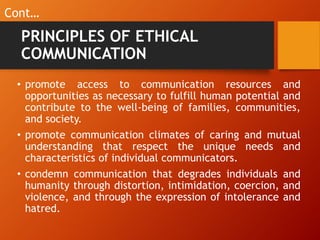
• promote access to communication resources and
opportunities as necessary to fulfill human potential and
contribute to the well-being of families, communities,
and society.
• promote communication climates of caring and mutual
understanding that respect the unique needs and
characteristics of individual communicators.
• condemn communication that degrades individuals and
humanity through distortion, intimidation, coercion, and
violence, and through the expression of intolerance and
hatred.
Cont…
PRINCIPLES OF ETHICAL
COMMUNICATION
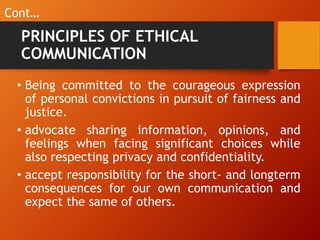
• Being committed to the courageous expression
of personal convictions in pursuit of fairness and
justice.
• advocate sharing information, opinions, and
feelings when facing significant choices while
also respecting privacy and confidentiality.
• accept responsibility for the short- and longterm
consequences for our own communication and
expect the same of others.
Cont…
EFFECTIVE COMMUNICATION
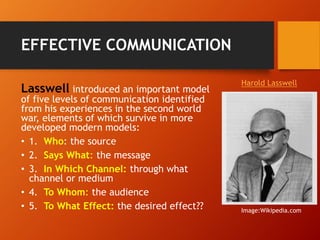
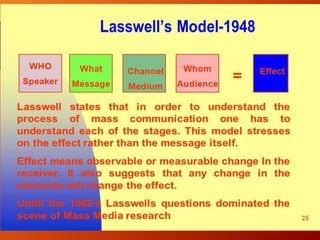
Lasswell introduced an important model
of five levels of communication identified
from his experiences in the second world
war, elements of which survive in more
developed modern models:
• 1. Who: the source
• 2. Says What: the message
• 3. In Which Channel: through what
channel or medium
• 4. To Whom: the audience
• 5. To What Effect: the desired effect?? Image:Wikipedia.com
Harold Lasswell
The Five Ws
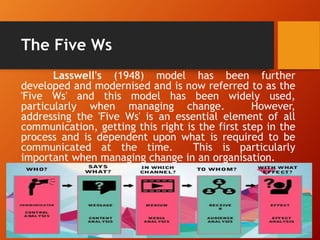
Lasswell's (1948) model has been further
developed and modernised and is now referred to as the
'Five Ws' and this model has been widely used,
particularly when managing change. However,
addressing the 'Five Ws' is an essential element of all
communication, getting this right is the first step in the
process and is dependent upon what is required to be
communicated at the time. This is particularly
important when managing change in an organisation.
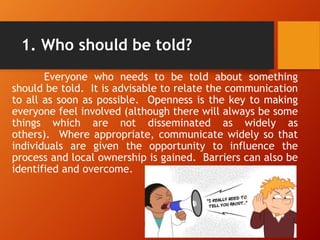
1. Who should be told?
Everyone who needs to be told about something
should be told. It is advisable to relate the communication
to all as soon as possible. Openness is the key to making
everyone feel involved (although there will always be some
things which are not disseminated as widely as
others). Where appropriate, communicate widely so that
individuals are given the opportunity to influence the
process and local ownership is gained. Barriers can also be
identified and overcome.
2. When should they be told?
The time to communicate with relevant people
should be carefully considered. It might be within a set
meeting or a one-off arrangement. If the communication
covers a wide range of people where possible it is desirable
that discussions take place at the same time to avoid
confusion, spread of rumours or misunderstandings. If
internal and external stakeholders are involved, internal
staff should be communicated with prior to external
stakeholders; this is to prevent staff hearing from other
sources, including the media.
• Key communications should be made
as soon as possible following a
significant event or decision.
3. What should they be told?
• Clear messages, related to the subject or problem. In
complex situations it is advisable to create a shared
meaning and understanding, this can be done by:
• checking back with the recipients through an iterative
process
• let them ask questions
• asking for clarification of what they have understood
being clear that words, behaviours and symbols are not
misunderstood or misinterpreted.
4. Where should the message
be conveyed?
Choose the most effective medium to get your
message across, this could be in meetings, seminars,
press releases etc. Make time to communicate properly,
do not do it in the corridor, in the toilet or the car
park. This leads to gabbled and garbled messages and
can contribute to the 'grape vine'.
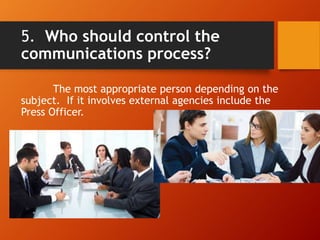
5. Who should control the
communications process?
The most appropriate person depending on the
subject. If it involves external agencies include the
Press Officer.
Confucius wrote..
'If language is not correct, then
what is said is not what is meant. If
what is said is not what is meant,
then what ought to be done remains
undone'.
How would you describe
good/effective communication?
Effective communication is: an
interconnected connected system where
people and ideas flow quickly,
comprehensively, and sustainable. Effective
communication is NOT just getting your point
across to others quickly
Why and when do we need it?
Effective communication is
important all the time in every situation
whether professional or personal.
Depending on the situation, effective
communication can save lives,
marriages, countries, or just help avoid
every day issues
What are the greatest challenges to
good communication?
• People who think communication is about
WHAT YOU SAY, versus HOW YOU SAY IT
• People who focus too much on BEING HEARD,
instead of LISTENING TO OTHERS
• People who use the WRONG CHANNEL TO
SEND A MESSAGE, such as choosing to discuss
a difficult situation with someone else
through a weak channel such as TEXT, EMAIL,
or THROUGH SOMEONE ELSE
How important is listening in
communication?
Listening is equally, and some
would say even more important,
than talking when it comes to
good communication.
Is there a way we can measure or
assess effective communication?
Yes, you can measure almost anything
though it really depends on the context as to
what measures you use. You can survey people
about how effective communication is, you
can map and graph emails in terms of
frequency, length, quality, content, there is
something called Network analysis that is used
to analyze workplace communication, lots of
different ways to measure something.
5
REFERENCES:
• Lasswell, H. (1948). "The Structure and Function
of Communication in Society." In Lyman Bryson
(ed.), The Communication of Ideas. Harper and
Row
• McGuire, W. (1981). "Theoretical Foundations of
Campaigns." In Ronald Rice and William Paisley
(eds.), Public Communication Campaigns, Sage.

Communication Process, Principles, and Ethics

  • 1.
    Communication process, principles, andethics Presented by: DARYL P. CASIANO Instructor, SSU Mercedes Campus
  • 2.
    What is CommunicationEthics? COMMUNICATION • the act or process of communicating; fact of being communicated. • the imparting or interchange of thoughts, opinions, or information by speech, writing, or signs. Image:google.com
  • 3.
    What is CommunicationEthics? ETHICS • a system of moral principles • deals with values relating to human conduct, with respect to the rightness and wrongness of certain actions and to the goodness and badness of the motives and ends of such actions. Image:Dreamstime.com
  • 4.
    COMMUNICATION ETHICS • Theprinciple governing communication, the right and wrong aspects of it, the moral-immoral dimensions relevant to Interpersonal communication are called the ethics of Interpersonal communication. • Maintaining the correct balance between the speaking and listening • the legitimacy of fear and emotional appeal • degree of criticism and praise • A death or an overdose of either of the factors could result in unfavourable consequences. • The principle of honesty on both sides should be completely applied because any amount of insincerity from either the listener or the speaker would not be prudent.
  • 5.
    FUNDAMENTALS OF ETHICAL COMMUNICATION •responsible thinking • decision making • development of relationships and communities • Contexts Cultures Channels Media Image:AllBusiness.comImage:wiseGEEK.com
  • 6.
    UNETHICAL COMMUNICATION • threatensthe quality of all communication and consequently the well-being of individuals and the society.
  • 7.
    PRINCIPLES OF ETHICAL COMMUNICATION •advocate truthfulness, accuracy, honesty, and reason as essential to the integrity of communication. • endorse freedom of expression, diversity of perspective, and tolerance of dissent to achieve the informed and responsible decision making fundamental to a civil society. • strive to understand and respect other communicators before evaluating and responding to their messages.
  • 8.
    PRINCIPLES OF ETHICAL COMMUNICATION •promote access to communication resources and opportunities as necessary to fulfill human potential and contribute to the well-being of families, communities, and society. • promote communication climates of caring and mutual understanding that respect the unique needs and characteristics of individual communicators. • condemn communication that degrades individuals and humanity through distortion, intimidation, coercion, and violence, and through the expression of intolerance and hatred. Cont…
  • 9.
    PRINCIPLES OF ETHICAL COMMUNICATION •Being committed to the courageous expression of personal convictions in pursuit of fairness and justice. • advocate sharing information, opinions, and feelings when facing significant choices while also respecting privacy and confidentiality. • accept responsibility for the short- and longterm consequences for our own communication and expect the same of others. Cont…
  • 10.
    EFFECTIVE COMMUNICATION Lasswell introducedan important model of five levels of communication identified from his experiences in the second world war, elements of which survive in more developed modern models: • 1. Who: the source • 2. Says What: the message • 3. In Which Channel: through what channel or medium • 4. To Whom: the audience • 5. To What Effect: the desired effect?? Image:Wikipedia.com Harold Lasswell
  • 11.
    The Five Ws Lasswell's(1948) model has been further developed and modernised and is now referred to as the 'Five Ws' and this model has been widely used, particularly when managing change. However, addressing the 'Five Ws' is an essential element of all communication, getting this right is the first step in the process and is dependent upon what is required to be communicated at the time. This is particularly important when managing change in an organisation.
  • 13.
    1. Who shouldbe told? Everyone who needs to be told about something should be told. It is advisable to relate the communication to all as soon as possible. Openness is the key to making everyone feel involved (although there will always be some things which are not disseminated as widely as others). Where appropriate, communicate widely so that individuals are given the opportunity to influence the process and local ownership is gained. Barriers can also be identified and overcome.
  • 14.
    2. When shouldthey be told? The time to communicate with relevant people should be carefully considered. It might be within a set meeting or a one-off arrangement. If the communication covers a wide range of people where possible it is desirable that discussions take place at the same time to avoid confusion, spread of rumours or misunderstandings. If internal and external stakeholders are involved, internal staff should be communicated with prior to external stakeholders; this is to prevent staff hearing from other sources, including the media. • Key communications should be made as soon as possible following a significant event or decision.
  • 15.
    3. What shouldthey be told? • Clear messages, related to the subject or problem. In complex situations it is advisable to create a shared meaning and understanding, this can be done by: • checking back with the recipients through an iterative process • let them ask questions • asking for clarification of what they have understood being clear that words, behaviours and symbols are not misunderstood or misinterpreted.
  • 16.
    4. Where shouldthe message be conveyed? Choose the most effective medium to get your message across, this could be in meetings, seminars, press releases etc. Make time to communicate properly, do not do it in the corridor, in the toilet or the car park. This leads to gabbled and garbled messages and can contribute to the 'grape vine'.
  • 17.
    5. Who shouldcontrol the communications process? The most appropriate person depending on the subject. If it involves external agencies include the Press Officer.
  • 18.
    Confucius wrote.. 'If languageis not correct, then what is said is not what is meant. If what is said is not what is meant, then what ought to be done remains undone'.
  • 20.
    How would youdescribe good/effective communication? Effective communication is: an interconnected connected system where people and ideas flow quickly, comprehensively, and sustainable. Effective communication is NOT just getting your point across to others quickly
  • 21.
    Why and whendo we need it? Effective communication is important all the time in every situation whether professional or personal. Depending on the situation, effective communication can save lives, marriages, countries, or just help avoid every day issues
  • 22.
    What are thegreatest challenges to good communication? • People who think communication is about WHAT YOU SAY, versus HOW YOU SAY IT • People who focus too much on BEING HEARD, instead of LISTENING TO OTHERS • People who use the WRONG CHANNEL TO SEND A MESSAGE, such as choosing to discuss a difficult situation with someone else through a weak channel such as TEXT, EMAIL, or THROUGH SOMEONE ELSE
  • 23.
    How important islistening in communication? Listening is equally, and some would say even more important, than talking when it comes to good communication.
  • 24.
    Is there away we can measure or assess effective communication? Yes, you can measure almost anything though it really depends on the context as to what measures you use. You can survey people about how effective communication is, you can map and graph emails in terms of frequency, length, quality, content, there is something called Network analysis that is used to analyze workplace communication, lots of different ways to measure something.
  • 25.
  • 26.
    REFERENCES: • Lasswell, H.(1948). "The Structure and Function of Communication in Society." In Lyman Bryson (ed.), The Communication of Ideas. Harper and Row • McGuire, W. (1981). "Theoretical Foundations of Campaigns." In Ronald Rice and William Paisley (eds.), Public Communication Campaigns, Sage.