MEDIA LITERACY AND MEDIA EDUCATION
Understanding & Utilizing Media in Teaching
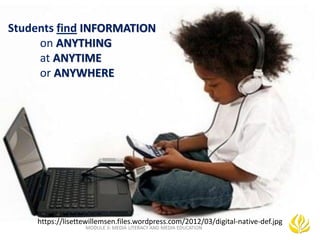
https://lisettewillemsen.files.wordpress.com/2012/03/digital-native-def.jpg
Students find INFORMATION
on ANYTHING
at ANYTIME
or ANYWHERE
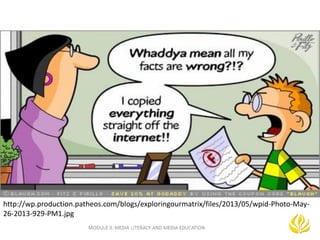
http://wp.production.patheos.com/blogs/exploringourmatrix/files/2013/05/wpid-Photo-May-
26-2013-929-PM1.jpg
MEDIA LITERACY
MODULE 3: MEDIA LITERACY AND MEDIA EDUCATION
MEDIA LITERACY
Media literacy embraces everything from having
the knowledge needed to use old and new
media technology to having a critical
relationship to media content in a time when
the media constitute one of the most powerful
forces in society.
Goteborgs Universitet (n.d)
MODULE 3: MEDIA LITERACY AND MEDIA EDUCATION
MEDIA LITERACY
o …the ability to access, analyze, evaluate and create
media in a variety of forms
Aspen Media Literacy Leadership Institute, 1992
o “The ability to access, understand and create
communications in a variety of contexts.”
Ofcom, 2010
o The ability to ACCESS, ANALYZE, EVALUATE, CREATE,
and ACT using all forms of communication.
NAMLE, 2010
MODULE 3: MEDIA LITERACY AND MEDIA EDUCATION
MEDIA LITERACY
 Understanding and using mass media in either an assertive or
non-assertive way, including an informed and critical
understanding of media, what techniques they employ and their
effects
 The ability to read, analyze, evaluate and produce
communication in a variety of media forms, e.g. television, print,
radio, computers etc.
 The ability to decode, analyze, evaluate and produce
communication in a variety of forms
Wilson, Tuazon, et al. (2011), p 188
UNESCO MIL Curriculum for Teachers
MODULE 3: MEDIA LITERACY AND MEDIA EDUCATION
MEDIA LITERACY
Media Literacy is a 21st century approach to education.
It provides a framework to access, analyze, evaluate,
create and participate using messages in a variety of
forms—from print to video to the internet.
Media literacy builds an understanding of the role of
media in society as well as essential skills of inquiry and
self-expression necessary for citizens of a democracy.
ML MediaLit Kit™ (2008)
Center for Media Learning
MODULE 3: MEDIA LITERACY AND MEDIA EDUCATION
Media Literacy: 8 Guidelines for Teachers
Ohler, J. (2009). Orchestrating the Media Collage
1) Shift from text centrism to media collage.
2) Value writing and reading now more than ever.
3) Adopt art as the next R.
4) Blend traditional and emerging literacies.
5) Harness report and story.
6) Practice private and participatory social literacy.
7) Develop literacy with digital tools and about digital
tools.
8) Pursue fluency.
MODULE 3: MEDIA LITERACY AND MEDIA EDUCATION
MEDIA EDUCATION
MODULE 3: MEDIA LITERACY AND MEDIA EDUCATION
MEDIA EDUCATION
MODULE 3: MEDIA LITERACY AND MEDIA EDUCATION
• The technical production skills linked with
producing media texts. It also refers to the
processes of critically examining or exploring
meanings behind media texts.
-Wilson, Tuazon, et al. (2011), p 188
UNESCO MIL Curriculum for Teachers
MEDIA EDUCATION
MODULE 3: MEDIA LITERACY AND MEDIA EDUCATION
• Media education is the process of teaching
and learning about the media.
-Buckingham, 2003
MEDIA EDUCATION
MODULE 3: MEDIA LITERACY AND MEDIA EDUCATION
• Media education aims to provide citizens
with new competencies, attitudes and skills
in relation to the media setting, its languages
and discourse.
TRAINING CURRICULA FOR MIL (2008)
UNESCO TEACHER TRAINING CURRICULA FOR MIL (2008)
--UNESCO TEACHER TRAINING CURRICULA FOR MIL (2008)
MEDIA EDUCATION and MEDIA LITERACY
Media Education: A Toolkit for Teachers, Students, Parents and
Professionals (2006)
• Media Literacy is just as important for young
people as the more traditional literacy of
print.
• Media Education, then, is the process of
teaching and learning about media
• Media Literacy is the outcome–the
knowledge and skills learners acquire.
MODULE 3: MEDIA LITERACY AND MEDIA EDUCATION
Media Literacy vs Media Education
Ulla Carlsson(n.d). Goteborgs Universitet
Media Literacy is a considerably broader concept than
’Media Education’, which only refers to the mission of
the schools (where there is great consensus, e.g.,
within the EU, that the schools are responsible for
introducing children’s media culture into teaching).
MODULE 3: MEDIA LITERACY AND MEDIA EDUCATION
Media Literacy vs Media Education (cont’d)
Ulla Carlsson(n.d). Goteborgs Universitet
The point of departure of the two concepts is, however, the
same, that is, that:
(1) media construct reality
(2) audiences interpret media content on the basis of their
own preferences
(3) media have commercial as well as social and
political significations
(4) media contain ideological messages
(5) every medium has an aesthetic form
MODULE 3: MEDIA LITERACY AND MEDIA EDUCATION
Is MEDIA EDUCATION important?
Stephanie Brooke, Oct. 21, 2013
MODULE 3: MEDIA LITERACY AND MEDIA EDUCATION
https://www.youtube.com/watch?v=5JSYT2Ceqmo
Three Core Ideas in
Media Education and Media Literacy
UNESCO TEACHER TRAINING CURRICULA FOR MIL (2008)
MODULE 3: MEDIA LITERACY AND MEDIA EDUCATION
1) Critical Thinking
2) Media Appropriation
3) Intervention and Participation in the Public Sphere
Three Core Ideas in
Media Education and Media Literacy (cont’d)
UNESCO TEACHER TRAINING CURRICULA FOR MIL (2008)
MODULE 3: MEDIA LITERACY AND MEDIA EDUCATION
1) CRITICAL THINKING
Reading, understanding and interpreting
information and media sources (in context and
intent), seeking alternatives to media discourse,
and using discourse to problem solve.
The emphasis here is on the receiving and
reading process.
MODULE 3: MEDIA LITERACY AND MEDIA EDUCATION
2) MEDIA APPROPRIATION
Making old and new media “your own”, using IT
autonomously and conscientiously within the
context of one’s needs and objectives, devoid of
submission or dependence in terms of reception
and expression, production and issuance.
The emphasis here is on motivation and intentional
use, and on the production and creation process.
Media and information literacy appears here as an
ability to solve problems.
MODULE 3: MEDIA LITERACY AND MEDIA EDUCATION
3) INTERVENTION AND PARTICIPATION IN THE
PUBLIC SPHERE
Active, committed citizens intervene and
participate in public debate and in orienting
social action through the media.
The stress here is on participation.
Why Media Literacy is Important
Thoman & Jolls (2008). Media Literacy for the 21st Century, p. 12
1. The influence of media in our central democratic
processes.
2. The high rate of media consumption and the
saturation of society by media.
3. The media’s influence on shaping perceptions, beliefs
and attitudes.
4. The increasing importance of visual communication
and information.
5. The importance of information in society and the
need for lifelong learning.
MODULE 3: MEDIA LITERACY AND MEDIA EDUCATION
Why Media Literacy and other Literacies are Important
Livingstone, van Couvering, & Thumim (2006). Converging Traditions of Research
on Media and Information Literacies
• democracy, participation and active citizenship
• knowledge economy, competitiveness and
choice
• lifelong learning, cultural expression and
personal fulfilment
MODULE 3: MEDIA LITERACY AND MEDIA EDUCATION
Center for Media Literacy (CML) Words of Wisdom
Jolls (2008). Literacy for the 21st Century
• To teach, one must first understand.
• Developing a common vocabulary around media
literacy within classes, and within overall teaching
and learning communities, is essential.
• Media literacy is a skill and teaching it is different
than teaching factual knowledge. Media literacy
provides a process for learning—the process of
inquiry—which can be applied to any content or
subject area.
MODULE 3: MEDIA LITERACY AND MEDIA EDUCATION
Center for Media Literacy (CML) Words of Wisdom
Jolls (2008). Literacy for the 21st Century
• Some teachers immediately make the
connections between media literacy and other
subject areas. Others need more time.
Generally, it takes about a year for teachers to
feel confident about teaching media literacy—
and by then, their teaching is transformed
forever.
MODULE 3: MEDIA LITERACY AND MEDIA EDUCATION
Center for Media Literacy (CML) Words of Wisdom
Jolls (2008). Literacy for the 21st Century
• Citizens of all ages would benefit from
knowing the Five Core Concepts and Five Key
Questions of Media Literacy. They are a
fundamental skillset for participants in a
democratic society.
MODULE 3: MEDIA LITERACY AND MEDIA EDUCATION
Low Battery
Prince Ea, Oct. 15, 2014
https://www.youtube.com/watch?v=8-
xk7YunVhc
MODULE 3: MEDIA LITERACY AND MEDIA EDUCATION
References
• UNESCO (2008). Teacher Training Curricula for Media and information Literacy
http://www.unesco.org/new/fileadmin/M
ULTIMEDIA/HQ/CI/CI/pdf/teacher_training
_curricula_mil_background_strategy_paper_en.pdf
• Wilson, Tuazon, et al. (2011).UNESCO MIL Curriculum for Teachers
http://unesdoc.unesco.org/images/0019/0 01929/192971e.pdf
• UNESCO (2008). Media Education: A Toolkit for Teachers, Students, Parents and
Professionals
http://www.unesco.org/new/fileadmin/MULTIMEDIA/HQ/CI/CI/pdf/teacher
_training_curricula_mil_background_strategy_paper_en.pdf
• Center for Media Learning (2008). ML MediaLit Kit™
http://webspace.ship.edu/hliu/etextbook/the
ory/doc/media%20literacy_v02.pdf
• Goteborgs Universitet, (n.d.). What is Media and Information Literacy
http://www.nordicom.gu.se/sites/default/files/kapitel
pdf/232_what_is_media.pdf
MODULE 3: MEDIA LITERACY AND MEDIA EDUCATION
References
• Buckingham, D. (2003). Media education: Literacy,
learning and contemporary culture. Cambridge: Polity.
• Ofcom (2010). What is media literacy - Ofcom’s
definition. Ofcom.org.uk
• National Association of Media Literacy Education
(NAMLE) https://namle.net/publications/media-
literacy-definitions/
• Ohler, J. (2009). Orchestrating the Media Collage
http://www.ascd.org/publications/educational-
leadership/mar09/vol66/num06/Orchestrating-
the-Media-Collage.aspx
MODULE 3: MEDIA LITERACY AND MEDIA EDUCATION

MIL module 3

  • 1.
    MEDIA LITERACY ANDMEDIA EDUCATION Understanding & Utilizing Media in Teaching
  • 2.
  • 3.
  • 4.
    MEDIA LITERACY MODULE 3:MEDIA LITERACY AND MEDIA EDUCATION
  • 5.
    MEDIA LITERACY Media literacyembraces everything from having the knowledge needed to use old and new media technology to having a critical relationship to media content in a time when the media constitute one of the most powerful forces in society. Goteborgs Universitet (n.d) MODULE 3: MEDIA LITERACY AND MEDIA EDUCATION
  • 6.
    MEDIA LITERACY o …theability to access, analyze, evaluate and create media in a variety of forms Aspen Media Literacy Leadership Institute, 1992 o “The ability to access, understand and create communications in a variety of contexts.” Ofcom, 2010 o The ability to ACCESS, ANALYZE, EVALUATE, CREATE, and ACT using all forms of communication. NAMLE, 2010 MODULE 3: MEDIA LITERACY AND MEDIA EDUCATION
  • 7.
    MEDIA LITERACY  Understandingand using mass media in either an assertive or non-assertive way, including an informed and critical understanding of media, what techniques they employ and their effects  The ability to read, analyze, evaluate and produce communication in a variety of media forms, e.g. television, print, radio, computers etc.  The ability to decode, analyze, evaluate and produce communication in a variety of forms Wilson, Tuazon, et al. (2011), p 188 UNESCO MIL Curriculum for Teachers MODULE 3: MEDIA LITERACY AND MEDIA EDUCATION
  • 8.
    MEDIA LITERACY Media Literacyis a 21st century approach to education. It provides a framework to access, analyze, evaluate, create and participate using messages in a variety of forms—from print to video to the internet. Media literacy builds an understanding of the role of media in society as well as essential skills of inquiry and self-expression necessary for citizens of a democracy. ML MediaLit Kit™ (2008) Center for Media Learning MODULE 3: MEDIA LITERACY AND MEDIA EDUCATION
  • 9.
    Media Literacy: 8Guidelines for Teachers Ohler, J. (2009). Orchestrating the Media Collage 1) Shift from text centrism to media collage. 2) Value writing and reading now more than ever. 3) Adopt art as the next R. 4) Blend traditional and emerging literacies. 5) Harness report and story. 6) Practice private and participatory social literacy. 7) Develop literacy with digital tools and about digital tools. 8) Pursue fluency. MODULE 3: MEDIA LITERACY AND MEDIA EDUCATION
  • 10.
    MEDIA EDUCATION MODULE 3:MEDIA LITERACY AND MEDIA EDUCATION
  • 11.
    MEDIA EDUCATION MODULE 3:MEDIA LITERACY AND MEDIA EDUCATION • The technical production skills linked with producing media texts. It also refers to the processes of critically examining or exploring meanings behind media texts. -Wilson, Tuazon, et al. (2011), p 188 UNESCO MIL Curriculum for Teachers
  • 12.
    MEDIA EDUCATION MODULE 3:MEDIA LITERACY AND MEDIA EDUCATION • Media education is the process of teaching and learning about the media. -Buckingham, 2003
  • 13.
    MEDIA EDUCATION MODULE 3:MEDIA LITERACY AND MEDIA EDUCATION • Media education aims to provide citizens with new competencies, attitudes and skills in relation to the media setting, its languages and discourse. TRAINING CURRICULA FOR MIL (2008) UNESCO TEACHER TRAINING CURRICULA FOR MIL (2008) --UNESCO TEACHER TRAINING CURRICULA FOR MIL (2008)
  • 14.
    MEDIA EDUCATION andMEDIA LITERACY Media Education: A Toolkit for Teachers, Students, Parents and Professionals (2006) • Media Literacy is just as important for young people as the more traditional literacy of print. • Media Education, then, is the process of teaching and learning about media • Media Literacy is the outcome–the knowledge and skills learners acquire. MODULE 3: MEDIA LITERACY AND MEDIA EDUCATION
  • 15.
    Media Literacy vsMedia Education Ulla Carlsson(n.d). Goteborgs Universitet Media Literacy is a considerably broader concept than ’Media Education’, which only refers to the mission of the schools (where there is great consensus, e.g., within the EU, that the schools are responsible for introducing children’s media culture into teaching). MODULE 3: MEDIA LITERACY AND MEDIA EDUCATION
  • 16.
    Media Literacy vsMedia Education (cont’d) Ulla Carlsson(n.d). Goteborgs Universitet The point of departure of the two concepts is, however, the same, that is, that: (1) media construct reality (2) audiences interpret media content on the basis of their own preferences (3) media have commercial as well as social and political significations (4) media contain ideological messages (5) every medium has an aesthetic form MODULE 3: MEDIA LITERACY AND MEDIA EDUCATION
  • 17.
    Is MEDIA EDUCATIONimportant? Stephanie Brooke, Oct. 21, 2013 MODULE 3: MEDIA LITERACY AND MEDIA EDUCATION https://www.youtube.com/watch?v=5JSYT2Ceqmo
  • 18.
    Three Core Ideasin Media Education and Media Literacy UNESCO TEACHER TRAINING CURRICULA FOR MIL (2008) MODULE 3: MEDIA LITERACY AND MEDIA EDUCATION 1) Critical Thinking 2) Media Appropriation 3) Intervention and Participation in the Public Sphere
  • 19.
    Three Core Ideasin Media Education and Media Literacy (cont’d) UNESCO TEACHER TRAINING CURRICULA FOR MIL (2008) MODULE 3: MEDIA LITERACY AND MEDIA EDUCATION 1) CRITICAL THINKING Reading, understanding and interpreting information and media sources (in context and intent), seeking alternatives to media discourse, and using discourse to problem solve. The emphasis here is on the receiving and reading process.
  • 20.
    MODULE 3: MEDIALITERACY AND MEDIA EDUCATION 2) MEDIA APPROPRIATION Making old and new media “your own”, using IT autonomously and conscientiously within the context of one’s needs and objectives, devoid of submission or dependence in terms of reception and expression, production and issuance. The emphasis here is on motivation and intentional use, and on the production and creation process. Media and information literacy appears here as an ability to solve problems.
  • 21.
    MODULE 3: MEDIALITERACY AND MEDIA EDUCATION 3) INTERVENTION AND PARTICIPATION IN THE PUBLIC SPHERE Active, committed citizens intervene and participate in public debate and in orienting social action through the media. The stress here is on participation.
  • 22.
    Why Media Literacyis Important Thoman & Jolls (2008). Media Literacy for the 21st Century, p. 12 1. The influence of media in our central democratic processes. 2. The high rate of media consumption and the saturation of society by media. 3. The media’s influence on shaping perceptions, beliefs and attitudes. 4. The increasing importance of visual communication and information. 5. The importance of information in society and the need for lifelong learning. MODULE 3: MEDIA LITERACY AND MEDIA EDUCATION
  • 23.
    Why Media Literacyand other Literacies are Important Livingstone, van Couvering, & Thumim (2006). Converging Traditions of Research on Media and Information Literacies • democracy, participation and active citizenship • knowledge economy, competitiveness and choice • lifelong learning, cultural expression and personal fulfilment MODULE 3: MEDIA LITERACY AND MEDIA EDUCATION
  • 24.
    Center for MediaLiteracy (CML) Words of Wisdom Jolls (2008). Literacy for the 21st Century • To teach, one must first understand. • Developing a common vocabulary around media literacy within classes, and within overall teaching and learning communities, is essential. • Media literacy is a skill and teaching it is different than teaching factual knowledge. Media literacy provides a process for learning—the process of inquiry—which can be applied to any content or subject area. MODULE 3: MEDIA LITERACY AND MEDIA EDUCATION
  • 25.
    Center for MediaLiteracy (CML) Words of Wisdom Jolls (2008). Literacy for the 21st Century • Some teachers immediately make the connections between media literacy and other subject areas. Others need more time. Generally, it takes about a year for teachers to feel confident about teaching media literacy— and by then, their teaching is transformed forever. MODULE 3: MEDIA LITERACY AND MEDIA EDUCATION
  • 26.
    Center for MediaLiteracy (CML) Words of Wisdom Jolls (2008). Literacy for the 21st Century • Citizens of all ages would benefit from knowing the Five Core Concepts and Five Key Questions of Media Literacy. They are a fundamental skillset for participants in a democratic society. MODULE 3: MEDIA LITERACY AND MEDIA EDUCATION
  • 27.
    Low Battery Prince Ea,Oct. 15, 2014 https://www.youtube.com/watch?v=8- xk7YunVhc MODULE 3: MEDIA LITERACY AND MEDIA EDUCATION
  • 28.
    References • UNESCO (2008).Teacher Training Curricula for Media and information Literacy http://www.unesco.org/new/fileadmin/M ULTIMEDIA/HQ/CI/CI/pdf/teacher_training _curricula_mil_background_strategy_paper_en.pdf • Wilson, Tuazon, et al. (2011).UNESCO MIL Curriculum for Teachers http://unesdoc.unesco.org/images/0019/0 01929/192971e.pdf • UNESCO (2008). Media Education: A Toolkit for Teachers, Students, Parents and Professionals http://www.unesco.org/new/fileadmin/MULTIMEDIA/HQ/CI/CI/pdf/teacher _training_curricula_mil_background_strategy_paper_en.pdf • Center for Media Learning (2008). ML MediaLit Kit™ http://webspace.ship.edu/hliu/etextbook/the ory/doc/media%20literacy_v02.pdf • Goteborgs Universitet, (n.d.). What is Media and Information Literacy http://www.nordicom.gu.se/sites/default/files/kapitel pdf/232_what_is_media.pdf MODULE 3: MEDIA LITERACY AND MEDIA EDUCATION
  • 29.
    References • Buckingham, D.(2003). Media education: Literacy, learning and contemporary culture. Cambridge: Polity. • Ofcom (2010). What is media literacy - Ofcom’s definition. Ofcom.org.uk • National Association of Media Literacy Education (NAMLE) https://namle.net/publications/media- literacy-definitions/ • Ohler, J. (2009). Orchestrating the Media Collage http://www.ascd.org/publications/educational- leadership/mar09/vol66/num06/Orchestrating- the-Media-Collage.aspx MODULE 3: MEDIA LITERACY AND MEDIA EDUCATION