UNIT 4 EFFECTIVE COMMUNICATION and STAGE MANAGEMENTS.pptx
1.
UNIT 4 :EFFECTIVE COMMUNICATION
Effective communication is the process of
exchanging ideas, thoughts, opinions, knowledge,
and data so that the message is received and
understood with clarity and purpose. when we
communicate effectively, both the sender and
receiver feel satisfied . Effective communication is
important in problem solving, conflict resolution,
for positive working and personal relationships,
and in reducing the stresses associated with
interpersonal interactions.
2.
Communication occurs inmany forms,
including verbal and non-verbal, written,
visual, and listening. it can occur in
person, on the internet (on forums, social
media, and websites), over the phone
(through apps, calls, and video), or by
mail.
3.
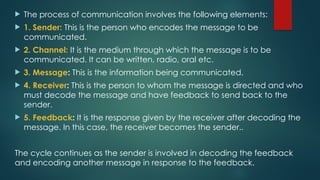
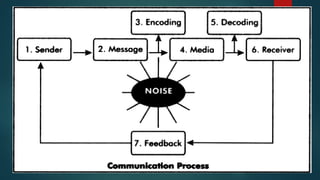
The processof communication involves the following elements:
1. Sender: This is the person who encodes the message to be
communicated.
2. Channel: It is the medium through which the message is to be
communicated. It can be written, radio, oral etc.
3. Message: This is the information being communicated.
4. Receiver: This is the person to whom the message is directed and who
must decode the message and have feedback to send back to the
sender.
5. Feedback: It is the response given by the receiver after decoding the
message. In this case, the receiver becomes the sender..
The cycle continues as the sender is involved in decoding the feedback
and encoding another message in response to the feedback.
5.
FORMS OF COMMUNICATION
VERBALCOMMUNICATION
Verbal communication occurs when we engage in speaking with
others. It can be face-to-face, over the telephone, via Skype or
Zoom, etc. Some verbal engagements are informal, such as
chatting with a friend over coffee or in the office kitchen, while
others are more formal, such as a scheduled meeting.
Regardless of the type, it is not just about the words, it is also
about the caliber and complexity of those words, how we string
those words together to create an overarching message, as well
as the intonation (pitch, tone, cadence, etc.) used while speaking.
And when occurring face-to-face, while the words are important,
they cannot be separated from non-verbal communication
6.
NON-VERBAL COMMUNICATION
Whatwe do while we speak often says more than the
actual words. Non-verbal communication includes facial
expressions, posture, eye contact, hand movements, and
touch. For example, if you’re engaged in a conversation
with your boss about your cost-saving idea, it is
important to pay attention to both the their words and
their non-verbal communication. Your boss might be in
agreement with your idea verbally, but their nonverbal
cues: avoiding eye contact, sighing, scrunched up face,
etc. indicate something different.
7.
WRITTEN COMMUNICATION
Whether itis an email, a memo, a report, a Facebook post, a Tweet, a
contract, etc. all forms of written communication have the same goal to
disseminate information in a clear and concise manner – though that
objective is often not achieved. In fact, poor writing skills often lead to
confusion and embarrassment, and even potential legal jeopardy. One
important thing to remember about written communication, especially in
the digital age, is the message lives on, perhaps in perpetuity. Thus, there
are two things to remember: first, write well – poorly constructed
sentences and careless errors make you look bad; and second, ensure
the content of the message is something you want to promote or be
associated with for the long haul
8.
VISUAL COMMUNICATION
Weare a visual society. Think about it, televisions are
running 24/7, Facebook is visual with memes, videos,
images, etc., Instagram is an image-only platform, and
advertisers use imagery to sell products and ideas. Think
about from a personal perspective – the images we post
on social media are meant to convey meaning – to
communicate a message. In some cases that message
might be, look at me, I’m in Italy or I just won an award.
Others are carefully curated to tug on our heartstrings –
injured animals, crying children, etc.
9.
LISTENING
The actof listening does not often make its way onto
the list of types of communication. Active listening,
however, is perhaps one of the most important types
of communication because if we cannot listen to the
person sitting across from us, we cannot effectively
engage with them. Think about a negotiation – part of
the process is to assess what the opposition wants and
needs. Without listening, it is impossible to assess that,
which makes it difficult to achieve a win/win
outcome.
10.
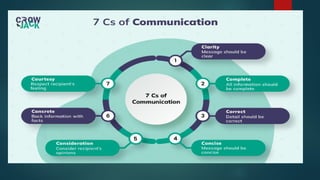
ESSENTIAL TOOLS FORCOMMUNICATION
For communication to be effective, . We
consider the 7 C’s of communication, though
they may vary depending on who you’re
asking.
EFFECTIVE COMMUNICATION CANBE ACHIEVED THROUGH :
- Speaking and listening
1. Using and recognising body language and non-verbal
communication
2. Taking control of emotion and attitude, in a way that doesn’t
interfere with the interpretation
3. Eye contact and attentiveness that shows interest to the topic
being discussed The process of communication is what allows us
to interact with other people. Without it, we would not be able to
share knowledge or experience with others. Therefore
communication is a process of appropriate transmission,
reception and feedback of information.
14.
Writing andreading
. Since writing is the act of transmitting knowledge; we must have information to
share before we can write it. Therefore reading plays a major role in writing.
Effective writing allows the reader to thoroughly understand everything the
writer is saying. Effective writing involves; readability and good choice of words.
Readability entails proper use of words, sentences and paragraphs to ensure
clear communication of facts and ideas. Good choice of words, on the other
hand, ensures that the reader does not get bored by maintaining interest. For
effective and efficient reading, observe the following:
• Have clear reading goals choose the right texts to read
• Use the right reading style; can be skimming, scanning or any other
appropriate style depending on your goals
• Take notes while reading Learning to read and communicate is very
important as it is the most appropriate way to gain knowledge.
15.
CHALLENGES OF COMMUNICATION
1.Language barriers and cultural differences
Adding on to the first communication challenge presented, language
barriers and cultural differences can also lead to
serious miscommunication.
Misinterpretations of words and gestures can create animosity and
conflicts that negatively impact team cohesion.
Reluctancy to collaborate due to poor interpersonal relationships
among co-workers because of cultural differences can cost businesses
greatly. Which is why fostering cross-cultural communication through
intercultural training is absolutely necessary within a multicultural
company
16.
Finding theright communication
tools and technologies
• Technical issues, such as poor internet
connectivity, can disrupt communication
in virtual environments.
• Overreliance on technology may lead to
miscommunication or
misunderstandings
17.
PHYSICAL CHALLENGES
Noise andDistractions:
• External factors like background noise,
interruptions, or competing stimuli can make it
difficult to focus on the message.
• For example when the room is too hot or too cold
• Mental distractions and multitasking can also
impact communication effectiveness.
18.
Power Dynamics:
• Hierarchicalstructures and power imbalances
can create communication barriers.
• Subordinates may hesitate to communicate
openly with superiors due to fear of
consequences
19.
PSYCHOLOGICAL CHALLENGES
Selective Perception:
•People may selectively perceive, or filter information based on their own
biases, beliefs, or interests.
• This can lead to a distorted understanding of the message
Feedback Issues:
• Lack of timely and constructive feedback can hinder the improvement of
communication.
• Ineffective feedback, such as criticism without guidance, may discourage
open communication.
• Ethical considerations, such as honesty and transparency, can impact
communication.
• Deceptive communication or lack of integrity may erode trust and hinder
effective communication
20.
Feedback ineffective communication
You have discovered that people are happier when
communication is clear and effective. The same is true for
businesses, schools and homes. There is peace and order when
businesses thrive or fail depending on how well information
circulates within the organisation. This means that feedback is
central in all communication as it ascertains whether the
communication process was successful or not. Feedback gives
people specific goals to reach for and reinforces productive
behaviour, encouraging them to look for ways to improve based
on the work they are already appreciated for. Effective feedback
has benefits to the sender as it helps to know whether the
message was well understood or not.
21.
Benefits of effectivecommunication
The benefits of communication effectiveness can be witnessed in the workplace,
in an educational setting, and in your personal life. Learning how to
communicate well can be a boon in each of these areas
In the workplace, effective communication can help you:
• Manage employees and build teams
• Grow your organization more rapidly and retain employees
• Benefit from enhanced creativity and innovation
• Build strong relationships and attract more opportunities for you or your
organization
In your personal life, effective communication can lead to:
• Improved social, emotional, and mental health
• Deeper existing connections Better problem–solving and conflict resolution
skills
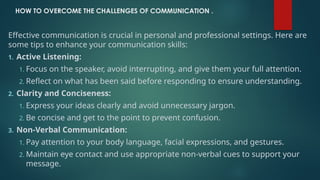
HOW TO OVERCOMETHE CHALLENGES OF COMMUNICATION .
Effective communication is crucial in personal and professional settings. Here are
some tips to enhance your communication skills:
1. Active Listening:
1. Focus on the speaker, avoid interrupting, and give them your full attention.
2. Reflect on what has been said before responding to ensure understanding.
2. Clarity and Conciseness:
1. Express your ideas clearly and avoid unnecessary jargon.
2. Be concise and get to the point to prevent confusion.
3. Non-Verbal Communication:
1. Pay attention to your body language, facial expressions, and gestures.
2. Maintain eye contact and use appropriate non-verbal cues to support your
message.
24.
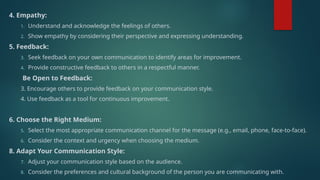
4. Empathy:
1. Understandand acknowledge the feelings of others.
2. Show empathy by considering their perspective and expressing understanding.
5. Feedback:
3. Seek feedback on your own communication to identify areas for improvement.
4. Provide constructive feedback to others in a respectful manner.
Be Open to Feedback:
3. Encourage others to provide feedback on your communication style.
4. Use feedback as a tool for continuous improvement.
6. Choose the Right Medium:
5. Select the most appropriate communication channel for the message (e.g., email, phone, face-to-face).
6. Consider the context and urgency when choosing the medium.
8. Adapt Your Communication Style:
7. Adjust your communication style based on the audience.
8. Consider the preferences and cultural background of the person you are communicating with.
25.
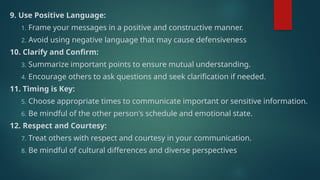
9. Use PositiveLanguage:
1. Frame your messages in a positive and constructive manner.
2. Avoid using negative language that may cause defensiveness
10. Clarify and Confirm:
3. Summarize important points to ensure mutual understanding.
4. Encourage others to ask questions and seek clarification if needed.
11. Timing is Key:
5. Choose appropriate times to communicate important or sensitive information.
6. Be mindful of the other person's schedule and emotional state.
12. Respect and Courtesy:
7. Treat others with respect and courtesy in your communication.
8. Be mindful of cultural differences and diverse perspectives
26.
1. Know YourAudience:
1. Tailor your communication style to the preferences and needs of your
audience.
2. Consider their level of familiarity with the topic and adjust accordingly.
2. Stay Calm Under Pressure:
1. Maintain composure during challenging or high-pressure situations.
2. Practice stress-management techniques to stay focused and articulate.
3. Continuous Improvement:
1. Regularly assess and reflect on your communication skills.
2. Seek out opportunities for training or professional development to
enhance your abilities.
27.
What can leadersdo to be better
communicators?
1. Stop making excuses. Commit to getting better,
for you, your team and your company. Allocate
the necessary time, energy and resources to
deliver your message with the right context and
meaning to engage your employees.
Consider preparations before communication put
in mind physical and psychological preparations.
28.
We communicatecontinually throughout each and every day.
We do it without thinking – we operate on communication
autopilot. However, I encourage you to think about how you
communicate. How do you communicate verbally? What
nonverbal cues do you use when you are disinterested?
Excited? Nervous? Are you a good listener? Can you write a
concise, clearly articulated message? Are there barriers to how
you communicate effectively?
Understanding how you communicate is the first step to
communicating more effectively
29.
Reading and summarisingtexts and books
A summary is, by definition, a condensed version of the original. It’s
shorter, and it must focus on the original’s main point(s) to be accurate.
To write a summary well, we cannot misrepresent the ideas in a text,
either by accident or on purpose, nor can we write a summary as if a
minor point is the central idea of a text. Even if we are going to argue with
an author’s points, the summary must accurately represent the ideas in
the original.
Writing a summary can help you better understand the material that you
are reading. Whether you write summary annotations in the margins of
your textbook or write summary paragraphs for every reading,
summarizing can help you by clarifying what is really important in a
reading—even if you aren’t going to write about it.
30.
Honest summariesstart with careful reading. You
won’t be able to summarize well if you don’t
understand what you are reading. Once you have a
good understanding, you’ll be able to write a good
summary.
The following activity will help you write a successful
summary that covers the entire text. This activity
assumes that you have carefully read the text and that
you understand it.
31.
Divide the textinto sections.
Sometimes those sections are marked for you
by headings or extra spaces between
paragraphs.
If they aren’t, look especially for that indicate
contrast or sequence, which frequently indicate
a shift in focus.
Don’t worry about getting these sections
“right”; instead, make sure that you understand
why you are grouping those particular
paragraphs together
32.
For each section,determine the main point of that section.
Separate that point from examples, , and .
Write a one- or two-sentence summary of each section,
focusing on that point.
Be sure to refer to the author as you write your summary.
A good rule of thumb is to reference the author by name at or near
the beginning of your summary,
and then to reference them at least one more time
in every summary paragraph.
This practice reminds your reader that the ideas you are describing
are not your ideas.
33.
Generally, youwon’t quote in summaries, except for very short
quotations. don’t quote in summaries unless the quotations are very
short or the summary is long (more than a page). Quotations require a
lot of extra material and are usually too specific to be useful in
summaries. In addition, quoting gets in the way of your comprehension
of the text since you are relying on the author’s words instead of your
understanding.
If there is an introductory narrative, skip (or at least minimize) that as you
write your summary. These introductory narratives are usually a way to
draw the reader in. They hint at the main point, but they rarely spell that
point out. Moreover, you can end up spending far too much time
summarizing that narrative and miss the main point entirely
34.
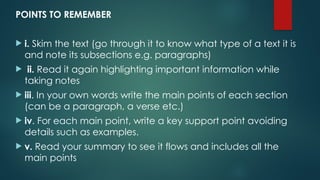
POINTS TO REMEMBER
i. Skim the text (go through it to know what type of a text it is
and note its subsections e.g. paragraphs)
ii. Read it again highlighting important information while
taking notes
iii. In your own words write the main points of each section
(can be a paragraph, a verse etc.)
iv. For each main point, write a key support point avoiding
details such as examples.
v. Read your summary to see it flows and includes all the
main points
35.
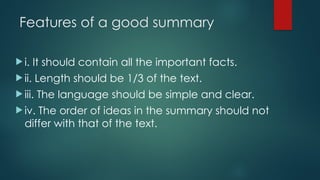
Features of agood summary
i. It should contain all the important facts.
ii. Length should be 1/3 of the text.
iii. The language should be simple and clear.
iv. The order of ideas in the summary should not
differ with that of the text.
36.
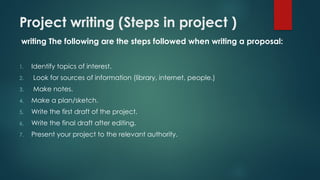
Project writing (Stepsin project )
writing The following are the steps followed when writing a proposal:
1. Identify topics of interest.
2. Look for sources of information (library, internet, people.)
3. Make notes.
4. Make a plan/sketch.
5. Write the first draft of the project.
6. Write the final draft after editing.
7. Present your project to the relevant authority.