SCHOOL AS A
CULTURAL
INSTITUTION
WHAT IS CULTURE?
OBJECTIVES
WHAT IS CULTURE?
THE SCHOOL AS A CULTURAL INSTITUTION
WHAT IS CULTURE?
WHAT IS CULTURE?
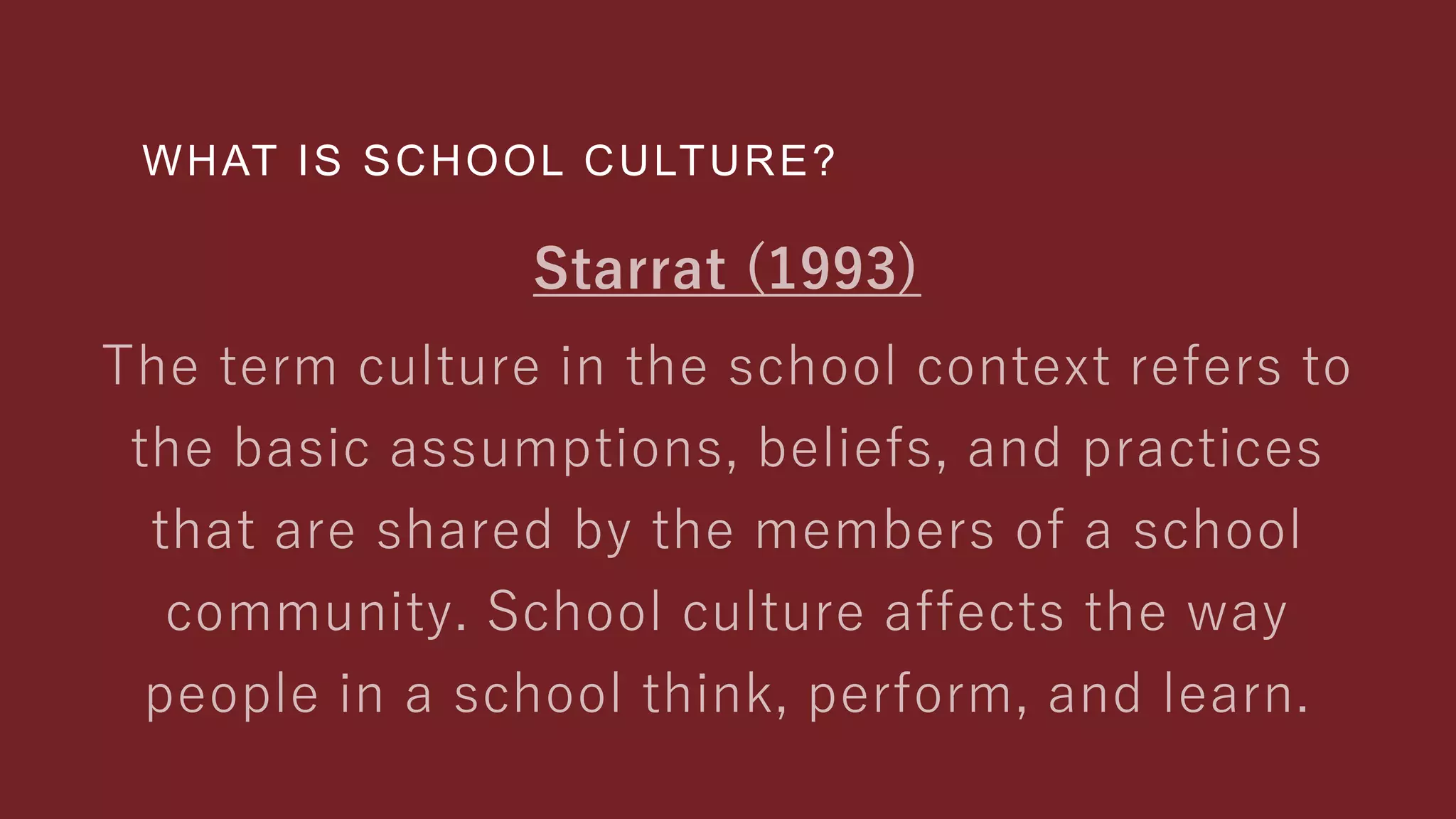
WHAT IS SCHOOL CULTURE?
Let us test how creative you are. Define school
culture by thinking if an adjective that starts with
each letter of the term. Write your answer in a piece
of paper.
S –
C –
H –
O –
O –
L –
C –
U –
L –
T –
U –
R –
E –
1 MINUTE
2 MINUTES
Other Cultures
in a School
Other Cultures in School
Hargreaves (1994) highlights the four existing
teaching cultures:
1. Individualism- refers to classrooms as "egg-
crates" or "castles". Autonomy isolation and
insulation prevail, and blame and support are
avoided.
2. Collaboration- refers to the teachers who
choose spontaneously and voluntarily, to work
together, without external control agenda.
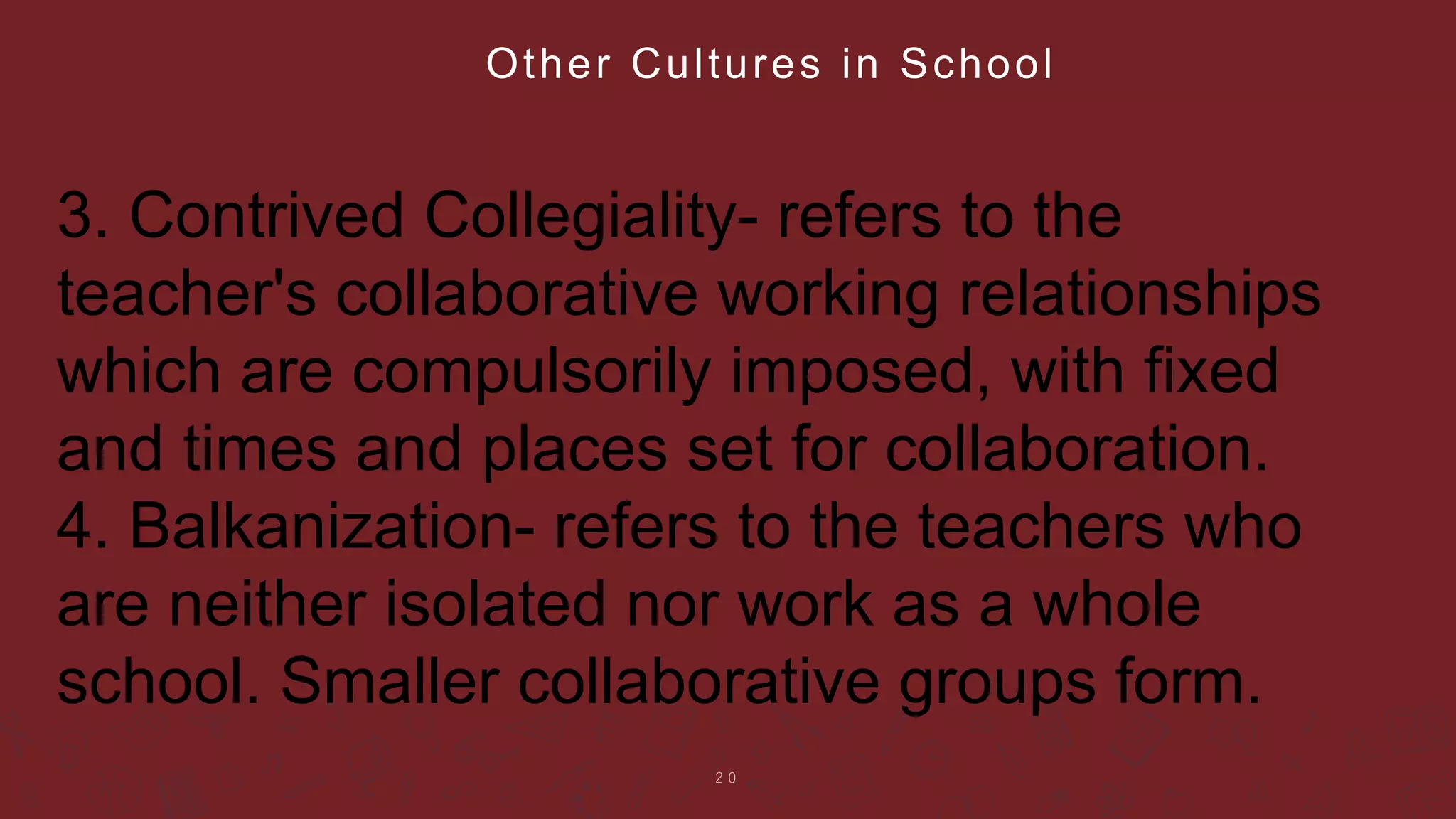
Other Cultures in School
3. Contrived Collegiality- refers to the
teacher's collaborative working relationships
which are compulsorily imposed, with fixed
and times and places set for collaboration.
4. Balkanization- refers to the teachers who
are neither isolated nor work as a whole
school. Smaller collaborative groups form.
Other Cultures in School
Becoming familiar with the culture of a
particular school takes time. Some tangible
things that may give an initial indication
include the following:
• school statement purpose
• school management plan
• school policies such as student welfare
policy
Other Cultures in School
• school's prospectus
• school's motto
• school's newsletter
• interactions between teachers and
students
Typology of
Schools Culture
Typology of Schools Culture
Stoll and Fink (1996) Develop a model in
determining a school culture. They focused on
school's current effectiveness, but also argue
that the rapidly accelerating space of change
make standing still impossible and therefore
schools are either getting better or getting
worse.
Typology of Schools Culture
1. Moving refers on the following:
• Boosting pupil's progress and
development
• Working together and respond to
changing context
• Know where they are going nd having
the will and skill to get there
• Possess norms of including schools
Typology of Schools Culture
2. Cruising focuses on the following:
• Appear to be effective
• Usually in more affluent areas
• Pupils achieve in spite of teaching
quality
• Not preparing pupils to change world
• Possess powerful norms that inhibit
change
Typology of Schools Culture
3. Strolling highlights the following:
• Neither particularly effective nor ineffective
• Moving at inadequate rate to cope with
pace of change
• Meandering into future to pupil's detriment
• Ill defined and sometimes conflicting aims
inhibit improvement
Typology of Schools Culture
4. Struggling centers the following:
• Ineffective and they know it
• Expend considerable energy to improve
• Unproductive "trashing about"
• Will ultimately succeed because have
the will if not the skill
• Often identified as "failing", which is
demotivational
Typology of Schools Culture
5. Sinking refers on the following:
• Ineffective: norms of isolation, blame, self
reliance, and loss of faith powerfully inhibit
improvement.
• Staff unable to change
• Often in deprived areas where they blame
parenting or unprepared children
• Need dramatic action and significant
support
Typology of Schools Culture
School Mission,
Vision, and
Values
School Mission, Vision, and Values
The foundation of school culture's
elements lay at the mission vision of the
school. Underlying the mission vision
statements are the values the schools holds
which determine what philosophies and
standards the individuals will assimilate and
incorporate into his/her everyday teaching and
learning (Rhodes, Stevens and Hemming's
School Mission, Vision, and Values
Every school crafts their mission and vision
statements to draw the direction of the
institution. The mission vision mirror what the
school wishes and hopes to eventually become
and accomplish (Peterson & Deal, 2009). Even
though these are called statement they are
embodied by all of the values, beliefs, norms,
assumption that the school holds (Confeld,
2016)
THE DEPED VISION
We dream of Filipinos
who passionately love their country
and whose values and competencies
enable them to realize their full potential
and contribute meaningfully to building the nation.
As a learner-centered public institution,
the Department of Education
continuously improves itself
to better serve its stakeholders.
THE DEPED MISSION
To protect and promote the right of every Filipino to quality,
equitable, culture-based, and complete basic education where:
Students learn in a child-friendly, gender-sensitive, safe, and
motivating environment.
Teachers facilitate learning and constantly nurture every learner.
Administrators and staff, as stewards of the institution, ensure
an enabling and supportive environment for effective learning to
happen.
Family, community, and other stakeholders are actively
engaged and share responsibility for developing life-long
learners.
DEPED CORE VALUES
Maka-Diyos
Maka-tao
Makakalikasan
Makabansa

SCHOOL AS A CULTURAL INSTITUTION.pptx

  • 1.
  • 2.
  • 3.
  • 4.
  • 5.
    THE SCHOOL ASA CULTURAL INSTITUTION
  • 6.
    THE SCHOOL ASA CULTURAL INSTITUTION
  • 7.
  • 8.
  • 9.
  • 10.
  • 11.
  • 12.
  • 13.
  • 14.
  • 15.
  • 16.
    Let us testhow creative you are. Define school culture by thinking if an adjective that starts with each letter of the term. Write your answer in a piece of paper. S – C – H – O – O – L – C – U – L – T – U – R – E – 1 MINUTE 2 MINUTES
  • 17.
  • 19.
    Other Cultures inSchool Hargreaves (1994) highlights the four existing teaching cultures: 1. Individualism- refers to classrooms as "egg- crates" or "castles". Autonomy isolation and insulation prevail, and blame and support are avoided. 2. Collaboration- refers to the teachers who choose spontaneously and voluntarily, to work together, without external control agenda.
  • 20.
    Other Cultures inSchool 3. Contrived Collegiality- refers to the teacher's collaborative working relationships which are compulsorily imposed, with fixed and times and places set for collaboration. 4. Balkanization- refers to the teachers who are neither isolated nor work as a whole school. Smaller collaborative groups form.
  • 21.
    Other Cultures inSchool Becoming familiar with the culture of a particular school takes time. Some tangible things that may give an initial indication include the following: • school statement purpose • school management plan • school policies such as student welfare policy
  • 22.
    Other Cultures inSchool • school's prospectus • school's motto • school's newsletter • interactions between teachers and students
  • 23.
  • 24.
    Typology of SchoolsCulture Stoll and Fink (1996) Develop a model in determining a school culture. They focused on school's current effectiveness, but also argue that the rapidly accelerating space of change make standing still impossible and therefore schools are either getting better or getting worse.
  • 25.
    Typology of SchoolsCulture 1. Moving refers on the following: • Boosting pupil's progress and development • Working together and respond to changing context • Know where they are going nd having the will and skill to get there • Possess norms of including schools
  • 26.
    Typology of SchoolsCulture 2. Cruising focuses on the following: • Appear to be effective • Usually in more affluent areas • Pupils achieve in spite of teaching quality • Not preparing pupils to change world • Possess powerful norms that inhibit change
  • 27.
    Typology of SchoolsCulture 3. Strolling highlights the following: • Neither particularly effective nor ineffective • Moving at inadequate rate to cope with pace of change • Meandering into future to pupil's detriment • Ill defined and sometimes conflicting aims inhibit improvement
  • 28.
    Typology of SchoolsCulture 4. Struggling centers the following: • Ineffective and they know it • Expend considerable energy to improve • Unproductive "trashing about" • Will ultimately succeed because have the will if not the skill • Often identified as "failing", which is demotivational
  • 29.
    Typology of SchoolsCulture 5. Sinking refers on the following: • Ineffective: norms of isolation, blame, self reliance, and loss of faith powerfully inhibit improvement. • Staff unable to change • Often in deprived areas where they blame parenting or unprepared children • Need dramatic action and significant support
  • 30.
  • 31.
  • 32.
    School Mission, Vision,and Values The foundation of school culture's elements lay at the mission vision of the school. Underlying the mission vision statements are the values the schools holds which determine what philosophies and standards the individuals will assimilate and incorporate into his/her everyday teaching and learning (Rhodes, Stevens and Hemming's
  • 33.
    School Mission, Vision,and Values Every school crafts their mission and vision statements to draw the direction of the institution. The mission vision mirror what the school wishes and hopes to eventually become and accomplish (Peterson & Deal, 2009). Even though these are called statement they are embodied by all of the values, beliefs, norms, assumption that the school holds (Confeld, 2016)
  • 34.
    THE DEPED VISION Wedream of Filipinos who passionately love their country and whose values and competencies enable them to realize their full potential and contribute meaningfully to building the nation. As a learner-centered public institution, the Department of Education continuously improves itself to better serve its stakeholders.
  • 35.
    THE DEPED MISSION Toprotect and promote the right of every Filipino to quality, equitable, culture-based, and complete basic education where: Students learn in a child-friendly, gender-sensitive, safe, and motivating environment. Teachers facilitate learning and constantly nurture every learner. Administrators and staff, as stewards of the institution, ensure an enabling and supportive environment for effective learning to happen. Family, community, and other stakeholders are actively engaged and share responsibility for developing life-long learners.
  • 36.