Local and Global Communication
in Multicultural
Settings
?
?
?
??
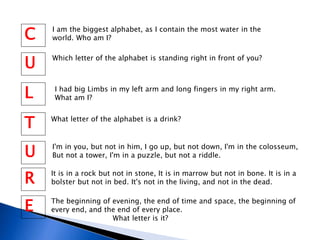
C
L
U
U
T
R
E The beginning of evening, the end of time and space, the beginning of
every end, and the end of every place.
What letter is it?
What letter of the alphabet is a drink?
It is in a rock but not in stone, It is in marrow but not in bone. It is in a
bolster but not in bed. It's not in the living, and not in the dead.
I am the biggest alphabet, as I contain the most water in the
world. Who am I?
I'm in you, but not in him, I go up, but not down, I'm in the colosseum,
But not a tower, I'm in a puzzle, but not a riddle.
Which letter of the alphabet is standing right in front of you?
I had big Limbs in my left arm and long fingers in my right arm.
What am I?
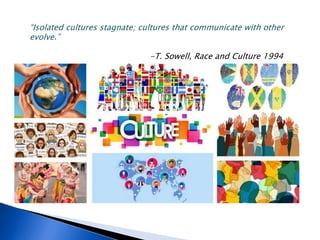
“Isolated cultures stagnate; cultures that communicate with other
evolve.”
-T. Sowell, Race and Culture 1994
 Communication can be a challenging activity
because of the highly pluralistic nature of the
people participating in the communication
process. Each participant may differ in
cultural, social and biological backgrounds,
which are all critical factors to effective and
successful intercultural communication.
 Instances there are that these differences may
lead speakers to misinterpretation or
misunderstanding. So in order to understand
communication within and outside the
context of one’s culture, it is necessary to
identify first the challenges that may be
encountered, then the form of intercultural
communication, and the ways on how to
improve communicative competence in
multicultural settings.
 Living in a globalized world, you encounter
people with diverse cultural backgrounds. Such
interactions occur in a social, educational,
political and commercial settings.
 Hence, in today’s era of increased global
communication, it is imperative to understand
intercultural communication for us to enhance
our intercultural awareness and competence.
Intercultural competence is essential for us to
live harmoniously despite our differences in
culture.
 It has become a widespread notion that speakers’
use of different languages results in intercultural
miscommunication and misunderstanding. As
Scollon and Scollon (1995) state:
“When we are communication with people who are
very different from us, it is very difficult to know
how to draw inferences about what they mean, and
so it is impossible to depend on shared knowledge
and background for confidence in our
interpretation.”
 Indeed, the lack of shared knowledge and
beliefs and cultural diversity make it more
complicated to arrive at the correct inference
or interpretation of meanings. But it can also
be argued that English is now a global lingua
franca. In fact, with the ASEAN integration,
English has been declared the official or
working language of ASEAN. So with just one
language to be spoken or used by many
countries including the 10 member countries
of the ASEAN, what else can go wrong?
 It is thus important to emphasize that the
ownership of English cannot be attributed to
just one country or to those who use it as a
native or home language. The varieties of
English spoken by different speech
communities have evolved for a reason. They
use it for communal purposes. These
varieties have been heavily influenced by the
local culture and its speakers.
 Communication is like a kaleidoscope. Many
units of different sizes, shapes, and color
make up the whole picture. Any action, shift,
or change adjusts the pattern and the
relationship of all of the units to each other,
thereby altering the picture.
a. Interracial communication – communicating
with people from different races
b. Interethnic communication – interacting with
people of different ethnic origin
c. International communication –
communicating between representatives from
different nations.
d. Intracultural communication – interacting
with members of the same racial or ethnic
group or co-culture
 According to Gamble and Gamble (2008),
communication style among cultures differs,
it may be high context or low-context
communication.
 High-context communication is a tradition-
linked communication system which adheres
strongly to being indirect. Low-context
communication is a system that works on
straightforward communication.
 The following guidelines may help you
enhance your ability to communicate
effectively across cultures (Gamble & Gamble,
2008):
1. Recognize the validity and differences of
communication styles among people.
2. Learn to eliminate personal biases and
prejudices.
3. Strive to acquire communication skills
necessary in a multicultural world.
 The spoken mode is often associated with
everyday registers while the written mode is
strongly associated with academic registers.
However, this is not always true. For instance, in
everyday communication, face to face
conversations are usually supplemented by text
messaging. In academic contexts, significant
forms of oral communication are used along with
written communication. Significantly, both every
day and academic communications are
characterized by multi-modality or the use of
multiple modes of communication, including
spoken, written modes and images, music,
videos, gestures, etc.
 Lin (2016) presents the following nature of
language variation as prescribed by most
linguists based on the ideas of Mahboob
(2014).
1. Language varies when communicating with
people within (local) and outside (global) our
community.
2. Language varies in speaking and in writing.
3. Language varies in everyday and specialized
discourses.
There are five language registers. Each level has an
appropriate use that is determined by differing
situations.
a. Frozen
 This style of communication rarely or never
changes. It is “frozen” in time and content. This
is official business and educational language
which features complete sentences and specific
word choice, which often contains archaisms.
Example:
 We, the sovereign Filipino people, imploring the
aid of Almighty God, in order to build a just and
humane society, and establish a Government that
shall embody our ideals and aspirations, promote
the common good, conserve and develop our
patrimony, and secure to ourselves and our
posterity, the blessings of independence and
democracy under the rule of law and a regime of
truth, justice, freedom, love, equality, and peace,
do ordain and promulgate this Constitution
(Preamble, 1987 Constitution)
b. Formal/Academic
 This language is used in formal setting and is
one-way. This use of language usually follows a
commonly accepted format. It is generally
impersonal and formal. It is often used to show
respect. Word selection is more sophisticated,
and certain words are always or never used
depending on the situation. In a formal register,
the story structure focuses on the plot: It has a
beginning and ending and it weaves sequence,
cause and effect, characters, and consequences
into the plot.
Example:
 “The strongest reason why we ask for woman a
voice in the government under which she lives; in
the religion she is asked to believe; equality in
social life, where she is the chief factor; a place in
the trades and professions, where she may earn
her bread, is because of her birth right to self-
sovereignty; because, as an individual, she must
rely on herself (a speech delivered by Elizabeth
Cady Stanton (1892).”
c. Consultative
 It is a standard form of communications. Users
engage in a mutually accepted structure of interfaces.
It is formal and societal expectations accompany the
users of speech. This register can be described as
two-way participation, professional setting,
background information is provided (prior knowledge
is not assumed), interruptions and feedback fillers
allowed (“uh-huh,” “I see”), more complex syntax, and
longer phrases. Sentence structure need not be
complete, since non-verbal assists, hand movements
and body language, are often used to convey
meaning
Example:
 Patient: Hello doctor! Can you spare me a few minutes?
 Doctor: Certainly! Come in and sit down. Now, what is the matter with
you?
 Patient: I seem to be generally out of sorts. I have no appetite for my
food, and yet I am always suffering from indigestion.
 Doctor: Are you troubled with headaches?
 Patient: Yes, I am. And what is worse I cannot sleep at night.
 Doctor: I see. What is your work?
 Patient: I am a clerk in an office, and have to work for long hours.
 Doctor: I see, Well, you are evidently run down and need a rest and
change. All your troubles are signs of nervous exhaustion. I will give you
a nerve tonic, but the main thing is rest. If you do as I say, you will soon
be alright.
 Patient: Thank you, doctor. I will follow your advice.
 Doctor; Let me know how you get on.
 d. Casual/Informal
 The language used in conversation with friends. A
casual register is characterized by 400- to 500- word
vocabulary, broken sentences, and interruptions are
common. Very informal language, idioms, ellipsis,
and slang are common. No background information
is provided, “group” language – must be a member to
use, interruptions are common, and context and
non-verbal communication are important. General
word choice and conversation are dependent upon
non-verbal assists. The focus of the story is
characterization. It is an indirect, random approach
with many omissions and does not have a sequence,
cause, and effect, or consequence.
 Example:
 Marie: Hey, D! I’m stressing about weight gain on
Xmas. Got any ideas for me?
 Diane: It’s only one day, so don’t worry too much.
 Marie: I’m worried I’ll eat a gazillion calories at my
in-laws! 
 Diane: Just make sure you don’t arrive too hungry,
have a healthy snack beforehand (nuts, granola bar,
etc.)
 Marie: Yeah, you’re right. Thanks, D! You’re the best!
Xx
 Diane: No worries, M! xx
 e. Intimate
 This communication is private. It is reserved
for close family members or intimate
relations. It is non-public, the intonation is as
crucial as wording and grammar, and often a
special vocabulary full of coded words is
used.
 Example:
 Husband: Hi honey, how was your day?
 Wife: Great, We got a lot done. And yours?
 Husband: Fine, but stressful. Pass me that
magazine, please.
 Wife: Here you go, darling.
In what specific ways can you enhance your
ability to communicate with people from
diverse cultures?
 “Human beings draw close to one another by
their common nature, but habits and customs
keep them apart.” (Cunfucius) Do you agree
or disagree? Give concrete situations to
support your stand.

Local and Global Communication in Multicultural Settings

  • 1.
    Local and GlobalCommunication in Multicultural Settings
  • 2.
  • 3.
    C L U U T R E The beginningof evening, the end of time and space, the beginning of every end, and the end of every place. What letter is it? What letter of the alphabet is a drink? It is in a rock but not in stone, It is in marrow but not in bone. It is in a bolster but not in bed. It's not in the living, and not in the dead. I am the biggest alphabet, as I contain the most water in the world. Who am I? I'm in you, but not in him, I go up, but not down, I'm in the colosseum, But not a tower, I'm in a puzzle, but not a riddle. Which letter of the alphabet is standing right in front of you? I had big Limbs in my left arm and long fingers in my right arm. What am I?
  • 4.
    “Isolated cultures stagnate;cultures that communicate with other evolve.” -T. Sowell, Race and Culture 1994
  • 5.
     Communication canbe a challenging activity because of the highly pluralistic nature of the people participating in the communication process. Each participant may differ in cultural, social and biological backgrounds, which are all critical factors to effective and successful intercultural communication.
  • 6.
     Instances thereare that these differences may lead speakers to misinterpretation or misunderstanding. So in order to understand communication within and outside the context of one’s culture, it is necessary to identify first the challenges that may be encountered, then the form of intercultural communication, and the ways on how to improve communicative competence in multicultural settings.
  • 7.
     Living ina globalized world, you encounter people with diverse cultural backgrounds. Such interactions occur in a social, educational, political and commercial settings.  Hence, in today’s era of increased global communication, it is imperative to understand intercultural communication for us to enhance our intercultural awareness and competence. Intercultural competence is essential for us to live harmoniously despite our differences in culture.
  • 8.
     It hasbecome a widespread notion that speakers’ use of different languages results in intercultural miscommunication and misunderstanding. As Scollon and Scollon (1995) state: “When we are communication with people who are very different from us, it is very difficult to know how to draw inferences about what they mean, and so it is impossible to depend on shared knowledge and background for confidence in our interpretation.”
  • 9.
     Indeed, thelack of shared knowledge and beliefs and cultural diversity make it more complicated to arrive at the correct inference or interpretation of meanings. But it can also be argued that English is now a global lingua franca. In fact, with the ASEAN integration, English has been declared the official or working language of ASEAN. So with just one language to be spoken or used by many countries including the 10 member countries of the ASEAN, what else can go wrong?
  • 10.
     It isthus important to emphasize that the ownership of English cannot be attributed to just one country or to those who use it as a native or home language. The varieties of English spoken by different speech communities have evolved for a reason. They use it for communal purposes. These varieties have been heavily influenced by the local culture and its speakers.
  • 13.
     Communication islike a kaleidoscope. Many units of different sizes, shapes, and color make up the whole picture. Any action, shift, or change adjusts the pattern and the relationship of all of the units to each other, thereby altering the picture.
  • 14.
    a. Interracial communication– communicating with people from different races b. Interethnic communication – interacting with people of different ethnic origin c. International communication – communicating between representatives from different nations. d. Intracultural communication – interacting with members of the same racial or ethnic group or co-culture
  • 15.
     According toGamble and Gamble (2008), communication style among cultures differs, it may be high context or low-context communication.  High-context communication is a tradition- linked communication system which adheres strongly to being indirect. Low-context communication is a system that works on straightforward communication.
  • 16.
     The followingguidelines may help you enhance your ability to communicate effectively across cultures (Gamble & Gamble, 2008): 1. Recognize the validity and differences of communication styles among people. 2. Learn to eliminate personal biases and prejudices. 3. Strive to acquire communication skills necessary in a multicultural world.
  • 18.
     The spokenmode is often associated with everyday registers while the written mode is strongly associated with academic registers. However, this is not always true. For instance, in everyday communication, face to face conversations are usually supplemented by text messaging. In academic contexts, significant forms of oral communication are used along with written communication. Significantly, both every day and academic communications are characterized by multi-modality or the use of multiple modes of communication, including spoken, written modes and images, music, videos, gestures, etc.
  • 19.
     Lin (2016)presents the following nature of language variation as prescribed by most linguists based on the ideas of Mahboob (2014). 1. Language varies when communicating with people within (local) and outside (global) our community. 2. Language varies in speaking and in writing. 3. Language varies in everyday and specialized discourses.
  • 20.
    There are fivelanguage registers. Each level has an appropriate use that is determined by differing situations. a. Frozen  This style of communication rarely or never changes. It is “frozen” in time and content. This is official business and educational language which features complete sentences and specific word choice, which often contains archaisms.
  • 21.
    Example:  We, thesovereign Filipino people, imploring the aid of Almighty God, in order to build a just and humane society, and establish a Government that shall embody our ideals and aspirations, promote the common good, conserve and develop our patrimony, and secure to ourselves and our posterity, the blessings of independence and democracy under the rule of law and a regime of truth, justice, freedom, love, equality, and peace, do ordain and promulgate this Constitution (Preamble, 1987 Constitution)
  • 22.
    b. Formal/Academic  Thislanguage is used in formal setting and is one-way. This use of language usually follows a commonly accepted format. It is generally impersonal and formal. It is often used to show respect. Word selection is more sophisticated, and certain words are always or never used depending on the situation. In a formal register, the story structure focuses on the plot: It has a beginning and ending and it weaves sequence, cause and effect, characters, and consequences into the plot.
  • 23.
    Example:  “The strongestreason why we ask for woman a voice in the government under which she lives; in the religion she is asked to believe; equality in social life, where she is the chief factor; a place in the trades and professions, where she may earn her bread, is because of her birth right to self- sovereignty; because, as an individual, she must rely on herself (a speech delivered by Elizabeth Cady Stanton (1892).”
  • 24.
    c. Consultative  Itis a standard form of communications. Users engage in a mutually accepted structure of interfaces. It is formal and societal expectations accompany the users of speech. This register can be described as two-way participation, professional setting, background information is provided (prior knowledge is not assumed), interruptions and feedback fillers allowed (“uh-huh,” “I see”), more complex syntax, and longer phrases. Sentence structure need not be complete, since non-verbal assists, hand movements and body language, are often used to convey meaning
  • 25.
    Example:  Patient: Hellodoctor! Can you spare me a few minutes?  Doctor: Certainly! Come in and sit down. Now, what is the matter with you?  Patient: I seem to be generally out of sorts. I have no appetite for my food, and yet I am always suffering from indigestion.  Doctor: Are you troubled with headaches?  Patient: Yes, I am. And what is worse I cannot sleep at night.  Doctor: I see. What is your work?  Patient: I am a clerk in an office, and have to work for long hours.  Doctor: I see, Well, you are evidently run down and need a rest and change. All your troubles are signs of nervous exhaustion. I will give you a nerve tonic, but the main thing is rest. If you do as I say, you will soon be alright.  Patient: Thank you, doctor. I will follow your advice.  Doctor; Let me know how you get on.
  • 26.
     d. Casual/Informal The language used in conversation with friends. A casual register is characterized by 400- to 500- word vocabulary, broken sentences, and interruptions are common. Very informal language, idioms, ellipsis, and slang are common. No background information is provided, “group” language – must be a member to use, interruptions are common, and context and non-verbal communication are important. General word choice and conversation are dependent upon non-verbal assists. The focus of the story is characterization. It is an indirect, random approach with many omissions and does not have a sequence, cause, and effect, or consequence.
  • 27.
     Example:  Marie:Hey, D! I’m stressing about weight gain on Xmas. Got any ideas for me?  Diane: It’s only one day, so don’t worry too much.  Marie: I’m worried I’ll eat a gazillion calories at my in-laws!   Diane: Just make sure you don’t arrive too hungry, have a healthy snack beforehand (nuts, granola bar, etc.)  Marie: Yeah, you’re right. Thanks, D! You’re the best! Xx  Diane: No worries, M! xx
  • 28.
     e. Intimate This communication is private. It is reserved for close family members or intimate relations. It is non-public, the intonation is as crucial as wording and grammar, and often a special vocabulary full of coded words is used.
  • 29.
     Example:  Husband:Hi honey, how was your day?  Wife: Great, We got a lot done. And yours?  Husband: Fine, but stressful. Pass me that magazine, please.  Wife: Here you go, darling.
  • 30.
    In what specificways can you enhance your ability to communicate with people from diverse cultures?  “Human beings draw close to one another by their common nature, but habits and customs keep them apart.” (Cunfucius) Do you agree or disagree? Give concrete situations to support your stand.