ARISTOTLE: VIRTUE AND ETHICS
ARISTOTLE
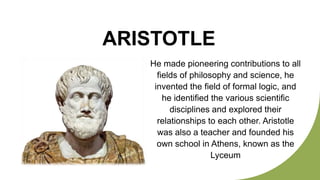
Aristotle was a Greek philosopher
and polymath during the Classical
period in Ancient Greece. Taught by
Plato, he was the founder of the
Peripatetic school of philosophy
within the Lyceum and the wider
Aristotelian tradition.
ARISTOTLE
He made pioneering contributions to all
fields of philosophy and science, he
invented the field of formal logic, and
he identified the various scientific
disciplines and explored their
relationships to each other. Aristotle
was also a teacher and founded his
own school in Athens, known as the
Lyceum
VIRTUE ETHICS
Virtue ethics is a philosophy developed by Aristotle and other
ancient Greeks. It is the quest to understand and live a life of
moral character. This character-based approach to morality
assumes that we acquire virtue through practice. By practicing
being honest, brave, just, generous, and so on, a person
develops an honorable and moral character. According to
Aristotle, by honing virtuous habits, people will likely make
the right choice when faced with ethical challenges.
VIRTUE ETHICS
To illustrate the difference among three key moral philosophies,
ethicists Mark White and Robert Arp refer to the film The Dark Knight
where Batman has the opportunity to kill the Joker. Utilitarians,
White and Arp suggest, would endorse killing the Joker. By taking
this one life, Batman could save multitudes. Deontologists, on the
other hand, would reject killing the Joker simply because it’s wrong
to kill. But a virtue ethicist “would highlight the character of the
person who kills the Joker. Does Batman want to be the kind of
person who takes his enemies’ lives?” No, in fact, he doesn’t.
VIRTUE ETHICS
So, virtue ethics helps us understand what it
means to be a virtuous human being. And,
it gives us a guide for living life without
giving us specific rules for resolving ethical
dilemmas.
VIRTUES ACCORDING TO ARISTOTLE
Intellectual Virtues
The virtues of the rational part of the soul
Practical reason: prudence
Theoretical reason: wisdom
VIRTUES ACCORDING TO ARISTOTLE
Intellectual Virtues
PRUDENCE (PHRONESIS):
Consists in knowing correctly how to direct the life of man
Assist us in deliberating correctly about the true aims of man:
it points out the suitable means to the achievement of true
goals
VIRTUES ACCORDING TO ARISTOTLE
Intellectual Virtues
PRUDENCE (PHRONESIS):
Practical wisdom (Greek phronesis; sometimes translated
‘prudence’), says Aristotle, is ‘a reasoned capacity to act with regard
to the things that are good or bad for man’ (Nicomachean Ethics
VI.5). So while practical wisdom involves knowledge of what is good
or bad, it is not merely theoretical knowledge, but a capacity to act on
such knowledge as well.
VIRTUES ACCORDING TO ARISTOTLE
Intellectual Virtues
WISDOM: (EXPERIENCES, PROPER &
REASONABLE, UNDERSTANDABLE)
The most elevated dianoetic virtue
It regards those things that are higher than man: e.g.
theoretical sciences, metaphysics.
VIRTUES ACCORDING TO ARISTOTLE
Moral/Ethical Virtues
Derive from attitudes in us (habituation)
E.g. by carrying out acts of courage we
easily bring in completion the acts of courage
Correlation between Intellectual and
Ethical Virtues
“For virtue makes us aim at the right mark, and practical wisdom
makes us take the right means.”
Intellectual virtues points out the suitable means but they do not point
out the ends themselves
The true ends and aims are grasped by the ethical virtues that directs
the will in the correct way
“It is not possible to be virtuous without prudence or to be wise without
ethical virtues.”
Ethical Virtues
Virtue of character is a mean, …, it is a mean between two vices, one of excess and
one of deficiency; and that it is such because it is the sort of thing able to hit the
mean in feelings and actions.
This is why it is hard to be good, because in each case it is hard to find the middle
point; for instance, not everyone can find the center of a circle, but only the person
with knowledge.
So too anyone can get angry, or give and spend money – these are easy; but doing
them in relation to the right person, in the right amount, at the right time, with the
right aim in view, and in the right way – that is not something anyone can do, nor it is
easy. This is why excellence in these things is rare, praiseworthy and noble.”
The Golden Mean
The morally good persons live a life of moderation, the
“mean” between two extreme type of actions
The life of moderation is one that:
Avoids the excesses and the deficiencies of behavior
Is governed by reason
Is not directed by uncontrollable desires and passion
PLEASURE
Pleasure accompanies every activity and brings it to perfection.
Which pleasures are good?
Those which have good sources (even bodily pleasures are
good up to some point - temperance)
The only real pleasures are those of the virtuous person.
Pleasure crowns the virtuous life and is the necessary
consequence of which virtue is the antecedent
HAPPINESS (Eudaimonia)
It is not merely a subjective state of pleasure or contentment
but the kind of life we would all want to live if we understood
our essential nature.
Our function (essence) is to live according to reason and
thereby become a certain sort of highly rational being.
When we fulfill the ideal of living the virtuous life, we are truly
happy.
Happy life is directed toward worthwhile goals.
THE GOOD LIFE
“Activity of the soul in accordance with virtue,
and if there are more than one virtue, in
accordance with the best and most complete.”
The best and most complete virtue is to be
found in intellectual virtues
Any Questions?
Thank you!

ARISTOTLE (VIRTUE ETHICS).pptx

  • 1.
  • 2.
    ARISTOTLE Aristotle was aGreek philosopher and polymath during the Classical period in Ancient Greece. Taught by Plato, he was the founder of the Peripatetic school of philosophy within the Lyceum and the wider Aristotelian tradition.
  • 3.
    ARISTOTLE He made pioneeringcontributions to all fields of philosophy and science, he invented the field of formal logic, and he identified the various scientific disciplines and explored their relationships to each other. Aristotle was also a teacher and founded his own school in Athens, known as the Lyceum
  • 4.
    VIRTUE ETHICS Virtue ethicsis a philosophy developed by Aristotle and other ancient Greeks. It is the quest to understand and live a life of moral character. This character-based approach to morality assumes that we acquire virtue through practice. By practicing being honest, brave, just, generous, and so on, a person develops an honorable and moral character. According to Aristotle, by honing virtuous habits, people will likely make the right choice when faced with ethical challenges.
  • 5.
    VIRTUE ETHICS To illustratethe difference among three key moral philosophies, ethicists Mark White and Robert Arp refer to the film The Dark Knight where Batman has the opportunity to kill the Joker. Utilitarians, White and Arp suggest, would endorse killing the Joker. By taking this one life, Batman could save multitudes. Deontologists, on the other hand, would reject killing the Joker simply because it’s wrong to kill. But a virtue ethicist “would highlight the character of the person who kills the Joker. Does Batman want to be the kind of person who takes his enemies’ lives?” No, in fact, he doesn’t.
  • 6.
    VIRTUE ETHICS So, virtueethics helps us understand what it means to be a virtuous human being. And, it gives us a guide for living life without giving us specific rules for resolving ethical dilemmas.
  • 7.
    VIRTUES ACCORDING TOARISTOTLE Intellectual Virtues The virtues of the rational part of the soul Practical reason: prudence Theoretical reason: wisdom
  • 8.
    VIRTUES ACCORDING TOARISTOTLE Intellectual Virtues PRUDENCE (PHRONESIS): Consists in knowing correctly how to direct the life of man Assist us in deliberating correctly about the true aims of man: it points out the suitable means to the achievement of true goals
  • 9.
    VIRTUES ACCORDING TOARISTOTLE Intellectual Virtues PRUDENCE (PHRONESIS): Practical wisdom (Greek phronesis; sometimes translated ‘prudence’), says Aristotle, is ‘a reasoned capacity to act with regard to the things that are good or bad for man’ (Nicomachean Ethics VI.5). So while practical wisdom involves knowledge of what is good or bad, it is not merely theoretical knowledge, but a capacity to act on such knowledge as well.
  • 10.
    VIRTUES ACCORDING TOARISTOTLE Intellectual Virtues WISDOM: (EXPERIENCES, PROPER & REASONABLE, UNDERSTANDABLE) The most elevated dianoetic virtue It regards those things that are higher than man: e.g. theoretical sciences, metaphysics.
  • 11.
    VIRTUES ACCORDING TOARISTOTLE Moral/Ethical Virtues Derive from attitudes in us (habituation) E.g. by carrying out acts of courage we easily bring in completion the acts of courage
  • 12.
    Correlation between Intellectualand Ethical Virtues “For virtue makes us aim at the right mark, and practical wisdom makes us take the right means.” Intellectual virtues points out the suitable means but they do not point out the ends themselves The true ends and aims are grasped by the ethical virtues that directs the will in the correct way “It is not possible to be virtuous without prudence or to be wise without ethical virtues.”
  • 13.
    Ethical Virtues Virtue ofcharacter is a mean, …, it is a mean between two vices, one of excess and one of deficiency; and that it is such because it is the sort of thing able to hit the mean in feelings and actions. This is why it is hard to be good, because in each case it is hard to find the middle point; for instance, not everyone can find the center of a circle, but only the person with knowledge. So too anyone can get angry, or give and spend money – these are easy; but doing them in relation to the right person, in the right amount, at the right time, with the right aim in view, and in the right way – that is not something anyone can do, nor it is easy. This is why excellence in these things is rare, praiseworthy and noble.”
  • 14.
    The Golden Mean Themorally good persons live a life of moderation, the “mean” between two extreme type of actions The life of moderation is one that: Avoids the excesses and the deficiencies of behavior Is governed by reason Is not directed by uncontrollable desires and passion
  • 15.
    PLEASURE Pleasure accompanies everyactivity and brings it to perfection. Which pleasures are good? Those which have good sources (even bodily pleasures are good up to some point - temperance) The only real pleasures are those of the virtuous person. Pleasure crowns the virtuous life and is the necessary consequence of which virtue is the antecedent
  • 16.
    HAPPINESS (Eudaimonia) It isnot merely a subjective state of pleasure or contentment but the kind of life we would all want to live if we understood our essential nature. Our function (essence) is to live according to reason and thereby become a certain sort of highly rational being. When we fulfill the ideal of living the virtuous life, we are truly happy. Happy life is directed toward worthwhile goals.
  • 17.
    THE GOOD LIFE “Activityof the soul in accordance with virtue, and if there are more than one virtue, in accordance with the best and most complete.” The best and most complete virtue is to be found in intellectual virtues
  • 18.