FOUNDATION OF MORALITY
F R E E D O M A N D R E S P O N S I B I L I T Y
L E C T U R E N O . 4
Humans, as moral beings, are free to
act or not to act. Their will equip them
with the power to determine their
actions. It is in this light that humans
differ from other creatures and beings.
HOW DO WE DEFINE FREEDOM?
FREEDOM
Freedom is the power or right to act, speak or think as one
wants without hindrance or restraint; not absolute. It has
limits, so we have to be responsible in exercising our
freedom; it is the dependence of the “will” on the “self” or
“I” for the same to act or not to act.
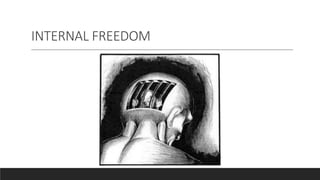
INTERNAL FREEDOM
 Internal freedom is limited and confined to an individual, and
results in the ability to act as what one would like to act inside
the effects of outside influences. It is determined through self-
control and the acceptance of personal responsibilities, affecting
one’s conscious choices as well as their habits.
INTERNAL FREEDOM
SELF FREEDOM
In the sense of learning how to escape the ever-present danger
of enslavement by our own passions and ignorance.
Practice of self-control, restraint, and balance to achieve the
admired master-slave relationship of soul over body.
“to find my self”
EXTERNAL FREEDOM
This refers to the normal and common freedoms expected
in daily life, in most countries, throughout history.
Sometimes called “freedom from…”
It implies immunity from undue interference by authority,
especially by government.
POLITICAL FREEDOM
Sometimes called “freedom to…”
Has to do with establishing certain rights of actions and
limits to government power that help to guarantee the
practice of those rights.
The right to speak freely, to associate with people of your
choice, to own property, to worship.
COLLECTIVE FREEDOM
Sometimes called “freedom from…”
Based on the ideology of collective unity that prescribes
distinct social and moral values and objectives for all.
Example, often

FOUNDATION OF MORALITY LECTURE 4.pptx

  • 1.
    FOUNDATION OF MORALITY FR E E D O M A N D R E S P O N S I B I L I T Y L E C T U R E N O . 4
  • 2.
    Humans, as moralbeings, are free to act or not to act. Their will equip them with the power to determine their actions. It is in this light that humans differ from other creatures and beings.
  • 5.
    HOW DO WEDEFINE FREEDOM?
  • 6.
    HOW DO WEDEFINE FREEDOM?
  • 7.
    HOW DO WEDEFINE FREEDOM?
  • 8.
    HOW DO WEDEFINE FREEDOM?
  • 9.
    HOW DO WEDEFINE FREEDOM?
  • 10.
    HOW DO WEDEFINE FREEDOM?
  • 11.
    FREEDOM Freedom is thepower or right to act, speak or think as one wants without hindrance or restraint; not absolute. It has limits, so we have to be responsible in exercising our freedom; it is the dependence of the “will” on the “self” or “I” for the same to act or not to act.
  • 13.
    INTERNAL FREEDOM  Internalfreedom is limited and confined to an individual, and results in the ability to act as what one would like to act inside the effects of outside influences. It is determined through self- control and the acceptance of personal responsibilities, affecting one’s conscious choices as well as their habits.
  • 14.
  • 15.
    SELF FREEDOM In thesense of learning how to escape the ever-present danger of enslavement by our own passions and ignorance. Practice of self-control, restraint, and balance to achieve the admired master-slave relationship of soul over body. “to find my self”
  • 17.
    EXTERNAL FREEDOM This refersto the normal and common freedoms expected in daily life, in most countries, throughout history. Sometimes called “freedom from…” It implies immunity from undue interference by authority, especially by government.
  • 19.
    POLITICAL FREEDOM Sometimes called“freedom to…” Has to do with establishing certain rights of actions and limits to government power that help to guarantee the practice of those rights. The right to speak freely, to associate with people of your choice, to own property, to worship.
  • 21.
    COLLECTIVE FREEDOM Sometimes called“freedom from…” Based on the ideology of collective unity that prescribes distinct social and moral values and objectives for all. Example, often