Overview of Purposive Communication
ANGELI E BAYAWA, LPT
Purposive Communication in the 21st Century
is about writing, speaking, and presenting to
different audiences and for various purposes.
Further, it was prepared with the following
objectives: (1) to align the CHED mandate and
materials to the 21st century literacies, i.e.,
Partnership in the 21st Century Framework; (2) to
ensure that the materials correspond with the
established and current theories and principles in
English; and (3) to incorporate sociocognitive and
transformative learning.
Overview of Purposive
Communication
Purposive Communication generally aims to
develop your fundamental skills of
communication such as listening, speaking,
reading, writing, viewing and representing
studied and simulated in advanced academic and
other multicultural settings. Purposive
Communication in the 21st Century offers an
array of activities that will help you achieve this
goal. The activities include listening,
comprehending, critiquing, and responding to
live or recorded discussions, speaking publicity
with confidence, explaining authentic passages or
text in your own words aided by illustrations in
Overview of Purposive
Communication
Communication in the 21st century has become much complex
than it was decades past. The continuous development in human
society allowed for individuals to form communities. The first
development was the appearance of language. The next
development was the invention of the written language. The third
development that significantly changed communication from the
last two developments was printing. This technology was further
developed when communication had been able to reach distances
without physically moving for it to take place. In the past, postal
services and transportation made it possible for artifacts to be
delivered to different places. However, the critical fourth
development made communication easier. The electronic
communication like the telegraph to telephone, fax machines.
This module is about writing, speaking and presenting to different
audiences and for various purposes that will aid the student to
have a deeper understanding of effective communication using
English. It aims to develop students‘ communicative competence
and enhance their cultural and intercultural awareness through
multimodal tasks by providing them opportunities for
communicating effectively and appropriately in multicultural
contexts. The knowledge and skills that the students are expected
to gain from this module may be used in their academic
endeavours, in their chosen disciplines, and in their future careers
as they compose and produce relevant oral, written, audio-visual,
and/or web-based output for various purposes complying with the
provisions of C.M.O.20, series of 2013, and guided by the content
of the syllabus from the Commission on Higher Education
The Nature of
Communication
Lesson Objectives:
At the end of the lesson the
student will be able to:
• Define communication
• State the principles of
communication
• Develop understanding on the
importance of communication
Communication
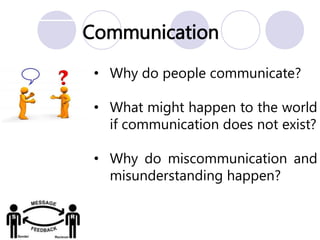
• Why do people communicate?
• What might happen to the world
if communication does not exist?
• Why do miscommunication and
misunderstanding happen?
What is Communication?
Communication is a
process by which people
send messages or
exchange ideas or
thoughts with one
another in a verbal or
non-verbal
manner.
Communication
Comes from the Latin word
“Communicare” meaning to share, to
unite, to join or to have things in
common
Communication
Communication is inevitable. Our need for
self-expression leads us to communicate not
only our thoughts but also our feelings.
Communication may be done verbally or non-
verbally. A simple yawn from a member of the
audience in a public speaking engagement is a
non-verbal message sent to the speaker. On the
other hand, a phone call inquiring about a
certain product is an example of a verbal
message.
Principles and
Characteristics of
Communication
1. Communication is Schemata-driven
Communication makes
you send to or receive
messages from somebody
by activating your
schemata, experiences or
background knowledge
that you have stored in
your brain since your early
developmental stages.
What does SCHEMATA means?
In psychology and
cognitive science, a
schema
(plural schemata or
schemas) describes an
organized pattern of
thought or behavior that
organizes categories of
information and the
relationships among
them.
Communication is Schemata-driven
It begins with yourself, you begin with what
you have already stocked in your brain or
with what you have already known or
understood about the subject matter of the
communicative act.
Transmitted messages become
understandable or meaningful because of
your innate or old knowledge about the
messages.
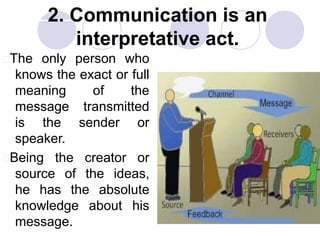
2. Communication is an
interpretative act.
The only person who
knows the exact or full
meaning of the
message transmitted
is the sender or
speaker.
Being the creator or
source of the ideas,
he has the absolute
knowledge about his
message.
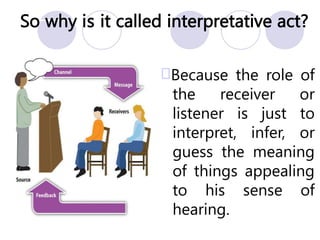
So why is it called interpretative act?
Because the role of
the receiver or
listener is just to
interpret, infer, or
guess the meaning
of things appealing
to his sense of
hearing.
3. Communication does not
guarantee a direct or automatic link
between two minds
These forms of
knowledge
become
meaningful only to
others when you
initiate
communication
with them.
Asking something from
your officemate…
Mingle with other people in the
party…
Meeting someone to present a
business proposal…
4. Communication is active,
powerful, or forceful
Active - Engage in
action
Forceful - Full of force,
powerful or effective
Messages have varied
effects on all participants
in any communicative
event
Powerful - Having
great
effectiveness
4. Communication is active,
powerful, or forceful
Eliciting different meanings or reactions,
these messages are prone to
changes. Subjected to the changeable
and continued existence of the world,
communication is a dynamic(A process
or system characterized by constant
change) as life that goes on and on like a
river. Nothing remains permanent or fixed in
the world of communication.
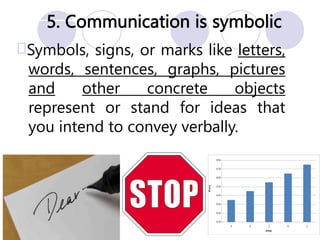
5. Communication is symbolic
Symbols, signs, or marks like letters,
words, sentences, graphs, pictures
and other concrete objects
represent or stand for ideas that
you intend to convey verbally.
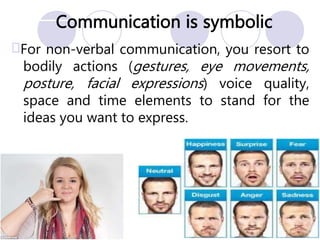
Communication is symbolic
For non-verbal communication, you resort to
bodily actions (gestures, eye movements,
posture, facial expressions) voice quality,
space and time elements to stand for the
ideas you want to express.
6. Communication always results
in something
Two or more persons
participate in any
communicative act.
The first, expresses or
sends a message; the
second, responds or
reacts to the message.
It is impossible
for any person
communicating
a message not
to get any
response or
reaction at all
from his
listeners.
From the classroom..
From the meeting…
The Nine Principlesof Effective
Communication
Michael Osborn (2009) claims that
communication must meet certain
standard for effective communication to
take place.
James Humes said, “The art of
communication is the language of
leadership.”
1. Clarity
Clarity makes speeches understandable.
Fuzzy language is absolutely forbidden, such as
are jargons, cliché expressions, euphemisms and
doublespeak language.
2. Concreteness
Concreteness reduces misunderstandings.
Messages must be supported by facts such as
research data, statistics, or figures. To achieve
concreteness, abstract words must be avoided.
3. Courtesy
Courtesy builds goodwill. It involves being
polite in terms of approach and manner of
addressing an individual.
4. Correctness
Glaring mistakes in grammar obscures the
meaning of a sentence. Also, the misuse of
language can damage your credibility.
5. Consideration
Messages must be geared towards the
audience. The sender of a message must
consider the recipient’s profession, level of
6. Conciseness - Simplicity and
directness help you to be concise. - Avoid
using lengthy expressions and words that
may confuse the recipient.
7. Creativity - in communication
means having the ability to craft
Interesting messages in terms of
sentence structure and word choice.
8. Cultural Sensitivity
Today, with the increasing emphasis on
empowering diverse cultures, lifestyles, and
races and the pursuit of gender equality,
cultural sensitivity becomes an important
standard for effective communication.
9. Captivating
You must strive to make messages
interesting to command more attention and
better responses.

1.-TheNatureOfCommunication-S.ppt

  • 1.
    Overview of PurposiveCommunication ANGELI E BAYAWA, LPT
  • 2.
    Purposive Communication inthe 21st Century is about writing, speaking, and presenting to different audiences and for various purposes. Further, it was prepared with the following objectives: (1) to align the CHED mandate and materials to the 21st century literacies, i.e., Partnership in the 21st Century Framework; (2) to ensure that the materials correspond with the established and current theories and principles in English; and (3) to incorporate sociocognitive and transformative learning. Overview of Purposive Communication
  • 3.
    Purposive Communication generallyaims to develop your fundamental skills of communication such as listening, speaking, reading, writing, viewing and representing studied and simulated in advanced academic and other multicultural settings. Purposive Communication in the 21st Century offers an array of activities that will help you achieve this goal. The activities include listening, comprehending, critiquing, and responding to live or recorded discussions, speaking publicity with confidence, explaining authentic passages or text in your own words aided by illustrations in Overview of Purposive Communication
  • 4.
    Communication in the21st century has become much complex than it was decades past. The continuous development in human society allowed for individuals to form communities. The first development was the appearance of language. The next development was the invention of the written language. The third development that significantly changed communication from the last two developments was printing. This technology was further developed when communication had been able to reach distances without physically moving for it to take place. In the past, postal services and transportation made it possible for artifacts to be delivered to different places. However, the critical fourth development made communication easier. The electronic communication like the telegraph to telephone, fax machines.
  • 5.
    This module isabout writing, speaking and presenting to different audiences and for various purposes that will aid the student to have a deeper understanding of effective communication using English. It aims to develop students‘ communicative competence and enhance their cultural and intercultural awareness through multimodal tasks by providing them opportunities for communicating effectively and appropriately in multicultural contexts. The knowledge and skills that the students are expected to gain from this module may be used in their academic endeavours, in their chosen disciplines, and in their future careers as they compose and produce relevant oral, written, audio-visual, and/or web-based output for various purposes complying with the provisions of C.M.O.20, series of 2013, and guided by the content of the syllabus from the Commission on Higher Education
  • 6.
  • 7.
    Lesson Objectives: At theend of the lesson the student will be able to: • Define communication • State the principles of communication • Develop understanding on the importance of communication
  • 8.
    Communication • Why dopeople communicate? • What might happen to the world if communication does not exist? • Why do miscommunication and misunderstanding happen?
  • 9.
    What is Communication? Communicationis a process by which people send messages or exchange ideas or thoughts with one another in a verbal or non-verbal manner.
  • 10.
    Communication Comes from theLatin word “Communicare” meaning to share, to unite, to join or to have things in common
  • 11.
    Communication Communication is inevitable.Our need for self-expression leads us to communicate not only our thoughts but also our feelings. Communication may be done verbally or non- verbally. A simple yawn from a member of the audience in a public speaking engagement is a non-verbal message sent to the speaker. On the other hand, a phone call inquiring about a certain product is an example of a verbal message.
  • 12.
  • 13.
    1. Communication isSchemata-driven Communication makes you send to or receive messages from somebody by activating your schemata, experiences or background knowledge that you have stored in your brain since your early developmental stages.
  • 14.
    What does SCHEMATAmeans? In psychology and cognitive science, a schema (plural schemata or schemas) describes an organized pattern of thought or behavior that organizes categories of information and the relationships among them.
  • 15.
    Communication is Schemata-driven Itbegins with yourself, you begin with what you have already stocked in your brain or with what you have already known or understood about the subject matter of the communicative act. Transmitted messages become understandable or meaningful because of your innate or old knowledge about the messages.
  • 16.
    2. Communication isan interpretative act. The only person who knows the exact or full meaning of the message transmitted is the sender or speaker. Being the creator or source of the ideas, he has the absolute knowledge about his message.
  • 17.
    So why isit called interpretative act? Because the role of the receiver or listener is just to interpret, infer, or guess the meaning of things appealing to his sense of hearing.
  • 18.
    3. Communication doesnot guarantee a direct or automatic link between two minds These forms of knowledge become meaningful only to others when you initiate communication with them.
  • 19.
    Asking something from yourofficemate… Mingle with other people in the party… Meeting someone to present a business proposal…
  • 20.
    4. Communication isactive, powerful, or forceful Active - Engage in action Forceful - Full of force, powerful or effective Messages have varied effects on all participants in any communicative event Powerful - Having great effectiveness
  • 21.
    4. Communication isactive, powerful, or forceful Eliciting different meanings or reactions, these messages are prone to changes. Subjected to the changeable and continued existence of the world, communication is a dynamic(A process or system characterized by constant change) as life that goes on and on like a river. Nothing remains permanent or fixed in the world of communication.
  • 22.
    5. Communication issymbolic Symbols, signs, or marks like letters, words, sentences, graphs, pictures and other concrete objects represent or stand for ideas that you intend to convey verbally.
  • 23.
    Communication is symbolic Fornon-verbal communication, you resort to bodily actions (gestures, eye movements, posture, facial expressions) voice quality, space and time elements to stand for the ideas you want to express.
  • 24.
    6. Communication alwaysresults in something Two or more persons participate in any communicative act. The first, expresses or sends a message; the second, responds or reacts to the message.
  • 25.
    It is impossible forany person communicating a message not to get any response or reaction at all from his listeners. From the classroom.. From the meeting…
  • 26.
    The Nine PrinciplesofEffective Communication
  • 27.
    Michael Osborn (2009)claims that communication must meet certain standard for effective communication to take place. James Humes said, “The art of communication is the language of leadership.”
  • 28.
    1. Clarity Clarity makesspeeches understandable. Fuzzy language is absolutely forbidden, such as are jargons, cliché expressions, euphemisms and doublespeak language. 2. Concreteness Concreteness reduces misunderstandings. Messages must be supported by facts such as research data, statistics, or figures. To achieve concreteness, abstract words must be avoided.
  • 29.
    3. Courtesy Courtesy buildsgoodwill. It involves being polite in terms of approach and manner of addressing an individual. 4. Correctness Glaring mistakes in grammar obscures the meaning of a sentence. Also, the misuse of language can damage your credibility. 5. Consideration Messages must be geared towards the audience. The sender of a message must consider the recipient’s profession, level of
  • 30.
    6. Conciseness -Simplicity and directness help you to be concise. - Avoid using lengthy expressions and words that may confuse the recipient. 7. Creativity - in communication means having the ability to craft Interesting messages in terms of sentence structure and word choice.
  • 31.
    8. Cultural Sensitivity Today,with the increasing emphasis on empowering diverse cultures, lifestyles, and races and the pursuit of gender equality, cultural sensitivity becomes an important standard for effective communication. 9. Captivating You must strive to make messages interesting to command more attention and better responses.