Centrifugal pump
INTRODUCTION
CONSTRUCTION
CLASSIFICATION
WORKING
HEADS LOSSES & EFFICIENCIES
ADVANTAGE & DISADVANTAGE
APPLICATION
A fluid machine is a device which converts
the energy stored by a fluid into
mechanical energy or vice versa . The
energy stored by a fluid mass appears in
the form of potential, kinetic and
intermolecular energy. The mechanical
energy, on the other hand, is usually
transmitted by a rotating shaft. Machines
using liquid (mainly water, for almost all
practical purposes) are termed as hydraulic
machines.
The device in which the kinetic, potential or
intermolecular energy held by the fluid is converted
in the form of mechanical energy of a rotating
member is known as a turbine .
The machines, on the other hand, where the
mechanical energy from moving parts is transferred
to a fluid to increase its stored energy by increasing
either its pressure or velocity are known as pumps,
compressors, fans or blowers .
The machines whose functioning depend essentially on the
change of volume of a certain amount of fluid within the
machine are known as positive displacement machines .
The word positive displacement comes from the fact that
there is a physical displacement of the boundary of a
certain fluid mass as a closed system. This principle is
utilized in practice by the reciprocating motion of a piston
within a cylinder while entrapping a certain amount of fluid
in it.
Therefore, the word reciprocating is commonly used with
the name of the machines of this kind. The machine
producing mechanical energy is known as reciprocating
engine while the machine developing energy of the fluid
from the mechanical energy is known as reciprocating
pump or reciprocating compressor.
The machines, functioning of which depend basically on the principle of
fluid dynamics, are known as rotodynamic machines . They are
distinguished from positive displacement machines in requiring relative
motion between the fluid and the moving part of the machine.
The rotating element of the machine usually consisting of a number of
vanes or blades, is known as rotor or impeller while the fixed part is
known as stator. Impeller is the heart of rotodynamic machines, within
which a change of angular momentum of fluid occurs imparting torque
to the rotating member.
• Pump: When a fluid has to be "moved" in a system, pumps are used. The
pump is a machine which has the function of increasing the total energy of
a liquid; this means that the pump transfers energy to the fluid that it
receives from the driving motor”.
Need of a Pump:
 Used to pump a liquid from lower pressure area to a High pressure area.
 To increase Flow rate.
 To move liquid from lower elevation to higher elevation.
TYPES
Displaceme
nt
Pumps
Centrifugal
Pump
Reciprocatin
g
RotaryPumps
Dynamic
Pump
Radial Mixed
Gear Screw
PistonDiaphragm Lobe
Vertical
Horizontal
Axial
INTRODUCTION
CONSTRUCTION
 Sump
 Strainer
 Foot valve
 Vanes
 Impeller
 Suction pipe
 Delivery pipe
 Casing
 Delivery valve
Displacement Vs Centrifugal
 Centrifugal pumps are suitable for low head and high flow rate.
 PD pumps produce high head and low flow rate.
 PD are suitable for High Viscosity application.
 Centrifugal Pumps are not recommended for high viscosity
application because as viscosity increases its flow decreases.
 Usually a relieve valve is attached with the displacement
pumps.
CLASSIFICATION
 According to working head
 According to casing
 According to number of entrances to the impeller
 According to types of impeller
 According to number of stages
 According to shape of the vanes
 According to disposition of shaft
 According to working head
 Low head centrifugal pump – working head developed by
these pumps is up to 15m.
 Medium head centrifugal pump – working head developed
by these system is 15m<H<45m.
 High head centrifugal pump – working head developed by
these pumps is more than 45m.
• Volute Casing
• In this casing, the impeller is
surrounded by the spiral casing.
• The casing is such shaped that
it’s casing area gradually increases
from tongue to delivery pipe.
• Due to impact of the high
velocity water leaving the impeller
(shock losses), efficiency of
conversion of K.E. into P.E. is
very less.
According to casing
• Vortex Casing
• In this casing, an annular space
known as vortex or whirlpool
chamber is provided between the
impeller and volute casing.
• Liquid from the impeller flow
with free vortex motion in vortex
chamber where it’s velocity is
converted into pressure energy.
• It is more efficient than a volute
casing.
• Diffuser Casing
• In this casing , the guide vanes
are arranged at the outlet of the
impeller.
• The guide vanes are shaped to
provide gradually enlarged
passage for flow of liquid.
• The kinetic energy of the liquid
coming out from the impeller is
converted into the pressure
energy during flow in guide
vanes (increasing area).
 According to number of
entrances to the impeller
• Single suction pump
Liquid enters from a
suction pipe to impeller
only from one side.
• Double suction pump
Liquid enters to both the
sides of impeller.
According to types of impeller
• Closed impeller
if the vanes of the impeller
are covered with plates on
both sides, it is called a
closed impeller. It is made
of cast iron, stainless steel,
cast steel, gun metal.
• Semi open impeller
if the vanes of the
impeller are covered
with plate on one side, it
is called semi open
impeller. It has less
number of vanes, but it’s
height is more than that
of closed impeller.
• Open impeller
If the vanes of the
impeller are without
covered plate, it is called
open impeller. These are
generally made of forged
steel. It has less life, as
they have to perform
very rough task.
According to number of stage
• Single stage
In a single stage pump, only
one impeller is used on the
shaft.
 Multi stage
In a multi stage pump, more
than one impeller is used on
the same shaft and enclosed
in the same casing. It is
used to raise high head.
According to shape of the vanes
• Curved forward vanes
The outlet tip of the vane
is curved forward in the
direction of rotation of the
impeller. The impeller
having such vanes is
called slow speed
impeller. This type of the
impeller has low
efficiency about 75%.
• Radial vanes
These vanes have outlet tips
in radial direction. The
impeller having such vanes
is called medium speed
impeller. The efficiency of
this type of impeller varies
from 80% to 85%.
• Curved backward vanes
The outlet tip of the vane is
curved backward in the
direction of rotation of the
impeller. The impeller
having such vanes is
called fast speed impeller.
This type of impeller
gives highest efficiency
about 85% to 90%.
 According to disposition of the shaft
• Horizontal pump • Vertical pump
In this type of pump, the
impeller shaft is used
horizontal.
In this type of pump, the
impeller shaft is used
vertical.
Efficiencies
 Mechanical Efficiency (ȠM):
 Volumetric Efficiency (ȠV):
 Hydraulic Efficiency (ȠH)
 Overall Efficiency (ȠO)
Priming
Necessity of priming
Methods of Priming
Manual Priming Self Priming
Working
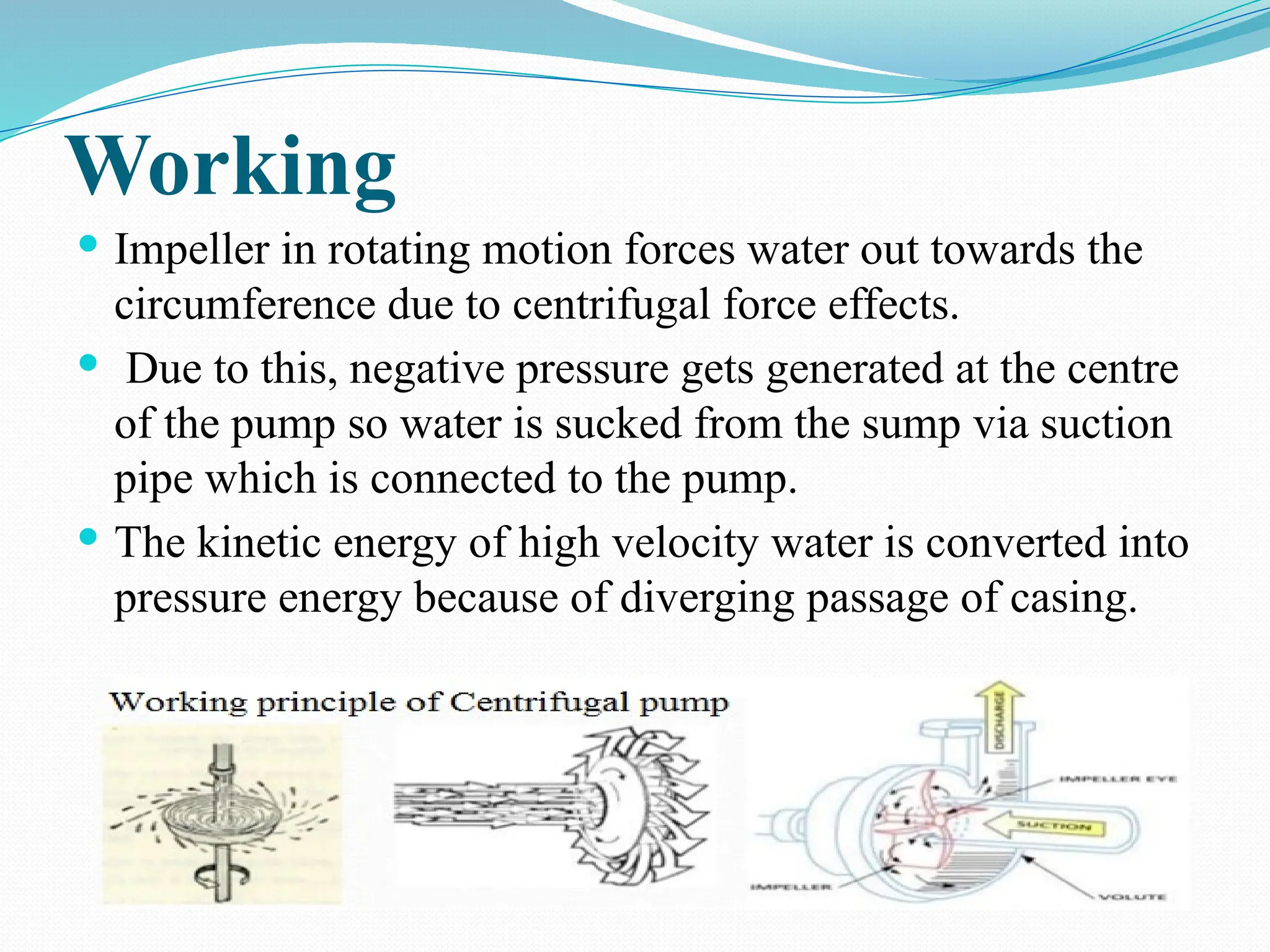
 Impeller in rotating motion forces water out towards the
circumference due to centrifugal force effects.
 Due to this, negative pressure gets generated at the centre
of the pump so water is sucked from the sump via suction
pipe which is connected to the pump.
 The kinetic energy of high velocity water is converted into
pressure energy because of diverging passage of casing.
Heads
The heads of a pump may be expressed as:
 Suction Head
 Delivery Head
 Static Head
 Manometric Head
 Total Head
 Euler’s Head
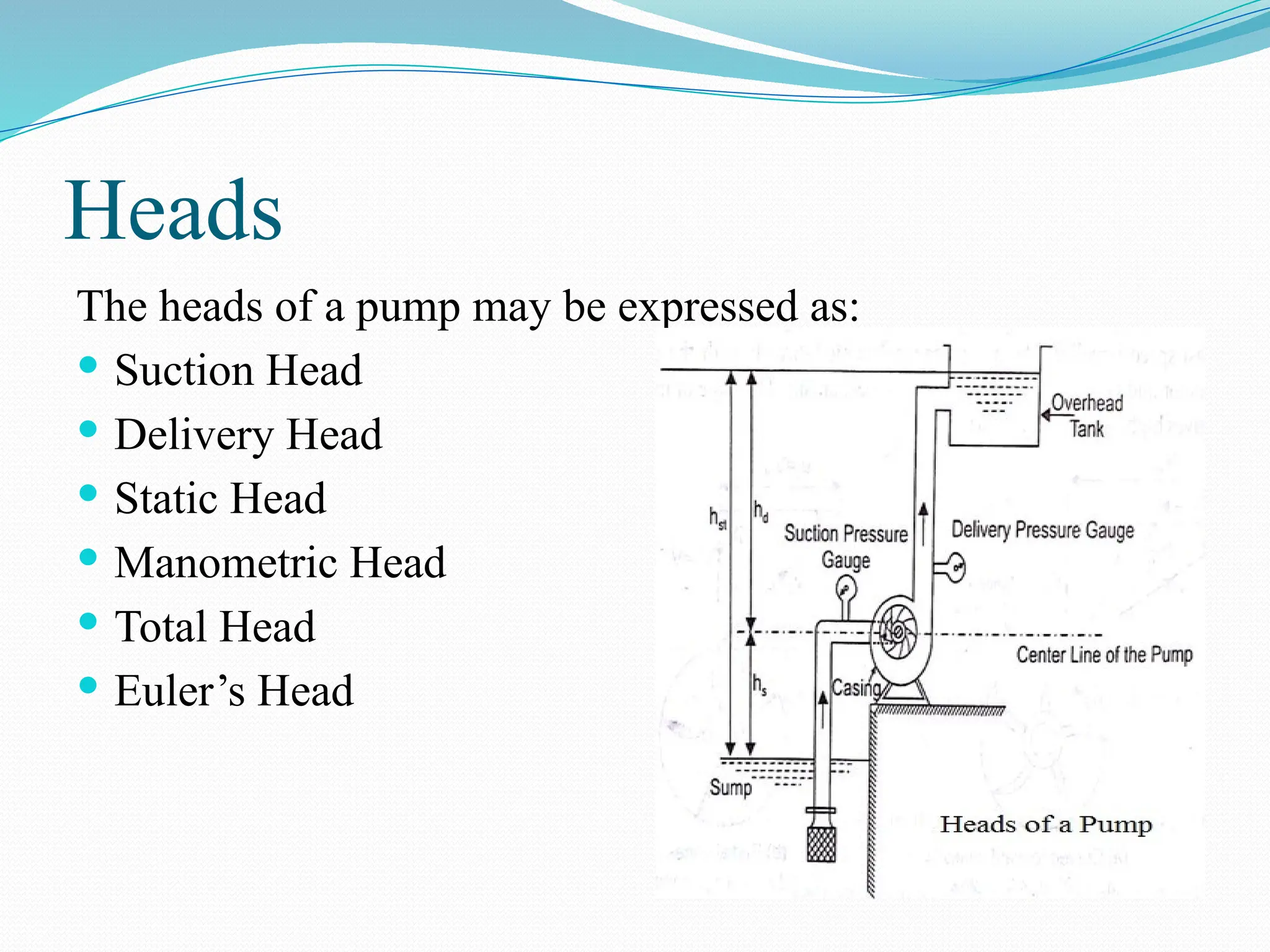
 Suction Head (hs): It is the vertical distance b/w liquid levels
in the sump and the centre line of the pump. Usually, it is
kept 7 to 8 m to avoid cavitation.
 Delivery Head (hd): It is the vertical height of the liquid
surface in the overhead tank to which the liquid is delivered
above the centre line of the pump.
 Static Head (hst): It is the vertical distance b/w liquid levels
in the sump and the overhead tank. It is the sum of suction
head and delivery head. (hst=hs+hd).
 Manometric Head (Hm): The available head against which a
centrifugal pump has to work is known as the monomeric
Head.
 Total Head (H): It is the total head which has to be
developed by a pump to deliver the liquid from the sump
into the overhead tank.
 Euler’s Head (He): It is defined as the head developed by
the impeller. It is denoted as He.
Losses
Energy losses in centrifugal pumps may be classified as
follows:
a. Hydraulic Losses
b. Mechanical losses
c. Leakage Losses`
 Hydraulic Losses: There are two types of hydraulic
losses which may occur in a pump.
a. Pipeline Losses: Major (due to friction) and minor (due
to pipe bend) losses in pipes.
b. Pump Losses: Eddy or shock losses, frictional losses in
impeller, guide vane/diffuser, casing.
 Mechanical Losses: Losses due to friction of main
bearings and glands.
 Leakage Losses: slipping back of part of liquid through
the clearance between the impeller and casing due to
pressure difference b/w inlet and outlet. Energy carried
by these liquid is ultimately wasted and this loss of
energy of liquid is known as leakage losses.
Advantages
 Small in size & space saving.
 Output is very steady and consistent.
 Easy for maintenance.
 No danger creates if discharge valve is closed while
starting.
 Deal with large volume.
 Able to work on medium to low head.
 Able to work on medium to low viscous fluid.
 Almost no noise
Disadvantages
 Extra priming process requires.
 Cannot be able to work on high speeds.
 Cannot deal with highly viscous liquid.
Application
• Agriculture and irrigation purpose.
• Pumping of water in buildings.
• Transfer raw material.
Cavitation can be termed as
“the heart attack of the pump”.
The formation and collapse of vapor bubbles in a liquid.
Mechanism of Cavitation
•The phenomenon of cavitation is
summarized as follows:
•1- Formation of bubbles inside the
liquid being pumped.
•2-Growth of bubbles
•3- Collapse of bubbles
Cavitation
 The formation of bubble occurs at
point where the pressure is less than
the vapor pressure, and bubble
collapse occurs at a point where the
pressure is increased to the vapor
pressure.
CAVITATION
Collapse of vapor bubble suddenly
change its phase from vapor to liquid at
very high velocity which impact shock
wave on the surface of the impeller
which can reach a value around 12000
Psi .This pressure capable to deform the
metal of the pump creating pitting. It is
important to remember that , this
process IS NOT ONE TIME EVENT ,it
will be repeated 2400 time each
minutes this may lead to erode the
metal and damage the pump.
Symptoms of Cavitation
Cavitation in pumps can often be detected by
a characteristic generated sound. It sounds
like gravel in a concrete mixer.
Cavitation lead to excessive vibration, fatigue
and greatly increased wear of pump parts
such as bearing failures , sealing leakage ,
Metal gets corroded seen as small pitting's.
Cavitation Loss in pump performance
reduces the flow rate , head & efficiency of the
pump & life time.
Net Positive Suction Head Available
(N.P.S.H.A.) The Net-Positive Suction
Head Available (N.P.S.H.A.) is the total
energy per unit weight, or head, at the
suction flange of the pump minus the
vapor pressure head of the fluid. This is
the accepted definition that is published
by the Hydraulic institute’s Standards
books The term "Net" refers to the
actual head at the pump suction flange
which should be “Positive” , since some
energy is lost in friction prior to the
suction.
Net positive suction head
required for the pump is
the absolute pressure
head in meters that the
pump can overcome the
pressure drop through
the pump and maintain
the majority of the
liquid above the vapor
pressure.
NPSHA NPSHR
This is the minimum suction pressure head at the inlet of the pump. (That
means the pump has to overcome the elevation difference, the head loss in
the suction pipe and the change in kinetic energy).
In reality, the minimum pressure does not exactly occur at the inlet of the
pump, but there is an additional pressure drop inside the pump due to the
change in flow direction from axial to radial at very high rotational speed of
the impeller ( Forced vortex) . This action leads to an increase in eddy
losses and sudden increase in flow velocity followed by reduction in
pressure at the vane of the impeller as shown in figure below
NPSHA> NPSHR = OK
• NPSHA< NPSHR = CAVITATION
As a guideline, the NPSH-Available
should exceed the NPSH-Required by
a minimum of 5 feet (1.5 m), or be
equal to 1.2-2.5 times the NPSH-
Required, Suggested by (Hydraulic
Institute Standard (ANSI/HI 9.6.1)
To reduce the NPSHreq:
•pump with less circular velocity.
•more pumps or using a double-suction eyed pump
•specially designed suction-eye propeller (only specific
volumetric flow rates).
•Ways to increase NPSHA:
•putting suction source or total system under pressure to
increase pump suction pressure
•if fluid temp. is high, feed source should be on a higher
position than pump and under pressure
•low fluid velocity
•reducing the losses in suction pipe
The NPSH Required varies with speed
and capacity within any particular
pump. Pump manufacturer's curves
normally provide this information.

ME 2101 Centrifugal pump - overview - helpful

  • 1.
  • 2.
    INTRODUCTION CONSTRUCTION CLASSIFICATION WORKING HEADS LOSSES &EFFICIENCIES ADVANTAGE & DISADVANTAGE APPLICATION
  • 3.
    A fluid machineis a device which converts the energy stored by a fluid into mechanical energy or vice versa . The energy stored by a fluid mass appears in the form of potential, kinetic and intermolecular energy. The mechanical energy, on the other hand, is usually transmitted by a rotating shaft. Machines using liquid (mainly water, for almost all practical purposes) are termed as hydraulic machines.
  • 4.
    The device inwhich the kinetic, potential or intermolecular energy held by the fluid is converted in the form of mechanical energy of a rotating member is known as a turbine . The machines, on the other hand, where the mechanical energy from moving parts is transferred to a fluid to increase its stored energy by increasing either its pressure or velocity are known as pumps, compressors, fans or blowers .
  • 6.
    The machines whosefunctioning depend essentially on the change of volume of a certain amount of fluid within the machine are known as positive displacement machines . The word positive displacement comes from the fact that there is a physical displacement of the boundary of a certain fluid mass as a closed system. This principle is utilized in practice by the reciprocating motion of a piston within a cylinder while entrapping a certain amount of fluid in it. Therefore, the word reciprocating is commonly used with the name of the machines of this kind. The machine producing mechanical energy is known as reciprocating engine while the machine developing energy of the fluid from the mechanical energy is known as reciprocating pump or reciprocating compressor.
  • 9.
    The machines, functioningof which depend basically on the principle of fluid dynamics, are known as rotodynamic machines . They are distinguished from positive displacement machines in requiring relative motion between the fluid and the moving part of the machine. The rotating element of the machine usually consisting of a number of vanes or blades, is known as rotor or impeller while the fixed part is known as stator. Impeller is the heart of rotodynamic machines, within which a change of angular momentum of fluid occurs imparting torque to the rotating member.
  • 10.
    • Pump: Whena fluid has to be "moved" in a system, pumps are used. The pump is a machine which has the function of increasing the total energy of a liquid; this means that the pump transfers energy to the fluid that it receives from the driving motor”. Need of a Pump:  Used to pump a liquid from lower pressure area to a High pressure area.  To increase Flow rate.  To move liquid from lower elevation to higher elevation.
  • 11.
  • 12.
  • 14.
    CONSTRUCTION  Sump  Strainer Foot valve  Vanes  Impeller  Suction pipe  Delivery pipe  Casing  Delivery valve
  • 15.
    Displacement Vs Centrifugal Centrifugal pumps are suitable for low head and high flow rate.  PD pumps produce high head and low flow rate.  PD are suitable for High Viscosity application.  Centrifugal Pumps are not recommended for high viscosity application because as viscosity increases its flow decreases.  Usually a relieve valve is attached with the displacement pumps.
  • 16.
    CLASSIFICATION  According toworking head  According to casing  According to number of entrances to the impeller  According to types of impeller  According to number of stages  According to shape of the vanes  According to disposition of shaft
  • 17.
     According toworking head  Low head centrifugal pump – working head developed by these pumps is up to 15m.  Medium head centrifugal pump – working head developed by these system is 15m<H<45m.  High head centrifugal pump – working head developed by these pumps is more than 45m.
  • 18.
    • Volute Casing •In this casing, the impeller is surrounded by the spiral casing. • The casing is such shaped that it’s casing area gradually increases from tongue to delivery pipe. • Due to impact of the high velocity water leaving the impeller (shock losses), efficiency of conversion of K.E. into P.E. is very less. According to casing
  • 19.
    • Vortex Casing •In this casing, an annular space known as vortex or whirlpool chamber is provided between the impeller and volute casing. • Liquid from the impeller flow with free vortex motion in vortex chamber where it’s velocity is converted into pressure energy. • It is more efficient than a volute casing.
  • 20.
    • Diffuser Casing •In this casing , the guide vanes are arranged at the outlet of the impeller. • The guide vanes are shaped to provide gradually enlarged passage for flow of liquid. • The kinetic energy of the liquid coming out from the impeller is converted into the pressure energy during flow in guide vanes (increasing area).
  • 21.
     According tonumber of entrances to the impeller • Single suction pump Liquid enters from a suction pipe to impeller only from one side. • Double suction pump Liquid enters to both the sides of impeller.
  • 22.
    According to typesof impeller • Closed impeller if the vanes of the impeller are covered with plates on both sides, it is called a closed impeller. It is made of cast iron, stainless steel, cast steel, gun metal.
  • 23.
    • Semi openimpeller if the vanes of the impeller are covered with plate on one side, it is called semi open impeller. It has less number of vanes, but it’s height is more than that of closed impeller.
  • 24.
    • Open impeller Ifthe vanes of the impeller are without covered plate, it is called open impeller. These are generally made of forged steel. It has less life, as they have to perform very rough task.
  • 25.
    According to numberof stage • Single stage In a single stage pump, only one impeller is used on the shaft.  Multi stage In a multi stage pump, more than one impeller is used on the same shaft and enclosed in the same casing. It is used to raise high head.
  • 26.
    According to shapeof the vanes • Curved forward vanes The outlet tip of the vane is curved forward in the direction of rotation of the impeller. The impeller having such vanes is called slow speed impeller. This type of the impeller has low efficiency about 75%.
  • 27.
    • Radial vanes Thesevanes have outlet tips in radial direction. The impeller having such vanes is called medium speed impeller. The efficiency of this type of impeller varies from 80% to 85%.
  • 28.
    • Curved backwardvanes The outlet tip of the vane is curved backward in the direction of rotation of the impeller. The impeller having such vanes is called fast speed impeller. This type of impeller gives highest efficiency about 85% to 90%.
  • 29.
     According todisposition of the shaft • Horizontal pump • Vertical pump In this type of pump, the impeller shaft is used horizontal. In this type of pump, the impeller shaft is used vertical.
  • 33.
    Efficiencies  Mechanical Efficiency(ȠM):  Volumetric Efficiency (ȠV):
  • 34.
     Hydraulic Efficiency(ȠH)  Overall Efficiency (ȠO)
  • 35.
  • 36.
  • 37.
    Methods of Priming ManualPriming Self Priming
  • 38.
    Working  Impeller inrotating motion forces water out towards the circumference due to centrifugal force effects.  Due to this, negative pressure gets generated at the centre of the pump so water is sucked from the sump via suction pipe which is connected to the pump.  The kinetic energy of high velocity water is converted into pressure energy because of diverging passage of casing.
  • 39.
    Heads The heads ofa pump may be expressed as:  Suction Head  Delivery Head  Static Head  Manometric Head  Total Head  Euler’s Head
  • 40.
     Suction Head(hs): It is the vertical distance b/w liquid levels in the sump and the centre line of the pump. Usually, it is kept 7 to 8 m to avoid cavitation.  Delivery Head (hd): It is the vertical height of the liquid surface in the overhead tank to which the liquid is delivered above the centre line of the pump.  Static Head (hst): It is the vertical distance b/w liquid levels in the sump and the overhead tank. It is the sum of suction head and delivery head. (hst=hs+hd).  Manometric Head (Hm): The available head against which a centrifugal pump has to work is known as the monomeric Head.  Total Head (H): It is the total head which has to be developed by a pump to deliver the liquid from the sump into the overhead tank.
  • 41.
     Euler’s Head(He): It is defined as the head developed by the impeller. It is denoted as He. Losses Energy losses in centrifugal pumps may be classified as follows: a. Hydraulic Losses b. Mechanical losses c. Leakage Losses`
  • 42.
     Hydraulic Losses:There are two types of hydraulic losses which may occur in a pump. a. Pipeline Losses: Major (due to friction) and minor (due to pipe bend) losses in pipes. b. Pump Losses: Eddy or shock losses, frictional losses in impeller, guide vane/diffuser, casing.  Mechanical Losses: Losses due to friction of main bearings and glands.  Leakage Losses: slipping back of part of liquid through the clearance between the impeller and casing due to pressure difference b/w inlet and outlet. Energy carried by these liquid is ultimately wasted and this loss of energy of liquid is known as leakage losses.
  • 43.
    Advantages  Small insize & space saving.  Output is very steady and consistent.  Easy for maintenance.  No danger creates if discharge valve is closed while starting.  Deal with large volume.  Able to work on medium to low head.  Able to work on medium to low viscous fluid.  Almost no noise
  • 44.
    Disadvantages  Extra primingprocess requires.  Cannot be able to work on high speeds.  Cannot deal with highly viscous liquid. Application • Agriculture and irrigation purpose. • Pumping of water in buildings. • Transfer raw material.
  • 49.
    Cavitation can betermed as “the heart attack of the pump”. The formation and collapse of vapor bubbles in a liquid. Mechanism of Cavitation •The phenomenon of cavitation is summarized as follows: •1- Formation of bubbles inside the liquid being pumped. •2-Growth of bubbles •3- Collapse of bubbles Cavitation  The formation of bubble occurs at point where the pressure is less than the vapor pressure, and bubble collapse occurs at a point where the pressure is increased to the vapor pressure. CAVITATION
  • 54.
    Collapse of vaporbubble suddenly change its phase from vapor to liquid at very high velocity which impact shock wave on the surface of the impeller which can reach a value around 12000 Psi .This pressure capable to deform the metal of the pump creating pitting. It is important to remember that , this process IS NOT ONE TIME EVENT ,it will be repeated 2400 time each minutes this may lead to erode the metal and damage the pump.
  • 55.
    Symptoms of Cavitation Cavitationin pumps can often be detected by a characteristic generated sound. It sounds like gravel in a concrete mixer. Cavitation lead to excessive vibration, fatigue and greatly increased wear of pump parts such as bearing failures , sealing leakage , Metal gets corroded seen as small pitting's. Cavitation Loss in pump performance reduces the flow rate , head & efficiency of the pump & life time.
  • 57.
    Net Positive SuctionHead Available (N.P.S.H.A.) The Net-Positive Suction Head Available (N.P.S.H.A.) is the total energy per unit weight, or head, at the suction flange of the pump minus the vapor pressure head of the fluid. This is the accepted definition that is published by the Hydraulic institute’s Standards books The term "Net" refers to the actual head at the pump suction flange which should be “Positive” , since some energy is lost in friction prior to the suction. Net positive suction head required for the pump is the absolute pressure head in meters that the pump can overcome the pressure drop through the pump and maintain the majority of the liquid above the vapor pressure. NPSHA NPSHR
  • 59.
    This is theminimum suction pressure head at the inlet of the pump. (That means the pump has to overcome the elevation difference, the head loss in the suction pipe and the change in kinetic energy). In reality, the minimum pressure does not exactly occur at the inlet of the pump, but there is an additional pressure drop inside the pump due to the change in flow direction from axial to radial at very high rotational speed of the impeller ( Forced vortex) . This action leads to an increase in eddy losses and sudden increase in flow velocity followed by reduction in pressure at the vane of the impeller as shown in figure below
  • 60.
    NPSHA> NPSHR =OK • NPSHA< NPSHR = CAVITATION As a guideline, the NPSH-Available should exceed the NPSH-Required by a minimum of 5 feet (1.5 m), or be equal to 1.2-2.5 times the NPSH- Required, Suggested by (Hydraulic Institute Standard (ANSI/HI 9.6.1)
  • 61.
    To reduce theNPSHreq: •pump with less circular velocity. •more pumps or using a double-suction eyed pump •specially designed suction-eye propeller (only specific volumetric flow rates). •Ways to increase NPSHA: •putting suction source or total system under pressure to increase pump suction pressure •if fluid temp. is high, feed source should be on a higher position than pump and under pressure •low fluid velocity •reducing the losses in suction pipe
  • 62.
    The NPSH Requiredvaries with speed and capacity within any particular pump. Pump manufacturer's curves normally provide this information.