Different types of Water pump
Vijitha Vikneshwaran
Lecturer (Temporary)
Faculty of Technology
University of Jaffna
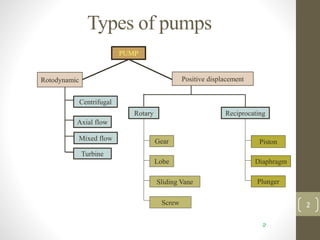
Diaphragm
Piston
Plunger
Reciprocating
Rotary
Mixed flow Gear
Lobe
Sliding Vane
Screw
Axial flow
Centrifugal
Rotodynamic
Turbine
Positive displacement
PUMP
2
2
Types of pumps
Typesofpumps,cont….
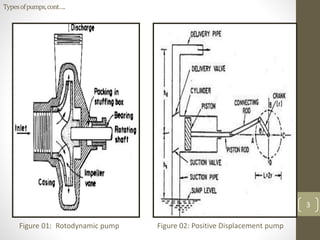
Figure 01: Rotodynamic pump Figure 02: Positive Displacement pump
3
Rotodynamic pump
• It has a rotating element which rotates in a
casing and imparts energy to water.
• There are 4 types,
•Centrifugal
•Axial flow
•Mixed flow
•Turbine
• The rotating element is impeller which creates
radial flow of water.
4
Rotodynamic pump
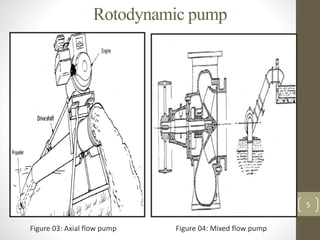
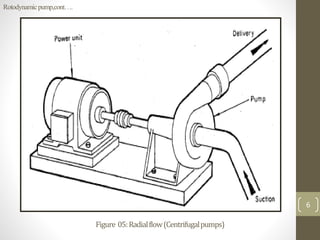
Figure 03: Axial flow pump Figure 04: Mixed flow pump
5
Rotodynamicpump,cont….
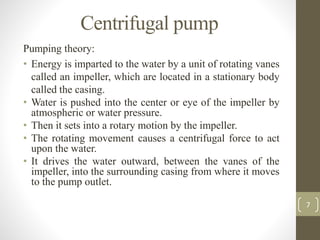
Figure 05:Radialflow(Centrifugalpumps)
6
Pumping theory:
• Energy is imparted to the water by a unit of rotating vanes
called an impeller, which are located in a stationary body
called the casing.
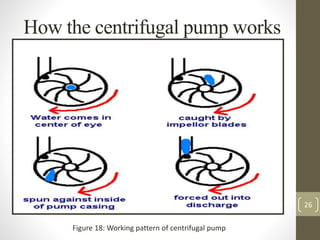
• Water is pushed into the center or eye of the impeller by
atmospheric or water pressure.
• Then it sets into a rotary motion by the impeller.
• The rotating movement causes a centrifugal force to act
upon the water.
• It drives the water outward, between the vanes of the
impeller, into the surrounding casing from where it moves
to the pump outlet.
7
Centrifugal pump
Casing
• Impellers are fitted inside casings.
• The area of flow of the casing gradually increases
in the direction of flow of water.
• It convert kinematic energy into pressure energy.
• Reducing speed while increasing pressure.
• Seal it to prevent leakage and sometimes retain
pressure.
• Support some of the key parts such as shafts,
bearings, etc.
8
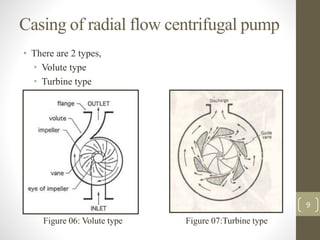
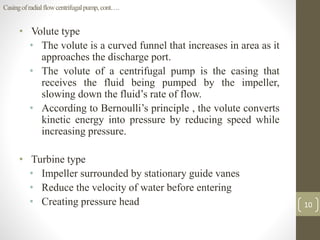
• There are 2 types,
• Volute type
• Turbine type
Casing of radial flow centrifugal pump
Figure 06: Volute type Figure 07:Turbine type
9
Casingofradialflowcentrifugalpump,cont….
• Volute type
• The volute is a curved funnel that increases in area as it
approaches the discharge port.
• The volute of a centrifugal pump is the casing that
receives the fluid being pumped by the impeller,
slowing down the fluid’s rate of flow.
• According to Bernoulli’s principle , the volute converts
kinetic energy into pressure by reducing speed while
increasing pressure.
• Turbine type
• Impeller surrounded by stationary guide vanes
• Reduce the velocity of water before entering
• Creating pressure head 10
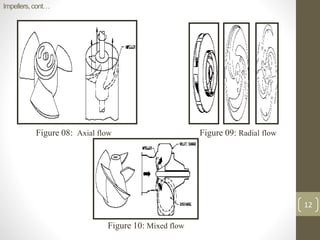
Impellers
• Impellers can be classified according to the direction of
flow through the impeller in relation to the axis of
rotation as,
• Radial
• Axial
• Mixed flow
• The most efficient impeller is an axial flow one which
creates high flows at low heads.
11
12
Impellers,cont…
Figure 09: Radial flow
Figure 08: Axial flow
Figure 10: Mixed flow
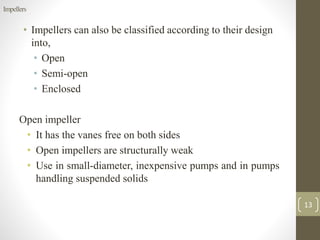
• Impellers can also be classified according to their design
into,
• Open
• Semi-open
• Enclosed
Open impeller
• It has the vanes free on both sides
• Open impellers are structurally weak
• Use in small-diameter, inexpensive pumps and in pumps
handling suspended solids
13
Impellers
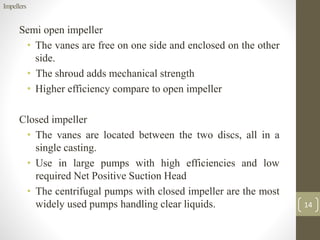
Semi open impeller
• The vanes are free on one side and enclosed on the other
side.
• The shroud adds mechanical strength
• Higher efficiency compare to open impeller
Closed impeller
• The vanes are located between the two discs, all in a
single casting.
• Use in large pumps with high efficiencies and low
required Net Positive Suction Head
• The centrifugal pumps with closed impeller are the most
widely used pumps handling clear liquids.
Impellers
14
15
Impellers,cont…
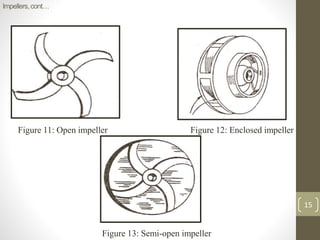
Figure 12: Enclosed impeller
Figure 13: Semi-open impeller
Figure 11: Open impeller
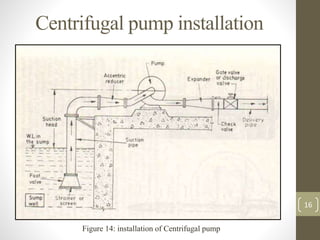
Centrifugal pump installation
Figure 14: installation of Centrifugal pump
16
17
Pump Jargon
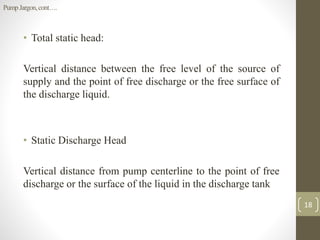
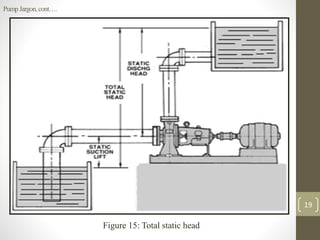
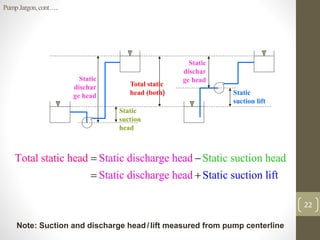
• Total static head:
Vertical distance between the free level of the source of
supply and the point of free discharge or the free surface of
the discharge liquid.
• Static Discharge Head
Vertical distance from pump centerline to the point of free
discharge or the surface of the liquid in the discharge tank
18
PumpJargon,cont….
19
PumpJargon,cont….
Figure 15: Total static head
PumpJargon,cont…
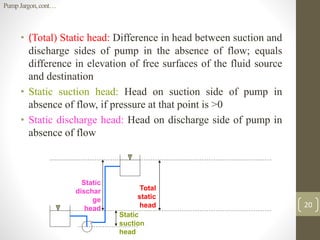
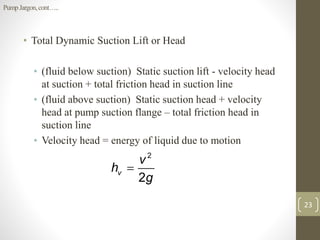
• (Total) Static head: Difference in head between suction and
discharge sides of pump in the absence of flow; equals
difference in elevation of free surfaces of the fluid source
and destination
• Static suction head: Head on suction side of pump in
absence of flow, if pressure at that point is >0
• Static discharge head: Head on discharge side of pump in
absence of flow
Total
static
head
Static
suction
head
Static
dischar
ge
head 20
PumpJargon,cont…
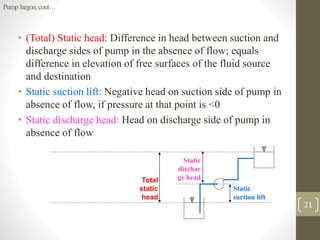
• (Total) Static head: Difference in head between suction and
discharge sides of pump in the absence of flow; equals
difference in elevation of free surfaces of the fluid source
and destination
• Static suction lift: Negative head on suction side of pump in
absence of flow, if pressure at that point is <0
• Static discharge head: Head on discharge side of pump in
absence of flow
Total
static
head
Static
suction lift
Static
dischar
ge head
21
PumpJargon,cont…..
Total static
head (both) Static
suction lift
Static
dischar
ge head
Static
suction
head
Static
dischar
ge head
Static suction head
Static suction lif
Static discharge head
Static d t
Total static h
ischarge he d
ead
a
 
 
Note: Suction and discharge head/lift measured from pump centerline
22
• Total Dynamic Suction Lift or Head
• (fluid below suction) Static suction lift - velocity head
at suction + total friction head in suction line
• (fluid above suction) Static suction head + velocity
head at pump suction flange – total friction head in
suction line
• Velocity head = energy of liquid due to motion
23
2
2
v
v
h
g

PumpJargon,cont…..
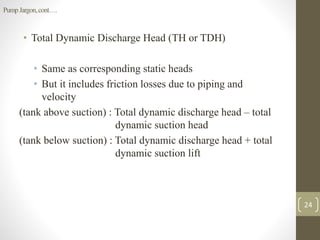
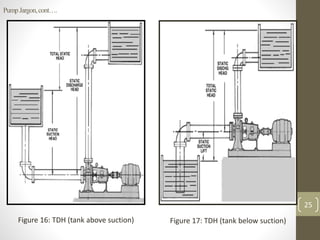
• Total Dynamic Discharge Head (TH or TDH)
• Same as corresponding static heads
• But it includes friction losses due to piping and
velocity
(tank above suction) : Total dynamic discharge head – total
dynamic suction head
(tank below suction) : Total dynamic discharge head + total
dynamic suction lift
24
PumpJargon,cont….
25
PumpJargon,cont….
Figure 16: TDH (tank above suction) Figure 17: TDH (tank below suction)
26
How the centrifugal pump works
Figure 18: Working pattern of centrifugal pump
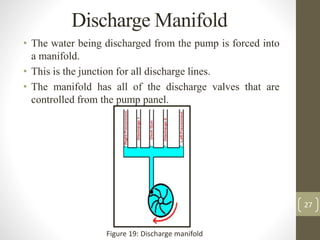
• The water being discharged from the pump is forced into
a manifold.
• This is the junction for all discharge lines.
• The manifold has all of the discharge valves that are
controlled from the pump panel.
27
Discharge Manifold
Figure 19: Discharge manifold
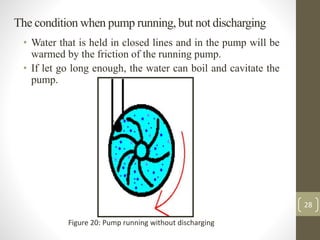
• Water that is held in closed lines and in the pump will be
warmed by the friction of the running pump.
• If let go long enough, the water can boil and cavitate the
pump.
28
The condition when pump running, but not discharging
Figure 20: Pump running without discharging
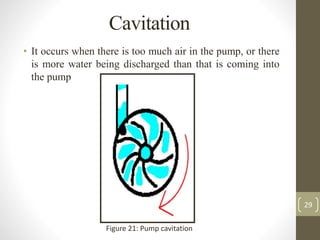
Cavitation
• It occurs when there is too much air in the pump, or there
is more water being discharged than that is coming into
the pump
29
Figure 21: Pump cavitation
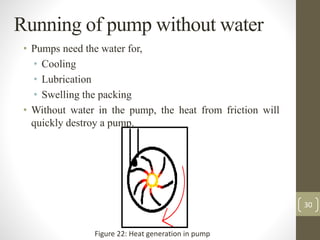
• Pumps need the water for,
• Cooling
• Lubrication
• Swelling the packing
• Without water in the pump, the heat from friction will
quickly destroy a pump.
30
Running of pump without water
Figure 22: Heat generation in pump
Advantages
• Initial and maintenance cost are low
• Simple mechanism
• Operated by high speed motor/engine
• Durable
• Cheap
• Simple in construction
• No metal to metal fits
• Handle liquid with large amount of solids
• No valves involved in pump operation
Advantages and disadvantages of centrifugal pumps
31
Disadvantages
• Require priming
• Check valve is required to avoid back flow
• Discharge varies with head
• Efficiency is low at high heads
• Suction is limited
• Can not handle highly viscous fluids efficiently
32
Advantagesanddisadvantagesofcentrifugalpumps,cont…
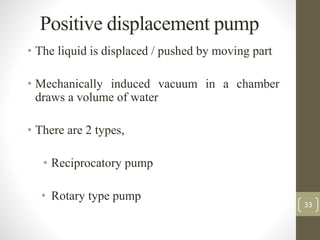
• The liquid is displaced / pushed by moving part
• Mechanically induced vacuum in a chamber
draws a volume of water
• There are 2 types,
• Reciprocatory pump
• Rotary type pump
Positive displacement pump
33
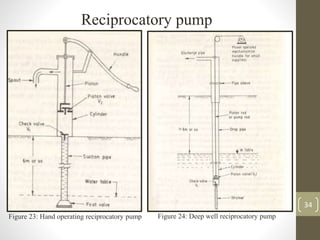
Figure 23: Hand operating reciprocatory pump Figure 24: Deep well reciprocatory pump
Reciprocatory pump
34
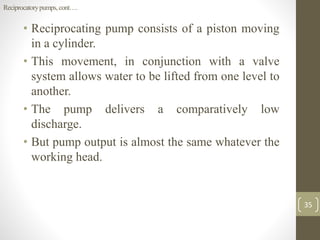
• Reciprocating pump consists of a piston moving
in a cylinder.
• This movement, in conjunction with a valve
system allows water to be lifted from one level to
another.
• The pump delivers a comparatively low
discharge.
• But pump output is almost the same whatever the
working head.
35
Reciprocatorypumps,cont….
Advantages
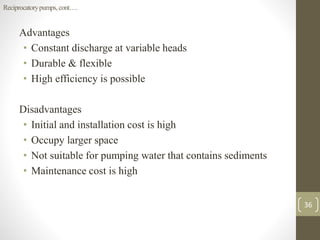
• Constant discharge at variable heads
• Durable & flexible
• High efficiency is possible
Disadvantages
• Initial and installation cost is high
• Occupy larger space
• Not suitable for pumping water that contains sediments
• Maintenance cost is high
Reciprocatorypumps,cont….
36
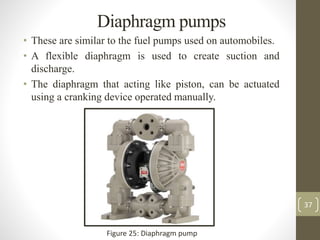
Diaphragm pumps
• These are similar to the fuel pumps used on automobiles.
• A flexible diaphragm is used to create suction and
discharge.
• The diaphragm that acting like piston, can be actuated
using a cranking device operated manually.
Figure 25: Diaphragm pump
37
• Rotary motion is used here.
• Rotary elements are cam or gear that fit closely to the casing
Rotary pumps
Figure 26: Rotary pump with cam Figure 27: Rotary pump with gear
38
Advantages of rotary pump
• No priming
• Flow is free from pulsation
• Efficiency is high
Disadvantages
• Cost is high
• Not durable
• Sediments in water are damaging the pumps
Rotarypumps,cont….
39
Other types of pumps
• There are some other kinds of pumps,
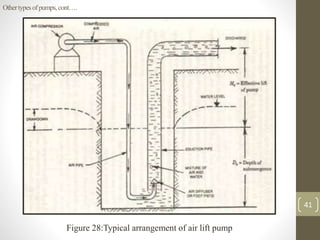
• Air lift pump - used for deep wells (60-80m)
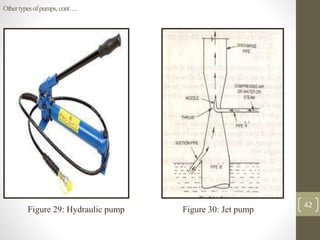
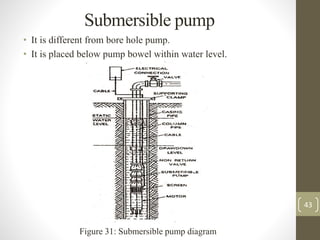
• Jet pump - suitable for small wells
• Hydraulic pump
40
Othertypesofpumps,cont….
Figure 28:Typical arrangement of air lift pump
41
Figure 29: Hydraulic pump Figure 30: Jet pump
Othertypesofpumps,cont….
42
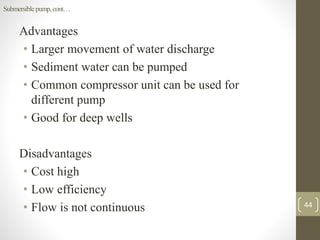
• It is different from bore hole pump.
• It is placed below pump bowel within water level.
Submersible pump
Figure 31: Submersible pump diagram
43
Advantages
• Larger movement of water discharge
• Sediment water can be pumped
• Common compressor unit can be used for
different pump
• Good for deep wells
Disadvantages
• Cost high
• Low efficiency
• Flow is not continuous
Submersiblepump,cont…
44
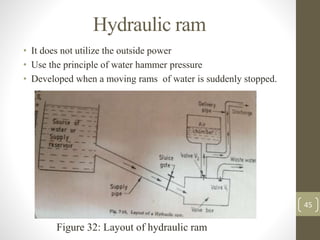
• It does not utilize the outside power
• Use the principle of water hammer pressure
• Developed when a moving rams of water is suddenly stopped.
Hydraulic ram
Figure 32: Layout of hydraulic ram
45
Advantages
• Simple to operate
• Durable
• Cheap
Disadvantages
• Noise pollution
• Wastage of water
Hydraulicram, cont….
46
THANK YOU
47

Different types of water pump

  • 1.
    Different types ofWater pump Vijitha Vikneshwaran Lecturer (Temporary) Faculty of Technology University of Jaffna
  • 2.
    Diaphragm Piston Plunger Reciprocating Rotary Mixed flow Gear Lobe SlidingVane Screw Axial flow Centrifugal Rotodynamic Turbine Positive displacement PUMP 2 2 Types of pumps
  • 3.
    Typesofpumps,cont…. Figure 01: Rotodynamicpump Figure 02: Positive Displacement pump 3
  • 4.
    Rotodynamic pump • Ithas a rotating element which rotates in a casing and imparts energy to water. • There are 4 types, •Centrifugal •Axial flow •Mixed flow •Turbine • The rotating element is impeller which creates radial flow of water. 4
  • 5.
    Rotodynamic pump Figure 03:Axial flow pump Figure 04: Mixed flow pump 5
  • 6.
  • 7.
    Pumping theory: • Energyis imparted to the water by a unit of rotating vanes called an impeller, which are located in a stationary body called the casing. • Water is pushed into the center or eye of the impeller by atmospheric or water pressure. • Then it sets into a rotary motion by the impeller. • The rotating movement causes a centrifugal force to act upon the water. • It drives the water outward, between the vanes of the impeller, into the surrounding casing from where it moves to the pump outlet. 7 Centrifugal pump
  • 8.
    Casing • Impellers arefitted inside casings. • The area of flow of the casing gradually increases in the direction of flow of water. • It convert kinematic energy into pressure energy. • Reducing speed while increasing pressure. • Seal it to prevent leakage and sometimes retain pressure. • Support some of the key parts such as shafts, bearings, etc. 8
  • 9.
    • There are2 types, • Volute type • Turbine type Casing of radial flow centrifugal pump Figure 06: Volute type Figure 07:Turbine type 9
  • 10.
    Casingofradialflowcentrifugalpump,cont…. • Volute type •The volute is a curved funnel that increases in area as it approaches the discharge port. • The volute of a centrifugal pump is the casing that receives the fluid being pumped by the impeller, slowing down the fluid’s rate of flow. • According to Bernoulli’s principle , the volute converts kinetic energy into pressure by reducing speed while increasing pressure. • Turbine type • Impeller surrounded by stationary guide vanes • Reduce the velocity of water before entering • Creating pressure head 10
  • 11.
    Impellers • Impellers canbe classified according to the direction of flow through the impeller in relation to the axis of rotation as, • Radial • Axial • Mixed flow • The most efficient impeller is an axial flow one which creates high flows at low heads. 11
  • 12.
    12 Impellers,cont… Figure 09: Radialflow Figure 08: Axial flow Figure 10: Mixed flow
  • 13.
    • Impellers canalso be classified according to their design into, • Open • Semi-open • Enclosed Open impeller • It has the vanes free on both sides • Open impellers are structurally weak • Use in small-diameter, inexpensive pumps and in pumps handling suspended solids 13 Impellers
  • 14.
    Semi open impeller •The vanes are free on one side and enclosed on the other side. • The shroud adds mechanical strength • Higher efficiency compare to open impeller Closed impeller • The vanes are located between the two discs, all in a single casting. • Use in large pumps with high efficiencies and low required Net Positive Suction Head • The centrifugal pumps with closed impeller are the most widely used pumps handling clear liquids. Impellers 14
  • 15.
    15 Impellers,cont… Figure 12: Enclosedimpeller Figure 13: Semi-open impeller Figure 11: Open impeller
  • 16.
    Centrifugal pump installation Figure14: installation of Centrifugal pump 16
  • 17.
  • 18.
    • Total statichead: Vertical distance between the free level of the source of supply and the point of free discharge or the free surface of the discharge liquid. • Static Discharge Head Vertical distance from pump centerline to the point of free discharge or the surface of the liquid in the discharge tank 18 PumpJargon,cont….
  • 19.
  • 20.
    PumpJargon,cont… • (Total) Statichead: Difference in head between suction and discharge sides of pump in the absence of flow; equals difference in elevation of free surfaces of the fluid source and destination • Static suction head: Head on suction side of pump in absence of flow, if pressure at that point is >0 • Static discharge head: Head on discharge side of pump in absence of flow Total static head Static suction head Static dischar ge head 20
  • 21.
    PumpJargon,cont… • (Total) Statichead: Difference in head between suction and discharge sides of pump in the absence of flow; equals difference in elevation of free surfaces of the fluid source and destination • Static suction lift: Negative head on suction side of pump in absence of flow, if pressure at that point is <0 • Static discharge head: Head on discharge side of pump in absence of flow Total static head Static suction lift Static dischar ge head 21
  • 22.
    PumpJargon,cont….. Total static head (both)Static suction lift Static dischar ge head Static suction head Static dischar ge head Static suction head Static suction lif Static discharge head Static d t Total static h ischarge he d ead a     Note: Suction and discharge head/lift measured from pump centerline 22
  • 23.
    • Total DynamicSuction Lift or Head • (fluid below suction) Static suction lift - velocity head at suction + total friction head in suction line • (fluid above suction) Static suction head + velocity head at pump suction flange – total friction head in suction line • Velocity head = energy of liquid due to motion 23 2 2 v v h g  PumpJargon,cont…..
  • 24.
    • Total DynamicDischarge Head (TH or TDH) • Same as corresponding static heads • But it includes friction losses due to piping and velocity (tank above suction) : Total dynamic discharge head – total dynamic suction head (tank below suction) : Total dynamic discharge head + total dynamic suction lift 24 PumpJargon,cont….
  • 25.
    25 PumpJargon,cont…. Figure 16: TDH(tank above suction) Figure 17: TDH (tank below suction)
  • 26.
    26 How the centrifugalpump works Figure 18: Working pattern of centrifugal pump
  • 27.
    • The waterbeing discharged from the pump is forced into a manifold. • This is the junction for all discharge lines. • The manifold has all of the discharge valves that are controlled from the pump panel. 27 Discharge Manifold Figure 19: Discharge manifold
  • 28.
    • Water thatis held in closed lines and in the pump will be warmed by the friction of the running pump. • If let go long enough, the water can boil and cavitate the pump. 28 The condition when pump running, but not discharging Figure 20: Pump running without discharging
  • 29.
    Cavitation • It occurswhen there is too much air in the pump, or there is more water being discharged than that is coming into the pump 29 Figure 21: Pump cavitation
  • 30.
    • Pumps needthe water for, • Cooling • Lubrication • Swelling the packing • Without water in the pump, the heat from friction will quickly destroy a pump. 30 Running of pump without water Figure 22: Heat generation in pump
  • 31.
    Advantages • Initial andmaintenance cost are low • Simple mechanism • Operated by high speed motor/engine • Durable • Cheap • Simple in construction • No metal to metal fits • Handle liquid with large amount of solids • No valves involved in pump operation Advantages and disadvantages of centrifugal pumps 31
  • 32.
    Disadvantages • Require priming •Check valve is required to avoid back flow • Discharge varies with head • Efficiency is low at high heads • Suction is limited • Can not handle highly viscous fluids efficiently 32 Advantagesanddisadvantagesofcentrifugalpumps,cont…
  • 33.
    • The liquidis displaced / pushed by moving part • Mechanically induced vacuum in a chamber draws a volume of water • There are 2 types, • Reciprocatory pump • Rotary type pump Positive displacement pump 33
  • 34.
    Figure 23: Handoperating reciprocatory pump Figure 24: Deep well reciprocatory pump Reciprocatory pump 34
  • 35.
    • Reciprocating pumpconsists of a piston moving in a cylinder. • This movement, in conjunction with a valve system allows water to be lifted from one level to another. • The pump delivers a comparatively low discharge. • But pump output is almost the same whatever the working head. 35 Reciprocatorypumps,cont….
  • 36.
    Advantages • Constant dischargeat variable heads • Durable & flexible • High efficiency is possible Disadvantages • Initial and installation cost is high • Occupy larger space • Not suitable for pumping water that contains sediments • Maintenance cost is high Reciprocatorypumps,cont…. 36
  • 37.
    Diaphragm pumps • Theseare similar to the fuel pumps used on automobiles. • A flexible diaphragm is used to create suction and discharge. • The diaphragm that acting like piston, can be actuated using a cranking device operated manually. Figure 25: Diaphragm pump 37
  • 38.
    • Rotary motionis used here. • Rotary elements are cam or gear that fit closely to the casing Rotary pumps Figure 26: Rotary pump with cam Figure 27: Rotary pump with gear 38
  • 39.
    Advantages of rotarypump • No priming • Flow is free from pulsation • Efficiency is high Disadvantages • Cost is high • Not durable • Sediments in water are damaging the pumps Rotarypumps,cont…. 39
  • 40.
    Other types ofpumps • There are some other kinds of pumps, • Air lift pump - used for deep wells (60-80m) • Jet pump - suitable for small wells • Hydraulic pump 40
  • 41.
  • 42.
    Figure 29: Hydraulicpump Figure 30: Jet pump Othertypesofpumps,cont…. 42
  • 43.
    • It isdifferent from bore hole pump. • It is placed below pump bowel within water level. Submersible pump Figure 31: Submersible pump diagram 43
  • 44.
    Advantages • Larger movementof water discharge • Sediment water can be pumped • Common compressor unit can be used for different pump • Good for deep wells Disadvantages • Cost high • Low efficiency • Flow is not continuous Submersiblepump,cont… 44
  • 45.
    • It doesnot utilize the outside power • Use the principle of water hammer pressure • Developed when a moving rams of water is suddenly stopped. Hydraulic ram Figure 32: Layout of hydraulic ram 45
  • 46.
    Advantages • Simple tooperate • Durable • Cheap Disadvantages • Noise pollution • Wastage of water Hydraulicram, cont…. 46
  • 47.