CHAPTER
PUMPS
24/05/2018 1
General out line of the topic
 Introduction.
 Pumps classifications.
• Hydraulic analysis, efficiencies and installation of
pumps.
 Cavitation in pumps.
 System curve, selection and characteristics curves of
pumps.
 Multiple operations of pumps(Pumps in series and
parallel).
 Specific speed and significances.
 Similarity laws ( affinity laws).
.
24/05/2018 2
3.0. Introduction
 Liquids have to be moved from one location to another
and one level to another in
• Domestic,
• Agricultural and
• Industrial spheres.
 The liquid is more often water in the domestic and
agriculture spheres.
 In industries chemicals, petroleum products and in some
cases slurries have to be moved, by pumping.
24/05/2018 3
Introduction(con’t)
 Water pumps are devices designed to convert mechanical energy to
hydraulic energy.
 They are used to move water from lower points to higher points with a
required discharge and pressure head.
 In general pumps add energy to the fluid - they do work on the fluid,
turbines extract energy from the fluid - the fluid does work on them.
 Turbo pumps are used to raise the level of potential energy of the fluid
and widely used in hydro and thermal power plants, chemical industries,
buildings and deep wells.
 This chapter will deal with the basic hydraulic concepts of water
pumps
24/05/2018 4
3.1. Pump Classification
 Three types of pumps are in use.
(1) Rotodynamic pumps:
 Move the fluid by dynamic action of imparting
momentum to the fluid using mechanical energy.
 These can handle from small volumes to very large
volumes.
 These pumps can handle corrosive and viscous, fluids
and even slurries.
 The overall efficiency is high in the case of these
pumps.24/05/2018 5
Pump Classification(con’t)
 Hence these are found to be the most popular pumps in use.
 It can be of radial flow, mixed flow and axial flow types
according to the flow direction.
 Radial flow pumps: handle lower volumes at higher
pressures (example, purely centrifugal pumps).
 Mixed flow pumps: handle larger volumes at medium
range of pressures ( example,Jet pumps ).
 Axial flow pumps: handle very large volumes, but the
pressure against which these pumps operate is limited.
(example, Propeller pumps ).
24/05/2018 6
Pump Classification(con’t)
(2) Reciprocating pumps:
 Which first trap the liquid in a cylinder by suction and then push the liquid
against pressure.
 Are limited by the low speed of operation required and small volumes it can
handle.
(3) Rotary positive displacement pumps:
 Which also trap the liquid in a volume and push the same out against pressure.
 Are limited by lower pressures of operation and small volumes these can
handle.
 Gear, vane and lobe pumps are of these type.
 The overall efficiency of the three types are nearly the same.
24/05/2018 7
3.2. Centrifugal pumps
 Energy is imparted to the fluid by centrifugal action of
moving blades from the inner radius to the outer radius.
 The main components of centrifugal pumps are
• The impeller.
• The casing or housing.
• The drive shaft with gland and packing.
• Suction pipe with one way valve (foot valve).
• Delivery pipe with delivery valve and
• The driving motor.
24/05/2018 8
 Which is the rotating part of the
centrifugal pump.
 It consists of a series of
backwards curved vanes (blades).
 The impeller is driven by a shaft
which is connected to the shaft
of an electric motor.
1. Impeller:
24/05/2018 9
Centrifugal Pumps(con’t)
 Impellers are of two types
Open impeller:- blades are arranged on a hub or backing
plate and are open on the other (casing or shroud) side.
 That is a simple disc with blades mounted
perpendicularly on it.
 They are well adopted for use with dirty or water
containing solids.
Enclosed or Shrouded impeller :- blades are covered on
both hub and shroud ends or another disc is used to
cover the blades.
 A shrouded impeller will have no peripheral leakage.
 This is more popular with water pumps.24/05/2018 10
24/05/2018 11
Centrifugal pumps(con’t)
 The liquid enters the eye of the impeller due to the
suction created by the impeller motion.
 The impeller blades guide the fluid and impart
momentum to the fluid, which increases the total head
(or pressure) of the fluid, causing the fluid to flow out.
 The fluid comes out at a high velocity which is not
directly usable.
24/05/2018 12
 Which is an air-tight passage
surrounding the impeller.
 Designed to direct the liquid
to the impeller and lead it
away.
 Part of the kinetic energy in
the fluid is converted to
pressure in the casing.
 Volute casing. It is of spiral
type in which the area of the
flow increases gradually.
2. Casing
24/05/2018 13
The Shaft:
 Is the bar by which the power is transmitted from
the motor drive to the impeller.
The driving motor:
 Is responsible for rotating the shaft.
 It can be mounted directly on the pump, above it, or
adjacent to it.
24/05/2018 14
Centrifugal Pumps(con’t)
Impeller
Vanes
Casing
Suction Eye Impeller
Discharge
Flow Expansion
 Broad range of applicable flows and heads
 Higher heads can be achieved by increasing the diameter or
the rotational speed of the impeller.
24/05/2018 15
24/05/2018 16
Centrifugal Pump(con’t)
 Centrifugal pumps (radial-flow pumps) are the most
used pumps for hydraulic purposes.
24/05/2018 17
24/05/2018 18
Centrifugal pumps(con’t)
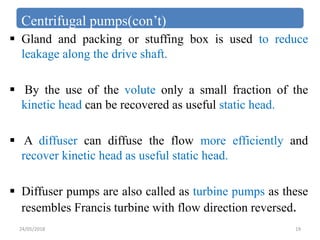
 Gland and packing or stuffing box is used to reduce
leakage along the drive shaft.
 By the use of the volute only a small fraction of the
kinetic head can be recovered as useful static head.
 A diffuser can diffuse the flow more efficiently and
recover kinetic head as useful static head.
 Diffuser pumps are also called as turbine pumps as these
resembles Francis turbine with flow direction reversed.
24/05/2018 19
24/05/2018 20
24/05/2018 21
3.2.1. Classification of centrifugal pumps
 As already mentioned, centrifugal pumps may be classified in
several ways.
On the basis of speed:
 Low speed, medium speed and high speed pumps.
On the basis of direction of flow of fluid:
 Radial flow, mixed flow and axial flow.
On the basis of head pumps:
 Low head (10 m and below), medium head (10-50 m) and
high head pumps.
24/05/2018 22
Classification of centrifugal pumps(con’t)
Single entry type and double entry type
 For the single suction impeller the fluid enters through
the eye from one side of impeller.
 Double entry pumps have blades on both sides of the
impeller disc and the fluid enters from both sides of the
impeller.
 This leads to reduction in axial thrust and increase in
flow for the same speed and diameter.
24/05/2018 23
24/05/2018 24
Classification of centrifugal pumps(con’t)
Single stage or multi-stage
 For a single stage pump, only one impeller is mounted
on the shaft
 For multi-stage pump, several impellers are mounted on
the same shaft.
 When the head required is high and which cannot be
developed by a single impeller, multi staging is used.
 In deep well submersible pumps the diameter is limited
by the diameter of the bore well casing.
24/05/2018 25
Classification of centrifugal pumps(con’t)
 In this case multi stage pump becomes a must.
 In multi stage pumps several impellers are mounted on the
same shaft and the outlet flow of one impeller is led to the
inlet of the next impeller and so on.
 The total head developed equals the sum of heads developed
by all the stages.
 Based on the specific speed of the pump.
 The expression for the dimensionless specific speed is given
in equation
24/05/2018 26
Classification of centrifugal pumps(con’t)
24/05/2018 27
24/05/2018 28
3.2.2. Working of Centrifugal Pump
 As the impeller rotates the fluid is sucked in through the eye
of the impeller and flows radially outward.
 Energy is added to the rotating blades and both pressure and
absolute velocity are increased as the fluid flows from the eye
to the periphery of the vanes.
 The fluid then discharges directly into a volute chamber.
 The volute is designed to reduce velocity and increase
pressure.
 The volute casing with an increase in area in the direction of
the fluid, is used to produce essentially a uniform velocity
distribution as fluid moves around the casing into discharge
opening.24/05/2018 29
3.2.3. Pressure developed by the impeller
 The general arrangement of a centrifugal pump system is
shown in Figure below.
Hs—Suction level above water level.
Hd—Delivery level above the impeller outlet.
hfd, hfs—frictionless m , m.
Vs, Vd —pipe velocities.
 Applying Bernoulli's equation between the water level and
pump suction,
24/05/2018 30
24/05/2018 31
Pressure developed by the impeller(con’t)
 Similarly applying Bernoulli’s theorem between the
pump delivery and the delivery at the tank,
24/05/2018 32
24/05/2018 33
3.2.4.Manometric Head
 The official code defines the head on the pump as the
difference in total energy heads at the suction and
delivery flanges.
 This head is defined as manometric head.
 The total energy at suction inlet (expressed as head of
fluid)
where Zs is the height of suction gauge from datum.
24/05/2018 34
Manometric head(con’t)
 The total energy at the delivery of the pump
Zd is the height of delivery gauge from datum.
∴ The difference in total energy is defined as Hm
We know that,
24/05/2018 35
Manometric head(con’t)
 Substituting, we get
 As (Zd – Zs) is small and V2
d/2g is also small as the
gauges are fixed as close as possible.
∴ Hm = Static head + all losses.
24/05/2018 36
3.2.5. Hydraulic Analysis of Pumps and Piping Systems
 Pump can be placed in two possible position in
reference to the water levels in the reservoirs.
 We begin our study by defining all the different terms
used to describe the pump performance in the piping
system.
24/05/2018 37
Hydraulic Analysis of Pumps and Piping Systems(con’t)
Ht
hd
Hstat
hs
Hms
Hmd
Datum pump
center line
hfs
hfd
Case 1
24/05/2018 38
Hstat
HmdHms
hd
Ht
hs
Datum pump
center line
hfd
hfs
Case 2
24/05/2018 39
 hs (static suction head): it is the difference in elevation
between the suction liquid level and the centerline of
the pump impeller.
 hd (static discharge head): it is the difference in
elevation between the discharge liquid level and the
centerline of the pump impeller.
 Hstat (static head): it is the difference (or sum) in
elevation between the static discharge and the static
suction heads:
H h hstat d s 
24/05/2018 40
 Hms (manometric suction head): it is the suction gage
reading (if a manometer is installed just at the inlet of
the pump, then Hms is the height to which the water will
rise in the manometer).
 Hmd (manometric discharge head): it is the discharge
gage reading (if a manometer is installed just at the
outlet of the pump, then Hmd is the height to which the
water will rise in the manometer).
 Hm (manometric head): it is the increase of pressure
head generated by the pump:
H H Hm md ms 
24/05/2018 41
 Ht (total dynamic head): it is the total head delivered
by the pump:
H H
V
g
H
V
gt md
d
ms
s
   
2 2
2 2
( )
H H
V
g
H
V
gt md
d
ms
s
   
2 2
2 2
( )
Case 1
Case 2
Eq.(1)
Eq.(2)
24/05/2018 42
 Ht can be written in another form as follows:
H h h hmd d f d md   
H h h h
V
gms s f s ms
s
   
2
2
H h h h
V
gms s f s ms
s
   
2
2
Case 1
Case 2
H h h h
V
g
h h h
V
g
V
gt d f d md
d
s f s ms
s s
         








2 2 2
2 2 2
H h hstat d s 
but
H H h h h h
V
gt stat f d md f s ms
d
      
2
2
Substitute into eq. (1)
Eq.(3)
Case 1
24/05/2018 43
3.2.6. Energy transfer by impeller
 The energy transfer is given by Euler Turbine equation
applied to work absorbing machines.
W = – (u1 Vu1 – u2 Vu2) = (u2 Vu2 – u1 Vu1)
This can be expressed as ideal head imparted as
 The velocity diagrams at inlet and outlet of a backward
curved vaned impeller is shown in figure below.
 The inlet whirl is generally zero.
 There is no guide vanes at inlet to impart whirl. So the
inlet triangle is right angled.
24/05/2018 44
24/05/2018 45
Energy transfer by impeller(con’t)
 V1 = Vf1 and are radial.
tanβ1=V1/u1 or Vf1/u1
Vu1=0 then the ideal head becomes
Hideal=Vu2u2/g
From the outlet triangle,
24/05/2018 46


p
o
i
t
i
Power output
Power input
P
P
Q H
P
  
P
Q H
i
t
p



or
Which is the power input delivered from the motor to the
impeller of the pump.
24/05/2018 47
Motor efficiency : m
m
i
m
P
P

P
P
m
i
m


which is the power input delivered to the motor.
o
  o p m
o
o
m
P
P

Overall efficiency of the motor-pump system:
24/05/2018 48
Pumps efficiency(con’t)
 Manometric efficiency is defined as the ratio of
manometric head and ideal head.
Hm = Static head + all losses (for practical purposes).
24/05/2018 49
Pumps efficiency(con’t)
 There are always some leakage of fluid after being
imparted energy by the impeller.
V2
d/2g is not really useful as output of the pump. Hence
the useful amount of energy transfer (as head, is taken as
(Ha)
 By algebraic manipulation, this can be obtained as
24/05/2018 50
3.2.8. Losses in Centrifugal Pumps.
 Mainly there are three specific losses which can be separately
calculated. These are
Mechanical friction losses:
 Between the fixed and rotating parts in the bearings and
gland and packing.
Disc friction loss:
 Between the impeller surfaces and the fluid.
Leakage and recirculation losses.
 The recirculation is along the clearance between the impeller
and the casing due to the pressure difference between the hub
and tip of the impeller.
 The various losses are indicated in figure below.
24/05/2018 51
24/05/2018 52
3.2.9. Effect of Outlet Blade Angle
 There are three possible orientation of the blade at the outlet.
 Forward curved, radial and Backward curved arrangements.
 The velocity triangles for the three arrangements are shown
in Figure below .
 In the case of forward curved blading Vu2 > u2 and V2 is
larger comparatively.
 In the case of radial blades Vu2 = u2.
 In the case of backward curved blading, Vu2 < u2.
24/05/2018 53
24/05/2018 54
3.3. Axial flow pump
 The flow in these machines is purely axial and axial
velocity is constant at all radii.
 The blade velocity varies with radius and so the velocity
diagrams and blade angles will be different at different
radii.
 Twisted blade or airfoil sections are used for the blading.
 Guide vanes are situated behind the impeller to direct the
flow axially without whirl.
24/05/2018 55
Axial flow pump(con’t)
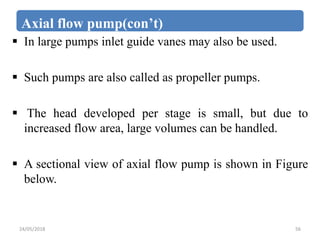
 In large pumps inlet guide vanes may also be used.
 Such pumps are also called as propeller pumps.
 The head developed per stage is small, but due to
increased flow area, large volumes can be handled.
 A sectional view of axial flow pump is shown in Figure
below.
24/05/2018 56
24/05/2018 57
Schematic diagram of axial-flow
pump arranged in vertical operation24/05/2018 58
Axial flow pump(con’t)
 The whirl at inlet is zero. The velocity triangles are
given in Figure below.
 Va is constant at all sections both at inlet and outlet.
 u varies with radius. Hence β1 and β2 will vary with
radius.
Hth =u2 Vu2/g as in the case of centrifugal pumps.
 All other efficiencies are similar to the centrifugal pump.
 The angle turned by the fluid during the flow over the
blades is about 10 – 15°.
24/05/2018 59
24/05/2018 60
Axial flow pump(con’t)
 Hence whirl imparted per stage is small.
 The number of blades is limited as in the case of Kaplan
turbine ranging between 2 and 8.
 The hub to tip ratio is in the range 0.3 to 0.6.
 Generally the blades are fixed.
 In rare designs the blades are rotated as in the case of
Kaplan turbine by suitable governing mechanism.
24/05/2018 61
3.3.1. Power transmitting systems
 Ordinarily power is transmitted by mechanical means like
gear drive or belt drive.
 In the case of gear drive there is a rigid connection between
the driving and driven shafts.
 The shocks and vibrations are passed on from one side to the
other which is not desirable.
 Also gear drives can not provide a step less variation of
speeds.
 In certain cases where the driven machine has a large inertia,
the driving prime mover like electric motor will not be able
to provide a large starting torque.
24/05/2018 62
Power transmitting systems(con’t)
 Instead of the mechanical connection if fluids can be
used for such drives, high inertia can be met.
 Also shock loads and vibration will not be passed on.
Smooth speed variation is also possible.
 The power transmitting systems offer these advantages.
 There are two types power transmitting devices.
 These are
(i) Fluid coupling and
(ii) Torque converter or torque multiplier.
24/05/2018 63
24/05/2018 64
24/05/2018 65
3.4. Reciprocating Pumps
 The main components are:
1. Cylinder with suitable valves at inlet and delivery.
2. Plunger or piston with piston rings.
3. Connecting rod and crank mechanism.
4. Suction pipe with one way valve.
5. Delivery pipe.
6. Supporting frame.
7. Air vessels to reduce flow fluctuation and reduction of
acceleration head and friction head.
24/05/2018 66
24/05/2018 67
• In the reciprocating pump a piston sucks the
fluid into a cylinder then pushes it up
causing the water to rise.
24/05/2018 68
3.4.1. Flow rate and power
 Theoretical flow rate per second for single acting pump
is given by,
Where L is the length of stroke, A is the cylinder or piston
area and N is the revolution per minute.
 It is desirable to express the same in terms of crank
radius and the angular velocity as simple harmonic
motion is assumed.
24/05/2018 69
Flow rate and power(con’t)
 In double acting pumps, the flow will be nearly twice
this value.
 If the piston rod area is taken into account, then
24/05/2018 70
Flow rate and power(con’t)
 Compared to the piston area, the piston rod area is very
small and neglecting this will lead to an error less than
1%.
 There fore
 For multicylinder pumps, the above expressions, are to
be multiplied by the number of cylinders.
24/05/2018 71
3.4.2. Air vessels
 Air vessel is a strong closed vessel as shown in figure below.
 The top half contains compressed air and the lower portion
contains water or the fluid being pumped.
 Air and water are separated by a flexible diaphragm which
can move up or down depending on the difference in pressure
between the fluids.
 The air charged at near total delivery pressure/suction
pressure from the top and sealed.
 The air vessel is connected to the pipe lines very near the
pump, at nearly the pump level.24/05/2018 72
24/05/2018 73
3.5. Rotary positive displacement pumps
 In order to avoid the complexity of construction and restriction on
speed of the reciprocating pumps, rotary positive displacement
pumps have been developed.
 These can run at higher speeds and produce moderately high
pressures.
 These are very compact and can be made for very low delivery
volumes also.
 These are extensively used for pumping lubricant to the engine
parts and oil hydraulic control systems.
 These are not suited for water pumping.
 Some types described in this section are: (i) Gear pump, (ii) Lobe
pump and Vane pump.24/05/2018 74
Gear Pump
 These are used more often for oil pumping.
 Consist of two identical mating gears in a casing.
 The gears rotate as indicated in the sketch.
 Oil is trapped in the space between the gear teeth and the
casing.
 The oil is then carried from the lower pressure and is
delivered at the pressure side.
 The two sides are sealed by the meshing teeth in the
middle.
 The maximum pressure that can be developed depends on
the clearance and viscosity of the oil.
24/05/2018 75
24/05/2018 76
Lobe Pump
 This type is also popularly used with oil.
 The diagrammatic sketch of a lobe pump is shown in figure below.
 This is a three lobed pump.
 Two lobe pump is also possible.
 The gear teeth are replaced by lobes.
 Two lobes are arranged in a casing.
 As the rotor rotates, oil is trapped in the space between the lobe and the
casing and is carried to the pressure side.
 Helical lobes along the axis are used for smooth operation.
24/05/2018 77
24/05/2018 78
Lobe Pump
 Oil has to be filled before starting the pump.
 Lobe type of compressors are also in use.
 The constant contact between the lobes makes a leak tight
joint preventing oil leakage from the pressure side.
 The maximum pressure of operation is controlled by the
back leakage through the clearance.
 This type of pump has a higher capacity compared to the
gear pump.
24/05/2018 79
Vane Pump
 This is another popular type not only for oil but also for gases.
 A rotor is eccentrically placed in the casing as shown in figure
below.
 The rotor carries sliding vanes in slots along the length.
 Springs control the movement of the vanes and keep them pressed
on the casing.
 Oil is trapped between the vanes and the casing.
 As the rotor rotates the trapped oil is carried to the pressure side.
 The maximum operating pressure is controlled by the back leakage.
24/05/2018 80
24/05/2018 81
3.6. Cavitation
 What is cavitation and where and why it occurs has been
discussed in the chapter on turbines.
 In the case of pumps, the pressure is lowest at the inlet
and cavitation damage occurs at the inlet.
 For cavitation to occur the pressure at the location
should be near the vapour pressure at the location.
24/05/2018 82
 Under this condition, vapor bubbles form (water
starts to boil) at the impeller inlet and when these
bubbles are carried into a zone of higher pressure,
they collapse abruptly and hit the vanes of the
impeller (near the tips of the impeller vanes). causing:
• Damage to the pump (pump impeller)
• Violet vibrations (and noise).
• Reduce pump capacity.
• Reduce pump efficiency
 Applying the energy equation between sump surface
and the pump suction
24/05/2018 83
Cavitation(con’t)
where Z is the height from sump surface and pump suction.
 The other terms have their usual significance.
 The term hfs should include all losses in the suction line.
 Net Positive Suction Head (NPSH) is defined as the
available total suction head at the pump inlet above the
head corresponding to the vapour pressure at that
temperature.
24/05/2018 84
Cavitation(con’t)
 There are two values of NPSH of interest.
(1). Required NPSH, denoted (NPSH)R , that must be
maintained or exceeded so that cavitation will not occur and
usually determined experimentally and provided by the
manufacturer.
(2). Available NPSH, denoted (NPSH)A , which represents the
head that actually occurs for the particular piping system. This
value can be determined experimentally, or calculated if the
system parameters are known.
 For proper pump operation (no cavitation) :
(NPSH)A>(NPSH)R
24/05/2018 85
Cavitation(con’t)
where Pv is the vapour pressure.
 From the equation above
 Thoma cavitation parameter is defined by
24/05/2018 86
Cavitation(con’t)
 At cavitation conditions,
 The height of suction, the frictional losses in the suction
line play an important role for avoiding cavitation at a
location.
 When pumps designed for one location is used at another
location, atmospheric pressure plays a role in the onset of
cavitation.
24/05/2018 87
Cavitation(con’t)
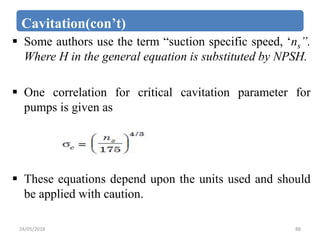
 Some authors use the term “suction specific speed, ‘ns”.
Where H in the general equation is substituted by NPSH.
 One correlation for critical cavitation parameter for
pumps is given as
 These equations depend upon the units used and should
be applied with caution.
24/05/2018 88
3.7. Pump Performance Curve
 A mapping or graphing of the pump's ability to
produce head and flow
24/05/2018 89
Pump Performance Curve(con’t)
Step #1, Horizontal Axis
 The pump's flow rate is plotted on the
horizontal axis ( X axis)
 Usually expressed in m3 per Minute
Pump Flow Rate
24/05/2018 90
Pump Performance Curve(con’t)
Pump Flow Rate
Step #2, Vertical Axis
 The head the pump produces is plotted on
the vertical axis (Y axis).
 Usually express in meter of Water
Head
24/05/2018 91
Pump Performance Curve(con’t)
Pump Flow Rate
Step #3, Mapping the Flow and the Head
 Most pump performance
curves slope from left to right
Performance Curve
Head
24/05/2018 92
Pump Performance Curve(con’t)
 Shut-off Head is the
maximum pressure or
head the pump can
produce
 No flow is produced
Pump Flow Rate
Head
Shut-off Head
24/05/2018 93
Pump Performance Curve(con’t)
Pump Flow Rate
Head
Maximum Flow
 Maximum Flow is the
largest flow the pump can
produce
 No Head is produced
24/05/2018 94
 System Performance Curve is a mapping of the
head required to produce flow in a given
system.
 A system includes all the pipe, fittings and
devices the fluid must flow through, and
represents the friction loss the fluid
experiences.
 Lstatt hHH
24/05/2018 95
System Performance Curve(con’t)
System Flow Rate
Step #1, Horizontal Axis
 The System's flow rate is plotted on the
horizontal axis ( X axis).
 Usually expressed in m3 per Minute
24/05/2018 96
System Performance Curve(con’t)
Pump Flow Rate
Step #2, Vertical Axis
 The head the system requires is plotted on
the vertical axis (Y axis).
 Usually express in meter of Water
Head
24/05/2018 97
System Performance Curve(con’t)
Step #3, Curve Mapping
 The friction loss is mapped onto the graph
 The amount of friction loss varies with flow
through the system
Head
Pump Flow Rate
Friction Loss
24/05/2018 98
Head
Pump Flow Rate
The point on the system curve that intersects the
pump curve is known as the operating point.
24/05/2018 99
3.9. Selection of A Pump
It has been seen that the efficiency of a pump depends on the
discharge, head, and power requirement of the pump. The
approximate ranges of application of each type of pump are
indicated in the following Figure.
24/05/2018 100
Selection of A Pump(con’t)
In selecting a particular pump for a given system.
 The design conditions are specified and a pump is selected for
the range of applications.
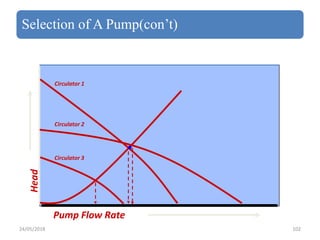
 A system characteristic curve (H-Q) is then prepared.
 The H-Q curve is then matched to the pump characteristics
chart which is provided by the manufacturer.
 The matching point (operating point) indicates the actual
working conditions.24/05/2018 101
Head
Pump Flow Rate
Circulator 1
Circulator 2
Circulator 3
Selection of A Pump(con’t)
24/05/2018 102
3.10. Pump Characteristic Curves
 Pump manufacturers provide information on the performance
of their pumps in the form of curves, commonly called pump
characteristic curves (or simply pump curves).
 In pump curves the following information may be given:
• The discharge on the x-axis,
• The head on the left y-axis,
• The pump power input on the right y-axis,
• The pump efficiency as a percentage,
• The speed of the pump (rpm = revolutions/min).
• The NPSH of the pump.
24/05/2018 103
NPSH-m
Q (m /hr)
20
10
0 100 200
H(m)
70
60
50
40
30
Pump Curve
NPSH
efficiency
300
3
400
6
70%
60%
50%
40%
4
2
0
Efficiency
%
80%
24/05/2018 104
 The pump characteristic curves are very important to help
select the required pump for the specified conditions.
 If the system curve is plotted on the pump curves as shown,
we may produce the following Figure:
 This matching point indicates the actual working conditions,
and therefore the proper pump that satisfy all required
performance characteristic is selected.
Matching the system and pump curves.
24/05/2018 105
15
30
10
20
0 3
Q (m /hr)
6 9
3
12
Pump Curve
H (m)
efficiency
70
40
50
60
System Curve
18
NPSH-m
4
2
0
6
40%
50%
60%
70%
Efficiency%
24/05/2018 106
3.11. Multiple-Pump Operation
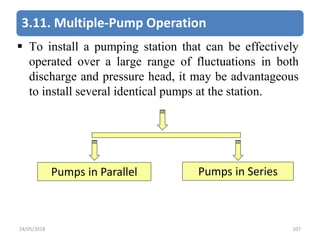
 To install a pumping station that can be effectively
operated over a large range of fluctuations in both
discharge and pressure head, it may be advantageous
to install several identical pumps at the station.
Pumps in Parallel Pumps in Series
24/05/2018 107
3.11.1. Parallel Operation
 Pumping stations frequently contain several (two or
more) pumps in a parallel arrangement.
Q1 Q2 Q3
Pump PumpPump
Manifold
Qtotal
Qtotal =Q1+Q2+Q3
24/05/2018 108
3.11.1. Parallel Operation(con’t)
 In this configuration any number of the pumps can be
operated simultaneously.
 The objective being to deliver a range of discharges, i.e.;
the discharge is increased but the pressure head remains
the same as with a single pump.
 This is a common feature of sewage pumping stations
where the inflow rate varies during the day.
 By automatic switching according to the level in the
suction reservoir any number of the pumps can be
brought into operation.24/05/2018 109
How to draw the pump curve for pumps in parallel?
 The manufacturer gives the pump curve for a single
pump operation only.
 If two or pumps are in operation, the pumps curve should
be calculated and drawn using the single pump curve.
 For pumps in parallel, the curve of two pumps, for
example, is produced by adding the discharges of the two
pumps at the same head (assuming identical pumps).
24/05/2018 110
Pumps in Parallel:
mnm3m2m1m
nj
1j
n321
HHHHH
QQQQQQ

 




24/05/2018 111
24/05/2018 112
3.11.2. Series Operation
 The series configuration which is used whenever we
need to increase the pressure head and keep the discharge
approximately the same as that of a single pump.
 This configuration is the basis of multistage pumps; the
discharge from the first pump (or stage) is delivered to
the inlet of the second pump, and so on.
 The same discharge passes through each pump receiving
a pressure boost in doing so.
24/05/2018 113
Q
Pump PumpPump
Q
Htotal =H1+H2+H3
24/05/2018 114
How to draw the pump curve for pumps in series?
 The manufacturer gives the pump curve for a single
pump operation only.
 For pumps in series, the curve of two pumps, for
example, is produced by adding the heads of the two
pumps at the same discharge.
 Note that, of course, all pumps in a series system must be
operating simultaneously.
24/05/2018 115
H
Q
Q1
H1
H1
H1
2H1
H1
3H1
Single pump
Two pumps
in series
Three pumps
in series
24/05/2018 116
3.12. Specific speed and significance
 Some of the dimensionless parameters pertaining to
pumps have been derived in the chapter on Dimensional
analysis.
Flow coefficient:
For similar machine and also the same machine.
 In the case of same machine D is constant.
24/05/2018 117
Specific speed and significance(con’t)
Head parameter :
 The head parameter is constant for similar machines.
 For the same machine.
Power parameter :
 Multiplying the two parameters,
24/05/2018 118
Specific speed and significance(con’t)
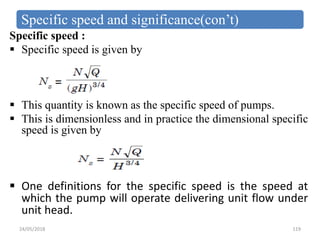
Specific speed :
 Specific speed is given by
 This quantity is known as the specific speed of pumps.
 This is dimensionless and in practice the dimensional specific
speed is given by
 One definitions for the specific speed is the speed at
which the pump will operate delivering unit flow under
unit head.
24/05/2018 119
Specific speed and significance(con’t)
 Actually the significance of the specific speed is its
indication of the flow direction, width etc of the
impeller.
 It is seen that different types of pumps have best
efficiency at different specific speeds.
24/05/2018 120
3.13. Similarity Laws: Affinity laws
 The actual performance characteristics curves of pumps
have to be determined by experimental testing.
 Furthermore, pumps belonging to the same family, i.e.;
being of the same design but manufactured in different
sizes and, thus, constituting a series of geometrically
similar machines, may also run at different speeds within
practical limits.
 Each size and speed combination will produce a unique
characteristics curve, so that for one family of pumps the
number of characteristics curves needed to be determined
is impossibly large.
24/05/2018 121
Similarity Laws: Affinity laws
 The problem is solved by the application of dimensional
analysis and by replacing the variables by dimensionless
groups so obtained.
 These dimensionless groups provide the similarity
(affinity) laws governing the relationships between the
variables within one family of geometrically similar
pumps.
• Thus, the similarity laws enable us to obtain a set of
characteristic curves for a pump from the known test data
of a geometrically similar pump.
24/05/2018 122
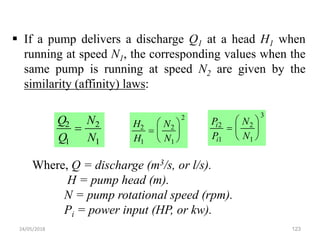
 If a pump delivers a discharge Q1 at a head H1 when
running at speed N1, the corresponding values when the
same pump is running at speed N2 are given by the
similarity (affinity) laws:
Q
Q
N
N
2
1
2
1
 H
H
N
N
2
1
2
1
2







P
P
N
N
i
i
2
1
2
1
3







Where, Q = discharge (m3/s, or l/s).
H = pump head (m).
N = pump rotational speed (rpm).
Pi = power input (HP, or kw).
24/05/2018 123
 Therefore, if the pump
curve for speed N1 is
given, we can construct
the pump curve for the
speed N2 using previous
relationships.
Effect of speed change on pump
characteristic curves.
N1
N2
24/05/2018 124
 A change in pump size and therefore, impeller
diameter (D), results in a new set of characteristic
curves using the following similarity (affinity) laws:
Q
Q
D
D
2
1
2
1
3







H
H
D
D
2
1
2
1
2







P
P
D
D
i
i
2
1
2
1
5







where D = impeller diameter (m, cm).
Note : D indicated the size of the pump
24/05/2018 125
53
OF
CHAPTER
THREE
END
24/05/2018 126

Hm ch3 pumps

  • 1.
  • 2.
    General out lineof the topic  Introduction.  Pumps classifications. • Hydraulic analysis, efficiencies and installation of pumps.  Cavitation in pumps.  System curve, selection and characteristics curves of pumps.  Multiple operations of pumps(Pumps in series and parallel).  Specific speed and significances.  Similarity laws ( affinity laws). . 24/05/2018 2
  • 3.
    3.0. Introduction  Liquidshave to be moved from one location to another and one level to another in • Domestic, • Agricultural and • Industrial spheres.  The liquid is more often water in the domestic and agriculture spheres.  In industries chemicals, petroleum products and in some cases slurries have to be moved, by pumping. 24/05/2018 3
  • 4.
    Introduction(con’t)  Water pumpsare devices designed to convert mechanical energy to hydraulic energy.  They are used to move water from lower points to higher points with a required discharge and pressure head.  In general pumps add energy to the fluid - they do work on the fluid, turbines extract energy from the fluid - the fluid does work on them.  Turbo pumps are used to raise the level of potential energy of the fluid and widely used in hydro and thermal power plants, chemical industries, buildings and deep wells.  This chapter will deal with the basic hydraulic concepts of water pumps 24/05/2018 4
  • 5.
    3.1. Pump Classification Three types of pumps are in use. (1) Rotodynamic pumps:  Move the fluid by dynamic action of imparting momentum to the fluid using mechanical energy.  These can handle from small volumes to very large volumes.  These pumps can handle corrosive and viscous, fluids and even slurries.  The overall efficiency is high in the case of these pumps.24/05/2018 5
  • 6.
    Pump Classification(con’t)  Hencethese are found to be the most popular pumps in use.  It can be of radial flow, mixed flow and axial flow types according to the flow direction.  Radial flow pumps: handle lower volumes at higher pressures (example, purely centrifugal pumps).  Mixed flow pumps: handle larger volumes at medium range of pressures ( example,Jet pumps ).  Axial flow pumps: handle very large volumes, but the pressure against which these pumps operate is limited. (example, Propeller pumps ). 24/05/2018 6
  • 7.
    Pump Classification(con’t) (2) Reciprocatingpumps:  Which first trap the liquid in a cylinder by suction and then push the liquid against pressure.  Are limited by the low speed of operation required and small volumes it can handle. (3) Rotary positive displacement pumps:  Which also trap the liquid in a volume and push the same out against pressure.  Are limited by lower pressures of operation and small volumes these can handle.  Gear, vane and lobe pumps are of these type.  The overall efficiency of the three types are nearly the same. 24/05/2018 7
  • 8.
    3.2. Centrifugal pumps Energy is imparted to the fluid by centrifugal action of moving blades from the inner radius to the outer radius.  The main components of centrifugal pumps are • The impeller. • The casing or housing. • The drive shaft with gland and packing. • Suction pipe with one way valve (foot valve). • Delivery pipe with delivery valve and • The driving motor. 24/05/2018 8
  • 9.
     Which isthe rotating part of the centrifugal pump.  It consists of a series of backwards curved vanes (blades).  The impeller is driven by a shaft which is connected to the shaft of an electric motor. 1. Impeller: 24/05/2018 9
  • 10.
    Centrifugal Pumps(con’t)  Impellersare of two types Open impeller:- blades are arranged on a hub or backing plate and are open on the other (casing or shroud) side.  That is a simple disc with blades mounted perpendicularly on it.  They are well adopted for use with dirty or water containing solids. Enclosed or Shrouded impeller :- blades are covered on both hub and shroud ends or another disc is used to cover the blades.  A shrouded impeller will have no peripheral leakage.  This is more popular with water pumps.24/05/2018 10
  • 11.
  • 12.
    Centrifugal pumps(con’t)  Theliquid enters the eye of the impeller due to the suction created by the impeller motion.  The impeller blades guide the fluid and impart momentum to the fluid, which increases the total head (or pressure) of the fluid, causing the fluid to flow out.  The fluid comes out at a high velocity which is not directly usable. 24/05/2018 12
  • 13.
     Which isan air-tight passage surrounding the impeller.  Designed to direct the liquid to the impeller and lead it away.  Part of the kinetic energy in the fluid is converted to pressure in the casing.  Volute casing. It is of spiral type in which the area of the flow increases gradually. 2. Casing 24/05/2018 13
  • 14.
    The Shaft:  Isthe bar by which the power is transmitted from the motor drive to the impeller. The driving motor:  Is responsible for rotating the shaft.  It can be mounted directly on the pump, above it, or adjacent to it. 24/05/2018 14
  • 15.
    Centrifugal Pumps(con’t) Impeller Vanes Casing Suction EyeImpeller Discharge Flow Expansion  Broad range of applicable flows and heads  Higher heads can be achieved by increasing the diameter or the rotational speed of the impeller. 24/05/2018 15
  • 16.
  • 17.
    Centrifugal Pump(con’t)  Centrifugalpumps (radial-flow pumps) are the most used pumps for hydraulic purposes. 24/05/2018 17
  • 18.
  • 19.
    Centrifugal pumps(con’t)  Glandand packing or stuffing box is used to reduce leakage along the drive shaft.  By the use of the volute only a small fraction of the kinetic head can be recovered as useful static head.  A diffuser can diffuse the flow more efficiently and recover kinetic head as useful static head.  Diffuser pumps are also called as turbine pumps as these resembles Francis turbine with flow direction reversed. 24/05/2018 19
  • 20.
  • 21.
  • 22.
    3.2.1. Classification ofcentrifugal pumps  As already mentioned, centrifugal pumps may be classified in several ways. On the basis of speed:  Low speed, medium speed and high speed pumps. On the basis of direction of flow of fluid:  Radial flow, mixed flow and axial flow. On the basis of head pumps:  Low head (10 m and below), medium head (10-50 m) and high head pumps. 24/05/2018 22
  • 23.
    Classification of centrifugalpumps(con’t) Single entry type and double entry type  For the single suction impeller the fluid enters through the eye from one side of impeller.  Double entry pumps have blades on both sides of the impeller disc and the fluid enters from both sides of the impeller.  This leads to reduction in axial thrust and increase in flow for the same speed and diameter. 24/05/2018 23
  • 24.
  • 25.
    Classification of centrifugalpumps(con’t) Single stage or multi-stage  For a single stage pump, only one impeller is mounted on the shaft  For multi-stage pump, several impellers are mounted on the same shaft.  When the head required is high and which cannot be developed by a single impeller, multi staging is used.  In deep well submersible pumps the diameter is limited by the diameter of the bore well casing. 24/05/2018 25
  • 26.
    Classification of centrifugalpumps(con’t)  In this case multi stage pump becomes a must.  In multi stage pumps several impellers are mounted on the same shaft and the outlet flow of one impeller is led to the inlet of the next impeller and so on.  The total head developed equals the sum of heads developed by all the stages.  Based on the specific speed of the pump.  The expression for the dimensionless specific speed is given in equation 24/05/2018 26
  • 27.
    Classification of centrifugalpumps(con’t) 24/05/2018 27
  • 28.
  • 29.
    3.2.2. Working ofCentrifugal Pump  As the impeller rotates the fluid is sucked in through the eye of the impeller and flows radially outward.  Energy is added to the rotating blades and both pressure and absolute velocity are increased as the fluid flows from the eye to the periphery of the vanes.  The fluid then discharges directly into a volute chamber.  The volute is designed to reduce velocity and increase pressure.  The volute casing with an increase in area in the direction of the fluid, is used to produce essentially a uniform velocity distribution as fluid moves around the casing into discharge opening.24/05/2018 29
  • 30.
    3.2.3. Pressure developedby the impeller  The general arrangement of a centrifugal pump system is shown in Figure below. Hs—Suction level above water level. Hd—Delivery level above the impeller outlet. hfd, hfs—frictionless m , m. Vs, Vd —pipe velocities.  Applying Bernoulli's equation between the water level and pump suction, 24/05/2018 30
  • 31.
  • 32.
    Pressure developed bythe impeller(con’t)  Similarly applying Bernoulli’s theorem between the pump delivery and the delivery at the tank, 24/05/2018 32
  • 33.
  • 34.
    3.2.4.Manometric Head  Theofficial code defines the head on the pump as the difference in total energy heads at the suction and delivery flanges.  This head is defined as manometric head.  The total energy at suction inlet (expressed as head of fluid) where Zs is the height of suction gauge from datum. 24/05/2018 34
  • 35.
    Manometric head(con’t)  Thetotal energy at the delivery of the pump Zd is the height of delivery gauge from datum. ∴ The difference in total energy is defined as Hm We know that, 24/05/2018 35
  • 36.
    Manometric head(con’t)  Substituting,we get  As (Zd – Zs) is small and V2 d/2g is also small as the gauges are fixed as close as possible. ∴ Hm = Static head + all losses. 24/05/2018 36
  • 37.
    3.2.5. Hydraulic Analysisof Pumps and Piping Systems  Pump can be placed in two possible position in reference to the water levels in the reservoirs.  We begin our study by defining all the different terms used to describe the pump performance in the piping system. 24/05/2018 37
  • 38.
    Hydraulic Analysis ofPumps and Piping Systems(con’t) Ht hd Hstat hs Hms Hmd Datum pump center line hfs hfd Case 1 24/05/2018 38
  • 39.
  • 40.
     hs (staticsuction head): it is the difference in elevation between the suction liquid level and the centerline of the pump impeller.  hd (static discharge head): it is the difference in elevation between the discharge liquid level and the centerline of the pump impeller.  Hstat (static head): it is the difference (or sum) in elevation between the static discharge and the static suction heads: H h hstat d s  24/05/2018 40
  • 41.
     Hms (manometricsuction head): it is the suction gage reading (if a manometer is installed just at the inlet of the pump, then Hms is the height to which the water will rise in the manometer).  Hmd (manometric discharge head): it is the discharge gage reading (if a manometer is installed just at the outlet of the pump, then Hmd is the height to which the water will rise in the manometer).  Hm (manometric head): it is the increase of pressure head generated by the pump: H H Hm md ms  24/05/2018 41
  • 42.
     Ht (totaldynamic head): it is the total head delivered by the pump: H H V g H V gt md d ms s     2 2 2 2 ( ) H H V g H V gt md d ms s     2 2 2 2 ( ) Case 1 Case 2 Eq.(1) Eq.(2) 24/05/2018 42
  • 43.
     Ht canbe written in another form as follows: H h h hmd d f d md    H h h h V gms s f s ms s     2 2 H h h h V gms s f s ms s     2 2 Case 1 Case 2 H h h h V g h h h V g V gt d f d md d s f s ms s s                   2 2 2 2 2 2 H h hstat d s  but H H h h h h V gt stat f d md f s ms d        2 2 Substitute into eq. (1) Eq.(3) Case 1 24/05/2018 43
  • 44.
    3.2.6. Energy transferby impeller  The energy transfer is given by Euler Turbine equation applied to work absorbing machines. W = – (u1 Vu1 – u2 Vu2) = (u2 Vu2 – u1 Vu1) This can be expressed as ideal head imparted as  The velocity diagrams at inlet and outlet of a backward curved vaned impeller is shown in figure below.  The inlet whirl is generally zero.  There is no guide vanes at inlet to impart whirl. So the inlet triangle is right angled. 24/05/2018 44
  • 45.
  • 46.
    Energy transfer byimpeller(con’t)  V1 = Vf1 and are radial. tanβ1=V1/u1 or Vf1/u1 Vu1=0 then the ideal head becomes Hideal=Vu2u2/g From the outlet triangle, 24/05/2018 46
  • 47.
      p o i t i Power output Power input P P QH P    P Q H i t p    or Which is the power input delivered from the motor to the impeller of the pump. 24/05/2018 47
  • 48.
    Motor efficiency :m m i m P P  P P m i m   which is the power input delivered to the motor. o   o p m o o m P P  Overall efficiency of the motor-pump system: 24/05/2018 48
  • 49.
    Pumps efficiency(con’t)  Manometricefficiency is defined as the ratio of manometric head and ideal head. Hm = Static head + all losses (for practical purposes). 24/05/2018 49
  • 50.
    Pumps efficiency(con’t)  Thereare always some leakage of fluid after being imparted energy by the impeller. V2 d/2g is not really useful as output of the pump. Hence the useful amount of energy transfer (as head, is taken as (Ha)  By algebraic manipulation, this can be obtained as 24/05/2018 50
  • 51.
    3.2.8. Losses inCentrifugal Pumps.  Mainly there are three specific losses which can be separately calculated. These are Mechanical friction losses:  Between the fixed and rotating parts in the bearings and gland and packing. Disc friction loss:  Between the impeller surfaces and the fluid. Leakage and recirculation losses.  The recirculation is along the clearance between the impeller and the casing due to the pressure difference between the hub and tip of the impeller.  The various losses are indicated in figure below. 24/05/2018 51
  • 52.
  • 53.
    3.2.9. Effect ofOutlet Blade Angle  There are three possible orientation of the blade at the outlet.  Forward curved, radial and Backward curved arrangements.  The velocity triangles for the three arrangements are shown in Figure below .  In the case of forward curved blading Vu2 > u2 and V2 is larger comparatively.  In the case of radial blades Vu2 = u2.  In the case of backward curved blading, Vu2 < u2. 24/05/2018 53
  • 54.
  • 55.
    3.3. Axial flowpump  The flow in these machines is purely axial and axial velocity is constant at all radii.  The blade velocity varies with radius and so the velocity diagrams and blade angles will be different at different radii.  Twisted blade or airfoil sections are used for the blading.  Guide vanes are situated behind the impeller to direct the flow axially without whirl. 24/05/2018 55
  • 56.
    Axial flow pump(con’t) In large pumps inlet guide vanes may also be used.  Such pumps are also called as propeller pumps.  The head developed per stage is small, but due to increased flow area, large volumes can be handled.  A sectional view of axial flow pump is shown in Figure below. 24/05/2018 56
  • 57.
  • 58.
    Schematic diagram ofaxial-flow pump arranged in vertical operation24/05/2018 58
  • 59.
    Axial flow pump(con’t) The whirl at inlet is zero. The velocity triangles are given in Figure below.  Va is constant at all sections both at inlet and outlet.  u varies with radius. Hence β1 and β2 will vary with radius. Hth =u2 Vu2/g as in the case of centrifugal pumps.  All other efficiencies are similar to the centrifugal pump.  The angle turned by the fluid during the flow over the blades is about 10 – 15°. 24/05/2018 59
  • 60.
  • 61.
    Axial flow pump(con’t) Hence whirl imparted per stage is small.  The number of blades is limited as in the case of Kaplan turbine ranging between 2 and 8.  The hub to tip ratio is in the range 0.3 to 0.6.  Generally the blades are fixed.  In rare designs the blades are rotated as in the case of Kaplan turbine by suitable governing mechanism. 24/05/2018 61
  • 62.
    3.3.1. Power transmittingsystems  Ordinarily power is transmitted by mechanical means like gear drive or belt drive.  In the case of gear drive there is a rigid connection between the driving and driven shafts.  The shocks and vibrations are passed on from one side to the other which is not desirable.  Also gear drives can not provide a step less variation of speeds.  In certain cases where the driven machine has a large inertia, the driving prime mover like electric motor will not be able to provide a large starting torque. 24/05/2018 62
  • 63.
    Power transmitting systems(con’t) Instead of the mechanical connection if fluids can be used for such drives, high inertia can be met.  Also shock loads and vibration will not be passed on. Smooth speed variation is also possible.  The power transmitting systems offer these advantages.  There are two types power transmitting devices.  These are (i) Fluid coupling and (ii) Torque converter or torque multiplier. 24/05/2018 63
  • 64.
  • 65.
  • 66.
    3.4. Reciprocating Pumps The main components are: 1. Cylinder with suitable valves at inlet and delivery. 2. Plunger or piston with piston rings. 3. Connecting rod and crank mechanism. 4. Suction pipe with one way valve. 5. Delivery pipe. 6. Supporting frame. 7. Air vessels to reduce flow fluctuation and reduction of acceleration head and friction head. 24/05/2018 66
  • 67.
  • 68.
    • In thereciprocating pump a piston sucks the fluid into a cylinder then pushes it up causing the water to rise. 24/05/2018 68
  • 69.
    3.4.1. Flow rateand power  Theoretical flow rate per second for single acting pump is given by, Where L is the length of stroke, A is the cylinder or piston area and N is the revolution per minute.  It is desirable to express the same in terms of crank radius and the angular velocity as simple harmonic motion is assumed. 24/05/2018 69
  • 70.
    Flow rate andpower(con’t)  In double acting pumps, the flow will be nearly twice this value.  If the piston rod area is taken into account, then 24/05/2018 70
  • 71.
    Flow rate andpower(con’t)  Compared to the piston area, the piston rod area is very small and neglecting this will lead to an error less than 1%.  There fore  For multicylinder pumps, the above expressions, are to be multiplied by the number of cylinders. 24/05/2018 71
  • 72.
    3.4.2. Air vessels Air vessel is a strong closed vessel as shown in figure below.  The top half contains compressed air and the lower portion contains water or the fluid being pumped.  Air and water are separated by a flexible diaphragm which can move up or down depending on the difference in pressure between the fluids.  The air charged at near total delivery pressure/suction pressure from the top and sealed.  The air vessel is connected to the pipe lines very near the pump, at nearly the pump level.24/05/2018 72
  • 73.
  • 74.
    3.5. Rotary positivedisplacement pumps  In order to avoid the complexity of construction and restriction on speed of the reciprocating pumps, rotary positive displacement pumps have been developed.  These can run at higher speeds and produce moderately high pressures.  These are very compact and can be made for very low delivery volumes also.  These are extensively used for pumping lubricant to the engine parts and oil hydraulic control systems.  These are not suited for water pumping.  Some types described in this section are: (i) Gear pump, (ii) Lobe pump and Vane pump.24/05/2018 74
  • 75.
    Gear Pump  Theseare used more often for oil pumping.  Consist of two identical mating gears in a casing.  The gears rotate as indicated in the sketch.  Oil is trapped in the space between the gear teeth and the casing.  The oil is then carried from the lower pressure and is delivered at the pressure side.  The two sides are sealed by the meshing teeth in the middle.  The maximum pressure that can be developed depends on the clearance and viscosity of the oil. 24/05/2018 75
  • 76.
  • 77.
    Lobe Pump  Thistype is also popularly used with oil.  The diagrammatic sketch of a lobe pump is shown in figure below.  This is a three lobed pump.  Two lobe pump is also possible.  The gear teeth are replaced by lobes.  Two lobes are arranged in a casing.  As the rotor rotates, oil is trapped in the space between the lobe and the casing and is carried to the pressure side.  Helical lobes along the axis are used for smooth operation. 24/05/2018 77
  • 78.
  • 79.
    Lobe Pump  Oilhas to be filled before starting the pump.  Lobe type of compressors are also in use.  The constant contact between the lobes makes a leak tight joint preventing oil leakage from the pressure side.  The maximum pressure of operation is controlled by the back leakage through the clearance.  This type of pump has a higher capacity compared to the gear pump. 24/05/2018 79
  • 80.
    Vane Pump  Thisis another popular type not only for oil but also for gases.  A rotor is eccentrically placed in the casing as shown in figure below.  The rotor carries sliding vanes in slots along the length.  Springs control the movement of the vanes and keep them pressed on the casing.  Oil is trapped between the vanes and the casing.  As the rotor rotates the trapped oil is carried to the pressure side.  The maximum operating pressure is controlled by the back leakage. 24/05/2018 80
  • 81.
  • 82.
    3.6. Cavitation  Whatis cavitation and where and why it occurs has been discussed in the chapter on turbines.  In the case of pumps, the pressure is lowest at the inlet and cavitation damage occurs at the inlet.  For cavitation to occur the pressure at the location should be near the vapour pressure at the location. 24/05/2018 82
  • 83.
     Under thiscondition, vapor bubbles form (water starts to boil) at the impeller inlet and when these bubbles are carried into a zone of higher pressure, they collapse abruptly and hit the vanes of the impeller (near the tips of the impeller vanes). causing: • Damage to the pump (pump impeller) • Violet vibrations (and noise). • Reduce pump capacity. • Reduce pump efficiency  Applying the energy equation between sump surface and the pump suction 24/05/2018 83
  • 84.
    Cavitation(con’t) where Z isthe height from sump surface and pump suction.  The other terms have their usual significance.  The term hfs should include all losses in the suction line.  Net Positive Suction Head (NPSH) is defined as the available total suction head at the pump inlet above the head corresponding to the vapour pressure at that temperature. 24/05/2018 84
  • 85.
    Cavitation(con’t)  There aretwo values of NPSH of interest. (1). Required NPSH, denoted (NPSH)R , that must be maintained or exceeded so that cavitation will not occur and usually determined experimentally and provided by the manufacturer. (2). Available NPSH, denoted (NPSH)A , which represents the head that actually occurs for the particular piping system. This value can be determined experimentally, or calculated if the system parameters are known.  For proper pump operation (no cavitation) : (NPSH)A>(NPSH)R 24/05/2018 85
  • 86.
    Cavitation(con’t) where Pv isthe vapour pressure.  From the equation above  Thoma cavitation parameter is defined by 24/05/2018 86
  • 87.
    Cavitation(con’t)  At cavitationconditions,  The height of suction, the frictional losses in the suction line play an important role for avoiding cavitation at a location.  When pumps designed for one location is used at another location, atmospheric pressure plays a role in the onset of cavitation. 24/05/2018 87
  • 88.
    Cavitation(con’t)  Some authorsuse the term “suction specific speed, ‘ns”. Where H in the general equation is substituted by NPSH.  One correlation for critical cavitation parameter for pumps is given as  These equations depend upon the units used and should be applied with caution. 24/05/2018 88
  • 89.
    3.7. Pump PerformanceCurve  A mapping or graphing of the pump's ability to produce head and flow 24/05/2018 89
  • 90.
    Pump Performance Curve(con’t) Step#1, Horizontal Axis  The pump's flow rate is plotted on the horizontal axis ( X axis)  Usually expressed in m3 per Minute Pump Flow Rate 24/05/2018 90
  • 91.
    Pump Performance Curve(con’t) PumpFlow Rate Step #2, Vertical Axis  The head the pump produces is plotted on the vertical axis (Y axis).  Usually express in meter of Water Head 24/05/2018 91
  • 92.
    Pump Performance Curve(con’t) PumpFlow Rate Step #3, Mapping the Flow and the Head  Most pump performance curves slope from left to right Performance Curve Head 24/05/2018 92
  • 93.
    Pump Performance Curve(con’t) Shut-off Head is the maximum pressure or head the pump can produce  No flow is produced Pump Flow Rate Head Shut-off Head 24/05/2018 93
  • 94.
    Pump Performance Curve(con’t) PumpFlow Rate Head Maximum Flow  Maximum Flow is the largest flow the pump can produce  No Head is produced 24/05/2018 94
  • 95.
     System PerformanceCurve is a mapping of the head required to produce flow in a given system.  A system includes all the pipe, fittings and devices the fluid must flow through, and represents the friction loss the fluid experiences.  Lstatt hHH 24/05/2018 95
  • 96.
    System Performance Curve(con’t) SystemFlow Rate Step #1, Horizontal Axis  The System's flow rate is plotted on the horizontal axis ( X axis).  Usually expressed in m3 per Minute 24/05/2018 96
  • 97.
    System Performance Curve(con’t) PumpFlow Rate Step #2, Vertical Axis  The head the system requires is plotted on the vertical axis (Y axis).  Usually express in meter of Water Head 24/05/2018 97
  • 98.
    System Performance Curve(con’t) Step#3, Curve Mapping  The friction loss is mapped onto the graph  The amount of friction loss varies with flow through the system Head Pump Flow Rate Friction Loss 24/05/2018 98
  • 99.
    Head Pump Flow Rate Thepoint on the system curve that intersects the pump curve is known as the operating point. 24/05/2018 99
  • 100.
    3.9. Selection ofA Pump It has been seen that the efficiency of a pump depends on the discharge, head, and power requirement of the pump. The approximate ranges of application of each type of pump are indicated in the following Figure. 24/05/2018 100
  • 101.
    Selection of APump(con’t) In selecting a particular pump for a given system.  The design conditions are specified and a pump is selected for the range of applications.  A system characteristic curve (H-Q) is then prepared.  The H-Q curve is then matched to the pump characteristics chart which is provided by the manufacturer.  The matching point (operating point) indicates the actual working conditions.24/05/2018 101
  • 102.
    Head Pump Flow Rate Circulator1 Circulator 2 Circulator 3 Selection of A Pump(con’t) 24/05/2018 102
  • 103.
    3.10. Pump CharacteristicCurves  Pump manufacturers provide information on the performance of their pumps in the form of curves, commonly called pump characteristic curves (or simply pump curves).  In pump curves the following information may be given: • The discharge on the x-axis, • The head on the left y-axis, • The pump power input on the right y-axis, • The pump efficiency as a percentage, • The speed of the pump (rpm = revolutions/min). • The NPSH of the pump. 24/05/2018 103
  • 104.
    NPSH-m Q (m /hr) 20 10 0100 200 H(m) 70 60 50 40 30 Pump Curve NPSH efficiency 300 3 400 6 70% 60% 50% 40% 4 2 0 Efficiency % 80% 24/05/2018 104
  • 105.
     The pumpcharacteristic curves are very important to help select the required pump for the specified conditions.  If the system curve is plotted on the pump curves as shown, we may produce the following Figure:  This matching point indicates the actual working conditions, and therefore the proper pump that satisfy all required performance characteristic is selected. Matching the system and pump curves. 24/05/2018 105
  • 106.
    15 30 10 20 0 3 Q (m/hr) 6 9 3 12 Pump Curve H (m) efficiency 70 40 50 60 System Curve 18 NPSH-m 4 2 0 6 40% 50% 60% 70% Efficiency% 24/05/2018 106
  • 107.
    3.11. Multiple-Pump Operation To install a pumping station that can be effectively operated over a large range of fluctuations in both discharge and pressure head, it may be advantageous to install several identical pumps at the station. Pumps in Parallel Pumps in Series 24/05/2018 107
  • 108.
    3.11.1. Parallel Operation Pumping stations frequently contain several (two or more) pumps in a parallel arrangement. Q1 Q2 Q3 Pump PumpPump Manifold Qtotal Qtotal =Q1+Q2+Q3 24/05/2018 108
  • 109.
    3.11.1. Parallel Operation(con’t) In this configuration any number of the pumps can be operated simultaneously.  The objective being to deliver a range of discharges, i.e.; the discharge is increased but the pressure head remains the same as with a single pump.  This is a common feature of sewage pumping stations where the inflow rate varies during the day.  By automatic switching according to the level in the suction reservoir any number of the pumps can be brought into operation.24/05/2018 109
  • 110.
    How to drawthe pump curve for pumps in parallel?  The manufacturer gives the pump curve for a single pump operation only.  If two or pumps are in operation, the pumps curve should be calculated and drawn using the single pump curve.  For pumps in parallel, the curve of two pumps, for example, is produced by adding the discharges of the two pumps at the same head (assuming identical pumps). 24/05/2018 110
  • 111.
  • 112.
  • 113.
    3.11.2. Series Operation The series configuration which is used whenever we need to increase the pressure head and keep the discharge approximately the same as that of a single pump.  This configuration is the basis of multistage pumps; the discharge from the first pump (or stage) is delivered to the inlet of the second pump, and so on.  The same discharge passes through each pump receiving a pressure boost in doing so. 24/05/2018 113
  • 114.
  • 115.
    How to drawthe pump curve for pumps in series?  The manufacturer gives the pump curve for a single pump operation only.  For pumps in series, the curve of two pumps, for example, is produced by adding the heads of the two pumps at the same discharge.  Note that, of course, all pumps in a series system must be operating simultaneously. 24/05/2018 115
  • 116.
    H Q Q1 H1 H1 H1 2H1 H1 3H1 Single pump Two pumps inseries Three pumps in series 24/05/2018 116
  • 117.
    3.12. Specific speedand significance  Some of the dimensionless parameters pertaining to pumps have been derived in the chapter on Dimensional analysis. Flow coefficient: For similar machine and also the same machine.  In the case of same machine D is constant. 24/05/2018 117
  • 118.
    Specific speed andsignificance(con’t) Head parameter :  The head parameter is constant for similar machines.  For the same machine. Power parameter :  Multiplying the two parameters, 24/05/2018 118
  • 119.
    Specific speed andsignificance(con’t) Specific speed :  Specific speed is given by  This quantity is known as the specific speed of pumps.  This is dimensionless and in practice the dimensional specific speed is given by  One definitions for the specific speed is the speed at which the pump will operate delivering unit flow under unit head. 24/05/2018 119
  • 120.
    Specific speed andsignificance(con’t)  Actually the significance of the specific speed is its indication of the flow direction, width etc of the impeller.  It is seen that different types of pumps have best efficiency at different specific speeds. 24/05/2018 120
  • 121.
    3.13. Similarity Laws:Affinity laws  The actual performance characteristics curves of pumps have to be determined by experimental testing.  Furthermore, pumps belonging to the same family, i.e.; being of the same design but manufactured in different sizes and, thus, constituting a series of geometrically similar machines, may also run at different speeds within practical limits.  Each size and speed combination will produce a unique characteristics curve, so that for one family of pumps the number of characteristics curves needed to be determined is impossibly large. 24/05/2018 121
  • 122.
    Similarity Laws: Affinitylaws  The problem is solved by the application of dimensional analysis and by replacing the variables by dimensionless groups so obtained.  These dimensionless groups provide the similarity (affinity) laws governing the relationships between the variables within one family of geometrically similar pumps. • Thus, the similarity laws enable us to obtain a set of characteristic curves for a pump from the known test data of a geometrically similar pump. 24/05/2018 122
  • 123.
     If apump delivers a discharge Q1 at a head H1 when running at speed N1, the corresponding values when the same pump is running at speed N2 are given by the similarity (affinity) laws: Q Q N N 2 1 2 1  H H N N 2 1 2 1 2        P P N N i i 2 1 2 1 3        Where, Q = discharge (m3/s, or l/s). H = pump head (m). N = pump rotational speed (rpm). Pi = power input (HP, or kw). 24/05/2018 123
  • 124.
     Therefore, ifthe pump curve for speed N1 is given, we can construct the pump curve for the speed N2 using previous relationships. Effect of speed change on pump characteristic curves. N1 N2 24/05/2018 124
  • 125.
     A changein pump size and therefore, impeller diameter (D), results in a new set of characteristic curves using the following similarity (affinity) laws: Q Q D D 2 1 2 1 3        H H D D 2 1 2 1 2        P P D D i i 2 1 2 1 5        where D = impeller diameter (m, cm). Note : D indicated the size of the pump 24/05/2018 125
  • 126.