Guided By:
Mr. Rajan Karir
Made By:
Sudhanshu Nama
Tarun Kumar
Santosh Kumar
Sarveshwar Anand
Shashank Shekhar
Dubey
Batch: M-4
2013-2014
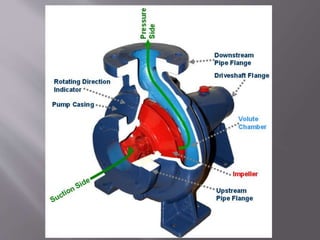
 It converts mechanical energy into hydraulic
energy (pressure energy) by virtue of
centrifugal force.
 Flow is in radial outward direction.
 It works on principle of forced vortex flow.
 Common uses include water, sewage,
petroleum and petrochemical pumping.
 It works on the principle of forced vortex flow
means when a certain mass of fluid is rotated
by external torque rise in pressure head takes
place.
 Conversion of energy occur by virtue of two
main parts of the pump:
a) Impeller
b) Casing.
 Impeller converts driver energy into the kinetic
energy & diffuser converts the kinetic energy
into pressure energy.
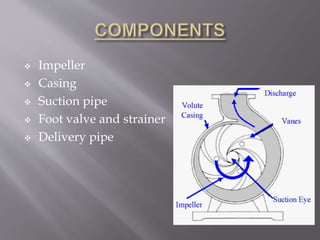
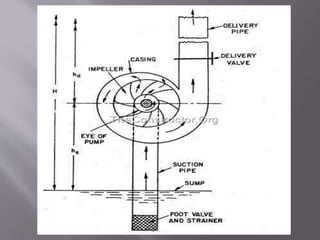
 Impeller
 Casing
 Suction pipe
 Foot valve and strainer
 Delivery pipe
 A centrifugal pump has two main components:
I. A rotating component comprised of an
impeller and a shaft.
II. A stationary component comprised of a
casing, casing cover, and bearings.
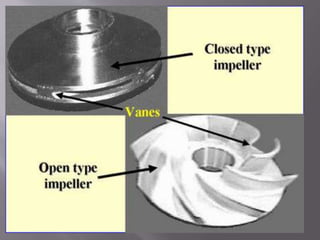
 Impeller:
The impeller is the main rotating part
that provides the centrifugal acceleration to
the fluid.
 Shaft:
Its purpose is to transmit the torques
encountered when starting and during
operation.
Supports the impeller & other rotating
parts.
 Casing:
The main purpose of casing is to
convert kinetic energy into pressure energy.
Casings are generally of three types:
a) Volute : Used for higher head, eddy currents formed
b) Vortex : Eddy currents are reduced.
c) Circular : Used for lower head.
 A volute is a curved funnel increasing in area to the
discharge port. As the area of the cross-section
increases, the volute reduces the speed of the
liquid and increases the pressure of the liquid.
 Vortex Casing :A circular chamber is
introduced between casing and impeller.
Efficiency of pump is increased
 Circular casing have stationary diffusion vanes
surrounding the impeller periphery that
convert velocity energy to pressure energy.
 Conventionally, the diffusers are applied to
multi-stage pumps.
 It is the process of filling suction pipe, casing
and delivery pipe upto delivery valve with
water.
 Used to remove air from these parts.
 It is of 2 types:
a) Positive Priming:-The one which speeds up
processing.
b) Negative Priming:-The one which slows down
the processing.
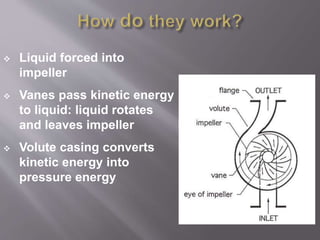
 Liquid forced into
impeller
 Vanes pass kinetic energy
to liquid: liquid rotates
and leaves impeller
 Volute casing converts
kinetic energy into
pressure energy
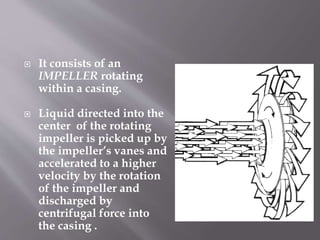
 It consists of an
IMPELLER rotating
within a casing.
 Liquid directed into the
center of the rotating
impeller is picked up by
the impeller’s vanes and
accelerated to a higher
velocity by the rotation
of the impeller and
discharged by
centrifugal force into
the casing .
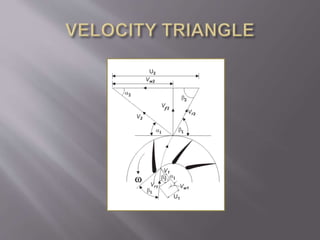
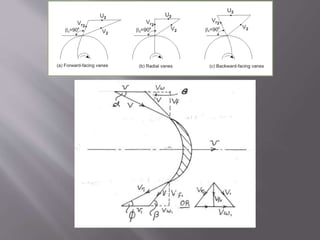
 Work is done by the impeller on the water
W=[Vw2U2-Vw1U1]/g
where,
W=work done per unit wg. of water per sec.
Vw2=whirl component of absolute vel. of jet at
outlet.
U2=tangential vel. of impeller at outlet.
Vw1=whirl component of absolute vel. of jet at
inlet.
U1=tangential vel. of impeller at inlet.
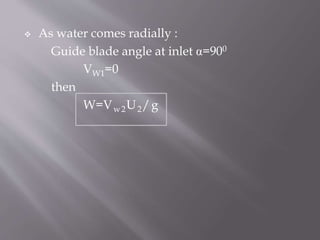
 As water comes radially :
Guide blade angle at inlet α=900
VW1=0
then
W=Vw2U2/g
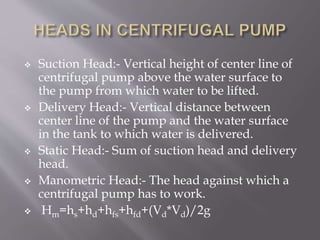
 Suction Head:- Vertical height of center line of
centrifugal pump above the water surface to
the pump from which water to be lifted.
 Delivery Head:- Vertical distance between
center line of the pump and the water surface
in the tank to which water is delivered.
 Static Head:- Sum of suction head and delivery
head.
 Manometric Head:- The head against which a
centrifugal pump has to work.
 Hm=hs+hd+hfs+hfd+(Vd*Vd)/2g
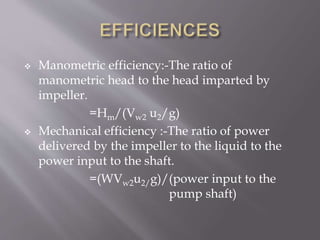
 Manometric efficiency:-The ratio of
manometric head to the head imparted by
impeller.
=Hm/(Vw2 u2/g)
 Mechanical efficiency :-The ratio of power
delivered by the impeller to the liquid to the
power input to the shaft.
=(WVw2u2/g)/(power input to the
pump shaft)
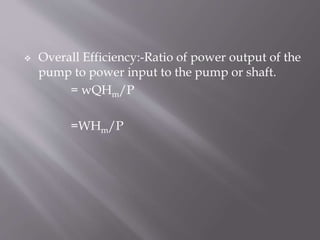
 Overall Efficiency:-Ratio of power output of the
pump to power input to the pump or shaft.
= wQHm/P
=WHm/P
 These are required to predict the performance
& behavior of pump working under different
head, flow rate & speed.
 Following are the important curves:
a) Main characteristic curve.
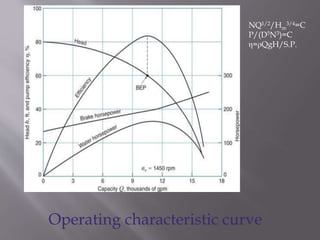
b) Operating characteristic curve.
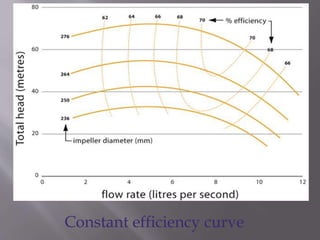
c) Muschel or constant efficiency curve.
Operating characteristic curve
NQ1/2/Hm
3/4=C
P/(D5N3)=C
η=ρQgH/S.P.
Constant efficiency curve
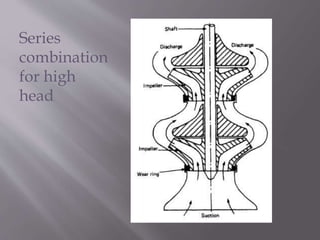
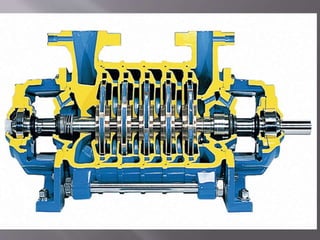
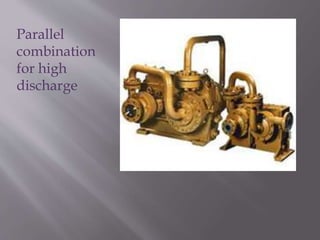
 It consists of two or more impellers.
 There are two types as follows:
a) SERIES :To produce high head.
b) PARALLEL :To discharge large quantity of liquid.
Series
combination
for high
head
Parallel
combination
for high
discharge
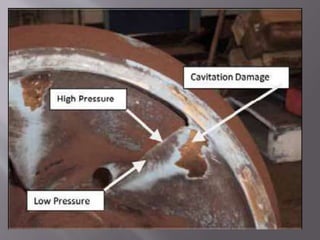
 It is a phenomena of formation of vapour
bubble where the pressure falls below the
vapour pressure of flowing liquid .
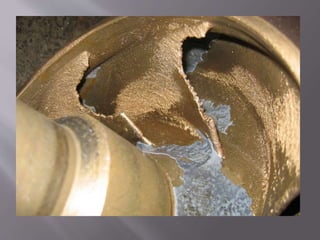
 Collapsing of vapour bubble causes high
pressure results in pitting action on metallic
surface.
 Erosion, noise & vibration are produced.
 Metallic surface are damaged & cavities are
formed.
 Efficiency of pump decreases.
 Unwanted noise and vibrations are produced.
Centrifugal pump
Centrifugal pump

Centrifugal pump

  • 1.
    Guided By: Mr. RajanKarir Made By: Sudhanshu Nama Tarun Kumar Santosh Kumar Sarveshwar Anand Shashank Shekhar Dubey Batch: M-4 2013-2014
  • 2.
     It convertsmechanical energy into hydraulic energy (pressure energy) by virtue of centrifugal force.  Flow is in radial outward direction.  It works on principle of forced vortex flow.  Common uses include water, sewage, petroleum and petrochemical pumping.
  • 3.
     It workson the principle of forced vortex flow means when a certain mass of fluid is rotated by external torque rise in pressure head takes place.  Conversion of energy occur by virtue of two main parts of the pump: a) Impeller b) Casing.  Impeller converts driver energy into the kinetic energy & diffuser converts the kinetic energy into pressure energy.
  • 4.
     Impeller  Casing Suction pipe  Foot valve and strainer  Delivery pipe
  • 6.
     A centrifugalpump has two main components: I. A rotating component comprised of an impeller and a shaft. II. A stationary component comprised of a casing, casing cover, and bearings.
  • 7.
     Impeller: The impelleris the main rotating part that provides the centrifugal acceleration to the fluid.  Shaft: Its purpose is to transmit the torques encountered when starting and during operation. Supports the impeller & other rotating parts.
  • 9.
     Casing: The mainpurpose of casing is to convert kinetic energy into pressure energy. Casings are generally of three types: a) Volute : Used for higher head, eddy currents formed b) Vortex : Eddy currents are reduced. c) Circular : Used for lower head.  A volute is a curved funnel increasing in area to the discharge port. As the area of the cross-section increases, the volute reduces the speed of the liquid and increases the pressure of the liquid.
  • 10.
     Vortex Casing:A circular chamber is introduced between casing and impeller. Efficiency of pump is increased  Circular casing have stationary diffusion vanes surrounding the impeller periphery that convert velocity energy to pressure energy.  Conventionally, the diffusers are applied to multi-stage pumps.
  • 11.
     It isthe process of filling suction pipe, casing and delivery pipe upto delivery valve with water.  Used to remove air from these parts.  It is of 2 types: a) Positive Priming:-The one which speeds up processing. b) Negative Priming:-The one which slows down the processing.
  • 12.
     Liquid forcedinto impeller  Vanes pass kinetic energy to liquid: liquid rotates and leaves impeller  Volute casing converts kinetic energy into pressure energy
  • 13.
     It consistsof an IMPELLER rotating within a casing.  Liquid directed into the center of the rotating impeller is picked up by the impeller’s vanes and accelerated to a higher velocity by the rotation of the impeller and discharged by centrifugal force into the casing .
  • 16.
     Work isdone by the impeller on the water W=[Vw2U2-Vw1U1]/g where, W=work done per unit wg. of water per sec. Vw2=whirl component of absolute vel. of jet at outlet. U2=tangential vel. of impeller at outlet. Vw1=whirl component of absolute vel. of jet at inlet. U1=tangential vel. of impeller at inlet.
  • 17.
     As watercomes radially : Guide blade angle at inlet α=900 VW1=0 then W=Vw2U2/g
  • 18.
     Suction Head:-Vertical height of center line of centrifugal pump above the water surface to the pump from which water to be lifted.  Delivery Head:- Vertical distance between center line of the pump and the water surface in the tank to which water is delivered.  Static Head:- Sum of suction head and delivery head.  Manometric Head:- The head against which a centrifugal pump has to work.  Hm=hs+hd+hfs+hfd+(Vd*Vd)/2g
  • 20.
     Manometric efficiency:-Theratio of manometric head to the head imparted by impeller. =Hm/(Vw2 u2/g)  Mechanical efficiency :-The ratio of power delivered by the impeller to the liquid to the power input to the shaft. =(WVw2u2/g)/(power input to the pump shaft)
  • 21.
     Overall Efficiency:-Ratioof power output of the pump to power input to the pump or shaft. = wQHm/P =WHm/P
  • 22.
     These arerequired to predict the performance & behavior of pump working under different head, flow rate & speed.  Following are the important curves: a) Main characteristic curve. b) Operating characteristic curve. c) Muschel or constant efficiency curve.
  • 23.
  • 24.
  • 25.
     It consistsof two or more impellers.  There are two types as follows: a) SERIES :To produce high head. b) PARALLEL :To discharge large quantity of liquid.
  • 26.
  • 28.
  • 29.
     It isa phenomena of formation of vapour bubble where the pressure falls below the vapour pressure of flowing liquid .  Collapsing of vapour bubble causes high pressure results in pitting action on metallic surface.  Erosion, noise & vibration are produced.
  • 31.
     Metallic surfaceare damaged & cavities are formed.  Efficiency of pump decreases.  Unwanted noise and vibrations are produced.