Pharmaceutical Product Development
Quality Control Of Packaging Material
By
Kaushal Kumar
TABLE OF CONTENTS
01 02 03 04
Introduction Testing
Procedure
Primary
Components
Quality Control
Test
The selection of package begins with determination of products
physical & chemical characteristics.
Quality control of a packaging component starts at design stage.
All the aspects of a pack development may give rise to quality
problems. It must be identified & minimized by performing
quality control tests.
Quality Control Testing & Standards
» Primary :
→ Ampoules, Vials, Plastic-bottles, Polymer-coated Foils
» Secondary :
→ Cartoons, Labels, Leaflets
Introduction
The testing procedures may be divided into two groups according to whether the test is
applied to the packaging material in isolation or to the entire package.
» Testing Material – Test applied to packaging materials.
→ Chemical - The pH value of materials chloride and sulphate in paper or board, alkalinity of
glass, compatibility test with chemicals or medicaments are typical of the chemical tests.
→ Mechanical - Standard tests are available for the effect of creasing, folding and so on.
→ Environmental - Materials may be tested by standard methods for absorption of water,
permeability to water vapour, gases, oils, odours etc. and for characteristics such as light
transmission.
Package Testing Procedure
» Testing Packages – Test applied to packaging materials.
→ Mechanical - They consist of the use of a standardized test procedure to compare the effect
of different protective materials to prevent damage to the contents.
→ Environmental - Such procedures may be applied to testing closures for water vapour
transmission.
Hazard Encounter By Package
→ Mechanical Hazards - Shock, Compression, Puncture, Vibration etc.
→ Environmental Hazards - Temperature, Pressure, Moisture, Gases, Light, Contamination
etc.
Package Testing Procedure
Several distinct areas are taken in to concern for setting the standards :
» Appearance
Critical, Major, Minor
» Dimension
Critical, Non-critical
» Compatibility & Customer Usability
Eye Dropper Pack
» Chemical Testing
» Hydrolytic Resistance Test
» Water Attack Test
» Powdered Glass Test
» Light Transmission Test
» Arsenic Test
Primary Components
A suitable Acceptable Quality Limit (AQL) is set for the major and minor categories.
An AQL must not be set for critical defects since these are unacceptable at any level.
A tighter AQL will be set for major defects (eg: 0.65AQL) than for minor defects (eg:
2.5 AQL)
Appearance
Dimensons
Critical
Critical Dimension Defects
Flange Depth Variation in Flange Depth
Flange Diameter Large, Small diameter
Bore Diameter Large , Small Bore
Vail Height Height of Vial varies
Body Diameter Large, Small diameter
Non Critical
Wall & Base Thickness Too Thin & Thick Wall
Concentricity Flange movement when vial is
rotated
Verticality Max. angle of lean measured
Capability & Customer Usability
Eye dropper pack
Nozzle must have good interference fit in to the bottle & allow one drop at a time though nozzle
hole when inverted. No leak should be noted.
Cap should be capable of begin removed by customers easily.
Capability & Usability
Powdered Glass Test
It is done to estimate the amount of alkali leached from the powdered glass which usually
happens at the elevated temperatures. When the glass is powdered, leaching of alkali is
enhanced, which can be titrated with 0.02N sulphuric acid using methyl red as an indicator.
Preparation of glass specimen
○ Few containers are rinsed with purified water
○ Dried with stream of clean air
○ Grind the containers in a mortar to a fine powder
○ Pass through sieve no.20 and 50.
Washing the specimen
• 10gm of the above specimen is taken into 250 ml conical flask
• Wash it with 30 ml acetone
• Repeat the washing
• Decant the acetone and dried after which it is used within 48hr
Chemical Tests
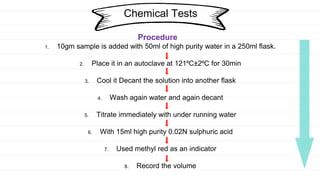
Procedure
1. 10gm sample is added with 50ml of high purity water in a 250ml flask.
2. Place it in an autoclave at 121⁰C±2⁰C for 30min
3. Cool it Decant the solution into another flask
4. Wash again water and again decant
5. Titrate immediately with under running water
6. With 15ml high purity 0.02N sulphuric acid
7. Used methyl red as an indicator
8. Record the volume
Chemical Tests
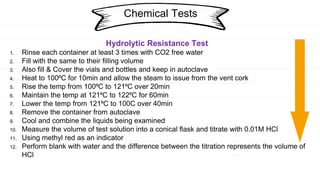
Hydrolytic Resistance Test
1. Rinse each container at least 3 times with CO2 free water
2. Fill with the same to their filling volume
3. Also fill & Cover the vials and bottles and keep in autoclave
4. Heat to 100⁰C for 10min and allow the steam to issue from the vent cork
5. Rise the temp from 100⁰C to 121⁰C over 20min
6. Maintain the temp at 121⁰C to 122⁰C for 60min
7. Lower the temp from 121⁰C to 100C over 40min
8. Remove the container from autoclave
9. Cool and combine the liquids being examined
10. Measure the volume of test solution into a conical flask and titrate with 0.01M HCl
11. Using methyl red as an indicator
12. Perform blank with water and the difference between the titration represents the volume of
HCl
Chemical Tests
Arsenic Test
This test is for glass containers intended for aqueous parenteral.
1. Wash the inner and outer surface of container with fresh distilled water for 5min
2. Prep test as described in the test for hydrolytic resistance for an adequate no. of samples to
produce 50ml.
3. Pipette out 10ml solution from combined contents of all ampoules to the flask
4. Add 10ml of HNO3 to dryness on the water bath
5. Dry the residue in an oven at 130⁰C for 30min cool
6. Add 10ml hydrogen molybdate reagent
7. Swirl to dissolve and heat under water bath and reflux for 25min
8. Cool to room temp and determine the absorbance at 840nm.
9. Do the blank with 10ml hydrogen molybdate
10. The absorbance of the test solution should not exceed the absorbance obtained by
repeating the determination using 0.1ml of arsenic standard solution (10ppm) in place of
test soln.
Chemical Tests
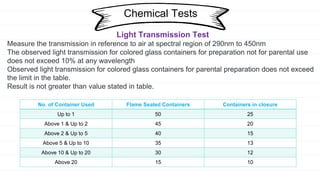
Light Transmission Test
Measure the transmission in reference to air at spectral region of 290nm to 450nm
The observed light transmission for colored glass containers for preparation not for parental use
does not exceed 10% at any wavelength
Observed light transmission for colored glass containers for parental preparation does not exceed
the limit in the table.
Result is not greater than value stated in table.
Chemical Tests
No. of Container Used Flame Sealed Containers Containers in closure
Up to 1 50 25
Above 1 & Up to 2 45 20
Above 2 & Up to 5 40 15
Above 5 & Up to 10 35 13
Above 10 & Up to 20 30 12
Above 20 15 10
Plastic Containers
 Thermosetting plastics (cannot be remelted)
 Thermoplastics (can be reprocessed)
Quality Control Tests
→ Leakage test → Collapsibility test → Transperancy
→ Clarity Of Aqueous Extract → Water Vapour Permeability
Rubber Closures
Rubber closures are used to seal the cartridges, vials and bottles, providing a material soft
and elastic enough to permit entry & withdrawal of a hypodermic needle without loss of
integrity of sealed container.
Quality Control Tests
Fragmentation test - This test is applicable to closure intended to be pierced by a
hypodermic needle & the closures used for aqueous preparation.
Self-sealability test - Applicable to closures intended to be used in multi dose container.
Sterility test pH Of Aqueous Extract Light Absorption Test
Quality Control Test
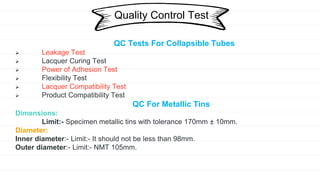
QC Tests For Collapsible Tubes
 Leakage Test
 Lacquer Curing Test
 Power of Adhesion Test
 Flexibility Test
 Lacquer Compatibility Test
 Product Compatibility Test
QC For Metallic Tins
Dimensions:
Limit:- Specimen metallic tins with tolerance 170mm ± 10mm.
Diameter:
Inner diameter:- Limit:- It should not be less than 98mm.
Outer diameter:- Limit:- NMT 105mm.
Quality Control Test
Testing of Paper & Boards
→ Moisture Content → Folding Endurance
→ Density → Grammage
→ Air Permeability → Tensile Strength
→ Tear Strength → Puncture Resistance
→ Stiffness of Thick paper & Board → Ink Absorbency
Test For Cartons
→ Compression → Carton Opening Force
→ Coefficient of Friction → Crease Stiffness
→ Joint Shear Strength
Secondary Components
THANKS!
Do you have any questions?
easyconcept@gmail.com
+91 9546688666

Quality control of packaging material.pptx

  • 1.
    Pharmaceutical Product Development QualityControl Of Packaging Material By Kaushal Kumar
  • 2.
    TABLE OF CONTENTS 0102 03 04 Introduction Testing Procedure Primary Components Quality Control Test
  • 3.
    The selection ofpackage begins with determination of products physical & chemical characteristics. Quality control of a packaging component starts at design stage. All the aspects of a pack development may give rise to quality problems. It must be identified & minimized by performing quality control tests. Quality Control Testing & Standards » Primary : → Ampoules, Vials, Plastic-bottles, Polymer-coated Foils » Secondary : → Cartoons, Labels, Leaflets Introduction
  • 4.
    The testing proceduresmay be divided into two groups according to whether the test is applied to the packaging material in isolation or to the entire package. » Testing Material – Test applied to packaging materials. → Chemical - The pH value of materials chloride and sulphate in paper or board, alkalinity of glass, compatibility test with chemicals or medicaments are typical of the chemical tests. → Mechanical - Standard tests are available for the effect of creasing, folding and so on. → Environmental - Materials may be tested by standard methods for absorption of water, permeability to water vapour, gases, oils, odours etc. and for characteristics such as light transmission. Package Testing Procedure
  • 5.
    » Testing Packages– Test applied to packaging materials. → Mechanical - They consist of the use of a standardized test procedure to compare the effect of different protective materials to prevent damage to the contents. → Environmental - Such procedures may be applied to testing closures for water vapour transmission. Hazard Encounter By Package → Mechanical Hazards - Shock, Compression, Puncture, Vibration etc. → Environmental Hazards - Temperature, Pressure, Moisture, Gases, Light, Contamination etc. Package Testing Procedure
  • 6.
    Several distinct areasare taken in to concern for setting the standards : » Appearance Critical, Major, Minor » Dimension Critical, Non-critical » Compatibility & Customer Usability Eye Dropper Pack » Chemical Testing » Hydrolytic Resistance Test » Water Attack Test » Powdered Glass Test » Light Transmission Test » Arsenic Test Primary Components
  • 7.
    A suitable AcceptableQuality Limit (AQL) is set for the major and minor categories. An AQL must not be set for critical defects since these are unacceptable at any level. A tighter AQL will be set for major defects (eg: 0.65AQL) than for minor defects (eg: 2.5 AQL) Appearance
  • 8.
    Dimensons Critical Critical Dimension Defects FlangeDepth Variation in Flange Depth Flange Diameter Large, Small diameter Bore Diameter Large , Small Bore Vail Height Height of Vial varies Body Diameter Large, Small diameter Non Critical Wall & Base Thickness Too Thin & Thick Wall Concentricity Flange movement when vial is rotated Verticality Max. angle of lean measured
  • 9.
    Capability & CustomerUsability Eye dropper pack Nozzle must have good interference fit in to the bottle & allow one drop at a time though nozzle hole when inverted. No leak should be noted. Cap should be capable of begin removed by customers easily. Capability & Usability
  • 10.
    Powdered Glass Test Itis done to estimate the amount of alkali leached from the powdered glass which usually happens at the elevated temperatures. When the glass is powdered, leaching of alkali is enhanced, which can be titrated with 0.02N sulphuric acid using methyl red as an indicator. Preparation of glass specimen ○ Few containers are rinsed with purified water ○ Dried with stream of clean air ○ Grind the containers in a mortar to a fine powder ○ Pass through sieve no.20 and 50. Washing the specimen • 10gm of the above specimen is taken into 250 ml conical flask • Wash it with 30 ml acetone • Repeat the washing • Decant the acetone and dried after which it is used within 48hr Chemical Tests
  • 11.
    Procedure 1. 10gm sampleis added with 50ml of high purity water in a 250ml flask. 2. Place it in an autoclave at 121⁰C±2⁰C for 30min 3. Cool it Decant the solution into another flask 4. Wash again water and again decant 5. Titrate immediately with under running water 6. With 15ml high purity 0.02N sulphuric acid 7. Used methyl red as an indicator 8. Record the volume Chemical Tests
  • 12.
    Hydrolytic Resistance Test 1.Rinse each container at least 3 times with CO2 free water 2. Fill with the same to their filling volume 3. Also fill & Cover the vials and bottles and keep in autoclave 4. Heat to 100⁰C for 10min and allow the steam to issue from the vent cork 5. Rise the temp from 100⁰C to 121⁰C over 20min 6. Maintain the temp at 121⁰C to 122⁰C for 60min 7. Lower the temp from 121⁰C to 100C over 40min 8. Remove the container from autoclave 9. Cool and combine the liquids being examined 10. Measure the volume of test solution into a conical flask and titrate with 0.01M HCl 11. Using methyl red as an indicator 12. Perform blank with water and the difference between the titration represents the volume of HCl Chemical Tests
  • 13.
    Arsenic Test This testis for glass containers intended for aqueous parenteral. 1. Wash the inner and outer surface of container with fresh distilled water for 5min 2. Prep test as described in the test for hydrolytic resistance for an adequate no. of samples to produce 50ml. 3. Pipette out 10ml solution from combined contents of all ampoules to the flask 4. Add 10ml of HNO3 to dryness on the water bath 5. Dry the residue in an oven at 130⁰C for 30min cool 6. Add 10ml hydrogen molybdate reagent 7. Swirl to dissolve and heat under water bath and reflux for 25min 8. Cool to room temp and determine the absorbance at 840nm. 9. Do the blank with 10ml hydrogen molybdate 10. The absorbance of the test solution should not exceed the absorbance obtained by repeating the determination using 0.1ml of arsenic standard solution (10ppm) in place of test soln. Chemical Tests
  • 14.
    Light Transmission Test Measurethe transmission in reference to air at spectral region of 290nm to 450nm The observed light transmission for colored glass containers for preparation not for parental use does not exceed 10% at any wavelength Observed light transmission for colored glass containers for parental preparation does not exceed the limit in the table. Result is not greater than value stated in table. Chemical Tests No. of Container Used Flame Sealed Containers Containers in closure Up to 1 50 25 Above 1 & Up to 2 45 20 Above 2 & Up to 5 40 15 Above 5 & Up to 10 35 13 Above 10 & Up to 20 30 12 Above 20 15 10
  • 15.
    Plastic Containers  Thermosettingplastics (cannot be remelted)  Thermoplastics (can be reprocessed) Quality Control Tests → Leakage test → Collapsibility test → Transperancy → Clarity Of Aqueous Extract → Water Vapour Permeability Rubber Closures Rubber closures are used to seal the cartridges, vials and bottles, providing a material soft and elastic enough to permit entry & withdrawal of a hypodermic needle without loss of integrity of sealed container. Quality Control Tests Fragmentation test - This test is applicable to closure intended to be pierced by a hypodermic needle & the closures used for aqueous preparation. Self-sealability test - Applicable to closures intended to be used in multi dose container. Sterility test pH Of Aqueous Extract Light Absorption Test Quality Control Test
  • 16.
    QC Tests ForCollapsible Tubes  Leakage Test  Lacquer Curing Test  Power of Adhesion Test  Flexibility Test  Lacquer Compatibility Test  Product Compatibility Test QC For Metallic Tins Dimensions: Limit:- Specimen metallic tins with tolerance 170mm ± 10mm. Diameter: Inner diameter:- Limit:- It should not be less than 98mm. Outer diameter:- Limit:- NMT 105mm. Quality Control Test
  • 17.
    Testing of Paper& Boards → Moisture Content → Folding Endurance → Density → Grammage → Air Permeability → Tensile Strength → Tear Strength → Puncture Resistance → Stiffness of Thick paper & Board → Ink Absorbency Test For Cartons → Compression → Carton Opening Force → Coefficient of Friction → Crease Stiffness → Joint Shear Strength Secondary Components
  • 18.
    THANKS! Do you haveany questions? easyconcept@gmail.com +91 9546688666