PRIMARY HEALTH
CENTRE
PRESENTED BY:
Ms. Annu Verma
Roll No- 1914713
M.Sc. Nursing 1st
year
INTRODUCTION
 The primary health centre occupies a key
position in the nation’s health care system. It
provide an integrated curative and preventive
health care to the rural population with emphasis
on preventive and promotive aspects of health
care.
INTRODUCTION …CONT
 Population covered by one PHC
 Rural populations in the plains - 30,000
 In hilly, tribal & backward areas- 20,000
DEFINITIONS
 HEALTH
Acc to WHO (1946), Health is defined as "a
state of complete physical, mental, and
social well-being and not merely the absence
of disease or infirmity."
DEFINITIONS …CONT
 PRIMARY HEALTH CARE:1978
Alma-Ate defined the “primary health care is
essential health care made universally
accessible to individuals and acceptable to
them through their full participation and at a
cost the community and country can afford.
DEFINITIONS …CONT
 PRIMARY HEALTH CENTRE
Primary Health Centre is an
institution for providing
comprehensives health care
viz., preventive, promotive and
curative services, to the people
living in a defined geographical
area.
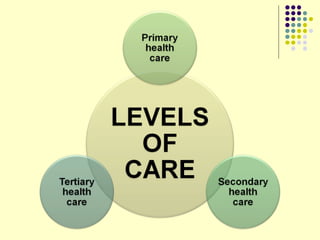
PRIMARY HEALTH CARE
 The “first” level of contact between the
individual and the health system.
 Essential health care (PHC) is provided.
 A majority of prevailing health problems can
be satisfactorily managed.
 The closest to the people.
 Provided by the primary health centers.
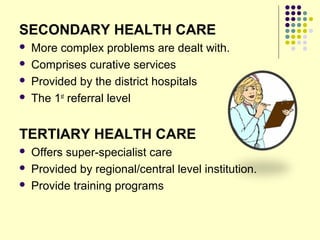
SECONDARY HEALTH CARE
 More complex problems are dealt with.
 Comprises curative services
 Provided by the district hospitals
 The 1st
referral level
TERTIARY HEALTH CARE
 Offers super-specialist care
 Provided by regional/central level institution.
 Provide training programs
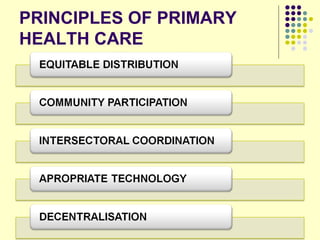
PRINCIPLES OF PRIMARY
HEALTH CARE
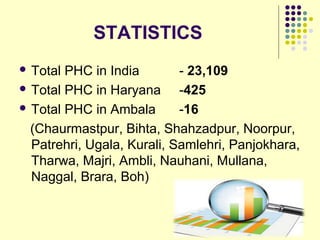
STATISTICS
 Total PHC in India - 23,109
 Total PHC in Haryana -425
 Total PHC in Ambala -16
(Chaurmastpur, Bihta, Shahzadpur, Noorpur,
Patrehri, Ugala, Kurali, Samlehri, Panjokhara,
Tharwa, Majri, Ambli, Nauhani, Mullana,
Naggal, Brara, Boh)
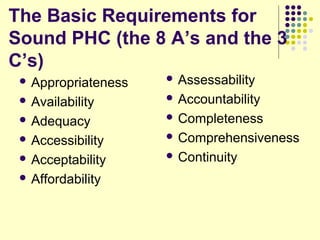
The Basic Requirements for
Sound PHC (the 8 A’s and the 3
C’s)
 Appropriateness
 Availability
 Adequacy
 Accessibility
 Acceptability
 Affordability
 Assessability
 Accountability
 Completeness
 Comprehensiveness
 Continuity
HISTORY AND EVOLUTION OF
PRIMARY HEALTH CENTRE in
INDIA
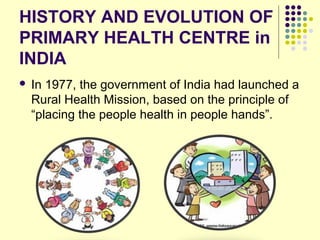
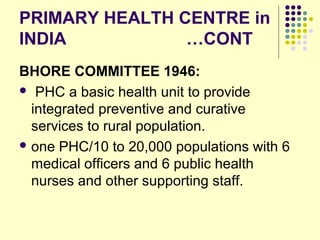
 In 1977, the government of India had launched a
Rural Health Mission, based on the principle of
“placing the people health in people hands”.
PRIMARY HEALTH CENTRE in
INDIA …CONT
BHORE COMMITTEE 1946:
 PHC a basic health unit to provide
integrated preventive and curative
services to rural population.
 one PHC/10 to 20,000 populations with 6
medical officers and 6 public health
nurses and other supporting staff.
PRIMARY HEALTH CENTRE in
INDIA …CONT
CENTRAL COUNCIL OF HEALTH:
 In 1953 ,recommended for establishment of
PHCs in community development blocks to
provide comprehensive health care to rural
population.
 One PHC is for 1,00,000 population with little
or no community involvement.
 Poorly staffed and equipped, inadequately for
covering the population.
PRIMARY HEALTH CENTRE in
INDIA …CONT
 MUDALIAR COMMITTEE,1962:
1. Strengthening of existing PHCs and
2. One PHC for 40,000 populations.
 SHRIVASTAV COMMITTEE-1975:
Community health care should be provided
by health workers who are from the same
community after proper training. So that
people health is placed in people hands.
PRIMARY HEALTH CENTRE in
INDIA …CONT
 NATIONAL HEALTH PLAN:
As a signatory to the Alma-Ata declaration ,
India has proposed
reorganization of primary health centers on
the basis of one PHC for 30,000 populations
in plain areas and 20,000 populations in
tribal and hilly areas for more effective
coverage.
STAFFING PATTERN
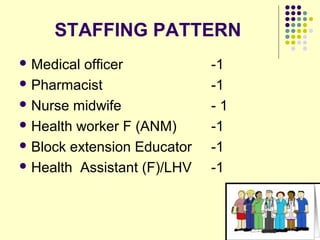
 Medical officer -1
 Pharmacist -1
 Nurse midwife - 1
 Health worker F (ANM) -1
 Block extension Educator -1
 Health Assistant (F)/LHV -1
STAFFING PATTERN
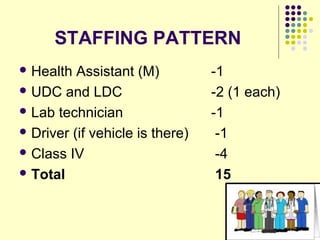
 Health Assistant (M) -1
 UDC and LDC -2 (1 each)
 Lab technician -1
 Driver (if vehicle is there) -1
 Class IV -4
 Total 15
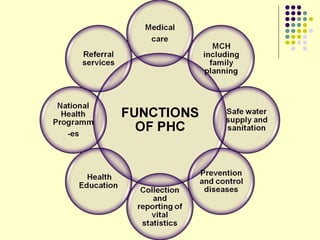
MEDICAL CARE
 OPD services: 4 hours in the morning and
2 hours in the afternoon/evening. Time
schedule will vary from state to state.
Minimum OPD attendance should be 40
patients per doctor per day.
 24 hours emergency services :
appropriate management of injuries and
accident,
MEDICAL CARE …cont
 First-aid, stabilization of the condition of
patient before referral.
 dog bite/ snake bite/scorpion bite cases,
and other emergency conditions;
 Referral services;
 In-patient services (6 beds).
MCH including family
planning
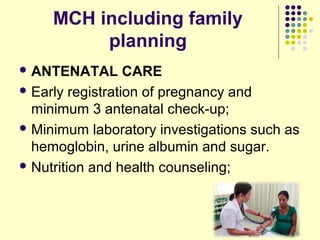
 ANTENATAL CARE
 Early registration of pregnancy and
minimum 3 antenatal check-up;
 Minimum laboratory investigations such as
hemoglobin, urine albumin and sugar.
 Nutrition and health counseling;
Antenatal care …cont
 Supplementation of folic acid and iron tablets
and tetanus toxoid immunization.
 Identification of high risk pregnancies and
appropriate management;
 Refer to other hospital in case of high
pregnancy beyond the management
capability of medical officer in PHC.
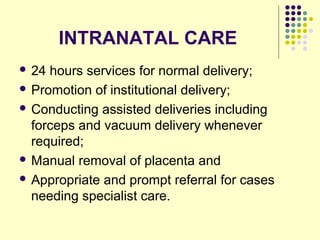
INTRANATAL CARE
 24 hours services for normal delivery;
 Promotion of institutional delivery;
 Conducting assisted deliveries including
forceps and vacuum delivery whenever
required;
 Manual removal of placenta and
 Appropriate and prompt referral for cases
needing specialist care.
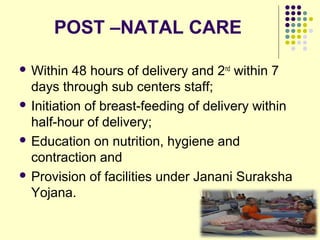
POST –NATAL CARE
 Within 48 hours of delivery and 2nd
within 7
days through sub centers staff;
 Initiation of breast-feeding of delivery within
half-hour of delivery;
 Education on nutrition, hygiene and
contraction and
 Provision of facilities under Janani Suraksha
Yojana.
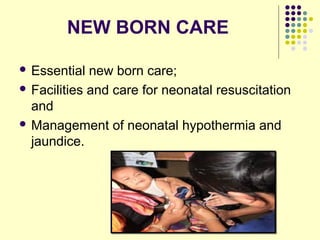
NEW BORN CARE
 Essential new born care;
 Facilities and care for neonatal resuscitation
and
 Management of neonatal hypothermia and
jaundice.
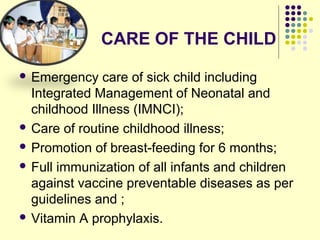
CARE OF THE CHILD
 Emergency care of sick child including
Integrated Management of Neonatal and
childhood Illness (IMNCI);
 Care of routine childhood illness;
 Promotion of breast-feeding for 6 months;
 Full immunization of all infants and children
against vaccine preventable diseases as per
guidelines and ;
 Vitamin A prophylaxis.
TRAINING
 Initial and periodic training of paramedics in
treatment of minor ailments.
 Training of ASHAs.
 Training of ANM and LHV in antenatal care
and skilled birth attendance.
 Training of AYUSH doctor in imparting health
services related to National Health and
Family Welfare programme.
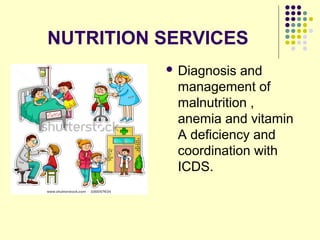
NUTRITION SERVICES
 Diagnosis and
management of
malnutrition ,
anemia and vitamin
A deficiency and
coordination with
ICDS.
MONITORING AND
SUPERVISION
 Monitoring and supervision of activities of
sub-centers through regular meetings/
periodic visits, etc.
 Monitoring of all National Health
Programmes.
 Monitoring activities of ASHAs.
 Health assistant’s male and LHV should visit
sub-centers once a week.
Primary Health Centre

Primary Health Centre

  • 2.
    PRIMARY HEALTH CENTRE PRESENTED BY: Ms.Annu Verma Roll No- 1914713 M.Sc. Nursing 1st year
  • 3.
    INTRODUCTION  The primaryhealth centre occupies a key position in the nation’s health care system. It provide an integrated curative and preventive health care to the rural population with emphasis on preventive and promotive aspects of health care.
  • 4.
    INTRODUCTION …CONT  Populationcovered by one PHC  Rural populations in the plains - 30,000  In hilly, tribal & backward areas- 20,000
  • 5.
    DEFINITIONS  HEALTH Acc toWHO (1946), Health is defined as "a state of complete physical, mental, and social well-being and not merely the absence of disease or infirmity."
  • 6.
    DEFINITIONS …CONT  PRIMARYHEALTH CARE:1978 Alma-Ate defined the “primary health care is essential health care made universally accessible to individuals and acceptable to them through their full participation and at a cost the community and country can afford.
  • 7.
    DEFINITIONS …CONT  PRIMARYHEALTH CENTRE Primary Health Centre is an institution for providing comprehensives health care viz., preventive, promotive and curative services, to the people living in a defined geographical area.
  • 9.
    PRIMARY HEALTH CARE The “first” level of contact between the individual and the health system.  Essential health care (PHC) is provided.  A majority of prevailing health problems can be satisfactorily managed.  The closest to the people.  Provided by the primary health centers.
  • 10.
    SECONDARY HEALTH CARE More complex problems are dealt with.  Comprises curative services  Provided by the district hospitals  The 1st referral level TERTIARY HEALTH CARE  Offers super-specialist care  Provided by regional/central level institution.  Provide training programs
  • 11.
  • 12.
    STATISTICS  Total PHCin India - 23,109  Total PHC in Haryana -425  Total PHC in Ambala -16 (Chaurmastpur, Bihta, Shahzadpur, Noorpur, Patrehri, Ugala, Kurali, Samlehri, Panjokhara, Tharwa, Majri, Ambli, Nauhani, Mullana, Naggal, Brara, Boh)
  • 13.
    The Basic Requirementsfor Sound PHC (the 8 A’s and the 3 C’s)  Appropriateness  Availability  Adequacy  Accessibility  Acceptability  Affordability  Assessability  Accountability  Completeness  Comprehensiveness  Continuity
  • 14.
    HISTORY AND EVOLUTIONOF PRIMARY HEALTH CENTRE in INDIA  In 1977, the government of India had launched a Rural Health Mission, based on the principle of “placing the people health in people hands”.
  • 15.
    PRIMARY HEALTH CENTREin INDIA …CONT BHORE COMMITTEE 1946:  PHC a basic health unit to provide integrated preventive and curative services to rural population.  one PHC/10 to 20,000 populations with 6 medical officers and 6 public health nurses and other supporting staff.
  • 16.
    PRIMARY HEALTH CENTREin INDIA …CONT CENTRAL COUNCIL OF HEALTH:  In 1953 ,recommended for establishment of PHCs in community development blocks to provide comprehensive health care to rural population.  One PHC is for 1,00,000 population with little or no community involvement.  Poorly staffed and equipped, inadequately for covering the population.
  • 17.
    PRIMARY HEALTH CENTREin INDIA …CONT  MUDALIAR COMMITTEE,1962: 1. Strengthening of existing PHCs and 2. One PHC for 40,000 populations.  SHRIVASTAV COMMITTEE-1975: Community health care should be provided by health workers who are from the same community after proper training. So that people health is placed in people hands.
  • 18.
    PRIMARY HEALTH CENTREin INDIA …CONT  NATIONAL HEALTH PLAN: As a signatory to the Alma-Ata declaration , India has proposed reorganization of primary health centers on the basis of one PHC for 30,000 populations in plain areas and 20,000 populations in tribal and hilly areas for more effective coverage.
  • 19.
    STAFFING PATTERN  Medicalofficer -1  Pharmacist -1  Nurse midwife - 1  Health worker F (ANM) -1  Block extension Educator -1  Health Assistant (F)/LHV -1
  • 20.
    STAFFING PATTERN  HealthAssistant (M) -1  UDC and LDC -2 (1 each)  Lab technician -1  Driver (if vehicle is there) -1  Class IV -4  Total 15
  • 22.
    MEDICAL CARE  OPDservices: 4 hours in the morning and 2 hours in the afternoon/evening. Time schedule will vary from state to state. Minimum OPD attendance should be 40 patients per doctor per day.  24 hours emergency services : appropriate management of injuries and accident,
  • 23.
    MEDICAL CARE …cont First-aid, stabilization of the condition of patient before referral.  dog bite/ snake bite/scorpion bite cases, and other emergency conditions;  Referral services;  In-patient services (6 beds).
  • 24.
    MCH including family planning ANTENATAL CARE  Early registration of pregnancy and minimum 3 antenatal check-up;  Minimum laboratory investigations such as hemoglobin, urine albumin and sugar.  Nutrition and health counseling;
  • 25.
    Antenatal care …cont Supplementation of folic acid and iron tablets and tetanus toxoid immunization.  Identification of high risk pregnancies and appropriate management;  Refer to other hospital in case of high pregnancy beyond the management capability of medical officer in PHC.
  • 26.
    INTRANATAL CARE  24hours services for normal delivery;  Promotion of institutional delivery;  Conducting assisted deliveries including forceps and vacuum delivery whenever required;  Manual removal of placenta and  Appropriate and prompt referral for cases needing specialist care.
  • 27.
    POST –NATAL CARE Within 48 hours of delivery and 2nd within 7 days through sub centers staff;  Initiation of breast-feeding of delivery within half-hour of delivery;  Education on nutrition, hygiene and contraction and  Provision of facilities under Janani Suraksha Yojana.
  • 28.
    NEW BORN CARE Essential new born care;  Facilities and care for neonatal resuscitation and  Management of neonatal hypothermia and jaundice.
  • 29.
    CARE OF THECHILD  Emergency care of sick child including Integrated Management of Neonatal and childhood Illness (IMNCI);  Care of routine childhood illness;  Promotion of breast-feeding for 6 months;  Full immunization of all infants and children against vaccine preventable diseases as per guidelines and ;  Vitamin A prophylaxis.
  • 30.
    TRAINING  Initial andperiodic training of paramedics in treatment of minor ailments.  Training of ASHAs.  Training of ANM and LHV in antenatal care and skilled birth attendance.  Training of AYUSH doctor in imparting health services related to National Health and Family Welfare programme.
  • 31.
    NUTRITION SERVICES  Diagnosisand management of malnutrition , anemia and vitamin A deficiency and coordination with ICDS.
  • 32.
    MONITORING AND SUPERVISION  Monitoringand supervision of activities of sub-centers through regular meetings/ periodic visits, etc.  Monitoring of all National Health Programmes.  Monitoring activities of ASHAs.  Health assistant’s male and LHV should visit sub-centers once a week.