
Fawzia abo ali
Prof.of allergy &clinical immunology
         Faculty of medicine
        Ain shams university
Exercise-induced
             asthma & bronchospasm
• Definition: Airway obstruction, and hyper
  responsiveness, triggered by exercise

  - EIA: exercise induces symptoms of asthma in
  patients who have asthma (90% of patients)

  - EIB: exercise induces bronchospasm in patients
  without chronic asthma, for example, an elite athlete.
 physical activity is the second leading cause of airway
  constriction after upper respiratory tract infections.

 EIA: symptoms start after exercise, peak 8 to 15 minutes
  after exercise and spontaneously resolve in 60 minutes.

 EIA is diagnosed by a 15% decrease in FEV1.

 EIA is most frequently seen in children and young adults
  because of their high levels of physical activity.
Epidemiology

  EIA affects:
  90% of asthmatics
  40-50% of patients with allergic rhinitis
  3-13% of the general population
  10-20% of athletes
Asthmogenic exercise:

     The type of exercise performed directly affects
      the intensity and duration of an EIA episode.

     Asthmogenic sports are characterized by
      sustained hyperpnea (deep, rapid breathing
      during intense, prolonged aerobic activity)

     - basketball
      - cycling
      - running
      - hockey
Less asthmogenic sports:

sport that produces intermittent bursts of
 hyperpnea, such as baseball, weight lifting
 or tennis.
 In addition, activities such as bike-riding
 and swimming are less likely to induce EIA
 than running.
Swimming appears to be the least
 asthmogenic sport, which may in part be
 related to the inhalation of humidified air.
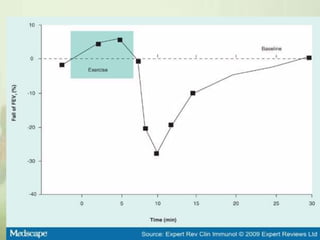
The sequence of events in EIA is characteristic:
 1. Airways dilate during exercise (FEV1 increases by
 5% in normal people).
 2. When the exercise is over, airway obstruction
 begins and progresses until it reaches a peak in 5-10
 minutes
 3. Spontaneous resolution occurs in 30 minutes.
 The tendency toward spontaneous remission is a
 hallmark of EIA: one needs only to reverse the acute
 event and the patient will then remain free of
 symptoms.
Pathogenesis

 There are 2 theories for EIA pathogenesis:

       thermal              osmotic

Thermal hypothesis, there is no role for
  biochemical mediators.
 Osmotic theory has been gaining a wider
  acceptance in recent years.
histamine, leukotrienes,
     prostaglandins
 Several studies have noted an increase in the
  concentration of cysteinyl leukotrienes (CysLTs) in the
  airways of patients with EIB.

 a recent study found that the fraction of exhaled nitric
  oxide (FENO) is elevated in asthmatic patients with EIB,

 Angiopoetin 2, a mediator that enhances microvascular
  permeability, is increased in the airways in EIB

 Mast cell infiltration of the airways has also been
  implicated in EIB.
Duration of EIA Symptoms


• Symptoms begin during
  or after exercise and
  usually worsen 5-20
  minutes after stopping
  activity

• Some people experience
  a “late-phase reaction” 4-
  12 hours after exercising.
  Symptoms usually less
  severe.
Diagnosis

 Exercise-induced asthma can be diagnosed by history
  only and formal testing is usually required only in
  competitive athletes.
 Points in the patient history:
  - Onset during or after exercise
  - EIB not affect first 5 minutes of exercise
  - Symptoms duration longer than 5 minutes
Testing for EIA
  - FRAST: free running asthma screening test
  - Treadmill exercise test
  - Cycling


  FRAST

  A simple screening test in children:
  1. Establish a baseline PEF.
  2. Have the child run continuously for 7 minutes (same
  duration as treadmill exercise test), OR have the child run
  until he/she has symptoms.
  3. Check PEF, more than 15% decrease in PEF is
  diagnostic of EIA.
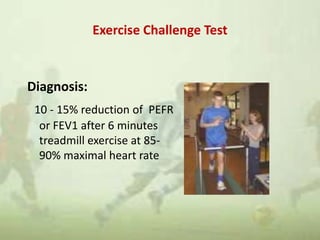
Exercise Challenge Test


Diagnosis:
 10 - 15% reduction of PEFR
  or FEV1 after 6 minutes
  treadmill exercise at 85-
  90% maximal heart rate
Bronchial provocation tests used to diagnose asthma
  in athletes

• Methacholine challenge
• Exercise challenge
• Mannitol inhalation
• Eucapnic voluntary hyperpnea
• Hypertonic saline challenge
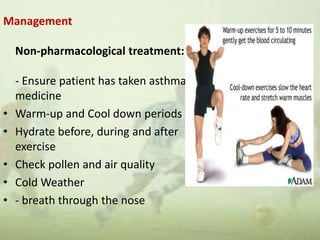
Management

    Non-pharmacological treatment:

    - Ensure patient has taken asthma
    medicine
•   Warm-up and Cool down periods
•   Hydrate before, during and after
    exercise
•   Check pollen and air quality
•   Cold Weather
•   - breath through the nose
Pharmacological treatment

  Mnemonic for drugs used for treatment of EIB -
  CLIMB:

  Cromolyn
  Leukotriene receptor antagonist (LTRA),
  montelukast
  Inhaled steroids (ICS)
  Mast cell stabilizers other than cromolyn
  Beta-2 agonists, albuterol
In conclusion
• EIA is common affecting10-20% of the general
  population, and up to 90% of unselected asthmatics
• It is easily managed with warm-up and cool-
  down, nasal breathing and pre-medication.
• Cough post exercise best predictor for positive
  exercise challenge test
• 90% can be successfully treated with pre exercise
  MDI
• Return to play usually safe
• Control of Exercise-induced asthma affords a healthy
  lifestyle in which exercise is performed without
  restrictions.
Resources
•   American College of Allergy, Asthma, and Immunology
     –   http://www.acaai.org
•   American College of Chest Physicians
     –   http://www.chestnet.org
•   American Thoracic Society
     –   http://www.thoracic.org
•   The Centers for Disease Control and Prevention
     –   http://www.cdc.gov/asthma
•   National Asthma Education and Prevention Program
     –   http://www.nhlbi.nih.gov/about/naepp/
•   Asthma and Allergy Foundation of America
     –   http://www.aafa.org
•   American Lung Association
     –   http://www.lungusa.org
•   American Academy of Allergy, Asthma, and Immunology
     –   http://www.aaaai.org
•   Allergy and Asthma Network/Mothers of Asthmatics, Inc.
     –   http://www.aanma.org
Exercise induced asthma &bronchospasm

Exercise induced asthma &bronchospasm

  • 1.
    Fawzia abo ali Prof.ofallergy &clinical immunology Faculty of medicine Ain shams university
  • 3.
    Exercise-induced asthma & bronchospasm • Definition: Airway obstruction, and hyper responsiveness, triggered by exercise - EIA: exercise induces symptoms of asthma in patients who have asthma (90% of patients) - EIB: exercise induces bronchospasm in patients without chronic asthma, for example, an elite athlete.
  • 4.
     physical activityis the second leading cause of airway constriction after upper respiratory tract infections.  EIA: symptoms start after exercise, peak 8 to 15 minutes after exercise and spontaneously resolve in 60 minutes.  EIA is diagnosed by a 15% decrease in FEV1.  EIA is most frequently seen in children and young adults because of their high levels of physical activity.
  • 5.
    Epidemiology EIAaffects: 90% of asthmatics 40-50% of patients with allergic rhinitis 3-13% of the general population 10-20% of athletes
  • 6.
    Asthmogenic exercise:  The type of exercise performed directly affects the intensity and duration of an EIA episode.  Asthmogenic sports are characterized by sustained hyperpnea (deep, rapid breathing during intense, prolonged aerobic activity) - basketball - cycling - running - hockey
  • 7.
    Less asthmogenic sports: sportthat produces intermittent bursts of hyperpnea, such as baseball, weight lifting or tennis.  In addition, activities such as bike-riding and swimming are less likely to induce EIA than running. Swimming appears to be the least asthmogenic sport, which may in part be related to the inhalation of humidified air.
  • 8.
    The sequence ofevents in EIA is characteristic: 1. Airways dilate during exercise (FEV1 increases by 5% in normal people). 2. When the exercise is over, airway obstruction begins and progresses until it reaches a peak in 5-10 minutes 3. Spontaneous resolution occurs in 30 minutes. The tendency toward spontaneous remission is a hallmark of EIA: one needs only to reverse the acute event and the patient will then remain free of symptoms.
  • 10.
    Pathogenesis There are2 theories for EIA pathogenesis: thermal osmotic Thermal hypothesis, there is no role for biochemical mediators. Osmotic theory has been gaining a wider acceptance in recent years.
  • 11.
  • 12.
     Several studieshave noted an increase in the concentration of cysteinyl leukotrienes (CysLTs) in the airways of patients with EIB.  a recent study found that the fraction of exhaled nitric oxide (FENO) is elevated in asthmatic patients with EIB,  Angiopoetin 2, a mediator that enhances microvascular permeability, is increased in the airways in EIB  Mast cell infiltration of the airways has also been implicated in EIB.
  • 13.
    Duration of EIASymptoms • Symptoms begin during or after exercise and usually worsen 5-20 minutes after stopping activity • Some people experience a “late-phase reaction” 4- 12 hours after exercising. Symptoms usually less severe.
  • 14.
    Diagnosis  Exercise-induced asthmacan be diagnosed by history only and formal testing is usually required only in competitive athletes.  Points in the patient history: - Onset during or after exercise - EIB not affect first 5 minutes of exercise - Symptoms duration longer than 5 minutes
  • 16.
    Testing for EIA - FRAST: free running asthma screening test - Treadmill exercise test - Cycling FRAST A simple screening test in children: 1. Establish a baseline PEF. 2. Have the child run continuously for 7 minutes (same duration as treadmill exercise test), OR have the child run until he/she has symptoms. 3. Check PEF, more than 15% decrease in PEF is diagnostic of EIA.
  • 17.
    Exercise Challenge Test Diagnosis: 10 - 15% reduction of PEFR or FEV1 after 6 minutes treadmill exercise at 85- 90% maximal heart rate
  • 18.
    Bronchial provocation testsused to diagnose asthma in athletes • Methacholine challenge • Exercise challenge • Mannitol inhalation • Eucapnic voluntary hyperpnea • Hypertonic saline challenge
  • 19.
    Management Non-pharmacological treatment: - Ensure patient has taken asthma medicine • Warm-up and Cool down periods • Hydrate before, during and after exercise • Check pollen and air quality • Cold Weather • - breath through the nose
  • 20.
    Pharmacological treatment Mnemonic for drugs used for treatment of EIB - CLIMB: Cromolyn Leukotriene receptor antagonist (LTRA), montelukast Inhaled steroids (ICS) Mast cell stabilizers other than cromolyn Beta-2 agonists, albuterol
  • 23.
    In conclusion • EIAis common affecting10-20% of the general population, and up to 90% of unselected asthmatics • It is easily managed with warm-up and cool- down, nasal breathing and pre-medication. • Cough post exercise best predictor for positive exercise challenge test • 90% can be successfully treated with pre exercise MDI • Return to play usually safe • Control of Exercise-induced asthma affords a healthy lifestyle in which exercise is performed without restrictions.
  • 24.
    Resources • American College of Allergy, Asthma, and Immunology – http://www.acaai.org • American College of Chest Physicians – http://www.chestnet.org • American Thoracic Society – http://www.thoracic.org • The Centers for Disease Control and Prevention – http://www.cdc.gov/asthma • National Asthma Education and Prevention Program – http://www.nhlbi.nih.gov/about/naepp/ • Asthma and Allergy Foundation of America – http://www.aafa.org • American Lung Association – http://www.lungusa.org • American Academy of Allergy, Asthma, and Immunology – http://www.aaaai.org • Allergy and Asthma Network/Mothers of Asthmatics, Inc. – http://www.aanma.org

Editor's Notes

  • #14 Symptoms may begin during exercise and will usually worsen 5-20 minutes after your student stops the activity. Some individuals may experience a “late-phase reaction” 4-12 hours after exercising. These symptoms are usually less severe, but may last up to 24 hours. Students who are experiencing minor symptoms or are recovering from a recent asthma attack or episode/ illness may require exercise/activity modification. You may need to be creative to include these students, but participating at any level is better than being left out.