AMEENA KADAR K A
SECOND SEMESTER M PHARM
DEPT. OF PHARMACY PRACTICE
SANJO COLLEGE OF PHARMACEUTICAL STUDIES
COMMUNICATION IN QUM
 ‘As in all areas of general practice, effective and open
communication with patients, members of the general
practice team and the broader health sector are critical for
achieving quality use of medicines.’
 General practitioners need to clearly communicate why a
medicine is or not, required and provide clear advice when
recommending medicines to minimize risk and maximize
medicine safety.
 This includes addressing the patients, understanding of their
management and identifying any barriers to effective
communication such as cultural and linguistic diversity,
disability and health literacy problems.
 This enables the doctor and the patient to arrive at a
satisfactory mutually negotiated management outcome.
 Open communication is also required to identify other
medications that the patient may be taking that were not
initiated by the General Practitioner, including over-the-
counter medications and complementary therapies.
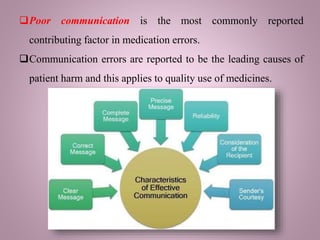
Poor communication is the most commonly reported
contributing factor in medication errors.
Communication errors are reported to be the leading causes of
patient harm and this applies to quality use of medicines.
 Errors have been shown to occur during all stages of the
medication process including Prescribing, supply,
administration, monitoring and documentation.
 However, the highest risk of errors is during transfer of care,
with Australian and overseas studies finding that 52% to 88% of
transfer documents contain an error.
 Rate of prescribing errors were found to be as high as 32 errors
per 100 prescriptions.
 Good patient handover skills are important to promote quality
and safety curriculum statement.
 A Prescription is essentially a type of handover document that
needs to be unambiguously and legally written or printed using
the correct documentation.
 General practices need to be able to use communication tools
such as briefings, clear handover procedures, good record
keeping, electronic prescribing tools, patient information
materials and checklists to improve quality use of medicines
and reduce the rate of patient harm.
 Systems to minimize medication errors therefore have the
potential to significantly reduce patient harm.
Communication:
 Health communication is more effective when it reaches people
on an emotional as well as a rational level.
 A combination of interpersonal communication and mass media
communication is needed to change population behaviour.
 Tailored communication is more effective than general
messages.
 Interactive communication is also effective.
Communication methods:
1. Face-to-face activities, sometimes called interpersonal
communication.
2. Drama and other folk media, sometimes called performance,
popular or traditional media.
3. Mass media, including electronic media.
4. Print materials and other support activities.
Face to face communication
 Direct form of communication.
 Provide opportunities to participate actively in the
communication.
 Face-to-face approach requires field staff with adequate time
and strong communication skills.
Drama and other folk media
 In communities, a wide range of drama and other folk media
exist that can be mobilized in health communication activities.
 Their impact and popularity are widespread especially in
communities with strong oral traditions.
Mass media, including electronic media
 Mass media can be useful for promoting awareness and raising
interest in an issue, but do not usually lead to behaviour change.
 They are good for reaching large numbers of people quickly
with general messages.
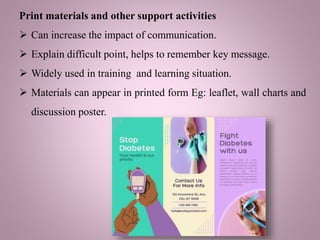
Print materials and other support activities
 Can increase the impact of communication.
 Explain difficult point, helps to remember key message.
 Widely used in training and learning situation.
 Materials can appear in printed form Eg: leaflet, wall charts and
discussion poster.
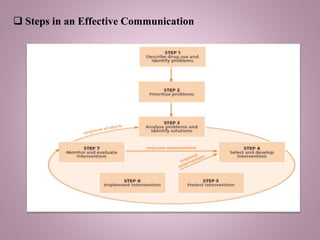
 Steps in an Effective Communication
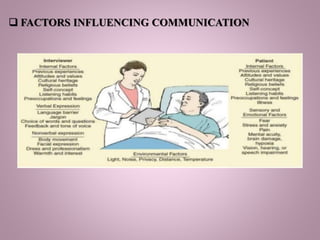
 FACTORS INFLUENCING COMMUNICATION
 TEAMWORK & COMMUNICATION SKILLS
INHERENT IN SAFE MEDICATION PRACTICES
1. PERSON- CENTERED CARE
 Including patient/ family in discussion.
 Seeking and considering patient’s social and medical history.
 Equipping patients with the skills to identify problems and to
play an active role in their medication management.
2 . TEAMWORK AND COOPERATION
 Awareness of and respecting the roles of team members
 Supporting others
 Understanding needs of the team.
 Managing conflict
 Asking for help valuing others contribution
 Sharing accountability and responsibility…
3. COMMUNICATION & INTERACTION
 Maintaining eye contact
 Demonstrating open body language
 Being polite and friendly
 Active listening
 Discussing together and asking questions
 Coordinating actions
 Expressing concerns freely, speaking up when unsure
 Communicating openly.
4. LEADERSHIP & MANAGEMENT
 Taking the initiative
 Maintaining clinical standards
 Delegating
 Demonstrating gradated assertiveness
 Creating a ‘no-blame’ culture
5. PROBLEM SOLVING & DECISION MAKING
 Collaborative problem solving
 Shared option generation
 Shared risk assessment
 Shared decision making
 Reviewing outcomes
6. SITUATIONAL AWARENESS
 Noticing anticipating-identifying future problems and
discussing contingencies
 Recognizing the capabilities of others, cross- checking, and
contacting outside sources when necessary.
7. ADHERENCE TO GUIDELINES
 Being familiar and adhering to relevant guidelines , policies
and evidence –based resources.
8 . DOCUMENTATION
 Documenting clearly, accurately, contemporaneously and
concisely accessing and clarifying medical records.
Communication relationship and the patient-doctor
relationship
Training outcome of general practice:
1. Communicate clearly with patients and carer the reasons for
prescribing or not prescribing, including the potential
benefits and risks.
2. Take into account the patient’s ideas, concerns and
expectations when negotiating medicine use, including
patient culture and personal preferences for the nature of
treatment with both conventional and complementary
therapies.
3. Provide clear advice about medicine administration when
recommending medicines.
4. Create a nonjudgmental and open environment for patient
doctor communication so that patients can discuss any concern
regarding their medicine use, also promote the identification of
other medicines that the patient may be taking that were not
initiated by the GP, including OTC medicines and
complementary therapies.
5. Assess the influence of health literacy of patient and carer on
their understanding of their use of medicines and incorporate
this into patient doctor communications.
6. Use communication methods, tools, and patient resources to
promote quality use of medicines including treatment.
Learning objectives for students
1. Outline communication issues with patients and carer that
promote the quality use of medicines.
2. Describe how a patients ideas ,concerns and expectations,
including cultural and personal preferences for the nature of
treatment with both conventional and complementary therapies,
may influence medicines choice.
3. Demonstrate skills for providing clear advice about medicine
administration.
4. Describe the influence of a nonjudgmental and open
environment for patient doctor communication for patients to
be able to discuss any concerns regarding their medicine use.
5. Investigate communication methods, tools and patient
resources to promote quality use of medicines including
treatment adherence in various health settings.
REFERENCES
 www.health.gov.au/internet/main/publishing.nsf
 www.racgp.org.au/standards
 www.health /gov/au/health-pbs-general-faq.htm

COMMUNICATION IN QUM.pptx

  • 1.
    AMEENA KADAR KA SECOND SEMESTER M PHARM DEPT. OF PHARMACY PRACTICE SANJO COLLEGE OF PHARMACEUTICAL STUDIES
  • 2.
    COMMUNICATION IN QUM ‘As in all areas of general practice, effective and open communication with patients, members of the general practice team and the broader health sector are critical for achieving quality use of medicines.’  General practitioners need to clearly communicate why a medicine is or not, required and provide clear advice when recommending medicines to minimize risk and maximize medicine safety.
  • 3.
     This includesaddressing the patients, understanding of their management and identifying any barriers to effective communication such as cultural and linguistic diversity, disability and health literacy problems.  This enables the doctor and the patient to arrive at a satisfactory mutually negotiated management outcome.  Open communication is also required to identify other medications that the patient may be taking that were not initiated by the General Practitioner, including over-the- counter medications and complementary therapies.
  • 4.
    Poor communication isthe most commonly reported contributing factor in medication errors. Communication errors are reported to be the leading causes of patient harm and this applies to quality use of medicines.
  • 5.
     Errors havebeen shown to occur during all stages of the medication process including Prescribing, supply, administration, monitoring and documentation.  However, the highest risk of errors is during transfer of care, with Australian and overseas studies finding that 52% to 88% of transfer documents contain an error.  Rate of prescribing errors were found to be as high as 32 errors per 100 prescriptions.  Good patient handover skills are important to promote quality and safety curriculum statement.
  • 6.
     A Prescriptionis essentially a type of handover document that needs to be unambiguously and legally written or printed using the correct documentation.  General practices need to be able to use communication tools such as briefings, clear handover procedures, good record keeping, electronic prescribing tools, patient information materials and checklists to improve quality use of medicines and reduce the rate of patient harm.  Systems to minimize medication errors therefore have the potential to significantly reduce patient harm.
  • 7.
    Communication:  Health communicationis more effective when it reaches people on an emotional as well as a rational level.  A combination of interpersonal communication and mass media communication is needed to change population behaviour.  Tailored communication is more effective than general messages.  Interactive communication is also effective.
  • 8.
    Communication methods: 1. Face-to-faceactivities, sometimes called interpersonal communication. 2. Drama and other folk media, sometimes called performance, popular or traditional media. 3. Mass media, including electronic media. 4. Print materials and other support activities.
  • 9.
    Face to facecommunication  Direct form of communication.  Provide opportunities to participate actively in the communication.  Face-to-face approach requires field staff with adequate time and strong communication skills.
  • 10.
    Drama and otherfolk media  In communities, a wide range of drama and other folk media exist that can be mobilized in health communication activities.  Their impact and popularity are widespread especially in communities with strong oral traditions. Mass media, including electronic media  Mass media can be useful for promoting awareness and raising interest in an issue, but do not usually lead to behaviour change.  They are good for reaching large numbers of people quickly with general messages.
  • 11.
    Print materials andother support activities  Can increase the impact of communication.  Explain difficult point, helps to remember key message.  Widely used in training and learning situation.  Materials can appear in printed form Eg: leaflet, wall charts and discussion poster.
  • 12.
     Steps inan Effective Communication
  • 13.
  • 14.
     TEAMWORK &COMMUNICATION SKILLS INHERENT IN SAFE MEDICATION PRACTICES 1. PERSON- CENTERED CARE  Including patient/ family in discussion.  Seeking and considering patient’s social and medical history.  Equipping patients with the skills to identify problems and to play an active role in their medication management. 2 . TEAMWORK AND COOPERATION  Awareness of and respecting the roles of team members  Supporting others  Understanding needs of the team.
  • 15.
     Managing conflict Asking for help valuing others contribution  Sharing accountability and responsibility… 3. COMMUNICATION & INTERACTION  Maintaining eye contact  Demonstrating open body language  Being polite and friendly  Active listening  Discussing together and asking questions  Coordinating actions  Expressing concerns freely, speaking up when unsure  Communicating openly.
  • 16.
    4. LEADERSHIP &MANAGEMENT  Taking the initiative  Maintaining clinical standards  Delegating  Demonstrating gradated assertiveness  Creating a ‘no-blame’ culture 5. PROBLEM SOLVING & DECISION MAKING  Collaborative problem solving  Shared option generation  Shared risk assessment  Shared decision making  Reviewing outcomes
  • 17.
    6. SITUATIONAL AWARENESS Noticing anticipating-identifying future problems and discussing contingencies  Recognizing the capabilities of others, cross- checking, and contacting outside sources when necessary. 7. ADHERENCE TO GUIDELINES  Being familiar and adhering to relevant guidelines , policies and evidence –based resources. 8 . DOCUMENTATION  Documenting clearly, accurately, contemporaneously and concisely accessing and clarifying medical records.
  • 18.
    Communication relationship andthe patient-doctor relationship Training outcome of general practice: 1. Communicate clearly with patients and carer the reasons for prescribing or not prescribing, including the potential benefits and risks. 2. Take into account the patient’s ideas, concerns and expectations when negotiating medicine use, including patient culture and personal preferences for the nature of treatment with both conventional and complementary therapies.
  • 19.
    3. Provide clearadvice about medicine administration when recommending medicines. 4. Create a nonjudgmental and open environment for patient doctor communication so that patients can discuss any concern regarding their medicine use, also promote the identification of other medicines that the patient may be taking that were not initiated by the GP, including OTC medicines and complementary therapies. 5. Assess the influence of health literacy of patient and carer on their understanding of their use of medicines and incorporate this into patient doctor communications.
  • 20.
    6. Use communicationmethods, tools, and patient resources to promote quality use of medicines including treatment. Learning objectives for students 1. Outline communication issues with patients and carer that promote the quality use of medicines. 2. Describe how a patients ideas ,concerns and expectations, including cultural and personal preferences for the nature of treatment with both conventional and complementary therapies, may influence medicines choice. 3. Demonstrate skills for providing clear advice about medicine administration.
  • 21.
    4. Describe theinfluence of a nonjudgmental and open environment for patient doctor communication for patients to be able to discuss any concerns regarding their medicine use. 5. Investigate communication methods, tools and patient resources to promote quality use of medicines including treatment adherence in various health settings.
  • 22.