What is intelligence? Think of the smartest people you know. What makes you think they are intelligent?
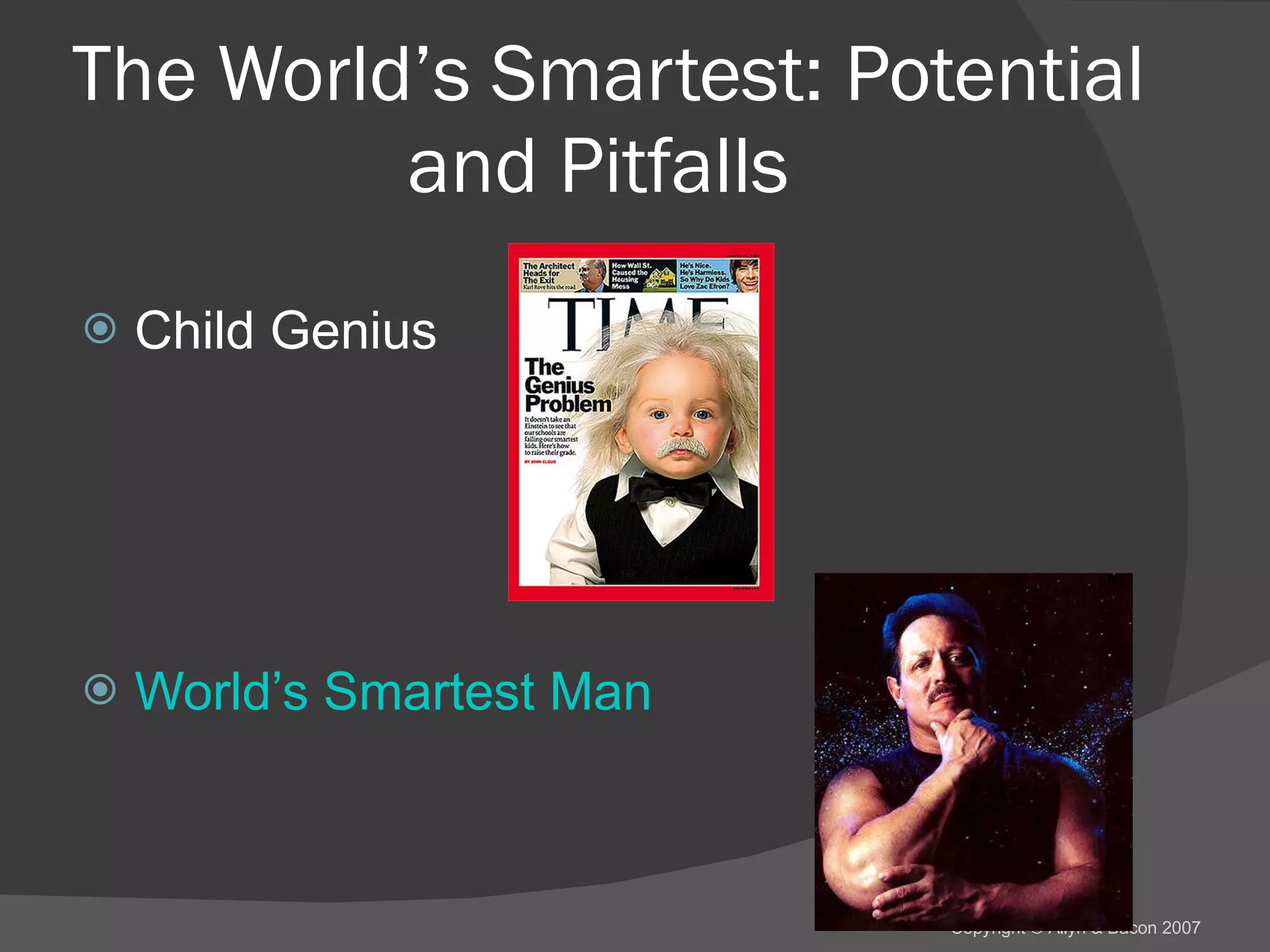
The World’s Smartest: Potential and Pitfalls  Child Genius World’s Smartest Man
Intelligence What is intelligence? Are there different types of intelligence? If so, how many? Can intelligence be measured? Not all psychologists agree on the answers to these important questions
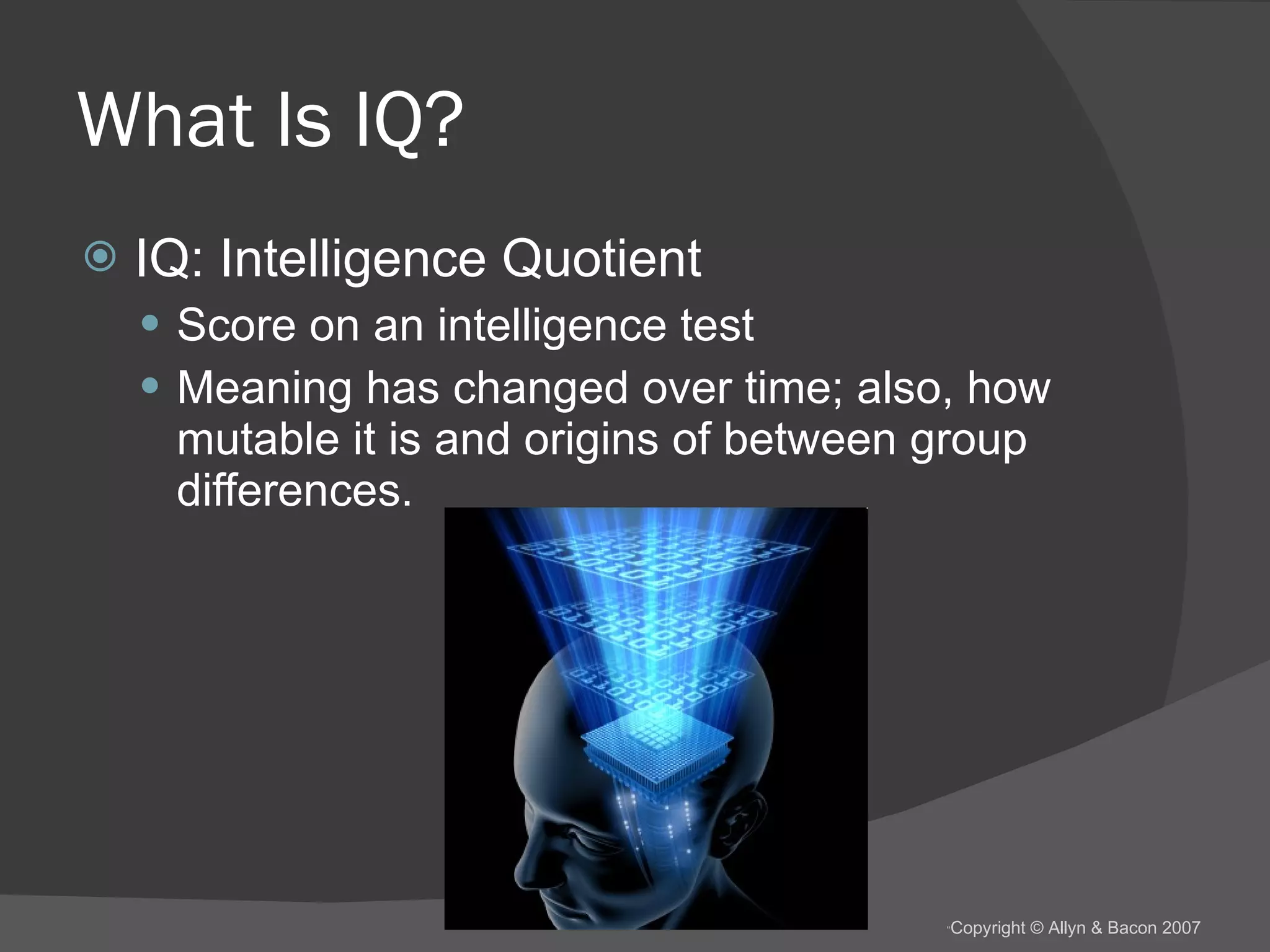
What Is IQ? IQ: Intelligence Quotient Score on an intelligence test Meaning has changed over time; also, how mutable it is and origins of between group differences.
Intelligence Testing: History Alfred Binet and Theodore Simon Developed first intelligence test (1904-1911) Identify students who need extra help Test many normal children at each age Compare individual’s score to “normal” scores Mental age Chronological age
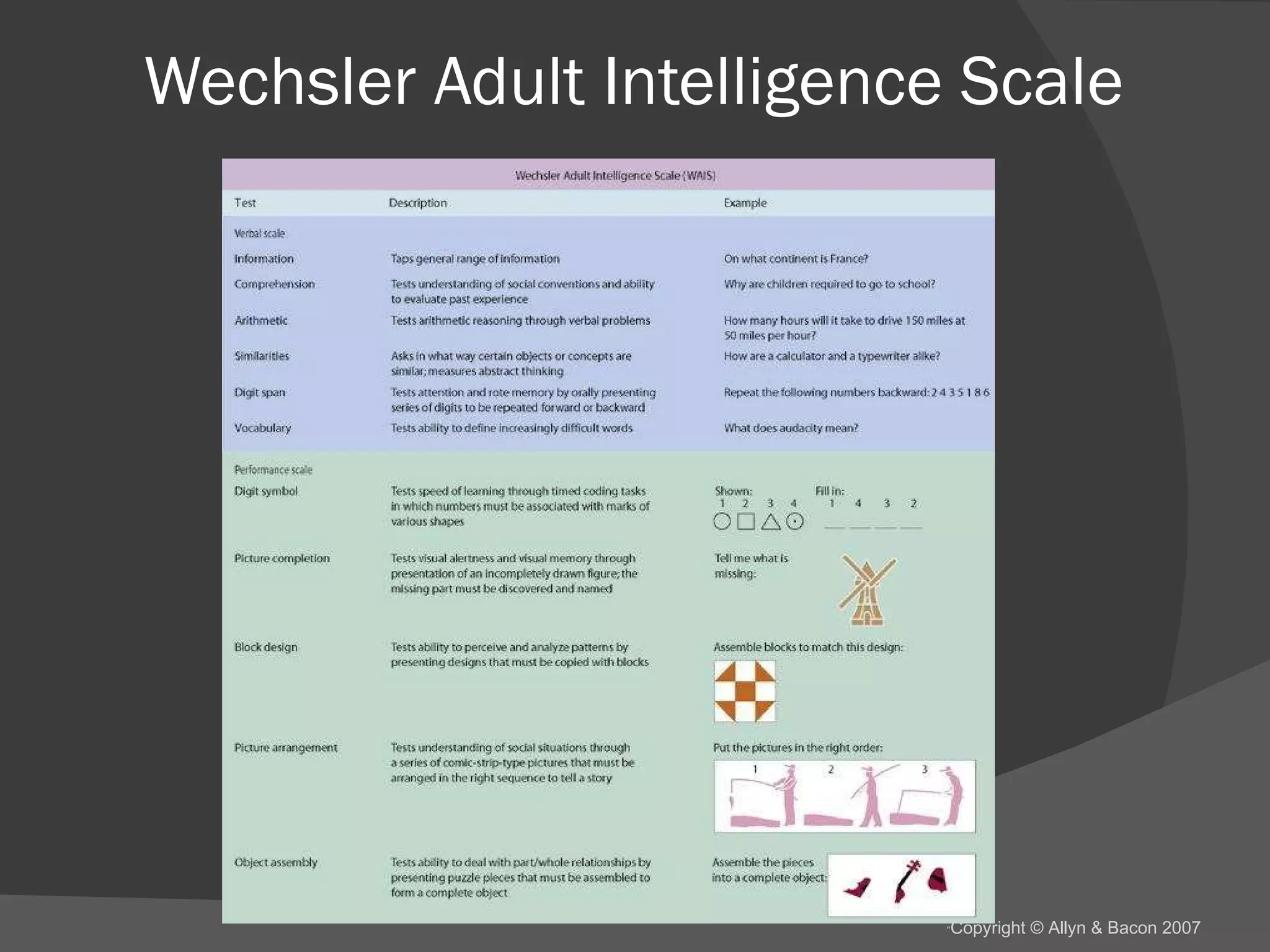
Intelligence Testing: History Lewis Terman (Stanford University) Developed American version of the Binet-Simon test, called the Stanford-Binet test, for ages 2 to adult  David Wechsler Wechsler Adult Intelligence Scale (WAIS) Wechsler Intelligence Scale for Children (WISC) Performance and verbal subtests
Wechsler Adult Intelligence Scale
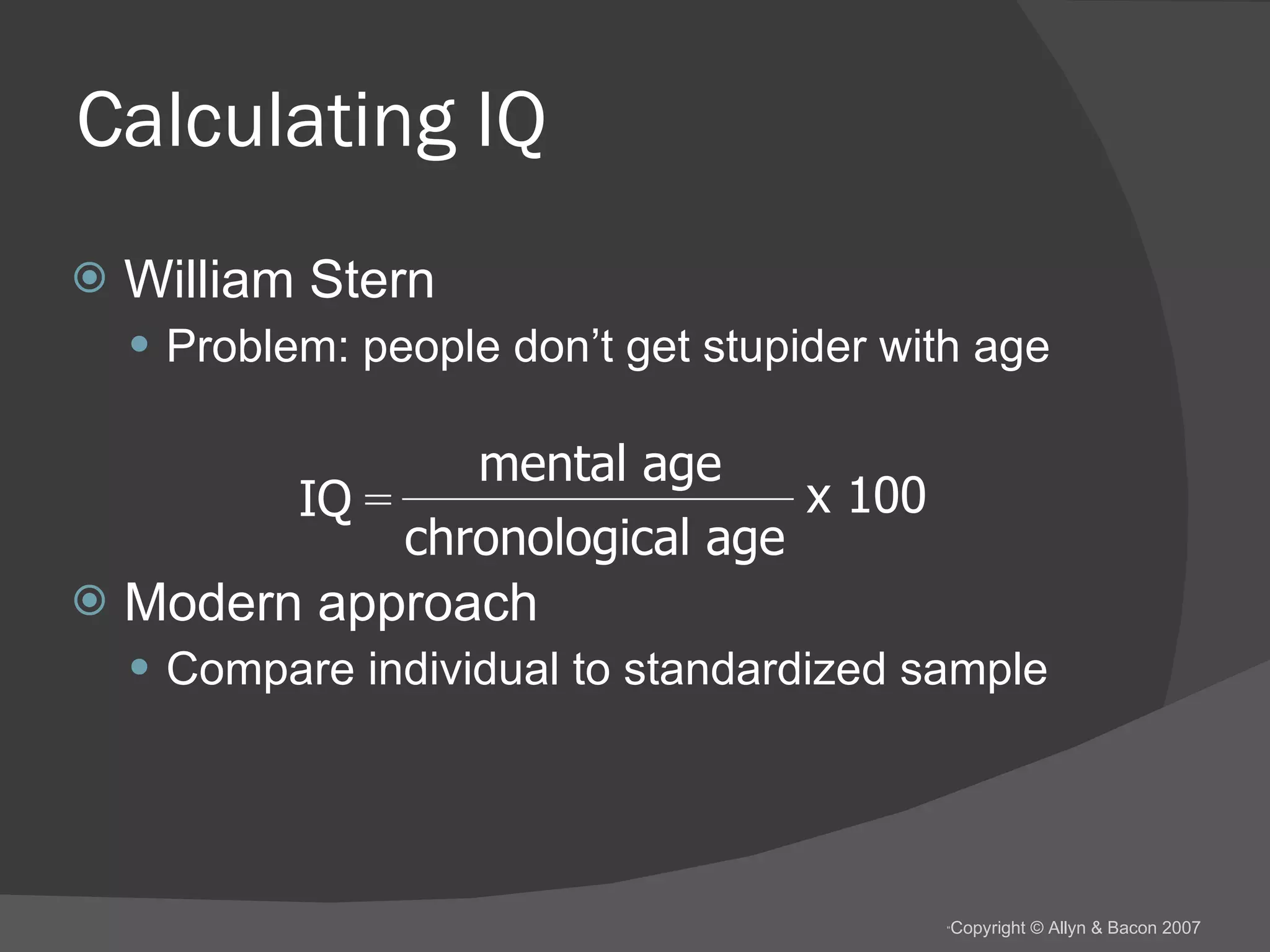
Calculating IQ William Stern Problem: people don’t get stupider with age Modern approach Compare individual to standardized sample IQ   = mental age chronological age x 100
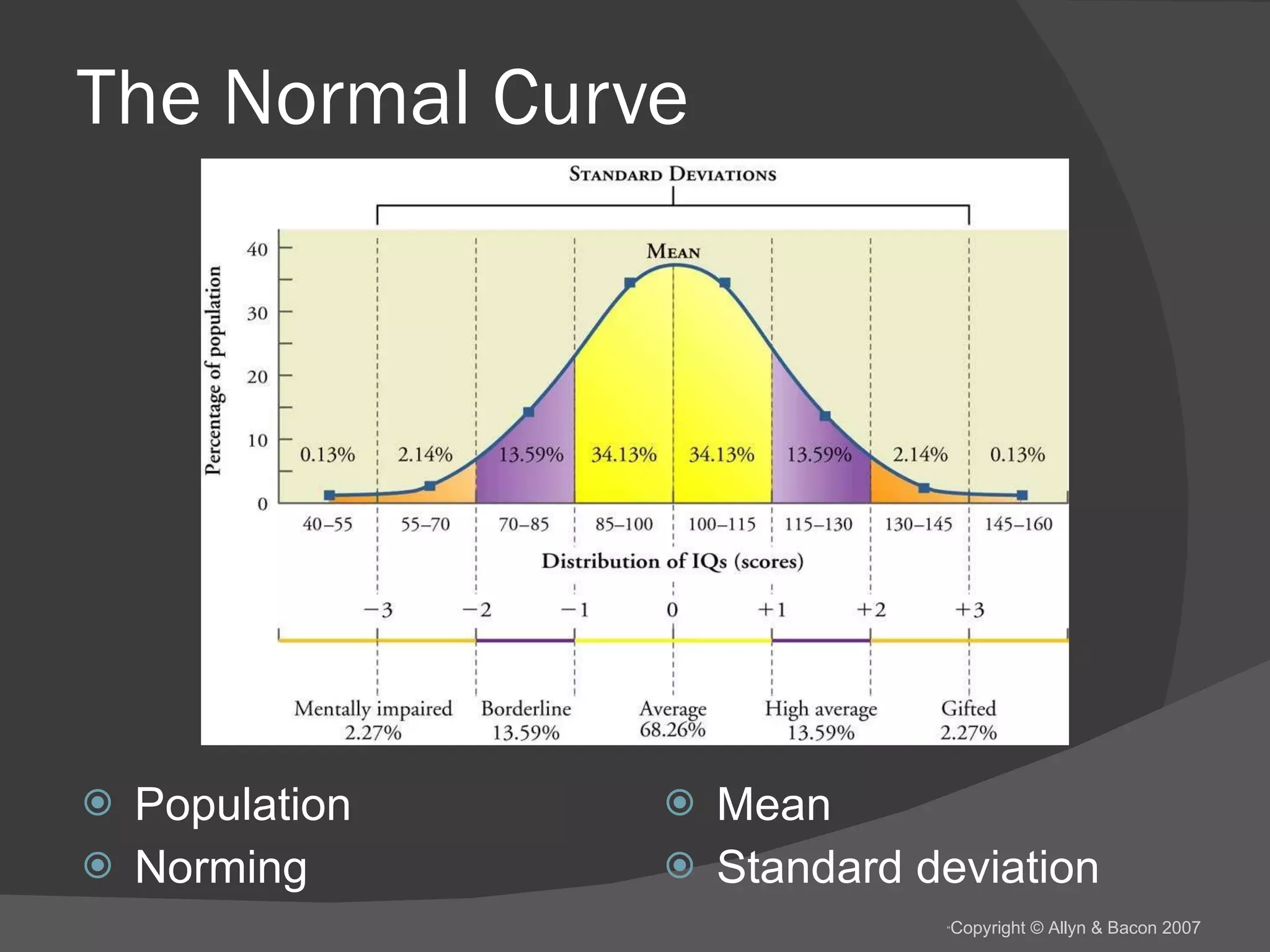
The Normal Curve Population Norming Mean Standard deviation
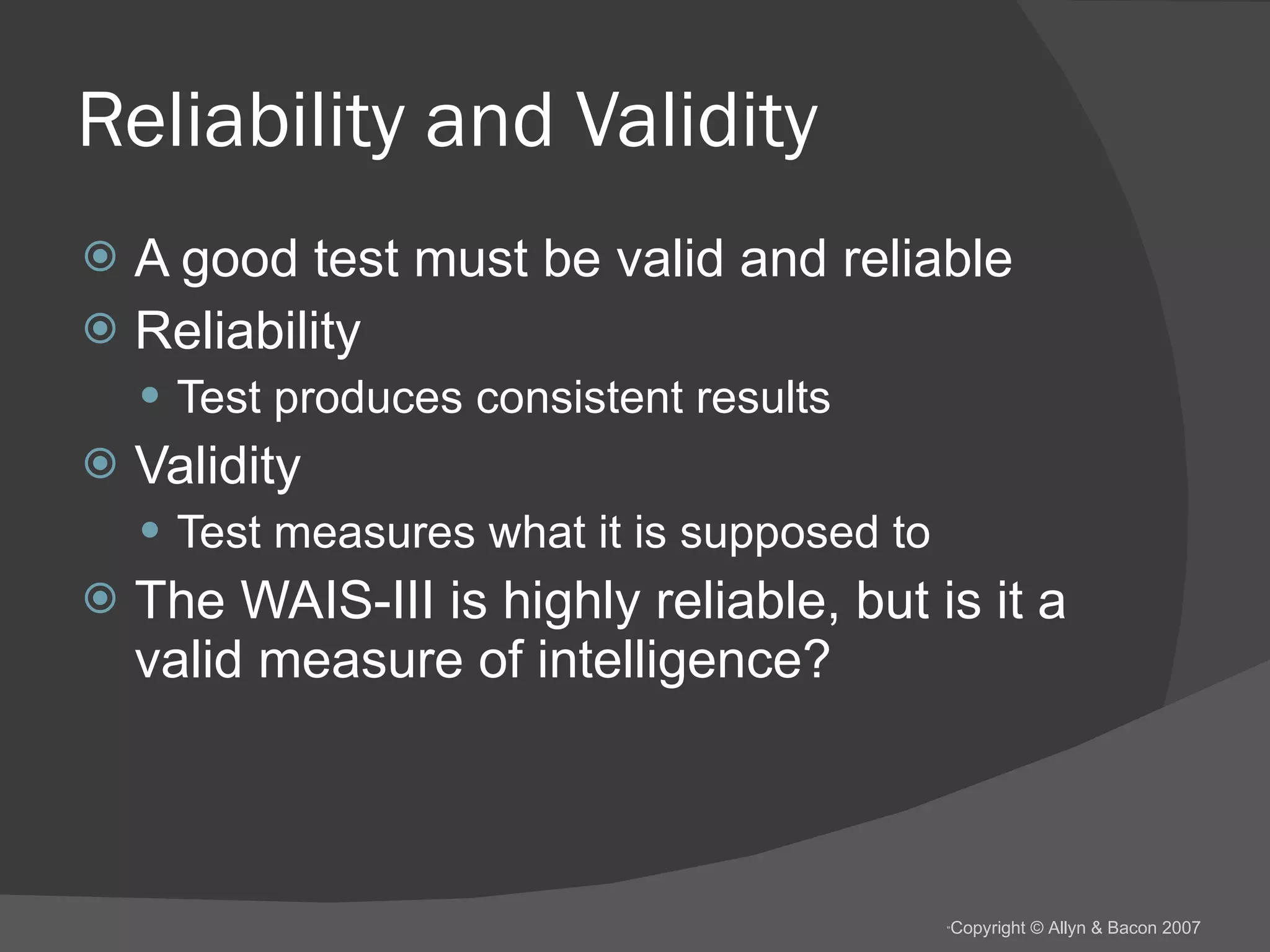
Reliability and Validity A good test must be valid and reliable Reliability Test produces consistent results Validity Test measures what it is supposed to The WAIS-III is highly reliable, but is it a valid measure of intelligence?
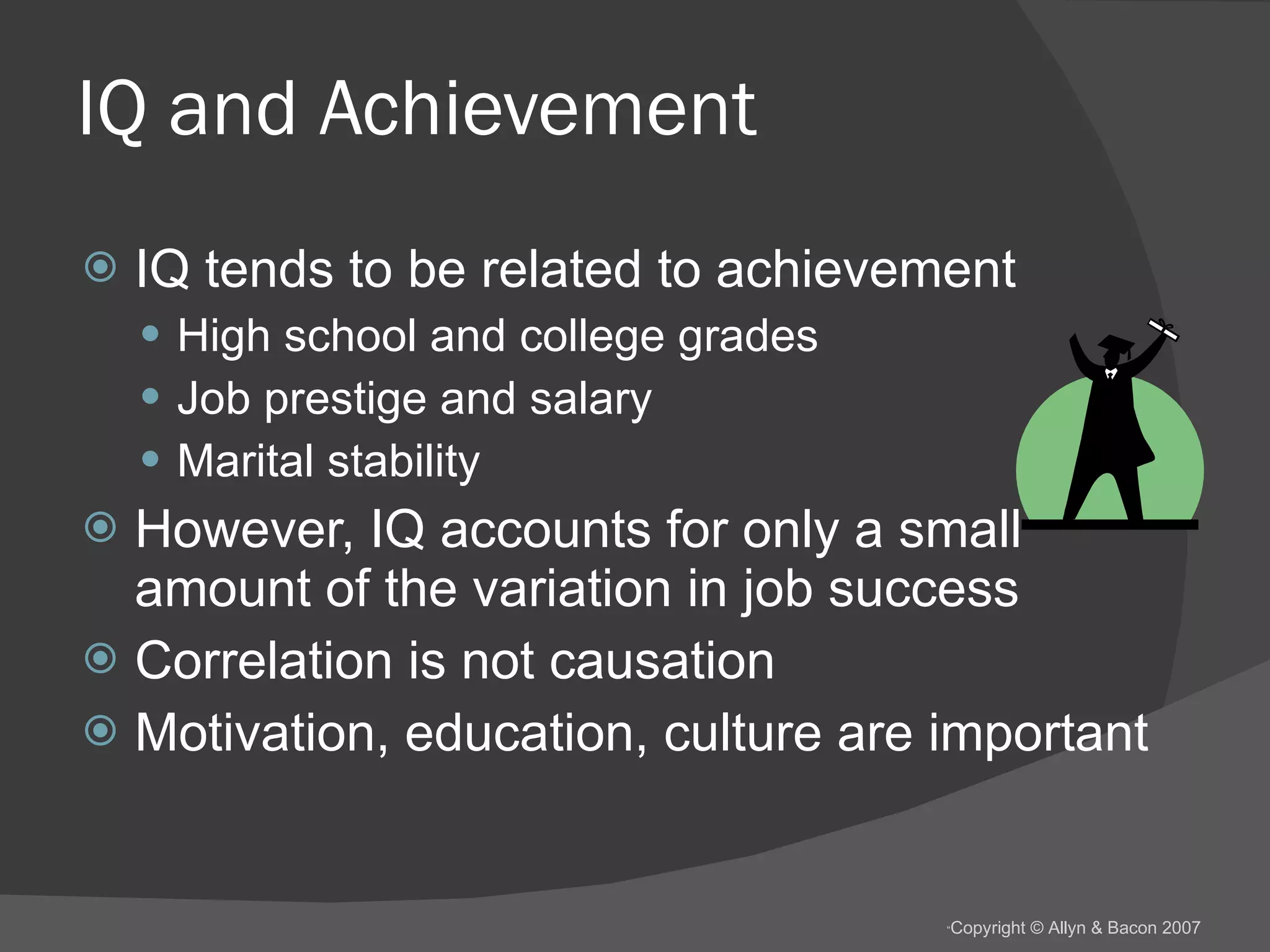
IQ and Achievement IQ tends to be related to achievement High school and college grades Job prestige and salary Marital stability However, IQ accounts for only a small amount of the variation in job success  Correlation is not causation Motivation, education, culture are important
One Intelligence or Many? Charles Spearman g : general factor s : specific factors Intelligence depends mostly on  g Factor analysis Louis Thurstone Separate primary mental abilities Examples: verbal comprehension and spatial visualization
One Intelligence or Many? Raymond Cattell and John Horn Crystallized intelligence Fluid intelligence Aging Crystallized intelligence doesn’t suffer Fluid intelligence tends to decrease Different aging effects support the distinction
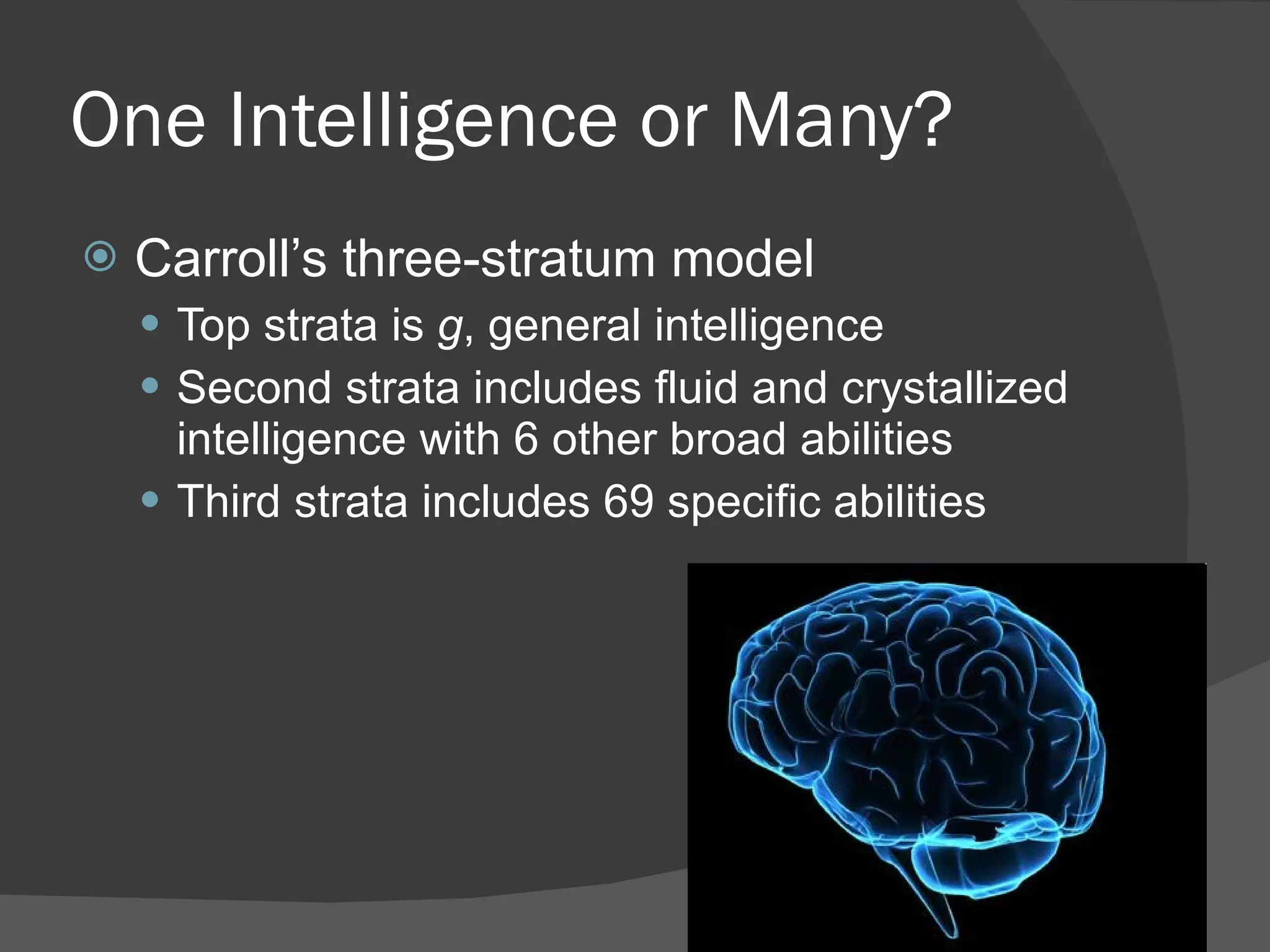
One Intelligence or Many? Carroll’s three-stratum model Top strata is  g , general intelligence Second strata includes fluid and crystallized intelligence with 6 other broad abilities Third strata includes 69 specific abilities
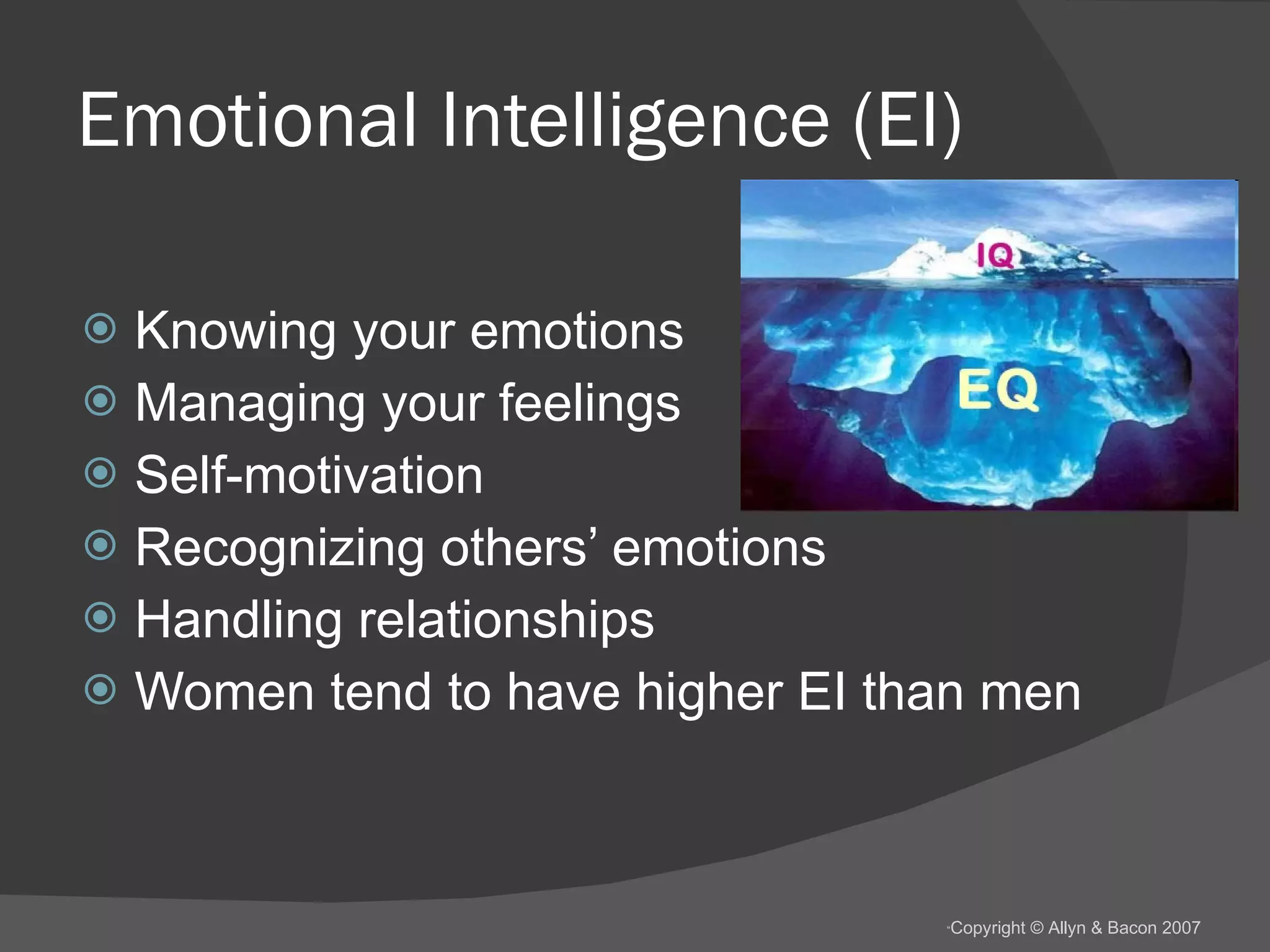
Emotional Intelligence (EI) Knowing your emotions Managing your feelings Self-motivation Recognizing others’ emotions Handling relationships Women tend to have higher EI than men
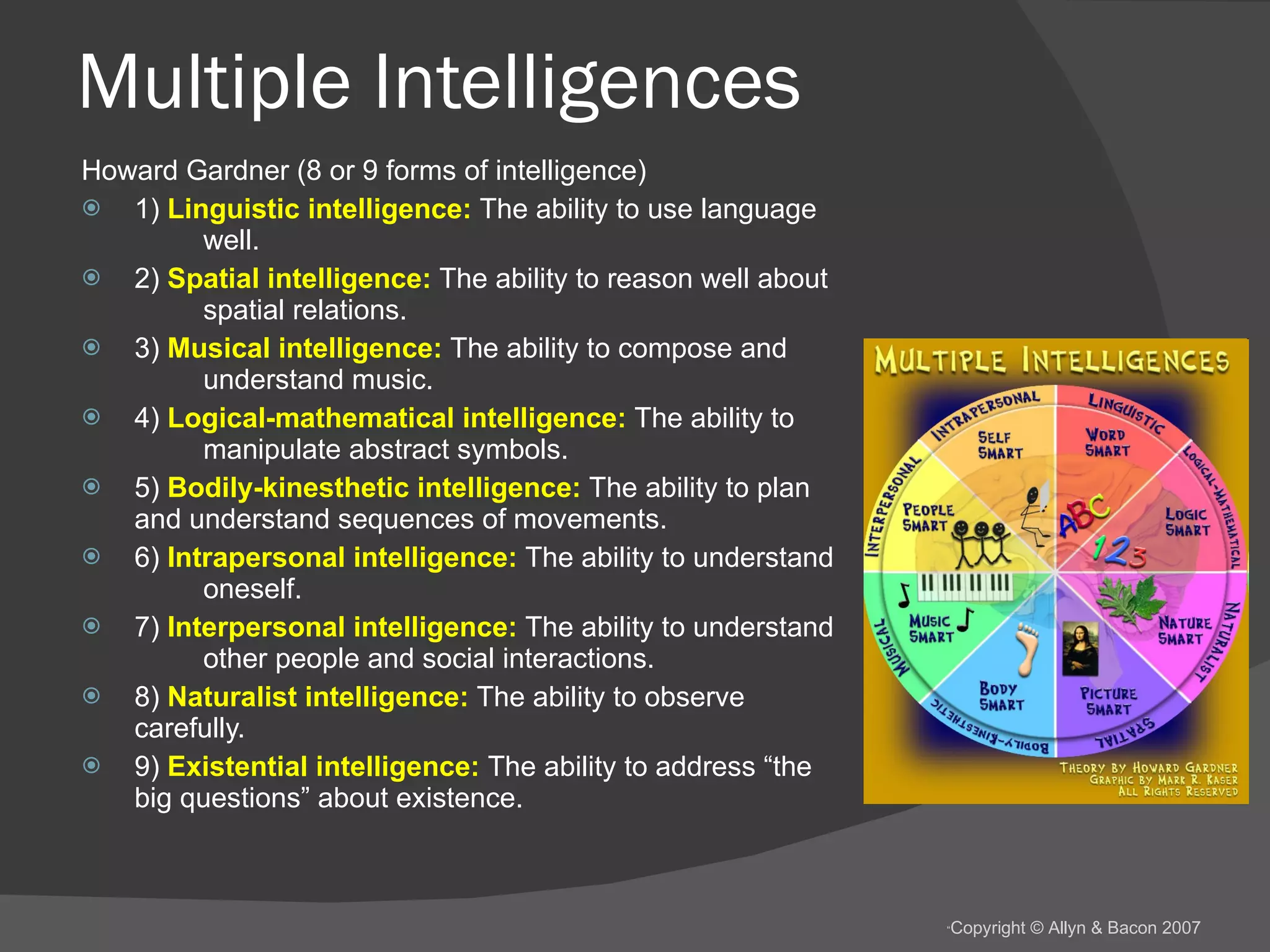
Multiple Intelligences Howard Gardner (8 or 9 forms of intelligence) 1)  Linguistic intelligence:  The ability to use language  well. 2)  Spatial intelligence:  The ability to reason well about  spatial relations. 3)  Musical intelligence:  The ability to compose and  understand music. 4)  Logical-mathematical intelligence:  The ability to  manipulate abstract symbols. 5)  Bodily-kinesthetic intelligence:  The ability to plan  and understand sequences of movements. 6)  Intrapersonal intelligence:  The ability to understand  oneself. 7)  Interpersonal intelligence:  The ability to understand  other people and social interactions. 8)  Naturalist intelligence:  The ability to observe  carefully. 9)  Existential intelligence:  The ability to address “the  big questions” about existence.
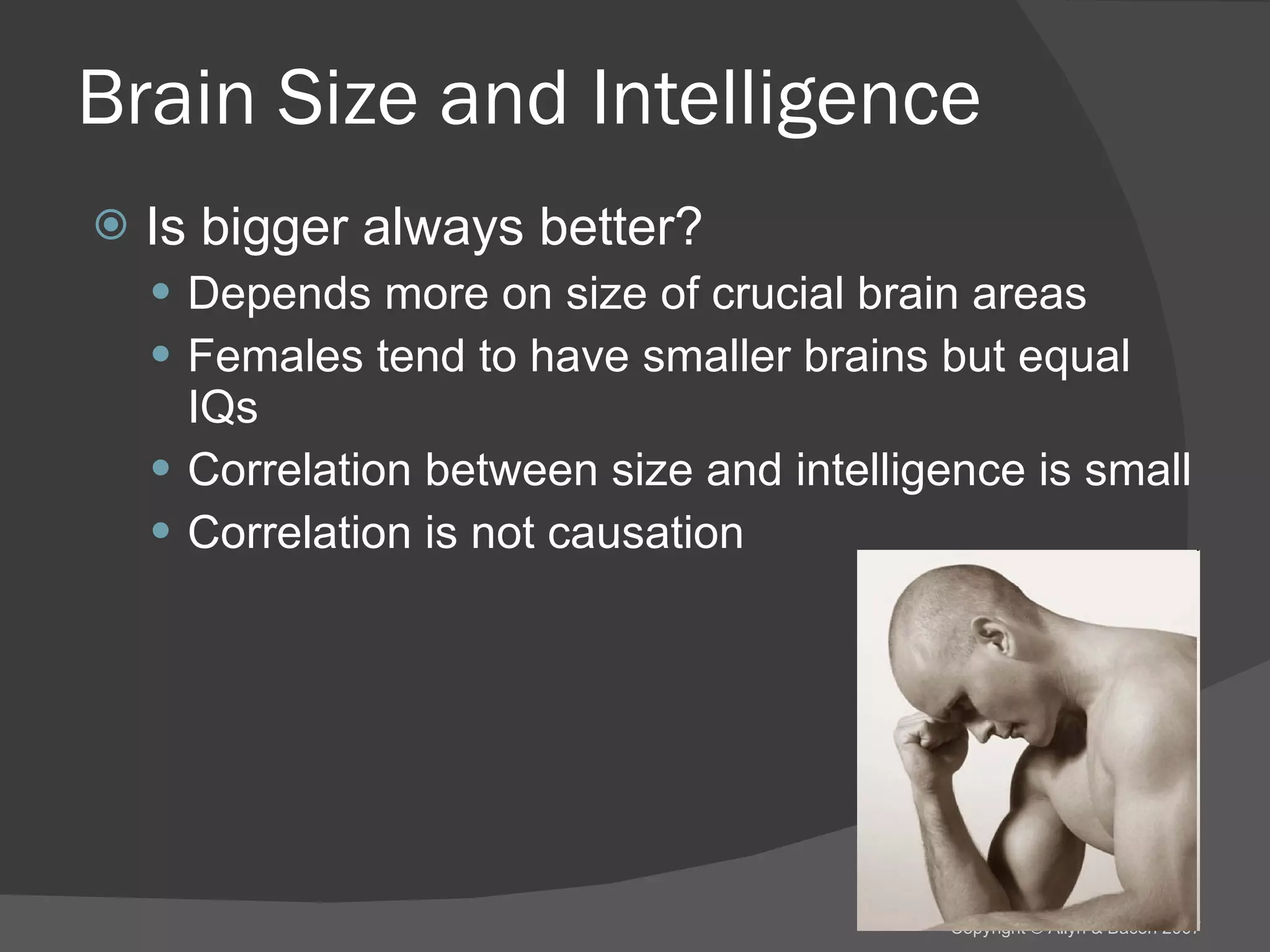
Brain Size and Intelligence Is bigger always better? Depends more on size of crucial brain areas Females tend to have smaller brains but equal IQs Correlation between size and intelligence is small Correlation is not causation
IQ and Speed of Processing Is IQ correlated with speed of information processing? Mixed results Many IQ subscales are time, so it is not surprising that mental processing speed would be related to IQ Measures of neural conduction are only weakly related to intelligence
Working Memory and IQ IQ is correlated with working memory Many IQ subscales are involve memory, so it is not surprising that mental processing speed would be related to IQ
IQ: Genes and Environment Adoption studies Correlation of IQs for identical twins raised apart is higher than that for fraternal twins and nontwin siblings raised together An adopted child’s IQ correlates higher with the biological mother’s IQ than with the adoptive mother’s IQ Strong evidence of the link between genes and IQ
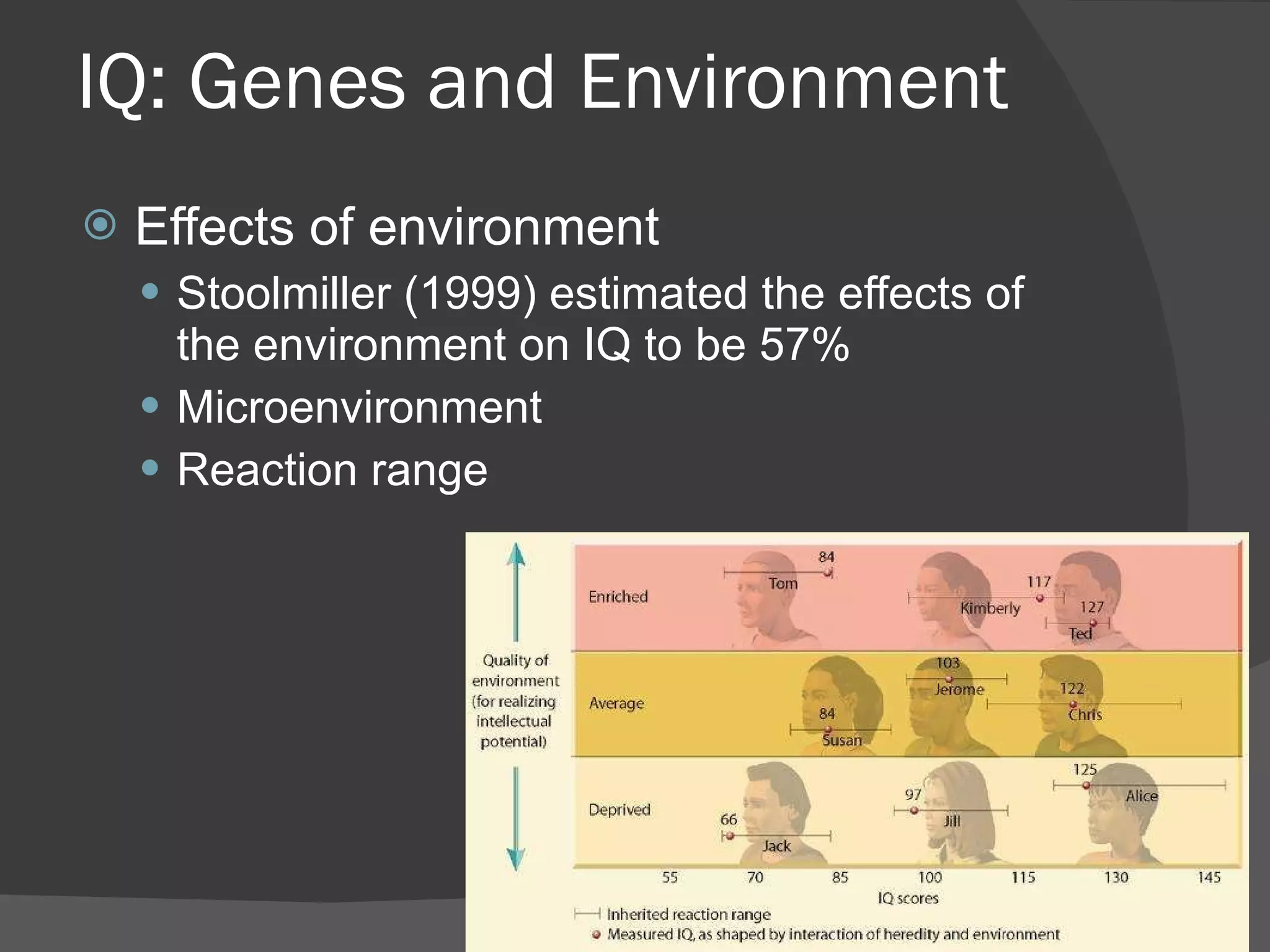
IQ: Genes and Environment Effects of environment Stoolmiller (1999) estimated the effects of the environment on IQ to be 57% Microenvironment Reaction range
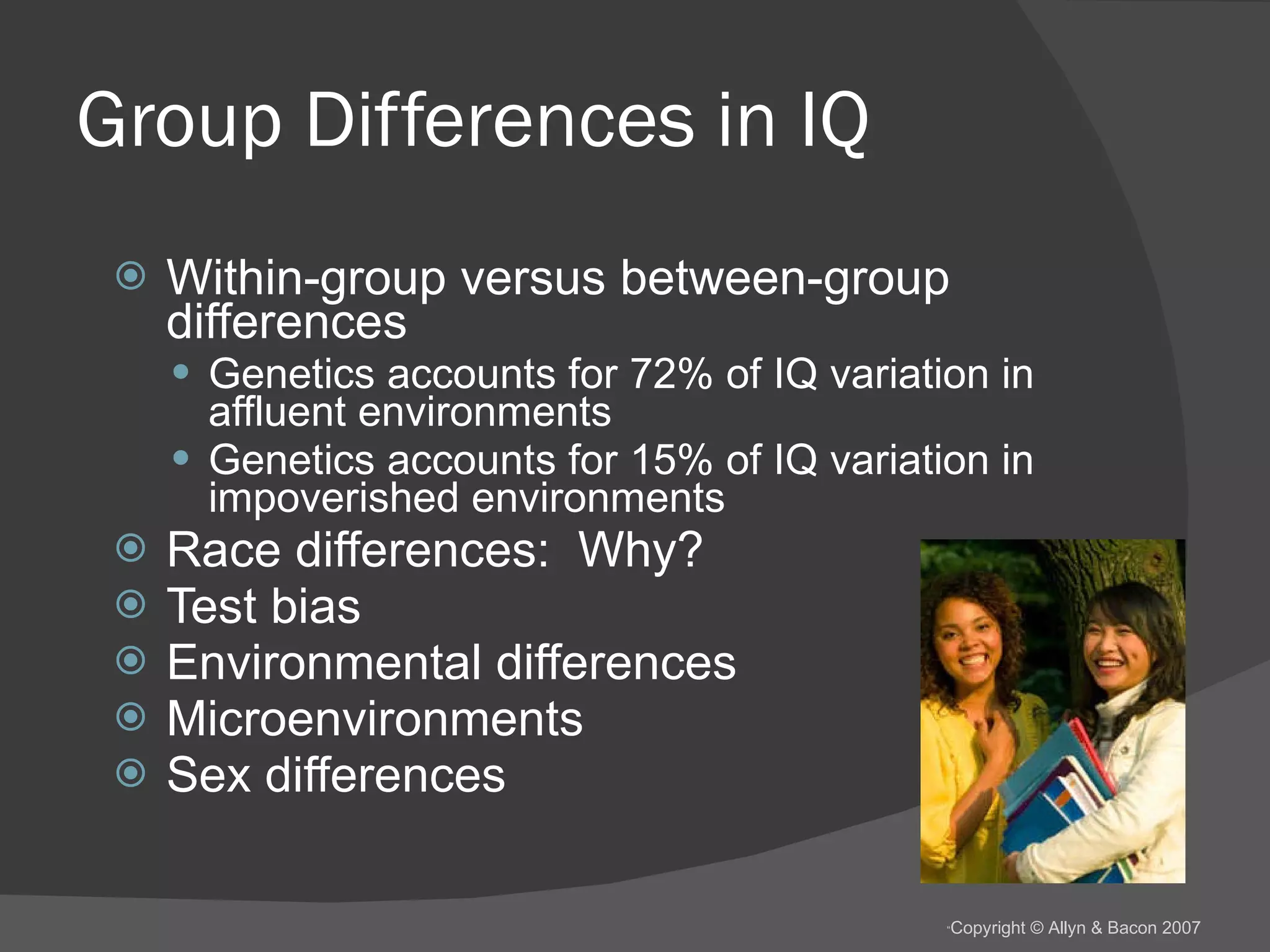
Group Differences in IQ Within-group versus between-group differences Genetics accounts for 72% of IQ variation in affluent environments Genetics accounts for 15% of IQ variation in impoverished environments Race differences:  Why? Test bias Environmental differences Microenvironments Sex differences
Boosting IQ The Flynn effect Average IQ increases 3 points every 10 years Explanations? Daily life is more challenging Nutrition is better Reasoning ability stressed by IQ tests has gotten better, not IQ itself
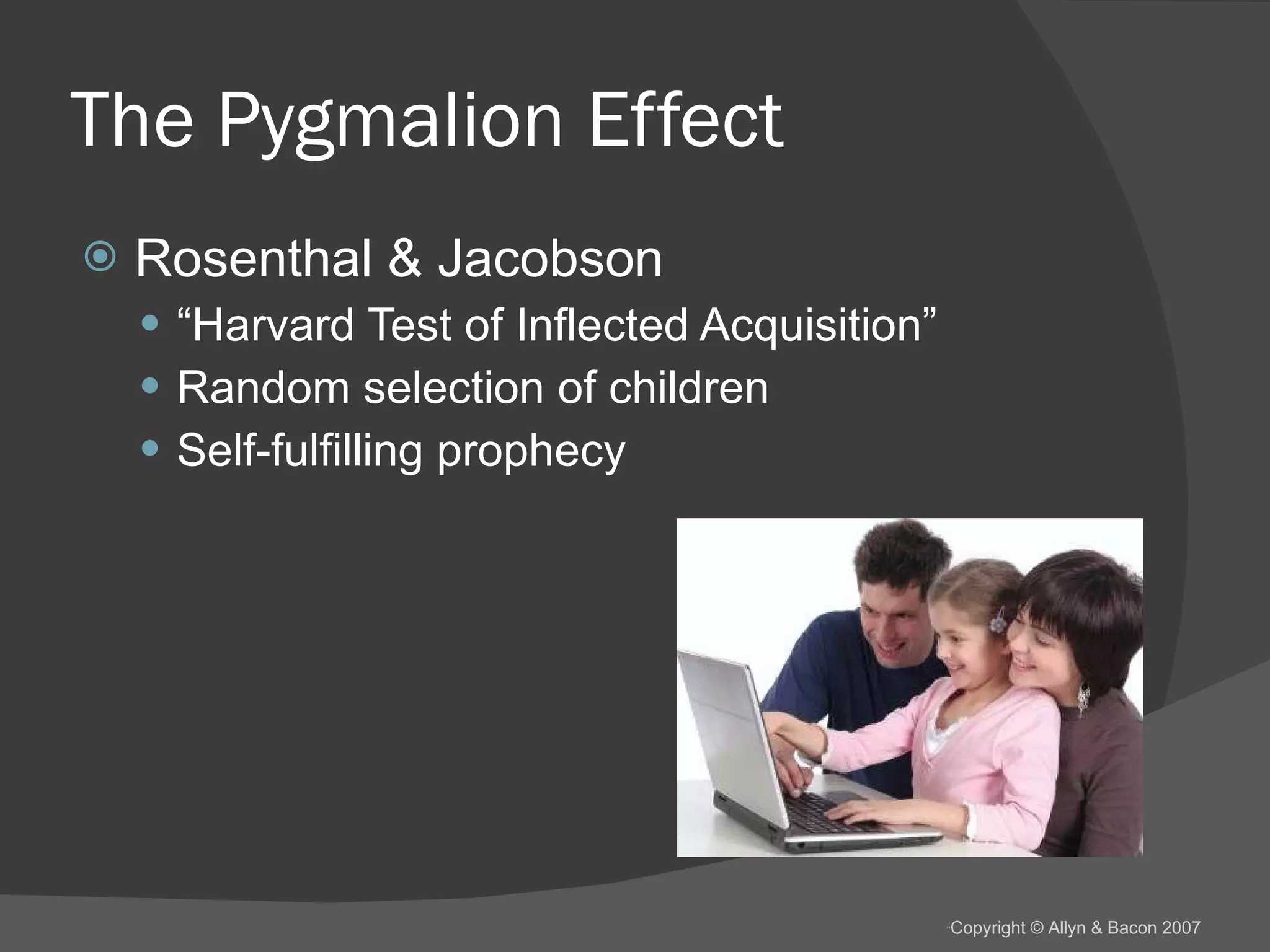
The Pygmalion Effect Rosenthal & Jacobson “ Harvard Test of Inflected Acquisition” Random selection of children Self-fulfilling prophecy
Educational Programs and IQ Head Start and similar projects Most show only short-term IQ gains Most gains evaporate over time Abecedarian Project Intellectual, medical, and nutritional enrichment 5 years before kindergarten Long-term 5-point IQ boost
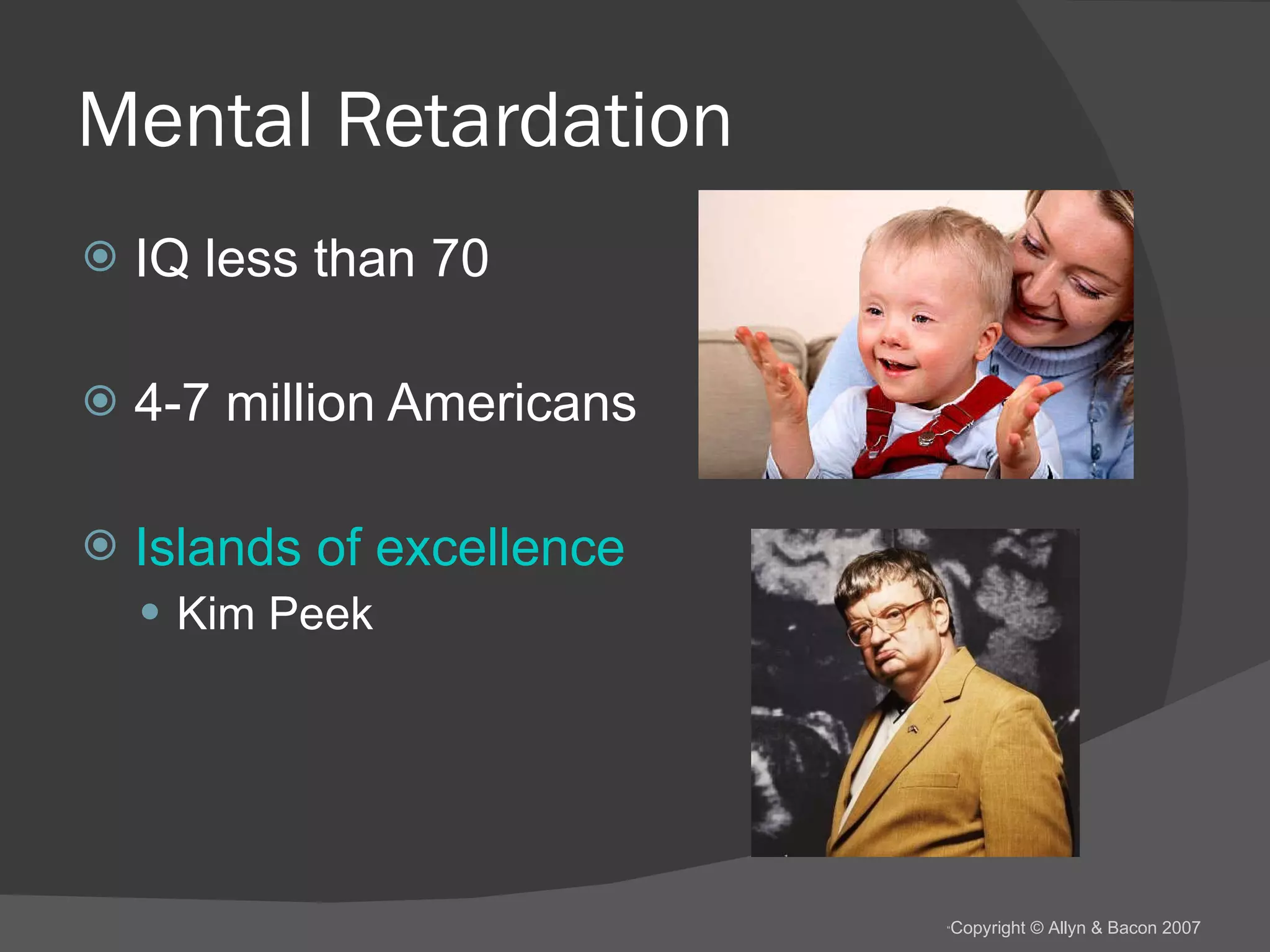
Mental Retardation IQ less than 70 4-7 million Americans Islands of excellence Kim Peek
Mental Retardation Genetic influences Down syndrome Fragile X syndrome Autism Environmental influences Fetal alcohol syndrome Childhood diseases Exposure to environmental toxins Inadequate medical care
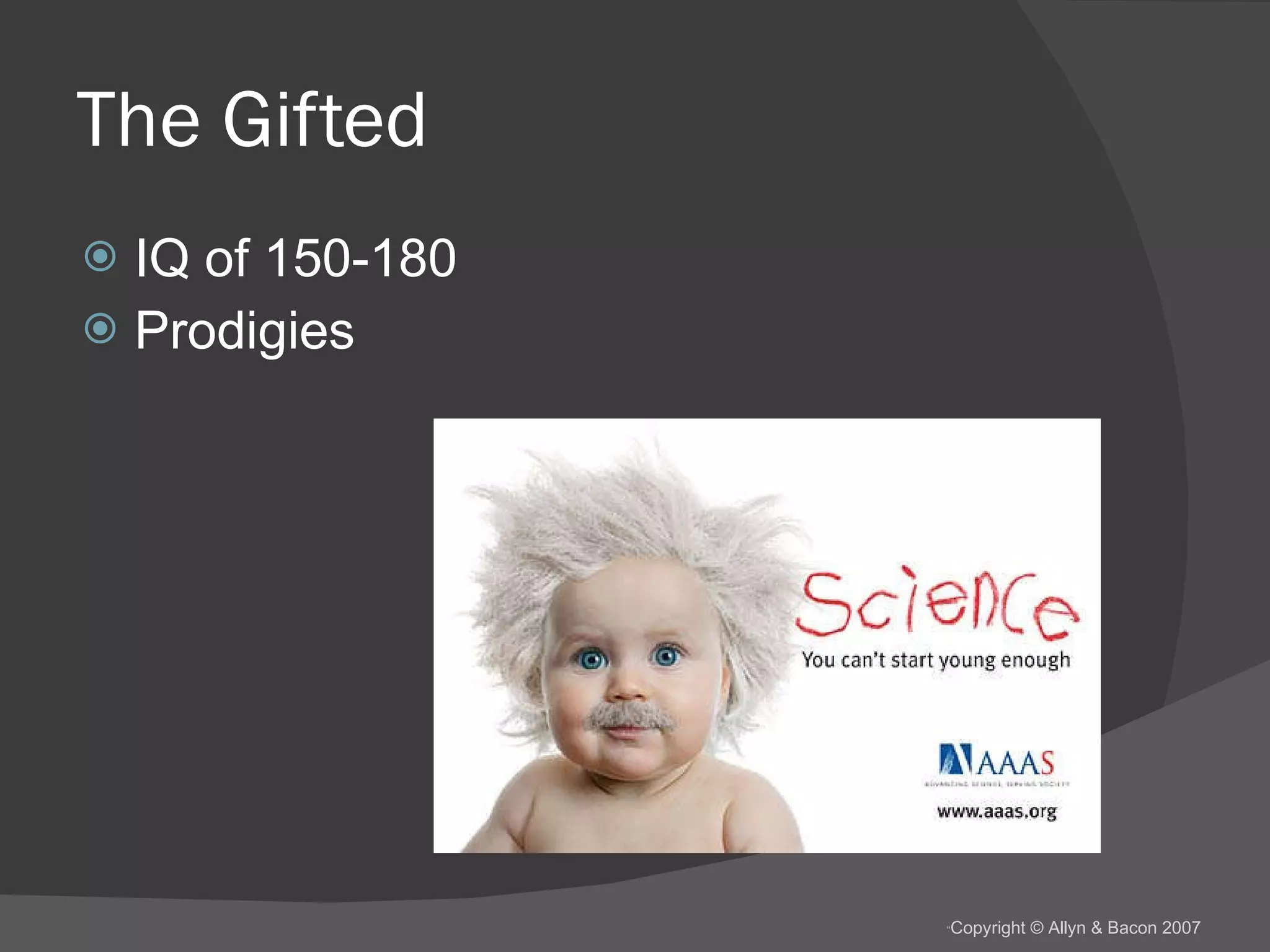
The Gifted IQ of 150-180 Prodigies

Intelligence

  • 1.
  • 2.
    What is intelligence?Think of the smartest people you know. What makes you think they are intelligent?
  • 3.
    The World’s Smartest:Potential and Pitfalls Child Genius World’s Smartest Man
  • 4.
    Intelligence What isintelligence? Are there different types of intelligence? If so, how many? Can intelligence be measured? Not all psychologists agree on the answers to these important questions
  • 5.
    What Is IQ?IQ: Intelligence Quotient Score on an intelligence test Meaning has changed over time; also, how mutable it is and origins of between group differences.
  • 6.
    Intelligence Testing: HistoryAlfred Binet and Theodore Simon Developed first intelligence test (1904-1911) Identify students who need extra help Test many normal children at each age Compare individual’s score to “normal” scores Mental age Chronological age
  • 7.
    Intelligence Testing: HistoryLewis Terman (Stanford University) Developed American version of the Binet-Simon test, called the Stanford-Binet test, for ages 2 to adult David Wechsler Wechsler Adult Intelligence Scale (WAIS) Wechsler Intelligence Scale for Children (WISC) Performance and verbal subtests
  • 8.
  • 9.
    Calculating IQ WilliamStern Problem: people don’t get stupider with age Modern approach Compare individual to standardized sample IQ = mental age chronological age x 100
  • 10.
    The Normal CurvePopulation Norming Mean Standard deviation
  • 11.
    Reliability and ValidityA good test must be valid and reliable Reliability Test produces consistent results Validity Test measures what it is supposed to The WAIS-III is highly reliable, but is it a valid measure of intelligence?
  • 12.
    IQ and AchievementIQ tends to be related to achievement High school and college grades Job prestige and salary Marital stability However, IQ accounts for only a small amount of the variation in job success Correlation is not causation Motivation, education, culture are important
  • 13.
    One Intelligence orMany? Charles Spearman g : general factor s : specific factors Intelligence depends mostly on g Factor analysis Louis Thurstone Separate primary mental abilities Examples: verbal comprehension and spatial visualization
  • 14.
    One Intelligence orMany? Raymond Cattell and John Horn Crystallized intelligence Fluid intelligence Aging Crystallized intelligence doesn’t suffer Fluid intelligence tends to decrease Different aging effects support the distinction
  • 15.
    One Intelligence orMany? Carroll’s three-stratum model Top strata is g , general intelligence Second strata includes fluid and crystallized intelligence with 6 other broad abilities Third strata includes 69 specific abilities
  • 16.
    Emotional Intelligence (EI)Knowing your emotions Managing your feelings Self-motivation Recognizing others’ emotions Handling relationships Women tend to have higher EI than men
  • 17.
    Multiple Intelligences HowardGardner (8 or 9 forms of intelligence) 1) Linguistic intelligence: The ability to use language well. 2) Spatial intelligence: The ability to reason well about spatial relations. 3) Musical intelligence: The ability to compose and understand music. 4) Logical-mathematical intelligence: The ability to manipulate abstract symbols. 5) Bodily-kinesthetic intelligence: The ability to plan and understand sequences of movements. 6) Intrapersonal intelligence: The ability to understand oneself. 7) Interpersonal intelligence: The ability to understand other people and social interactions. 8) Naturalist intelligence: The ability to observe carefully. 9) Existential intelligence: The ability to address “the big questions” about existence.
  • 18.
    Brain Size andIntelligence Is bigger always better? Depends more on size of crucial brain areas Females tend to have smaller brains but equal IQs Correlation between size and intelligence is small Correlation is not causation
  • 19.
    IQ and Speedof Processing Is IQ correlated with speed of information processing? Mixed results Many IQ subscales are time, so it is not surprising that mental processing speed would be related to IQ Measures of neural conduction are only weakly related to intelligence
  • 20.
    Working Memory andIQ IQ is correlated with working memory Many IQ subscales are involve memory, so it is not surprising that mental processing speed would be related to IQ
  • 21.
    IQ: Genes andEnvironment Adoption studies Correlation of IQs for identical twins raised apart is higher than that for fraternal twins and nontwin siblings raised together An adopted child’s IQ correlates higher with the biological mother’s IQ than with the adoptive mother’s IQ Strong evidence of the link between genes and IQ
  • 22.
    IQ: Genes andEnvironment Effects of environment Stoolmiller (1999) estimated the effects of the environment on IQ to be 57% Microenvironment Reaction range
  • 23.
    Group Differences inIQ Within-group versus between-group differences Genetics accounts for 72% of IQ variation in affluent environments Genetics accounts for 15% of IQ variation in impoverished environments Race differences: Why? Test bias Environmental differences Microenvironments Sex differences
  • 24.
    Boosting IQ TheFlynn effect Average IQ increases 3 points every 10 years Explanations? Daily life is more challenging Nutrition is better Reasoning ability stressed by IQ tests has gotten better, not IQ itself
  • 25.
    The Pygmalion EffectRosenthal & Jacobson “ Harvard Test of Inflected Acquisition” Random selection of children Self-fulfilling prophecy
  • 26.
    Educational Programs andIQ Head Start and similar projects Most show only short-term IQ gains Most gains evaporate over time Abecedarian Project Intellectual, medical, and nutritional enrichment 5 years before kindergarten Long-term 5-point IQ boost
  • 27.
    Mental Retardation IQless than 70 4-7 million Americans Islands of excellence Kim Peek
  • 28.
    Mental Retardation Geneticinfluences Down syndrome Fragile X syndrome Autism Environmental influences Fetal alcohol syndrome Childhood diseases Exposure to environmental toxins Inadequate medical care
  • 29.
    The Gifted IQof 150-180 Prodigies