History of Intelligence Test
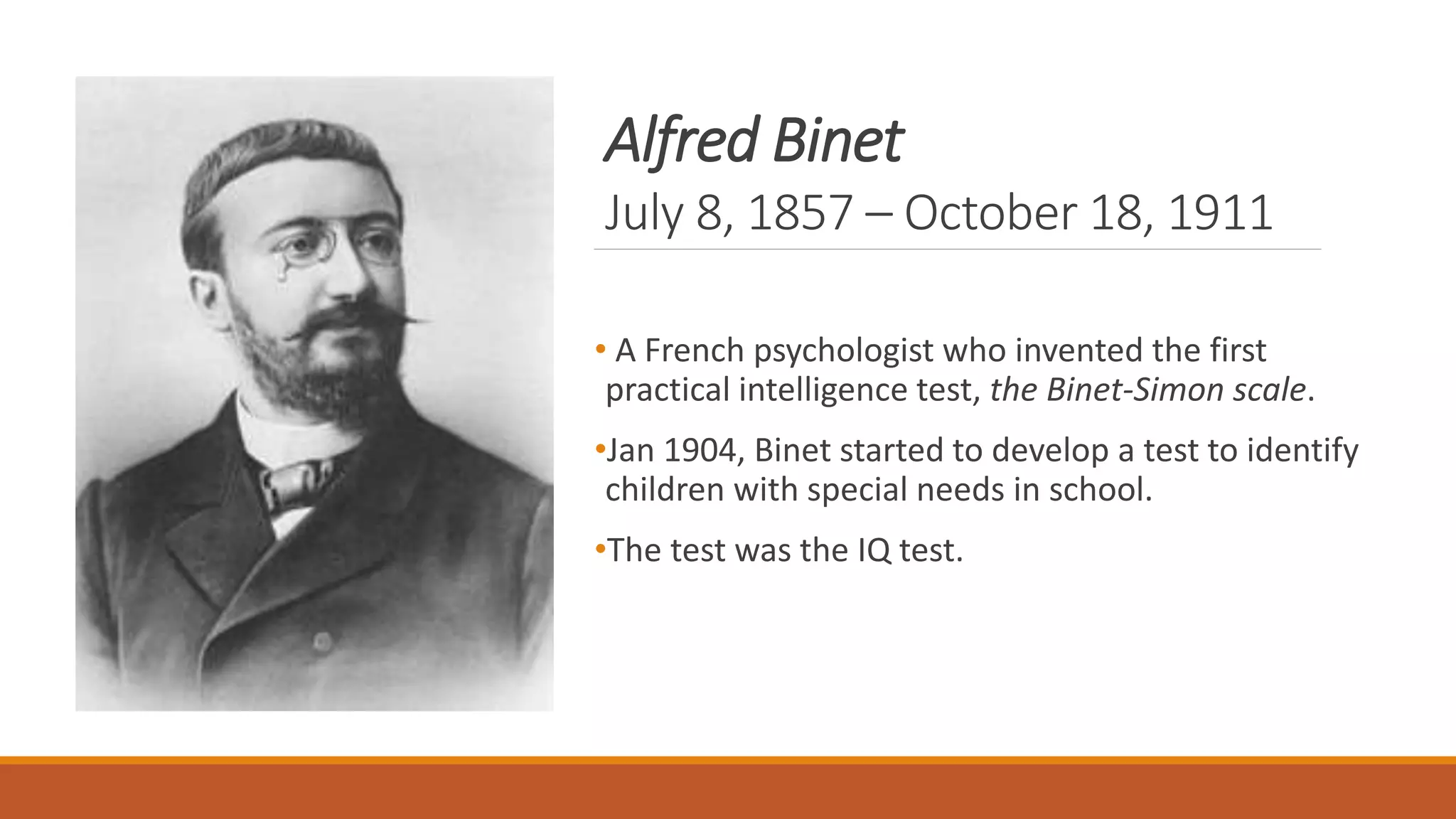
Alfred Binet
July 8, 1857 – October 18, 1911
• A French psychologist who invented the first
practical intelligence test, the Binet-Simon scale.
•Jan 1904, Binet started to develop a test to identify
children with special needs in school.
•The test was the IQ test.
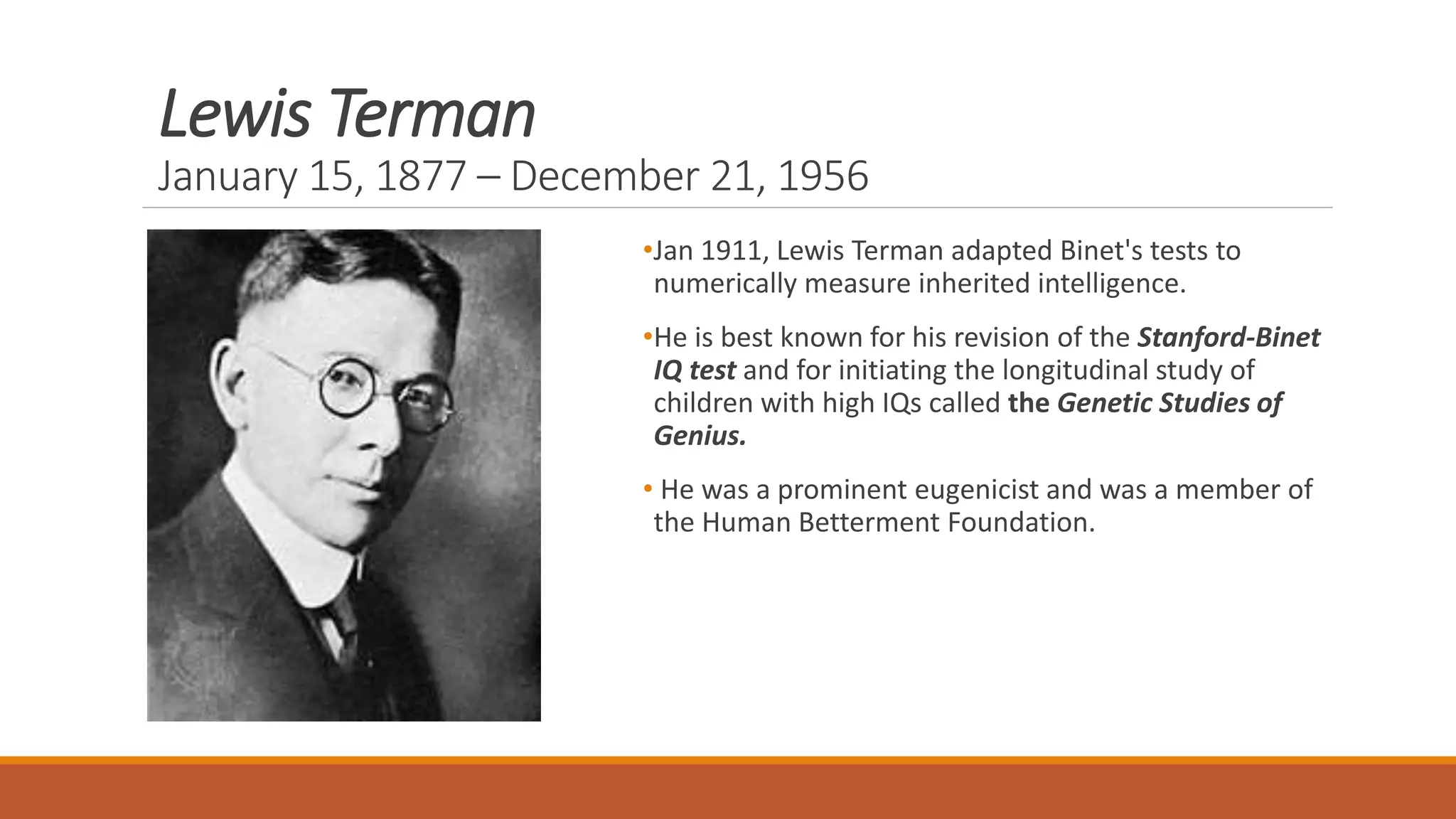
Lewis Terman
January 15, 1877 – December 21, 1956
•Jan 1911, Lewis Terman adapted Binet's tests to
numerically measure inherited intelligence.
•He is best known for his revision of the Stanford-Binet
IQ test and for initiating the longitudinal study of
children with high IQs called the Genetic Studies of
Genius.
• He was a prominent eugenicist and was a member of
the Human Betterment Foundation.
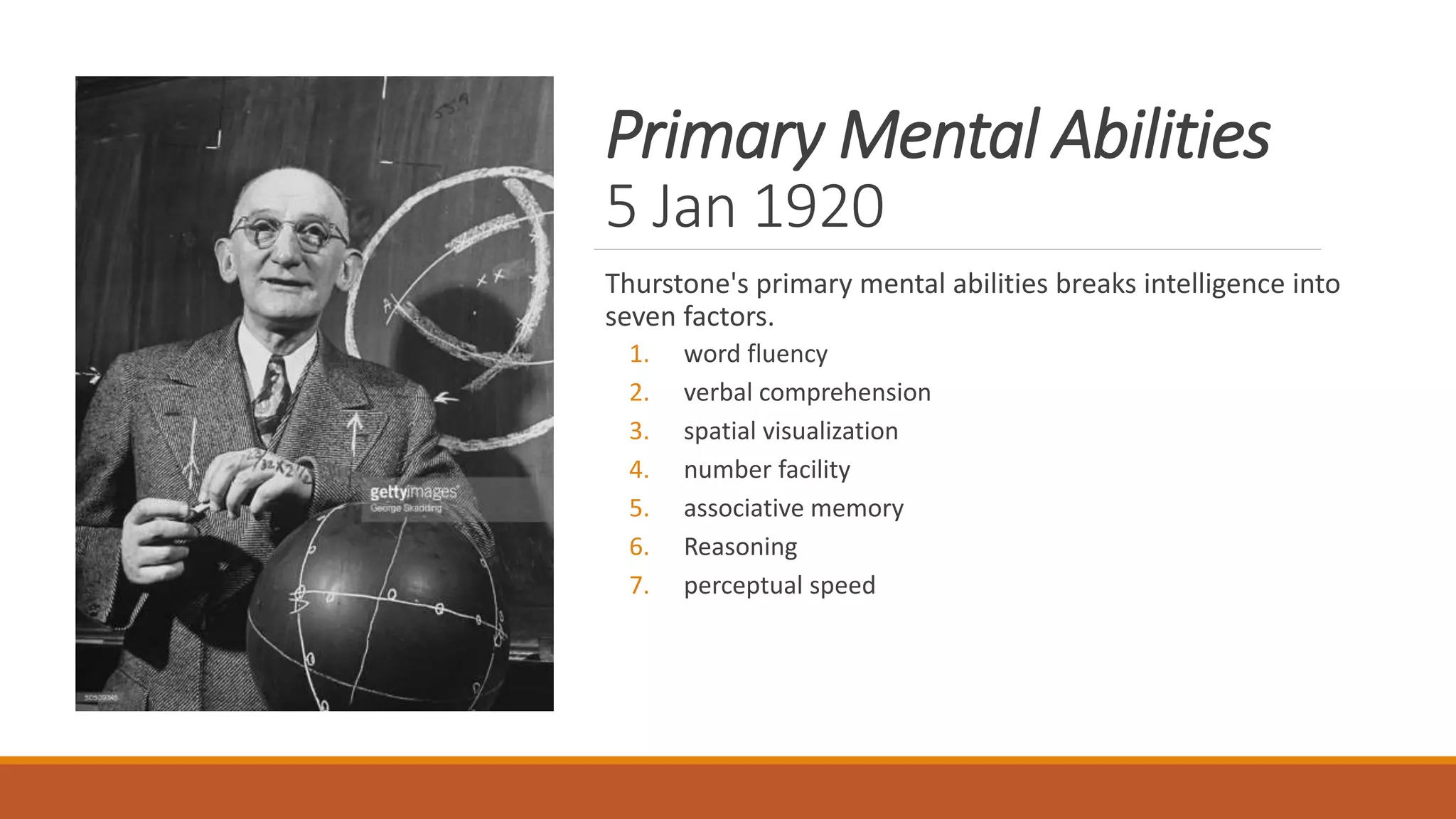
Primary Mental Abilities
5 Jan 1920
Thurstone's primary mental abilities breaks intelligence into
seven factors.
1. word fluency
2. verbal comprehension
3. spatial visualization
4. number facility
5. associative memory
6. Reasoning
7. perceptual speed
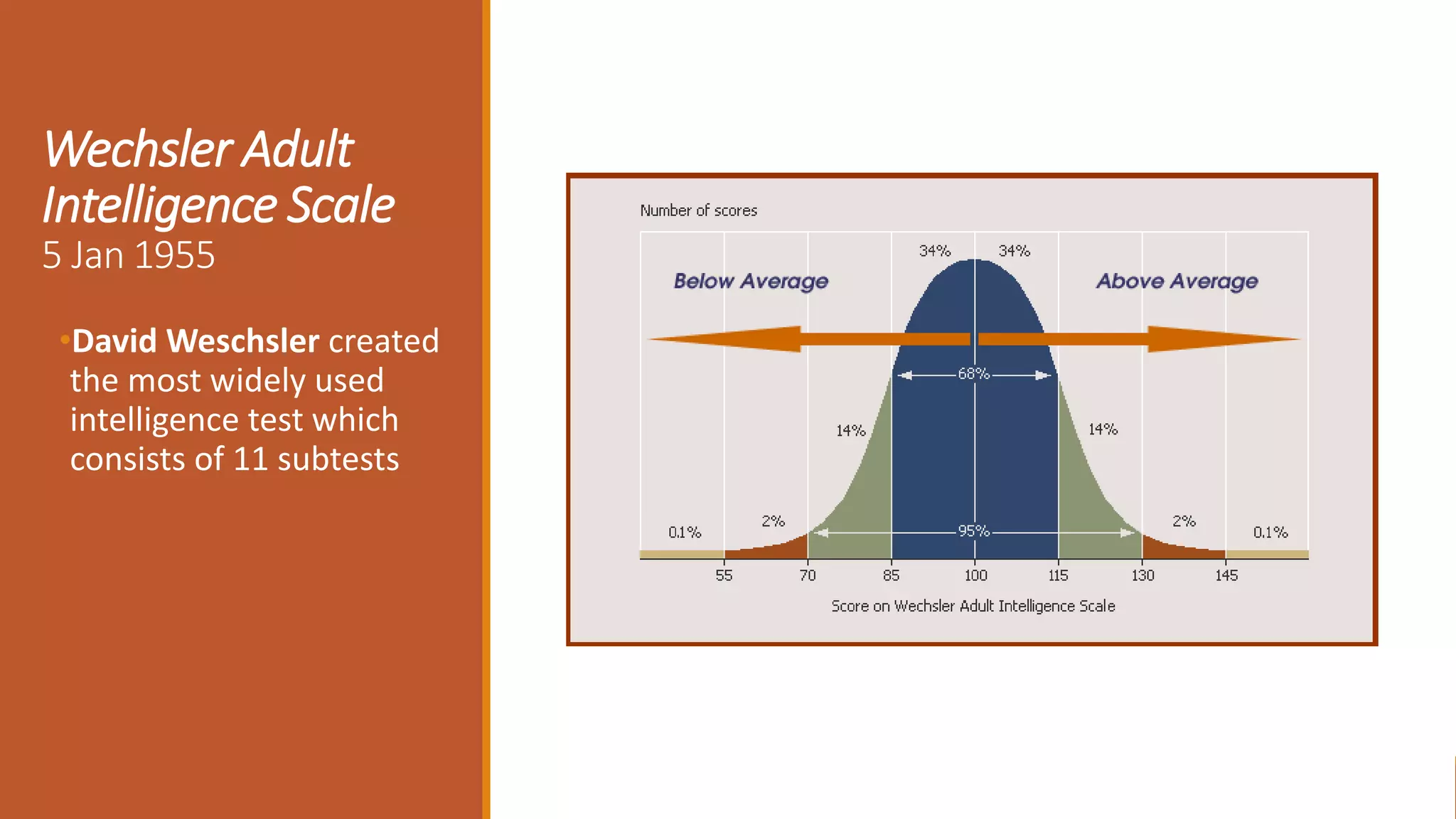
Wechsler Adult
Intelligence Scale
5 Jan 1955
•David Weschsler created
the most widely used
intelligence test which
consists of 11 subtests
Wechsler Adult Intelligence Scale
11 subsets
•Verbal WAIS scales
Information: 29 questions - a measure of general knowledge
Digit Span: The sets of digits to repeat initially forwards then backwards
Vocabulary: A measure of expressive word knowledge
Arithmetic: 14 mental arithmetic brief story type problems
Comprehension: 16 questions which focus on issues of social awareness.
Similarities: A measure of concept formation.
Wechsler Adult Intelligence Scale
11 subsets
•Performance WAIS scales
Picture Completion: 20 small pictures that all have one vital detail missing
Picture Arrangement: 10 sets of small pictures, where the subject is
required to arrange them into a logical sequence
Block Design: Involves putting sets of blocks together to match patterns
on cards
Digit Symbol: Involves copying a coding pattern.
Object Assembly: Four small jig-saw type puzzles
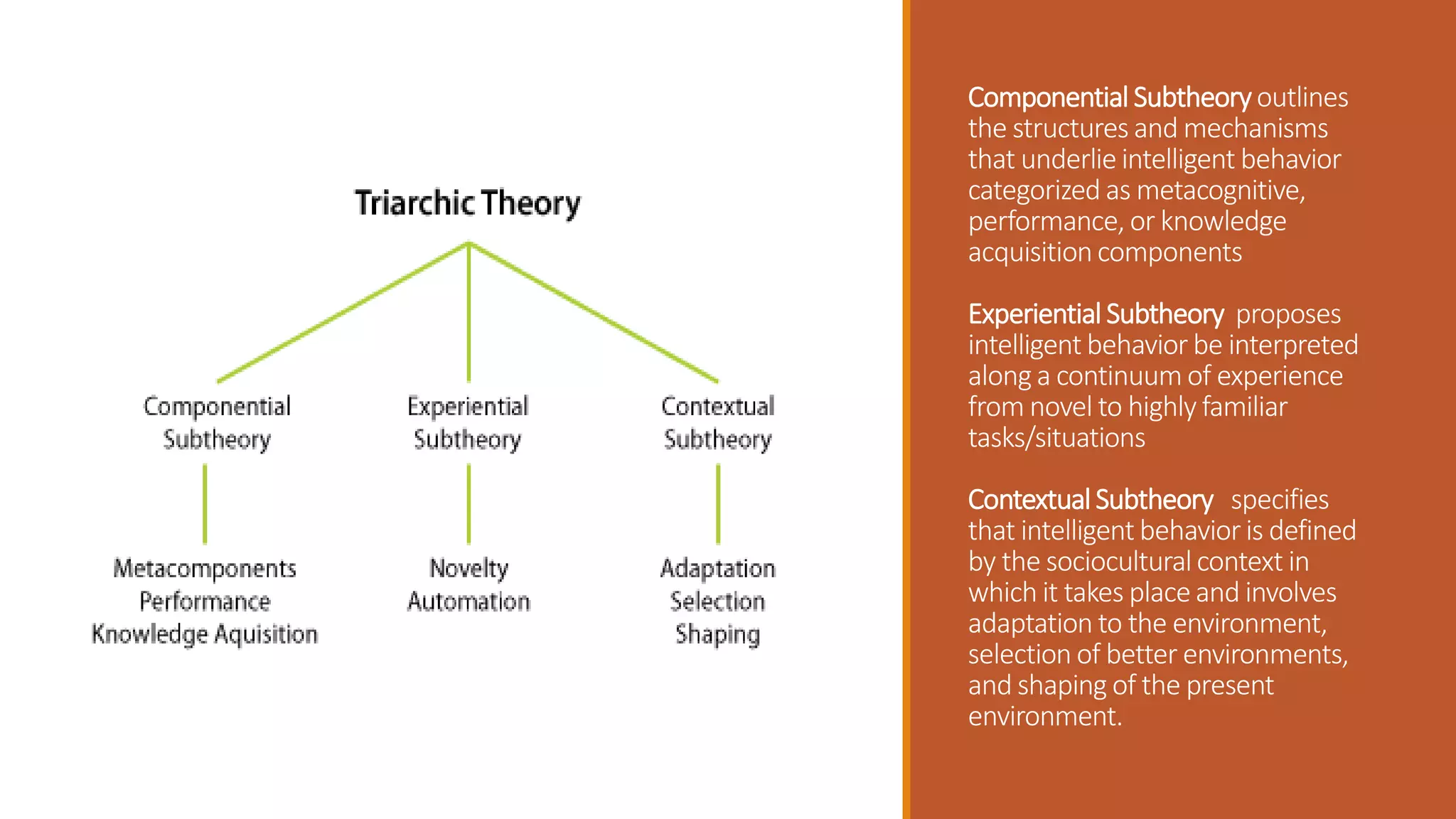
Triarchic Theory
Jan 1985
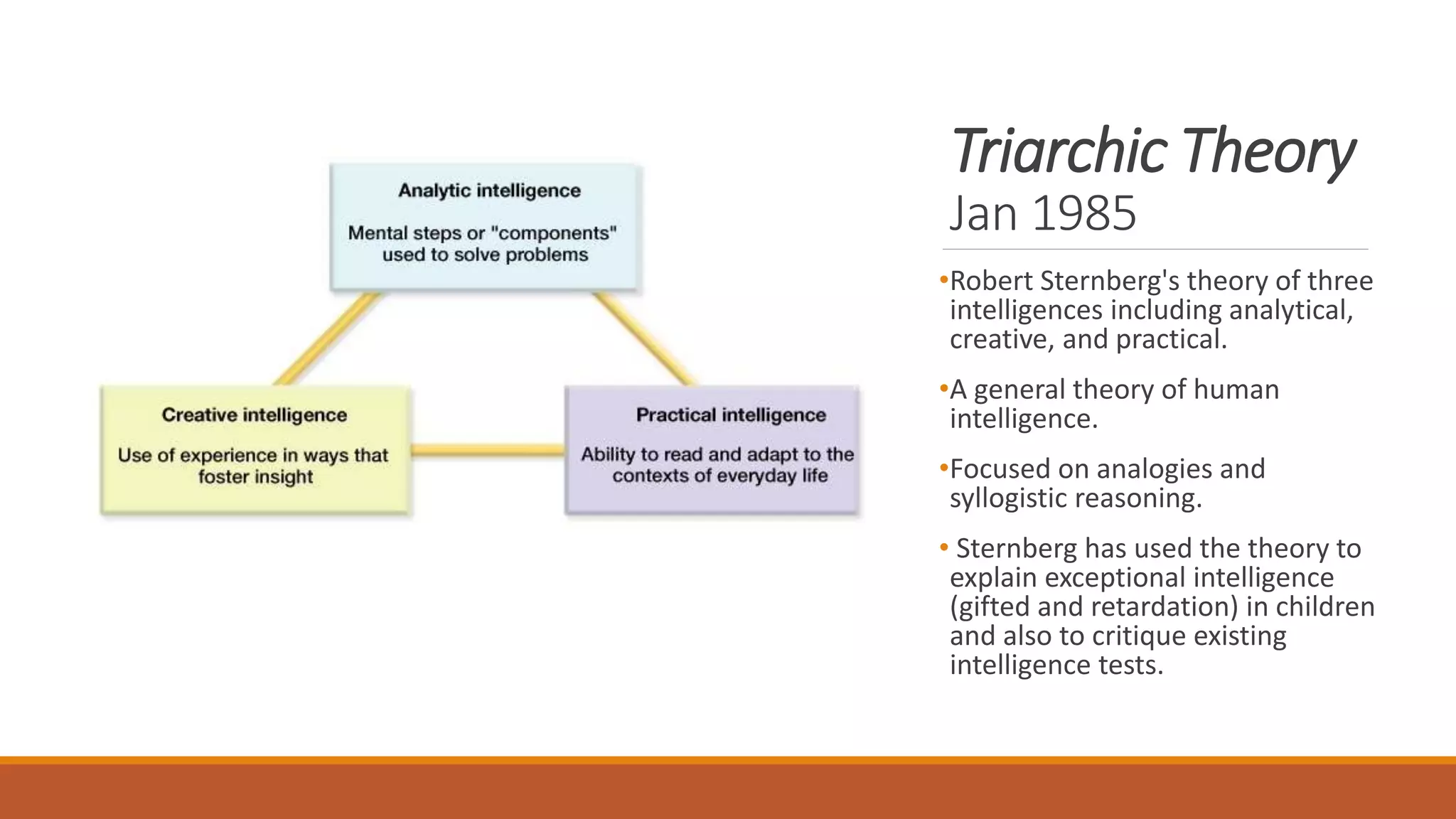
•Robert Sternberg's theory of three
intelligences including analytical,
creative, and practical.
•A general theory of human
intelligence.
•Focused on analogies and
syllogistic reasoning.
• Sternberg has used the theory to
explain exceptional intelligence
(gifted and retardation) in children
and also to critique existing
intelligence tests.
Componential Subtheoryoutlines
the structures and mechanisms
that underlie intelligent behavior
categorized as metacognitive,
performance, or knowledge
acquisition components
Experiential Subtheory proposes
intelligent behavior be interpreted
along a continuum of experience
from novel to highly familiar
tasks/situations
Contextual Subtheory specifies
that intelligent behavior is defined
by the sociocultural context in
which it takes place and involves
adaptation to the environment,
selection of better environments,
and shaping of the present
environment.
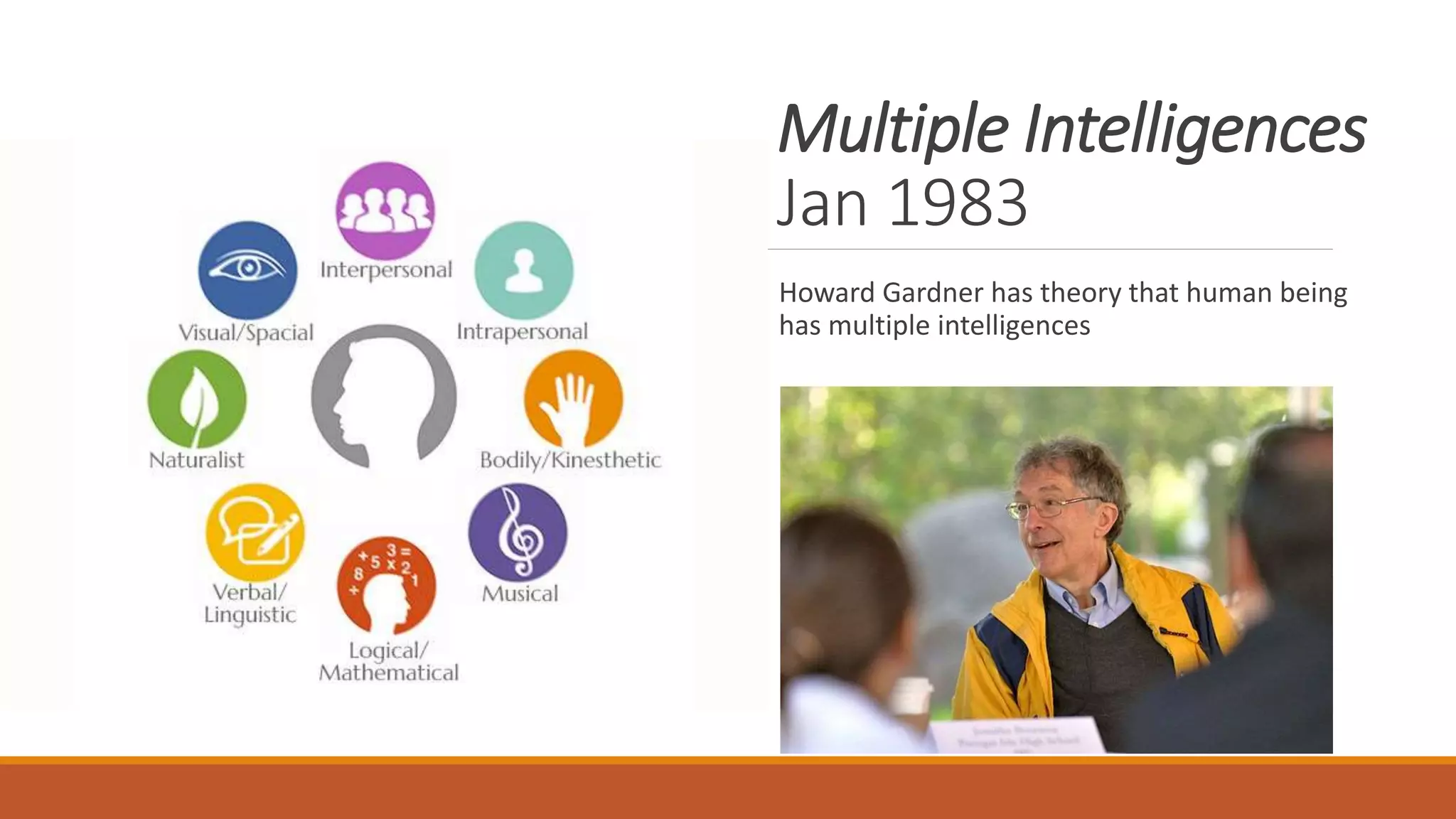
Multiple Intelligences
Jan 1983
Howard Gardner has theory that human being
has multiple intelligences
Multiple Intelligences
1. Linguistic intelligence involves sensitivity to spoken and written language, the ability to learn
languages, and the capacity to use language to accomplish certain goals. This intelligence
includes the ability to effectively use language to express oneself rhetorically or poetically
2. Logical-mathematical intelligence consists of the capacity to analyze problems logically, carry
out mathematical operations, and investigate issues scientifically. This intelligence is most often
associated with scientific and mathematical thinking.
3. Musical intelligence involves skill in the performance, composition, and appreciation of
musical patterns. It encompasses the capacity to recognize and compose musical pitches, tones,
and rhythms. According to Howard Gardner musical intelligence runs in an almost structural
parallel to linguistic intelligence.
Multiple Intelligences
4. Bodily-kinesthetic intelligence entails the potential of using one’s whole body or parts of the
body to solve problems. It is the ability to use mental abilities to coordinate bodily movements.
Howard Gardner sees mental and physical activity as related.
5. Spatial intelligence involves the potential to recognize and use the patterns of wide space and
more confined areas.
6. Interpersonal intelligence is concerned with the capacity to understand the intentions,
motivations and desires of other people. Educators, salespeople, religious and political leaders
and counsellors all need a well-developed interpersonal intelligence.
7. Intrapersonal intelligence entails the capacity to understand oneself, to appreciate one’s
feelings, fears and motivations. In Howard Gardner’s view it involves having an effective working
model of ourselves, and to be able to use such information to regulate our lives.
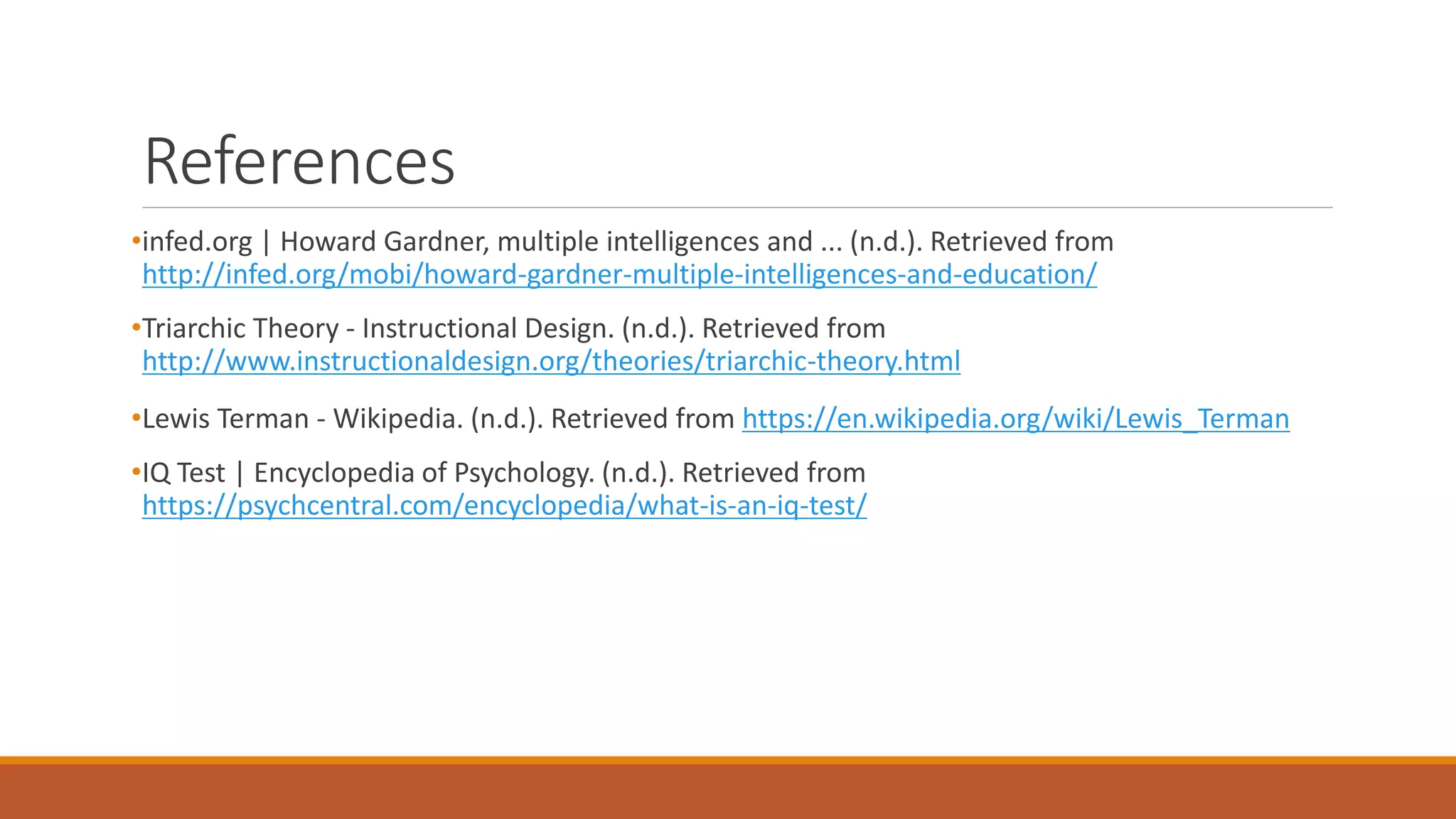
References
•infed.org | Howard Gardner, multiple intelligences and ... (n.d.). Retrieved from
http://infed.org/mobi/howard-gardner-multiple-intelligences-and-education/
•Triarchic Theory - Instructional Design. (n.d.). Retrieved from
http://www.instructionaldesign.org/theories/triarchic-theory.html
•Lewis Terman - Wikipedia. (n.d.). Retrieved from https://en.wikipedia.org/wiki/Lewis_Terman
•IQ Test | Encyclopedia of Psychology. (n.d.). Retrieved from
https://psychcentral.com/encyclopedia/what-is-an-iq-test/

History of intelligence test

  • 1.
  • 2.
    Alfred Binet July 8,1857 – October 18, 1911 • A French psychologist who invented the first practical intelligence test, the Binet-Simon scale. •Jan 1904, Binet started to develop a test to identify children with special needs in school. •The test was the IQ test.
  • 3.
    Lewis Terman January 15,1877 – December 21, 1956 •Jan 1911, Lewis Terman adapted Binet's tests to numerically measure inherited intelligence. •He is best known for his revision of the Stanford-Binet IQ test and for initiating the longitudinal study of children with high IQs called the Genetic Studies of Genius. • He was a prominent eugenicist and was a member of the Human Betterment Foundation.
  • 4.
    Primary Mental Abilities 5Jan 1920 Thurstone's primary mental abilities breaks intelligence into seven factors. 1. word fluency 2. verbal comprehension 3. spatial visualization 4. number facility 5. associative memory 6. Reasoning 7. perceptual speed
  • 5.
    Wechsler Adult Intelligence Scale 5Jan 1955 •David Weschsler created the most widely used intelligence test which consists of 11 subtests
  • 6.
    Wechsler Adult IntelligenceScale 11 subsets •Verbal WAIS scales Information: 29 questions - a measure of general knowledge Digit Span: The sets of digits to repeat initially forwards then backwards Vocabulary: A measure of expressive word knowledge Arithmetic: 14 mental arithmetic brief story type problems Comprehension: 16 questions which focus on issues of social awareness. Similarities: A measure of concept formation.
  • 7.
    Wechsler Adult IntelligenceScale 11 subsets •Performance WAIS scales Picture Completion: 20 small pictures that all have one vital detail missing Picture Arrangement: 10 sets of small pictures, where the subject is required to arrange them into a logical sequence Block Design: Involves putting sets of blocks together to match patterns on cards Digit Symbol: Involves copying a coding pattern. Object Assembly: Four small jig-saw type puzzles
  • 8.
    Triarchic Theory Jan 1985 •RobertSternberg's theory of three intelligences including analytical, creative, and practical. •A general theory of human intelligence. •Focused on analogies and syllogistic reasoning. • Sternberg has used the theory to explain exceptional intelligence (gifted and retardation) in children and also to critique existing intelligence tests.
  • 9.
    Componential Subtheoryoutlines the structuresand mechanisms that underlie intelligent behavior categorized as metacognitive, performance, or knowledge acquisition components Experiential Subtheory proposes intelligent behavior be interpreted along a continuum of experience from novel to highly familiar tasks/situations Contextual Subtheory specifies that intelligent behavior is defined by the sociocultural context in which it takes place and involves adaptation to the environment, selection of better environments, and shaping of the present environment.
  • 10.
    Multiple Intelligences Jan 1983 HowardGardner has theory that human being has multiple intelligences
  • 11.
    Multiple Intelligences 1. Linguisticintelligence involves sensitivity to spoken and written language, the ability to learn languages, and the capacity to use language to accomplish certain goals. This intelligence includes the ability to effectively use language to express oneself rhetorically or poetically 2. Logical-mathematical intelligence consists of the capacity to analyze problems logically, carry out mathematical operations, and investigate issues scientifically. This intelligence is most often associated with scientific and mathematical thinking. 3. Musical intelligence involves skill in the performance, composition, and appreciation of musical patterns. It encompasses the capacity to recognize and compose musical pitches, tones, and rhythms. According to Howard Gardner musical intelligence runs in an almost structural parallel to linguistic intelligence.
  • 12.
    Multiple Intelligences 4. Bodily-kinestheticintelligence entails the potential of using one’s whole body or parts of the body to solve problems. It is the ability to use mental abilities to coordinate bodily movements. Howard Gardner sees mental and physical activity as related. 5. Spatial intelligence involves the potential to recognize and use the patterns of wide space and more confined areas. 6. Interpersonal intelligence is concerned with the capacity to understand the intentions, motivations and desires of other people. Educators, salespeople, religious and political leaders and counsellors all need a well-developed interpersonal intelligence. 7. Intrapersonal intelligence entails the capacity to understand oneself, to appreciate one’s feelings, fears and motivations. In Howard Gardner’s view it involves having an effective working model of ourselves, and to be able to use such information to regulate our lives.
  • 13.
    References •infed.org | HowardGardner, multiple intelligences and ... (n.d.). Retrieved from http://infed.org/mobi/howard-gardner-multiple-intelligences-and-education/ •Triarchic Theory - Instructional Design. (n.d.). Retrieved from http://www.instructionaldesign.org/theories/triarchic-theory.html •Lewis Terman - Wikipedia. (n.d.). Retrieved from https://en.wikipedia.org/wiki/Lewis_Terman •IQ Test | Encyclopedia of Psychology. (n.d.). Retrieved from https://psychcentral.com/encyclopedia/what-is-an-iq-test/