Effects of Word Presentation
       Modality and Word
    Visualizability on Memory
Ann P. Beck, Roberto Araujo, George R. Foss, and
                   Roy G. Biv
            San Jose State University
Theoretical Background
•  Words are usually remembered better
   when presented visually than aurally
   (Smith, 1985; Jones, Ragalooshian, and
   Bosner, 1992)
•  Visual imagery is helpful in encoding
   words into memory (Rork and Wendel,
   1972; Rosenkrantz and Guildenstern,
   1997)
  – these studies always used visual
    presentation of words
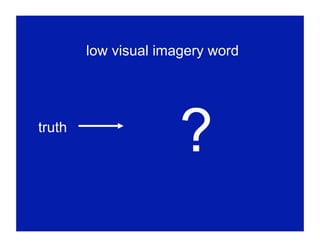
high visual imagery word


cow
low visual imagery word


truth
                      ?
Question
•  If words are presented aurally, will
   visual imagery still be helpful?
•  Our hypothesis: No. Visual mode must
   be active in order to use visual imagery.
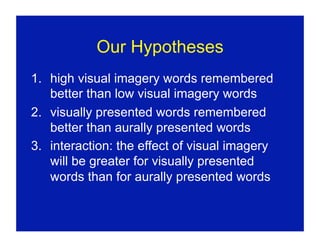
Our Hypotheses
1.  high visual imagery words remembered
    better than low visual imagery words
2.  visually presented words remembered
    better than aurally presented words
3.  interaction: the effect of visual imagery
    will be greater for visually presented
    words than for aurally presented words
Method
•  Participants: 40 participants (23 females, 17
   males)
  – SJSU students
•  Procedure: participants were presented with
   40 words, which they then recalled by
   writing down the words in any order
Method (continued)
•  Design:
  – IV #1: visualizability of word (high visual
    imagery, low visual imagery)
     •  within subjects
  – IV #2: modality of word presentation
    (visual, auditory)
     •  between subjects
  – DV: number of words correctly recalled
Example of word list
cow
truth
respect
book
belonging
spoon
…
Results
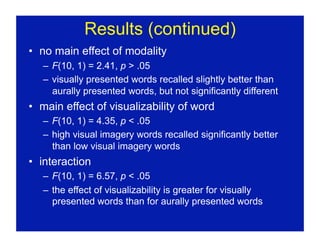
Results (continued)
•  no main effect of modality
   –  F(10, 1) = 2.41, p > .05
   –  visually presented words recalled slightly better than
      aurally presented words, but not significantly different
•  main effect of visualizability of word
   –  F(10, 1) = 4.35, p < .05
   –  high visual imagery words recalled significantly better
      than low visual imagery words
•  interaction
   –  F(10, 1) = 6.57, p < .05
   –  the effect of visualizability is greater for visually
      presented words than for aurally presented words
Discussion
•  High visual imagery words are remembered
   better than low visual imagery words
•  Visual imagery is a more helpful tool for
   memory when words are presented visually
   than when they are presented aurally
•  We did not find that words are remembered
   better when they are presented visually than
   aurally. This may have been due to
   difficulties reading the visual words.
  –  two subjects reported difficulty reading the words,
     which were in 10-point font
Note!
•  I didn’t include the “theoretical impact of
   the study” in this example

Psychology presentation

  • 1.
    Effects of WordPresentation Modality and Word Visualizability on Memory Ann P. Beck, Roberto Araujo, George R. Foss, and Roy G. Biv San Jose State University
  • 2.
    Theoretical Background •  Wordsare usually remembered better when presented visually than aurally (Smith, 1985; Jones, Ragalooshian, and Bosner, 1992) •  Visual imagery is helpful in encoding words into memory (Rork and Wendel, 1972; Rosenkrantz and Guildenstern, 1997) – these studies always used visual presentation of words
  • 3.
  • 4.
    low visual imageryword truth ?
  • 5.
    Question •  If wordsare presented aurally, will visual imagery still be helpful? •  Our hypothesis: No. Visual mode must be active in order to use visual imagery.
  • 6.
    Our Hypotheses 1.  highvisual imagery words remembered better than low visual imagery words 2.  visually presented words remembered better than aurally presented words 3.  interaction: the effect of visual imagery will be greater for visually presented words than for aurally presented words
  • 7.
    Method •  Participants: 40participants (23 females, 17 males) – SJSU students •  Procedure: participants were presented with 40 words, which they then recalled by writing down the words in any order
  • 8.
    Method (continued) •  Design: – IV #1: visualizability of word (high visual imagery, low visual imagery) •  within subjects – IV #2: modality of word presentation (visual, auditory) •  between subjects – DV: number of words correctly recalled
  • 9.
    Example of wordlist cow truth respect book belonging spoon …
  • 10.
  • 11.
    Results (continued) •  nomain effect of modality –  F(10, 1) = 2.41, p > .05 –  visually presented words recalled slightly better than aurally presented words, but not significantly different •  main effect of visualizability of word –  F(10, 1) = 4.35, p < .05 –  high visual imagery words recalled significantly better than low visual imagery words •  interaction –  F(10, 1) = 6.57, p < .05 –  the effect of visualizability is greater for visually presented words than for aurally presented words
  • 12.
    Discussion •  High visualimagery words are remembered better than low visual imagery words •  Visual imagery is a more helpful tool for memory when words are presented visually than when they are presented aurally •  We did not find that words are remembered better when they are presented visually than aurally. This may have been due to difficulties reading the visual words. –  two subjects reported difficulty reading the words, which were in 10-point font
  • 13.
    Note! •  I didn’tinclude the “theoretical impact of the study” in this example