BEHAVIORAL ASSESSMENT
BEHAVIORALASSESSMENT
refers to an approach to understanding
and changing behavior by identifying the
context in which it occurs (the situations or
stimuli that either precede it or follow from it).
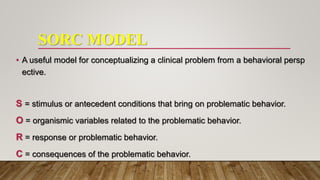
SORC MODEL
• A useful model for conceptualizing a clinical problem from a behavioral persp
ective.
S = stimulus or antecedent conditions that bring on problematic behavior.
O = organismic variables related to the problematic behavior.
R = response or problematic behavior.
C = consequences of the problematic behavior.
BEHAVIORALASSESSMENT
METHODS
• BEHAVIORAL INTERVIEWS
• OBSERVATION METHODS
• CONTROLLED PERFORMANCE TECHNIQUE
• SELF-MONITORING
• ROLE-PLAYING METHODS
• COGNITIVE-BEHAVIORAL METHODS
BEHAVIORAL INTERVIEWS
•Interviews conducted for the purpose of
identifying a problem behavior, the
situational factors that maintain the
behavior, and the consequences that result
from that behavior.
OBSERVATION METHODS
•is one method for collecting research data. It
involves watching a participant and
recording relevant behavior for later
analysis.
• NATURALISTIC CONDITION - A study method that involves
covertly or overtly watching subjects’ behaviors in their natural
environment, without intervention.
• CONTROLLED OBSERVATION - Controlled observation is a
type of observational study where the conditions are contrived by
the researcher.
CONTROLLED PERFORMANCE
TECHNIQUE
refers to an assessment procedure in which the
clinician places individuals in carefully controlled
performance situations and collects data on their
performance/behaviors, their emotional reactions
which is subjectively rated, and/or varieties of
psychophysiological indices.
SELF-MONITORING
An observational technique in which individuals
observe and record their own behaviors, thoughts,
or emotions (including information on timing,
frequency, intensity and duration).
ROLE-PLAYING METHOD
A technique in which patients are directed
to respond the way they would typically
respond if they were in a given situation.
INVENTORIES AND
CHECKLISTS
Behavioral clinicians have used a variety of
self report techniques to identify behaviors,
emotional responses, and perceptions
of the environment.
COGNITIVE-BEHAVIORAL
ASSESSMENTS
An assessment approach
recognizing that the person’s thought
or cognitions play an important role in
behavior.
CONTEMPORARY TRENDS IN
DATAACQUISITION
• Handheld computers can be assigned to clients so that cl
ients can provide real-time self-monitoring data.
• Hand-held computers can be programmed to prompt
clients to respond to queries at specified times of the day
or night.
•Data from either laptop or hand-held computers
can be loaded onto other computers that have
greater processing and memory capacity so that
observations can be aggregated, scored and
analyzed.
VARIABLES AFFECTING
RELIABILITY OF OBSERVATION
•Complexity of Target behaviors
•Training observers
VARIABLES AFFECTING VALIDITY OF
OBSERVATIONS
• Content Validity
• Concurrent Validity
• Construct Validity
• Mechanics of Rating
• Observer error
• Reactivity
• Ecological Validity
ADVANTAGE AND DISADVANTAGE OF
BEHAVIORALASSESSMENT
ADVANTAGES
• Gives accurate results because the researcher has direct access to the
subject, which allows the researcher to be in direct contact with the person.
• There are less chances of the subject lying because of the pressure of the
researcher sitting right in front of him or her.
• This method is among the most widely used methods because it does not
require heavy inputs. Questionnaires can be prepared and distributed to a
large number of audiences in a short span of time.
DISADVANTAGES
• This method is very time consuming as it requires the researcher to donate his
or her time and be in attendance in person.
• The researcher is often biased and more interested in getting the answers he
or she seeks instead of the answers that the subject wishes to give.
• Since the identities are generally kept secret or the questionnaires are
anonymous, people feel confident in giving true answers without the fear of
their information reaching unsafe hands.
The End =)

Behavioral Assessment

  • 1.
  • 2.
    BEHAVIORALASSESSMENT refers to anapproach to understanding and changing behavior by identifying the context in which it occurs (the situations or stimuli that either precede it or follow from it).
  • 3.
    SORC MODEL • Auseful model for conceptualizing a clinical problem from a behavioral persp ective. S = stimulus or antecedent conditions that bring on problematic behavior. O = organismic variables related to the problematic behavior. R = response or problematic behavior. C = consequences of the problematic behavior.
  • 4.
    BEHAVIORALASSESSMENT METHODS • BEHAVIORAL INTERVIEWS •OBSERVATION METHODS • CONTROLLED PERFORMANCE TECHNIQUE • SELF-MONITORING • ROLE-PLAYING METHODS • COGNITIVE-BEHAVIORAL METHODS
  • 5.
    BEHAVIORAL INTERVIEWS •Interviews conductedfor the purpose of identifying a problem behavior, the situational factors that maintain the behavior, and the consequences that result from that behavior.
  • 6.
    OBSERVATION METHODS •is onemethod for collecting research data. It involves watching a participant and recording relevant behavior for later analysis.
  • 7.
    • NATURALISTIC CONDITION- A study method that involves covertly or overtly watching subjects’ behaviors in their natural environment, without intervention. • CONTROLLED OBSERVATION - Controlled observation is a type of observational study where the conditions are contrived by the researcher.
  • 8.
    CONTROLLED PERFORMANCE TECHNIQUE refers toan assessment procedure in which the clinician places individuals in carefully controlled performance situations and collects data on their performance/behaviors, their emotional reactions which is subjectively rated, and/or varieties of psychophysiological indices.
  • 9.
    SELF-MONITORING An observational techniquein which individuals observe and record their own behaviors, thoughts, or emotions (including information on timing, frequency, intensity and duration).
  • 10.
    ROLE-PLAYING METHOD A techniquein which patients are directed to respond the way they would typically respond if they were in a given situation.
  • 11.
    INVENTORIES AND CHECKLISTS Behavioral clinicianshave used a variety of self report techniques to identify behaviors, emotional responses, and perceptions of the environment.
  • 12.
    COGNITIVE-BEHAVIORAL ASSESSMENTS An assessment approach recognizingthat the person’s thought or cognitions play an important role in behavior.
  • 13.
    CONTEMPORARY TRENDS IN DATAACQUISITION •Handheld computers can be assigned to clients so that cl ients can provide real-time self-monitoring data. • Hand-held computers can be programmed to prompt clients to respond to queries at specified times of the day or night.
  • 14.
    •Data from eitherlaptop or hand-held computers can be loaded onto other computers that have greater processing and memory capacity so that observations can be aggregated, scored and analyzed.
  • 15.
    VARIABLES AFFECTING RELIABILITY OFOBSERVATION •Complexity of Target behaviors •Training observers
  • 16.
    VARIABLES AFFECTING VALIDITYOF OBSERVATIONS • Content Validity • Concurrent Validity • Construct Validity • Mechanics of Rating • Observer error • Reactivity • Ecological Validity
  • 17.
    ADVANTAGE AND DISADVANTAGEOF BEHAVIORALASSESSMENT ADVANTAGES • Gives accurate results because the researcher has direct access to the subject, which allows the researcher to be in direct contact with the person. • There are less chances of the subject lying because of the pressure of the researcher sitting right in front of him or her. • This method is among the most widely used methods because it does not require heavy inputs. Questionnaires can be prepared and distributed to a large number of audiences in a short span of time.
  • 18.
    DISADVANTAGES • This methodis very time consuming as it requires the researcher to donate his or her time and be in attendance in person. • The researcher is often biased and more interested in getting the answers he or she seeks instead of the answers that the subject wishes to give. • Since the identities are generally kept secret or the questionnaires are anonymous, people feel confident in giving true answers without the fear of their information reaching unsafe hands.
  • 19.