




EDWARD PERSONAL
PREFERENCE SCHEDULE
INTRODUCTION
.
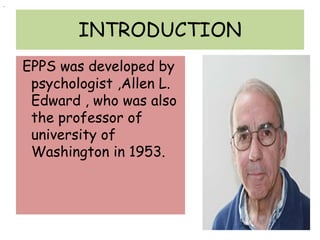
EPPS was developed by
psychologist ,Allen L.
Edward , who was also
the professor of
university of
Washington in 1953.
CONT.....
. This test can be used for people within 16-85
yrs and takes about 45 mins to complete.
Murray's Theory of Psychogenic
Needs
โ€ข American psychologist Henry Murray
developed a theory of personality that was
organized in terms of motives, and needs.
Murray described a need as a potentiality
or readiness to respond in a certain way
under certain given circumstances.
โ€ข Theories of personality based upon needs
and motives suggest that our personalities
are a reflection of behaviors controlled by
needs.
TEST FORMAT
15 TEST FORMAT
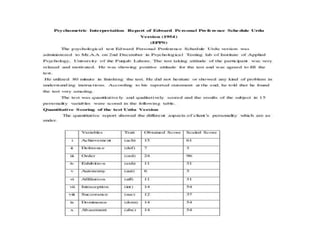
๏ถAcheivement--- A need to accomplish tasks well.
๏ถDeferance-------A need to conform to customs and
defer to others.
๏ถOrder------------A need to plan well and be organized.
๏ถExhibition----- A need to be the centre of attention in a
group.
๏ถAutonomy--- A need to be free of responsibilities and
obligations.
๏ถAffiliation----A need to form strong friendships and
attachments.
CONT.........
๏ถIntraception----A need to analyse behaviours and
feelings of others.
๏ถSuccoranceโ€”A need to receive support and attention
from others.
๏ถDominanceโ€”A need to be a leader and influence
others.
๏ถAbasementโ€”A need to accept blame for problems
and confess errors to others.
๏ถNurturance- a need to be of assistance to others.
๏ถChange---A need to seek new experiences and avoid
routine.
CONT............
๏ถEnduranceโ€”A need to follow through on
tasks and complete assignments.
๏ถHeterosexualityโ€”A need to be associated
with and attractive to members of opposite
sex.
๏ถAggression- A need to express ones opinion
and be critical of others.
TEST CONSISTENCY
The inventory consists of 225 pairs of
statements in which items from each of
the 15 scales are paired with items from
the other 14 plus the other fifteen pair of
items for the optional consistency check.
This leaves the total number of items at
210. Edward has used the last 15 items to
offer the candidate the same item twice,
using the results to calculate a consistency
score.
USES
โ€ข The EPPS is primarily used for personal counseling
but, can also be used as a recruitment tool.
โ€ข It has been hypothesized that personality needs
have a significant impact upon eventual
occupational placement.
โ€ข The Edwards Personal Preference Schedule (EPPS)
was designed to provide researchers in Career
development with a quick and convenient
measure of a number of relatively independent
personality variables, or needs.
ADVANTAGES
The EPPS was designed to illustrate relative
importance to the individual of several
significant needs & motives
RELIABILITY
The inter-correlation of the
variables measured by EPPS are
quite low. It indicates that the
variables being measured are
relatively independent and the
schedule is quite low.
CONCLUSION
The EPPS has been published for a long period of
time through The Psychological Corporation, now
known as Harcourt Assessment. In 2002 the
worldwide publishing rights have been returned
by Harcourt to the Allen L. Edwards Living Trust.
Internationally there is a translation in Dutch,
which has been published in the Netherlands
legally until 2002 (by Harcourt Test Publishers).
There is also a translation into Japanese,
published in 1970 by Nihon Bunka Kagakusha,
Tokyo. The EPPS is translated into Spanish in 2014
in Mexico.
BIBLIOGRAPHY
1. Educational Testing Services. (1992). "The ets test collection
catalog:Affective measures and personality tests", Arizona: Oryx Press.
2. Kaplan, R. M., & Saccuzzo, D. P. (2009). "Psychological testing: Principles,
appoications, and issues" (7th ed.). Belmont, CA: Wadsworth
3. Cherry, Kendra. (2012). "Murray's theory of psychogenic needs".
Retrieved November 21, 2012,
from http://psychology.about.com/od/theoriesofpersonality/a/psychog
enic.htm
4. Edwards Personal Preference Schedule EPPS. (n.d.) Retrieved
November 21, 2012 from http://www.scribd.com/doc/40156050/The-
Edwards-Personal-Preference-Schedule.
5. Cps.nova .edu/cpphelp/EPPS.html
6. . https:/en.wikipedia.org/wiki/Edwards-personal-preferance-schedule
Edward personal preference scales

Edward personal preference scales

  • 2.
  • 3.
    INTRODUCTION . EPPS was developedby psychologist ,Allen L. Edward , who was also the professor of university of Washington in 1953.
  • 5.
    CONT..... . This testcan be used for people within 16-85 yrs and takes about 45 mins to complete.
  • 6.
    Murray's Theory ofPsychogenic Needs โ€ข American psychologist Henry Murray developed a theory of personality that was organized in terms of motives, and needs. Murray described a need as a potentiality or readiness to respond in a certain way under certain given circumstances. โ€ข Theories of personality based upon needs and motives suggest that our personalities are a reflection of behaviors controlled by needs.
  • 7.
  • 8.
    15 TEST FORMAT ๏ถAcheivement---A need to accomplish tasks well. ๏ถDeferance-------A need to conform to customs and defer to others. ๏ถOrder------------A need to plan well and be organized. ๏ถExhibition----- A need to be the centre of attention in a group. ๏ถAutonomy--- A need to be free of responsibilities and obligations. ๏ถAffiliation----A need to form strong friendships and attachments.
  • 9.
    CONT......... ๏ถIntraception----A need toanalyse behaviours and feelings of others. ๏ถSuccoranceโ€”A need to receive support and attention from others. ๏ถDominanceโ€”A need to be a leader and influence others. ๏ถAbasementโ€”A need to accept blame for problems and confess errors to others. ๏ถNurturance- a need to be of assistance to others. ๏ถChange---A need to seek new experiences and avoid routine.
  • 10.
    CONT............ ๏ถEnduranceโ€”A need tofollow through on tasks and complete assignments. ๏ถHeterosexualityโ€”A need to be associated with and attractive to members of opposite sex. ๏ถAggression- A need to express ones opinion and be critical of others.
  • 11.
    TEST CONSISTENCY The inventoryconsists of 225 pairs of statements in which items from each of the 15 scales are paired with items from the other 14 plus the other fifteen pair of items for the optional consistency check. This leaves the total number of items at 210. Edward has used the last 15 items to offer the candidate the same item twice, using the results to calculate a consistency score.
  • 12.
    USES โ€ข The EPPSis primarily used for personal counseling but, can also be used as a recruitment tool. โ€ข It has been hypothesized that personality needs have a significant impact upon eventual occupational placement. โ€ข The Edwards Personal Preference Schedule (EPPS) was designed to provide researchers in Career development with a quick and convenient measure of a number of relatively independent personality variables, or needs.
  • 13.
    ADVANTAGES The EPPS wasdesigned to illustrate relative importance to the individual of several significant needs & motives
  • 14.
    RELIABILITY The inter-correlation ofthe variables measured by EPPS are quite low. It indicates that the variables being measured are relatively independent and the schedule is quite low.
  • 18.
    CONCLUSION The EPPS hasbeen published for a long period of time through The Psychological Corporation, now known as Harcourt Assessment. In 2002 the worldwide publishing rights have been returned by Harcourt to the Allen L. Edwards Living Trust. Internationally there is a translation in Dutch, which has been published in the Netherlands legally until 2002 (by Harcourt Test Publishers). There is also a translation into Japanese, published in 1970 by Nihon Bunka Kagakusha, Tokyo. The EPPS is translated into Spanish in 2014 in Mexico.
  • 19.
    BIBLIOGRAPHY 1. Educational TestingServices. (1992). "The ets test collection catalog:Affective measures and personality tests", Arizona: Oryx Press. 2. Kaplan, R. M., & Saccuzzo, D. P. (2009). "Psychological testing: Principles, appoications, and issues" (7th ed.). Belmont, CA: Wadsworth 3. Cherry, Kendra. (2012). "Murray's theory of psychogenic needs". Retrieved November 21, 2012, from http://psychology.about.com/od/theoriesofpersonality/a/psychog enic.htm 4. Edwards Personal Preference Schedule EPPS. (n.d.) Retrieved November 21, 2012 from http://www.scribd.com/doc/40156050/The- Edwards-Personal-Preference-Schedule. 5. Cps.nova .edu/cpphelp/EPPS.html 6. . https:/en.wikipedia.org/wiki/Edwards-personal-preferance-schedule