Citation

Zahedi, Y., & Abdi, M. (2012). The Impact of
Imagery Strategy on EFL Learners’ Vocabulary
Learning. Procedia-Social and Behavioral
Sciences, 69, 2264-2272.

2
Contents

Introduction

Literature
Review

Methodology

Results &
Conclusion

Reflection

3
Introduction
Background

Purpose

 Vocabulary has always been  The study aimed to explore if
one of the significant issues imagery strategy was helpful for
lower-intermediate students’
related both with teachers
English vocabulary leaning in
and learners of foreign
comparison to direct translation.
language.

4
Introduction
Research Question

 Does imagery strategy have any significant impact on
Iranian EFL learners’ vocabulary learning?
Hypothesis

 Using imagery strategy has no significant impact on Iranian
EFL learners’ vocabulary learning.

5
Literature Review
 Vocabulary plays a significant role for
communication, because the communication would be
stopped if people hear or read words that people fail to
understand.
(Scott, Jamieson-Noel, & Asselin, 2003)

6
Literature Review
 Without a sufficient vocabulary, one cannot convey his
messages effectively or express his ideas in both oral and
written form.

(Fauziati, 2005)

7
Methodology
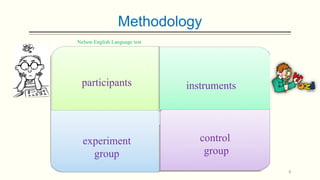
Nelson English Language test

80people took NELT
40 people scored 70
20 people experiment group
participants
20 people control group

Use the same book
entitled Facts and Figures by
Ackert and Lee (2004)
200 words selected from this book
instruments

Methodology

20 people
experiment
elective course
memory grouptraining
strategy

control
20 people
elective course
group
traditional direct strategy
8
Methodology
Procedure
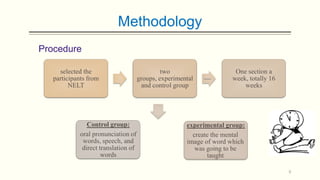
selected the
participants from
NELT

Control group:
oral pronunciation of
words, speech, and
direct translation of
words

two
groups, experimental
and control group

One section a
week, totally 16
weeks

experimental group:
create the mental
image of word which
was going to be
taught
9
Results & Conclusion
 Does imagery strategy have any significant impact on Iranian EFL
learners’ vocabulary learning?

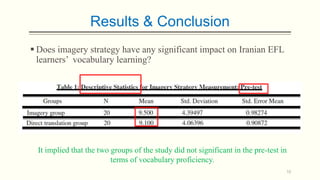
It implied that the two groups of the study did not significant in the pre-test in
terms of vocabulary proficiency.
10
Results & Conclusion
 Does imagery strategy have any significant impact on Iranian EFL
learners’ vocabulary learning?

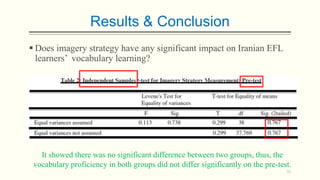
It showed there was no significant difference between two groups, thus, the
vocabulary proficiency in both groups did not differ significantly on the pre-test.
11
Results & Conclusion
 Does imagery strategy have any significant impact on Iranian EFL
learners’ vocabulary learning?

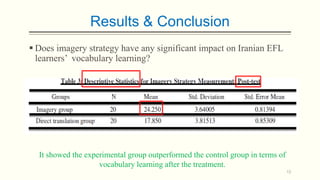
It showed the experimental group outperformed the control group in terms of
vocabulary learning after the treatment.
12
Results & Conclusion
 Does imagery strategy have any significant impact on Iranian EFL
learners’ vocabulary learning?

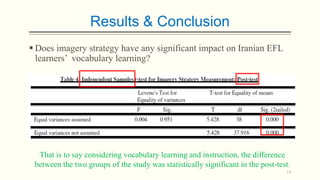
That is to say considering vocabulary learning and instruction, the difference
between the two groups of the study was statistically significant in the post-test.
13
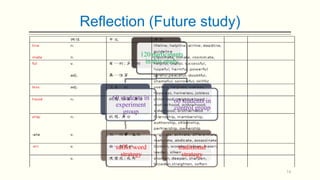
Reflection (Future study)
120 participants
in this study

60 students in
experiment
group

60 students in
control group

suffix word
strategy

traditional
strategy
14
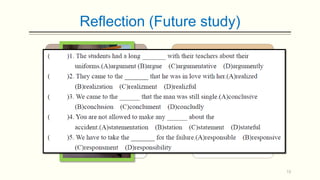
Reflection (Future study)

Instrument
Vocabulary book

Data
analysis
T-test

15
THANK YOU FOR LISTENING!

2013.10.23 論文發表課

  • 2.
    Citation Zahedi, Y., &Abdi, M. (2012). The Impact of Imagery Strategy on EFL Learners’ Vocabulary Learning. Procedia-Social and Behavioral Sciences, 69, 2264-2272. 2
  • 3.
  • 4.
    Introduction Background Purpose  Vocabulary hasalways been  The study aimed to explore if one of the significant issues imagery strategy was helpful for lower-intermediate students’ related both with teachers English vocabulary leaning in and learners of foreign comparison to direct translation. language. 4
  • 5.
    Introduction Research Question  Doesimagery strategy have any significant impact on Iranian EFL learners’ vocabulary learning? Hypothesis  Using imagery strategy has no significant impact on Iranian EFL learners’ vocabulary learning. 5
  • 6.
    Literature Review  Vocabularyplays a significant role for communication, because the communication would be stopped if people hear or read words that people fail to understand. (Scott, Jamieson-Noel, & Asselin, 2003) 6
  • 7.
    Literature Review  Withouta sufficient vocabulary, one cannot convey his messages effectively or express his ideas in both oral and written form. (Fauziati, 2005) 7
  • 8.
    Methodology Nelson English Languagetest 80people took NELT 40 people scored 70 20 people experiment group participants 20 people control group Use the same book entitled Facts and Figures by Ackert and Lee (2004) 200 words selected from this book instruments Methodology 20 people experiment elective course memory grouptraining strategy control 20 people elective course group traditional direct strategy 8
  • 9.
    Methodology Procedure selected the participants from NELT Controlgroup: oral pronunciation of words, speech, and direct translation of words two groups, experimental and control group One section a week, totally 16 weeks experimental group: create the mental image of word which was going to be taught 9
  • 10.
    Results & Conclusion Does imagery strategy have any significant impact on Iranian EFL learners’ vocabulary learning? It implied that the two groups of the study did not significant in the pre-test in terms of vocabulary proficiency. 10
  • 11.
    Results & Conclusion Does imagery strategy have any significant impact on Iranian EFL learners’ vocabulary learning? It showed there was no significant difference between two groups, thus, the vocabulary proficiency in both groups did not differ significantly on the pre-test. 11
  • 12.
    Results & Conclusion Does imagery strategy have any significant impact on Iranian EFL learners’ vocabulary learning? It showed the experimental group outperformed the control group in terms of vocabulary learning after the treatment. 12
  • 13.
    Results & Conclusion Does imagery strategy have any significant impact on Iranian EFL learners’ vocabulary learning? That is to say considering vocabulary learning and instruction, the difference between the two groups of the study was statistically significant in the post-test. 13
  • 14.
    Reflection (Future study) 120participants in this study 60 students in experiment group 60 students in control group suffix word strategy traditional strategy 14
  • 15.
  • 16.
    THANK YOU FORLISTENING!