1
AIM
To apprise the audience about
the meaning and philosophy of
          Education
MEANING AND DEFINITION
     OF EDUCATION

• The term education is derived from Latin
 word educere, educare, and educatum
 which means 'to learn‘, to know and to
 'lead out‘

• That is education means to lead out
 internal hidden talent of a child or person
NARROW MEANING OF
       EDUCATION


• The education provided under the
 premises       of   school,   colleges   and
 universities
NARROW MEANING OF
        EDUCATION
• Education limited under the premises
  of educational institutions
NARROW MEANING OF
        EDUCATION
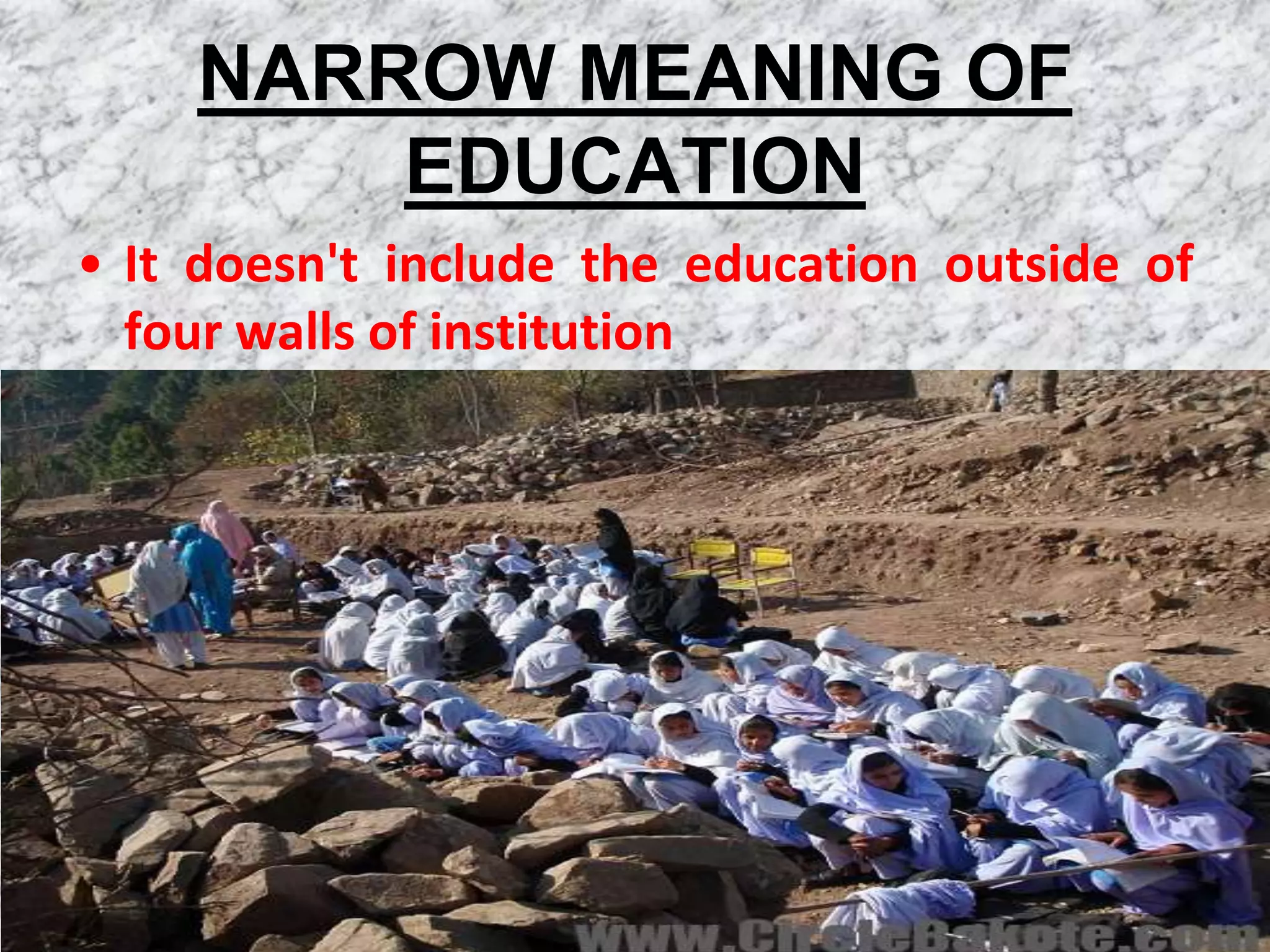
• It doesn't include the education outside of
  four walls of institution
NARROW MEANING OF
    EDUCATION
BROADER MEANING OF
       EDUCATION


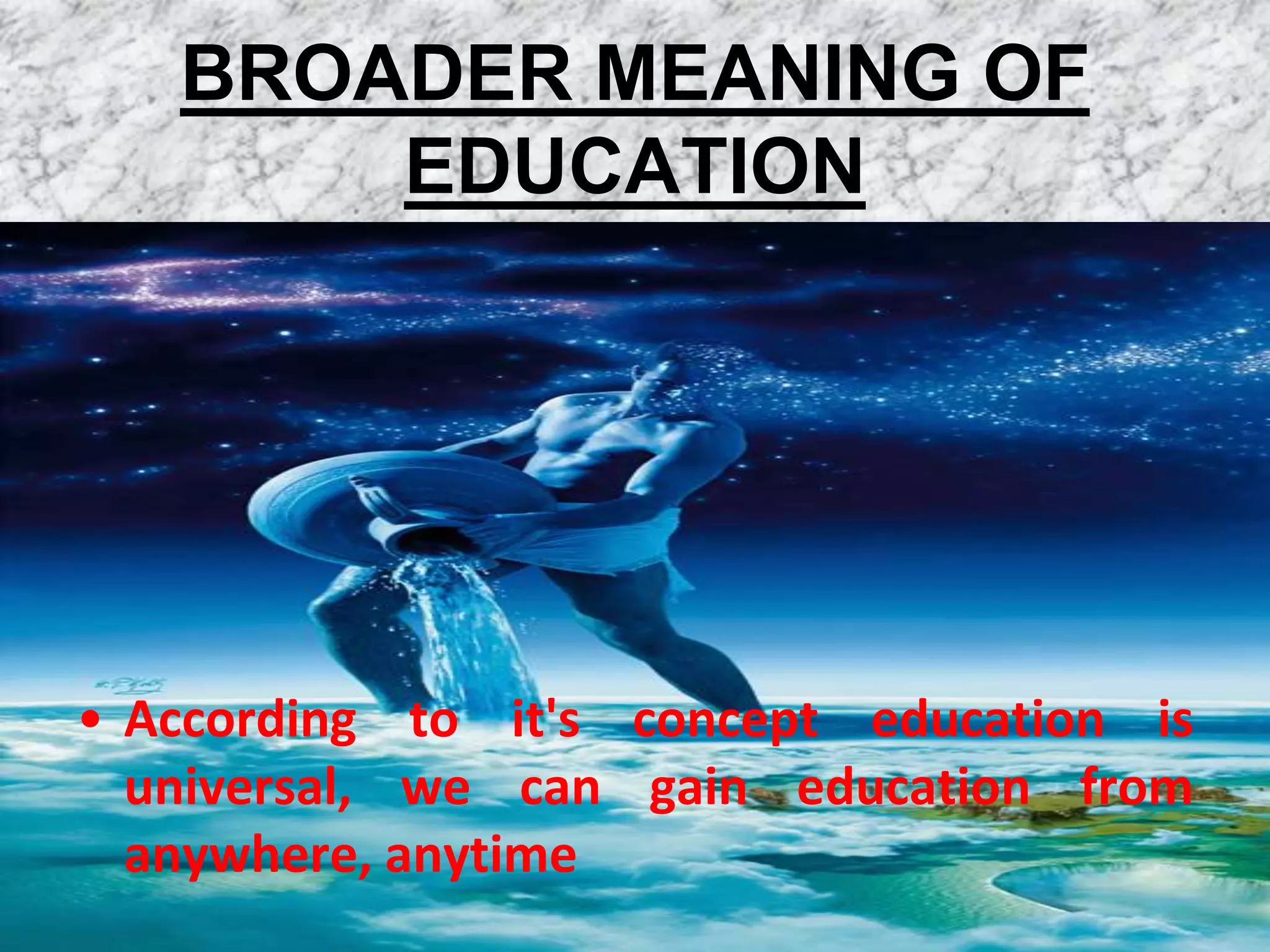
• According to it's concept education is
  universal, we can gain education from
  anywhere, anytime
BROADER MEANING OF
       EDUCATION


• There is no bound of place and time
  Education is the long life process
BROADER MEANING OF
        EDUCATION
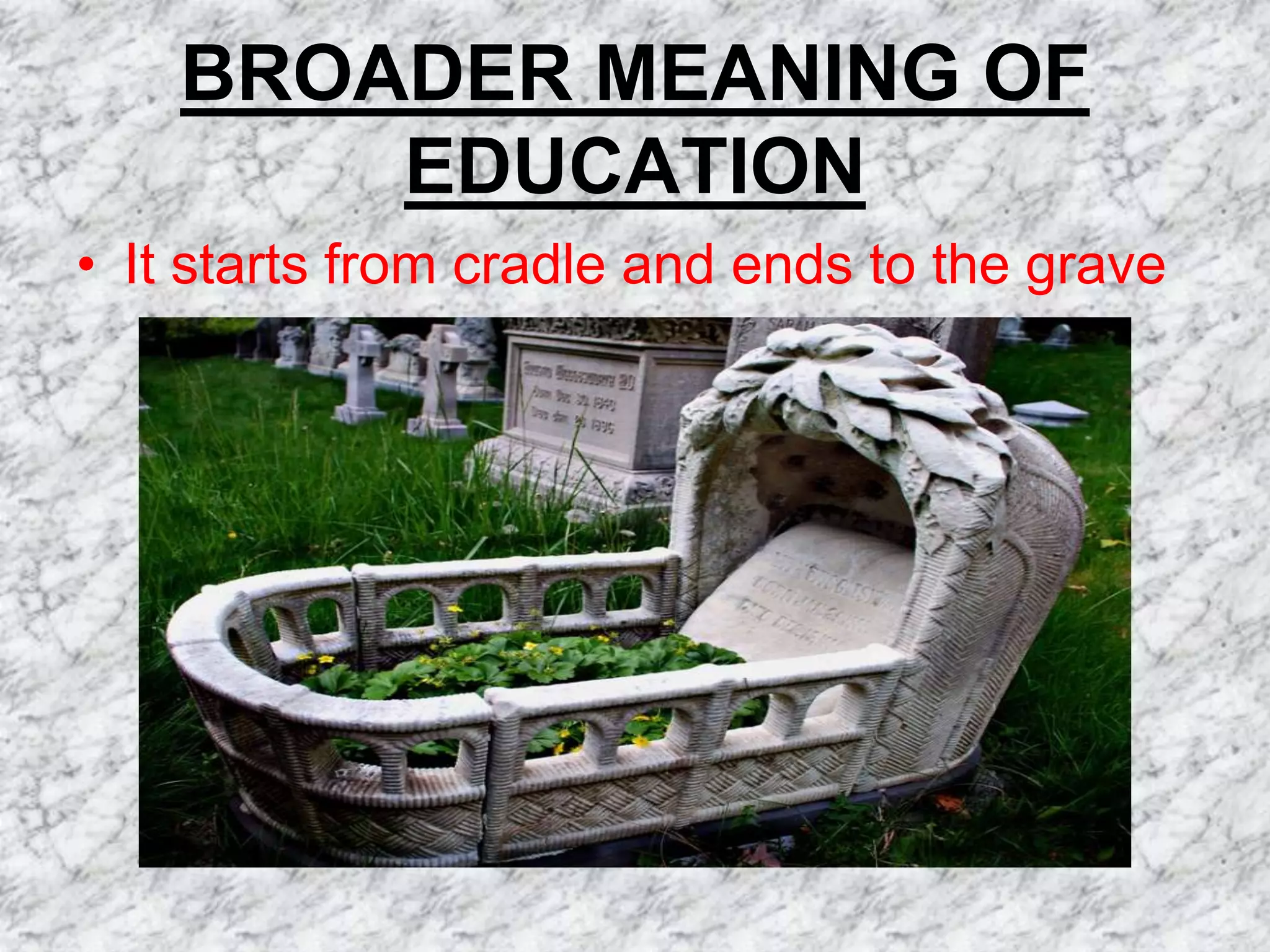
• It starts from cradle and ends to the grave
WHAT IS EDUCATION?

• Natural learning environments inspire a
 burning desire to learn
• What is education; knowledge in basic
 skills, academics, technical, discipline, citizen
 ship or is it something else?
WHAT IS EDUCATION?


Our formal education system says only
academic basics are important and that is
based on collecting knowledge without
understanding its value
WHAT IS EDUCATION?
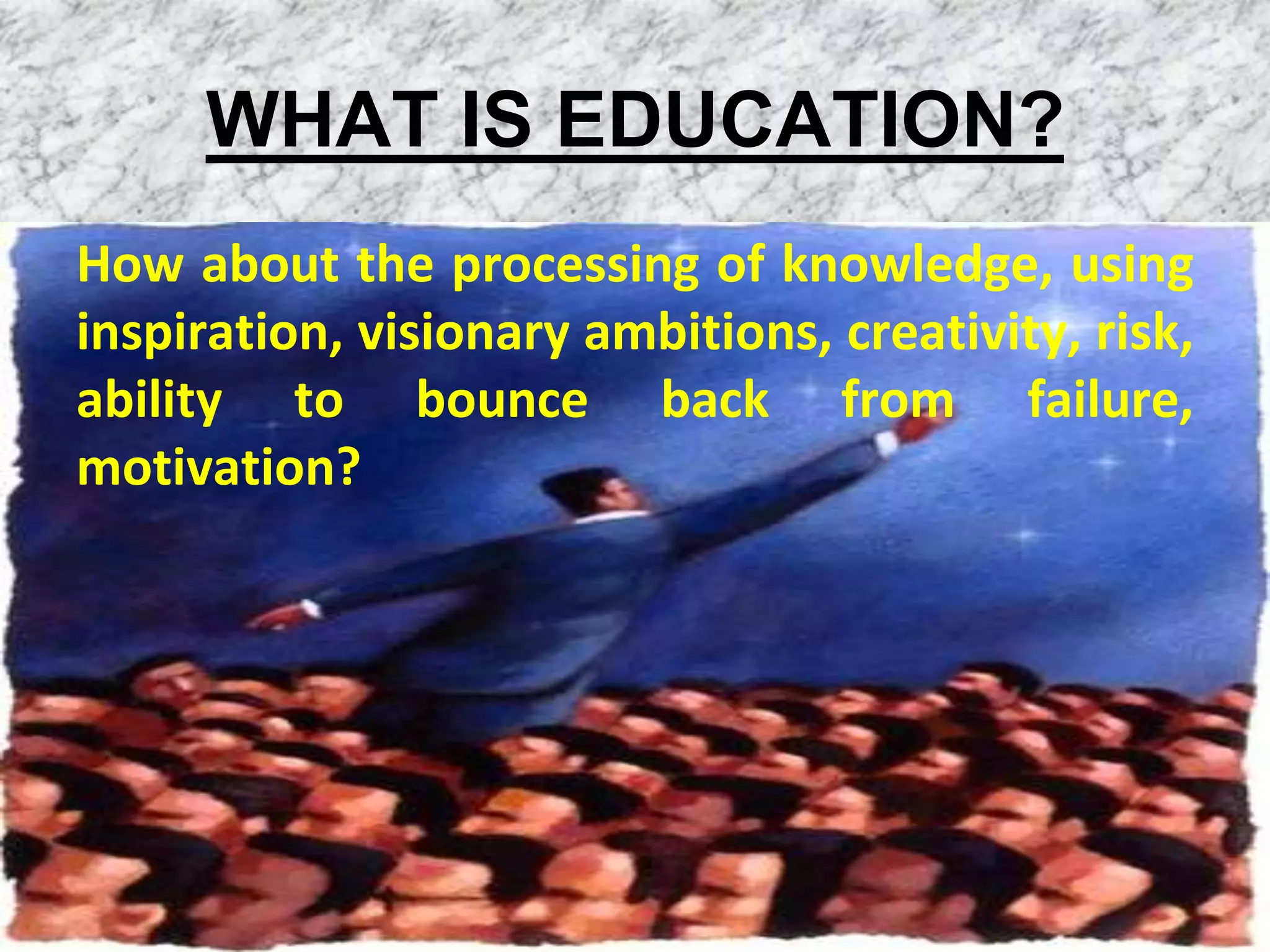
How about the processing of knowledge, using
inspiration, visionary ambitions, creativity, risk,
ability to bounce back from failure,
motivation?
WHAT IS EDUCATION?
They succeeded because they knew how to
research, collect information for a selected
project and process knowledge
Anyone who does not have the ability to
put clear thoughts on paper is labeled a
failure
All natural skills, including   knowledge
processing, does not count.
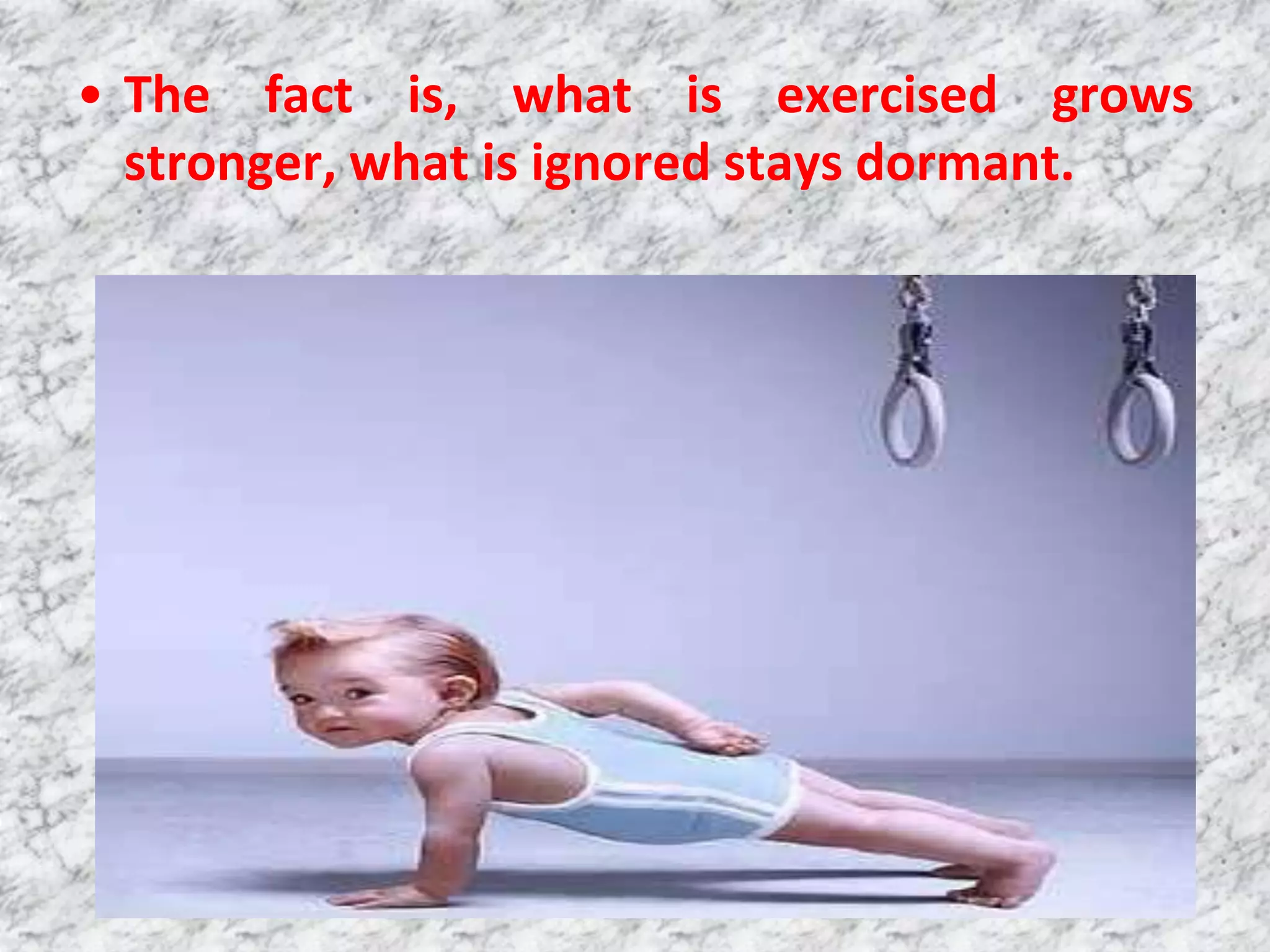
• The fact is, what is exercised grows
  stronger, what is ignored stays dormant.
The classroom exercises the collection of
academics leaving all other natural skills in
the closet.
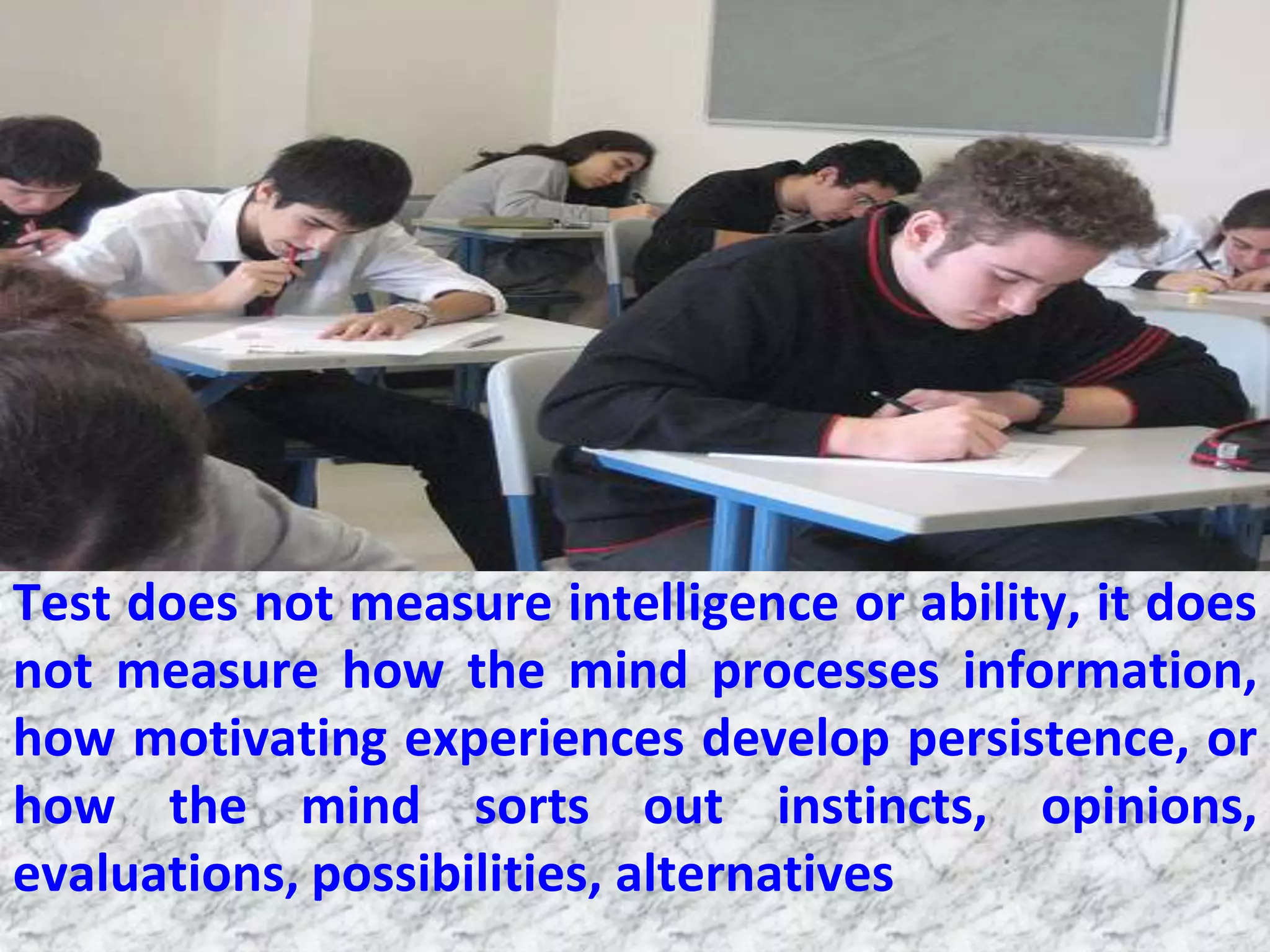
Test does not measure intelligence or ability, it does
not measure how the mind processes information,
how motivating experiences develop persistence, or
how the mind sorts out instincts, opinions,
evaluations, possibilities, alternatives
WHAT IS EDUCATION?
• Knowledge by itself has no value, it is like
  a dictionary filled with words.
• Words by themselves have no value, it is
  the process of stringing them together that
  gives them value.
• How they are strung together determines
  the level of value.
• Now our education system is becoming a system
  that memorizes the dictionary

• When         students   have   memorized   selected
  knowledge, then they will be given a one-day
  test, based on dictionary knowledge, which will
  influence employment opportunity for the rest of
  their life

• Natural skills are not considered
WHAT IS EDUCATION?
• Achievers in life use inspiration and
  motivation to overcome barriers.
• Teaching to the test does not inspire or
  motivate anyone, memorizing does not
  inspire a love to learn, in fact, it does just
  the opposite, it turns off the desire to learn.
• Education’s goal should be to develop a
  love to learn that stays with students
  throughout a lifetime.
• Education should be a lifetime
  experience, not limited to the youth years.
WHAT IS EDUCATION?
• Self-made millionaires are not "A" students
  in the classroom.
• The way they process knowledge is in
  conflict with classroom priorities.
• The self-made millionaire has a
  vision, then he researches specific
  knowledge, applies intuitive knowledge
  and process all elements, searching for a
  workable solution.
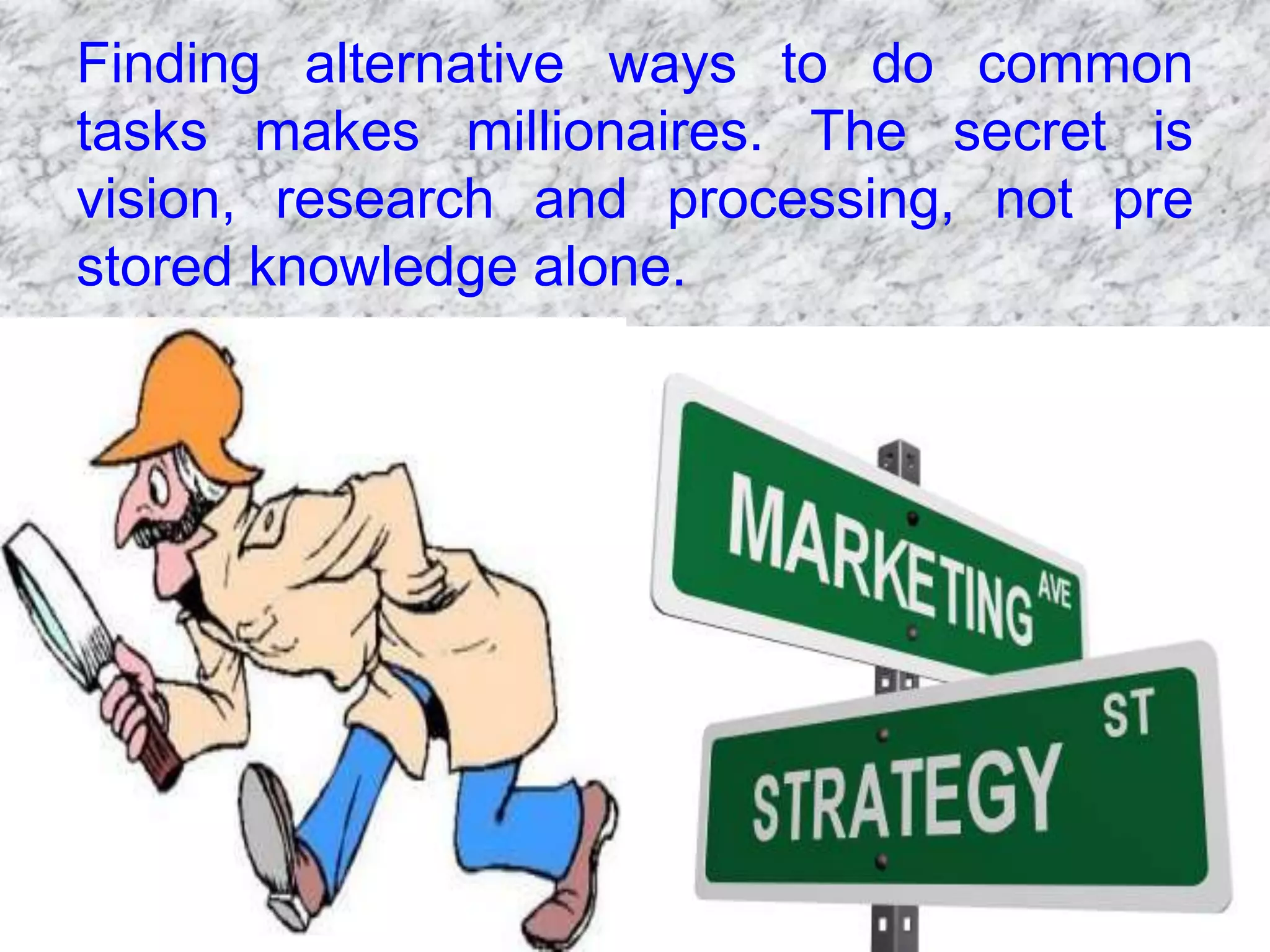
Finding alternative ways to do common
tasks makes millionaires. The secret is
vision, research and processing, not pre
stored knowledge alone.
An Educated Person
• perceive accurately, think clearly, and act
  effectively according to self-defined goals
  and aspirations.
• An educated person is also respectful of
  others regardless of their power and
  status, responsible for the results of their
  actions, and resourceful at getting what
  they need, both, personally and for their
  family, organization, and /or society.
• It is true that the educated person needs
  information, but an educated person is not
  dependent on the information they have
  stored in their heads, because they have
  the ability to find information, create
  knowledge, and develop skills when
  necessary.
• Achieving the status of being educated
  does not require a teacher.
• The necessity of having and manipulating
  knowledge, skills and information
• The constant need to see through the
  inherent illusions that arise from our
  unconscious thought processes, and
• Our ability to influence our states of mind
An Educated Person
• What all learners are doing is developing a
  map of reliable methods of getting from
  negative states of mind to positive states
  of mind.
• The units of knowledge skills and
  information are points on the map, but
  what makes the map useful are accurate
  portrayals of the relationships between the
  points and how those points can be used
  to arrive at the desired states of mind.
An Educated Person
• The key quality of an educated person is
  the ability to move from negative states of
  mind to positive states of mind and assist
  others to do the same.
• This covers all situations where there are
  problems such as poverty, conflict, and
  pollution as well as problems like
  depression, ignorance, or ambition.
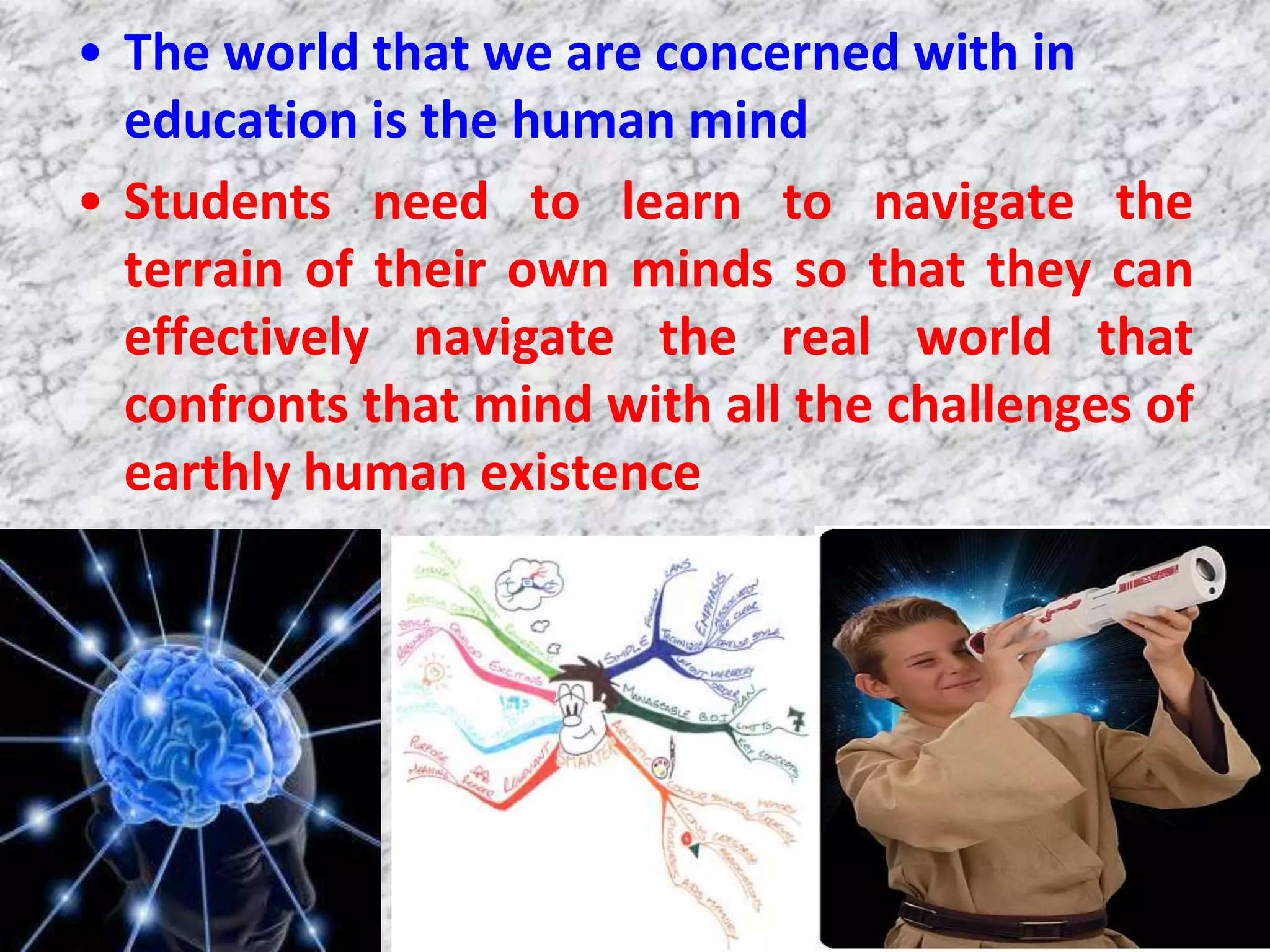
• The world that we are concerned with in
  education is the human mind
• Students need to learn to navigate the
  terrain of their own minds so that they can
  effectively navigate the real world that
  confronts that mind with all the challenges of
  earthly human existence
• Consistent attainment of positive states of
  mind is better known as having a good
  attitude
• if everyone can achieve a good attitude and
  help others do the same then the world will
  be a better place.
An Educated Person
Thus education, the process of attaining and
assisting others to attain a good attitude that
enables      a     person      to     perceive
accurately, think clearly, and act effectively
according to self-selected goals, is
fundamentally about attitude no matter what
age or level of schooling you are concerned
with.
A Three Role Circus
• a learning agent,
• a learning catalyst,
• and the learning context.
A Three Role Circus
• The learning agent is the active map-
  maker.
• The learning agent is obviously the
  student as that role is normally thought of
  in schools.
• The learning catalyst is someone or
  something that the agent engages in a
  deep relationship with and attempts to
  understand how the catalyst fits into the
  agent’s world.
What is knowledge?
• body of information that exists "out there“
• the results or products of human thought
  processes that have taken on a life of their
  own
• K…is        the      sum        total      of
  facts, truths, laws, principles, and ideas
  that man has produced
What is knowledge?
• "developing the Knowledge…of the
  student" is conceptualized as "giving"
  them                                   these
  facts, truths, laws, principles, ideas, and
  history
• knowledge is not "out there," but arises in
  the mind of an individual when that person
  interacts with the world.
What is knowledge?
"The central task of education is to implant a
will and facility for learning; it should
produce not learned but learning people.
The truly human society is a learning
society, where grandparents, parents, and
children are students together." ~Eric Hoffer
What is knowledge?
"No one has yet realized the wealth of
sympathy, the kindness and generosity
hidden in the soul of a child. The effort of
every true education should be to unlock
that treasure." ~Emma Goldman
What is knowledge?
"The aim of education should be to teach us
rather how to think, than what to think—
rather to improve our minds, so as to enable
us to think for ourselves, than to load the
memory with the thoughts of other men."
~Bill Beattie
What is knowledge?
"The purpose of education is..."?
41
42
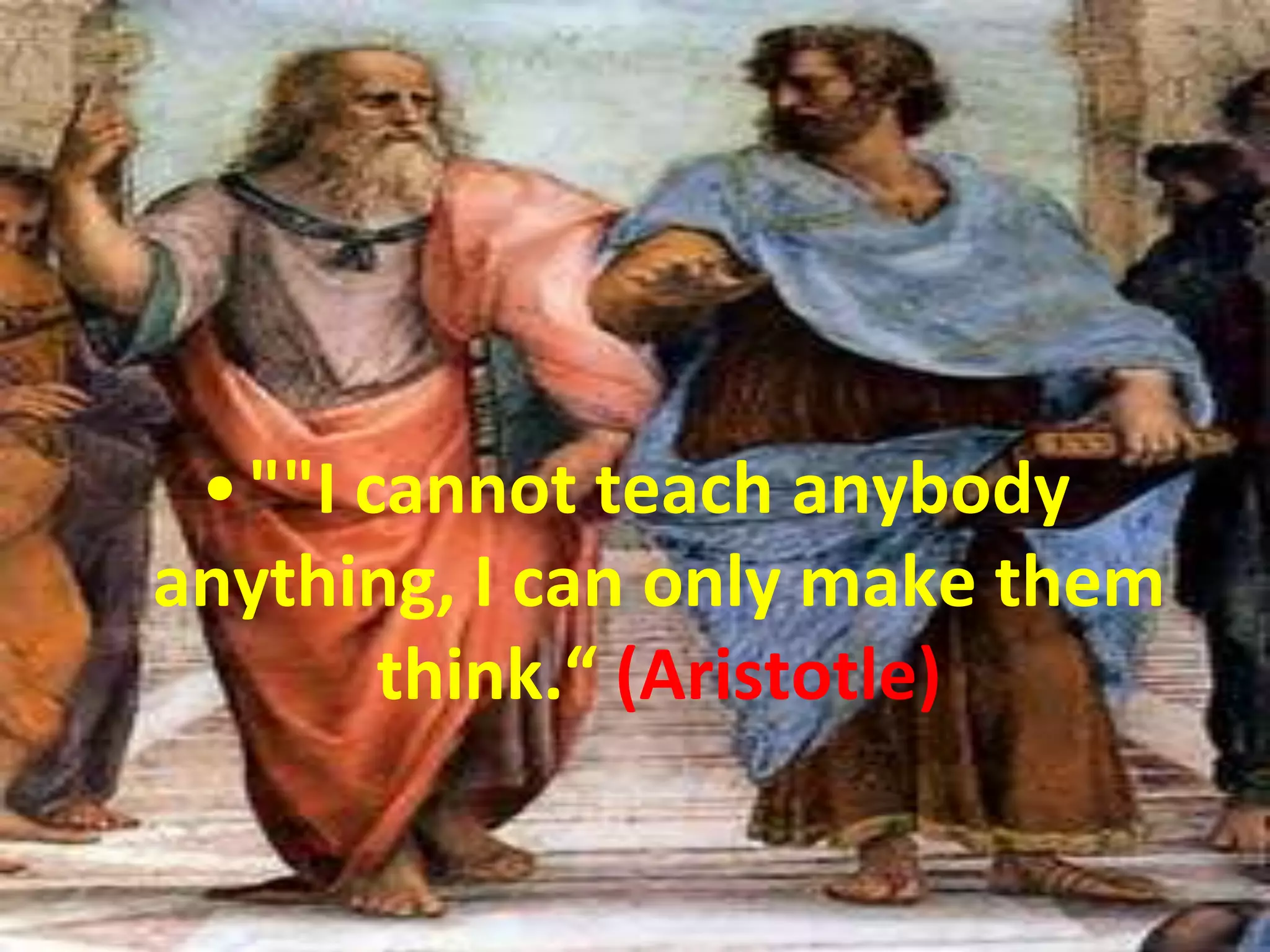
• ""I cannot teach anybody
anything, I can only make them
        think.“ (Aristotle)
Meaning and definition of education

Meaning and definition of education

  • 1.
  • 2.
    AIM To apprise theaudience about the meaning and philosophy of Education
  • 3.
    MEANING AND DEFINITION OF EDUCATION • The term education is derived from Latin word educere, educare, and educatum which means 'to learn‘, to know and to 'lead out‘ • That is education means to lead out internal hidden talent of a child or person
  • 4.
    NARROW MEANING OF EDUCATION • The education provided under the premises of school, colleges and universities
  • 5.
    NARROW MEANING OF EDUCATION • Education limited under the premises of educational institutions
  • 6.
    NARROW MEANING OF EDUCATION • It doesn't include the education outside of four walls of institution
  • 7.
  • 8.
    BROADER MEANING OF EDUCATION • According to it's concept education is universal, we can gain education from anywhere, anytime
  • 9.
    BROADER MEANING OF EDUCATION • There is no bound of place and time Education is the long life process
  • 10.
    BROADER MEANING OF EDUCATION • It starts from cradle and ends to the grave
  • 11.
    WHAT IS EDUCATION? •Natural learning environments inspire a burning desire to learn • What is education; knowledge in basic skills, academics, technical, discipline, citizen ship or is it something else?
  • 12.
    WHAT IS EDUCATION? Ourformal education system says only academic basics are important and that is based on collecting knowledge without understanding its value
  • 13.
    WHAT IS EDUCATION? Howabout the processing of knowledge, using inspiration, visionary ambitions, creativity, risk, ability to bounce back from failure, motivation?
  • 14.
    WHAT IS EDUCATION? Theysucceeded because they knew how to research, collect information for a selected project and process knowledge
  • 15.
    Anyone who doesnot have the ability to put clear thoughts on paper is labeled a failure
  • 16.
    All natural skills,including knowledge processing, does not count.
  • 17.
    • The factis, what is exercised grows stronger, what is ignored stays dormant.
  • 18.
    The classroom exercisesthe collection of academics leaving all other natural skills in the closet.
  • 19.
    Test does notmeasure intelligence or ability, it does not measure how the mind processes information, how motivating experiences develop persistence, or how the mind sorts out instincts, opinions, evaluations, possibilities, alternatives
  • 20.
    WHAT IS EDUCATION? •Knowledge by itself has no value, it is like a dictionary filled with words. • Words by themselves have no value, it is the process of stringing them together that gives them value. • How they are strung together determines the level of value.
  • 21.
    • Now oureducation system is becoming a system that memorizes the dictionary • When students have memorized selected knowledge, then they will be given a one-day test, based on dictionary knowledge, which will influence employment opportunity for the rest of their life • Natural skills are not considered
  • 22.
    WHAT IS EDUCATION? •Achievers in life use inspiration and motivation to overcome barriers. • Teaching to the test does not inspire or motivate anyone, memorizing does not inspire a love to learn, in fact, it does just the opposite, it turns off the desire to learn. • Education’s goal should be to develop a love to learn that stays with students throughout a lifetime. • Education should be a lifetime experience, not limited to the youth years.
  • 23.
    WHAT IS EDUCATION? •Self-made millionaires are not "A" students in the classroom. • The way they process knowledge is in conflict with classroom priorities. • The self-made millionaire has a vision, then he researches specific knowledge, applies intuitive knowledge and process all elements, searching for a workable solution.
  • 24.
    Finding alternative waysto do common tasks makes millionaires. The secret is vision, research and processing, not pre stored knowledge alone.
  • 25.
    An Educated Person •perceive accurately, think clearly, and act effectively according to self-defined goals and aspirations. • An educated person is also respectful of others regardless of their power and status, responsible for the results of their actions, and resourceful at getting what they need, both, personally and for their family, organization, and /or society.
  • 26.
    • It istrue that the educated person needs information, but an educated person is not dependent on the information they have stored in their heads, because they have the ability to find information, create knowledge, and develop skills when necessary. • Achieving the status of being educated does not require a teacher.
  • 27.
    • The necessityof having and manipulating knowledge, skills and information • The constant need to see through the inherent illusions that arise from our unconscious thought processes, and • Our ability to influence our states of mind
  • 28.
    An Educated Person •What all learners are doing is developing a map of reliable methods of getting from negative states of mind to positive states of mind. • The units of knowledge skills and information are points on the map, but what makes the map useful are accurate portrayals of the relationships between the points and how those points can be used to arrive at the desired states of mind.
  • 29.
    An Educated Person •The key quality of an educated person is the ability to move from negative states of mind to positive states of mind and assist others to do the same. • This covers all situations where there are problems such as poverty, conflict, and pollution as well as problems like depression, ignorance, or ambition.
  • 30.
    • The worldthat we are concerned with in education is the human mind • Students need to learn to navigate the terrain of their own minds so that they can effectively navigate the real world that confronts that mind with all the challenges of earthly human existence
  • 31.
    • Consistent attainmentof positive states of mind is better known as having a good attitude • if everyone can achieve a good attitude and help others do the same then the world will be a better place.
  • 32.
    An Educated Person Thuseducation, the process of attaining and assisting others to attain a good attitude that enables a person to perceive accurately, think clearly, and act effectively according to self-selected goals, is fundamentally about attitude no matter what age or level of schooling you are concerned with.
  • 33.
    A Three RoleCircus • a learning agent, • a learning catalyst, • and the learning context.
  • 34.
    A Three RoleCircus • The learning agent is the active map- maker. • The learning agent is obviously the student as that role is normally thought of in schools. • The learning catalyst is someone or something that the agent engages in a deep relationship with and attempts to understand how the catalyst fits into the agent’s world.
  • 35.
    What is knowledge? •body of information that exists "out there“ • the results or products of human thought processes that have taken on a life of their own • K…is the sum total of facts, truths, laws, principles, and ideas that man has produced
  • 36.
    What is knowledge? •"developing the Knowledge…of the student" is conceptualized as "giving" them these facts, truths, laws, principles, ideas, and history • knowledge is not "out there," but arises in the mind of an individual when that person interacts with the world.
  • 37.
    What is knowledge? "Thecentral task of education is to implant a will and facility for learning; it should produce not learned but learning people. The truly human society is a learning society, where grandparents, parents, and children are students together." ~Eric Hoffer
  • 38.
    What is knowledge? "Noone has yet realized the wealth of sympathy, the kindness and generosity hidden in the soul of a child. The effort of every true education should be to unlock that treasure." ~Emma Goldman
  • 39.
    What is knowledge? "Theaim of education should be to teach us rather how to think, than what to think— rather to improve our minds, so as to enable us to think for ourselves, than to load the memory with the thoughts of other men." ~Bill Beattie
  • 40.
    What is knowledge? "Thepurpose of education is..."?
  • 41.
  • 42.
  • 43.
    • ""I cannotteach anybody anything, I can only make them think.“ (Aristotle)