Mul$media	
  presenta$on	
  
•  Multimedia aids for foreign language instruction are known to promote
intentional or explicit learning of L2 vocabulary (e.g., Chun & Plass, 1996).
•  Multimedia presentation is broadly supported by the dual-coding theory
(Paivio, 1986): two symbolic systems (imagery system and verbal system)
mediate cognitive activity.
Rationale: Research has examined multimedia effects mostly on beginner/
intermediate level L2 vocabulary. The present study investigated video effects on
high-level infrequent words: words tested on the GRE.
	
Research	
  ques$on
Will the use of video clips in addition to traditional textual information facilitate
L2 vocabulary acquisition of high-level, low-frequency English words among
Korean learners of English?
Methodology
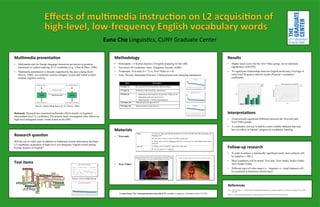
•  Participants: 15 Korean learners of English preparing for the GRE
•  Test items: 40 vocabulary items (frequency beyond 14,000)
•  Treatments: Text-only (n = 7) vs. Text+Video (n = 8)
•  Tests: Pre-test, Immediate Post-test, 2 Delayed post-tests (meaning translation)
Results	
  
•  Higher mean scores for the Text+Video group, yet no statistical
significance (ANOVA)
•  No significant relationships between English proficiency level/age of
onset/word frequency and test results (Pearson’s correlation
coefficient)
Interpreta$ons	
  
•  Trend towards significant difference between the Text-only and
Text+Video groups
•  A vocabulary size test would be a more reliable indicator that may
have an effect on learners’ progress in vocabulary learning.
Euna	
  Cho	
  Linguis'cs,	
  CUNY	
  Graduate	
  Center	
  
References	
  
"
Chun, D. M., & Plass, J. L. (1996). Effects of multimedia annotations on vocabulary acquisition. The Modern Language Journal, 80(2),
183-198.
Paivio, A. (1986). Mental representations: A dual coding approach. New York: Oxford University Press.
	
Materials
•  Text-only:
•  Text+Video:
Test	
  items
	
"
	
Contact Euna Cho: echo@gradcenter.cuny.edu (PhD candidate Linguistics, Graduate Center, CUNY)
Follow-­‐up	
  research	
  
•  In order to achieve a statistically significant result, more subjects will
be tested (n = 100+).
•  More conditions will be tested: Text-only, Text+Audio, Audio+Video,
Text+Audio+Video
•  Different types of video input (i.e., linguistic vs. visual features) will
be examined to determine effectiveness.
Source: www.wordcount.org
Paivio’s dual coding theory (p. 67, Paivio, 1986)

multimedia effects poster (34x22)

  • 1.
    Mul$media  presenta$on   • Multimedia aids for foreign language instruction are known to promote intentional or explicit learning of L2 vocabulary (e.g., Chun & Plass, 1996). •  Multimedia presentation is broadly supported by the dual-coding theory (Paivio, 1986): two symbolic systems (imagery system and verbal system) mediate cognitive activity. Rationale: Research has examined multimedia effects mostly on beginner/ intermediate level L2 vocabulary. The present study investigated video effects on high-level infrequent words: words tested on the GRE. Research  ques$on Will the use of video clips in addition to traditional textual information facilitate L2 vocabulary acquisition of high-level, low-frequency English words among Korean learners of English? Methodology •  Participants: 15 Korean learners of English preparing for the GRE •  Test items: 40 vocabulary items (frequency beyond 14,000) •  Treatments: Text-only (n = 7) vs. Text+Video (n = 8) •  Tests: Pre-test, Immediate Post-test, 2 Delayed post-tests (meaning translation) Results   •  Higher mean scores for the Text+Video group, yet no statistical significance (ANOVA) •  No significant relationships between English proficiency level/age of onset/word frequency and test results (Pearson’s correlation coefficient) Interpreta$ons   •  Trend towards significant difference between the Text-only and Text+Video groups •  A vocabulary size test would be a more reliable indicator that may have an effect on learners’ progress in vocabulary learning. Euna  Cho  Linguis'cs,  CUNY  Graduate  Center   References   " Chun, D. M., & Plass, J. L. (1996). Effects of multimedia annotations on vocabulary acquisition. The Modern Language Journal, 80(2), 183-198. Paivio, A. (1986). Mental representations: A dual coding approach. New York: Oxford University Press. Materials •  Text-only: •  Text+Video: Test  items " Contact Euna Cho: echo@gradcenter.cuny.edu (PhD candidate Linguistics, Graduate Center, CUNY) Follow-­‐up  research   •  In order to achieve a statistically significant result, more subjects will be tested (n = 100+). •  More conditions will be tested: Text-only, Text+Audio, Audio+Video, Text+Audio+Video •  Different types of video input (i.e., linguistic vs. visual features) will be examined to determine effectiveness. Source: www.wordcount.org Paivio’s dual coding theory (p. 67, Paivio, 1986)