Running head: EFFECTS OF STUDY STRATEGY ON MEMORY 1
Effects of Study Strategy on Paired-Associates Learning in Cued-Recall Task
Brianna D. Burgess
University of Montana
EFFECTS OF STUDY STRATEGY ON MEMORY 2
Abstract
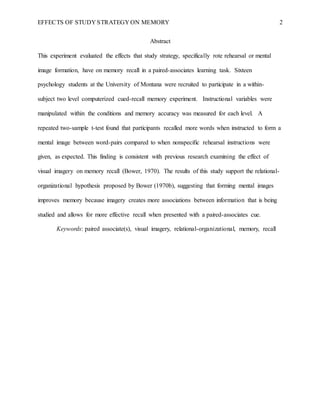
This experiment evaluated the effects that study strategy, specifically rote rehearsal or mental
image formation, have on memory recall in a paired-associates learning task. Sixteen
psychology students at the University of Montana were recruited to participate in a within-
subject two level computerized cued-recall memory experiment. Instructional variables were
manipulated within the conditions and memory accuracy was measured for each level. A
repeated two-sample t-test found that participants recalled more words when instructed to form a
mental image between word-pairs compared to when nonspecific rehearsal instructions were
given, as expected. This finding is consistent with previous research examining the effect of
visual imagery on memory recall (Bower, 1970). The results of this study support the relational-
organizational hypothesis proposed by Bower (1970b), suggesting that forming mental images
improves memory because imagery creates more associations between information that is being
studied and allows for more effective recall when presented with a paired-associates cue.
Keywords: paired associate(s), visual imagery, relational-organizational, memory, recall
EFFECTS OF STUDY STRATEGY ON MEMORY 3
Effects of Study Strategy on Paired-Associates Learning in Cued-Recall Task
Every day people are bombarded with various stimuli that impede our memory. Often we
are asked to remember phone numbers, sale prices, or a person’s name. Living in a culture
where multi-tasking is condoned and rather glorified, the burden to remember is even greater.
Because humans have a limited working and short-term memory capacity, learning new ways to
effectively encode and study information for future retrieval from long term memory is critical.
For decades cognitive psychologists have attempted to study these unseen cognitive processes to
help better understand the underlying principles that allow people to process information in a
way that promotes accurate retrieval. Psychologists have spent years studying the capacity of
long-term memory (LTM) and have concluded that it is virtually unlimited (Galotti, 2008). Now
the question is less about how much we can store and more about how we remember. An
important issue in current cognitive research is the role that mnemonics, or techniques to
improve memory, play in aiding recall.
One principle of retrieval that is often used to explain effective recall is categorization,
which states that material that is organized into categories or units is more easily recalled than
information without any apparent organization (Bousfield, 1953). In a study by Bousfield
(1953), participants were presented with a list of 60 words that came in four unrelated categories
and were presented in random order. Although the words had no apparent organization,
participants tended to recall words in related clusters, suggesting that people who organize
information in their own subjective categories have better recall (Galotti, 2008).
Another interesting finding by memory researchers that has been studied since the late
19th century is that the ability to retrieve information stored in LTM is highly variable. Assuming
that information can last indefinitely in LTM, why is it so difficult to remember certain
EFFECTS OF STUDY STRATEGY ON MEMORY 4
information? The issue of forgetting has been widely researched, most notably by Hermann
Ebbinghaus, a Prussian psychologist who pioneered the empirical study of memory under
controlled conditions. Ebbinghaus concluded that forgetting is not simply a linear function of
time, but rather that forgetting is rapid at first and then levels off (Galotti, 2008). As a result,
many researchers went on to conclude that interference, or the belief that information is thought
to be buried or otherwise displaced by other information, accounts for most of the forgetting
from LTM.
Literature on interference has typically used a task called paired-associates learning,
where participants either hear or are shown a list of word-pairs such as flag—spoon and
drawer—switch (Galotti, 2008). After presentation of the list of words, the researcher presents
the participant with the first word in each pair and is asked to recall the word originally paired
with it (cued-recall). The paired-associates learning task has been used by researchers to study
interference both proactively and retroactively. Proactive interference is a phenomenon where
previous learning can make retention of subsequent learning more difficult. Retroactive
interference, on the other hand, happens when current learning makes remembering past
information more difficult.
An interesting study conducted by Bower (1970) took to the question about how to
improve our chances of recalling information in a given memory task. He was interested in the
effect of different study strategies or rehearsal techniques on paired-associates learning. In his
between-subjects experiment, three groups of adult participants were asked to study word-word
paired-associates after receiving instructions to either learn by (a) using rote rehearsal of the
word pairs, (b) forming a mental image of the word pairs, or (c) using imagery of the objects
noninteracting and separated by an “imaginal” space. The study trial was followed by a test for
EFFECTS OF STUDY STRATEGY ON MEMORY 5
stimulus recognition and cued-recall (Bower, 1970). Bower found that participants had
significantly better recall when instructed to form a mental image of the word-pairs, a finding
consistent with previous research on categorization of information and mnemonics. To further
examine the underpinnings of pair-associates learning and the effect of mental image formation,
we seek to replicate the findings of Bower with a slight design modification. It is hypothesized
that participants will have significantly better memory retrieval of word-pair targets when
instructed to use the rehearsal technique of mental image formation (interactive imagery) than
when given nonspecific rehearsal instructions.
Methods
Participants
Sixteen psychology majors at the University of Montana were recruited as part of an in-
class assignment to participant in a memory experiment testing the effect of study strategies on
cued-recall accuracy. Participants’ identities were concealed using a randomly assigned subject
identification number.
Materials and Design
This experiment employed a single factor within-subjects design with two conditions.
Because the study was a repeated measure, creating equivalent groups was unnecessary. The
word-pairs used in this study all contained two English—English unrelated concrete nouns to
make image formation easier. It is much more difficult to form a mental image of an abstract
word-pair like love—fear than it is for concrete words like dog—bicycle.
Procedure
A computer-based memory experiment with two sessions was provided to participants.
Each session consisted of 20 word-pairs that were presented to each subject for 5 s. The first
EFFECTS OF STUDY STRATEGY ON MEMORY 6
session was presented to subjects without specific instruction, assuming that subjects would use
the traditional study method of rote rehearsal. After the study session, subjects were provided a
cued-recall memory task and asked to type in the target word (second word in word-pair).
During the memory task, participants were self-paced (no time limit) to type the target word.
After the first session, participants were given another list of 20 word-pairs presented for 5 s.
This session included instructions to form a mental image when studying the word-pairs. After
the study phase, participants were self-paced in providing the correct target word (cued-recall).
Memory accuracy was measured through E-Prime software and no feedback was provided
during the test phase.
Results
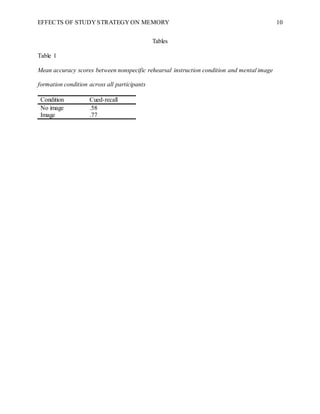
Between the image condition and the no image condition, memory accuracy was
measured by dividing the number of correctly recalled target words by the total number of word-
pairs in each condition. The mean for the no image condition and image condition were 0.58
(SD=.28) and 0.77 (SD=.21) respectively. A related two-sample t-test revealed a significant
effect of mental image formation, as hypothesized, t(15)=2.63, p<.05. Given this data, we
conclude that participants recalled significantly more words when asked to form a mental image
than when given nonspecific rehearsal instructions.
Discussion
Although this experiment successfully replicated the results of Bower (1970) we cannot
be sure that the results are truly due to the effects of mental image formation. There are a
number of limitations to be addressed when interpreting the results of this study. Participants
were first asked to use rote rehearsal to study the 20 word-pairs and later were tested for recall
accuracy. Immediately following the first condition, participants were asked to do the same
EFFECTS OF STUDY STRATEGY ON MEMORY 7
thing but were given instructions to form a mental image between the word-pairs. It is possible
that the better performance in the second condition was a result of using the first condition as a
practice round. Maybe participants performed better the second time around because they
already knew what to do.
If we were to use complete counter-balancing in the experimental design half of the
participants would experience condition 1 (no image) followed by condition 2 (image) and the
remaining half would experience condition 2 and then condition 1. If we were to switch the
presentation order of the conditions we may see the opposite effect. Participants that are asked to
form a mental image in one condition and instructed to not use that technique in a following
condition might have a difficult time not using a mnemonic after it had been made salient to
them, therefore having greater recall in both the image and no image condition.
Despite the limitations of this study, it appears that people are better able to remember
information when they use interactive imagery during encoding. As discussed above in the
introduction, this finding is consistent with many contemporary theories in cognitive psychology.
Bower (1970b) proposed that imagery allows more associations between items that can aid in
later recall, not simply that images are richer than verbal labels. More specifically, the target
word is easier to retrieve when imagery is used because the process of forming mental images
creates more links between the target word and its corresponding word-pair (Galotti, 2008).
When thinking about real world significance, it is crucial to remember just how important
of a role memory and cognition play in our everyday life. We use strategies like mnemonics to
increase our chances of remembering information all the time under a variety of circumstances.
Because we are bombarded with stimuli all day every day, our mind naturally finds a way
to organize information in a way that makes encoding, storing, and retrieval easier. When faced
EFFECTS OF STUDY STRATEGY ON MEMORY 8
with the task of remembering important information, we are even more likely to use mnemonics
like interactive imagery. On another level, it could be said that utilizing interactive imagery when
studying information in school or at a job could aid in overall productivity.
Although there is little doubt that using mental imagery can help in memory recall, some
psychologists point to limitations in visual imagery research. One critique is that forming mental
images is a necessarily private event without an agreed upon way to measure it. In addition,
some researchers argue that imagery experiments themselves have flaws that influence the
quality of data. For example, it is possible that visual imagery experiments present enough
“hints” for people to perform a certain way, relying on prior knowledge and beliefs rather than
the effect of visual imagery (Galotti, 2008).
EFFECTS OF STUDY STRATEGY ON MEMORY 9
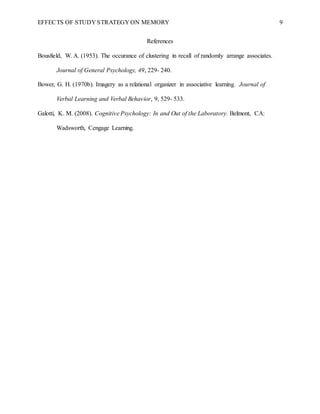
References
Bousfield, W. A. (1953). The occurance of clustering in recall of randomly arrange associates.
Journal of General Psychology, 49, 229- 240.
Bower, G. H. (1970b). Imagery as a relational organizer in associative learning. Journal of
Verbal Learning and Verbal Behavior, 9, 529- 533.
Galotti, K. M. (2008). Cognitive Psychology: In and Out of the Laboratory. Belmont, CA:
Wadsworth, Cengage Learning.
EFFECTS OF STUDY STRATEGY ON MEMORY 10
Tables
Table 1
Mean accuracy scores between nonspecific rehearsal instruction condition and mental image
formation condition across all participants
Condition Cued-recall
No image .58
Image .77
EFFECTS OF STUDY STRATEGY ON MEMORY 11

psyx320_inclasspaper1

  • 1.
    Running head: EFFECTSOF STUDY STRATEGY ON MEMORY 1 Effects of Study Strategy on Paired-Associates Learning in Cued-Recall Task Brianna D. Burgess University of Montana
  • 2.
    EFFECTS OF STUDYSTRATEGY ON MEMORY 2 Abstract This experiment evaluated the effects that study strategy, specifically rote rehearsal or mental image formation, have on memory recall in a paired-associates learning task. Sixteen psychology students at the University of Montana were recruited to participate in a within- subject two level computerized cued-recall memory experiment. Instructional variables were manipulated within the conditions and memory accuracy was measured for each level. A repeated two-sample t-test found that participants recalled more words when instructed to form a mental image between word-pairs compared to when nonspecific rehearsal instructions were given, as expected. This finding is consistent with previous research examining the effect of visual imagery on memory recall (Bower, 1970). The results of this study support the relational- organizational hypothesis proposed by Bower (1970b), suggesting that forming mental images improves memory because imagery creates more associations between information that is being studied and allows for more effective recall when presented with a paired-associates cue. Keywords: paired associate(s), visual imagery, relational-organizational, memory, recall
  • 3.
    EFFECTS OF STUDYSTRATEGY ON MEMORY 3 Effects of Study Strategy on Paired-Associates Learning in Cued-Recall Task Every day people are bombarded with various stimuli that impede our memory. Often we are asked to remember phone numbers, sale prices, or a person’s name. Living in a culture where multi-tasking is condoned and rather glorified, the burden to remember is even greater. Because humans have a limited working and short-term memory capacity, learning new ways to effectively encode and study information for future retrieval from long term memory is critical. For decades cognitive psychologists have attempted to study these unseen cognitive processes to help better understand the underlying principles that allow people to process information in a way that promotes accurate retrieval. Psychologists have spent years studying the capacity of long-term memory (LTM) and have concluded that it is virtually unlimited (Galotti, 2008). Now the question is less about how much we can store and more about how we remember. An important issue in current cognitive research is the role that mnemonics, or techniques to improve memory, play in aiding recall. One principle of retrieval that is often used to explain effective recall is categorization, which states that material that is organized into categories or units is more easily recalled than information without any apparent organization (Bousfield, 1953). In a study by Bousfield (1953), participants were presented with a list of 60 words that came in four unrelated categories and were presented in random order. Although the words had no apparent organization, participants tended to recall words in related clusters, suggesting that people who organize information in their own subjective categories have better recall (Galotti, 2008). Another interesting finding by memory researchers that has been studied since the late 19th century is that the ability to retrieve information stored in LTM is highly variable. Assuming that information can last indefinitely in LTM, why is it so difficult to remember certain
  • 4.
    EFFECTS OF STUDYSTRATEGY ON MEMORY 4 information? The issue of forgetting has been widely researched, most notably by Hermann Ebbinghaus, a Prussian psychologist who pioneered the empirical study of memory under controlled conditions. Ebbinghaus concluded that forgetting is not simply a linear function of time, but rather that forgetting is rapid at first and then levels off (Galotti, 2008). As a result, many researchers went on to conclude that interference, or the belief that information is thought to be buried or otherwise displaced by other information, accounts for most of the forgetting from LTM. Literature on interference has typically used a task called paired-associates learning, where participants either hear or are shown a list of word-pairs such as flag—spoon and drawer—switch (Galotti, 2008). After presentation of the list of words, the researcher presents the participant with the first word in each pair and is asked to recall the word originally paired with it (cued-recall). The paired-associates learning task has been used by researchers to study interference both proactively and retroactively. Proactive interference is a phenomenon where previous learning can make retention of subsequent learning more difficult. Retroactive interference, on the other hand, happens when current learning makes remembering past information more difficult. An interesting study conducted by Bower (1970) took to the question about how to improve our chances of recalling information in a given memory task. He was interested in the effect of different study strategies or rehearsal techniques on paired-associates learning. In his between-subjects experiment, three groups of adult participants were asked to study word-word paired-associates after receiving instructions to either learn by (a) using rote rehearsal of the word pairs, (b) forming a mental image of the word pairs, or (c) using imagery of the objects noninteracting and separated by an “imaginal” space. The study trial was followed by a test for
  • 5.
    EFFECTS OF STUDYSTRATEGY ON MEMORY 5 stimulus recognition and cued-recall (Bower, 1970). Bower found that participants had significantly better recall when instructed to form a mental image of the word-pairs, a finding consistent with previous research on categorization of information and mnemonics. To further examine the underpinnings of pair-associates learning and the effect of mental image formation, we seek to replicate the findings of Bower with a slight design modification. It is hypothesized that participants will have significantly better memory retrieval of word-pair targets when instructed to use the rehearsal technique of mental image formation (interactive imagery) than when given nonspecific rehearsal instructions. Methods Participants Sixteen psychology majors at the University of Montana were recruited as part of an in- class assignment to participant in a memory experiment testing the effect of study strategies on cued-recall accuracy. Participants’ identities were concealed using a randomly assigned subject identification number. Materials and Design This experiment employed a single factor within-subjects design with two conditions. Because the study was a repeated measure, creating equivalent groups was unnecessary. The word-pairs used in this study all contained two English—English unrelated concrete nouns to make image formation easier. It is much more difficult to form a mental image of an abstract word-pair like love—fear than it is for concrete words like dog—bicycle. Procedure A computer-based memory experiment with two sessions was provided to participants. Each session consisted of 20 word-pairs that were presented to each subject for 5 s. The first
  • 6.
    EFFECTS OF STUDYSTRATEGY ON MEMORY 6 session was presented to subjects without specific instruction, assuming that subjects would use the traditional study method of rote rehearsal. After the study session, subjects were provided a cued-recall memory task and asked to type in the target word (second word in word-pair). During the memory task, participants were self-paced (no time limit) to type the target word. After the first session, participants were given another list of 20 word-pairs presented for 5 s. This session included instructions to form a mental image when studying the word-pairs. After the study phase, participants were self-paced in providing the correct target word (cued-recall). Memory accuracy was measured through E-Prime software and no feedback was provided during the test phase. Results Between the image condition and the no image condition, memory accuracy was measured by dividing the number of correctly recalled target words by the total number of word- pairs in each condition. The mean for the no image condition and image condition were 0.58 (SD=.28) and 0.77 (SD=.21) respectively. A related two-sample t-test revealed a significant effect of mental image formation, as hypothesized, t(15)=2.63, p<.05. Given this data, we conclude that participants recalled significantly more words when asked to form a mental image than when given nonspecific rehearsal instructions. Discussion Although this experiment successfully replicated the results of Bower (1970) we cannot be sure that the results are truly due to the effects of mental image formation. There are a number of limitations to be addressed when interpreting the results of this study. Participants were first asked to use rote rehearsal to study the 20 word-pairs and later were tested for recall accuracy. Immediately following the first condition, participants were asked to do the same
  • 7.
    EFFECTS OF STUDYSTRATEGY ON MEMORY 7 thing but were given instructions to form a mental image between the word-pairs. It is possible that the better performance in the second condition was a result of using the first condition as a practice round. Maybe participants performed better the second time around because they already knew what to do. If we were to use complete counter-balancing in the experimental design half of the participants would experience condition 1 (no image) followed by condition 2 (image) and the remaining half would experience condition 2 and then condition 1. If we were to switch the presentation order of the conditions we may see the opposite effect. Participants that are asked to form a mental image in one condition and instructed to not use that technique in a following condition might have a difficult time not using a mnemonic after it had been made salient to them, therefore having greater recall in both the image and no image condition. Despite the limitations of this study, it appears that people are better able to remember information when they use interactive imagery during encoding. As discussed above in the introduction, this finding is consistent with many contemporary theories in cognitive psychology. Bower (1970b) proposed that imagery allows more associations between items that can aid in later recall, not simply that images are richer than verbal labels. More specifically, the target word is easier to retrieve when imagery is used because the process of forming mental images creates more links between the target word and its corresponding word-pair (Galotti, 2008). When thinking about real world significance, it is crucial to remember just how important of a role memory and cognition play in our everyday life. We use strategies like mnemonics to increase our chances of remembering information all the time under a variety of circumstances. Because we are bombarded with stimuli all day every day, our mind naturally finds a way to organize information in a way that makes encoding, storing, and retrieval easier. When faced
  • 8.
    EFFECTS OF STUDYSTRATEGY ON MEMORY 8 with the task of remembering important information, we are even more likely to use mnemonics like interactive imagery. On another level, it could be said that utilizing interactive imagery when studying information in school or at a job could aid in overall productivity. Although there is little doubt that using mental imagery can help in memory recall, some psychologists point to limitations in visual imagery research. One critique is that forming mental images is a necessarily private event without an agreed upon way to measure it. In addition, some researchers argue that imagery experiments themselves have flaws that influence the quality of data. For example, it is possible that visual imagery experiments present enough “hints” for people to perform a certain way, relying on prior knowledge and beliefs rather than the effect of visual imagery (Galotti, 2008).
  • 9.
    EFFECTS OF STUDYSTRATEGY ON MEMORY 9 References Bousfield, W. A. (1953). The occurance of clustering in recall of randomly arrange associates. Journal of General Psychology, 49, 229- 240. Bower, G. H. (1970b). Imagery as a relational organizer in associative learning. Journal of Verbal Learning and Verbal Behavior, 9, 529- 533. Galotti, K. M. (2008). Cognitive Psychology: In and Out of the Laboratory. Belmont, CA: Wadsworth, Cengage Learning.
  • 10.
    EFFECTS OF STUDYSTRATEGY ON MEMORY 10 Tables Table 1 Mean accuracy scores between nonspecific rehearsal instruction condition and mental image formation condition across all participants Condition Cued-recall No image .58 Image .77
  • 11.
    EFFECTS OF STUDYSTRATEGY ON MEMORY 11