The psychology of motivation concerns the whys of behavior.Motives are hypothetical states that activate behavior towards goals. Motives may take the form of:NeedsPhysiological needs necessary for survival (e.g. oxygen, food)not necessarily based on deprivation.Psychological needs for achievement, power, self-esteem, etc.may be acquired through experienceThe Psychology of Motivation
DrivesIncentivesobjects, persons, or situations viewed as capable of satisfying a need or as desirable for its own sake.The Psychology of Motivation
Psychologists do not agree about the precise nature of motivation.The Evolutionary PerspectiveAnimals naturally prewired to respond to certain stimuli in certain ways.Species-specific behaviors are called instincts or fixed action patterns.Instincts are genetically transmitted from generation to generation.William James and William McDougal argued that humans have instincts.Love, sympathy, modesty, hunger, sex, self assertion.Theories of Motivation
Drive Reductionism and HomeostasisPrimary drives trigger arousal (tension) and activate behavior.  We engage in behaviors that reduce the tension.  Acquired drives are acquired through experience.Homeostasis is a steady state.  People are motivated to maintain a steady state.Theories of Motivation
The Search for StimulationStimulus motives:  the organism is motivated to increase stimulation not reduce a drive.Lower animals and humans appear to be motivated to seek novel stimulation.Stimulus motivation provides an evolutionary advantage.  Animals that are active and motivated to learn about their environment are more likely to survive.Theories of Motivation
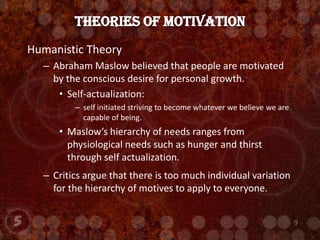
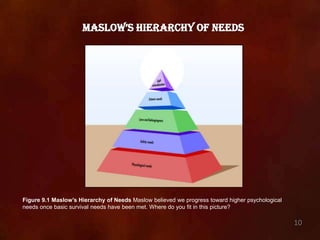
Humanistic TheoryAbraham Maslow believed that people are motivated by the conscious desire for personal growth.Self-actualization:  self initiated striving to become whatever we believe we are capable of being.Maslow’s hierarchy of needs ranges from physiological needs such as hunger and thirst through self actualization.Critics argue that there is too much individual variation for the hierarchy of motives to apply to everyone.Theories of Motivation
Maslow’s Hierarchy of NeedsFigure 9.1 Maslow’s Hierarchy of Needs Maslow believed we progress toward higher psychological needs once basic survival needs have been met. Where do you fit in this picture?
Importance of food.Necessary for survival.Symbol of family togetherness and caring.We associate food with the nurturance of the parent-child relationship.Hunger
Biological Influences on Hunger.Satiety or satisfaction.Hunger pangs are stomach contractions.Ventromedial nucleus of the hypothalamus.  The stop eating center of the brain. Research with rats has shown that:When destroyed the rat continues to eat (becomes hyperphagic).When stimulated the rat stops eating.Lateral hypothalamus is the start eating center of the brain.  When destroyed the rat may stop eating altogether (aphagic).When stimulated the rat starts to eat.Hunger
Psychological Influences of Hunger.Other factors that influence hunger include: Aroma of food, Anxiety or depression, or Boredom.Hunger
A life threatening eating disorder characterized by:Extreme fear of being too heavy.Dramatic weight loss.Distorted body image.Resistance to eating enough to maintain a healthy weight.Afflicts: Women during adolescence and young adulthood.European American females of higher socioeconomic status.Increase in numbers in recent years.Risks: Mortality rate is approximately 5%.Osteoporosis.Anorexia Nervosa
Characterized by recurrent cycles of binging and purging.Purging can include: vomiting, strict dieting,fasting, laxatives, and prolonged exercise.Bulimia Nervosa
Psychodynamic theory:  coping with sexual fear, regressing to life prior to puberty.The family environment is negative.Typically a history of child abuse.Exposure to high parental expectations.Sociocultural perspective.Slimness is idealized.BMI lower than 18.5 is malnourished.  Recent Miss Americas come in at a BMI near 17.Origins of Eating Disorders
Genetic perspectiveTends to run in families.Genetic factors might not directly cause eating disorders but are likely to involve obsessionistic and perfectionistic personality traits.Origins of Eating Disorders
LIFE CONNECTIONS:Obesity Facts about obesity:More than six out of ten American adults are overweight.Problems associated with unhealthy weight are on the upswing.More than 80% of African American women age 40 or above are overweight.Americans eat more than a total of 800 billion calories each day (200 billion calories more than they need to maintain their weights). About 300,000 Americans die each year because of health problems related to excess weight.Weight control for most people is elusive.
LIFE CONNECTIONS:Obesity Origins of ObesityBiological side points to the influence of heredity.Obesity runs in families.Set point:  the point at which the hunger drive kicks in because of fat deficiency in cells.Fatty tissue also metabolizes food more slowly than muscle does.Dieting slows down the metabolic rate thus making it more difficult to lose weight.
Shedding excess pounds lowers the risk of health problems such as diabetes and heart disease.The most effective weight control programs involve:Improving nutritional knowledge.Decreasing caloric intake.Exercising.Changing eating habits.Eating more fresh fruits and vegetables.Cutting down on butter, margarine, oils, and sugar.Weight Control
Strategies for weight loss include:Establishing calorie intake goals.Substitute low calorie foods.Take a 5-minute break between helpings.Avoid temptations.ExerciseReward yourself but not with food.Use imagery.Mentally walk through various scenarios.Above all if you slip don’t blow it out of proportion.Weight Control
Hormones
Sexual response
Surveys of Sexual Behavior
Sexual Orientation
Explanations for Aggression:Social deprivation and inequality.Act aggressively to establish and defend land (territory).Killer instinct to establish and defend territory.Biology, Chemistry, and Aggression.Instinctive aggressive reactions in lower animals may be automatic.Chemistry:Testosterone appears to affect the tendencies to dominate and control other people.Aggression
Psychological Aspects of Aggression.Psychodynamic Theory and Aggression.Freud believed that aggression is natural and instinctive.Reactions to the frustrations of daily life.Steam engine analogy; by holding in steam rather than venting it we set the stage for future explosions.Cognitive Psychology and Aggression.Behavior is influenced by our values, by how we interpret situations, and by choice.Aggression is not automatic: people decide. Aggression
CONTROVERSY IN PSYCHOLOGY:  The Catharsis ControversyVenting of aggressive impulses is termed catharsis.  This is a safety valve.Possibly leading to pleasant reductions in tension, Some research indicates that it may encourage more aggression later.
A CLOSER LOOK:  Cross Cultural Aspects of AggressionCultural Characteristics.Stereotype of aggressive male is not universal.Likely that people arrive at consensus as to what proper behavior is and teach their children accordingly.
Psychological Aspects of Aggression continued. Learning and Aggression.Learning is acquired through reinforcement thus reinforced aggression is more likely to be repeated.Aggressive skills are mainly acquired by the observation of other people.Aggression
Situational factors can contribute to aggression.  In mobs people may experience deindividuation which is a state of reduced self awareness. This includes: anonymity, sharing of responsibility (diffusion of responsibility), high level of emotional arousal, and a focus on the group’s norms.Environmental factors leading to aggressive behavior include:Bad smelling pollutants.Extreme noise.Extreme heat.Situational Factors and Aggression
Assessment of Motivation.Henry Murray developed the Thematic Apperception Test (TAT). TAT contains cards with pictures and drawings that are subject to various interpretations.  Subjects are to construct stories about the picture.People with high motivation:Earn higher grades.Likely to earn higher salaries and be promoted.Better at math.Achievement Motivation
Assessment of Motivation.Different Forces that drive motivation:Tangible rewards.Performance goals are usually met through extrinsic rewards.Learning goals usually lead to intrinsic rewards.Achievement Motivation
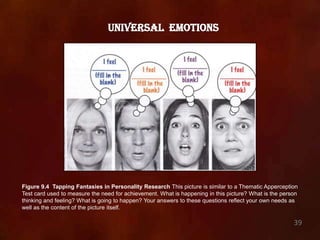
Universal  EmotionsFigure 9.4  Tapping Fantasies in Personality Research This picture is similar to a Thematic Apperception Test card used to measure the need for achievement. What is happening in this picture? What is the person thinking and feeling? What is going to happen? Your answers to these questions reflect your own needs as well as the content of the picture itself.
Emotions are feeling states with physiological, cognitive, and behavioral components.Arousal of the autonomic nervous system.Sympathetic nervous system:  rapid heartbeat, breathing, sweating, muscle tension.Behavioral tendencies occur with emotions.  For example fear leads to avoidance or escape and anger may lead to “pay back” behaviors.Parasympathetic nervous system arousal can also occur.  Joy, grief, jealousy, disgust, etc. all have cognitive, physiological, and behavioral components.Emotion
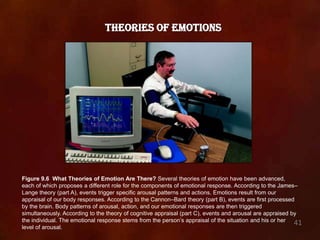
Theories of EmotionsFigure 9.6  What Theories of Emotion Are There? Several theories of emotion have been advanced, each of which proposes a different role for the components of emotional response. According to the James–Lange theory (part A), events trigger specific arousal patterns and actions. Emotions result from our appraisal of our body responses. According to the Cannon–Bard theory (part B), events are first processed by the brain. Body patterns of arousal, action, and our emotional responses are then triggered simultaneously. According to the theory of cognitive appraisal (part C), events and arousal are appraised by the individual. The emotional response stems from the person’s appraisal of the situation and his or her level of arousal.
Expression of many emotions bay be universal.  Smiling apparent universal smile of friendlinessShowing of teeth a sign of aggressionHowever, not perfect one-to-one relationship between facial expressions and emotions. The Expression of Emotions
Deals with positive emotions such as happiness and love.Statistics of those who are happy.Majority of people in developed nations are satisfied with their lives.Happiness tends to run in families.People tend to be happier when they live in affluent societies and earn decent incomes.Money does not make people happy but when we have enough money at least we don’t have to worry about money.More educated people tend to be happier.Positive Psychology

Psych 200 Motivation

  • 3.
    The psychology ofmotivation concerns the whys of behavior.Motives are hypothetical states that activate behavior towards goals. Motives may take the form of:NeedsPhysiological needs necessary for survival (e.g. oxygen, food)not necessarily based on deprivation.Psychological needs for achievement, power, self-esteem, etc.may be acquired through experienceThe Psychology of Motivation
  • 4.
    DrivesIncentivesobjects, persons, orsituations viewed as capable of satisfying a need or as desirable for its own sake.The Psychology of Motivation
  • 6.
    Psychologists do notagree about the precise nature of motivation.The Evolutionary PerspectiveAnimals naturally prewired to respond to certain stimuli in certain ways.Species-specific behaviors are called instincts or fixed action patterns.Instincts are genetically transmitted from generation to generation.William James and William McDougal argued that humans have instincts.Love, sympathy, modesty, hunger, sex, self assertion.Theories of Motivation
  • 7.
    Drive Reductionism andHomeostasisPrimary drives trigger arousal (tension) and activate behavior. We engage in behaviors that reduce the tension. Acquired drives are acquired through experience.Homeostasis is a steady state. People are motivated to maintain a steady state.Theories of Motivation
  • 8.
    The Search forStimulationStimulus motives: the organism is motivated to increase stimulation not reduce a drive.Lower animals and humans appear to be motivated to seek novel stimulation.Stimulus motivation provides an evolutionary advantage. Animals that are active and motivated to learn about their environment are more likely to survive.Theories of Motivation
  • 9.
    Humanistic TheoryAbraham Maslowbelieved that people are motivated by the conscious desire for personal growth.Self-actualization: self initiated striving to become whatever we believe we are capable of being.Maslow’s hierarchy of needs ranges from physiological needs such as hunger and thirst through self actualization.Critics argue that there is too much individual variation for the hierarchy of motives to apply to everyone.Theories of Motivation
  • 10.
    Maslow’s Hierarchy ofNeedsFigure 9.1 Maslow’s Hierarchy of Needs Maslow believed we progress toward higher psychological needs once basic survival needs have been met. Where do you fit in this picture?
  • 12.
    Importance of food.Necessaryfor survival.Symbol of family togetherness and caring.We associate food with the nurturance of the parent-child relationship.Hunger
  • 13.
    Biological Influences onHunger.Satiety or satisfaction.Hunger pangs are stomach contractions.Ventromedial nucleus of the hypothalamus. The stop eating center of the brain. Research with rats has shown that:When destroyed the rat continues to eat (becomes hyperphagic).When stimulated the rat stops eating.Lateral hypothalamus is the start eating center of the brain. When destroyed the rat may stop eating altogether (aphagic).When stimulated the rat starts to eat.Hunger
  • 14.
    Psychological Influences ofHunger.Other factors that influence hunger include: Aroma of food, Anxiety or depression, or Boredom.Hunger
  • 15.
    A life threateningeating disorder characterized by:Extreme fear of being too heavy.Dramatic weight loss.Distorted body image.Resistance to eating enough to maintain a healthy weight.Afflicts: Women during adolescence and young adulthood.European American females of higher socioeconomic status.Increase in numbers in recent years.Risks: Mortality rate is approximately 5%.Osteoporosis.Anorexia Nervosa
  • 16.
    Characterized by recurrentcycles of binging and purging.Purging can include: vomiting, strict dieting,fasting, laxatives, and prolonged exercise.Bulimia Nervosa
  • 17.
    Psychodynamic theory: coping with sexual fear, regressing to life prior to puberty.The family environment is negative.Typically a history of child abuse.Exposure to high parental expectations.Sociocultural perspective.Slimness is idealized.BMI lower than 18.5 is malnourished. Recent Miss Americas come in at a BMI near 17.Origins of Eating Disorders
  • 18.
    Genetic perspectiveTends torun in families.Genetic factors might not directly cause eating disorders but are likely to involve obsessionistic and perfectionistic personality traits.Origins of Eating Disorders
  • 19.
    LIFE CONNECTIONS:Obesity Factsabout obesity:More than six out of ten American adults are overweight.Problems associated with unhealthy weight are on the upswing.More than 80% of African American women age 40 or above are overweight.Americans eat more than a total of 800 billion calories each day (200 billion calories more than they need to maintain their weights). About 300,000 Americans die each year because of health problems related to excess weight.Weight control for most people is elusive.
  • 20.
    LIFE CONNECTIONS:Obesity Originsof ObesityBiological side points to the influence of heredity.Obesity runs in families.Set point: the point at which the hunger drive kicks in because of fat deficiency in cells.Fatty tissue also metabolizes food more slowly than muscle does.Dieting slows down the metabolic rate thus making it more difficult to lose weight.
  • 21.
    Shedding excess poundslowers the risk of health problems such as diabetes and heart disease.The most effective weight control programs involve:Improving nutritional knowledge.Decreasing caloric intake.Exercising.Changing eating habits.Eating more fresh fruits and vegetables.Cutting down on butter, margarine, oils, and sugar.Weight Control
  • 22.
    Strategies for weightloss include:Establishing calorie intake goals.Substitute low calorie foods.Take a 5-minute break between helpings.Avoid temptations.ExerciseReward yourself but not with food.Use imagery.Mentally walk through various scenarios.Above all if you slip don’t blow it out of proportion.Weight Control
  • 24.
  • 25.
  • 26.
  • 27.
  • 29.
    Explanations for Aggression:Socialdeprivation and inequality.Act aggressively to establish and defend land (territory).Killer instinct to establish and defend territory.Biology, Chemistry, and Aggression.Instinctive aggressive reactions in lower animals may be automatic.Chemistry:Testosterone appears to affect the tendencies to dominate and control other people.Aggression
  • 30.
    Psychological Aspects ofAggression.Psychodynamic Theory and Aggression.Freud believed that aggression is natural and instinctive.Reactions to the frustrations of daily life.Steam engine analogy; by holding in steam rather than venting it we set the stage for future explosions.Cognitive Psychology and Aggression.Behavior is influenced by our values, by how we interpret situations, and by choice.Aggression is not automatic: people decide. Aggression
  • 31.
    CONTROVERSY IN PSYCHOLOGY: The Catharsis ControversyVenting of aggressive impulses is termed catharsis. This is a safety valve.Possibly leading to pleasant reductions in tension, Some research indicates that it may encourage more aggression later.
  • 32.
    A CLOSER LOOK: Cross Cultural Aspects of AggressionCultural Characteristics.Stereotype of aggressive male is not universal.Likely that people arrive at consensus as to what proper behavior is and teach their children accordingly.
  • 33.
    Psychological Aspects ofAggression continued. Learning and Aggression.Learning is acquired through reinforcement thus reinforced aggression is more likely to be repeated.Aggressive skills are mainly acquired by the observation of other people.Aggression
  • 34.
    Situational factors cancontribute to aggression. In mobs people may experience deindividuation which is a state of reduced self awareness. This includes: anonymity, sharing of responsibility (diffusion of responsibility), high level of emotional arousal, and a focus on the group’s norms.Environmental factors leading to aggressive behavior include:Bad smelling pollutants.Extreme noise.Extreme heat.Situational Factors and Aggression
  • 36.
    Assessment of Motivation.HenryMurray developed the Thematic Apperception Test (TAT). TAT contains cards with pictures and drawings that are subject to various interpretations. Subjects are to construct stories about the picture.People with high motivation:Earn higher grades.Likely to earn higher salaries and be promoted.Better at math.Achievement Motivation
  • 37.
    Assessment of Motivation.DifferentForces that drive motivation:Tangible rewards.Performance goals are usually met through extrinsic rewards.Learning goals usually lead to intrinsic rewards.Achievement Motivation
  • 39.
    Universal EmotionsFigure9.4 Tapping Fantasies in Personality Research This picture is similar to a Thematic Apperception Test card used to measure the need for achievement. What is happening in this picture? What is the person thinking and feeling? What is going to happen? Your answers to these questions reflect your own needs as well as the content of the picture itself.
  • 40.
    Emotions are feelingstates with physiological, cognitive, and behavioral components.Arousal of the autonomic nervous system.Sympathetic nervous system: rapid heartbeat, breathing, sweating, muscle tension.Behavioral tendencies occur with emotions. For example fear leads to avoidance or escape and anger may lead to “pay back” behaviors.Parasympathetic nervous system arousal can also occur. Joy, grief, jealousy, disgust, etc. all have cognitive, physiological, and behavioral components.Emotion
  • 41.
    Theories of EmotionsFigure9.6 What Theories of Emotion Are There? Several theories of emotion have been advanced, each of which proposes a different role for the components of emotional response. According to the James–Lange theory (part A), events trigger specific arousal patterns and actions. Emotions result from our appraisal of our body responses. According to the Cannon–Bard theory (part B), events are first processed by the brain. Body patterns of arousal, action, and our emotional responses are then triggered simultaneously. According to the theory of cognitive appraisal (part C), events and arousal are appraised by the individual. The emotional response stems from the person’s appraisal of the situation and his or her level of arousal.
  • 42.
    Expression of manyemotions bay be universal. Smiling apparent universal smile of friendlinessShowing of teeth a sign of aggressionHowever, not perfect one-to-one relationship between facial expressions and emotions. The Expression of Emotions
  • 43.
    Deals with positiveemotions such as happiness and love.Statistics of those who are happy.Majority of people in developed nations are satisfied with their lives.Happiness tends to run in families.People tend to be happier when they live in affluent societies and earn decent incomes.Money does not make people happy but when we have enough money at least we don’t have to worry about money.More educated people tend to be happier.Positive Psychology