
Adulthood and Aging, 6e
John C. Cavanaugh
Fredda Blanchard-Fields
Learning Objectives
   How do rate-of-living theories explain aging?
   What are the major hypotheses in cellular theories of
    aging?
   How do programmed cell death theories propose that we
    age?
   How do the basic developmental forces interact in
    biological and physiological aging?
Rate-of-Living Theories
   Limited energy
     Organisms have only so much energy to expend in a lifetime
     Metabolic rate of certain animals seem to be correlated to their lifespan
   Excess calories
     Reduction in calorie intake increases lifespan
     Okinawans consume 60% less; have 40 times more centenarians
   Hormonal regulatory system adaptation to stress
     Age which a mammal becomes mature is related to longevity


       Metabolism relates directly to longevity
           Saving your energy won’t directly
                result in living longer
Cellular Theories
 Limited number of times a cell can divide
    (Hayflick limit)
   Cross-linking
     Tissue becomes stiffer with age
   Free radicals
     Reactive chemicals causing cellular damage
Programmed Cell Death Theories
 Aging programmed into genetic code?
 Cells pre-programmed to self-destruct
 Other genetic pathologies:
     Osteoarthritis
     Changes in the brain cells
     Alzheimer’s
     Memory loss
     Personality changes
Implications of the Developmental Forces
 The biological, psychological, sociocultural, and
  lifecycle forces
 Unified theory not yet developed

 Three general approaches to slowing or reversing
  the aging process:
   1. Delay the chronic illnesses of old age
   2. Slow the fundamental processes of aging to increase life span
   3. Arrest or reverse aging by removing the damage caused by the
      metabolic process
Learning Objectives
   How do our skin, hair, and voices change with age?
   What happens to our body build with age?
   What age-related changes occur in our ability to move
    around?
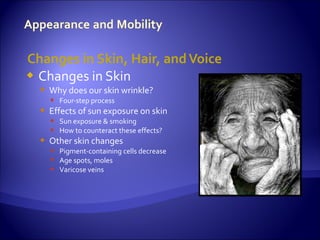
Changes in Skin, Hair, and Voice
 Changes in Skin
   Why does our skin wrinkle?
     Four-step process
   Effects of sun exposure on skin
     Sun exposure & smoking
     How to counteract these effects?
   Other skin changes
     Pigment-containing cells decrease
     Age spots, moles
     Varicose veins
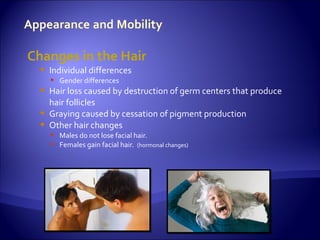
Changes in the Hair
  Individual differences
    Gender differences
  Hair loss caused by destruction of germ centers that produce
   hair follicles
  Graying caused by cessation of pigment production
  Other hair changes
    Males do not lose facial hair.
    Females gain facial hair. (hormonal changes)
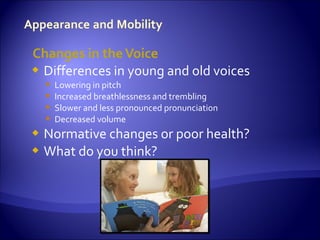
Changes in the Voice
 Differences in young and old voices
       Lowering in pitch
       Increased breathlessness and trembling
       Slower and less pronounced pronunciation
       Decreased volume
 Normative changes or poor health?
 What do you think?
Changes in Body Build
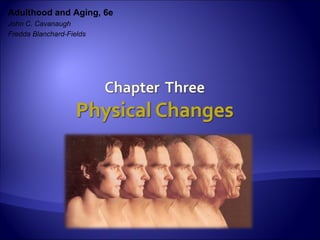
   Differences in the way bodies look over time
     Decrease in height and fluctuations in weight
       Between mid-50s and mid-70s men lose about 1 inch and women 2 inches
       Compression of the spine
       Changes in posture

   Weight gain then loss
     How different between men and women?
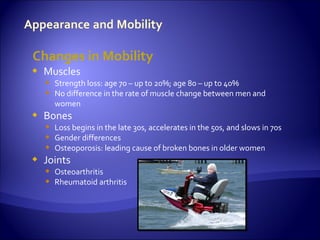
Changes in Mobility
   Muscles
     Strength loss: age 70 – up to 20%; age 80 – up to 40%
     No difference in the rate of muscle change between men and
      women
   Bones
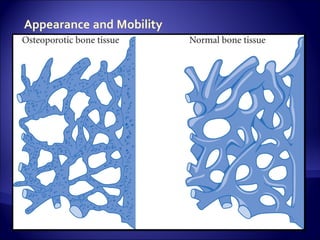
     Loss begins in the late 30s, accelerates in the 50s, and slows in 70s
     Gender differences
     Osteoporosis: leading cause of broken bones in older women
   Joints
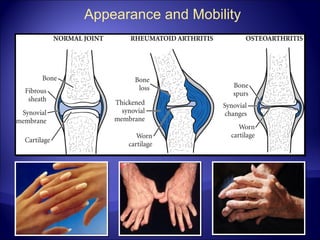
     Osteoarthritis
     Rheumatoid arthritis
Appearance and Mobility
Psychological Implications
 Gender differences
     Compensation
       Cosmetics
       Hair dyes
       Plastic surgery
   Appearance vs. actual losses in strength and
    endurance
     Exercise and resistance training is useful up to age 90
   Adaptive behaviors
     Pain in the joints may reduce mobility
     Rehabilitation after hip fractures
Learning Objectives
   What age-related changes happen in vision?
   How does hearing change as people age?
   What age-related changes occur in the sense of touch and
    balance?
   What happens to taste and smell with increasing age?
Vision
 Structural changes in the eye
       Adaptation – light and dark; change focus
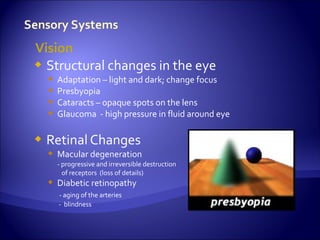
       Presbyopia
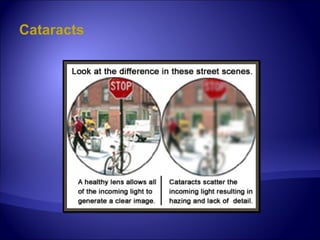
       Cataracts – opaque spots on the lens
       Glaucoma - high pressure in fluid around eye

   Retinal Changes
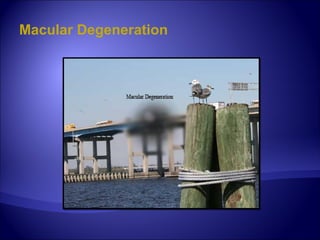
     Macular degeneration
        - progressive and irreversible destruction
          of receptors (loss of details)
     Diabetic retinopathy
        - aging of the arteries
        - blindness
Cataracts
Macular Degeneration
Classroom Participation Measure

1. Take out a piece of paper
2. Put your name in the right top corner
3. Without talking answer the visual puzzle on
   the next slide


                                                 20 of 40
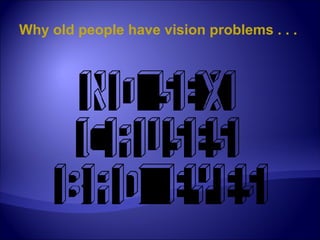
Why old people have vision problems . . .
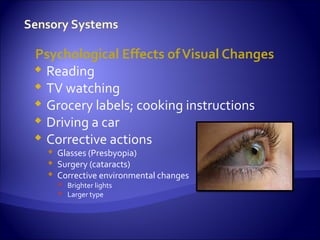
Psychological Effects of Visual Changes
 Reading
 TV watching
 Grocery labels; cooking instructions
 Driving a car
 Corrective actions
   Glasses (Presbyopia)
   Surgery (cataracts)
   Corrective environmental changes
     Brighter lights
     Larger type
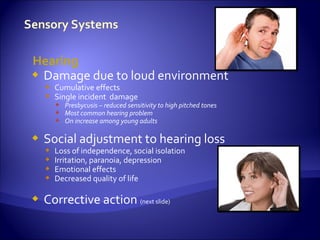
Hearing
 Damage due to loud environment
     Cumulative effects
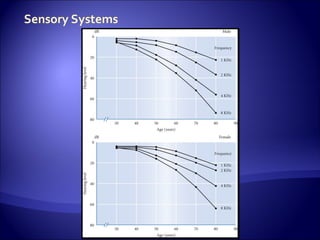
     Single incident damage
         Presbycusis – reduced sensitivity to high pitched tones
         Most common hearing problem
         On increase among young adults

   Social adjustment to hearing loss
       Loss of independence, social isolation
       Irritation, paranoia, depression
       Emotional effects
       Decreased quality of life

   Corrective action (next slide)
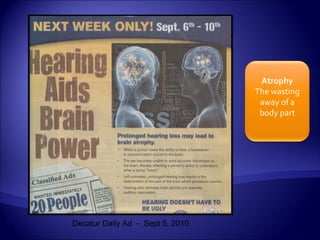
Atrophy
                                  The wasting
                                   away of a
                                   body part


Decatur Daily Ad - Sept 5, 2010
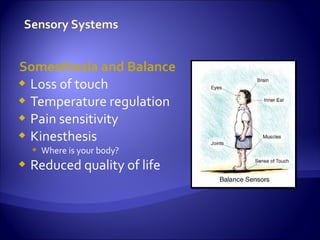
Somesthesia and Balance
 Loss of touch
 Temperature regulation
 Pain sensitivity
 Kinesthesis
     Where is your body?
   Reduced quality of life
“Weebles wobble,
                                                         but they don’t fall
Balance                                                       down!”
   Vestibular system
     Dizziness, lightheaded, vertigo
     Longer time to integrate all sensory information
     Fear of falling

   Environmental hazards
     Loose rugs
     Slippery floors
     Lighting
     Hip protection


   Tai-Chi
     Enhance body awareness
     Improve balance
     Reduce falls
Taste and Smell
 Too old to cut the mustard?
 Taste dependent on smell
 Safety factors
 Personal hygiene
 Memory differences between odors and other
  memory cues
Learning Objectives
   What age-related changes occur in the cardiovascular
    system? What types of cardiovascular disease are common
    in adult development and aging? Psychological effects?
   What structural and functional changes occur with age in
    the respiratory system? What are the most common types
    of respiratory diseases in older adults? Psychological
    effects?
Cardiovascular System
 Underlying cause of diminished capacity
     Accumulation of fat deposits
     Stiffening of the heart muscle

   Decline in aerobic capacity
     By age 65 - 60 to 70% decline
     Get tired easily
     Heart attaches while performing
      moderately exerting tasks
     Want to decline less?
      Stay in shape during adulthood
Cardiovascular Disease
 Ethnic and gender differences—Why?
 Congestive heart failure (most common hospitalization over 65)
 Angina pectoris (decrease oxygen to the heart, causing pain)
 Myocardial infarction (MI) (heart attack)
 Atherosclerosis (build up of fat and calcium in artery walls)
 Hypertension
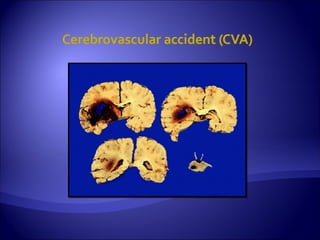
 Cerebrovascular accident (CVA) (stroke)
Respiratory System
 Respiratory Diseases
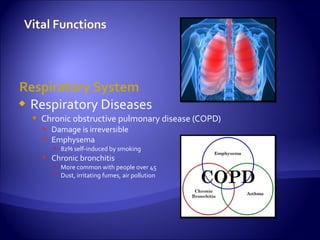
   Chronic obstructive pulmonary disease (COPD)
     Damage is irreversible
     Emphysema
        82% self-induced by smoking
     Chronic bronchitis
        More common with people over 45
        Dust, irritating fumes, air pollution
Learning Objectives
   What reproductive changes occur in women?
   What reproductive changes occur in men?
   What are the psychological effects of reproductive
    changes?
Female Reproductive System
  Genital organ change begins in the 40s
    Transition – perimenopause
    Changes in reproductive organs and sexual functioning
  Menopause
    Ethnic differences in the severity of symptoms
    Progressive change after menopause
  Hormone Replacement Therapy (HRT)


  No physiological reason why most women cannot continue
   sexual activity into old age.
Male Reproductive System
     Unlike menopause, no event to mark changes
       Decline in testosterone levels
       Decrease in sperm production (30% between 30 and 60)

     Prostate cancer a real threat
     Impotence: normally treatable with drugs
     Erectile Dysfunction: treatable with Viagra, Cialis, and Levitra


   Psychological Implications
     For healthy adults males, sexual activity is lifelong option.
     Stereotyping has important consequences.
Learning Objectives
   How do we measure changes in the brain?
   What major changes occur in neurons? How do neurons’
    ability to communicate with each other change with age?
    What are the psychological effects of changes in the brain?
   What major changes occur in the autonomic nervous system?
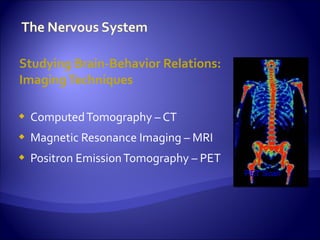
Studying Brain-Behavior Relations:
Imaging Techniques

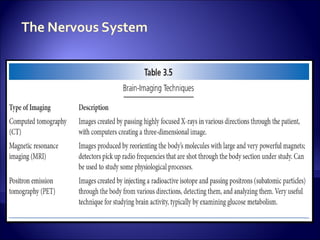
   Computed Tomography – CT
   Magnetic Resonance Imaging – MRI
   Positron Emission Tomography – PET
                                         PET Scan
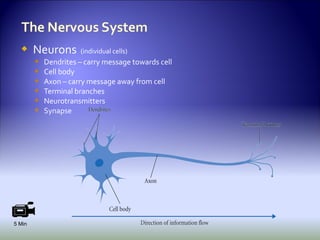
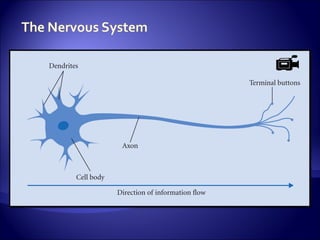
    Neurons       (individual cells)
           Dendrites – carry message towards cell
           Cell body
           Axon – carry message away from cell
           Terminal branches
           Neurotransmitters
           Synapse


5 Min
                                                     41 of 40
Structural Changes in Neurons
 Plasticity (capability of brain to adapt its function and structure)
 Neurofibrillary Tangles (fibers of the axon become tangled)
 Amyloid Plaques (damaged & dying neurons around a core of protein)

       Both considered characteristics of Alzheimer’s disease

Changes in communication between neurons
 Parkinson’s disease
         Tremors
         Rigidity
         Difficulty keeping balance
         Shuffling walking style
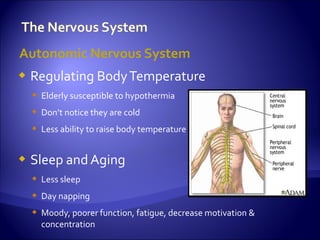
Autonomic Nervous System
   Regulating Body Temperature
     Elderly susceptible to hypothermia
     Don’t notice they are cold
     Less ability to raise body temperature


   Sleep and Aging
     Less sleep
     Day napping
     Moody, poorer function, fatigue, decrease motivation &
      concentration
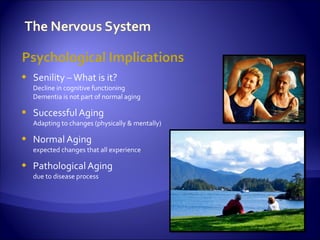
Psychological Implications
   Senility – What is it?
    Decline in cognitive functioning
    Dementia is not part of normal aging

   Successful Aging
    Adapting to changes (physically & mentally)

   Normal Aging
    expected changes that all experience

   Pathological Aging
    due to disease process
3 HUS 133   Physical Changes

3 HUS 133 Physical Changes

  • 1.
    Adulthood and Aging,6e John C. Cavanaugh Fredda Blanchard-Fields
  • 2.
    Learning Objectives  How do rate-of-living theories explain aging?  What are the major hypotheses in cellular theories of aging?  How do programmed cell death theories propose that we age?  How do the basic developmental forces interact in biological and physiological aging?
  • 3.
    Rate-of-Living Theories  Limited energy  Organisms have only so much energy to expend in a lifetime  Metabolic rate of certain animals seem to be correlated to their lifespan  Excess calories  Reduction in calorie intake increases lifespan  Okinawans consume 60% less; have 40 times more centenarians  Hormonal regulatory system adaptation to stress  Age which a mammal becomes mature is related to longevity Metabolism relates directly to longevity Saving your energy won’t directly result in living longer
  • 4.
    Cellular Theories  Limitednumber of times a cell can divide (Hayflick limit)  Cross-linking  Tissue becomes stiffer with age  Free radicals  Reactive chemicals causing cellular damage
  • 5.
    Programmed Cell DeathTheories  Aging programmed into genetic code?  Cells pre-programmed to self-destruct  Other genetic pathologies:  Osteoarthritis  Changes in the brain cells  Alzheimer’s  Memory loss  Personality changes
  • 6.
    Implications of theDevelopmental Forces  The biological, psychological, sociocultural, and lifecycle forces  Unified theory not yet developed  Three general approaches to slowing or reversing the aging process: 1. Delay the chronic illnesses of old age 2. Slow the fundamental processes of aging to increase life span 3. Arrest or reverse aging by removing the damage caused by the metabolic process
  • 7.
    Learning Objectives  How do our skin, hair, and voices change with age?  What happens to our body build with age?  What age-related changes occur in our ability to move around?
  • 8.
    Changes in Skin,Hair, and Voice  Changes in Skin  Why does our skin wrinkle?  Four-step process  Effects of sun exposure on skin  Sun exposure & smoking  How to counteract these effects?  Other skin changes  Pigment-containing cells decrease  Age spots, moles  Varicose veins
  • 9.
    Changes in theHair  Individual differences  Gender differences  Hair loss caused by destruction of germ centers that produce hair follicles  Graying caused by cessation of pigment production  Other hair changes  Males do not lose facial hair.  Females gain facial hair. (hormonal changes)
  • 10.
    Changes in theVoice  Differences in young and old voices  Lowering in pitch  Increased breathlessness and trembling  Slower and less pronounced pronunciation  Decreased volume  Normative changes or poor health?  What do you think?
  • 11.
    Changes in BodyBuild  Differences in the way bodies look over time  Decrease in height and fluctuations in weight  Between mid-50s and mid-70s men lose about 1 inch and women 2 inches  Compression of the spine  Changes in posture  Weight gain then loss  How different between men and women?
  • 12.
    Changes in Mobility  Muscles  Strength loss: age 70 – up to 20%; age 80 – up to 40%  No difference in the rate of muscle change between men and women  Bones  Loss begins in the late 30s, accelerates in the 50s, and slows in 70s  Gender differences  Osteoporosis: leading cause of broken bones in older women  Joints  Osteoarthritis  Rheumatoid arthritis
  • 14.
  • 15.
    Psychological Implications  Genderdifferences  Compensation  Cosmetics  Hair dyes  Plastic surgery  Appearance vs. actual losses in strength and endurance  Exercise and resistance training is useful up to age 90  Adaptive behaviors  Pain in the joints may reduce mobility  Rehabilitation after hip fractures
  • 16.
    Learning Objectives  What age-related changes happen in vision?  How does hearing change as people age?  What age-related changes occur in the sense of touch and balance?  What happens to taste and smell with increasing age?
  • 17.
    Vision  Structural changesin the eye  Adaptation – light and dark; change focus  Presbyopia  Cataracts – opaque spots on the lens  Glaucoma - high pressure in fluid around eye  Retinal Changes  Macular degeneration - progressive and irreversible destruction of receptors (loss of details)  Diabetic retinopathy - aging of the arteries - blindness
  • 18.
  • 19.
  • 20.
    Classroom Participation Measure 1.Take out a piece of paper 2. Put your name in the right top corner 3. Without talking answer the visual puzzle on the next slide 20 of 40
  • 21.
    Why old peoplehave vision problems . . .
  • 22.
    Psychological Effects ofVisual Changes  Reading  TV watching  Grocery labels; cooking instructions  Driving a car  Corrective actions  Glasses (Presbyopia)  Surgery (cataracts)  Corrective environmental changes  Brighter lights  Larger type
  • 23.
    Hearing  Damage dueto loud environment  Cumulative effects  Single incident damage  Presbycusis – reduced sensitivity to high pitched tones  Most common hearing problem  On increase among young adults  Social adjustment to hearing loss  Loss of independence, social isolation  Irritation, paranoia, depression  Emotional effects  Decreased quality of life  Corrective action (next slide)
  • 25.
    Atrophy The wasting away of a body part Decatur Daily Ad - Sept 5, 2010
  • 27.
    Somesthesia and Balance Loss of touch  Temperature regulation  Pain sensitivity  Kinesthesis  Where is your body?  Reduced quality of life
  • 28.
    “Weebles wobble, but they don’t fall Balance down!”  Vestibular system  Dizziness, lightheaded, vertigo  Longer time to integrate all sensory information  Fear of falling  Environmental hazards  Loose rugs  Slippery floors  Lighting  Hip protection  Tai-Chi  Enhance body awareness  Improve balance  Reduce falls
  • 29.
    Taste and Smell Too old to cut the mustard?  Taste dependent on smell  Safety factors  Personal hygiene  Memory differences between odors and other memory cues
  • 30.
    Learning Objectives  What age-related changes occur in the cardiovascular system? What types of cardiovascular disease are common in adult development and aging? Psychological effects?  What structural and functional changes occur with age in the respiratory system? What are the most common types of respiratory diseases in older adults? Psychological effects?
  • 31.
    Cardiovascular System  Underlyingcause of diminished capacity  Accumulation of fat deposits  Stiffening of the heart muscle  Decline in aerobic capacity  By age 65 - 60 to 70% decline  Get tired easily  Heart attaches while performing moderately exerting tasks  Want to decline less? Stay in shape during adulthood
  • 32.
    Cardiovascular Disease  Ethnicand gender differences—Why?  Congestive heart failure (most common hospitalization over 65)  Angina pectoris (decrease oxygen to the heart, causing pain)  Myocardial infarction (MI) (heart attack)  Atherosclerosis (build up of fat and calcium in artery walls)  Hypertension  Cerebrovascular accident (CVA) (stroke)
  • 34.
    Respiratory System  RespiratoryDiseases  Chronic obstructive pulmonary disease (COPD)  Damage is irreversible  Emphysema  82% self-induced by smoking  Chronic bronchitis  More common with people over 45  Dust, irritating fumes, air pollution
  • 35.
    Learning Objectives  What reproductive changes occur in women?  What reproductive changes occur in men?  What are the psychological effects of reproductive changes?
  • 36.
    Female Reproductive System  Genital organ change begins in the 40s  Transition – perimenopause  Changes in reproductive organs and sexual functioning  Menopause  Ethnic differences in the severity of symptoms  Progressive change after menopause  Hormone Replacement Therapy (HRT)  No physiological reason why most women cannot continue sexual activity into old age.
  • 37.
    Male Reproductive System  Unlike menopause, no event to mark changes  Decline in testosterone levels  Decrease in sperm production (30% between 30 and 60)  Prostate cancer a real threat  Impotence: normally treatable with drugs  Erectile Dysfunction: treatable with Viagra, Cialis, and Levitra  Psychological Implications  For healthy adults males, sexual activity is lifelong option.  Stereotyping has important consequences.
  • 38.
    Learning Objectives  How do we measure changes in the brain?  What major changes occur in neurons? How do neurons’ ability to communicate with each other change with age? What are the psychological effects of changes in the brain?  What major changes occur in the autonomic nervous system?
  • 39.
    Studying Brain-Behavior Relations: ImagingTechniques  Computed Tomography – CT  Magnetic Resonance Imaging – MRI  Positron Emission Tomography – PET PET Scan
  • 41.
    Neurons (individual cells)  Dendrites – carry message towards cell  Cell body  Axon – carry message away from cell  Terminal branches  Neurotransmitters  Synapse 5 Min 41 of 40
  • 43.
    Structural Changes inNeurons  Plasticity (capability of brain to adapt its function and structure)  Neurofibrillary Tangles (fibers of the axon become tangled)  Amyloid Plaques (damaged & dying neurons around a core of protein)  Both considered characteristics of Alzheimer’s disease Changes in communication between neurons  Parkinson’s disease  Tremors  Rigidity  Difficulty keeping balance  Shuffling walking style
  • 44.
    Autonomic Nervous System  Regulating Body Temperature  Elderly susceptible to hypothermia  Don’t notice they are cold  Less ability to raise body temperature  Sleep and Aging  Less sleep  Day napping  Moody, poorer function, fatigue, decrease motivation & concentration
  • 45.
    Psychological Implications  Senility – What is it? Decline in cognitive functioning Dementia is not part of normal aging  Successful Aging Adapting to changes (physically & mentally)  Normal Aging expected changes that all experience  Pathological Aging due to disease process

Editor's Notes

  • #14 Figure 3.1 Bone changes in osteoporosis
  • #15 Figure 3.3 Rheumatoid and osteoarthritis changes
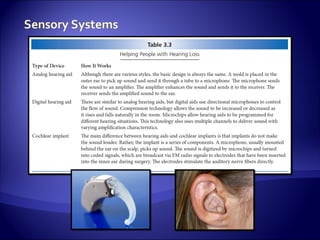
  • #25 Table 3.3 Helping people with hearing loss
  • #27 Figure 3.4 Gender differences in hearing loss
  • #34 Figure 3.5 The Heart: Young and Old
  • #41 Table 3.5 Brain-Imaging Techniques
  • #43 Figure3.6 Diagram of a typical neuron